Balkinization
an unanticipated consequence of
Jack M. Balkin
Balkinization Symposiums: A Continuing List
E-mail:
Jack Balkin:
jackbalkin at yahoo.com
Bruce Ackerman
bruce.ackerman at yale.edu
Ian Ayres
ian.ayres at yale.edu
Corey Brettschneider
corey_brettschneider at brown.edu
Mary Dudziak
mary.l.dudziak at emory.edu
Joey Fishkin
joey.fishkin at gmail.com
Heather Gerken heather.gerken at yale.edu
Abbe Gluck abbe.gluck at yale.edu
Mark Graber
mgraber at law.umaryland.edu
Stephen Griffin
sgriffin at tulane.edu
Jonathan Hafetz
jonathan.hafetz at shu.edu
Jeremy Kessler
jkessler at law.columbia.edu
Andrew Koppelman
akoppelman at law.northwestern.edu
Marty Lederman
msl46 at law.georgetown.edu
Sanford Levinson
slevinson at law.utexas.edu
David Luban
david.luban at gmail.com
Gerard Magliocca
gmaglioc at iupui.edu
Jason Mazzone
mazzonej at illinois.edu
Linda McClain
lmcclain at bu.edu
John Mikhail
mikhail at law.georgetown.edu
Frank Pasquale
pasquale.frank at gmail.com
Nate Persily
npersily at gmail.com
Michael Stokes Paulsen
michaelstokespaulsen at gmail.com
Deborah Pearlstein
dpearlst at yu.edu
Rick Pildes
rick.pildes at nyu.edu
David Pozen
dpozen at law.columbia.edu
Richard Primus
raprimus at umich.edu
K. Sabeel Rahmansabeel.rahman at brooklaw.edu
Alice Ristroph
alice.ristroph at shu.edu
Neil Siegel
siegel at law.duke.edu
David Super
david.super at law.georgetown.edu
Brian Tamanaha
btamanaha at wulaw.wustl.edu
Nelson Tebbe
nelson.tebbe at brooklaw.edu
Mark Tushnet
mtushnet at law.harvard.edu
Adam Winkler
winkler at ucla.edu
Compendium of posts on Hobby Lobby and related cases
The Anti-Torture Memos: Balkinization Posts on Torture, Interrogation, Detention, War Powers, and OLC
The Anti-Torture Memos (arranged by topic)
Recent Posts
Straining (Analogies) to Make Sense of the First Amendment in Cyberspace
Where Are The Fourteenth Amendment Commemorations?
Symposium: Civic Education in a Time of Upheaval
What's the Deal?
We the People, or We the Voters?
A Constitutional Role Morality for Presidents and Members of Congress
The Hearings Congress Should Hold After the Nunes Memo’s Release
![[Powered by Blogger]](https://lh3.googleusercontent.com/blogger_img_proxy/AEn0k_vd4xwXvbdtzACoCNs2PyP79UsgZmL58Z92fAgWpKT8YPDFV19oYCgCgupauMPKs33x2B3qeFgG7dMMbOG1N-G21gz4qcsJwTmXB9tj2rWd=s0-d)
Just A Few Blogs
ACS Blog
Alas, a Blog
Althouse
Arts and Letters Daily
Atrios (Eschaton)
Bill of Health
Buzzflash.com
Buzz Machine
Cato at Liberty
Juan Cole (Informed Comment)
Concurring Opinions
The Constitution in 2020
Corrente
Crooked Timber
Daily Howler
Daily Kos
Dana Boyd
Brad DeLong
Digby (Hullabaloo)
Discriminations
Daniel Drezner
Kevin Drum (Mother Jones)
Electrolite
En Banc
Eunomia (Daniel Larison)
Fafblog
Michael Froomkin (Discourse.net)
GovLab (Beth Noveck)
Rick Hasen (Election Law)
History News Network
How Appealing
Ignatz (Sam Heldman)
The Importance of (Ernie Miller)
Infolaw
Instapundit
International Economic Law and Policy Blog
IntLawGrrls
Jacob Levy
Jesus' General
Jurisdynamics
The Kitchen Cabinet
Mark Kleiman
Law Blog Central
Larry Lessig
Lawyers, Guns and Money
Liberal Oasis
Brian Leiter's Law School Reports
The Leiter Reports
Marginal Revolution
Megan McArdle
Memeorandum
Metafilter
Mirror of Justice
The New Republic
Newseum
No More Mister Nice Blog
Brendan Nyhan
Opinio Juris
Orcinus
The Originalism Blog
Pandagon
Passport (Foreign Policy)
Overcoming Bias
Political Animal (Washington Monthly)
Political Theory Daily Review
Political Wire (Taegan Goddard)
The Poor Man
Virginia Postrel
Prawfsblawg
Public Reason
Jonathan Rauch
Raw Story
Redstate
ReligiousLeftLaw.com
Reporters Committee For Freedom of the Press
Reproductive Rights Blog
Rothman's Roadmap to the Right of Publicity
SCOTUS Blog
Seeing the Forest
Clay Shirky
The Shifted Librarian
The Situationist
Larry Solum (Legal Theory)
Andrew Sullivan
Talking Points Memo
Talk Left
Tapped
Tbogg
TechPresident
The Paper Chase (Jurist)
Tom Paine
Tom Tomorrow (This Modern World)
Eve Tushnet
Uggabugga
University of Chicago Law School Faculty Blog
Unqualified Offerings
The Volokh Conspiracy
War and Piece (Laura Rozen)
Wampum
Oliver Willis
Wonkette
Written Description
Matthew Yglesias
Yin
Your Choice of Feeds
1. XML
powered by

2. Atom Feed
3. RSS 2.0
Straining (Analogies) to Make Sense of the First Amendment in Cyberspace
David Pozen
Posted
2:13 PM
by David Pozen [link]
Where Are The Fourteenth Amendment Commemorations?
Gerard N. Magliocca
A centerpiece of my new book is the first Bill of Rights Day, which marked the 150th anniversary of the ratification of the first ten amendments. It was a major national festival, including parades, public readings, a special prime-time radio show, and an address by the President.
This year we will celebrate the 150th anniversary of the ratification of the Fourteenth Amendment. What is being done to mark that momentous occasion? Not much. There is an academic conference here and there, and some civic-minded organizations are organizing events. But there will be, as far as I know, no public recognition of this anniversary. It's shameful, but not surprising.
Not long ago a student of mine discovered an interesting fact. Aside from a paper written when he was in middle school, Martin Luther King Jr. almost never mentioned the Fourteenth Amendment in his speeches or writings. The "I Have a Dream" speech refers to many American landmarks, but not to the Fourteenth Amendment. In King's era, of course, the Fourteenth Amendment was still tainted by the slander that Reconstruction Republicans were interested only in punishing the South. Today that Jim Crow history is history. Still, the Fourteenth Amendment is not getting its due.
Posted
4:04 PM
by Gerard N. Magliocca [link]
(17) comments
Symposium: Civic Education in a Time of Upheaval
Sandy Levinson
That is the title of a symposium co-organized by myself and Meira Levinson, a professor at the Harvard Graduate School of Education, that will take place at the University of Texas Law School this coming Friday and Saturday. Friday, February 16 It will begin on Friday morning with a "summit conference" of a number of editors of leading constitutional law casebooks, The afternoon will begin a series of panels primarily organized by Meira that focuses more explicitly on the problems presented by trying to create given classroom narratives in significantly divided societies. There is no charge for attending and lunch will be served on Friday and Saturday to those in attendance. Public school teachers can get continuing education credit (though the Texas Bar Association.) All of the programs will be videoed and available, in relatively short order, online. The focus of the gathering is not the presentation of traditional academic papers, but, rather, intense discussion among a variety of extremely accomplished people who have written about and dealt with the issues presented.
You might also note that Saturday morning will include a session specifically on the book coathored by Cynthia and Sanford Levinson, Fault Lines in the Constitution. The entire schedule is as follows:
8:30 – 9:00 Welcome by Dean Farnsworth and Setting the Stage by Sanford Levinson
9:00 – 12:15 On "Introducing" Constitutional Law--and the Casebooks We Use to Do That. A host of editors of leading casebooks on the US Constitution will address two central questions: 1. What aspects of the Constitution should American undergraduates and/or law students be “introduced” to in 2018, given the high unlikelihood that even the law students will actually "practice" constitutional law in any capacity other than citizens? 2. What do you see as the principal point(s) of your own casebook relative to whatever answer you gave to the first question?
Each person will make a short presentation, followed by presumably intense conversation including participation by the audience. There will be a brief break around 10:30
Panelists: Josh Blackman, Erwin Chemerinsky, Richard Fallon, Mark Graber, Gary Jacobsohn, Sanford Levinson, Mark Tushnet Present by video: Sam Bray, Noah Feldman
Chair: Richard Albert
Location: Sheffield-Massey Room, with overflow in TNH 2.138
1:45-2:00 Introduction to the general topic of civic education (and the remaining panels): Meira Levinson
2:00 – 3:30 Historical Perspectives. As educators and citizens try to make sense of contemporary political and ideological divisions in the United States, it can be useful to see how educators and policy makers addressed profound division and civic upheaval in the past. This panel brings together historians of education to provide perspectives and insights into prior approaches to civic education in times of upheaval.
Panelists: Jarvis Givens, Julie Reuben, Jonathan Zimmerman
Chair: Lorraine Pangle
Location: Sheffield-Massey Room, with overflow in Francis Auditorium
3:50 – 5:35 Civic Education in Divided Societies. Partisanship in the United States is at higher levels than we’ve seen in decades, and increasingly tracks other divides such as education level, income, and place of residence. Not only are we more extreme in our beliefs, therefore, but we are also more likely to be disconnected from those who have different perspectives. We are not the only country to face profound civic division, however; nor is this the first time that the United States finds itself ideologically driven. This panel brings together scholars and educators who work around the globe in deeply divided countries.
Panelists: Michelle Bellino, Thea Abu El-Haj, Michael Karayanni, Adam Strom
Chair: Michael Stoff
Location: Sheffield-Massey Room, with overflow in Francis Auditorium
Saturday, February 17
9:00 – 10:30 Teaching Civic Contestation in Schools. How can and should educators teach controversial issues in schools? This is a perennial question, but one that has heightened salience in these unsettled times. What principles and practices should guide educators’ choices about what to include in the curriculum, and what to leave out as either “too hot to handle” or inappropriate to be treated as something open to debate? How have educators tried to protect themselves or their students when investigating contested topics, and what happens when things go wrong?
Panelists: Curtis Acosta, Dafney Blanca Dabach, Diana Hess
Chair: Randall Kennedy
Location: Eidman Courtroom
10:45 – 12:15 Fault Lines in the Constitution. To the extent that the Constitution is taught in middle schools and high schools today, focus is generally placed on two areas: (1) the genius of the Framers in creating a government of divided and balanced powers, and (2) the perfection of the rights accorded to citizens, particularly those embedded in the Bill of Rights. Such anodyne and uncritical approaches to our founding document, however, diminish students' civic capacities. As the panelists will explain, celebratory approaches to teaching the Constitution are both inadequate and inaccurate. Cynthia Levinson and Sanford Levinson, authors of Fault Lines in the Constitution: The Framers, Their Fights, and the Flaws that Affect Us Today, a book for young readers, explain an alternative perspective on the Constitution, focusing on the ways that the structures of our government contribute to dysfunctionalities in American political life. In addition, an educator will provide insights into ways to make civics education more complex and comprehensive.
Panelists: Cynthia Levinson, Sanford Levinson, Aaron Hull, Katherina Payne
Moderator: Meira Levinson
Location: Eidman Courtroom
1:30 – 3:00 Schools as Civic Actors. Civic education is traditionally thought of as a subject (like math or science), a set of pedagogies (such as in-class discussion or action civics), or extracurricular learning opportunities (such as student government or debate). But schools also educate civically by modeling civic values and engagement themselves as civic actors. This can prove challenging when teachers, administrators, students, and parents are divided about what their obligations should be. Should schools create “sanctuary campuses” intended to disrupt the school-to-deportation pipeline? How should they respond when students stage school walkouts over civic and political issues, or when students who merely repeat politicians’ statements run afoul of anti-bullying laws? This session will immerse participants in case study discussions about how educators and policy makers are addressing schools’ responsibilities as civic actors in times of upheaval.
Case leaders: Meira Levinson, Jacob Fay
Location: Eidman Courtroom
3:00 Summary comments and farewells: Sandy Levinson, Meira Levinson
Location: Eidman Courtroom
RSVP Here: https://goo.gl/forms/WDIX1DNo11XwqVD93
Note: Teachers can get Continuing Education credit through the State Bar of Texas.
Posted
6:46 PM
by Sandy Levinson [link]
What's the Deal?
David Super
Posted
8:35 AM
by David Super [link]
We the People, or We the Voters?
Joseph Fishkin
Our Constitution, as amended, requires that every ten years the federal government reallocate seats in the House of Representatives to the states “according to their respective numbers, counting the whole number of persons.” This provision leaves little room for interpretation. It is part of what my colleague Sandy Levinson calls the “constitution of settlement.” But like much of the constitution of settlement, this provision settles certain questions while leaving other closely proximate ones unsettled. The settled part is this: We do not apportion representatives to states on the basis of how many citizens, voting age citizens, eligible voters, or registered voters the state may have. Instead we use total population. Under our Constitution, for purposes of congressional apportionment, we count children, non-citizens, disenfranchised felons, and all other non-voters. If you are living in a U.S. state, and you are a person rather than a tree, you count.
This makes a huge difference. These days, the total population rule in the Constitution moves power within Congress in a distinctly Southwesterly direction, compared to where it would be if we didn’t count all those children and non-citizens. According to my back of the envelope calculations, if we apportioned House seats by citizen voting age population (CVAP), my state of Texas would immediately lose four seats. California would lose five. Those seats would go instead to states with higher CVAP-to-total-population ratios, which is another way of saying states with fewer children and fewer immigrants—states like Pennsylvania and Montana.* This will not happen. Congressional apportionment by CVAP is a nativist pipe dream, unambiguously unconstitutional.
That much is settled. But, the constitutional rule does not by its express terms settle anything else. As a matter of political practice, and in the shadow of the constitutional rule, all U.S. states sensibly use total population, as well, for drawing congressional district lines within states—and also for their own state and local iterations of apportionment and redistricting. But conservative policy entrepreneurs have begun to challenge this practice, beginning at the state and local level. Ed Blum, the great conservative impact-litigation impresario, brought the case of Evenwel v. Abbott to the Supreme Court in 2016, challenging Texas’ use of total population for state legislative districting. He lost, but in a way that did not entirely resolve the question of what would happen if he had a state or local government on his side. The next logical move will be for some jurisdiction, in 2021, to attempt to use CVAP or some other less-than-total-population measure for apportionment, drawing districts with different numbers of people, but equal numbers of “voters.”**
The argument for counting voters instead of people gains its political salience from the increasing centrality of immigration to both Republican and Democratic party politics—and the increasingly clear sense that areas with lots of children and lots if immigrants support Democrats while older areas with fewer immigrants support Republicans. But the argument gains its conceptual and legal plausibility from a different place: the strangely undertheorized nature of virtual representation—the representation of non-voters—in modern conceptions of democracy. Or so I argue in a new essay just posted to ssrn on “Taking Virtual Representation Seriously”; I’ll say a little more about this point after the jump.
Meanwhile, consider a seemingly separate set of current controversies with common political roots. Census population figures do not come out of the sky; it is Congress, and political appointees in the executive branch, who ultimately determine how we conduct the count. What if the federal government redesigned its Census in a way deliberately calculated to skew the population numbers by increasing the already-substantial undercount of non-citizens? Would there be any legal or constitutional recourse? As I write this, there is growing controversy about the Trump administration’s proposal to add a question to the Census asking whether you are a U.S. citizen. The controversy has focused (rightly) on the question of whether adding this question will further increase the undercounting of immigrant communities, with potentially far-reaching consequences.
What has gotten much less attention is the fact that this Census question gambit is also a move in the Evenwel chess game. It is an effort to change the Census itself in a way that aims to lay the groundwork, in terms of data, on which some bold jurisdiction will likely make its bid in 2021 to stop worrying about counting all the people, for purposes of representation, and instead count only the ones who can vote. There are good reasons to believe this denies non-voters the equal protection of the laws. But to see why that could be the case requires giving some thought to the role of virtual representation in our democratic system. More after the jump.
Read more »
Posted
11:37 PM
by Joseph Fishkin [link]
A Constitutional Role Morality for Presidents and Members of Congress
Neil Siegel
In the contemporary United States, the conduct of members of the political branches is generally regarded as more damaging to the American constitutional system than is the behavior of the federal courts. Yet constitutional law scholarship continues to do what it has done since at least the mid-twentieth century. It continues to focus primarily on judges and judging.
In a new article, I suggest that constitutional law scholarship should develop for presidents and members of Congress what it has long advanced for judges: a role morality that imposes normative limits on the exercise of official discretion over and above strictly legal limits. The article first grounds a role morality for elected officials of the federal government in two purposes of the U.S. Constitution whose vindication requires more than compliance with legal rules: (1) securing the American conception of democracy as collective self-governance, and (2) creating a reasonably well-functioning federal government. Given its close connection to those purposes, a role morality for presidents and members of Congress is appropriately described as constitutional, not merely political.
The article then tentatively proposes some rhetorical, procedural, and substantive components of constitutional role morality. They include a commitment to consult the political opposition before taking important actions and a rebuttable presumption in favor of moderation and compromise. The article also explains how different actors in the American constitutional system should execute their professional responsibilities if they are to make it more, rather than less, likely that such a role morality will eventually be adopted and maintained.
A final part anticipates objections, including the obvious one that the vision advanced in the article faces significant implementation problems.
Posted
7:39 PM
by Neil Siegel [link]
The Hearings Congress Should Hold After the Nunes Memo’s Release
Deborah Pearlstein
Posted
4:10 PM
by Deborah Pearlstein [link]
Books by Balkinization Bloggers

Gerard N. Magliocca, The Actual Art of Governing: Justice Robert H. Jackson's Concurring Opinion in the Steel Seizure Case (Oxford University Press, 2025)

Linda C. McClain and Aziza Ahmed, The Routledge Companion to Gender and COVID-19 (Routledge, 2024)

David Pozen, The Constitution of the War on Drugs (Oxford University Press, 2024)

Jack M. Balkin, Memory and Authority: The Uses of History in Constitutional Interpretation (Yale University Press, 2024)
Mark A. Graber, Punish Treason, Reward Loyalty: The Forgotten Goals of Constitutional Reform after the Civil War (University of Kansas Press, 2023)
Jack M. Balkin, What Roe v. Wade Should Have Said: The Nation's Top Legal Experts Rewrite America's Most Controversial Decision - Revised Edition (NYU Press, 2023)

Andrew Koppelman, Burning Down the House: How Libertarian Philosophy Was Corrupted by Delusion and Greed (St. Martin’s Press, 2022)

Gerard N. Magliocca, Washington's Heir: The Life of Justice Bushrod Washington (Oxford University Press, 2022)
Joseph Fishkin and William E. Forbath, The Anti-Oligarchy Constitution: Reconstructing the Economic Foundations of American Democracy (Harvard University Press, 2022)
Mark Tushnet and Bojan Bugaric, Power to the People: Constitutionalism in the Age of Populism (Oxford University Press 2021).

Mark Philip Bradley and Mary L. Dudziak, eds., Making the Forever War: Marilyn B. Young on the Culture and Politics of American Militarism Culture and Politics in the Cold War and Beyond (University of Massachusetts Press, 2021).

Jack M. Balkin, What Obergefell v. Hodges Should Have Said: The Nation's Top Legal Experts Rewrite America's Same-Sex Marriage Decision (Yale University Press, 2020)

Frank Pasquale, New Laws of Robotics: Defending Human Expertise in the Age of AI (Belknap Press, 2020)

Jack M. Balkin, The Cycles of Constitutional Time (Oxford University Press, 2020)

Mark Tushnet, Taking Back the Constitution: Activist Judges and the Next Age of American Law (Yale University Press 2020).

Andrew Koppelman, Gay Rights vs. Religious Liberty?: The Unnecessary Conflict (Oxford University Press, 2020)

Ezekiel J Emanuel and Abbe R. Gluck, The Trillion Dollar Revolution: How the Affordable Care Act Transformed Politics, Law, and Health Care in America (PublicAffairs, 2020)

Linda C. McClain, Who's the Bigot?: Learning from Conflicts over Marriage and Civil Rights Law (Oxford University Press, 2020)
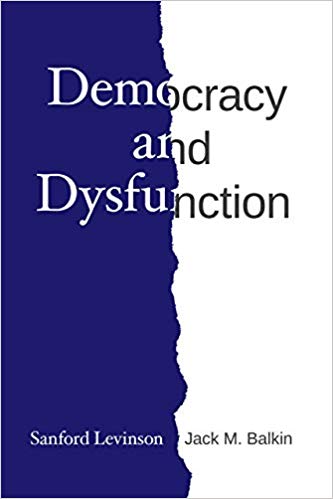
Sanford Levinson and Jack M. Balkin, Democracy and Dysfunction (University of Chicago Press, 2019)

Sanford Levinson, Written in Stone: Public Monuments in Changing Societies (Duke University Press 2018)

Mark A. Graber, Sanford Levinson, and Mark Tushnet, eds., Constitutional Democracy in Crisis? (Oxford University Press 2018)

Gerard Magliocca, The Heart of the Constitution: How the Bill of Rights became the Bill of Rights (Oxford University Press, 2018)

Cynthia Levinson and Sanford Levinson, Fault Lines in the Constitution: The Framers, Their Fights, and the Flaws that Affect Us Today (Peachtree Publishers, 2017)

Brian Z. Tamanaha, A Realistic Theory of Law (Cambridge University Press 2017)

Sanford Levinson, Nullification and Secession in Modern Constitutional Thought (University Press of Kansas 2016)

Sanford Levinson, An Argument Open to All: Reading The Federalist in the 21st Century (Yale University Press 2015)

Stephen M. Griffin, Broken Trust: Dysfunctional Government and Constitutional Reform (University Press of Kansas, 2015)

Frank Pasquale, The Black Box Society: The Secret Algorithms That Control Money and Information (Harvard University Press, 2015)

Bruce Ackerman, We the People, Volume 3: The Civil Rights Revolution (Harvard University Press, 2014)
Balkinization Symposium on We the People, Volume 3: The Civil Rights Revolution

Joseph Fishkin, Bottlenecks: A New Theory of Equal Opportunity (Oxford University Press, 2014)

Mark A. Graber, A New Introduction to American Constitutionalism (Oxford University Press, 2013)

John Mikhail, Elements of Moral Cognition: Rawls' Linguistic Analogy and the Cognitive Science of Moral and Legal Judgment (Cambridge University Press, 2013)

Gerard N. Magliocca, American Founding Son: John Bingham and the Invention of the Fourteenth Amendment (New York University Press, 2013)

Stephen M. Griffin, Long Wars and the Constitution (Harvard University Press, 2013)

Andrew Koppelman, The Tough Luck Constitution and the Assault on Health Care Reform (Oxford University Press, 2013)

James E. Fleming and Linda C. McClain, Ordered Liberty: Rights, Responsibilities, and Virtues (Harvard University Press, 2013)
Balkinization Symposium on Ordered Liberty: Rights, Responsibilities, and Virtues

Andrew Koppelman, Defending American Religious Neutrality (Harvard University Press, 2013)

Brian Z. Tamanaha, Failing Law Schools (University of Chicago Press, 2012)

Sanford Levinson, Framed: America's 51 Constitutions and the Crisis of Governance (Oxford University Press, 2012)

Linda C. McClain and Joanna L. Grossman, Gender Equality: Dimensions of Women's Equal Citizenship (Cambridge University Press, 2012)

Mary Dudziak, War Time: An Idea, Its History, Its Consequences (Oxford University Press, 2012)

Jack M. Balkin, Living Originalism (Harvard University Press, 2011)

Jason Mazzone, Copyfraud and Other Abuses of Intellectual Property Law (Stanford University Press, 2011)

Richard W. Garnett and Andrew Koppelman, First Amendment Stories, (Foundation Press 2011)

Jack M. Balkin, Constitutional Redemption: Political Faith in an Unjust World (Harvard University Press, 2011)

Gerard Magliocca, The Tragedy of William Jennings Bryan: Constitutional Law and the Politics of Backlash (Yale University Press, 2011)

Bernard Harcourt, The Illusion of Free Markets: Punishment and the Myth of Natural Order (Harvard University Press, 2010)

Bruce Ackerman, The Decline and Fall of the American Republic (Harvard University Press, 2010)
Balkinization Symposium on The Decline and Fall of the American Republic

Ian Ayres. Carrots and Sticks: Unlock the Power of Incentives to Get Things Done (Bantam Books, 2010)

Mark Tushnet, Why the Constitution Matters (Yale University Press 2010)

Ian Ayres and Barry Nalebuff: Lifecycle Investing: A New, Safe, and Audacious Way to Improve the Performance of Your Retirement Portfolio (Basic Books, 2010)
.jpg)
Jack M. Balkin, The Laws of Change: I Ching and the Philosophy of Life (2d Edition, Sybil Creek Press 2009)

Brian Z. Tamanaha, Beyond the Formalist-Realist Divide: The Role of Politics in Judging (Princeton University Press 2009)
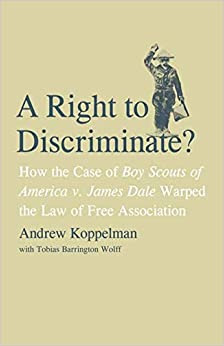
Andrew Koppelman and Tobias Barrington Wolff, A Right to Discriminate?: How the Case of Boy Scouts of America v. James Dale Warped the Law of Free Association (Yale University Press 2009)

Jack M. Balkin and Reva B. Siegel, The Constitution in 2020 (Oxford University Press 2009)

Heather K. Gerken, The Democracy Index: Why Our Election System Is Failing and How to Fix It (Princeton University Press 2009)

Mary Dudziak, Exporting American Dreams: Thurgood Marshall's African Journey (Oxford University Press 2008)

David Luban, Legal Ethics and Human Dignity (Cambridge Univ. Press 2007)

Ian Ayres, Super Crunchers: Why Thinking-By-Numbers is the New Way to be Smart (Bantam 2007)

Jack M. Balkin, James Grimmelmann, Eddan Katz, Nimrod Kozlovski, Shlomit Wagman and Tal Zarsky, eds., Cybercrime: Digital Cops in a Networked Environment (N.Y.U. Press 2007)
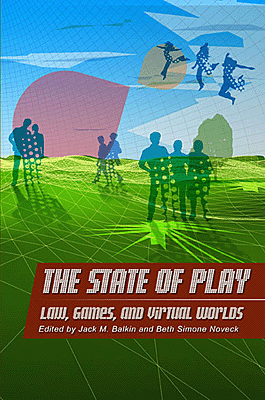
Jack M. Balkin and Beth Simone Noveck, The State of Play: Law, Games, and Virtual Worlds (N.Y.U. Press 2006)

Andrew Koppelman, Same Sex, Different States: When Same-Sex Marriages Cross State Lines (Yale University Press 2006)

Brian Tamanaha, Law as a Means to an End (Cambridge University Press 2006)

Sanford Levinson, Our Undemocratic Constitution (Oxford University Press 2006)

Mark Graber, Dred Scott and the Problem of Constitutional Evil (Cambridge University Press 2006)

Jack M. Balkin, ed., What Roe v. Wade Should Have Said (N.Y.U. Press 2005)

Sanford Levinson, ed., Torture: A Collection (Oxford University Press 2004)
Balkin.com homepage
Bibliography
Conlaw.net
Cultural Software
Writings
Opeds
The Information Society Project
BrownvBoard.com
Useful Links
Syllabi and Exams
