Balkinization
an unanticipated consequence of
Jack M. Balkin
Balkinization Symposiums: A Continuing List
E-mail:
Jack Balkin:
jackbalkin at yahoo.com
Bruce Ackerman
bruce.ackerman at yale.edu
Ian Ayres
ian.ayres at yale.edu
Corey Brettschneider
corey_brettschneider at brown.edu
Mary Dudziak
mary.l.dudziak at emory.edu
Joey Fishkin
joey.fishkin at gmail.com
Heather Gerken heather.gerken at yale.edu
Abbe Gluck abbe.gluck at yale.edu
Mark Graber
mgraber at law.umaryland.edu
Stephen Griffin
sgriffin at tulane.edu
Jonathan Hafetz
jonathan.hafetz at shu.edu
Jeremy Kessler
jkessler at law.columbia.edu
Andrew Koppelman
akoppelman at law.northwestern.edu
Marty Lederman
msl46 at law.georgetown.edu
Sanford Levinson
slevinson at law.utexas.edu
David Luban
david.luban at gmail.com
Gerard Magliocca
gmaglioc at iupui.edu
Jason Mazzone
mazzonej at illinois.edu
Linda McClain
lmcclain at bu.edu
John Mikhail
mikhail at law.georgetown.edu
Frank Pasquale
pasquale.frank at gmail.com
Nate Persily
npersily at gmail.com
Michael Stokes Paulsen
michaelstokespaulsen at gmail.com
Deborah Pearlstein
dpearlst at yu.edu
Rick Pildes
rick.pildes at nyu.edu
David Pozen
dpozen at law.columbia.edu
Richard Primus
raprimus at umich.edu
K. Sabeel Rahmansabeel.rahman at brooklaw.edu
Alice Ristroph
alice.ristroph at shu.edu
Neil Siegel
siegel at law.duke.edu
David Super
david.super at law.georgetown.edu
Brian Tamanaha
btamanaha at wulaw.wustl.edu
Nelson Tebbe
nelson.tebbe at brooklaw.edu
Mark Tushnet
mtushnet at law.harvard.edu
Adam Winkler
winkler at ucla.edu
Compendium of posts on Hobby Lobby and related cases
The Anti-Torture Memos: Balkinization Posts on Torture, Interrogation, Detention, War Powers, and OLC
The Anti-Torture Memos (arranged by topic)
Recent Posts
Conference on Constitutional History: Comparative Perspectives
Four Star Nonsense
The "best and the brightest" revisited
What the New Congressional Budget Resolution Means
Corrupting the National Book Award?
Good Practices at Law Reviews
The Fixed Term Convention
Trump's ACA Sabotage and the President's Constitutional Duty to Take Care that the Laws be Faithfully Executed
Voting With Their Feet
Anti-Contrarianism
Not King Tut's Tomb, But . . .
A Primer on the DACA Rescission
Our correction and apology to Professor Tillman
The Authority of the Court
Getting the 25th Amendment on the Record
![[Powered by Blogger]](https://lh3.googleusercontent.com/blogger_img_proxy/AEn0k_sAuS_8AqisMPMXezwcZqwJMpqJe9pufgyNFt8b-FKU_ap70Mqb00KeQJJLoQcFaBu3dWEX4aMdDIvssHYz6xQFO0oZFM8e2mG-SfJ7sFUH=s0-d)
Just A Few Blogs
ACS Blog
Alas, a Blog
Althouse
Arts and Letters Daily
Atrios (Eschaton)
Bill of Health
Buzzflash.com
Buzz Machine
Cato at Liberty
Juan Cole (Informed Comment)
Concurring Opinions
The Constitution in 2020
Corrente
Crooked Timber
Daily Howler
Daily Kos
Dana Boyd
Brad DeLong
Digby (Hullabaloo)
Discriminations
Daniel Drezner
Kevin Drum (Mother Jones)
Electrolite
En Banc
Eunomia (Daniel Larison)
Fafblog
Michael Froomkin (Discourse.net)
GovLab (Beth Noveck)
Rick Hasen (Election Law)
History News Network
How Appealing
Ignatz (Sam Heldman)
The Importance of (Ernie Miller)
Infolaw
Instapundit
International Economic Law and Policy Blog
IntLawGrrls
Jacob Levy
Jesus' General
Jurisdynamics
The Kitchen Cabinet
Mark Kleiman
Law Blog Central
Larry Lessig
Lawyers, Guns and Money
Liberal Oasis
Brian Leiter's Law School Reports
The Leiter Reports
Marginal Revolution
Megan McArdle
Memeorandum
Metafilter
Mirror of Justice
The New Republic
Newseum
No More Mister Nice Blog
Brendan Nyhan
Opinio Juris
Orcinus
The Originalism Blog
Pandagon
Passport (Foreign Policy)
Overcoming Bias
Political Animal (Washington Monthly)
Political Theory Daily Review
Political Wire (Taegan Goddard)
The Poor Man
Virginia Postrel
Prawfsblawg
Public Reason
Jonathan Rauch
Raw Story
Redstate
ReligiousLeftLaw.com
Reporters Committee For Freedom of the Press
Reproductive Rights Blog
Rothman's Roadmap to the Right of Publicity
SCOTUS Blog
Seeing the Forest
Clay Shirky
The Shifted Librarian
The Situationist
Larry Solum (Legal Theory)
Andrew Sullivan
Talking Points Memo
Talk Left
Tapped
Tbogg
TechPresident
The Paper Chase (Jurist)
Tom Paine
Tom Tomorrow (This Modern World)
Eve Tushnet
Uggabugga
University of Chicago Law School Faculty Blog
Unqualified Offerings
The Volokh Conspiracy
War and Piece (Laura Rozen)
Wampum
Oliver Willis
Wonkette
Written Description
Matthew Yglesias
Yin
Your Choice of Feeds
1. XML
powered by

2. Atom Feed
3. RSS 2.0
Tuesday, October 31, 2017
Conference on Constitutional History: Comparative Perspectives
Jason Mazzone
The annual Illinois-Bologna Conference on Constitutional History: Comparative Perspectives will be held on November 13 & 14, 2017 in Bologna, Italy. Program details are available at this link. We do have space available for audience members; if you are interested in attending, please contact me at mazzonej [@] illinois.edu. Papers from the 2016 conference, held in Chicago, were published in the Illinois Law Review and are available online.
Posted
1:22 PM
by Jason Mazzone [link]
Four Star Nonsense
Gerard N. Magliocca
The notion, as the White House Chief of Staff said last night, that Robert E. Lee was "an honorable man" is junk history, as I've posted about before. The General also, though, offered the half-baked idea that the Civil War was caused by a failure to compromise. If he ever bothers to walk down the street to the Lincoln Memorial, he will see emblazoned on its walls the answer to that claim:
The Almighty has His own purposes. 'Woe unto the world because of offenses; for it must needs be that offenses come, but woe to that man by whom the offense cometh.' If we shall suppose that American slavery is one of those offenses which, in the providence of God, must needs come, but which, having continued through His appointed time, He now wills to remove, and that He gives to both North and South this terrible war as the woe due to those by whom the offense came, shall we discern therein any departure from those divine attributes which the believers in a living God always ascribe to Him? Fondly do we hope, fervently do we pray, that this mighty scourge of war may speedily pass away. Yet, if God wills that it continue until all the wealth piled by the bondsman's two hundred and fifty years of unrequited toil shall be sunk, and until every drop of blood drawn with the lash shall be paid by another drawn with the sword, as was said three thousand years ago, so still it must be said 'the judgments of the Lord are true and righteous altogether.'
Posted
10:17 AM
by Gerard N. Magliocca [link]
(112) comments
Saturday, October 28, 2017
The "best and the brightest" revisited
Sandy Levinson
In the spate of stories about the new material on the JFK assassination, I could not help but notice the following in a NYT account by Peter Baker:
One document included in the July release outlined a proposal to cause food shortages in Cuba as part of Operation Mongoose, the Kennedy administration project to remove Castro from power. The plan called for introducing untraceable biological agents to destroy crops in Cuba, leading to widespread hunger that could set off a revolt against Castro.
According to the memo, Kennedy’s national security adviser, McGeorge Bundy, “said that he had no worries about any such sabotage which could clearly be made to appear as the result of local Cuban disaffection or of a natural disaster, but that we must avoid external activities such as the release of chemicals, etc., unless they could be completely covered up.” Like many of the plans, there is no evidence that it was ever executed.
Bundy, of course, was the former Dean of the Faculty at Harvard who became JFK's National Security Advisor (and who became one of the architects of Vietnam, serving well into the Johnson Administration). David Halberstam delivered the classic critique of Bundy and his associates in The Best and the Brightest. But note the implications of these paragraphs. The well-educated and cultured Harvardian expressed no objections in principle to adopting a policy of mass starvation of innocent Cubans in order to elicit opposition to Castro. He simply pointed out that it would have "to be completely covered up." Anne Applebaum has been receiving praise this week for her newly published book on Stalin's collectivization of farms in Ukraine that resulted in mass starvation. Almost of all of us today find this kind of ideological zeal appalling. But Bundy was suggesting an American form of Stalinism, which, of course, brought us Vietnam and much else that we continue to live with today.
We should be comforted, of course, by the information that "there is no evidence that it was ever executed," but one can't help wondering why not. Did the denizens in the JFK Administration realize that the idea was truly appalling and should be dismissed forthwith, or was it "simply" that they came to the conclusion that it could not in fact be successfully covered up? [ADDITION: OF COURSE, THE INSANE EMBARGO THAT WAS IN PLACE FOR A HALF CENTURY WAS NOT AT ALL SECRET, AS WAS THE CASE WITH THE EMBARGO ON IRAQ REFERENCED BELOW IN ONE OF THE COMMENTS. THE LIVES OF NON-AMERICANS OFTEN SEEM TO MATTER VERY LITTLE TO US POLICY MAKERS, INCLUDING, OF COURSE, THOSE WHO ARE THREATENING WAR WITH NORTH KOREA AND THE ALMOST CERTAIN "COLLATERAL CONSEQUENCES" FOR OUR PUTATIVE ALLIES IN SOUTH KOREA WHO SEEM TO BE PLAYING NO REAL ROLE IN THE SABER RATTLING.]
Posted
12:22 PM
by Sandy Levinson [link]
(43) comments
Friday, October 27, 2017
What the New Congressional Budget Resolution Means
David Super
The House of
Representatives yesterday approved
the Senate-passed Concurrent Budget Resolution for Fiscal Year 2018. The narrow margin – 216-212 – reflected Republican
anxieties both about the impending tax legislation’s consequences for the
deficit and about some of the upper-middle-class tax preferences that
Republican leaders have discussed trimming to reduce the net cost of the
measure. These include the deduction for
state and local taxes (SALT)
and the exclusion for contributions to 401(k) and similar retirement
plans. Because much of the popular media
coverage has been rather muddled, this seems a good time to set out where this
process stands.
Budget resolutions
are not law – they are concurrent resolutions not submitted to the President
for signature – but rather allocate important procedural advantages within
Congress, chiefly in the Senate.
Growing partisanship, fractures within each of the parties,
and the rise of multi-year budget deals have robbed annual budget resolutions
of much of the importance they once had in setting the nation’s fiscal
priorities. At present, its main
function is to authorize
“reconciliation” legislation, which are bills that can move through the
Senate immune from filibusters and pass with a bare majority. Budget resolutions contain a great deal of
additional material, but most of it is not binding. Thus, for example, the language in this
budget resolution assuming reductions in the SALT deduction does not commit
Congress to enact that into law.
Last winter,
Republicans passed a budget resolution for Fiscal Year 2017 that authorized
repeal of the Affordable Care Act through reconciliation but ultimately were
unable to secure the 50th vote needed for passage. That resolution expired with the end of
Fiscal Year 2017 at the end of last month.
This new budget
resolution authorizes reconciliation legislation to cut taxes any time between
now and September 30. This budget
resolution also allows this reconciliation legislation to authorize leasing of
the environmentally delicate coastal plain of the Arctic
National Wildlife Refuge for oil and gas drilling.
The House and
Senate versions of the Fiscal Year 2018 budget resolution differed in several
important respects. In particular, the
House version also would have given several committees with jurisdiction over
important anti-poverty programs reconciliation instructions to propose deep
cuts in those programs to pay for part of the cost of the tax legislation. Theoretically, if these committees failed to
report out such legislation, the budget committees could have written it for
them and sent it directly to the floor, where only a bare majority would be
required to pass in the Senate.
The Senate
leadership concluded that mandating deep spending cuts at the same time would
needlessly complicate passing upper-income
tax cuts: even the draconian cuts
the House envisioned would only offset a small part of the cost of the
envisioned tax legislation, leaving congressional Republicans still subject to
attack for fiscal
irresponsibility while adding vulnerability for playing “reverse Robin Hood”. Believing that senators were set on this
position, the House leadership opted simply to bring the Senate version up for
a vote in the House rather than attempting to call a House-Senate conference
committee.
The final budget
resolution therefore does not mandate immediate budget cuts. This may seem like good news, but it only
postpones the inevitable: tax cuts of anything
like the magnitude congressional Republicans are proposing are fiscally
unsustainable and will inevitably
lead to even deeper cuts to social programs than those that occurred under
bipartisan deals during the Obama years.
As soon as the tax cuts are enacted, the flock of deficit hawks
currently suffering an epidemic of laryngitis will recover and demand “shared
sacrifice” to close the resulting hole.
Republicans have consistently opposed any net tax increases to reduce
deficits, and the most that most Democrats have advocated has been an even
split between spending cuts and revenue increases. Even if the Democrats have miraculous success
in the next two elections, this still spells deep cuts in vital domestic programs. (Anecdotes of dubious spending of course can
still be found, but any substantial, politically feasible excesses in domestic
spending were eliminated years ago to pay for earlier tax cuts or in response
to sequestration.) The Center on Budget
and Policy Priorities has written an
informative
set
of
papers
illustrating
the kinds of spending cuts
this tax legislation is likely to yield.
Although having a budget
resolution containing “reconciliation instructions” protects Republicans from
filibusters and from points of order for adding to the budget deficit during
the ten years it covers, it does not eliminate all significant procedural
problems with tax cuts. In particular, 2
U.S.C. § 644(b)(1)(E)
creates a point of order against any legislation that would increase the
deficit during the decade following the period covered by a budget resolution. Because the Act assumes that many rules
affecting taxes and direct spending programs that exist in the final year of a
budget resolution will continue, the only way to avoid a deficit increase in
the second ten years is to sunset the tax cuts before the end of the first ten
years. Congressional Republicans did
this in
2001 and 2003 with major tax cut legislation and largely won the resulting
game of chicken with the Obama Administration when those cuts were due to
expire.
Although some
interest groups and Republican Members continue to denounce expiring tax cuts –
claiming that expiration dates will deny business the certainty to make investments
– it appears Republicans will have little choice. At most, they may be able to make permanent a
set of tax cuts that lose the same amount of revenue that their tax increases
would supply. Thus, interest groups
lobbying for making their favoring tax cut permanent are pushing back hard against
those trying to eliminate the SALT or 401(k) revenue-raising provisions of the
legislation.
Another problem
Republicans face is that the ideas they have released would lose far more than
the $1.5 trillion over ten years that the budget resolution allows. They likely will close part of this gap by phasing
in some of their cuts to conceal the cost during the ten years covered by the
budget resolution.
Thus, we could have provisions that slowly phase in, jump up
to full force in the ninth year, and then are repealed completely in the
tenth. How this is supposed to stimulate
business activity is far from clear.
Part of the
solution we are likely to see involves various forms of “creative accounting.” They may include provisions allowing the affluent
to pre-pay, at a steep discount, taxes that would otherwise become due outside
of the ten-year budget window, moving revenues into the accounting period while
actually increasing the fiscal irresponsibility of the legislation. In addition, congressional Republicans have directed
the Congressional Budget Office (CBO) and the Joint Committee on Taxation (JCT)
to estimate tax legislation with “dynamic scoring”: the unproven, indeed largely
discredited,
supply-side theory that lower tax rates spur increases in economic activity and
largely pay for themselves with increased revenues from taxing that
activity. They also have installed
leadership at both organizations that is receptive to their agenda.
Yet Republicans
seem to be trying to have it both ways on dynamic scoring. On the one hand, they are claiming that they
actually will not be increasing the deficit by $1.5 trillion because dynamic
effects will eliminate most or all of the deficit increase. Yet they also seem to be contemplating
various schemes to reach the $1.5 trillion figure only by dynamically scoring a
much larger revenue loss. One
possibility is to sideline CBO and JCT completely and have the Treasury
Department estimate the effects of this legislation using the kinds of
outlandish economic assumptions previously seen only from the Heritage
Foundation. Getting the Senate
parliamentarian to accept this unprecedented contortion would be challenging,
but she does serve at their pleasure.
One side note illustrates
the cynicism of claims that this legislation will stimulate the economy. Roughly three-quarters of all non-military
infrastructure spending in this country is financed by state and local
governments. Reducing or eliminating the
deduction for state and local taxes will make raising revenues to pay for those
activities considerably harder politically.
Bond
ratings agencies have made clear that they regard any impediments to state
and local taxation as substantially increasing the risk of bonds and will
downgrade future issues accordingly.
Thus, this legislation seems on-track to significantly depressing
needed, economically desirable, and job-creating domestic infrastructure
spending.
The tax legislation’s
prospects are unclear. This legislation is
a Republican priority, not by any means just a Trump priority, so even Members
that are becoming skeptical of the President are likely to support it. By including drilling in the Arctic Refuge in
the plan for the bill, the leadership all but guaranteed the support of Sen.
Lisa Murkowski (R-AK). Although some
Members feared that repealing the Affordable Care Act could provoke a voter
backlash, virtually all Republicans expect that the failure of this tax
legislation would cause important donors to sit out the coming election campaign
and likely support challenges to the party leadership in both chambers. The budget resolution passed narrowly in the
House, but the leadership reportedly gave several Members permission to vote
against it to assuage constituents after amassing sufficient votes for
passage. And Republicans have made clear
that they intend to move this legislation very, very fast, before opposition
has time to organize. Finally, the deadline
for raising the debt limit, which Democrats had hoped might give them leverage
against tax cuts that would swell the National Debt, is now not expected to
occur until the Spring.
Posted
8:56 AM
by David Super [link]
Thursday, October 26, 2017
Corrupting the National Book Award?
Andrew Koppelman
Has the National Book Award been corrupted by politics?
The Award committee has just shortlisted as a finalist Nancy
MacLean’s Democracy in Chains: The
Deep History of the Radical Right’s Stealth Plan for America, an
expose of the Koch Brothers’ plot to undermine democracy. The book is well written and a fast
read. It tells a story that is
heartening to those who fear the Kochs’ growing power. It is, however, full of errors and
distortions, which have already been extensively documented. The selection, in the face of these notorious
problems, raises uncomfortable questions about what the committee is thinking.
Awards committees have occasionally recognized scholarship
that later turned out to be badly flawed.
They can’t check sources.
Scholarship inevitably relies on norms of trust that are sometimes
betrayed. But this may be the first time
that a work was honored with a nomination for a major award after the flaws were widely known.
Democracy in Chains
has been testing the proposition that there is no such thing as bad
publicity. There has been an explosion
of documentation
that MacLean gets facts wrong, misunderstands her sources, and invents
quotations or pulls them out of context to mean the opposite of what they
said. You can find all this easily if
you just google the book’s title.
It is hard to avoid the inference that the book’s defects are
outweighed, in the committee’s judgment, by the book’s eloquent denunciation of
the Kochs. Perhaps the committee so
distrusts MacLean’s attackers that it has not bothered to look into their
claims. This development is bad news for
the political left, which, until now, has prided itself on its ability to face
inconvenient truths.
Read more »
Posted
10:38 AM
by Andrew Koppelman [link]
Wednesday, October 25, 2017
Good Practices at Law Reviews
Mark Tushnet
This is a shout-out to the Washington International Law Journal, formerly the Pacific Rim Law and Policy Journal. Over the weekend I got a request out of the blue for a peer evaluation of an article they had received. (It's a quite good piece on problems that can arise when constitution-drafters defer important questions that they find it impossible to solve, to later resolution through ordinary politics.) I put off reading it for a while, thinking that it might eventually slip below my radar screen. But I did read it and sent them a short note with a brief positive evaluation. I've received requests to review articles from some first-line law reviews at T-15 law schools, and it's nice to see the practice spreading to a second-line journal. (Though I certainly hope that I personally won't get too many of these evaluation requests!)
Posted
9:17 AM
by Mark Tushnet [link]
Tuesday, October 24, 2017
The Fixed Term Convention
Gerard N. Magliocca
Today Senator Jeff Flake (R) of Arizona delivered a sharp attack against the President on the Senate floor. Since he "did not want to be complicit" in the behavior of the Trump Administration, Flake also said that he will not run for reelection in 2018. He did not, though, announce that he was resigning his Senate seat. Turns out he is willing to be complicit for another year or so--just not more than that.
Senator Flake's decision exemplifies a weakness in American constitutional culture. Unlike in Britain, officials here rarely resign on a point of principle. Instead, they serve out their term to the bitter end (or, in the case of Cabinet members, hang on until they get fired.) Why is that? Part of the answer is that the fixed terms written into the Constitution exert some pull against leaving early. While these terms state only maximum limits on holding a particular office, they may create the impression that there is a duty to complete the term no matter what.
A more persuasive explanation, though, is simply that scores of officials over the past two centuries have refused to quit when they really should have. I can think of few counterexamples. John Tyler resigned his Senate seat in 1836 after a constitutional dispute with the Virginia legislature and said:
I shall carry with me into retirement the principles which I brought with me into public life, and by the surrender of the high station to which I was called by the voice of the people of Virginia, I shall set an example to my children which shall teach them to regard as nothing place and office, when either is to be attained or held at the sacrifice of honor.
Posted
9:04 PM
by Gerard N. Magliocca [link]
(66) comments
Tuesday, October 17, 2017
Trump's ACA Sabotage and the President's Constitutional Duty to Take Care that the Laws be Faithfully Executed
Abbe Gluck
Over at Vox, I offer an argument that Trump's ACA sabotage violates the Take Care Clause. I argue that, whatever scholarly divisions may exist about the Clause's application, this is the limiting case. The President has not even tried to suggest that he is using his power in the law's interest. Rather, he has boasted that he is using his power to kill it. An excerpt follows. Please click the link for the full argument.
https://www.vox.com/the-big-idea/2017/10/17/16489526/take-care-clause-obamacare-trump-sabotage-aca-illegal
Modern American history has never seen as full-scale an effort to sabotage a valid law as we have with President Trump and the Affordable Care Act — a law whose legality has been upheld twice by the US Supreme Court.
The president has a legal obligation, under Article II of the US Constitution, to “take Care that the laws be faithfully executed.” That means he must make sure that our laws are implemented in good faith and that he uses his executive discretion reasonably toward that end.
His agencies likewise have a legal obligation, under the Administrative Procedure Act — the statute that sets the rules for our entire federal regulatory apparatus — not to use their power to engage in arbitrary action.
The intentional, multi-pronged sabotage of the ACA that we have seen over the past nine months — reaching new heights since attempts by Congress to repeal the law failed — violates both Trump’s constitutional obligations and quite possibly the obligations of his Department of Health and Human Services.
Trump does not get to say that he can best help the law by killing it and thereby forcing Congress to start afresh. His obligation is to “take care” that the laws that are already on the books are carried out. Since he has flouted this obligation, lawsuits by individuals and states harmed by the damage he causes may now be in order.
To be sure, the Take Care clause is rarely invoked. Indeed, it does not appear ever to have been used successfully in modern times as an offensive tool against a president. Cases are rare because most experts agree that the president must have discretion with respect to how he enforces a law; drawing lines that separate when that discretion is exercised reasonably and, instead, when it changes too much of the law to be “faithful” to it (as the clause requires) is extremely difficult.
But whatever divides exist about invoking the Take Care clause, this is the extreme case in which it is clear-cut that the clause has been violated. Far from using his power to faithfully implement the ACA, the president is actively using his power to destroy it. He does not hide his motives.
Posted
4:48 PM
by Abbe Gluck [link]
Thursday, October 12, 2017
Voting With Their Feet
Gerard N. Magliocca
Advocates of states'-rights often point out that an advantage of federalism is that people can move from a state where they are dissatisfied with public policy to a state that they prefer. The prospect that people or businesses will relocate is often more effective at constraining majority opinion (say on tax rates or regulatory policy) than state constitutional provisions or internal political action.
In the case of Puerto Rico, we may see a different example of people voting with their feet. Citizens who are unhappy with the national response to their plight after a natural disaster could move to the mainland, where they will gain the right to vote in national elections. (This would not, of course, be the reason for their move--just a byproduct). And this diaspora may have a significant political impact depending on its size and destination (for example, Florida). You would think that the fear of such an exodus would provide an adequate incentive for the Trump Administration to provide assistance. The President of the Jets, though, may simply not want to help the Sharks.
Posted
10:28 PM
by Gerard N. Magliocca [link]
(45) comments
Anti-Contrarianism
Mark Tushnet
I just finished reading a draft of a superficially interesting but deeply terrible article taking issue with the current wisdom, associated with Daryl Levinson and Richard Pildes's article, "Separation of Parties, not Powers," on the contemporary inaccuracy of Madison's "ambition counteracting ambition" account of how separation of powers works to protect against tyranny. The article's flaws are too numerous to go into here (one indicator of difficulty is the article's characterization of statutes enacted in 1946 as "recent" -- the article's word, not mine.) The snarky reaction is the apocryphal, "This article fills a much-needed gap in the literature." Or, equally snarky, if published in anything like its current form, this article will result in a decrease in human knowledge.
But published it will be, and not merely because a law professor can find some place to publish essentially anything (the secondary journal at a tier-three law school is desperate to fill its pages). Rather, it will be published because it is satisfyingly contrarian. And, in many law school circles, being contrarian (as such) is seen as a positive attribute. (It certainly is at Harvard, where it is routine in discussions of candidates for positions that an advocate for hiring a specific person will assert that a positive feature of the candidate's portfolio is that s/he is a contrarian.)
Being a contrarian means, I think, taking a position against the conventional wisdom. And far be it from me to be a generic defender of the conventional wisdom across the board. The conventional wisdom is (often?) wrong, though sometimes right. Now, if the conventional wisdom is right, being contrarian is no intellectual virtue. And if the conventional wisdom is wrong, you have to be contrarian for the right reasons -- that is, you actually have to identify how the conventional wisdom is wrong. And then, your intellectual virtue lies in doing that, not in the fact that you're contrarian.
It's like shooting fish in a barrel to offer some examples -- climate-change deniers are contrarians, but nobody seriously thinks that that's a reason for hiring them at a university. The case of "law" broadly understood is trickier because we quite often don't have agreed-upon criteria for sorting arguments that are right from those that are wrong. But, sometimes we can see that the contrarian argument depends upon empirical claims that are either only weakly supported or (as in the example at hand) have only the loosest connection to the claim that the conventional wisdom is wrong. And when that occurs, I think we can fairly say we are observing contrarianism in a bad form.
Of course this isn't to say that we might be justified in suppressing contrarianism of the wrong kind; there are good Millian reasons -- sharpening our understanding of why the conventional wisdom is right, or at least hasn't yet been undermined -- for not doing that. Rather, the point is that contrarianism as such isn't an intellectual virtue.
Posted
10:22 PM
by Mark Tushnet [link]
Sunday, October 08, 2017
Not King Tut's Tomb, But . . .
Gerard N. Magliocca
(Cross-posted at Concurring Opinions)
I am pleased to announce a discovery that will interest many legal scholars. The Chicago History Museum has a journal that contains Justice Bushrod Washington's notes on Corfield v. Coryell; the 1823 circuit case that set forth the first major interpretation of the Privileges and Immunities Clause of the Constitution and was an influential source for some members of the Thirty-Ninth Congress in assessing the meaning of the Privileges or Immunities Clause of the Fourteenth Amendment.
I am currently researching a biography of Justice Washington and learned that the Chicago History Museum has some relevant materials. The item that immediately drew my attention was a notebook that dates from the 1820s (I need to do more work to give a precise date range). The journal contains drafts of letters, legal research, notes about life at Mount Vernon, and rough versions of at least two of the Justice's Supreme Court opinions. My eyes opened as wide as saucers, though, when I saw "Corfield v. Coryell" as a heading followed by pages of notes about the case. (Over on Concurring Opinions, you can see a picture of the first of these journal pages.)
What do these notes tell us about Corfield? One revelation is that Washington's initial view with respect to privileges and immunities was the opposite of what the opinion ended up saying. Corfield concerned a claim that a New Jersey statute barring non-residents from harvesting oysters and clams in state waters was unconstitutional, among other reasons, for violating the Privileges and Immunities Clause by making a distinction between state residents with respect to a privilege. The Court rejected this argument, concluding that no privilege was involved. Washington's notes on the case, though, say "I am inclined to think that it [in other words, harvesting oysters and clams] is a privilege within the meaning of this article of the Constitution. If it be not, then the right to navigate the waters would not be, because they also are common property, and yet it would seem to violate this article to make a law forbidding citizens of their state to navigate the waters of that state."
Another significant insight is that Washington's thinking was shaped by an 1812 New York case, Livingston v. Van Ingen, in which Chancellor Kent discussed the Privileges and Immunities Clause briefly. The notes state that Washington found this case persuasive on the point "that the citizen of each State shall within every other state have equal privileges or rights as the citizens of such state have the words all privileges of citizens being equivalent to equal privileges." The actual opinion in Corfield, though, does not cite the Livingston case at all.
I will have more to say as I work through other portions of the journal. I will also think about how to make this material available as widely as possible without treading on the interests of the Chicago History Museum. Anyone, of course, can go there and look at the journal.
Posted
10:34 PM
by Gerard N. Magliocca [link]
(27) comments
Thursday, October 05, 2017
A Primer on the DACA Rescission
Marty Lederman
By Adam Cox, Marty Lederman and Cristina Rodriguez
One month ago, on September 5, the
Acting Secretary of Homeland Security, Elaine Duke, rescinded
a June
2012 memorandum issued by her predecessor, Secretary Janet Napolitano,
which had established the Deferred Action for Childhood Arrivals program,
commonly known as “DACA.” DACA was a
program that enabled the so-called “DREAMers” to apply for temporary relief
from removal and authorization to work in the United States.
Although the Duke
memorandum announced that the “DACA program should be terminated,” it also declared
that the Department will “execute a wind-down of the [DACA] program” and, in
particular, “will provide a limited window in which it will adjudicate certain
requests for DACA and associated applications meeting certain parameters.” That “window” has widely (but not entirely
accurately) been characterized as “extending” DACA for six months, until March
5, 2018, during which time Congress might consider whether to enact legislation
to protect DREAMers and possibly even afford them legal authority to remain in
the United States. (We’ll have more to
say toward the end of this post about how to understand the DHS “wind down” and
the so-called six-month “window.”)
President Trump reportedly has
begun discussions with congressional Democrats about a possible legislative
proposal. It’s not yet clear, however,
what such legislation would look like or what its prospects for enactment might
be. On September 5, Trump tweeted
that if Congress does not “legalize
DACA” by March, he “will revisit this issue.”
As we explain below, however, his Attorney General and DHS have
announced that there is no legal authority for DACA, a conclusion that complicates
any “revisiting” of the issue, to say the least (see Part V below).
In the meantime, several sets of
plaintiffs have filed lawsuits challenging the legality of DHS’s DACA
rescission. Most notably, New York and
fifteen other states, and the District of Columbia, filed suit
in the Eastern District of New York; and the Regents of the University of
California filed suit
in the Northern District of California, together with former DHS Secretary
Napolitano, who is now President of the University of California. More recently, similar suits have been filed
by the
States of California, Maine, Maryland and Minnesota; the
NAACP; and a
half-dozen individuals who are currently protected by DACA.
There are many confusions and
misconceptions about what DACA is (or was); about the effects of DHS’s “rescission" and what the legal basis might be for that rescission; about what happens
during the so-called six-month “window”; about the prospects that Trump might
reverse course in March; and about the current litigation challenging DHS’s
rescission. In this post, we try to
offer some specificity and clarification with respect to these matters. A caveat is in order, however: On some of these matters, our assessment is
merely a best guess. Because the
Administration has not been entirely forthcoming about all of the details of
its latest actions, or the legal basis on which it acted, the answers to some
of the questions remain unclear or unsettled.
An outline of the questions we
address in this post:
I.
What Did DACA Do?
A. Decreased Likelihood of Removal
B. Work Authorization
C. Social Security and Medicare Benefits
II.
Why and How did the Trump DHS Rescind the DACA Program?
III.
What Are the Effects of DHS’s DACA Rescission?
A. Social Security/Medicare Benefits
B. Work Authorization
C. Constraining
ICE’s Discretion to Remove DREAMers
IV.
How Do the “Wind-Down” and the Six-Month “Window” Work?
A. Who’s
Covered?
B. What’s the Effect of
“Wind-Down” Deferred Action (i.e., after September 5, 2017)?
C. What’s DHS’s Legal
Justification for Continued Work Authorization After September 5, 2017?
V.
Can the Administration Revive DACA After March 5, 2018, as President
Trump Has Insinuated It Might?
VI.
What Are the Prospects for the Litigation Challenging the DACA
Rescission?
Read more »
Posted
10:23 AM
by Marty Lederman [link]
Tuesday, October 03, 2017
Our correction and apology to Professor Tillman
John Mikhail
Today
our lawyers sent a letter to Judge Daniels acknowledging an error
in footnote 82 of our amicus brief in CREW et al., v. Trump. In addition to correcting this error, we
would like to take this opportunity to apologize to Seth Barrett Tillman, to
whom this footnote refers. Although we
acted in good faith, we now recognize that we were wrong to cite blog posts
criticizing Professor Tillman’s research without undertaking more extensive due
diligence to determine whether those criticisms were justified. On the issue of Hamilton’s signature on the
so-called Condensed Report, we now believe that Professor Tillman is likely
correct, and his critics—including us—were mistaken.
In
addition, we wish to acknowledge that footnote 82 makes several imprecise and
unwarranted statements about Professor Tillman’s amicus brief. First, we wrote that Professor Tillman’s
brief “overlooks a key Hamilton manuscript that undercuts its thesis and belies
its description of archival material,” when we should simply have observed
that, in our judgment, his brief does not clearly identify a key archival
manuscript that bears on its thesis.
Second, we wrote that a footnote (fn. 76) in Professor Tillman’s brief
“incorrectly described the ASP print as ‘undated’ and ‘unsigned.’” In fact, Professor Tillman’s footnote did not
use the words “ASP print” or “unsigned” but instead characterized the “ASP
document” as “undated” and the “document in ASP” as “not signed by Hamilton.”
Finally,
we wish to apologize to Professor Tillman for the manner in which we took issue
with his findings and arguments in our amicus brief. Under the circumstances, a more appropriate
way to proceed would have been to approach him directly and ask for clarification
about his interpretation of the Condensed Report. Each of us would hope for more generous
treatment from another scholar who criticized our own work in this fashion, so
it was unfair not show the same level of respect to Professor Tillman.
We
regret these errors and extend our apologies to Professor Tillman, whose
diligent research we admire. We appreciate his long-standing position on how to
interpret the Constitution’s reference to “Office of Profit or Trust under [the
United States],” regardless of who is holding the office of President, and we
respect his commitment and creativity in pursuing that interpretation. We look
forward to continuing to engage the many important historical questions raised
by this lawsuit.
Sincerely,
Jed
Shugerman
John
Mikhail
Jack
Rakove
Gautham
Rao
Simon
Stern
Posted
8:30 PM
by John Mikhail [link]
The Authority of the Court
Joseph Fishkin
The Justices of the Supreme Court are nine of the most powerful people on the face of the earth. Yet it seems to be their lot to be forever anxious that exercising their power might undermine it. Some Justices seem to fear—at least, in certain select sorts of cases, and more on that below—that they are still the weak third branch from 1789, hobbled by the lack of purse or sword. But the Court has since obtained a thing arguably at least as good: the widespread belief among Americans—an unusually legalistic and litigious bunch—that the Supreme Court stands for justice, fairness, the Constitution, and the rule of law. This widespread belief is precious and consequential. But, perhaps the public is fickle, or so the worry goes; perhaps this belief is something the Court could squander by straying out of its lane into matters that are too “political.” And so, on a day when the Court sits at a historic inflection point, with a big decision to make about whether to police partisan gerrymandering as a justiciable violation of the Constitution, some Justices are worried. As one Justice put it, “continuing national respect for the Court's authority depends in large measure upon its wise exercise of self-restraint and discipline in constitutional adjudication”; this ought to lead us to view “with deep concern” a judicial intervention in how states draw their district lines.
That quote is actually from 1962. Justice Harlan was dissenting from the Court’s decision in Baker v. Carr. The Court’s dramatic intervention in that case into state redistricting practices would grow into what we now call the one person one vote doctrine. Just as critics at the time feared, the new doctrine swept across the national landscape, invalidating the districting maps in nearly every jurisdiction in the United States. It is not an overstatement to say that one person one vote revised and revitalized the entire American political order, and executed a dramatic power shift along a highly salient political axis: the divide between the rural hinterland and the growing urban centers. (At that time, the major parties, especially the Democrats, were ideologically incoherent umbrella coalitions, and the South didn’t even have a second party. Thus, the rural-urban axis along which the Court’s intervention was most deeply felt was arguably a more important and salient axis of political disagreement than partisanship itself.) One person one vote was a profoundly politically charged intervention. But it turned out Justices Frankfurter and Harlan had it exactly backward. The authority of the Court emerged not diminished, but augmented. One person one vote turned out to be an intuitive and popular form of democracy-reinforcing judicial review that bolstered the Court’s authority and further intertwined that authority with the general American reverence for law and the Constitution.
Still, perhaps there is something different and special about partisanship. Perhaps it is especially dangerous for the Court to intervene directly in a high-profile partisan fight, with control of the government at stake. As one Justice put it, the appearance of a Court split along partisan lines, voting “in a highly politicized manner” in a case that favors one party over the other in an extremely high-stakes conflict, “runs the risk of undermining the public’s confidence in the Court itself. That confidence is a public treasure. It has been built slowly over many years, some of which were marked by a Civil War and the tragedy of segregation. It is a vitally necessary ingredient of any successful effort to protect basic liberty and, indeed, the rule of law itself. We . . . risk a self-inflicted wound – a wound that may harm not just the Court, but the Nation.”
That quote is from 2000. Justice Breyer was dissenting in Bush v. Gore. His articulation of the worry is compelling. At the time, and for years afterward, it seemed to me entirely plausible. And yet—much as it pains me to say this—it turns out Justice Breyer, too, had it exactly wrong. The Supreme Court’s “highly politicized,” ticket-good-for-one-ride-only intervention to stop the clock on an election recount and thereby decide a Presidential race in favor of the Republican candidate over the Democratic candidate left the public’s confidence in the Court not diminished but augmented.
Read more »
Today at the oral argument in Gill v. Whitford, Chief Justice Roberts resurrected the worries articulated so well by Justices Frankfurter and Harlan—and in a different and even more explicitly partisan context by his colleague Justice Breyer. If the Court intervenes in the widespread and increasingly sophisticated practice of partisan gerrymandering, Chief Justice Roberts said, “the intelligent man on the street” is going to hear about all this social science evidence and “say that’s a bunch of baloney. It must be because the Supreme Court preferred the Democrats over the Republicans…. And that is going to cause very serious harm to the status and integrity of the decisions of this Court in the eyes of the country.” (oral argument transcript, p.37-38).
I have a simple and realist answer for Chief Justice Roberts and it is this. That thing you are worried about, where the Court’s intervention is perceived as partisan and thereby erodes respect for the Court? It is not going to happen.
Posted
5:48 PM
by Joseph Fishkin [link]
Sunday, October 01, 2017
Getting the 25th Amendment on the Record
Gerard N. Magliocca
On Friday, HHS Secretary Tom Price was thrown to the tarmac. This means that there are now two Cabinet vacancies, as DHS has been without a head since General Kelly left to become White House Chief of Staff. Cabinet secretaries come and go from every Administration, of course, but there is one special aspect of these vacancies in the Trump Administration.
Why? Because some people (with either buyer's remorse or seller's exasperation) think that Section Four of the 25th Amendment should be invoked to remove the President. While I think this is a terrible idea, when the next Cabinet nominee is before the Senate for a confirmation hearing, a perfectly appropriate question would be "What is your understanding of that provision?" or "What standard would you apply if asked, pursuant to Section Four, to declare the President incapable of performing his duties?" Perhaps the answer will reflect the pre-2017 view that Section Four was only meant to address clear physical illnesses, or perhaps the answer will be something else. But we might learn something, as all members of the Cabinet are part of the jury in that special case.
Posted
5:29 PM
by Gerard N. Magliocca [link]
(21) comments
Books by Balkinization Bloggers

Gerard N. Magliocca, The Actual Art of Governing: Justice Robert H. Jackson's Concurring Opinion in the Steel Seizure Case (Oxford University Press, 2025)

Linda C. McClain and Aziza Ahmed, The Routledge Companion to Gender and COVID-19 (Routledge, 2024)

David Pozen, The Constitution of the War on Drugs (Oxford University Press, 2024)

Jack M. Balkin, Memory and Authority: The Uses of History in Constitutional Interpretation (Yale University Press, 2024)
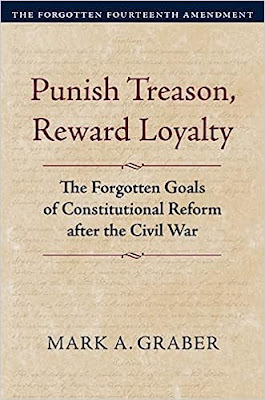
Mark A. Graber, Punish Treason, Reward Loyalty: The Forgotten Goals of Constitutional Reform after the Civil War (University of Kansas Press, 2023)
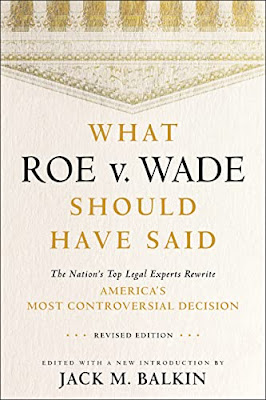
Jack M. Balkin, What Roe v. Wade Should Have Said: The Nation's Top Legal Experts Rewrite America's Most Controversial Decision - Revised Edition (NYU Press, 2023)

Andrew Koppelman, Burning Down the House: How Libertarian Philosophy Was Corrupted by Delusion and Greed (St. Martin’s Press, 2022)

Gerard N. Magliocca, Washington's Heir: The Life of Justice Bushrod Washington (Oxford University Press, 2022)
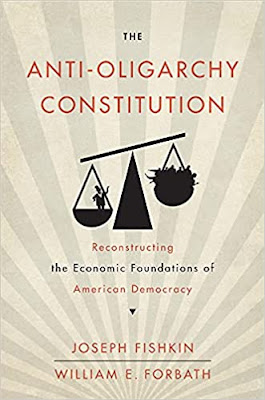
Joseph Fishkin and William E. Forbath, The Anti-Oligarchy Constitution: Reconstructing the Economic Foundations of American Democracy (Harvard University Press, 2022)
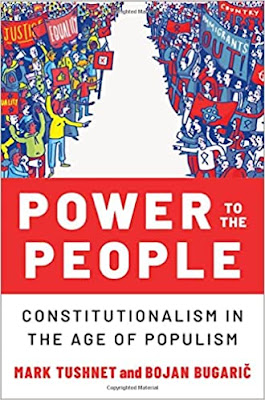
Mark Tushnet and Bojan Bugaric, Power to the People: Constitutionalism in the Age of Populism (Oxford University Press 2021).

Mark Philip Bradley and Mary L. Dudziak, eds., Making the Forever War: Marilyn B. Young on the Culture and Politics of American Militarism Culture and Politics in the Cold War and Beyond (University of Massachusetts Press, 2021).

Jack M. Balkin, What Obergefell v. Hodges Should Have Said: The Nation's Top Legal Experts Rewrite America's Same-Sex Marriage Decision (Yale University Press, 2020)

Frank Pasquale, New Laws of Robotics: Defending Human Expertise in the Age of AI (Belknap Press, 2020)

Jack M. Balkin, The Cycles of Constitutional Time (Oxford University Press, 2020)

Mark Tushnet, Taking Back the Constitution: Activist Judges and the Next Age of American Law (Yale University Press 2020).

Andrew Koppelman, Gay Rights vs. Religious Liberty?: The Unnecessary Conflict (Oxford University Press, 2020)

Ezekiel J Emanuel and Abbe R. Gluck, The Trillion Dollar Revolution: How the Affordable Care Act Transformed Politics, Law, and Health Care in America (PublicAffairs, 2020)

Linda C. McClain, Who's the Bigot?: Learning from Conflicts over Marriage and Civil Rights Law (Oxford University Press, 2020)
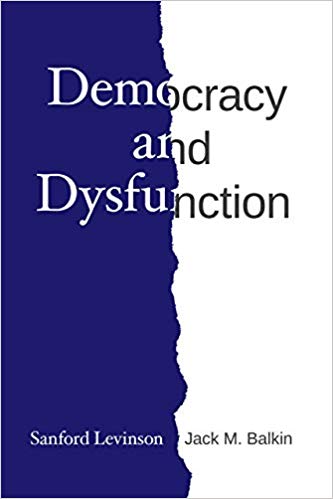
Sanford Levinson and Jack M. Balkin, Democracy and Dysfunction (University of Chicago Press, 2019)

Sanford Levinson, Written in Stone: Public Monuments in Changing Societies (Duke University Press 2018)

Mark A. Graber, Sanford Levinson, and Mark Tushnet, eds., Constitutional Democracy in Crisis? (Oxford University Press 2018)

Gerard Magliocca, The Heart of the Constitution: How the Bill of Rights became the Bill of Rights (Oxford University Press, 2018)

Cynthia Levinson and Sanford Levinson, Fault Lines in the Constitution: The Framers, Their Fights, and the Flaws that Affect Us Today (Peachtree Publishers, 2017)

Brian Z. Tamanaha, A Realistic Theory of Law (Cambridge University Press 2017)

Sanford Levinson, Nullification and Secession in Modern Constitutional Thought (University Press of Kansas 2016)

Sanford Levinson, An Argument Open to All: Reading The Federalist in the 21st Century (Yale University Press 2015)

Stephen M. Griffin, Broken Trust: Dysfunctional Government and Constitutional Reform (University Press of Kansas, 2015)

Frank Pasquale, The Black Box Society: The Secret Algorithms That Control Money and Information (Harvard University Press, 2015)

Bruce Ackerman, We the People, Volume 3: The Civil Rights Revolution (Harvard University Press, 2014)
Balkinization Symposium on We the People, Volume 3: The Civil Rights Revolution

Joseph Fishkin, Bottlenecks: A New Theory of Equal Opportunity (Oxford University Press, 2014)

Mark A. Graber, A New Introduction to American Constitutionalism (Oxford University Press, 2013)

John Mikhail, Elements of Moral Cognition: Rawls' Linguistic Analogy and the Cognitive Science of Moral and Legal Judgment (Cambridge University Press, 2013)

Gerard N. Magliocca, American Founding Son: John Bingham and the Invention of the Fourteenth Amendment (New York University Press, 2013)

Stephen M. Griffin, Long Wars and the Constitution (Harvard University Press, 2013)

Andrew Koppelman, The Tough Luck Constitution and the Assault on Health Care Reform (Oxford University Press, 2013)

James E. Fleming and Linda C. McClain, Ordered Liberty: Rights, Responsibilities, and Virtues (Harvard University Press, 2013)
Balkinization Symposium on Ordered Liberty: Rights, Responsibilities, and Virtues

Andrew Koppelman, Defending American Religious Neutrality (Harvard University Press, 2013)

Brian Z. Tamanaha, Failing Law Schools (University of Chicago Press, 2012)

Sanford Levinson, Framed: America's 51 Constitutions and the Crisis of Governance (Oxford University Press, 2012)

Linda C. McClain and Joanna L. Grossman, Gender Equality: Dimensions of Women's Equal Citizenship (Cambridge University Press, 2012)

Mary Dudziak, War Time: An Idea, Its History, Its Consequences (Oxford University Press, 2012)

Jack M. Balkin, Living Originalism (Harvard University Press, 2011)

Jason Mazzone, Copyfraud and Other Abuses of Intellectual Property Law (Stanford University Press, 2011)

Richard W. Garnett and Andrew Koppelman, First Amendment Stories, (Foundation Press 2011)

Jack M. Balkin, Constitutional Redemption: Political Faith in an Unjust World (Harvard University Press, 2011)

Gerard Magliocca, The Tragedy of William Jennings Bryan: Constitutional Law and the Politics of Backlash (Yale University Press, 2011)

Bernard Harcourt, The Illusion of Free Markets: Punishment and the Myth of Natural Order (Harvard University Press, 2010)

Bruce Ackerman, The Decline and Fall of the American Republic (Harvard University Press, 2010)
Balkinization Symposium on The Decline and Fall of the American Republic

Ian Ayres. Carrots and Sticks: Unlock the Power of Incentives to Get Things Done (Bantam Books, 2010)

Mark Tushnet, Why the Constitution Matters (Yale University Press 2010)

Ian Ayres and Barry Nalebuff: Lifecycle Investing: A New, Safe, and Audacious Way to Improve the Performance of Your Retirement Portfolio (Basic Books, 2010)
.jpg)
Jack M. Balkin, The Laws of Change: I Ching and the Philosophy of Life (2d Edition, Sybil Creek Press 2009)

Brian Z. Tamanaha, Beyond the Formalist-Realist Divide: The Role of Politics in Judging (Princeton University Press 2009)
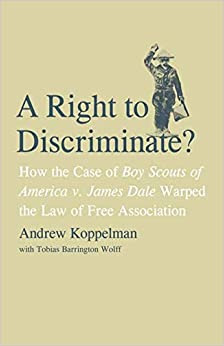
Andrew Koppelman and Tobias Barrington Wolff, A Right to Discriminate?: How the Case of Boy Scouts of America v. James Dale Warped the Law of Free Association (Yale University Press 2009)

Jack M. Balkin and Reva B. Siegel, The Constitution in 2020 (Oxford University Press 2009)

Heather K. Gerken, The Democracy Index: Why Our Election System Is Failing and How to Fix It (Princeton University Press 2009)

Mary Dudziak, Exporting American Dreams: Thurgood Marshall's African Journey (Oxford University Press 2008)

David Luban, Legal Ethics and Human Dignity (Cambridge Univ. Press 2007)

Ian Ayres, Super Crunchers: Why Thinking-By-Numbers is the New Way to be Smart (Bantam 2007)

Jack M. Balkin, James Grimmelmann, Eddan Katz, Nimrod Kozlovski, Shlomit Wagman and Tal Zarsky, eds., Cybercrime: Digital Cops in a Networked Environment (N.Y.U. Press 2007)
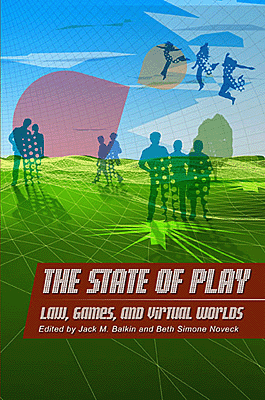
Jack M. Balkin and Beth Simone Noveck, The State of Play: Law, Games, and Virtual Worlds (N.Y.U. Press 2006)

Andrew Koppelman, Same Sex, Different States: When Same-Sex Marriages Cross State Lines (Yale University Press 2006)

Brian Tamanaha, Law as a Means to an End (Cambridge University Press 2006)

Sanford Levinson, Our Undemocratic Constitution (Oxford University Press 2006)

Mark Graber, Dred Scott and the Problem of Constitutional Evil (Cambridge University Press 2006)

Jack M. Balkin, ed., What Roe v. Wade Should Have Said (N.Y.U. Press 2005)

Sanford Levinson, ed., Torture: A Collection (Oxford University Press 2004)
Balkin.com homepage
Bibliography
Conlaw.net
Cultural Software
Writings
Opeds
The Information Society Project
BrownvBoard.com
Useful Links
Syllabi and Exams
