Balkinization
an unanticipated consequence of
Jack M. Balkin
Balkinization Symposiums: A Continuing List
E-mail:
Jack Balkin:
jackbalkin at yahoo.com
Bruce Ackerman
bruce.ackerman at yale.edu
Ian Ayres
ian.ayres at yale.edu
Corey Brettschneider
corey_brettschneider at brown.edu
Mary Dudziak
mary.l.dudziak at emory.edu
Joey Fishkin
joey.fishkin at gmail.com
Heather Gerken heather.gerken at yale.edu
Abbe Gluck abbe.gluck at yale.edu
Mark Graber
mgraber at law.umaryland.edu
Stephen Griffin
sgriffin at tulane.edu
Jonathan Hafetz
jonathan.hafetz at shu.edu
Jeremy Kessler
jkessler at law.columbia.edu
Andrew Koppelman
akoppelman at law.northwestern.edu
Marty Lederman
msl46 at law.georgetown.edu
Sanford Levinson
slevinson at law.utexas.edu
David Luban
david.luban at gmail.com
Gerard Magliocca
gmaglioc at iupui.edu
Jason Mazzone
mazzonej at illinois.edu
Linda McClain
lmcclain at bu.edu
John Mikhail
mikhail at law.georgetown.edu
Frank Pasquale
pasquale.frank at gmail.com
Nate Persily
npersily at gmail.com
Michael Stokes Paulsen
michaelstokespaulsen at gmail.com
Deborah Pearlstein
dpearlst at yu.edu
Rick Pildes
rick.pildes at nyu.edu
David Pozen
dpozen at law.columbia.edu
Richard Primus
raprimus at umich.edu
K. Sabeel Rahmansabeel.rahman at brooklaw.edu
Alice Ristroph
alice.ristroph at shu.edu
Neil Siegel
siegel at law.duke.edu
David Super
david.super at law.georgetown.edu
Brian Tamanaha
btamanaha at wulaw.wustl.edu
Nelson Tebbe
nelson.tebbe at brooklaw.edu
Mark Tushnet
mtushnet at law.harvard.edu
Adam Winkler
winkler at ucla.edu
Compendium of posts on Hobby Lobby and related cases
The Anti-Torture Memos: Balkinization Posts on Torture, Interrogation, Detention, War Powers, and OLC
The Anti-Torture Memos (arranged by topic)
Recent Posts
What We Talk About When We Talk About "Stop and Frisk"
Inequality, Inclusion, and Populism after the Election
JeffreyToobin, "In the Balance"
Presidential Tax Returns and the Constitution
A Perfect Constitutional Storm
The Scalia Legacy and the Overton Park Meme
Lupu, Tuttle, and Singling Out Religion
Repudiating NAFTA
Birtherism as Faux-Constitutionalism: A Tale of Two Cities
Will the United States survive the 2016 election (continuing)
Presidential governance -- the political foundations of judicial review in the emerging constitutional regime
Will the United States survive the 2016 election (a continuing series)
On the Metaphor "Grading on a Curve"
Justice Scalia's Legacy
![[Powered by Blogger]](https://lh3.googleusercontent.com/blogger_img_proxy/AEn0k_vd4xwXvbdtzACoCNs2PyP79UsgZmL58Z92fAgWpKT8YPDFV19oYCgCgupauMPKs33x2B3qeFgG7dMMbOG1N-G21gz4qcsJwTmXB9tj2rWd=s0-d)
Just A Few Blogs
ACS Blog
Alas, a Blog
Althouse
Arts and Letters Daily
Atrios (Eschaton)
Bill of Health
Buzzflash.com
Buzz Machine
Cato at Liberty
Juan Cole (Informed Comment)
Concurring Opinions
The Constitution in 2020
Corrente
Crooked Timber
Daily Howler
Daily Kos
Dana Boyd
Brad DeLong
Digby (Hullabaloo)
Discriminations
Daniel Drezner
Kevin Drum (Mother Jones)
Electrolite
En Banc
Eunomia (Daniel Larison)
Fafblog
Michael Froomkin (Discourse.net)
GovLab (Beth Noveck)
Rick Hasen (Election Law)
History News Network
How Appealing
Ignatz (Sam Heldman)
The Importance of (Ernie Miller)
Infolaw
Instapundit
International Economic Law and Policy Blog
IntLawGrrls
Jacob Levy
Jesus' General
Jurisdynamics
The Kitchen Cabinet
Mark Kleiman
Law Blog Central
Larry Lessig
Lawyers, Guns and Money
Liberal Oasis
Brian Leiter's Law School Reports
The Leiter Reports
Marginal Revolution
Megan McArdle
Memeorandum
Metafilter
Mirror of Justice
The New Republic
Newseum
No More Mister Nice Blog
Brendan Nyhan
Opinio Juris
Orcinus
The Originalism Blog
Pandagon
Passport (Foreign Policy)
Overcoming Bias
Political Animal (Washington Monthly)
Political Theory Daily Review
Political Wire (Taegan Goddard)
The Poor Man
Virginia Postrel
Prawfsblawg
Public Reason
Jonathan Rauch
Raw Story
Redstate
ReligiousLeftLaw.com
Reporters Committee For Freedom of the Press
Reproductive Rights Blog
Rothman's Roadmap to the Right of Publicity
SCOTUS Blog
Seeing the Forest
Clay Shirky
The Shifted Librarian
The Situationist
Larry Solum (Legal Theory)
Andrew Sullivan
Talking Points Memo
Talk Left
Tapped
Tbogg
TechPresident
The Paper Chase (Jurist)
Tom Paine
Tom Tomorrow (This Modern World)
Eve Tushnet
Uggabugga
University of Chicago Law School Faculty Blog
Unqualified Offerings
The Volokh Conspiracy
War and Piece (Laura Rozen)
Wampum
Oliver Willis
Wonkette
Written Description
Matthew Yglesias
Yin
Your Choice of Feeds
1. XML
powered by

2. Atom Feed
3. RSS 2.0
What We Talk About When We Talk About "Stop and Frisk"
Alice Ristroph
Posted
5:55 PM
by Alice Ristroph [link]
Inequality, Inclusion, and Populism after the Election
K. Sabeel Rahman
Posted
12:41 PM
by K. Sabeel Rahman [link]
JeffreyToobin, "In the Balance"
Mark Tushnet
From Mark Tushnet, In the Balance: Law and Politics on the Roberts Court (2013), p. xii -- "The future of the Court will be shaped not only by the nominations that President Obama and his successors will make, but by the competition between Roberts and Kagan for intellectual leadership of the Court, as each forcefully articulates differing views about the balance between law and politics. In the Balance suggests that we might find ourselves talking about a Court formally led by Chief Justice Roberts -- a 'Roberts Court' -- but led intellectually by Justice Kagan -- a 'Kagan Court.'"
Just sayin'. (I put the full link in this post because the print edition apparently gives the article a different title -- "The Supreme Court After Scalia.")
Posted
5:11 PM
by Mark Tushnet [link]
Presidential Tax Returns and the Constitution
Gerard N. Magliocca
A significant criticism of Donald Trump is that he has not released his tax returns (which I'm sure are amazing and fantastic if only we could see them). There has been a convention in recent decades that presidential candidates should release their tax returns. Why? Because Richard Nixon was accused of tax evasion while he was President. I'm not a tax expert, but my understanding is that Nixon took questionable deductions (one was for donating his vice-presidential papers) that got him in trouble.
The House Judiciary Committee actually drafted an article of impeachment against President Nixon stating that his tax evasion was a high crime and misdemeanor, but the Committee rejected the article. I'm not sure if this was because the evidence of tax evasion was not strong enough, whether some felt that tax evasion was not an impeachable offense, or if that charge was just weaker than the others. Still, the tax behavior of the President was taken very seriously.
I wonder what will happen (should Trump prevail) if a congressional committee decides to subpoena Mr. Trump's tax records as part of an investigation of Trump University or some other issue. Refusing to release tax returns as a candidate is legal. Refusing to do so in the face of a subpoena is probably impeachable, as the House Judiciary Committee voted for the article of impeachment against Nixon for his general refusal to comply with congressional subpoenas to investigate his conduct.
Posted
2:37 PM
by Gerard N. Magliocca [link]
(108) comments
A Perfect Constitutional Storm
Sandy Levinson
Events of the past decade (should) have made us aware that low-probability events can, nonetheless, take place and test the resilience of systems, whether US banking or levees in New Orleans, that essentially translate "low-probabity" into "never." So consider the following possibilities, which may indeed be low-probability but are by no means impossible:
1) Donald Trump either ties Hillary Clinton 269-269 or even apparently wins by one or two electoral votes, either event occurring in essence because of perceived voter suppression in North Carolina or even Texas (which some polls show close to a toss-up). (Or perhaps it is simply enough that the electoral college boost given Alaska, Idaho, Wyoming, and the Dakotas, is enough to carry Trump over the top, even though he receives, say, only 43% of the popular vote.) Does it make a difference, incidentally, if Clinton receives more popular votes or not? In any event, there is (justified) rioting in the streets at the prospect of the narcissistic sociopath actually becoming president and in revulsion at the circumstances that brought this eventuality to passt.
2) Tremendous pressure is placed by "Party elders" on Republican electors to vote for, say, Mitt Romney or Paul Ryan. Should enough do so--and the number need not be more than two or three-- there would be no candidate with a majority of the electoral vote. The election would be thrown into the House of Representatives, which, of course, votes on a one-state, one-vote basis and chooses among the top three candidates receiving electoral votes: i.e., Trump, Clinton, and Romney or Ryan. .
3) The one-state/one-vote system is altogether illegitimate in terms of any 21st century theory of democracy, though it is, of course, constitutionally compelled, so let the fundamental illegitimacy pass. But now assume, which is altogether possible, that the Republican majority of delegations results substantially from the illegitimate weight held by small states (e.g., Idaho, Alaska, North and South Dakota, Wyoming), which will have the same weight as, say, California, New York, Illinois, Michigan, and Virginia, as well, and just as importantly, from illegitimate partisan gerrymandering. Consider, e.g., Pennsylvania and North Carolina, whose current Republican majorities are the result of a thoroughly illegitimate (though, the Supreme Court has told us, constitutional) gerrymanders designed to minimize the actual ability of Democrats to elect their candidates.
4) The House, as in 1801, conducts a number of ballots, since none of the three candidates, Trump, Clinton, or Romney/Ryan gets a majority of the state delegations. All of the Democratic delegations obviously vote for Clinton, whereas enough of the Republican delegations vote for Romney/Ryan to deprive the sociopath of a majority.
5) Meanwhile, under the same 12th Amendment, the Senate now chooses a vice-president from the top two candidates for that office. The new Senate splits exactly 50-50, but, of course, Joe Biden casts the tie-breaking vote until January 20. So the Senate votes 51-50 to select Tim Kaine as the new vice president.
6) Meanwhile, back at the House, as it gets closer to January 20, the votes continue. Clinton addresses the country in a nation-wide speech saying that it is time for a "government of national unity" to overcome the dangerous polarization (evidenced, incidentally, by continuing street demonstrations from disgruntled Democrats and Trumpistas alike). She therefore states that if selected by the House she is prepared to name a number of named Republicans to significant Cabinet positions.
7) January 20 comes and goes, with no majority yet achieved. Tim Kaine is sworn in as Vice President at noon and immediately succeeds to the vacant office of the presidency. (Are things made any easier, in terms of constitutional crisis, if it is Mike Pence, elected by 51 Republican senators representing, say, 42% of the American public?)
8) The Republican delegations in the House finally unite behind Romney or Ryan, who thereupon evicts President Kaine from the Oval Office. Or, if you like, enough Republican delegations accept Clinton's offer of a national-unity government so that she gets a majority of the states (and then evicts Kaine).
I assume the odds of this concatenation of events are relatively low? But precisely how low? 1% 10% 15% (the odds of losing at Russian roulette in a standard six-bullett handgun)? Would any sane political system adopt a Constitution, today, that allows for such possibilities?
Posted
11:30 AM
by Sandy Levinson [link]
(63) comments
The Scalia Legacy and the Overton Park Meme
Richard Primus
On two occasions in the last month, I've been present when speakers discussing Justice Scalia's legacy have anchored their praise for Scalia's textualism by pointing to a famous West Publishing headnote from Citizens to Preserve Overton Park v. Volpe, 401 U.S. 402 (1971). The point of adducing the Overton Park headnote, for both speakers, was to say that in the pre-Scalia age, the Supreme Court cared relatively little -- perhaps comically little -- about enacted text. And in that light, Scalia's crusade for textualism was about the restoration of a bit of sanity.
It's surely true that Scalia contributed to raising the status of textualism, and in doing so he had more influence on the shape of legal discourse than most justices ever do. But the Overton Park meme is a misrepresentation, or at least a misundersatnding. So in the coming discussions of Scalia's legacy, audiences should be alert to the flaw in that meme, lest they accept a caricature as reality. Yes, Scalia changed legal discourse -- in my view, both for the better and for the worse. But perhaps American jurisprudence was not all anarchy and nonsense before Scalia came to town.
The Overton Park meme goes like this: In West's headnotes to the case, there is one -- Headnote 5 -- which reads as follows: "Where legislative history is ambiguous, court will look to the statutes themselves to find the legislative intent." You see, the person relating the meme says, the Court took the view that in statutory cases courts should look first to legislative history, not to the enacted text, and consult the actual words of the enacted text only if the case cannot be settled on the basis of the legislative history. How backwards that seems! But strange as it seems, the meme continues, courts in the bad old days of the 1970s apparently thought this was a sensible procedure: look to legislative history first, and only read the actual statute if you really need to.
The world wasn't like that, even in 1971. As one should know from Overton Park itself, so long as one reads the Court's analysis rather than a headnote written by West Publishing, and so long as one reads with the aim of understanding what the Court was actually doing, rather than with the aim of taking something out of context and using it to mean something that makes midcentury judges seem silly.
In Overton Park, the Supreme Court addressed a decision by John Volpe, the Secretary of Transportation, to approve a plan to build a highway through a park in downtown Memphis. The petitioners claimed that the Secretary had failed to comply with the administrative-procedure requirements for approving the plan, including requirements imposed under the APA as well as requirements imposed under two federal statutes specifically dealing with the construction of highways.
In his opinion for the Court, Justice Marshall identified the statutes, quoted their actual language, and applied that language to various issues in the case. He did not wallow in legislative history or in other concerns about legislative intent that float free from enacted text.
After a fair amount of engagement with the words of the enacted statutes, Marshall came to one particular issue about the meaning of one piece of the enacted statutory language. Under relevant sections of the Department of Transportation Act and the Federal-Aid to Highway Act, Justice Marshall noted, the Secretary was to approve highways running through park land only if there were no "prudent" alternative routes. As Marshall explained, the Secretary argued for an expansive sense of "prudent." According to the Secretary, the prudence of an alternative route was a function of a broad all-things-considered calculation, one that would feature considerations of cost and perhaps community disruption. The Court rejected that interpretation, reasoning that a decision based on cost and community disruption would always favor building highways through parkland, which is already municipally owned and where people do not live, such that adopting the Secretary's interpretation would make the statutory requirement close to pointless. "[T]he very existence of the statutes," Marshall reasoned, indicated that preserving parkland was not to be simply sacrificed to considerations of cost.
After the quoted words about the very existence of the statutes, Marshall dropped a footnote. In the footnote, he wrote that the legislative history of the statutes did not clearly speak to the breadth of the Secretary's discretion to make decisions about the competing factors. The footnote then concluded with these words: "Because of this ambiguity it is clear that we must look primarily to the statutes themselves to find the legislative intent."
That's the language that gets picked up by the West Headnote and made into a meme signifying that the Supreme Court in 1971 considered legislative history more important than statutory text.
But of course the Court wasn't saying that. Nor had the Court tried to conduct an analysis of the case that began with an inquiry into legislative history and then turned, as a last resort, to the statutory text only when the legislative history didn't furnish an answer. What the Court's opinion actually did was look first at the statutes and reason about their language. When a dispute arose over the meaning of a term in the statute -- "prudent" -- the Court reasoned about what that word should sensibly be understood to mean in these particular statutes. And then, perhaps to meet some possible objection arguing that Congress did not intend the term to mean what the Court thought it meant, the Court in a footnote mentioned that the legislative history of the statutes does not resolve the issue, such that the issue must be resolved on the basis of the statutes without aid from legislative history. To be sure, there is something purposivist, and contestable, about Marshall's reasoning. But his interpretation was an answer to a question about the meaning of the enacted statutory language, and he mentioned legislative history only after confronting and reasoning about the statute directly.
In other words, nothing in Overton Park says "We look first to the legislative history, and if that won't settle the case we'll look at the statute." What the Court did in Overton Park was to read the statutes and interpret them and then in a footnote say that the legislative history was not to the contrary.
To some considerable extent, I happen to share Justice Scalia's skepticism about the use of legislative history in statutory interpretation. And of course I agree that he had an important impact in that area. But in taking the measure of that impact, it seems both inaccurate and uncharitable to portray the pre-Scalia judiciary as possessed of a kind of disregard for enacted text that would make those judges seem crazy and alien and foolish. They too took statutory text seriously, albeit in ways that sometimes differed in important respects from the way that Justice Scalia later advocated.
So I hope my recent experiences are anomalous and the the Overton Park meme (which I recognize is not new) will be given a deserved repose. Or at least that it will be challenged when offered.
Posted
1:57 PM
by Richard Primus [link]
Lupu, Tuttle, and Singling Out Religion
Andrew Koppelman
I've just published a brief review of the book, for the Northwestern University Law Review Online, focusing on that issue. It is available here.
Posted
3:15 PM
by Andrew Koppelman [link]
Repudiating NAFTA
Gerard N. Magliocca
One of Donald Trump's campaign promises is to renegotiate NAFTA (into a more amazing and fantastic agreement, no doubt). Here's a simple question that should get some attention: Can he abrogate NAFTA without an Act of Congress? If NAFTA were a traditional treaty (approved by two-thirds of the Senate), then the answer would be yes. The Supreme Court long ago held that it's up to the President alone to decide whether treaties should be, in effect, broken.
NAFTA, though, is not a traditional treaty. It was a congressional-executive agreement enacted by both houses of Congress. Thus, I would think that only an Act of Congress can undo NAFTA from our side. (There could be a provision in the original statute that gives the President some repudiating authority, and I would be curious if any of the comments to this post might shed light on that.)
If NAFTA can only be renegotiated following an Act of Congress, then I think the Speaker of the House and the Senate Majority Leader should be asked about their position on that. Granted, they are doing their best to imitate an ostrich these days, but I think this is a valid question about future action in the legislature.
Posted
3:56 PM
by Gerard N. Magliocca [link]
(66) comments
Birtherism as Faux-Constitutionalism: A Tale of Two Cities
Guest Blogger
Laurence H.
Tribe
Posted
7:00 AM
by Guest Blogger [link]
Will the United States survive the 2016 election (continuing)
Sandy Levinson
UPDATE: I think it's probably correct, as suggested by some of the discussants, that it may be excessive to suggest that tall of the "majority" of those who did not vote for Clinton--i.e., the sum of Trump, Johnson, and Stein voters--will regard her as "illegitimate." (I'm not willing, incidentally, to make the same concession with regard to those who do not vote for Trump: i.e., I do suspect that a majority of the country will regard a Trump presidency as illegitimate.) But I'm not sure that's such a major concession. The key question is what percentage of rabid Trump supporters--whether or not we wish to label them "deplorable" (more on that below)--will regard her as illegitimate. And I continue to believe that the number/percentage will be high enough to threaten basic political stability, especially given the threats.hints of violence encouraged by Governor Biven and the sociopathic candidate for the presidency. After all, there's no reason at all to believe that a "majority" of those living in the colonies believed that King George III was an illegitimate tyrant even in 1776, nor a "majority" who supported the Bolsheviks over the Mensheviks, and we know that Hitler did not receive the support of a majority of Germans when he gained control of the German government in 1933. Great events (or catastrophes) often, perhaps usually, take place because of intense minorities who are "mad as hell and aren't going to take it any more," i.e, those whipped up by the sociopath. The irony/paradox is that the majority who would properly regard a Trump presidency as illegitimate are not inclined to engage in violence. That may or may not be thought to be a compliment. It is the right, over the past quarter century, that has blown up federal buildings, occupied federal lands, and organized "militias" to overthrow what they deem to be an oppressive state. The American left, presuming it really exists as an organized entity, is by and large satisfied with engaging in dramatic marches and expressions of woe rather than genuine political organization. And, of course, unlike the Right, some of whose members, including Texas Governor Greg Abbott, are willing to connect the dots and suggest significant constitutional reform (from their perspective), the so-called left continues to engage in Constitution-worship and resolute unwillingness to connect any dots (see, e.g., the Sanders campaign and its ultimate cult of personality).
So let me suggest the following as almost certain realities of American politics come January: Let's begin with the absolute worst case: A Trump "victory" with a minority of the popular vote and a slim majority of the electoral vote (thanks to voter suppression in North Carolina, Wisconsin, or Texas, to name the three most likely suspects). Result: a sullen majority that refuses to accept him as a legitimate president and will support every effort to limit his presidency, beginning with a resolute unwillingness to confirm any judicial appointees (for starters) and suggesting impeachment the first time he jaywalks. If a Trump victory is coupled with Republican control of Congress, then Democrats should exercise the filibuster (until, of course, the Republicans eliminate it), though it will also be interesting to see how craven Republican senators (or Speaker Ryan) will be in submitting themselves to the "leadership" of an ignorant sociopath. And, who knows, perhaps there will be secessionist movements in Pacifica or New England, unlikely as that seems today. A Clinton victory with a minority of the popular vote and a close electoral vote would, as suggested above, not necessarily mean that a majority of the country would regard her as illegitimate. But what if, say, "only" 25% of the country thought her to be illegitimate (because, after all, they believe she is "evil" (to quote an Iowa Republican) and deserves to be in jail. This 25% is not equally distributed throughout the country, but tends to cluster particularly in White Dixie and other similar enclaves (including the "Alabama" portion of Pennsylvania). Will they be merely sullen, or will some members of this group feel empowered to exercise their Second Amendment rights? Moreover, of course, there is the question of whether Republican members of Congress can possibly be seen to "collaborate" (I use this term advisedly) with Clinton with regard to achieving any of her policy goals, whatever their (i.e., the Republican senators and representatives) private views about the merits of some of these goals. They will, presumably be terrified of being primaried.
Ao the question remains, why doesn't this likely consequence count as a genuine constitutional--and existential--crisis for the United States (and thus, in a deep sense, the entire world)? Can any reasonable person believe that our political system is working well or iis likely to get genuinely better in the foreseeable future (even if, as I would of course hope to be the case, Clinton smashes the sociopath and carries the House and Senate with her).
Finally, a comment about the "deplorable": I do think it absolutely deplorable that anyone would vote for the sociopath. But, as noted in my original post, I don't think that everyone doing so is a "deplorable person." Marxists developed a whole theory of "false consciousness" to explain how potentially admirable people could be misled by ideological structures to misunderstand their actual situation and thus vote against their own best interests. I think this explains much of the support going to the sociopath from relatively uneducated white members of the working class. They have indeed been sold down the river by political elites over the past several decades and have eery reason to feel angry. It is, therefore, not so surprising that they are falling victim to a skilled demagogue, sociopath though he may be. One might say much the same, though, of some of the Germans in the early '30s who voted for the Nazis. Whether or not they were "deplorable people," they made a completely deplorable decision with world-historical consequences.
So who are the truly "deplorable people"? The answer is easy: At the head of the list are Paul Ryan and Mitch McConnell, who have chosen to be "useful idiots" for their sociopathic candidate even though it is literally inconceivable that they believe him fit to be President of the United States. Both deserve to roast in hell, along with eery other opportunist--think of Kelly Ayotte--who coyly says that a vote for the sociopath doesn't count as an "endorsement." They are "deplorable" in every sense, unlike, say, Ted Cruz or, even mores, John Katich. Needless to say, I admire even more those Republicans who are endorsing the eminently capable former senator and secretary of state to be President, but I am nevertheless willing to give at least half a "Hamilton award" to Cruz, Katich,Jeb Bush, Mitt Romney, and governors Baker of Massachusetts and Gov. Hogan of Maryland, all of whom have indicated they have no intention of voting for the sociopath. (The "Hamilton awards" are based on Hamilton's willingness to endorse his bitter enemy Thomas Jefferson over Aaron Burr because he regarded Jefferson as a man of principle and Burr as a "voluptuary" wholly without principles and any sense of public virtue.) Full Hamiltons go to those Republicans who are willing to bit the bullet and recognize that the only sure way to stop the sociopath is to vote for Clinton.
_________________________________________________________________
OK, since my last missive, the Republican Governor of Kentucky has basically suggested/threatened violence should Hillary Clinton win the election. And the sociopath who is the Republican candidate for President has suggested that Hillary Clinton no longer receive armed protection, because, as he typically lies, he suggests that Clinton believes in universal disarmament. (That's especially ironic given that many liberals are justifiably concerned that she is too quick to support armed intervention.)
Also, polling indicates not only a tightening race, but, just as importantly, the overwhelming likelihood, unless the Johnson candidacy utterly collapses, that the winner on November 8 will not, unlike Barack Obama, receive a majority of the popular vote (or, perhaps, even a near majority, as did Bill Clinton in 1996. ) So this means, I suggest that a majority of the country, on November 9, whatever the result, is likely to believe that the next President of the United States is illegitimate. [SEE ABOVE FOR MY MODIFICATION OF THIS VIEW.] That is certainly my view regarding the narcissistic sociopath. That anyone believes he is actually capable of being president I find deplorable. It is nothing less than putting the lives of all of us, including, obviously, our children and grandchildren, in the hands of a blithering incompetent, but with all of the legal powers of the President. I want no part of a country that would have him as our president. Thus my repeated suggestions, crazy as they no doubt sound to many readers, for secession or even a military coup in order to prevent Trump from taking office. But, of course, if Clinton wins, as I still expect will be the case, it is equally impossible to imagine anything resembling a gracious concession from the sociopath, who will encourage the deplorable segment of his supporters--and not all of them are "deplorable," though all of them are making a deplorable decision--to resist the criminal Clinton, who should, according to them, be locked up, by any means possible, including, as Governor Bevin suggests, taking up arms. I think it is safe to say that this will be unprecedented, save perhaps for 1860, not a happy precedent.
If either the sociopath or Secretary Clinton wins a narrow electoral vote victory, then I expect each side to put pressure on given electors to be "faithless." Perhaps Clinton will feel politically estopped from doing that, but I sure as hell hope that is not the case withf her supporters. It should be made crystal clear that his election is unacceptable. [ADDITION: If this means public bargaining between Clinton and Republicans concerning, say, cabinet appointments or other techniques to achieve a "government of national unity," so be it.) But, of course, I fully expect Trump, backed by Rush Limbaugh and Sean Hannity, to make the same arguments.
I won't even mention the various permutations and combinations re the House and the Senate. What if the Senate ends up as a tie, for example?
In any event, I couldn't disagree more with those who are adopting a relatively complacent view of the election. We are facing a true existential crisis far more serious, frankly, that almost anything that a terrorist could inflict on the US.
It is currently the case that only about 25% of the public believe the country is moving in the right direction. It is also the case that Congress has the "approval" of approximately 10% of the population, with 71% "disapproving." For the first time in the history of polling, the Supreme Court is disapproved of by a majority of the population. Barack Obama, interestingly enough, does have the approval of a (bare) majority, but, obviously, he's not on the ballot.
As Oliver Wendell Holmes Senior noted in "The One Hoss Shay," thought to be an allegory about the collapse of Calvinism in the U.S., established institutions or cultures can collapse almost overnight when the right conjunction of events happens. This particular election is a perfect storm, and anyone who loves this country should be in despair about the future.
As usual, I am not in the least interested in whether anyone agrees with me about the merits or demerits of the sociopath or of Secretary Clinton, who I believe will make a fine president if given half a chance. Instead, I am interested only in whether you disagree with the basic thesis that A CRITICAL MASS OF the country, on November 9, will not only be disappointed in the outcome--which is, relatively speaking, par for the course in close elections--but, rather, find the ostensible winner to be "unacceptable" and, indeed, "illegitimate." If I am wrong, please explain why. I would feel much better.
Posted
10:27 PM
by Sandy Levinson [link]
(65) comments
Presidential governance -- the political foundations of judicial review in the emerging constitutional regime
JB
For the purposes of this post, assume that the Democrats win the White House in November. If this happens, they will have won the popular vote in six of the last seven elections, and the presidency in five of the last seven.
At this point we should recognize that the Reagan regime is over. A new regime--call it the Obama regime--will have begun. Just as the Republicans were the dominant party at the national level in the Reagan regime, the Democrats will be the dominant party in the new regime.
This regime, however, will be quite different from the last two previous constitutional/political regimes-- the New Deal Civil Rights regime of 1932-1980, and the Reagan regime of 1980-2008. The central reason the new regime will be different is because of party polarization. The function of judicial review--and therefore the political foundations of judicial review--will also be different in the new regime. The reason why politicians accept and support judicial review will change as the function of judicial review changes in the new regime.
Judicial review always requires political foundations that support its exercise. What are the political supports of judicial review in the upcoming Obama regime?
The emerging regime is likely to feature (1) strongly polarized parties and (2) a system of presidential governance.
Read more »
Posted
1:50 PM
by JB [link]
Will the United States survive the 2016 election (a continuing series)
Sandy Levinson
I was struck last week in Philadelphia, in several conversations at the APSA convention, with the relative complacency about the prospect of a Trump victory. To be clear, no one I spoke to doubted that he was dangerously narcissistic sociopath or otherwise came even close to finding him a reasonable choice for President. And the general mood was certainly one of denial that Trump could in fact win; all of us were taking solace in the NYTimes' then-90% probability estimate (since lowered to "only" 80%) of a Clinton victory. Rather, when asked what Clinton would/should do if the sociopath won, the answer seemed to be some version of "she should be a good sport--and presumably good American, like Al Gore--and concede graciously," whatever exactly that would mean. When I demurred, suggesting that his election would simply be catastrophic and that there was no reason at all to accept it graciously, the reasonable question was asked of me: what did I envision as the alternative? Taking up arms? A military coup? Or, as I have written several times, a secessionist movement led by Pacifica and New England (plus New York) that would reasonably state that they had no desire any longer to be part of a country that would place a sociopath in its highest office. All, to be sure, sound either fanciful or out-and-out dangerous (or, to some, lunatic). But exactly why is it less dangerous or lunatic to accept without question the legitimacy of a Trump presidency? Especially if it is procured by voter suppression in North Carolina and Texas, to name only the two most rabidly Republican states that are determined to limit the participation of Democratic voters?
Read more »
Posted
10:30 PM
by Sandy Levinson [link]
(60) comments
On the Metaphor "Grading on a Curve"
Mark Tushnet
Students worry about being graded on a curve because it means that, no matter how well all of them do in some objective sense, the curve is going to force the teacher to give some of them "bad" grades -- worse grades than they would have received had the course been graded according to some objective measure of performance. If a class is graded objectively, when everyone in the class gets a 90 or above on the exam, everyone might get an A, whereas if the class is graded on a curve the students who get "only" 90 on the exam will get low grades. And, conversely, if everyone does badly in some objective sense, grading on a curve means that someone who does just a little bit less badly than everyone else will get an A. Grading on a curve forces teachers to give bad grades to people who perform objectively well, and to give good ones to those who perform objectively badly, depending entirely upon what other students in the class do.
The usage of "grading on a curve" in discussions of Donald Trump seems to me just the reverse: The media are applying an objective standard to his performance. (One indication is that no one seems to think that Trump is performing better than Clinton in the contexts in which the metaphor has been used, which means that, if we really were grading on a curve, he'd being getting a bad grade.) The metaphor for that, which has also appeared, is "setting a low bar" -- that is, making it easy to get a passing grade.
Posted
10:01 AM
by Mark Tushnet [link]
Justice Scalia's Legacy
JB
Last week at the American Political Science Association, I gave a talk on a panel on Justice Scalia's legacy. This is a summary of my remarks.
In 2002, I wrote an article about John Marshall for the (then) upcoming 2003 bicentennial of Marbury v. Madison, in which I developed a way of thinking about the legacy of various Justices. In predicting whether a Justice will be remembered as great, some of the basic questions to consider are:
(1) How useful is the Justice to later generations?
(2) Is the Justice central to or symbolic of the constitutional/political regime in which he or she lived? Did the Justice take prominent positions on the key decisions that arose during that regime that are still canonical today?
(3) Perhaps even more important, did the Justice stand for (or take) the "right" positions on the right issues as judged by later generations? Was the Justice on the "right side of history" as determined by later generations? Note in particular that a Justice's methodological commitments and legal skill may often be less important to later generations than the Justice's substantive commitments.
(4) Did the Justice have acolytes and supporters who will defend and promote the Justice's reputation, and launder it for later generations? A good example is Oliver Wendell Holmes, Jr., who was lionized by a generation of progressives and, thereafter, by generations of Harvard Law professors and students. Even though Holmes made many bad decisions (including Buck v. Bell), he was especially useful to progressives and New Dealers, who laundered his reputation. His judicial sins, so to speak, were washed away.
Viewed from this standpoint, Scalia has a definite shot at greatness. He is clearly symbolic of the Reagan regime that is nearing its end (or has just ended). Indeed, he sat on the Supreme Court during almost the entire regime. Scalia also took important positions on most of the key constitutional issues in the Reagan regime. Perhaps most important, Scalia has plenty of acolytes and cheerleaders who are eager to burnish his reputation and keep his memory alive. There is already a law school and a lecture series named after him. The conservative movement (and the Republican Party) are still very much behind him. He was also a colorful character and a memorable writer, like Justice Holmes.
One might compare Scalia to Felix Frankfurter, who, at the time of his death, had a towering reputation, and garnered many tributes. Yet, in the long run, Frankfurter's reputation has declined. Frankfurter has no law school named after him, and, unlike Holmes and Scalia, no endowed lecture at the Harvard Law School. One reason for this may be that his consistent advocacy of judicial restraint put him on the wrong side of many important questions as the New Deal/Civil Rights Regime went on. The positions that made him a darling of liberals in the 1920s and 1930s made him seem overly conservative and out of touch to liberals promoting civil rights in the 1950s and 1960s. Scalia's positions, by contrast, did not become obsolete to conservatives as the interests and focus of the conservative movement changed. On most of the issues that conservatives cared about over a thirty year period, Scalia supported and promoted their views and ambitions. In particular, although he started out as a staunch defender of judicial restraint and majoritarianism, he did not remain so. He embraced judicial restraint and judicial engagement at different times on different subject matters.
Probably the most difficult hurdle Scalia's reputation will face is whether he took too many positions that will turn out to be "wrong" from the perspective of later generations. That might be especially so if the new political regime that replaces the Reagan regime is dominated by the Democratic Party's "coalition of the ascendant." As Scalia himself once remarked, if the politics go against him, he might be remembered as "the Justice Sutherland of the late-twentieth and early-21st century."
But I emphasize that one shouldn't be too sure about this. We can't really predict what later generations will think is most important. It's possible that Scalia will be remembered not for his vociferous opposition to gay rights but for his defense of 4th amendment and 6th amendment rights, and for his defense of separation of powers in cases like Morrison v. Olson. A lot depends on what the key issues of the future look like, and what later political regimes think are important.
In addition, a lot depends on what becomes of the conservative movement and the conservative politics that Scalia symbolized. If the positions that he stood for become and remain dominant in American politics, he will be a bit like Oliver Wendell Holmes-- his judicial sins will be washed away.
Scalia, of course, was one of the Court's two originalists, along with Justice Clarence Thomas. As I've pointed out before, originalism is not going away anytime soon. As long as people advocate originalism (and textualism), they will find Scalia symbolically useful. But I don't think that Scalia will be remembered as great primarily because of his methodological commitments to originalism or textualism, although I do agree that these are currently very important to his reputation. In the long run, I expect, his substantive positions, judged from the perspective of the future, will probably prove most important.
Posted
5:22 PM
by JB [link]
Books by Balkinization Bloggers

Gerard N. Magliocca, The Actual Art of Governing: Justice Robert H. Jackson's Concurring Opinion in the Steel Seizure Case (Oxford University Press, 2025)

Linda C. McClain and Aziza Ahmed, The Routledge Companion to Gender and COVID-19 (Routledge, 2024)

David Pozen, The Constitution of the War on Drugs (Oxford University Press, 2024)

Jack M. Balkin, Memory and Authority: The Uses of History in Constitutional Interpretation (Yale University Press, 2024)
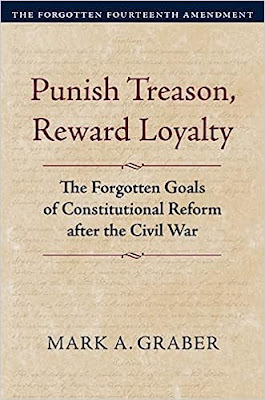
Mark A. Graber, Punish Treason, Reward Loyalty: The Forgotten Goals of Constitutional Reform after the Civil War (University of Kansas Press, 2023)
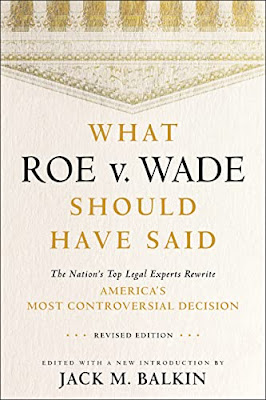
Jack M. Balkin, What Roe v. Wade Should Have Said: The Nation's Top Legal Experts Rewrite America's Most Controversial Decision - Revised Edition (NYU Press, 2023)

Andrew Koppelman, Burning Down the House: How Libertarian Philosophy Was Corrupted by Delusion and Greed (St. Martin’s Press, 2022)

Gerard N. Magliocca, Washington's Heir: The Life of Justice Bushrod Washington (Oxford University Press, 2022)
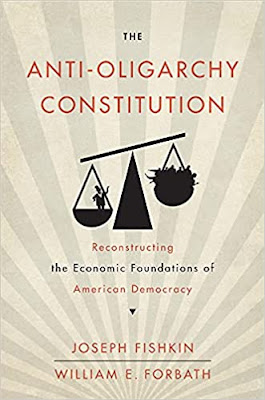
Joseph Fishkin and William E. Forbath, The Anti-Oligarchy Constitution: Reconstructing the Economic Foundations of American Democracy (Harvard University Press, 2022)
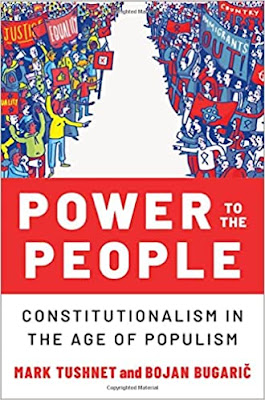
Mark Tushnet and Bojan Bugaric, Power to the People: Constitutionalism in the Age of Populism (Oxford University Press 2021).

Mark Philip Bradley and Mary L. Dudziak, eds., Making the Forever War: Marilyn B. Young on the Culture and Politics of American Militarism Culture and Politics in the Cold War and Beyond (University of Massachusetts Press, 2021).

Jack M. Balkin, What Obergefell v. Hodges Should Have Said: The Nation's Top Legal Experts Rewrite America's Same-Sex Marriage Decision (Yale University Press, 2020)

Frank Pasquale, New Laws of Robotics: Defending Human Expertise in the Age of AI (Belknap Press, 2020)

Jack M. Balkin, The Cycles of Constitutional Time (Oxford University Press, 2020)

Mark Tushnet, Taking Back the Constitution: Activist Judges and the Next Age of American Law (Yale University Press 2020).

Andrew Koppelman, Gay Rights vs. Religious Liberty?: The Unnecessary Conflict (Oxford University Press, 2020)

Ezekiel J Emanuel and Abbe R. Gluck, The Trillion Dollar Revolution: How the Affordable Care Act Transformed Politics, Law, and Health Care in America (PublicAffairs, 2020)

Linda C. McClain, Who's the Bigot?: Learning from Conflicts over Marriage and Civil Rights Law (Oxford University Press, 2020)
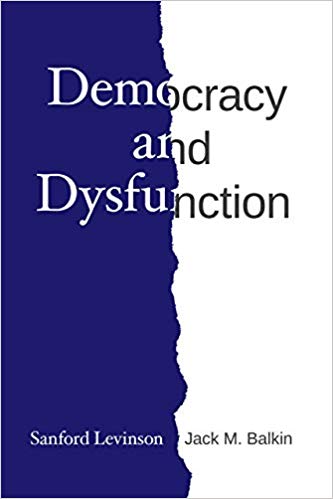
Sanford Levinson and Jack M. Balkin, Democracy and Dysfunction (University of Chicago Press, 2019)

Sanford Levinson, Written in Stone: Public Monuments in Changing Societies (Duke University Press 2018)

Mark A. Graber, Sanford Levinson, and Mark Tushnet, eds., Constitutional Democracy in Crisis? (Oxford University Press 2018)

Gerard Magliocca, The Heart of the Constitution: How the Bill of Rights became the Bill of Rights (Oxford University Press, 2018)

Cynthia Levinson and Sanford Levinson, Fault Lines in the Constitution: The Framers, Their Fights, and the Flaws that Affect Us Today (Peachtree Publishers, 2017)

Brian Z. Tamanaha, A Realistic Theory of Law (Cambridge University Press 2017)

Sanford Levinson, Nullification and Secession in Modern Constitutional Thought (University Press of Kansas 2016)

Sanford Levinson, An Argument Open to All: Reading The Federalist in the 21st Century (Yale University Press 2015)

Stephen M. Griffin, Broken Trust: Dysfunctional Government and Constitutional Reform (University Press of Kansas, 2015)

Frank Pasquale, The Black Box Society: The Secret Algorithms That Control Money and Information (Harvard University Press, 2015)

Bruce Ackerman, We the People, Volume 3: The Civil Rights Revolution (Harvard University Press, 2014)
Balkinization Symposium on We the People, Volume 3: The Civil Rights Revolution

Joseph Fishkin, Bottlenecks: A New Theory of Equal Opportunity (Oxford University Press, 2014)

Mark A. Graber, A New Introduction to American Constitutionalism (Oxford University Press, 2013)

John Mikhail, Elements of Moral Cognition: Rawls' Linguistic Analogy and the Cognitive Science of Moral and Legal Judgment (Cambridge University Press, 2013)

Gerard N. Magliocca, American Founding Son: John Bingham and the Invention of the Fourteenth Amendment (New York University Press, 2013)

Stephen M. Griffin, Long Wars and the Constitution (Harvard University Press, 2013)

Andrew Koppelman, The Tough Luck Constitution and the Assault on Health Care Reform (Oxford University Press, 2013)

James E. Fleming and Linda C. McClain, Ordered Liberty: Rights, Responsibilities, and Virtues (Harvard University Press, 2013)
Balkinization Symposium on Ordered Liberty: Rights, Responsibilities, and Virtues

Andrew Koppelman, Defending American Religious Neutrality (Harvard University Press, 2013)

Brian Z. Tamanaha, Failing Law Schools (University of Chicago Press, 2012)

Sanford Levinson, Framed: America's 51 Constitutions and the Crisis of Governance (Oxford University Press, 2012)

Linda C. McClain and Joanna L. Grossman, Gender Equality: Dimensions of Women's Equal Citizenship (Cambridge University Press, 2012)

Mary Dudziak, War Time: An Idea, Its History, Its Consequences (Oxford University Press, 2012)

Jack M. Balkin, Living Originalism (Harvard University Press, 2011)

Jason Mazzone, Copyfraud and Other Abuses of Intellectual Property Law (Stanford University Press, 2011)

Richard W. Garnett and Andrew Koppelman, First Amendment Stories, (Foundation Press 2011)

Jack M. Balkin, Constitutional Redemption: Political Faith in an Unjust World (Harvard University Press, 2011)

Gerard Magliocca, The Tragedy of William Jennings Bryan: Constitutional Law and the Politics of Backlash (Yale University Press, 2011)

Bernard Harcourt, The Illusion of Free Markets: Punishment and the Myth of Natural Order (Harvard University Press, 2010)

Bruce Ackerman, The Decline and Fall of the American Republic (Harvard University Press, 2010)
Balkinization Symposium on The Decline and Fall of the American Republic

Ian Ayres. Carrots and Sticks: Unlock the Power of Incentives to Get Things Done (Bantam Books, 2010)

Mark Tushnet, Why the Constitution Matters (Yale University Press 2010)

Ian Ayres and Barry Nalebuff: Lifecycle Investing: A New, Safe, and Audacious Way to Improve the Performance of Your Retirement Portfolio (Basic Books, 2010)
.jpg)
Jack M. Balkin, The Laws of Change: I Ching and the Philosophy of Life (2d Edition, Sybil Creek Press 2009)

Brian Z. Tamanaha, Beyond the Formalist-Realist Divide: The Role of Politics in Judging (Princeton University Press 2009)
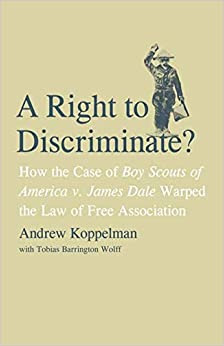
Andrew Koppelman and Tobias Barrington Wolff, A Right to Discriminate?: How the Case of Boy Scouts of America v. James Dale Warped the Law of Free Association (Yale University Press 2009)

Jack M. Balkin and Reva B. Siegel, The Constitution in 2020 (Oxford University Press 2009)

Heather K. Gerken, The Democracy Index: Why Our Election System Is Failing and How to Fix It (Princeton University Press 2009)

Mary Dudziak, Exporting American Dreams: Thurgood Marshall's African Journey (Oxford University Press 2008)

David Luban, Legal Ethics and Human Dignity (Cambridge Univ. Press 2007)

Ian Ayres, Super Crunchers: Why Thinking-By-Numbers is the New Way to be Smart (Bantam 2007)

Jack M. Balkin, James Grimmelmann, Eddan Katz, Nimrod Kozlovski, Shlomit Wagman and Tal Zarsky, eds., Cybercrime: Digital Cops in a Networked Environment (N.Y.U. Press 2007)
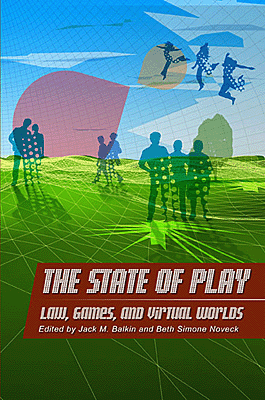
Jack M. Balkin and Beth Simone Noveck, The State of Play: Law, Games, and Virtual Worlds (N.Y.U. Press 2006)

Andrew Koppelman, Same Sex, Different States: When Same-Sex Marriages Cross State Lines (Yale University Press 2006)

Brian Tamanaha, Law as a Means to an End (Cambridge University Press 2006)

Sanford Levinson, Our Undemocratic Constitution (Oxford University Press 2006)

Mark Graber, Dred Scott and the Problem of Constitutional Evil (Cambridge University Press 2006)

Jack M. Balkin, ed., What Roe v. Wade Should Have Said (N.Y.U. Press 2005)

Sanford Levinson, ed., Torture: A Collection (Oxford University Press 2004)
Balkin.com homepage
Bibliography
Conlaw.net
Cultural Software
Writings
Opeds
The Information Society Project
BrownvBoard.com
Useful Links
Syllabi and Exams
