Balkinization
an unanticipated consequence of
Jack M. Balkin
Balkinization Symposiums: A Continuing List
E-mail:
Jack Balkin:
jackbalkin at yahoo.com
Bruce Ackerman
bruce.ackerman at yale.edu
Ian Ayres
ian.ayres at yale.edu
Corey Brettschneider
corey_brettschneider at brown.edu
Mary Dudziak
mary.l.dudziak at emory.edu
Joey Fishkin
joey.fishkin at gmail.com
Heather Gerken heather.gerken at yale.edu
Abbe Gluck abbe.gluck at yale.edu
Mark Graber
mgraber at law.umaryland.edu
Stephen Griffin
sgriffin at tulane.edu
Jonathan Hafetz
jonathan.hafetz at shu.edu
Jeremy Kessler
jkessler at law.columbia.edu
Andrew Koppelman
akoppelman at law.northwestern.edu
Marty Lederman
msl46 at law.georgetown.edu
Sanford Levinson
slevinson at law.utexas.edu
David Luban
david.luban at gmail.com
Gerard Magliocca
gmaglioc at iupui.edu
Jason Mazzone
mazzonej at illinois.edu
Linda McClain
lmcclain at bu.edu
John Mikhail
mikhail at law.georgetown.edu
Frank Pasquale
pasquale.frank at gmail.com
Nate Persily
npersily at gmail.com
Michael Stokes Paulsen
michaelstokespaulsen at gmail.com
Deborah Pearlstein
dpearlst at yu.edu
Rick Pildes
rick.pildes at nyu.edu
David Pozen
dpozen at law.columbia.edu
Richard Primus
raprimus at umich.edu
K. Sabeel Rahmansabeel.rahman at brooklaw.edu
Alice Ristroph
alice.ristroph at shu.edu
Neil Siegel
siegel at law.duke.edu
David Super
david.super at law.georgetown.edu
Brian Tamanaha
btamanaha at wulaw.wustl.edu
Nelson Tebbe
nelson.tebbe at brooklaw.edu
Mark Tushnet
mtushnet at law.harvard.edu
Adam Winkler
winkler at ucla.edu
Compendium of posts on Hobby Lobby and related cases
The Anti-Torture Memos: Balkinization Posts on Torture, Interrogation, Detention, War Powers, and OLC
The Anti-Torture Memos (arranged by topic)
Recent Posts
The Defense of Marriage Act
What's Wrong With Income Based Repayment In Legal Academia: A Response to Schrag
A Rejoinder to Michael Cannon Re the Rearguard Challenge to Obamacare
The Legally Flawed Rearguard Challenge to Obamacare
Democracy is Disdain
The Supreme Court, “Conjugal Marriage,” and DOMA: A Response to Girgis, Anderson, and George’s Appeal to SCOTUS to “Let the People Choose”
'Necessary,' 'Proper,' and Health Care Reform
"Looking forward" to 2016
The Petraeus Case: Legal Exposure of Military Retirees
John Brown’s Spy
![[Powered by Blogger]](https://lh3.googleusercontent.com/blogger_img_proxy/AEn0k_v9sYdayF-CNFN6UpjRaSPZ2LAUEPwRfBrs-19oq7VNqOG45U-LG5D89ud6HBqaneujzcY4AYiYxbtLJiyxTfPXpbHm23gdasRXFHW2MP7I=s0-d)
Just A Few Blogs
ACS Blog
Alas, a Blog
Althouse
Arts and Letters Daily
Atrios (Eschaton)
Bill of Health
Buzzflash.com
Buzz Machine
Cato at Liberty
Juan Cole (Informed Comment)
Concurring Opinions
The Constitution in 2020
Corrente
Crooked Timber
Daily Howler
Daily Kos
Dana Boyd
Brad DeLong
Digby (Hullabaloo)
Discriminations
Daniel Drezner
Kevin Drum (Mother Jones)
Electrolite
En Banc
Eunomia (Daniel Larison)
Fafblog
Michael Froomkin (Discourse.net)
GovLab (Beth Noveck)
Rick Hasen (Election Law)
History News Network
How Appealing
Ignatz (Sam Heldman)
The Importance of (Ernie Miller)
Infolaw
Instapundit
International Economic Law and Policy Blog
IntLawGrrls
Jacob Levy
Jesus' General
Jurisdynamics
The Kitchen Cabinet
Mark Kleiman
Law Blog Central
Larry Lessig
Lawyers, Guns and Money
Liberal Oasis
Brian Leiter's Law School Reports
The Leiter Reports
Marginal Revolution
Megan McArdle
Memeorandum
Metafilter
Mirror of Justice
The New Republic
Newseum
No More Mister Nice Blog
Brendan Nyhan
Opinio Juris
Orcinus
The Originalism Blog
Pandagon
Passport (Foreign Policy)
Overcoming Bias
Political Animal (Washington Monthly)
Political Theory Daily Review
Political Wire (Taegan Goddard)
The Poor Man
Virginia Postrel
Prawfsblawg
Public Reason
Jonathan Rauch
Raw Story
Redstate
ReligiousLeftLaw.com
Reporters Committee For Freedom of the Press
Reproductive Rights Blog
Rothman's Roadmap to the Right of Publicity
SCOTUS Blog
Seeing the Forest
Clay Shirky
The Shifted Librarian
The Situationist
Larry Solum (Legal Theory)
Andrew Sullivan
Talking Points Memo
Talk Left
Tapped
Tbogg
TechPresident
The Paper Chase (Jurist)
Tom Paine
Tom Tomorrow (This Modern World)
Eve Tushnet
Uggabugga
University of Chicago Law School Faculty Blog
Unqualified Offerings
The Volokh Conspiracy
War and Piece (Laura Rozen)
Wampum
Oliver Willis
Wonkette
Written Description
Matthew Yglesias
Yin
Your Choice of Feeds
1. XML
powered by

2. Atom Feed
3. RSS 2.0
The Defense of Marriage Act
Gerard N. Magliocca
How can DOMA be read this way? Here is the relevant language of Section 3:
"In determining the meaning of any Act of Congress, or of any ruling, regulation, or interpretation of the various administrative bureaus and agencies of the United States, the word 'marriage' means only a legal union between one man and one woman as husband and wife, and the word 'spouse' refers only to a person of the opposite sex who is a husband or wife."
This seems unambiguous, right? But it is not. Why? Because the background assumption in 1996 was that no state recognized same-sex marriage. In other words, Section 3 was just declaratory. Indeed, the managers of the bill indicated that Section 3 was meant to codify the traditional definition of marriage. Now that the background assumption has changed and some states do permit same-sex marriages, Section 3 should be construed in light of that change.
Is this the most straightforward reading of Section 3? No. But the Chief Justice explained in upholding the Affordable Care Act that this does not matter when a court is construing an Act of Congress. The only question is whether a saving construction is a "fairly possible one." I submit that reading Section 3 as declaratory language that was (and still is) tethered to state law is fairly possible, and thus the Court can dispose of the DOMA challenges without reaching the constitutional issues.
UPDATE: Sorry for the odd typeface in the prior version of the post.
Posted
9:49 AM
by Gerard N. Magliocca [link]
(23) comments
What's Wrong With Income Based Repayment In Legal Academia: A Response to Schrag
Brian Tamanaha
In Failing Law Schools, I argue that the economics of legal education don't work for the bulk of students because the high cost of a degree exceeds the economic return they obtain. In 2011, only 55% of graduates nationwide landed full-time jobs as lawyers; the average law school debt of private law school graduates was $125,000 (not counting undergraduate debt and interest accrued), and the median salary was $60,000. A law graduate who earns the median salary cannot manage the monthly payments on the average debt.
Phil Schrag has written a strong critique of my analysis, which I encourage everyone interested in these issues to read. He criticizes me for directing a "nuclear weapon" at the structure of legal education, when "small arms fire, to curb a few evident abuses, would have been a more appropriate response." The Income Based Repayment program (IBR) solves the economic problems I identify, he argues. IBR allows graduates to make monthly loan payments based upon their income (10% of income above 150% of the poverty rate), and forgives the remaining balance after 20 years. In a section called "Sarah gets rich," Schrag shows that law graduates on IBR end up doing very well. He also argues that, contrary to concerns I expressed, their credit scores (FICO) will not be adversely affected by the fact that their loan balances will remain very large (and in many instances grow), because creditors will care only about their fixed and manageable low monthly payments.
My main confusion, according to Schrag, was caused by a too literal reading of two central elements: I erroneously believe that the ten year "standard" repayment period really is (or should be) the baseline; and I erroneously believe that the statutory eligibility threshold for IBR--"partial financial hardship"--really means that graduates in IBR are suffering from "partial financial hardship." He argues that students in IBR are not in fact in financial hardship. A more accurate perspective, he argues, would see IBR as the "'standard payment' or 'standard payment for high debt borrowers,'" and the 10 year term as "accelerated repayment."
Schrag makes a convincing case. The recently implemented version of IBR is far more generous than the formula in place when I wrote the book (15% of income above 150% of the poverty line, forgiveness after 25%). Under the previous program, a student on IBR would end up paying more each month and a much higher amount of interest on the loan before forgiveness. (Critics of the new formula, from both the left and the right, argue that it offers almost no benefit to low income earners, while being very generous to graduates who earn $50,000 or more.)
It bears pointing out that Schrag's positive take on the situation downplays the fact that the balance forgiven at the end of twenty years is treated as taxable income (a nasty tax bill awaits them), and he is less troubled than I am by the fact that our graduates will not be free of their law school debt until deep into their middle age (when paying mortgages, and saving for retirement and their children's college tuition). But those differences aside, his argument is sound.
That said, in my view IBR does not solve the basic underlying problem of the warped economics of legal education, but actually has the potential to make it worse. I will identify just two reasons to doubt Schrag's assertion that no big changes are necessary.
First, I find it alarming, not reassuring, to be told that IBR should be viewed as the "standard payment" for contemporary law grads. This very assertion confirms the argument of my book that, as a systemic matter for the bulk of law students, the income they earn coming out (and for years thereafter) cannot support the amount of debt they took on to obtain their law degree.
Now, given this recognition, legal educators can take the position that we should engage in fundamental reforms aimed at rectifying this systemic economic mismatch; or we can leave the situation basically as it is and be thankful that IBR saves us from making hard choices. My stance is the former, not just because I believe the economic mismatch has many bad consequences, but also because I believe it is unwise to count on the existence of a government program that might well be cut back or restricted in the budget cutting battles that lie ahead. As Schrag recognizes, the forgiveness aspect of IBR operates as a subsidy for law schools, covered by taxpayers. When this becomes widely understood, at least in Congress and the Department of Education, I doubt that it will enjoy much support.
The second reason for concern is that the operation of IBR exacerbates the situation in several ways. Because monthly loan payments under the program are tied to salary, not to the amount owed, IBR renders the size of the debt irrelevant. For example, a student who owes $130,000 will pay exactly the same amount over the 20 years as a student who owes $200,000 (assuming the same income). Consequently, students might be less concerned about whether law school is a poor economic risk (their downside is limited), and they need not think about the magnitude of the debt they take on because all will be forgiven at 20 years.
Besides encouraging inefficient economic decisions by students, IBR will artificially keep alive law schools that should not exist. There are a bunch of law schools where graduates have debt well in excess of $130,000, only a third or so of graduates land jobs as lawyers, and most grads who land jobs earn between $40,000 and $60,000. Without IBR these law schools would likely go under--or drastically slash their tuition--because few rational students would enroll. Owing to IBR, however, these law schools can entice students by telling them that they should not be afraid of the size of the debt they take on because their monthly payments will be capped at a manageable level and the remaining debt will be forgiven in the end. A number of law schools are making this pitch today (Cal Western is cited as an example in the report linked above). The intended purpose of IBR is to rescue grads who find themselves drowning under large educational debt--but it was not set up to be utilized by schools (fighting for their own survival) as an inducement to persuade prospective students to leap into risky financial waters that will likely leave them foundering.
Finally, the fact that IBR makes the size of the debt irrelevant means that law schools can increase tuition without worrying about adverse consequences for our students. The added debt that follows from tuition increases will not be borne by them because anything added to the bottom line will simply be wiped away at forgiveness.
Law schools benefit from and are happy about these aspects of IBR. But legal educators should also consider whether they are good for our students and for society.
Posted
6:38 PM
by Brian Tamanaha [link]
(33) comments
A Rejoinder to Michael Cannon Re the Rearguard Challenge to Obamacare
Unknown
Michael Cannon has a post up responding to my post from yesterday critiquing his and Jonathan Adler's backdoor challenge to Obamacare. I don't want to get in an endless back-and-forth on the blogs, so I will stop after this post. But I thought I'd offer this rejoinder to Cannon's most recent post, as I regard that post as essentially conceding the crucial points in the argument.
To review the bidding: The ACA imposed on individuals a mandate that they obtain health insurance. To enable them to obtain health insurance, the ACA directed states to set up exchanges and provided individuals with tax credits to make the insurance purchased on those exchanges affordable. Recognizing that states might not cooperate, the ACA provided that where the state does not establish the "required exchange," the federal government shall "establish and operate such exchange within the State." 42 U.S.C. § 18041(c)(1).
Despite this language , Cannon and Adler argue that the ACA forbids the IRS from providing tax credits to individuals who purchase insurance on federally-operated exchanges. They make this argument even though Cannon recognizes that the exchange system will unravel -- that the exchanges won't be able to do what they were intended to do -- if participants cannot receive the tax subsidies that the ACA provides. They argue that this result is required by Congress's use of the phrase "Exchange established by the State under section 1311" in the ACA provision that describes how the premium tax credits should be calculated, 26 U.S.C. § 36B(b)(2)(A), (c)(2)(A)(i). But to read the "established by the State under section 1311" language as exclusionary would fly in the face of the "establish and operate such exchange" language that also appears in the statute. More to the point, it would make the entire backup option that the ACA provides -- that the federal government will operate exchanges in states that don't set them up -- largely unable to achieve its purpose. Again, Cannon basically admits this.
In other words, Cannon and Adler are arguing that a single statutory phrase -- a phrase that does not purport to identify what individuals can receive the ACA's premium tax credits -- trumps other statutory language and the overall structure of the ACA. For such an argument to be plausible, Cannon and Adler have a pretty significant burden to explain why Congress would want to withhold the premium tax credits from participants in the federally-operated exchanges. In the post to which I responded, Cannon attempted to do just that. He gave two reasons why Congress would have wanted to grant tax credits only to participants in state-operated, but not federally-operated exchanges: (1) that "[i]n order to have state-run Exchanges, the bill needed some way to encourage states to create them without 'commandeering' the states"; and (2) that "[c]onditioning the tax credits on state compliance was the only way the [Senate Finance] Committee could even consider legislation directing states to establish Exchanges."
As I showed in my post yesterday, neither of these reasons explains why Congress would have wanted to grant tax credits to participants in state-operated exchanges while denying them from federally-operated exchanges. Because the ACA gave the states the option to set up their own exchanges or stand aside and let the federal government do it directly, there was no commandeering problem to solve. And the Senate Finance Committee's jurisdiction extends to granting tax credits to participants on federally-operated exchanges just as much as it extends to granting tax credits to participants on state-operated exchanges.
Tellingly, Cannon's post today largely acknowledges that I was right on these points. But, Cannon argues, "[j]ust because Congress didn’t have to do something doesn’t mean Congress didn’t do it." Well, sure. But Cannon misunderstands his burden here. He's the one who is taking a single statutory phrase and unnecessarily reading it as in conflict with other statutory language and with the overall structure of the statute. So he's the one who has to explain why Congress would have intended that phrase to have that meaning and to trump the statute's other language and overall structure. The best he can come up with is that Congress was trying to solve two problems (the commandeering problem and the committee jurisdiction problem) that he seems to admit weren't even problems.
But it is implausible to think that Congress would have intended to create a statute that was so at war with itself -- and that rendered largely useless its crucial backup provision for federally-operated exchanges -- in order to solve two nonproblems. The far more plausible interpretation of the statutory text is the one that I set forth in my previous post: when Congress said that the federal government shall step in and operate the "required exchange," that language meant that the federally-operated exchange stands in the shoes of the exchange that the state was directed to, but did not, set up, and participants on federally-operated exchanges are entitled to the same tax credits as are participants on state-operated exchanges.
To borrow from Forrest Gump, that's all I have to say about that.
Posted
10:38 PM
by Unknown [link]
The Legally Flawed Rearguard Challenge to Obamacare
Unknown
Although the Supreme Court upheld the Affordable Care Act's individual mandate in its blockbuster NFIB decision this past summer, a move is afoot among the ACA's opponents to try to unravel that victory. As I will show below, that move rests on an argument that is deeply legally flawed. But to get there will require a bit of explanation about how the statute works.
The ACA's individual mandate was part of a coordinated set of interventions in health insurance markets that were designed, together, to guarantee affordable coverage to a wide range of people. In addition to requiring that individuals obtain coverage, the statute also providesthat states will create health insurance "exchanges" (essentially controlled marketplaces) for individuals to obtain that coverage, and itestablishes a series of tax subsidies to make it possible for individuals to afford the insurance that is offered on those exchanges. In states that do not set up exchanges, the statute provides that the federal government will set up and operate the exchanges for them. The mandate, the exchanges, and the subsidies all work together (along with the statute's bar on discrimination against individuals with preexisting conditions, and its penalties for employers who do not cover their employees) to achieve the goal of expanded, affordable health insurance coverage.
Although the Obama Administration has extended the deadline for states to decide whether to set up their own health insurance exchanges, estimates are that up to 20 states will refuse to do so. Those refusals, in many cases borne of continued opposition to Obamacare, will put a burden on the federal Department of Health and Human Services. But under the statutory scheme, they should ultimately be no problem: in states that don't set up exchanges, the federal government will set up and operate the exchanges for them.
But some Obamacare opponents insist that, if a state refuses to set up an exchange and the federal government sets one up in its place, the individuals who purchase insurance on the federally-operated exchange will not be entitled to receive the statute's tax subsidies. Directly rejecting that argument, the Internal Revenue Service has interpreted the statute as making the tax subsidies are available to individuals regardless of whether they live in a state that operates its own exchange or in one in which the federal government operates the exchange. But the opponents are undaunted. In an argument set forth most extensively in a widely circulated paper by Cato's Michael Cannon and my friend Professor Jonathan Adler, and in a federal-courtchallenge filed by the State of Oklahoma, they contend that the IRS's interpretation of the statute is illegal.
As Cannon acknowledges, the entire structure and operation of the ACA will unravel if individuals who receive insurance from federally-operated exchanges cannot receive the tax subsidies the statute establishes. If participants can't get tax subsidies, many won't be able to purchase insurance on the exchanges. That will harm those who cannot get insurance, and it will also undermine the benefits of mandated coverage. And, perhaps not coincidentally, it will undermine support for the law. As Jonathan Cohn argues, "Obamacare critics believe that, by blocking the subsidies, they’ll undermine the law’s effectiveness and eventually erode support to the point that people clamor for a conservative alternative."
Cannon and Adler's argument, taken up by Oklahoma in its lawsuit, is deeply flawed as a matter of law. Their basic argument is this: In Cannon's words, the provision of the ACA that establishes premium tax credits "explicitly and laboriously restricts tax credits to those who buy health insurance in Exchanges 'established by the State under section 1311.' There is no parallel language – none whatsoever – granting eligibility through Exchanges established by the federal government (section 1321)."
But that is not quite right. Although the tax-credit provision twice uses the phrase "Exchange established by the State under section 1311," see 26 U.S.C. § 36B(b)(2)(A), (c)(2)(A)(i), that phrase does not have the exclusionary meaning Cannon attributes to it. That is because Section 1321 (codified at 42 U.S.C. § 18041) makes clear that, when a state fails to set up an exchange, the federally-operated exchange will stand in the shoes of the state exchange for purposes of Section 1311. Thus, Section 1311 provides that "[e]ach State shall" set up an exchange by January 1, 2014. 42 U.S.C. § 18031(b)(1). Section 1321 provides that if a state "will not have any required Exchange operational" by then -- that is, an exchange required by Section 1311 -- then the federal government "shall (directly or through agreement with a not-for-profit entity) establish and operate such Exchange within the State." 42 U.S.C. § 18041(c)(1) (emphasis added). "[S]uch Exchange" in Section 1321 clearly refers to the "required exchange" -- that is, the Section 1311 exchange. When the federal government operates an exchange pursuant to Section 1321, then, it is not operating some wholly foreign entity; it is operating the state exchange that Section 1311 required the state to set up but that the state failed to create. Because Section 1321 provides that a federally-operated exchange will stand in the shoes of a state-operated exchange created by Section 1311, there is no basis for denying participants in federally-operated exchanges the same tax credits obtained by participants in state-operated exchanges.
The IRS's interpretation of the ACA to extend premium subsidies to participants in both state- and federally-operated exchanges thus seems to me not merely a permissible one but also the most plausible reading of the statutory text. Nor is there any reason to think that Congress would have intended to treat participants in state- and federally-operated exchanges differently for purposes of obtaining the subsidies. In both state- and federally-operated exchanges, the subsidies serve the same crucial role in achieving the statute's goal of expanded, affordable health coverage. If you take the subsidies away from participants in either sort of exchange, the law's protections are likely to unravel in the same way.
Cannon argues, though, that Congress did intend to draw a distinction between state- and federally-operated exchanges for these purposes. But his arguments are red herrings. First, Cannon argues that "[i]n order to have state-run Exchanges, the bill needed some way to encourage states to create them without 'commandeering' the states," and that offering premium subsidies limited to states that set up their own exchanges was a means to overcome the commandeering problem. But anyone who understands the Supreme Court's commandeering doctrine knows that the premium subsidies were not at all necessary to overcome any commandeering problem. The anticommandeering principle forbids Congress from compelling the states to regulate private parties, but it permits Congress to give the states the choice between regulating private parties according to federal standards and standing aside to allow the federal government to regulate those parties directly. That's the Court's square holding in New York v. United States. And that, of course, is the precise choice that the ACA gave states even without the subsidies -- regulate individuals and insurance companies through state-operated exchanges, or stand aside and let the federal government set up and operate exchanges of its own. So there is no reason to attribute to Congress a decision to limit subsidies to participants in state-operated exchanges in order to overcome any commandeering problem. Once the federal government could set up its own exchanges, there was no commandeering problem.
Second, Cannon adverts to the limited jurisdiction of the Senate Finance Committee: "The Finance Committee had even more reason to condition tax credits on state compliance: it doesn’t have direct jurisdiction over health insurance. Conditioning the tax credits on state compliance was the only way the Committee could even consider legislation directing states to establish Exchanges." But there is nothing in the Finance Committee's jurisdiction that required it to limit tax subsidies to participants in state-operated exchanges. Legislation that extended premium tax credits to participants in any exchange, whether state- or federally-operated, was fully within the Committee's jurisdiction. And, as I have argued above, that is precisely the legislation that Congress passed.
Whatever its value to conservative activists and those who wish to relitigate NFIB and the election, the rearguard effort to undermine Obamacare is deeply flawed as a matter of law.
Cross-posted from the Disability Law Blog.
Posted
12:21 AM
by Unknown [link]
Democracy is Disdain
Gerard N. Magliocca
Over the weekend I read Pam Karlan's Foreword in the Harvard Law Review, which is entitled "Democracy and Disdain." Like almost everything Professor Karlan writes, this paper was filled with terrific insights and makes a strong case. Nevertheless, I did come away with a significant doubt.
The thesis of the Foreword, put crudely, is that a characteristic trait of the Roberts Court is disdain for the elected branches, especially Congress. In contrast to the Warren Court, which was deferential and respectful towards Congress (in upholding the Civil Rights Act of 1964 and the Voting Rights Act of 1965, for example), the Roberts Court is far more skeptical of congressional motives and capabilities. Professor Karlan argues that this negative attitude is corrosive to democratic institutions, and claims that the Court's disdain for Congress can be traced, to some extent, to the current lack of any Justices who served in Congress or in any other elective office. (Once again, the comparison is with a Court filled with Earl Warren, ex-Governor of California, and Hugo Black, ex-Senator from Alabama.)
While I agree with much of this analysis, my problem with Professor Karlan's position is that the Court's disdain is an accurate reflection of popular opinion, which holds Congress in low esteem. (Much lower than in the 1960s). In effect, her complaint is that the Justices are too representative. That's an ironic twist for an article arguing that the Court is not treating democratic institutions with enough respect. Moreover, I think the disdain that Professor Karlan describes is not the product of ignorance about the legislative process. I was once at an event where the Chief Justice expressed his frustration with congressional treatment of judicial pay increases, an issue on which he personally lobbied and met with the leadership. (To paraphrase, he said he was fed up with Congress.)
I think the deeper question lurking here is why the American People are so disappointed with Congress, and what can be done about that. More applause from the Justices probably will not help.
Posted
3:25 PM
by Gerard N. Magliocca [link]
(19) comments
The Supreme Court, “Conjugal Marriage,” and DOMA: A Response to Girgis, Anderson, and George’s Appeal to SCOTUS to “Let the People Choose”
Linda McClain
In an opinion piece in yesterday’s Wall Street Journal, "The Wisdom of Upholding Tradition," Sherif Girgis, Ryan Anderson, and Robert George offer an argument for "conjugal marriage." Their impetus for writing is that: "The U.S. Supreme Court decides next week whether to hear challenges to laws defining marriage as the conjugal union of a man and a woman." Another impetus is launching their forthcoming book, What Is Marriage? Man and Woman: A Defense, an elaboration upon their similarly-titled and much-circulated law review article. The authors note that the voters in three states – Maryland, Maine, and Washington – chose, just a few weeks ago, to approve legislation extending civil marriage to same-sex couples. They contend that these voters endorsed a "revisionist view of marriage as the union of any two adults." They take heart from the contrasting example of North Carolina voters amending their constitution, earlier this year, "to protect the conjugal definition of marriage, a definition that 41 states retain." They exhort conservatives not to be "duped into surrender" by arguments that same-sex marriage is inevitable.
The opinion piece is most striking – even baffling – for its assertion that: "The Supreme Court should let the people choose; and we should choose marriage, conjugal marriage." The people should choose because "nothing in the Constitution" favors either the conjugal or revisionist view of marriage. They no doubt aim here at the reliance by federal courts upon Romer v. Evans – and the Court’s Equal Protection jurisprudence – to strike down Section 3 of the Defense of Marriage Act, which defines marriage, for purposes of federal law, as between one man and one woman. They contend: "We can’t move one inch toward an answer simply by appealing to equality." Further, the conjugal view of marriage does not rest on "animus against any group" but instead "best fits our social practices and judgements about what marriage is."
As a family law scholar, I could offer a detailed account of how their view of "conjugal marriage’ does not best fit how contemporary family law – or constitutional law – regards marriage. Moreover, surveys of public opinion and patterns of family life also contradict their claims about social practices. However, my concern here is the authors’ prescription to the Supreme Court to "let the people choose." What does that mean in the context of the challenges brought by same-sex couples and by states themselves to the constitutionality of Section 3 of DOMA? If "the people" of a particular state choose to allow same-sex couples to marry (e.g., New York or Vermont), then how would the Court support their choice if it reverses lower federal courts and upholds DOMA?
Is the authors’ claim that the people should choose, instead, an argument that they did choose when their elected representatives in Congress enacted DOMA? And that, unless and until they choose again by Congress repealing DOMA, the federal law should maintain a one man-one woman definition of marriage even if a particular state defines marriage to include same-sex couples?
Congress enacted DOMA in 1996, warning of the threat of activist judges (at that time, in Hawaii) imposing same-sex marriage on the Nation. Lawmakers argued that DOMA would leave the matter of defining marriage to democratically-elected legislatures. And, in 2003, when Massachusetts’s highest court interpreted the state constitution to require marriage equality, conservatives again decried judicial activism. However, when state legislatures – without a judicial spur – enacted marriage equality laws, groups like the National Organization for Marriage (of which George is a leader) argued that "the people" should be allowed to choose through ballot initiatives. NOM fought hard in Maine, Maryland, and Washington for -- in their terms -- "conjugal marriage" and against "revisionist marriage." NOM leaders expressed confidence that every time "the people" had a chance at the polls, they had voted in favor of traditional, or conjugal, marriage. However, voters in Maryland, Maine, and Washington proved NOM wrong. And in Minnesota, they declined to enshrine a state DOMA in their constitution. (No wonder Girgis, Anderson, and George stress North Carolina. Their urging conservatives not to abandon support for conjugal marriage seems a direct response to some conservative commentary that it is time for the Republican party to rethink fighting marriage equality as well as its alliance with NOM.)
So, the pertinent question for the Supreme Court with respect to considering the many DOMA petitions before it is not best framed as "whether to hear challenges to laws defining marriage as the conjugal union of a man and a woman" or whether to "let the people choose." The more precise question is: when a state’s marriage law defines marriage to include the union of two members of the same sex, does Section 3 violate the guarantee of equal protection when it denies those couples lawfully married under state law significant federal benefits otherwise available to persons lawfully married under state law? To put it in terms of the recent ballot initiatives where voters chose marriage equality, when couples lawfully married under these laws confront DOMA’s failure to recognize their marriages, how would the Court be letting "the people" choose in upholding DOMA and denying those couples federal benefits?
In striking down Section 3 of DOMA, the First Circuit persuasively appealed to values of federalism and of different states reaching different resolutions on the definition of marriage. Acknowledging that "many Americans believe that marriage is the union of a man and a woman, and most Americans live in states where that is the law today," it further observed: "One virtue of federalism is that it permits this diversity of governance to be based on local choice, but this applies as well to the states that have chosen to legalize same-sex marriage."
Using a heightened scrutiny standard, the Second Circuit did not find appeals to a federally uniform definition of marriage to be a constitutionally persuasive reason for the federal government to refuse to recognize marriages lawful under state law. It noted that DOMA was an "unprecedented breach of longstanding deference to federalism that singles out same-sex marriage as the only inconsistency (among many) in state law that requires a federal rule to achieve uniformity."
The petitions before the Supreme Court challenging the constitutionality of Section 3 of DOMA are not asking the Court to "impose" one view or the other of marriage upon the Nation. The petitions filed by the Bipartisan Legal Advisory Group, in defense of DOMA, are asking the Court to uphold a law that imposes one uniform definition of marriage at the federal level, even when a growing number of states have embraced marriage equality. It is important to be clear and precise about what is – and is not – at stake in the constitutional challenges to DOMA.
Posted
4:25 PM
by Linda McClain [link]
'Necessary,' 'Proper,' and Health Care Reform
Andrew Koppelman
Posted
10:05 AM
by Andrew Koppelman [link]
"Looking forward" to 2016
Sandy Levinson
It's clearly not too early to begin thinking of the 2016 elections. Unlike most such analysts, I'm not particularly interested in predicting the particular identity of the candidates--though I withdraw my prediction that David Petraeus might well be the next President! Instead, I remain far more interested in the implications of our dysfunctional structures, many (though not all) imposed by the Constitution.
The best example of the latter, of course, is the electoral college. The New York Times has an editorial on the "tarnish" of the electoral college, pointing out, quite rightly, that suddenly it's Republicans who are wondering about their devotion to this aspect of the Constitution. In any event, they endorse the Fair Vote proposal by which the 10 largest states would simply agree to allot their votes to the winner of the national popular vote on a first-past-the-post basis. As I've undoubtedly written before, I have strong hesitations about this proposal precisely because it does absolutely nothing to address the problem of "minority presidents," defined as popular vote "winners" who, nonetheless, have not received the support of a majority of the voting population. The most dramatic example, with the most significant consequences, is surely Abraham Lincoln, whose election, with 39.8% of the popular vote, triggered the ensuing War. But I've also noted that both Richard Nixon and Bill Clinton got to the Oval Office with only around 43% of the total popular vote. Thus, I strongly support a procedure whereby the winner could make a truly plausible claim to be supported by the majority. Easiest to imagine is a run-off system, as in France or the state of Georgia. Harder, but with its own virtues, is "approval voting," whereby voters are asked to indicate all of the candidates they'd in fact "approve of" with regard to their becoming president. There are other options as well, but first-past-the-post has nothing to be said for it as a mechanism for assuring majority rule. The reason that the Fair Vote proposal has legs, for the Times and others, is because of the most dreadful single aspect of the Constitution, Article V, which, by making amendment nearly impossible, forces us to think of solutions that don't require such amendment, of which the Fair Vote proposal is a good example.
Having criticized Fair Vote and its indefatigable chair, Rob Ritchie, I should note that the Washington Post has a superb op-ed by him on what might be termed (by me, not him) the "illegitimacy" of the House of Representatives inasmuch the substantial Republican majority in no way reflects the 52% of the voters who in fact voted for Democratic representatives. Instead, it represents the triumph of partisan gerrymandering, defined very well as the process by which politicos pick their voters rather than the other way around. It is this dreadful feature of our political system, NOT required by the Constitution, that explains why it now counts as "success" if the United States doesn't go over a "cliff" or continues to pay its debts, as against genuinely confronting the serious problems that face us as a polity. No one expects that to happen in the next two years, given the ability of the House to veto any progressive legislation. Barack Obama once famously said, "elections have consequences," but he was misleading us. That might be true in some political systems, but in our own, the Constitution assures that elections too often are extremely limited in their consequences, save for discouraging ever more Americans to have any genuine faith in their government. On one end of the spectrum, this leads to chatter about secession; on the other, a simple "inner emigration" from any participation in a corrupt and gridolocked political process.
Instead of viewing 2016 as the occasion for just another horse race--will Christie lose enough weight to outpace Rubio?--we should, instead, be talking about what might be needed in order to make that election more truly significant than this one's was (save that, for most of us, it saved us from the dreaded spectre of the "leadership" of the monumentally clueless Mitt Romney and his Ayn Rand sidekick). It also strikes me as highly likely that the Republican Party will fragment, as social conservatives and nativists (not necessarily the same) reject the triumph of either libertarians or country-club business (again, not the same) and run their own candidates. Consider only the fissures already being revealed re immigration, let alone the response of the GOP to the repeal of DOMA should the Supreme Court (rather surprisingly) uphold it in a rare exercise of what the majority would undoubtedly term "judicial restraint." Social conservatives might well like the Electoral College, incidentally, if they figure, probably rightly, that they can win at least the same number of electoral votes won by Strom Thurmond or George Wallace and, should the election be thrown into the House (which, remember picks a Preisdent on a one-state/one-vote basis), be able to exercise great influence at least over the Cabinet picks of ultimate winner.
So there will still be many opportunities to go over the cliff even if Barack Obama and John Boehner manage to put together a "grand bargain." Think of it as the Compromise of 1850, which kind-of-worked for ten years, and then all hell broke loose.
Posted
3:24 PM
by Sandy Levinson [link]
(144) comments
The Petraeus Case: Legal Exposure of Military Retirees
Eugene R. Fidell
As a retired member of the Regular Army, Gen. Petraeus remains subject to the Uniform Code of Military Justice. Army regulations provide that retirees "may be tried by court-martial for violations of the UCMJ that occurred while they were on active duty or, while in a retired status. Department of the Army policy provides that retired Soldiers subject to the UCMJ will not be tried for any offense by any courts-martial unless extraordinary circumstances are present." The exercise of court-martial jurisdiction over retirees violates contemporary international human rights standards, even though it is a tolerated (if infrequently used) feature of American military justice.
Adultery is no longer a crime in many states but remains one under the UCMJ. Article 134 criminalizes conduct that is, among other things, prejudicial to good order and discipline or of a nature to bring discredit upon the armed forces. Adultery is occasionally prosecuted within the armed forces, typically after the servicemember disregards advice to terminate an affair or if there are other aggravating factors. The Manual for Courts-Martial provides that "[w]hile adulterous conduct that is private and discreet in nature may not be service discrediting," it may still be found to be prejudicial to good order and discipline. In 2002, President George W. Bush issued guidelines for the exercise of discretion as to when adultery should be prosecuted by court-martial. These are still in force and include the accused's marital status, rank, and position and that of the other party and the spouses of each; the impact of the relationship on the accused's performance of duty, as well as that of the other party and their spouses; whether any notoriety ensued; and detrimental effects on unit or organizational morale, teamwork, and efficiency.
Barring dramatic new evidence, it seems highly unlikely that Gen. Petraeus's case rises to the level of "extraordinary circumstances" contemplated for trial of an Army retiree. That does not mean he is out of the woods.
Military officers retire in the highest grade they have satisfactorily held. Gen. Petraeus retired on August 31, 2011 as a four-star officer, the highest rank currently available to members of the U.S. armed forces. One would think that was the end of the matter, but the Army disagrees. A 2002 regulation provides, "Officer grade determinations are normally accomplished at time of retirement or disability separation, and the officer's grade is fixed at that time." Grade determinations can be "reopened," however, if "substantial new evidence" is discovered "within a short time following separation." It is unclear whether Gen. Petraeus's case meets the "short time" test. Given his life expectancy, a reduction in his retired grade would inflict a whopping financial penalty.
The other party to Gen. Petraeus's affair is a reserve officer. Military jurisdiction could reach her if she engaged in adultery while in a drilling status or, viewing her as a civilian, if she were deemed to have been "accompanying" an armed force in the field in time of a "contingency operation" such as Afghanistan. It would certainly raise hackles if (notwithstanding his public disgrace) Gen. Petraeus were to escape punishment and she did not. Disparate outcomes would erode public confidence in the administration of military justice.
Gen. Petraeus's security clearance presents other issues. The Executive Branch--and definitely not just the present administration--is humorless when it comes to access to classified information. Misconduct such as adultery could form the basis for revoking his clearance, although the "whole person" concept would work in his favor. Once an affair becomes public, the danger of blackmail vanishes--although the error in judgment does not. Ms. Broadwell may also have to fight to keep her own clearance.
Finally, considering Gen. Petraeus not as a retired military officer but as a civilian official, federal law permits adverse personnel action for off-duty conduct that does not promote "the efficiency of the service." An egregious case decided in 2000 upheld the removal of a civilian employee of the Marine Corps because he had had an adulterous affair with the wife of an officer who was deployed overseas. One would have to know more before deciding whether there was a nexus between Gen. Petraeus's affair with Ms. Broadwell and his duties as Director of Central Intelligence. As a political appointee, the fine points of federal personnel law do not play much of a role, but had there been a nexus, adultery would certainly have been a severe blow to his viability as a civilian public official.
Gen. Petraeus's case will in time sort itself out. In the process, the country should consider whether on balance it is well served by his departure, whether adultery ought to be so big a deal, whether it should remain criminalized, and whether it's time for military justice to let go of retirees.
Posted
7:31 PM
by Eugene R. Fidell [link]
John Brown’s Spy
Andrew Koppelman
Posted
3:51 PM
by Andrew Koppelman [link]
Books by Balkinization Bloggers

Gerard N. Magliocca, The Actual Art of Governing: Justice Robert H. Jackson's Concurring Opinion in the Steel Seizure Case (Oxford University Press, 2025)

Linda C. McClain and Aziza Ahmed, The Routledge Companion to Gender and COVID-19 (Routledge, 2024)

David Pozen, The Constitution of the War on Drugs (Oxford University Press, 2024)

Jack M. Balkin, Memory and Authority: The Uses of History in Constitutional Interpretation (Yale University Press, 2024)
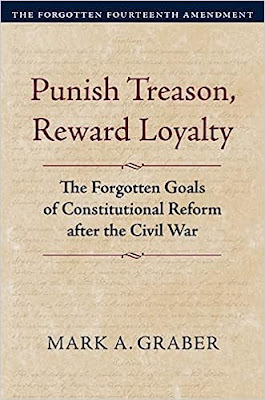
Mark A. Graber, Punish Treason, Reward Loyalty: The Forgotten Goals of Constitutional Reform after the Civil War (University of Kansas Press, 2023)
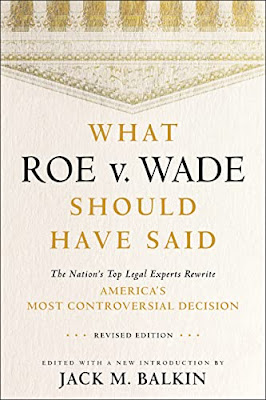
Jack M. Balkin, What Roe v. Wade Should Have Said: The Nation's Top Legal Experts Rewrite America's Most Controversial Decision - Revised Edition (NYU Press, 2023)

Andrew Koppelman, Burning Down the House: How Libertarian Philosophy Was Corrupted by Delusion and Greed (St. Martin’s Press, 2022)

Gerard N. Magliocca, Washington's Heir: The Life of Justice Bushrod Washington (Oxford University Press, 2022)
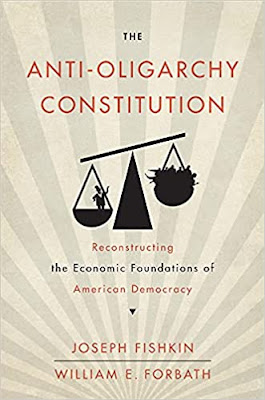
Joseph Fishkin and William E. Forbath, The Anti-Oligarchy Constitution: Reconstructing the Economic Foundations of American Democracy (Harvard University Press, 2022)
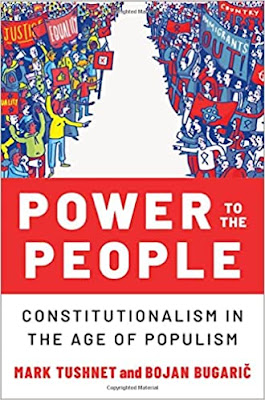
Mark Tushnet and Bojan Bugaric, Power to the People: Constitutionalism in the Age of Populism (Oxford University Press 2021).

Mark Philip Bradley and Mary L. Dudziak, eds., Making the Forever War: Marilyn B. Young on the Culture and Politics of American Militarism Culture and Politics in the Cold War and Beyond (University of Massachusetts Press, 2021).

Jack M. Balkin, What Obergefell v. Hodges Should Have Said: The Nation's Top Legal Experts Rewrite America's Same-Sex Marriage Decision (Yale University Press, 2020)

Frank Pasquale, New Laws of Robotics: Defending Human Expertise in the Age of AI (Belknap Press, 2020)

Jack M. Balkin, The Cycles of Constitutional Time (Oxford University Press, 2020)

Mark Tushnet, Taking Back the Constitution: Activist Judges and the Next Age of American Law (Yale University Press 2020).

Andrew Koppelman, Gay Rights vs. Religious Liberty?: The Unnecessary Conflict (Oxford University Press, 2020)

Ezekiel J Emanuel and Abbe R. Gluck, The Trillion Dollar Revolution: How the Affordable Care Act Transformed Politics, Law, and Health Care in America (PublicAffairs, 2020)

Linda C. McClain, Who's the Bigot?: Learning from Conflicts over Marriage and Civil Rights Law (Oxford University Press, 2020)
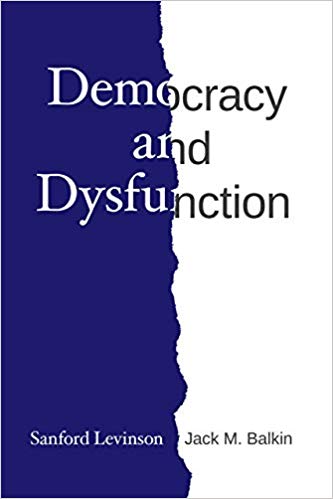
Sanford Levinson and Jack M. Balkin, Democracy and Dysfunction (University of Chicago Press, 2019)

Sanford Levinson, Written in Stone: Public Monuments in Changing Societies (Duke University Press 2018)

Mark A. Graber, Sanford Levinson, and Mark Tushnet, eds., Constitutional Democracy in Crisis? (Oxford University Press 2018)

Gerard Magliocca, The Heart of the Constitution: How the Bill of Rights became the Bill of Rights (Oxford University Press, 2018)

Cynthia Levinson and Sanford Levinson, Fault Lines in the Constitution: The Framers, Their Fights, and the Flaws that Affect Us Today (Peachtree Publishers, 2017)

Brian Z. Tamanaha, A Realistic Theory of Law (Cambridge University Press 2017)

Sanford Levinson, Nullification and Secession in Modern Constitutional Thought (University Press of Kansas 2016)

Sanford Levinson, An Argument Open to All: Reading The Federalist in the 21st Century (Yale University Press 2015)

Stephen M. Griffin, Broken Trust: Dysfunctional Government and Constitutional Reform (University Press of Kansas, 2015)

Frank Pasquale, The Black Box Society: The Secret Algorithms That Control Money and Information (Harvard University Press, 2015)

Bruce Ackerman, We the People, Volume 3: The Civil Rights Revolution (Harvard University Press, 2014)
Balkinization Symposium on We the People, Volume 3: The Civil Rights Revolution

Joseph Fishkin, Bottlenecks: A New Theory of Equal Opportunity (Oxford University Press, 2014)

Mark A. Graber, A New Introduction to American Constitutionalism (Oxford University Press, 2013)

John Mikhail, Elements of Moral Cognition: Rawls' Linguistic Analogy and the Cognitive Science of Moral and Legal Judgment (Cambridge University Press, 2013)

Gerard N. Magliocca, American Founding Son: John Bingham and the Invention of the Fourteenth Amendment (New York University Press, 2013)

Stephen M. Griffin, Long Wars and the Constitution (Harvard University Press, 2013)

Andrew Koppelman, The Tough Luck Constitution and the Assault on Health Care Reform (Oxford University Press, 2013)

James E. Fleming and Linda C. McClain, Ordered Liberty: Rights, Responsibilities, and Virtues (Harvard University Press, 2013)
Balkinization Symposium on Ordered Liberty: Rights, Responsibilities, and Virtues

Andrew Koppelman, Defending American Religious Neutrality (Harvard University Press, 2013)

Brian Z. Tamanaha, Failing Law Schools (University of Chicago Press, 2012)

Sanford Levinson, Framed: America's 51 Constitutions and the Crisis of Governance (Oxford University Press, 2012)

Linda C. McClain and Joanna L. Grossman, Gender Equality: Dimensions of Women's Equal Citizenship (Cambridge University Press, 2012)

Mary Dudziak, War Time: An Idea, Its History, Its Consequences (Oxford University Press, 2012)

Jack M. Balkin, Living Originalism (Harvard University Press, 2011)

Jason Mazzone, Copyfraud and Other Abuses of Intellectual Property Law (Stanford University Press, 2011)

Richard W. Garnett and Andrew Koppelman, First Amendment Stories, (Foundation Press 2011)

Jack M. Balkin, Constitutional Redemption: Political Faith in an Unjust World (Harvard University Press, 2011)

Gerard Magliocca, The Tragedy of William Jennings Bryan: Constitutional Law and the Politics of Backlash (Yale University Press, 2011)

Bernard Harcourt, The Illusion of Free Markets: Punishment and the Myth of Natural Order (Harvard University Press, 2010)

Bruce Ackerman, The Decline and Fall of the American Republic (Harvard University Press, 2010)
Balkinization Symposium on The Decline and Fall of the American Republic

Ian Ayres. Carrots and Sticks: Unlock the Power of Incentives to Get Things Done (Bantam Books, 2010)

Mark Tushnet, Why the Constitution Matters (Yale University Press 2010)

Ian Ayres and Barry Nalebuff: Lifecycle Investing: A New, Safe, and Audacious Way to Improve the Performance of Your Retirement Portfolio (Basic Books, 2010)
.jpg)
Jack M. Balkin, The Laws of Change: I Ching and the Philosophy of Life (2d Edition, Sybil Creek Press 2009)

Brian Z. Tamanaha, Beyond the Formalist-Realist Divide: The Role of Politics in Judging (Princeton University Press 2009)
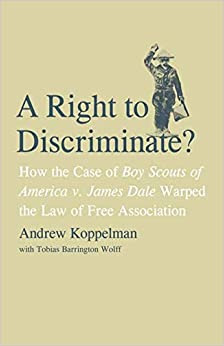
Andrew Koppelman and Tobias Barrington Wolff, A Right to Discriminate?: How the Case of Boy Scouts of America v. James Dale Warped the Law of Free Association (Yale University Press 2009)

Jack M. Balkin and Reva B. Siegel, The Constitution in 2020 (Oxford University Press 2009)

Heather K. Gerken, The Democracy Index: Why Our Election System Is Failing and How to Fix It (Princeton University Press 2009)

Mary Dudziak, Exporting American Dreams: Thurgood Marshall's African Journey (Oxford University Press 2008)

David Luban, Legal Ethics and Human Dignity (Cambridge Univ. Press 2007)

Ian Ayres, Super Crunchers: Why Thinking-By-Numbers is the New Way to be Smart (Bantam 2007)

Jack M. Balkin, James Grimmelmann, Eddan Katz, Nimrod Kozlovski, Shlomit Wagman and Tal Zarsky, eds., Cybercrime: Digital Cops in a Networked Environment (N.Y.U. Press 2007)

Jack M. Balkin and Beth Simone Noveck, The State of Play: Law, Games, and Virtual Worlds (N.Y.U. Press 2006)

Andrew Koppelman, Same Sex, Different States: When Same-Sex Marriages Cross State Lines (Yale University Press 2006)

Brian Tamanaha, Law as a Means to an End (Cambridge University Press 2006)

Sanford Levinson, Our Undemocratic Constitution (Oxford University Press 2006)

Mark Graber, Dred Scott and the Problem of Constitutional Evil (Cambridge University Press 2006)

Jack M. Balkin, ed., What Roe v. Wade Should Have Said (N.Y.U. Press 2005)

Sanford Levinson, ed., Torture: A Collection (Oxford University Press 2004)
Balkin.com homepage
Bibliography
Conlaw.net
Cultural Software
Writings
Opeds
The Information Society Project
BrownvBoard.com
Useful Links
Syllabi and Exams
