Balkinization
an unanticipated consequence of
Jack M. Balkin
Balkinization Symposiums: A Continuing List
E-mail:
Jack Balkin:
jackbalkin at yahoo.com
Bruce Ackerman
bruce.ackerman at yale.edu
Ian Ayres
ian.ayres at yale.edu
Corey Brettschneider
corey_brettschneider at brown.edu
Mary Dudziak
mary.l.dudziak at emory.edu
Joey Fishkin
joey.fishkin at gmail.com
Heather Gerken heather.gerken at yale.edu
Abbe Gluck abbe.gluck at yale.edu
Mark Graber
mgraber at law.umaryland.edu
Stephen Griffin
sgriffin at tulane.edu
Jonathan Hafetz
jonathan.hafetz at shu.edu
Jeremy Kessler
jkessler at law.columbia.edu
Andrew Koppelman
akoppelman at law.northwestern.edu
Marty Lederman
msl46 at law.georgetown.edu
Sanford Levinson
slevinson at law.utexas.edu
David Luban
david.luban at gmail.com
Gerard Magliocca
gmaglioc at iupui.edu
Jason Mazzone
mazzonej at illinois.edu
Linda McClain
lmcclain at bu.edu
John Mikhail
mikhail at law.georgetown.edu
Frank Pasquale
pasquale.frank at gmail.com
Nate Persily
npersily at gmail.com
Michael Stokes Paulsen
michaelstokespaulsen at gmail.com
Deborah Pearlstein
dpearlst at yu.edu
Rick Pildes
rick.pildes at nyu.edu
David Pozen
dpozen at law.columbia.edu
Richard Primus
raprimus at umich.edu
K. Sabeel Rahmansabeel.rahman at brooklaw.edu
Alice Ristroph
alice.ristroph at shu.edu
Neil Siegel
siegel at law.duke.edu
David Super
david.super at law.georgetown.edu
Brian Tamanaha
btamanaha at wulaw.wustl.edu
Nelson Tebbe
nelson.tebbe at brooklaw.edu
Mark Tushnet
mtushnet at law.harvard.edu
Adam Winkler
winkler at ucla.edu
Compendium of posts on Hobby Lobby and related cases
The Anti-Torture Memos: Balkinization Posts on Torture, Interrogation, Detention, War Powers, and OLC
The Anti-Torture Memos (arranged by topic)
Recent Posts
The Necessary and Proper Clauses, Part 3: James Wilson's Contribution to the Virginia Plan
Assessing Medicaid Managed Care
Collusion in the marriage cases?
A Snapshot of Law Student Debt that Every 1L (and Law Professor) Should See
Audit Trails: The Corporate Surveillance We Need
The Next Supreme Court National Security Detention Case?
Thomas Reed and Institutional Reform
How Inelastic is Demand for Law School? (Testing The Limits)
“Wall Street is our Main Street”
The Necessary and Proper Clauses, Part 2: Foregoing Powers v. All Other Powers
From Safety Net to Dragnet
Why the Supreme Court will strike down DOMA
Bill Bratton in London: Time for a Reality Check
New Haven Firefighters: Round Two
Individual Mandate: Federalism and Rights
Stealth Constitutional Change
A 2012 Preview
A few remarkable sentences in the Eleventh Circuit’s health care decision
Why the 11th Circuit’s Opinion Self-Destructs
The Necessary and Proper Clauses
SF BART: Silencing Phones, Stifling Protests, Violating Freedom of Speech?
Resolution VI as a Principle of Construction
Deficits and Defense Spending
Shared Sacrifice of Whom?
The Roberts Court and the State Courts: 2010 Term
Standard & Poor’s Downgrade of the USA: Defense Spending, Insider Trading, and the Myth of Unregulated Markets
Winters on Oligarchy
Constitutional Redemption Online Symposium
The Legislation
Regime change: Delegation run riot
George Washington on the Debt Ceiling Crisis
More on a constitutional convention
Is the Constitution simply irrelevant?
![[Powered by Blogger]](https://lh3.googleusercontent.com/blogger_img_proxy/AEn0k_uaaZ9JcMSezbbIF3q3Zaj-PsranhngRosrWRdd67fa1XzQlPgpGZEKohRDm0YCUl2AlsN4h-pfQo6YkkreCe2tzerH4dg01JvL7bMFJX1x=s0-d)
Just A Few Blogs
ACS Blog
Alas, a Blog
Althouse
Arts and Letters Daily
Atrios (Eschaton)
Bill of Health
Buzzflash.com
Buzz Machine
Cato at Liberty
Juan Cole (Informed Comment)
Concurring Opinions
The Constitution in 2020
Corrente
Crooked Timber
Daily Howler
Daily Kos
Dana Boyd
Brad DeLong
Digby (Hullabaloo)
Discriminations
Daniel Drezner
Kevin Drum (Mother Jones)
Electrolite
En Banc
Eunomia (Daniel Larison)
Fafblog
Michael Froomkin (Discourse.net)
GovLab (Beth Noveck)
Rick Hasen (Election Law)
History News Network
How Appealing
Ignatz (Sam Heldman)
The Importance of (Ernie Miller)
Infolaw
Instapundit
International Economic Law and Policy Blog
IntLawGrrls
Jacob Levy
Jesus' General
Jurisdynamics
The Kitchen Cabinet
Mark Kleiman
Law Blog Central
Larry Lessig
Lawyers, Guns and Money
Liberal Oasis
Brian Leiter's Law School Reports
The Leiter Reports
Marginal Revolution
Megan McArdle
Memeorandum
Metafilter
Mirror of Justice
The New Republic
Newseum
No More Mister Nice Blog
Brendan Nyhan
Opinio Juris
Orcinus
The Originalism Blog
Pandagon
Passport (Foreign Policy)
Overcoming Bias
Political Animal (Washington Monthly)
Political Theory Daily Review
Political Wire (Taegan Goddard)
The Poor Man
Virginia Postrel
Prawfsblawg
Public Reason
Jonathan Rauch
Raw Story
Redstate
ReligiousLeftLaw.com
Reporters Committee For Freedom of the Press
Reproductive Rights Blog
Rothman's Roadmap to the Right of Publicity
SCOTUS Blog
Seeing the Forest
Clay Shirky
The Shifted Librarian
The Situationist
Larry Solum (Legal Theory)
Andrew Sullivan
Talking Points Memo
Talk Left
Tapped
Tbogg
TechPresident
The Paper Chase (Jurist)
Tom Paine
Tom Tomorrow (This Modern World)
Eve Tushnet
Uggabugga
University of Chicago Law School Faculty Blog
Unqualified Offerings
The Volokh Conspiracy
War and Piece (Laura Rozen)
Wampum
Oliver Willis
Wonkette
Written Description
Matthew Yglesias
Yin
Your Choice of Feeds
1. XML
powered by

2. Atom Feed
3. RSS 2.0
The Necessary and Proper Clauses, Part 3: James Wilson's Contribution to the Virginia Plan
John Mikhail
A useful starting point is the critical language of Resolution VI of the Virginia Plan, which gave Congress the power “to legislate in all cases to which the States are incompetent, or in which the harmony of the United States may be interrupted by the exercise of individual legislation.”
This proposal was adopted by the convention and sent to the Committee of Detail, which then produced a list of enumerated powers that later became Article I, Section 8. As a result, historians and jurists have long recognized the importance of Resolution VI for interpreting the conceptions of federalism that motivated the Founders. In recent years, these ideas have been given renewed attention in work by Jack Rakove, Joseph Lynch, Jack Balkin, Kurt Lash, Robert Cooter & Neil Siegal, and many other writers, including my friend and colleague Randy Barnett.
By contrast, the origin of this critical passage in Resolution VI has received little or no attention. Instead, most scholars have simply assumed that all of the key provisions of the Virginia Plan, including this one, originated with James Madison.
Posted
9:24 AM
by John Mikhail [link]
Assessing Medicaid Managed Care
Frank Pasquale
The Washington Post has featured two interesting pieces recently on Medicaid managed care. Christopher Weaver reported on a battle between providers and insurers in Texas. Noting that "federal health law calls for a huge expansion of the Medicaid program in 2014," Weaver shows how eager insurers are to enroll poor individuals in their plans. Each enrollee would "yield on average $7 a month profit," according to recent calculations. Cost-cutting legislators see potential fiscal gains, too, once the market starts working its magic.
There's only one problem with those projections: it turns out that "moving Medicaid recipients into managed care 'did not lead to lower Medicaid spending during the 1991 to 2003 period,'" according to a report published by the National Bureau of Economic Research this month. Sarah Kliff is surprised to find that this is "the first national look at whether Medicaid managed care has actually done a key thing that states want it to do."
I share the frustration that we don't have enough information on key policy issues. On the other hand, I can see why economists and other social scientists would be reluctant to pronounce on the efficacy of Medicaid managed care.
Read more »
Posted
3:32 PM
by Frank Pasquale [link]
Collusion in the marriage cases?
Andrew Koppelman
The recent debates on SCOTUSblog about the same-sex marriage issue are remarkable for how little has been said on the substantive merits of the challenge to the Defense of Marriage Act (DOMA). I predicted that the Supreme Court would strike it down, and said that the Court would be right to do so. To my enormous surprise, those claims have gone unchallenged. Instead, William Duncan and John Eastman complain that the marriage suits are collusive; that they have not been properly defended, casting doubt on the legitimacy of the result.
I only wrote about the DOMA suit, so I’ll confine my attention there. Duncan claims that Attorney General Holder tried to throw the case. But Holder announced the decision to stop defending DOMA in a letter to John Boehner, who Holder knew would retain outside counsel.
The case is in fact being vigorously litigated by Paul Clement on Boehner’s behalf. DOMA’s real problem is not that it isn’t being defended, but that it is indefensible. Consider, for example, one truly terrible argument that Clement has just filed: the claim that Congress excluded same-sex couples from every single federal benefit in order to “provide for consistency in eligibility for federal benefits based on marital status.” Clement is a fine lawyer. If this is the best he can come up with, then the case for DOMA is desperate.
Read more »
Posted
12:43 PM
by Andrew Koppelman [link]
A Snapshot of Law Student Debt that Every 1L (and Law Professor) Should See
Brian Tamanaha
Average law school debt in 2010 was $68,827 for graduates from public schools and $106,249 from private schools. That is in addition to whatever undergraduate debt they might have accumulated. Remember, these are averages: many law students have debt in excess of $200,000. Here is a list of the twenty two law schools with the highest average indebtedness for the class of 2010 (among graduates who had debt):
1. California Western: $145,621 (88 percent of the class);
In total, graduates of 88 law schools, private and public, had debt in excess of $100,000 (with typically between mid-eighty to mid-ninety percent of the class in debt). A nationwide 2010 survey found that almost one third of law students expected to graduate with debt above $120,000.
2. Thomas Jefferson: $137,352 (95 percent);
3. Southwestern: $136,569 (79 percent);
4. American: $136,121 (84 percent);
5. Catholic (D.C.): $134,133 (91 percent);
6. Golden Gate: $132,895 (89 percent);
7. Northwestern: $132,685 (69 percent);
8. Loyola Marymount: $132,267 (85 percent);
9. Charleston: $128,571 (84 percent);
10. Pacific (McGeorge): $128,495 (93 percent);
11. Chicago: $127,997 (84 percent);
12. Vermont: $127,914 (93 percent);
13. Columbia: 126,945 (77 percent);
14. Cornell: $126,000 (80 percent);
15. John Marshall: $125,806 (74 percent);
16. Touro: $125,481 (94 percent);
17. New York University: $125,169 (80 percent);
18. Pepperdine: $125,114 (82 percent);
19. San Francisco: $124,982 (76 percent);
20. Albany: $124,271 (88 percent);
21. Roger Williams: $123,338 (88 percent);
22. Atlanta's John Marshall: $123,025 (96 percent).
Let's assume a newly minted graduate wishes to pay that $120,000 off in the standard 10 year term, and let's assume a consolidated loan rate of 7.25 percent (combining Stafford and GradPlus loans). The loan payment due each month will be $1,408. The student loan site I used to make this calculation, FinAid, advises: "It is estimated that you will need an annual salary of at least $169,057.20 to be able to afford to repay this loan....If you use 15% of your gross monthly income to repay the loan, you will need an annual salary of only $112,704.80, but you may experience some financial difficulty.This corresponds to a debt-to-income ratio of 1.1."
As an alternative, the graduate can pay back the loan over 30 years, which would allow a more manageable monthly loan payment of $818 (paying nearly $300,000 in total, retiring the debt at the ripe age of 55-60). FinAid says: "It is estimated that you will need an annual salary of at least $98,233.20 to be able to afford to repay this loan....If you use 15% of your gross monthly income to repay the loan, you will need an annual salary of only $65,488.80, but you may experience some financial difficulty.This corresponds to a debt-to-income ratio of 1.8."
Now take a look at the above list (all with average debt above $120,000) and contemplate how many law graduates can expect to earn enough to pay off their debt within 10 years, or even 30 years. Keep in mind that, according to NALP, only 64 percent of the class of 2010 secured full time lawyer jobs, with a median salary of $63,000.
For at least a half-dozen law schools on the above list, and probably more, it is fair to surmise, a majority of graduates will obtain jobs that pay less than $60,000 (with a significant number who will not find legal jobs at all). Many, many graduates face "financial difficulty." Their best way out is resort to Income Based Repayment--a federal program which allows students who qualify to pay lower monthly amounts and forgives the unpaid balance after 25 years (at taxpayer expense). That might sound like a deal, but another way to look at it is that for the bulk of their legal careers their income level qualifies them as suffering from financial hardship. Graduates who work in public service jobs will have the unpaid remainder of their loan forgiven after 10 years.
You might think that over time their debt payments will become easier to manage because their pay will increase. That will be true for some, but not for many. According to the Bureau of Labor Statistics, "In May 2008, the median annual wages of all wage-and-salaried lawyers were $110,590. The middle half of the occupation earned between $74,980 and $163,320." These numbers suggest that, at least among "wage-and-salaried lawyers," many will continue to experience difficulty paying down a $120,000 loan well into their careers.
New first-year students, 45,000 strong, are streaming into law schools around the country this week. If you know any, please send them a link to this post. (I'm sending it to all of my students.) Attending law school can be the right decision for students with a strong desire to become a lawyer. However, students who are attending law school mainly because they are unemployed and think a law degree will provide them with better opportunities down the line must seriously consider the economic consequences of taking on law school debt.
Posted
7:00 AM
by Brian Tamanaha [link]
(18) comments
Audit Trails: The Corporate Surveillance We Need
Frank Pasquale
What do the following problems have in common?
1) food poisoning
2) systemic risk in the financial system
3) data breaches
4) violations of civil liberties
5) tax evasion
6) insider trading
In each case, we could do a lot more to stop the problem if we better tracked the actions that lead to it. An "audit trail" can enable that tracking. Decades ago, such tracking would be inordinately costly. Nowadays, it is increasingly embedded into any quality logistical system. The technologies of RFID chips, cheap imaging and data storage, and rapid search are ubiquitous. Corporations use them to track customers and products. Now public authorities need to use them to track corporations.
Consider, for instance, this recent story on food safety:
Read more »
Posted
5:42 PM
by Frank Pasquale [link]
The Next Supreme Court National Security Detention Case?
Jonathan Hafetz
One or more of the “war on terror” Bivens cases now working their way through the lower courts may soon end up on the Supreme Court’s doorstep. Of these cases, five involve American citizens alleging torture and abuse while in illegal U.S. detention. The defendants have moved to dismiss each one, arguing that national security is a “special factor” counseling hesitation, thus precluding a Bivens damages remedy. (Bivens v. Six Unknown Federal Narcotics Agents is the 1971 Supreme Court decision recognizing a cause of action for constitutional violations committed by federal officials).
The “special factors” arguments boil down to this: federal courts have no place enforcing constitutional protections in the “war on terror” as a matter of separation of powers principles or institutional capacity. In that respect, these cases recall post-9/11 detainee habeas cases in which the Supreme Court has resisted sweeping claims of executive power (Hamdi, Rasul, Hamdan, and Boumediene). All, moreover, involve U.S. citizens, distinguishing them from the various noncitizen damages actions that have so far foundered. And none involves a government assertion of “state secrets,” at least not yet.
The five pending U.S. citizen Bivens cases are: (1) Vance v. Rumsfeld, in which the Seventh Circuit recently affirmed, in a divided opinion, the district court’s denial of a motion to dismiss of a suit by two civilian contractors tortured in Iraq; (2 & 3) Padilla v. Rumsfeld & Yoo v. Padilla—pending before the 4th & 9th Circuits, respectively—challenging the plaintiff's torture while detained as an “enemy combatant” in a South Carolina navy brig; (4) Doe v. Rumsfeld, in which the district court for the District of Columbia denied a motion to dismiss a suit by a civilian contractor tortured in Iraq; and (5) Meshal v. Higgenbotham, a suit challenging proxy detention, torture, and rendition in the Horn of Africa, pending on a motion to dismiss in the district court for the District of Columbia (Disclosure: I am cooperating counsel with the ACLU in Meshal).
The Supreme Court has, to be sure, resisted expanding Bivens during the past three decades. (Its 1980 decision in Carlson v. Green, recognizing a prisoner’s right to sue federal officials under the Eighth Amendment, is the last time it extended Bivens). This Term, moreover, the Court will review the Ninth Circuit's decision in Minneci v. Pollard, holding that private employees operating a prison under contract with the federal government may be sued under Bivens. The cert. grant in Minneci may or may not presage a new limit on Bivens. But the detainee Bivens cases are different because they fall so closely within Bivens' heartland and purpose of deterring government misconduct. What most distinguishes them from run-of-mill Bivens cases alleging abuse in federal prisons is that the mistreatment was more egregious, not least because, in some instances, it resulted from official government policy. And, since none of these plaintiffs has alternative remedies, it is, as Justice Harlan explained in Bivens, "damages or nothing."
The defendants' arguments about the need to protect sensitive information and avoid interference with military decisionmaking rest on a fundamental misconception of Bivens: the Supreme Court intended “special factors” to protect legislative, not executive, prerogatives. Unlike, for example, in Bivens suits over Social Security benefits (see Schweicker v. Chilicky), Congress has not provided another remedial scheme for victims of U.S. torture that should cause judges to stay their Bivens hand. To the contrary, the limited congressional action in this area is consistent with recognizing a Bivens remedy for American citizens tortured and abused by officials of their own government (see, for example, Congress’ denial of a Bivens remedy only to certain aliens in the Military Commission and Detainee Treatment Acts). Nor do any of the cases present a question of interfering with internal military affairs, an area that the Court has exempted from Bivens (e.g., Chappell v. Wallace).
The defendants in each case try to suggest some limiting factor, be it detention in a warzone (Vance and Doe) or the risk of interfering in the affairs of another sovereign (Meshal). But the varied facts of the cases highlight the problem with this approach. How, for example, can “warzone” be a limiting factor when Jose Padilla was arrested and detained in the U.S.? How, alternatively, can "enemy combatant" be a limiting factor when "special factors" would preclude a Bivens action by innocent civilians? There is, in short, no limit to defendants' "special factors" argument. Accepting it would create a broad national security exception to Bivens, denying even U.S. citizens a remedy no matter how egregious the mistreatment—no matter, that is, whether the harm was a detainee's loss of sleep or of his fingers, or whether that harm occurred in Kandahar or Kansas. It’s the kind of argument that has troubled the Supreme Court in the past—and should trouble it no less this time around.
Posted
11:33 PM
by Jonathan Hafetz [link]
Thomas Reed and Institutional Reform
Gerard N. Magliocca
I just finished James Grant's new book on Thomas "Czar" Reed, the Republican Speaker of the House in the 1890s who reformed the chamber's rules. The book is not well-written, but Grant's account is worth reading if you are pessimistic about the paralysis in our political institutions.
During the 1870s and 1880s, bills that sailed through the Senate were frequently filibustered in the House of Representatives. That sounds impossible--the House is supposed to be the majoritarian body, right? At that time, though, a minority in the House could engage in a wide variety of dilatory tactics. The most common was that members could refuse to vote present and thereby deprive the House of a quorum (at least when the majority did not have many votes to spare). The House was also often tied up in knots by motions to adjourn, debates over the Journal, and obscure parliamentary inquiries. If Sandy Levinson had been around then, he probably would have denounced the "egregious House of Representatives."
Though Reed used these stalling maneuvers when he was in the minority, as Speaker he invoked "general parliamentary law" and started ruling filibusters as out of order while counting present members as present whether they voted that way or not. (Reading the record where "absent" members protested being counted as present is pretty funny). Reed then pushed through a new set of rules that gave the majority the right to push its bills through, which is basically how the House functions today.
Nothing prevents the Senate from doing something similar at the start of 2013. The equivalent of "general parliamentary law" is the nuclear (or constitutional) option, which allows a ruling of the presiding officer to alter the Senate rules, backed by a simple majority that tables any appeal from the chair's decision. For those who think that the Senate's culture of delay will never change, that was what people said about the House of Representatives in the nineteenth century. But it did.
Posted
9:08 AM
by Gerard N. Magliocca [link]
(16) comments
How Inelastic is Demand for Law School? (Testing The Limits)
Brian Tamanaha
At Concurring Opinions, Gerard Magliocca (also a contributor to Balkinization) remarks, "Applications to law school are not going down much (or at all) notwithstanding the sharp increases in tuition and the decline of the job market. Demand for legal education seems relatively inelastic."
The key is the modifier "relatively." Demand that remains strong despite increases in price (tuition) and a reduction in expected value (jobs) might appear to be inelastic--until the threshold is crossed beyond which demand collapses.
Contrary to what Gerard suggests, the number of law school applicants (more relevant than "applications") has gone down by more than 20 percent since reaching a high of 100,000 in 2004 (details here). Several consecutive years of decline were interrupted by a two year uptick at the outset of the current recession, but the number of applicants turned down again this year, and there are indications that this decline will continue.
The following chart (provided by my colleague Jeff Sovern, prepared by his assistant Ourania Sdogos) provides some insight into what drives demand for law school, and suggests that law schools might be testing the limits of inelasticity.
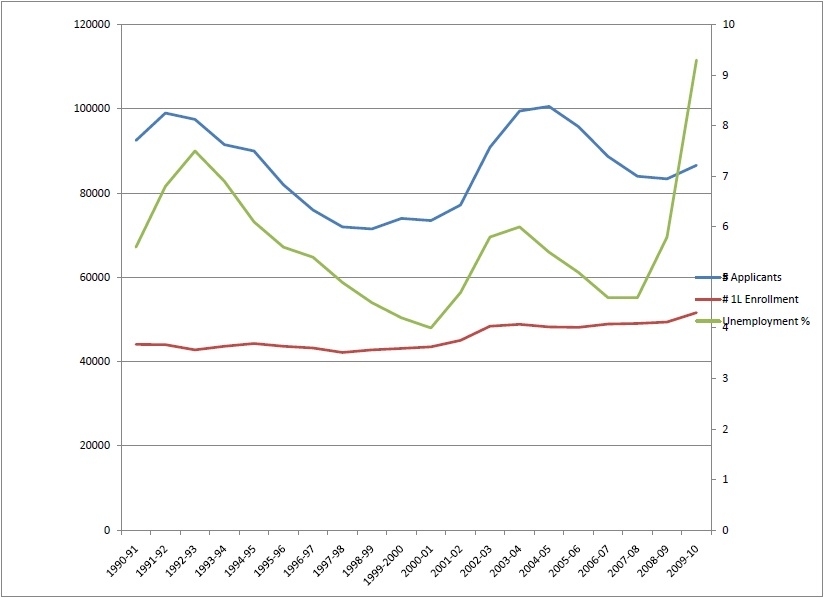
This chart shows a fairly close correlation over the past twenty years between unemployment and the number of law school applicants: when unemployment rises (green line), the number of applicants goes up (blue line). For the current recession, this relationship continued to hold, with two notable differences: 1) although unemployment shot up, the number of applicants rose only modestly (this was before the recent spate of bad news about law schools); and 2) the number of applicants turned down again this year by 11 percent (not indicated on the chart) despite a continuation of high unemployment.
These are aggregate numbers. The demand for any particular law school will be determined by its tuition (or discount rate) and the job prospects of its graduates. But it does seem fair to say that law schools generally should not assume that students will continue to apply as long as the employment situation remains bleak. We may have reached the point at which large numbers of prospective students who are contemplating law school--otherwise facing unemployment or underemployment--decide that it costs too much for what they get in return. (Annual tuition at private law schools now averages over $37,000; according to NALP, only 64 percent of the class of 2010 obtained full time jobs as lawyers.)
And what will happen to demand for law school when the general employment situation improves? (see chart for a likely consequence)
Posted
12:58 AM
by Brian Tamanaha [link]
(10) comments
“Wall Street is our Main Street”
Frank Pasquale
Who could imagine that a board member of the New York Federal Reserve Bank would adopt radical political economy? Both Slavoj Zizek and Robert Brenner have questioned the Wall Street/Main Street dichotomy, claiming that the US economy is so deeply financialized that it's hard to discern a real core beneath the monetary fluff. We've gone from "what is good for GM is good for American" to "what is good for GS is good for America." And it appears that the "public's representative" on the NYFRB agrees:
Mr. Schneiderman has . . . come under criticism for objecting to a settlement proposed by Bank of New York Mellon and Bank of America that would cover 530 mortgage-backed securities containing Countrywide Financial loans that investors say were mischaracterized when they were sold. . . . This month, Mr. Schneiderman sued to block that deal, which had been negotiated by Bank of New York Mellon as trustee for the holders of the securities. . . .
Read more »
Posted
2:42 PM
by Frank Pasquale [link]
The Necessary and Proper Clauses, Part 2: Foregoing Powers v. All Other Powers
John Mikhail
The Necessary and Proper Clause authorizes Congress “To make all Laws which shall be necessary and proper for carrying into Execution the foregoing Powers, and all other Powers vested by this Constitution in the Government of the United States, or in any Department or Officer thereof.” Most judges and commentators focus attention on the first part of the clause, which refers to the foregoing powers enumerated in Article 1, Section 8. The Necessary and Proper Clause is comprised of three distinct provisions, however, only the first of which is tied to these enumerated powers. Only the first part of the clause thus directly supports the common assumption that the powers of the federal government are tightly circumscribed. Put differently, there are three Necessary and Proper clauses, not one or two. Only a misconception of the scope of federal power can result from ignoring this fact, or from assuming that this aspect of our fundamental law does not exist. One can begin to grasp the force of these observations by examining the two main components of the N&P Clause—the Foregoing Powers provision and the All Other Powers provision—and recalling the different roles they played in the drafting, ratification, and early interpretations of the Constitution. Foregoing Powers: “Congress shall have the Power … To make all Laws which shall be necessary and proper for carrying into Execution the foregoing Powers” All Other Powers: “Congress shall have the Power … To make all Laws which shall be necessary and proper for carrying into Execution . . . all other Powers vested by this Constitution in the Government of the United States, or in any Department or Officer thereof.”
Posted
12:53 PM
by John Mikhail [link]
From Safety Net to Dragnet
Frank Pasquale
The fourth Class Crits conference will be held in DC in about a month. Titled "Criminalizing Economic Inequality," it focuses on the US's "increasing reliance on the criminal justice system to make and enforce economic policy." A few recent items highlight the conference's timeliness:
Nationally, according to Kaaryn Gustafson of the University of Connecticut Law School, "applying for welfare is a lot like being booked by the police." There may be a mug shot, fingerprinting, and lengthy interrogations as to one's children's true paternity. The ostensible goal is to prevent welfare fraud, but the psychological impact is to turn poverty itself into a kind of crime.
1) Barbara Ehrenreich on "How America Turned Poverty Into a Crime:" It's hard to believe that Ehrenreich's Nickeled and Dimed came out 10 years ago. As she's written in the book's re-issue, things have only gotten worse for the struggling families whose plight she chronicled in the book. Ehrenreich describes how officials at public assistance programs treat many beneficiaries with contempt. One needy mom named Kristen says caseworkers "treat you like a bum. They act like every dollar you get is coming out of their own paychecks."
Posted
10:17 PM
by Frank Pasquale [link]
Why the Supreme Court will strike down DOMA
Andrew Koppelman
The Supreme Court is not likely to impose same-sex marriage on the entire country, so Perry v. Schwarzenegger has been a quixotic case from the beginning. That’s why experienced gay rights litigators were so reluctant to support it. The Court is likely to find some procedural trick in order to avoid hearing the case at all.
The challenge to the Defense of Marriage Act (DOMA) is different. The Court can strike down this stupid and brutal law without bringing same-sex marriage to any state that does not want it. Its unconstitutionality follows from recent opinions by Justice Kennedy, the swing vote on the Court, and I predict that he will write the opinion striking the law down.
Read more »
Posted
10:37 AM
by Andrew Koppelman [link]
Bill Bratton in London: Time for a Reality Check
Bernard E. Harcourt
Great news from the LAPD: Violent crime in Los Angeles fell almost 10% for the first six months of 2011, with an 8% drop in homicides. Crimes tied to gangs fell by an astounding 16%. Serious crimes—including robberies, rapes, burglaries, and thefts—were down by about 8%. LAPD’s Bill Bratton must be doing a fabulous job. Oops! Bill Bratton’s not chief anymore! Not since October 2009. Well then, how can we explain those sharp drops in crime? And who is taking credit?
As you've heard, there’s been a lot of talk about Bill Bratton in London these days. Based on several statistical studies, I’ve written somewhat critically in the past about Bratton taking credit for crime drops both in the Los Angeles Times and in the New York Times, and elsewhere. So naturally I’ve been curious about the recent developments abroad. I decided to take a quick look at Bratton’s most recent record to see if there is anything new.
On Bratton’s LAPD experience, there is no serious statistical study regarding his effect on crime—with the exception of Ian Ayres’ thorough study documenting racial profiling by the LAPD under Bratton’s tenure in 2003 and 2004. (Some people think racial profiling should be a crime, in which case the only reliable statistical study suggests the Bratton effect was, sadly, positive).
All that is left in LA, then, are bald assertions based on raw crime rates. The raw crime data from LA are themselves inconclusive—and, as I will get to in a minute, cannot be relied on anyway.
On the raw data. Under Bratton’s tenure, from 2003 to 2009, homicides fell 36.2% from 10.5 to 6.7 per 100,000, and all violent crimes fell 37.6% from 842.7 to 526.0 per 100,000. That’s impressive, but hold on. A decade earlier, when the LAPD was essentially defunct, during the same six-year period, from 1993 to 1999, homicides fell 56.9% from 21.1 to 9.1 per 100,000, and all violent crime fell 47.4% from 1,673.6 to 880.9 per 100,000. That’s a lot higher rate! In other words, when the LAPD was staggering without any leadership and headed toward federal court receivership—navigating between the Rodney King beating in 1991 and the Rampart scandal in the late 1990s—crime was dropping at a faster rate than when Bratton was in charge ten years later!
Not only that, but it was dropping even faster in LA in certain respects than in New York City, where Bratton was in charge (at least from 1993 to 1996). As I showed here, a straight comparison of homicide and robbery rates between 1991 and 1998 reveals that, although New York City was a strong performer, with declines in homicide and robbery rates of 70.6 percent and 60.1 percent respectively, Los Angeles experienced a greater decline in its robbery rate (60.9 percent); in addition, San Diego experienced larger declines in homicide and robbery rates (76.4 percent and 62.6 percent respectively), Boston experienced a comparable decline in its homicide rate (69.3 percent), and San Antonio experienced a comparable decline in its robbery rate (59.1 percent). Other major cities also experienced impressive declines in their homicide and robbery rates, including Houston (61.3 percent and 48.5 percent respectively) and Dallas (52.4 percent and 50.7 percent respectively).
What does all this tell us?
First, there are independent reasons why big cities—our former "homicide capitals"—saw some of the sharper drops in crime. Jens Ludwig and I explain it in our article in 2006. We call it Newton’s Law of Crime: What goes up must come down (and what goes up the most tends to come down the most). Statisticians call this “reversion to the mean”—a slightly more technical term. But essentially, when you take into account the sharp rise in crime in particular neighborhoods (primarily due to the crack trade homicides and violence of the mid-1980s to early 1990s), the correlations between NYPD policing under Bratton (or probably LAPD policing without Bratton) and the sharp crime drops in the 1990s vanish.
In other words, second, it makes no sense to use raw crime data and draw inferences. Comparing raw rates of crime is a shell game.
Third, it’s preposterous for police officials to take credit for these kinds of massive crime drops when there have been larger national forces radically changing the penal landscape of the USA over the past two plus decades. Policing strategies are going to have marginal effects compared to the national level forces such as mass incarceration, drug-use trends, police force numbers, demographics, and societal and ideational changes—many of these are discussed elegantly by my colleague Steve Levit in this paper.
In the end, I’ve never truly understood how we came to believe that the Bratton years were a period of order-maintenance in the Big Apple. To be sure, crime decreased sharply, as it would to the present day two decades after Bratton’s departure. But complaints of police misconduct also rose sharply, as I document here. From 1993 to 1996, under Chief Bratton, allegations of police misconduct rose steadily by 68% and the number of complaints of police misconduct rose by 55%. Court filings against the police in civil rights claims for abusive conduct rose 75% from 1994 to 1998. And those rising allegation and complaint rates stick even when we hold constant a sharply increasing police force and increasing total adult arrest rates. Similarly, racial profiling was going strong under Chief Bratton in LA. So were those periods of order or disorderliness? I suppose the answer depends on which end of the stick you found yourself.
Posted
10:57 PM
by Bernard E. Harcourt [link]
(4) comments
New Haven Firefighters: Round Two
Jason Mazzone
In his concurring opinion in Ricci v. DeStefano (2009), Justice Scalia wrote: "[T]he war between disparate impact and equal protection will be waged sooner or later, and it behooves us to begin thinking about how--and on what terms--to make peace between them." Justice Scalia's point was that Title VII affirmatively requires remedial race-based employment actions when a disparate-impact violation would otherwise result but that constitutional equal protection forbids the federal government from requiring employers to engage in racial discrimination.
Posted
12:01 AM
by Jason Mazzone [link]
Individual Mandate: Federalism and Rights
Jason Mazzone
A common criticism of arguments that the individual mandate is beyond Congress's power to enact is that the arguments are "really" concerned with individual liberty. The implication of this criticism is that plaintiffs challenging the mandate are (improperly) using a federalism argument to conceal a liberty argument--an argument based on substantive due process that they could not win. In his dissenting opinion from the 11th Circuit's ruling last Friday, Judge Marcus made the point:On appeal, the plaintiffs have expressly disclaimed any substantive due process challenge to the individual mandate . . . Nevertheless, it is clear that individual liberty concerns lurk just beneath the surface, inflecting the plaintiffs’ argument throughout, although largely dressed up in Commerce Clause and Necessary and Proper Clause terms.
Posted
8:05 PM
by Jason Mazzone [link]
Stealth Constitutional Change
Guest Blogger
Jill M. Fraley
In The Decline and Fall of the American Republic, Professor Ackerman worries that constitutional scholarship “remains focused narrowly on the judiciary and fails to appreciate that our most serious constitutional problems lie elsewhere.” In this blog, as a prelude to a forthcoming essay, I want to say something about precisely why a focus on the judiciary undermines our ability to recognize a trajectory of constitutional change in our structures and institutions and why certain features of historical and constitutional scholarship contribute to this failure.
Read more »
Posted
7:02 PM
by Guest Blogger [link]
A 2012 Preview
Gerard N. Magliocca
My two books (on Jacksonian Democracy and 1890s Populism) articulate a "generational cycle" theory to help explain how the Constitution changes. In a nutshell, the theory is that every thirty years or so the political system undergoes a realignment that follows a similar pattern and leads to substantial institutional and doctrinal changes. The Obama presidency is the latest example of this phenomenon, which begs the question of what the past examples might tell us about 2012.
The 2008 election bore all the hallmarks of a party realignment. It had been nearly thirty years since the previous one (Reagan in 1980). Barack Obama received the highest popular vote percentage for any Democrat since Lyndon B. Johnson. The Democrats won large majorities in both houses of Congress. And the President's election was preceded by a sharp economic panic, which is often the trigger for a political earthquake.
The Obama Generation used this mandate in the same manner as its predecessors and pushed through a transformative statute with significant constitutional implications--health care reform. This law (and the stimulus bill) created a substantial backlash--the Tea Party. This is also typical during periods of generational transition, as any attempt at profound change is met by strong resistance. And like its previous counterparts, the Tea Party is not a "status quo ante" movement. They are advancing an agenda that is far stronger than what passed for conservatism during George W. Bush's presidency (at least on certain issues).
The 2010 elections broke with the historical pattern. In every prior realignment, the President's party held its position in Congress. Sometimes they lost seats (Republicans in 1862 and 1982, for example), but Obama Democrats were the first group to lose one part of Congress. That defeat was followed in 2011 by repeated (and unorthodox) clashes between the House and the President over the budget, including the debt ceiling debate. This kind of pitched battle is also reminiscent of previous disputes (consider Jackson's fight with Congress over the Bank) and will be renewed when the "Super Committee" reports back in November.
As we head into 2012, the constitutional fight is coming down to the two issues. The first is involves the individual mandate. With the Eleventh Circuit's decision on Friday, it is very likely that the Supreme Court will decide the question next summer. This could lead to a rare "preemptive opinion" that I discuss in my scholarship that come at these generational turning points and carry heavy political implications (Worcester v. Georgia, Dred Scott, Pollock, Schechter Poultry). The second flashpoint is the Balanced Budget Amendment. The BBA is an integral part of the debt ceiling compromise, and while it cannot be passed by Congress in the next year, you can be sure that this proposal will be a major party of the GOP's platform and will lead to a significant conversation in the country about the role of the federal government.
A final thought. In almost every prior generation, the President was reelected. (Lyndon Johnson is the only exception.) There is nothing, though, that says that this trend will hold, especially given the unprecedented result in the 2010 midterms. And if the President does lose, then the Tea Party will have a mandate. Much like William Jennings Bryan, President Obama's political legacy could be ironic--the establishment of an enhanced Republican coalition.
Posted
9:18 AM
by Gerard N. Magliocca [link]
(202) comments
A few remarkable sentences in the Eleventh Circuit’s health care decision
Andrew Koppelman
I haven’t much to add to Mark Hall’s fine map of the contradictions in the Eleventh Circuit’s opinion holding that the health care mandate is unconstitutional. The constitutional objections are silly, for reasons I’ve explained elsewhere. But it is worth noting a few remarkable moves buried in the verbose, 207-page opinion.
Read more »
Posted
6:24 PM
by Andrew Koppelman [link]
Why the 11th Circuit’s Opinion Self-Destructs
Guest Blogger
Mark Hall
Like a tragic literary figure, the 11th Circuit’s opinion declaring the individual mandate unconstitutional is doomed to failure by its own internal contradictions. What follows is a series of quotes directly from the opinion, paired to show how desperately the majority twisted logic in order to find its path to a unsupportable conclusion:
Read more »
Posted
12:05 PM
by Guest Blogger [link]
The Necessary and Proper Clauses
John Mikhail
I’m grateful to Jack for inviting me to contribute to Balkinization. My first objective will be to publish a series of posts on the origin and meaning of the Necessary and Proper clauses. I refer to the N&P “clauses” (plural) rather than the N&P “clause” (singular) to emphasize that the relevant text is comprised of three distinct provisions, only the first of which refers to the enumerated powers in Article I, Section 8: (1) “Congress shall have the Power … To make all Laws which shall be necessary and proper for carrying into Execution the foregoing Powers” (2) “Congress shall have the Power … To make all Laws which shall be necessary and proper for carrying into Execution … all other Powers vested by this Constitution in the Government of the United States” (3) “Congress shall have the Power … To make all Laws which shall be necessary and proper for carrying into Execution … all other Powers vested by this Constitution in . . . any Department or Officer [of the United States]” James Wilson was probably the most skilled and accomplished lawyer at the federal convention, and he devoted great care to drafting these clauses as a member of the Committee of Detail. Just why he constructed the N&P clauses in this manner and how they influenced the ratification and early interpretations of the Constitution will be the subject of my first series of posts.
Posted
3:06 AM
by John Mikhail [link]
SF BART: Silencing Phones, Stifling Protests, Violating Freedom of Speech?
Marvin Ammori
Yesterday, the Bay Area Rapid Transit (BART) shut off phone service at some BART stations to defuse a "flash mob" protest. The Washington Post reports that the planned protest was a response to transit police killing someone during a confrontation on July 3. BART explained that it respects First Amendment activities--even though it tried to stop a protest criticizing and drawing attention to its transit police.
Labels: First Amendment, Internet
BART's action has resulted in quite a bit of outrage and comparisons to Egypt's dictator Hosni Mubarek, who ordered Egyptian carriers to shut off the Internet. On Twitter, there's a hashtag to capture the comparison: #MuBARTek. Several free speech advocates have condemned the action, from the ACLU of No. California to the Electronic Frontier Foundation.
I'm sure BART is rethinking its decision and I hope BART and other local authorities across the nation learn from this moment.
Here's why I think BART's move was a terrible idea.
Read more »
Posted
7:08 PM
by Marvin Ammori [link]
(10) comments
Resolution VI as a Principle of Construction
JB
Over at the Volokh Conspiracy Kurt Lash (here, here, here and here); and Neil Siegel (here, here, here, and here), have been discussing the constitutional theory of enumerated powers, and, in particular Lash's new article on SSRN challenging my views about the commerce clause.
Lash sent me a draft of his article as a courtesy, and I have already given him extensive comments on it. My basic conclusion is that Lash's article doesn't offer much that is new that affects the current debate about federal power or the constitutionality of the individual mandate. Moreover, a few of his historical claims are dubious, as I'll explain below.
Although he singles me out as a central example of the position he criticizes, Lash's paper does not really engage very well with my arguments about enumerated powers. That is partly because he does not always portray my positions on these issues accurately and partly because he assumes a very different theory of constitutional interpretation and construction than mine. As a result much of his paper tends to talk past what I have written.
In this blog post I'll explain my own views, and I'll also suggest places where I think Lash draws the wrong inferences from the historical record. In addition, I'll try to highlight the differences between my theory of constitutional interpretation and the assumptions that Lash employs in his essay. Those differences in theoretical commitments and assumptions affect the ways that each of evaluates historical evidence. (You can read Lash's reply to my arguments here.).
Read more »
Posted
5:55 AM
by JB [link]
Deficits and Defense Spending
Bernard E. Harcourt
Following up on my post on the S& P downgrade, some interesting comments about defense spending, and Frank Pasquale’s powerful remarks on austerity, Lori Williams over at Tableau Software produced two marvelous graphs that visualize my earlier thoughts on deficits and defense spending.
The first graph represents the presidential contributions to the national debt. The data match those of the New York Times, but are pulled from Treasury Direct. The red and the blue should be self-explanatory! If you scroll over the bars, the data show. If you are having problems with your browser, you can see the graph here. (It never ceases to amaze me how the Republican Party can claim to be the party of fiscal restraint).
Read more »
Posted
4:40 PM
by Bernard E. Harcourt [link]
(111) comments

Shared Sacrifice of Whom?
Frank Pasquale
As Drew Westen observes today, "400 people control more of the wealth than 150 million of their fellow Americans," and "the average middle-class family has seen its income stagnate over the last 30 years while the richest 1 percent has seen its income rise astronomically." These extremes cry out for a theodicy, justifying mammon's ways to man. As wealth gets more concentrated, here is one of the millions of "faces of austerity" whom policymakers must answer to: Cynde Soto dreads the arrival of yet another benefit notice. Her cash assistance has been cut four times in two years. State medical coverage is getting more expensive and no longer includes dental care or podiatry. And the in-home help she needs to take care of basics has been cut by about 20 minutes a day. "That doesn't sound like a lot to people but ... I'm a quadriplegic," said the 54-year-old Long Beach resident. "I can't even scratch my own nose."
Read more »
Posted
7:23 PM
by Frank Pasquale [link]
The Roberts Court and the State Courts: 2010 Term
Jason Mazzone
Posted
4:12 PM
by Jason Mazzone [link]
Standard & Poor’s Downgrade of the USA: Defense Spending, Insider Trading, and the Myth of Unregulated Markets
Bernard E. Harcourt
China: $114,300,000,000 (2.2% of GDP)
France: $61,285,000,000 (2.5% of GDP)
UK: $57,424,000,000 (2.7% of GDP)
Russia: $52,586,000,000 (4.3% of GDP)
Japan: 51,420,000,000 (1% of GDP)
Germany: $46,848,000,000 (1.4% of GDP)
France: $977
UK: $940
Germany: $558
Russia: $430
Japan: $401
China: $74.7
It is interesting to note in this regard that President Obama’s administration plans to spend more, about 20 percent more, than the previous Bush administration on defense. On that score, though, it is impressive to see how much the Wars in Iraq and Afghanistan have contributed to the national deficit. It is reflected well in the graph of presidential contributions to the $14.3 trillion dollars, with President George W. Bush’s contribution being $6.1 trillion. This graph from the New York Times is one of the most interesting graphs produced during the debt ceiling debates:
Second, I suspect that the 5% drop in the markets this past Thursday was triggered by insider trading among large institutional investors. I’m assuming, of course, contra-Chicago School thinking, that the S&P downgrade would affect the markets—in other words, that just because all the information on which S&P based it’s decision was already factored into the market price, the very fact of the downgrade itself would have an adverse psychological affect on the market. (We’ll see on Monday). But in rereading the front page of Friday’s New York Times in the faculty lounge this morning, it just struck me that all this talk of “Thursday’s painful rout” being caused by “anxiety that both Europe and the United States were failing to fix deepening economic problems” was probably nonsense. The rout was probably, I suspect, the result of insider information circulating about S&P’s decision to downgrade. S&P sent their announcement to the Treasury before the markets closed on Friday—but the information must, I suspect, have leaked out a few days before.
Posted
12:32 PM
by Bernard E. Harcourt [link]
(91) comments
Winters on Oligarchy
Andrew Koppelman
Jeffrey Winters’s new book, Oligarchy, is a brilliant comparative study of the role of wealthy elites in politics. He argues that the protection of wealth is a central theme in politics throughout history. He draws on an enormous range of illustrations, from ancient Greece and Rome to medieval city-states to contemporary Indonesia and the Philippines. He also shows its influence in the contemporary United States, in a way that is remarkably timely.
Read more »
Posted
4:50 PM
by Andrew Koppelman [link]
Constitutional Redemption Online Symposium
JB
Over at Concurring Opinions, Danielle Citron has organized a blog symposium on my recent book, Constitutional Redemption: Political Faith in an Unjust World.
There are lots of new ideas offered in the symposium, including Joey Fishkin's introduction of the striking idea of "constitutional televangelism." What's that, you say? Go read the symposium and find out.
Posted
9:04 AM
by JB [link]
The Legislation
Marty Lederman
Rarely has so much been written and discussed about a document that so few people have actually seen or read.
Here it is.
I've barely started reading through it; a great deal of it is difficult to parse without a deep understanding of the underlying statutes being amended, and many fairly obscure terms of art. I'm curious whether it raises any serious constitutional problems (something to which OLC is no doubt currently devoting countless hours). I'm opening comments here, with some trepidation. Please limit comments to identifying possible constitutional issues -- there are thousands of other fora more appropriate for debating the wisdom and politics of the legislation. Thanks
Posted
12:39 PM
by Marty Lederman [link]
(11) comments
Regime change: Delegation run riot
Sandy Levinson
I'm off to Argentina this afternoon, so I won't be posting for the next two weeks. (No great loss.) But I do want to offer one final comment on the Grand Bargain that was just inflicted on it. Put to one side that it represents, as Joe Nocera aptly argues in today's NYTimes, the submission basically to terrorist threats by a remarkably feckless President. And put to one side that it almost guarantees the worsening of the American (and therefore the world) economy, though it may brighten the prospects of a Republican victory over the feckless President, apparently the only thing that Mitch McConnell is really committed to as he winds up his long and decidedly non-illustrious career in the Senate.
Rather, I want to elaborate the theme of several earlier posts, which is the way that changes in the American political regime occur. From one perspective, of course, the House Republicans behaved no worse than did earlier Republicans, in 1865, who refused to seat the elected Senators and Representatives from the defeated so-called Confederate States, whose governments had been accepted by President Andrew Johnson and whose votes to ratify the Thirteenth Amendment were accepted by Congress. I.e., each band of Republicans took advantage of the legal possibilities open to them and played a decided form of "constitutional hardball." And, of course, full representation of the defeated Southern entities (or whatever you wish to call them) was made contingent on their ratifying the Fourteenth Amendment. If one defends the earlier group of Republicans, as I most certainly do--including the impeachment of the egregious Andrew Johnson--it is on the basis of agreement with their political agenda, which was regime change in the defeated Confederacy. They failed, of course, and the Compromise of 1877 returned the defeated Confederacy to the white ruling class for another 100 years. (Something that should be taken into account by those who are trumpeting the overriding virtue of "compromise" in all cases. There are times when lines should be drawn in the sand.)
So if one wants to denounce the House Republicans today as terrorist thugs, it can only be because on disagrees with their political agenda, as I do. If one shares their agenda, and their sense of concern about the "debt crisis," then they behaved perfectly properly. In any event, one can assume that we will see in the future ever more taking advantage of any and all legal possibilities to get one's way, including the de facto holding America hostage in order to get one's way.
But even more telling with regard to regime change is the further diminution of Conress as a serious law-making or deliberative body. (Nothing new here; Carl Schmitt would certainly understand how and why that has happened.) We are to be effectively governed in the next several months by the new super-duper committee of six Republicans and six Democrats who will be able to propose fast-track budget cuts (or, in theory but not in fact, tax increases) that Congress must vote up or down on, with no possibility for amendment. Lest one compare this to other fast-track procedures, such as the base-closing commissions and the like, note that the failure of Congress to acquiesce to the wishes of their new masters will lead to killing the hostages, in this case automatic budget cuts in defense and in programs involvng the vulnerable.
As I wrote yesterday, this literally makes no sense IF one believes that our current defense budget makes sense (and, of course, if one is a bleeding heart who believes that the suffering should receive help instead of being left to their own prospects in a Darwinian free market). This is not the way a serious Republican Form of Government operates. It is the way a "constitutional dictatorship" takes further (and suitably complext) form. In any event, political terrorism will have been "normalized."
In this context, I'm happy to echo the words of a Texas Republican Representatives, Michael C. Burgess: "I hate it, I hate it, I hate it with a passion.” This comes, suitably enough, from a story in today's Times on how "Lawmakers in Both Parties Fear that New Budget Panel Will Erode Authority." Yes, indeed. It represents a new version of "delegation run riot," though this time the delegation is not to the Executive Branch, but, rather, to an insider's club of less than 5% of the entire Congress, whose members will be appointed by the Speaker, the House Minority leader (Nancy Pelosi), and the Senate majority and minority leaders, with, one presumes, no formal approval by the House or Senate itself. Why would anyone who has any lingering belief in democracy, representative government, or a Republican Form of Government believe this is a good idea?
Posted
11:21 AM
by Sandy Levinson [link]
(10) comments
George Washington on the Debt Ceiling Crisis
Jason Mazzone
Posted
12:51 PM
by Jason Mazzone [link]
(9) comments
More on a constitutional convention
Sandy Levinson
My friend Earl Maltz was kind enough to send me the following comment on my previous post, and he has given permission for me to make it public:I agree that our Constitution (genuflecting toward Philadelphia) is fatally flawed. Leaving issues of democracy aside (I really don't care about them), the current structure is simply dysfunctional. Unfortunately, it is going to be impossible to make really significant change through the convention route. The problem is not Fox News, but rather that the country is now too large and too diverse to get the kind of consensus that you need to make major constitutional changes. So what you are going to get is a counterproductive circus that will do nothing but divert us from practical measures that might at least make small but significant advances in dealing with the problem.
In particular, I think that a real, concerted effort should be made to organize an assault on the filibuster rule. Getting rid of the supermajority requirement in the Senate would at least be a start and might be doable in the forseeable future (the beginning of the Obama administration would have been the ideal time, but that would have required actual leadership instead of grandstanding on a train and pretending to be Lincoln).
I think this is an eminently reasonable position. We should confront the possibility that Madison was simply wrong in the 14th Federalist if he was arguing that a "republican form of government" could be indefinitely extended. Of course, he literally had no conception of how large and heavily populated the US would ultimately become. He was simply suggesting that a country of 4 million people (where most of them were excluded from political participation) could govern itself in a "republican" mode, which for Madison meant rule by benevolent elites committed to the "public interset" and relatively insulated from political "factions." That's not the country we live in (and hasn't been at least since the time of Andrew Jackson).
I predict, incidentally, that if the Republicans do take control of the Senate and Obama wins re-election, that their first order of business will be to eliminate the filibuster. They are serious about imposing their own agenda--whether or not one calls it "governing" or not--in a way that Senate Democrats are not (perhaps because they don't have a firm idea of what they actually want to do and how they would finance it, given that taxing the rich, though necessary, is scarcely sufficient to finance the welfare needs of an American population that is getting over older).
Posted
11:55 AM
by Sandy Levinson [link]
(87) comments
Is the Constitution simply irrelevant?
Sandy Levinson
Paul Krugman ends his column on the disgraceful surrender (also called the "Grand Bargain") as follows:In the long run, however, Democrats won’t be the only losers. What Republicans have just gotten away with calls our whole system of government into question. After all, how can American democracy work if whichever party is most prepared to be ruthless, to threaten the nation’s economic security, gets to dictate policy? And the answer is, maybe it can’t.
He is, I think, absolutely correct. What we have witnessed is a perverse kind of Schmittian moment, in which political thuggery has prevailed. But the thuggery has not involved any illegal conduct. Rather, it required "only" that the House Republicans take advantage of the rules of American bicameralism and that the Senate continue to operate under the practice of the filibuster. Ironically, the craven President of the United States was so insistent on not even appearing to be thinking of acting like a Schmittian sovereign--even though the 14th Amendment provided a tenable, even if not a "winning" argument before somebody left unspecified--that he saw no alternative to capitulation, which he will no doubt present as a version of "peace in our time." [UPDATE: I WROTE THIS MUCH TOO HASTILY: I HAVE COME TO BELIEVE, THANKS TO THE ARGUMENTS OF LARRY TRIBE AND OTHERS, THT THE SO-CALLED "14TH AMENDMENT OPTION" HAD FATAL LEGAL AND POLITICAL WEAKNESSES. IRONICALLY ENOUGH, THOUGH, OBAMA WOULD APPARENTLY HAVE NOT HAVE LEGALLY TRANSGRESSED HAD HE ORDERED THE ISSUANCE OF TWO PLATINUM TRILLION COINS, HOWEVER "AUDACIOUS" THAT WOULD HAVE APPEARED. THAT'S WHAT SOMEONE PLAYING CONSTITUTIONAL HARDBALL WOULD HAVE DONE.]
My friend and former colleague, Brian Leiter, posted the following comment to my earlier post on Stanley Greenberg's essay in the NYTimes:1. You have correctly pointed out the deficiencies of the U.S. Constitution, but you can't seriously believe that the reason the U.S. is a reactionary and dysfunctional plutocracy is because of the particular Constitution adopted in 1789.
2. Do you seriously think a Constitutional Convention in the era of Fox News and other crypto-fascist media would yield anything other than a horror? This defies belief.
You're stuck in an Idee Fixe at this point, and it's making your commentary increasingly irrelevant. The Constitution is epiphenomenal at this point.
I don't rule out the possibility that Brian is right. I have become something of a crank, and perhaps the Constitution is "epiphenomenal." That's a debate very much worth having. I do not think that the Constitution is the explanatory be-all and end-all. But does it really explain nothing about our polity? What if, for example, the President had the power granted by the French Constitution to dissolve the legislature and call for new elections? Is there any reason in the world to believe that the Republicans would prevail, given that the 2010 victory was achieved by the massive falloff in turnout by Democrats from 2008? Indeed, perhaps we should even take seriously the premise that Obama might have behaved differently if he had been convinced, perhaps while teaching at the University of Chicago, that the President had the power to stand firm against the political thuggery of the Republicans by declaring that the debt limit is unconstitutional and he has the power simply to ignore it. [SEE ABOVE UPDATE/]
Does Brian believe that orthodox Marxism explains our present situation? Would smart capitalists really want a deal that almost certainly guarantees a return to recession, if not depression? Or is the point that capitalists are like Kansas;they really doesn't know their own class interests, so fixated have they become on Grover Norquist's no new taxes? (I don't rule that out, but it certainly doesn't speak well for their analytic powers, given that no sane person can believe that massive cutbacks on government spending will lead to new jobs, in part because there are ever fewer people with disposable income to return to our old consumer-goods based society. Indeed, it is amusing, in some sense, to watch Kay Bailey Hutchinson moan about cutbacks in NASA and the havoc that may cause the Houston economy. And so on.)
I'm more than happy to join Brian in describing Fox News as crypto-fascist. But what is the relevance with regard to debating the proposals that Tea Partiers are making with regard to constitutional amendments? Should we be debating the proposals on their merits (which I think are few) or should we simply be saying that the Constitution is irrelevant, so that it really doesn't matter at all what the Constitution says? I don't mean this as a rhetorical question. I really do want to know what Brian thinks the American left should be saying or doing in response to the despair well articulated by Paul Krugman.
UPDATE: Matt Miller has an interesting column in the Washington Post castigating the agreement for its utter failure to confront the present jobs problem or the long-run problems of an aging population that will make ever greater demands on the medical insurance and social security systems (not to mention the discussion that will have to take place about whether we can any longer afford to pretend to the be "New Rome." For better or, I think, worse, he concludes by endorsing Americans Elect and the prospect of a third party. Or is the Constitution merely epiphenomenal with regard to the lunatic way we conduct presidential elections in the United States?
Posted
12:07 AM
by Sandy Levinson [link]
(43) comments
Books by Balkinization Bloggers

Gerard N. Magliocca, The Actual Art of Governing: Justice Robert H. Jackson's Concurring Opinion in the Steel Seizure Case (Oxford University Press, 2025)

Linda C. McClain and Aziza Ahmed, The Routledge Companion to Gender and COVID-19 (Routledge, 2024)

David Pozen, The Constitution of the War on Drugs (Oxford University Press, 2024)

Jack M. Balkin, Memory and Authority: The Uses of History in Constitutional Interpretation (Yale University Press, 2024)
Mark A. Graber, Punish Treason, Reward Loyalty: The Forgotten Goals of Constitutional Reform after the Civil War (University of Kansas Press, 2023)
Jack M. Balkin, What Roe v. Wade Should Have Said: The Nation's Top Legal Experts Rewrite America's Most Controversial Decision - Revised Edition (NYU Press, 2023)

Andrew Koppelman, Burning Down the House: How Libertarian Philosophy Was Corrupted by Delusion and Greed (St. Martin’s Press, 2022)

Gerard N. Magliocca, Washington's Heir: The Life of Justice Bushrod Washington (Oxford University Press, 2022)
Joseph Fishkin and William E. Forbath, The Anti-Oligarchy Constitution: Reconstructing the Economic Foundations of American Democracy (Harvard University Press, 2022)
Mark Tushnet and Bojan Bugaric, Power to the People: Constitutionalism in the Age of Populism (Oxford University Press 2021).

Mark Philip Bradley and Mary L. Dudziak, eds., Making the Forever War: Marilyn B. Young on the Culture and Politics of American Militarism Culture and Politics in the Cold War and Beyond (University of Massachusetts Press, 2021).

Jack M. Balkin, What Obergefell v. Hodges Should Have Said: The Nation's Top Legal Experts Rewrite America's Same-Sex Marriage Decision (Yale University Press, 2020)

Frank Pasquale, New Laws of Robotics: Defending Human Expertise in the Age of AI (Belknap Press, 2020)

Jack M. Balkin, The Cycles of Constitutional Time (Oxford University Press, 2020)

Mark Tushnet, Taking Back the Constitution: Activist Judges and the Next Age of American Law (Yale University Press 2020).

Andrew Koppelman, Gay Rights vs. Religious Liberty?: The Unnecessary Conflict (Oxford University Press, 2020)

Ezekiel J Emanuel and Abbe R. Gluck, The Trillion Dollar Revolution: How the Affordable Care Act Transformed Politics, Law, and Health Care in America (PublicAffairs, 2020)

Linda C. McClain, Who's the Bigot?: Learning from Conflicts over Marriage and Civil Rights Law (Oxford University Press, 2020)
Sanford Levinson and Jack M. Balkin, Democracy and Dysfunction (University of Chicago Press, 2019)

Sanford Levinson, Written in Stone: Public Monuments in Changing Societies (Duke University Press 2018)

Mark A. Graber, Sanford Levinson, and Mark Tushnet, eds., Constitutional Democracy in Crisis? (Oxford University Press 2018)

Gerard Magliocca, The Heart of the Constitution: How the Bill of Rights became the Bill of Rights (Oxford University Press, 2018)

Cynthia Levinson and Sanford Levinson, Fault Lines in the Constitution: The Framers, Their Fights, and the Flaws that Affect Us Today (Peachtree Publishers, 2017)

Brian Z. Tamanaha, A Realistic Theory of Law (Cambridge University Press 2017)

Sanford Levinson, Nullification and Secession in Modern Constitutional Thought (University Press of Kansas 2016)

Sanford Levinson, An Argument Open to All: Reading The Federalist in the 21st Century (Yale University Press 2015)

Stephen M. Griffin, Broken Trust: Dysfunctional Government and Constitutional Reform (University Press of Kansas, 2015)

Frank Pasquale, The Black Box Society: The Secret Algorithms That Control Money and Information (Harvard University Press, 2015)

Bruce Ackerman, We the People, Volume 3: The Civil Rights Revolution (Harvard University Press, 2014)
Balkinization Symposium on We the People, Volume 3: The Civil Rights Revolution

Joseph Fishkin, Bottlenecks: A New Theory of Equal Opportunity (Oxford University Press, 2014)

Mark A. Graber, A New Introduction to American Constitutionalism (Oxford University Press, 2013)

John Mikhail, Elements of Moral Cognition: Rawls' Linguistic Analogy and the Cognitive Science of Moral and Legal Judgment (Cambridge University Press, 2013)

Gerard N. Magliocca, American Founding Son: John Bingham and the Invention of the Fourteenth Amendment (New York University Press, 2013)

Stephen M. Griffin, Long Wars and the Constitution (Harvard University Press, 2013)

Andrew Koppelman, The Tough Luck Constitution and the Assault on Health Care Reform (Oxford University Press, 2013)

James E. Fleming and Linda C. McClain, Ordered Liberty: Rights, Responsibilities, and Virtues (Harvard University Press, 2013)
Balkinization Symposium on Ordered Liberty: Rights, Responsibilities, and Virtues

Andrew Koppelman, Defending American Religious Neutrality (Harvard University Press, 2013)

Brian Z. Tamanaha, Failing Law Schools (University of Chicago Press, 2012)

Sanford Levinson, Framed: America's 51 Constitutions and the Crisis of Governance (Oxford University Press, 2012)

Linda C. McClain and Joanna L. Grossman, Gender Equality: Dimensions of Women's Equal Citizenship (Cambridge University Press, 2012)

Mary Dudziak, War Time: An Idea, Its History, Its Consequences (Oxford University Press, 2012)

Jack M. Balkin, Living Originalism (Harvard University Press, 2011)

Jason Mazzone, Copyfraud and Other Abuses of Intellectual Property Law (Stanford University Press, 2011)

Richard W. Garnett and Andrew Koppelman, First Amendment Stories, (Foundation Press 2011)

Jack M. Balkin, Constitutional Redemption: Political Faith in an Unjust World (Harvard University Press, 2011)

Gerard Magliocca, The Tragedy of William Jennings Bryan: Constitutional Law and the Politics of Backlash (Yale University Press, 2011)

Bernard Harcourt, The Illusion of Free Markets: Punishment and the Myth of Natural Order (Harvard University Press, 2010)

Bruce Ackerman, The Decline and Fall of the American Republic (Harvard University Press, 2010)
Balkinization Symposium on The Decline and Fall of the American Republic

Ian Ayres. Carrots and Sticks: Unlock the Power of Incentives to Get Things Done (Bantam Books, 2010)

Mark Tushnet, Why the Constitution Matters (Yale University Press 2010)

Ian Ayres and Barry Nalebuff: Lifecycle Investing: A New, Safe, and Audacious Way to Improve the Performance of Your Retirement Portfolio (Basic Books, 2010)
.jpg)
Jack M. Balkin, The Laws of Change: I Ching and the Philosophy of Life (2d Edition, Sybil Creek Press 2009)

Brian Z. Tamanaha, Beyond the Formalist-Realist Divide: The Role of Politics in Judging (Princeton University Press 2009)
Andrew Koppelman and Tobias Barrington Wolff, A Right to Discriminate?: How the Case of Boy Scouts of America v. James Dale Warped the Law of Free Association (Yale University Press 2009)

Jack M. Balkin and Reva B. Siegel, The Constitution in 2020 (Oxford University Press 2009)

Heather K. Gerken, The Democracy Index: Why Our Election System Is Failing and How to Fix It (Princeton University Press 2009)

Mary Dudziak, Exporting American Dreams: Thurgood Marshall's African Journey (Oxford University Press 2008)

David Luban, Legal Ethics and Human Dignity (Cambridge Univ. Press 2007)

Ian Ayres, Super Crunchers: Why Thinking-By-Numbers is the New Way to be Smart (Bantam 2007)

Jack M. Balkin, James Grimmelmann, Eddan Katz, Nimrod Kozlovski, Shlomit Wagman and Tal Zarsky, eds., Cybercrime: Digital Cops in a Networked Environment (N.Y.U. Press 2007)

Jack M. Balkin and Beth Simone Noveck, The State of Play: Law, Games, and Virtual Worlds (N.Y.U. Press 2006)

Andrew Koppelman, Same Sex, Different States: When Same-Sex Marriages Cross State Lines (Yale University Press 2006)

Brian Tamanaha, Law as a Means to an End (Cambridge University Press 2006)

Sanford Levinson, Our Undemocratic Constitution (Oxford University Press 2006)

Mark Graber, Dred Scott and the Problem of Constitutional Evil (Cambridge University Press 2006)

Jack M. Balkin, ed., What Roe v. Wade Should Have Said (N.Y.U. Press 2005)

Sanford Levinson, ed., Torture: A Collection (Oxford University Press 2004)
Balkin.com homepage
Bibliography
Conlaw.net
Cultural Software
Writings
Opeds
The Information Society Project
BrownvBoard.com
Useful Links
Syllabi and Exams
