Balkinization
an unanticipated consequence of
Jack M. Balkin
Balkinization Symposiums: A Continuing List
E-mail:
Jack Balkin:
jackbalkin at yahoo.com
Bruce Ackerman
bruce.ackerman at yale.edu
Ian Ayres
ian.ayres at yale.edu
Corey Brettschneider
corey_brettschneider at brown.edu
Mary Dudziak
mary.l.dudziak at emory.edu
Joey Fishkin
joey.fishkin at gmail.com
Heather Gerken heather.gerken at yale.edu
Abbe Gluck abbe.gluck at yale.edu
Mark Graber
mgraber at law.umaryland.edu
Stephen Griffin
sgriffin at tulane.edu
Jonathan Hafetz
jonathan.hafetz at shu.edu
Jeremy Kessler
jkessler at law.columbia.edu
Andrew Koppelman
akoppelman at law.northwestern.edu
Marty Lederman
msl46 at law.georgetown.edu
Sanford Levinson
slevinson at law.utexas.edu
David Luban
david.luban at gmail.com
Gerard Magliocca
gmaglioc at iupui.edu
Jason Mazzone
mazzonej at illinois.edu
Linda McClain
lmcclain at bu.edu
John Mikhail
mikhail at law.georgetown.edu
Frank Pasquale
pasquale.frank at gmail.com
Nate Persily
npersily at gmail.com
Michael Stokes Paulsen
michaelstokespaulsen at gmail.com
Deborah Pearlstein
dpearlst at yu.edu
Rick Pildes
rick.pildes at nyu.edu
David Pozen
dpozen at law.columbia.edu
Richard Primus
raprimus at umich.edu
K. Sabeel Rahmansabeel.rahman at brooklaw.edu
Alice Ristroph
alice.ristroph at shu.edu
Neil Siegel
siegel at law.duke.edu
David Super
david.super at law.georgetown.edu
Brian Tamanaha
btamanaha at wulaw.wustl.edu
Nelson Tebbe
nelson.tebbe at brooklaw.edu
Mark Tushnet
mtushnet at law.harvard.edu
Adam Winkler
winkler at ucla.edu
Compendium of posts on Hobby Lobby and related cases
The Anti-Torture Memos: Balkinization Posts on Torture, Interrogation, Detention, War Powers, and OLC
The Anti-Torture Memos (arranged by topic)
Recent Posts
Disastrous Unreality About Afghanistan and Terrorism
The Law of the Census
Kenworthey Bilz Doesn’t Want to Hear It
The New Old Federalism
New York Times Forum on the Constitutionality of Health Care Reform
Balkinization celebrates 5 million visitors
What happens next-- and what hasn't changed
The Anti-Counterfeiting Trade Agreement
By "The Warren Court Era," perhaps you mean Warren Burger?
These Are Scary Times
Ten Books That Have Influenced Me
Does Adam Winkler have an exaggerated fear of the Supreme Court?
Does the Health bill vindicate the Constitution?
If you can't stop the bill, just have another Bush v. Gore
Deem and Pass has passed away. Let us deem it a good thing
Michael McConnell and the metaphysics of bills
![[Powered by Blogger]](https://lh3.googleusercontent.com/blogger_img_proxy/AEn0k_vpN-Rj1jw6TUFn5mqEBW0FpwLQ10PFwtOg9snP_T_rrVYzqnM3D8dy3wBtJ0a2EuZbLKEeRiTPAyi_Ry4xcM4JMoL0z-6WJtwxNMtUtba-=s0-d)
Just A Few Blogs
ACS Blog
Alas, a Blog
Althouse
Arts and Letters Daily
Atrios (Eschaton)
Bill of Health
Buzzflash.com
Buzz Machine
Cato at Liberty
Juan Cole (Informed Comment)
Concurring Opinions
The Constitution in 2020
Corrente
Crooked Timber
Daily Howler
Daily Kos
Dana Boyd
Brad DeLong
Digby (Hullabaloo)
Discriminations
Daniel Drezner
Kevin Drum (Mother Jones)
Electrolite
En Banc
Eunomia (Daniel Larison)
Fafblog
Michael Froomkin (Discourse.net)
GovLab (Beth Noveck)
Rick Hasen (Election Law)
History News Network
How Appealing
Ignatz (Sam Heldman)
The Importance of (Ernie Miller)
Infolaw
Instapundit
International Economic Law and Policy Blog
IntLawGrrls
Jacob Levy
Jesus' General
Jurisdynamics
The Kitchen Cabinet
Mark Kleiman
Law Blog Central
Larry Lessig
Lawyers, Guns and Money
Liberal Oasis
Brian Leiter's Law School Reports
The Leiter Reports
Marginal Revolution
Megan McArdle
Memeorandum
Metafilter
Mirror of Justice
The New Republic
Newseum
No More Mister Nice Blog
Brendan Nyhan
Opinio Juris
Orcinus
The Originalism Blog
Pandagon
Passport (Foreign Policy)
Overcoming Bias
Political Animal (Washington Monthly)
Political Theory Daily Review
Political Wire (Taegan Goddard)
The Poor Man
Virginia Postrel
Prawfsblawg
Public Reason
Jonathan Rauch
Raw Story
Redstate
ReligiousLeftLaw.com
Reporters Committee For Freedom of the Press
Reproductive Rights Blog
Rothman's Roadmap to the Right of Publicity
SCOTUS Blog
Seeing the Forest
Clay Shirky
The Shifted Librarian
The Situationist
Larry Solum (Legal Theory)
Andrew Sullivan
Talking Points Memo
Talk Left
Tapped
Tbogg
TechPresident
The Paper Chase (Jurist)
Tom Paine
Tom Tomorrow (This Modern World)
Eve Tushnet
Uggabugga
University of Chicago Law School Faculty Blog
Unqualified Offerings
The Volokh Conspiracy
War and Piece (Laura Rozen)
Wampum
Oliver Willis
Wonkette
Written Description
Matthew Yglesias
Yin
Your Choice of Feeds
1. XML
powered by

2. Atom Feed
3. RSS 2.0
Disastrous Unreality About Afghanistan and Terrorism
Brian Tamanaha
President Obama's weekend visit to Afghanistan exposed how barren our policy there is. Obama once again justified our ramped up military presence in Afghanistan--with a sharp increase in military and civilian deaths and injuries--as essential to our anti-terrorism strategy, explaining that if the Taliban take over it will provide a safe haven for Al Qaeda. The defeat of the Taliban, in turn, depends upon the progress made by the Afghan government in fighting corruption and developing the rule of law. As a New York Times op-ed put it:American officials have repeatedly warned Mr. Karzai that unless he truly commits to eradicating corruption (including among his own family members), improving governance and institutionalizing the rule of law, there is no chance of defeating the Taliban. Mr. Karzai has repeatedly shrugged off those warnings.
This hope is delusional, as the remainder of the editorial makes clear (Karzai's most important political allies, as well as members of his family, are among the corrupt). No amount of jawboning is going to cure the systemic corruption that plagues the Afghan government. Building the rule of law, moreover, takes decades even under favorable circumstances.
We hope that hearing it directly from the American president will finally make the difference. There is certainly no more time to waste.
But the greater error in this policy is that our military presence in Afghanistan is making the terrorism problem worse (see this essay), not better, because it inflames Islamic radicalism worldwide--including homegrown terrorism. (Meanwhile, Al Qaeda has other places to seek refuge and locate training camps.)
The Obama Administration is enjoying the afterglow of its historic health care reform. But the Afghan war is a disaster in the making.
Posted
11:32 AM
by Brian Tamanaha [link]
(63) comments
The Law of the Census
Nate Persily
In anticipation of Census Day (tomorrow), here are a few thoughts on the law of the census (one of my thoroughly unmarketable areas of expertise for nine out of every ten years). The 2010 Census presents all kinds of interesting legal issues concerning how to count, what to count, whom to count and where to count them. These comments focus on the relationship between the census and reapportionment/redistricting, but the problems affect federal funding as well.
How to Count
When one thinks of controversies surrounding the census, the "sampling" debate ordinarily comes first to mind. The Supreme Court has ruled that the Census Act prohibits the use of "sampling" for apportionment purposes, but allows the use of other statistical methods such as "hot deck imputation." The Act allows sampling for other purposes, such as redistricting. The Bush administration scuttled plans for statistical adjustment in the 2000 Census, which ended up probably being the right thing to do given the success of the 2000 Census as measured by the shrinking of the differential undercount (that is, the relative rate at which census undercounts member of certain demographic groups, particularly racial groups).
For the 2010 Census, sampling is not even being considered as an option, but it is somewhat difficult to predict the character of the likely undercounted population. The high rate of foreclosures in the last year and subsequent shifts in population in some cases to nontraditional housing alter some of the assumptions that had guided the original operational plan for the census. The anti-census rhetoric from Michelle Bachmann and Glenn Beck and the general suspicion of the federal government among tea party sympathizers might deter participation from populations (i.e., whites) that historically have been more accurately counted. (Given that Minnesota may be on the cusp of losing a congressional district, Bachmann has altered her criticism to focus more on the race question on the census.)
What to Count
About half of the decennial census form now deals with questions concerning race. For the second time, the 2010 census will allow respondents to check off more than one race. For those of us who use the data for redistricting purposes, this means the census will publish data for a mind-bending 126 different racial and ethnic combinations for all levels of geography. The OMB has issued guidelines that instruct the federal government for purposes of civil rights enforcement to reallocate multiracial individuals to the non-white race. In a much overlooked footnote in Georgia v. Ashcroft, Justice O'Connor's opinion for the Court seemed to adopt this approach as well in the context of a voting rights case. It will be interesting to see whether the Roberts Court has an opportunity to confront the OMB guidelines directly in a coming case.
Many jurisdictions feared in 2000 that the multiracial checkoff would wreak havoc on the redistricting process. That turned out not to be true and likely will not be true this time either. This is due to the fact that most redistricting cases involve African Americans or Hispanics. African Americans have a very low rate of multiracial identification and Hispanics (considered an ethnicity, not a race, for the census) have their own separate question on the census and are therefore unaffected by the multiracial checkoff. In the recent case of Bartlett v. Strickland, the Court has required plaintiffs in section 2 VRA suits to demonstrate that they could constitute a majority (i.e., over 50%) in a single member district. Perhaps some groups hovering close to that number would have their claims affected by the multiracial checkoff, but that should be a rare case.
The more interesting controversy surrounding "what to count" concerns citizenship. The decennial census does not contain a question about the respondents citizenship, for fear that to do so would chill participation. In 2000, one out of every six households received the "long form" of the census, which did have a citizenship question. The long form of the census has been abandoned in 2010. It has been replaced by the American Community Survey (ACS), which is a survey sent to 2.5% of households every year throughout the decade. The census promises to publish citizenship data from five year averages from the ACS. While reliable for large areas of geography, such as counties, the data become less usable and accurate for smaller areas of geography, such as census blocks, which form the building blocks of redistricting plans.
This is important because the 5th Circuit, among others, requires voting rights plaintiffs to demonstrate that they would constitute a majority of the citizen voting age population (CVAP) in a district to bring a section 2 VRA claim. The less reliable the citizenship estimates, the greater the tension between the available data and the legal hurdles the courts place in the way of VRA plaintiffs. (Bartlett v. Strickland seemed to suggest that voting age population, rather than CVAP, is the appropriate basis for a VRA claim, but the 5th Circuit in a recent case declared that Bartlett did not overturn or undermine its earlier precedent on this issue.)
Also, a lawsuit has been filed recently in Irving, Texas, arguing that the city council districts there should be drawn on the basis of equal numbers of citizens, rather than equal numbers of people. One of the districts there, with a population that is majority Hispanic, has half the number of citizens as adjoining districts. As with the question regarding the use of CVAP in VRA lawsuits, the Supreme Court has never directly dealt with the question of citizenship in the context of a one person one vote case. However, in Burns v. Richardson (1966), the Court expressed considerable deference to the states' choice among different population bases for redistricting, when it allowed Hawaii to draw its districts based on equal numbers of registered voters per district. In a dissent from a denial of cert in Chen v. City of Houston, 532 U.S. 1046, 1046 (2001), Justice Thomas recently has urged the Court to consider and clarify whether the one-person, one-vote rule requires equal numbers of citizens.
Although the Irving, Texas case is probably dead on arrival anyway, the absence of block level citizenship data should make the notion of requiring redistricting according to equal numbers of citizens particularly untenable.
Whom to Count and Where to Count Them
The 2000 Census also saw controversies over whether (and where) certain populations should be counted for purposes of reapportionment. In Utah v. Evans, for example, Utah argued that it was deprived of a congressional seat because the census allocated overseas federal employees to their respective states but failed to do the same for LDS missionaries.
For the 2010 Census, the main point of controversy concerns the counting of the prison population. For the first time, the census will make available in time for redistricting the number of prisoners by census block. This will allow jurisdictions to subtract out prisoners for purposes of redistricting in order to prevent the possibility that some districts become padded with large numbers of ineligible voters. In some state legislative districts over ten percent of the population is incarcerated. See here. And in some states, such as New York, this means that a heavily minority prison population ends up padding rural, largely white legislative districts. (In other states, the disparate racial impact is less clear given the racial composition of the census blocks from which prisoners come and to which they are transferred.)
Several state legislatures are considering bills that would require alteration of of census data in this manner for purposes of redistricting. We should expect litigation under both the VRA and one person, one vote as a result either of states' decisions to subtract the prison population or their decisions not to do so.
Those are just a few of the many legal issues we should expect to flow from the 2010 census in the coming year. For now, just send in your form!
Posted
9:21 AM
by Nate Persily [link]
Kenworthey Bilz Doesn’t Want to Hear It
Andrew Koppelman
“To understand all is to forgive all.” The old French proverb is often invoked on behalf of forgiveness: if it is true, then we ought to forgive everyone for everything. But the logic cuts a different way. Suppose that some actions are unforgivable – or, more modestly, that it would not be a good thing if all actions were forgiven. Could that mean that we ought deliberately to avoid understanding some things?
The problem is nicely posed in a new paper by my Northwestern Law colleague Kenworthey Bilz, entitled “We Don’t Want to Hear It: Psychology, Literature and the Narrative Model of Judging.” Here is the abstract:
The “narrative” model of legal judging argues that legal decision makers both do and should render judgments by assembling sensible stories out of evidence (as opposed to using Bayesian-type, linear models). This model is usually understood to demand that before one may judge a situation, one must give the parties the opportunity to tell their story in a manner that invites, or at least allows, empathy from the judger. This Article refers to this as the “inclusionary approach” to the narrative model of judging. Using psychological research in emotions and perspective taking and the more intuitive techniques of literary criticism, this Article challenges the inclusionary narrative approach, arguing that, in practice, the law gives equal weight to an “exclusionary approach.” That is, in order to render sound, legitimate legal judgments, the law deliberately limits the sort of stories parties are allowed to tell—and does so on moral grounds, not, or at least not only, to improve the “accuracy” of the legal judgment. That is, as both a descriptive and normative matter, impoverished narratives can be better than enriched ones in leading decision makers to morally acceptable legal judgments.
One of Bilz’s most interesting claims is about literature: she argues that it isn’t possible for a good work of literature to make us sympathetically identify with an evil character. I think that the point needs important qualifications, in the face of some obvious counterexamples, but I am reluctantly convinced. Sometimes it’s morally appropriate to be stupid and insensitive.
Bilz argues that literature would be repulsively distorted if it portrayed evil in a fully sympathetic way, because that would invite the reader uncritically to embrace the perspective of the evildoer, leaving no space for judgment. Depictions that appear to do this in fact cheat. Richard Wright’s novel Native Son, for example (discussed by Bilz at pp. 127-30), manages to combine sympathy for and judgment of its murderer hero, Bigger Thomas, only by oscillating between the two emotions, so that the effect is like a strobe light rather than a dimmer.
Bilz sometimes suggests that it isn’t possible to tell a good, sympathetic story about young Hitler, or about the tough childhood of Amon Goeth, the death camp commander in Schindler’s List. But this is an overstatement. It’s more precise to say that, as with Bigger Thomas, you can portray the antihero’s predicament as fully and sympathetically as you like, but there has to come a moment when the reader’s sympathy is finally withheld – typically, when the protagonist, who has been under a lot of stress, responds to the stress in a viciously inappropriate way, making a choice that the reader rejects and thereby breaking the bond between protagonist and reader. That happens with the murder of Bessie in Native Son, with the attempted murder of Marge Sherwood (the Gwyneth Paltrow character, for those who have seen the movie) in The Talented Mr. Ripley, with the murder of Duncan in Macbeth, with Satan’s decision to ruin the lives of Adam and Eve in Paradise Lost, and so forth. It’s not true that, as Bilz writes on 120-21, “if the portrayal is truly sensitive and convincing, we could not really blame Goeth for his character.” It’s more accurate to say that you could write about Hitler or Goeth and make them the sympathetic central figures, but unless the literature is going to be morally repugnant, the sympathy has to evaporate at some point.
To borrow some terminology from Wayne Booth, we can start out as Goeth’s friend, but we can’t end up that way. Or more precisely, the implied author either is or is not Goeth’s friend. If we are encouraged to see everything from his point of view, then we end up just being him, and he’s not a good person to be.
The distancing, though, has to be carefully managed. The sympathy needs to be created and then withdrawn at the exact moment when the protagonist crosses the line, and it needs to be made clear that, in the view of the implied author, the line is being crossed at just that point.
This takes more literary skill than is likely to be deployed by any of the competing storytellers at a trial. That may be why, in law, we have cruder rules of inclusion and exclusion: letting in everything raises a real danger that our sympathies will go in the wrong direction. This may be one of the salient differences between law and literature. Compare E.M. Forster: “Nothing is more obdurate to artistic treatment than the carnal, but it has to be got in I’m sure: everything has got to be got in.” Letter to Siegfried Sassoon, in Selected Letters of E.M. Forster, v. 1: 1879-1920, at 316. Forster is writing about sex, but the same point can be made about the charms of evil. At a trial, on the other hand, everything has not got to be got in. Relevant information must be excluded if the danger of prejudice outweighs its probative value. Authors can play with fire, but some materials are too flammable to be allowed into the courtroom.
Bilz understands this caveat, and incorporates it into her argument: “Perhaps the reader will disagree and be able to find successful literary examples of the dual-compassion argument. But I am very confident that if they do exist, they are rare. If it is this hard to accomplish in literature, can it really be a lesson we should demand the law adopt, at a retail level, in delivering its own moral judgments? If the trial is a novel, and the judgers are the readers, can we demand that the authors (lawyers, judges, even procedural and substantive legal rules) all be Shakespeares?” (P. 130).
I’m one of the targets of this paragraph. (Bilz and I have been arguing about this for months.) I think that the trick can be done, and that Milton and Shakespeare manage to do it. But it ain’t easy, juries are unlikely to manage it, so the moral blinkering that happens at trial – the refusal, for example, to allow the defendant to tell about his unreasonable susceptibility to homicidal rage when confronted with the victim’s homosexuality - is appropriate. Bilz and I agree about the bottom line.
I’m sympathetic with the argument, made these days most prominently by Martha Nussbaum, that our civilization badly needs the cultivation of empathy and the capacity to understand others’ narratives, and that this should be an element of a liberal education. But I also think that Bilz has qualified Nussbaum’s claim in important, even startling, ways. In some respects, insensitivity and failures of perception are good.
I obviously haven’t done justice here to the rich way that Bilz weaves psychology and law together into a richly articulated picture (and defense) of how moral exclusion operates in the law. Go read the paper.
Posted
6:41 PM
by Andrew Koppelman [link]
The New Old Federalism
Alison LaCroix
Federalism is one of the most important but least understood cornerstones of American law and politics. Current debates over issues as diverse as the healthcare bill, the economic stimulus package, abortion, and medical marijuana confirm this suspicion. Today, most Americans routinely employ the word “federal” to refer to a federal case, federal law, the actions of a federal prosecutor, or to the federal government itself. But what exactly does the term “federal” mean, and how did it come to have that meaning? In my new book The Ideological Origins of American Federalism, which has just been published by Harvard University Press, I investigate the moments of political and constitutional crisis when the federal idea began to be cobbled together, first by colonists opposing the power of the British Parliament and later by the founders as they struggled to set up a workable model of government.
The emergence of American federalism in the late eighteenth century was neither a foregone conclusion nor an act of pure invention. Rather, it began as a response to British imperial theory and transformed into a freestanding vision of law and politics that prized multilayered governmental authority. Only later did the term “federal” come to refer to the national government itself, rather than to the nature of the entire system, including the nation as well as the states.
Like judicial review, federalism’s origins are typically traced to the drafting of the Constitution, despite the lack of any explicit reference to either concept in the document itself. Certainly, a set of ideas about government that would later be called “federalism” began to coalesce at the Constitutional Convention, conjured into action by the exigencies of a fraying confederation and the combined force of fifty-five creative minds. The product of these imperatives was not simply a constitutional doctrine but rather an entire philosophy of government.
But the story of federalism began decades before the delegates met in Philadelphia. Again like judicial review, with which it was intimately connected, federal thought predated the United States, emerging in the course of the colonists’ struggle to define the constitution that governed their relationship with the British Empire. In my book, I trace the history of American federal thought from its colonial beginnings as a scattered array of provincial responses to British metropolitan assertions of authority, to its growth during and after the American Revolution as a normative theory of multilayered government.
The rise of American federalism in the second half of the eighteenth century should be understood as primarily an ideological development – and, indeed, as one of the most important ideological developments of the period. The core of this new federal ideology was a belief that multiple independent levels of government could legitimately exist within a single polity, and that such an arrangement was not a defect to be lamented but a virtue to be celebrated. In this sense, the transition from the British Empire to the federal republic was characterized by constitutional change rather than mimesis or continuity.
Indeed, the new federal ideology rapidly became identified with the fledgling nation itself. More than a mere doctrine, the belief in multiplicity, overlap, and concurrence became a foundational principle of the American political enterprise. “Federal” and “republic” were the nation’s twin attributes, terms so resonant that they were obvious choices for the names of the country’s first political parties. From its origins in a disconnected set of pre-Revolutionary arguments about the relative powers of Parliament and the colonial legislatures to regulate colonial affairs, the federal conception of divided authority became necessary to the republic itself.
Later this week, I’ll briefly discuss some of the implications of historical understandings of federalism for current debates.
Posted
9:17 PM
by Alison LaCroix [link]
New York Times Forum on the Constitutionality of Health Care Reform
JB
The New York Times has posted five answers to the question whether health care reform is constitutional, including contributions from me, Randy Barnett, Georgetown Law School, Abbe R. Gluck, Columbia Law School, David B. Rivkin and Lee A. Casey, counsel in the Florida lawsuit, and James F. Blumstein, Vanderbilt Law School.
Posted
7:50 AM
by JB [link]
Balkinization celebrates 5 million visitors
JB
Sitemeter reports that this blog, begun in January 2003, has just had its 5,000,000th visitor (with about 7,900,000 page views).
On behalf of all of the contributors to Balkinization, I would like to express my deep and heartfelt thanks to all of our wonderful readers who keep returning to read us. We try to give you serious and informed commentary on law and political science, and you forgive us for the crazy things we sometimes say.
We love you all. Please keep coming back!
Thanks,
Jack Balkin
Posted
10:31 PM
by JB [link]
What happens next-- and what hasn't changed
JB
The victory of President Obama and the Democrats in passing historic health care legislation has changed the political climate in Washington.
What has not changed is the basic structural problem that American government faces. It is a problem for the Democrats today. It will be a problem for the Republicans in the future if nothing is done about it.
The problem is the Senate.
No matter how great last weeks' victory, the Democrats still need 60 votes in the Senate to pass major new legislative initiatives. They will get little cooperation from the Republicans. We now have the equivalent of parliamentary style parties-- featuring strong party discipline by the party out of power-- in a system that is not a parliamentary democracy.
This combination is unsustainable.
The Senate got to 60 votes on health care in December. That is what made possible the use of House passage plus reconciliation in March.
But that 60 vote majority is now gone. Very soon Americans will figure out that the President and his party can achieve almost nothing. And at that point the President's recently gained aura as a winner who can do great things will dissipate.
The country needs to do a great deal more to deal with the economic crisis. There must be new financial regulations. Legislation to promote economic growth and job creation. And there are also important energy and environmental initiatives.
For each of these measures, the President will need 60 votes in the Senate.
The opposition party has given notice that it will not cooperation with the President and his party on anything. The Republicans will resist not only legislative initiatives, but also basic appointments to the Executive branch, as well as judicial appointments. There may be a few exceptions like the recent jobs bill, and we might possibly see minor reforms on financial regulation, but in the months leading up to the 2010 and 2012 elections, it is likely that the Republicans will double down on their policy of virtually complete intransigence.
And things will only get worse after 2010. The Democrats will have even fewer seats in the Senate because of the off year election, when the President's party usually loses seats. Given the state of the economy, it will probably lose more seats than usual. The Democrats are very unlikely to get back to 60 seats in the near future. They are still likely to have majorities in both houses. But those majorities will prove next to useless without 60 votes in the Senate.
The President and his advisers are well aware of these facts. They recognize that the glow of victory on health care will soon give way to the harsh reality that the President and his party may not be able to get anything else done of significance if they cannot do something about the Senate.
That is why the next big task the Administration must take on for itself is the reform of the Senate rules.
The President must get the Democrats in the Senate to do what they were unwilling to do in 2004 and 2005 when the Republicans were in control: reform the filibuster rules and the rules on holds.
If the Republicans are correct that the logical strategy is noncooperation, the Democrats will adopt it the next time that the Republicans gain the White House. Neither party is likely to get to 60 votes in the Senate very often, which means that without reform of Senate rules, it will be very hard for Congress to pass any important legislation in the future. The minority party, whether Republican or Democratic, will use the Senate to prevent reform in any direction, whether liberal or conservative. Congress will continue to vote appropriations to keep the government running, and will be able to make very minor adjustments. But if the President cannot persuade the Senate to reform itself, health care may be the last big reform measure passed by either party for some time.
American government cannot operate like this, especially given the many problems we face.
The Senate must be reformed.
Posted
11:35 AM
by JB [link]
The Anti-Counterfeiting Trade Agreement
Guest Blogger
Margot Kaminski
The Anti-Counterfeiting Trade Agreement, a plurilateral agreement negotiated outside of the WTO's processes and protections, is the biggest set of new laws to hit international Intellectual Property. Many organizations have had serious concerns about the potential civil liberty and economic impact of ACTA. A draft text of ACTA has been leaked here. Many of these issues are clearly still up for debate. The biggest three issues may be the scope of criminal copyright infringement, the expansion of the US Digital Millenium Copyright Act (DMCA) internationally, and the creation of a new international institution (an ACTA "Committee") to deal with enforcement of ACTA. In short, ACTA is geared up to do almost exactly what I predicted in a "Recent Development" in YJIL last year (The Origins and Potential Impact of the Anti-Counterfeiting Trade Agreement (ACTA), 34 Yale J. Int’l L. 261 (2009)). It amps up IP protection and criminal sanctions, without respecting existing international institutional process and involving the interests of developing countries. Unsurprisingly, the US is an IP maximalist here, pushing for the strongest provisions. Singapore is a minimalist. Australia fluctuates depending on the provision. Japan appears to be on board with the US except for DMCA provisions, with which it heartily disagrees. What's at stake here? Institutional process and legitimacy (why is this taking place outside of the World Trade Organization (WTO) and WIPO?), and a rush to standardization on approaches to the Internet around the US standard, which arguably isn't the ideal. Privacy interests (implicated by data sharing with both other countries and with rights' holders) and liberty interests (why rush to the unreasonable US standard of criminalization?) are also very much at stake. Important things to note, in no particular order: 1) There is a debate over Paragraphs 2 and 3, mandating a statutory damages provision in civil copyright law. Australia, Mexico, and New Zealand do not want it (as Australia does not require statutory damages for copyright infringement), and the US/EU do. Statutory damages can be grossly overvalued, from $750-$150,000 per work in the US. 2) Privacy in civil cases: ACTA Art. 2.4 as proposed by the U.S. and Japan mandates the production of evidence by infringers of the "means of production and distribution" during civil proceedings. The EU proposes that this mandate be subject to data privacy protections. These privacy protections must enter the agreement; otherwise copyright law can be used as a wedge for tantamount surveillance of potentially IP infringing networks. 3) EU/Canada/New Zealand want proportionality between infringement and remedies. Art 2.3 5. Good. The US doesn't want this. 4) Rushing/harnessing/overloading the courts: ACTA Art. 2.5 Option 1 mandates a particularly swift response from courts, disproportionate to the impact of these IP cases. Why should copyright take precedent over other cases and have such a fast turnaround? 5) Smaller De minimis exception in Border Measures: TRIPS stated that there's an exception for the import of "small quantities of goods of a non-commercial nature". The US/Canada/New Zealand propose to further limit this exception by stating that the quantities must be "reasonably attributable to personal use of the traveler". This has potential to allow searches of laptops finding copyright infringing material to be outside the de minimis exception, and appears to suggest that gifts (not personal use) are non-de minimis. 6) Seizure of goods at the border: a potentially injured party may apply for the suspension of the release of potentially infringing goods- and that one application is valid for ONE YEAR from the date of application. This places the work burden on the government as opposed to the private companies who fear infringement (regulatory capture). Singapore proposes an alternative that applies to specific shipments and lasts for 60 days only. 7) Ex Officio action at border aka seizure of goods by customs officials without a complaint filed. Countries may optionally mandate ex officio action under TRIPs, but only once a prima facie case of infringement has been shown. Under ACTA, the US argues for mandating such ex officio action ("shall" instead of "may"), and refers to "suspected" counterfeit goods rather than goods for which a prima facie case of infringement has been shown. Mexico does not require ex officio action, and Singapore proposes using "infringing" instead of "suspected". 8) Further at issue: the US and Japan request including "confusingly similar" goods instead of just suspected counterfeit goods. 9) Privacy: Releasing personally identifying information of Border crossers to rights holders: EU/US/Australia/New Zealand propose that "with a view to establishing whether an intellectual property right has been infringed" authorities shall inform rights holders of the names, addresses, etc of potential infringers. TRIPS requires that before such action can be taken, "a positive determination has been made on the merits of a case" Art 57. See also ACTA 2.13 Disclosure of Information- Singapore, per TRIPS, argues that information be disclosed only after determination that it's infringing; US argues for disclosure once suspect goods have been confiscated. Both Mexico and Singapore express concern over the privacy of those from whom suspect, but not necessarily infringing, goods have been seized. 10) Government pays for these border procedures- the US and Japan propose that application fees, storage fees, and costs to the government not "unreasonably burden rights holders" or "unreasonably deter recourse to these procedures". Aus/Can/Sing/N.Z. want instead to provide for procedures for recovery of such costs by rights' holders- but doesn't automatically prevent them from paying such costs. 11) Expanding the definition of Criminal Copyright Infringement- THIS IS BIG: ACTA as the US wants it to read will expand the international definition of criminal copyright infringement to explicitly include Internet "piracy" done for personal benefit alone. Under TRIPS, countries must hold a person to have committed an act of criminal copyright infringement if he or she has willfully infringed on a "commercial scale", which was understood to mean involving sale to others. ACTA: 1) expands the international definition of “commercial scale” to include “private financial gain,” (Australia and New Zealand request striking "private" to stick to a TRIPS understand of commercial scale) which is the standard in U.S. law, and 2) explicitly includes “significant willful infringements that have no direct or indirect motivation of financial gain" (U.S. initially, in its ACTA discussion paper, made clear that this was referring to Internet copyright infringement: "without motivation for financial gain to such an extent as prejudicially affect the copyright owner (e.g., Internet piracy).”) The downloading of copyrighted files or collection of copyright-infringing research “for private financial gain” by avoiding paying for such material may be found to meet this standard. This standard has the potential to criminalize the behavior of an enormous number of individuals, worldwide. 12) ACTA adds criminal sanctions for trafficking in counterfeit labels, not existing in TRIPS. 13) ACTA enlarges the scope of international criminal law sanctions to include imprisonment. TRIPS allowed countries to chose between criminal fines and prison terms, and sets no minimum standards for either. Art. 61. ACTA 2.15 mandates "penalties that include actual sentences of imprisonment as well as monetary fines", and includes a negotiator's note by the US (requested deleted by Australia and Canada) reiterating that countries "encourage competent authorities" to "impose penalties... including imposition of actual terms of imprisonment". 14) ACTA allows "authorities", which may include Customs Officials, to initiate criminal investigations or legal action: Art 2.17 The EU notes that this article is still under examination, meaning that they're trying to figure out a stance. 15) SECTION 4 THE INTERNET: The US purports to effectively export the Digital Millenium Copyright Act (DMCA)'s provisions of notice and takedown into international law. Exceptions for third-party (OSP or ISP) liability include: 1) automatic technical processes, 2) actions of users that are not "initiated" by the site, 3) links and/or storage (an EU request). The OSP or ISP must not have actual knowledge or awareness of the "facts and circumstances from which infringing activity is apparent". Note that the US narrows the safe harbor exceptions by saying that the site might also be liable if it "directs" rather than solely "initiates", indicating inducement, while the EU wants this "direction" language struck and limited to "initiating" infringement. The US standard is lower. In strong language: New Zealand notes that it does not find search engine activity to be copyright infringing, and therefore questions why this provision regarding third party liability exists in reference to search engines. Interestingly, US case law suggests a similar trend of understanding by courts (see Perfect 10), even if ACTA negotiators appear to think differently. New Zealand also notes that it does not agree with the notice/takedown provisions, but supports saying that any safe harbors cannot be conditioned on monitoring services or affirmatively seeking infringing content. Mexico notes that takedown must be requested by a competent authority, not a party. Japan proposes that in absence of meeting safe harbors, an OSP or ISP should be held civilly liable only if 1) it is technically possible to prevent infringement AND 2) the provider knew infringement was occurring. Japan includes extensive explanation of why the DMCA measures are not consistent with its own jurisdiction. 16) Exceptions and Fair Use: The US in a note argues for including reference to exceptions and limitations, and fair use. EU wishes to strike this note, and include exceptions and limitations in the actual text of the agreement, proper. Countries currently have discretion to enact copyright exceptions and limitations according to the Berne Convention and the Three Step Test in Article 13 of TRIPs. ACTA must include in-text reference to these exceptions and limitations. 17) DMCA technological circumvention measures: The US wants to expand DMCA criminalization of technological circumvention ("hacking" digital rights management (DRM)). The EU wants to strike the criminalization aspect of this, limiting to civil remedies. Japan explicitly notes that its laws allow for circumvention in certain cases, and do not provide criminal sanctions, but suggests that it may modify Japanese laws to match the US standard if the US provides information to show that the DMCA has been effective at preventing actual harm. New Zealand notes that circumvention of noncopyrighted works is not a crime, and access control is not a right given to copyright owners. 18) International cooperation: ACTA mandates cooperation between countries in criminal IP infringement cases. The EU proposes including language that mandates "particular attention... to infringing goods detrimental to the health and safety". This potentially targets the distribution of generic medicines. 19) Information Sharing between countries- parties are debating whether countries "may" or "shall" share information. This could be extremely problematic for countries with different privacy laws or understandings of privacy, aka China. 20) Crafting Domestic Legislation: countries must work with countries not party to ACTA to craft domestic legislation that brings them in line with ACTA. Canada wishes to strike this provision. This is extraordinarly offensive to the national sovereingty of developing countries. 21) Officially fostering dialogue with private party rights holders: the US wants to establish formal mechanisms for authorities to hear the views of rights holders. Again, this looks like regulatory capture: the government doing the dirty work for private commercial entities. 22) Transparency- but with major discretional exceptions: ACTA thankfully provides for some mandates of transparency in the enforcement process, but also provides exceptions to such transparency, including where it would be "contrary to its domestic laws or policy" (US) or "the public interest". 23) A NEW IP INSTITUTION TO PRESERVE ACTA: what, WIPO and WTO weren't good enough for you? This ACTA "Committee" would oversee disputes, amendments to ACTA, and supervise implimentation. This is unbelievable- effectively, ACTA signatories are establishing a new international mechanism for enforcing IP law, taking it outside of WTO. This also screws developing countries, who are not original signatories to the agreement. 24) Only Five states are required for ratification. So effectively, the five most powerful can rush to sign on to terms that everybody else will have to take on later.
Posted
9:57 PM
by Guest Blogger [link]
By "The Warren Court Era," perhaps you mean Warren Burger?
JB
Tom Goldstein inadvertently makes an all too familiar mistake:Still, other conservatives object that Liu's writings echo many of the themes of the Warren Court era. That is the period in which the Supreme Court read the Constitution to recognize a right to an abortion, raise the wall separating church and state, uphold the constitutionality of affirmative action and expand the protections provided to criminal defendants.
Earl Warren gets a bum rap from conservatives and so does the Warren Court. It's the Burger Court when most of these things happened. That's the Court conservatives really shouldn't like, and it was a Court dominated by what were then considered to be conservatives.
Earl Warren left the Supreme Court in June 1969. The right to abortion is first recognized in Roe v. Wade in 1973 by the Burger Court. The decision in Roe v. Wade is 7-2, with a majority consisting of Burger, Blackmun, and Powell (appointed by Nixon) and Stewart (appointed by Eisenhower) joined by liberal Democrats Brennan (also appointed by Eisenhower!), Marshall and Douglas. William Rehnquist (appointed by Nixon) and Byron White (appointed by Kennedy) are the only dissenters. It's important to remember that at the time Roe v. Wade is a bipartisan decision that actually unites the left and the right wings of the Court. It only becomes a conservative flashpoint later in the 1970s.
The first affirmative action case decided by the Supreme Court does not actually uphold affirmative action but strikes it down. It is Bakke v. Regents of the University of California, decided in 1978, at which point Earl Warren has been off the Court for nine years and dead for four years. Bakke does have a opinion that offers colleges and universities a way of justifying affirmative action programs, but it is written by a Nixon appointee, Lewis Powell.
In fact, the opinion about race that modern conservatives really do like, and always use to attack affirmative action is Brown v. Board of Education. That opinion was written by Earl Warren. (So, really, why isn't he a conservative hero?)
There are no affirmative action decisions during the Warren Court era. The theory of disparate impact in racial employment discrimination cases is recognized in Griggs v. Duke Power, a unanimous opinion written in 1971 by Warren Burger.
Earl Warren's court doesn't legitimate the use of busing as a remedy for public school segregation. That comes in Swann v. Charlotte-Mecklenburg Board of Education, decided in 1971 by a unanimous court and written by Warren Burger.
The Warren Court does strike down state organized school prayer and Bible reading in public schools, but the Establishment Clause decision that announces the general test that requires separation of church and state, and the one most detested by modern conservatives, is Lemon v. Kurtzman, decided in 1971 and written by--you guessed it--Warren Burger.
Tom's mistake is so common that he can hardly be blamed for it. It permeates journalists' and politicians' discussions of the history of the Supreme Court. To them "the Warren Court" equals all the things conservatives don't like--but most of these things happened during the Burger Court. Miranda v. Arizona and Mapp v. Ohio (application of the exclusionary rule to the states) are the big exceptions. But the Burger Court does not overrule Miranda or Mapp. It hems them in a bit but, far more importantly, also legitimates and normalizes them so that they are still with us today.
So what I want to know is: why do people keep blaming Earl Warren and the Warren Court for what Warren Burger and the Burger Court did? And why does Earl Warren get no conservative love for writing Brown, which conservatives use to bash affirmative action? Is there some sort of collective amnesia about the 1970s? Is there some unspoken rule that no matter what happens, it's always Earl Warren's fault?
Posted
8:19 PM
by JB [link]
These Are Scary Times
Brian Tamanaha
Consider this recent Harris Poll:Majorities of Republicans believe that President Obama:
The most ominous finding in the poll is not the 24% who think Obama might be the Anti-Christ or the 22% who believe he wants the terrorists to win. The truly scary finding is that 45% of the Republicans polled consider him the "domestic enemy that the U.S. Constitution speaks of." In the eyes of the extremist fringe of self-described patriots, this belief provides a compelling justification to assassinate President Obama.
* Is a socialist (67%)
* Wants to take away Americans’ right to own guns (61%)
* Is a Muslim (57%)
* Wants to turn over the sovereignty of the United States to a one world government (51%); and
* Has done many things that are unconstitutional (55%).
Also large numbers of Republicans also believe that President Obama:
* Resents America’s heritage (47%)
* Does what Wall Street and the bankers tell him to do (40%)
* Was not born in the United States and so is not eligible to be president (45%)
* Is the “domestic enemy that the U.S. Constitution speaks of” (45%)
* Is a racist (42%)
* Want to use an economic collapse or terrorist attack as an excuse to take dictatorial powers (41%)
* Is doing many of the things that Hitler did (38%).
Even more remarkable perhaps, fully 24% of Republicans believe that “he may be the Anti-Christ” and 22% believe “he wants the terrorists to win.”
Their crazed sense of urgency is doubtless magnified by apocalyptic rhetoric now issuing from respectable politicians and intellectuals on the right. Thomas Sowell, for example, closed an essay yesterday with this warning: "But the 2010 election may be the last chance to halt the dismantling of America. It can be the point of no return."
Sowell is not advocating assassination, of course, but just before these closing lines he suggests that Obama and the Democratic Congress will rig future elections to maintain their hold on power by ramming "through new legislation to create millions of new voters by granting citizenship to illegal immigrants."
What is a patriot to do?
Posted
12:03 PM
by Brian Tamanaha [link]
(244) comments
Ten Books That Have Influenced Me
JB
A meme traveling around the blogosphere (started, as far as I can tell, by Tyler Cowen) asks you to list ten books that influenced the way you think.
So here is my list. There are no law books on the list, not because there are no influences but because there are too many. I thought I would focus instead on older, deeper, influences and themes.
In roughly chronological order (of reading):
1. The Passover Haggadah. I have read it every year since I was a child. The story, the rhetoric, the Talmudic counting of plagues, the psalms, the songs. They are etched into my brain. That is the whole point of the book-- the transference of a constitutive story of a people from one generation to the next: "In every generation one is obligated to regard himself as if he personally had come out of Egypt, as it is written `You shall tell your child on that day, because of what the Lord did for me when I went out of Egypt.'" If you want to understand how narratives work and how they shape people's understanding, read the Haggadah.
2. Isaac Asimov, The Foundation Trilogy. I also read this as a child. It gave me the dream of using science-- and especially mathematics--to try to predict and influence the future, the hope that patterns of history might make sense when viewed at the broadest levels, and the lesson that the vagaries and contingencies of history always confound our efforts to predict and control.
3. The Ethics of the Fathers (Pirke Avot). The most popular tractate (i.e., book or treatise) of the Talmud, a compilation of Rabbinical sayings that for me has always encapsulated Jewish thought.
4. Plato, Dialogues. I read these when I was young and impressionable. They were the first works that got me interested in philosophy. They are well written, which, I later discovered, most philosophy is not.
5. David Hume, A Treatise on Human Nature. I could just have easily substituted the rest of Hume's philosophical writings. A skeptical vision of the world by a powerfully clear thinker; astonishingly, written when Hume was only in his 20s. Like Plato, a great stylist who knows how to write philosophy. If only all philosophers could write as well as Plato and Hume.
6. Fyodor Dostoevsky, The Brothers Karamazov. I could have listed any of the major novels. This final novel seems to sum up Dostoevsky's ideas. Faith and doubt, suffering, redemption, it's all there.
7. Lao Tzu, Tao Te Ching (Lao Zi, Dao De Jing). It has been translated more often than the Bible. A short book designed first to puzzle you, then to infuriate you, and then to make you see that you agreed with it all along.
8. The I Ching (Yijing). The Chinese sages say that everything is contained in the Book of Changes. That is only a slight exaggeration. A book about the transformation of opposites into each other over time, about the unexpected interrelation and interdependence of things, about perseverance in the face of adversity, and about how to maintain personal integrity in a world of change. A book so important that I celebrated my mid-life crisis by doing my own translation and commentary.
9. Michel Foucault, Power/Knowledge. I could have listed several other works of Foucault, but this book of short essays and interviews is perhaps as good an introduction as any.
(Runner up for the 9 spot: Pierre Bourdieu, Outline of a Theory of Practice. Like Foucault, an important influence on how I think about culture.)
10. Karl Mannheim, Ideology and Utopia. For me, still the key work in the sociology of knowledge.
Posted
11:00 AM
by JB [link]
Does Adam Winkler have an exaggerated fear of the Supreme Court?
Sandy Levinson
Adam Winkler offers some comments at the Daily Beast, which includes the following:
In cases from abortion rights to affirmative action, the Roberts Court has already shown itself to be one of the most activist courts in recent memory. The court’s conservatives aren’t any more likely to support President Obama’s health-care agenda than the conservatives in Congress. Justice Anthony Kennedy, the swing vote on the court, is known to be a libertarian who probably won’t find much to like in the individual mandate.
Health-care opponents’ arguments against the law are without merit. But that doesn’t mean those arguments won’t be successful in the Supreme Court."
With respect to Adam, whose work I admire greatly, I think this is a bit overheated, and I continue to believe that it is extremely unlikely that even the current conservative Republican Supreme Court would strike down the bill. But let’s assume I’m wrong (I’ve been wrong before, see Bush v. Gore). Can anyone imagine the conservative Republican five joining a common opinion? Kennedy may be a libertarian, see Lawrence, but what about Thomas? I’m not aware that he has signed on to the program. And if Thomas writes on the basis of an “originalist” understanding of the Commerce Clause, does he really pick up Kennedy’s vote? And so on. So might one not have the additional spectacle, under the “Winkler prediction,” of five votes, distributed over, say, three opinions, striking down the most important piece of legislation in 50 years on the basis of theories none of which gets majority approval? There’s nothing truly exceptional about this; it comes with having a multi-member court that ultimately relies on votes rather than persuasive opinions. That’s what “should” have happened in Bush v. Gore, where it is unthinkable that Rehnquist, Scalia, and Thomas agreed with the Equal Protection argument of Kennedy and O’Connor, but they signed the per curiam anyway in order to avoid the unseemliness described above.
Returning to the substance of his comment, I’m no fan of Citizens United, but it does rest on a serious theory of the First Amendment (what part of “no law” do you not understand?) and, as many people have pointed out, it’s highly unclear what the consequences of the decision will turn out to be. I don’t see how one can easily extrapolate from Citizens United to a willingness to enlist in Randy Barnett’s campaign in behalf of a thoroughly tendentious “fundamental values” theory of the Constitution. One should recall, after all, that Randy lost Raich and couldn’t get Scalia’s vote. I see no reason to believe that Scalia would be more sympathetic this time around. After all, he also on many occasions, see, e.g., punitive damages, has demonstrated his commitment to “judicial restraint” in contexts that cut against his putative allies among conservatives. I think one should see these lawsuits as what they are, posturing by conservative Republican state attorneys general who believe it will help them achieve re-nomination and re-election or promotion to some higher office, and they’re being egged on by a distinct group of legal academics who have their own constitutional and ideological hobbyhorses to ride. (I mean this less critically than it might sound, given that I’m certainly not above riding such hobbyhorses; it’s one of the things that legal academics do.)
A final point: If the bill is really so unpopular, one would expect Republicans to recapture legislative majorities (and the White House in 2012) to make judicial action totally unnecessary because the bill would simply be repealed. But if, as I suspect, Republicans will not ride this issue to success, then by the time the Supreme Court gets the case, it would be clear that most of the American public realizes that any sane insurance scheme requires compulsory participation (though perhaps we should adopt a “libertarian waiver” that both allows people to refuse to purchase insurance and, at the same time, prohibit all hospitals receiving any public funds from treating anyone who in fact had the option to purchase insurance and declined it). I take it that would be perfectly constitutional and perfectly awful, which is one reason why no serious person suggests such a waiver. Instead, I have no doubt that libertarians who develop sudden illnesses or who are the victims of accidents would expect to be treated/subsidized in emergency rooms even if they had not bought insurance. And properly so, which is why we can force them to buy insurance in the first place.
"Earlier this year, the Roberts Court invalidated a campaign-finance law that banned corporations from spending shareholders’ money to influence federal elections. Such laws have been a prominent feature of campaign-finance law for over a century. The court itself had upheld corporate political spending restrictions in candidate elections, the very provision upheld less than a decade ago by the Rehnquist Court.
Posted
4:38 PM
by Sandy Levinson [link]
(47) comments
Does the Health bill vindicate the Constitution?
Sandy Levinson
I am not in the least interested in discussing whether the bill is constitutional. I think the answer is clearly yes, but I'll happily leave it to Jack and others to make the substantive arguments. Rather, I want to respond to someone who sent me an email asking if passage of the bill restores any of my lost faith in the Constitution. The answer is no (though it did restore much of my diminished faith in President Obama).
I begin with the obvious fact that stopped clocks are right twice a day. Similarly, it's the case that desirable legislation can occasionally run the bicameralism, indefensibly-structured Senate hurdles established by the Constitution. I've never denied that. But how many people are genuinely enthusiastic about the bill? I'm certainly not one of them, though I'm exultant that it passed, since its failure would have been far worse than passing it and establishing a new status quo. But we we still have probably the worst organized medical care system of any "advanced" country in the West. There is a reason, after all, why the stock market went up today on the basis of predicted new profits by the insurance industries who will clearly benefit from the (perfectly constitutional) mandate. One can only hope that this will translate into far better medical care, but who knows. It is predictable that I would support a single-payer or strong public option system, but, obviously, that was never really in the cards, given the egregious Senate. So one has to hope for the best (and for many "fixes" in future years).
We'll never know how much better a bill we might have gotten had the Senate not been allowed to exercise its stranglehold, especially given the filibuster. And, for all of the importance of the medical care issue--and my exhilaration that President Obama and Speaker Pelosi were able to achieve this signal victory--it is not the only major issue facing the American republic today. Does anyone really believe that Congress--i.e., both the House and the Senate together--is likely to respond adequately to problems of, say, financial regulation, climate change, or energy policy, for starters? Given the place of me and my family in the class structure, it really didn't matter all that much whether the bill passed or not. But our failure adequately to confront climate change could literally end up killing my grandchildren, and I have no reason to hope that Congress will respond to that problem. Last July I heard the President's Science Adviser praise the House for passing an objective bad climate control bill--it would have been catastrophic, he said, had the House failed to confront the issue at all--and then express his hope that the Senate would improve the bill. That's when I knew he was a "natural," and not a "political," scientist, for no one can really look to the Senate for deep improvements of practically any legislation.
Indeed, I spent last week in Germany (to attend an interesting conference on "the imperial presidency). As I read the (American) newspapers describing the last week prior to the vote, I could not help thinking of Weimar and the collapse of German political institutions during the 1920s, as described by Carl Schmitt. In no serious sense does Congress any longer serve as a forum for serious deliberation (which means, among other things, that there is a finite possibility that members will seriously listen to one another and, at least on occasion, change their views on the merits. Every speech, Democratic and Republican, is directed not at one's colleagues but, rather, at "the base" outside. And the "base" of one of the parties is getting more and more alienated and extreme. At least some of the demonstrations in Washington, and the language used, suggests, as I've argued earlier, more than a whiff of fascism in the air. At the very least, the "tea partiers" who hate the bill, and their opportunistic allies in the Republican Party who describe the bill as "tyrannical," are certainly promoting an ever greater delegitimization of the American political system that will take God knows what form in the coming years. Perhaps the greatest source for optimism is that, at least so far, there have been no political assassinations (or attempts) reminiscent of the 60s.
But the bottom line is that I still believe, more than ever, that we have a radically defective Constitution that continues to be taking us over the cliff. Have a good day!
Posted
7:22 PM
by Sandy Levinson [link]
(29) comments
If you can't stop the bill, just have another Bush v. Gore
JB
In today's Washington Post, Randy Barnett outlines various theories for attacking health care reform if it is passed. If all else fails, he offers the remarkable suggestion that the Supreme Court might try what it did in an infamous case decided almost exactly ten years ago-- Bush v. Gore.
The most likely constitutional challenge will be that the individual mandate to purchase health insurance is unconstitutional because it forces people to buy insurance. Barnett omits to mention in his op-ed that the mandate is actually structured as a tax: if you don't buy insurance, you are assessed a tax for each month you fail to pay premiums. Barnett argues that individual mandate must be unconstitutional because the government can't require people to do anything; however, the government can make you pay taxes. It does so every year. Congress pretty clearly has the power to pass such a tax under its powers to tax and spend for the general welfare. This is an easy case for constitutionality.
Congress also has the power to require the individual mandate under the Commerce clause, despite Barnett's objection. That is because Congress can regulate economic activities that have a cumulative economic effect on interstate commerce, and as Justice Scalia pointed out in Gonzales v. Raich (a case, by the way, that Barnett himself litigated and lost in the Supreme Court), Congress can regulate even non-economic activities if it believes that this is necessary to make its regulation of interstate commerce effective. As I've explained elsewhereCritics charge that . . . people [who do not buy insurance] are not engaged in any activity that Congress might regulate; they are simply doing nothing. This is not the case. Such people actually self-insure through various means. When uninsured people get sick, they rely on their families for financial support, go to emergency rooms (often passing costs on to others), or purchase over-the-counter remedies. They substitute these activities for paying premiums to health insurance companies. All these activities are economic, and they have a cumulative effect on interstate commerce. Moreover, like people who substitute homegrown marijuana or wheat for purchased crops, the cumulative effect of uninsured people’s behavior undermines Congress’s regulation — in this case, its regulation of health insurance markets. Because Congress believes that national health care reform won’t succeed unless these people are brought into national risk pools, it can regulate their activities in order to make its general regulation of health insurance effective.
A second theory for challenging health care reform is that special deals for Louisiana and Nebraska violate the General Welfare Clause because they only benefit particular states. These features will be gone if Congress passes a reconciliation measure, which the House will vote on today. If a reconciliation bill is not passed, Barnett points out, Congress would have to show why these special deals benefit the entire union.
Even if Congress couldn't come up with a reason, the proper remedy would be to hold these special deals unconstitutional, not to declare the entire health care reform act invalid. So here's the irony of Barnett's suggestion: If opponents successfully attack these special deals, they will actually strengthen health care reform because in effect they will have gotten the courts to perform the same function as the reconciliation measure.
A third possibility is that states will pass laws exempting their citizens from the individual mandate. Barnett correctly sees that this strategy is itself unconstitutional under the Supremacy Clause.
A fourth strategy is a constitutional amendment. Once health care reform is passed, however, it is unlikely that the public will support an constitutional amendment eliminating it. Such an amendment would require approval by three fourths of the states and two thirds of both houses of Congress. But as Barnett suggests, if health care reform ever becomes that unpopular, Congress will simply repeal the legislation first.
A fifth strategy is to attack the House rule for passing the bill. But as Barnett points out, the House decided yesterday not to use "deem and pass" and so this objection is now irrelevant. (It would not have succeeded in the courts in any case, because of the enrolled bill rule).
Barnett's final suggestion is that the Supreme Court might simply decide that the Democrats didn't play fair and strike down health care reform in the same way that it decided that the Democrats didn't deserve the presidency in Bush v. Gore.
Barnett is ambiguous about whether he is actually advocating a second Bush v. Gore or simply arguing that the five Republican Justices on the Supreme Court might be shameless enough to attempt a second version of Bush v. Gore. (It's sort of like he is saying, "nice health care bill you've got there; it would be a shame if anything happened to it.")
I assume that Barnett actually isn't advocating it. Bush v. Gore was widely derided as a travesty of legal reasoning, and the Supreme Court has avoided citing it or mentioning it in its opinions since. Whether or not the individual Justices viewed their actions this way at the time, many people saw Bush v. Gore as five conservative Justices making implausible legal arguments to benefit the interests of a particular political party which they happened to favor. And not to put too fine a point on it, Bush v. Gore helped smooth the way to the Bush Presidency, the dissipation of the federal budget surplus, the war in Iraq, presidentially approved torture, the cratering of the economy, and enormous budget deficits through reckless overspending by the Bush Administration. Bush v. Gore was, in hindsight, not only deeply flawed judicial reasoning, but led to a disaster for the country. Bush v. Gore is an example of what the Supreme Court and federal judges shouldn't do.
If opponents of the bill are reduced to wishing for a second Bush v. Gore, they, and not their opponents, have truly given up believing in American democracy.
UPDATE: In an e-mail to me, Barnett confirms that his reference to Bush v. Gore "was simply about predicting 5 votes." He writes: "If the conservative justices are as lawless as accused, the bill's supporters should worry. But if not, not. Which is it?"
Posted
10:35 AM
by JB [link]
Deem and Pass has passed away. Let us deem it a good thing
JB
The Hill reports that Democratic leaders have decided not to use a deem and pass rule to pass health care reform. There will be separate votes on the rule, the Senate bill and the reconciliation measure.
I think this is good news on a number of fronts. First, although I think that the House had the right to use a self-executing rule for this legislation, it was pretty clearly a political distraction that gave all sorts of political benefits to opponents of health care reform, who could hijack the conversation to process issues. (For example, that's all I've been doing on this blog for the past several days!) Moreover, as I noted earlier in my discussions of the constitutionality of deem and pass, I believe that the Democrats who support health care reform should have the political fortitude to make difficult choices and cast difficult votes, even if the Constitution does not require it.
Second, the decision to hold two votes instead of one signals that the House leadership believes that they may actually get more votes this way than using the tactic of deem and pass. This suggests that Democrats in the House recognize that showing a little political fortitude is also good politics.
Posted
5:05 PM
by JB [link]
Michael McConnell and the metaphysics of bills
JB
Professor and (former Judge) Michael McConnell writes a sequel to his previous op-ed in the Wall Street Journal, reiterating his argument that use of a self-executing rule in the House of Representatives is unconstitutional. As McConnell notes, I sent a letter to Rep. Slaughter (which I reprint below) that states that the rule that the House plans to use is constitutional.
Judge McConnell responds:Balkin['s letter] assert[s] that a "rule which consolidates a vote on a bill and accompanying amendments, or, as in this case, a reconciliation measure and an amended bill, is within the House's powers under Article I, Section 5, Clause 2."
But I think in this case, McConnell himself is not addressing the point in issue. As I understand the rule in question, it does not actually "consolidate two bills into a single measure." Rather, it says that once the House votes on the reconciliation measure, it also votes on the Senate Bill. As I understand it, the language in question will be a standard formulation which has been used by both parties for many years. It will go something like this: "Effective upon passage of [whatever the reconciliation bill is called], the House hereby concurs in the Senate amendments to H.R. 3590." (H.R. 3590 is the House measure the Senate used as the shell to create its own bill.)
But that does not actually address the point at issue. No one doubts that the House can consolidate two bills in a single measure; the question is whether, having done so, it may then hive the resulting bill into two parts, treating one part as an enrolled bill ready for presidential signature and the other part as a House bill ready for senatorial consideration. That seems inconsistent with the principle that the president may sign only bills in the exact form that they have passed both houses. A combination of two bills is not in "the same form" as either bill separately.
McConnell's objection is formalist: He concedes that the House could have separate votes on both bills, and send one to the President and the other to the Senate. His sole objection is that the House leadership has decided to vote on them together using a single procedural rule.
But if he wants to make that kind of formalist argument, the House has an equally formalist rejoinder: The use of this particular procedural rule does not consolidate the two measures into a single measure. It just consolidates a vote on the two measures. In fact, the language of the rule actually preserves their separate character; it refers to the language of the reconciliation measure and the Senate bill separately.
What the leaders of the House would say is that McConnell has made a basic mistake: He has confused a bill with an internal rule for voting on a bill. Every major bill out of the House is accompanied by an internal rule that sets up procedures for debate, amendment and voting. The internal House rule that mentions the two bills is not itself a bill (rules for bills can't be bills because the other house never votes on them); it's just an internal vehicle for setting the House's ground rules, and it doesn't consolidate the two bills into a single measure. Therefore the House is not, as McConnell suggests, "hiv[ing] the resulting bill into two parts, treating one part as an enrolled bill ready for presidential signature and the other part as a House bill ready for senatorial consideration." There's no hiving off because there were always two bills. Just one vote.
All this is particularly tiresome and formalistic. Having to rehearse these arguments is like having to wonder about how many angels can dance on the head of a pin. If McConnell wants to make hyperformalist arguments to junk the bill, supporters can make hyperformalist arguments in response. But this shows the point at which we have come to in this debate over a very important piece of legislation. I sympathize with Judge McConnell's larger political point: the House really should have the political fortitude to schedule two separate votes on the Senate bill and the reconciliation measure. But this political objection is not a constitutional objection.
McConnell goes on to deal with the problem of whether a challenge could get anywhere in the federal courts because of the enrolled bill rule in Marshall Field v. Clark, which, as I've noted before, pretty much slams the door on any court challenge. McConnell (who in addition to being a distinguished jurist is also an absolutely first-rate litigator) tries valiantly to make use of an obscure footnote in a 1990 case, United States v. Munoz-Flores (1990), which, he suggests, might have secretly overruled or limited Marshall Field without anyone noticing it. Here is the text of the footnote:JUSTICE SCALIA . . . contends that Congress' resolution of the constitutional question in passing the bill bars this Court from independently considering that question. The only case he cites for his argument is Marshall Field & Co. v. Clark, 143 U.S. 649 (1892). But Field does not support his argument. That case concerned "the nature of the evidence" the Court would consider in determining whether a bill had actually passed Congress. Id., at 670. Appellants had argued that the constitutional Clause providing that "[e]ach House shall keep a Journal of its Proceedings" implied that whether a bill had passed must be determined by an examination of the journals. See ibid. (quoting Art. I, 5) (internal quotation marks omitted). The Court rejected that interpretation of the Journal Clause, holding that the Constitution left it to Congress to determine how a bill is to be authenticated as having passed. Id., at 670-671. In the absence of any constitutional requirement binding Congress, we stated that "[t]he respect due to coequal and independent departments" demands that the courts accept as passed all bills authenticated in the manner provided by Congress. Id., at 672. Where, as here, a constitutional provision is implicated, Field does not apply.
Nice try, but no cigar. It's important to remember that in Field, another constitutional provision *was* at stake-- the bicameralism clauses of Article I, section 7, the very clauses that McConnell relies on in his argument against the health care bill. Since the Court distinguishes Field by actually repeating its holding, it's hard to read this footnote as overruling Marshall Field v. Clark or holding that litigants can now challenge enrolled bills under the bicameralism clauses of Article I, section 7.
Rather, what Munoz-Flores seems to be saying is that challenges to laws under the Origination Clause of Article I, section 7, Clause 1 (which requires that all bills for raising revenue originate in the House of Representatives) present a different question from the question in Marshall Field v. Clark (and the question in the present controversy over health care reform). Marshall Field v. Clark holds that as soon as a bill is attested to by the presiding officers of the House and Senate and enrolled, courts won't enquire any further into whether the text of the bill passed by the House is the same as the bill passed by the Senate. The Constitution leaves to Congress to decide how to authenticate bills, and the Court won't second-guess the evidence. But when a constitutional challenge claims that a bill started in the Senate when it should have started in the House, the Court regards this as something it can look into, because the text of the Constitution does not leave it to Congress to authenticate this particular fact. Instead, courts can take evidence on where the bill began.
This seems to be the most reasonable way of reading Munoz-Flores. And if it is, then the enrolled bill rule still applies, and this particular challenge to health care reform will still go nowhere in the courts.
* * * * *
Here is the text of the letter I sent to Rep. Slaughter yesterday:
March 18, 2010
The Honorable Louise M. Slaughter
Chair, House Rules Committee
2469 Rayburn, House Office Building
United States House of Representatives
Washington, D.C. 20515
Dear Representative Slaughter:
Questions have recently been raised in the press about the constitutionality of the House of Representatives using a self-executing rule to pass health care reform. The rule would allow the House to pass the Senate’s health care reform amendments to H.R. 3590 along with the House’s proposed reconciliation measure in a single vote.
I write to explain why the use of a self-executing rule for these purposes is consistent with the Constitution.
Under Article I, section 7 of the Constitution, a bill does not become a law until it is passed by both houses of Congress, presented to the President for his signature, and the President then signs the bill or otherwise allows it to become law without his signature. These are sometimes collectively referred to as the requirements of bicameralism and presentment.
In order to satisfy the requirements of bicameralism and presentment, the two houses must pass bills with identical language. Clinton v. City of New York, 524 U.S. 417 (1998).
As I understand it, the rule to be employed by the House for the consideration of the reconciliation measure will state that, upon passage of the reconciliation measure by the House, the House concurs in the amendments to H.R. 3590 passed by the Senate. This language means that the House agrees to pass the same language as the amended bill passed by the Senate.
If this is the case, then the language of this self-executing rule complies with the requirements of Article I, Section 7. The Constitution does not require that the House take a separate vote on the Senate amendments to H.R. 3590. Under Article I, Section 5, Clause 2, the Constitution gives the House of Representatives, like the Senate, the power to “determine the rules of its proceedings.” A rule which consolidates a vote on a bill and accompanying amendments, or, as in this case, a reconciliation measure and an amended bill, is within the House’s powers under Article I, Section 5, Clause 2.
Sincerely Yours,
/s/ Jack M. Balkin /s/
Jack M. Balkin
Knight Professor of Constitutional Law and the First Amendment,
Yale Law School
Posted
7:55 PM
by JB [link]
Books by Balkinization Bloggers

Gerard N. Magliocca, The Actual Art of Governing: Justice Robert H. Jackson's Concurring Opinion in the Steel Seizure Case (Oxford University Press, 2025)

Linda C. McClain and Aziza Ahmed, The Routledge Companion to Gender and COVID-19 (Routledge, 2024)

David Pozen, The Constitution of the War on Drugs (Oxford University Press, 2024)

Jack M. Balkin, Memory and Authority: The Uses of History in Constitutional Interpretation (Yale University Press, 2024)
Mark A. Graber, Punish Treason, Reward Loyalty: The Forgotten Goals of Constitutional Reform after the Civil War (University of Kansas Press, 2023)
Jack M. Balkin, What Roe v. Wade Should Have Said: The Nation's Top Legal Experts Rewrite America's Most Controversial Decision - Revised Edition (NYU Press, 2023)

Andrew Koppelman, Burning Down the House: How Libertarian Philosophy Was Corrupted by Delusion and Greed (St. Martin’s Press, 2022)

Gerard N. Magliocca, Washington's Heir: The Life of Justice Bushrod Washington (Oxford University Press, 2022)
Joseph Fishkin and William E. Forbath, The Anti-Oligarchy Constitution: Reconstructing the Economic Foundations of American Democracy (Harvard University Press, 2022)
Mark Tushnet and Bojan Bugaric, Power to the People: Constitutionalism in the Age of Populism (Oxford University Press 2021).

Mark Philip Bradley and Mary L. Dudziak, eds., Making the Forever War: Marilyn B. Young on the Culture and Politics of American Militarism Culture and Politics in the Cold War and Beyond (University of Massachusetts Press, 2021).

Jack M. Balkin, What Obergefell v. Hodges Should Have Said: The Nation's Top Legal Experts Rewrite America's Same-Sex Marriage Decision (Yale University Press, 2020)

Frank Pasquale, New Laws of Robotics: Defending Human Expertise in the Age of AI (Belknap Press, 2020)

Jack M. Balkin, The Cycles of Constitutional Time (Oxford University Press, 2020)

Mark Tushnet, Taking Back the Constitution: Activist Judges and the Next Age of American Law (Yale University Press 2020).

Andrew Koppelman, Gay Rights vs. Religious Liberty?: The Unnecessary Conflict (Oxford University Press, 2020)

Ezekiel J Emanuel and Abbe R. Gluck, The Trillion Dollar Revolution: How the Affordable Care Act Transformed Politics, Law, and Health Care in America (PublicAffairs, 2020)

Linda C. McClain, Who's the Bigot?: Learning from Conflicts over Marriage and Civil Rights Law (Oxford University Press, 2020)
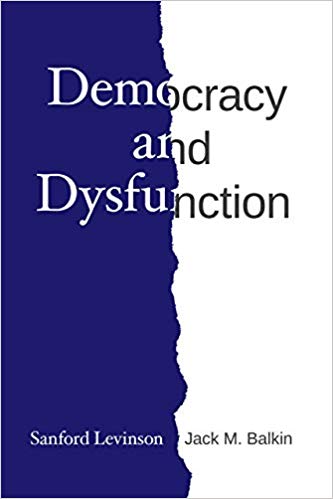
Sanford Levinson and Jack M. Balkin, Democracy and Dysfunction (University of Chicago Press, 2019)

Sanford Levinson, Written in Stone: Public Monuments in Changing Societies (Duke University Press 2018)

Mark A. Graber, Sanford Levinson, and Mark Tushnet, eds., Constitutional Democracy in Crisis? (Oxford University Press 2018)

Gerard Magliocca, The Heart of the Constitution: How the Bill of Rights became the Bill of Rights (Oxford University Press, 2018)

Cynthia Levinson and Sanford Levinson, Fault Lines in the Constitution: The Framers, Their Fights, and the Flaws that Affect Us Today (Peachtree Publishers, 2017)

Brian Z. Tamanaha, A Realistic Theory of Law (Cambridge University Press 2017)

Sanford Levinson, Nullification and Secession in Modern Constitutional Thought (University Press of Kansas 2016)

Sanford Levinson, An Argument Open to All: Reading The Federalist in the 21st Century (Yale University Press 2015)

Stephen M. Griffin, Broken Trust: Dysfunctional Government and Constitutional Reform (University Press of Kansas, 2015)

Frank Pasquale, The Black Box Society: The Secret Algorithms That Control Money and Information (Harvard University Press, 2015)

Bruce Ackerman, We the People, Volume 3: The Civil Rights Revolution (Harvard University Press, 2014)
Balkinization Symposium on We the People, Volume 3: The Civil Rights Revolution

Joseph Fishkin, Bottlenecks: A New Theory of Equal Opportunity (Oxford University Press, 2014)

Mark A. Graber, A New Introduction to American Constitutionalism (Oxford University Press, 2013)

John Mikhail, Elements of Moral Cognition: Rawls' Linguistic Analogy and the Cognitive Science of Moral and Legal Judgment (Cambridge University Press, 2013)

Gerard N. Magliocca, American Founding Son: John Bingham and the Invention of the Fourteenth Amendment (New York University Press, 2013)

Stephen M. Griffin, Long Wars and the Constitution (Harvard University Press, 2013)

Andrew Koppelman, The Tough Luck Constitution and the Assault on Health Care Reform (Oxford University Press, 2013)

James E. Fleming and Linda C. McClain, Ordered Liberty: Rights, Responsibilities, and Virtues (Harvard University Press, 2013)
Balkinization Symposium on Ordered Liberty: Rights, Responsibilities, and Virtues

Andrew Koppelman, Defending American Religious Neutrality (Harvard University Press, 2013)

Brian Z. Tamanaha, Failing Law Schools (University of Chicago Press, 2012)

Sanford Levinson, Framed: America's 51 Constitutions and the Crisis of Governance (Oxford University Press, 2012)

Linda C. McClain and Joanna L. Grossman, Gender Equality: Dimensions of Women's Equal Citizenship (Cambridge University Press, 2012)

Mary Dudziak, War Time: An Idea, Its History, Its Consequences (Oxford University Press, 2012)

Jack M. Balkin, Living Originalism (Harvard University Press, 2011)

Jason Mazzone, Copyfraud and Other Abuses of Intellectual Property Law (Stanford University Press, 2011)

Richard W. Garnett and Andrew Koppelman, First Amendment Stories, (Foundation Press 2011)

Jack M. Balkin, Constitutional Redemption: Political Faith in an Unjust World (Harvard University Press, 2011)

Gerard Magliocca, The Tragedy of William Jennings Bryan: Constitutional Law and the Politics of Backlash (Yale University Press, 2011)

Bernard Harcourt, The Illusion of Free Markets: Punishment and the Myth of Natural Order (Harvard University Press, 2010)

Bruce Ackerman, The Decline and Fall of the American Republic (Harvard University Press, 2010)
Balkinization Symposium on The Decline and Fall of the American Republic

Ian Ayres. Carrots and Sticks: Unlock the Power of Incentives to Get Things Done (Bantam Books, 2010)

Mark Tushnet, Why the Constitution Matters (Yale University Press 2010)

Ian Ayres and Barry Nalebuff: Lifecycle Investing: A New, Safe, and Audacious Way to Improve the Performance of Your Retirement Portfolio (Basic Books, 2010)
.jpg)
Jack M. Balkin, The Laws of Change: I Ching and the Philosophy of Life (2d Edition, Sybil Creek Press 2009)

Brian Z. Tamanaha, Beyond the Formalist-Realist Divide: The Role of Politics in Judging (Princeton University Press 2009)
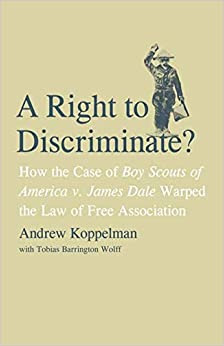
Andrew Koppelman and Tobias Barrington Wolff, A Right to Discriminate?: How the Case of Boy Scouts of America v. James Dale Warped the Law of Free Association (Yale University Press 2009)

Jack M. Balkin and Reva B. Siegel, The Constitution in 2020 (Oxford University Press 2009)

Heather K. Gerken, The Democracy Index: Why Our Election System Is Failing and How to Fix It (Princeton University Press 2009)

Mary Dudziak, Exporting American Dreams: Thurgood Marshall's African Journey (Oxford University Press 2008)

David Luban, Legal Ethics and Human Dignity (Cambridge Univ. Press 2007)

Ian Ayres, Super Crunchers: Why Thinking-By-Numbers is the New Way to be Smart (Bantam 2007)

Jack M. Balkin, James Grimmelmann, Eddan Katz, Nimrod Kozlovski, Shlomit Wagman and Tal Zarsky, eds., Cybercrime: Digital Cops in a Networked Environment (N.Y.U. Press 2007)

Jack M. Balkin and Beth Simone Noveck, The State of Play: Law, Games, and Virtual Worlds (N.Y.U. Press 2006)

Andrew Koppelman, Same Sex, Different States: When Same-Sex Marriages Cross State Lines (Yale University Press 2006)

Brian Tamanaha, Law as a Means to an End (Cambridge University Press 2006)

Sanford Levinson, Our Undemocratic Constitution (Oxford University Press 2006)

Mark Graber, Dred Scott and the Problem of Constitutional Evil (Cambridge University Press 2006)

Jack M. Balkin, ed., What Roe v. Wade Should Have Said (N.Y.U. Press 2005)

Sanford Levinson, ed., Torture: A Collection (Oxford University Press 2004)
Balkin.com homepage
Bibliography
Conlaw.net
Cultural Software
Writings
Opeds
The Information Society Project
BrownvBoard.com
Useful Links
Syllabi and Exams
