Balkinization
an unanticipated consequence of
Jack M. Balkin
Balkinization Symposiums: A Continuing List
E-mail:
Jack Balkin:
jackbalkin at yahoo.com
Bruce Ackerman
bruce.ackerman at yale.edu
Ian Ayres
ian.ayres at yale.edu
Corey Brettschneider
corey_brettschneider at brown.edu
Mary Dudziak
mary.l.dudziak at emory.edu
Joey Fishkin
joey.fishkin at gmail.com
Heather Gerken heather.gerken at yale.edu
Abbe Gluck abbe.gluck at yale.edu
Mark Graber
mgraber at law.umaryland.edu
Stephen Griffin
sgriffin at tulane.edu
Jonathan Hafetz
jonathan.hafetz at shu.edu
Jeremy Kessler
jkessler at law.columbia.edu
Andrew Koppelman
akoppelman at law.northwestern.edu
Marty Lederman
msl46 at law.georgetown.edu
Sanford Levinson
slevinson at law.utexas.edu
David Luban
david.luban at gmail.com
Gerard Magliocca
gmaglioc at iupui.edu
Jason Mazzone
mazzonej at illinois.edu
Linda McClain
lmcclain at bu.edu
John Mikhail
mikhail at law.georgetown.edu
Frank Pasquale
pasquale.frank at gmail.com
Nate Persily
npersily at gmail.com
Michael Stokes Paulsen
michaelstokespaulsen at gmail.com
Deborah Pearlstein
dpearlst at yu.edu
Rick Pildes
rick.pildes at nyu.edu
David Pozen
dpozen at law.columbia.edu
Richard Primus
raprimus at umich.edu
K. Sabeel Rahmansabeel.rahman at brooklaw.edu
Alice Ristroph
alice.ristroph at shu.edu
Neil Siegel
siegel at law.duke.edu
David Super
david.super at law.georgetown.edu
Brian Tamanaha
btamanaha at wulaw.wustl.edu
Nelson Tebbe
nelson.tebbe at brooklaw.edu
Mark Tushnet
mtushnet at law.harvard.edu
Adam Winkler
winkler at ucla.edu
Compendium of posts on Hobby Lobby and related cases
The Anti-Torture Memos: Balkinization Posts on Torture, Interrogation, Detention, War Powers, and OLC
The Anti-Torture Memos (arranged by topic)
Recent Posts
The Burris appointment -- another view
Can The Senate Refuse to Seat Roland Burris? Quite Possibly
Unilateral Disarmament in the Judicial Appointments Arm Race
Read me whine
Our defective state constitutions? (Or, does this crisis portend the end of what remains of robust federalism?)
The Decline of the Political Question Doctrine
I unbeg your pardon-- I never promised you, said the man in the Rose Garden
Will Al Franken or Norm Coleman be able to claim to be "the people's choice"?
Tushnet, Teles, and "What Consequences Do Ideas Have?"
Obama, Economic Stimulus, and Women Workers
Secession Winter Revisited
When is the best time to engage in reform?
A Temporary Exit for Blogojevich? Some Lessons from the Twenty Fifth Amendment
Is the Bush presidency a "major catastrophe"?
Can there be too much democracy? Yes.
For this we had a revolution?
Trouble at China's Supreme People's Court
Are We Witnessing the Receding Tide of Law and Economics? (The Evolving Views of Judge Posner)
A Defender of the Rule of Law Waits in Legal Jeopardy, While Abusers are Doing Well
Ann Althouse and I on Bloggingheads
The Privileges or Immunities Clause and Unenumerated Fundamental Rights
![[Powered by Blogger]](https://lh3.googleusercontent.com/blogger_img_proxy/AEn0k_tmDEyiEiSxuaobWlWoSE__Ff-SGOTCeelHqS3trDMlksl5Asfr4NHs-suSyKMuPYJMc98Qeb3gWas9Qv8COj6g50UpSVIEcirIy5C32mSH=s0-d)
Just A Few Blogs
ACS Blog
Alas, a Blog
Althouse
Arts and Letters Daily
Atrios (Eschaton)
Bill of Health
Buzzflash.com
Buzz Machine
Cato at Liberty
Juan Cole (Informed Comment)
Concurring Opinions
The Constitution in 2020
Corrente
Crooked Timber
Daily Howler
Daily Kos
Dana Boyd
Brad DeLong
Digby (Hullabaloo)
Discriminations
Daniel Drezner
Kevin Drum (Mother Jones)
Electrolite
En Banc
Eunomia (Daniel Larison)
Fafblog
Michael Froomkin (Discourse.net)
GovLab (Beth Noveck)
Rick Hasen (Election Law)
History News Network
How Appealing
Ignatz (Sam Heldman)
The Importance of (Ernie Miller)
Infolaw
Instapundit
International Economic Law and Policy Blog
IntLawGrrls
Jacob Levy
Jesus' General
Jurisdynamics
The Kitchen Cabinet
Mark Kleiman
Law Blog Central
Larry Lessig
Lawyers, Guns and Money
Liberal Oasis
Brian Leiter's Law School Reports
The Leiter Reports
Marginal Revolution
Megan McArdle
Memeorandum
Metafilter
Mirror of Justice
The New Republic
Newseum
No More Mister Nice Blog
Brendan Nyhan
Opinio Juris
Orcinus
The Originalism Blog
Pandagon
Passport (Foreign Policy)
Overcoming Bias
Political Animal (Washington Monthly)
Political Theory Daily Review
Political Wire (Taegan Goddard)
The Poor Man
Virginia Postrel
Prawfsblawg
Public Reason
Jonathan Rauch
Raw Story
Redstate
ReligiousLeftLaw.com
Reporters Committee For Freedom of the Press
Reproductive Rights Blog
Rothman's Roadmap to the Right of Publicity
SCOTUS Blog
Seeing the Forest
Clay Shirky
The Shifted Librarian
The Situationist
Larry Solum (Legal Theory)
Andrew Sullivan
Talking Points Memo
Talk Left
Tapped
Tbogg
TechPresident
The Paper Chase (Jurist)
Tom Paine
Tom Tomorrow (This Modern World)
Eve Tushnet
Uggabugga
University of Chicago Law School Faculty Blog
Unqualified Offerings
The Volokh Conspiracy
War and Piece (Laura Rozen)
Wampum
Oliver Willis
Wonkette
Written Description
Matthew Yglesias
Yin
Your Choice of Feeds
1. XML
powered by

2. Atom Feed
3. RSS 2.0
The Burris appointment -- another view
Mark Tushnet
Following up on Jack's post, here's the substance of something I sent to a listserv. It offers an analysis compatible with Jack's though a bit more textual in focus, and a bit more tentative in its conclusions than even Jack's tentative conclusions.
Without knowing *anything* whatever about the relevant history (whether of original meaning or subsequent practice), I began to think along these lines: There's no election (except in a metaphorical sense,and I think that term is displaced by the provision for "making" appointments to fill vacancies), and Burris clearly meets the qualifications as defined by Powell v. McCormack. But what about "returns"? The original Constitution contemplated temporary appointments by the state "executive" to "vacancies" (modified by the 17th Amendment, but not, as I read it, in any respect relevant to the argument I'm going to sketch). In the case of a vacancy, the "return" would be, I would think, the document indicating who the governor had appointed (pursuant to authority given him/her by the state legislature, per the 17th amendment). Is the Senate limited in any way when it "judges" the "returns"? Presumably it can't judge that a return is invalid on any ground whatever, because that would undermine Powell's holding. Presumably as well the Senate could say that the person who showed up is not the person named in the return. Presumably, too, were there two people claiming to be the state's executive, the Senate could judge which one "really" was the executive (an example that might arise were Burris to show up, Blago to be impeached before the Senate did anything about Burris, and the new "executive" -- I gather, the current Lieutenant Governor -- were to name someone else). Could the Senate say that the return is invalid because it did not conform to state law (were the Secretary of State to decline to sign the relevant document, even if experts in state law asserted that his signature was unnecessary to make the document effective as a matter of state law)? Could it judge a return invalid simply because it was suspicious of the process by which the named person was chosen (without coming to a conclusive judgment -- how? -- that those suspicions were well-founded)? Because it made an independent judgment that the state's executive should not be allowed to make the appointment because of questions about the executive unrelated to the appointment? Note that, with respect to the last question in particular, the fact that this is an appointment to fill a vacancy weakens -- although it does not eliminate -- the concern in Powell v. McCormack that the people and not the Senate should make the decision about who should represent them. As I indicated, these are genuine questions.
My inclination is to say that the Powell footnote about the nonjusticiability of decisions genuinely directed at determining whether a person met the qualifications rests on a judgment that we can expect the political process to operate responsibly when confined to those questions (even though we can imagine hypotheticals indicating irresponsible action). I would generalize that (I've done so, more or less, relying in part on a reading of Walter Nixon v. United States, in an article in the North Carolina Law Review) to say that the Senate has full power to judge returns as long as it confines itself by adopting some law-like standard that limits its discretion in ways that generate political accountability (and that, were it to adopt some law-like standard -- either formally, for example, in a report from the relevant committee recommending that the Senate not accept the return naming Burris, or informally [I'm inclined to think] -- the question of whether it acted in a manner consistent with the Constitution should be nonjusticiable).
Posted
9:37 AM
by Mark Tushnet [link]
(12) comments
Can The Senate Refuse to Seat Roland Burris? Quite Possibly
JB
Governor Blagojevich has decided to appoint former Illinois Attorney General Roland Burris to President Elect Obama's vacant Senate seat. Several commentators have argued that because of Powell v. McCormack, the Senate cannot refuse to seat Burris for any reasons other than whether he meets the qualifications of age, residency, and U.S. citizenship specified in Article I, section 3. He meets those qualifications, therefore he cannot be refused a seat. Instead, the Senate by two thirds majority, must vote to expel him, a considerably more difficult task.
Sounds like an airtight argument, right?
Not so fast.
Article I, section 5 reads: "Each House shall be the judge of the elections, returns and qualifications of its own members."
Hence the Senate may refuse to seat Burris for three reasons: because he is not qualified under Article I, section 3, because the election returns do not support him, and because his election was not properly conducted. Nothing in Powell v. McCormack is to the contrary. In Powell, the Supreme Court repeatedly assumed (and repeatedly asserted) that Powell had been duly elected, and Congress did not attempt to refuse to seat him on that ground.
In this case, Burris was not elected; he was appointed. Since he was not elected, perhaps the Senate could refuse to seat him for that reason. No, you might reasonably reply: That would be crazy. It would mean that whenever a Senator was appointed rather than elected, the Senate could automatically refuse to seat the person for any reason, which would be an end run around Powell v. McCormack.
Similarly, it would make no sense to say that because Burris was appointed but not elected, the Senate has no authority to judge whether he was duly appointed, because that would be an end run around Article I, section 5 of the Constitution in the other direction: Under that argument, the Senate would have to seat anyone who was appointed by anyone who claimed to be the lawful governor of a State, even people who were appointed by a sitting governor as the result of a transparent bribe. That is, under this argument, the Senate could look into whether an election was rigged but not an equally corrupt appointment.
Instead, you might argue, Section Two of the Seventeenth Amendment modifies Article I, section 5. It states:
"When vacancies happen in the representation of any State in the Senate, the executive authority of such State shall issue writs of election to fill such vacancies: Provided, That the Legislature of any State may empower the Executive thereof to make temporary appointments until the people fill the vacancies by election as the Legislature may direct."
Thus, you might argue, the Senate must treat a person appropriately appointed by the executive authority of the state as duly elected for purposes of Article I, section 5.
But that is precisely is the basis of the Senate's refusal to seat Burris. In the Senate's view, Burris has not been properly appointed by the executive authority of the State of Illinois.
Why might the Senate conclude that Burris has not been properly appointed by Illinois' executive authority? Well, for starters, it looks like the Governor might be corrupt and was trying to sell the seat.
But, you might respond, the Governor has not been convicted of anything. Surely he is innocent until proven guilty.
True enough. But Article I, section 5 does not contemplate a criminal proceeding. Rather, it contemplates that the Senate will be the judge of the circumstances of election (or in this case, after the Seventeenth Amendment, an appointment.).
And if the Senate decides that Burris has received his appointment in suspicious circumstances, the question is whether the Supreme Court could overturn their judgment or whether it must defer to it. The answer to that question comes from none other than Powell v. McCormack: In that case the Court said that the Constitution provided a textually demonstrable commitment to judging the qualifications listed, but no others. However, the same constitutional text gives the Senate the authority to judge the elections and returns of its members. If the Senate determines that Burris has not been duly elected (or, under the Seventeenth Amendment, duly appointed), Powell might seem to suggest that courts should defer to that judgment under the political question doctrine.
Is the argument I have presented foolproof? Probably not. I can think of a number of different issues to raise in objection. As new ideas come in, I will try to list them below.
However, what I have said is enough to suggest that the question of whether the Senate can seat Burris is not open and shut. It is very likely that the Senate would have a fairly plausible argument for refusing to seat him. And the Supreme Court would have a fairly plausible argument for deferring to the Senate's decision.
Let me conclude by saying that I have not yet made up my mind whether I think this is a good thing or a bad thing. Perhaps it would be better to just have the matter settled, so perhaps the Senate should just allow Burris to be seated so that we can get on with the country's business. What I do believe is that the Senate may have more options in this case than one might think.
UPDATE: Akhil Amar and Josh Chafetz over at Slate reach conclusions similar to mine by a different route: They point out (as does Mark Tushnet) that the Senate is also the judge of the "return" which, in this case, means the report of an appointment. They read Powell v. McCormack in much the same way I do.
Posted
8:11 AM
by JB [link]
(24) comments
Unilateral Disarmament in the Judicial Appointments Arm Race
David Stras
With a new president entering office in less than a month, one difficult question for conservatives will be how to treat President-elect Obama's judicial nominees. My friend, Jonathan Adler, has stated in a post on the Volokh Conspiracy that "if we get a President Obama, and he nominates accomplished left-leaning lawyers and judges to the Supreme Court and federal appellate courts, I hope most conservatives and Republican Senators let them go through without much of a fight." Rick Hills, meanwhile, proposed in this post on PrawfsBlawg a "professors' nonaggression pact" against any academic nominees advanced by President-elect Obama because "literally any law prof -- is likely to be as good as, or even a better than, the typical nominee to a lower court, whose qualifications typically amount to being a Senator's friend or staffer." I am not sure that I agree with Rick, but I do think that Jonathan makes an extremely compelling point, one that I would be willing to endorse as a policy matter. In other words, in an ideal world, I would call for fellow Republicans to unilaterally disarm in the judicial appointments arms race.
One powerful argument is that it harms the legitimacy of the judiciary when we spend so much time arguing about who to appoint to the judiciary. A paper by James Gibson and Greg Caldeira, see here, basically makes that point in finding that exposing citizens to advertisements against judicial nominees (and particularly Justice Alito's confirmation) erodes support for the courts. Meanwhile, presenting the public with positive symbols of judicial power such as robes or the use of the words "your honor," teaches Americans that the courts are different than other political institutions and thus should be held in high esteem. The bottom line, as Gibson and Caldeira put it, is that "[p]oliticized confirmation processes therefore seem to have considerable
capacity to undermine the legitimacy of the Supreme Court itself." One possible consequence of our highly-politicized confirmation process is that, if the public believes that judges are nothing more than political actors in robes (as many political scientists believe), then perhaps it will be more difficult for the country to accept politically-controversial decisions like Bush v. Gore.
Moreover, several circuits are now so understaffed that a number of cases are now being decided summarily without oral argument or by panels that have one or more judges sitting by designation from another court (such as district court judges). For instance, the Fourth Circuit now has four vacancies (out of 15 authorized judgeships), three of which have been labeled as "judicial emergencies." There are now 44 judicial vacancies, about 5% of the total capacity of the federal judiciary, with about 22 additional vacancies nearly certain to occur within the next six months. When the confirmation process becomes so politicized (to use Gibson and Caldeira's words) that it becomes difficult to get the work of the judiciary done in an efficient and timely manner, then it is time to step back and reexamine the process.
I am sure there are other arguments as well for a depoliticized process, but it bears mentioning that the average circuit court nominee has taken more than one year to confirm during the presidency of George W. Bush. For those nominations that have been renewed from one Congress to another, that figure jumps to more than two years. To my knowledge, it has taken longer to confirm President George W. Bush's circuit court nominees than for any other president in United States history. In my view, if Senators were holding up nominees in order to closely examine their credentials or ideology, then I would have no objection to a lengthy, probing process. But that is simply not the case in most instances. Senators are now refusing to give judicial nominees a vote in order to please interest groups and to extract concessions from the opposing party. Judicial nominees have become a bargaining chip in a process that has increasingly involved vote-trading among Senators (according to Orrin Hatch).
In an ideal world, I would very much support disarming over judicial nominees. Unfortunately, however, we do not live in an ideal world. In a later post, I will explain why it is unlikely that we will return a time when nominees to the lower courts were confirmed within weeks, not years.
Posted
1:30 PM
by David Stras [link]
(19) comments
Read me whine
Sandy Levinson
Consider current issues of two leading ostensibly "progressive" journals, The Boston Review and the American Prospect. The former, which bills itself as "a political and literary forum" (though it doesn't appear to include a letter-to-the-editors page for its readers to participate in the forum) has, in the November/December issue, an interesting article by William Hoagland, "Constitutional Conventions." Hoagland is the author of The Whiskey Rebellion and the forthcoming Inventing American History. I have no doubt he is an interesting person. That being said, I hope that some of you will appreciate my disappointment when I actually read the piece, which is a review of the American Constitution Center in Philadelphia and an attack on same for allegedly promoting an anodyne "consensus" view of American history instead of the more Beardian class struggle that Hoagland prefers. He says that the promotion of this consensus view has helped to blind the contemporary American public to the extent to which the Constitution is anti-democratic. I 0bviously don't object to this general argument, even if I think he is at least a bit anachronistic in his view of truly "democratic" possibility in late 18th century America. What did dismay me, however egocentric it is to say so, is Hoagland's seemingly complete ignorance of the fact that there are some contemporary writers, including Dan Lazare, Robert Dahl, Larry Sabato, and myself, who are far more interested in stirring a debate about the contemporary inadequacies of the Constitution than going over, once more, whether the Constitutional Convention was a collection of demigods or of militant opponents of the kind of democracy represented by the Shays Rebellion and, later, the Whiskey Rebellion. Perhaps trashing the Framers is thought to be necessary condition for criticizing the Constitution today, though I don't think so. One can say they did the best they could for their time and provided us with the example, which we've chosen to ignore, of responding to new exigencies with truly radical thought. But, hey, if returning to Beard would generate more contemporary discussion of the Constitution, that's fine.
I'd be considerably happier, of course, if the Boston Review had taken any cognizance of either Sabato's or my book, both of which I continue to believe have something to say to people interested in achieving a truly "progressive politics."
But my disappointment with the Boston Review (which I will continue to subscribe to, if for no other reason than Alan Stone's always fascinating movie reviews) is as nothing compared with my reaction to the issue of The Ameican Prospect (which I also, of course, subscribe to) that arrived in today's mail. It includes a 15-page special section on "Revitalizing Democracy," financed by grants of the Rockefeller Brothers Fund, the Carnegie Corporation of New York, and The Joyce Foundation, with contributions by a number of first-rate authors, including Balkinization's sometime contributor (and friend) Heather Gerken.
There is, alas, not a word in the fifteen pages that suggests that anyone interested in "revitalizing democracy" might actually be looking at the Constitution and asking whether it works for or against achieving the goals that the American Prospect sets forth for America (and which I share). Again, I, and I assume Sabato, would be happier if critics grappled with our arguments and then disagreed with them rather than pretend that no such arguments exist.
What is dismayingly typical is the first piece, by Bob Edgar, idenified as "the president and CEO of Common Cause, who offers four suggestions. The first two involve good-government electoral reform, that I certainly endorse, but says nothing about the anti-democratic electoral college. The fourth suggestion is to "restore the Constituion":The new Congress and administration must work to restore the rule of law, the separation of powers, and the respect for human rights and the Constitution. We need more than just a government that enacts sound policies. We need a democracy capable of building broad and resilient support for the changes, sacrifices, and disruptions that are inevitable. And we need to rebuild the structures of democracy that hold power accountable, especially for the poor, the powerless, and the voiceless.
With all due respect (a dead rhetorical giveaway), the foundations should sue for their money back if this is all he can come up with. I certainly agree that we should "respect" the parts of the Constitution that are worthy of our respect. But does it occur to Mr. Edgar that there may be some parts of the Constitution that are not worthy of respect precisely because they reinforce the lack of accountability and help to assure that the poor, the powerless, and the voiceless will continue to be systematically screwed by a system that, as Hoagland well points out, wasn't constructed with their interests in mind in the first place? Anyone interested in assuring better accountability, for example, should look at how "the opposition parties" are treated in other constitutional systems, including Germany. Rick Pildes and Daryl (no relation) Levinson wrote a brilliant article several years ago in the Harvard Law Review on "the separation of parties, no powers." It should be at the heart of contemporary public discussion.
Larry Marx, the executive director of the Donor Collaborative of Wisconsin, has a three page article calling for "a broader definintion of democracy," with the subhead "Small reforms won't bring the system-wide change we need." Amen, brother. But it turns out that Marx, too, doesn't seem to contemplate even the possibility that we might look at the Constitution if we want "system-wide change we need." Of course, the reason may be that Article V dooms us to failure with regard to any such efforts, so it's simply easier to continue with small- or medium-size reforms (many of them, I hasten to add, that are fine ideas) than even to discuss any more ambitious alternatives. This repression of any radical thought is one of the reasons I have come truly to despise Article V, since it's pernicious consequences go well beyond simply preventing some changes I might support (and, to be sure, sometimes stopping changes I oppose).
Forgive me for the self-indulgence of this posting. But it really does rankle to watch one's erstwhile political allies, committed to all sorts of good goals, whether it's further "democratization" of American politics or helping the poor and the currently voiceless, simply maintain a truly willful ignorance to the possibility that our Constitution is at least as much the problem as the solution to the ills they all identify. If they set out the limits of "change we can believe in," we really are doomed, as argued in an extremely interesting and troubling review elsewhere in that issue of The American Prospect, by Chris Mooney, of two books on global warming and the seeming incapacity of our political system (or, perhaps, all political systems around the world as well) to respond adequately and begin engaging in the changes that are necessary.
Posted
10:08 PM
by Sandy Levinson [link]
(13) comments
Our defective state constitutions? (Or, does this crisis portend the end of what remains of robust federalism?)
Sandy Levinson
Paul Krugman's column in today's Times, tellingly titled "Fifty Herbert Hoovers," discusses the insanity of the fact that most states are cutting back on public expenditures right now. And why is that the case, beyond the implausible power of fanatical anti-tax libertarians in the hustings? As Krugman writes, "Partly that’s because these governments, unlike the feds, are subject to balanced-budget rules. But even if they weren’t, running temporary deficits would be difficult. Investors, driven by fear, are refusing to buy anything except federal debt, and those states that can borrow at all are being forced to pay punitive interest rates." Of course, what Krugman, Nobel Prize-economist that he is, refers to "balanced-budget rules" can also be described, perhaps more pointedly, as "state constitutional requirements." But, as he notes, even if more states were allowed to run deficits, that still wouldn't resolve the problems involved in states finding people to lend them money, especially since, thanks to the US Constitution, states are prevented from issuing their own currencies. (I DON'T count this as a defect of the US Constitution, incidentally.) In any event,
as more and more states emulate Arnold Schwarzenegger and Tim Strickland--and almost everyone literally and figuratively in between--in asking federal aid to allow them to meet basic expenditures of the modern welfare state, including, say, public education, law enforcement, and provision of emergency medical service (not to mention imprisoning people and inspecting restaurants, etc.), "federalism" will have to be recognized even by members of the Federalist Society as the dessicated notion that it has become in the course of the past century and a half. And this, of course, has nothing to do with the most common post-World War II attack on federalsm, which is the propensity of unregulated states to engage in such things as invidious racial discrimination and the like. No, we are going back to the critiques of the initial Progressive Period, when it was becoming obvious that state autonomy with regard to the economy just didn't make much sense. It really doesn't matter if one actually likes principles of "subsidiarity" that dictate that decisions should be made at the most local level possible. (I think that's a pretty good principle myself). The hooker is the word "possible." Hell, we're realizing that Buchananite fantasies of national "sovereignty" really don't make much sense anymore with regard to the general economy, that a whole bunch of countries are going to have to come together and agree, e.g., on what count as acceptable principles of accounting so that regulators (and investors) can have some idea of what vaunted financial institutions are actually worth and what they're doing with their money.
The challenge facing President-to-be (in only 22 more days, glory be) is speaking candidly to the American people about how many of their accepted understandings of our system(s) are now up for grabs. (And, of course, I hope that sooner or later he'll get around to our dysfunctional Constitution, but I don't need to go down that road today.)
Posted
5:54 PM
by Sandy Levinson [link]
(69) comments
The Decline of the Political Question Doctrine
David Stras
I am very pleased to be a guest on Balkinization. Many thanks to Jack for permitting me to share a few thoughts here.
Although much of my research focuses on the intersection of law and political science, my first post will take up a lingering doctrinal matter from the Court's decision in Boumediene this past June. For those of us who teach federal courts, one of the most elusive concepts is the political question doctrine, primarily because it is so difficult to reconcile with the other justiciability doctrines such as standing, mootness, or ripeness. Unlike those three other doctrines, the political question doctrine is unrelated to the question of whether a particular plaintiff has a sufficient personal stake in a controversy to bring a lawsuit. Instead, the political question doctrine focuses on whether the resolution of a particular issue is a matter for the judiciary or one of the political departments of government.
Not surprisingly, the Court has limited the application of the political question doctrine to thorny areas that are at the intersection of law and public policy, such as Congress's ability to regulate its own internal processes and matters of foreign affairs. With respect to the latter category, the Court has long declined to interfere with sensitive questions of foreign policy, holding at various points in history that such questions of when a war begins and ends and whether to recognize a foreign government and grant diplomatic immunity to its officials are all nonjusticiable political questions. In fact, some scholars have recognized that the area of foreign affairs was the last bastion where the political question doctrine had "real bite." The question I pose is what is left of the political question doctrine after Boumediene v. Bush?
The answer, I believe, is not very much. As an initial matter, a majority of the Court has only employed the political question doctrine twice since 1964 (the year Baker v. Carr was decided) to dismiss a case, though various Justices have endorsed its use in a variety of contexts (e.g., treaty interpretation, political gerrymandering cases, etc.). Second, in Boumediene, the Court quickly dismissed the Government's argument that questions of sovereignty are matters for the political branches to conclusively decide. As the Court stated, "our cases do not hold it is improper for us to inquire into the objective degree of control the Nation asserts over foreign territory . . . . When we have stated that sovereignty is a political question, we have referred not to sovereignty in the general, colloquial sense, meaning the exercise of dominion or power, but sovereignty in the narrow, legal sense of the term, meaning a claim of right." The Court went on to conclude essentially that questions of de jure sovereignty (or a claim of right) are matters for the political branches to decide, but that questions of de facto sovereignty (or practical control over a territory) can be examined by the judicial branch.
Given that de jure sovereignty is the clearer purely legal question and that one of the lynchpins of the political question doctrine is the presence or absence of judicially manageable standards, I find the Court's abbreviated discussion of the political question doctrine quite significant, even astonishing. Questions of de facto sovereignty tend to be difficult to determine because of competing indicia of control and, as a result, judicially manageable standards seem to be fairly elusive. (However, I would freely admit that the United States' near-total control of Guantanamo Bay made the question of de facto sovereignty by the United States in Boumediene pretty clear.)
I also find the Court's discussion of the political question doctrine to be in stark contrast to its prior case law, which is quite deferential to the political branches on foreign policy questions. For instance, in Chicago & Southern Air Lines, Inc. v. Waterman Steamship Corp., 383 U.S. 103 (1948), the Court held that it could not review decisions of the President to grant or deny certificates of necessity to air carriers wishing to establish air travel routes to foreign countries. As the Court stated:[t]he very nature of executive decisions as to foreign policy is political, not judicial. Such decisions are wholly confided by our Constitution to the political departments of the Government, Executive and Legislative. They are delicate, complex, and involve large elements of prophecy. They are and should be undertaken only by those directly responsible to the people whose welfare they advance or imperil. They are decisions of the kind for which the Judiciary has neither aptitude, facilities, nor responsibility, and have long been held to belong in the domain of political power not subject to judicial intrusion or inquiry.
In the past, the Court has held that questions relating to sovereignty, such as whether to recognize a foreign government and grant diplomatic immunity to government officials, were among the "delicate" and "complex" matters that were better left to the "political departments." And as the Court freely concedes in Boumediene, it would have at least deferred to the Executive Branch if the outcome of the case depended on which country possessed de jure sovereignty over Guantanamo Bay. I am surprised, therefore, that not a single Justice on the Court would have dismissed this case on political question grounds, at least as the majority framed the case. (Perhaps the majority opinion could have taken sovereignty off the table by expanding its discussion of extraterritorial application of the Constitution and further distinguishing Eisentrager.)
This post is a long-winded way of saying that I wonder what is left of the political question doctrine after Boumediene, if anything? Is it, like the Rooker-Feldman doctrine after Saudi Basic, left for only the most exceptional of circumstances? More fundamentally, does the decline of the political question doctrine coincide with and portend of a federal judiciary that is more willing to involve itself with matters of cultural and particularly political significance that have traditionally been left to (and are arguably textually committed to) the political branches? I do not mean for this post to invite a free-for-all on whether the Court was wrong or right in granting habeas rights in Boumediene, a question that has been examined at length elsewhere, but to emphasize and begin a discussion on an aspect of the opinion that has been almost entirely ignored by the media and even constitutional law scholars.
UPDATE: I have been a bit surprised by some of the comments that seem to suggest that questions of sovereignty should not be a political question. I suspect that much of the skepticism on this issue is due to the fact that Guantanamo Bay presented such an easy case on de facto sovereignty. But suppose that the Supreme Court of the United States were to declare the United States as the de facto or de jure sovereign over Iraq on account of the occupation of US troops. I find it hard to believe that such a declaration would not impact foreign policy and thus affect the US's relationship with both Iraq and other middle East countries. In fact, I view such a scenario as almost the paradigmatic case for application of the political question doctrine, at least as the doctrine has been articulated by the Supreme Court.
Posted
2:30 PM
by David Stras [link]
(137) comments
I unbeg your pardon-- I never promised you, said the man in the Rose Garden
JB
For readers who want to know whether George W. Bush can in fact take back a pardon to Robert Toussie already given, there is a blog solely devoted to pardon issues, appropriately titled Pardon Power. The most recent post gives a historical run down of pardons given and taken back.
The argument made in that post is based on a series of precedents by the executive branch. Generally speaking, such precedents count for a lot in construing the Constitution. If the text is ambiguous or silent on the question whether the President can take back a pardon once offered, an unbroken line of practice on the question, if otherwise reasonable, is a powerful argument.
The question of taking back pardons, it should be noted, is really only the tip of the iceberg. The more general question is why the President's pardon power should be construed as broadly as it has been. There are many possibilities for abuse of the pardon power.
Even if the President has unreviewable power to grant pardons under the Constitution, it does not follow that the system cannot be rationalized and made subject to various procedures. The Executive branch already has structures for processing pardons. Moreover, Congress has the power, through its horizontal powers under the necessary and proper clause, to create and structure executive departments. Obviously, Congress cannot act so as to limit the President's prerogatives, but this does not mean that Congress may not set up agencies within the Executive Branch to assist the President in his determinations. The President, in turn, may have political reasons for employing these structures even if they channel the exercise of his discretion.
In this case, it appears that the pardon to Robert Toussie may not have gone through the Justice Department's regular procedural channels for granting pardons. This shows one of the reasons why these procedures are a good idea. It also reminds us of the fact that the Bush Administration has regularly tried to short-circuit a series existing procedures for decisionmaking-- ranging from intelligence analysis to the treatment of detainees to plans for dealing with post-war Iraq-- all with disastrous results. You would think that by now the White House would have learned that there are sometimes good reasons to vet decisions with people who don't already agree with your proposed course of action.
Posted
11:42 AM
by JB [link]
(48) comments
Will Al Franken or Norm Coleman be able to claim to be "the people's choice"?
Sandy Levinson
First things first: I of course support Al Franken and hope that he prevails over Norm Coleman, who appears to be a particularly odious opportunist in terms of his first embracing the Bush Administration and then, this year, pretending to distance himself from the Administration that he had helped to enable. That being said, and giving Minnesota due credit for appeaing to run a first-rate recount system, the election is Exhibit A for the problem of first-past-the-post systems of election.
Franken and Coleman each received approximately 42% of the votes cast on November 4. You can do the math. This means that over 15% of the vote was received by a third-party candidate, Dean Barkley (and, I gather, the remainder went to a couple of truly minor candidates). The one thing we can be sure of is that approximately 58% of Minnesotans will have cast their vote against the winner, whether it's Franken or Coleman. Obviously the 16% who voted for "other" in November may have a preference as between Coleman and Franken, but we--or at least I--do not know what it is, and no one in the universe has any "official" numbers.
Far better would be a voting system that allowed the winner plausibly to claim majority approval. One could do what Georgia does, so that Saxbe Chambliss, who received less than 50% of the vote against Jim Martin, had to compete in a runoff election against Martin, which he handily won. My own preference is the Alternative Transferrable Vote, by which every Minnesota voter would have rank ordered the candidates. Once Barkley is eliminated, then the second choices of those who had given Barkley their first-choice vote would be allocated, and the winner would have received some version of majority endorsement.
There is nothing in the Constitution that prevents states from adopting voting systems that would do a better job of meeting democratic criteria. It's also the case, incidentally, that several of the Democratic wins in 2006 featured non-majority winners who might have been helped by the presence of third-party candidates who deprived Republicans of likely votes. This might have been the case in Montana, and Sen. Webb in Virginia, too, might have been helped by the third-party candidate. So there's nothing partisan in my critique of the voting system that Minnesota, like almost all other states, has adopted.
Given everything that's happening in the world right now, this is a minor issue (unless, of course, Franken's win, together the political realities facing Republicans seeking re-election in 2010 gives the Democrats a filibuster-proof majority in the Senate, or a Coleman win makes it genuinely possible for Senate Republicans to play their role as filibustering obstructionists with regard to Democratic programs designed to meet the various crises).
For those who celebrate Christmas shortly, I hope it is a suitably merry one.
Posted
11:03 PM
by Sandy Levinson [link]
(55) comments
Tushnet, Teles, and "What Consequences Do Ideas Have?"
Mary L. Dudziak
Mark Tushnet, Harvard Law School, has posted What Consequences Do Ideas Have? which reviews Steven Teles, The Rise of the Conservative Legal Movement: The Battle for Control of the Law. The review appears in the Texas Law Review (2008). Hat tip to the Legal Theory Blog. Legal historians may take a special interest in Tushnet's comparison of the Federalist Society with "Felix Frank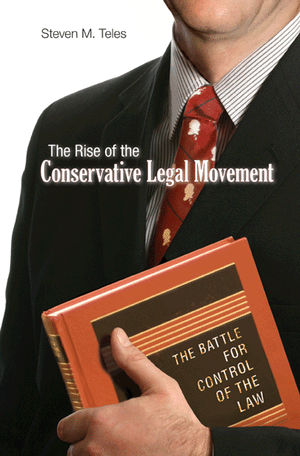
Steven Teles's book, The Rise of the Conservative Legal Movement, is a case study of ideological challenge. Teles, a political scientist, emphasizes the institutional dimensions of such challenges. Relying on interviews and internal documents produced by conservative organizations, he examines the development of conservative litigating groups (i.e., conservative public interest law firms), the growth of the Federalist Society, and the embedding of law and economics within the legal academy. There have been similar studies of liberal public interest law firms and of the rise of liberal legalism in the academy, but Teles's is the first to look on the other side of the ideological divide. And, given the dominance of liberal legal ideology, his analysis brings out in sharp relief many new insights into the institutions that affect the outcomes of ideological contests. In addition, Teles connects his analysis to a broader theme in recent studies of American political development. The rise of the conservative legal movement was intimately connected to changes in the dominant political order that have occurred over the past thirty years: the decay of the New Deal-Great Society political order, and the Reagan Revolution and its limits. In these ways Teles provides a firm foundation for thinking (or perhaps merely speculating) about future developments in the institutional apparatuses associated with conservative and liberal legal thought.
Teles is essential reading for anyone interested in late 20th century legal history or the role of institution-building in social change efforts. One point Tushnet doesn't raise in this extremely helpful review, in spite of his title, is the way Teles's fine but necessarily focused work underplays the role of certain ideas in "the conservative legal movement."
This Review summarizes and critiques Teles's analysis of the three components of the conservative legal movement, beginning with the least important, law and economics in the legal academy, and then turning to conservative public interest law firms and the Federalist Society. It concludes with some speculations about the future of that movement, in light of the connection Teles rightly draws between that movement and the American political regime of the late twentieth century.
Left out of Teles' account is the role of the religious right, and I suspect that this is the reason that abortion rights play so little role in Teles's description of legal conservatism. Roe v. Wade was not just a case, but also a catalyst for organizing against the Court, enabling fund raising efforts and mass mobilization.
Others have criticized Teles for this absence, and Teles, a careful political scientist, has an appropriate response: First, another book covers religious conservatives, Steven Brown’s Trumping Religion: The New Christian Right, The Free Speech Clause, and the Courts (Alabama, 2004), and "One of the main reasons I did not go into the subject at any greater length than I did was that I did not feel I had much to offer that Brown had not already covered." Second, and perhaps more important, Teles explains: "while I believed I was already reasonably far up the learning curve on the subjects I covered in the book (despite not being a lawyer), I do not have any particular training or background in Christian conservatism....To write a book like mine that covered Christian conservatives would require that the author have an intuitive sense of that part of the movement, and in all honesty, that is not part of my intellectual capital." He develops this point here.
But this means that Teles's point that he could only do so much and has not written a comprehensive history of legal conservatism must be kept in mind when we draw lessons from this work about the content and impact of the conservative legal movement. (I also wonder whether conservative women, who rarely appear in this otherwise excellent book, would play more of a role in a broader account.)
Because of this, although the book is a must-read for anyone interested in legal thought in the late 20th century, the limitations of Teles's methodology mean that, at least when it comes to the movement's motivating ideas, it cannot be read as a history of the conservative legal movement, but instead of critically important parts of it.Cross-posted from the Legal History Blog.
Posted
9:32 AM
by Mary L. Dudziak [link]
(43) comments
Obama, Economic Stimulus, and Women Workers
Mary L. Dudziak
Over 1000 historians have sent a letter to President-Elect Barack Obama, urging him to keep gender equity in mind, particularly in light of the way women were often l we are heartened by your commitment to a jobs stimulus program inspired by the New Deal and aimed at helping "Main Street." We firmly believe that such a strategy not only helps the greatest number in our communities but goes a long way toward correcting longstanding national problems. The letter was written and organized by Professor Eileen Boris, University of California Santa Barbara; Professor Linda Gordon, New York University; Professor Jennifer Klein, Yale University; and Professor Alice O’Connor, University of California Santa Barbara. I signed the letter, as did many other legal historians. Concerns about gender equity in the stimulus plan have also been raised recently by Linda Hirshman in the New York Times and Randy Albelda in the Boston Globe. A letter from economists calling for greater economic opportunities for women is here. We all know that our country's infrastructure is literally rusting away. But our social infrastructure is equally important to a vibrant economy and livable society, and it too is crumbling. Investment in education and jobs in health and care work shore up our national welfare as well as our current and future productivity. Revitalizing the economy will require better and more widespread access to education to foster creative approaches and popular participation in responding to the many challenges we face. As you wrestle with the country's desperate need for universal health insurance, we know you are aware that along with improved access we need to prioritize expenditure on preventive health. We could train a corps of health educators to work in schools and malls and medical offices. As people live longer, the inadequacy of our systems of care for the disabled and elderly becomes ever more apparent. While medical research works against illness and disability, there is equal need for people doing the less noticed work of supervision, rehabilitation, prevention, and personal care.
For all our admiration of FDR's reform efforts, we must also point out that the New Deal's jobs initiative was overwhelmingly directed toward skilled male and mainly white workers. This was a mistake in the 1930s, and it would be a far greater mistake in the 21st century economy, when so many families depend on women's wages and when our nation is even more racially diverse.
The text of the letter with signatories is here. The announcement, with contact info for the organizers, is here. Suggested actions that you can take are here.
The most popular programs of the New Deal were its public jobs. They commanded respect in large part because the results were so visible: tens of thousands of new courthouses, firehouses, hospitals, and schools; massive investment in road-building, reforestation, water and sewage treatment, and other aspects of the nation's physical plant--not to mention the monumental Triborough Bridge, and the Grand Coulee and Bonneville dams. But the construction emphasis discriminated against women. At best women were 18% of those hired and, like non-white men, got inferior jobs. While some of the well-educated obtained jobs through the small white-collar and renowned arts programs, the less well-educated were put to work in sewing projects, often at busy work, and African American and Mexican American women were slotted into domestic service. This New Deal policy assumed that nearly all women had men to support them and underestimated the numbers of women who were supporting dependents.
Today most policy-makers recognize that the male-breadwinner-for-every-household assumption is outdated. Moreover, experts agree that, throughout the globe, making jobs and income available to women greatly improves family well-being. Most low-income women, like men, are eager to work, but the jobs available to them too often provide no sick leave, no health insurance, no pensions, and, for mothers, pay less than the cost of child care. The part-time jobs that leave mothers adequate time to care for their children almost never provide these benefits.
Meanwhile the country needs a stronger social as well as physical infrastructure. Teachers, social workers, elder- and child-care providers and attendants for disabled people are overwhelmed with the size of their classes and caseloads. We need more teachers and teachers' aides, nurses and nurses' aides, case workers, playground attendants, day-care workers, home care workers; we need more senior centers, after-school programs, athletic leagues, music, and art lessons. These are not luxuries, although locality after locality has had to cut them. They are the investments that can make the U.S. economically competitive as we confront an increasingly dynamic global economy. Like physical infrastructure projects, these jobs-rich investments are, literally, ready to go.
A jobs-centered stimulus package to revitalize and “green” the economy needs to make caring work as important as construction work. We need to rebuild not only concrete and steel bridges but also human bridges, the social connections that create cohesive communities. We need a stimulus program that is maximally inclusive. History shows us that these concerns cannot be postponed until big business has returned to "normal." We look to the new administration not just for recovery but for a more humane direction—and in the awareness that what happens in the first 100 days and in response to immediate need sets the framework for the longer haul of reform.
Images 1 and 2.
Cross-posted from the Legal History Blog.
Posted
10:44 PM
by Mary L. Dudziak [link]
(28) comments
Secession Winter Revisited
Mark Graber
Most commentary indicates that the interval between the Lincoln election and Lincoln inauguration was a disaster for American politics. This consensus supports claims that the Constitution ought to be amended (or perhaps replaced entirely) to ensure a faster transition. I wonder whether the secession winter teaches that lesson, at least as clearly as some commentary suggests. Consider the following claim that Buchanan was not doing nothing or maintaining a failed policy that had been repudiated by the electorate. Instead, he may have been following a strategy that had been successful in the past.
The events of 1860 were not completely unprecedented. Andrew Jackson, Buchanan's idol, had to deal with the nullification crisis. By most accounts, Jackson did a good job resolving this crisis His strategy, Richard Ellis argues in his terrific THE UNION AT RISK, was to isolate South Carolina. Jackson did so by appeasing on crucial issues the other states opposed to protecting tariffs who might be inclined to line up with South Carolina. The Force Act aside (other than that, Ms.Lincoln), Jackson's main thrust was to promote a revised tariff that would halt any additional southern support for nullification. Jackson's idea was simple. Nullification was not viable if South Carolina stood alone.
Buchanan was faced with a similar problem in 1860, although admittedly a more difficult one. His strategy was not dilatory. Rather, he did pretty much what Jackson did successfully in 1832. He sought first to minimize the damage. The theory may have been pretty simple, although this is pure speculation on my part. Secession may have been viable in the long run only if Virginia, Tennessee, and other middle south states joined in. The longer Virginia stayed out, the more likely a Union preserving compromise. In short, any compromise that holds Virginia may in the long run have made the secession crisis goes away.
Lincoln's strategy was quite different. His goal, as Kenneth Stampp details, was to initiate a Civil War in such a way as to keep Kentucky and Maryland in the Union. Essentially, and for all practical purposes, Lincoln from day one abandoned the "keep Virginia in" strategy. Notice, however, Lincoln could not possibly have claimed a mandate for preferring Civil War to a proslavery compromise. He repeatedly insisted on the campaign trail that secession would not take place after he was elected. Lincoln's policies appear more successful than Buchanan's only if we assume the Civil War was inevitable, that Virginia was inevitably going to leave the Union, so that the only reasonable strategies were aimed at keeping Kentucky in the Union. But other assumptions were reasonable in 1860 and Buchanan's strategy may have been reasonable in light of those assumptions.
In short, secession winter did not witness the maintenance of a failed policy that had been repudiated by the electorate, but an inherited strategy for dealing with Union threatening controversies without violence. A good case can be made that violence was justified to free slaves, even if the success of the violence was uncertain. Still, given Lincoln insisted that violence would never take place, Buchanan can hardly be accused of ignoring the mandate of the 1860 election.
Posted
8:31 PM
by Mark Graber [link]
(5) comments
When is the best time to engage in reform?
Sandy Levinson
A respondent to my preceding post wrote, If Bush's great adventure has taught us anything it is that in the midst of a crisis, it is not the time to make shit up. This raises a genuinely interestng question. Begin with the undeniable fact that the impetus for the Philadelphia Convention in 1787 was the widely shared perception that the United States was in a state of "crisis." There never would have been a convention had Madison et al. believed that things were just fine and that minor tinkering (which would still have had to run the gauntlet of the unanimity requirement of Article XIII of the Articles of Confederation) would put us right on track. So if the respondent is accurate in his argument, then why not apply its lesson to the Constitution? At the very least, one might countenance the possibility that decisionmaking during a time of crisis is not the optimal time to make decisions that will binding on a country 220 years later in remarkably different circumstances.
But what is the optimal time to make decisions? The sober answer, of course, is in times of non-crisis. But isn't the record fairly overwhelming that if things are considered to be quite fine, then there is little or no incentive for anyone to act. Instead Congress will respond to the "crisis" of child-kidnapping or whatever the tabloids and television stations are leading with at the time. As Rahm Emanuel apparently has said, "A crisis is a terrible thing to waste." I presume that what he is getting at is precisely that crises, like the prospect of dying the next morning, tends to clarify the mind. What is problematic is not making decisions during a time of crisis. Maybe the phone will ring at 3AM (and I'd still prefer someone with Obama's demonstrated judgment over Clinton's, but I digress....) I certainly hope that the deepening crisis in medical care, where many more people are finding themselves without health insurance and access to doctors other than at overcrowded (and, in some cities, shutting down) emergency rooms, will provoke a move toward a more sane medical care system, ideally single payer.
The problem is what political scientists call path dependence or "lock-in," where a decision made under crisis, however understandable at the time, takes on a life of its own and becomes functionally impossible to change. My model examples, of course, involve such structural and basically non-partisan (i.e., it really doesn't tilt in a particular ideological direction) features of our system as the electoral college and the hiatus between election and inauguration, wisely emulated by no other country in the entire known universe but defended by American patriots because this is, after all, the way we do (and have done) things from time immemorial (except when we had the good sense to move up Inauguration Day and the date for Congress to reconvene in the 20th Amendment).
Defeating lock-ins is the appeal of "sunset provisions" in legislation, such as the PATRIOT Act, where Congress had explicitly to reauthorize many, if not all (I really don't know) of the key provisions. One can't really "sunset" a constitution, but at least fourteen states have provisions in their own constitutions that are in the "sunset spirit" by allowing their voters to call a new convention to consider the desirability of amendment. (Connecticut voted against calling such a convention this year, a very important decision given the gay-and-lesbian-marriage decision of the Connecticut Supreme Court a month before the election, but otherwise regrettable unless one believes, for example, that Connecticut really needs a bicameral system and wouldn't be better off emulating the sober state of Nebraska, which seems to function just fine (and more cheaply) with one house.)
Finally, I am put in mind of the most pernicious feature of arguments made by right-wing apologists for Israeli policy vis-a-vis Palestinians. They tend to argue either that a) Israel is beseiged by terrorists (which is often true) and thus can't negotiate, because that would be capitulating to terrorism, or b) things are really going pretty well (i.e., there are no terrorist incidents), so why should Israel make any concessions. We all know what that has led to. Similarly, if we can't engage in a serious discussion now about presidential succession because we're in the midst of a crisis, and then won't engage in such a discussion two years from now both because there will be other crisis dominating our attention and because we will have forgotten (or repressed) the terrible costs of the current episode in lameduckery, we will adhere to the status quo until we slide over a final cliff and wonder why no one bothered to buy new tires.
Posted
8:38 PM
by Sandy Levinson [link]
(43) comments
A Temporary Exit for Blogojevich? Some Lessons from the Twenty Fifth Amendment
Guest Blogger
Adam Gustafson
Governor Blagojevich just gave his first press conference since his Senate-seat-selling scandal broke. He predictably disclaimed "any criminal wrongdoing" and promised to fight criminal and impeachment charges "until I take my last breath." His lawyer, Sam Adam, announced that the Governor would not step aside unless "the People of Illinois are suffering" or the Governor "cannot govern" or "nothing at all can be done that needs to be done." But note that under Art. V, § 6(c) of the Illinois Constitution, the Governor need not be unable to govern in order to temporarily step aside: He only needs to be "seriously impeded in the exercise of his powers." This impediment standard seems easier to satisfy than the more protective "unable to serve" standard in §6(d) that applies when someone else questions the Governor's ability, as Illinois Attorney General Lisa Madigan did. (The Illinois Supreme Court dismissed the claim without opinion on Wednesday.)
The textual difference between these two gubernatorial impairment provisions could prove helpful whenever--in the Governor's good judgment--the People of Illinois have suffered enough: He could declare that the cloud over his administration has "seriously impeded" the exercise of his authority without rendering him "unable to serve,"and voluntarily and temporarily step aside under §6(c) without creating slam-dunk precedent that could be used against him by the Attorney General (or someone else) questioning his "ability to serve"under §6(d).
Compare this to the Twenty-Fifth Amendment to the U.S. Constitution. Under § 3 the President can temporarily relinquish the reins of his office if he declares that he is "unable to discharge the powers and duties of his office." But this is the exact same ten-word phrase used in §4, which empowers the Vice President and Cabinet to declare the President "unable." Does this mean that anytime the President activates §3 he's creating precedent for §4 removal under similar circumstances? President Reagan thought so. That's why he claimed not to apply §3 when he transferred power to Vice President George Bush during a colon operation in 1985, even though there was no other constitutional justification for the transfer of power. If he was right, then §4 is an ever more potent removal power, buttressed as it has been by explicit invocations of §3 by President George W. Bush in 2002 and 2007 for short-term, non-emergency medical procedures. Could the Vice President and Cabinet (or "other body" named by Congress under §4) really take the President out of commission the next time he's under anesthesia or has a similarly minor "inability"? Or if an embattled President were to step down to devote his attention to defending
Constitutional structure supports this counterintuitive result. Section 3 can't possibly cover the same set of conditions as §4, because if the President were totally disabled he could never make the necessary declaration under §3. Legislative history supports the conclusion that §4 was designed for a more severe class of presidential inability than §3: A brief medical procedure with general anesthesia was offered as the typical occasion for invoking §3, but explicitly rejected for §4. Even though they used the same phrase to describe presidential inability in each section, the sponsors of the Amendment defined it differently "as used in" specific sections. Equating presidential inability under §§ 3 and 4 would undermine the two purposes of the Amendment—promoting Executive continuity by encouraging temporary abdications by the President, and protecting the President from a political coup.
There may also be something special about constitutional provisions like §3 of the Twenty-Fifth Amendment and §6(c) of Illinois' Article V that give un-reviewable interpretive power to an individual constitutional actor. Perhaps the idiosemic nature of these provisions invites individualized interpretations and prevents those interpretations from having any precedential value for other phrases that look similar, but lack the individual, autonomous interpreter.
Posted
4:30 PM
by Guest Blogger [link]
(6) comments
Is the Bush presidency a "major catastrophe"?
Sandy Levinson
The New York Times is reporting that President Bush is considering letting GM and Chrysler go bankrupt after all. (This might help to explain why the Dow Jones is currently down almost 275 points, but I digress...) Key paragraphs include:President Bush said Thursday during an appearance [at the American Enterprise Institute] that he was “worried about a disorderly bankruptcy” and the psychological implications it would have for an economy already staggering under the weight of a severe recession. He said he also felt an obligation not to saddle President-elect Barack Obama with “a major catastrophe” on his first day. But, Mr. Bush, answering questions at the [AEI], said he was concerned about “putting good money after bad.”
It is not that I don't share Mr. Bush's concern or that I think it is self-evident what the proper response to the auto industry's problems should be. But isn't it really the case that Mr. Bush's very presence in office, for another 34 days, is itself a "major catastrophe" that could be avoided through the relatively easy step of having Dick Cheney resign, appointing Obama as his successor, and then resigning himself? As the most discredited president in the history of the United States, Mr. Bush simply has no political authority whatsoever to make the decision as to how to respond to the auto industry. Nor, sadly, does former Goldman Sachs chair Henry Paulson, who has scarcely inspired confidence in the markets or amont the general public by lurching from one policy to another over the past two months.
It is good to know that Mr. Bush possesses enough civic virtue to wish to avoid presenting his successor to the Oval Office with a "major catastrophe" on January 20. But the catastrophe has already occurred, and at least some significant part of it is the Bush presidency itself. So why aren't people echoing Oliver Cromwell's speech to the Rump Parliament in 1653: "You have sat too long for any good you have been doing lately ... Depart, I say; and let us have done with you. In the name of God, go!" I note that the Economist has just published, in its own name a blogpost entitled "In the name of God, go," referring to the Illinois gubernatorial scandal. Surely there are bigger fish against whom to invoke God's name and wish a rapid departure.
Posted
2:39 PM
by Sandy Levinson [link]
(65) comments
Can there be too much democracy? Yes.
Sandy Levinson
John Nichols has a blogpost for the Nation, a magazine I have written for and (therefore?) much admire. He, too, is upset by the bandwagon that is developing behind the candidacy of Caroline Kennedy to succeed Hillary Clinton in the Senate. He writes: The problem is not Caroline Kennedy, or Andrew Cuomo for that matter. It's not Rod Blagojevich or Paterson. It's the fact that governors get to appoint senators. When a U.S. House seat goes vacant -- due to death or resignation -- the Constitution requires that a special election be held. When a U.S. Senate seat goes vacant, a Constitutional loophole allows governors in most states to start wheeling and dealing. It's a lousy loophole. Governors should not be in the business of appointing senators, be they Kennedys, Cuomos, Smiths or Jones. The people should make the pick. The Constitution should be amended to require that all Senate vacancies be filled by special elections.....
Nichols concludes by writing that we currently have "an anti-democratic model for choosing senators. In fact, it is worse than the pre-1913 system of allowing state legislatures to do the picking." There may be something to his general point, though the embrace of the pre-1913 system seems more than passing strange. But Nichols's more important failure is to think of contingencies that make his suggestion really a terrible one. They involve what has come to be known as the "continuity in government" problem, triggered by, say, a hi-jacked plane crashing into the Capitol and killing or disabling lots of representatives and senators. Under the present Constitution, killed senators are no particular problem, since they can be replaced the very next day by senatorial appointment. (Disabled senators are another matter, precisely because they are not dead and therefore don't create a "vacancy" that needs to be filled.) Both dead and disabled representatives, on the other hand, are a significant problems, precisely because the Constitution requires precisely what Nichols wishes for with regard to the Senate: All members of the House must be elected, none can be appointed.
This means that a catastrophe would almost certainly leave us without a functioning House or, if senators were "merely" disabled, Senate, and waiting around for special elections would scarcely help. Nichols, incidentally, has a strange bedfellow: Rep. James Sensenbrenner (R-Wis.), the former chair of the House Judiciary Committee who simply refused to hold any hearings at all on a proposed amendment to the Constitution, developed through a commission co-sponsored by the American Enterprise Institute and the Brookings Institution, that would allow for alternatives to special elections in the case of "wholesale" vacancies. Sensenbrenner believes that the Constitution has it right--that every representative should be elected, and that a catastrophe that would, say, wipe out 1/2 of the House could easily be tolerated systemically. Nichols apparently believes the same with regard to the Senate.
I think that such a view is close to bizarre. Among other things, as I argue in my book, the present Constitution assures a full-scale presidential dictatorship in the case of a catastrophe simply because there would not be even the possibility of a functioning, politically legitimate, Congress, and the American people would properly demand action.
I am as critical as anyone I know of "our undemocratic Constitution." But, putting to one side other debates we have had and will have in the future about other provisions of the Constitution, Mr. Nichols's embrace of choosing senators by popular election, whatever the circumstances, is little less dangerous than I believe the unamended Constitution to be. The 17th Amendment might not be perfect; it does allow, for example, the former governor of Alaska, Frank Murkowski, to name his daughter Lisa as his successor to the Senate (though I believe that it would be perfectly constitutional for states to pass laws preventing governors from choosing family members, just as federal law now prohibits a recurrence of the "Bobby Kennedy phenomenon," in which he was appointed to be Attorney General by his brother. But there is no real evidence that it disserves our country the way so many other features of the Constitution do. If the electorate doesn't like dynastic politics, there is an easy enough way to express that, at an election that must be held within a two-year period following the gubernatorial choice. (If Ms. Kennedy is slected in January 2009, she will have to face the voters in November 2010, as is true of the successors to Senators Salazar, Obama, and Biden (though the last has already pledged not to run in the 2010 election when, presumably, Joe Biden's son will try to succeed his father). Mr. Nichols proposed solution, on the other hand, has truly catastrophic implications even if, most of the time, it would be entirely benign in its application.
Posted
2:10 PM
by Sandy Levinson [link]
(7) comments
For this we had a revolution?
Sandy Levinson
Nicholas Kristoff has a marvelous blogpost in the Times that captures some of my own disquiet about the prospect of Caroline Kennedy's emergence as the apparent "front-runner" as Hillary Clinton's successor in the Senate. He writes, After all, Beau Biden seems poised to succeed Joe Biden in the senate from Delaware, once his military service is completed. Ken Salazar’s senate seat from Colorado may be filled by his brother John. And here in New York State, we have a governor who is a second-generation politician who is choosing a senator from among such front-runners as a woman who is the daughter of a former president and a man who is the son of a former governor. And, of course, Jeb Bush now seems poised to be the Republican candidate to succeed Mel Martinez to the Senate from Florida. I wonder if there are any other "democracies" around the world who have so much dynastic succession as part of their contemporary political order. "Isn’t that the kind of system we rebelled against in 1776? " Kristoff asks. Perhaps we're not really out of line; after all, there is always the exhilarating possibility of a Barack Obama or, even if less exhilarating to most of us, a Sarah Palin. I must also say, as a partisan Democrat, that I genuinely wonder whether Ms. Kennedy, whatever her strengths might be, would necessarily prevail over Peter King or some other well-financed Republican in 2010, who might well find a constituency to agree with another of Kristoff's comments, that Gov. Patterson is "said to be drawn to appointing Caroline Kennedy to the senate because she would be a good fund-raiser who could be reelected in 2010 and would cast a glow around him and his issues. But we don’t want a plutocracy, we want a democracy." .... frankly it is discouraging to see the way the system so often elevates particular families into politics, generation after generation, because of their names, bank accounts and Rolodexes. Bill Clinton and Barack Obama are self-made exceptions, but we now have a president who rose in part because of who his father was, and there are many such cases.
Posted
10:42 PM
by Sandy Levinson [link]
(21) comments
Trouble at China's Supreme People's Court
Lauren Hilgers
For China’s judiciary, the final months of 2008 draw a messy conclusion to a chaotic year. Courts in Southern China are overwhelmed as the financial crisis brings labor issues bubbling to the surface. Charter 08, a call for government reform signed by more than 300 Chinese intellectuals and activists, has led a number of recent detentions and observers are waiting for signs of how the government will deal with them.
Among the controversies that are ringing in the New Year, hints of a tug-of-war in the Supreme People’s Court are surfacing with relatively little notice outside of China. A new president at the SPC seems determined to cut back on judicial independence, while reports from the Central Committee of the Communist Party continue to promise judicial reform.
Change has been afoot since March when the SPC presidency changed hands, marking the end of an era. For nearly 10 years, a veteran government prosecutor and legal scholar, Xiao Yang, was at the helm of the SPC. During his time as president of the court, Xiao was known for pushing professionalism in the judiciary. He played a large role in implementing the SPC review of death penalty convictions, formerly the responsibility of provincial courts.
Xiao handed over the reins this year not to another legal scholar, but to the former police chief of Anhui Province, a poor and flood-prone province just west of Shanghai. Wang Shengjun is first and foremost a Communist Party man with little legal training. His appointment raised some eyebrows—was this a move by President Hu Jiantao to gain more control over China’s courts?
Wang has changed the tone at the SPC in a matter of months by taking up the doctrine of “Three Supremes,” a philosophy espoused by Hu for about a year now. The “Three Supremes” are the party’s cause, the people’s interest and the constitution and laws. Wang’s recent speeches have emphasized the need to measure all three, rather than focus on laws alone. In considering the death penalty, Wang has suggested that the court should take into consideration the sentiment of local courts and officials.
The makeup of the SPC changed further with the loss of Huang Songyou, who stepped down and was detained on allegations of corruption. An advocate of constitutional law, Huang gained notoriety in 2001 in relation to the case Qi Yuling vs. Chen Xiaoqi et al. The court ruled that Qi Yuling’s constitutional right to education had been infringed upon by Chen Xiaoqi and that Chen and should bear civil liability. Huang argued that the case set the stage for China’s constitution to play a greater role. “It creates a precedent of institutionalizing the constitution in the judicial process,” he wrote in 2002. “The case showed that citizens’ basic constitutional rights can be enforced in ordinary civil proceedings.”
Huang stepped down from his position as vice president of the SPC in October, when he was detained in relation to a corruption case involving property in Guangzhou. While the corruption appears real, the timing suggests Huang's detention could be a sign of Wang’s consolidation of power. Rumors circulated for a while that the investigation would also rope in Xiao Yang himself. A well-publicized meeting between Wang and Xiao a few weeks ago seemed orchestrated to put those rumors to rest.
Huang’s loss and the recent emphasis on the “Three Supremes” may sound grim, but the party continues making noises about judicial reform. The Central Committee of the Communist Party issued a resolution last month pledging to pursue judicial reform, seemingly aimed at putting to rest concerns that Wang Shengjun would take the three Supremes too far. Details on the nature of reform, however, were slim.
"The reform must be put under the party's leadership and carried out actively yet steadily,” said a report issued after the meeting. “Judicial reform will be carried out in its own manner and at its own pace.”
One positive sign is a proposal to centralize the funding of China’s courts, which now rely on local government funds to continue operating. With Wang in charge of the court, however, judicial reform could have any number of meanings.
Posted
9:12 PM
by Lauren Hilgers [link]
(2) comments
Are We Witnessing the Receding Tide of Law and Economics? (The Evolving Views of Judge Posner)
Brian Tamanaha
The economic analysis of law has been the most influential theoretical approach to law of the last three decades. It has influenced several areas of law, and has been reflected in legislation, regulation, and judicial decisions. It is a major subject of legal scholarship, and professors with Ph.D’s in economics have obtained positions on a number of top law faculties.
Put in the simplest terms: economic analysis proposes that law should be (and often is) oriented to maximizing social wealth. Law and economics assumes that individuals are rational actors who seek to maximize their interests. With this assumption in mind, it advocates that legal rules and institutions be designed and evaluated in terms of whether they are efficient.
The leading developer and promoter of the economic analysis of law has been the peerless Judge Richard Posner. A student who attended a recent speech by Judge Posner at Columbia Law School enthused that “He invented the law-economics field. He’s a rock star among lawyers.” Posner didn’t “invent” the field—credit for its early development goes to Ronald Coase, Guido Calabresi, and Gary Becker—but he certainly deserves substantial credit for its current prominence. (And he is a “rock star” among legal theorists.)
Judge Posner described the impressive success of the field:It is not merely an ivory-tower enterprise, at least in the United States, where the law and economics movement is understood to have influenced legal reform in a number of important areas. These areas include antitrust, the regulation of public utilities and common carriers, environmental regulation, the computation of damages in personal injury suits, the regulation of the securities markets, the federal sentencing guidelines, the division of property and the calculation of alimony in divorce cases, and the law governing investment by pension funds and other trustees, and to have been a significant factor in the deregulation movement and in free-market ideology generally.
Posner made these observations in his 1998 Coase Lecture at Chicago.
Today he sounds notably less enthusiastic. In his speech three weeks ago at Columbia, Posner placed some blame for the current economic crisis on excessive deregulation. “This was a big embarrassment to the economics profession,” Posner said. “Mortgage brokers, local banks and homeowners knew what was going on, but banking and securities regulators did not.”
Recent events appear to have genuinely shaken Posner’s faith in the self-correcting power of the market. He lamented that “This is troublesome for economics. You can have rationality and you can have competition, and you can still have disasters.”
On the Becker-Posner Blog, Judge Posner has recently taken a series of surprising positions. For one, he supports the bailout of American auto companies, contrary to the standard economic position that inefficient firms should be allowed to fail, or at least to reorganize in bankruptcy (as Becker advocates). Posner also supports major public works projects as the solution to the current economic crisis (Obama’s proposed approach), contrary to the preference of free-market faithful for tax cuts, and contrary to their resistance to expansions of government programs and spending.
Advocating a “non-ideological,” “pragmatic” approach, Posner is explicitly critical of doctrinaire conservative “ideology” (although he also dislikes liberal ideology as well), which he blames for recent events:Concretely, there is a range of perfectly respectable economic theorizing, at one end (the interventionist) typified by Paul Samuelson and at the other end (the libertarian) by Milton Friedman, but it would be a mistake to commit to one or the other end since neither can be proved to be correct. The libertarian end of the range failed to grasp the danger of deregulation of financial markets and underestimated the risk and depth of the current economic crisis--an economic shock that appears to be severe enough to trigger a genuine depression.
Gary Becker’s comments on the blog reflect a similar shift in views:Nevertheless, in light of the severity of the financial crisis, greater regulation of financial institutions is merited. The challenge is to find regulations that would significantly reduce the probability of future financial crises without discouraging the valuable contributions commercial banks, investment banks, and other financial institutions make to risk management and the financing of home ownership and business investments.
These are remarkable assertions coming from Becker—advocating greater regulation, and even suggesting controls on compensation packages.
Several changes do seem likely to be beneficial. Greater capital requirements (relative to assets) for all financial institutions, including investment banks and hedge funds, would help banks better weather runs on their assets. Greater transparency in the information financial institutions provide about their assets would also be useful, although modern assets are often so complicated that transparency will not always be easy to achieve. Fully privatizing Fannie Mae and Freddie Mac would help reduce the flow of mortgages to unqualified homeowners. Incomes of many fund managers and private equity leaders rose enormously, but it is difficult to prevent that from happening again without introducing controls over their salaries, stock options, and bonuses. The greatest challenge is to find ways to reduce the type of private risk-taking in which the taxpayer bails out failure, although greater capital requirements would help.
Just decade ago, remember, Posner was touting the success of law and economics as a “significant factor in the deregulation movement and in free-market ideology generally.”
The economic analysis of law consists of a core of important insights and has real achievements to its credit. But it has also contained “ideological” components: part dogma, part scientism, value-laden, overly broad claims, and often reliant upon speculative reasoning about what rational actors would do.
Posner is not repudiating economic analysis—far from it. And the comments above are not specifically aimed at law and economics. Judging from these comments, however, his views on the subject appear to be undergoing a shift, although it is too early to know the extent or final destination of this shift. (In the past decade, Posner has focused more on pragmatism than on economic analysis, so his ideas have been evolving all along.) He shows no sign of embracing the opposite set of positions, but a moderation of his faith in what economic analysis of law can deliver seems likely.
The fact that leading thinkers like Posner and Becker are modifying their positions need not portend the general direction of law and economics. Indeed, the field has already moved in recent years, with increasing momentum in the direction of behavioral economics, which incorporates the insight that people are often irrational (in predictable ways). And in certain respects economic analysis has been “domesticated” within law, absorbing its useful insights shorn of its excesses. But it seems likely that the field generally will be shaken by the same events that have prompted Posner and Becker to rethink their positions.
Judge Posner is one of the most influential legal thinkers of this generation. His willingness to critically re-examine ideas that he has championed for decades is uncommon among theorists of his stature. No doubt many jurists would be very interested in, and would learn from, a full elaboration by Judge Posner of his current views of the economic analysis of law.
Posted
10:22 AM
by Brian Tamanaha [link]
(49) comments
A Defender of the Rule of Law Waits in Legal Jeopardy, While Abusers are Doing Well
Brian Tamanaha
Mr. Thomas Tamm, a former employee of the Department of Justice, has lost everything and lives under the threat of criminal charges. He is in trouble for defending the rule of law.
We’ll get back to Mr. Tamm in a moment, but first a few words about abusers of the rule of law who are doing just fine. As Jack notes below, the Senate Armed Services Committee Inquiry into the Treatment of Detainees in U.S. Custody, chaired by Senator Carl Leven (D) and Senator John McCain (R), recently issued a summary of its Report. News accounts of the Report emphasize that it places responsibility squarely on Donald Rumsfeld and other higher ups.
But what really stands out about the report—what the report itself emphasizes—is the pivotal role legal opinions issued by the Office of Legal Counsel (OLC) played in the authorization of torture. This story has been told many times, but nowhere so explicitly by an authoritative, nonpartisan body.
The Report suggests--without saying so conclusively--that Jay Bybee and John Yoo of the OLC, prior to producing the "torture memos," had knowledge of the abusive techniques interrogators wished to use on detainees (Bybee admits general awareness; Yoo refused to answer the question, but Bybee indicates that Yoo was present at relevant discussions. p.xvi). The interrogators worried that these techniques violated legal restrictions against torture--a sensible concern since the techniques came out of SERE, a manual on torture. They wanted legal cover.
Below are three key findings taken from different parts of the Report that highlight the link between the memos and ensuing abuse:1. "The first Bybee memo, dated August 1, 2002, had concluded that, to violate the federal torture statute, physical pain that resulted from an act would have to be 'equivalent in intensity to the pain accompanying serious physical injury, such as organ failure, impairment of bodily function, or even death.' Mr. Yoo’s March 14th memo stated that criminal laws, such as the federal torture statute, would not apply to certain military interrogations, and that interrogators could not be prosecuted by the Justice Department for using interrogation methods that would otherwise violate the law." (xxii)
2. "The Central Intelligence Agency’s (CIA) interrogation program included at least one SERE training technique, waterboarding. Senior Administration lawyers, including Alberto Gonzales, Counsel to the President, and David Addington, Counsel to the Vice President, were consulted on the development of legal analysis of CIA interrogation techniques. Legal opinions subsequently issued by the Department of Justice’s Office of Legal Counsel (OLC)[by Bybee and Yoo] interpreted legal obligations under U.S. anti-torture laws and determined the legality of CIA interrogation techniques. Those OLC opinions distorted the meaning and intent of anti-torture laws, rationalized the abuse of detainees in U.S. custody and influenced Department of Defense determinations as to what interrogation techniques were legal for use during interrogations conducted by U.S. military personnel." (xxvii)
3. "Department of Defense General Counsel William J. Haynes II’s direction to the Department of Defense’s Detainee Working Group in early 2003 to consider a legal memo from John Yoo of the Department of Justice’s OLC as authoritative, blocked the Working Group from conducting a fair and complete legal analysis….Reliance on the OLC memo resulted in a final Working Group report that recommended approval of several aggressive techniques, including removal of clothing, sleep deprivation, and slapping, similar to those used in SERE training to teach U.S. personnel to resist abusive interrogations." (xxviii)
Bybee is a sitting federal appellate judge; Yoo is a law professor at one of the top law schools in the country.
Thomas Tamm, in comparison, lost his job, and has lived for more than two years in fear of prosecution by the Department of Justice. Department investigators have searched his home, interviewed in his family and contacts, and are contemplating whether to file criminal charges. He has been criticized “as a renegade who took the law into his own hands and violated solemn obligations…”
What were Tamm's heinous crimes? He blew the whistle on the Bush Administration’s illegal secret wiretapping program.
After being warned to silence by higher ups when he raised questions about the legality of the program, Tamm contacted a New York Times reporter and expressed his concerns that the Administration was violating the law. Tamm did not provide any details of the program (which he knew little about). A year and a half later, following an exhaustive investigation, two reporters broke the story that exposed the illegal program.
A Newsweek article about Tamm asks “Is he a hero or a criminal?”
Of course he’s a hero. Tamm risked everything to defend the law against an Administration that systematically engaged in violations of the law. He lost his career as a result—with his freedom still at risk. Fortunately, the new Administration will make the decision on whether to prosecute Tamm. Let’s hope they act with alacrity to remove the cloud hanging over him.
Law and order types might be outraged if Tamm is allowed to escape criminal sanction for his unauthorized disclosures. But what about the Bush Administration officials whose conduct to skirt the law provoked Tamm’s actions in defense of the law?
All signs suggest that the Obama Administration will not likely pursue criminal charges against Bush Administration officials who engaged in or facilitated illegal activities (much of which has been immunized anyway). To pursue such charges would be explosive and divisive, and might cripple the effort to move forward. As Jack suggests below, however, there is every reason to insist that these machinations be fully investigated and exposed.
The Obama Administration can also do something more positive. It can honor the individuals who heroically stood up for the rule of law against the Bush Administration. Thomas Tamm should be on that list, along with Alberto Mora, the Navy’s General Counsel, as well as a few others (including several stalwart conservatives).
Imagine the perfect symbolism if these individuals, several of whom sacrificed their careers to do the right thing, were to receive Presidential Medals for their conduct in resisting a president who acted above the law.
Posted
1:03 PM
by Brian Tamanaha [link]
(95) comments
Ann Althouse and I on Bloggingheads
JB
In this Bloggingheads video we talk about Blagojevich’s endgame, whether Arnold Schwarzenegger can be president no matter what the Constitution says, whether we should have a separate ceremonial head of state, the future of gay marriage after California's Proposition 8, and whether the President should be a publicly religious person.
Posted
12:58 PM
by JB [link]
(2) comments
The Privileges or Immunities Clause and Unenumerated Fundamental Rights
Doug Kendall
For the last forty years, the Court’s fundamental rights jurisprudence developed under the Due Process Clause has been dogged by persistent claims of illegitimacy. Roe v. Wade has been the target of most of these attacks, but the claims made by Roe’s attackers go well beyond Roe or even abortion rights. Justice Scalia – the most fervent of the challengers – argues that the protection of unwritten fundamental rights is simply not lawyer’s work. “The tools of this job,” he says “are not to be found in the lawyer’s – and hence not the judge’s – workbox.” But one need not reach for tools beyond Scalia’s favorites—text and history—to see that judges properly protect substantive fundamental rights not enumerated elsewhere in the Constitution. On Scalia’s own terms, his objections fall flat when faced with the text and history of the Privileges or Immunities Clause.
The words of the Privileges or Immunities Clause protect the substantive fundamental rights of all Americans. As Senator Jacob Howard said in the Senate debates on the Amendment: “[i]t will, if adopted by the States, forever disable every one of them from passing laws trenching upon those fundamental rights and privileges which pertain to citizens of the United States . . . .” Many others said the same thing, and the Amendment’s opponents never once contradicted them.
The list of fundamental rights the Privileges or Immunities Clause was designed to protect began with those in the Bill of Rights, but it did not end there. In discussing the fundamental rights of citizenship, the framers regularly included a long list of fundamental rights – such as the right of access to the courts, the right to freedom of movement, the right to bodily integrity, and the right to have a family and direct the upbringing of one’s children – that have no obvious textual basis in the Bill of Rights. These were core rights of personal liberty and personal security that belong to “citizens of all free governments;” it did not matter that they were not enumerated elsewhere in the Constitution. The framers’ thinking should hardly be surprising. The Ninth Amendment affirms that the Constitution protects unenumerated rights; as Steven Calabresi reports, more than three-quarters of state constitutions at the time of the ratification of the Fourteenth Amendment did the same.
What should be striking about this list of protected rights is how closely it dovetails with the results of the Court’s substantive due process jurisprudence. The rights of heart and home that the Court’s substantive due process cases have vindicated beginning with Meyer v. Nebraska are the very rights that the framers of the Fourteenth Amendment sought to guarantee for the newly freed slaves. The framers recoiled at the treatment of slave families – parents were denied the right to marry and often separated, children were taken from them, and education and free worship were limited or prohibited altogether – and they wrote the Privileges or Immunities Clause to protect these liberties of heart and home.
Thus, the results the Court has reached under substantive due process need not be jettisoned; the Court simply has focused on the wrong clause of the Fourteenth Amendment. That should make the task of developing a new Privileges or Immunities jurisprudence considerably easier. The Court should not (and need not) start from scratch; it can turn to the lessons learned over 135 years of wrestling with the questions about what constitutes protected substantive liberty.
Even the most controversial of the Court’s substantive due process precedents – Roe and Lawrence v. Texas – flow logically from the substantive fundamental rights the framers of the Fourteenth Amendment wrote the Privileges or Immunities Clause to secure. Both cases, it should be mentioned, are about equality as well as substantive liberty, but our focus here is on the Court’s recognition of a protected liberty. As Jack Balkin and others have recognized, Roe protects a right of bodily integrity. A woman’s right to terminate a pregnancy flows out of her right to control her body. The right of bodily integrity has a long heritage as a core aspect of liberty. The framers of the Privileges or Immunities Clause called this right the right of personal security, and there is little doubt that they considered it one of the privileges of national citizenship. Lawrence, too, is rooted in the substantive liberties that the framers of the Privileges or Immunities Clause sought to protect. Lawrence held that the rights of heart and home recognized by the framers and protected since Meyer apply to all Americans, regardless of sexual orientation.
There is an important lesson here. For too long, progressives have ceded the Constitution’s text and history to conservatives, staking their claim more on the Supreme Court’s interpretation of the Constitution than the document itself. This has been doubly damning. On the Court, Justice Scalia has gotten far too little push back on his reading of the Constitution’s text and history – a reading that views the Reconstruction Amendments as minor tinkering around the edges of our original Constitution. No one on the Court consistently challenges Scalia on how to read the Constitution’s text and history. Off the Court, Republican presidents and politicians argue that we need more Justices like Scalia who are committed to the Constitution’s text and history, while Democratic politicians all too often talk about the results of cases they care about, not the Constitution. For many, this leaves the impression that progressives don’t care about the Constitution’s text and history.
That is why it is so important for progressives to engage in the coming debates about the Privileges or Immunities Clause, and its role in protecting substantive fundamental rights. Progressives may not like the individual, Second Amendment right recognized in Heller, but they cannot afford to sit out the upcoming fight over the incorporation of the Second Amendment. Instead, progressives should treat these incorporation cases as a tremendous opportunity. For years, debates over the Fourteenth Amendment’s protections have run aground, a casualty of persistent attacks that the Court had no basis to use the Due Process Clause to protect fundamental rights. Now is the chance to change the American constitutional conversation about fundamental human and civil rights. Progressives have the chance to rejuvenate the Clause in the Fourteenth Amendment that was meant to protect the substantive liberty of all Americans, and to show how the Constitution’s text and history support the Supreme Court’s existing fundamental rights jurisprudence. With a text that explicitly protects the substantive liberties of all Americans finally back in the Constitution, claims that the Court has no textual basis to safeguard substantive constitutional rights would lose their force, and the protection of fundamental constitutional rights would be on secure textual footing.
(David Gans is Constitutional Accountability Center's Human and Civil Rights Director, Doug Kendall is CAC's President. This post is the last of a series of three posts here introducing the organization's Gem of the Constitution report, the first report in CAC's Text and History Narrative Series. We are grateful to Jack for the opportunity to share our views with the Balkinization community. For more on the progressive force of the Constitution's text and history, visit our blog, http://www.textandhistory.org/).
Posted
12:32 PM
by Doug Kendall [link]
(20) comments
Books by Balkinization Bloggers

Gerard N. Magliocca, The Actual Art of Governing: Justice Robert H. Jackson's Concurring Opinion in the Steel Seizure Case (Oxford University Press, 2025)

Linda C. McClain and Aziza Ahmed, The Routledge Companion to Gender and COVID-19 (Routledge, 2024)

David Pozen, The Constitution of the War on Drugs (Oxford University Press, 2024)

Jack M. Balkin, Memory and Authority: The Uses of History in Constitutional Interpretation (Yale University Press, 2024)
Mark A. Graber, Punish Treason, Reward Loyalty: The Forgotten Goals of Constitutional Reform after the Civil War (University of Kansas Press, 2023)
Jack M. Balkin, What Roe v. Wade Should Have Said: The Nation's Top Legal Experts Rewrite America's Most Controversial Decision - Revised Edition (NYU Press, 2023)

Andrew Koppelman, Burning Down the House: How Libertarian Philosophy Was Corrupted by Delusion and Greed (St. Martin’s Press, 2022)

Gerard N. Magliocca, Washington's Heir: The Life of Justice Bushrod Washington (Oxford University Press, 2022)
Joseph Fishkin and William E. Forbath, The Anti-Oligarchy Constitution: Reconstructing the Economic Foundations of American Democracy (Harvard University Press, 2022)
Mark Tushnet and Bojan Bugaric, Power to the People: Constitutionalism in the Age of Populism (Oxford University Press 2021).

Mark Philip Bradley and Mary L. Dudziak, eds., Making the Forever War: Marilyn B. Young on the Culture and Politics of American Militarism Culture and Politics in the Cold War and Beyond (University of Massachusetts Press, 2021).

Jack M. Balkin, What Obergefell v. Hodges Should Have Said: The Nation's Top Legal Experts Rewrite America's Same-Sex Marriage Decision (Yale University Press, 2020)

Frank Pasquale, New Laws of Robotics: Defending Human Expertise in the Age of AI (Belknap Press, 2020)

Jack M. Balkin, The Cycles of Constitutional Time (Oxford University Press, 2020)

Mark Tushnet, Taking Back the Constitution: Activist Judges and the Next Age of American Law (Yale University Press 2020).

Andrew Koppelman, Gay Rights vs. Religious Liberty?: The Unnecessary Conflict (Oxford University Press, 2020)

Ezekiel J Emanuel and Abbe R. Gluck, The Trillion Dollar Revolution: How the Affordable Care Act Transformed Politics, Law, and Health Care in America (PublicAffairs, 2020)

Linda C. McClain, Who's the Bigot?: Learning from Conflicts over Marriage and Civil Rights Law (Oxford University Press, 2020)
Sanford Levinson and Jack M. Balkin, Democracy and Dysfunction (University of Chicago Press, 2019)

Sanford Levinson, Written in Stone: Public Monuments in Changing Societies (Duke University Press 2018)

Mark A. Graber, Sanford Levinson, and Mark Tushnet, eds., Constitutional Democracy in Crisis? (Oxford University Press 2018)

Gerard Magliocca, The Heart of the Constitution: How the Bill of Rights became the Bill of Rights (Oxford University Press, 2018)

Cynthia Levinson and Sanford Levinson, Fault Lines in the Constitution: The Framers, Their Fights, and the Flaws that Affect Us Today (Peachtree Publishers, 2017)

Brian Z. Tamanaha, A Realistic Theory of Law (Cambridge University Press 2017)

Sanford Levinson, Nullification and Secession in Modern Constitutional Thought (University Press of Kansas 2016)

Sanford Levinson, An Argument Open to All: Reading The Federalist in the 21st Century (Yale University Press 2015)

Stephen M. Griffin, Broken Trust: Dysfunctional Government and Constitutional Reform (University Press of Kansas, 2015)

Frank Pasquale, The Black Box Society: The Secret Algorithms That Control Money and Information (Harvard University Press, 2015)

Bruce Ackerman, We the People, Volume 3: The Civil Rights Revolution (Harvard University Press, 2014)
Balkinization Symposium on We the People, Volume 3: The Civil Rights Revolution

Joseph Fishkin, Bottlenecks: A New Theory of Equal Opportunity (Oxford University Press, 2014)

Mark A. Graber, A New Introduction to American Constitutionalism (Oxford University Press, 2013)

John Mikhail, Elements of Moral Cognition: Rawls' Linguistic Analogy and the Cognitive Science of Moral and Legal Judgment (Cambridge University Press, 2013)

Gerard N. Magliocca, American Founding Son: John Bingham and the Invention of the Fourteenth Amendment (New York University Press, 2013)

Stephen M. Griffin, Long Wars and the Constitution (Harvard University Press, 2013)

Andrew Koppelman, The Tough Luck Constitution and the Assault on Health Care Reform (Oxford University Press, 2013)

James E. Fleming and Linda C. McClain, Ordered Liberty: Rights, Responsibilities, and Virtues (Harvard University Press, 2013)
Balkinization Symposium on Ordered Liberty: Rights, Responsibilities, and Virtues

Andrew Koppelman, Defending American Religious Neutrality (Harvard University Press, 2013)

Brian Z. Tamanaha, Failing Law Schools (University of Chicago Press, 2012)

Sanford Levinson, Framed: America's 51 Constitutions and the Crisis of Governance (Oxford University Press, 2012)

Linda C. McClain and Joanna L. Grossman, Gender Equality: Dimensions of Women's Equal Citizenship (Cambridge University Press, 2012)

Mary Dudziak, War Time: An Idea, Its History, Its Consequences (Oxford University Press, 2012)

Jack M. Balkin, Living Originalism (Harvard University Press, 2011)

Jason Mazzone, Copyfraud and Other Abuses of Intellectual Property Law (Stanford University Press, 2011)

Richard W. Garnett and Andrew Koppelman, First Amendment Stories, (Foundation Press 2011)

Jack M. Balkin, Constitutional Redemption: Political Faith in an Unjust World (Harvard University Press, 2011)

Gerard Magliocca, The Tragedy of William Jennings Bryan: Constitutional Law and the Politics of Backlash (Yale University Press, 2011)

Bernard Harcourt, The Illusion of Free Markets: Punishment and the Myth of Natural Order (Harvard University Press, 2010)

Bruce Ackerman, The Decline and Fall of the American Republic (Harvard University Press, 2010)
Balkinization Symposium on The Decline and Fall of the American Republic

Ian Ayres. Carrots and Sticks: Unlock the Power of Incentives to Get Things Done (Bantam Books, 2010)

Mark Tushnet, Why the Constitution Matters (Yale University Press 2010)

Ian Ayres and Barry Nalebuff: Lifecycle Investing: A New, Safe, and Audacious Way to Improve the Performance of Your Retirement Portfolio (Basic Books, 2010)
.jpg)
Jack M. Balkin, The Laws of Change: I Ching and the Philosophy of Life (2d Edition, Sybil Creek Press 2009)

Brian Z. Tamanaha, Beyond the Formalist-Realist Divide: The Role of Politics in Judging (Princeton University Press 2009)
Andrew Koppelman and Tobias Barrington Wolff, A Right to Discriminate?: How the Case of Boy Scouts of America v. James Dale Warped the Law of Free Association (Yale University Press 2009)

Jack M. Balkin and Reva B. Siegel, The Constitution in 2020 (Oxford University Press 2009)

Heather K. Gerken, The Democracy Index: Why Our Election System Is Failing and How to Fix It (Princeton University Press 2009)

Mary Dudziak, Exporting American Dreams: Thurgood Marshall's African Journey (Oxford University Press 2008)

David Luban, Legal Ethics and Human Dignity (Cambridge Univ. Press 2007)

Ian Ayres, Super Crunchers: Why Thinking-By-Numbers is the New Way to be Smart (Bantam 2007)

Jack M. Balkin, James Grimmelmann, Eddan Katz, Nimrod Kozlovski, Shlomit Wagman and Tal Zarsky, eds., Cybercrime: Digital Cops in a Networked Environment (N.Y.U. Press 2007)

Jack M. Balkin and Beth Simone Noveck, The State of Play: Law, Games, and Virtual Worlds (N.Y.U. Press 2006)

Andrew Koppelman, Same Sex, Different States: When Same-Sex Marriages Cross State Lines (Yale University Press 2006)

Brian Tamanaha, Law as a Means to an End (Cambridge University Press 2006)

Sanford Levinson, Our Undemocratic Constitution (Oxford University Press 2006)

Mark Graber, Dred Scott and the Problem of Constitutional Evil (Cambridge University Press 2006)

Jack M. Balkin, ed., What Roe v. Wade Should Have Said (N.Y.U. Press 2005)

Sanford Levinson, ed., Torture: A Collection (Oxford University Press 2004)
Balkin.com homepage
Bibliography
Conlaw.net
Cultural Software
Writings
Opeds
The Information Society Project
BrownvBoard.com
Useful Links
Syllabi and Exams


