Balkinization
an unanticipated consequence of
Jack M. Balkin
Balkinization Symposiums: A Continuing List
E-mail:
Jack Balkin:
jackbalkin at yahoo.com
Bruce Ackerman
bruce.ackerman at yale.edu
Ian Ayres
ian.ayres at yale.edu
Corey Brettschneider
corey_brettschneider at brown.edu
Mary Dudziak
mary.l.dudziak at emory.edu
Joey Fishkin
joey.fishkin at gmail.com
Heather Gerken heather.gerken at yale.edu
Abbe Gluck abbe.gluck at yale.edu
Mark Graber
mgraber at law.umaryland.edu
Stephen Griffin
sgriffin at tulane.edu
Jonathan Hafetz
jonathan.hafetz at shu.edu
Jeremy Kessler
jkessler at law.columbia.edu
Andrew Koppelman
akoppelman at law.northwestern.edu
Marty Lederman
msl46 at law.georgetown.edu
Sanford Levinson
slevinson at law.utexas.edu
David Luban
david.luban at gmail.com
Gerard Magliocca
gmaglioc at iupui.edu
Jason Mazzone
mazzonej at illinois.edu
Linda McClain
lmcclain at bu.edu
John Mikhail
mikhail at law.georgetown.edu
Frank Pasquale
pasquale.frank at gmail.com
Nate Persily
npersily at gmail.com
Michael Stokes Paulsen
michaelstokespaulsen at gmail.com
Deborah Pearlstein
dpearlst at yu.edu
Rick Pildes
rick.pildes at nyu.edu
David Pozen
dpozen at law.columbia.edu
Richard Primus
raprimus at umich.edu
K. Sabeel Rahmansabeel.rahman at brooklaw.edu
Alice Ristroph
alice.ristroph at shu.edu
Neil Siegel
siegel at law.duke.edu
David Super
david.super at law.georgetown.edu
Brian Tamanaha
btamanaha at wulaw.wustl.edu
Nelson Tebbe
nelson.tebbe at brooklaw.edu
Mark Tushnet
mtushnet at law.harvard.edu
Adam Winkler
winkler at ucla.edu
Compendium of posts on Hobby Lobby and related cases
The Anti-Torture Memos: Balkinization Posts on Torture, Interrogation, Detention, War Powers, and OLC
The Anti-Torture Memos (arranged by topic)
Recent Posts
District Court Orders Padilla Released
Rick Pildes on Johnson v. California
Court Decides Johnson v. California; Thomas and Scalia Continue to Mystify
The Constitution in 2020
Compensating for Reckless Reporting
Asking Different Questions in a “Don’t Ask Don’t Tell” Army
JAG complaints of prisoner abuse at Guantanamo Bay ignored
Bruce Ackerman on the coming battles over the Supreme Court
First of All Do No Harm
Constitutional theories of same-sex marriage
The NY Same Sex Marriage Case
You can fight the defense department
![[Powered by Blogger]](https://lh3.googleusercontent.com/blogger_img_proxy/AEn0k_tY_ZAzaloRVPZxjr9YtIZbtSPQYUzV14Os8tGFPbkv9r-qONBP9bXxduV3tK7dhj5XOvyXOKQ5GnEVA3l0gQFLBQfOP8gnZwgWyjVfz0Sc=s0-d)
Just A Few Blogs
ACS Blog
Alas, a Blog
Althouse
Arts and Letters Daily
Atrios (Eschaton)
Bill of Health
Buzzflash.com
Buzz Machine
Cato at Liberty
Juan Cole (Informed Comment)
Concurring Opinions
The Constitution in 2020
Corrente
Crooked Timber
Daily Howler
Daily Kos
Dana Boyd
Brad DeLong
Digby (Hullabaloo)
Discriminations
Daniel Drezner
Kevin Drum (Mother Jones)
Electrolite
En Banc
Eunomia (Daniel Larison)
Fafblog
Michael Froomkin (Discourse.net)
GovLab (Beth Noveck)
Rick Hasen (Election Law)
History News Network
How Appealing
Ignatz (Sam Heldman)
The Importance of (Ernie Miller)
Infolaw
Instapundit
International Economic Law and Policy Blog
IntLawGrrls
Jacob Levy
Jesus' General
Jurisdynamics
The Kitchen Cabinet
Mark Kleiman
Law Blog Central
Larry Lessig
Lawyers, Guns and Money
Liberal Oasis
Brian Leiter's Law School Reports
The Leiter Reports
Marginal Revolution
Megan McArdle
Memeorandum
Metafilter
Mirror of Justice
The New Republic
Newseum
No More Mister Nice Blog
Brendan Nyhan
Opinio Juris
Orcinus
The Originalism Blog
Pandagon
Passport (Foreign Policy)
Overcoming Bias
Political Animal (Washington Monthly)
Political Theory Daily Review
Political Wire (Taegan Goddard)
The Poor Man
Virginia Postrel
Prawfsblawg
Public Reason
Jonathan Rauch
Raw Story
Redstate
ReligiousLeftLaw.com
Reporters Committee For Freedom of the Press
Reproductive Rights Blog
Rothman's Roadmap to the Right of Publicity
SCOTUS Blog
Seeing the Forest
Clay Shirky
The Shifted Librarian
The Situationist
Larry Solum (Legal Theory)
Andrew Sullivan
Talking Points Memo
Talk Left
Tapped
Tbogg
TechPresident
The Paper Chase (Jurist)
Tom Paine
Tom Tomorrow (This Modern World)
Eve Tushnet
Uggabugga
University of Chicago Law School Faculty Blog
Unqualified Offerings
The Volokh Conspiracy
War and Piece (Laura Rozen)
Wampum
Oliver Willis
Wonkette
Written Description
Matthew Yglesias
Yin
Your Choice of Feeds
1. XML
powered by

2. Atom Feed
3. RSS 2.0
District Court Orders Padilla Released
JB
A lower court in South Carolina granted Padilla's petition for habeas corpus. The opinion can be found here. The District Court held that the President did not have authority to hold Padilla as an enemy combatant under the terms of the September 18th, 2001 Authorization of Military Force against Al Qaeda (AUMF). It followed Justice O'Connor's plurality opinion in Hamdi, which read the AUMF quite narrowly to cover the right to detain persons fighting against American forces and captured on the battlefield. Hamdi, the court explained, was arrested at O'Hare Airport and held as a material witness. He was not arrested carrying arms on a foreign battlefield. Nor did the President have inherent authority to detain Padilla outside the terms of the AUMF because he would be acting contrary to explicit Congressional command. Congress had passed the Non-Detention Act, which states that "[n]o citizen shall be arrested or otherwise detained by the United States except pursuant to an Act of Congress." Thus, the court rejected the Bush Administration's claim that it could not be bound even by explicit Congressional laws that restricted the President's war making authority. This opinion is a setback for the Administration. It rejects most of the Administration arguments about inherent Presidential power and gives little deference to executive construction of the AUMF, arguing that to do so would give the President too much unreviewable authority and would undermine the separation of powers and the rule of law. The opinion also suggests that at least one lower court will read Hamdi as strongly circumscribing the President's maximalist claims about executive power. Obviously, this isn't the end of the litigation. The Administration can still appeal to the 4th Circuit, which has been quite friendly to its claims. And the Supreme Court might take the case again if the 4th Circuit reads Hamdi too narrowly. We'll just have to see what happens next.
Posted
9:08 PM
by JB [link]
(14) comments
Rick Pildes on Johnson v. California
JB
Professor Rick Pildes from NYU Law School e-mails his thoughts on yesterday's decision: The interesting point that emerges for me is not that this case reveals Thomas and Scalia to be inconsistent: it's that both the right and the left of the Court end up taking such incoherent and inconsistent positions on racial categories. That reveals something, perhaps, about how deeply confused both the poles are, on the Court and maybe elsewhere, about these issues -- or how much the underlying ideological assumptions about the substance of the policies at issue (assumptions not actually tested by facts in these standard-of-review cases) influence the standard of review choice. This might also reveal that, for all the criticisms of O'Connor for being too ad hoc, pragmatic, or whatever, her insistence along with Powell that the standard of review must also be strict scrutiny, however applied in specific contexts, is the only consistent position that can be taken -- however surprising that conclusion might be.Someone forwarded your interesting post on yesterday's Johnson decision regarding racial classifications. I agree that Thomas's endorsement of the use of "race as a proxy" is an odd position. But I also think the Ginsburg concurring position is equally incoherent or at least unfathomable to me. It would be one thing to take the view that only racial classifications that are subordinating should be subject to strict scrutiny. But once you conclude that non-subordinating racial classifications can also be unconstitutional when used too casually, for reasons like administrative convenience, then I don't see as a formal or logical matter how you can avoid the conclusion that all racial classifications must be subject to strict scrutiny. The obvious reason is that even classifications that reflect a benign, integrative or similarly acceptable purpose at a high level of generality can nevertheless be employed in ways that also too casually, for reasons like administrative convenience, use the racial proxy or classification when not a truly necessary or sufficiently justified means to the acceptable purpose. And there's no way to test adequately whether that's going on, even with non-subordinating uses of race, without apply strict scrutiny, for the reasons you suggest in Johnson. An example: distinct admissions processes for white and black applicants, say different admissions committees, as Texas used to use. Once you accept there's a technocratic component to the judicial evaluation of racial classifications -- that even when used for acceptable purposes, racial classifications must be well tailored to be constitutional -- I don't see how you can avoid the conclusion that strict scrutiny must always be used to effectuate that technocratic concern for properly tailored uses of race. Of course this all about the standard of review, nothing about applications, and perhaps nothing of substance would turn on how the standard is defined. But the choice of standard of review is what's at issue and does reveal much about how to conceive the legal treatment of race.
Posted
7:55 AM
by JB [link]
(17) comments
Court Decides Johnson v. California; Thomas and Scalia Continue to Mystify
JB
Today, in Johnson v. California, the Supreme Court held that California's practice of segregating newly arrived prisoners by race for up to 60 days was subject to strict scrutiny. Justice O'Connor wrote the majority opinion. Justices Scalia and Thomas dissented, arguing that strict scrutiny shouldn't apply in prison settings; instead the Court should use the very relaxed standard of Turner v. Safely. Turner says that prisoner rights can be abridged whenever the regulation is reasonably related to legitimate penological interests. Justice O'Connor argued that Turner does not apply to racial discrimination. She pointed out that under the Turner standard, there would be no obvious limit to how much of a prison could be segregated, as long as prison officials asserted that it might have some benefit and might decrease the risk of racial violence. O'Connor pointed out that Turner doesn't require any inquiry into whether more limited policies or race neutral alternatives would do just as well. I thought that the Court would subject this policy to strict scrutiny. However, I am mystified about why Thomas and Scalia are dissenting in this case. I had thought that they had strongly principled objections to racial classifications because these classifications fail to respect individual dignity, because they fail to treat individuals as individuals, and because they stigmatize and stereotype people according to their race, even when the classification is made from the purest of motives. I don't happen to agree with their views in the affirmative action cases, but at least I respect a principled stand when I see one. But there is nothing of that principled objection in this case. Instead, it appears that their rhetoric only applies when they are opposing affirmative action policies designed to assist racial minorities. Prisoners, it seems, have no rights which the state is bound to respect. Of course, Thomas has never been interested in prisoner's rights, but one would think that his very strong objections to even "benign" racial classification would count for something here. In saying that Thomas and Scalia aren't being consistent, I do not mean to suggest that O'Connor is. As Thomas correctly points out, her refusal to defer to prison administrators in Johnson is in tension with her deference to university administrators in Grutter. And there are passages in today's opinion that are, frankly, laughable given what she wrote in Grutter. The point is that I don't really expect doctrinal consistency from O'Connor-- I expect pragmatic case manipulation designed to hit the precise center of current public opinion. Scalia and Thomas, on the other hand, have always struck me as true believers. But cases like this one seem to suggest that they are doing precisely what they accuse liberals of doing-- writing their own personal predilections about policy into constitutional law. Speaking of liberals, at least Justices Ginsburg, Breyer and Souter have a principle that distinguishes this case from Grutter. It is the antisubordination principle-- racial classifications are suspect because they help perpetuate the subordination of racial groups. Where the majority acts to undo the effects of past subordination, courts can apply somewhat less scrutiny (although not minimal scrutiny) because what the state is doing is not inconsistent with the goal of antisubordination. That explains the Court's deferential attitude toward admissions committees in Grutter. However, when the state uses racial classifications for mere administrative convenience, as in this case, its goals are orthogonal to alleviating social subordination, and the usual rule of strict scrutiny should apply. Obviously, one could object to this line of argument at several places, but on the whole it seems somewhat more principled than what the other Justices are doing.
Posted
10:34 PM
by JB [link]
(17) comments
The Constitution in 2020
JB
The Yale Law School and the American Constitution Society are sponsoring a conference on The Constitution in 2020. We've invited some of the foremost progressive constitutional scholars in the United States to come to New Haven on April 8-10th and talk about the future of the Constitution and our country. This is going to be one of the most exciting conferences in recent years. You can find out the details here and here.
Posted
6:40 PM
by JB [link]
(23) comments
Compensating for Reckless Reporting
Ian Ayres
Pop-quiz: What is the only for-profit business that can recklessly injure someone without having to pay tort damages?
Answer: The news media.
The law immunizes the media from defamation damages if they recklessly misrepresent facts about a public figure – even if that public figure is truly injured by the misrepresentation.
Some people might feel that regardless of the law they have a moral duty to compensate people who are injured by their negligence. But guess how many dollars the news media voluntarily paid to people that they injured.
Now it is true that timely retractions often mitigate the injury of misrepresentions – but don’t kid yourself. If a newspaper recklessly prints that a restaurant has a rat infection or that someone is a suspected child molestor, the timely retraction does not make the person whole (people who didn’t hear about the retraction or question its accuracy are likely to stay clear).
Many people will argue that the production of news is special. A newspaper only captures a fraction of the social benefits that it creates – so that we can’t expect it to pay its full costs. But the same is true of car manufacturers and we don’t give them a free ride. [Indeed, why don’t we also immunize the newspaper delivery truck if it negligently injures someone while it is disseminating the news]. It’s fine for the government to subsidize the public good of news. But there’s not a reason in the world that this should be done on the backs of individuals who are harmed.
But it turns out that the immunizing 1st Amendment rule laid in New York Times v. Sullivan is contractible. That’s right citizens are free to contract for compensation if they’re harmed by news media misrepresentations.
Imagine what would what would happen if news sources responded to interview requests with the following email:I would be happy to be interviewed. But I am concerned about the ability of the
This simple contract would protect anyone who was named in an article quoting the source. Of course, if you’re the only source that offers this contract, the newspaper is going to worry that you will be an overly sensitive, high-maintenance, pain in the ass and will avoid you with a ten-foot pole. I know I’ve offered this contract and you should hear the shock and indignation in the voice of the reporters.
print media to harm people by negligent misrepresentations of fact without
compensating them for their injury. I therefore propose the following contract
that I've offered in the past:
Agreement to Compensate for Negligent Misrepresentation
In this agreement:
______ shall be referred to as “the reporter”;
______ shall be referred to as “the publication”; and
______ shall be referred to as “the source.”
In return for the participation of the source as an interviewee, the publication promises to compensate anyone who is damaged by a factual misrepresentation printed in an article that expressly quotes the source. Compensation for factual
misrepresentations is to be measured by the dollar amount required to make the
damaged person whole, but in no event shall be less than $100. Damages might be
mitigated by timely retractions of the misrepresentation. Any one explicitly
named in the article is an express third party beneficiary of this contract and
thereby has a right to directly sue the publication if it breaches its promise
to compensate. The publication and the source intend for this to be a legally
binding agreement. The reporter in agreeing to this contract on behalf of the
publication represents that the reporter has actual and apparent authority to
enter into this contract on behalf of the publication.
To accept this contractual offer (and thereby create a legally binding contract between the publication and the source), please reply to this email with a subject line that states “On behalf of the publication, I accept the Agreement to Compensate for
Negligent Misrepresentation.”
This is un-American. It would cripple newspapers.
Okay, the news media may have a constitutional right to print reckless misrepresentations without paying compensation, but you and I don’t have to cooperate with the enterprise. Imagine how sources might react if every interview began with the reporter’s disclaimer: I can recklessly misrepresent facts about you without any legal duty to compensate you.”
Would you eagerly participate?
And let’s be clear, contracting for compensation is clearly constitutional. If it is constitutional for Michael Jackson to sell an interview for an unconditional payment, it is constitutional for me to sell an interview for a conditional payment to cover my costs of injury from falsehood.
Indeed, it would be a very strange that free speech prohibited people from opting to stand behind the truthfulness of their statements. It would further the first marketplace of ideas because listeners could give more credence to reporters who promised to pay if the negligently misrepresented the truth.
And even though the earlier contract is between sources and reporters, a similar contract could be created by newspaper subscribers and newspapers – again promising to compensate people who are injured by negligent misrepresentations.
If just one sources demands misrepresentation compensation, she is just a weirdo who is refusing to be interviewed. But if a larger group of sources decided it was immoral to assist in the production of a for-profit product that refused to be legal accountable for their negligence, who knows what might transpire.
Posted
7:12 AM
by Ian Ayres [link]
(21) comments
Asking Different Questions in a “Don’t Ask Don’t Tell” Army
Ian Ayres
Ian Ayres and Jennifer Brown
Imagine that every soldier upon entering the military was asked a simple question.Would you prefer to serve in a command without any gay personnel?
Soldiers would know that if they answer “No” they would be assigned to an “inclusive” command, and that if they answer “Yes” they would be assigned to an “exclusive” command.
Asking this question does not violate “Don’t Ask, Don’t Tell” because it does not ask a soldier about his or her own sexual orientation. But it nonetheless is likely to promote a kind of voluntary integration in the inclusive command. In an essay just published in the Michigan law review, we argue that:The benefits of the inclusive units would be threefold: amelioration (of current
The inclusive command idea is a particular example of two themes that we explore in a variety of contexts in our forthcoming book, Straightforward: How to Mobilize Heterosexual Support for Gay Rights:
discrimination), demonstration (that DADT is not necessary to preserve unit
cohesion), and realignment of political allies and enemies (creating a common
cause for pro-gay legislators on the left and pro-defense legislators on the
right). The proposal is dynamic, not static. The hope is that inclusive commands
would so effectively demonstrate the benefits of integration that, over time,
increasing numbers of service members would opt for integrated units. From
there, the step to universal, mandatory integration of sexual minorities into
the armed forces would be smaller and more easily taken.
First, there are often valuable incremental strategies between seeming intractable dichotomies. And second, heterosexual allies often play a crucial role in effectuating these strategies.
Posted
10:23 PM
by Ian Ayres [link]
(19) comments
JAG complaints of prisoner abuse at Guantanamo Bay ignored
JB
From the New York Daily News: Judge advocates - uniformed legal advisers known as JAGs who were assigned to a secret war crimes task force - repeatedly objected to aggressive interrogations by a separate intelligence unit at Camp Delta, where Taliban and Al Qaeda suspects have been jailed since January 2002. But Pentagon officials "didn't think this was a big deal, so they just ignored the JAGs," a senior military source said. The military lawyers' actions had never been disclosed and are the first known cases of lower-level officers resisting interrogations at the Cuban camp that might constitute torture. Some officials called them "unsung heroes" for risking their careers by crossing senior officials who approved the techniques.Military lawyers at the Guantanamo Bay terrorist prison tried to stop inhumane interrogations, but were ignored by senior Pentagon officials, the Daily News has learned.
Posted
1:54 PM
by JB [link]
(18) comments
Bruce Ackerman on the coming battles over the Supreme Court
JB
My colleague Bruce Ackerman explains what is at stake in the next Supreme Court appointment here.
Posted
10:22 AM
by JB [link]
(10) comments
First of All Do No Harm
Ian Ayres
Here's an analysis of the EU's Microsoft Remedy originally published in the Economist's Voice. Barry Nalebuff and I argue that European Commission's requirement that Microsoft sell a version of the Windows operating system without Windows Media player will only have an impact if the tie was socially inefficient:
Dislosure: Nalebuff testified at the Court of First Instance hearings on behalf of a third party–the Computer and Communications Industry Association (CCIA).
Just as King Solomon’s proposal to divide the baby only caused pain to the true mother, the Commission’s remedy will only cause pain to a monopolist who abused its position.
Posted
5:27 AM
by Ian Ayres [link]
(19) comments
Constitutional theories of same-sex marriage
JB
This is a follow up to my previous post about the New York State case, Hernandez v. Robles, in which I argued that the trial court did not make the best possible arguments for its position. In order to explain why that is so, let me offer five different legal theories of why states cannot limit marriage to opposite sex couples. None of these theories is perfect; each has its strengths and weaknesses. Viewing them together one can see the choices that courts will have to make in upholding the rights of same-sex couples. My guess is that if the Hernandez case is upheld on appeal, the New York Court of Appeals will choose one of these five theories.
(1) Sex equality. It violates sex equality to tell a man he cannot marry another man when a woman could do so. It violates sex equality to tell a woman she cannot marry another woman when a man could do so. The ban on same-sex marriage makes an illegal distinction on the basis of the sex of the parties.
The advantage of this argument is that it does not call into question any state restrictions on marriage other than the sex of the partners, so it raises no constitutional problems about whether the state must now allow incest or polygamy. It is also premised on a category of state discrimination (sex discrimination) that is already well established as unconstitutional, so there is no need to create a new category of suspect classification or recognize a new fundamental right. The disadvantage of the argument is that it uses sex equality doctrine to uphold what most people would say is really discrimination on the basis of sexual orientation.
2) Sexual orientation discrimination. The ban on same-sex marriage discriminates against gays and lesbians in their choice of spouses.
The advantage of this argument is that it is completely honest about what the problem is; it avoids the misfit of the argument from sex equality noted above. It also poses no obvious problems for state prohibition of incestuous and polygamous marriages. Its major disadvantage is that most states have not held that state discrimination on the basis of sexual orientation violates the state constitution, nor is such discrimination currently illegal under the federal constitution (see below on Romer v. Evans). So litigants must first win on the suspect classification point before they can use this argument. There is also the argument that the suspect classification approach wrongly treats sexual orientation minorities as a single group like blacks or women, and it would be better if courts used doctrines that protect their individual liberty instead. (This is an argument for the due process approach described below).
(3) Irrational discrimination. Even if sexual orientation discrimination is not subject to strict or heightened scrutiny, one could argue that the ban on same-sex marriage violates the rational basis standard that all social and economic legislation must pass. This is the approach taken in Goodridge, the Massachusetts case.
The disadvantage of this argument is it's not clear why the state doesn't have a rational basis if courts must presume any set of facts that the legislature might have believed. For example, the legislature might have wished to wait until there was more evidence about the relative long-term stability and benefits of same-sex couples, fearing that expanding the definition of marriage so soon would lead to increased divorce and family litigation. (Remember, in this traditional rational basis argument, we're assuming no fundamental right is involved, so the only issue is whether we can come up with plausible reasons to justify the distinctions the legislature has made. This traditional rational basis test is not the Moreno/Plyler v. Doe/Romer v. Evans line of cases, which I discuss below).
(4) The ban on same sex marriage violates the rule of Romer v. Evans that laws passed out of animus at a specific social group or out of a bare desire to harm a politically unpopular group violate the rational basis test.
The advantage of this argument is similar to that of the other equal protection arguments, and unlike (2), it is based on a well established principle. The disadvantage is that the definition of marriage in New York (and thus the ban on same sex marriage) does not seem to have been based on anti-gay animus; it seems to be a relic of traditional ways of thinking. In Romer, Colorado passed a specific ordinance to exclude gays and lesbians. It is hard to argue that gays and lesbians were on the minds of the New York State legislators when they drafted their marriage licensing requirement, or that, even if they did think about gays and lesbians, they passed the law deliberately in order to harm them or punish them.
(5) The ban on same sex marriage violates a fundamental due process right to marry.
The advantage of this argument is that constitutional law already recognizes a fundamental right to marry, and there is no need to establish that sexual orientation discrimination is a suspect classification or a need to argue that sexual orientation minorities fall into a single group like blacks or women. The problem with this argument is that it begs the question about what the right to marry means. If due process is based on tradition, there is no tradition of legally recognized same-sex marriage in the United States so there is no constitutional protection. If the right to marry means the right not to have the state interfere with your existing marriage (this is the argument for the right of marital privacy in Griswold v. Connecticut), it does not protect the right of same-sex couples to marry. Finally, if the right to marry means the right to choose to marry whoever you want, (the argument made in Hernandez v. Robles) then the state violates this right when it bans incest and polygamy. After all, if the state has no business telling you whom you can and cannot marry, then presumably, you can marry your brother or sister, or you can marry several people at once. To make this third argument work you would have to find ways of showing that the state has a compelling state interest narrowly tailored for making incestuous marriage and polygamy illegal, but not a compelling state interest for banning same sex marriage.
I think that the best arguments are (1) and (2), although (2) requires creating a new suspect classification. Number (5), the due process argument made in Hernandez, is much weaker for the reasons stated above. Theory (3), the rational basis argument made in Goodridge, the Massachusetts case, is an implausible expansion of the rational basis test unless the court quickly follows up by making sexual orientation a suspect classification. In that case, the argument really is (2). (Something like this happened in the 1970s with sex equality law). Theory (4), based on Romer v. Evans, sad to say, is the least plausible theory under current law.
Posted
9:15 AM
by JB [link]
(102) comments
The NY Same Sex Marriage Case
JB
In Hernandez v. Robles a New York State trial court judge held that the New York State constitution prohibited restricting marriage to opposite sex couples.
The court held that prohibition on same sex couples violated the Due Process Clause and Equal Protection Clauses of the New York State Constitution. The court did not remand to the legislature to fix the law, as the Vermont Supreme Court did in Baker v. State. Instead, the Court noted that the specific provision of the Domestic Relations Law which governs marriage licenses did not specifically exclude same sex couples by its language, but that other accompanying statutes did refer to husbands and wives, brides and grooms. Therefore, the appropriate remedy, the court argued, was to read the accompanying New York statutes so "that the words `husband', `wife', `groom', and `bride', as they appear in the relevant sections of the Domestic Relations law are and shall be construed to mean `spouse' and all personal pronouns, as they appear in the relevant sections of the Domestic Relations Law, are and shall be construed to apply equally to either men or women."
Hernandez is a puzzling case on two counts. First, the Due Process argument is that the right of privacy under the New York State Constitution includes a right to marry, which the Court says is the right to choose whom to marry. But the problem is that this would undermine state laws regarding incest and polygamy as well, and the court makes no attempt to distinguish those cases from the case of same-sex marriage. Indeed, at one point in the opinion (p. 45), the court uses the example of polygamy to show that marriage has meant different things at different times and in different places. Perhaps the court really means to say that as applied to same sex couples, the state has provided no compelling reasons for restricting who may marry, leaving to another day the question of whether there would be compelling reasons in cases of incest and polygamy. But if that is the holding of Hernandez-- and perhaps it is the best reading of the case-- the point is nowhere clearly expressed. And what is puzzling about the opinion is that the court does not even seem to spot the difficulty.
The court also says that prohibition on same sex marriages violates New York's Equal Protection Clause. The court does not hold that the prohibition violates sex equality because it restricts the choice of a person's marital partner on the basis of one's sex. Rather, the court holds that the restriction violates the prohibition against discrimination on the basis of sexual orientation. The New York Court of Appeals has not held that discrimination based on sexual orientation requires heightened judicial scrutiny. Nevertheless, the court in Hernandez argued that the state of New York did not offer even a rational basis for excluding same sex couples from marriage. This part of the opinion is quite short and, because it is so short, it is not very convincing. At least the Massachusetts court in Goodridge spent some time trying to explain why the state's reasons failed the test of rational basis. What the court says in Hernandez is mostly conclusory.
I have no idea whether this case will be affirmed by the New York Court of Appeals. But if it is affirmed, it will have to be for somewhat different reasons than the court gives here. The court has not given the New York Court of Appeals very much to work with. It will pretty much have to start from scratch.
I strongly support same sex marriage, but my decided preference is for legislatures to adopt reform of the marriage laws rather than have courts impose the reform. If courts are going to get involved, I greatly prefer the approach of the Vermont Supreme Court in Baker v. State-- hold that the current law is unconstitutional, explain the rough contours of the constitutional principles that a statute would have to satisfy, and send the issue to the legislature to come up with a solution. That is not the same thing as having the legislature take the issue up on its own, but it does have the advantage of giving the result some degree of democratic ratification. My view is that this is probably what the U.S. Supreme Court should have done in Roe v. Wade and Doe v. Bolton as well.
For this reason, I would argue that if the New York Court of Appeals decides to uphold this case (although it will have to be on different grounds), it should reverse the trial court's remedy and give the New York Legislature 90 days to come up with a statutory solution.
Posted
11:17 AM
by JB [link]
(24) comments
You can fight the defense department
Ian Ayres
Two days ago, a group of faculty at Yale Law School (including Jack Balkin and me) won a case against Donald Rumsfeld and the Defense Department. U.S. District Court Judge Janet C. Hall held:
[T]he Solomon Amendment is hereby declared unconstitutional as applied, and the
Since 1978, Yale Law School has had a non-discrimination policy which included an opposition to discrimination on the grounds of sexual orientation. Employers who refused to certify their compliance with this policy were barred from school sponsored recruiting services provided by the school’s Career Development Office. Until 2002, the policy effectively barred the military from participating in certain CDO events – because the military was unable to certify that they do not discriminate against openly gay soldiers.
defendant [Defense Department] is enjoined from enforcing it against Yale
University based upon Yale Law School’s Non-Discrimination Policy.
All of this changed in 2002. On May 29, 2002, Colonel in the Army, Clyde J. Tate III, wrote Yale President Richard Levin warning: “ Unless we receive new information from you by July 1, 2002, showing that
The government’s strong arm tactics would have had a devastating impact on Yale and the law school voted to temporarily suspend its policy.
policies and practices of yourinstitution have been modified to conform with
federal requirements . . . we will consider forwarding this matter to the Office
of the Secretary of Defense with a recommendation of funding denial.”
44 members of the faculty then filed suit challenging the Amendment.
The court held that the Solomon Amendment was an unconstitutional condition that violated the faculty’s first amendment rights. The Solomon Amendment “substantially interferes with the Faculty Members’ ability to advocate their viewpoint” Among other things, the law is unconstitutional because “[it]unjustifiably burdens the Faculty Members’ First Amendment right of expressive association.” You can read the opinion here and here.
This victory is not a proud day for Yale President, Rick Levin. I am a great supporter of Levin’s presidency. But Levin’s refused to have Yale directly challenge this Amendment. This was wrong for three reasons. First, it signals that Levin doesn’t care sufficiently about sexual orientation discrimination (if the military were again discriminating on the basis of race, I bet he would have acted differently). Two, it signals that he doesn’t care sufficiently about academic freedom. The Solomon Amendment is a coercive intrusion into a core pedagogical expression of the faculty. If the government can force us to provide access to discriminatory speech, then it might force us to provide access for other views as well (anti-evolution textbooks come to mind). Third, it signals that he doesn’t sufficiently care about the law school faculty – which unanimously voted opposition to the amendment and urged the University to file suit.
But this wonderful victory suggests to me to new ideas:
1) YLS might want to consider applying the non-discrimination policy to judges. The opinion got me thinking about this when it said in a footnote “approximately 50% of Yale law school students obtain employment as judicial law clerks, a recruiting process that does not use the CDO program or any form of on-campus recruiting.” So it turns out that a much more important government employer of YLS graduates (i.e. judges) are never asked to sign the non-discrimination pledge. Should the law school faculty refuse to help the faculty send recommendations to employers who refuse to take the pledge? [This is not just a matter of symbolism. I sadly remember receiving a call from a judge who was concerned that a male clerkship applicant was wearing an ear-ring. I’m almost certain that the concern was that the man might be gay.]
2) Does California interfere with the expressive association of young heterosexual couples? Imagine a law suit by a young heterosexual couples challenging the law which allows same sex couples to register for domestic partnership (and old different sex couples) but prohibits young different sex couples from registering. This law, which discriminates against heterosexuals, forces heterosexuals who want domestic partnership rights to associate with the discriminatory M word. This possibly violates both equal protection and first amendment.
Posted
11:39 AM
by Ian Ayres [link]
(9) comments
Books by Balkinization Bloggers

Gerard N. Magliocca, The Actual Art of Governing: Justice Robert H. Jackson's Concurring Opinion in the Steel Seizure Case (Oxford University Press, 2025)

Linda C. McClain and Aziza Ahmed, The Routledge Companion to Gender and COVID-19 (Routledge, 2024)

David Pozen, The Constitution of the War on Drugs (Oxford University Press, 2024)

Jack M. Balkin, Memory and Authority: The Uses of History in Constitutional Interpretation (Yale University Press, 2024)
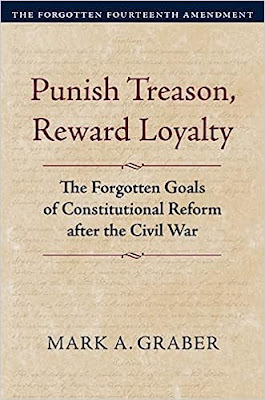
Mark A. Graber, Punish Treason, Reward Loyalty: The Forgotten Goals of Constitutional Reform after the Civil War (University of Kansas Press, 2023)
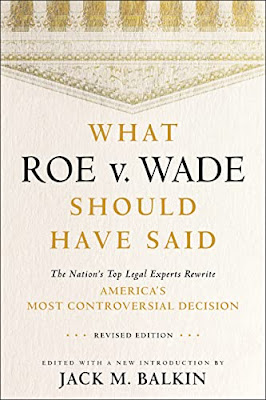
Jack M. Balkin, What Roe v. Wade Should Have Said: The Nation's Top Legal Experts Rewrite America's Most Controversial Decision - Revised Edition (NYU Press, 2023)

Andrew Koppelman, Burning Down the House: How Libertarian Philosophy Was Corrupted by Delusion and Greed (St. Martin’s Press, 2022)

Gerard N. Magliocca, Washington's Heir: The Life of Justice Bushrod Washington (Oxford University Press, 2022)
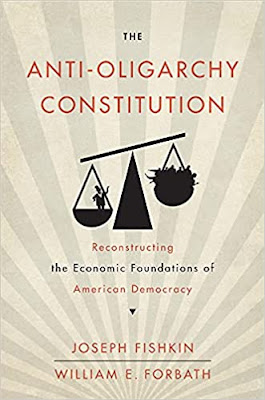
Joseph Fishkin and William E. Forbath, The Anti-Oligarchy Constitution: Reconstructing the Economic Foundations of American Democracy (Harvard University Press, 2022)
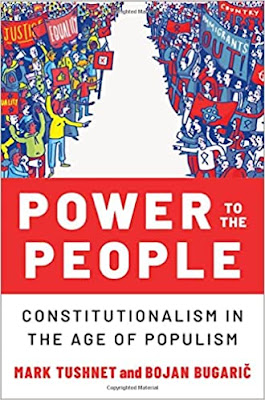
Mark Tushnet and Bojan Bugaric, Power to the People: Constitutionalism in the Age of Populism (Oxford University Press 2021).

Mark Philip Bradley and Mary L. Dudziak, eds., Making the Forever War: Marilyn B. Young on the Culture and Politics of American Militarism Culture and Politics in the Cold War and Beyond (University of Massachusetts Press, 2021).

Jack M. Balkin, What Obergefell v. Hodges Should Have Said: The Nation's Top Legal Experts Rewrite America's Same-Sex Marriage Decision (Yale University Press, 2020)

Frank Pasquale, New Laws of Robotics: Defending Human Expertise in the Age of AI (Belknap Press, 2020)

Jack M. Balkin, The Cycles of Constitutional Time (Oxford University Press, 2020)

Mark Tushnet, Taking Back the Constitution: Activist Judges and the Next Age of American Law (Yale University Press 2020).

Andrew Koppelman, Gay Rights vs. Religious Liberty?: The Unnecessary Conflict (Oxford University Press, 2020)

Ezekiel J Emanuel and Abbe R. Gluck, The Trillion Dollar Revolution: How the Affordable Care Act Transformed Politics, Law, and Health Care in America (PublicAffairs, 2020)

Linda C. McClain, Who's the Bigot?: Learning from Conflicts over Marriage and Civil Rights Law (Oxford University Press, 2020)
Sanford Levinson and Jack M. Balkin, Democracy and Dysfunction (University of Chicago Press, 2019)

Sanford Levinson, Written in Stone: Public Monuments in Changing Societies (Duke University Press 2018)

Mark A. Graber, Sanford Levinson, and Mark Tushnet, eds., Constitutional Democracy in Crisis? (Oxford University Press 2018)

Gerard Magliocca, The Heart of the Constitution: How the Bill of Rights became the Bill of Rights (Oxford University Press, 2018)

Cynthia Levinson and Sanford Levinson, Fault Lines in the Constitution: The Framers, Their Fights, and the Flaws that Affect Us Today (Peachtree Publishers, 2017)

Brian Z. Tamanaha, A Realistic Theory of Law (Cambridge University Press 2017)

Sanford Levinson, Nullification and Secession in Modern Constitutional Thought (University Press of Kansas 2016)

Sanford Levinson, An Argument Open to All: Reading The Federalist in the 21st Century (Yale University Press 2015)

Stephen M. Griffin, Broken Trust: Dysfunctional Government and Constitutional Reform (University Press of Kansas, 2015)

Frank Pasquale, The Black Box Society: The Secret Algorithms That Control Money and Information (Harvard University Press, 2015)

Bruce Ackerman, We the People, Volume 3: The Civil Rights Revolution (Harvard University Press, 2014)
Balkinization Symposium on We the People, Volume 3: The Civil Rights Revolution

Joseph Fishkin, Bottlenecks: A New Theory of Equal Opportunity (Oxford University Press, 2014)

Mark A. Graber, A New Introduction to American Constitutionalism (Oxford University Press, 2013)

John Mikhail, Elements of Moral Cognition: Rawls' Linguistic Analogy and the Cognitive Science of Moral and Legal Judgment (Cambridge University Press, 2013)

Gerard N. Magliocca, American Founding Son: John Bingham and the Invention of the Fourteenth Amendment (New York University Press, 2013)

Stephen M. Griffin, Long Wars and the Constitution (Harvard University Press, 2013)

Andrew Koppelman, The Tough Luck Constitution and the Assault on Health Care Reform (Oxford University Press, 2013)

James E. Fleming and Linda C. McClain, Ordered Liberty: Rights, Responsibilities, and Virtues (Harvard University Press, 2013)
Balkinization Symposium on Ordered Liberty: Rights, Responsibilities, and Virtues

Andrew Koppelman, Defending American Religious Neutrality (Harvard University Press, 2013)

Brian Z. Tamanaha, Failing Law Schools (University of Chicago Press, 2012)

Sanford Levinson, Framed: America's 51 Constitutions and the Crisis of Governance (Oxford University Press, 2012)

Linda C. McClain and Joanna L. Grossman, Gender Equality: Dimensions of Women's Equal Citizenship (Cambridge University Press, 2012)

Mary Dudziak, War Time: An Idea, Its History, Its Consequences (Oxford University Press, 2012)

Jack M. Balkin, Living Originalism (Harvard University Press, 2011)

Jason Mazzone, Copyfraud and Other Abuses of Intellectual Property Law (Stanford University Press, 2011)

Richard W. Garnett and Andrew Koppelman, First Amendment Stories, (Foundation Press 2011)

Jack M. Balkin, Constitutional Redemption: Political Faith in an Unjust World (Harvard University Press, 2011)

Gerard Magliocca, The Tragedy of William Jennings Bryan: Constitutional Law and the Politics of Backlash (Yale University Press, 2011)

Bernard Harcourt, The Illusion of Free Markets: Punishment and the Myth of Natural Order (Harvard University Press, 2010)

Bruce Ackerman, The Decline and Fall of the American Republic (Harvard University Press, 2010)
Balkinization Symposium on The Decline and Fall of the American Republic

Ian Ayres. Carrots and Sticks: Unlock the Power of Incentives to Get Things Done (Bantam Books, 2010)

Mark Tushnet, Why the Constitution Matters (Yale University Press 2010)

Ian Ayres and Barry Nalebuff: Lifecycle Investing: A New, Safe, and Audacious Way to Improve the Performance of Your Retirement Portfolio (Basic Books, 2010)
.jpg)
Jack M. Balkin, The Laws of Change: I Ching and the Philosophy of Life (2d Edition, Sybil Creek Press 2009)

Brian Z. Tamanaha, Beyond the Formalist-Realist Divide: The Role of Politics in Judging (Princeton University Press 2009)
Andrew Koppelman and Tobias Barrington Wolff, A Right to Discriminate?: How the Case of Boy Scouts of America v. James Dale Warped the Law of Free Association (Yale University Press 2009)

Jack M. Balkin and Reva B. Siegel, The Constitution in 2020 (Oxford University Press 2009)

Heather K. Gerken, The Democracy Index: Why Our Election System Is Failing and How to Fix It (Princeton University Press 2009)

Mary Dudziak, Exporting American Dreams: Thurgood Marshall's African Journey (Oxford University Press 2008)

David Luban, Legal Ethics and Human Dignity (Cambridge Univ. Press 2007)

Ian Ayres, Super Crunchers: Why Thinking-By-Numbers is the New Way to be Smart (Bantam 2007)

Jack M. Balkin, James Grimmelmann, Eddan Katz, Nimrod Kozlovski, Shlomit Wagman and Tal Zarsky, eds., Cybercrime: Digital Cops in a Networked Environment (N.Y.U. Press 2007)
Jack M. Balkin and Beth Simone Noveck, The State of Play: Law, Games, and Virtual Worlds (N.Y.U. Press 2006)

Andrew Koppelman, Same Sex, Different States: When Same-Sex Marriages Cross State Lines (Yale University Press 2006)

Brian Tamanaha, Law as a Means to an End (Cambridge University Press 2006)

Sanford Levinson, Our Undemocratic Constitution (Oxford University Press 2006)

Mark Graber, Dred Scott and the Problem of Constitutional Evil (Cambridge University Press 2006)

Jack M. Balkin, ed., What Roe v. Wade Should Have Said (N.Y.U. Press 2005)

Sanford Levinson, ed., Torture: A Collection (Oxford University Press 2004)
Balkin.com homepage
Bibliography
Conlaw.net
Cultural Software
Writings
Opeds
The Information Society Project
BrownvBoard.com
Useful Links
Syllabi and Exams
