Balkinization
an unanticipated consequence of
Jack M. Balkin
Balkinization Symposiums: A Continuing List
E-mail:
Jack Balkin:
jackbalkin at yahoo.com
Bruce Ackerman
bruce.ackerman at yale.edu
Ian Ayres
ian.ayres at yale.edu
Corey Brettschneider
corey_brettschneider at brown.edu
Mary Dudziak
mary.l.dudziak at emory.edu
Joey Fishkin
joey.fishkin at gmail.com
Heather Gerken heather.gerken at yale.edu
Abbe Gluck abbe.gluck at yale.edu
Mark Graber
mgraber at law.umaryland.edu
Stephen Griffin
sgriffin at tulane.edu
Jonathan Hafetz
jonathan.hafetz at shu.edu
Jeremy Kessler
jkessler at law.columbia.edu
Andrew Koppelman
akoppelman at law.northwestern.edu
Marty Lederman
msl46 at law.georgetown.edu
Sanford Levinson
slevinson at law.utexas.edu
David Luban
david.luban at gmail.com
Gerard Magliocca
gmaglioc at iupui.edu
Jason Mazzone
mazzonej at illinois.edu
Linda McClain
lmcclain at bu.edu
John Mikhail
mikhail at law.georgetown.edu
Frank Pasquale
pasquale.frank at gmail.com
Nate Persily
npersily at gmail.com
Michael Stokes Paulsen
michaelstokespaulsen at gmail.com
Deborah Pearlstein
dpearlst at yu.edu
Rick Pildes
rick.pildes at nyu.edu
David Pozen
dpozen at law.columbia.edu
Richard Primus
raprimus at umich.edu
K. Sabeel Rahmansabeel.rahman at brooklaw.edu
Alice Ristroph
alice.ristroph at shu.edu
Neil Siegel
siegel at law.duke.edu
David Super
david.super at law.georgetown.edu
Brian Tamanaha
btamanaha at wulaw.wustl.edu
Nelson Tebbe
nelson.tebbe at brooklaw.edu
Mark Tushnet
mtushnet at law.harvard.edu
Adam Winkler
winkler at ucla.edu
Compendium of posts on Hobby Lobby and related cases
The Anti-Torture Memos: Balkinization Posts on Torture, Interrogation, Detention, War Powers, and OLC
The Anti-Torture Memos (arranged by topic)
Recent Posts
Do Corporations Enjoy a 2nd Amendment Right to Drones?
To Whom is a Drone Loyal?
Incentives and Competition in Innovation Markets: A Study of the FAA UAS Test Sites Competition
"If your Constitution is so good, how come you're sending drones against us?"
Law lives through categories; technology disrupts categories
Life in a constitutional dictatorship (Again)
The Controversy over DOJ's Targeted Killing White Paper
Automated Arrangement of Information: Speech, Conduct, and Power
The Emerging Law of Algorithms, Robots, and Predictive Analytics
That Syria War Power Debate, Continued
A Growing 'Civilian-Military' Gap, and its Consequences
"A Permanent State of Remote War"
Sleepwalking
Sitting at a cafe in Houston...
Why the legal issues in the White Paper are not the most important issues, and how Jack Goldsmith gets it right
Is life "priceless"?
Three Years in Law School are Barely Enough!
The Framers, Democracy, and the Demagogue, Part One
On the Presidential Assassination of American Citizens
Updates on the National Surveillance State
![[Powered by Blogger]](https://lh3.googleusercontent.com/blogger_img_proxy/AEn0k_tuSQlS-T3OBdxtAPxIrCn6qmEtHxXIzSlCwf5m6oKEV_Ot_DHYZVxgLG6VPORB9BCVHABMn7O6C3wHJZ1oY5KkKspGqXTAuSLwR-sn694F=s0-d)
Just A Few Blogs
ACS Blog
Alas, a Blog
Althouse
Arts and Letters Daily
Atrios (Eschaton)
Bill of Health
Buzzflash.com
Buzz Machine
Cato at Liberty
Juan Cole (Informed Comment)
Concurring Opinions
The Constitution in 2020
Corrente
Crooked Timber
Daily Howler
Daily Kos
Dana Boyd
Brad DeLong
Digby (Hullabaloo)
Discriminations
Daniel Drezner
Kevin Drum (Mother Jones)
Electrolite
En Banc
Eunomia (Daniel Larison)
Fafblog
Michael Froomkin (Discourse.net)
GovLab (Beth Noveck)
Rick Hasen (Election Law)
History News Network
How Appealing
Ignatz (Sam Heldman)
The Importance of (Ernie Miller)
Infolaw
Instapundit
International Economic Law and Policy Blog
IntLawGrrls
Jacob Levy
Jesus' General
Jurisdynamics
The Kitchen Cabinet
Mark Kleiman
Law Blog Central
Larry Lessig
Lawyers, Guns and Money
Liberal Oasis
Brian Leiter's Law School Reports
The Leiter Reports
Marginal Revolution
Megan McArdle
Memeorandum
Metafilter
Mirror of Justice
The New Republic
Newseum
No More Mister Nice Blog
Brendan Nyhan
Opinio Juris
Orcinus
The Originalism Blog
Pandagon
Passport (Foreign Policy)
Overcoming Bias
Political Animal (Washington Monthly)
Political Theory Daily Review
Political Wire (Taegan Goddard)
The Poor Man
Virginia Postrel
Prawfsblawg
Public Reason
Jonathan Rauch
Raw Story
Redstate
ReligiousLeftLaw.com
Reporters Committee For Freedom of the Press
Reproductive Rights Blog
Rothman's Roadmap to the Right of Publicity
SCOTUS Blog
Seeing the Forest
Clay Shirky
The Shifted Librarian
The Situationist
Larry Solum (Legal Theory)
Andrew Sullivan
Talking Points Memo
Talk Left
Tapped
Tbogg
TechPresident
The Paper Chase (Jurist)
Tom Paine
Tom Tomorrow (This Modern World)
Eve Tushnet
Uggabugga
University of Chicago Law School Faculty Blog
Unqualified Offerings
The Volokh Conspiracy
War and Piece (Laura Rozen)
Wampum
Oliver Willis
Wonkette
Written Description
Matthew Yglesias
Yin
Your Choice of Feeds
1. XML
powered by

2. Atom Feed
3. RSS 2.0
Do Corporations Enjoy a 2nd Amendment Right to Drones?
Frank Pasquale
An emerging, "solutionist" narrative about drones goes something like this:
Yes, we should be very worried about government misuse of drones at home and abroad. But the answer is not to ban, or even blame, the technology itself. Rather, we need to spread the technology among more people. Worried that the government will spy on you? Get your own drones to watch the watchers. Fearful of malevolent drones? Develop your own protective force. The answer is more technology, not regulation of particular technologies.
I'd like to believe that's true, if only because technology develops so quickly, and government seems paralyzed by comparison. But I think it's a naive position. It manages to understate both the threats posed by drones, and the governance challenges they precipitate.
Read more »
Posted
1:23 PM
by Frank Pasquale [link]
To Whom is a Drone Loyal?
Mary L. Dudziak
In my west coast copy of the New York Times today, two stories are side-by-side: one on disagreements within the Obama Administration about Afghanistan, and one titled 
When contemplating the scope and limits of presidential war power, constitutional scholars tend to focus on the relationship between the branches and the impact of public opinion. But the existence of drones, the reliance on private contractors, and the absence of a draft are part of a shift in the political structure of American warfare, enabling presidential power.
The role of drones might cause us to believe that an inevitable march of technology, together with strategies of contemporary warfare, have led to the disconnect between most Americans and the wars their nation is engaged in. But military historian Adrien Lewis suggests that these developments were not at all inevitable, and that a fundamental shift in the political structure of American warmaking has occurred since Vietnam, resulting in an isolation of the people from their wars.
Continue reading below the fold.
In reaction to opposition to the war in Vietnam, “the armed forces developed doctrines for war that endeavored to mitigate or eliminate the need for the support of the people. In short, they sought a way to fight a war that was not dependent on the will of the people.” This involved a greater reliance on air power rather than land forces, and an increasing use of high tech warfare.
Taking the American people out of war gave presidents “greater freedom to go to war, [and] the White House and the Pentagon greater freedom to fight wars as they saw fit.”
In Iraq and Afghanistan, American warfare is sometimes waged by machines. This raises questions about the morality of war, when an attack can occur with only one side’s mortality at risk. It also raises questions about political constraints on warfare. We need not peer into a future in which machines of warfare are more self-motivating than they already are. When, at another point on the globe, people are killed by an object that has its origins in the United States, but in its nature can owe allegiance to no one, we should ask where the people are in this war, and in their absence from the battle zone, how might they reassert their voice as a check on executive war power.
Posted 2:26 PM by Mary L. Dudziak [link]
Incentives and Competition in Innovation Markets: A Study of the FAA UAS Test Sites Competition
Guest Blogger
Robert Heverly Labels: Beyond IP
For the Innovation Law Beyond IP 2 conference, March 28-29 at Yale Law School
The (commercial) drones are coming. Amazon wants to deliver packages with them, as does Google, and
utilities
want to monitor their infrastructure with them. Known more properly as Unmanned Aircraft Systems (UAS), the Federal Aviation Administration has proposed
new rules to regulate commercial drone use, and states have passed laws in an attempt to protect privacy and prevent alleged misuse of the drones (for example, preventing hunting by UAS).
In 2012, Congress passed the Federal Aviation Administration Modernization and Reform Act (FMRA), in
which it directed the Federal Aviation Administration (FAA) to begin integrating Unmanned Aircraft Systems (UAS, or drones) into the national airspace. Section 332(c) required the FAA to
designate six UAS national test ranges to allow testing to begin at those sites (without this authority, UAS cannot be used for commercial purposes without
specific FAA authority). No funding was included in the test range designation; instead, UAS could fly at the ranges pursuant to a local, streamlined
approval process, avoiding the otherwise relatively lengthy existing FAA procedure).
Fifty applicants initially sought FAA authority to open test ranges, a number the FAA first reduced to 24 and finally to the six awardees (the FAA has
since issued proposed rules for more general commercial UAS use, and even more recently approved use of certain UAS below 200 feet without significant restrictions).
The UAS industry is an innovative industry. We can contrast UAS with industries, such as manufacturing or even gambling facilities, that states may seek to entice to locate within their borders for
purposes of encouraging economic development. Silicon Valley was not built by luring employers into the region. It was built – and succeeds – because of
the benefits that innovation bring to the region (and it is so successful that there are now various “Silicon” and “Valley” themed regions throughout the
world as others attempt to recreate Silicon Valley’s success).
Read more »
Posted
12:00 PM
by Guest Blogger [link]
"If your Constitution is so good, how come you're sending drones against us?"
Mark Tushnet
Posted
4:35 PM
by Mark Tushnet [link]
Law lives through categories; technology disrupts categories
JB
A discussion about drones with my colleague Oona Hathaway led me to propose a simple way to think about technological change and legal interpretation: Law lives through categories, but technology disrupts categories. The problem for lawyers--and many other people besides--is what to do when technological change disrupts the categories through which we understand the social and legal world.
Legal doctrines often take the form of differentiation and division into different situations--to which different legal norms and legal solutions apply. Law divides the world into categories in order to specify which norms should apply in which situation. Legal categories, in turn, are often premised on distinctions that rest on the way we understand the world to be, what is possible and what is not possible, what is costly and what is cheap, and so on. Moreover, legal categories often reflect a balance of competing interests or principles; a balance that applies differently--for the most part--within each category.
Technological change disrupts our understanding of what is possible or impossible, what is relatively expensive or inexpensive. It makes possible or gives new incentives for activities that were either impossible or prohibitively costly. It introduces new combinations of properties or features that we hadn't imagined before. It brings new participants into systems and activities from which they had been previously excluded. It changes the balance of principles that previously justified the categories we had chosen.
Each of these changes may confound existing legal categories. Then we must decide what values are more important, and that we really want to protect, in the context of changed conditions. Categories often reflect a balance of considerations, and when we change our categories, we may have strike a new balance, which inevitably means giving up something-- often something that we would not rather have to give up.
As a result, it is difficult to say that we can simply preserve our existing values-- and the balance between conflicting values-- in the face of technological change. Rather, what change does is put values that people once imagined (correctly or not) were fairly well accommodated once again in conflict with each other. Technological change exacerbates the tensions between these values, and seems to demand from us a new accommodation, a new set of lines, and a new set of categories. This demand appears as a demand from the outside-- i.e., from "technology"--but is really a demand from inside, from our moral imaginations. Crafting a solution is difficult precisely because it disrupts existing settlements, compromises or ways of living. It may require us to sacrifice some values for others in a new set of contexts. What technology does, in short is disrupt our moral sense of propriety, and force us to imagine a new sense of propriety.
Of course, to speak in terms of "technology" doing things is apt to be misleading. "Technology" does not do things by itself. Its effects depend on the choices that people make, and the way that people apprehend, interpret, and make use of the possibilities opened up by technological change. People experiment, imagine, and try out new uses for new tools. They organize to protect their (sometimes newly discovered) interests and agendas.
The military and civilian use of drones for example, or the interfaces through which we communicate digitally were not inevitable; they did not have to happen precisely as they have. Rather, people made choices that were opened up by technological change. They took advantage of new capacities and possibilities and created a new social reality. When we say that technology disrupts law, what we really mean is that people, using the capacities and tools available to them, and using these tools to understand and imagine the world in new ways, have disrupted the social life and social norms around them. The consequences for law may often be quite dramatic.
Posted
1:42 PM
by JB [link]
Life in a constitutional dictatorship (Again)
Sandy Levinson
It is time, alas, to reopen a new series of postings on the theme of how our constitutional dictatorship operates. It is now crystal clear that Obama does not represent a true repudiation of the Bush Administration, but, rather, a (somewhat) kindler and gentler version of its claims vis-a-vis presidential power and what is defined by the White House as "national security." James Fallows, in an excellent comment on the remarkable assertion that the War Powers Act is irrelevant because Libya doesn't constitute the kind of "hostilities" adverted to, writes that "[t]he central concern, and the major threat to our politics, is that once again we are going to war essentially on one person's say-so." He is correct, even if one grants full credit for Obama's having sought out acquiescent lawyers who turn out, however, not to be employed by the Office of Legal Counsel or the Department of Defense.
One also wonders who precisely has been making the decisions to go after "leakers." As Jane Mayer has noted, the Obama Administration has conducted more such prosecutions than all other administrations combined, which, by definition, includes the Bush Administration. Not to mention what the NYTimes has aptly described as "backward" steps with regard to surveillance authorization by the FBI. And is Robert Mueller really so "indispensable" that he should be given an extra two years (until after the election, note). I'm not necessarily a believer in hard-and-fast term limits, given that I've argued elsewhere that a real problem with the 22nd Amendment is that we can't "suspend" its operation in circumstances--during time of war, say,--when it's really stupid to evict a really talented Commander/Diplomat-in-Chief simply because it's two terms and out. But it should take something truly extraordinary, and I see no reason to think that such circumstances are currently present. Surely, the President could find someone capable of taking the helm at the FBI. Perhaps he fears that Republicans would simply refuse to confirm anyone. After all, another indispensable NYTimes article is tellingly titled "Nominees at Standstill as G.O.P. Flexes Its Muscle." Perhaps Peter Baker (see previous posting) should read his own newspaper before he waxes rhapsodic about our Madisonian system (but the 1787 Madison hated the idea of political parties).
Where, or where, is "the change we can believe in" regarding the "national surveillance" and "national security" states? Or, as Jack and I have argued, is the real message that deep structures of politics inevitably dominate the ephemera of different "leaders"?
Update: Garrett Epps has an excellent posting on his Atlantic site. He makes the valuable point that the Obama reading makes sense if and only if one assumes that the sole purpose was to protect American troops who might be placed in harms way. But if one believes that a second(ary) purpose was to prevent others from being the victims of harm at the unilateral decision of the President--and if, in addition, one might reasonably fear that adventures that being with, say, drones might end up escalating if it appers that we won't actually prevail with only drones (the latest fantasy of "victory through air power alone"), one might believe that sooner or later, the US will be faced with a decision either to "cut and run," with significantly adverse consequences, or to send the boots in on the ground, with other kinds of adverse consequences.
Posted
12:17 PM
by Sandy Levinson [link]
(48) comments
The Controversy over DOJ's Targeted Killing White Paper
Jonathan Hafetz
The media and blogosphere are abuzz over the release (via a leak) of DoJ's "white paper" outlining legal arguments used to support the targeted killing of a U.S. citizen in Yemen described as a "senior operational leader of al Qaeda or of an associated force." It is not difficult to see why. The white paper highlights the collision of a new technology that enables killing by remote control (drone warfare) and a novel concept of war itself, one waged increasingly away from "hot battlefields"--that is, the war formerly known as the Global War on Terror (GWOT). Both are highly controversial, and the subject of much uncertainty. Yet, rather than resolve questions, the white paper begs more.
The white paper's international law analysis is imprecise and confusing (perhaps, in places, deliberately so). It oscillates between two justifications for targeted killings: the use of military force against members of enemy forces during armed conflict and the use of force in self-defense (here, the paper cites, but does not quote, article 51 of the U.N. Charter). The paper is problematic on both fronts. As to the former, it assumes there is a global non-international armed conflict (NIAC) against al Qaeda and associated forces--a point contested by many international law scholars (see Kevin Jon Heller's indispensable posts here and here--and, contrary to the white paper, one not actually endorsed (not yet anyway) by the Supreme Court. Not only did Hamdan recognize only a non-international armed conflict with al Qaeda in Afghanistan, but the Supreme Court has historically been very cautious in addressing the government's claim that changing conceptions of war require expanded presidential powers (an argument pressed not only in Hamdan, Hamdi, and other GWOT cases, but also in Youngstown, Quirin, and other cases from more conventional armed conflicts where the government invoked the idea of "total war"). The paper also fails to engage with IHL rules on targeting civilians in NIAC, particularly with the requirement of direct participation in hostilities (likely because the government views it as too restrictive). As to self-defense, the white paper does not address how its elastic concept of "imminence" expands upon existing international-law definitions and understandings of the term.
The white paper's constitutional analysis is also problematic. The paper glosses over the lurking substantive due process question. I agree with the paper's conclusion that U.S. citizenship does not immunize an individual from the use of military force. That is the upshot of Quirin and Hamdi (while the former dealt with military trial and the latter with military detention, both support the argument that deadly force may potentially be used against citizens in time of war). Those cases (not to mention Milligan)also suggest, however, that the U.S. government cannot constitutionally kill a U.S. citizen under a law-of-war rationale unless that use of force comports with the law of war. Further, but importantly, the cases suggest that a statute (here, the 2001 Authorization for Use of Military Force (AUMF)) should not be construed as authorizing the use of deadly force against a constitutionally protected target unless that use of force is firmly grounded in the law of war. Note here Quirin and Hamdi's reference to clearly established and universally accepted law-of-war principles in finding the president's use of the military constitutional.
The paper does acknowledge that procedural due process can limit the president's authority to use military force against a U.S. citizen, citing Hamdi and its invocation of the Matthews v. Eldridge balancing test. But, as Steve Vladeck has pointed out, the paper ignores the prong of the test focused on the risk of error and the value of additional safeguards in minimizing that risk. The paper further concludes that judicial process is unwarranted.
As a recent report, The Civilian Impact of Drones: Unexamined Costs, Unanswered Questions, makes clear, the risk of error in drone attacks remains significant, despite technological improvements. But there is no judicial examination of the standards the government utilizes, even ex post. Nor is there any remedial structure in place--judicial or otherwise--for civilians harmed by drones in Pakistan, Somalia, and Yemen. Such a structure not only could provide some compensation to victims, but also could provide some check on the drone program and the process it employees in selecting targets and carrying out attacks.
But perhaps my biggest concern with the constitutional analysis is what the paper doesn't address. Because it concerns only the targeted killing of a U.S. citizen, it does not engage with the question of what, if any, constitutional protections are afforded non-citizens, who are the overwhelming target of drone strikes. What, if any, role does the Constitution play in limiting drone attacks against non-citizens? Presumably none. The U.S. has consistently resisted recognizing the Constitution's extraterritorial application to non-citizens. This means then that the white paper likely reflects the U.S. government's most robust interpretation of the constitutional limits of its targeted killing program. To the extent the Constitution serves as a constraint on drone strikes in a case like the one described in the white paper, that constraint would be absent from virtually every other scenario.
The complexity of the issues, the continuing concerns about the program's legality, and the absence of any judicial check, at minimum, demand greater transparency to allow for more informed public debate. This is particularly so given the nature of drone warfare, which is conducted largely in secret and which avoids the type of U.S. troop involvement that can cause the public to question the government's actions. (Greater transparency is thus critical to what Mary Dudziak describes here as the need for "a new form of war politics"). There is no legitimate basis for the Obama administration's refusal to release the white paper, which was never classified in the first place. (It should also release the legal reasoning in the underlying Office of Legal Counsel memo on which the paper is based). Indeed, one might think that President Obama--who has otherwise been so pragmatic in approaching national security issues--would be eager to release the legal basis for targeted killing since failing to do so suggests there is something to hide.
Posted
1:45 PM
by Jonathan Hafetz [link]
(10) comments
Automated Arrangement of Information: Speech, Conduct, and Power
Frank Pasquale

Tim Wu's opinion piece on speech and computers has attracted a lot of attention. Wu's position is a useful counterpoint to Eugene Volokh's sweeping claims about 1st Amendment protection for automated arrangements of information. However, neither Wu nor Volokh can cut the Gordian knot of digital freedom of expression with maxims like "search is speech" or "computers can't have free speech rights." Any court that respects extant doctrine, and the normative complexity of the new speech environment, will need to take nuanced positions on a case-by-case basis.
Digital Opinions
Wu states that "The argument that machines speak was first made in the context of Internet search," pointing to cases like Langdon v. Google, Kinderstart, and SearchKing. In each scenario, Google successfully argued to a federal district court that it could not be liable in tort for faulty or misleading results 1) because it "spoke" the offending arrangement of information and 2) the arrangement was Google's "opinion," and could not be proven factually wrong (a sine qua non for liability).
Read more »
Posted
12:45 PM
by Frank Pasquale [link]
The Emerging Law of Algorithms, Robots, and Predictive Analytics
Frank Pasquale
In 1897, Holmes famously pronounced, "For the rational study of the law the blackletter man may be the man of the present, but the man of the future is the man of statistics and the master of economics." He could scarcely envision at the time the rise of cost-benefit analysis, and comparative devaluation of legal process and non-economic values, in the administrative state. Nor could he have foreseen the surveillance-driven tools of today's predictive policing and homeland security apparatus. Nevertheless, I think Holmes's empiricism and pragmatism still animate dominant legal responses to new technologies. Three conferences this Spring show the importance of "statistics and economics" in future tools of social order, and the fundamental public values that must constrain those tools.
Advances in information and communications technology and the “datafication” of broadening fields of human endeavor are generating unparalleled quantities and kinds of data about individual and group behavior, much of which is now being deployed to assess risk by governments worldwide. For example, law enforcement personnel are expected to prevent terrorism through data-informed policing aimed at curbing extremism before it expresses itself as violence. And police are deployed to predicted “hot spots” based on data related to past crime. Judges are turning to data-driven metrics to help them assess the risk that an individual will act violently and should be detained before trial.
Posted
9:11 PM
by Frank Pasquale [link]
That Syria War Power Debate, Continued
Deborah Pearlstein
Posted
12:15 PM
by Deborah Pearlstein [link]
A Growing 'Civilian-Military' Gap, and its Consequences
Mary L. Dudziak
"A smaller share of Americans currently serve in the U.S. Armed Forces than at any time since the peace-time era between World Wars I and II," according to a new report from the Pew Research Center (hat tip New York Times).
During the past decade, as the military has been engaged in the longest period of sustained conflict in the nation’s history, just one-half of one percent of American adults has served on active duty at any given time.1 As the size of the military shrinks, the connections between military personnel and the broader civilian population appear to be growing more distant.
The data reveals is "a large generation gap." According to the report, "more than three-quarters (77%) of adults ages 50 and older said they had an immediate family member –a spouse, parent, sibling or child – who had served in the military." In contrast, for people under 50, "57% of those ages 30-49 say they have an immediate family member who served. And among those ages 18-29, the share is only one-third."
Military service is now more concentrated in certain families: "Veterans are more than twice as likely as members of the general public to say they have a son or daughter who has served (21% vs. 9%)." And overall, what the report calls a "military-civilian gap" is more pronounced among younger people.
This suggests that the gap between veterans and the general public in the share that has family connections to the military may be a relatively new phenomenon. With the shrinking size of the military in recent decades there are now fewer connections between the military and the civilian world. This is reflected in the relatively small share of young adults (39%) with an immediate family member who has served in the armed forces.
The Pew report suggests that various political opinions are correlated with connections to family members who have served in the military, but there are deeper implications of the disconnect between Americans and American war-making. The more distant and isolated Americans are from their nation's wars, the less they are politically engaged with American war policy.
Legal scholars argue on this blog and elsewhere that the tendency of presidents to initiate military action without congressional authorization can only be reined in if Congress insists on playing its constitutional role. But Congress will never play a more meaningful role in American war politics if the people aren't engaged. The Pew Report helps us to see what appears to be a growing distance from the costs of war, potentially reinforcing contemporary political disengagement.
In my new book, War Time: An Idea, Its History, Its Consequences, I take up this point in the Conclusion:
In Iraq and Afghanistan, war...spread across borders as American drones fired on targets in Pakistan and elsewhere. Death and destruction were the province of soldiers and of peoples in faraway lands. The experience of wartime for most Americans largely devolved to encounters between travelers and airport screeners, as the Transportation Security Administration adopted intrusive new practices. At home, wartime had become a policy rather than a state of existence....
I argue that keeping the war powers in check requires a politics of war, and that requires a citizenry attentive to the exercise of military power. Our ideas about "wartime" play a role in the current disconnect, as a cultural framing of wartimes as discrete and temporary occasions, destined to give way to a state of normality, undermines democratic vigilance over on-going wars.
As war goes on, Americans have lapsed into a new kind of peacetime. It is not a time without war, but instead a time in which war does not bother everyday Americans.
As Americans become more isolated from the costs of war, military engagement no longer seems to require the support of the American people. Their disengagement does not limit the reach of American military action, but enables its expansion.
Cross-posted from War Time.
Posted
9:17 AM
by Mary L. Dudziak [link]
"A Permanent State of Remote War"
Mary L. Dudziak
William J. Astore, retired lieutenant colonel (USAF), has a post today on the remoteness of American wars from the American people:
America’s wars are remote. They’re remote from us geographically, remote from us emotionally (unless you’re serving in the military or have a close relative or friend who serves), and remote from our major media outlets, which have given us no compelling narrative about them, except that they’re being fought by “America’s heroes” against foreign terrorists and evil-doers. They’re even being fought, in significant part, by remote control—by robotic drones “piloted” by ground-based operators from a secret network of bases located hundreds, if not thousands, of miles from the danger of the battlefield.
Astore goes on to argue that wars of choice have led to "a state of permanent remote war" that "has weakened our military, drained our treasury, and eroded our rights and freedoms."
Their remoteness, which breeds detachment if not complacency at home, is no accident. Indeed, it’s a product of the fact that Afghanistan and Iraq were wars of choice, not wars of necessity. It’s a product of the fact that we’ve chosen to create a “warrior” or “war fighter” caste in this country, which we send with few concerns and fewer qualms to prosecute Washington’s foreign wars of choice.
The engagement of the people with a nation's wars has been central to ideas about warfare. War theorist Carl von Clausewitz wrote of the people as both an engine and a restraint on warfare. Clausewitz's "wonderful trinity," describes the nature of war as "composed of the original violence of its elements, hatred and animosity, which may be looked upon as blind instinct; of the play of probabilities and chance, which make it a free activity of the soul; and of the subordinate nature of a political instrument, by which it belongs purely to the reason." The trinity is often reduced to those Clausewitz thought to embody these elements: the people, the military, and the government.
The emotional element of war, centered in the people, can help motivate a nation to warfare. But the people can also rein in warfare. When the costs of war are too great, the people are thought to lose their will to fight, hampering the nation's ability to pursue war.
But what happens if the people are never in engaged in a war in the first place? This where Astore's point is so important. The remoteness of the American people from American wars, he argues, enables the nation's wars of choice. The absence of the people -- the embodiment of the emotional element Clausewitz thought was a central feature of warfare -- means that the people do not tire of the costs of war. The people's remoteness and isolation from war undermines their traditional role as a restraint.
Astore writes:
As Admiral Mike Mullen, former Chairman of the Joint Chiefs of Staff, put it recently to Time: “Long term, if the military drifts away from its people in this country, that is a catastrophic outcome we as a country can't tolerate.”
One of the consequences of this development appears to be our current "permanent state of remote war."
Cross-posted from War Time.
Posted
2:25 PM
by Mary L. Dudziak [link]
Sleepwalking
Sandy Levinson
I am close to finishing a truly great (and thoroughly depressing) book, The Sleepwalkers: How Europe Went to War in 1914, by Cambridge (England) historian Christopher Clark. It portrays how a group of decisionmakers from many different countries chose actions that eventuated in the true catastrophe of 1914-1918 (which led quite directly to the even greater catastrophe of 1939-45). No one "chose" World War I, of course; most of them believed that a show of force would lead to a relatively quick victory. They were wrong.
I discovered a few moments ago that I'm in the 30% of the people responding to a Washington Post poll (obviously scientifically unreliable) who think the Administration is correct in not cutting off military aid to the dreadful people now running Egypt. Listening to stories about what happened in Cairo yesterday is wrenching, and Obama was surely correct in cancelling the joint military exercises with Egypt. If he can cancel the meeting with Putin (which I also oppose) because of the relatively minor Snowden episode (there is, obviously, no extradition treaty with Russia, and there is a millennium-long tradition of offering political asylum to political refugees), then, obviously, the military exercises had to go. But cutting off the $1.5 billion of aid, however satisfying as a statement--but about what, the savagery of the repression yesterday, or the decision to displace the elected president who was himself proving to be a disaster on a variety of grounds?--could well threaten a variety of American and world interest. Think of Donald Rumsfeld and "known unknown" as well as the more dangerous "unknown unknowns." What might happen if we cut aid off? Perhaps the military would be tempted to renounce the peace treaty with Israel; indeed, that treaty is a major explanation of the aid in the first place. Perhaps more serious, as a threat to American interests, would be a decision to cut off trade through the Suez Canal. Or perhaps that would happen simply through the dissolution of the Egyptian State. Are we prepared to send in American troops on the ground--I'm afraid drones will prove completely irrelevant--to capture the Canal? Israel, France, and the UK tried that in 1956, and Ike, to his eternal credit, realized that was a truly terrible idea.
I also find myself supporting the Administration's waffling in Syria. Does anyone really believe that the US has a magic wand it can wave to make things come out all right in that country? I initially supported Obama back in 2008 because I had more faith in his judgment than in then-Senator Clinton's. I share many of the disappointments with Obama. I'm afraid he has reinforced my view that we ultimately should junk the presidential system in favor of a parliamentary one that would produce not only less gridlock but more capable and experienced national leaders. But I really don't know what beyond sheer hopefulness--similar to what was expressed in a number of embassies in July 1914--supports the call that he be more "decisive" and use American power to "intervene" in the really terrible situations in both Syria and Egypt. How much of a more general conflagration do we want to risk? (And, yes, I support his waffling on Iran.) Should we really "sleepwalk" into a general Middle East War as the self-proclaimed "indispensable nation"?
Posted
8:03 PM
by Sandy Levinson [link]
(50) comments
Sitting at a cafe in Houston...
Mark Tushnet
Posted
8:57 PM
by Mark Tushnet [link]
(58) comments
Why the legal issues in the White Paper are not the most important issues, and how Jack Goldsmith gets it right
Mary L. Dudziak
The leak of a White Paper on targeting killings is getting the expected attention from law bloggers and others, with much commentary focused on whether the legal analysis is correct – for example the definition of “imminence.” The precise legal analysis is a distraction from more compelling issues, which are taken up by Jack Goldsmith in a Washington Post op-ed. I often disagree with Goldsmith, but this time I find myself in agreement. In part.
Goldsmith begins: “A decade of war is now ending,” President Obama proclaimed in his second inaugural address. But war is not ending, it is changing — and has been for years. Obama has cut back on heavy-footprint, conventional-force war in two countries. At the same time, he has presided over the rise of a secret, nimbler war defined by covert action, Special Forces, drone surveillance and targeting, cyberattacks and other stealthy means deployed in many countries.”
The character of ongoing war, largely off the American political radar screen, has been the focus of scholarly attention across fields. Ongoing secret war is an extension of ongoing small wars – justified for many years by the Cold War-era national security policy that American safety at home could only be protected by the projection of American military force around the world (NSC 68).
Goldsmith is right, unfortunately, that the president is arguing that war is coming to an end, while at the same time he continues it. (A point also made here.) He continues:
This new form of warfare needs a firmer political and legal foundation....Because secret surveillance and targeted strikes, rather than U.S. military detention, are central to the new warfare, there are no viable plaintiffs to test the government’s authorities in court. In short, executive-branch decisions since 2001 have led the nation to a new type of war against new enemies on a new battlefield without focused national debate, deliberate congressional approval or real judicial review.
Although Goldsmith is right that the character of war has changed, his solution is disappointingly conventional: “What the government needs is a new framework statute — akin to the National Security Act of 1947, or the series of intelligence reforms made after Watergate, or even the 2001 authorization of force — to define the scope of the new war, the authorities and limitations on presidential power, and forms of review of the president’s actions.” This is where I disagree. Something more fundamental is in order.
The nation most needs robust political engagement with American military policy, something we have not had in a sustained way since the war in Vietnam. Americans debated the war in Vietnam, and ultimately countless numbers took to the streets. Congress fiercely debated war appropriations. Elections were affected, as candidates gained or lost in the polls based on their position on Vietnam.
Deep public engagement with Vietnam was tied in large part to the fact that the costs of war came home to American families because of the draft. In the years since, the all-volunteer armed forces are one factor among others to isolate many Americans from war. (The other most important issues are privatization/contracting, and changes in war technologies.) A 2011 Pew Research Center report found that "A smaller share of Americans currently serve in the U.S. Armed Forces than at any time since the peace-time era between World Wars I and II." The data reveals "a large generation gap,"with "more than three-quarters (77%) of adults ages 50 and older...[having] an immediate family member –a spouse, parent, sibling or child – who had served in the military." In contrast, for people under 50, "57% of those ages 30-49 say they have an immediate family member who served. And among those ages 18-29, the share is only one-third."
In recent years, I’ve noted elsewhere,
In Iraq and Afghanistan, war...spread across borders as American drones fired on targets in Pakistan and elsewhere. Death and destruction were the province of soldiers and of peoples in faraway lands. The experience of wartime for most Americans largely devolved to encounters between travelers and airport screeners, as the Transportation Security Administration adopted intrusive new practices. At home, wartime had become a policy rather than a state of existence.
The only enduring limit on the use of force comes from an informed and engaged citizenry. The most troubling aspect of an era of secret warfare is that its very “secret, nimbler” character makes it easier to ignore, and thereby harder for democratic limits to function.
More essential than a new framework statute, we need a form of war politics. An essential but inadequate step is transparency, so that Americans have the capacity to know what their nation is doing. More difficult but more essential, we must find a way to care about the nation’s most fearsome power, which is now exercised without our even noticing. Whether the American people can become engaged again without a draft or forces on the ground is something I can’t answer. But finding a path toward political engagement is more important now that, for Americans, the experience of war has become so easy, and so forgettable.
Posted
11:13 PM
by Mary L. Dudziak [link]
(42) comments
Is life "priceless"?
Sandy Levinson
In a recent article in the Washington Post about whether the U.S. should pay ransom, in the context of the savage killing of James Foley, Adam Taylor writes, "It wasn't about figures. $100 million is a lot of money, but a life is priceless." I must say that my first thought when I read this was that the central lesson of my first-year torts course at Stanford almost 45 years ago--which I consider the best course I've ever had, on any subject, anywhere (taught by Marc Franklin)--brought home the point that this statement is simply and utterly wrong. The legal system prices human lives all the time; that is, among other things, what insurance policies are about, and, of course, the essence of tort law is to monetize the costs of what from a social perspective are completely foreseeable accidents. We know, when we decide to build skyscrapers or major bridges, etc., that people are going to die. Ditto, incidentally, with regard to raising speed limits on automobiles or continuing to allow the sale of alcohol in bars, etc., etc. To be sure, we don't know exactly who is going to die, and that makes all the difference, just as Barack Obama doesn't know exactly whom he is sentencing to death when deploying troops or allowing the use of drones that will generate "collateral damage." For many, that non-specificity makes all the difference. Once we are presented with the picture of Mr. Foley, whose life could have been saved by the payment of a ransom, he becomes the "child in the well," where society spends an excess of funds to rescue the tot instead of spending the same money more wisely to save many more "statistical lives' unattached to particular faces. And, of course, the difference between Mr. Foley and the child in the well is that we don't believe that rescuing the child will in fact create incentives for further children to fall down wells, whereas payment of ransom to thugs in fact does generate extremely bad incentives. There is absolutely no excuse for what was done to Mr. Foley, but perhaps we have to treat war journalilsts the way we treat soldiers: i.e., they voluntarily enlisted in a very dangerous occupation, for a mixture of reasons, including patriotism and devotion to the public weal, but part of the deal is that their lives will be on the line, to be protected only at "acceptable" cost.
Even if it is true that most of us consider our own lives "priceless," no society has ever operated on that basis, and none ever will.
Posted
12:33 PM
by Sandy Levinson [link]
(71) comments
Three Years in Law School are Barely Enough!
Bruce Ackerman
Posted
1:43 PM
by Bruce Ackerman [link]
(36) comments
The Framers, Democracy, and the Demagogue, Part One
Guest Blogger
Michael Klarman
For the Symposium on Michael Klarman, The Framers' Coup: The Making of the United States Constitution.
Posted
9:00 AM
by Guest Blogger [link]
On the Presidential Assassination of American Citizens
Guest Blogger
Bruce Ackerman
It’s important to distinguish between two issues raised by the drone attack that killed Anwar Al Awlaki – the American citizen/ Moslem cleric who gained notoriety by his jihadist sermonizing over the internet. So far, the focus has been on the president’s legal authority to order drone strikes in Yemen and other places far removed from the battlefields of Afghanistan/Pakistan and Iraq. This is the subject of an OLC memo, which President Obama unaccountably refuses to make public (in a suitably redacted form). Instead, the Administration is trying to deflect the pressure for publication by leaking a summary to Charlie Savage who has outlined the memo in a front page story on Sunday’s Times.
From Savage’s account, it seems that the OLC is taking a very extreme position, using a latitudinarian construction of both international law and Congress’ 2001 Resolution Authorizing the Use of Force to defend the virtually unlimited use of drones against “terrorists” in failed states like Yemen or Somalia. But of course, it’s impossible to assess OLC’s position fairly until the Administration actually publishes the memo itself. It is simply unacceptable to force Americans to determine when they can be assassinated by reading rumors about the government’s legal reasoning in the New York Times.
Read more »
Posted
1:37 PM
by Guest Blogger [link]
Updates on the National Surveillance State
Frank Pasquale
I just wanted to draw attention to two articles describing the advance of the national surveillance state.
Stephen Graham's pathbreaking essay "Surveillance, Urbanization, and the US 'Revolution in Military Affairs'" (in the collection Theorizing Surveillance edited by David Lyons) predicted that innovations designed to subdue hostile territories could have many troubling applications elsewhere. In "Welcome Home, War," Alfred W. McCoy argues that "the crusade for democracy abroad . . . has proven remarkably effective in building a technological template that could be just a few tweaks away from creating a domestic surveillance state—-with omnipresent cameras, deep data-mining . . . biometric identification, and drone aircraft patrolling 'the homeland:'"[M]ilitary intelligence units are coming home to apply their combat-tempered surveillance skills to our expanding homeland security state, while preparing to counter any future domestic civil disturbances here. . . . [I]n September 2008, the Army's Northern Command announced that one of the Third Division's brigades in Iraq would be reassigned as a Consequence Management Response Force (CMRF) inside the US Its new mission: planning for moments when civilian authorities may need help with "civil unrest and crowd control." According to Colonel Roger Cloutier, his unit's civil-control equipment featured "a new modular package of non-lethal capabilities" designed to subdue unruly or dangerous individuals—including Taser guns, roadblocks, shields, batons, and beanbag bullets.
In a future America, enhanced retinal recognition could be married to omnipresent security cameras as a part of the increasingly routine monitoring of public space. Military surveillance equipment, tempered to a technological cutting edge in counterinsurgency wars, might also one day be married to the swelling domestic databases of the NSA and FBI, sweeping the fiber-optic cables beneath our cities for any sign of subversion. And in the skies above, loitering aircraft and cruising drones could be checking our borders and peering down on American life.
I would count on Fox News celebrating all these innovations as vital to protection of the homeland (as soon as they are implemented by a President who is not a Democrat).
More innovations in surveillance and control appear to be coming out of the office of Immigration and Customs Enforcement (ICE). Here is part of Jacqueline Stevens' essay on the topic in The Nation: ICE agents regularly impersonate civilians--OSHA inspectors, insurance agents, religious workers--in order to arrest longtime US residents who have no criminal history. . . . "If you don't have enough evidence to charge someone criminally but you think he's illegal, we can make him disappear." Those chilling words were spoken by [the] then executive director of Immigration and Customs Enforcement's (ICE) Office of State and Local Coordination, at a conference of police and sheriffs in August 2008. Also present was Amnesty International's Sarnata Reynolds, who wrote about the incident in the 2009 report "Jailed Without Justice" and said in an interview, "It was almost surreal being there, particularly being someone from an organization that has worked on disappearances for decades in other countries. I couldn't believe he would say it so boldly, as though it weren't anything wrong."
Conditions for those in immigration detention centers can be very trying: The absence of a real-time database tracking people in ICE custody means ICE has created a network of secret jails. . . . Alla Suvorova, 26, a Mission Hills, California, resident for almost six years, ended up in B-18 after she was snared in an ICE raid targeting others at a Sherman Oaks apartment building. For her, the worst part was not the dirt, the bugs flying everywhere or the clogged, stinking toilet in their common cell but the panic when ICE agents laughed at her requests to understand how long she would be held. "No one could visit; they couldn't find me."
As Glenn Greenwald has suggested, the key to the national surveillance state is intrusive attention directed at its own citizens, coupled with very little access to the state's use of the information it gathers. That's one reason why the Markle Foundation's proposal for rapid implementation of "immutable audit logs" is critical. Abuses can only be deterred if they are recorded.
Posted
9:42 PM
by Frank Pasquale [link]
Books by Balkinization Bloggers

Gerard N. Magliocca, The Actual Art of Governing: Justice Robert H. Jackson's Concurring Opinion in the Steel Seizure Case (Oxford University Press, 2025)

Linda C. McClain and Aziza Ahmed, The Routledge Companion to Gender and COVID-19 (Routledge, 2024)

David Pozen, The Constitution of the War on Drugs (Oxford University Press, 2024)

Jack M. Balkin, Memory and Authority: The Uses of History in Constitutional Interpretation (Yale University Press, 2024)
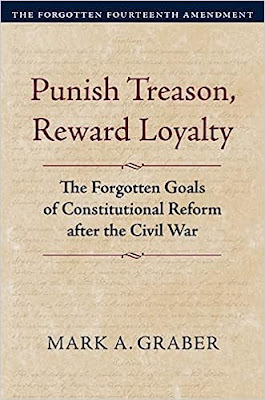
Mark A. Graber, Punish Treason, Reward Loyalty: The Forgotten Goals of Constitutional Reform after the Civil War (University of Kansas Press, 2023)
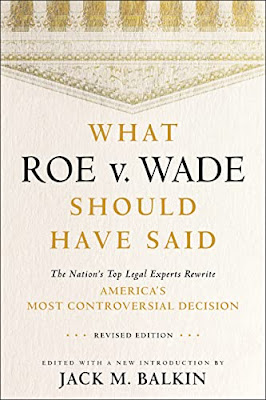
Jack M. Balkin, What Roe v. Wade Should Have Said: The Nation's Top Legal Experts Rewrite America's Most Controversial Decision - Revised Edition (NYU Press, 2023)

Andrew Koppelman, Burning Down the House: How Libertarian Philosophy Was Corrupted by Delusion and Greed (St. Martin’s Press, 2022)

Gerard N. Magliocca, Washington's Heir: The Life of Justice Bushrod Washington (Oxford University Press, 2022)
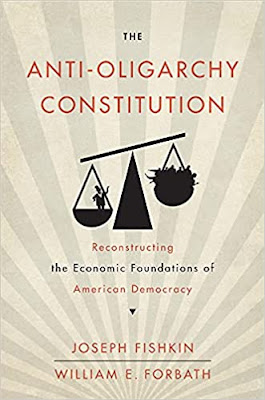
Joseph Fishkin and William E. Forbath, The Anti-Oligarchy Constitution: Reconstructing the Economic Foundations of American Democracy (Harvard University Press, 2022)
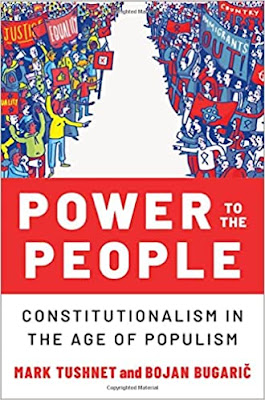
Mark Tushnet and Bojan Bugaric, Power to the People: Constitutionalism in the Age of Populism (Oxford University Press 2021).

Mark Philip Bradley and Mary L. Dudziak, eds., Making the Forever War: Marilyn B. Young on the Culture and Politics of American Militarism Culture and Politics in the Cold War and Beyond (University of Massachusetts Press, 2021).

Jack M. Balkin, What Obergefell v. Hodges Should Have Said: The Nation's Top Legal Experts Rewrite America's Same-Sex Marriage Decision (Yale University Press, 2020)

Frank Pasquale, New Laws of Robotics: Defending Human Expertise in the Age of AI (Belknap Press, 2020)

Jack M. Balkin, The Cycles of Constitutional Time (Oxford University Press, 2020)

Mark Tushnet, Taking Back the Constitution: Activist Judges and the Next Age of American Law (Yale University Press 2020).

Andrew Koppelman, Gay Rights vs. Religious Liberty?: The Unnecessary Conflict (Oxford University Press, 2020)

Ezekiel J Emanuel and Abbe R. Gluck, The Trillion Dollar Revolution: How the Affordable Care Act Transformed Politics, Law, and Health Care in America (PublicAffairs, 2020)

Linda C. McClain, Who's the Bigot?: Learning from Conflicts over Marriage and Civil Rights Law (Oxford University Press, 2020)
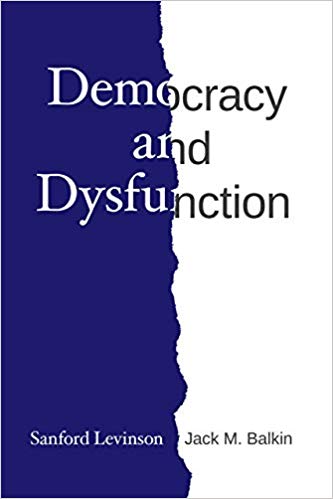
Sanford Levinson and Jack M. Balkin, Democracy and Dysfunction (University of Chicago Press, 2019)

Sanford Levinson, Written in Stone: Public Monuments in Changing Societies (Duke University Press 2018)

Mark A. Graber, Sanford Levinson, and Mark Tushnet, eds., Constitutional Democracy in Crisis? (Oxford University Press 2018)

Gerard Magliocca, The Heart of the Constitution: How the Bill of Rights became the Bill of Rights (Oxford University Press, 2018)

Cynthia Levinson and Sanford Levinson, Fault Lines in the Constitution: The Framers, Their Fights, and the Flaws that Affect Us Today (Peachtree Publishers, 2017)

Brian Z. Tamanaha, A Realistic Theory of Law (Cambridge University Press 2017)

Sanford Levinson, Nullification and Secession in Modern Constitutional Thought (University Press of Kansas 2016)

Sanford Levinson, An Argument Open to All: Reading The Federalist in the 21st Century (Yale University Press 2015)

Stephen M. Griffin, Broken Trust: Dysfunctional Government and Constitutional Reform (University Press of Kansas, 2015)

Frank Pasquale, The Black Box Society: The Secret Algorithms That Control Money and Information (Harvard University Press, 2015)

Bruce Ackerman, We the People, Volume 3: The Civil Rights Revolution (Harvard University Press, 2014)
Balkinization Symposium on We the People, Volume 3: The Civil Rights Revolution

Joseph Fishkin, Bottlenecks: A New Theory of Equal Opportunity (Oxford University Press, 2014)

Mark A. Graber, A New Introduction to American Constitutionalism (Oxford University Press, 2013)

John Mikhail, Elements of Moral Cognition: Rawls' Linguistic Analogy and the Cognitive Science of Moral and Legal Judgment (Cambridge University Press, 2013)

Gerard N. Magliocca, American Founding Son: John Bingham and the Invention of the Fourteenth Amendment (New York University Press, 2013)

Stephen M. Griffin, Long Wars and the Constitution (Harvard University Press, 2013)

Andrew Koppelman, The Tough Luck Constitution and the Assault on Health Care Reform (Oxford University Press, 2013)

James E. Fleming and Linda C. McClain, Ordered Liberty: Rights, Responsibilities, and Virtues (Harvard University Press, 2013)
Balkinization Symposium on Ordered Liberty: Rights, Responsibilities, and Virtues

Andrew Koppelman, Defending American Religious Neutrality (Harvard University Press, 2013)

Brian Z. Tamanaha, Failing Law Schools (University of Chicago Press, 2012)

Sanford Levinson, Framed: America's 51 Constitutions and the Crisis of Governance (Oxford University Press, 2012)

Linda C. McClain and Joanna L. Grossman, Gender Equality: Dimensions of Women's Equal Citizenship (Cambridge University Press, 2012)

Mary Dudziak, War Time: An Idea, Its History, Its Consequences (Oxford University Press, 2012)

Jack M. Balkin, Living Originalism (Harvard University Press, 2011)

Jason Mazzone, Copyfraud and Other Abuses of Intellectual Property Law (Stanford University Press, 2011)

Richard W. Garnett and Andrew Koppelman, First Amendment Stories, (Foundation Press 2011)

Jack M. Balkin, Constitutional Redemption: Political Faith in an Unjust World (Harvard University Press, 2011)

Gerard Magliocca, The Tragedy of William Jennings Bryan: Constitutional Law and the Politics of Backlash (Yale University Press, 2011)

Bernard Harcourt, The Illusion of Free Markets: Punishment and the Myth of Natural Order (Harvard University Press, 2010)

Bruce Ackerman, The Decline and Fall of the American Republic (Harvard University Press, 2010)
Balkinization Symposium on The Decline and Fall of the American Republic

Ian Ayres. Carrots and Sticks: Unlock the Power of Incentives to Get Things Done (Bantam Books, 2010)

Mark Tushnet, Why the Constitution Matters (Yale University Press 2010)

Ian Ayres and Barry Nalebuff: Lifecycle Investing: A New, Safe, and Audacious Way to Improve the Performance of Your Retirement Portfolio (Basic Books, 2010)
.jpg)
Jack M. Balkin, The Laws of Change: I Ching and the Philosophy of Life (2d Edition, Sybil Creek Press 2009)

Brian Z. Tamanaha, Beyond the Formalist-Realist Divide: The Role of Politics in Judging (Princeton University Press 2009)
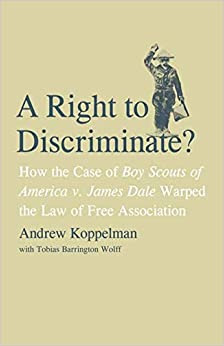
Andrew Koppelman and Tobias Barrington Wolff, A Right to Discriminate?: How the Case of Boy Scouts of America v. James Dale Warped the Law of Free Association (Yale University Press 2009)

Jack M. Balkin and Reva B. Siegel, The Constitution in 2020 (Oxford University Press 2009)

Heather K. Gerken, The Democracy Index: Why Our Election System Is Failing and How to Fix It (Princeton University Press 2009)

Mary Dudziak, Exporting American Dreams: Thurgood Marshall's African Journey (Oxford University Press 2008)

David Luban, Legal Ethics and Human Dignity (Cambridge Univ. Press 2007)

Ian Ayres, Super Crunchers: Why Thinking-By-Numbers is the New Way to be Smart (Bantam 2007)

Jack M. Balkin, James Grimmelmann, Eddan Katz, Nimrod Kozlovski, Shlomit Wagman and Tal Zarsky, eds., Cybercrime: Digital Cops in a Networked Environment (N.Y.U. Press 2007)
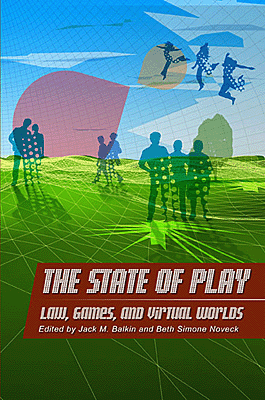
Jack M. Balkin and Beth Simone Noveck, The State of Play: Law, Games, and Virtual Worlds (N.Y.U. Press 2006)

Andrew Koppelman, Same Sex, Different States: When Same-Sex Marriages Cross State Lines (Yale University Press 2006)

Brian Tamanaha, Law as a Means to an End (Cambridge University Press 2006)

Sanford Levinson, Our Undemocratic Constitution (Oxford University Press 2006)

Mark Graber, Dred Scott and the Problem of Constitutional Evil (Cambridge University Press 2006)

Jack M. Balkin, ed., What Roe v. Wade Should Have Said (N.Y.U. Press 2005)

Sanford Levinson, ed., Torture: A Collection (Oxford University Press 2004)
Balkin.com homepage
Bibliography
Conlaw.net
Cultural Software
Writings
Opeds
The Information Society Project
BrownvBoard.com
Useful Links
Syllabi and Exams
