Balkinization
an unanticipated consequence of
Jack M. Balkin
Balkinization Symposiums: A Continuing List
E-mail:
Jack Balkin:
jackbalkin at yahoo.com
Bruce Ackerman
bruce.ackerman at yale.edu
Ian Ayres
ian.ayres at yale.edu
Corey Brettschneider
corey_brettschneider at brown.edu
Mary Dudziak
mary.l.dudziak at emory.edu
Joey Fishkin
joey.fishkin at gmail.com
Heather Gerken heather.gerken at yale.edu
Abbe Gluck abbe.gluck at yale.edu
Mark Graber
mgraber at law.umaryland.edu
Stephen Griffin
sgriffin at tulane.edu
Jonathan Hafetz
jonathan.hafetz at shu.edu
Jeremy Kessler
jkessler at law.columbia.edu
Andrew Koppelman
akoppelman at law.northwestern.edu
Marty Lederman
msl46 at law.georgetown.edu
Sanford Levinson
slevinson at law.utexas.edu
David Luban
david.luban at gmail.com
Gerard Magliocca
gmaglioc at iupui.edu
Jason Mazzone
mazzonej at illinois.edu
Linda McClain
lmcclain at bu.edu
John Mikhail
mikhail at law.georgetown.edu
Frank Pasquale
pasquale.frank at gmail.com
Nate Persily
npersily at gmail.com
Michael Stokes Paulsen
michaelstokespaulsen at gmail.com
Deborah Pearlstein
dpearlst at yu.edu
Rick Pildes
rick.pildes at nyu.edu
David Pozen
dpozen at law.columbia.edu
Richard Primus
raprimus at umich.edu
K. Sabeel Rahmansabeel.rahman at brooklaw.edu
Alice Ristroph
alice.ristroph at shu.edu
Neil Siegel
siegel at law.duke.edu
David Super
david.super at law.georgetown.edu
Brian Tamanaha
btamanaha at wulaw.wustl.edu
Nelson Tebbe
nelson.tebbe at brooklaw.edu
Mark Tushnet
mtushnet at law.harvard.edu
Adam Winkler
winkler at ucla.edu
Compendium of posts on Hobby Lobby and related cases
The Anti-Torture Memos: Balkinization Posts on Torture, Interrogation, Detention, War Powers, and OLC
The Anti-Torture Memos (arranged by topic)
Recent Posts
Can He Do That? Of Appropriations, Walls and Shutdowns
A Different Border Wall: Judgments of Legal Quality in Texas v. United States
Three Short and Sweet Possible Legislative Responses to Texas v. United States
Institute for Justice Podcast on the 14th Amendment
Texas v. U.S.: Congress's Inherent Power to Require No One to Do Anything
All the Things You Don’t Realize Are in the ACA and Now Could Vanish
Texas v. U.S: Off the Wall and On the Wall in the Age of Trump
There is no "mandate." And oh, by the way, Judge O'Connor didn't enjoin enforcement of any provision of the ACA, let alone "strike down" Obamacare in its entirety.
Happy Bill of Rights Day
The Curative Power of Law and Political Economy
Brexit is Prohibition
CFP--Conference on Constitutional History: Comparative Perspectives
What’s Really Wrong with the Census
Fiscal Policy after the Mid-term Elections
The Senate's Representational Imbalance (2019 edition)
The Legal Shape of Resistance
![[Powered by Blogger]](https://lh3.googleusercontent.com/blogger_img_proxy/AEn0k_uzqa9nfrtG48J7vDVIGzA-aedqQX09sQ22q0S3KPFVyS3kQT4SKJg9FG622_wHFpBCXbRsoacIWZnlpBRQRguJlNGL5yKcsUe9g76bBzv5=s0-d)
Just A Few Blogs
ACS Blog
Alas, a Blog
Althouse
Arts and Letters Daily
Atrios (Eschaton)
Bill of Health
Buzzflash.com
Buzz Machine
Cato at Liberty
Juan Cole (Informed Comment)
Concurring Opinions
The Constitution in 2020
Corrente
Crooked Timber
Daily Howler
Daily Kos
Dana Boyd
Brad DeLong
Digby (Hullabaloo)
Discriminations
Daniel Drezner
Kevin Drum (Mother Jones)
Electrolite
En Banc
Eunomia (Daniel Larison)
Fafblog
Michael Froomkin (Discourse.net)
GovLab (Beth Noveck)
Rick Hasen (Election Law)
History News Network
How Appealing
Ignatz (Sam Heldman)
The Importance of (Ernie Miller)
Infolaw
Instapundit
International Economic Law and Policy Blog
IntLawGrrls
Jacob Levy
Jesus' General
Jurisdynamics
The Kitchen Cabinet
Mark Kleiman
Law Blog Central
Larry Lessig
Lawyers, Guns and Money
Liberal Oasis
Brian Leiter's Law School Reports
The Leiter Reports
Marginal Revolution
Megan McArdle
Memeorandum
Metafilter
Mirror of Justice
The New Republic
Newseum
No More Mister Nice Blog
Brendan Nyhan
Opinio Juris
Orcinus
The Originalism Blog
Pandagon
Passport (Foreign Policy)
Overcoming Bias
Political Animal (Washington Monthly)
Political Theory Daily Review
Political Wire (Taegan Goddard)
The Poor Man
Virginia Postrel
Prawfsblawg
Public Reason
Jonathan Rauch
Raw Story
Redstate
ReligiousLeftLaw.com
Reporters Committee For Freedom of the Press
Reproductive Rights Blog
Rothman's Roadmap to the Right of Publicity
SCOTUS Blog
Seeing the Forest
Clay Shirky
The Shifted Librarian
The Situationist
Larry Solum (Legal Theory)
Andrew Sullivan
Talking Points Memo
Talk Left
Tapped
Tbogg
TechPresident
The Paper Chase (Jurist)
Tom Paine
Tom Tomorrow (This Modern World)
Eve Tushnet
Uggabugga
University of Chicago Law School Faculty Blog
Unqualified Offerings
The Volokh Conspiracy
War and Piece (Laura Rozen)
Wampum
Oliver Willis
Wonkette
Written Description
Matthew Yglesias
Yin
Your Choice of Feeds
1. XML
powered by

2. Atom Feed
3. RSS 2.0
Can He Do That? Of Appropriations, Walls and Shutdowns
David Super
Posted
3:19 PM
by David Super [link]
A Different Border Wall: Judgments of Legal Quality in Texas v. United States
Neil Siegel
In his December 15 post on Texas v. United States ("Off the Wall and on the Wall in the Age of Trump"), Jack Balkin brings to bear the historicist sensibility that partially informs his magnificent 2011 book, Living Originalism. In the post, he opines that Judge Evan O'Connor invalidated all of the Affordable Care Act (ACA) "on (in [Balkin's] own view) pretty dicey legal grounds." But Balkin moves quickly from the perspective of the individual participant in the constitutional system to the perspective of the historicist appreciator of how the system functions. He explains why the arguments accepted by Judge O'Connor are already "on the wall," albeit "barely." In addition, Balkin in effect lays out a road map that, if followed by the right groups of people -- especially a unified Republican Party and conservative intellectuals who work on the arguments -- will rapidly place those arguments firmly on the wall. Most significantly, Balkin writes that "judgments of legal quality and social influence mutually shape each other," but his post focuses almost entirely on how social influence shapes judgments of legal quality, and not the other way around.
My own view -- and I would bet that Balkin actually agrees with me, although he did not emphasize this point -- is that judgments of legal quality and the character trait of intellectual integrity are a significant part of the reason why conservative intellectuals and many professional Republicans are far from unified on the merits of this particular challenge to the constitutionality of the ACA.
Specifically:
1. One could reject most or all of modern Article III standing doctrine and try to reground it in a new, substantially more permissive understanding of Article III. But until such an attempt succeeds, it is legally untenable for Judge O'Connor to have concluded that two obviously ideological plaintiffs in Texas have Article III standing because they feel coerced by a "mandate" that will require them to make a shared responsibility payment of $0 if they remain uninsured -- a "mandate" that gives Americans the lawful choice between complying and making the shared responsibility payment. See Nicholas Bagley's incisive analysis.
2. As Marty Lederman and I have separately explained, it is legally untenable for Judge O'Connor to have held that Congress requires an enumerated power to impose no material or expressive consequences on anyone.
3. And as a bipartisan group of experts on severability made clear, it is legally untenable for Judge O'Connor to have concluded in effect that Congress in 2017 accomplished through the reconciliation process what congressional opponents of the ACA lacked the votes to accomplish using the ordinary legislative process -- that is, repeal the entire statute merely by zeroing out the shared responsibility payment and leaving the rest of the ACA in place.
C'mon, man.
Posted
11:43 AM
by Neil Siegel [link]
Three Short and Sweet Possible Legislative Responses to Texas v. United States
Richard Primus
Nick Bagley and I have a short piece in The Atlantic offering the incoming House of Representatives three strategies for super-simple legislation that would end the litigation in Texas v. United States and preserve the ACA. One would raise the penalty for not carrying insurance from nothing to one dollar; one would clarify that the mandate is severable; one would just repeal the mandate, which, given the absence of a penalty, now hangs atavistically around the ACA like a human appendix, doing nothing useful but threatening to blow up the whole system if attacked from the outside. We also offer brief thoughts on why it's worth the House's time to adopt one of these fixes even though the Senate's leadership is less keen on the ACA. The piece is here.
Posted
4:36 PM
by Richard Primus [link]
Institute for Justice Podcast on the 14th Amendment
Gerard N. Magliocca
The Institute for Justice has released a podcast to mark the 150th anniversary of the Fourteenth Amendment. You can find the link here. https://ij.org/sc_long_podcast/the-fight-for-the-14th/ I am one of the participants, along with Kurt Lash and others.
Posted
10:43 AM
by Gerard N. Magliocca [link]
Texas v. U.S.: Congress's Inherent Power to Require No One to Do Anything
Neil Siegel
While the constitutionality of the Affordable Care Act's minimum coverage provision (the "individual mandate") and shared responsibility payment were pending before the U.S. Supreme Court, Robert Cooter of UC Berkeley Law School and I developed a theory of Congress's taxing power that anticipated, and may have influenced, the Court's taxing power analysis in NFIB v. Sebelius. (Several commentators, including Neal Katyal, Randy Barnett, and Jeffrey Rosen, noticed close similarities in the analysis, citations, and rhetoric between our article and the majority opinion of Chief Justice Roberts.) According to our theory, the difference between a permissible tax and an impermissible penalty for purposes of the Taxing Clause turns on the likely effects of a federal exaction on human behavior. Whereas a tax characteristically dampens the conduct subject to the tax and thereby raises revenue, a penalty prevents the conduct subject to the penalty and thereby does not raise revenue.
Read more »
Posted
2:20 PM
by Neil Siegel [link]
All the Things You Don’t Realize Are in the ACA and Now Could Vanish
Abbe Gluck
Medicaid has already covered some 15
million extra Americans. Even those who
had Medicaid before the A.C.A would lose the advantages of the simplifications
brought by the ACA (those simplifications have increased Medicaid enrollments
even in states that have not expanded coverage). In total, roughly 20 million
fewer people are estimated to lose access to care, including the care Medicaid
provides to treat the opioid epidemic. Children in foster care also would lose
the additional coverage the A.C.A. extended for them as they transition into
adulthood.
Take a step back
absorb how much this decision affects. Most
of these reforms have nothing to do with the insurance-purchase mandate the
judge opined was so central to the entire 2,000+ pages of the A.C.A. that
nothing in those pages could function without it. But more importantly,
Congress never said a thing about eliminating all of these provisions-- indeed,
Congress failed more than 50 times in attempts to repeal them. Congress only eliminated
the mandate penalty, leaving the rest of the law still standing. As we have explained, the legal test at issue turns
entirely on what Congress intended. The
judge’s opinion effectively repeals the entire A.C.A. when Congress couldn’t
and didn’t.
The A.C.A. affects
all Americans, not just those with lower incomes. Most of us have employer coverage and have
also benefited from the law. Most of us,
with some luck, will be on Medicare and would benefit from the A.C.A’s payment
reforms and expanded drug coverage. Many
of us will need the biologic drugs, or the mental health services, maternity
converge or cancer screening or vaccines that the A.C.A. makes accessible.
[Cross-posted at https://takecareblog.com/]
Posted
2:58 PM
by Abbe Gluck [link]
Texas v. U.S: Off the Wall and On the Wall in the Age of Trump
JB
Judge Reed O'Connor's opinion in Texas v. U.S. has declared all of Obamacare unconstitutional based on (in my own view) pretty dicey legal grounds. Commentators are trashing it, predicting that the 5th Circuit will reverse it, and that it has absolutely no chance before the Supreme Court.
I have seen this movie before. (In fact, I had a minor supporting role.)
Assume that the commentators are right and the judge's arguments are not even close to being persuasive given existing legal precedents. Does that mean that the position is "off-the-wall?" Suppose it was off-the-wall six months ago, before the judge issued his final decision. What about now? Have the arguments against Obamacare moved from "off-the-wall" to "on-the-wall," as they did in NFIB v. Sebelius and King v. Burwell?
Read more »
Posted
2:05 PM
by JB [link]
There is no "mandate." And oh, by the way, Judge O'Connor didn't enjoin enforcement of any provision of the ACA, let alone "strike down" Obamacare in its entirety.
Marty Lederman
All
the many critics are absolutely correct that Judge O’Connor’s severability analysis in his Affordable Care Act opinion yesterday is indefensible.
By focusing so intently on the severability argument, however, many of those critics concede (or assume) far too much at the front end, which is, if anything, even less defensible.
As of January 1, the second of those two lawful choices will become even less onerous—paying "zero" will be an option that
satisfies the law, just as paying the greater of 2.5% of household income or
$695 to the IRS did until now.
Posted
1:04 PM
by Marty Lederman [link]
Happy Bill of Rights Day
Gerard N. Magliocca
Tomorrow is Bill of Rights Day, and in honor of that anniversary I want to quote from the speech that President Bush 41 gave to mark the bicentennial of the Bill of Rights in 1991. This speech captures the essence of the late President:
“The genius of the Bill of Rights is that it limits its attention to truly important things and to things over which a must and limited government can exercise some actual control. Two centuries ago, just as now, politics tempted some to take flight from moderation and realism. Edmund Burke complained at the time of those who ‘are so taken up with their theories about the rights of man that they have totally forgotten his nature’
“The framers, however, were practical men. They gave us not a declaration of rights but a Bill of Rights, not a piece of propaganda but a set of legally enforceable constraints on government. Most important, they drafted a Bill of Rights that reflected the higher nature and the aspirations of the American people, a bill that grew out of the American character . . .”
Posted
7:51 PM
by Gerard N. Magliocca [link]
The Curative Power of Law and Political Economy
Guest Blogger
Posted
9:00 AM
by Guest Blogger [link]
Brexit is Prohibition
Gerard N. Magliocca
I wonder whether Brexit is Britain's Prohibition. By that I mean that any nation can back a major change with the best of intentions only to learn from experience that the decision was flawed. The only solution, in the end, is a reversal of that decision by the same constitutional process. There is a difference in that Parliament is not legally obligated by the 2016 referendum to leave the EU, but in practice the withdrawal decision cannot be undone without a second referendum.
Prohibition was a disaster, but Brexit shows that no constitutional system is immune from them.
Posted
11:58 AM
by Gerard N. Magliocca [link]
(115) comments
CFP--Conference on Constitutional History: Comparative Perspectives
Jason Mazzone
A reminder of the call for papers for the conference on Constitutional History: Comparative Perspectives in Chicago on April 29-30, 2019. Proposals submitted by December 15 will receive priority consideration. Full details are here.
Posted
9:44 AM
by Jason Mazzone [link]
What’s Really Wrong with the Census
Guest Blogger
Posted
6:45 PM
by Guest Blogger [link]
Fiscal Policy after the Mid-term Elections
David Super
Posted
12:34 PM
by David Super [link]
The Senate's Representational Imbalance (2019 edition)
Marty Lederman
Now that Cindy Hyde-Smith has, as expected, won the run-off election to serve the final two years of Thad Cochran's term as Senator from Mississippi (Cochran retired), we know that Republicans will have a 53-47 advantage in the 116th Congress beginning in January.
What percentage of the U.S. population will those 53 incoming GOP Senators represent, if we assume the Senators from a particular state represent the residents of that state?
Nineteen states, with a total of approximately 144,461,202 residents (based on 2018 estimates), will be represented by two Democratic Senators (if we count King and Sanders among them).
Twenty-two states, with approximately 130,126,870 residents, will be represented by two Republican Senators.
And the nine states with split delegations, i.e., with one Senator from each party--PA, OH, AZ, WI, CO, AL, WV, ME, MT (in order of population)--have a total of approximately 52,240,741 residents.
If we allocate the residents in those nine "split delegation" states evenly--if we assume, that is, the somewhat crude fiction that half of the residents are represented by Democratic Senators, and half by Republicans--then the 53 Republican Senators in the new Senate majority will represent only 47.8 percent of the population of the 50 states. And that number doesn't even take account of the approximately 4.4 million residents of D.C. and the territories, who presumably would vote overwhelmingly for Democratic Senators, given the chance (although it's possible that the Puerto Rican electorate might, over time, choose some Senators who would caucus with Republicans). If we accounted for them, the percentage of U.S. residents represented by the 53 GOP Senators would likely be closer to 46 percent. And, importantly, it will be a remarkably unified majority, one that conforms in virtually every case to the wishes of the Majority Leader.
To be sure, this five to seven percent "representational imbalance" isn't a huge discrepancy in absolute terms--nowhere even close to predictions that by 2040 one-third of Americans might be represented by as many as 70 of the 100 Senators. (I do not know how historically anomalous it is, either--i.e., in how many of the first 115 Congresses a unified majority of Senators represented less than half the nation. If anyone knows of such calculations, please let me know.) Nevertheless, because it moves the GOP from minority to majority status and because the 53 GOP Senators can be expected to march in lockstep with leadership (as will the vast majority of the 47 Democratic Senators), it makes all the practical difference in the world in terms of who controls the composition of the judiciary for the next two years (and perhaps beyond). And that means, among other things, a continuation of the 50+ years of a Republican-appointed majority on the Supreme Court, despite the fact that a majority of Americans (and voters) have supported Democratic candidates for President and Senate in most recent elections, and the fact that the 47 Democratic Senators in the 116th Congress will represent states where a majority of Americans live. (I discussed this judicial/political entrenchment phenomenon at greater length back in early October.)
On the broader question of whether the representational imbalance in the Senate is justifiable and/or lamentable, I highly recommend (i) this very interesting recent post by Mike Dorf in which he concludes that although "the Senate is a problem, . . . it is not a problem that systematically disfavors Democrats, except in the short run"; (ii) Richard Primus's response, in which he "push[es] back" on Mike's suggestion that the Senate might be "justified as part of the package deal that gives us our federal system"; (iii) Dorf's response to Primus, "A Tentative Burkean Defense of Something Like the Senate"; and (iv) Primus's sur-reply.
Posted
6:14 AM
by Marty Lederman [link]
The Legal Shape of Resistance
David Pozen
Posted
8:38 AM
by David Pozen [link]
Books by Balkinization Bloggers

Gerard N. Magliocca, The Actual Art of Governing: Justice Robert H. Jackson's Concurring Opinion in the Steel Seizure Case (Oxford University Press, 2025)

Linda C. McClain and Aziza Ahmed, The Routledge Companion to Gender and COVID-19 (Routledge, 2024)

David Pozen, The Constitution of the War on Drugs (Oxford University Press, 2024)

Jack M. Balkin, Memory and Authority: The Uses of History in Constitutional Interpretation (Yale University Press, 2024)
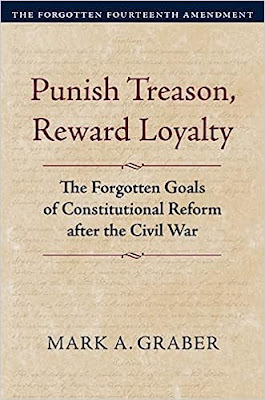
Mark A. Graber, Punish Treason, Reward Loyalty: The Forgotten Goals of Constitutional Reform after the Civil War (University of Kansas Press, 2023)
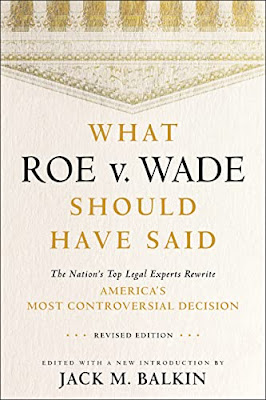
Jack M. Balkin, What Roe v. Wade Should Have Said: The Nation's Top Legal Experts Rewrite America's Most Controversial Decision - Revised Edition (NYU Press, 2023)

Andrew Koppelman, Burning Down the House: How Libertarian Philosophy Was Corrupted by Delusion and Greed (St. Martin’s Press, 2022)

Gerard N. Magliocca, Washington's Heir: The Life of Justice Bushrod Washington (Oxford University Press, 2022)
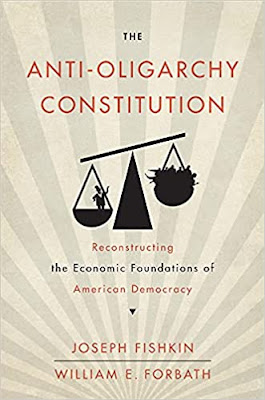
Joseph Fishkin and William E. Forbath, The Anti-Oligarchy Constitution: Reconstructing the Economic Foundations of American Democracy (Harvard University Press, 2022)
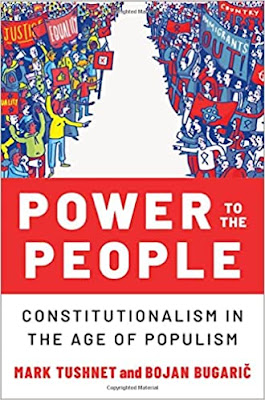
Mark Tushnet and Bojan Bugaric, Power to the People: Constitutionalism in the Age of Populism (Oxford University Press 2021).

Mark Philip Bradley and Mary L. Dudziak, eds., Making the Forever War: Marilyn B. Young on the Culture and Politics of American Militarism Culture and Politics in the Cold War and Beyond (University of Massachusetts Press, 2021).

Jack M. Balkin, What Obergefell v. Hodges Should Have Said: The Nation's Top Legal Experts Rewrite America's Same-Sex Marriage Decision (Yale University Press, 2020)

Frank Pasquale, New Laws of Robotics: Defending Human Expertise in the Age of AI (Belknap Press, 2020)

Jack M. Balkin, The Cycles of Constitutional Time (Oxford University Press, 2020)

Mark Tushnet, Taking Back the Constitution: Activist Judges and the Next Age of American Law (Yale University Press 2020).

Andrew Koppelman, Gay Rights vs. Religious Liberty?: The Unnecessary Conflict (Oxford University Press, 2020)

Ezekiel J Emanuel and Abbe R. Gluck, The Trillion Dollar Revolution: How the Affordable Care Act Transformed Politics, Law, and Health Care in America (PublicAffairs, 2020)

Linda C. McClain, Who's the Bigot?: Learning from Conflicts over Marriage and Civil Rights Law (Oxford University Press, 2020)
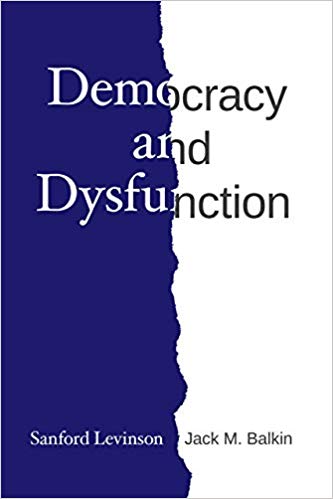
Sanford Levinson and Jack M. Balkin, Democracy and Dysfunction (University of Chicago Press, 2019)

Sanford Levinson, Written in Stone: Public Monuments in Changing Societies (Duke University Press 2018)

Mark A. Graber, Sanford Levinson, and Mark Tushnet, eds., Constitutional Democracy in Crisis? (Oxford University Press 2018)

Gerard Magliocca, The Heart of the Constitution: How the Bill of Rights became the Bill of Rights (Oxford University Press, 2018)

Cynthia Levinson and Sanford Levinson, Fault Lines in the Constitution: The Framers, Their Fights, and the Flaws that Affect Us Today (Peachtree Publishers, 2017)

Brian Z. Tamanaha, A Realistic Theory of Law (Cambridge University Press 2017)

Sanford Levinson, Nullification and Secession in Modern Constitutional Thought (University Press of Kansas 2016)

Sanford Levinson, An Argument Open to All: Reading The Federalist in the 21st Century (Yale University Press 2015)

Stephen M. Griffin, Broken Trust: Dysfunctional Government and Constitutional Reform (University Press of Kansas, 2015)

Frank Pasquale, The Black Box Society: The Secret Algorithms That Control Money and Information (Harvard University Press, 2015)

Bruce Ackerman, We the People, Volume 3: The Civil Rights Revolution (Harvard University Press, 2014)
Balkinization Symposium on We the People, Volume 3: The Civil Rights Revolution

Joseph Fishkin, Bottlenecks: A New Theory of Equal Opportunity (Oxford University Press, 2014)

Mark A. Graber, A New Introduction to American Constitutionalism (Oxford University Press, 2013)

John Mikhail, Elements of Moral Cognition: Rawls' Linguistic Analogy and the Cognitive Science of Moral and Legal Judgment (Cambridge University Press, 2013)

Gerard N. Magliocca, American Founding Son: John Bingham and the Invention of the Fourteenth Amendment (New York University Press, 2013)

Stephen M. Griffin, Long Wars and the Constitution (Harvard University Press, 2013)

Andrew Koppelman, The Tough Luck Constitution and the Assault on Health Care Reform (Oxford University Press, 2013)

James E. Fleming and Linda C. McClain, Ordered Liberty: Rights, Responsibilities, and Virtues (Harvard University Press, 2013)
Balkinization Symposium on Ordered Liberty: Rights, Responsibilities, and Virtues

Andrew Koppelman, Defending American Religious Neutrality (Harvard University Press, 2013)

Brian Z. Tamanaha, Failing Law Schools (University of Chicago Press, 2012)

Sanford Levinson, Framed: America's 51 Constitutions and the Crisis of Governance (Oxford University Press, 2012)

Linda C. McClain and Joanna L. Grossman, Gender Equality: Dimensions of Women's Equal Citizenship (Cambridge University Press, 2012)

Mary Dudziak, War Time: An Idea, Its History, Its Consequences (Oxford University Press, 2012)

Jack M. Balkin, Living Originalism (Harvard University Press, 2011)

Jason Mazzone, Copyfraud and Other Abuses of Intellectual Property Law (Stanford University Press, 2011)

Richard W. Garnett and Andrew Koppelman, First Amendment Stories, (Foundation Press 2011)

Jack M. Balkin, Constitutional Redemption: Political Faith in an Unjust World (Harvard University Press, 2011)

Gerard Magliocca, The Tragedy of William Jennings Bryan: Constitutional Law and the Politics of Backlash (Yale University Press, 2011)

Bernard Harcourt, The Illusion of Free Markets: Punishment and the Myth of Natural Order (Harvard University Press, 2010)

Bruce Ackerman, The Decline and Fall of the American Republic (Harvard University Press, 2010)
Balkinization Symposium on The Decline and Fall of the American Republic

Ian Ayres. Carrots and Sticks: Unlock the Power of Incentives to Get Things Done (Bantam Books, 2010)

Mark Tushnet, Why the Constitution Matters (Yale University Press 2010)

Ian Ayres and Barry Nalebuff: Lifecycle Investing: A New, Safe, and Audacious Way to Improve the Performance of Your Retirement Portfolio (Basic Books, 2010)
.jpg)
Jack M. Balkin, The Laws of Change: I Ching and the Philosophy of Life (2d Edition, Sybil Creek Press 2009)

Brian Z. Tamanaha, Beyond the Formalist-Realist Divide: The Role of Politics in Judging (Princeton University Press 2009)
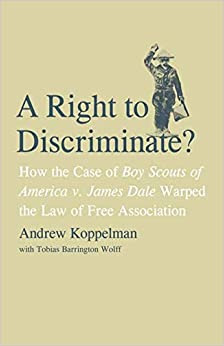
Andrew Koppelman and Tobias Barrington Wolff, A Right to Discriminate?: How the Case of Boy Scouts of America v. James Dale Warped the Law of Free Association (Yale University Press 2009)

Jack M. Balkin and Reva B. Siegel, The Constitution in 2020 (Oxford University Press 2009)

Heather K. Gerken, The Democracy Index: Why Our Election System Is Failing and How to Fix It (Princeton University Press 2009)

Mary Dudziak, Exporting American Dreams: Thurgood Marshall's African Journey (Oxford University Press 2008)

David Luban, Legal Ethics and Human Dignity (Cambridge Univ. Press 2007)

Ian Ayres, Super Crunchers: Why Thinking-By-Numbers is the New Way to be Smart (Bantam 2007)

Jack M. Balkin, James Grimmelmann, Eddan Katz, Nimrod Kozlovski, Shlomit Wagman and Tal Zarsky, eds., Cybercrime: Digital Cops in a Networked Environment (N.Y.U. Press 2007)

Jack M. Balkin and Beth Simone Noveck, The State of Play: Law, Games, and Virtual Worlds (N.Y.U. Press 2006)

Andrew Koppelman, Same Sex, Different States: When Same-Sex Marriages Cross State Lines (Yale University Press 2006)

Brian Tamanaha, Law as a Means to an End (Cambridge University Press 2006)

Sanford Levinson, Our Undemocratic Constitution (Oxford University Press 2006)

Mark Graber, Dred Scott and the Problem of Constitutional Evil (Cambridge University Press 2006)

Jack M. Balkin, ed., What Roe v. Wade Should Have Said (N.Y.U. Press 2005)

Sanford Levinson, ed., Torture: A Collection (Oxford University Press 2004)
Balkin.com homepage
Bibliography
Conlaw.net
Cultural Software
Writings
Opeds
The Information Society Project
BrownvBoard.com
Useful Links
Syllabi and Exams
