Balkinization
an unanticipated consequence of
Jack M. Balkin
Balkinization Symposiums: A Continuing List
E-mail:
Jack Balkin:
jackbalkin at yahoo.com
Bruce Ackerman
bruce.ackerman at yale.edu
Ian Ayres
ian.ayres at yale.edu
Corey Brettschneider
corey_brettschneider at brown.edu
Mary Dudziak
mary.l.dudziak at emory.edu
Joey Fishkin
joey.fishkin at gmail.com
Heather Gerken heather.gerken at yale.edu
Abbe Gluck abbe.gluck at yale.edu
Mark Graber
mgraber at law.umaryland.edu
Stephen Griffin
sgriffin at tulane.edu
Jonathan Hafetz
jonathan.hafetz at shu.edu
Jeremy Kessler
jkessler at law.columbia.edu
Andrew Koppelman
akoppelman at law.northwestern.edu
Marty Lederman
msl46 at law.georgetown.edu
Sanford Levinson
slevinson at law.utexas.edu
David Luban
david.luban at gmail.com
Gerard Magliocca
gmaglioc at iupui.edu
Jason Mazzone
mazzonej at illinois.edu
Linda McClain
lmcclain at bu.edu
John Mikhail
mikhail at law.georgetown.edu
Frank Pasquale
pasquale.frank at gmail.com
Nate Persily
npersily at gmail.com
Michael Stokes Paulsen
michaelstokespaulsen at gmail.com
Deborah Pearlstein
dpearlst at yu.edu
Rick Pildes
rick.pildes at nyu.edu
David Pozen
dpozen at law.columbia.edu
Richard Primus
raprimus at umich.edu
K. Sabeel Rahmansabeel.rahman at brooklaw.edu
Alice Ristroph
alice.ristroph at shu.edu
Neil Siegel
siegel at law.duke.edu
David Super
david.super at law.georgetown.edu
Brian Tamanaha
btamanaha at wulaw.wustl.edu
Nelson Tebbe
nelson.tebbe at brooklaw.edu
Mark Tushnet
mtushnet at law.harvard.edu
Adam Winkler
winkler at ucla.edu
Compendium of posts on Hobby Lobby and related cases
The Anti-Torture Memos: Balkinization Posts on Torture, Interrogation, Detention, War Powers, and OLC
The Anti-Torture Memos (arranged by topic)
Recent Posts
Perry and the Constitutionalization of Agency Law
This Pudding Lacks a Theme
The Way Forward After Shelby County
The problem of racism solved, yet again
The Missing Amendments
Shelby County
Why Fisher is Important
The Court continues micromanaging college admissions
Symposium on Michael Greve, The Upside Down Constitution
A Response to My Critics
Eureka!
Inside Baseball Observations/Speculations on Today's Supreme Court Opinions
And the (1915, 2013) Winner is . . . Business
Constitutional Codification
Constitutional Theory and Political Science in Michael Greve’s, The Upside-Down Constitution
Michael Greve’s Competitive Federalism and the Maturation of the Federalism Debate
Our Vacuous Constitutional Text as Under-Specified Agreement
Justice Thomas’ Originalism and the Civil War
Competitive Federalism and Collective Action Federalism
The Business-Friendly Constitution
Federal Power over Elections & the Hydraulics of Congressional Power
The concept of "surplus" in The Upside Down Constitution
Michael Greve’s The Upside Down Constitution: Parasitic Federalism and the Ambiguities of Constitutional Structure
Symposium on Michael Greve, The Upside Down Constitution
The Guantanamo Quagmire: What Criminal Sentencing Can Teach Us
Reflecting on PRISM: The Institutional Failures that Led to Surveillance Culture
On the importance of nomenclature: "Surveillance state" or "police state"
Shelby County v. Holder: The Yale Law Journal Online Symposium
Does Sebelius Have a Racial Subtext?
A Nifty Legal Dance
Constitutional Moments
The Curious Case of Professor Miller's Tweet
The Voting Rights Act & Commandeering
Law Schools and the University: Who is Supporting Who
Bleg answered (with a followup)
![[Powered by Blogger]](https://lh3.googleusercontent.com/blogger_img_proxy/AEn0k_vBSA_5oLpnWbbIesA9Wtxu60H9JC_OeQ7RIm5AN4LZ0V2srDGIhMnLXEVxtDI5bwC2Nd--ofZtgKyur3OnbFYY-UXR43qYZTWA2REKcoU-=s0-d)
Just A Few Blogs
ACS Blog
Alas, a Blog
Althouse
Arts and Letters Daily
Atrios (Eschaton)
Bill of Health
Buzzflash.com
Buzz Machine
Cato at Liberty
Juan Cole (Informed Comment)
Concurring Opinions
The Constitution in 2020
Corrente
Crooked Timber
Daily Howler
Daily Kos
Dana Boyd
Brad DeLong
Digby (Hullabaloo)
Discriminations
Daniel Drezner
Kevin Drum (Mother Jones)
Electrolite
En Banc
Eunomia (Daniel Larison)
Fafblog
Michael Froomkin (Discourse.net)
GovLab (Beth Noveck)
Rick Hasen (Election Law)
History News Network
How Appealing
Ignatz (Sam Heldman)
The Importance of (Ernie Miller)
Infolaw
Instapundit
International Economic Law and Policy Blog
IntLawGrrls
Jacob Levy
Jesus' General
Jurisdynamics
The Kitchen Cabinet
Mark Kleiman
Law Blog Central
Larry Lessig
Lawyers, Guns and Money
Liberal Oasis
Brian Leiter's Law School Reports
The Leiter Reports
Marginal Revolution
Megan McArdle
Memeorandum
Metafilter
Mirror of Justice
The New Republic
Newseum
No More Mister Nice Blog
Brendan Nyhan
Opinio Juris
Orcinus
The Originalism Blog
Pandagon
Passport (Foreign Policy)
Overcoming Bias
Political Animal (Washington Monthly)
Political Theory Daily Review
Political Wire (Taegan Goddard)
The Poor Man
Virginia Postrel
Prawfsblawg
Public Reason
Jonathan Rauch
Raw Story
Redstate
ReligiousLeftLaw.com
Reporters Committee For Freedom of the Press
Reproductive Rights Blog
Rothman's Roadmap to the Right of Publicity
SCOTUS Blog
Seeing the Forest
Clay Shirky
The Shifted Librarian
The Situationist
Larry Solum (Legal Theory)
Andrew Sullivan
Talking Points Memo
Talk Left
Tapped
Tbogg
TechPresident
The Paper Chase (Jurist)
Tom Paine
Tom Tomorrow (This Modern World)
Eve Tushnet
Uggabugga
University of Chicago Law School Faculty Blog
Unqualified Offerings
The Volokh Conspiracy
War and Piece (Laura Rozen)
Wampum
Oliver Willis
Wonkette
Written Description
Matthew Yglesias
Yin
Your Choice of Feeds
1. XML
powered by

2. Atom Feed
3. RSS 2.0
Perry and the Constitutionalization of Agency Law
Mark Tushnet
Suppose the California Supreme Court had said that initiative proponents who pursued litigation to defend "their" initiative when state officials refused to do so were entitled to receive a bounty of $100,000 if their defense succeeded. (This is like the federal qui tam cases, I think.) Would they then be "Article III agents"? Or merely ordinary holders of a contingent property right? Note that "the people" could revoke the bounty whenever they wanted to (just as they could revoke the proponents' entitlement to defend the initiative, as Justice Kennedy points out). Would a retrospective revocation be a taking of property?
Now take away the bounty, and you have a situation where the initiative proponents have a property right protected by remedies other than "damages." (No state court could enjoin them from appearing to defend their initiative, for example.) You also have the situation in Perry itself. But, we know that the proponents don't have standing because they don't have the characteristics of agents as defined by the Restatement of Agency.
So, apparently, California can't develop its own law of agency in connection with ballot initiatives, responsive -- as Justice Kennedy says -- to the special circumstances of ballot initiatives (in the way common-law courts develop the law of agency in other contexts). (The limitation is restricted to Article III standing, of course.)
The question then is, What other state-law entitlements are constrained by Article III for standing purposes? (Here "state-law" is a shorthand for "entitlements created by law outside Article III," so the principle applies to congressionally-determined entitlements as well.) Akins says that Congress can create a right to information merely to satisfy the requestor's curiosity; Lujan says that Congress can't create a right to ensure that "the law" be adhered to. Perry is somewhere in between, but who knows exactly where. Maybe the technical problem in Perry is that the California Supreme Court didn't use the right magic words to describe the initiative proponents as "really, really" agents of the people.
And, of course, the most accurate analysis is almost certainly that five Justices wanted to duck the merits at the moment (maybe more did so, but were liberated to join Kennedy's dissent by the fact that five were willing to bite the bullet and find no standing).
Posted
11:24 AM
by Mark Tushnet [link]
This Pudding Lacks a Theme
Gerard N. Magliocca
Let me start by saying that I like the result in Windsor. I support same-sex marriage as a policy matter. And I can understand a few ways of concluding that same-sex marriage is constitutionally required.
However . . .
Justice Scalia's dissent in Windsor is a tour de force on two points: (1) there was no standing in the case; and (2) the Court's rationale for why the holding applies only to DOMA is nonsensical. The argument for standing is actually stronger in Perry, where the Court (with a strange lineup of Justices) said that there was no standing. For all of you who think that standing is just code for "Does the Court feel like reaching the merits?" you now have two fat trophies to mount on your wall.
With respect to the merits, I find Justice Kennedy's opinion hard to understand. He says it's not a federalism decision, though he talks a lot about states'-rights and marriage. He says that it is a Fifth Amendment decision, but does not explain why that Due Process Clause should be read differently from the identical provision in the Fourteenth Amendment. I must say I'm getting tired of reading Supreme Court opinions that throw in some lines of dicta at the end to limit their holdings. (Bush v. Gore, Grutter v. Bollinger, Lawrence v. Texas, Heller, and now Windsor.) More to the point, denying marriage to same-sex couples who are married in a state is unconstitutionally demeaning, but denying them any rights in a state is not? Who believes this? Anybody?
Maybe this boils down to a question of how much you like the common-law method. A basic precept of the common law is that courts reach results that seem right, but it takes a long time for a framework to emerge that makes sense of those precedents. In the case of sexual orientation, the framework seems obvious. The Court is applying heightened scrutiny to laws that single out gays and lesbians--they just don't want to say that. When they eventually strike down all state laws banning same-sex marriage, as they inevitably will, that's what they will say. I'm surprised, though, that you can't even find one Justice who will say that in 2013.
Posted
11:10 AM
by Gerard N. Magliocca [link]
(14) comments
The Way Forward After Shelby County
Joseph Fishkin
On the face of it, what the Court did today in Shelby County seems more modest than what it might have done. While it could have struck down Section 5 of the Voting Rights Act—and indeed Justice Thomas wrote separately to say he would have—instead the Court struck “only” Section 4, the coverage formula that determines which states are covered under the Act. Many have already pointed out that this is a distinction without a difference: since this Congress seems unlikely to enact a new Section 4 coverage formula (and there is no telling whether such a formula would be upheld by this Court anyway), the Court’s move today was at best false modesty. Section 5 is essentially dead, whether or not the Court admits it did the deed.
I want to suggest in this post that while it’s correct that this distinction makes little immediate difference, in jurisprudential terms, striking Section 4 was in some ways more radical than striking Section 5. The Court’s approach to Section 4 represents a new departure in American federalism, one only hinted at in dicta in one previous case: a principle that the states’ “equal sovereignty” constrains Congress’ ability to treat one state differently from another. This principle is one that should not have survived Reconstruction. Its appearance in the federalism jurisprudence of 2013 does not augur anything good.
Although the Court would not put it this way, let’s be blunt. Today’s decision was a major victory for all those who have ever viewed federal civil rights laws as unfairly victimizing and singling out the white South. I say more about this in this recent essay about the principle of “equal sovereignty” that the Court endorsed today. I won’t repeat it all here. To fully understand what happened today, one needs to go back not only to the Nixon and Reagan era of backlash against civil rights laws (and the related revival of talk of “state sovereignty”), but also to a century or so before that. It was the opponents of Reconstruction and the Reconstruction Amendments who first put forward the argument that the enforcement of black civil rights against the Southern states in particular was an affront to those states’ equal sovereignty. That is why I think that in jurisprudential terms, and in the long sweep of history, the choice to strike down Section 4 in particular, in part on “equal sovereignty” grounds, was not modest at all, but radical. As Justice Ginsburg says in dissent (p.30), going this route took considerable “hubris.”
Even so, the Court’s choice to strike the coverage formula (Section 4) as opposed to the preclearance provision itself (Section 5) actually leaves a bit more room for potential responses. And here I do not simply mean the unlikely scenario of the current Congress quickly enacting a new Section 4 formula. Section 5 sits now in a kind of suspended animation. It can be reactivated in specific instances through litigation, even in the absence of any action by Congress, through the so-called “pocket trigger” system (Section 3). Congress ought to amend and strengthen this system. In the meantime, civil rights advocates should consider targeted litigation under Section 3 to trigger preclearance coverage in a state like Texas, even if Congress does nothing.
Although I am open to persuasion on this point, after reading the decision today my view of the way forward is this: Congress should not attempt to enact a revised Section 4. Instead, Congress (whether this Congress or a future Congress) should enact stronger nationwide voting rights protections, while at the same time strengthening the pocket trigger. My proposal on the latter point is this: Section 5 coverage should commence automatically in any jurisdiction that a court determines has violated Section 2. Coverage should last ten years (to cover a redistricting cycle) and should include other jurisdictions physically within the covered jurisdiction. I think this proposal would achieve many of Section 5’s aims, and furthermore, I think the Court would uphold it.
Read more »
Posted
8:07 PM
by Joseph Fishkin [link]
The problem of racism solved, yet again
Andrew Koppelman
The Supreme Court has a long history of declaring that the problem of
racism in the United States has been solved. It did that in a series of
decisions just after the Civil War, striking down civil-rights and
anti-lynching laws and paving the way for decades of racial segregation.
And today it has just done it again.
You can read the rest of this post at the New York Magazine website, here.
Posted
3:20 PM
by Andrew Koppelman [link]
The Missing Amendments
Mark Graber
Posted
11:00 AM
by Mark Graber [link]
Shelby County
Gerard N. Magliocca
To my mind, Justice Ginsburg's dissent is correct in calling out the Chief Justice for declining to "update a statute" to save its constitutionality, citing his opinion in Sebelius.
UPDATE: The most important implication of the Court's opinion is its use of an "equal state sovereignty" principle to invalidate a federal law. This could be applied in other contexts, such as the pending constitutional challenge to the Act of Congress that permits a few states (such as Nevada) to have legal sports betting while prohibiting the rest from doing so.
Posted
10:39 AM
by Gerard N. Magliocca [link]
(26) comments
Why Fisher is Important
JB
Fisher v. University of Texas is a torso of an opinion, a seven-Justice compromise that strongly suggests that a longer opinion either would not write or could not command five votes. Nevertheless, the opinion we have does have several interesting features:
Read more »
Posted
8:02 PM
by JB [link]
The Court continues micromanaging college admissions
Mary L. Dudziak
My take on Fisher at CNN.com.
(Though cnn just gave it a new headline that is both wrong & inconsistent with my argument. I focused on the discussion of strict scrutiny and made the point that Kennedy's approach to narrow tailoring gives the courts too big a role in setting admissions policy.)
Posted
5:53 PM
by Mary L. Dudziak [link]
Symposium on Michael Greve, The Upside Down Constitution
JB

Jack Balkin, Introduction
Neil Siegel, Competitive Federalism and Collective Action Federalism
Michael W. McConnell, Constitutional Theory and Political Science in Michael Greve’s, The Upside-Down Constitution
Michael Greve, A Response to My Critics
Posted
3:57 PM
by JB [link]
A Response to My Critics
Guest Blogger
Michael Greve
For the symposium on Michael Greve's The Upside Down Constitution (Harvard University Press 2012).
Posted
2:56 PM
by Guest Blogger [link]
Eureka!
Gerard N. Magliocca
The decision in Fisher explains the Court's choice to grant review of the Sixth Circuit's en banc opinion invalidating Michigan's constitutional amendment banning racial preferences in higher education. Taking that cert. petition and setting the case down for argument in the Fall seemed odd given that there was the option of vacating and remanding "in light of Fisher." Since Fisher said nothing, though, the grant makes sense.
Posted
11:58 AM
by Gerard N. Magliocca [link]
(5) comments
Inside Baseball Observations/Speculations on Today's Supreme Court Opinions
Mark Tushnet
1. In Kebodeaux, how many sentences does Justice Breyer begin with "And." And, how many other Justices are fond of doing so? (Lots, and none, I think.)
2. Why did it take so long to hand Fisher down? Speculations based upon nothing other than the opinions and the timing: (a) The ultimate opinion isn't how it looked at the outset. Initially there was a more substantive discussion of Texas's program, but it wouldn't fly (meaning, I would think, that Justice Kennedy ended up thinking that he didn't have good answers to the criticisms he got, perhaps from both sides). Counterargument: There's nothing in Justice Thomas's opinion suggesting that he was writing about some now-gone portions of a proposed opinion. Counter to that: He did a good job of scrubbing the opinion of such references, which contributed to the length of time it took to get the cases out.
(b) Justice Thomas's opinion simply took a long time to write. There's a lot of mining of old briefs, and there were lots to go through, and then he had to choose precisely which quotations to use.
(c) The Justices (not entirely consciously and sometimes contrary to their stated views) love public attention, and holding the opinion up (for "polishing," no doubt) heightens suspense and public attention.
Posted
11:46 AM
by Mark Tushnet [link]
And the (1915, 2013) Winner is . . . Business
Mark Graber
Posted
11:35 AM
by Mark Graber [link]
Constitutional Codification
Gerard N. Magliocca
Let's engage in a simple thought experiment. Suppose Congress passed a law that said "Be it enacted" and then just quoted the Constitution and its amendments verbatim--nothing more. How should courts apply such a statute if litigation is filed saying that it conflicts with another federal statute?
I ask this question for a couple of reasons. First, advocates of judicial restraint are often drawn to the idea of some sort of conditional judicial review that allows legislatures to enter into a dialogue with the courts. Minimalism is one way of accomplishing this (through narrow holdings), while other systems use a non obstante clause to permit the legislative override of certain opinions. If the Constitution was also a statute, though, then courts would always have the option of avoiding a constitutional question and letting Congress (or a state legislature for a state constitution) reach a contrary conclusion.
Wait a minute. What I just said cannot be right. How can the same language be read one way as part of a statute and another way in the Constitution? A glib answer is that Chief Justice Roberts did that last year (What is a tax?). A more complete answer is that the interpretation may differ depending on the point of enactment. In other words, a judge would not automatically read language ratified in 1791 the same way as the same language enacted in 2013. The legal background could (and usually would) be very different.
This last observation leads to my next thought, which is that codifying the Constitution periodically in a statute would also make it harder for courts to undertake broad changes. Here's one example. A statute enacting the Due Process Clause today would include the right to have an abortion. Suppose the Court then overturns Roe v. Wade. Nothing would change absent legislative action. The statute would stand unless the doctrine took the view that permitting abortion was unconstitutional. Could a court interpret the codification statute to match its new constitutional interpretation? Possibly, but that would be to hard to explain in a way that would be consistent with an enactment like the one I'm positing.
Anyway, the takeaway is that constitutional codification, like the common-law codifications in the nineteenth century, might be a useful project and merits further scrutiny.
Posted
9:15 PM
by Gerard N. Magliocca [link]
(62) comments
Constitutional Theory and Political Science in Michael Greve’s, The Upside-Down Constitution
Guest Blogger
Michael W. McConnell
For the symposium on Michael Greve's The Upside Down Constitution (Harvard University Press 2012).
As a work of constitutional analysis, I don’t know what to make of
Michael Greve’s book. It seems to consist of criticisms of Supreme Court
opinions and doctrines (championed by both sides in the federalism debates),
but is essentially silent on what he thinks the various constitutional
provisions relating to federalism mean, which is what constitutional
interpretation is all about. It is fairly clear what kind of federalism Greve
thinks would be desirable, but it is far from clear whether he thinks that kind
of federalism is constitutionally mandated, or whether competing versions of
federalism should be treated as unconstitutional.
Despite the word
“Constitution” in its title, Greve’s book is better understood as a work of
political science than of constitutional law. Here it succeeds brilliantly. After
reading this book, surely no one will use the term “states’ rights” as a
shortcut for constitutional federalism. Greve’s favored version of federalism,
competitive federalism, is primarily a structural restraint on state
governments, rather than an empowerment. And no one will again make the mistake
of thinking that national legislation necessarily derogates from the authority
of state governments. Just as regulation often benefits some businesses –
usually the large and well-connected – at the expense of other businesses,
national legislation often enables state governments to engage in taxation and
regulation that would be counterproductive in an environment of competitive
federalism.
Greve’s insights thus enable
supporters of various policies to choose more intelligently what mix of
national and state lawmaking and administration they should favor, depending on
their goals. A reader of Greve’s book might well come to the conclusion that
the best political course is to be opportunistic about federalism – as both
political parties are – rather than to strive for some kind of consistency.
(That, of course, is the opposite of a constitutional theory.)
But it seems to me that, whether one leans more to the free-market, limited government side, as Greve does, or to the redistributionist regulatory state, as some of his critics do, there are two aspects of Greve’s competitive federalism that should command more widespread agreement.
First, Greve’s federalism is more conducive to a diversity of policies. Ideologues who think their own views are simply best for everyone will have little use for Greve’s federalism, but those who think that there are a variety of reasonable approaches to policy questions will applaud. Let California be a high-tax, burdensome-regulation state, let Texas be the opposite, and we can see what the relative results are for the common good. Which ends up with better schools, more employment
opportunity, more immigration, and rising incomes? When policies touch on
moral-cultural matters, moreover, Greve’s federalism enhances freedom by
ensuring that when Americans vote with their feet, there will be more than a
dime’s worth of difference in the places where they may choose to settle.
Second, Greve is surely correct that it is wrong by any measure to allow individual states with idiosyncratic views to compel the entire nation to conform, through such
mechanisms as mass tort litigation or regulation based on out-of state conduct.
Where markets are genuinely national and the costs of differentiation among
states insurmountable, it is probably better to nationalize standards, rather
than allow fifty tails to wag the dog. There are occasions when national
majorities should rule the entire nation and occasions where the various state
majorities should rule within their own states, but there are probably no
occasions where an individual state majority should rule the entire nation.
Michael W. McConnell is Richard & Frances Mallery Professor, Stanford Law School,
Posted
9:00 AM
by Guest Blogger [link]
Michael Greve’s Competitive Federalism and the Maturation of the Federalism Debate
Guest Blogger
Ernest A. Young
For the symposium on Michael Greve's The Upside Down Constitution (Harvard University Press 2012).
Posted
10:00 AM
by Guest Blogger [link]
Our Vacuous Constitutional Text as Under-Specified Agreement
Guest Blogger
Rick Hills
For the symposium on Michael Greve's The Upside Down Constitution (Harvard University Press 2012).
Posted
9:00 AM
by Guest Blogger [link]
Justice Thomas’ Originalism and the Civil War
Joseph Fishkin
Justice Scalia’s majority opinion in yesterday’s Inter Tribal Council case spoke primarily in a textualist idiom: it framed the case in terms of the purportedly simple question of how to read a very small number of words of statutory text; he even makes the obligatory citation to a convenient dictionary definition (of “accept”). On the constitutional question of whether the NVRA is within Congress’ power under the Elections Clause, Justice Scalia’s method was pretty ecumenical: a brief originalist invocation of some relevant framers, a structural/functional argument, and a pile of relevant precedents.
In contrast, Justice Thomas’ dissent spoke almost entirely in an originalist mode. It’s true that he briefly responds to Justice Scalia’s claims about precedent, but that’s not where the action is in this dissent. Primarily, Justice Thomas offers up pages and pages of analysis of the Constitutional Convention and the deliberate choice, in 1787, to leave it up to the states who would be qualified to vote in federal elections (see p.5-8), along with a related argument that the meaning of “Times, Places, and Manner” in 1787 was relatively narrow (see p.8-12)—that is, that the states retained control over most of the rules of federal elections. From this, Justice Thomas concludes that if the National Voter Registration Act (NVRA) really required all states to “accept” the federal voter registration form as sufficient, then the NVRA would be unconstitutional. The federal government, on his view, just doesn’t have the power.
Let’s suppose Justice Thomas is right that in 1787, all relevant constitutional actors would have agreed with him that states’ power to set voting qualifications was broad, and the federal role limited. This is not a big stretch. After all, as Thomas points out, at the founding “it would have been difficult to convince States to give up their right to set voting qualifications”; he cites Alex Keyssar’s book for a table of “18th- and 19th-century voter qualifications, including property, taxpaying, residency, sex, and race requirements.” That last one was key. Let us all concede: in 1787, the Constitution certainly did not give the federal government any power to tell the states they had to let black people vote. So, based on this history, we can clearly see that the federal role in elections must be narrow, and states’ powers broad.
Really?
You see the problem. This analysis seems to, shall we say, bypass a few important events that occurred between 1787 and today, events that are highly relevant to the question of the relative balance of power between states and the federal government in regard to the specific area of voting and elections. One might begin (but not end) with the events of 1861-70. How, if at all, should such post-1787 constitutional history affect our reading of the Elections Clause, a chunk of Constitutional text that was written in 1787? This question is just the latest iteration of an important, recurring question that looms behind many originalist arguments—particularly originalist arguments about federalism.
Read more »
Posted
7:03 PM
by Joseph Fishkin [link]
Competitive Federalism and Collective Action Federalism
Neil Siegel
For the symposium on Michael Greve's The Upside Down Constitution (Harvard University Press 2012).
Mazel Tov to my friend Michael Greve, who has written a comprehensive and insightful book on American constitutional federalism. In The Upside-Down Constitution, he argues that a structural constitutional principle binds together many of the federalism provisions in the U.S. Constitution. According to his theory of competitive federalism, the Constitution requires a system of governance in which states compete with one another for businesses and citizens. Greve does not maintain that the Framers or Founders of 1787 had a commitment to competition among states explicitly in mind. For example, he concedes that his champion, James Madison, missed the crucial importance of mobility to ensuring a competitive constitutional regime. But Greve does argue that a commitment to competition makes the best structural sense of the Constitution that the Framers drafted and the People ratified.
I have advocated a different structural theory of constitutional federalism, one that I have developed with Robert Cooter and refined on my own. The theory of collective action federalism understands the expanse and limits of congressional power in Article I, Section 8, as well as certain limits on state power in Article I, Section 10, and Article IV, in light of the collective action problems that the nation faced under the Articles of Confederation, when Congress lacked the powers to tax, regulate interstate commerce, raise and support a military, and act directly on individuals. The collective action principle distinguishes problems whose solution requires separate action by states from problems whose solution requires collective action by states.
The presence or absence of multi-state collective action problems is central to understanding the scope of federal power in the clauses of Article I, Section 8. These clauses mostly concern collective action problems created by interstate externalities and interstate markets. A prominent example is the Commerce Clause, which empowers Congress to regulate commerce “among the several States” but not commerce that is internal to a state.
Collective action federalism’s structural account of Article I, Section 8 draws substantial support from constitutional text, history, and much judicial precedent. For instance, the Framers understood collective action problems well; indeed, the pervasiveness of such problems facing the states during the Critical Period of the 1780s inspired the Constitutional Convention.
The collective action principle also makes functional sense. It flows directly from the relative advantages of the federal and state governments. Much of what the federal government does better than the states is solve collective action problems that the states cannot deal with as effectively on their own.
What is the relationship between Greve’s theory of competitive federalism and the theory of collective action federalism? There are obvious similarities in interpretive orientation. While Greve and I agree that each constitutional provision possesses its own distinctive meaning, we are both structuralists at heart on matters of constitutional federalism: we inquire into the underlying purposes of many of the Constitution’s federalism-related provisions considered as an architectural whole. We ask how the federalism components of the constitutional machine work or are supposed to work in practice. And in answering that question, we bring to bear tools and insights of modern economic analysis.
Read more »
Posted
12:30 PM
by Neil Siegel [link]
The Business-Friendly Constitution
Guest Blogger
Sandy Levinson
For the symposium on Michael Greve's The Upside Down Constitution (Harvard University Press 2012).
Michael Greve has written a remarkable book that should be read by anyone interested in federalism. He also offers an interesting--and quite persuasive--defense of Swift v. Tyson and subsequent "federal common law" and, therefore, critique of Brandeis's success in Erie v. Tompkins in eliminating the ability to provide a national common law to protect, say, the insurance industry against the vagaries of state regulation.
One must begin, incidentally, by clearly distinguishing legal (or constitutionalized) "federalism" from political preferences or policies that instantiate "decentralization." The distinction is crucial, for it underscores that the former is a "locked-in," judicially enforceable legal norm, whereas the latter is only a discretionary decision--often made, ironically or not, by people at the top of a centralized hierarchy who altogether accurately believe that decentralized policy formation or implementation will bring about desirable results. See, eg, modern China, which I gather is remarkably decentralized in many important ways though not remotely "federal."
So why have "federalism"? Many modern defenses sound in the importance of "diversity" or, as in the often fatuous comments of Justices O'Connor or Kennedy, the completely unsubstantiated belief that there is a necessary connection between local autonomy and "liberty"--or, in some versions, self-government. That is not Greve's tack at all. This is most certainly not a book written from a civic-republican sensibility.
Instead, he is primarily interested in what might be termed the "political economy" of federalism, by which I mean its essential role, for Greve, in liberating business from oppressive regulation by generating competition among the states to attract business (and by eliminating the ability of states that might well be reflecting the views of local communities to freeze out goods produced by companies in business-friendly states). This requires vigorous enforcement of the dormant commerce clause, on the one hand, and limitations on congressional power, on the other hand, to impose "cartelization" by a coalition of dominant states who wish to limit the autonomy of outliers. The key examples of the latter, of course, are Hammer v. Dagenhart and its overruling case of Darby Lumber. He would also happily constrain the power of states to impose punitive damages on vulnerable business. He is unabashed and admirably candid in articulating what might ne termed a "Coolidgean view" of the constitutional enterprise, by which the business of Constitutionalism is protecting business.
Many things might be said, of course. A "liberal" or "progressive" will be tempted to say that Greve is basically indifferent about the prospect (or likelhood) of "races to the bottom," where a relatively few states can stymie widely-desired reforms (such as regulating child labor or other working conditions) by holding out and threatening their progressive counterparts with the loss of their manufacturers, for example, to more states with more "business-friendly" policies.
That being said, one of the things I found most interesting about the long, consistently illuminating, and well-argued book is its orthogonal relationship with what passes these days for "conservatism." Thus, for example, he is withering in his dismissal of "originalism.". No doubt there are overlaps between the political preferences of Greve and, say, Randy Barnett, but there is no agreement at all on the underlying meta-theory of interpretation. Nor, as already suggested, does he have any patience for Scalia's hostility to the dormant commerce clause (because it is in fact created nearly out of whole cloth by judges) or his tolerance of state imposition of "disproportionate" punitive damages in the name of state autonomy and restricting judicial power. Nor does Greve seem to have his heart in defending states' rights to stifle alternatives to heterosexuality. This is a book--and argument--about liberating business, nothing more, nothing less.
Posted
9:42 AM
by Guest Blogger [link]
Federal Power over Elections & the Hydraulics of Congressional Power
Joseph Fishkin
Today’s Supreme Court decision in Arizona v. Inter Tribal Council of Arizona offers something important, and surprising, to both sides in the long war over procedural and substantive restrictions on voting in the United States. The holding of the case seems straightforward and modest: When Congress says every state has to “accept and use” a common, federal voter registration form, which is what it said in the 1993 National Voter Registration Act (the NVRA, the “motor voter” law), that means what it sounds like—the state of Arizona can’t say ‘oh, by the way, in Arizona you also need to submit additional documentation with your form proving you’re a citizen, or we’ll toss out your federal form.’
Indeed the holding looks even more modest than that: the Court notes that Arizona is free to ask the relevant federal agency, the Election Assistance Commission (EAC) (currently hobbled by Republicans in Congress who won't confirm any Commissioners) to please include its proposed citizenship documentation requirements on the federal form, in special instructions that apply only to Arizona residents; if the agency won’t do that, the Court says, Arizona could then sue. The Court says very little about how that case might be resolved. (In a little shout-out to administrative law final exam question writers everywhere, the majority raises but doesn’t answer the question of what admin law has to say about appealing the inaction of an agency that can’t say no because it can’t act at all. “It is a nice point,” the Court says.) So on the specific fight at issue in this litigation, the Court basically seems to have kicked the can down the road. Today’s ruling nonetheless stands for at least the modest proposition that the feds, rather than Arizona, are in charge of the voter registration form and its procedural requirements. Arizona can’t just impose additional documentation requirements on its own.
National Voter Registration Form
However, underneath this simple, modest holding we can see some deep movement in the tectonic plates, some shifts in the balance of federal power under the Elections Clause and under the Reconstruction Powers, that might have the effect of raising the stakes in Shelby County v. Holder (the blockbuster case still outstanding this term, regarding Section 5 of the Voting Rights Act) and other cases about the modern sweep of Congressional power under the Reconstruction Amendments. Congress only has so many different powers, and when you pare back one, you raise the stakes for others. You might call it the hydraulics of Congressional power. That’s how this case will really matter in the long run.
Read more »
Posted
9:51 PM
by Joseph Fishkin [link]
The concept of "surplus" in The Upside Down Constitution
JB
For the symposium on Michael Greve's The Upside Down Constitution (Harvard University Press 2012).
A key concept in Mike Greve's book is the idea of "surplus." This concept helps Greve explain the political motivations for the New Deal and the way that the New Deal inverted the proper form of federal-state relations.
Greve argues that the New Deal was not, as generally believed, an increase in federal power at the expense of the states. Rather, it was an increase in government at all levels. Increases in federal power served the interests of state political elites, because it allowed them to collect more "surplus." As he points out (p. 201), "Far from trampling on the states, the expansion of federal commerce powers enhanced their capacity to collect surplus. Even the Commerce Clause, exhibit A in every account of a supposedly nationalist New Deal, was a state-friendly doctrine and a response to state demand."
The expansion of state capacities during the New Deal lead to what Greve calls "cartel federalism." As he explains early in the book (p. 4) in this cartel version of federalism states do not lose power vis a vis the federal government. Rather, they actively collude with the federal government to maximize "surplus": States will accept increased federal power "only if the move promises to enhance their surplus capacity—very roughly, their ability to tax citizens in excess of the cost of providing public services."
In competitive federalism, by contrast, "states’ attempts to collect surplus will induce exploited citizens to exit—to 'vote with their feet.' This 'Tiebout competition' will discipline the junior governments in the same way in which market competition disciplines private producers." (p. 7)
Cooperative federalism is good for individual citizens "because it promises to reduce government abuse and exploitation all levels." But it is bad for states (or more correctly, state political elites), because they want to maximize their surplus. So states will use the federal government to form what are in effect regulatory cartels. They will do so in order "to improve their position—the `power, emolument and consequence of the[ir] offices,' in Hamilton’s words; their 'surplus,' in the parlance of public choice economists. Much like private producers in economic markets, states 'as states' seek supracompetitive returns. To that end, they need a central government that stands ready to prevent competition among states and to cartelize the political market." (p. 7)
So far, so good. But what exactly does Greve mean by "surplus?" This idea provides the central motivation in Greve's book for explaining why good states do bad things. However, the word is used in different ways in different parts of the book. As far as I can determine, the term "surplus" refers to three different kinds of phenomena:
Read more »
Posted
4:31 PM
by JB [link]
Michael Greve’s The Upside Down Constitution: Parasitic Federalism and the Ambiguities of Constitutional Structure
Guest Blogger
Gillian Metzger
For the symposium on Michael Greve's The Upside Down Constitution (Harvard University Press 2012).
Posted
9:24 AM
by Guest Blogger [link]
Symposium on Michael Greve, The Upside Down Constitution
JB
Posted
9:20 AM
by JB [link]
The Guantanamo Quagmire: What Criminal Sentencing Can Teach Us
Jonathan Hafetz
In last month's speech at the National Defense University, President Obama renewed his pledge to close the Guantanamo Bay detention center. As initial steps, Obama lifted his prior ban on transfers of detainees to Yemen (home to approximately half of the remaining 166 detainees) and announced that he would appoint a senior envoy from the State and Defense Departments to oversee the transfer of detainees to third countries. Obama also expressed his intention of ending the transnational armed conflict with al Qaeda and associated forces (i.e., the "war on terror"), which would eliminate the basis for the continued indefinite detention of Guantanamo detainees under the 2001 Authorization for Use of Military Force (AUMF). But the conflict does not appear to be ending anytime soon. And even if Obama can overcome the substantial political obstacles to moving Guantanamo detainees to the United States, it would not resolve the underlying problem of continued law-of-war detention under the AUMF. Indeed, that problem is likely to grow more acute in light of the recent statement by the military commissions' chief prosecutor that fewer Guantanamo detainees will face charges than originally expected.
I’ve just posted a forthcoming article that suggests a new approach to this issue—one that seeks to reexamine long-term AUMF detentions through the lens of criminal sentencing. As the article explains, criminal sentencing offers two main insights: first, it highlights the importance of a judicial proceeding focused not merely on whether a person may be detained (as the current habeas litigation does), but also on how long that confinement should last; and second, it underscores the value of examining multiple factors about an individual, including whether continued confinement is proportional to that individual’s past conduct, and not merely assessing future risk (as the administrative review process now does). These two proposals are severable, as adoption of a standard that considers a broader range of factors about an individual may be implemented whether review of continued detention is conducted by a court or an administrative body, such as the current Periodic Review Board.
Criminal sentencing might, at first blush, seem irrelevant to AUMF detention, which is premised on the non-punitive rationale underlying traditional law-of-war confinement (i.e., temporary confinement intended not to punish, but merely to prevent a combatant’s return to the battlefield). However, criminal law notions of culpability and individual responsibility permeate the detention of terrorism suspects under the AUMF. Criminal sentencing, with its potential for calibrated assessments and the imposition of liberty-restrictions proportionate to an individual’s conduct, also has a greater potential to curb over-detention. It is unnecessary to determine that AUMF confinement formally constitutes punishment—thus triggering the panoply of criminal trial rights—to acknowledge that criminal sentencing can inform the design and operation of a detention review system conducted pursuant to law-of-war principles. If, as Bobby Chesney and Jack Goldsmith have previously argued, the emerging model of national security detentions properly incorporates heightened procedural safeguards drawn from criminal law in determining who may be held, that hybrid model can likewise constructively draw upon other facets of the criminal law that bear on the question of how long the confinement should last.
The aim, in short, is not simply to provide new solutions to the seemingly intractable problems posed by Guantanamo. It is also to underscore the need for a normative and conceptual shift in the evolving jurisprudence of detention, one that more accurately reflects the nature of the armed conflict the U.S. is now waging.
Posted
9:41 AM
by Jonathan Hafetz [link]
Reflecting on PRISM: The Institutional Failures that Led to Surveillance Culture
Guest Blogger
Anjali Dalal
We live in a culture of secret surveillance, a topic I have written about recently, here. PRISM and the Verizon order are instances of how such a culture can manifest. And though they are the focal point of current public outrage, they are merely symptoms - the visible manifestations of a more serious ailment: institutional failures that allow the development of secret surveillance.
There are two components of secret surveillance – the act of surveillance and the secrecy under which it takes place. Importantly, neither component is necessarily problematic. Surveillance and secrecy are in fact both necessary for effective law enforcement and national security. Law enforcement agencies surely do not have to publish the names of people they are investigating and wire-tapping (with warrants!) has led to numerous convictions. The problem arises in the secrecy of the process by which we arrive at PRISM and the Verizon order. Secrecy of process threatens both the deliberative process and public accountability. There are two important measures that have contributed to this secrecy of process. I’ll take each in turn.
Read more »
Posted
10:57 PM
by Guest Blogger [link]
On the importance of nomenclature: "Surveillance state" or "police state"
Sandy Levinson
I find it extremely interesting that the term "surveillance state," which Jack and I first used in our own writing about half a dozen years ago--and I am positive we were not the first--has apparently entered into ordinary discourse. Thus the New York Times, in its story today about Edward Snowden, writes that
he said he had been selective in what he disclosed, releasing only what he found to be the greatest abuses of a surveillance state that he came to view as reckless and having grown beyond reasonable boundaries.... 'If you realize that that’s the world you helped create and it is going to get worse with the next generation and the next generation and extend the capabilities of this architecture of oppression, you realize that you might be willing to accept any risks and it doesn’t matter what the outcome is,' Mr. Snowden said.
Even more interesting in this regard is Ross Douthat's column in yesterday's Times, which not only uses the term "surveillance state," but also goes on to include the following remarkable paragraph:
For us, the age of surveillance is more likely to drift toward what Alexis de Tocqueville described as “soft despotism” or what the Forbes columnist James Poulos has dubbed “the pink police state.” Our government will enjoy extraordinary, potentially tyrannical powers, but most citizens will be monitored without feeling persecuted or coerced.
So my question for the day is this: Why has "surveillance state" apparently become so widely accepted as a "neutral" term describing the present United States (and, no doubt, other countries as well, and perhaps all that have the technological capacity), while "police state," even if modified by "soft" or "pink" or, to adopt an adjective from the 18th century referring to one type of despot, "benevolent," still presumably raises all sorts of hackles and undoubtedly would generate accusations of ideological shrillness (perhaps like using "constitutional dictatorship" to refer to at least aspects of the American system, even if most of it these days is dysfunctional and incapable of any cogent action regarding many of our most crucial challenges)?
I'm far more interested in the question of nomenclature than of debating the propriety of Mr. Snowden's actions. One might believe that it is and should be a criminal offense to disclose the secrets of a surveillance or police state. That's for another discussion. I simply want to know how the contemporary United States is best described by people seeking to understand the nature of the political regime (which is far more important in many respects, obviously, than the contingent identity of the person who happens to occupy, perhaps like the Wizard of Oz, the White House.
Posted
11:28 AM
by Sandy Levinson [link]
(77) comments
Shelby County v. Holder: The Yale Law Journal Online Symposium
Joseph Fishkin
As we all wait to hear what the Supreme Court decides to do with Section 5 of the Voting Rights Act in Shelby County v. Holder, the Yale Law Journal Online has a symposium up with four short essays on the case and its implications:
— Ellen Katz starts things off with a question: will the Court conclude that Section 5 is “A Cure Worse Than the Disease?” She argues that that would be a mistake, and that reliance on this analogy is dangerous: it “threatens to leave the underlying condition unaddressed and Congress without the power to address it.” She argues that the aspects of Section 5 to which some Justices object are really a matter of statutory interpretation rather than the statute itself, and that the right solution here ought to be reinterpretation, not constitutional invalidation.
— Looking ahead, Guy-Uriel Charles and Luis Fuentes-Rohwer argue that it’s time to start “Mapping a Post-Shelby County Contingency Strategy.” The authors imagine a new regime in which what they call institutional intermediaries—public-interest groups, advocacy organizations, even political parties—could potentially take over some important roles that Section 5 plays today. They describe this “emerging ecosystem” and imagine changes that could make it more effective.
— Justin Levitt’s essay considers “Section 5 as Simulacrum”: the imaginary statute the Court appears poised to strike down—a sort of “editorial cartoon” of the statute—as distinct from the statute that actually exists. He maps out a number of important dimensions on which the two differ, from the machinery of the coverage rules to the role that “racial essentialism and racial entitlements” play in what Section 5 permits or requires.
— My own essay for the symposium focuses on “The Dignity of the South”: the striking claim by the Shelby County plaintiffs that singling out the covered (mostly Southern) states for special scrutiny is constitutionally suspect because it violates those states’ “equal dignity.” I argue that the best way to understand this claim—which the Civil War ought to have foreclosed—is in the context of the long and surprisingly robust tradition of Southern and ex-Confederate arguments that aim to restore the lost dignity of the South. Along the way the essay discusses Chief Justice Rehnquist the amateur historian, John C. Calhoun in a toga, and zombies. (Ok, not really, but sort of.)
I learned from all the other participants’ essays; I recommend them all.
Now back to your regularly scheduled June vigil.
Posted
8:49 PM
by Joseph Fishkin [link]
Does Sebelius Have a Racial Subtext?
Stephen Griffin
Doesn't anyone think the maps showing which states have rejected the Medicaid expansion look a bit familiar? Subtract Oklahoma, and you are basically looking at a map of the Confederacy, at least as far as the south is concerned. (Note: some of the maps available on the web are inaccurate -- you have to verify the information state by state and some legislatures are still considering the matter). But I'm sure about my own state because the Louisiana legislature just finished its session without approving the Medicaid expansion -- opposed of course by our Republican Governor Bobby Jindal. There is no question that the vast majority of the people affected -- often described accurately as "poor" and "minority" are, in fact, also "African American" and "Hispanic" and, in the South at least, tend to vote Democratic in presidential elections. The Sebelius case itself highlighted how some states, particularly such as Alabama, historically had extremely low rates of reimbursement under Medicaid which tended to exclude poor blacks from the program. But opting out of a program that would have been initially totally federally-funded really takes the anti-minority cake in my humble opinion. It is not news that obeisance to the values of federalism have historically operated against the interests of blacks and minorities. I'm afraid that when Chief Justice Roberts and six other justices paid homage to those values and created the opt-out, that also created the opportunity for the white south (now the Republican white south) to rise again. But is anyone really proud of the result? Justice Kennedy likes to argue that federalism always promotes liberty. Has the "liberty" of poor blacks and Hispanics been enhanced by the benighted actions of state legislatures operating directly contrary to their interests, actions that may actually kill some of them (as Paul Krugman points out today)? I think not!
Posted
5:45 PM
by Stephen Griffin [link]
(24) comments
A Nifty Legal Dance
Guest Blogger
Posted
8:57 PM
by Guest Blogger [link]
(22) comments
Constitutional Moments
Gerard N. Magliocca
Without getting into the allegations now being made against Judge Edith Jones (of the Fifth Circuit), a pretty good argument can be made that George H.W. Bush's decision to nominate David Souter instead of her in 1990 was the most important constitutional action of the last two decades. According to media accounts, Souter and Jones were the two finalists, and the President made a list of "pros and cons" on a pad for each candidate before going with Souter. Imagine how different the Supreme Court's doctrine would look now if Justice Jones had been nominated and confirmed.
Posted
1:35 PM
by Gerard N. Magliocca [link]
(19) comments
The Curious Case of Professor Miller's Tweet
Jason Mazzone
University of New Mexico psychology professor Geoffrey Miller recently asserted via his Twitter account that you have to be thin to complete a dissertation. Criticism was swift and loud. Inside Higher Ed quotes a nutrition professor at UC Davis--one Linda Bacon--urging the University of New Mexico to take "disciplinary action" because, among other sins, Miller's tweet showed allegiance to students "who may have discriminatory attitudes." In response to the numerous complaints about the tweet, the chair of Professor Miller's department has vowed (by video "interview" nonetheless) that "we"--presumably the university--"will investigate and take appropriate measures."
You don't have to have spent much time on a university campus to recognize the performers and performances of this oft-aired drama: Professor says something stupid. Offense is taken. Stupid comment is circulated, causing more offense. Complaints are filed. Demands for justice are made. Campus officials promise an investigation and (notwithstanding a little thing called the First Amendment) raise the possibility of punishment. Nothing of importance ultimately results. The incident is forgotten. Lather, rinse, repeat.
The only interesting question in this ritual is why, out of the surely millions of offensive (or potentially so) remarks made annually in educational settings, only some, like that by Professor Miller, generate widespread attention and condemnation.
Perhaps the amount of attention is purely random. But perhaps not. I see that Professor Miller has authored a series of articles that, at least according to their titles, are not likely to have earned him Colleague of the Year from those who populate modern American academia. A few of the post-tenure works listed on the CV of this evidently prolific author: "Ovulatory cycle effects on tip earnings by lap-dancers: Economic evidence for human estrus?;" Intelligence and semen quality are positively correlated;" "Humor ability reveals intelligence, predicts mating success, and is higher in males;" "Female orgasm rates are largely independent of other traits: Implications for 'female orgasmic disorder' and evolutionary theories of orgasm;" "Women who prefer longer penises are more likely to have vaginal orgasms (but not clitoral orgasms): Implications for an evolutionary theory of vaginal orgasm;" and "Ovulatory cycle effects on tip earnings by waitresses in family restaurants." I have no idea whether any of these studies are sound (and I definitely lack the inclination to find out). But I'd wager they made a lot of noise.
Posted
11:33 PM
by Jason Mazzone [link]
The Voting Rights Act & Commandeering
Jason Mazzone
With the Supreme Court poised to decide Shelby County v. Holder, here is a question: why isn't Section 5 of the Voting Rights Act (the pre-clearance provision) a form of unconstitutional commandeering? Let's say a covered jurisdiction wants to shut down a polling location and send voters across town in order to save money. Section 5 prohibits that change unless the covered jurisdiction demonstrates to the satisfaction of the Attorney General (or the district court) that the change does not have a racially discriminatory purpose and will not have a racially discriminatory effect. If the proposed change is rejected, the jurisdiction must keep the polling place open. In other words, the VRA will require the state to operate, staff, and pay for a designated polling place--and the state will lack any ability to refuse the federal command. That would seem to be exactly what Printz and New York (the Court's anti-commandeering cases) forbid.
Is there a relevant distinction? Two possibilities come to mind. (1) Perhaps the anti-commandeering prohibition is confined to Congress's use of a power under Article I (Printz and New York involved federal statutes enacted under the Commerce Clause) and so does not apply to congressional power exercised under the Reconstruction Amendments. (2) Perhaps what matters is that under the VRA state government does have the ability to avoid compliance--through the pre-clearance procedure--and so the state is no more commandeered than is a state subject to a court-issued injunction in response to a finding of a constitutional violation.
Do readers have other thoughts about why the anti-commandeering doctrine does not (or perhaps does) apply to render section 5 unconstitutional?
Posted
12:52 PM
by Jason Mazzone [link]
(10) comments
Law Schools and the University: Who is Supporting Who
Mark Graber
Posted
8:08 PM
by Mark Graber [link]
Bleg answered (with a followup)
Mark Tushnet
Posted
3:38 AM
by Mark Tushnet [link]
Books by Balkinization Bloggers

Mark Tushnet and Bojan Bugaric, Constitutionalism and Its Discontents (University of Chicago Press, 2026)

Gerard N. Magliocca, The Actual Art of Governing: Justice Robert H. Jackson's Concurring Opinion in the Steel Seizure Case (Oxford University Press, 2025)

Linda C. McClain and Aziza Ahmed, The Routledge Companion to Gender and COVID-19 (Routledge, 2024)

David Pozen, The Constitution of the War on Drugs (Oxford University Press, 2024)

Jack M. Balkin, Memory and Authority: The Uses of History in Constitutional Interpretation (Yale University Press, 2024)
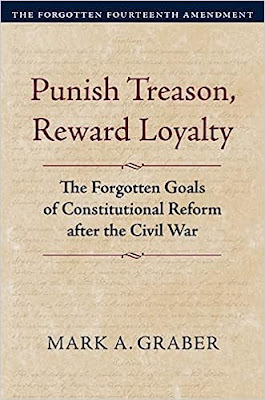
Mark A. Graber, Punish Treason, Reward Loyalty: The Forgotten Goals of Constitutional Reform after the Civil War (University of Kansas Press, 2023)
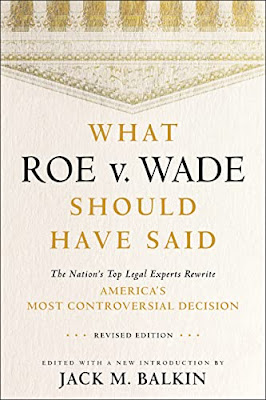
Jack M. Balkin, What Roe v. Wade Should Have Said: The Nation's Top Legal Experts Rewrite America's Most Controversial Decision - Revised Edition (NYU Press, 2023)

Andrew Koppelman, Burning Down the House: How Libertarian Philosophy Was Corrupted by Delusion and Greed (St. Martin’s Press, 2022)

Gerard N. Magliocca, Washington's Heir: The Life of Justice Bushrod Washington (Oxford University Press, 2022)
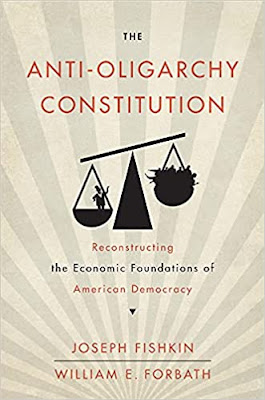
Joseph Fishkin and William E. Forbath, The Anti-Oligarchy Constitution: Reconstructing the Economic Foundations of American Democracy (Harvard University Press, 2022)
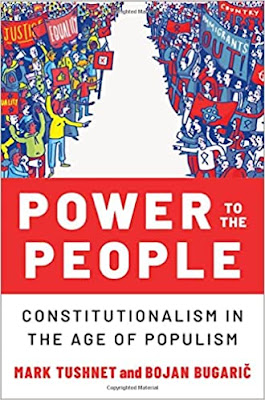
Mark Tushnet and Bojan Bugaric, Power to the People: Constitutionalism in the Age of Populism (Oxford University Press 2021).

Mark Philip Bradley and Mary L. Dudziak, eds., Making the Forever War: Marilyn B. Young on the Culture and Politics of American Militarism Culture and Politics in the Cold War and Beyond (University of Massachusetts Press, 2021).

Jack M. Balkin, What Obergefell v. Hodges Should Have Said: The Nation's Top Legal Experts Rewrite America's Same-Sex Marriage Decision (Yale University Press, 2020)

Frank Pasquale, New Laws of Robotics: Defending Human Expertise in the Age of AI (Belknap Press, 2020)

Jack M. Balkin, The Cycles of Constitutional Time (Oxford University Press, 2020)

Mark Tushnet, Taking Back the Constitution: Activist Judges and the Next Age of American Law (Yale University Press 2020).

Andrew Koppelman, Gay Rights vs. Religious Liberty?: The Unnecessary Conflict (Oxford University Press, 2020)

Ezekiel J Emanuel and Abbe R. Gluck, The Trillion Dollar Revolution: How the Affordable Care Act Transformed Politics, Law, and Health Care in America (PublicAffairs, 2020)

Linda C. McClain, Who's the Bigot?: Learning from Conflicts over Marriage and Civil Rights Law (Oxford University Press, 2020)
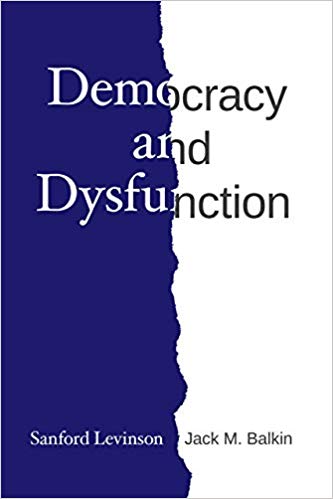
Sanford Levinson and Jack M. Balkin, Democracy and Dysfunction (University of Chicago Press, 2019)

Sanford Levinson, Written in Stone: Public Monuments in Changing Societies (Duke University Press 2018)

Mark A. Graber, Sanford Levinson, and Mark Tushnet, eds., Constitutional Democracy in Crisis? (Oxford University Press 2018)

Gerard Magliocca, The Heart of the Constitution: How the Bill of Rights became the Bill of Rights (Oxford University Press, 2018)

Cynthia Levinson and Sanford Levinson, Fault Lines in the Constitution: The Framers, Their Fights, and the Flaws that Affect Us Today (Peachtree Publishers, 2017)

Brian Z. Tamanaha, A Realistic Theory of Law (Cambridge University Press 2017)

Sanford Levinson, Nullification and Secession in Modern Constitutional Thought (University Press of Kansas 2016)

Sanford Levinson, An Argument Open to All: Reading The Federalist in the 21st Century (Yale University Press 2015)

Stephen M. Griffin, Broken Trust: Dysfunctional Government and Constitutional Reform (University Press of Kansas, 2015)

Frank Pasquale, The Black Box Society: The Secret Algorithms That Control Money and Information (Harvard University Press, 2015)

Bruce Ackerman, We the People, Volume 3: The Civil Rights Revolution (Harvard University Press, 2014)
Balkinization Symposium on We the People, Volume 3: The Civil Rights Revolution

Joseph Fishkin, Bottlenecks: A New Theory of Equal Opportunity (Oxford University Press, 2014)

Mark A. Graber, A New Introduction to American Constitutionalism (Oxford University Press, 2013)

John Mikhail, Elements of Moral Cognition: Rawls' Linguistic Analogy and the Cognitive Science of Moral and Legal Judgment (Cambridge University Press, 2013)

Gerard N. Magliocca, American Founding Son: John Bingham and the Invention of the Fourteenth Amendment (New York University Press, 2013)

Stephen M. Griffin, Long Wars and the Constitution (Harvard University Press, 2013)

Andrew Koppelman, The Tough Luck Constitution and the Assault on Health Care Reform (Oxford University Press, 2013)

James E. Fleming and Linda C. McClain, Ordered Liberty: Rights, Responsibilities, and Virtues (Harvard University Press, 2013)
Balkinization Symposium on Ordered Liberty: Rights, Responsibilities, and Virtues

Andrew Koppelman, Defending American Religious Neutrality (Harvard University Press, 2013)

Brian Z. Tamanaha, Failing Law Schools (University of Chicago Press, 2012)

Sanford Levinson, Framed: America's 51 Constitutions and the Crisis of Governance (Oxford University Press, 2012)

Linda C. McClain and Joanna L. Grossman, Gender Equality: Dimensions of Women's Equal Citizenship (Cambridge University Press, 2012)

Mary Dudziak, War Time: An Idea, Its History, Its Consequences (Oxford University Press, 2012)

Jack M. Balkin, Living Originalism (Harvard University Press, 2011)

Jason Mazzone, Copyfraud and Other Abuses of Intellectual Property Law (Stanford University Press, 2011)

Richard W. Garnett and Andrew Koppelman, First Amendment Stories, (Foundation Press 2011)

Jack M. Balkin, Constitutional Redemption: Political Faith in an Unjust World (Harvard University Press, 2011)

Gerard Magliocca, The Tragedy of William Jennings Bryan: Constitutional Law and the Politics of Backlash (Yale University Press, 2011)

Bernard Harcourt, The Illusion of Free Markets: Punishment and the Myth of Natural Order (Harvard University Press, 2010)

Bruce Ackerman, The Decline and Fall of the American Republic (Harvard University Press, 2010)
Balkinization Symposium on The Decline and Fall of the American Republic

Ian Ayres. Carrots and Sticks: Unlock the Power of Incentives to Get Things Done (Bantam Books, 2010)

Mark Tushnet, Why the Constitution Matters (Yale University Press 2010)

Ian Ayres and Barry Nalebuff: Lifecycle Investing: A New, Safe, and Audacious Way to Improve the Performance of Your Retirement Portfolio (Basic Books, 2010)
.jpg)
Jack M. Balkin, The Laws of Change: I Ching and the Philosophy of Life (2d Edition, Sybil Creek Press 2009)

Brian Z. Tamanaha, Beyond the Formalist-Realist Divide: The Role of Politics in Judging (Princeton University Press 2009)
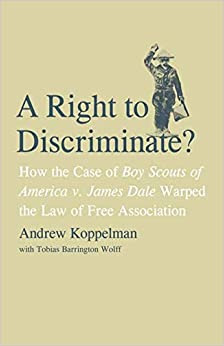
Andrew Koppelman and Tobias Barrington Wolff, A Right to Discriminate?: How the Case of Boy Scouts of America v. James Dale Warped the Law of Free Association (Yale University Press 2009)

Jack M. Balkin and Reva B. Siegel, The Constitution in 2020 (Oxford University Press 2009)

Heather K. Gerken, The Democracy Index: Why Our Election System Is Failing and How to Fix It (Princeton University Press 2009)

Mary Dudziak, Exporting American Dreams: Thurgood Marshall's African Journey (Oxford University Press 2008)

David Luban, Legal Ethics and Human Dignity (Cambridge Univ. Press 2007)

Ian Ayres, Super Crunchers: Why Thinking-By-Numbers is the New Way to be Smart (Bantam 2007)

Jack M. Balkin, James Grimmelmann, Eddan Katz, Nimrod Kozlovski, Shlomit Wagman and Tal Zarsky, eds., Cybercrime: Digital Cops in a Networked Environment (N.Y.U. Press 2007)

Jack M. Balkin and Beth Simone Noveck, The State of Play: Law, Games, and Virtual Worlds (N.Y.U. Press 2006)

Andrew Koppelman, Same Sex, Different States: When Same-Sex Marriages Cross State Lines (Yale University Press 2006)

Brian Tamanaha, Law as a Means to an End (Cambridge University Press 2006)

Sanford Levinson, Our Undemocratic Constitution (Oxford University Press 2006)

Mark Graber, Dred Scott and the Problem of Constitutional Evil (Cambridge University Press 2006)

Jack M. Balkin, ed., What Roe v. Wade Should Have Said (N.Y.U. Press 2005)

Sanford Levinson, ed., Torture: A Collection (Oxford University Press 2004)
Balkin.com homepage
Bibliography
Conlaw.net
Cultural Software
Writings
Opeds
The Information Society Project
BrownvBoard.com
Useful Links
Syllabi and Exams
