Balkinization
an unanticipated consequence of
Jack M. Balkin
Balkinization Symposiums: A Continuing List
E-mail:
Jack Balkin:
jackbalkin at yahoo.com
Bruce Ackerman
bruce.ackerman at yale.edu
Ian Ayres
ian.ayres at yale.edu
Corey Brettschneider
corey_brettschneider at brown.edu
Mary Dudziak
mary.l.dudziak at emory.edu
Joey Fishkin
joey.fishkin at gmail.com
Heather Gerken heather.gerken at yale.edu
Abbe Gluck abbe.gluck at yale.edu
Mark Graber
mgraber at law.umaryland.edu
Stephen Griffin
sgriffin at tulane.edu
Jonathan Hafetz
jonathan.hafetz at shu.edu
Jeremy Kessler
jkessler at law.columbia.edu
Andrew Koppelman
akoppelman at law.northwestern.edu
Marty Lederman
msl46 at law.georgetown.edu
Sanford Levinson
slevinson at law.utexas.edu
David Luban
david.luban at gmail.com
Gerard Magliocca
gmaglioc at iupui.edu
Jason Mazzone
mazzonej at illinois.edu
Linda McClain
lmcclain at bu.edu
John Mikhail
mikhail at law.georgetown.edu
Frank Pasquale
pasquale.frank at gmail.com
Nate Persily
npersily at gmail.com
Michael Stokes Paulsen
michaelstokespaulsen at gmail.com
Deborah Pearlstein
dpearlst at yu.edu
Rick Pildes
rick.pildes at nyu.edu
David Pozen
dpozen at law.columbia.edu
Richard Primus
raprimus at umich.edu
K. Sabeel Rahmansabeel.rahman at brooklaw.edu
Alice Ristroph
alice.ristroph at shu.edu
Neil Siegel
siegel at law.duke.edu
David Super
david.super at law.georgetown.edu
Brian Tamanaha
btamanaha at wulaw.wustl.edu
Nelson Tebbe
nelson.tebbe at brooklaw.edu
Mark Tushnet
mtushnet at law.harvard.edu
Adam Winkler
winkler at ucla.edu
Compendium of posts on Hobby Lobby and related cases
The Anti-Torture Memos: Balkinization Posts on Torture, Interrogation, Detention, War Powers, and OLC
The Anti-Torture Memos (arranged by topic)
Recent Posts
Incentives and Competition in Innovation Markets: A Study of the FAA UAS Test Sites Competition
IP and Other Regulations
Innovation Law Beyond IP 2: Bringing the State Back In
The Innovation State: "No Country" for Old Rules, only Experimental Ones?
Property Rules and Liability Rules for Genetic Data
Creative Production Without Intellectual Property
Centralization, Fragmentation, and Replication in the Genomic Data Commons
The Hidden Wisdom of Architectural Copyright Before the AWCPA
We Don’t Need No State! Wait. The State Funds That? Never Mind.
Ceci N’est Pas Un Taxi: Definitional Defiance as Innovation in the Platform Economy
Publishing without Property
Governing Knowledge Commons
Trademark Innovation to Support Open Collaboration
The Cost of Free and Paradoxes of Informational Capitalism
Intellectual Property as Global Public Finance
Regulating Secrecy
Cluster Competition
IP and Constitutional Equality
The Success of "Access to Error"
Access to Error
![[Powered by Blogger]](https://lh3.googleusercontent.com/blogger_img_proxy/AEn0k_u6T33tiu0IrzBzQcdB6WwI1X4L2mi3DMq2XRuX64Wc15_0r1eETFAXI5gC8pfAT5qd-acXQrqrY5xxsA-QOCpfGigOqJWa8jSJzUNf5cA4=s0-d)
Just A Few Blogs
ACS Blog
Alas, a Blog
Althouse
Arts and Letters Daily
Atrios (Eschaton)
Bill of Health
Buzzflash.com
Buzz Machine
Cato at Liberty
Juan Cole (Informed Comment)
Concurring Opinions
The Constitution in 2020
Corrente
Crooked Timber
Daily Howler
Daily Kos
Dana Boyd
Brad DeLong
Digby (Hullabaloo)
Discriminations
Daniel Drezner
Kevin Drum (Mother Jones)
Electrolite
En Banc
Eunomia (Daniel Larison)
Fafblog
Michael Froomkin (Discourse.net)
GovLab (Beth Noveck)
Rick Hasen (Election Law)
History News Network
How Appealing
Ignatz (Sam Heldman)
The Importance of (Ernie Miller)
Infolaw
Instapundit
International Economic Law and Policy Blog
IntLawGrrls
Jacob Levy
Jesus' General
Jurisdynamics
The Kitchen Cabinet
Mark Kleiman
Law Blog Central
Larry Lessig
Lawyers, Guns and Money
Liberal Oasis
Brian Leiter's Law School Reports
The Leiter Reports
Marginal Revolution
Megan McArdle
Memeorandum
Metafilter
Mirror of Justice
The New Republic
Newseum
No More Mister Nice Blog
Brendan Nyhan
Opinio Juris
Orcinus
The Originalism Blog
Pandagon
Passport (Foreign Policy)
Overcoming Bias
Political Animal (Washington Monthly)
Political Theory Daily Review
Political Wire (Taegan Goddard)
The Poor Man
Virginia Postrel
Prawfsblawg
Public Reason
Jonathan Rauch
Raw Story
Redstate
ReligiousLeftLaw.com
Reporters Committee For Freedom of the Press
Reproductive Rights Blog
Rothman's Roadmap to the Right of Publicity
SCOTUS Blog
Seeing the Forest
Clay Shirky
The Shifted Librarian
The Situationist
Larry Solum (Legal Theory)
Andrew Sullivan
Talking Points Memo
Talk Left
Tapped
Tbogg
TechPresident
The Paper Chase (Jurist)
Tom Paine
Tom Tomorrow (This Modern World)
Eve Tushnet
Uggabugga
University of Chicago Law School Faculty Blog
Unqualified Offerings
The Volokh Conspiracy
War and Piece (Laura Rozen)
Wampum
Oliver Willis
Wonkette
Written Description
Matthew Yglesias
Yin
Your Choice of Feeds
1. XML
powered by

2. Atom Feed
3. RSS 2.0
Incentives and Competition in Innovation Markets: A Study of the FAA UAS Test Sites Competition
Guest Blogger
Robert Heverly Labels: Beyond IP
For the Innovation Law Beyond IP 2 conference, March 28-29 at Yale Law School
The (commercial) drones are coming. Amazon wants to deliver packages with them, as does Google, and
utilities
want to monitor their infrastructure with them. Known more properly as Unmanned Aircraft Systems (UAS), the Federal Aviation Administration has proposed
new rules to regulate commercial drone use, and states have passed laws in an attempt to protect privacy and prevent alleged misuse of the drones (for example, preventing hunting by UAS).
In 2012, Congress passed the Federal Aviation Administration Modernization and Reform Act (FMRA), in
which it directed the Federal Aviation Administration (FAA) to begin integrating Unmanned Aircraft Systems (UAS, or drones) into the national airspace. Section 332(c) required the FAA to
designate six UAS national test ranges to allow testing to begin at those sites (without this authority, UAS cannot be used for commercial purposes without
specific FAA authority). No funding was included in the test range designation; instead, UAS could fly at the ranges pursuant to a local, streamlined
approval process, avoiding the otherwise relatively lengthy existing FAA procedure).
Fifty applicants initially sought FAA authority to open test ranges, a number the FAA first reduced to 24 and finally to the six awardees (the FAA has
since issued proposed rules for more general commercial UAS use, and even more recently approved use of certain UAS below 200 feet without significant restrictions).
The UAS industry is an innovative industry. We can contrast UAS with industries, such as manufacturing or even gambling facilities, that states may seek to entice to locate within their borders for
purposes of encouraging economic development. Silicon Valley was not built by luring employers into the region. It was built – and succeeds – because of
the benefits that innovation bring to the region (and it is so successful that there are now various “Silicon” and “Valley” themed regions throughout the
world as others attempt to recreate Silicon Valley’s success).
Read more »
Posted
12:00 PM
by Guest Blogger [link]
IP and Other Regulations
Guest Blogger
Mark A. Lemley [1] Labels: Beyond IP
For the Innovation Law Beyond IP 2 conference, March 28-29 at Yale Law School
Intellectual property (IP) is a form of regulation. As I have argued elsewhere, [3] IP laws are deliberate
government interventions in the market to try to shape how people participate in that market, encouraging new creation by rewarding it with above-market
returns and discouraging imitation by imposing damages or even barring it altogether.
Once we understand IP laws as government social policies that seek to alter market outcomes, we can start to think of those laws as part of a broader
tapestry of government rules that affect innovation in a complex variety of ways. Daniel Hemel and Lisa Ouellette have already situated IP regimes among a
variety of other government policy levers designed to affirmatively encourage innovation and market entry, including prizes, grants, and tax incentives. [4]
But the potential role of regulation in encouraging market entry is not limited to offering various forms of government-sponsored largess to innovators.
More traditional forms of regulation restrict market entry. Doing so offers supracompetitive returns to market incumbents who benefit from the entry
barriers regulations impose. Taxi drivers benefit – or did until quite recently – from the absence of a truly competitive market, propped up by government
limits on market entry. So too do the learned professions, which limit entry into their fields, sometimes in quite blatantly anticompetitive ways. [5] Pharmaceutical companies benefit from the limits the FDA puts on generic entry, over and above – and
sometimes regardless of – the existence of patents. [6]
Read more »
Posted
1:00 PM
by Guest Blogger [link]
Innovation Law Beyond IP 2: Bringing the State Back In
Guest Blogger
Amy Kapczynski Labels: Beyond IP
For the Innovation Law Beyond IP 2 conference, March 28-29 at Yale Law School
I’m looking forward to welcoming a superb group here to Yale this weekend for our second annual “Innovation Law Beyond IP” conference. I’m particularly excited about the main theme of our gathering this year: bringing the state back in.
I’ve puzzled for many years about the reflexive pessimism about the state that prevails in the field of IP. The dominant justification for IP law, in fact, relies at its core on a particular view of the state. As Kenneth Arrow noted long ago, IP rights create necessary inefficiencies, and these make the state a plausible competitor to the market on efficiency grounds. Why, then, should we use IP rather than the state? Because, as one of the leading IP law casebooks tells us:
Intellectual property rights have the advantage of limiting the government’s role in allocating resources to a finite set of decentralized decisions: whether particular inventions are worthy of a fixed period of protection. The market then serves as the principal engine of progress. Decentralized consumers generate demand for products and competing decentralized sellers produce them. By contrast, most other incentive systems, especially large-scale research funding, require central planning on a mass scale. (Merges, Menell & Lemley, 18)
This image of the state casts a long shadow in the field. So long, in fact, that it reaches deep into the “beyond IP” literature. Larry Lessig, for example, argues that “[I]f the twentieth century taught us one lesson, it is the dominance of private over state ordering.” (Future of Ideas, 12). We should rebel against IP law in part, Lessig says, because we should “limit the government’s role in choosing the future of creativity.” (Id. at xvi).
Read more »
Posted
9:30 AM
by Guest Blogger [link]
The Innovation State: "No Country" for Old Rules, only Experimental Ones?
Guest Blogger
Sofia Ranchordás Labels: Beyond IP
For the Innovation Law Beyond IP 2 conference, March 28-29 at Yale Law School
We love the word innovation. We pronounce it endlessly and, very often, meaninglessly. It seems like everything can be qualified as an innovation these days, and hence escape the legal control and the heavy hand of the state. Law and innovation are often presented in the popular media---and a portion of the literature---as two realities that shouldn’t mix. While innovation is an intangible, evolving, and trial-and-error process, law is made of stable and predictable rules.
Regulators seem to aim at a form of legal certainty which is not compatible with the inherent uncertainty that characterizes innovation. Therefore, whenever law tries to regulate innovative products and services, it often ends up stifling innovation by applying rigid and obsolete rules that constrain the freedom of innovators. As I have explained in my previous work on sharing economy, we have witnessed this problem with the prohibition of Uber in Europe, where the ‘old rules’ designed for taxi regulation have been used to prohibit this innovative form of peer-to-peer economy.
However, is this tension between law and innovation truly due to the inherent uncertainty of innovation, or to the normative uncertainty that confronts regulators? In other words, in many cases, clinical trials and ex ante evaluations may already provide regulators with sufficient information as to the potential risks and benefits of an innovation, but this may still not say much about the rules to be enacted in a concrete case, or the timing of such rules.
Read more »
Posted
8:00 AM
by Guest Blogger [link]
Property Rules and Liability Rules for Genetic Data
Guest Blogger
Jorge L. Contreras Labels: Beyond IP
For the Innovation Law Beyond IP 2 conference, March 28-29 at Yale Law School
In 2009, the Texas Department of Health agreed to destroy a research biobank containing approximately 5.3 million infant blood samples. The samples, stored on index cards as dried blood spots, were collected over an eight-year period as part of a state program to screen newborns for genetic disorders and birth defects. The parents of each infant consented to the blood draw and the testing. Nevertheless, when four Texas parents discovered that the state retained the infant blood spots for future research, they sued (Beleno v. Lakey (W.D. Tex. 2009)). Andrea Beleno and the other parents alleged that the state’s use of infant blood spots for research purposes without their express consent violated their right to privacy under the Fourteenth Amendment, among other things. To settle the litigation, the state agreed to destroy its entire repository of more than five million infant blood spots, an invaluable and irreplaceable resource for biomedical research.
The result in Beleno is not unique. Individuals have been asserting the right to control the use of biological samples and data with increasing frequency. In a highly-publicized case involving the Havasupai tribe, Arizona State University agreed to return DNA samples and discontinue several lines of research following objections from tribe members (Havasupai Tribe v. Ariz. Bd. of Regents, 220 Ariz. 214, 217 (2008)). They argued that, although they may have consented to the use of their DNA for diabetes research, they did not consent to other uses, including research on schizophrenia and ancient human migration. After the tribe brought suit seeking $50 million in damages, the university settled, notwithstanding the fact that tribe members signed broad consent forms potentially authorizing the research.
It is axiomatic under U.S. law that there is no property interest in mere facts. Nevertheless, as these cases show, with respect to human genetic data, a de facto property regime has emerged in all but name. This regime has enabled individuals to exert strong proprietary rights over the use of data obtained from them, leading to instances in which research has been hindered or stopped, and in which valuable resources have been destroyed. The mechanism by which individuals have been able to assert control over “their” data is informed consent.
Read more »
Posted
1:00 PM
by Guest Blogger [link]
Creative Production Without Intellectual Property
Guest Blogger
Kate Klonick Labels: Beyond IP
For the Innovation Law Beyond IP 2 conference, March 28-29 at Yale Law School
The problem of the commons has existed as long as humans have formed communities: how do you protect against overfishing in an ocean no one owns, but everyone uses? How do you prevent pollution in a sky that belongs to no one, but everyone breathes?
In talking about more traditional natural resource-based commons problems, economists and lawyers have largely debated the relative merits of two approaches to solving the commons problem:
An alternative approach, developed by Elinor Ostrom — and which won her a Nobel Prize in Economics in 2009 — escapes this binary, and suggests that a voluntary self-governing citizenry will create its own institutions and solutions to commons problems. Ostrom created a framework for analyzing and studying these institutions, as a means of creating societal preconditions to support their development.
But protecting and allocating natural resources like fish or air or land is slightly different than allocating culture and knowledge. “Knowledge commons” — as Brett Frischmann, Michael Madison, and Katherine Strandburg explain in Governing Knowledge Commons — are created by humans and are both intellectual and cultural. In natural resources, the problem of the commons stems from the self-interest individuals have in depleting a common resource; but in intellectual and cultural resources, the problem of the commons stems from the challenge of incentivizing the ongoing creation of these resources, while also recognizing that such contributions are public goods.
Read more »
Posted
10:30 AM
by Guest Blogger [link]
Centralization, Fragmentation, and Replication in the Genomic Data Commons
Guest Blogger
Peter Lee Labels: Beyond IP
For the Innovation Law Beyond IP 2 conference, March 28-29 at Yale Law School
Genomics—the study of organisms’ entire genomes—holds great promise to advance biological knowledge and facilitate the development of new diagnostics and therapeutics. Genomics research has benefited greatly from various policies requiring the rapid disclosure of nucleotide sequence data in public databases. The result is a genomic data commons, a widely-accessible repository of information from which all members of the scientific community can draw. Notably, this intensely productive space operates almost completely outside of formal intellectual property law through a combination of public funding, agency policy, and communal norms.
The genomic data commons has attracted significant scholarly interest both because of its great potential to advance biomedical research as well as its broader lessons about the nature of commons-based productivity. For instance, Jorge Contreras has charted the evolution of the genomic data commons from a system that essentially disseminates information into the public domain into a more complex, “polycentric” governance institution for managing knowledge resources. This paper, which grows out of Brett Frischmann, Michael Madison, and Kathy Strandburg’s project to study commons governance, explores less appreciated but highly significant complexities of managing genomic information. In so doing, it seeks to shed greater light on the nature of commons in general.
In particular, this paper focuses on the governance challenges of correcting, updating, and annotating vast amounts of sequence data in the commons. Most legal accounts of the genomic data commons focus on researchers’ initial provisioning of data and access to such data by other scientists. Delving into the science of genome sequencing, assembly, and annotation, however, this paper highlights the indeterminate nature of sequence data and related information. Quite simply, the genomic data commons is full of errors and incompleteness. Accordingly, this paper examines four approaches for correcting, completing, and updating existing data: contributor-centric data management, third-party biocuration, community-based wikification, and specialized databases and genome browsers. It argues that these approaches reveal deep tensions between centralization and fragmentation of control within the genomic data commons, a tension that can be mitigated through a strategy of replication.
Read more »
Posted
1:00 PM
by Guest Blogger [link]
The Hidden Wisdom of Architectural Copyright Before the AWCPA
Guest Blogger
Kevin Emerson Collins Labels: Beyond IP
For the Innovation Law Beyond IP 2 conference, March 28-29 at Yale Law School
My project follows through on an intuition about the value of architectural copyright that dates from my days as an architect before I went to law school. When I was an architect, I believed that copyright would be valuable to me not because it prevented other architects from borrowing from my designs but rather because it gave me more bargaining power in relation to the building owners who were my clients. More specifically, my current project identifies the hidden wisdom of architectural copyright before the adoption of the Architectural Works Copyright Protection Act (AWCPA) of 1990—an odd copyright regime that, to date, no one has sought to justify. Formalizing my old intuition, I argue that the primary benefit of pre-AWCPA copyright was not an augmented incentive to create but rather the resolution of a variant of Arrow’s information paradox. That is, pre-AWCPA architectural copyright was a well-engineered copyright regime because it allowed strangers to free ride on design information while it prevented building owners who were contractually related to architects from opportunistically appropriating disclosed information without full payment.
Before the AWCPA, copying original expression from an architectural drawing amounted to infringement, but copying the exact same original expression from a constructed building did not. Economically speaking, pre-AWCPA architectural copyright was therefore a defeasible right because it lost much of its economic value upon the construction of a building. Pre-AWCPA copyright was a facially odd copyright without an analog in any other copyrightable subject matter. Imagine protecting the drawings used to design useful articles, but not the conceptually separable aspects of the useful articles themselves. Alternatively, imagine protecting the sketches made in preparation for large-scale murals or mosaics, but not the completed murals or mosaics.
Pre-AWCPA copyright has been widely criticized by critics who evaluate it under the incentives-access tradeoff that underpins conventional economic justifications of copyright. Aspiring to a maximalist regime, some copyright scholars criticize pre-AWCPA copyright directly, arguing that its defeasible rights are too paltry. Because free riding on constructed buildings is permitted, they posit that it does not generate meaningful incentives to invest in creative architectural design. Others, aspiring to a minimalist regime, argue in favor of thin—or perhaps even non-existent—copyright protection for architecture. However, they do not defend the defeasible nature of pre-AWCPA rights as a good way to limit an architect’s copyright rather than, say, a strictly administered substantial similarity test. In sum, pre-AWCPA architectural copyright was not only weak, but runtish as well. If the point of copyright is to generate incentives for creativity and tamping down on the most egregious free riding is the most palatable way of having copyright augment the incentive to create, pre-AWCPA copyright simply misses the mark.
Read more »
Posted
8:00 AM
by Guest Blogger [link]
We Don’t Need No State! Wait. The State Funds That? Never Mind.
Guest Blogger
Deven Desai Labels: Beyond IP
For the Innovation Law Beyond IP 2 conference, March 28-29 at Yale Law School
The sub-theme for Innovation Law Beyond IP 2 is “Bringing the State Back In.” That theme prompted me to submit a proposal in part because I am not sure the state ever left. The assumption of bringing the state back in seems to be that it has been pushed out or ignored. Marianna Mazzacuto’s white paper on the state and innovation and her follow-up book, The Entrepreneurial State, on the topic offer another perspective: that society has under-valued the state’s role in innovation.
As I kicked around the conference theme, I thought about the number of times I had said the term. "Innovation" has been gutted of meaning. When I worked it Silicon Valley, I was constantly hearing that everything and everyone was "innovative." What do you want to be? Innovative. Why should we fund you? We are innovative. Why shouldn’t we tax you? We will stop innovating. It reached a point that I’d not be surprised if someone claimed to be innovative in the way they crossed a street. The ever-present invocation of innovation made me think: what exactly do we mean by innovation? And are some innovations more important than others? Furthermore, from where do innovations come?
Part of the problem is that the focus on innovation in general misses that any given innovation is part of a system, and it is the system that matters. If we think about systems that support innovation, it appears that there are three parts to such a system:
The state plays a role for each part. The problem today seems to be that as soon as one talks of the state being involved in anything, what Fred Block has called “market fundamentalism” rises to challenge and deny that the state has any role to play. In addition, the Schumpeterian idea of gales of creative destruction has been claimed by many sides of the innovation policy debate and confuses the debate further. As I read Schumpeter, I found that he recognized the differences between invention and innovation. He also recognized that not all innovations are equal.
Read more »
Posted
1:00 PM
by Guest Blogger [link]
Ceci N’est Pas Un Taxi: Definitional Defiance as Innovation in the Platform Economy
Guest Blogger
Orly Lobel Labels: Beyond IP
For the Innovation Law Beyond IP 2 conference, March 28-29 at Yale Law School
Over 10,000 new platform companies have sprouted and mushroomed in less than a decade and they continue to pop up daily. The platform economy, while not easy to define or quantify, was valued in 2013 at $26 billion with predictions of an exponential growth to $110 billion in the next few years. A recent Price Waterhouse report predicts that globally, revenues from the platform sectors could hit $335 billion by 2025.
So what’s your business? You don’t need to open a restaurant to host cooking events; you don’t need to become a taxi driver to offer paid rides; you don’t need to open a hotel to be a lodging host; you don’t need to start a moving company to get paid for helping someone relocate. Platform businesses are challenging conventional industries in every realm, including hotels (Airbnb, Couchsurfing, Homeaway, VRBO), office space (Liquid Space, ShareDesk), parking spaces (ParkingPanda, Park Circa), transportation (Lyft, Sidecar, Uber), restaurants (Eatwith, Feastly, Blue Apron, Munchery), used clothing (ThredUp), household tools (Open Shed), outdoor gear (Gearcommons), capital (Zopa; Prosper, Kickstarter, Bitcoin), broadcasting (Aereo, FilmOn.com), co-developing (Quirkly, Etsy), legal services (Upcounsel), medical services (Healthtap), academic tutoring (Uguru), everyday errands such as grocery shopping and laundry (TaskRabbit, Instacart, Airtasker, Washio), and specialized errands, such as flower delivery (BloomThat), dog-walking (DogVacay) and package delivery (Shyp).
New digital technologies are turning everything into an available resource: services, products, spaces, connections, and knowledge, all of which would otherwise be collecting dust. It’s been called the sharing economy, the disaggregated economy, the peer-to-peer economy (P2P), human-to-human (H2H), the community marketplace, the on-demand economy, the app economy, mesh economy, gig economy, and the "Uberization of everything."
Read more »
Posted
8:00 AM
by Guest Blogger [link]
Publishing without Property
Guest Blogger
Lea Shaver Labels: Beyond IP
For the Innovation Law Beyond IP 2 conference, March 28-29 at Yale Law School
In "Copyright and Inequality," I explored the ways in which copyright protection often – perhaps inevitably – fails to incentivize books for certain audiences, because they are too poor, speak the “wrong” languages, or require niche content or formats. The project I will present at the Beyond IP 2 conference examines a possible solution to copyright’s inequality problem, one which holds the potential to finally bring books to billions of readers long neglected by the mainstream publishing industry.
In India, Pratham Books pursues the mission of “A book in every child’s hand,” producing more than 1000 titles in over 15 languages, and reaching 52 million children. The African Storybook Project distributes openly licensed stories on a digital platform that facilitates translation to help young children develop a love of reading. First Book provides low-cost new books to over 160,000 schools and community programs, and leverages its buying power to demand more diverse books.
Social publishers are defined by the centrality of a social mission rather than the pursuit of profit. For this reason, they often rely heavily on social subsidies and treat their product as a social good to be distributed free or at cost. Often, but not always, social publishers also engage in social production. These alternative content-production models leverage intrinsic motivations, social networks, and peer production enabled by digital platforms.
My project analyzes this emerging phenomenon to understand how law and policy can help social publishers reach their fullest potential, and to derive broader lessons from this example of intellectual production without IP.
Read more »
Posted
1:00 PM
by Guest Blogger [link]
Governing Knowledge Commons
Guest Blogger
Michael Madison Labels: Beyond IP
For the Innovation Law Beyond IP 2 conference, March 28-29 at Yale Law School
Empirical investigation into different modalities of knowledge production, distribution, access, and preservation has accelerated in recent years. Much of the energy behind that effort emerges from the intuition that formal intellectual property law frameworks are inadequate and/or incomplete to describe what one observes in the world when examining the governance of innovation. “Peer production” frameworks, and frameworks simply “beyond intellectual property,” are likewise inadequate and/or incomplete; broad, simple labels cannot themselves correct for the errors and omissions of IP as such and cannot capture the significance of diverse ground-level details.
Yet policymaking cannot proceed effectively if it tries to align law with micro-level experience, or if researchers advance policy arguments based on isolated case studies of innovation “beyond intellectual property.” What is needed is an empirical strategy for investigating the mechanics of innovation systems that encourages both micro-level and system-level inquiry and invites comparing and eventually synthesizing lessons across diverse innovation domains, accepting linkages among commons-based production, user-innovation, IP-based production, and state-sponsored production. Commons-based production, sometimes in part referred to as “peer production,” is widespread and heavily theorized, yet commons governance is under-researched. One-off studies and anecdotes have been collected without a strategy for using that data to build a larger model of knowledge and innovation governance.
My colleagues Brett Frischmann, Kathy Strandburg and I proposed the first part of such a strategy in our 2010 paper, Constructing Commons in the Cultural Environment, and we refine that strategy and demonstrate its potential in Governing Knowledge Commons, the edited collection that is the subject of my presentation at the Innovation Law Beyond IP 2 conference.
Read more »
Posted
8:00 AM
by Guest Blogger [link]
Trademark Innovation to Support Open Collaboration
Guest Blogger
Stephen LaPorte and Yana Welinder Labels: Beyond IP
For the Innovation Law Beyond IP 2 conference, March 28-29 at Yale Law School
Next week, scholars from around the world will gather at Yale Law
School to discuss different institutions that impact knowledge
production at the Innovation Law Beyond IP 2 conference. One of the
topics will be how legal rules and infrastructure can sustain or
undermine commons-based peer-production. Trademark law is one such
legal regime that is rarely discussed in this context. Unlike
copyright law’s Creative Commons and open source licenses,
trademark law has not generated new inventions to support
collaborative production on the internet. Trademark law provides some
support for collaborative projects like Wikipedia and Linux by
protecting their brands from imposters and making the brands
distinguishable so that the projects can use them to recruit new
contributors. But brand protection can also impose restrictions that
go against communities’ values and slow down their work. Over the
past decade, communities and their lawyers have found different
strategies to reconcile their novel forms of knowledge production
with the stringent requirements of trademark law.
The core tension between collaboration and trademark law is the
requirement of quality control. The quality control requirement is
based on the theory that a trademark should be a reliable indicator
of a good’s origin. When trademark holders provide permission for
someone to use their mark, they usually retain the right to inspect
the quality of the goods that carry the mark and impose restrictions
on how the mark may be used. Open source and free culture
communities, on the other hand, thrive
on
openness
and
decentralization.
These communities rely on technical tools and social norms to
maintain the quality of their project.
In 2010, collaborative communities got a wake-up call with a
Ninth
Circuit
ruling that the Freecycle Network had lost the legal rights in its logo due to non-traditional brand management.
Freecycle had failed to enter into proper quality control provisions
with affiliate organizations when they gave the organizations general
permission to use the Freecycle logo without specific restrictions.
The Court found this to be naked licensing, a form of trademark
abandonment, that limited the Freecycle Network’s ability to
enforce their trademark. This case served as a warning of the risk
of
naked
licensing
to collaborative communities that were too open. Since then,
collaborative communities have been grappling with how to protect
their marks in a manner that fits open source and free culture
values.
Read more »
Posted
9:00 AM
by Guest Blogger [link]
The Cost of Free and Paradoxes of Informational Capitalism
Guest Blogger
Guy Pessach Labels: Beyond IP
For the Innovation Law Beyond IP 2 conference, March 28-29 at Yale Law School
Among other aspects and dimensions, the frame “Beyond IP” summarizes two key complementary insights in contemporary politics of intellectual property. The first insight touches upon the limits, shortcomings and social costs that are associated with legal ordering of cultural/information production through intellectual property regimes. The second insight lists alternative structures, institutions and regulatory options for the promotion of innovation and ubiquitous cultural flourishing. Both insights reside upon concrete and persuasive arguments.
At least to some degree, the shift from an IP-centric approach to alternate methodologies that go beyond IP was stimulated by the emergence of digitization and networked communications platforms. New methods and reduced costs of producing, storing and distributing content/information provide fertile grounds and constant demonstration that there are enhanced schemes, beyond IP, for cultural and knowledge sustainability.
“Beyond IP” is not just a frame for mobilization but also a descriptive term that captures and summarizes contemporary information, creative and cultural activities, which rest upon concepts of free content, free access and openness as their building blocks.
Yet, it is at this juncture that another, less noticed, aspect of “Beyond IP” is being revealed: the political economy of certain “Beyond IP” realms, and particularly market-oriented realms, may be counterintuitive to the above-mentioned premises.
Read more »
Posted
9:00 AM
by Guest Blogger [link]
Intellectual Property as Global Public Finance
Guest Blogger
Lisa Larrimore Ouellette Labels: Beyond IP
For the Innovation Law Beyond IP 2 conference, March 28-29 at Yale Law School
The conventional justification for IP is that information is a public good (i.e., it is non-rival and non-excludable), and making information excludable through IP allows it to be efficiently supplied by private markets. Both sides of this account have been questioned: not all information has the characteristics of a public good or can be made excludable through IP, and propertization is not the only way the state compensates public-goods providers. As Daniel Hemel and I analyzed in Beyond the Patents–Prizes Debate, the state also encourages information production through mechanisms such as tax incentives and direct spending. One challenge for domestic innovation policy is recognizing that, like conventional public finance mechanisms, IP facilitates a transfer from consumers to innovators, and that the off-budget nature of this IP “shadow” tax should not affect the innovation policy choice.
In our paper "Intellectual Property as Global Public Finance," Daniel and I examine information production at the global level, where conventional public finance mechanisms are lacking. Many information goods are global public (or quasi-public) goods, so under the conventional account, global coordination is needed to prevent countries from free-riding on each others' information production. Global IP treaties such as the TRIPS Agreement help solve this global coordination problem by requiring countries to contribute to the extent that they use the information produced under IP laws, with defection punished by trade sanctions. In the global context, the off-budget nature of IP laws may be an asset, as it facilitates creation of this stable Nash equilibrium in a way that maps onto very different national public finance regimes.
If this were the full story, one would expect to find little state investment in non-IP innovation mechanisms for which free-riding cannot be prevented. And yet governments at all levels do invest significant resources beyond IP in producing information goods. Daniel and I offer a number of hypotheses to explain these investments. For example, producing information goods has local production externalities, so nation-states may compete to attract innovative individuals and firms. Relatedly, rent-seeking may cause countries to use information subsidies to circumvent free-trade limits on industrial subsidies, and may cause industry interest groups to lobby for grants and tax credits to extract subsidies from the state. Non-pecuniary motivations such as altruism and the pursuit of prestige may supplement these incentives for high-profile goods.
Read more »
Posted
8:00 AM
by Guest Blogger [link]
Regulating Secrecy
Guest Blogger
Nicholson Price Labels: Beyond IP
For the Innovation Law Beyond IP 2 conference, March 28-29 at Yale Law School
Many inventors who wish to protect their inventions from imitators are faced with a choice: do they rely on trade secrecy or patents? The literature has explored how inventors make this choice—when they are likely to choose trade secrecy, when they should choose trade secrecy from an individual perspective, when we as a society would prefer that they choose patents (or trade secrecy)—and how to shape incentives and the rules of trade secrecy and patentability to help drive that choice in socially optimal directions. But trade secrecy and patent law do not operate in a vacuum, and one strong interaction that has been underexplored is how these incentives are affected by regulatory oversight, and how that oversight can change the incentives to choose between the two. In particular, I argue that way regulation strengthens trade secrecy is complex and is overlooked in current policy debates, and that regulatory regimes should act deliberately to reduce secrecy in heavily regulated industries.
When I say “regulatory oversight,” I am thinking principally about heavily regulated industries, with strict oversight and, typically, a market gatekeeper (though I think the insights may also apply in other regulated contexts). The paradigmatic example is the Food and Drug Administration’s oversight of new drugs: the FDA determines which drugs can be examined in clinical trials and allowed onto the market. It also regulates when and how drugs are manufactured, how drugs are marketed, when they can be removed from the market, and when and how competitors can enter the market. Other similarly regulated regimes include pesticides, medical devices, and biologics, and to a lesser degree, aerospace, nuclear energy, and military tech/procurement.
In these contexts, IP protection often becomes more powerful by its link to the regulatory benefit under three conditions:
Read more »
Posted
8:00 AM
by Guest Blogger [link]
Cluster Competition
Guest Blogger
Camilla Hrdy Labels: Beyond IP
For the Innovation Law Beyond IP 2 conference, March 28-29 at Yale Law School
Governments across the globe have increasingly made it a core feature of their economic development policies to foster the growth of “innovation clusters” in their jurisdictions: regional economies made up of innovative firms, talent, and supporting institutions, which are thought to benefit from proximity to one another. The concept is elusive, and is often accompanied with references to examples of successful clusters, ranging from biotech in Boston, to information technology in Silicon Valley, to marine technologies in eastern North Carolina.
Now the U.S. federal government is getting involved. The most prominent example of the expanded federal role in growing clusters is the regional innovation program (RIP) created in the America Competes Act (2010) in order to encourage and support the development of “regional innovation strategies.” Administered by the Economic Development Administration (EDA) in coordination with agencies like the Department of Energy (DOE), the RIP’s flagship initiative is a multi-agency grant competition through which states, regional governments, and other stakeholders compete for federal grants and matching funds to design and implement strategies for growing innovation clusters or science and research parks. The largest cluster grant to date has gone to the Greater Philadelphia area, which received over $150 million in federal and matched funds to build an Efficient Energy Buildings hub focusing on developing ways to make buildings more energy-efficient.
The U.S. government’s decision to fund a national cluster competition is curious in light of the fact that there is already an intense competition to grow innovation clusters in the United States at the regional level. For decades, states, cities, and other subdivisions of states have put significant resources into programs to build innovation clusters, from spending on infrastructure, to investments in higher education and university research, to tax breaks, subsidies, and public venture capital for firms seeking to conduct or commercialize cutting-edge research.
Read more »
Posted
9:31 AM
by Guest Blogger [link]
IP and Constitutional Equality
Guest Blogger
Jessica Silbey Labels: Beyond IP
For the Innovation Law Beyond IP 2 conference, March 28-29 at Yale Law School
Intellectual property reform most often questions the most effective levers for “promoting progress” by incentivizing creativity and innovation. However, substantial ambiguity exists as to what “progress” means, particularly in some of the most notable (and critiqued) court cases interpreting intellectual property statutes (e.g., Aereo, Golan, Eldred, Bowman). What is the content of “progress” towards which IP law reaches?
I have been thinking about this question from multiple levels, beyond the drafting and legislative history of the Constitution’s clause. If we think that it matters that those engaging in creative and innovative work perceive an alignment between IP protection and “progress” in their field or culture generally, presumably we would think it important to ask those people and qualitatively measure and analyze their answers. I have done that to some extent over several years in dozens of interviews with creative and innovative professionals and their business managers or lawyers. It may perhaps be unsurprising that many people who make, distribute and commercialize creative or innovative work otherwise protected by IP do not think that IP promotes “progress” as defined by facilitating more and better work. Perhaps less surprising, however, is that “progress” to them appears to resonate less with quantity and quality of work and more with equality and distributive justice regarding their practices and experiences of working.
To be sure, mining the empirical data set for substantive and narrative themes about how IP helps or hinders “progress” of science and art reveals a diversity of “progress” values. This presents an opportunity and perhaps several puzzles. Insofar as the mandate to Congress is to “promote progress of science and useful arts” through certain exclusive rights, if the kind of progress that creative and innovators care about and toward which they strive is better known, it may be easier to tailor regulation to achieve those goals. Similarly, urging a more specific articulation of what “progress” might mean for congressional legislation aimed at it, would also be an improvement in government transparency.
Read more »
Posted
9:30 AM
by Guest Blogger [link]
The Success of "Access to Error"
Guest Blogger
Lea Shaver Labels: Beyond IP
For the Innovation Law Beyond IP 2 conference, March 28-29 at Yale Law School
Michal Shur-Ofry’s article, "Access to Error," is a thoroughly enjoyable read, outstanding in both concept and execution. Hers is one of those arguments that makes you think, “How did we miss that?” And, “Now what do we do about it?"
Here’s the foundational insight, in brief: patents provide an incentive to disclose workable technologies. Failures are the blind spot of the patent incentive structure. But there is actually an enormous value in knowing what doesn’t work. As the author points out, the commercial value of knowing what doesn’t work makes this knowledge eligible for trade secret protection. But that is the opposite of incentivizing its disclosure, where it can do the most good.
In the health sector, other scholars have pointed out the problems associated with allowing companies with a financial stake in pharmaceutical research to selectively release their research results. This literature has been closely tied to the context of pharmaceutical research and assumes that the need for access to unsuccessful trial results is unique to that context.
This article takes that concern to a different level, with relevance to all areas of science and technology, business models and social innovation. IP facilitates a market for invention at the end-stage, when you have a successful technology. But the secrecy along the way is counter-productive to speeding innovation.
Read more »
Posted
9:00 AM
by Guest Blogger [link]
Access to Error
Guest Blogger
Michal Shur-Ofry Labels: Beyond IP
For the Innovation Law Beyond IP 2 conference, March 28-29 at Yale Law School
What are your immediate associations to the word "innovation"? The responses I
received while running this question through friends and acquaintances ranged
from the general ("progress", "future", "modernization",
"technology", "patents", "curiosity", "thinking
outside the box", "fresh", and "intriguing") to the
specific ("artificial intelligence", "spaceships", "cherry
tomatoes", "Einstein", "Da Vinci" and "Apple").
No one, however, mentioned errors, failures or negative findings.
This is
hardly surprising—we tend to associate innovation with success (or other
positive things) and errors with defeat. But errors and innovation are actually
tightly linked. My purpose in this project is to focus on errors as drivers of
innovation. I argue that the
current incentive structure in our innovation ecosystem, both within and beyond
IP, does not provide sufficient incentives for the dissemination of errors and other
negative information. I further hope to start a conversation about
access-to-error as an important (and largely overlooked) goal for innovation
policy.
First, what
do errors have to do with innovation? To clarify, I
use "errors" here in a very broad sense, that includes mistakes,
failures, falsifications, blind-alleys, negative findings and additional types
of negative information. The main answer is almost obvious, and was suggested by philosophers of
science long ago: errors provide us with important negative knowledge, the
knowledge of what doesn't work, which brings us closer to understanding what
does. In the words of Karl Popper: "we learn from our mistakes."
But there is more to it: errors are especially
important for triggering paradigm shifts---a particular type of innovation that
opens up new fields of research and can completely change scientific domains. Thomas Kuhn in his influential work about scientific revolutions recognized that paradigm shifts are often preceded by detecting mistakes and inconsistencies
under existing paradigms. Indeed, actual shifts in physics, life-sciences and even behavioral economics provide ample examples
for the power of errors to push innovation beyond the state of the art. More recent
research in the field of complexity highlights another angle: due to the
networked and inter-dependent nature of many innovation ecosystems small errors
that accumulate undetected can eventually cause large-scale catastrophes---famous
failures of aircraft, buildings and nuclear plants provide powerful examples. The
detection of errors in complex innovation ecosystems may therefore be
especially significant. Finally, although my focus is on the scientific and
technological domains, errors and mistakes are also drivers of artistic
creativity.
Read more »
Posted
3:52 PM
by Guest Blogger [link]
Books by Balkinization Bloggers

Gerard N. Magliocca, The Actual Art of Governing: Justice Robert H. Jackson's Concurring Opinion in the Steel Seizure Case (Oxford University Press, 2025)

Linda C. McClain and Aziza Ahmed, The Routledge Companion to Gender and COVID-19 (Routledge, 2024)

David Pozen, The Constitution of the War on Drugs (Oxford University Press, 2024)

Jack M. Balkin, Memory and Authority: The Uses of History in Constitutional Interpretation (Yale University Press, 2024)
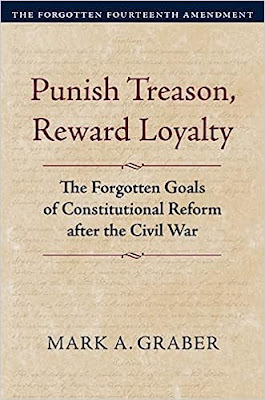
Mark A. Graber, Punish Treason, Reward Loyalty: The Forgotten Goals of Constitutional Reform after the Civil War (University of Kansas Press, 2023)
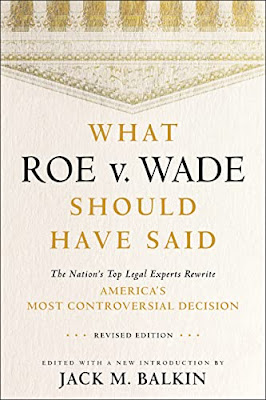
Jack M. Balkin, What Roe v. Wade Should Have Said: The Nation's Top Legal Experts Rewrite America's Most Controversial Decision - Revised Edition (NYU Press, 2023)

Andrew Koppelman, Burning Down the House: How Libertarian Philosophy Was Corrupted by Delusion and Greed (St. Martin’s Press, 2022)

Gerard N. Magliocca, Washington's Heir: The Life of Justice Bushrod Washington (Oxford University Press, 2022)
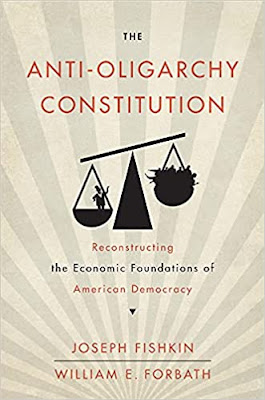
Joseph Fishkin and William E. Forbath, The Anti-Oligarchy Constitution: Reconstructing the Economic Foundations of American Democracy (Harvard University Press, 2022)
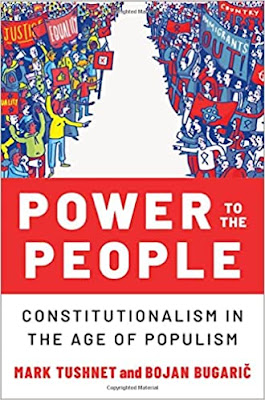
Mark Tushnet and Bojan Bugaric, Power to the People: Constitutionalism in the Age of Populism (Oxford University Press 2021).

Mark Philip Bradley and Mary L. Dudziak, eds., Making the Forever War: Marilyn B. Young on the Culture and Politics of American Militarism Culture and Politics in the Cold War and Beyond (University of Massachusetts Press, 2021).

Jack M. Balkin, What Obergefell v. Hodges Should Have Said: The Nation's Top Legal Experts Rewrite America's Same-Sex Marriage Decision (Yale University Press, 2020)

Frank Pasquale, New Laws of Robotics: Defending Human Expertise in the Age of AI (Belknap Press, 2020)

Jack M. Balkin, The Cycles of Constitutional Time (Oxford University Press, 2020)

Mark Tushnet, Taking Back the Constitution: Activist Judges and the Next Age of American Law (Yale University Press 2020).

Andrew Koppelman, Gay Rights vs. Religious Liberty?: The Unnecessary Conflict (Oxford University Press, 2020)

Ezekiel J Emanuel and Abbe R. Gluck, The Trillion Dollar Revolution: How the Affordable Care Act Transformed Politics, Law, and Health Care in America (PublicAffairs, 2020)

Linda C. McClain, Who's the Bigot?: Learning from Conflicts over Marriage and Civil Rights Law (Oxford University Press, 2020)
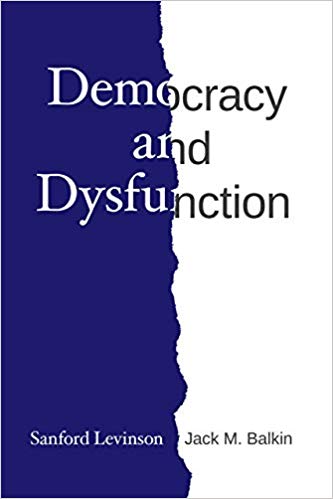
Sanford Levinson and Jack M. Balkin, Democracy and Dysfunction (University of Chicago Press, 2019)

Sanford Levinson, Written in Stone: Public Monuments in Changing Societies (Duke University Press 2018)

Mark A. Graber, Sanford Levinson, and Mark Tushnet, eds., Constitutional Democracy in Crisis? (Oxford University Press 2018)

Gerard Magliocca, The Heart of the Constitution: How the Bill of Rights became the Bill of Rights (Oxford University Press, 2018)

Cynthia Levinson and Sanford Levinson, Fault Lines in the Constitution: The Framers, Their Fights, and the Flaws that Affect Us Today (Peachtree Publishers, 2017)

Brian Z. Tamanaha, A Realistic Theory of Law (Cambridge University Press 2017)

Sanford Levinson, Nullification and Secession in Modern Constitutional Thought (University Press of Kansas 2016)

Sanford Levinson, An Argument Open to All: Reading The Federalist in the 21st Century (Yale University Press 2015)

Stephen M. Griffin, Broken Trust: Dysfunctional Government and Constitutional Reform (University Press of Kansas, 2015)

Frank Pasquale, The Black Box Society: The Secret Algorithms That Control Money and Information (Harvard University Press, 2015)

Bruce Ackerman, We the People, Volume 3: The Civil Rights Revolution (Harvard University Press, 2014)
Balkinization Symposium on We the People, Volume 3: The Civil Rights Revolution

Joseph Fishkin, Bottlenecks: A New Theory of Equal Opportunity (Oxford University Press, 2014)

Mark A. Graber, A New Introduction to American Constitutionalism (Oxford University Press, 2013)

John Mikhail, Elements of Moral Cognition: Rawls' Linguistic Analogy and the Cognitive Science of Moral and Legal Judgment (Cambridge University Press, 2013)

Gerard N. Magliocca, American Founding Son: John Bingham and the Invention of the Fourteenth Amendment (New York University Press, 2013)

Stephen M. Griffin, Long Wars and the Constitution (Harvard University Press, 2013)

Andrew Koppelman, The Tough Luck Constitution and the Assault on Health Care Reform (Oxford University Press, 2013)

James E. Fleming and Linda C. McClain, Ordered Liberty: Rights, Responsibilities, and Virtues (Harvard University Press, 2013)
Balkinization Symposium on Ordered Liberty: Rights, Responsibilities, and Virtues

Andrew Koppelman, Defending American Religious Neutrality (Harvard University Press, 2013)

Brian Z. Tamanaha, Failing Law Schools (University of Chicago Press, 2012)

Sanford Levinson, Framed: America's 51 Constitutions and the Crisis of Governance (Oxford University Press, 2012)

Linda C. McClain and Joanna L. Grossman, Gender Equality: Dimensions of Women's Equal Citizenship (Cambridge University Press, 2012)

Mary Dudziak, War Time: An Idea, Its History, Its Consequences (Oxford University Press, 2012)

Jack M. Balkin, Living Originalism (Harvard University Press, 2011)

Jason Mazzone, Copyfraud and Other Abuses of Intellectual Property Law (Stanford University Press, 2011)

Richard W. Garnett and Andrew Koppelman, First Amendment Stories, (Foundation Press 2011)

Jack M. Balkin, Constitutional Redemption: Political Faith in an Unjust World (Harvard University Press, 2011)

Gerard Magliocca, The Tragedy of William Jennings Bryan: Constitutional Law and the Politics of Backlash (Yale University Press, 2011)

Bernard Harcourt, The Illusion of Free Markets: Punishment and the Myth of Natural Order (Harvard University Press, 2010)

Bruce Ackerman, The Decline and Fall of the American Republic (Harvard University Press, 2010)
Balkinization Symposium on The Decline and Fall of the American Republic

Ian Ayres. Carrots and Sticks: Unlock the Power of Incentives to Get Things Done (Bantam Books, 2010)

Mark Tushnet, Why the Constitution Matters (Yale University Press 2010)

Ian Ayres and Barry Nalebuff: Lifecycle Investing: A New, Safe, and Audacious Way to Improve the Performance of Your Retirement Portfolio (Basic Books, 2010)
.jpg)
Jack M. Balkin, The Laws of Change: I Ching and the Philosophy of Life (2d Edition, Sybil Creek Press 2009)

Brian Z. Tamanaha, Beyond the Formalist-Realist Divide: The Role of Politics in Judging (Princeton University Press 2009)

Andrew Koppelman and Tobias Barrington Wolff, A Right to Discriminate?: How the Case of Boy Scouts of America v. James Dale Warped the Law of Free Association (Yale University Press 2009)

Jack M. Balkin and Reva B. Siegel, The Constitution in 2020 (Oxford University Press 2009)

Heather K. Gerken, The Democracy Index: Why Our Election System Is Failing and How to Fix It (Princeton University Press 2009)

Mary Dudziak, Exporting American Dreams: Thurgood Marshall's African Journey (Oxford University Press 2008)

David Luban, Legal Ethics and Human Dignity (Cambridge Univ. Press 2007)

Ian Ayres, Super Crunchers: Why Thinking-By-Numbers is the New Way to be Smart (Bantam 2007)

Jack M. Balkin, James Grimmelmann, Eddan Katz, Nimrod Kozlovski, Shlomit Wagman and Tal Zarsky, eds., Cybercrime: Digital Cops in a Networked Environment (N.Y.U. Press 2007)
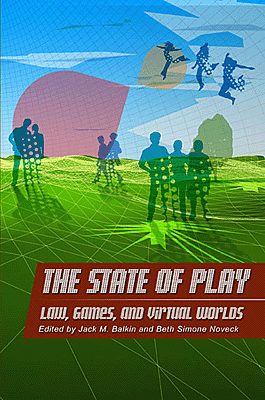
Jack M. Balkin and Beth Simone Noveck, The State of Play: Law, Games, and Virtual Worlds (N.Y.U. Press 2006)

Andrew Koppelman, Same Sex, Different States: When Same-Sex Marriages Cross State Lines (Yale University Press 2006)

Brian Tamanaha, Law as a Means to an End (Cambridge University Press 2006)

Sanford Levinson, Our Undemocratic Constitution (Oxford University Press 2006)

Mark Graber, Dred Scott and the Problem of Constitutional Evil (Cambridge University Press 2006)

Jack M. Balkin, ed., What Roe v. Wade Should Have Said (N.Y.U. Press 2005)

Sanford Levinson, ed., Torture: A Collection (Oxford University Press 2004)
Balkin.com homepage
Bibliography
Conlaw.net
Cultural Software
Writings
Opeds
The Information Society Project
BrownvBoard.com
Useful Links
Syllabi and Exams
