Balkinization
an unanticipated consequence of
Jack M. Balkin
Balkinization Symposiums: A Continuing List
E-mail:
Jack Balkin:
jackbalkin at yahoo.com
Bruce Ackerman
bruce.ackerman at yale.edu
Ian Ayres
ian.ayres at yale.edu
Corey Brettschneider
corey_brettschneider at brown.edu
Mary Dudziak
mary.l.dudziak at emory.edu
Joey Fishkin
joey.fishkin at gmail.com
Heather Gerken heather.gerken at yale.edu
Abbe Gluck abbe.gluck at yale.edu
Mark Graber
mgraber at law.umaryland.edu
Stephen Griffin
sgriffin at tulane.edu
Jonathan Hafetz
jonathan.hafetz at shu.edu
Jeremy Kessler
jkessler at law.columbia.edu
Andrew Koppelman
akoppelman at law.northwestern.edu
Marty Lederman
msl46 at law.georgetown.edu
Sanford Levinson
slevinson at law.utexas.edu
David Luban
david.luban at gmail.com
Gerard Magliocca
gmaglioc at iupui.edu
Jason Mazzone
mazzonej at illinois.edu
Linda McClain
lmcclain at bu.edu
John Mikhail
mikhail at law.georgetown.edu
Frank Pasquale
pasquale.frank at gmail.com
Nate Persily
npersily at gmail.com
Michael Stokes Paulsen
michaelstokespaulsen at gmail.com
Deborah Pearlstein
dpearlst at yu.edu
Rick Pildes
rick.pildes at nyu.edu
David Pozen
dpozen at law.columbia.edu
Richard Primus
raprimus at umich.edu
K. Sabeel Rahmansabeel.rahman at brooklaw.edu
Alice Ristroph
alice.ristroph at shu.edu
Neil Siegel
siegel at law.duke.edu
David Super
david.super at law.georgetown.edu
Brian Tamanaha
btamanaha at wulaw.wustl.edu
Nelson Tebbe
nelson.tebbe at brooklaw.edu
Mark Tushnet
mtushnet at law.harvard.edu
Adam Winkler
winkler at ucla.edu
Compendium of posts on Hobby Lobby and related cases
The Anti-Torture Memos: Balkinization Posts on Torture, Interrogation, Detention, War Powers, and OLC
The Anti-Torture Memos (arranged by topic)
Recent Posts
A Faint-Hearted Parliamentarian’s Response to Commenters
![[Powered by Blogger]](https://lh3.googleusercontent.com/blogger_img_proxy/AEn0k_sJmm0obf2mAmygkxA1vBbzrP0zJ9szDj_qLDNPR86yRIjv14S8pE9YVLKKTrUuRAtbifTPQruxUUQTrqDyusmIYfZKKvNpLElezTy142B3=s0-d)
Just A Few Blogs
ACS Blog
Alas, a Blog
Althouse
Arts and Letters Daily
Atrios (Eschaton)
Bill of Health
Buzzflash.com
Buzz Machine
Cato at Liberty
Juan Cole (Informed Comment)
Concurring Opinions
The Constitution in 2020
Corrente
Crooked Timber
Daily Howler
Daily Kos
Dana Boyd
Brad DeLong
Digby (Hullabaloo)
Discriminations
Daniel Drezner
Kevin Drum (Mother Jones)
Electrolite
En Banc
Eunomia (Daniel Larison)
Fafblog
Michael Froomkin (Discourse.net)
GovLab (Beth Noveck)
Rick Hasen (Election Law)
History News Network
How Appealing
Ignatz (Sam Heldman)
The Importance of (Ernie Miller)
Infolaw
Instapundit
International Economic Law and Policy Blog
IntLawGrrls
Jacob Levy
Jesus' General
Jurisdynamics
The Kitchen Cabinet
Mark Kleiman
Law Blog Central
Larry Lessig
Lawyers, Guns and Money
Liberal Oasis
Brian Leiter's Law School Reports
The Leiter Reports
Marginal Revolution
Megan McArdle
Memeorandum
Metafilter
Mirror of Justice
The New Republic
Newseum
No More Mister Nice Blog
Brendan Nyhan
Opinio Juris
Orcinus
The Originalism Blog
Pandagon
Passport (Foreign Policy)
Overcoming Bias
Political Animal (Washington Monthly)
Political Theory Daily Review
Political Wire (Taegan Goddard)
The Poor Man
Virginia Postrel
Prawfsblawg
Public Reason
Jonathan Rauch
Raw Story
Redstate
ReligiousLeftLaw.com
Reporters Committee For Freedom of the Press
Reproductive Rights Blog
Rothman's Roadmap to the Right of Publicity
SCOTUS Blog
Seeing the Forest
Clay Shirky
The Shifted Librarian
The Situationist
Larry Solum (Legal Theory)
Andrew Sullivan
Talking Points Memo
Talk Left
Tapped
Tbogg
TechPresident
The Paper Chase (Jurist)
Tom Paine
Tom Tomorrow (This Modern World)
Eve Tushnet
Uggabugga
University of Chicago Law School Faculty Blog
Unqualified Offerings
The Volokh Conspiracy
War and Piece (Laura Rozen)
Wampum
Oliver Willis
Wonkette
Written Description
Matthew Yglesias
Yin
Your Choice of Feeds
1. XML
powered by

2. Atom Feed
3. RSS 2.0
A Faint-Hearted Parliamentarian’s Response to Commenters
Guest Blogger
For the Balkinization symposium on Maxwell Stearns, Parliamentary America: The Least Radical Means of Radically Repairing Our Broken Democracy (Johns Hopkins University Press, 2024). Maxwell Stearns
Introduction It is indeed a privilege to have such
an esteemed group of legal scholars and political scientists critically assess Parliamentary
America: The Least Radical Means of Radically Repairing Our Broken Democracy
(JHU 2024). Professor Erwin Chemerinsky (Berkeley)
describes the book as “legal scholarship at its very best,” commends its
accessibility, and appreciates that it “explains complex concepts in a clear
way.” Professor Hank Chambers (Richmond) describes the book as “fantastic,”
noting that “a full discussion would require multiple symposia.” Professor Anna
Law (CUNY, Brooklyn) regards my goal of “radically alter[ing] the stakes by
changing the rules of the game” as “exactly the right move,” characterizes the
book as “erudite, thoughtful, and thoroughly explicated,” and considers my
reform proposals “an excellent start to begin a national conversation on what
the nation’s Third Reconstruction will look like.” Professor Sandy Levinson
(Texas) considers Parliamentary America “a standing reproach
to the intellectual conservatism of the [constitutional law] academy,” which he
regards as “sclerotic” and in need of “repair” before such reforms can be taken
seriously, given its “thorough-going ‘path dependence’ that makes it impossible
to think outside of the Constitution’s box.” Stephen Griffin (Tulane) commends
the book as a welcome contribution to a vital conversation, and Professor Lisa
Miller (Rutgers) describes the proposals as “thoughtful and compelling,” while
noting that the book encourages us to rethink early lessons in American civics.
I recount these assessments not to rehearse compliments, but to situate the
nature of the disagreements that follow. Responding to six critics presents a
challenge. A detailed response to each reviewer risks an extended treatment few
symposium visitors are apt to read. Briefer treatments risk leaving curious interlocutors
uncertain whether this author has adequate answers to probing questions. Calibrating
this essay demands a balance that weighs risks and benefits on both sides. Inevitable
tradeoffs leave some readers preferring greater brevity and others hoping for more
extended treatments. Calibration is both feature and bug. This description of a
trivial matter, responding to book reviews, reflects something of greater
consequence—calibrating remedies for our failing, or as Miller contends, failed,
democracy. I. What the Critics Disagree About—and
What They Do Not It is possible to divide the reviews according
to whether the author regards my reform proposals as too radical (Chemerinsky
and Griffin), as not radical enough (Levinson and Miller), or as about right
(Law and Chambers). But such an approach would be intellectually lazy and
substantively dissatisfying. Landing in the middle never suffices as a normative
defense against opposing critics. Especially on matters of such great
importance as our capacity to live in a thriving democracy, arguments demand
responses. I intend to provide them. A more helpful division rests on competing
methodological grounds. This allows grouping arguments conceptually even when
authors’ ultimate substantive assessments on specific questions fail to align. In framing the discussion this way, it
is helpful to start with what the reviews do not say. None suggest my book
misrepresents relevant constitutional structures, U.S. history, the foreign democratic
systems I introduce, or the underlying methodological tools I employ. None
criticize the logical foundations of my claims or question the overall
reasoning that undergirds my radical reform proposals. In my book I advance three constitutional
amendments to solve the constitutional crisis we are facing: first, doubling
the House with a system of mixed-member proportionality (MMP) corresponding to state-level
proportionality; second, empowering House coalitions to select the President
and Vice President based on pre-determined slates; and, third, providing the
House a means of presidential removal based on a sixty percent no confidence
vote for maladministration. To be clear, the absence of such criticism does not
imply universal agreement with my methodological approach or endorsement of my
proposals. But it allows me to distill any pushback, sometimes friendly fire, into
three helpful groupings: alternative operational premises, differing approaches
to reform, and competing endpoints of reform. To begin it is helpful to contrast Professors Erwin Chemerinsky
and Stephen Griffin, on one side, with Professors Sandy Levenson and Lisa
Miller, on the other. The differences across these pairings do not center on whether
my proposals are insufficiently or excessively radical. Rather, the pairings embrace
alternative premises concerning how to define and achieve democratic
objectives. Professor Chemerinsky is a leading
constitutional scholar who has contributed to contemporary reform debates. I
respect those writing within the reform tradition of which he is a part, but a
major motivation for writing my book involves a fundamental methodological
disagreement. Chemerinsky has written his own thoughtful book in this space,
titled No
Democracy Lasts Forever. He echoes increasingly prevalent sentiments across
the reform community, embraced, for example, by such scholars as Professor Danielle
Allen (Harvard) and political
scientist Lee Drutman (New America). Such writers recognize we are in a
democratic crisis, and they propose a combination of measures that overlap or
tend to align with those Chemerinsky advances: “eliminate the Electoral
College, end equal representation of states in the United States Senate, stop
partisan gerrymandering of districts for the House of Representatives, create
term limits for Supreme Court justices.” Other examples include multimember
House districts and various alternative voting schemes, such as top-four
nonpartisan primaries and ranked-choice voting. Chemerinsky’s central critique of Parliamentary
America is that some combination of these more modest tweaks is truly the
least radical means of radically repairing our broken democracy. In addition,
joined by Lisa Miller and Stephen Griffin, Chemerinsky laments that I do not tackle
campaign finance cases, including most notably, the problematic 2010 Supreme
Court decision, Citizens
United v. FEC, which allows corporations to outspend flesh and blood
persons in political campaigns. Professor Griffin goes further,
claiming that campaign finance incentives preclude my electoral reform
amendments from successfully generating a thriving multiparty democracy. He
contends the two major parties will block third party entrants, rendering smaller
parties incapable of raising the hundreds of millions of dollars necessary to
compete nationwide. He further claims that if my amendments are enacted, “the
multiparty coalition in charge of the House will meet a hostile reception in
state legislatures, a potential source of instability.” Once more, I have not grouped these
critics based on agreement respecting specific proposals but rather based on a
common premise. These arguments generally assume that the preferred pathway
forward involves identifying a problematic observed behavior, here excessive
corporate campaign expenditures, and ending the constitutional ruling that
facilitates it. Professor Chemerinsky extends what I will now characterize as a
doctrinal reform methodology to partisan gerrymandering. Chemerinsky would
declare the practice of partisan gerrymandering unlawful or perhaps vest districting
in nonpartisan commissions. II. Methodological Fault Lines:
Doctrine, Structure, and the Role of Incentives First and foremost, my book rejects
this approach as resting on a flawed premise. My alternative approach demands,
as a critical intermediate step in assessing any proposed reform, that we identify
the root structural causes—features of institutional design—that motivate the problematic
behaviors we observe. Only then can we restructure the problematic
institutional design to instead motivate benign behaviors. Without undertaking
this kind of analysis, reformers risk naively imagining that legal declarations,
or perhaps nominal nonpartisan bodies, are capable of generating improved
behaviors notwithstanding that key political actors and others who profit by
influencing them retain existing problematic incentives. It is precisely
because I reject the premise that declarations to improve conduct can achieve
their goals absent structural changes that motivate benign behaviors that I
argue neither to ban partisan gerrymandering nor corporate political expenditures.
Instead, I advocate institutional changes affecting underlying incentives in a
manner that blunts or discontinues these problematic behaviors. Money in politics is inevitable. And
yet, within a well-functioning multiparty system, corporations will not be
motivated to deploy their financial resources in a manner that continues
driving our two dominant parties increasingly far apart. As explained below,
this point is reinforced based on principles of finance. Once we have blunted
most problematic campaign financing incentives it also becomes possible to
engage with possible further reforms, even including public campaign financing.
More importantly, my goal is not to ensure a perfect system, but to ensure a
thriving multiparty democracy genuinely capable of further meaningful reform. Professors Chemerinsky and Griffin both
contend that I put too much stress on parties. Because parties quickly emerged an
unexpected feature that undermined the way the Constitution’s framers expected our
system to function and have become an especially corrosive force in undermining
basic democratic functioning in the information age, I am certain my focus is
essential, not excessive. My central claim is that in any democratic system
parties are inevitable. As political
scientist Jack Santucci has aptly phrased it, “The choice between two or no
parties is false. The real choice is between two or more parties.” Chemerinsky relies, as a counter
example to pressing for more parties, on the Israeli system, which has
disturbingly tacked increasingly far right. Pressing from the other side,
Levinson observes “the UK has had, in the past decade, six prime ministers
selected by the members of four different parliamentary bodies.” As a
critique of my thesis, these examples are curious. In Parliamentary America,
I introduce both as part of the virtual world tour precisely to demonstrate how
not to pursue parliamentary reform. Rather than refuting my argument,
the Israeli and UK examples help make it by demonstrating the importance of
institutions in calibrating a sweet spot with respect to the number of
parties—not too many, not too few. The central challenge democracies inevitably
face is extremism, whether in the form of an unwavering commitments to ideology
or, instead, manifest through a system bearing too few or too many parties. In
a democracy, an ultimate question of constitutional design is now to forge institutions
that eschew such extremes. England, like the United States, is
majoritarian, with two dominating parties. Israel is purely proportional,
coupled with a low party-qualification threshold, yielding too many parties. A
centerpiece of my book, the world tour, demonstrates the structural features
that generate these problematic results and explains how to avoid them. I focus
in particular on mixed-member proportionality (MMP), which is designed to
strike this balance. Approaching this from the other side, claiming
I do not go far enough in my proposed reforms, Professor Levinson calls me a
faint-hearted parliamentarian. My proposals leave in place major features of
our existing constitutional design: presidential powers, the Senate’s state-based
apportionment and coequal lawmaking role with the House, life-tenured members
of the Supreme Court, and expansive presidential powers. He observes that rather
than embracing a pure parliamentary system, my reforms are better viewed as a faint-hearted
move in that direction, analogizing to Antonin Scalia’s self-described
faint-hearted originalism. I am happy to own it. I do not
advocate Parliamentary America because of any dogmatic commitment to
parliamentary democracy. For one thing, many parliamentary schemes, including
both the UK and Israel, are prone to antidemocratic problems of comparable
magnitude to those we face here in the U.S. with two-party presidentialism. My
goal is not an instantiation of any formal democratic scheme for its own sake. Rather,
as my subtitle makes plain, my goal is the least radical means of radical
repairing our broken democracy. And with that, as Lisa Miller explains, in my
book’s final substantive chapter, I set out possible reforms worth considering,
but after we solve the crisis we face. III. Incentives, Parties, and Least
Radical as Most Promising I agree with many of Professor Levinson's
views concerning further reform possibilities. My book is not about what a perfect,
or even best conceivable, American democracy might look like. Rather it is
about how we ensure a thriving multiparty democracy truly capable of continuing
the fight toward “a more perfect union.” A defining attribute, presently
absent, is the capacity to bring about other meaningful reforms. But there is
also a caveat. We must avoid a common mistake among reformers. We might fail properly
to anticipate future challenges and might wrongly imagine the need for reforms
to fix future problems that, with wise remedies put in place, instead fall
away. Another premise of my book is the importance of humility over hubris. Professor Levinson infers that I am opposed
to a constitutional convention, which he welcomes. In truth, I am ambivalent.
Thus far all amendments—and they have been rare—have come through Congress. I
have structured the electoral reform amendments with that in mind. Mine are the
only proposed reforms that ensure sitting members of both houses of Congress retain
their offices, in their districts or states, after the proposals go into effect.
Even so, as I observe in the book, were
a constitutional convention to take place, it would likely embrace some
combination of the proposals advanced by, among others, Professors Chemerinsky
and Levinson. As my book explains in detail, such reforms cannot end the crisis
we face. But even setting that aside, if approved, several of them would threaten
the status and power of those traditionally holding blocking power, namely sitting
members of the Senate and House. Professor Levinson aptly captures the
challenge, resting on “‘Roche’s dictum,’ named after the late political
scientist John P. Roche: ‘Power corrupts, and the prospect of losing power
corrupts absolutely.’” Should a convention take place and
advance a combination of such commonly discussed reform proposals, my electoral
reform amendments provide Congress with an essential bypass. They empower
Congress, as it has always done, to initiate the amending process. These
amendments avoid the threat to their status and power while ending the crisis
we face. I remain ambivalent about a convention because I seriously doubt it
capable of generating meaningful reforms. But I also see it as an alternative
pathway to enacting the electoral reform amendments I propose. In saying this, I am sensitive to
Griffin’s closing sentiment: “In a democracy . . . it is best to make arguments
that appeal to popular opinion,’ as opposed to “build[ing] an argument . . . by
appealing to the political self-interest of the House members who will gain [or
at the very least, not lose] power (!).” But, once more, absent the
intermediate step of identifying how to revise institutional incentives to
transform problematic observed behaviors into desired benign behaviors, it is impossible
to envision a viable path forward to a thriving multiparty democracy. This insight helps further unpack an
earlier discussion. Professors Chemerinsky and Griffin each note my failure to
tackle campaign finance. Professor Griffin regards campaign finance incentives
as fatal to the viability of third parties. With respect, I believe he is
mistaken. Our disagreement rests less on empirical than analytical grounds
arising from general principles of finance, which also apply in the campaign
context. Griffin assumes those who make contributions or who undertake direct expenditures
base their decisions primarily on aggregate assessments of relative party strength.
With respect, this miscomprehends both financial incentives and the role of
third parties in global multiparty systems. Investment decisions are inevitably made
on the margin, based on expected marginal return or marginal rates of
substitution. Those assessing campaign contributions or direct expenditures in
systems in which third parties have the capacity for a decisive role in forming
the government will rationally consider the expected return of each marginal
expenditure. When the status of third parties changes from spoiler or
randomizer to making or breaking governing coalitions, such marginal
assessments fundamentally change. This also explains my disagreement
with Griffin on whether third party success demands amassing resources and
infrastructures that match our existing major parties so that smaller parties
might compete on national scale. One reason I take readers on a virtual world
tour is to demonstrate that in thriving multiparty systems, smaller parties can
play a key role even when they capture support only within a discrete
geographical region or among a smaller subset of the electorate as compared
with larger parties. In the MMP system I advocate for the U.S., although two
parties will continue to dominate districted House and Senate elections (as
opposed to party-based House elections), the same party combination will not
dominate each region of the country. This also explains why Griffin’s claim
that state general assemblies will not welcome third parties misses an
important dynamic effect of my proposed reforms. Effective reform demands understanding
how alternative democratic systems work. With respect to the many thoughtful
writers in the reform community, including some contributors to this symposium,
this too often has emerged the critical missing step. A central premise of Parliamentary
America, and truthfully all of my work, is that it mistaken to assume that
once a new set of rules is implemented, key actors will behave as if they
remained governed by prior rules. As Professor Law aptly observes, changing the
rules changes the game. I wrote my book to explain how changing our rules will transform
a vital high stakes game to ensure not simply that our democracy survives, but
that it truly thrives. In the separate context of partisan
gerrymandering, Professor Griffin embraces these very insights. In contrast
with Professor Chemerinsky who would declare the practice unlawful, Griffin observes
that proportional representation succeeds in eliminating incentives for
partisan gerrymandering by taking away the gains. Both in campaign finance and
in partisan gerrymandering, it is essential to focus on institutional
incentives as the critical intermediate step in devising solutions to end
antidemocratic behaviors. Drawing upon the work of political
scientist Jack Rakove, Professor Law cautions that in one respect, at least
descriptively, my book might not go sufficiently far in characterizing our
democracy as failed rather than merely in crisis. I do not necessarily
disagree, although my sense is that the distinction matters more historically
than prescriptively. I put Law in the camp claiming I get things about right
based on her review’s overall tenor and her support for my proposed reforms at the
very least as a critical starting point in thinking through genuine solutions. As
Law notes, Parliamentary America was published before the outcome
of the pivotal 2024 presidential election. I take admittedly troubled comfort
in not having conditioned my assessment of our nation’s ongoing democratic
viability on how that election came out. At the very least, we were already then
in a constitutional crisis. Law identifies the media as a major
cause of our democratic failure. I devote a chapter of my book to the history
of media, and I agree with Law that however divisive a role social media played
at the time of publication, matters have since grown notably worse. Although I
do not claim my reforms are a panacea, I do maintain that by creating more
parties—and thus more focal points or democratic anchors—the electoral reform
amendments would, over the longer term, blunt the capacity of social media to
continue driving an ever-widening wedge between two dominating parties. Professors Miller, like Professor Levinson
and in contrast with Professor Law, favors a more ambitious approach. She is
concerned my least radical reforms will not ensure desired progressive
legislation, at least any time soon. She lists the following as examples: “The
Fair Labor Standards Act, National Labor Relations Act, Voting Rights Act,
Medicare and Medicaid, the Affordable Care Act.” Along with Miller, I embrace these
statutes. But my goal is not to ensure particular policy outcomes. Instead, it
is to end the constitutional crisis that we face by producing a thriving
multiparty democracy. A major challenge in our system is the inability of
moderate Democrats and moderate Republicans to join together to effectuate
policies widely supported in the electorate. The examples Miller provides were mostly
marked by bipartisan congressional coalitions. While the Affordable Care Act
was decidedly partisan, it is noteworthy that Obamacare
was originally Romneycare, a Republican governor’s conception that in a
remarkable historical twist Mitt Romney later campaigned against as the 2012 GOP
presidential candidate! A challenge in our time is that the
GOP has since been overtaken by MAGA, and the Democratic party is at increasing
risk of being controlled by its democratic socialist wing. While I am
sympathetic to those who hope for a system that ensures their preferred
policies, thriving democratic systems cannot, and honestly should not, do that.
Systems that aim to ensure specific policy outcomes can do so only by
entrenching power against political opposition. Such systems threaten, rather
than exemplify, the highest ideals of democracy. When it comes to policy, thriving
democratic systems leave everyone frustrated much of the time. That too is both
a feature and a bug. Instead, what reform should do is
motivate political leaders to avoid extremes and to work with others sharing
that commitment. This facilitates outcomes that move toward the political core.
That is what my least radical proposals are designed to do. Rewiring Democratic Imagination Professor Chambers’ contribution
operates at a different, and crucial, level, and it provides a perfect place to
close. Chambers emphasizes the need to rewire our civic brain as both a challenge
and promise in devising a pathway toward meaningful reform. In my book, I
explain that voters identify their ideology based upon upbringing,
socioeconomic status, race, religion, education, among other demographic
attributes, as these relate to the limited heuristics available within our society.
In the information age, our two dominating anchors have grown increasingly far
apart. But these anchors are endogenous to, or a function of, our particular
and peculiar constitutional scheme. Our system eschews alternatives, punishing
their supporters and candidates, as spoilers or randomizers. The electoral reform amendments will produce
more, and better, anchors. And if my reform proposals are enacted, they will encourage
moves toward the core, thereby discouraging increasingly extreme political
behaviors. The rightful challenge, as Professor Chambers
observes, involves ratcheting up this heuristic challenge, which I discuss in
the book, in yet another important way. Here the goal is to change our
conceptual anchors as to what is possible, not on policy, but for our
democracy. He is right. And I wrote this book hoping to do just that. The first
step is educating the public on the need for radical—if least radical—reform. It has truly been an honor to partake
in this symposium. I am indebted to Jack Balkin and Mark Graber for arranging
it, and to all the thoughtful writers for so meaningfully contributing to these
vital conversations.
Posted
9:30 AM
by Guest Blogger [link]
Books by Balkinization Bloggers

Gerard N. Magliocca, The Actual Art of Governing: Justice Robert H. Jackson's Concurring Opinion in the Steel Seizure Case (Oxford University Press, 2025)

Linda C. McClain and Aziza Ahmed, The Routledge Companion to Gender and COVID-19 (Routledge, 2024)

David Pozen, The Constitution of the War on Drugs (Oxford University Press, 2024)

Jack M. Balkin, Memory and Authority: The Uses of History in Constitutional Interpretation (Yale University Press, 2024)
Mark A. Graber, Punish Treason, Reward Loyalty: The Forgotten Goals of Constitutional Reform after the Civil War (University of Kansas Press, 2023)
Jack M. Balkin, What Roe v. Wade Should Have Said: The Nation's Top Legal Experts Rewrite America's Most Controversial Decision - Revised Edition (NYU Press, 2023)

Andrew Koppelman, Burning Down the House: How Libertarian Philosophy Was Corrupted by Delusion and Greed (St. Martin’s Press, 2022)

Gerard N. Magliocca, Washington's Heir: The Life of Justice Bushrod Washington (Oxford University Press, 2022)
Joseph Fishkin and William E. Forbath, The Anti-Oligarchy Constitution: Reconstructing the Economic Foundations of American Democracy (Harvard University Press, 2022)
Mark Tushnet and Bojan Bugaric, Power to the People: Constitutionalism in the Age of Populism (Oxford University Press 2021).

Mark Philip Bradley and Mary L. Dudziak, eds., Making the Forever War: Marilyn B. Young on the Culture and Politics of American Militarism Culture and Politics in the Cold War and Beyond (University of Massachusetts Press, 2021).

Jack M. Balkin, What Obergefell v. Hodges Should Have Said: The Nation's Top Legal Experts Rewrite America's Same-Sex Marriage Decision (Yale University Press, 2020)

Frank Pasquale, New Laws of Robotics: Defending Human Expertise in the Age of AI (Belknap Press, 2020)

Jack M. Balkin, The Cycles of Constitutional Time (Oxford University Press, 2020)

Mark Tushnet, Taking Back the Constitution: Activist Judges and the Next Age of American Law (Yale University Press 2020).

Andrew Koppelman, Gay Rights vs. Religious Liberty?: The Unnecessary Conflict (Oxford University Press, 2020)

Ezekiel J Emanuel and Abbe R. Gluck, The Trillion Dollar Revolution: How the Affordable Care Act Transformed Politics, Law, and Health Care in America (PublicAffairs, 2020)

Linda C. McClain, Who's the Bigot?: Learning from Conflicts over Marriage and Civil Rights Law (Oxford University Press, 2020)
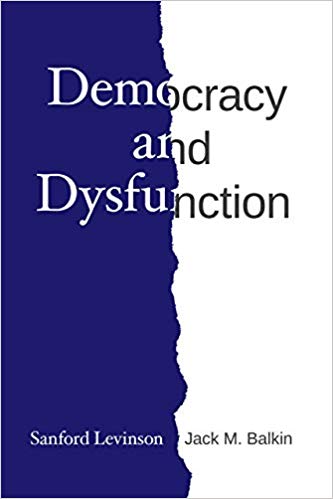
Sanford Levinson and Jack M. Balkin, Democracy and Dysfunction (University of Chicago Press, 2019)

Sanford Levinson, Written in Stone: Public Monuments in Changing Societies (Duke University Press 2018)

Mark A. Graber, Sanford Levinson, and Mark Tushnet, eds., Constitutional Democracy in Crisis? (Oxford University Press 2018)

Gerard Magliocca, The Heart of the Constitution: How the Bill of Rights became the Bill of Rights (Oxford University Press, 2018)

Cynthia Levinson and Sanford Levinson, Fault Lines in the Constitution: The Framers, Their Fights, and the Flaws that Affect Us Today (Peachtree Publishers, 2017)

Brian Z. Tamanaha, A Realistic Theory of Law (Cambridge University Press 2017)

Sanford Levinson, Nullification and Secession in Modern Constitutional Thought (University Press of Kansas 2016)

Sanford Levinson, An Argument Open to All: Reading The Federalist in the 21st Century (Yale University Press 2015)

Stephen M. Griffin, Broken Trust: Dysfunctional Government and Constitutional Reform (University Press of Kansas, 2015)

Frank Pasquale, The Black Box Society: The Secret Algorithms That Control Money and Information (Harvard University Press, 2015)

Bruce Ackerman, We the People, Volume 3: The Civil Rights Revolution (Harvard University Press, 2014)
Balkinization Symposium on We the People, Volume 3: The Civil Rights Revolution

Joseph Fishkin, Bottlenecks: A New Theory of Equal Opportunity (Oxford University Press, 2014)

Mark A. Graber, A New Introduction to American Constitutionalism (Oxford University Press, 2013)

John Mikhail, Elements of Moral Cognition: Rawls' Linguistic Analogy and the Cognitive Science of Moral and Legal Judgment (Cambridge University Press, 2013)

Gerard N. Magliocca, American Founding Son: John Bingham and the Invention of the Fourteenth Amendment (New York University Press, 2013)

Stephen M. Griffin, Long Wars and the Constitution (Harvard University Press, 2013)

Andrew Koppelman, The Tough Luck Constitution and the Assault on Health Care Reform (Oxford University Press, 2013)

James E. Fleming and Linda C. McClain, Ordered Liberty: Rights, Responsibilities, and Virtues (Harvard University Press, 2013)
Balkinization Symposium on Ordered Liberty: Rights, Responsibilities, and Virtues

Andrew Koppelman, Defending American Religious Neutrality (Harvard University Press, 2013)

Brian Z. Tamanaha, Failing Law Schools (University of Chicago Press, 2012)

Sanford Levinson, Framed: America's 51 Constitutions and the Crisis of Governance (Oxford University Press, 2012)

Linda C. McClain and Joanna L. Grossman, Gender Equality: Dimensions of Women's Equal Citizenship (Cambridge University Press, 2012)

Mary Dudziak, War Time: An Idea, Its History, Its Consequences (Oxford University Press, 2012)

Jack M. Balkin, Living Originalism (Harvard University Press, 2011)

Jason Mazzone, Copyfraud and Other Abuses of Intellectual Property Law (Stanford University Press, 2011)

Richard W. Garnett and Andrew Koppelman, First Amendment Stories, (Foundation Press 2011)

Jack M. Balkin, Constitutional Redemption: Political Faith in an Unjust World (Harvard University Press, 2011)

Gerard Magliocca, The Tragedy of William Jennings Bryan: Constitutional Law and the Politics of Backlash (Yale University Press, 2011)

Bernard Harcourt, The Illusion of Free Markets: Punishment and the Myth of Natural Order (Harvard University Press, 2010)

Bruce Ackerman, The Decline and Fall of the American Republic (Harvard University Press, 2010)
Balkinization Symposium on The Decline and Fall of the American Republic

Ian Ayres. Carrots and Sticks: Unlock the Power of Incentives to Get Things Done (Bantam Books, 2010)

Mark Tushnet, Why the Constitution Matters (Yale University Press 2010)

Ian Ayres and Barry Nalebuff: Lifecycle Investing: A New, Safe, and Audacious Way to Improve the Performance of Your Retirement Portfolio (Basic Books, 2010)
.jpg)
Jack M. Balkin, The Laws of Change: I Ching and the Philosophy of Life (2d Edition, Sybil Creek Press 2009)

Brian Z. Tamanaha, Beyond the Formalist-Realist Divide: The Role of Politics in Judging (Princeton University Press 2009)

Andrew Koppelman and Tobias Barrington Wolff, A Right to Discriminate?: How the Case of Boy Scouts of America v. James Dale Warped the Law of Free Association (Yale University Press 2009)

Jack M. Balkin and Reva B. Siegel, The Constitution in 2020 (Oxford University Press 2009)

Heather K. Gerken, The Democracy Index: Why Our Election System Is Failing and How to Fix It (Princeton University Press 2009)

Mary Dudziak, Exporting American Dreams: Thurgood Marshall's African Journey (Oxford University Press 2008)

David Luban, Legal Ethics and Human Dignity (Cambridge Univ. Press 2007)

Ian Ayres, Super Crunchers: Why Thinking-By-Numbers is the New Way to be Smart (Bantam 2007)

Jack M. Balkin, James Grimmelmann, Eddan Katz, Nimrod Kozlovski, Shlomit Wagman and Tal Zarsky, eds., Cybercrime: Digital Cops in a Networked Environment (N.Y.U. Press 2007)

Jack M. Balkin and Beth Simone Noveck, The State of Play: Law, Games, and Virtual Worlds (N.Y.U. Press 2006)

Andrew Koppelman, Same Sex, Different States: When Same-Sex Marriages Cross State Lines (Yale University Press 2006)

Brian Tamanaha, Law as a Means to an End (Cambridge University Press 2006)

Sanford Levinson, Our Undemocratic Constitution (Oxford University Press 2006)

Mark Graber, Dred Scott and the Problem of Constitutional Evil (Cambridge University Press 2006)

Jack M. Balkin, ed., What Roe v. Wade Should Have Said (N.Y.U. Press 2005)

Sanford Levinson, ed., Torture: A Collection (Oxford University Press 2004)
Balkin.com homepage
Bibliography
Conlaw.net
Cultural Software
Writings
Opeds
The Information Society Project
BrownvBoard.com
Useful Links
Syllabi and Exams
