Balkinization
an unanticipated consequence of
Jack M. Balkin
Balkinization Symposiums: A Continuing List
E-mail:
Jack Balkin:
jackbalkin at yahoo.com
Bruce Ackerman
bruce.ackerman at yale.edu
Ian Ayres
ian.ayres at yale.edu
Corey Brettschneider
corey_brettschneider at brown.edu
Mary Dudziak
mary.l.dudziak at emory.edu
Joey Fishkin
joey.fishkin at gmail.com
Heather Gerken heather.gerken at yale.edu
Abbe Gluck abbe.gluck at yale.edu
Mark Graber
mgraber at law.umaryland.edu
Stephen Griffin
sgriffin at tulane.edu
Jonathan Hafetz
jonathan.hafetz at shu.edu
Jeremy Kessler
jkessler at law.columbia.edu
Andrew Koppelman
akoppelman at law.northwestern.edu
Marty Lederman
msl46 at law.georgetown.edu
Sanford Levinson
slevinson at law.utexas.edu
David Luban
david.luban at gmail.com
Gerard Magliocca
gmaglioc at iupui.edu
Jason Mazzone
mazzonej at illinois.edu
Linda McClain
lmcclain at bu.edu
John Mikhail
mikhail at law.georgetown.edu
Frank Pasquale
pasquale.frank at gmail.com
Nate Persily
npersily at gmail.com
Michael Stokes Paulsen
michaelstokespaulsen at gmail.com
Deborah Pearlstein
dpearlst at yu.edu
Rick Pildes
rick.pildes at nyu.edu
David Pozen
dpozen at law.columbia.edu
Richard Primus
raprimus at umich.edu
K. Sabeel Rahmansabeel.rahman at brooklaw.edu
Alice Ristroph
alice.ristroph at shu.edu
Neil Siegel
siegel at law.duke.edu
David Super
david.super at law.georgetown.edu
Brian Tamanaha
btamanaha at wulaw.wustl.edu
Nelson Tebbe
nelson.tebbe at brooklaw.edu
Mark Tushnet
mtushnet at law.harvard.edu
Adam Winkler
winkler at ucla.edu
Compendium of posts on Hobby Lobby and related cases
The Anti-Torture Memos: Balkinization Posts on Torture, Interrogation, Detention, War Powers, and OLC
The Anti-Torture Memos (arranged by topic)
Recent Posts
If the Chamber of Commerce is Listening . . .
A Facebook Supreme Court?
Ideology, Not Politics, Is What Makes John Roberts Run -- Part Two
The President’s Proposed Tariffs on Mexico are Unlawful
Mr. Mueller Should Speak for the Report that Does Not Speak for Itself
Ideology, Not Politics, Is What Makes John Roberts Run -- Part One
To Monitor or Not to Monitor? The Uncertain Future of Article 15 of the E-Commerce Directive
More Policy from Justice Thomas
It’s Not About What You Know: An Overview of Hyperlink Law’s Troubles
Faith in Filters and the Fate of Safe Harbors
Introducing ‘New Controversies in Intermediary Liability Law’ -- an Essay Collection
Comparative Labors and Democratic Dysfunction
Defensive Certiorari Grants
Does Trump represent the end of the Reagan regime, or the beginning of something far more dangerous?
Surplus and Deficit: Resources of Legitimation in the “Crisis of Democracy”
Greg Ablavsky on the Origins of Dual Federalism
Can Congress Investigate Whether the President Has Complied with the Law?
On Democracy and Dysfunction
A Half-Century of Republican Control of the Court . . .
The United States Constitution is Not Dysfunctional
Waiting for reform
Crisis or Rot? Dueling Metaphors of Constitutional Decline
The Trump Era Has Pushed Scholars to the Limits of Our Understanding
The Disjunction That Was Promised
Another Rendezvous with Destiny
The Shrinking Constitution of Settlement
![[Powered by Blogger]](https://lh3.googleusercontent.com/blogger_img_proxy/AEn0k_sHdJtNNVhtoxXeDvzgbjF24Db9rgrJDtgjI--zXIuFLlKXyC4ymoSvKtO0QXHviehcEsuu7EI_ckLN-ijKxxI3LhO5KWzEnF_4WjicaO5j=s0-d)
Just A Few Blogs
ACS Blog
Alas, a Blog
Althouse
Arts and Letters Daily
Atrios (Eschaton)
Bill of Health
Buzzflash.com
Buzz Machine
Cato at Liberty
Juan Cole (Informed Comment)
Concurring Opinions
The Constitution in 2020
Corrente
Crooked Timber
Daily Howler
Daily Kos
Dana Boyd
Brad DeLong
Digby (Hullabaloo)
Discriminations
Daniel Drezner
Kevin Drum (Mother Jones)
Electrolite
En Banc
Eunomia (Daniel Larison)
Fafblog
Michael Froomkin (Discourse.net)
GovLab (Beth Noveck)
Rick Hasen (Election Law)
History News Network
How Appealing
Ignatz (Sam Heldman)
The Importance of (Ernie Miller)
Infolaw
Instapundit
International Economic Law and Policy Blog
IntLawGrrls
Jacob Levy
Jesus' General
Jurisdynamics
The Kitchen Cabinet
Mark Kleiman
Law Blog Central
Larry Lessig
Lawyers, Guns and Money
Liberal Oasis
Brian Leiter's Law School Reports
The Leiter Reports
Marginal Revolution
Megan McArdle
Memeorandum
Metafilter
Mirror of Justice
The New Republic
Newseum
No More Mister Nice Blog
Brendan Nyhan
Opinio Juris
Orcinus
The Originalism Blog
Pandagon
Passport (Foreign Policy)
Overcoming Bias
Political Animal (Washington Monthly)
Political Theory Daily Review
Political Wire (Taegan Goddard)
The Poor Man
Virginia Postrel
Prawfsblawg
Public Reason
Jonathan Rauch
Raw Story
Redstate
ReligiousLeftLaw.com
Reporters Committee For Freedom of the Press
Reproductive Rights Blog
Rothman's Roadmap to the Right of Publicity
SCOTUS Blog
Seeing the Forest
Clay Shirky
The Shifted Librarian
The Situationist
Larry Solum (Legal Theory)
Andrew Sullivan
Talking Points Memo
Talk Left
Tapped
Tbogg
TechPresident
The Paper Chase (Jurist)
Tom Paine
Tom Tomorrow (This Modern World)
Eve Tushnet
Uggabugga
University of Chicago Law School Faculty Blog
Unqualified Offerings
The Volokh Conspiracy
War and Piece (Laura Rozen)
Wampum
Oliver Willis
Wonkette
Written Description
Matthew Yglesias
Yin
Your Choice of Feeds
1. XML
powered by

2. Atom Feed
3. RSS 2.0
If the Chamber of Commerce is Listening . . .
Gerard N. Magliocca
There are media reports that the U.S. Chamber of Commerce is considering a lawsuit challenging the President's proposed tariffs against Mexico. I hope they do so. They have a good chance of winning. In this case, the Administration has no clothes.
The International Emergency Economic Powers Act (IEEPA), which is the statutory authority cited by the President, grants two types of authority. One gives the President the power to freeze the assets of foreign nationals and/or foreign governments. The other gives the President the power to suspend commerce (or types of commerce) with another nation. Nothing in the Act suggests that the President is given the power to levy tariffs on another nation. Indeed, there are many reasons to doubt that such a power exists.
First, Congress has delegated tariff authority in other statutes that do not apply here. For instance, the President can (and has) imposed tariffs on China in response to unfair trade practices based on clear statutory authority. The lack of such an express delegation in the IEEPA implies no tariff authority.
Second, there appears to be no precedent for a President using the IEEPA to impose tariffs. (I say appears because I cannot find an example. If there is one, then I would like to know.)
Third, there is no indication from the legislative history of the IEEPA that Congress intended to give the President the authority to raise tariffs.
Fourth, there is no judicial authority for the President's proposed tariffs. Moreover, the Supreme Court's careful analysis of the IEEPA in Dames & Moore v. Regan is considerably narrower than the President's view.
The argument in favor of the proposed Mexican tariffs is basically a crude kind of a fortiori logic. Because the President can ban commerce from Mexico under the IEEPA, he must be able to impose the lesser sanction of tariffs. The conclusion does not follow from the premise. The greater does not always imply the lesser, as Congress is not bound to delegate its authority that way. Indeed, Congress might well guard its taxing authority far more jealously because that authority is easier to exercise as compared to a commercial ban.
In conclusion, the proposed Mexican tariffs are illegal. Interested parties should prepare to file suit.
Posted
9:31 PM
by Gerard N. Magliocca [link]
A Facebook Supreme Court?
Guest Blogger
New Controversies in Intermediary Liability Law
Anupam Chander
Posted
11:00 AM
by Guest Blogger [link]
Ideology, Not Politics, Is What Makes John Roberts Run -- Part Two
Guest Blogger
Buying into ACA opponents’ mislabel of Roberts’ NFIB v. Sebelius decision does not merely serve their aim of delegitimizing that decision and the law it largely upheld. A second bit of mischief is that widespread diffusion of that canard deflects attention from the genuinely extreme claims that Roberts broke conservative ranks to reject. Trivializing his decision as “political” implicitly treats the dissent as a non-noteworthy retread of familiar “conservative” positions. This assumption misses the newly radicalized agenda for the Supreme Court and the federal judiciary evident throughout the four dissenters’ reasoning and rhetoric, in the magnitude of the socially destructive result they bent the law to reach, and in the demonization of Roberts that swept the political right for his daring to stand in their way.
Posted
9:00 AM
by Guest Blogger [link]
The President’s Proposed Tariffs on Mexico are Unlawful
Gerard N. Magliocca
Yesterday the President announced that he will impose tariffs on Mexico unless that nation takes steps to address illegal immigration into the United States. The proposed tariffs will increase over time if Mexico fails to act. (Of course, this could be another of the President’s empty threats.)
Posted
4:34 AM
by Gerard N. Magliocca [link]
Mr. Mueller Should Speak for the Report that Does Not Speak for Itself
Neil Siegel
Yesterday former Special Counsel Robert Mueller said that his 448-page report on (1) Russian interference in the 2016 presidential election and (2) potential obstruction of justice by the President speaks for itself. His report emphatically does not speak for itself. In order to understand what the report is finding, stating, and seemingly implying without explaining, one has to do more than read the whole thing, which few Americans have time or ability to do. One also must be a sophisticated lawyer, which few Americans are or will become any time soon.
The report no more speaks for itself than this statement from Mr. Mueller: "If we had confidence that the president clearly did not commit a crime, we would have said so." Among other problems, the word "clearly" is doing a lot of unexplained work in that inaccessible formulation, and its use obfuscates more than it clarifies given the report's findings--which I discuss in my analysis of the Mueller Report--that on several occasions the President satisfied the three elements of an obstruction offense.
Imagine your child answered your questions the way Mr. Mueller answered the questions he was charged with investigating.
You: "Did your friends make that mess in the kitchen?"
Your kid: "If I had confidence that my friends clearly didn't make that mess in the kitchen, I would have said so."
You: "Huh?"
Your kid: "My statement speaks for itself. I shouldn't be required to talk about this matter any further."
I understand that the analogy is imperfect, as all analogies are. But come on. Mr. Mueller should testify. Americans need to see the movie and not be left with what they are likely to experience as a Zen koan of a book.
Posted
12:41 PM
by Neil Siegel [link]
Ideology, Not Politics, Is What Makes John Roberts Run -- Part One
Guest Blogger
Posted
9:00 AM
by Guest Blogger [link]
To Monitor or Not to Monitor? The Uncertain Future of Article 15 of the E-Commerce Directive
Guest Blogger
New Controversies in Intermediary Liability Law
Posted
9:00 AM
by Guest Blogger [link]
More Policy from Justice Thomas
Mark Graber
Legal scholars think Justice Clarence Thomas’s opinions and
votes fall into three categories.
1. When historians support the conservative
position, Thomas cites that history (i.e. abortion).
2. When historians disagree, Thomas cites only
those historians who support the conservative position, even when those
historians have fewer credentials and publish in less prestigious outlets than
those historians who support more liberal positions (i.e., regulatory takings)
3. When historians support the liberal position,
Thomas ignores history (i.e., affirmative action, campaign finance.
Thomas’s opinion in Box
v. Planned Parenthood falls into the third category. The issue was whether Indiana could ban
abortions performed because the woman did not want to bear a child of a
specific sex, a child of a specific race or a child that had a specific disability. The justices punted. Thomas treated Americans
to a sermon on the evils of eugenics.
The problem with the sermon is, of course, eugenics was not
considered evil until recently. Thomas
condemns the Supreme Court decision in Buck
v. Bell (1927), but no historian has ever claimed that the persons responsible for
the Fourteenth Amendment sought to ban the sterilization of women thought unfit to
produce healthy children. Indeed, one
suspects that during the mid-nineteenth century most Americans would think that
preventing the birth of a disabled child (or a mixed-race child) was a particularly
good reason for terminating a pregnancy, one that might justify a de facto exception
from the abortion bans being enacted at the time.
The great advantage of living constitutionalism is that
judges actually vote for the reasons they say.
Justice Ruth Bader Ginsburg supports abortion rights because she
believes abortion rights are necessary for women to achieve political, economic
and social equality in the United States and because she believes the equal protection clause prohibits
states from passing laws that prevent any group from achieving political, economic
and social equality. Reasonable persons
may disagree with both premises, but at least that debate is over why we should
or should not support abortion. Thomas’s
originalism, by comparison, is a fraud, to be tossed aside whenever inconvenient,
as in Box v. Planned Parenthood. He is welcomed to deliver sermons against
eugenics, but should have the decency to acknowledge that the sermon is one of
constitutional morality and not of constitutional history or constitutional
law.
Posted
7:42 AM
by Mark Graber [link]
It’s Not About What You Know: An Overview of Hyperlink Law’s Troubles
Guest Blogger
New Controversies in Intermediary Liability Law
Jacob
Rogers
Posted
9:00 AM
by Guest Blogger [link]
Faith in Filters and the Fate of Safe Harbors
Guest Blogger
New Controversies in Intermediary Liability Law
Annemarie Bridy
Posted
4:30 PM
by Guest Blogger [link]
Introducing ‘New Controversies in Intermediary Liability Law’ -- an Essay Collection
Guest Blogger
Tiffany Li
Posted
4:05 PM
by Guest Blogger [link]
Comparative Labors and Democratic Dysfunction
Mark Graber
For the symposium on Sanford Levinson and Jack M. Balkin, Democracy and Dysfunction (University of Chicago Press, 2019).
Democracy and Dysfunction joins a
distinguished list of seminal works on constitutionalism in the United States
that have universal titles. The tradition is honorable. Participants include such classics as John
Hart Ely’s Democracy and Distrust,
Ronald Dworkin’s Taking Rights Seriously,
Gerald Gunther’s Constitutional Law,
and, for that matter, Sandy Levinson’s Constitutional
Faith and Jack Balkin’s Constitutional
Redemption. Each work in different ways contributes substantially to better
understandings and evaluations of the constitutional experience in the United
States. Democracy and Dysfunction does so by insisting we pay more
attention to the structures of American constitutional politics, which include
state equality in the Senate and notions of political time, than to the latest
Supreme Court decisions. The tradition
is problematic. Distinguished studies of
constitutionalism in the United States with universal titles risk confusions
between the constitutional experience and the constitutional experience in the
United States. Past works in this tradition imply that the United States is the
modal constitutional democracy, that the extent a regime differs from the
United States that regime is less of a constitutional democracy. Democracy
and Dysfunction highlights severe problems with constitutional democracy in
the United States, but the lack of comparative perspective leads Levinson and
Balkin to focus on distinctive American explanations and solutions to what may
be more global problems, most notably, at least from the perspective of this
essay, increases in global economic inequality, decreases in the power of
unions across the universe of constitutional democracy and the challenges of
putting together progressive coalitions that combine progressive
cosmopolitanism and economic populism.
Read more »
Posted
9:30 AM
by Mark Graber [link]
Defensive Certiorari Grants
Gerard N. Magliocca
Supreme Court watchers know all about "defensive certiorari denials." This is when a Justice votes to deny review of a case because she is worried that a grant will lead to a bad outcome on the merits.
The Alabama abortion law just enacted may present the opposite situation. The lower courts will make quick work of the statute, relying on Roe v. Wade and Planned Parenthood v. Casey. Then Alabama will file a certiorari petition. At first glance, you might think that the four liberal Justices would vote against review, fearing that the Court will overrule these cases.
They may instead view this as the best vehicle for reconsidering Roe and Casey. Here's why. First, forcing the Court to consider this issue in a presidential election year will put more pressure on the Court's uncertain members about whether they want to walk the plank on this issue. Second, the Alabama law gives the Court no way to evade the basic question. Neither statutory construction nor a narrow ruling is possible for a law that expressly bans all abortions with only one exception. Third, the lack of exceptions and the stiff criminal penalties make the Alabama statute an especially unattractive case for the Justices interested in narrowing abortion rights.
All three of these reasons might explain why five Justices would deny review of Alabama's certiorari petition. But only four Justices need to vote yes. Indeed, you could even argue that they should do so after the District Court enters its inevitable judgment (assuming one party files a petition). After all, what will review in the Eleventh Circuit add to the story? Basically nothing. So don't be surprised if the case gets to the Court quickly.
Posted
9:16 PM
by Gerard N. Magliocca [link]
(27) comments
Does Trump represent the end of the Reagan regime, or the beginning of something far more dangerous?
JB
In today's New York Times, Tom Edsall gives an outstanding summary of the academic debate over whether Donald Trump is a disjunctive president, or something far more dangerous. His column includes quotes from Theda Skocpol, Steven Levitsky, Daniel Ziblatt, Julia Azari, Scott Lemieux, and, of course, Stephen Skowronek himself.
Most of the commentators argue that Trump does not fit well into Skowronek's model of presidential leadership, and that he raises distinctive dangers of authoritarianism that we simply have not seen in the past. Azari and Lemieux argue that we may be headed into a long and exhausting conflict between two evenly matched, ideologically polarized parties.
Skowronek gives a nuanced account of how things might play out. I am the only optimist in the bunch.
Posted
9:14 AM
by JB [link]
Surplus and Deficit: Resources of Legitimation in the “Crisis of Democracy”
Guest Blogger
For the symposium on Sanford Levinson and Jack M. Balkin, Democracy and Dysfunction (University of Chicago Press, 2019).
Posted
9:00 AM
by Guest Blogger [link]
Greg Ablavsky on the Origins of Dual Federalism
Richard Primus
The purpose of this post is to call attention to an excellent new article in the Yale Law Journal by Gregory Ablavsky. It's called Empire States: The Coming of Dual Federalism. The citation is 128 YLJ 1792, or you can just find it here:
https://www.yalelawjournal.org/article/empire-states
Without attempting to explain everything that makes this article worth reading, I'll offer this: Ablavsky argues that the conventional view of the Founding as a moment when the Founders "split the atom of sovereignty" gets a major piece of the story backwards. In practice, the major change in the structure of sovereignty worked by the adoption of the Constitution was not the replacement of a system whereby sovereignty was lodged in a single location to one where it was divided between state and national governments. Instead, the Founding was a moment when the number of places where sovereign power was located was definitively *reduced* to only two (i.e., the state and national governments). Before that moment, Ablavsky points out, states were not as practical matters the wielders of sovereign authority. On the ground, they competed with a dizzying array of other wielders of power--towns, counties, juries, churches, corporations and charter companies, secessionists and insurrectionists, and so on. Seen from this perspective, a major piece of the Constitution's work was to enlist national power in the service of making states sovereign in practice for the first time by putting the overwhelming force of the national government behind the state governments as against those other contenders.
I make no effort to convey Ablavsky's argument in full here, let alone to defend it. That's what the article is for. My point here is simply that people who want to understand this subject matter should read the article. This work is something with which the field must grapple seriously.
Posted
9:24 PM
by Richard Primus [link]
Can Congress Investigate Whether the President Has Complied with the Law?
Marty Lederman
Attention, first-year ConLaw students who haven't yet taken your final exams!: You might want to consider how you'd answer that question.
No, really. You're no doubt wondering: Is that a trick question? Well, until today it would have been. But now . . .
The House Committee on Oversight and Reform recently asked Mazars USA LLP, one of Donald Trump's accountants, to provide documents and information relating to the firm’s preparation, review, and auditing of financial statements for Trump and his business entities. Mazars told the Committee that it couldn't voluntarily provide the requested documents without a subpoena, and so on April 15th the Committee issued a subpoena to Mazars for the documents.
Trump sued Mazars and the Committee Chairman (who was soon replaced as a defendant by the Committee itself), seeking to enjoin the Committee from enforcing its subpoena to Mazars.
This case doesn't raise any issues of executive privilege or immunity from legislative process. Trump's claim is entirely predicated, instead, on the argument that Congress lacks any legitimate investigative authority that could justify trying to obtain Trump's financial records from Mazars.
A couple of hours ago I attended a hearing that Judge Amit Mehta held on the merits of Trump v. House Committee on Oversight and Reform, No. 19-1136 (D.D.C.). Judge Mehta began his questioning of Trump's lawyer, Will Consovoy, in precisely the right place: He asked, one by one, whether Congress has the power to inquire into any or all of the four specific topics identified by Chairman Elijah Cummings in his memorandum to the Committee a month ago, explaining the basis for the request to Mazars. Cummings wrote that:
The Committee has full authority [1] to investigate whether the President may have engaged in illegal conduct before and during his tenure in office, [2] to determine whether he has undisclosed conflicts of interest that may impair his ability to make impartial policy decisions, [3] to assess whether he is complying with the Emoluments Clauses of the Constitution, and [4] to review whether he has accurately reported his finances to the Office of Government Ethics and other federal entities. The committee’s interest in these matters informs its review of multiple laws and legislative proposals under our jurisdiction, and to suggest otherwise is both inaccurate and contrary to the core mission of the committee to serve as an independent check on the Executive Branch.
Judge Mehta started from the end of this litany: Does Congress have authority to inquire into whether a president "has accurately reported his finances to the Office of Government Ethics?," he asked.
No, said Consovoy.
What about to assess whether the President is violating the Emoluments Clauses of the Constitution? After all, Judge Mehta noted, Article I, section 9 specifically provides that an officer can't accept any present, Emolument, Office, or Title, of any kind whatever, from any King, Prince, or foreign State, "without the Consent of the Congress."
No go, said Consovoy, Congress can't inquire into the President's possible acceptance of any foreign emoluments, either.
OK, but what about trying to determine whether Trump has undisclosed conflicts of interest that may impair his ability to be impartial in the conduct of his office?
Same answer.
(At this point the die was cast: Judge Mehta didn't get around to asking specifically about Congress's authority to investigate whether the President may have "engaged in illegal conduct before and during his tenure in office," because it wasn't hard to guess what Consovoy's response would have been. Indeed, according to my notes Consovoy did say at one point that Congress lacks any power to assess whether the President is violating the law!)
When it was his turn to argue, Counsel for the House Doug Letter explained why Chairman Cummings was right that "[t]he committee’s interest in these matters informs its review of multiple laws and legislative proposals under our jurisdiction"--which ought to be enough, in and of itself, to justify the subpoena.
But even apart from such "legislative" functions, Judge Mehta wondered, what about Congress's "informing function"--the power of Congress, which the Supreme Court has recognized, "to inquire into and publicize corruption, maladministration or inefficiency in agencies of the Government"? Watkins v. United States, 354 U.S. 178, 200 n.33 (1957). After all, as the Court noted in Watkins, id., "[f]rom the earliest times in its history, the Congress has assiduously performed an 'informing function' of this nature."
Consovoy conceded, as he had to in light of Watkins, that Congress has the power to inquire into and publicize corruption, maladministration or inefficiency in agencies--which are, Consovoy explained, entities created by Congress itself. However, Consovoy hastened to add, Congress does not enjoy a similar power to inquire into and publicize corruption, maladministration or inefficiency by the President.
Wait . . . WHAT? Congress lacks authority to investigate and publicize possible wrongdoing--corruption or maladministration--by the President? Did I hear that right? But cf. Nixon v. Administrator of General Services, 433 U.S, 425, 452-53 (1977) (explaining that Congress enacted a law requiring preservation of a president's records and tapes in order to, inter alia, secure "the American people's ability to reconstruct and come to terms with their history").
Apparently I did, because Judge Mehta, too, was incredulous. He asked Consovoy the obvious follow-up question: Does this mean that Congress's investigations into Watergate and Whitewater [and, I might add, Iran/Contra; etc.] were unconstitutional? Consovoy responded (if my notes are correct) that that would depend upon the basis for those investigations. It was "straightforward," said Judge Mehta: Congress was inquiring into possible violations of the law by the President. In that case, Consovoy said, then yes, perhaps Congress did overstep its authority. [That's my recollection of the substance of Consovoy's responses--not direct quotations. If anyone who attended has a different account, please let me know. Of course when the transcript becomes available I'll insert direct quotations.]
"Bold," "radical" and "unprecedented" don't begin to describe this line of argument. I'm not sure what does. Flabbergasting, I suppose.
I assume Consovoy--a very fine and accomplished advocate--will offer a less astounding, less categorical, answer to such questions when he next has an opportunity to brief them. But for now . . . wow.
As Judge Mehta's colloquy with Letter indicated, the case also raises questions about whether the particular subpoena at issue here is reasonably tailored to the Committee's legitimate inquiries, and whether the scope of the inquiries exceeds the Committee's jurisdiction. I don't know remotely enough about the facts of the case and the Committee's jurisdiction to offer any informed views on those questions.
[UPDATE: Charlie Savage's account of the hearing is, as usual, spot-on.]
Posted
6:21 PM
by Marty Lederman [link]
On Democracy and Dysfunction
Stephen Griffin
Posted
9:30 AM
by Stephen Griffin [link]
A Half-Century of Republican Control of the Court . . .
Marty Lederman
. . . with no end in sight.
On this auspicious anniversary, re-upping my recent lament about the Vicious Entrenchment Cycle.
Posted
8:46 AM
by Marty Lederman [link]
The United States Constitution is Not Dysfunctional
Guest Blogger
For the symposium on Sanford Levinson and Jack M. Balkin, Democracy and Dysfunction (University of Chicago Press, 2019).
Steven G. Calabresi
Posted
9:00 AM
by Guest Blogger [link]
Waiting for reform
Guest Blogger
For the symposium on Sanford Levinson and Jack M. Balkin, Democracy and Dysfunction (University of Chicago Press, 2019).
Posted
9:30 AM
by Guest Blogger [link]
Crisis or Rot? Dueling Metaphors of Constitutional Decline
Frank Pasquale
For the symposium on Sanford Levinson and Jack M. Balkin, Democracy and Dysfunction (University of Chicago Press, 2019).
The Balkin-Levinson dialogue is a model of academic conversation: two learned scholars of constitutional law, reasoning together on some of the deepest problems the topic poses. But it is also a debate, intended to shape ongoing public debates with the highest stakes. This debate pivots on dueling metaphors for contemporary crises of American constitutional legitimacy. Levinson, self-describedly “semi-apocalyptic” at one point, suggests the US is in or near a constitutional crisis. Balkin instead diagnoses “constitutional rot.”
In an earlier article, both Balkin and Levinson defined crisis as:
[A] potentially decisive turning point in the direction of the constitutional order, a moment at which the order threatens to break down, just as the body does in a medical crisis. It may lead back to a slightly altered status quo, that is, a crisis averted. The fever provoking a medical crisis breaks, and the patient returns to her prior condition little the worse for wear. On the other hand, the conclusion of a crisis may indeed be an important transformation in the forms and practices of power or, in the most extreme cases, the dissolution of the existing constitutional order and the creation of a new order in its place. The ultimate medical crisis, after all, is death, as demonstrated most spectacularly in our lifetime by the demise of the Union of Soviet Socialist Republics or the dissolution of Yugoslavia....
They go on to distinguish emergencies (“perceptions of urgency caused by facts on the ground or by the way that people perceive those facts”) from constitutional crises (“conflicts about the legitimate uses of power by persons or institutions”).
I just want to think a bit about how the diagnoses of crisis and rot work, by comparing them to other notable metaphors in social theory. What is the work that “rot” is doing here? What work could other metaphors do?
Read more »
Posted
9:30 AM
by Frank Pasquale [link]
The Trump Era Has Pushed Scholars to the Limits of Our Understanding
Guest Blogger
For the symposium on Sanford Levinson and Jack M. Balkin, Democracy and Dysfunction (University of Chicago Press, 2019).
Julia Azari
Posted
9:30 AM
by Guest Blogger [link]
The Disjunction That Was Promised
Guest Blogger
For the symposium on Sanford Levinson and Jack M. Balkin, Democracy and Dysfunction (University of Chicago Press, 2019).
Corey
Robin
Posted
9:30 AM
by Guest Blogger [link]
Another Rendezvous with Destiny
Gerard N. Magliocca
For the symposium on Sanford Levinson and Jack M. Balkin, Democracy and Dysfunction (University of Chicago Press, 2019).
Dear Jack and Sandy,
In the spirit of.your lively new book, which consists of a series of letters exchanged between you from 2015 to 2018, I decided to write my symposium contribution as a letter to each of you. I think you both downplay a key part of our dismal politics and each make an important point that explains why we are so stuck.
One impression from reading your letters is that only the United States is suffering from political paralysis and dysfunction. This is, of course, not true. There is Brexit, the Yellow Vest protests in France, the rise of the far right in Germany, and much more. Overall, we are witnessing a global decline in constitutional democracy from the high tide of the 1990s. (In retrospect, the failure of the Arab Spring in 2011 was a turning point that new gave to hope to autocrats everywhere.)
If the United States is just one of many dysfunctional democracies, then that suggests that Sandy's focus on the hard-wired provisions of our Constitution as the source of our problems is incorrect. Other national constitutions with very different provisions are faring no better. Indeed, the most flexible constitution in the world--Britain's--is now producing dysfunction on an almost daily basis. Perhaps each of these constitutions suffers from independent stupidities. I would be curious to know Sandy's view on which country has the best constitution. Whom exactly should we be emulating?
The global scope of the problem, though, also poses a problem for Jack's argument that our dysfunction is a symptom of the transition between party systems that will work itself out. How probable is it that this same transition is going on in Europe at the same time? One point in Jack's favor is that Thatcherism arose in Britain at about the same time that the Reagan Revolution came to the United States. Couldn't Brexit and President Trump be connected in a similar way? Perhaps. But extending that trend to the rest of Europe (or to the world) is more of a stretch. Surely other countries are at different stages of their respective party systems and not all running on fumes.
That said, I think that Jack's diagnosis is largely correct. In part, that is because of my respect for Stephen Skowronek's work and my own scholarship on party system transitions in the United States. (In the 1820, the 1850s, and the 1890s.) They were all ugly in one way or another. Why should this one be different?
One reason it could be different, though, is Sandy's argument about some particular features of the Constitution that are prolonging the life of the Reagan coalition. The Electoral College is a major impediment to the rise of a new party system. It is quite possible that Donald Trump will be the first two-term president to never win the popular vote. Likewise, the Senate's rejection of one-person, one vote representation may (though not as clearly) give Republicans a significant structural advantage that is proving crucial with respect to judicial confirmations. I wonder, therefore, if Jack may be too optimistic that a new party system can overcome these obstacles in time to avert a more substantial crisis of legitimacy.
Your obedient servant,
Gerard
P.S. In this age every successful project becomes a saga. I hope this book is the first of a trilogy.
Posted
9:30 AM
by Gerard N. Magliocca [link]
The Shrinking Constitution of Settlement
David Pozen
For the symposium on Sanford Levinson and Jack M. Balkin, Democracy and Dysfunction (University of Chicago Press, 2019).
In the afterword to the 2011
edition of Constitutional
Faith and in his 2012 book Framed: America’s
Fifty-One Constitutions and the Crisis of Governance, Sanford Levinson introduced a distinction between the
“Constitution of Settlement” and the “Constitution of Conversation.” The
Constitution of Settlement comprises those aspects of the Constitution that are
clear, well established, and resistant to creative interpretation: for example,
the two-senators-per-state rule. Precisely because they are seen as straightforward,
these provisions tend to be taken for granted. The Constitution of
Conversation, in contrast, comprises those aspects of the Constitution that are
sufficiently open-textured as to invite ongoing debate and litigation: for
example, the Equal Protection Clause. The distinction between the Constitution
of Settlement and the Constitution of Conversation has been embraced by scholars from
diverse disciplines and now features prominently in the celebrated
constitutional law casebook that Levinson coauthors.
Read more »
Posted
9:30 AM
by David Pozen [link]
Books by Balkinization Bloggers

Gerard N. Magliocca, The Actual Art of Governing: Justice Robert H. Jackson's Concurring Opinion in the Steel Seizure Case (Oxford University Press, 2025)

Linda C. McClain and Aziza Ahmed, The Routledge Companion to Gender and COVID-19 (Routledge, 2024)

David Pozen, The Constitution of the War on Drugs (Oxford University Press, 2024)

Jack M. Balkin, Memory and Authority: The Uses of History in Constitutional Interpretation (Yale University Press, 2024)
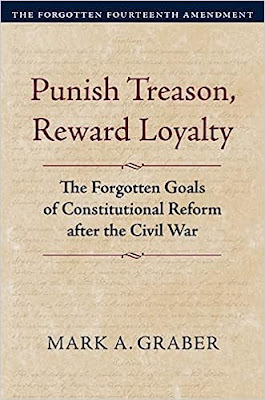
Mark A. Graber, Punish Treason, Reward Loyalty: The Forgotten Goals of Constitutional Reform after the Civil War (University of Kansas Press, 2023)
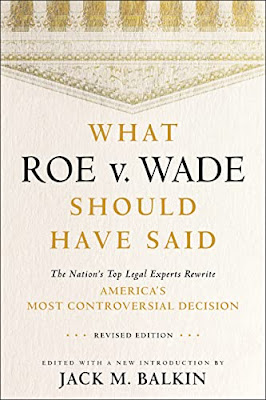
Jack M. Balkin, What Roe v. Wade Should Have Said: The Nation's Top Legal Experts Rewrite America's Most Controversial Decision - Revised Edition (NYU Press, 2023)

Andrew Koppelman, Burning Down the House: How Libertarian Philosophy Was Corrupted by Delusion and Greed (St. Martin’s Press, 2022)

Gerard N. Magliocca, Washington's Heir: The Life of Justice Bushrod Washington (Oxford University Press, 2022)
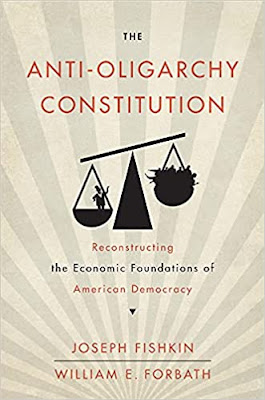
Joseph Fishkin and William E. Forbath, The Anti-Oligarchy Constitution: Reconstructing the Economic Foundations of American Democracy (Harvard University Press, 2022)
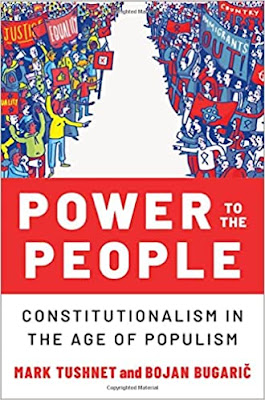
Mark Tushnet and Bojan Bugaric, Power to the People: Constitutionalism in the Age of Populism (Oxford University Press 2021).

Mark Philip Bradley and Mary L. Dudziak, eds., Making the Forever War: Marilyn B. Young on the Culture and Politics of American Militarism Culture and Politics in the Cold War and Beyond (University of Massachusetts Press, 2021).

Jack M. Balkin, What Obergefell v. Hodges Should Have Said: The Nation's Top Legal Experts Rewrite America's Same-Sex Marriage Decision (Yale University Press, 2020)

Frank Pasquale, New Laws of Robotics: Defending Human Expertise in the Age of AI (Belknap Press, 2020)

Jack M. Balkin, The Cycles of Constitutional Time (Oxford University Press, 2020)

Mark Tushnet, Taking Back the Constitution: Activist Judges and the Next Age of American Law (Yale University Press 2020).

Andrew Koppelman, Gay Rights vs. Religious Liberty?: The Unnecessary Conflict (Oxford University Press, 2020)

Ezekiel J Emanuel and Abbe R. Gluck, The Trillion Dollar Revolution: How the Affordable Care Act Transformed Politics, Law, and Health Care in America (PublicAffairs, 2020)

Linda C. McClain, Who's the Bigot?: Learning from Conflicts over Marriage and Civil Rights Law (Oxford University Press, 2020)
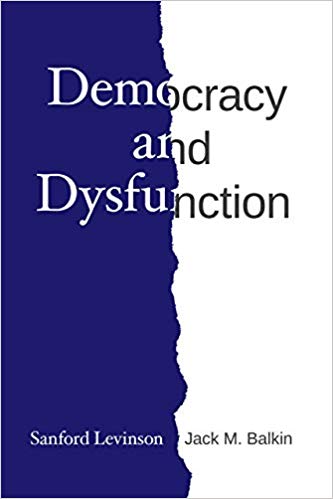
Sanford Levinson and Jack M. Balkin, Democracy and Dysfunction (University of Chicago Press, 2019)

Sanford Levinson, Written in Stone: Public Monuments in Changing Societies (Duke University Press 2018)

Mark A. Graber, Sanford Levinson, and Mark Tushnet, eds., Constitutional Democracy in Crisis? (Oxford University Press 2018)

Gerard Magliocca, The Heart of the Constitution: How the Bill of Rights became the Bill of Rights (Oxford University Press, 2018)

Cynthia Levinson and Sanford Levinson, Fault Lines in the Constitution: The Framers, Their Fights, and the Flaws that Affect Us Today (Peachtree Publishers, 2017)

Brian Z. Tamanaha, A Realistic Theory of Law (Cambridge University Press 2017)

Sanford Levinson, Nullification and Secession in Modern Constitutional Thought (University Press of Kansas 2016)

Sanford Levinson, An Argument Open to All: Reading The Federalist in the 21st Century (Yale University Press 2015)

Stephen M. Griffin, Broken Trust: Dysfunctional Government and Constitutional Reform (University Press of Kansas, 2015)

Frank Pasquale, The Black Box Society: The Secret Algorithms That Control Money and Information (Harvard University Press, 2015)

Bruce Ackerman, We the People, Volume 3: The Civil Rights Revolution (Harvard University Press, 2014)
Balkinization Symposium on We the People, Volume 3: The Civil Rights Revolution

Joseph Fishkin, Bottlenecks: A New Theory of Equal Opportunity (Oxford University Press, 2014)

Mark A. Graber, A New Introduction to American Constitutionalism (Oxford University Press, 2013)

John Mikhail, Elements of Moral Cognition: Rawls' Linguistic Analogy and the Cognitive Science of Moral and Legal Judgment (Cambridge University Press, 2013)

Gerard N. Magliocca, American Founding Son: John Bingham and the Invention of the Fourteenth Amendment (New York University Press, 2013)

Stephen M. Griffin, Long Wars and the Constitution (Harvard University Press, 2013)

Andrew Koppelman, The Tough Luck Constitution and the Assault on Health Care Reform (Oxford University Press, 2013)

James E. Fleming and Linda C. McClain, Ordered Liberty: Rights, Responsibilities, and Virtues (Harvard University Press, 2013)
Balkinization Symposium on Ordered Liberty: Rights, Responsibilities, and Virtues

Andrew Koppelman, Defending American Religious Neutrality (Harvard University Press, 2013)

Brian Z. Tamanaha, Failing Law Schools (University of Chicago Press, 2012)

Sanford Levinson, Framed: America's 51 Constitutions and the Crisis of Governance (Oxford University Press, 2012)

Linda C. McClain and Joanna L. Grossman, Gender Equality: Dimensions of Women's Equal Citizenship (Cambridge University Press, 2012)

Mary Dudziak, War Time: An Idea, Its History, Its Consequences (Oxford University Press, 2012)

Jack M. Balkin, Living Originalism (Harvard University Press, 2011)

Jason Mazzone, Copyfraud and Other Abuses of Intellectual Property Law (Stanford University Press, 2011)

Richard W. Garnett and Andrew Koppelman, First Amendment Stories, (Foundation Press 2011)

Jack M. Balkin, Constitutional Redemption: Political Faith in an Unjust World (Harvard University Press, 2011)

Gerard Magliocca, The Tragedy of William Jennings Bryan: Constitutional Law and the Politics of Backlash (Yale University Press, 2011)

Bernard Harcourt, The Illusion of Free Markets: Punishment and the Myth of Natural Order (Harvard University Press, 2010)

Bruce Ackerman, The Decline and Fall of the American Republic (Harvard University Press, 2010)
Balkinization Symposium on The Decline and Fall of the American Republic

Ian Ayres. Carrots and Sticks: Unlock the Power of Incentives to Get Things Done (Bantam Books, 2010)

Mark Tushnet, Why the Constitution Matters (Yale University Press 2010)

Ian Ayres and Barry Nalebuff: Lifecycle Investing: A New, Safe, and Audacious Way to Improve the Performance of Your Retirement Portfolio (Basic Books, 2010)
.jpg)
Jack M. Balkin, The Laws of Change: I Ching and the Philosophy of Life (2d Edition, Sybil Creek Press 2009)

Brian Z. Tamanaha, Beyond the Formalist-Realist Divide: The Role of Politics in Judging (Princeton University Press 2009)
Andrew Koppelman and Tobias Barrington Wolff, A Right to Discriminate?: How the Case of Boy Scouts of America v. James Dale Warped the Law of Free Association (Yale University Press 2009)

Jack M. Balkin and Reva B. Siegel, The Constitution in 2020 (Oxford University Press 2009)

Heather K. Gerken, The Democracy Index: Why Our Election System Is Failing and How to Fix It (Princeton University Press 2009)

Mary Dudziak, Exporting American Dreams: Thurgood Marshall's African Journey (Oxford University Press 2008)

David Luban, Legal Ethics and Human Dignity (Cambridge Univ. Press 2007)

Ian Ayres, Super Crunchers: Why Thinking-By-Numbers is the New Way to be Smart (Bantam 2007)

Jack M. Balkin, James Grimmelmann, Eddan Katz, Nimrod Kozlovski, Shlomit Wagman and Tal Zarsky, eds., Cybercrime: Digital Cops in a Networked Environment (N.Y.U. Press 2007)
Jack M. Balkin and Beth Simone Noveck, The State of Play: Law, Games, and Virtual Worlds (N.Y.U. Press 2006)

Andrew Koppelman, Same Sex, Different States: When Same-Sex Marriages Cross State Lines (Yale University Press 2006)

Brian Tamanaha, Law as a Means to an End (Cambridge University Press 2006)

Sanford Levinson, Our Undemocratic Constitution (Oxford University Press 2006)

Mark Graber, Dred Scott and the Problem of Constitutional Evil (Cambridge University Press 2006)

Jack M. Balkin, ed., What Roe v. Wade Should Have Said (N.Y.U. Press 2005)

Sanford Levinson, ed., Torture: A Collection (Oxford University Press 2004)
Balkin.com homepage
Bibliography
Conlaw.net
Cultural Software
Writings
Opeds
The Information Society Project
BrownvBoard.com
Useful Links
Syllabi and Exams
