Balkinization
an unanticipated consequence of
Jack M. Balkin
Balkinization Symposiums: A Continuing List
E-mail:
Jack Balkin:
jackbalkin at yahoo.com
Bruce Ackerman
bruce.ackerman at yale.edu
Ian Ayres
ian.ayres at yale.edu
Corey Brettschneider
corey_brettschneider at brown.edu
Mary Dudziak
mary.l.dudziak at emory.edu
Joey Fishkin
joey.fishkin at gmail.com
Heather Gerken heather.gerken at yale.edu
Abbe Gluck abbe.gluck at yale.edu
Mark Graber
mgraber at law.umaryland.edu
Stephen Griffin
sgriffin at tulane.edu
Jonathan Hafetz
jonathan.hafetz at shu.edu
Jeremy Kessler
jkessler at law.columbia.edu
Andrew Koppelman
akoppelman at law.northwestern.edu
Marty Lederman
msl46 at law.georgetown.edu
Sanford Levinson
slevinson at law.utexas.edu
David Luban
david.luban at gmail.com
Gerard Magliocca
gmaglioc at iupui.edu
Jason Mazzone
mazzonej at illinois.edu
Linda McClain
lmcclain at bu.edu
John Mikhail
mikhail at law.georgetown.edu
Frank Pasquale
pasquale.frank at gmail.com
Nate Persily
npersily at gmail.com
Michael Stokes Paulsen
michaelstokespaulsen at gmail.com
Deborah Pearlstein
dpearlst at yu.edu
Rick Pildes
rick.pildes at nyu.edu
David Pozen
dpozen at law.columbia.edu
Richard Primus
raprimus at umich.edu
K. Sabeel Rahmansabeel.rahman at brooklaw.edu
Alice Ristroph
alice.ristroph at shu.edu
Neil Siegel
siegel at law.duke.edu
David Super
david.super at law.georgetown.edu
Brian Tamanaha
btamanaha at wulaw.wustl.edu
Nelson Tebbe
nelson.tebbe at brooklaw.edu
Mark Tushnet
mtushnet at law.harvard.edu
Adam Winkler
winkler at ucla.edu
Compendium of posts on Hobby Lobby and related cases
The Anti-Torture Memos: Balkinization Posts on Torture, Interrogation, Detention, War Powers, and OLC
The Anti-Torture Memos (arranged by topic)
Recent Posts
Immigration reform as a "natural experiment"
![[Powered by Blogger]](https://lh3.googleusercontent.com/blogger_img_proxy/AEn0k_sQCS0PB434JuaAevySff64AXQQ2lrS4CZSMg1YhRRUzISiRuSjKBGQCr9J17fSU_t3o5uYAFyb-koPtG-oXmoZeu10htK_23xz_0SnNwe3=s0-d)
Just A Few Blogs
ACS Blog
Alas, a Blog
Althouse
Arts and Letters Daily
Atrios (Eschaton)
Bill of Health
Buzzflash.com
Buzz Machine
Cato at Liberty
Juan Cole (Informed Comment)
Concurring Opinions
The Constitution in 2020
Corrente
Crooked Timber
Daily Howler
Daily Kos
Dana Boyd
Brad DeLong
Digby (Hullabaloo)
Discriminations
Daniel Drezner
Kevin Drum (Mother Jones)
Electrolite
En Banc
Eunomia (Daniel Larison)
Fafblog
Michael Froomkin (Discourse.net)
GovLab (Beth Noveck)
Rick Hasen (Election Law)
History News Network
How Appealing
Ignatz (Sam Heldman)
The Importance of (Ernie Miller)
Infolaw
Instapundit
International Economic Law and Policy Blog
IntLawGrrls
Jacob Levy
Jesus' General
Jurisdynamics
The Kitchen Cabinet
Mark Kleiman
Law Blog Central
Larry Lessig
Lawyers, Guns and Money
Liberal Oasis
Brian Leiter's Law School Reports
The Leiter Reports
Marginal Revolution
Megan McArdle
Memeorandum
Metafilter
Mirror of Justice
The New Republic
Newseum
No More Mister Nice Blog
Brendan Nyhan
Opinio Juris
Orcinus
The Originalism Blog
Pandagon
Passport (Foreign Policy)
Overcoming Bias
Political Animal (Washington Monthly)
Political Theory Daily Review
Political Wire (Taegan Goddard)
The Poor Man
Virginia Postrel
Prawfsblawg
Public Reason
Jonathan Rauch
Raw Story
Redstate
ReligiousLeftLaw.com
Reporters Committee For Freedom of the Press
Reproductive Rights Blog
Rothman's Roadmap to the Right of Publicity
SCOTUS Blog
Seeing the Forest
Clay Shirky
The Shifted Librarian
The Situationist
Larry Solum (Legal Theory)
Andrew Sullivan
Talking Points Memo
Talk Left
Tapped
Tbogg
TechPresident
The Paper Chase (Jurist)
Tom Paine
Tom Tomorrow (This Modern World)
Eve Tushnet
Uggabugga
University of Chicago Law School Faculty Blog
Unqualified Offerings
The Volokh Conspiracy
War and Piece (Laura Rozen)
Wampum
Oliver Willis
Wonkette
Written Description
Matthew Yglesias
Yin
Your Choice of Feeds
1. XML
powered by

2. Atom Feed
3. RSS 2.0
Immigration reform as a "natural experiment"
Sandy Levinson
David Brooks has a fine column today on why immigration reform (including, if there is a political "truth-in-advertising" law, "amnesty") is such an easy case. I'm particularly interested in his concluding sentence: "The second big conclusion is that if we can’t pass a law this year, given the overwhelming strength of the evidence, then we really are a pathetic basket case of a nation."
Jack has revealed himself to be the cock-eyed optimist that I have long suspected he is (and that makes him such a wonderful person and friend.) . Though I don't know if he loves the Constitution quite so much as his Yale colleague (and our mutual friend and casebook co-editor Akhil Reed Amar), both are basically without genuine anxiety when they ask if the Constitution itself, and not, as Akhil (or Paul Krugman) might put it, simply the fact that one of our two major political parties has been taken over by right-wing crazies, might help to explain why we might in fact be "a pathetic basket case of a nation." For Jack, this is the time that darkest before the dawn of "transition" and, in the word found in the title of one of his two books published last year, "redemption." For obvious reasons, I hope he's right, but I'm more pessimistic. Redemption will not be found before the Messiah comes, and I see no signs of that occurring.
But immigration reform (far more than "gun reform") offers a wonderful test case. Most "leaders" of the Republican Party (I put the term in scare quotes because we have no real idea who the present "leaders" are, as between, say, Rush Limbaugh, Ted Cruz, John Boehner, Mitch McConnell, Chris Cristie, and anyone else one might want to list)--or at least those recognized by Brooks, who in his previous column called for "Coastal Republicans" to enter into a fight to the finish with Southern and Midwest provincials (my terms, not his)--seem to agree that the GOP might be finished as a "grand" party if it doesn't come to terms with the fact that the Simpson-Mazzoli bill of 1986 (passed, of course, while the sainted Ronald Reagan could have vetoed it) fundamentally changed the country forever with regard to its political demography. But, of course, it is totally unclear whether the message has gotten to House Republicans. No doubt, the House can pass any law actually passed by the Senate if Boehner behaves as a true Speaker of the House instead of the leader of the Republican caucus and therefore schedules a vote on a bill that might pass with the support of say, 100% of the Democrats and 20% of the Republicans. The "Hastert Rule" is not, obviously, part of the Constitution. But the ability of one of the two Houses of Congress to inflict a death-ray veto on any law passed by the other house, even if it enjoys the support of the President and most of the public, most certain is part of the Constitution.
Moreover, even after (or during) the immigration imbroglio, there is the question of the Debt Ceiling charade, scheduled for May, and, of course, the fabled sequester, designed basically to crippe the national government and inflict great (and altogether needless) suffering on the most vulnerable among us (as well, of course, as reduce a bloated military budget, as Barney Frank, who ought to be representing Massachusetts in the Senate, would point out).
So it remains unclear how quickly Jack's "transition" will take place and what costs will be inflicted on the country at large, particularly the most vulnerable among us, as the result of our defective Constitution. Perhaps we'll look back, in 2020, when Julian Castro, now the mayor of San Antonio, becomes our first Hispanic President, on the present as the run-up to our new and happy future. May it be Thy ill, O Lord....
Before commenting, you might want to take a look at least at the first panel in last week's gathering, "The State of the Union," with comments by myself, Mickey Edwards, Bill Galston, Thomas Mann, Norman Ornstein, and Alan Wolfe. My own description of our present state is somewhere between "bleak" and "dire," in part because of our Constitution. For better or worse, I'm the distinct outlier n the panel (and in the conference) in focusing on the Constitution as part of the cause of what ails us. Jack, I am sure, is far more representative.
Posted
5:50 PM
by Sandy Levinson [link]
Brooks correctly identifies the long known economic benefits of immigration, but glosses over or simply denies the costs to the taxpayer of introducing millions of low skill, low wage immigrants into a welfare state and the costs to native low skill workers when that labor pool is dramatically expanded while available low skill jobs are shrinking.
Voter opposition to immigration under these terms is hardly know-nothing nativism and is your primary political problem - not the Constitution, the Hastert Rule or any of your other hobby horses.
The obvious solution (and the one I personally support) would be to return to the immigration rules under which many of our European and Chinese ancestors came to America - so long as you are not a criminal, diseased or mentally disabled, you are in. Once here, you are on your own. The streets are occasionally paved with gold, but they do not lead to a welfare office.
This approach turned a colonial backwater into a world super power.
However, the political class who looks at low skill immigrants as an ongoing source of government-dependent voters is hardly likely to truly liberalize immigration as I suggest. Rather, they prefer ongoing amnesty bills and immigrant welcome packets with Obamacare inserts.

For just one example, there's no "humanitarian case" involved: everything Brooks writes would make things worse (for most people). It would make things more difficult for struggling Americans who'd have to compete against those who previously couldn't compete with them for their jobs (such as federal construction, bank teller, Denny's waitress assuming Denny's checks IDs, etc. etc.)
At the same time, it would harm foreign countries who'd lose even more of their strivers to the U.S. (in one MX state a few years ago, most of their workers were in the U.S.) MX needs all the smart ppl they can hold on to, Brooks would have them come here. That has long term impacts for them and for us.
But, some people would make out: crooked business owners who've knowingly used illegal labor, crooked banks that would profit from deposits and sending money back, crooked pols who take favors from the latter two groups and in exchange turn a blind eye to massive illegal activity, and so on.
Shouldn't law professors avoid siding with and enabling unrepentant crooks?
It is one thing to say the us const. is not a very good document which is obviously correct; it is quite another to say this actually matters. To do so convincingly you must not only show that there is a "correct" policy out there but also that the const is thwarting its implementation - thats a hard thing to do but its surely your burden. Good luck, it cant be done cuz its simply not the case.
http://www.digitalhistory.uh.edu/historyonline/immigration_chron.cfm
I provide this because of our yodeler's comment:
"The obvious solution (and the one I personally support) would be to return to the immigration rules under which many of our European and Chinese ancestors came to America - so long as you are not a criminal, diseased or mentally disabled, you are in. Once here, you are on your own. The streets are occasionally paved with gold, but they do not lead to a welfare office."
Perhaps our yodeler could provide us with dates of those good old immigration days of yesteryear he yearns for. Based on comments by our yodeler on other threads at this Blog, he yearns for those laissez-faire days of the late 18th and the 19th centuries in America's glory days before being ruined by progressives. Also, I wonder if there is a book or books on immigration in America that our yodeler uses as his sources, especially on our "Chinese ancestors" who came to America. Here in MA I am familiar with immigration patterns going back to the Irish and Italians in their initial waves of immigration, followed by other Europeans and Asians. Some of my familiarity goes back to the 1850s in the history of Boston.
So perhaps our yodeler could favor us by identifying with dates the immigration rules of America's past that he favors. Our yodeler's open immigration policy (subject to exceptions - " ... so long as you are not a criminal, diseased or mentally disabled, ... ") might add to the changing demographics that have been doing in the GOP. {Note: Some of our yodeler's exceptions should be compared to the welcome inscription on the Statue of Liberty.]
My Irish, German and Italian ancestors came over between the 1860s and 1903. Their experiences are what I based my comment.
I was discussing immigration and not naturalization, which is why I included the Chinese.
Perhaps our yodeler's ancestors passed down journals that he relies upon for his open immigration policy. But there is quite a bit of history on the treatment of various ethnic immigrants that may not square with our yodeler's anecdotal approach. And naturalization is a significant aspect of immigration, thus should not be ignored.

If the change/reform doesn't happen, it will be, almost certianly, because of the constitutional power of the House to block it. I take it that both Andrew and Mr. Whiskas agree with this analysis--how could they not?--which makes it clear that the institutions established by the Constitution matter and help to explain the actual laws on the books. (Consider in this context George W. Bush's veto of the stem-cell research bill some years ago.) That is why I literally don't understand the dismissive argument that the Constitution just doesn't matter.
Again, to be perfectly clear: I happily concede that lots of people are opposed to "normalization" or "amnesty" of those who are now here illegally. The one and only issue I'm interested in discussing is whether the bicameral system established in 1787 means that such opponents, even if only a minority of the country (or even the electorate), are able to veto changes desired by the majority, who, as it happened, voted for the President and Senate and against the Republican dominance of the House.
Perhaps this ability to veto changes is a good thing. I've certainly supported some in my time. But the debate between Jack and myself (and others) concerns the extent to which "the Constitution matters" and, indeed, helps to prevent the transition he predicts. That's why I still think the future of immigration reform is a good natural experiment.
There are other undemocratic provisions in the Constitution identified well prior to Sandy's current concerns with the Constitution. The population of America has increased substantially, making representative government perhaps more difficult providing democracy. Would more parties make a difference by sharing power via coalitions? There are no easy solutions. I shudder to think of the potential turmoil of a constitutional convention, with so many disparate views out there, especially at a time when America's leadership role in the world remains critical. I'm reminded of my classmate Joe at Boston English High School who used to quote his Italian grandfather's:
"HALITOSIS IS BETTER THAN NO BREATH AT ALL."
I love Sandy, I love Jack. Whatever their differences, I hope they continue to collaborate from time to time as they have added so much to better understanding our Constitution, which may have been "A Covenant with Death" (per William Lloyd Garrison), but has survived with some breath left.
False premise. Polls show opponents of amnesty to be a persistent majority of the population and electorate. The only reason it's got any chance is because the democratic system in this country is breaking down, such that on an increasing number of issues public opinion isn't effective at controlling the government anymore.
" ... the democratic system in this country is breaking down, such that on an increasing number of issues public opinion isn't effective at controlling the government anymore."
perhaps Brett might list some of the public opinion that isn't effective.
And Brett might identify the bases of his view on the democratic system breaking down. Perhaps he shares some of Sandy's concerns.eheretr
To me it is interesting that usually it is the Senate cited as undemocratic in a way that blocks the majority will, but in this instance it is likely going to be the House, the body most like that in a parlimentary system, which is going to where even more difficulties to reform will be faced. To the extent the House is undemocratic I think we can blame gerrymandering more than the Constitution (though perhaps the Constitution should have anticipated this in its rules).
As for the argument between Mr. Balkin and Mr. Levinson I've often seen it as not as big a one as some may think; Mr. Levinson argues the Constitution's flaws hold up many necessary actions and reforms, but Mr. Balkin often talks about how change and action occurs outside the literal text of the Constitution in changing national 'understandings' of the text. I think the two are rather complimentary actually...
Term limits: Adopted essentially everywhere the citizen's initiative was available, pretty much nowhere it wasn't.
Balanced budget amendment. So popular Congress made a show of voting on it, while bringing up multiple versions so that everybody who had to could vote for one of them, without the risk that any particular version would get enough votes to go to the states.
Immigration reform: Public opinion has favored enforcing the borders, and opposed amnesty, for decades, and we never get effective border enforcement, and they keep trying to pass amnesty again.
Essentially what Sandy seems to characterize as America becoming "ungovernable", is that the general population is starting to push back against the political class, preventing it in some cases from having it's way.
The Pew Foundation provides public polls with careful analysis, including changes over time. Brett's P-U version of public cherry-picked polls is pungent.
It is ironic that Brett cites polls when he rejects certain governmental action when it is deemed to violate certain rights. Thus, polls, e.g., show a rejection of his views on gun regulation, but I don't think he thinks blocking such regulation is perversion of self-government.
Immigration both involves rights and the conflicted nature of the electorate (e.g., those who like the cheap labor undocumented workers bring). Ditto balanced budget amendments. The multiple versions is just one reflection the lack of a clear united front here. Same with term limits really -- they vote for people who say they are for term limits who then change their minds, but the people still vote for them. See, e.g., Tom Coburn.
Anyway, sure, representatives are different from the general public in some ways. That's the point, right? We don't have simple democracy. Brett likes this at times, not liking much government, thus resulting in gridlock. Selectively, he does not.
Buy Fifa 14 Coins
LOL Boost
FUT 14 Coins
Canada Immigration Basics
Books by Balkinization Bloggers

Mark Tushnet and Bojan Bugaric, Constitutionalism and Its Discontents (University of Chicago Press, 2026)

Gerard N. Magliocca, The Actual Art of Governing: Justice Robert H. Jackson's Concurring Opinion in the Steel Seizure Case (Oxford University Press, 2025)

Linda C. McClain and Aziza Ahmed, The Routledge Companion to Gender and COVID-19 (Routledge, 2024)

David Pozen, The Constitution of the War on Drugs (Oxford University Press, 2024)

Jack M. Balkin, Memory and Authority: The Uses of History in Constitutional Interpretation (Yale University Press, 2024)
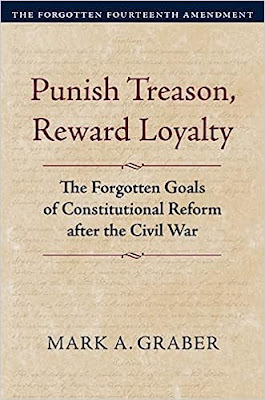
Mark A. Graber, Punish Treason, Reward Loyalty: The Forgotten Goals of Constitutional Reform after the Civil War (University of Kansas Press, 2023)
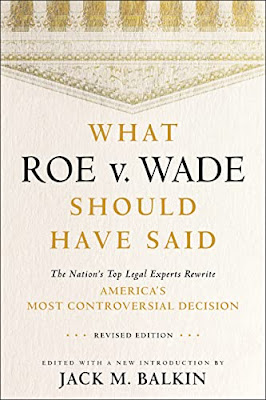
Jack M. Balkin, What Roe v. Wade Should Have Said: The Nation's Top Legal Experts Rewrite America's Most Controversial Decision - Revised Edition (NYU Press, 2023)

Andrew Koppelman, Burning Down the House: How Libertarian Philosophy Was Corrupted by Delusion and Greed (St. Martin’s Press, 2022)

Gerard N. Magliocca, Washington's Heir: The Life of Justice Bushrod Washington (Oxford University Press, 2022)
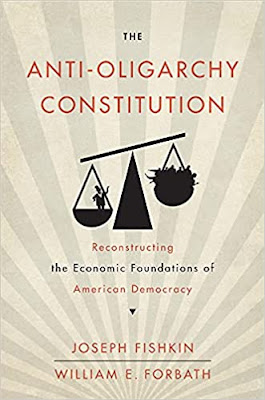
Joseph Fishkin and William E. Forbath, The Anti-Oligarchy Constitution: Reconstructing the Economic Foundations of American Democracy (Harvard University Press, 2022)
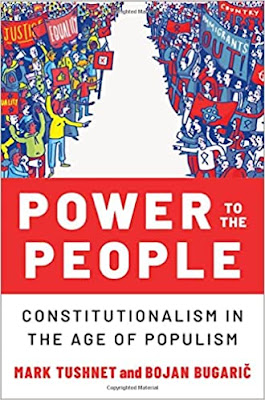
Mark Tushnet and Bojan Bugaric, Power to the People: Constitutionalism in the Age of Populism (Oxford University Press 2021).

Mark Philip Bradley and Mary L. Dudziak, eds., Making the Forever War: Marilyn B. Young on the Culture and Politics of American Militarism Culture and Politics in the Cold War and Beyond (University of Massachusetts Press, 2021).

Jack M. Balkin, What Obergefell v. Hodges Should Have Said: The Nation's Top Legal Experts Rewrite America's Same-Sex Marriage Decision (Yale University Press, 2020)

Frank Pasquale, New Laws of Robotics: Defending Human Expertise in the Age of AI (Belknap Press, 2020)

Jack M. Balkin, The Cycles of Constitutional Time (Oxford University Press, 2020)

Mark Tushnet, Taking Back the Constitution: Activist Judges and the Next Age of American Law (Yale University Press 2020).

Andrew Koppelman, Gay Rights vs. Religious Liberty?: The Unnecessary Conflict (Oxford University Press, 2020)

Ezekiel J Emanuel and Abbe R. Gluck, The Trillion Dollar Revolution: How the Affordable Care Act Transformed Politics, Law, and Health Care in America (PublicAffairs, 2020)

Linda C. McClain, Who's the Bigot?: Learning from Conflicts over Marriage and Civil Rights Law (Oxford University Press, 2020)
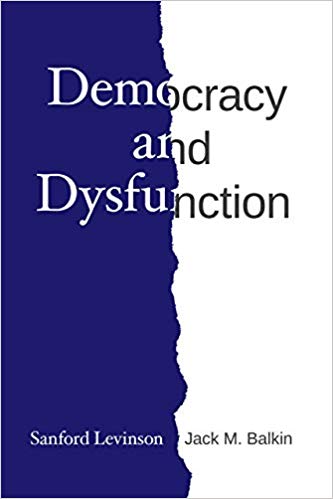
Sanford Levinson and Jack M. Balkin, Democracy and Dysfunction (University of Chicago Press, 2019)

Sanford Levinson, Written in Stone: Public Monuments in Changing Societies (Duke University Press 2018)

Mark A. Graber, Sanford Levinson, and Mark Tushnet, eds., Constitutional Democracy in Crisis? (Oxford University Press 2018)

Gerard Magliocca, The Heart of the Constitution: How the Bill of Rights became the Bill of Rights (Oxford University Press, 2018)

Cynthia Levinson and Sanford Levinson, Fault Lines in the Constitution: The Framers, Their Fights, and the Flaws that Affect Us Today (Peachtree Publishers, 2017)

Brian Z. Tamanaha, A Realistic Theory of Law (Cambridge University Press 2017)

Sanford Levinson, Nullification and Secession in Modern Constitutional Thought (University Press of Kansas 2016)

Sanford Levinson, An Argument Open to All: Reading The Federalist in the 21st Century (Yale University Press 2015)

Stephen M. Griffin, Broken Trust: Dysfunctional Government and Constitutional Reform (University Press of Kansas, 2015)

Frank Pasquale, The Black Box Society: The Secret Algorithms That Control Money and Information (Harvard University Press, 2015)

Bruce Ackerman, We the People, Volume 3: The Civil Rights Revolution (Harvard University Press, 2014)
Balkinization Symposium on We the People, Volume 3: The Civil Rights Revolution

Joseph Fishkin, Bottlenecks: A New Theory of Equal Opportunity (Oxford University Press, 2014)

Mark A. Graber, A New Introduction to American Constitutionalism (Oxford University Press, 2013)

John Mikhail, Elements of Moral Cognition: Rawls' Linguistic Analogy and the Cognitive Science of Moral and Legal Judgment (Cambridge University Press, 2013)

Gerard N. Magliocca, American Founding Son: John Bingham and the Invention of the Fourteenth Amendment (New York University Press, 2013)

Stephen M. Griffin, Long Wars and the Constitution (Harvard University Press, 2013)

Andrew Koppelman, The Tough Luck Constitution and the Assault on Health Care Reform (Oxford University Press, 2013)

James E. Fleming and Linda C. McClain, Ordered Liberty: Rights, Responsibilities, and Virtues (Harvard University Press, 2013)
Balkinization Symposium on Ordered Liberty: Rights, Responsibilities, and Virtues

Andrew Koppelman, Defending American Religious Neutrality (Harvard University Press, 2013)

Brian Z. Tamanaha, Failing Law Schools (University of Chicago Press, 2012)

Sanford Levinson, Framed: America's 51 Constitutions and the Crisis of Governance (Oxford University Press, 2012)

Linda C. McClain and Joanna L. Grossman, Gender Equality: Dimensions of Women's Equal Citizenship (Cambridge University Press, 2012)

Mary Dudziak, War Time: An Idea, Its History, Its Consequences (Oxford University Press, 2012)

Jack M. Balkin, Living Originalism (Harvard University Press, 2011)

Jason Mazzone, Copyfraud and Other Abuses of Intellectual Property Law (Stanford University Press, 2011)

Richard W. Garnett and Andrew Koppelman, First Amendment Stories, (Foundation Press 2011)

Jack M. Balkin, Constitutional Redemption: Political Faith in an Unjust World (Harvard University Press, 2011)

Gerard Magliocca, The Tragedy of William Jennings Bryan: Constitutional Law and the Politics of Backlash (Yale University Press, 2011)

Bernard Harcourt, The Illusion of Free Markets: Punishment and the Myth of Natural Order (Harvard University Press, 2010)

Bruce Ackerman, The Decline and Fall of the American Republic (Harvard University Press, 2010)
Balkinization Symposium on The Decline and Fall of the American Republic

Ian Ayres. Carrots and Sticks: Unlock the Power of Incentives to Get Things Done (Bantam Books, 2010)

Mark Tushnet, Why the Constitution Matters (Yale University Press 2010)

Ian Ayres and Barry Nalebuff: Lifecycle Investing: A New, Safe, and Audacious Way to Improve the Performance of Your Retirement Portfolio (Basic Books, 2010)
.jpg)
Jack M. Balkin, The Laws of Change: I Ching and the Philosophy of Life (2d Edition, Sybil Creek Press 2009)

Brian Z. Tamanaha, Beyond the Formalist-Realist Divide: The Role of Politics in Judging (Princeton University Press 2009)
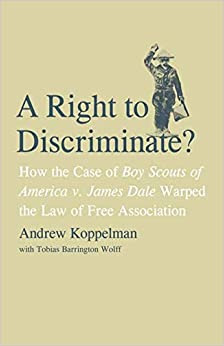
Andrew Koppelman and Tobias Barrington Wolff, A Right to Discriminate?: How the Case of Boy Scouts of America v. James Dale Warped the Law of Free Association (Yale University Press 2009)

Jack M. Balkin and Reva B. Siegel, The Constitution in 2020 (Oxford University Press 2009)

Heather K. Gerken, The Democracy Index: Why Our Election System Is Failing and How to Fix It (Princeton University Press 2009)

Mary Dudziak, Exporting American Dreams: Thurgood Marshall's African Journey (Oxford University Press 2008)

David Luban, Legal Ethics and Human Dignity (Cambridge Univ. Press 2007)

Ian Ayres, Super Crunchers: Why Thinking-By-Numbers is the New Way to be Smart (Bantam 2007)

Jack M. Balkin, James Grimmelmann, Eddan Katz, Nimrod Kozlovski, Shlomit Wagman and Tal Zarsky, eds., Cybercrime: Digital Cops in a Networked Environment (N.Y.U. Press 2007)
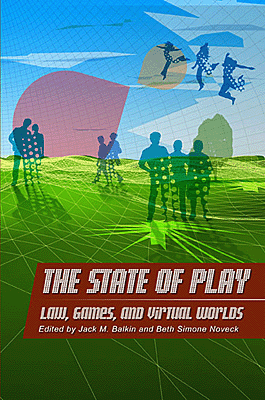
Jack M. Balkin and Beth Simone Noveck, The State of Play: Law, Games, and Virtual Worlds (N.Y.U. Press 2006)

Andrew Koppelman, Same Sex, Different States: When Same-Sex Marriages Cross State Lines (Yale University Press 2006)

Brian Tamanaha, Law as a Means to an End (Cambridge University Press 2006)

Sanford Levinson, Our Undemocratic Constitution (Oxford University Press 2006)

Mark Graber, Dred Scott and the Problem of Constitutional Evil (Cambridge University Press 2006)

Jack M. Balkin, ed., What Roe v. Wade Should Have Said (N.Y.U. Press 2005)

Sanford Levinson, ed., Torture: A Collection (Oxford University Press 2004)
Balkin.com homepage
Bibliography
Conlaw.net
Cultural Software
Writings
Opeds
The Information Society Project
BrownvBoard.com
Useful Links
Syllabi and Exams
