Balkinization
an unanticipated consequence of
Jack M. Balkin
Balkinization Symposiums: A Continuing List
E-mail:
Jack Balkin:
jackbalkin at yahoo.com
Bruce Ackerman
bruce.ackerman at yale.edu
Ian Ayres
ian.ayres at yale.edu
Corey Brettschneider
corey_brettschneider at brown.edu
Mary Dudziak
mary.l.dudziak at emory.edu
Joey Fishkin
joey.fishkin at gmail.com
Heather Gerken heather.gerken at yale.edu
Abbe Gluck abbe.gluck at yale.edu
Mark Graber
mgraber at law.umaryland.edu
Stephen Griffin
sgriffin at tulane.edu
Jonathan Hafetz
jonathan.hafetz at shu.edu
Jeremy Kessler
jkessler at law.columbia.edu
Andrew Koppelman
akoppelman at law.northwestern.edu
Marty Lederman
msl46 at law.georgetown.edu
Sanford Levinson
slevinson at law.utexas.edu
David Luban
david.luban at gmail.com
Gerard Magliocca
gmaglioc at iupui.edu
Jason Mazzone
mazzonej at illinois.edu
Linda McClain
lmcclain at bu.edu
John Mikhail
mikhail at law.georgetown.edu
Frank Pasquale
pasquale.frank at gmail.com
Nate Persily
npersily at gmail.com
Michael Stokes Paulsen
michaelstokespaulsen at gmail.com
Deborah Pearlstein
dpearlst at yu.edu
Rick Pildes
rick.pildes at nyu.edu
David Pozen
dpozen at law.columbia.edu
Richard Primus
raprimus at umich.edu
K. Sabeel Rahmansabeel.rahman at brooklaw.edu
Alice Ristroph
alice.ristroph at shu.edu
Neil Siegel
siegel at law.duke.edu
David Super
david.super at law.georgetown.edu
Brian Tamanaha
btamanaha at wulaw.wustl.edu
Nelson Tebbe
nelson.tebbe at brooklaw.edu
Mark Tushnet
mtushnet at law.harvard.edu
Adam Winkler
winkler at ucla.edu
Compendium of posts on Hobby Lobby and related cases
The Anti-Torture Memos: Balkinization Posts on Torture, Interrogation, Detention, War Powers, and OLC
The Anti-Torture Memos (arranged by topic)
Recent Posts
Why UC Irvine Went Wrong: Chasing Prestige at the Expense of Public Service
![[Powered by Blogger]](https://lh3.googleusercontent.com/blogger_img_proxy/AEn0k_tjXp1usERdGE3S0pEhDkGnXnsyP6jArtCulmuW2UkrfcILVF1_gOrHqJFfAReiv7fyr7SGaaE6kp7MewehFAsPuHtEjjtnMk_AvS7XBjLI=s0-d)
Just A Few Blogs
ACS Blog
Alas, a Blog
Althouse
Arts and Letters Daily
Atrios (Eschaton)
Bill of Health
Buzzflash.com
Buzz Machine
Cato at Liberty
Juan Cole (Informed Comment)
Concurring Opinions
The Constitution in 2020
Corrente
Crooked Timber
Daily Howler
Daily Kos
Dana Boyd
Brad DeLong
Digby (Hullabaloo)
Discriminations
Daniel Drezner
Kevin Drum (Mother Jones)
Electrolite
En Banc
Eunomia (Daniel Larison)
Fafblog
Michael Froomkin (Discourse.net)
GovLab (Beth Noveck)
Rick Hasen (Election Law)
History News Network
How Appealing
Ignatz (Sam Heldman)
The Importance of (Ernie Miller)
Infolaw
Instapundit
International Economic Law and Policy Blog
IntLawGrrls
Jacob Levy
Jesus' General
Jurisdynamics
The Kitchen Cabinet
Mark Kleiman
Law Blog Central
Larry Lessig
Lawyers, Guns and Money
Liberal Oasis
Brian Leiter's Law School Reports
The Leiter Reports
Marginal Revolution
Megan McArdle
Memeorandum
Metafilter
Mirror of Justice
The New Republic
Newseum
No More Mister Nice Blog
Brendan Nyhan
Opinio Juris
Orcinus
The Originalism Blog
Pandagon
Passport (Foreign Policy)
Overcoming Bias
Political Animal (Washington Monthly)
Political Theory Daily Review
Political Wire (Taegan Goddard)
The Poor Man
Virginia Postrel
Prawfsblawg
Public Reason
Jonathan Rauch
Raw Story
Redstate
ReligiousLeftLaw.com
Reporters Committee For Freedom of the Press
Reproductive Rights Blog
Rothman's Roadmap to the Right of Publicity
SCOTUS Blog
Seeing the Forest
Clay Shirky
The Shifted Librarian
The Situationist
Larry Solum (Legal Theory)
Andrew Sullivan
Talking Points Memo
Talk Left
Tapped
Tbogg
TechPresident
The Paper Chase (Jurist)
Tom Paine
Tom Tomorrow (This Modern World)
Eve Tushnet
Uggabugga
University of Chicago Law School Faculty Blog
Unqualified Offerings
The Volokh Conspiracy
War and Piece (Laura Rozen)
Wampum
Oliver Willis
Wonkette
Written Description
Matthew Yglesias
Yin
Your Choice of Feeds
1. XML
powered by

2. Atom Feed
3. RSS 2.0
Why UC Irvine Went Wrong: Chasing Prestige at the Expense of Public Service
Brian Tamanaha
Five years ago, when it was announced that UC Irvine would open a new law school, many critics asked why. With a surplus of law schools already, California had no need for another one. The justification offered was that Irvine would be different. “We have the chance to build something very special: the ideal law school for the 21st century,” said founding Dean Erwin Chemerinsky. “We have a wonderful opportunity in that we have a blank slate.” Irvine, he proclaimed, would be a law school oriented to public service. The school was given a great boost when a local businessman donated $20 million for the start-up.
In Failing Law Schools, for one critical reason I argue that, despite creating an excellent law school, UC Irvine went wrong: it is now among the most expensive law schools in the country (2012: $47,000 resident, $53,000 non-resident). When you add estimated annual living expenses of about $20,000, students will pay $200,000 for an Irvine law degree, and the average debt of the class of 2015 will exceed $100,000.
Students with debt that large are compelled by financial necessity to pursue corporate law jobs. Although public service jobs are eligible for a federal program that reduces monthly loan payments and forgives the remaining debt after 10 years, heavily indebted law students would take a huge risk to pass up a corporate law job, which is obtained though interviews in the fall of the second year, in the hope that they might later land a public service job, which is obtained near or after graduation.
Irvine law professors can saturate the atmosphere and curriculum with public service—it doesn’t matter. Irvine students will be forced to work in corporate law—and the many students who don’t land these positions will struggle under a huge debt. That is the reality of it. The “public service” goal was doomed, I argue in the book, by Dean Chemerinsky’s determination to create a "top 20" law school right out of the box. To achieve this goal, he recruited law professors from top law schools, who come at a high price.
An op-ed in the LA Times penned by Dean Chemerinsky in 2010 explains Irvine's high salary scale: Over the last few weeks, I have negotiated salaries with superb professors we are attempting to recruit who are currently teaching at Harvard, Northwestern and Yale. The University of California must match their current salaries or they will not come. As much as I love living in Southern California, I could not have afforded to leave Duke University if it meant taking a substantial pay cut.
If you are recruiting against top law schools, you pay top dollar for professors. Publicly available UC salary records (ucpay.globl.org) reveal that Irvine law professors are very well compensated (two received gross compensation topping $300,000 in 2011). Under the current economic model of law schools, I wrote in the book, “affordability and elite status are mutually exclusive.”
Understandably upset by my critical comments about UCI, Dean Chemerinsky has made two recent rebuttals: “You Get What You Pay For in Legal Education” and “Law Prof’s Ideal, Affordable Law School Not Possible.” In neither response does he contest my assertion that UCI grads (class of 2015) will be forced by their debt burden to seek corporate law jobs regardless of a desire they might have to work in public service.
He insists that tuition must be in the $50,000 range if UCI is to land in the top 20. On that point, he and I agree. What Dean Chemerinsky does not explain, however, is why it was necessary to create a “top 20” law school. If that was the driving goal, then perhaps Irvine law school should not have been created. There are already about 25 law schools in the “top 20,” three of them in California.
Dean Chemerinsky knows a great deal more than I do about the economics of running a law school, but I am skeptical of his suggestion that there were only two options: create a “top 20” law school or a “fourth tier” law school. One way to have kept costs down with no significant loss in faculty talent would have been to recruit top professors from excellent law schools with a lower pay scale (Alabama, Florida State, Georgia, North Carolina, William & Mary, etc.) rather than from Harvard, Northwestern and Yale. But he went for the prestige.
Two final comments: First, there is something vaguely discomfiting about a law school that urges its students to engage in public service—which requires a significant financial sacrifice on their part—while professors are paid their market value; high professor pay adds to the debt burden, making public service work that much harder for graduates to manage. Although Irvine professors are fully entitled to earn market value, what results is in tension with their advocacy of public service.
My second comment relates to these statements, which Chemerinsky repeats for emphasis: “It’s not just monetary.” “[Tamanaha] looks at the value of a law degree in too much of monetary concerns.” A bunch of legal educators have criticized me for this. I hereby affirm that a law degree brings many non-monetary benefits—social status, knowledge, intrinsic pleasure, and more.
I set these aside in my analysis, not because I deny them, but because the non-monetary benefits of a law degree provide scant solace to the many law graduates today who are struggling under enormous debt. At a time when average law school debt exceeds $100,000, only 55% of graduates land full time jobs as lawyers, and the median salary is $60,000, it makes sense to focus exclusively on cost and monetary benefits.
Posted
10:17 AM
by Brian Tamanaha [link]

Dean Chemerinsky's effort has brought at least one of the most brilliant minds in modern government and political science to his new department. I am not familiar with the entire faculty of UCI Law. If my progeny were to have the privilege of studying with this above-referenced, unnamed, prof, the investment in that superb quality teaching would be worth the extra cost.
UCI's policies concerning financial assistance need to be part of the equation of valuing the new department. Are there ways besides blanket loans, for students there to finance education in the new department?
Viewing the Irvine campus in the historical spectrum, I was quite pleased at the time the new law faculty leadership was selected. Having an important modern mind guiding the department enriches the entire campus.
And bright kids will gravitate to UCI.
Also, these young people vote while in college. And that section of the state of California could benefit from the polity issuing from that sort of new votership.
There are many ways of viewing the positives in what UCI, and UCI Law individually, are accomplishing.
However, I admit, if I were selecting a law school now, I still would weigh factors like what the best competition offers at other law schools. My own selection criteria would include both the financial assistance available, and the esthetic existence in the community in which the school is located, as life beyond the campus is part of the experience of education.
Yet, perhaps I have perused too much of the comedic law writer Lithwick! A renowned paragraph that D Lithwick wrote begins, "I had, for the first six months of law school, only one vector. I traveled from the dorms to the law school. After breakfast in the dorms I went to class in the law library, and from there I went to dinner in the dorms, which led inexorably to an evening in the law library." The rest of DL's essay is there:
http://www.slate.com/id/2069512
from an article published in 2002.
"Students with debt that large are compelled by financial necessity to pursue corporate law jobs. Although public service jobs are eligible for a federal program that reduces monthly loan payments and forgives the remaining debt after 10 years, heavily indebted law students would take a huge risk to pass up a corporate law job, which is obtained though interviews in the fall of the second year, in the hope that they might later land a public service job, which is obtained near or after graduation."
then the prudent law student will turn down the inadequate corporate law job and wait to land the public service job that will trigger the loan forgiveness. Graduating from a top-20 law school will make that prospective public servant all that more attractive to public service employers. If Irvine manages to turn out a generation of bright legal aid lawyers, more power to it.
As a public interest lawyer making 50k a year 5 years out of law school, I simply can't afford to raise my 2-year old son at this salary when half of my after-tax income goes to loan payments and the other half to health insurance.
Working for cause is its own reward, and I don't want or need many things. And I freely chose to sacrifice comfortable life to work at this job. And my wife married me knowing fully well all the sacrifices demanded of my job.
With my son in the picture, however, I don't think I can be in public interest any more. I should have known that only well-paid attorneys and law professors can afford to have a child.
No, I don't believe that having my son was a mistake. But thinking that I could make little money working for some just cause and have a "normal" life was.
CUNY Law provides a low-cost, public school legal education for about 13K in tuition per year. CUNY makes no bones about the kind of school it wants to be. They are a public sector school whose graduates are chasing kinds of public sector employment that it is reasonable for students outside the top 10 schools to chase. Not federal government honors programs or the ACLU fellowships, but DAs, PDs, local government, direct legal services, trial court clerkships. Not something the pedigreed faculty would consider "prestigious" but real lawyer work for real people. If they don't get those jobs, their debt loads make it easier to take low paid private sector employment in practice areas serving the middle and lower middle classes, such as immigration, criminal law, consumer debt, etc.
So, a smart plan would have been to set tuition low enough to graduate students with 50K of debt. You target students with demonstrated public interest backgrounds. You hire adjuncts from small and medium sized firms as well as DA and PD offices. Your career services department reaches out to local firms to place students in internships or law clerkships during the year. Then, you've created a true public interest school.
It is failure of imagination and wasted opportunity for REAL innovation in legal education.
Starting from scratch with a strong brand like UC-Irvine he tried (or ended up) building a liberal arts style law school rather than the polytechnic law school that is needed in the 21st Century.
At its core, the goal of a professional school is training students for success in professional careers in the relevant employment market. That starts with providing the sort of theoretical + skills training that can help them land JOBS.
The market simply did not need another Swarthmore Style School of Law -- it needed an MIT School of Law.
Note: Please dont give me the whole "practice v. theory" debate - it is tiresome and not applicable. Why ? - because no one would accuse MIT of not be a place where theory is taught. The question is what theory folks actually need to learn to be successful professionals.
Probably less Foucault and more Claude Shannon :)
See more of my thoughts on this questions here:
http://computationallegalstudies.com/2011/10/13/the-mit-school-of-law-a-perspective-on-legal-education-in-the-21st-century-presentation-slides-version-1-01/
Best,
Daniel Martin Katz
He does answer why it was necessary to create a top 20 law school. He says it was necessary to get students jobs.
My guess is you don't deny that, as a descriptive matter, he did what he had to do to create a school that gets most of its students good law jobs. Your point is a prescriptive one--that it would be better if we didn't pay faculty so much, since then a top school would cost students less.
I agree. I think $300,000 is far too much to pay a law professor. (I am a professor and I make 1/3 of that.) But how do we change the market for top professors?

The Dean's desire to move legal education toward preparing students for practice and emphasizing public service is commendable, but he has drunk the Kool-Aid that drains the life out of real reform.
"Over the last few weeks, I have negotiated salaries with superb professors we are attempting to recruit who are currently teaching at Harvard, Northwestern and Yale. The University of California must match their current salaries or they will not come. As much as I love living in Southern California, I could not have afforded to leave Duke University if it meant taking a substantial pay cut."
(1) At this point, *any* statement by a law school dean is assumed to be BS until proven otherwise. Note that he didn't say that they were *tenured* at any of those universities. A one-year VAP, even at an elite university, will be desperate for a job, any job.
(2) As has been pointed out, he has not explained how UCI will function in a world where the other similar UC system law schools are in deep trouble.
(3) Mark Regan - your comment ignores the text that you quote. The prudent student, in the current world, will take what he/she can get.
(4) Unknown: "
My guess is you don't deny that, as a descriptive matter, he did what he had to do to create a school that gets most of its students good law jobs. Your point is a prescriptive one--that it would be better if we didn't pay faculty so much, since then a top school would cost students less. "
No, he didn't. Most of the students will not get good law jobs; given the circumstances, it's likely that ~50% will get *any* law job, and 10% will get a law job which gives them a chance of paying off the debt.
This has been covered again and again and again, here and elsewhere.
thanks so much i like very so much your post
حلي الاوريو الفطر الهندي صور تورتة حلى قهوه طريقة عمل السينابون طريقة عمل بلح الشام بيتزا هت كيكة الزبادي حلا سهل صور كيك
عجينة العشر دقائق
طريقة عمل الدونات طريقة عمل البان كيك طريقة عمل الكنافة طريقة عمل البسبوسة طريقة عمل الكيك طريقة عمل عجينة البيتزا فوائد القرفه
Very awesome post , i am really impressed with it a lot
When I first visited your blog, I liked the concept of your blog posts. It is very well portrayed as well as depicted
Arts de la table
recette tiramisu
gateau aux pommes
creme patissiere
creme anglaise
recette chantilly
recette gaufre
recette galette des rois
mélatonine
pate a crepe
recette crepe
http://hargapaket.wordpress.com
http://samsulplur.edublogs.org/
http://carafacebookku.blogs.fi/
http://carakita.jigsy.com/
http://samsulplur.bravesites.com
https://hargahapekubaru.wordpress.com/
https://caramembuatfacebookbaru.wordpress.com/
http://carafacebook.blogdetik.com/
- بق الفراش
يحتاج الى مكافحة متخصصة لانها حشرة عنيدة وتختبأ في اماكن يصعب الوصول اليها ويحتاج الى رش المنزل واحيانا المنازل المجاورة لضمان عدم تواجدها في محيط المنزل ومعادة الاصابة بها الاول تستخدم افضل مبيدات مكافحة بق الفراش وتضمن لك القضاء النهائي عليه فالاول تعرف بانها اشهر شركة مكافحة البق بالرياض واشهر شركة مكافحة البق بجدة واشهر شركة مكافحة البق بمكة
شركة مكافحة بق الفراش بجدة
شركة مكافحة العته بمكة
- الفئران
تعد من اكثر القوارض خطورة على الانسان لانها ناقلة لامراض خطيرة كالسل والطاعون ولابد من مكافحتها على يد متخصص فهى تجيد الاختباء وتتكاثر بسرعة عاليةوتنتشر في شبكات الصرف الصحى ويتم مكافحتها بعدة طرق بافضل مبيدات وطرق مكافحة الفئران فالاول تعرف بانها افضل شركة مكافحة الفئران بالرياض وافضل شركة مكافحة الفئران بجدة وافضل شركة مكافحة الفئران بمكة وافضل شركة مكافحة الفئران بالخبر وافضل شركة مكافحة الفئران بالقصيم وافضل شركة مكافحة الفئران بالمدينة المنورة
- مكافحة الثعابين
تنتشر الثعابين في المملكة فهى اكثر من 55 نوعا وهى اغلبها سام ويؤدى الى الوفاة في الحال يمكنك الاستعانة بافضل شركة مكافحة الثعابين بالرياض و بجدة وبمكة والخبر وغيرها من المناطق
Books by Balkinization Bloggers

Mark Tushnet and Bojan Bugaric, Constitutionalism and Its Discontents (University of Chicago Press, 2026)

Gerard N. Magliocca, The Actual Art of Governing: Justice Robert H. Jackson's Concurring Opinion in the Steel Seizure Case (Oxford University Press, 2025)

Linda C. McClain and Aziza Ahmed, The Routledge Companion to Gender and COVID-19 (Routledge, 2024)

David Pozen, The Constitution of the War on Drugs (Oxford University Press, 2024)

Jack M. Balkin, Memory and Authority: The Uses of History in Constitutional Interpretation (Yale University Press, 2024)
Mark A. Graber, Punish Treason, Reward Loyalty: The Forgotten Goals of Constitutional Reform after the Civil War (University of Kansas Press, 2023)
Jack M. Balkin, What Roe v. Wade Should Have Said: The Nation's Top Legal Experts Rewrite America's Most Controversial Decision - Revised Edition (NYU Press, 2023)

Andrew Koppelman, Burning Down the House: How Libertarian Philosophy Was Corrupted by Delusion and Greed (St. Martin’s Press, 2022)

Gerard N. Magliocca, Washington's Heir: The Life of Justice Bushrod Washington (Oxford University Press, 2022)
Joseph Fishkin and William E. Forbath, The Anti-Oligarchy Constitution: Reconstructing the Economic Foundations of American Democracy (Harvard University Press, 2022)
Mark Tushnet and Bojan Bugaric, Power to the People: Constitutionalism in the Age of Populism (Oxford University Press 2021).

Mark Philip Bradley and Mary L. Dudziak, eds., Making the Forever War: Marilyn B. Young on the Culture and Politics of American Militarism Culture and Politics in the Cold War and Beyond (University of Massachusetts Press, 2021).

Jack M. Balkin, What Obergefell v. Hodges Should Have Said: The Nation's Top Legal Experts Rewrite America's Same-Sex Marriage Decision (Yale University Press, 2020)

Frank Pasquale, New Laws of Robotics: Defending Human Expertise in the Age of AI (Belknap Press, 2020)

Jack M. Balkin, The Cycles of Constitutional Time (Oxford University Press, 2020)

Mark Tushnet, Taking Back the Constitution: Activist Judges and the Next Age of American Law (Yale University Press 2020).

Andrew Koppelman, Gay Rights vs. Religious Liberty?: The Unnecessary Conflict (Oxford University Press, 2020)

Ezekiel J Emanuel and Abbe R. Gluck, The Trillion Dollar Revolution: How the Affordable Care Act Transformed Politics, Law, and Health Care in America (PublicAffairs, 2020)

Linda C. McClain, Who's the Bigot?: Learning from Conflicts over Marriage and Civil Rights Law (Oxford University Press, 2020)
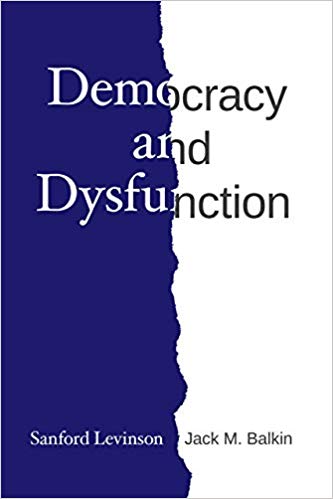
Sanford Levinson and Jack M. Balkin, Democracy and Dysfunction (University of Chicago Press, 2019)

Sanford Levinson, Written in Stone: Public Monuments in Changing Societies (Duke University Press 2018)

Mark A. Graber, Sanford Levinson, and Mark Tushnet, eds., Constitutional Democracy in Crisis? (Oxford University Press 2018)

Gerard Magliocca, The Heart of the Constitution: How the Bill of Rights became the Bill of Rights (Oxford University Press, 2018)

Cynthia Levinson and Sanford Levinson, Fault Lines in the Constitution: The Framers, Their Fights, and the Flaws that Affect Us Today (Peachtree Publishers, 2017)

Brian Z. Tamanaha, A Realistic Theory of Law (Cambridge University Press 2017)

Sanford Levinson, Nullification and Secession in Modern Constitutional Thought (University Press of Kansas 2016)

Sanford Levinson, An Argument Open to All: Reading The Federalist in the 21st Century (Yale University Press 2015)

Stephen M. Griffin, Broken Trust: Dysfunctional Government and Constitutional Reform (University Press of Kansas, 2015)

Frank Pasquale, The Black Box Society: The Secret Algorithms That Control Money and Information (Harvard University Press, 2015)

Bruce Ackerman, We the People, Volume 3: The Civil Rights Revolution (Harvard University Press, 2014)
Balkinization Symposium on We the People, Volume 3: The Civil Rights Revolution

Joseph Fishkin, Bottlenecks: A New Theory of Equal Opportunity (Oxford University Press, 2014)

Mark A. Graber, A New Introduction to American Constitutionalism (Oxford University Press, 2013)

John Mikhail, Elements of Moral Cognition: Rawls' Linguistic Analogy and the Cognitive Science of Moral and Legal Judgment (Cambridge University Press, 2013)

Gerard N. Magliocca, American Founding Son: John Bingham and the Invention of the Fourteenth Amendment (New York University Press, 2013)

Stephen M. Griffin, Long Wars and the Constitution (Harvard University Press, 2013)

Andrew Koppelman, The Tough Luck Constitution and the Assault on Health Care Reform (Oxford University Press, 2013)

James E. Fleming and Linda C. McClain, Ordered Liberty: Rights, Responsibilities, and Virtues (Harvard University Press, 2013)
Balkinization Symposium on Ordered Liberty: Rights, Responsibilities, and Virtues

Andrew Koppelman, Defending American Religious Neutrality (Harvard University Press, 2013)

Brian Z. Tamanaha, Failing Law Schools (University of Chicago Press, 2012)

Sanford Levinson, Framed: America's 51 Constitutions and the Crisis of Governance (Oxford University Press, 2012)

Linda C. McClain and Joanna L. Grossman, Gender Equality: Dimensions of Women's Equal Citizenship (Cambridge University Press, 2012)

Mary Dudziak, War Time: An Idea, Its History, Its Consequences (Oxford University Press, 2012)

Jack M. Balkin, Living Originalism (Harvard University Press, 2011)

Jason Mazzone, Copyfraud and Other Abuses of Intellectual Property Law (Stanford University Press, 2011)

Richard W. Garnett and Andrew Koppelman, First Amendment Stories, (Foundation Press 2011)

Jack M. Balkin, Constitutional Redemption: Political Faith in an Unjust World (Harvard University Press, 2011)

Gerard Magliocca, The Tragedy of William Jennings Bryan: Constitutional Law and the Politics of Backlash (Yale University Press, 2011)

Bernard Harcourt, The Illusion of Free Markets: Punishment and the Myth of Natural Order (Harvard University Press, 2010)

Bruce Ackerman, The Decline and Fall of the American Republic (Harvard University Press, 2010)
Balkinization Symposium on The Decline and Fall of the American Republic

Ian Ayres. Carrots and Sticks: Unlock the Power of Incentives to Get Things Done (Bantam Books, 2010)

Mark Tushnet, Why the Constitution Matters (Yale University Press 2010)

Ian Ayres and Barry Nalebuff: Lifecycle Investing: A New, Safe, and Audacious Way to Improve the Performance of Your Retirement Portfolio (Basic Books, 2010)
.jpg)
Jack M. Balkin, The Laws of Change: I Ching and the Philosophy of Life (2d Edition, Sybil Creek Press 2009)

Brian Z. Tamanaha, Beyond the Formalist-Realist Divide: The Role of Politics in Judging (Princeton University Press 2009)
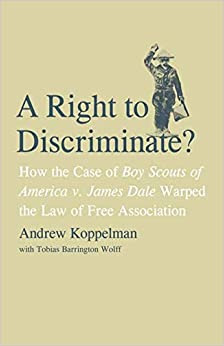
Andrew Koppelman and Tobias Barrington Wolff, A Right to Discriminate?: How the Case of Boy Scouts of America v. James Dale Warped the Law of Free Association (Yale University Press 2009)

Jack M. Balkin and Reva B. Siegel, The Constitution in 2020 (Oxford University Press 2009)

Heather K. Gerken, The Democracy Index: Why Our Election System Is Failing and How to Fix It (Princeton University Press 2009)

Mary Dudziak, Exporting American Dreams: Thurgood Marshall's African Journey (Oxford University Press 2008)

David Luban, Legal Ethics and Human Dignity (Cambridge Univ. Press 2007)

Ian Ayres, Super Crunchers: Why Thinking-By-Numbers is the New Way to be Smart (Bantam 2007)

Jack M. Balkin, James Grimmelmann, Eddan Katz, Nimrod Kozlovski, Shlomit Wagman and Tal Zarsky, eds., Cybercrime: Digital Cops in a Networked Environment (N.Y.U. Press 2007)

Jack M. Balkin and Beth Simone Noveck, The State of Play: Law, Games, and Virtual Worlds (N.Y.U. Press 2006)

Andrew Koppelman, Same Sex, Different States: When Same-Sex Marriages Cross State Lines (Yale University Press 2006)

Brian Tamanaha, Law as a Means to an End (Cambridge University Press 2006)

Sanford Levinson, Our Undemocratic Constitution (Oxford University Press 2006)

Mark Graber, Dred Scott and the Problem of Constitutional Evil (Cambridge University Press 2006)

Jack M. Balkin, ed., What Roe v. Wade Should Have Said (N.Y.U. Press 2005)

Sanford Levinson, ed., Torture: A Collection (Oxford University Press 2004)
Balkin.com homepage
Bibliography
Conlaw.net
Cultural Software
Writings
Opeds
The Information Society Project
BrownvBoard.com
Useful Links
Syllabi and Exams
