Balkinization
an unanticipated consequence of
Jack M. Balkin
Balkinization Symposiums: A Continuing List
E-mail:
Jack Balkin:
jackbalkin at yahoo.com
Bruce Ackerman
bruce.ackerman at yale.edu
Ian Ayres
ian.ayres at yale.edu
Corey Brettschneider
corey_brettschneider at brown.edu
Mary Dudziak
mary.l.dudziak at emory.edu
Joey Fishkin
joey.fishkin at gmail.com
Heather Gerken heather.gerken at yale.edu
Abbe Gluck abbe.gluck at yale.edu
Mark Graber
mgraber at law.umaryland.edu
Stephen Griffin
sgriffin at tulane.edu
Jonathan Hafetz
jonathan.hafetz at shu.edu
Jeremy Kessler
jkessler at law.columbia.edu
Andrew Koppelman
akoppelman at law.northwestern.edu
Marty Lederman
msl46 at law.georgetown.edu
Sanford Levinson
slevinson at law.utexas.edu
David Luban
david.luban at gmail.com
Gerard Magliocca
gmaglioc at iupui.edu
Jason Mazzone
mazzonej at illinois.edu
Linda McClain
lmcclain at bu.edu
John Mikhail
mikhail at law.georgetown.edu
Frank Pasquale
pasquale.frank at gmail.com
Nate Persily
npersily at gmail.com
Michael Stokes Paulsen
michaelstokespaulsen at gmail.com
Deborah Pearlstein
dpearlst at yu.edu
Rick Pildes
rick.pildes at nyu.edu
David Pozen
dpozen at law.columbia.edu
Richard Primus
raprimus at umich.edu
K. Sabeel Rahmansabeel.rahman at brooklaw.edu
Alice Ristroph
alice.ristroph at shu.edu
Neil Siegel
siegel at law.duke.edu
David Super
david.super at law.georgetown.edu
Brian Tamanaha
btamanaha at wulaw.wustl.edu
Nelson Tebbe
nelson.tebbe at brooklaw.edu
Mark Tushnet
mtushnet at law.harvard.edu
Adam Winkler
winkler at ucla.edu
Compendium of posts on Hobby Lobby and related cases
The Anti-Torture Memos: Balkinization Posts on Torture, Interrogation, Detention, War Powers, and OLC
The Anti-Torture Memos (arranged by topic)
Recent Posts
Dean David Levi's Response to the New York Times
Constitutional Theory is Like Toothpaste
Is Constitutional Theory Like Toothpaste?
A Reply to Jack
Why Sigh . . . . About Originalism?
Sigh . . . Originalism
Unconditional Bailouts: Capitalism’s Undoing
Bread, Freedom and Social Justice
Gary Jeffrey Jacobsohn on “Rights and American Constitutional Identity”
An Invitation to the Editorial Board of The New York Times
Understanding Wealth Defense: Direct Action from the 0.1%
Reforming legal education
A Growing 'Civilian-Military' Gap, and its Consequences
David Segal on Law Schools: A Note on the Published Correction
Politics, Cognition and "Pepper" Spray
The Last Days of Laissez-Faire
Our notably unpardoning President
The Responsibility of Yale Law School for the Rise of Tuition Nationwide--And What It Can do to Help
New York Times Financial Advice: Be an Unpaid Intern Through Your 20s (Then Work till You're 100)
David Segal on Law Schools
Constitutional Email
![[Powered by Blogger]](https://lh3.googleusercontent.com/blogger_img_proxy/AEn0k_t7__VV9m78Ahk2g5k4_XoIMQbd7sg2urZPKcSCTkPzHVPVfLMoQk8RbSBSoaGocHZcSWkQhjVHuKpKNpdcmZRYKy79SN0rFjdpkbn9Wug_=s0-d)
Just A Few Blogs
ACS Blog
Alas, a Blog
Althouse
Arts and Letters Daily
Atrios (Eschaton)
Bill of Health
Buzzflash.com
Buzz Machine
Cato at Liberty
Juan Cole (Informed Comment)
Concurring Opinions
The Constitution in 2020
Corrente
Crooked Timber
Daily Howler
Daily Kos
Dana Boyd
Brad DeLong
Digby (Hullabaloo)
Discriminations
Daniel Drezner
Kevin Drum (Mother Jones)
Electrolite
En Banc
Eunomia (Daniel Larison)
Fafblog
Michael Froomkin (Discourse.net)
GovLab (Beth Noveck)
Rick Hasen (Election Law)
History News Network
How Appealing
Ignatz (Sam Heldman)
The Importance of (Ernie Miller)
Infolaw
Instapundit
International Economic Law and Policy Blog
IntLawGrrls
Jacob Levy
Jesus' General
Jurisdynamics
The Kitchen Cabinet
Mark Kleiman
Law Blog Central
Larry Lessig
Lawyers, Guns and Money
Liberal Oasis
Brian Leiter's Law School Reports
The Leiter Reports
Marginal Revolution
Megan McArdle
Memeorandum
Metafilter
Mirror of Justice
The New Republic
Newseum
No More Mister Nice Blog
Brendan Nyhan
Opinio Juris
Orcinus
The Originalism Blog
Pandagon
Passport (Foreign Policy)
Overcoming Bias
Political Animal (Washington Monthly)
Political Theory Daily Review
Political Wire (Taegan Goddard)
The Poor Man
Virginia Postrel
Prawfsblawg
Public Reason
Jonathan Rauch
Raw Story
Redstate
ReligiousLeftLaw.com
Reporters Committee For Freedom of the Press
Reproductive Rights Blog
Rothman's Roadmap to the Right of Publicity
SCOTUS Blog
Seeing the Forest
Clay Shirky
The Shifted Librarian
The Situationist
Larry Solum (Legal Theory)
Andrew Sullivan
Talking Points Memo
Talk Left
Tapped
Tbogg
TechPresident
The Paper Chase (Jurist)
Tom Paine
Tom Tomorrow (This Modern World)
Eve Tushnet
Uggabugga
University of Chicago Law School Faculty Blog
Unqualified Offerings
The Volokh Conspiracy
War and Piece (Laura Rozen)
Wampum
Oliver Willis
Wonkette
Written Description
Matthew Yglesias
Yin
Your Choice of Feeds
1. XML
powered by

2. Atom Feed
3. RSS 2.0
Dean David Levi's Response to the New York Times
Neil Siegel
I have read with great interest the several recent posts responding to a news article and an editorial in the New York Times on the state of legal education in America. Dean David Levi of Duke Law School recently wrote a letter to the editor of the Times on this subject, which the paper did not print. He has given me permission to post it here:David Segal’s article, “Law Schools That Teach Little About Legal Practice,” addresses an important topic but misses the mark at least as it purports to describe the top schools. After 25 years as a prosecutor and a United States District Judge, I came to Duke Law School in 2007 as dean. I was astonished by the breadth and depth of the curriculum. Since I graduated from law school in 1980, the best law schools have hugely extended their curricula to provide a broad range of experiential, professional skills education as well as to address the complexity of modern legal problems, problems whose solutions often call for an understanding of other fields like economics or finance, or require understanding of other legal systems. Law schools now provide multiple opportunities to their students to represent real clients, draft contracts, appear in court, prepare motions, and settle cases. They offer courses on negotiation, “deals skills,” the business of law practice, international arbitration, and electronic discovery. Courses like these provide an introduction to law practice and are highly motivating for many students; they cannot, and are not intended to, substitute for the skills training and mentoring that the best law firms and government offices must continue to provide to new lawyers.
Just as law practice has changed, so have the law schools. The law school of today is not the law school of The Paper Chase or of Christopher Langdell. But some things have not changed, and we should be glad of it. The faculties of the top schools include leading scholars whose work engages with some of the most important legal problems facing the country and the world, from human rights to regulation of the financial markets, from constitutional interpretation to corporate criminal liability. It is still one of the finest educations in careful and precise thinking, writing, and speaking that can be found anywhere. And it is still a place where some of America’s finest young men and women receive a traditional education in law that prepares them for leadership of a profession and a nation.
David F. Levi
Dean and Professor of Law
Duke University School of Law
Posted
7:06 PM
by Neil Siegel [link]
Constitutional Theory is Like Toothpaste
Gerard N. Magliocca
We have now found the heart of our disagreement. Jack and some other scholars view originalism (in its more expansive form) as an interpretive theory that is doing meaningful work. I believe, by contrast, that it is now just a brand name that is getting close to becoming a generic term for interpretation. Indeed, originalism may be the most powerful brand ever developed by constitutional theory, which explains why it is being embraced by so many and why it is probably inevitable that it will lose its distinctiveness.
Let me start by saying that I think there is virtually no difference between how Jack and I would approach a constitutional issue, though we would not always agree on the result. He says that he is an originalist. I say that I am not. Does that matter? Well, I suppose not, though I prefer to define my approach rather than having it defined by others.
The more relevant point is that it's getting harder to know what originalism is. Jack is correct to say that not everything can be called originalist. As he points out in his book, if a court says that each state gets four senators, that would not be an originalist interpretation under any definition. Since everybody knows that, though, that isn't helpful to me. Moreover, I think that Jack is wrong when he says that Ronald Dworkin and David Strauss cannot be called originalists under the current meaning of that term. Presumably, they also think that we are bound by the original public meaning of the "hard-wired" constitutional provisions. They just disagree on how we should interpret the original principles that are in the text (such as due process, equal protection, and the Ninth Amendment). Of course, they would not call themselves originalists. And there are important differences between what they do and what many self-professed originalists do. But are they clearly not originalists nowadays? I don't think so.
There is an analogy here to what happens with great constitutional cases. At first, the contest is over whether the case was correctly decided. Eventually, though, a case becomes settled law and the debate turns to a fight over the meaning of that case. Everyone today, for example, thinks Brown is right. They do not agree, though, about what Brown means. Is that a bad thing? Not necessarily, though some might say that the invocation of Brown to support certain results is misleading. The same could be said for originalism. Are we better off with a broad originalist umbrella or a narrow one? Both can work. Instead of "originalism" versus "living constitutionalism," we have "living originalism" versus "expected application originalism." Why is the latter the way things are headed?
The answer is that more and more people are now convinced that originalism (whatever that actually means) is the right way to interpret the Constitution. This is a lasting legacy of the conservative legal movement, and is a subject on which Jamal Greene has done some terrific research. But does that branding improve our understanding of the Constitution?
This will be my last post on this thread (largely because I won't have much time for blogging in the next few days). I do want to close by saying that I have tremendous respect for Jack's work in this area despite my dissent to some of his conclusions. As a wise judge told me many years ago, even the best dissent just means that you failed to persuade the majority.
Posted
1:57 PM
by Gerard N. Magliocca [link]
(38) comments
Is Constitutional Theory Like Toothpaste?
JB
Gerard's last post helpfully clarifies our disagreement. He writes: "there is considerable value in retaining a sharp distinction between constitutional theories. . . It just seems to me that once anything can be labelled as originalist, then that term is no longer useful and may just obscure the truth."
I agree with Gerard about the importance of conceptual clarity. But I do not agree that his diagnosis of our current situation is accurate. I do not agree that currently *anything* can be labeled as originalist. And I certainly do not agree that unless we adopt Gerard's definition, anything can be labelled originalist.
Read more »
Posted
8:55 AM
by JB [link]
A Reply to Jack
Gerard N. Magliocca
I want to respond briefly to Jack's post, though I would like to think more deeply about his points over the next day or two. It is true that I am not an originalist, and it is also true that Jack's account of originalism is gaining traction in the academy. Now he asks why I should care about what originalism is (at least before I convert to the true faith).
The answer draws from Pam Karlan's observation that originalism is undergoing a form of genericide. In trademark law, a brand becomes generic if it comes to refer to the class of goods itself (e.g., aspirin used to be a mark for the product and now just is the product). That's harmful primarily to the brand owner that loses its powerful trademark rights, but it could also be harmful to the public by robbing it of a clear differentiation between products. (Indeed, courts have been hesitant in recent years to declare an established mark generic.)
Personally, I think that there is considerable value in retaining a sharp distinction between constitutional theories (Practice is a different matter, since courts almost never use a consistent theory.) It just seems to me that once anything can be labelled as originalist, then that term is no longer useful and may just obscure the truth. Perhaps my desire for conceptual clarity is a fool's errand, as Tom Colby's work establishes that the definition of originalism has never been stable. I'm not convinced, though, that I am wrong. Alas, as it is after midnight, I am convinced that I'm done for the night.)
If you'd like to read Pam's essay that addresses this issue, here is the link
Posted
11:39 PM
by Gerard N. Magliocca [link]
(10) comments
Why Sigh . . . . About Originalism?
JB
Gerard's post Sigh . . . Originalism proposes a test for what should properly termed originalism: "an argument is originalist only if the application of the text under consideration was contemplated by somebody at the time the provision was ratified."
But Gerard is not himself an originalist. So why is it valuable for a non-originalist to tell originalists who is authentic and who is not? This would be a little like a Jew telling various sects of Christianity which are *really* Christian and which are merely poseurs. Why does he have a dog in this particular fight?
Read more »
Posted
11:15 PM
by JB [link]
Sigh . . . Originalism
Gerard N. Magliocca
Richard Nixon once said that "we are all Keynesians now," and constitutional theory is approaching the point where we are will all be originalists. Steve Calabresi is the co-author of a forthcoming article claiming that gender discrimination violates the original understanding of the Fourteenth Amendment. Jack defends the Court's abortion decisions as an originalist reading of the same amendment. Michael McConnell claims that racial segregation was contrary to the original understanding (and so on). No doubt someone will soon tell us that a decision upholding the individual mandate is originalist.
I'd like to propose a simple test for originalism--an argument is originalist only if the application of the text under consideration was contemplated by somebody at the time the provision was ratified. For this definition to work, one would have to distinguish between "weak" originalism (not many people at the time read the provision that way) and "strong" originalism (lots of people did). For example, some people did say in the 1860s that the Fourteenth Amendment applied to laws discriminating against women. As far as I know, nobody in 1791 said that the Cruel and Unusual Punishments Clause prohibited the death penalty. The former could be an originalist interpretation; the latter cannot.
If there was a dispute over whether a particular application was covered, then the inquiry should turn to why the decision was made. For example, why did the Framers of the Fourteenth Amendment insist that women were not covered? Was that view based on their understanding of gender differences? On background law? On what the rest of the world was doing? If those premises were incorrect and an alternative interpretation by others making different assumptions was offered back then, a court would, in my opinion, be justified in embracing the minority view as the best originalist interpretation.
There are the usual difficulties with this approach. It still relies (though less so) on the original expected application of the text, which some (notably Jack) see as the wrong way of attacking the problem. It still presents the problem of how to define the level of generality in the analysis. (Is the proper approach to abortion that nobody mentioned it in 1868, or should it be considered an example of gender discrimination, which was discussed?).
My test, though, would do two useful things. First, it would put a meaningful limit on originalism. And second, it would allow originalists to support developments in modern constitutional law that are very popular with the American people.
Posted
8:28 AM
by Gerard N. Magliocca [link]
(18) comments
Unconditional Bailouts: Capitalism’s Undoing
Frank Pasquale
What are we to make of Bob Ivry, Bradley Keoun and Phil Kuntz's blockbuster report on the Fed's bailouts? The three journalists conclude that "taxpayers paid a price beyond dollars as the secret funding helped preserve a broken status quo and enabled the biggest banks to grow even bigger." Yves Smith argues that "banks lied" and grabbed $13 billion in profit. She also notes that their favorite water carrier, Timothy Geithner, "told Congressmen they were too stupid to be able to shrink banks, and they should leave those questions to the Basel Committee (which has no interest in making big banks smaller)."
For another perspective on the corrupt relationship between megabanks and our central bank, consider John Kay's recent description of the "martingale" strategy among bettors: Each time you lose, you increase your stake: to the point at which a win on the next game would recoup all your losses and leave you ahead. Since you will win sooner or later, you are certain to come home with a small profit. Provided you are infinitely rich before you start. Otherwise, if you regularly engage in martingales, you will eventually go bankrupt – and the richer you are, the larger the scale of bankruptcy.
Read more »
Posted
9:07 AM
by Frank Pasquale [link]
(2) comments
Bread, Freedom and Social Justice
Guest Blogger
Nagla Rizk
When we stormed the streets last January, we chanted “Aish, Horreya, Adala Egtema’eya” (“Bread, Freedom, Social Justice”). We knew exactly what we wanted: a better livelihood for all. At the time, Egypt was experiencing high rates of economic “growth”, a superficial sign of positive economic performance that did not trickle down to the masses. Part corruption part inaction, a 4-5% (or even the earlier 7%) growth rate was by itself meaningless as it did nothing to alleviate poverty or ease the merciless income inequality.
Equally serious was the iron grip on freedom of expression. In a typical Arab regime manner, Egypt focused on encouraging economic freedoms in the strictest neoclassical sense, while simultaneously continuing to harshly stifle political freedoms. Not surprisingly, Egypt fared relatively well on indices of doing business, while performed dismally on democracy and freedom indices.
The January chant, therefore, was a fierce cry against this asymmetry. More deeply, it was a cry for real development, one encompassing freedom of expression coupled with poverty alleviation and better income distribution. The cry of the masses reflected a street awareness of the complexity of development as human dignity and active citizenry -- an enlightenment that the ruling elite lacked.
Ten months down the road, yesterday we chanted in Tahrir, “Aish, Horreya, Adala Egtema’eya” (“Bread, Freedom, Social Justice”). Why?
Read more »
Posted
4:42 PM
by Guest Blogger [link]
Gary Jeffrey Jacobsohn on “Rights and American Constitutional Identity”
Ken Kersch
For those interested in the constitutional understandings of one of the leading political scientists (and constitutional comparativists) writing in the field, the journal Polity has just posted a podcast interview I did with Gary Jeffrey Jacobsohn, the H. Malcolm McDonald Professor of Constitutional and Comparative Law in the Government Department at the University of Texas-Austin.
In the interview, I talk with Gary about his lead article in Polity's October 2011 edition, “Rights and American Constitutional Identity” “(the article is currently available, free, for a limited time, on the Polity website).
Gary is also the author, most recently, of Constitutional Identity (Harvard, 2010), and, previously, of comparative studies of the constitutional dynamics of the U.S., Israel, and India.
Posted
1:32 PM
by Ken Kersch [link]
An Invitation to the Editorial Board of The New York Times
Jason Mazzone
I extend to the members of the editorial board of The New York Times an invitation: come to the law school where I teach and I'll show you around.
Posted
5:12 PM
by Jason Mazzone [link]
Understanding Wealth Defense: Direct Action from the 0.1%
Frank Pasquale
The OWS protests have provoked reflection on the morality of direct action and civil disobedience. How far should the police go to spy on, disrupt, or punish peaceful protesters? Is pepper spray a dangerous chemical agent or "a food product, essentially?" Does current American inequality merit a direct action follow-up to the Civil Rights Movement, whose mass-arrestees and water-cannoned marchers are now viewed as heroes?
It's difficult to answer these questions without understanding the past and present tactics of the groups OWS is protesting. We can learn something about those tactics from Jeffrey A. Winters' book Oligarchy and his recent articles. In Winters' treatment of America's politics of wealth defense, we can discern a transition from high-stakes defiance of government tax authority to an established position "inside the system."
Winters recounts how Congress passed a tax on the top 0.1% in 1894, only to be slapped down by a Supreme Court "which struck it down in a 5-4 decision." After the 16th Amendment effectively repealed that Supreme Court decision, Congress had the novel idea of actually helping pay for a war (WWI) with revenue from those best able to fund it. As Winters notes, "the highest rate [leapt] from 7 percent in 1915 to 77 percent in 1918," and "the number of brackets went from seven to 56 over the same period." This provoked direct action from the wealthiest "through tax avoidance and outright evasion." At this point, Winters writes,
Read more »
Posted
10:14 AM
by Frank Pasquale [link]
Reforming legal education
Sandy Levinson
The New York Times has an editorial in tomorrow's (Saturday, Nov. 26) paper on reforming legal education. The key sentences, I think, are the following:In American law schools, the choice is not between teaching legal theory or practice; the task is to teach useful legal ideas and skills in more effective ways. The case netgid has been the foundation of legal education for 140 years. Its premise was that students would learn legal reasoning by studying appellate rulings. That approach treated law as a form of science and as a source of truth.
That vision was dated by the 1920s. It was a relic by the 1960s. Law is now regarded as a means rather than an end, a tool for solving problems.
There is, of course, much truth in this critique. But the problem that the Times doesn't really address--how could it?--is what counts as "legal reasoning" at all. If law is simply "a means rather than an end, a tool for solving problems," then why not encourage students to attend the Kennedy or Johnson schools? What, indeed, is the "value added" of legal education in terms of problem solving? Certainly, anyone who has a professional duty to teach the work product of the current majority of the United States Supreme Court doesn't see anything close to a "problem solving" temperament, and the endless casecrunching (of both sides) seems to suggest that appellate rulings are indeed "a source of truth." I wonder if the Times editorial writer would be satisfied if, say, Judge Richard Posner and Justice Steven Breyer, the leading "pragmatists" on the bench, were put in charge of re-designing the curriculum, together with practicing lawyers, like, say, Brian Stevenson and Steven Bright, leading anti-capital punishment lawyers of this generation (who might enlist, say, my colleague Jordan Steiker, who helps to run a capital punishment clinic at the University of Texas Law School that has had notable success).
I really don't mean to be snarky. The Times editorial raises an important point that has been made at least since 1897, with Holmes's speech on The Path of the Law. But it is notably lacking in details (which one really can't expect from a short editorial). And it might be worth pointing out that the three law schools I'm most familiar with, Harvard, Yale, and the University of Texas, all have many clinics devoted to doing exactly what the Times says needs to be done.
My own suggestion is that the monopoly on access to becoming a lawyer held by the ABA and law schools shold be broken and that one should be able to get a certificate in several basic areas of legal practice, e.g., uncontested divorces, simple wills, basic landlord-tenant, without having to invest in three years of legal education that will indeed be largely irrelevant. Milton Friedman had much to say about such issues.
Posted
11:49 PM
by Sandy Levinson [link]
(6) comments
A Growing 'Civilian-Military' Gap, and its Consequences
Mary L. Dudziak
"A smaller share of Americans currently serve in the U.S. Armed Forces than at any time since the peace-time era between World Wars I and II," according to a new report from the Pew Research Center (hat tip New York Times).
During the past decade, as the military has been engaged in the longest period of sustained conflict in the nation’s history, just one-half of one percent of American adults has served on active duty at any given time.1 As the size of the military shrinks, the connections between military personnel and the broader civilian population appear to be growing more distant.
The data reveals is "a large generation gap." According to the report, "more than three-quarters (77%) of adults ages 50 and older said they had an immediate family member –a spouse, parent, sibling or child – who had served in the military." In contrast, for people under 50, "57% of those ages 30-49 say they have an immediate family member who served. And among those ages 18-29, the share is only one-third."
Military service is now more concentrated in certain families: "Veterans are more than twice as likely as members of the general public to say they have a son or daughter who has served (21% vs. 9%)." And overall, what the report calls a "military-civilian gap" is more pronounced among younger people.
This suggests that the gap between veterans and the general public in the share that has family connections to the military may be a relatively new phenomenon. With the shrinking size of the military in recent decades there are now fewer connections between the military and the civilian world. This is reflected in the relatively small share of young adults (39%) with an immediate family member who has served in the armed forces.
The Pew report suggests that various political opinions are correlated with connections to family members who have served in the military, but there are deeper implications of the disconnect between Americans and American war-making. The more distant and isolated Americans are from their nation's wars, the less they are politically engaged with American war policy.
Legal scholars argue on this blog and elsewhere that the tendency of presidents to initiate military action without congressional authorization can only be reined in if Congress insists on playing its constitutional role. But Congress will never play a more meaningful role in American war politics if the people aren't engaged. The Pew Report helps us to see what appears to be a growing distance from the costs of war, potentially reinforcing contemporary political disengagement.
In my new book, War Time: An Idea, Its History, Its Consequences, I take up this point in the Conclusion:
In Iraq and Afghanistan, war...spread across borders as American drones fired on targets in Pakistan and elsewhere. Death and destruction were the province of soldiers and of peoples in faraway lands. The experience of wartime for most Americans largely devolved to encounters between travelers and airport screeners, as the Transportation Security Administration adopted intrusive new practices. At home, wartime had become a policy rather than a state of existence....
I argue that keeping the war powers in check requires a politics of war, and that requires a citizenry attentive to the exercise of military power. Our ideas about "wartime" play a role in the current disconnect, as a cultural framing of wartimes as discrete and temporary occasions, destined to give way to a state of normality, undermines democratic vigilance over on-going wars.
As war goes on, Americans have lapsed into a new kind of peacetime. It is not a time without war, but instead a time in which war does not bother everyday Americans.
As Americans become more isolated from the costs of war, military engagement no longer seems to require the support of the American people. Their disengagement does not limit the reach of American military action, but enables its expansion.
Cross-posted from War Time.
Posted
9:17 AM
by Mary L. Dudziak [link]
David Segal on Law Schools: A Note on the Published Correction
Jason Mazzone
On Saturday evening I posted a response to David Segal's article in The New York Times on legal education. One of my points was that Segal didn't seem to know much about the law given his complaint that criminal procedure involved "case studies of common law crimes — like murder and theft" rather than training in plea bargaining. The Times has now revised Segal's article to substitute criminal law for criminal procedure and the following statement accompanies the online version of the article: "An article on Sunday about the emphasis on theoretical over practical learning in law schools misidentified a first-year course about common law crimes. It is Criminal Law, not Criminal Procedure."
Posted
9:56 PM
by Jason Mazzone [link]
Politics, Cognition and "Pepper" Spray
Dan Kahan
Does “pepper spray” really hurt? The answer probably depends on the relationship between the ideology of the person who was sprayed and the ideology of the person asking/answering the question. There is an internet buzz emerging over the suggestion by Fox news commentators & equivalent that “pepper” spray (it’s orders of magnitude more irritating than habanero) isn't all that painful. The debate is politically polarized along predictable lines. If the demonstrators who were sprayed had been protesting abortion rights outside an abortion clinic, would there be an ideological inversion of the perceptions of how much the spray stings? The answer is that we are unlikely even to get to that point in the discussion before we are already tied in knots over other facts relating to the behavior of the protesters and the police.
Posted
10:37 AM
by Dan Kahan [link]
The Last Days of Laissez-Faire
Ken Kersch
Spirited laissez-faire arguments peppered the media and other popular outlets in the decades leading up to the New Deal. These in many ways anticipate those now being used by the Tea Party and others on the contemporary Right.
Those interested in these dire, anti-(big) government warnings from a century ago – and their similarities and differences from the warnings issuing from the modern Right -- might enjoy historian Maxwell Bloomfield’s engaging study Peaceful Revolution: Constitutional Change and American Culture from Progressivism to the New Deal (Harvard University Press, 2000).
Bloomfield’s book is probably more relevant now than when it was published back in 2000 -- and is well worth a look for anyone interested in the country's current constitutional politics.
Posted
9:31 AM
by Ken Kersch [link]
Our notably unpardoning President
Sandy Levinson
Justin Smith, a philoosphy professor from Montreal, has an excellent posting on the New York Times web site denouncing the "parody" of mercy by which President Obama will shortly "pardon" a turkey, who will therefore be allowed to live. Smith notes the fact that the United States is almost unique among the self-proclaimed "enlightened" countries of the world in its use of the death penalty. Rick Perry, of course, garnered huge applause from telling a Republican audience that he has let literally dozens of prisoners go to their deaths without his exercising his gubernatorial prerogative even to delay the sentence for 30 days. (Pardons and commutations are in the hands of a separate pardoning board in Texas.) This included his sending to death a very-likely innocent man who had been railroaded by junk-science testimony about arson, and Perry thereafter torpedoed a a post-execution attempt to find out the full facts. Moreover, Mitt Romney has publicly praised himself for never once using his own authority as Massachusetts governor to pardon anyone.
The sad fact is, however, that Barack Obama is little better. He has been notably non-compassionate in his use of presidential pardoning power. President Obama did not issue his first pardon until December 2, 2010, a full 682 days into his presidency. This puts him in third place (behind only George Washington and George W. Bush) in his hesitancy to pardon. There were, of course, exceedingly few federal laws to violate at the time of the Washington Administration, and he in fact had the grace and good sense to pardoned those convicted of treason in the Whiskey Rebellion in Pennsylvania. As the New York Times emphasized in its story on the Obama pardons, the recipients had committed only “small-scale” offenses many years ago that garnered most of them only sentences of probation. One might contrast our last two presidents with Harry Truman, who issued his first pardon eight days after succeeding to the presidency; Woodrow Wilson, who took nine days to issue his first pardon; and John F. Kennedy, who granted his first pardon nineteen days after his inauguration in 1961. Barack Obama should be ashamed. Perhaps he might emulate Washington's sensitivity vis-a-vis the participants in the Whiskey Rebellion by commuting (though not pardoning) John walker Lindh, who is serving a brutally long sentence that was agreed to to avoid the possibilty of a death penalty as part of the initial hysteria of 2001. I won't hold my breath. Perhaps he will demonstrate some compassion in January 2013 or 2017, depending on the results of the election, when it will be "safe" for him to do so. In any event, one might hope he would avoid the shameful parody of showing mercy toward a turkey, selected entirely arbitrarily, as most of us (including myself) look forward to devouring millions of other turkeys on Thanksgiving.
Posted
11:46 AM
by Sandy Levinson [link]
(8) comments
The Responsibility of Yale Law School for the Rise of Tuition Nationwide--And What It Can do to Help
Brian Tamanaha
Yale Law Professors Akhil Reed Amar and Ian Ayres (a fellow Balkinization contributor) recently posted a thoughtful essay on Slate noting the problems with tuition and debt. Tuition at private law schools has more than doubled in real terms in the past quarter century, average debt among law graduates is approaching $100,000, many graduates are not getting jobs as lawyers, and many who do get lawyer jobs do not earn enough to manage their monthly loan payments. Their main proposal, which they are urging their dean to implement, is to encourage law schools to offer law students a one-half tuition rebate to drop out of law school after the first year. By then, students will know whether they are interested in a legal career and their likelihood of landing a decent-paying job.
That’s an easy offer for Yale to make, as Amar and Ayres acknowledge, because few Yale law students will take it. In addition, Yale already takes in plenty of transfer students at the end of the first year (about 10% of the class), which will allow it to easily recoup the cost of the handful of students who walk away with the one-half refund. Realistically speaking, few other law schools can afford to make such an offer.
If Yale law professors really want to make a difference for law students across the country, they must lobby their dean on the issue of tuition. Yale bears a direct responsibility for the rise in law school tuition noted by Professors Amar and Ayres at the outset of their piece.
First some numbers. From 1985 through 2009, resident tuition at public law schools increased by a staggering 820 percent—from $2,006 to $18,472 (non-resident tuition increased by 543 percent, from $4,724 to $30,413)—while tuition at private law schools went up by 375 percent—from $7,526 to $35,743. These increases far outstripped the rate of inflation. Had tuition merely kept pace with inflation, average resident tuition at public law schools today would be $3,945, less than a fourth of what it is, and average private school tuition would be $14,800, less than half of what it is. Law school would still be affordable if law schools had not extracted such a large premium over inflation.
Now let’s look at Yale. Tuition at Yale Law School was $12,450 in 1987; in 1999 it was $26,950; in 2011 it was $50,750—an increase of nearly $24,000 in just the last dozen years. Factoring in projected living expenses ($18,900), Yale students without scholarships (half of the class) who commenced their legal studies in 2010 will pay more than $200,000 to obtain their law degree. If the recent rate of increase continues, ten years hence tuition at Yale Law School will exceed $70,000 annually. That might sound impossible, but ten years ago many would have scoffed at the suggestion that that tuition at Yale would be $50,000 today.
Why is Yale law school responsible for the rise in tuition nationwide? As Henry Riggs, the former president of Harvey Mudd College, explains, “Tuition in the private higher-education industry is a classic example of price leadership—the ‘top players’ define the sticker price and all others follow suit.” Universities and law schools show the same pricing patterns: elite institutions charge the most, and others are priced below them in rough correlation with their ranking (with the exception that non-elite law schools in large legal markets are able to tack on a premium owing to their location). Tuition varies in relation to prestige—not costs—because the perceived value of the education affects how much students (and their parents) are willing to pay for it.
When Yale (and other uber-elites) raised its tuition each and every year by a significant amount, every other law school in the country rose as well under its wings. Law schools have raised their tuition every year because every other law school was doing the same, and students kept coming. Read more »
Posted
12:05 AM
by Brian Tamanaha [link]
(26) comments
New York Times Financial Advice: Be an Unpaid Intern Through Your 20s (Then Work till You're 100)
Frank Pasquale
Jason Mazzone has already addressed the main shortcomings of the latest N.Y. Times article by David Segal on law schools. I'd like to situate it as part of a neo-liberal ideology developing at the Times and other scriveners for the powerful.
If you pair the basic message of Segal's piece ("law students and professors aren't doing enough to raise corporate profits") with that of Ed Glaeser's anti-retirement musings in the same pages ("work into your 90s"), the ideology starts to emerge. Labor economist Mark Price pithily suggested it: Law schools couldn't possibly teach the wide range of firm specific skills that law firms need . . . . And yet you have a writer [pushing] propaganda that the big law firms are tired of paying for on the job training.
On the other hand it is at least comforting to know that law firms are not that different from firms in Manufacturing or Health Care[;] that is[,] they would prefer that somebody else pay for the skills that make them profitable.
This is a classic problem of uneven bargaining power familiar since the 1920s.* Why are wages falling while productivity is rising? Because firms realize they can fire current workers, shift their duties (unpaid) to frightened current employees, and reap the profits of having one person do the work of many. It's another form of "shadow work" that contributes to the time bind so many Americans find themselves in. When 65% of economic gains go to the top 1% of the population, it's not too hard to discern this dynamic.
Read more »
Posted
1:41 PM
by Frank Pasquale [link]
David Segal on Law Schools
Jason Mazzone
David Segal has an article in The New York Times called "What They Don’t Teach Law Students: Lawyering." The article rehashes some old complaints about legal education: law schools emphasize the theoretical over the useful; professors don't have practice experience and spend too much time writing law review articles; and employers have to train law school graduates before they can work for clients.
Posted
9:54 PM
by Jason Mazzone [link]
Constitutional Email
Ken Kersch
The Washington Post reported a few days ago on the heavy involvement of conservatives in the world of viral political chain emails.
I receive a fair number of these – passed on by my father – and so do my friends, passed on by either family or family friends. Many of these chain emails involve the Constitution and the Supreme Court, to the point where I suspect many people around the country, of all ages, are now getting influential lessons on the Constitution from these sources.
I’ll describe just a few that I’ve received from my father in the past year or so. I should say, by way of background, that, although my father is a life-long Republican, the tone of these is really out of synch with the longtime (now former?) tenor of his politics (until recently, he was a moderate Republican; he is a Jewish Long Islander, who, over the years, supported, amongst others, William Miller, Richard Nixon, Jacob Javits, and Nelson Rockefeller).
I received from him, for instance, an anti-New Deal editorial cartoon published in the Chicago Tribune in 1934, under the (original) header “Planned Economy or Planned Destruction?” (a little sleuthing revealed that the cartoon was drawn by Carey Orr (1890-1967), a front-page cartoonist for the Trib for nearly 50 years, a Pulitzer-Prize winner, and an indefatigable opponent of Franklin Roosevelt and the New Deal). Orr’s cartoon shows the FDR brain-truster Rexford Tugwell (in academic cap-and-gown) driving a horse cart holding several professors (also in caps and gowns, with a sign appended reading “Young Pinkies from Columbia and Harvard” [Obama attended both!]), along with Harold Ickes, Donald Richberg, and Henry Wallace, who are frantically shoveling bags of money off the back of the cart. Words on rear of the cart read: “Depleting the resources of the Soundest Government in the World.” Off to one side of the road, on the right, stands Joseph Stalin, remarking “How red the sunrise is getting!” On the left is a man who appears to be Leon Trotsky, insisting “It worked in Russia!” and scribbling a manifesto stating: “Plan of Action for the U.S.: SPEND! SPEND! SPEND! Under the guise of recovery – bust the government – blame the capitalists for the failure – junk the Constitution and declare a dictatorship.”
The chain email called the cartoon “a wake-up call for all of us!” and warned that “Those who forget history are doomed to repeat it.”
Another email in the style of a news report was headlined “Our New Dictator May Be in Deep Trouble… with Chief Justice John Roberts, U.S. Supreme Court.” The article opens: “According to sources who watch the inner workings of the federal government, a smack-down of Barack Obama by the U.S. Supreme Court may be inevitable.” The reporting begins “Ever since Obama assumed the office of President, critics have hammered him on a number of Constitutional issues. Critics have complained that much, if not all of Obama’s major initiatives run headlong into Constitutional roadblocks on the power of the federal government.” The article goes on to score Obama for “publicly declar[ing] war on the court” during his State of the Union Address [the noted incident in which Justice Alito mouthed “That’s not true.”] “even as [Obama] blatantly continued to propose legislation that flies in the face of every known Constitutional principle upon which this nation has stood for over 200 years.”
The article reports that Obama has identified Roberts as “his number one enemy.” But it then says that sources tell them that the Court has had enough, and is preparing to put a stop to Obama’s desecration of the Constitution. “Obamacare” is cited, as is “the Obama doctrine of open borders,” Obama’s eligibility for the office of the presidency (going well beyond the birth certificate controversy, we are told), along with Eric Holder’s Justice Department’s refusal to pursue the New Black Panther Party for preventing white people from voting, and for “calling for the murder of white people and their babies” (“This one is a biggie that could send the entire Administration crumbling – that is, if the Justices have the guts to draw a line in the sand at the Constitution and the Bill of Rights.”).
The email is labeled “a must read.”
I’ve also received a power-point tutorial on the (presumably) anti-gun control Second Amendment, and a list of rabidly anti-government quotes from Thomas Jefferson (some accurate, some not), and so on.
Apparently, inboxes are now a major site for “popular constitutionalism."
If my father’s attentiveness to these viral blasts is any indication, their influence (as you probably already suspected) has spread well beyond the fringe.
Posted
4:57 PM
by Ken Kersch [link]
Books by Balkinization Bloggers

Gerard N. Magliocca, The Actual Art of Governing: Justice Robert H. Jackson's Concurring Opinion in the Steel Seizure Case (Oxford University Press, 2025)

Linda C. McClain and Aziza Ahmed, The Routledge Companion to Gender and COVID-19 (Routledge, 2024)

David Pozen, The Constitution of the War on Drugs (Oxford University Press, 2024)

Jack M. Balkin, Memory and Authority: The Uses of History in Constitutional Interpretation (Yale University Press, 2024)
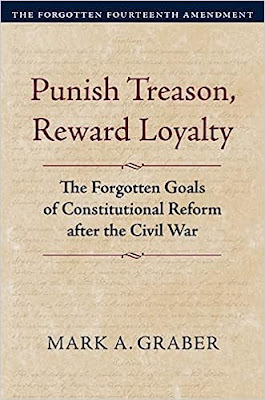
Mark A. Graber, Punish Treason, Reward Loyalty: The Forgotten Goals of Constitutional Reform after the Civil War (University of Kansas Press, 2023)
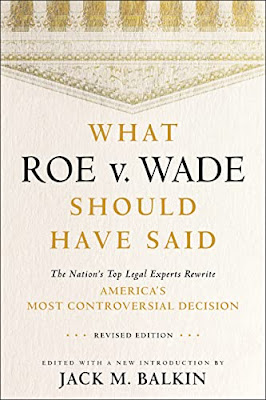
Jack M. Balkin, What Roe v. Wade Should Have Said: The Nation's Top Legal Experts Rewrite America's Most Controversial Decision - Revised Edition (NYU Press, 2023)

Andrew Koppelman, Burning Down the House: How Libertarian Philosophy Was Corrupted by Delusion and Greed (St. Martin’s Press, 2022)

Gerard N. Magliocca, Washington's Heir: The Life of Justice Bushrod Washington (Oxford University Press, 2022)
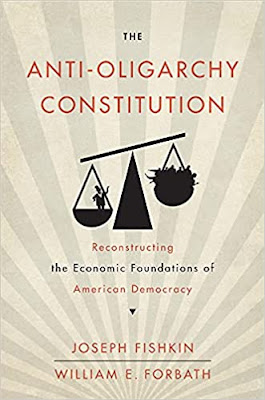
Joseph Fishkin and William E. Forbath, The Anti-Oligarchy Constitution: Reconstructing the Economic Foundations of American Democracy (Harvard University Press, 2022)
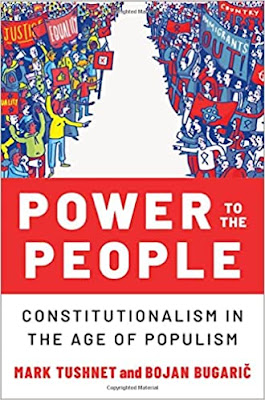
Mark Tushnet and Bojan Bugaric, Power to the People: Constitutionalism in the Age of Populism (Oxford University Press 2021).

Mark Philip Bradley and Mary L. Dudziak, eds., Making the Forever War: Marilyn B. Young on the Culture and Politics of American Militarism Culture and Politics in the Cold War and Beyond (University of Massachusetts Press, 2021).

Jack M. Balkin, What Obergefell v. Hodges Should Have Said: The Nation's Top Legal Experts Rewrite America's Same-Sex Marriage Decision (Yale University Press, 2020)

Frank Pasquale, New Laws of Robotics: Defending Human Expertise in the Age of AI (Belknap Press, 2020)

Jack M. Balkin, The Cycles of Constitutional Time (Oxford University Press, 2020)

Mark Tushnet, Taking Back the Constitution: Activist Judges and the Next Age of American Law (Yale University Press 2020).

Andrew Koppelman, Gay Rights vs. Religious Liberty?: The Unnecessary Conflict (Oxford University Press, 2020)

Ezekiel J Emanuel and Abbe R. Gluck, The Trillion Dollar Revolution: How the Affordable Care Act Transformed Politics, Law, and Health Care in America (PublicAffairs, 2020)

Linda C. McClain, Who's the Bigot?: Learning from Conflicts over Marriage and Civil Rights Law (Oxford University Press, 2020)
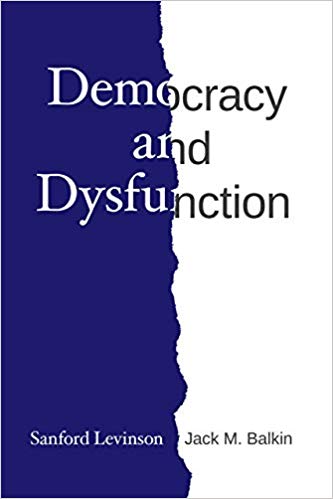
Sanford Levinson and Jack M. Balkin, Democracy and Dysfunction (University of Chicago Press, 2019)

Sanford Levinson, Written in Stone: Public Monuments in Changing Societies (Duke University Press 2018)

Mark A. Graber, Sanford Levinson, and Mark Tushnet, eds., Constitutional Democracy in Crisis? (Oxford University Press 2018)

Gerard Magliocca, The Heart of the Constitution: How the Bill of Rights became the Bill of Rights (Oxford University Press, 2018)

Cynthia Levinson and Sanford Levinson, Fault Lines in the Constitution: The Framers, Their Fights, and the Flaws that Affect Us Today (Peachtree Publishers, 2017)

Brian Z. Tamanaha, A Realistic Theory of Law (Cambridge University Press 2017)

Sanford Levinson, Nullification and Secession in Modern Constitutional Thought (University Press of Kansas 2016)

Sanford Levinson, An Argument Open to All: Reading The Federalist in the 21st Century (Yale University Press 2015)

Stephen M. Griffin, Broken Trust: Dysfunctional Government and Constitutional Reform (University Press of Kansas, 2015)

Frank Pasquale, The Black Box Society: The Secret Algorithms That Control Money and Information (Harvard University Press, 2015)

Bruce Ackerman, We the People, Volume 3: The Civil Rights Revolution (Harvard University Press, 2014)
Balkinization Symposium on We the People, Volume 3: The Civil Rights Revolution

Joseph Fishkin, Bottlenecks: A New Theory of Equal Opportunity (Oxford University Press, 2014)

Mark A. Graber, A New Introduction to American Constitutionalism (Oxford University Press, 2013)

John Mikhail, Elements of Moral Cognition: Rawls' Linguistic Analogy and the Cognitive Science of Moral and Legal Judgment (Cambridge University Press, 2013)

Gerard N. Magliocca, American Founding Son: John Bingham and the Invention of the Fourteenth Amendment (New York University Press, 2013)

Stephen M. Griffin, Long Wars and the Constitution (Harvard University Press, 2013)

Andrew Koppelman, The Tough Luck Constitution and the Assault on Health Care Reform (Oxford University Press, 2013)

James E. Fleming and Linda C. McClain, Ordered Liberty: Rights, Responsibilities, and Virtues (Harvard University Press, 2013)
Balkinization Symposium on Ordered Liberty: Rights, Responsibilities, and Virtues

Andrew Koppelman, Defending American Religious Neutrality (Harvard University Press, 2013)

Brian Z. Tamanaha, Failing Law Schools (University of Chicago Press, 2012)

Sanford Levinson, Framed: America's 51 Constitutions and the Crisis of Governance (Oxford University Press, 2012)

Linda C. McClain and Joanna L. Grossman, Gender Equality: Dimensions of Women's Equal Citizenship (Cambridge University Press, 2012)

Mary Dudziak, War Time: An Idea, Its History, Its Consequences (Oxford University Press, 2012)

Jack M. Balkin, Living Originalism (Harvard University Press, 2011)

Jason Mazzone, Copyfraud and Other Abuses of Intellectual Property Law (Stanford University Press, 2011)

Richard W. Garnett and Andrew Koppelman, First Amendment Stories, (Foundation Press 2011)

Jack M. Balkin, Constitutional Redemption: Political Faith in an Unjust World (Harvard University Press, 2011)

Gerard Magliocca, The Tragedy of William Jennings Bryan: Constitutional Law and the Politics of Backlash (Yale University Press, 2011)

Bernard Harcourt, The Illusion of Free Markets: Punishment and the Myth of Natural Order (Harvard University Press, 2010)

Bruce Ackerman, The Decline and Fall of the American Republic (Harvard University Press, 2010)
Balkinization Symposium on The Decline and Fall of the American Republic

Ian Ayres. Carrots and Sticks: Unlock the Power of Incentives to Get Things Done (Bantam Books, 2010)

Mark Tushnet, Why the Constitution Matters (Yale University Press 2010)

Ian Ayres and Barry Nalebuff: Lifecycle Investing: A New, Safe, and Audacious Way to Improve the Performance of Your Retirement Portfolio (Basic Books, 2010)
.jpg)
Jack M. Balkin, The Laws of Change: I Ching and the Philosophy of Life (2d Edition, Sybil Creek Press 2009)

Brian Z. Tamanaha, Beyond the Formalist-Realist Divide: The Role of Politics in Judging (Princeton University Press 2009)
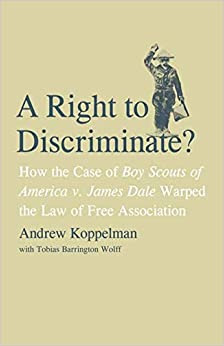
Andrew Koppelman and Tobias Barrington Wolff, A Right to Discriminate?: How the Case of Boy Scouts of America v. James Dale Warped the Law of Free Association (Yale University Press 2009)

Jack M. Balkin and Reva B. Siegel, The Constitution in 2020 (Oxford University Press 2009)

Heather K. Gerken, The Democracy Index: Why Our Election System Is Failing and How to Fix It (Princeton University Press 2009)

Mary Dudziak, Exporting American Dreams: Thurgood Marshall's African Journey (Oxford University Press 2008)

David Luban, Legal Ethics and Human Dignity (Cambridge Univ. Press 2007)

Ian Ayres, Super Crunchers: Why Thinking-By-Numbers is the New Way to be Smart (Bantam 2007)

Jack M. Balkin, James Grimmelmann, Eddan Katz, Nimrod Kozlovski, Shlomit Wagman and Tal Zarsky, eds., Cybercrime: Digital Cops in a Networked Environment (N.Y.U. Press 2007)

Jack M. Balkin and Beth Simone Noveck, The State of Play: Law, Games, and Virtual Worlds (N.Y.U. Press 2006)

Andrew Koppelman, Same Sex, Different States: When Same-Sex Marriages Cross State Lines (Yale University Press 2006)

Brian Tamanaha, Law as a Means to an End (Cambridge University Press 2006)

Sanford Levinson, Our Undemocratic Constitution (Oxford University Press 2006)

Mark Graber, Dred Scott and the Problem of Constitutional Evil (Cambridge University Press 2006)

Jack M. Balkin, ed., What Roe v. Wade Should Have Said (N.Y.U. Press 2005)

Sanford Levinson, ed., Torture: A Collection (Oxford University Press 2004)
Balkin.com homepage
Bibliography
Conlaw.net
Cultural Software
Writings
Opeds
The Information Society Project
BrownvBoard.com
Useful Links
Syllabi and Exams
