Balkinization
an unanticipated consequence of
Jack M. Balkin
Balkinization Symposiums: A Continuing List
E-mail:
Jack Balkin:
jackbalkin at yahoo.com
Bruce Ackerman
bruce.ackerman at yale.edu
Ian Ayres
ian.ayres at yale.edu
Corey Brettschneider
corey_brettschneider at brown.edu
Mary Dudziak
mary.l.dudziak at emory.edu
Joey Fishkin
joey.fishkin at gmail.com
Heather Gerken heather.gerken at yale.edu
Abbe Gluck abbe.gluck at yale.edu
Mark Graber
mgraber at law.umaryland.edu
Stephen Griffin
sgriffin at tulane.edu
Jonathan Hafetz
jonathan.hafetz at shu.edu
Jeremy Kessler
jkessler at law.columbia.edu
Andrew Koppelman
akoppelman at law.northwestern.edu
Marty Lederman
msl46 at law.georgetown.edu
Sanford Levinson
slevinson at law.utexas.edu
David Luban
david.luban at gmail.com
Gerard Magliocca
gmaglioc at iupui.edu
Jason Mazzone
mazzonej at illinois.edu
Linda McClain
lmcclain at bu.edu
John Mikhail
mikhail at law.georgetown.edu
Frank Pasquale
pasquale.frank at gmail.com
Nate Persily
npersily at gmail.com
Michael Stokes Paulsen
michaelstokespaulsen at gmail.com
Deborah Pearlstein
dpearlst at yu.edu
Rick Pildes
rick.pildes at nyu.edu
David Pozen
dpozen at law.columbia.edu
Richard Primus
raprimus at umich.edu
K. Sabeel Rahmansabeel.rahman at brooklaw.edu
Alice Ristroph
alice.ristroph at shu.edu
Neil Siegel
siegel at law.duke.edu
David Super
david.super at law.georgetown.edu
Brian Tamanaha
btamanaha at wulaw.wustl.edu
Nelson Tebbe
nelson.tebbe at brooklaw.edu
Mark Tushnet
mtushnet at law.harvard.edu
Adam Winkler
winkler at ucla.edu
Compendium of posts on Hobby Lobby and related cases
The Anti-Torture Memos: Balkinization Posts on Torture, Interrogation, Detention, War Powers, and OLC
The Anti-Torture Memos (arranged by topic)
Recent Posts
Legal Philosophers, Alien Civilizations, Monism versus Pluralism (Reflections on Shapiro's Legality)
![[Powered by Blogger]](https://lh3.googleusercontent.com/blogger_img_proxy/AEn0k_uA9Q0DSGa9FkSG-2rzm2oZorIsjPOh_lTO8hK37EMgJ0JIAJuyhZp34UoB_Teo7-nPsuFP6qq_pazDGjdQaTB1V36z_W_XrwW8l84GUeU5=s0-d)
Just A Few Blogs
ACS Blog
Alas, a Blog
Althouse
Arts and Letters Daily
Atrios (Eschaton)
Bill of Health
Buzzflash.com
Buzz Machine
Cato at Liberty
Juan Cole (Informed Comment)
Concurring Opinions
The Constitution in 2020
Corrente
Crooked Timber
Daily Howler
Daily Kos
Dana Boyd
Brad DeLong
Digby (Hullabaloo)
Discriminations
Daniel Drezner
Kevin Drum (Mother Jones)
Electrolite
En Banc
Eunomia (Daniel Larison)
Fafblog
Michael Froomkin (Discourse.net)
GovLab (Beth Noveck)
Rick Hasen (Election Law)
History News Network
How Appealing
Ignatz (Sam Heldman)
The Importance of (Ernie Miller)
Infolaw
Instapundit
International Economic Law and Policy Blog
IntLawGrrls
Jacob Levy
Jesus' General
Jurisdynamics
The Kitchen Cabinet
Mark Kleiman
Law Blog Central
Larry Lessig
Lawyers, Guns and Money
Liberal Oasis
Brian Leiter's Law School Reports
The Leiter Reports
Marginal Revolution
Megan McArdle
Memeorandum
Metafilter
Mirror of Justice
The New Republic
Newseum
No More Mister Nice Blog
Brendan Nyhan
Opinio Juris
Orcinus
The Originalism Blog
Pandagon
Passport (Foreign Policy)
Overcoming Bias
Political Animal (Washington Monthly)
Political Theory Daily Review
Political Wire (Taegan Goddard)
The Poor Man
Virginia Postrel
Prawfsblawg
Public Reason
Jonathan Rauch
Raw Story
Redstate
ReligiousLeftLaw.com
Reporters Committee For Freedom of the Press
Reproductive Rights Blog
Rothman's Roadmap to the Right of Publicity
SCOTUS Blog
Seeing the Forest
Clay Shirky
The Shifted Librarian
The Situationist
Larry Solum (Legal Theory)
Andrew Sullivan
Talking Points Memo
Talk Left
Tapped
Tbogg
TechPresident
The Paper Chase (Jurist)
Tom Paine
Tom Tomorrow (This Modern World)
Eve Tushnet
Uggabugga
University of Chicago Law School Faculty Blog
Unqualified Offerings
The Volokh Conspiracy
War and Piece (Laura Rozen)
Wampum
Oliver Willis
Wonkette
Written Description
Matthew Yglesias
Yin
Your Choice of Feeds
1. XML
powered by

2. Atom Feed
3. RSS 2.0
Legal Philosophers, Alien Civilizations, Monism versus Pluralism (Reflections on Shapiro's Legality)
Brian Tamanaha
Scott Shapiro’s new book, Legality (2011), is a superb articulation and defense of exclusive legal positivism. Readers are treated to an insightful and supremely clear exposition of the core issues that occupy contemporary analytical jurisprudents, including the debate between legal positivists and natural lawyers, between legal positivists and Ronald Dworkin, and between inclusive and exclusive legal positivists. Shapiro’s novel idea in the book is that every single law is a “plan” (or “plan like”) and law in general is a planning system.
Rather than discuss the merits of Shapiro’s theory of law, I will instead use his book to offer a few reflections on the state of contemporary analytical jurisprudence. As Shapiro acknowledges, many outsiders are critical of legal philosophers for engaging in scholastic debates over arcane matters of interest only to fellow philosophers. Shapiro is determined to refute this common perception by showing that his theory of law delivers important lessons for legal practice.
Notwithstanding his avowed intention, Shapiro confirms that legal philosophers really are occupied with otherworldly matters. In a crucial passage early in the book (albeit in a footnote), Shapiro makes a startling claim:Social science cannot tell us what the law is because it studies human society. Its deliverances have no relevance for the legal philosopher because it is a truism that nonhumans could have law. Science fiction, for example, is replete with stories involving alien civilizations with some form of legal system. These examples show that it is part of our concept of law that groups have legal systems provided that they are more or less rational agents and have the ability to follow rules. Social scientific theories are limited in this respect, being able to study only human groups, and hence cannot provide an account about all possible instances of law.
I laughed out loud when reading this passage (truisms about aliens?). But Shapiro is absolutely serious.
To expose the problematic implications of this attitude (which I will later describe as monist), I will give a quick response to Shapiro’s argument. His core contention, to repeat, is that legal philosophers are concerned with the nature of law in all possible worlds; insights from the social sciences about what law is are limited to humans and therefore are irrelevant to the philosophical task.
Shapiro builds his conceptual analysis by positing a series of what he claims are fundamental “truisms about law.” According to Shapiro, truisms “are not merely true, but self-evidently so”—“statements so unobjectionable that they hardly need mentioning.” (13,19)
But is it self-evident, as he declares, that nonhumans (aliens) could have law? After all, we don’t know whether aliens even exist, much less whether rule following aliens exist. It seems strange to confidently pronounce self-evident truths about beings whose existence has not been (and might never be) confirmed.
Shapiro would likely respond that what he means is this: If rule following aliens exist, then it is a truism that they could have law. Notice that, if this assertion is persuasive, it is so only because we know that humans have law, and law for us involves rule following. What we know about humans is doing all the rhetorical work for Shapiro’s supposed truism about aliens.
Shapiro’s reference to science fiction portrayals of alien civilizations draws the same response. Heinlein books and Star Trek episodes were, of course, written by humans. These were not portrayals of actual alien civilizations, needless to say, but familiar human practices clothed in cool costumes and make-up. We recognize examples of “law” in alien civilizations precisely because they are human practices in alien drag.
This point can be made clearer if we see that Shapiro actually understates the reach of his argument when referring only to alien civilizations. By the logic of his argument, it is a “truism that Gods could have laws.” We know this because as Greek mythology tells us—or if you prefer a modern bastardization, Percy Jackson & the Olympians books and movie—the Gods have laws too. (Like humans—it is no coincidence—the Gods, and aliens, also break laws, lust for power, indulge their desires, suffer from jealousy, pride, and rage, and wreak havoc.)
To state this proposition—“it is a truism that Gods could have laws”—is to expose its absurdity, and the emptiness of Shapiro’s argument. Although he purports to engage in conceptual analysis that rises above human existence, thereby telling us something about the nature of law with universal reach and validity, in fact his analysis is pure anthropomorphic projection grounded entirely in human social existence with nowhere else to go. Talk about alien civilizations amounts to verbal posturing—the philosopher telling the sociologist: “I’m not concerned with your real thing because my imaginary thing is bigger.”
In the end, Shapiro’s argument can be reduced to a virtual tautology: humans produce social institutions that we think of as “law”; any non-humans that produce similar institutions will also have something that resembles what we humans think of as law. Legal philosophers, notwithstanding their gesturing about alien civilizations and all possible worlds, rely entirely upon their knowledge and assumptions about human social existence to undergird their conceptual analysis of law. [In response to this post, Shapiro helpfully clarified that he does not deny that philosophers can benefit from the social sciences; rather, his point is that the social sciences cannot answer "What is law?" I agree with Shapiro about this inability, but for the reasons stated here, I believe legal philosophers also cannot provide a definitive answer to this question. Although Shapiro's clarification is a welcome one, the essential point remains that analytical jurisprudents in fact pay little attention to the social sciences.]
Why does Shapiro set out his argument in universalist terms? The answer lies in the quest embraced by many legal philosophers.
Isaiah Berlin highlighted a deep divide in philosophy between monism and pluralism. Monism has dominated Western philosophy since the Enlightenment (rooted in Plato), with three central tenets:(a)That every genuine question has one true answer and one only; all the others being false. Unless this is so, the question cannot be a real question—there is a confusion in it somewhere. This position, which has been made explicit by modern empiricist philosophers, is entailed no less firmly by the views of their theological and metaphysical predecessors, against whom they have been engaged in long and uncompromising warfare. (b) The method which leads to correct solutions to all genuine problems is rational in character; and is, in essence, if not in detailed application, identical in all fields. (c) These solutions, whether or not they are discovered, are true universally, eternally and immutably: true for all times, places and men….(Berlin, The Proper Study of Mankind, 326-270.)
Philosophical monism captures the attitude of many analytical jurisprudents as well as their natural law opponents (some of the particulars in Berlin’s account, which apply to philosophy generally, don’t apply here). Dworkin’s Justice for Hedgehogs (2010) is a supreme example of the monist project.
The pluralist alternative, embraced by Berlin, eschews the unity and universality of knowledge, accepting instead the presence of a multiplicity of perspectives and forms of life, potentially conflicting values and goods, incommensurability, the limits of reason, the uniqueness and variety of social forms, and the unavailability of universal, eternal, immutable truths. The legal theory parallel of pluralist views would reject the quest for a singular, universal concept of law and instead pay close attention to social manifestations of law, working out their various elements and implications, accepting that law cannot be reduced without gross distortion to a tidy analytical scheme.
While the pluralist view has prominent voices in philosophy, only a diminishingly small number of analytical jurisprudents (all young) can be classed as having a pluralist mindset—including Keith Culver and Michael Giudice (Legality’s Border, 2010) and Emmaneul Melissaris (Ubiquitous Law, 2009).
Legal theorists who have paid close attention to social scientific deliverances on law are among the foremost exemplars of the pluralist attitude, the most accomplished being William Twining (General Jurisprudence, 2009)(My book on the topic is here, with an essay available for download here, and more concisely here.). It is telling, furthermore, that these works use empirical insights to challenge a number of the core “truisms” taken for granted by analytical jurisprudents.
While legal theorists of the pluralist persuasion take up many of the same legal debates and cover the same literature as monist inclined analytical jurisprudents, the respective discussions in these two approaches are markedly different. Pluralist legal theorists refer to actual manifestations of law, noting their variety and differences, tracing out their elements and interaction; pluralists acknowledge legal multiplicity, the social construction of law, and the provisional nature of the concepts and categories they use to capture and describe law. Monist legal theorists, in contrast, tend to build their complex, unified systematic analysis of law out of a relatively small number of basic propositions—abstracted and posited —and claim to produce certain (analytically necessary) conclusions that convey truths about law. The former-type theories tend to be empirically rich (hence messier, admittedly contingent), while the latter-type are empirically austere (hence tidier, purportedly non-contingent).
Monist theories pay a price for their aspiration to universality. This goal can be approximated only by making drastic abstractions (and erasures) and by reducing matters to a narrow focus, fudging exceptions and squeezing recalcitrant counter-examples into ill-fitting categories that exist mainly to preserve the theory. When articulating the implications of his planning theory of law, in a moment of admirable candor, Shapiro observes that “Like Ptolemaic astronomy, the Planning Theory must add epicycle upon epicycle to save the doctrine from incoherence.” (278) Ptolemy resorted to epicycles because his theory was wrong; monists need epicycles because law cannot be captured in a single all encompassing theory (planning or any other)—legal reality is pluralist all the way down.
In closing I must emphasize that Shapiro has written a truly impressive book. It is a rare work of legal philosophy that manages to be a compelling read—a treat that I devoured in three straight days of uninterrupted mental indulgence. It will be deservedly celebrated by fellow legal philosophers. My main lament about his redoubtable achievement is that fits entirely within the parameters of—and promises to provoke another round of—the half-century old debate between and among analytical jurists and Dworkin. This series of debates has gone on far too long. Hart established the terms of the debate around points that now seem obsolete or exhausted; the world and law have changed in pivotal ways (to wit, the growing multiplicity and intersecting of legality, the shift of standard legal functions from public to private hands, the de-centering of the state, the relative reduction of actual judging within the system, etc.).
If Shapiro, with his formidable analytical skills, had seriously considered the deliverances of the social sciences on law, and used his evident imagination to build on those insights, he might have made a genuine breakthrough, moving legal philosophy in a new more fruitful direction. Perhaps, though, legal philosophers with a monist mindset don’t aspire to achieve a fundamental change in the discussion, for they are chasing after eternal truths on timeless questions.
Posted
1:38 PM
by Brian Tamanaha [link]

“Natural law is that which nature teaches to all animals [living things], for it is not peculiar to the human race, but is common to all animals which are produced in the air, on the earth, or in the sea. Hence comes the union of male and female, which we call marriage; hence the procreation and education of their young, for we see, in fact, that the other animals besides man act in conformity with this law as if they were acquainted with it.” Justinian. Institutes. Book I. Title ii. Of Natural Law, the Law of Nations, and the Civil Law.
The idea God (whether considered as singular or plural) is subject to laws has been the subject of much juristic thought, especially in the late middle ages as jurists tried to reconcile Christian dogma with Roman jurisprudence and Greek philosophy. If law is inherent in nature, then God is not sovereign; if God is sovereign, then there can be no [Aristotelian] essence, or law, in nature. Thus, juridical thought underlies our Enlightenment idea of science, in which nature has no essence.
And so a third point: apparently Shapiro in engaged in the business of elucidating a "science" of law in the same sense of Kelsen and others since the 18c. The intersection between analytic philosophy, naturalism, positivism and legal philosophy is interesting and complex, but i think the organizing idea is "science" or positivism. Although Shapiro eschews social science, his theory itself (or theories like his theory as you describe it), of a science of law, is as a historical matter identical with social science. The "science" part links them to the same fundamental propositions about nature. Well, they should, except that what you report about Shapiro may be a serious excursus into natural law. His dependence on the idea of “self-evident” statements recalls the same move made by John Finnis in his natural law theory; and they sound somewhat unscientific since science, positivism, values empirical “truisms.”
As I read your comments I wondered how these observations about monism, dualism and natural law would read through the historical school of jurisprudence. The idea laws arise through historical processes from “the life of man” can be consistent with scientific monism, natural law monism, and a natural pluralism, since there is no bar to the persistence of some norms through diverse, successive historical periods. There is a tendency towards the universal for some norms.
But that's part of the appeal of philosophy -- the questions are really hard, the terms of the debate often take decades to clarify. One measure of progress in philosophy should be how we get clear on the debates and in finding out where plausible-sounding arguments to these age-old disputes go wrong.
Shapiro has done an amazing job clarifying disputes and positing a plausible answer to the puzzles that have occupied decades of participants. I'm rather glad he didn't become a sociologist -- which is not to say philosophers couldn't benefit from exposure to more sociology.
فوائد الزنجبيل
فوائد الرمان فوائد الحلبة فوائد البصل فوائد الزعتر فوائد زيت السمسم علاج البواسير فوائد اليانسون فوائد الكركم قصص جحا صور يوم الجمعه علامات الحمل تعريف الحب حياة البرزخ فوائد الزبيب

karimunjawa island beauty |
puisi karimunjawa |
pulau gosong karimunjawa |
sunset ungu karimunjawa |
kapal nazi karimunjawa |
keindahan wisata karimunjawa |
pesona laut karimunjawa |
indahnya tanjung gelam karimunjawa |
wisata pulau karimunjawa |
liburan ke karimunjawa |
surga pantai karimunjawa |
hiu karimunjawa |
sunset cantik karimunjawa |
karimunjawa menakjubkan |
snorkling di karimunjawa |
agenda wisata karimunjawa
boking paket karimunjawa
tempat wisata di jepara
pantai karimunjawa
indahnya pantai karimunjawa
paket bulan puasa karimunjawa |
taman nasional karimunjawa |
pulau karimunjawa |
cara ke karimunjawa |
jadwal trip karimunjawa |
hotel di karimunjawa |
penginapan di karimunjawa |
resort karimunjawa |
hotel di jepara |
panorama karimunjawa |
situs bawah air karimunjawa |
homestay karimunjawa |
hoemestay karimunjawa |
paket homestay karimunjawa |
homestay karimunjawa |
homestay karimunjawa |
paket diving karimunjawa |
penduduk karimunjawa |
tracking mangrov karimunjawa |
wisata di karimunjawa |
keindahan pulau karimunjawa |
place of karimunjawa |
tips berlibur karimunjawa |
indahnya karimunjawa |
pesona karimunjawa |
paket karimunjawa januari |
paket karimunjawa februari |
paket karimunjawa maret |
paket karimunjawa april |
paket karimunjawa mei |
paket karimunjawa juni |
paket karimunjawa juli |
paket karimunjawa agustus |
paket karimunjawa september |
paket karimunjawa oktober |
paket karimunjawa november |
paket karimunjawa desember |
paket karimunjawa 2 hari 1 malam |
paket karimunjawa 3 hari 2 malam |
paket karimunjawa 4 hari 3 malam |
Homestay karimunjawa |
homestay karimunjawa |
homestay karimunjawa |
hotel karimunjawa |
paket hotel karimunjawa |
karimunjawa hotel |
KAMI SEKELUARGA MENGUCAPKAN BANYAK TERIMA KASIH ATAS BANTUANNYA MBAH , NOMOR YANG MBAH BERIKAN/ 4D SGP& HK SAYA DAPAT (350) JUTA ALHAMDULILLAH TEMBUS, SELURUH HUTANG2 SAYA SUDAH SAYA LUNAS DAN KAMI BISAH USAHA LAGI. JIKA ANDA INGIN SEPERTI SAYA HUB MBAH_PURO _085_342_734_904_ terima kasih.الالله صلى الله عليه وسلموعليكوتهله صلى الل
KAMI SEKELUARGA MENGUCAPKAN BANYAK TERIMA KASIH ATAS BANTUANNYA MBAH , NOMOR YANG MBAH BERIKAN/ 4D SGP& HK SAYA DAPAT (350) JUTA ALHAMDULILLAH TEMBUS, SELURUH HUTANG2 SAYA SUDAH SAYA LUNAS DAN KAMI BISAH USAHA LAGI. JIKA ANDA INGIN SEPERTI SAYA HUB MBAH_PURO _085_342_734_904_ terima kasih.الالله صلى الله عليه وسلموعليكوتهله صلى الل
Books by Balkinization Bloggers

Mark Tushnet and Bojan Bugaric, Constitutionalism and Its Discontents (University of Chicago Press, 2026)

Gerard N. Magliocca, The Actual Art of Governing: Justice Robert H. Jackson's Concurring Opinion in the Steel Seizure Case (Oxford University Press, 2025)

Linda C. McClain and Aziza Ahmed, The Routledge Companion to Gender and COVID-19 (Routledge, 2024)

David Pozen, The Constitution of the War on Drugs (Oxford University Press, 2024)

Jack M. Balkin, Memory and Authority: The Uses of History in Constitutional Interpretation (Yale University Press, 2024)
Mark A. Graber, Punish Treason, Reward Loyalty: The Forgotten Goals of Constitutional Reform after the Civil War (University of Kansas Press, 2023)
Jack M. Balkin, What Roe v. Wade Should Have Said: The Nation's Top Legal Experts Rewrite America's Most Controversial Decision - Revised Edition (NYU Press, 2023)

Andrew Koppelman, Burning Down the House: How Libertarian Philosophy Was Corrupted by Delusion and Greed (St. Martin’s Press, 2022)

Gerard N. Magliocca, Washington's Heir: The Life of Justice Bushrod Washington (Oxford University Press, 2022)
Joseph Fishkin and William E. Forbath, The Anti-Oligarchy Constitution: Reconstructing the Economic Foundations of American Democracy (Harvard University Press, 2022)
Mark Tushnet and Bojan Bugaric, Power to the People: Constitutionalism in the Age of Populism (Oxford University Press 2021).

Mark Philip Bradley and Mary L. Dudziak, eds., Making the Forever War: Marilyn B. Young on the Culture and Politics of American Militarism Culture and Politics in the Cold War and Beyond (University of Massachusetts Press, 2021).

Jack M. Balkin, What Obergefell v. Hodges Should Have Said: The Nation's Top Legal Experts Rewrite America's Same-Sex Marriage Decision (Yale University Press, 2020)

Frank Pasquale, New Laws of Robotics: Defending Human Expertise in the Age of AI (Belknap Press, 2020)

Jack M. Balkin, The Cycles of Constitutional Time (Oxford University Press, 2020)

Mark Tushnet, Taking Back the Constitution: Activist Judges and the Next Age of American Law (Yale University Press 2020).

Andrew Koppelman, Gay Rights vs. Religious Liberty?: The Unnecessary Conflict (Oxford University Press, 2020)

Ezekiel J Emanuel and Abbe R. Gluck, The Trillion Dollar Revolution: How the Affordable Care Act Transformed Politics, Law, and Health Care in America (PublicAffairs, 2020)

Linda C. McClain, Who's the Bigot?: Learning from Conflicts over Marriage and Civil Rights Law (Oxford University Press, 2020)
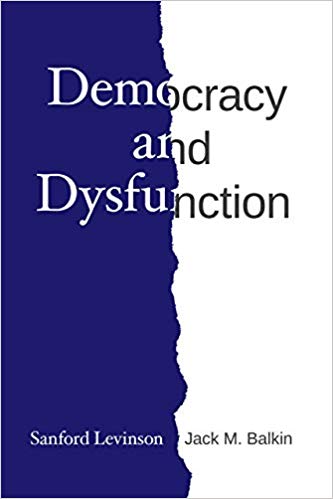
Sanford Levinson and Jack M. Balkin, Democracy and Dysfunction (University of Chicago Press, 2019)

Sanford Levinson, Written in Stone: Public Monuments in Changing Societies (Duke University Press 2018)

Mark A. Graber, Sanford Levinson, and Mark Tushnet, eds., Constitutional Democracy in Crisis? (Oxford University Press 2018)

Gerard Magliocca, The Heart of the Constitution: How the Bill of Rights became the Bill of Rights (Oxford University Press, 2018)

Cynthia Levinson and Sanford Levinson, Fault Lines in the Constitution: The Framers, Their Fights, and the Flaws that Affect Us Today (Peachtree Publishers, 2017)

Brian Z. Tamanaha, A Realistic Theory of Law (Cambridge University Press 2017)

Sanford Levinson, Nullification and Secession in Modern Constitutional Thought (University Press of Kansas 2016)

Sanford Levinson, An Argument Open to All: Reading The Federalist in the 21st Century (Yale University Press 2015)

Stephen M. Griffin, Broken Trust: Dysfunctional Government and Constitutional Reform (University Press of Kansas, 2015)

Frank Pasquale, The Black Box Society: The Secret Algorithms That Control Money and Information (Harvard University Press, 2015)

Bruce Ackerman, We the People, Volume 3: The Civil Rights Revolution (Harvard University Press, 2014)
Balkinization Symposium on We the People, Volume 3: The Civil Rights Revolution

Joseph Fishkin, Bottlenecks: A New Theory of Equal Opportunity (Oxford University Press, 2014)

Mark A. Graber, A New Introduction to American Constitutionalism (Oxford University Press, 2013)

John Mikhail, Elements of Moral Cognition: Rawls' Linguistic Analogy and the Cognitive Science of Moral and Legal Judgment (Cambridge University Press, 2013)

Gerard N. Magliocca, American Founding Son: John Bingham and the Invention of the Fourteenth Amendment (New York University Press, 2013)

Stephen M. Griffin, Long Wars and the Constitution (Harvard University Press, 2013)

Andrew Koppelman, The Tough Luck Constitution and the Assault on Health Care Reform (Oxford University Press, 2013)

James E. Fleming and Linda C. McClain, Ordered Liberty: Rights, Responsibilities, and Virtues (Harvard University Press, 2013)
Balkinization Symposium on Ordered Liberty: Rights, Responsibilities, and Virtues

Andrew Koppelman, Defending American Religious Neutrality (Harvard University Press, 2013)

Brian Z. Tamanaha, Failing Law Schools (University of Chicago Press, 2012)

Sanford Levinson, Framed: America's 51 Constitutions and the Crisis of Governance (Oxford University Press, 2012)

Linda C. McClain and Joanna L. Grossman, Gender Equality: Dimensions of Women's Equal Citizenship (Cambridge University Press, 2012)

Mary Dudziak, War Time: An Idea, Its History, Its Consequences (Oxford University Press, 2012)

Jack M. Balkin, Living Originalism (Harvard University Press, 2011)

Jason Mazzone, Copyfraud and Other Abuses of Intellectual Property Law (Stanford University Press, 2011)

Richard W. Garnett and Andrew Koppelman, First Amendment Stories, (Foundation Press 2011)

Jack M. Balkin, Constitutional Redemption: Political Faith in an Unjust World (Harvard University Press, 2011)

Gerard Magliocca, The Tragedy of William Jennings Bryan: Constitutional Law and the Politics of Backlash (Yale University Press, 2011)

Bernard Harcourt, The Illusion of Free Markets: Punishment and the Myth of Natural Order (Harvard University Press, 2010)

Bruce Ackerman, The Decline and Fall of the American Republic (Harvard University Press, 2010)
Balkinization Symposium on The Decline and Fall of the American Republic

Ian Ayres. Carrots and Sticks: Unlock the Power of Incentives to Get Things Done (Bantam Books, 2010)

Mark Tushnet, Why the Constitution Matters (Yale University Press 2010)

Ian Ayres and Barry Nalebuff: Lifecycle Investing: A New, Safe, and Audacious Way to Improve the Performance of Your Retirement Portfolio (Basic Books, 2010)
.jpg)
Jack M. Balkin, The Laws of Change: I Ching and the Philosophy of Life (2d Edition, Sybil Creek Press 2009)

Brian Z. Tamanaha, Beyond the Formalist-Realist Divide: The Role of Politics in Judging (Princeton University Press 2009)
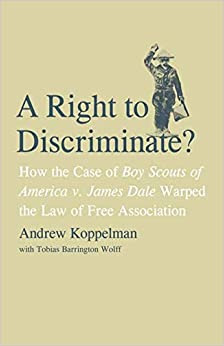
Andrew Koppelman and Tobias Barrington Wolff, A Right to Discriminate?: How the Case of Boy Scouts of America v. James Dale Warped the Law of Free Association (Yale University Press 2009)

Jack M. Balkin and Reva B. Siegel, The Constitution in 2020 (Oxford University Press 2009)

Heather K. Gerken, The Democracy Index: Why Our Election System Is Failing and How to Fix It (Princeton University Press 2009)

Mary Dudziak, Exporting American Dreams: Thurgood Marshall's African Journey (Oxford University Press 2008)

David Luban, Legal Ethics and Human Dignity (Cambridge Univ. Press 2007)

Ian Ayres, Super Crunchers: Why Thinking-By-Numbers is the New Way to be Smart (Bantam 2007)

Jack M. Balkin, James Grimmelmann, Eddan Katz, Nimrod Kozlovski, Shlomit Wagman and Tal Zarsky, eds., Cybercrime: Digital Cops in a Networked Environment (N.Y.U. Press 2007)
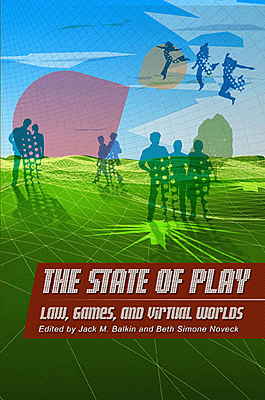
Jack M. Balkin and Beth Simone Noveck, The State of Play: Law, Games, and Virtual Worlds (N.Y.U. Press 2006)

Andrew Koppelman, Same Sex, Different States: When Same-Sex Marriages Cross State Lines (Yale University Press 2006)

Brian Tamanaha, Law as a Means to an End (Cambridge University Press 2006)

Sanford Levinson, Our Undemocratic Constitution (Oxford University Press 2006)

Mark Graber, Dred Scott and the Problem of Constitutional Evil (Cambridge University Press 2006)

Jack M. Balkin, ed., What Roe v. Wade Should Have Said (N.Y.U. Press 2005)

Sanford Levinson, ed., Torture: A Collection (Oxford University Press 2004)
Balkin.com homepage
Bibliography
Conlaw.net
Cultural Software
Writings
Opeds
The Information Society Project
BrownvBoard.com
Useful Links
Syllabi and Exams
