Balkinization
an unanticipated consequence of
Jack M. Balkin
Balkinization Symposiums: A Continuing List
E-mail:
Jack Balkin:
jackbalkin at yahoo.com
Bruce Ackerman
bruce.ackerman at yale.edu
Ian Ayres
ian.ayres at yale.edu
Corey Brettschneider
corey_brettschneider at brown.edu
Mary Dudziak
mary.l.dudziak at emory.edu
Joey Fishkin
joey.fishkin at gmail.com
Heather Gerken heather.gerken at yale.edu
Abbe Gluck abbe.gluck at yale.edu
Mark Graber
mgraber at law.umaryland.edu
Stephen Griffin
sgriffin at tulane.edu
Jonathan Hafetz
jonathan.hafetz at shu.edu
Jeremy Kessler
jkessler at law.columbia.edu
Andrew Koppelman
akoppelman at law.northwestern.edu
Marty Lederman
msl46 at law.georgetown.edu
Sanford Levinson
slevinson at law.utexas.edu
David Luban
david.luban at gmail.com
Gerard Magliocca
gmaglioc at iupui.edu
Jason Mazzone
mazzonej at illinois.edu
Linda McClain
lmcclain at bu.edu
John Mikhail
mikhail at law.georgetown.edu
Frank Pasquale
pasquale.frank at gmail.com
Nate Persily
npersily at gmail.com
Michael Stokes Paulsen
michaelstokespaulsen at gmail.com
Deborah Pearlstein
dpearlst at yu.edu
Rick Pildes
rick.pildes at nyu.edu
David Pozen
dpozen at law.columbia.edu
Richard Primus
raprimus at umich.edu
K. Sabeel Rahmansabeel.rahman at brooklaw.edu
Alice Ristroph
alice.ristroph at shu.edu
Neil Siegel
siegel at law.duke.edu
David Super
david.super at law.georgetown.edu
Brian Tamanaha
btamanaha at wulaw.wustl.edu
Nelson Tebbe
nelson.tebbe at brooklaw.edu
Mark Tushnet
mtushnet at law.harvard.edu
Adam Winkler
winkler at ucla.edu
Compendium of posts on Hobby Lobby and related cases
The Anti-Torture Memos: Balkinization Posts on Torture, Interrogation, Detention, War Powers, and OLC
The Anti-Torture Memos (arranged by topic)
Recent Posts
What About Bush's Judicial Nominees?
![[Powered by Blogger]](https://lh3.googleusercontent.com/blogger_img_proxy/AEn0k_tFOT9Ciw2KyG1-iYvXLLzS0N1f6fSWRTvWpsIe1oBVdjDBftqLfyFb8bqrcLCRPhnHZwD5zxCZ62vNuFTyoewNQq0vf9Ud6oBTMPM9Cybn=s0-d)
Just A Few Blogs
ACS Blog
Alas, a Blog
Althouse
Arts and Letters Daily
Atrios (Eschaton)
Bill of Health
Buzzflash.com
Buzz Machine
Cato at Liberty
Juan Cole (Informed Comment)
Concurring Opinions
The Constitution in 2020
Corrente
Crooked Timber
Daily Howler
Daily Kos
Dana Boyd
Brad DeLong
Digby (Hullabaloo)
Discriminations
Daniel Drezner
Kevin Drum (Mother Jones)
Electrolite
En Banc
Eunomia (Daniel Larison)
Fafblog
Michael Froomkin (Discourse.net)
GovLab (Beth Noveck)
Rick Hasen (Election Law)
History News Network
How Appealing
Ignatz (Sam Heldman)
The Importance of (Ernie Miller)
Infolaw
Instapundit
International Economic Law and Policy Blog
IntLawGrrls
Jacob Levy
Jesus' General
Jurisdynamics
The Kitchen Cabinet
Mark Kleiman
Law Blog Central
Larry Lessig
Lawyers, Guns and Money
Liberal Oasis
Brian Leiter's Law School Reports
The Leiter Reports
Marginal Revolution
Megan McArdle
Memeorandum
Metafilter
Mirror of Justice
The New Republic
Newseum
No More Mister Nice Blog
Brendan Nyhan
Opinio Juris
Orcinus
The Originalism Blog
Pandagon
Passport (Foreign Policy)
Overcoming Bias
Political Animal (Washington Monthly)
Political Theory Daily Review
Political Wire (Taegan Goddard)
The Poor Man
Virginia Postrel
Prawfsblawg
Public Reason
Jonathan Rauch
Raw Story
Redstate
ReligiousLeftLaw.com
Reporters Committee For Freedom of the Press
Reproductive Rights Blog
Rothman's Roadmap to the Right of Publicity
SCOTUS Blog
Seeing the Forest
Clay Shirky
The Shifted Librarian
The Situationist
Larry Solum (Legal Theory)
Andrew Sullivan
Talking Points Memo
Talk Left
Tapped
Tbogg
TechPresident
The Paper Chase (Jurist)
Tom Paine
Tom Tomorrow (This Modern World)
Eve Tushnet
Uggabugga
University of Chicago Law School Faculty Blog
Unqualified Offerings
The Volokh Conspiracy
War and Piece (Laura Rozen)
Wampum
Oliver Willis
Wonkette
Written Description
Matthew Yglesias
Yin
Your Choice of Feeds
1. XML
powered by

2. Atom Feed
3. RSS 2.0
What About Bush's Judicial Nominees?
David Stras
In response to my previous post on judicial appointments, see here, I have received some inquiries about whether I think that President-Elect Obama should renominate some of the pending (and less controversial) Bush 43 judicial nominees, including Peter Keisler. It should come as no surprise that my normative answer is yes because I believe that nominees such as Keisler have been unfairly held by the Senate. (In the interest of full disclosure, I worked with Peter while practicing law at Sidley, Austin, Brown & Wood from 2001-2002 and think quite highly of him.) I would also encourage President-Elect Obama to renominate one of Bush's Fourth Circuit nominees, such as Judge Robert Conrad of the Western District of North Carolina, because of the record number of vacancies on that court. Both Keisler and Conrad have been unanimously deemed "highly qualified" by the ABA Standing Committee on the Federal Judiciary.
Do I think that Obama will renominate any of Bush's judicial nominees? No, though it would be an incredible gesture of bipartisanship, one that Bush himself made when he renominated Roger Gregory, originally a Clinton nominee, to the Fourth Circuit in 2001. As Jonathan Adler points out in this post, however, Obama has not shown bipartisan tendencies with respect to judges as he voted to filibuster the Alito nomination and did not participate in the "Gang of 14."
But far more fundamentally, there is very little political incentive for Obama to renominate any of Bush's judicial nominees. If Roland Burris and Al Franken are seated, Democrats will control 59 of 100 Senate seats, just one short of a filibuster-proof majority. Unless Obama makes some outrageous judicial selections (such as corrupt, biased, or unqualified nominees), I cannot imagine that Republicans will be able to hold together a coalition to filibuster or block any nominees, particularly with moderate senators such as Olympia Snowe, Susan Collins, and Arlen Spector among the ranks of Republicans. (I suspect, in fact, that if any of Obama's judicial nominees fail to come up for a vote in Obama's first two years in office, it will be because one or more Democratic senators oppose the nomination.) If there were ever a situation where it might be prudent to renominate judicial nominees of a prior president, it would be when the Senate is virtually equally divided or even tilted toward the opposition party. Indeed, when President Bush renominated Roger Gregory to the Fourth Circuit and then nominated Clinton district court appointee Barrington Parker to the Second Circuit, the Senate was equally divided between Republican and Democratic senators. In such a case, the hope is that the gesture of bipartisanship by the president will encourage recalcitrant senators of the opposition party to confirm the entire slate of judicial nominees.
But even with an equally divided Senate, Bush's bipartisan strategy was unsuccessful. Of the eleven nominees initially advanced by President Bush including Parker and Gregory, two never received a vote (Terrence Boyle and Miguel Estrada) and another (Priscilla Owen) was confirmed by the Senate about four years after her nomination as a result of the compromise reached by the Gang of 14. Other nominees in that group, such as Jeffrey Sutton and Deborah Cook, also encountered some delay after their nominations were submitted to the Senate. Thus, based on recent history and the reality of the political situation, I cannot imagine that Obama would feel pressure to renominate any of Bush's judicial nominees unless he is trying to curry political favor with a particular set of senators, such as with respect to the North Carolina senators by renominating Judge Conrad.
Posted
1:45 PM
by David Stras [link]
I certainly don't think there's any harm in asking Obama to renominate a Bush appointee or two and he may well do it. Peter Keisler is a bit of a toughie just because the DC Circuit is so important, but hey, it never hurts to ask.


In response to my previous post on judicial appointments, see here, I have received some inquiries about whether I think that President-Elect Obama should renominate some of the pending (and less controversial) Bush 43 judicial nominees, including Peter Keisler....
Why? And just because you think so doesn't mean it's a good idea, much less required by "bipartisan civility" let alone law or even customary practise.
It should come as no surprise that my normative answer is yes because I believe that nominees such as Keisler have been unfairly held by the Senate....
You might have though about that in 2000.
... I would also encourage President-Elect Obama to renominate one of Bush's Fourth Circuit nominees, such as Judge Robert Conrad of the Western District of North Carolina, because of the record number of vacancies on that court. Both Keisler and Conrad have been unanimously deemed "highly qualified" by the ABA Standing Committee on the Federal Judiciary.
There's no shortage of ABA "highly qualified" candidates (not to mention Dubya decided to ignore that classification in lieu of FedSoc vetting long ago).
You want your nominees, go win an election. THe people want something other than Dubya's raft of RW conservatives (of which he got plenty of his share in that last eight years). Your time is up. Toodeloo.
Cheers,
Opposition to Alito is no sign of lack of bipartisanship.
Cheers,
He didn't just oppose Alito, but he also voted to filibuster him (which is a further step toward partisan behavior).
He didn't just oppose Alito, but he also voted to filibuster him (which is a further step toward partisan behavior).
So if the Republicans filibuster any Obama appointees, that would be "partisan behaviour"?
That's what they were doing when they filibustered Democratic bills these last two years?
Hate to say it, but the Republicans have no leg to stand on that will allow them to scream "partisanship" at full volume intelligibly.
Cheers,
Maybe he thought that Alito was too conservative to serve on the Supreme Court?
Look, I'd be in favor of a "grand bargain" (and I said this years ago anticipating the Bush presidency as well as now anticipating Obama) where every President gets their nominees on the courts.
But short of that, each party is going to block the other's nominees, and whatever spin they put on it, it's because they are opposed to them ideologically. It isn't mere partisanship, it's substance. Alito replaced O'Connor and moved the Court to the right. Clinton nominees who were held up by anonymous holds would have moved the courts to the left. That's all this is.
Either we are going to have a principle about confirming the President's nominees or we aren't. But if we aren't, then let's just be honest and admit that we are all trying to move the courts in one direction or another.
Given their constitutional role, it seems to me that it would be an abdication of constitutional duty to have any compact whereby the senators agreed simply to let through nominations.
There is much merit in having a judiciary which is slightly what in the UK we call "small c - conservative" running slightly behind the extreme positions of the legal theorists. A balance of activists and strict constructionists - of liberals and conservatives - a bench where there is debate and an interplay of ideas - but where no faction dominates.
The problem is that from Bork onwards there was a deliberate attempt to shift the judiciary to the right - in particular towards the "originalist heresy". Small wonder that there is a wish in some quarters to rebalance the mix. But, while the constitutional appointment power should probably stay as is, there might be a great deal of merit in having for the future some kind of permanent bipartisan advisory commission to draw up lists of recommended candidates for appointment to the president and the senate.
Agreed. Do unto others and all that--you'd think the so-called "party of the Christian right" would be familiar with the "casting bread upon the waters" meme.
And, if a pretty firm Republican caucus makes a stink about someone, he might decide to not press the issue. Block voting, as Mark Field notes, is consistently characteristic of only one side here. 59 votes might help, but so would Obama tossing a few choices the way of Republicans.
[Taking the NRO link to heart, this apparently can mean finding some Bush appointee that is safe enough to elevate. See Barrington Daniels Parker. Since they all weren't BAD, this is likely possible.]
But, this is a lame example of parity:
"Bush himself made when he renominated Roger Gregory, originally a Clinton nominee, to the Fourth Circuit in 2001"
Look at the Wikipedia entry, but I recall this matter quite well w/o it. This was the seat that was vacant for about a decade, in large part because of a certain conservative senator holding up the works, Clinton repeatedly trying to fill it.
Gregory was the first black to serve on the circuit. Given the history, Bush would have looked rather bad blocking things yet again. He was confirmed 93-1.
Using his opposition to Alito as proof he was not "bipartisan" is rather lame. Others have said enough on that pt.
Not supporting the Gang of 14 (which you previously suggested -- when I brought it up -- was just an example of horse trading anyway) is bit more useful in this respect. But, not by much, since it wasn't much of a compromise (the result was seating the most controversial judges at issue and time showed the "extreme circumstances" language was rather meaningless.
It also is of little value to cite Estrada etc. without facing up to the fact that many of the problems were problems for significant reasons. Not just partisan nastiness.
His definition of "bipartisanship" is a case in point. Since when is a vote against Alito any indication of a lack of true bipartisanship?
And even stranger, exactly when did Bush pursue any type of bipartisanship in appointment of federal judges? Stras points to a grand total of two, out of hundreds of appointments. That's about as bipartisan as the rest of Bush's record.
Ms. Stras's politics appear to be so far to the right -- as evidenced by his clerkship for Thomas -- that he considers Alito to be a moderate of some sort -- instead of being one or the two or three most right-wing Supreme Court justices of the last 70 years.
Further, Stras apparently overlooks Alito's at-best questionable truthfulness during the confirmation hearings about his membership in the nationally infamous "Concerned Alumni of Princeton," a group aimed at keeping women and minorities out of Princeton. His claim was that he joined the group only because they supported having ROTC on campus, and that he had utterly no idea about everything else this rancid group stood for.
And that must be the reason as well that he was careful to list it on his resume when applying to get in the Reagan Justice Department -- he wanted to let them know he was an avid ROTC supporter, of course.
And then we were treated to the kubuki theater of his wife weeping behind him, at the mere thought that her husband might be even suspected of being racist and misogynist -- all just because he belonged to a group famously espousing that philosophy.
That explanation demonstrated one of two things -- either that Alito was not telling the truth, or else was perhaps the most selective information parser history. In an almost mystical way, he DID know somehow where this group stood on ROTC -- a program to which Alito did not belong -- but somehow missed everything else this group was saying.
And though listing his membership in his 1985 job application, he was, of course, also totally ignorant of this comment, in a 1983 issue of the group's magazine:
""People nowadays just don't seem to know their place," author H.W. Crocker III wrote in a 1983 issue of the magazine. "Everywhere one turns blacks and hispanics are demanding jobs simply because they're black and hispanic, the physically handicapped are trying to gain equal representation in professional sports, and homosexuals are demanding that government vouchsafe them the right to bear children."
The only reasonable conclusion was that Alito in fact was deliberately prevaricating. I live in the State of Washington, and attended the University of Washington for undergrad and law school, finishing in 1977. I have no friends from Princeton. Yet I was very well aware of this nefarious group, because it received a lot of attention in the natonal news, and especially in legal circles.
So how come I and millions of others were somehow able to learn about this group, but a man attending Princeton, where it had an even higher profile, claimed he was ignorant.
This doesn't even pass the giggle test, let alone the smell test.
So I find it shocking that Stras would even attempt to argue that a vote against Alito was a vote against bipartisanship. And the "gang of 14" as such a measure? Please. That was seven official republicans; Lieberman, all but Republican; and seven "blue dog", conservative Democrats lacking any spine.
Ross Taylor
Also, note how Justice Alito, for some reason, was the only one who didn't show up when Obama/Biden came to visit. Perhaps, it was because they were so partisan?
Books by Balkinization Bloggers

Mark Tushnet and Bojan Bugaric, Constitutionalism and Its Discontents (University of Chicago Press, 2026)

Gerard N. Magliocca, The Actual Art of Governing: Justice Robert H. Jackson's Concurring Opinion in the Steel Seizure Case (Oxford University Press, 2025)

Linda C. McClain and Aziza Ahmed, The Routledge Companion to Gender and COVID-19 (Routledge, 2024)

David Pozen, The Constitution of the War on Drugs (Oxford University Press, 2024)

Jack M. Balkin, Memory and Authority: The Uses of History in Constitutional Interpretation (Yale University Press, 2024)
Mark A. Graber, Punish Treason, Reward Loyalty: The Forgotten Goals of Constitutional Reform after the Civil War (University of Kansas Press, 2023)
Jack M. Balkin, What Roe v. Wade Should Have Said: The Nation's Top Legal Experts Rewrite America's Most Controversial Decision - Revised Edition (NYU Press, 2023)

Andrew Koppelman, Burning Down the House: How Libertarian Philosophy Was Corrupted by Delusion and Greed (St. Martin’s Press, 2022)

Gerard N. Magliocca, Washington's Heir: The Life of Justice Bushrod Washington (Oxford University Press, 2022)
Joseph Fishkin and William E. Forbath, The Anti-Oligarchy Constitution: Reconstructing the Economic Foundations of American Democracy (Harvard University Press, 2022)
Mark Tushnet and Bojan Bugaric, Power to the People: Constitutionalism in the Age of Populism (Oxford University Press 2021).

Mark Philip Bradley and Mary L. Dudziak, eds., Making the Forever War: Marilyn B. Young on the Culture and Politics of American Militarism Culture and Politics in the Cold War and Beyond (University of Massachusetts Press, 2021).

Jack M. Balkin, What Obergefell v. Hodges Should Have Said: The Nation's Top Legal Experts Rewrite America's Same-Sex Marriage Decision (Yale University Press, 2020)

Frank Pasquale, New Laws of Robotics: Defending Human Expertise in the Age of AI (Belknap Press, 2020)

Jack M. Balkin, The Cycles of Constitutional Time (Oxford University Press, 2020)

Mark Tushnet, Taking Back the Constitution: Activist Judges and the Next Age of American Law (Yale University Press 2020).

Andrew Koppelman, Gay Rights vs. Religious Liberty?: The Unnecessary Conflict (Oxford University Press, 2020)

Ezekiel J Emanuel and Abbe R. Gluck, The Trillion Dollar Revolution: How the Affordable Care Act Transformed Politics, Law, and Health Care in America (PublicAffairs, 2020)

Linda C. McClain, Who's the Bigot?: Learning from Conflicts over Marriage and Civil Rights Law (Oxford University Press, 2020)
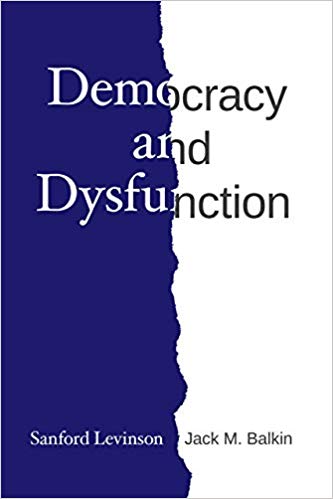
Sanford Levinson and Jack M. Balkin, Democracy and Dysfunction (University of Chicago Press, 2019)

Sanford Levinson, Written in Stone: Public Monuments in Changing Societies (Duke University Press 2018)

Mark A. Graber, Sanford Levinson, and Mark Tushnet, eds., Constitutional Democracy in Crisis? (Oxford University Press 2018)

Gerard Magliocca, The Heart of the Constitution: How the Bill of Rights became the Bill of Rights (Oxford University Press, 2018)

Cynthia Levinson and Sanford Levinson, Fault Lines in the Constitution: The Framers, Their Fights, and the Flaws that Affect Us Today (Peachtree Publishers, 2017)

Brian Z. Tamanaha, A Realistic Theory of Law (Cambridge University Press 2017)

Sanford Levinson, Nullification and Secession in Modern Constitutional Thought (University Press of Kansas 2016)

Sanford Levinson, An Argument Open to All: Reading The Federalist in the 21st Century (Yale University Press 2015)

Stephen M. Griffin, Broken Trust: Dysfunctional Government and Constitutional Reform (University Press of Kansas, 2015)

Frank Pasquale, The Black Box Society: The Secret Algorithms That Control Money and Information (Harvard University Press, 2015)

Bruce Ackerman, We the People, Volume 3: The Civil Rights Revolution (Harvard University Press, 2014)
Balkinization Symposium on We the People, Volume 3: The Civil Rights Revolution

Joseph Fishkin, Bottlenecks: A New Theory of Equal Opportunity (Oxford University Press, 2014)

Mark A. Graber, A New Introduction to American Constitutionalism (Oxford University Press, 2013)

John Mikhail, Elements of Moral Cognition: Rawls' Linguistic Analogy and the Cognitive Science of Moral and Legal Judgment (Cambridge University Press, 2013)

Gerard N. Magliocca, American Founding Son: John Bingham and the Invention of the Fourteenth Amendment (New York University Press, 2013)

Stephen M. Griffin, Long Wars and the Constitution (Harvard University Press, 2013)

Andrew Koppelman, The Tough Luck Constitution and the Assault on Health Care Reform (Oxford University Press, 2013)

James E. Fleming and Linda C. McClain, Ordered Liberty: Rights, Responsibilities, and Virtues (Harvard University Press, 2013)
Balkinization Symposium on Ordered Liberty: Rights, Responsibilities, and Virtues

Andrew Koppelman, Defending American Religious Neutrality (Harvard University Press, 2013)

Brian Z. Tamanaha, Failing Law Schools (University of Chicago Press, 2012)

Sanford Levinson, Framed: America's 51 Constitutions and the Crisis of Governance (Oxford University Press, 2012)

Linda C. McClain and Joanna L. Grossman, Gender Equality: Dimensions of Women's Equal Citizenship (Cambridge University Press, 2012)

Mary Dudziak, War Time: An Idea, Its History, Its Consequences (Oxford University Press, 2012)

Jack M. Balkin, Living Originalism (Harvard University Press, 2011)

Jason Mazzone, Copyfraud and Other Abuses of Intellectual Property Law (Stanford University Press, 2011)

Richard W. Garnett and Andrew Koppelman, First Amendment Stories, (Foundation Press 2011)

Jack M. Balkin, Constitutional Redemption: Political Faith in an Unjust World (Harvard University Press, 2011)

Gerard Magliocca, The Tragedy of William Jennings Bryan: Constitutional Law and the Politics of Backlash (Yale University Press, 2011)

Bernard Harcourt, The Illusion of Free Markets: Punishment and the Myth of Natural Order (Harvard University Press, 2010)

Bruce Ackerman, The Decline and Fall of the American Republic (Harvard University Press, 2010)
Balkinization Symposium on The Decline and Fall of the American Republic

Ian Ayres. Carrots and Sticks: Unlock the Power of Incentives to Get Things Done (Bantam Books, 2010)

Mark Tushnet, Why the Constitution Matters (Yale University Press 2010)

Ian Ayres and Barry Nalebuff: Lifecycle Investing: A New, Safe, and Audacious Way to Improve the Performance of Your Retirement Portfolio (Basic Books, 2010)
.jpg)
Jack M. Balkin, The Laws of Change: I Ching and the Philosophy of Life (2d Edition, Sybil Creek Press 2009)

Brian Z. Tamanaha, Beyond the Formalist-Realist Divide: The Role of Politics in Judging (Princeton University Press 2009)
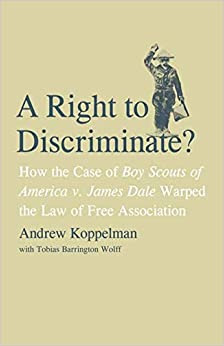
Andrew Koppelman and Tobias Barrington Wolff, A Right to Discriminate?: How the Case of Boy Scouts of America v. James Dale Warped the Law of Free Association (Yale University Press 2009)

Jack M. Balkin and Reva B. Siegel, The Constitution in 2020 (Oxford University Press 2009)

Heather K. Gerken, The Democracy Index: Why Our Election System Is Failing and How to Fix It (Princeton University Press 2009)

Mary Dudziak, Exporting American Dreams: Thurgood Marshall's African Journey (Oxford University Press 2008)

David Luban, Legal Ethics and Human Dignity (Cambridge Univ. Press 2007)

Ian Ayres, Super Crunchers: Why Thinking-By-Numbers is the New Way to be Smart (Bantam 2007)

Jack M. Balkin, James Grimmelmann, Eddan Katz, Nimrod Kozlovski, Shlomit Wagman and Tal Zarsky, eds., Cybercrime: Digital Cops in a Networked Environment (N.Y.U. Press 2007)
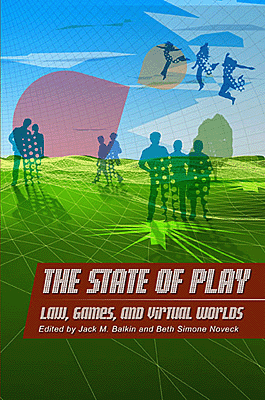
Jack M. Balkin and Beth Simone Noveck, The State of Play: Law, Games, and Virtual Worlds (N.Y.U. Press 2006)

Andrew Koppelman, Same Sex, Different States: When Same-Sex Marriages Cross State Lines (Yale University Press 2006)

Brian Tamanaha, Law as a Means to an End (Cambridge University Press 2006)

Sanford Levinson, Our Undemocratic Constitution (Oxford University Press 2006)

Mark Graber, Dred Scott and the Problem of Constitutional Evil (Cambridge University Press 2006)

Jack M. Balkin, ed., What Roe v. Wade Should Have Said (N.Y.U. Press 2005)

Sanford Levinson, ed., Torture: A Collection (Oxford University Press 2004)
Balkin.com homepage
Bibliography
Conlaw.net
Cultural Software
Writings
Opeds
The Information Society Project
BrownvBoard.com
Useful Links
Syllabi and Exams
