Balkinization
an unanticipated consequence of
Jack M. Balkin
Balkinization Symposiums: A Continuing List
E-mail:
Jack Balkin:
jackbalkin at yahoo.com
Bruce Ackerman
bruce.ackerman at yale.edu
Ian Ayres
ian.ayres at yale.edu
Corey Brettschneider
corey_brettschneider at brown.edu
Mary Dudziak
mary.l.dudziak at emory.edu
Joey Fishkin
joey.fishkin at gmail.com
Heather Gerken heather.gerken at yale.edu
Abbe Gluck abbe.gluck at yale.edu
Mark Graber
mgraber at law.umaryland.edu
Stephen Griffin
sgriffin at tulane.edu
Jonathan Hafetz
jonathan.hafetz at shu.edu
Jeremy Kessler
jkessler at law.columbia.edu
Andrew Koppelman
akoppelman at law.northwestern.edu
Marty Lederman
msl46 at law.georgetown.edu
Sanford Levinson
slevinson at law.utexas.edu
David Luban
david.luban at gmail.com
Gerard Magliocca
gmaglioc at iupui.edu
Jason Mazzone
mazzonej at illinois.edu
Linda McClain
lmcclain at bu.edu
John Mikhail
mikhail at law.georgetown.edu
Frank Pasquale
pasquale.frank at gmail.com
Nate Persily
npersily at gmail.com
Michael Stokes Paulsen
michaelstokespaulsen at gmail.com
Deborah Pearlstein
dpearlst at yu.edu
Rick Pildes
rick.pildes at nyu.edu
David Pozen
dpozen at law.columbia.edu
Richard Primus
raprimus at umich.edu
K. Sabeel Rahmansabeel.rahman at brooklaw.edu
Alice Ristroph
alice.ristroph at shu.edu
Neil Siegel
siegel at law.duke.edu
David Super
david.super at law.georgetown.edu
Brian Tamanaha
btamanaha at wulaw.wustl.edu
Nelson Tebbe
nelson.tebbe at brooklaw.edu
Mark Tushnet
mtushnet at law.harvard.edu
Adam Winkler
winkler at ucla.edu
Compendium of posts on Hobby Lobby and related cases
The Anti-Torture Memos: Balkinization Posts on Torture, Interrogation, Detention, War Powers, and OLC
The Anti-Torture Memos (arranged by topic)
Recent Posts
How to Describe Judge Posner
![[Powered by Blogger]](https://lh3.googleusercontent.com/blogger_img_proxy/AEn0k_tqMlZf1LYKU1-3IYgLzchrDl1wEcsFV7ozvxBMYg4FvRdEghhdbUpI55L_Si_nh-J5H5xZY-pZYkSkmmmZ7aBTUFUEPISTe3v7ckieGKwR=s0-d)
Just A Few Blogs
ACS Blog
Alas, a Blog
Althouse
Arts and Letters Daily
Atrios (Eschaton)
Bill of Health
Buzzflash.com
Buzz Machine
Cato at Liberty
Juan Cole (Informed Comment)
Concurring Opinions
The Constitution in 2020
Corrente
Crooked Timber
Daily Howler
Daily Kos
Dana Boyd
Brad DeLong
Digby (Hullabaloo)
Discriminations
Daniel Drezner
Kevin Drum (Mother Jones)
Electrolite
En Banc
Eunomia (Daniel Larison)
Fafblog
Michael Froomkin (Discourse.net)
GovLab (Beth Noveck)
Rick Hasen (Election Law)
History News Network
How Appealing
Ignatz (Sam Heldman)
The Importance of (Ernie Miller)
Infolaw
Instapundit
International Economic Law and Policy Blog
IntLawGrrls
Jacob Levy
Jesus' General
Jurisdynamics
The Kitchen Cabinet
Mark Kleiman
Law Blog Central
Larry Lessig
Lawyers, Guns and Money
Liberal Oasis
Brian Leiter's Law School Reports
The Leiter Reports
Marginal Revolution
Megan McArdle
Memeorandum
Metafilter
Mirror of Justice
The New Republic
Newseum
No More Mister Nice Blog
Brendan Nyhan
Opinio Juris
Orcinus
The Originalism Blog
Pandagon
Passport (Foreign Policy)
Overcoming Bias
Political Animal (Washington Monthly)
Political Theory Daily Review
Political Wire (Taegan Goddard)
The Poor Man
Virginia Postrel
Prawfsblawg
Public Reason
Jonathan Rauch
Raw Story
Redstate
ReligiousLeftLaw.com
Reporters Committee For Freedom of the Press
Reproductive Rights Blog
Rothman's Roadmap to the Right of Publicity
SCOTUS Blog
Seeing the Forest
Clay Shirky
The Shifted Librarian
The Situationist
Larry Solum (Legal Theory)
Andrew Sullivan
Talking Points Memo
Talk Left
Tapped
Tbogg
TechPresident
The Paper Chase (Jurist)
Tom Paine
Tom Tomorrow (This Modern World)
Eve Tushnet
Uggabugga
University of Chicago Law School Faculty Blog
Unqualified Offerings
The Volokh Conspiracy
War and Piece (Laura Rozen)
Wampum
Oliver Willis
Wonkette
Written Description
Matthew Yglesias
Yin
Your Choice of Feeds
1. XML
powered by

2. Atom Feed
3. RSS 2.0
How to Describe Judge Posner
Stephen Griffin
Tuesday's NYT has an article on criticism of DC v. Heller from "the right" or "conservative judges" and the two examples are Judges Posner and Wilkinson. The article doesn't appear to call Judge Posner a "conservative" but definitely locates him on the right.
With respect to Posner's views on constitutional interpretation, I've often wondered whether standard left/right, liberal/conservative categories are helpful. Posner describes himself as a pragmatist, but this term provides no hint of how alienated Posner is from anything resembling standard or traditional methods of constitutional interpretation. In this respect, Posner's opposite number is not a usual liberal suspect like Laurence Tribe, but Philip Bobbitt, who argues for the value of multiple modalities of interpretation.
Posner won praise from liberals for criticizing Robert Bork's originalism when Bork was nominated for the Court. But what liberals tend to miss about Posner is that he feels the same way about all proposed methods of interpretation, whether they are based on text, history, structure, doctrine, common law tradition, it doesn't matter. All have to swim in the same acid vat of Posnerian skepticism. You could accurately call Posner a radical if he appeared to understand the techniques of interpretation and rejected them wholesale for good reason. But Posner rarely tries. Standard constitutional arguments leave him cold.
So is this "conservative?" Certainly not. Posner has rarely mentioned anything worth conserving in the American constitutional tradition, except perhaps Holmes. Is it on "the right?" If the right typically rejects all forms of constitutional interpretation as meaningless from a pragmatic point of view, then yes. Otherwise, we should appreciate that Posner writes from a perspective on American constitutionalism that is virtually unique.
Posted
10:48 PM
by Stephen Griffin [link]

Any time spend with his scholarship or judicial opinions would quickly wipe away the conservative tag.
Moreover, I think his empiricism leads him to "follow the evidence" for the best policy--a move that will lead in opposite ideological directions. Sadly, this is also why he never made it to the Court. It would have been fascinating to see Justice Posner with *no* precedential restraints.
Posner's philosophy is asocial and atomistic. His descendants include many who ascribe to the atomism but try to reconstruct the social within the limits of atomism. An example of such a hybrid would the eccentricity of Ian Ayres.
Posner's ideas are the logical conclusion of the logic of justice as contract, as market contract: a moral esthetic of non-contradictory order. He imagines a society of one telos. Democracy is founded on the assumption of many teloi. His theories are fundamentally anti-democratic. They are "machine fascism" posited as freedom in that we can in ideal circumstances choose what kind of machine we want to be.
Democracy as the culture of language in use; of argument over the meanings of words and things. Posner says he has answered certain questions, and he thinks he has the right to speak for others.
Economic life is a subset of social life. Posner argues it is the reverse. He s wrong on the facts.
But his philosophy is more dangerous to the country than born again christianity and "young earth" creationism.
JUSTICE BREYER: ... one of these opinions is written by Judge Posner, and he's the smartest man in the world --
JUSTICE ALITO: He knows everything there is to know about law and economics and jurisprudence and literature and many other subjects.
I find Posner extremely dangerous, especially in his views about national security. In a lecture, he said that his approach is to decide if a particular tactic is desirable to deploy against terrorists, and then justify it. His intellectual arrogance, his belief that he is a philosopher-king entitled to posit first principles and reason from them to his conclusion, is as bad as the anti-intellectual arrogance of Clarence Thomas and his belief that his grandfather knew everything.

Why does anyone take this failing partisan rag seriously as an objective news source?
Posner is really sui generis. Some years ago, I suggested that he was basically a "righti-wing crit," though, ironically, crits take (or, if you think the movement is dead, took) doctrine far more seriously than does Posner.
“Neither of the two main opinions in Heller would pass muster as serious historical writing,” Jack Rakove, a historian at Stanford, wrote on the blog Balkinization soon after the decision was issued.
For that matter, he didn't link the article.
It's significant that legal theory Rawlsian and otherwise sees language through the prism of civil contract and an ideal of reasoned decision-making. But the heart of law and language in our moral system is in the vulgar theater of the criminal courts. Legal philosophers defend ideas they believe in. Defense attorneys defend people they don't believe in at all. They don't defend truth, they defend their clients.
Our criminal court system is built not on fantasies of the human capacity for reason but on an empirical awareness of our capacity for unreason: for failure. That's the response to Posner, and its staring you and him in the face.
What's the proper relation of the courts to the legislature to the executive? Tension.
Of the prosecution to the defense? Tension.
Of the government to the press? Tension.
Of experts to the people? Tension.
That's the only "right" answer in a representative democracy.
My beef with Posner is probably ill-formed, certainly inadequately researched. I believe it was Posner who suggested a corporation faced with a $10 fine or a $100 cost of compliance has a duty to break the law. This strikes me as a slippery slope, but perhaps the actual argument was more nuanced.
You have certainly made me curious to read Posner's take on Scalia.
Cheers,
rl
Huh? Yes, they're Jewish, but what does that have to do with their ideas?
Norman Mailer, Philip Roth, Woody Allan, or Larry David for that matter would never be so arrogant.
Posner is the technocrat and servant of logic.
One filters authority through a sense of the theater of social function, the other is indifferent. One is popular, one is not. It's the authoritarianism of the priest vs the authoritarianism of the technocrat. With Posner you just have to go a little deeper to find the deus ex machina.
I prefer Scalia because he understands the social function of language. You can argue with a fundamentalist over interpretations, because whether he will admit it or not, he is interpreting a text and the text in this case is public and in the common language. You can argue democracy with a someone who holds a conservative interpretation. You can not argue with someone who claims only logical structures in esoteric form.
A government by technocracy is not democracy. It's the pseudo-science of authoritarianism. cf. the "Brights" and "New" atheists.
Technocracy like the military is an authoritarian order that must be seen to serve democracy, not the other way around.
Too many people do get this obvious point.
We need more literary critics reading law. If words have meanings, so do structures. "The passive voice" carries meanings. Posner is another rhetorician against rhetoric. That's the contradiction.
Language is rhetoric. Democracy is language in use.
This is all really really basic stuff in the history of ideas.
Unlike "heritage conservatives" he does not revere the past for the sake of revering the past. But, on key dimensions of conservatism within the judiciary, like deference to hierarchical authority in society, his results are more conservtive than liberal.
There are right-wing Conventionalists and Left wing, depending on whether they see it as rooted in the people as a whole or the elite. Edmund Burke or William Blake. The rule of law is conventionalist and one of the early leaders of the ACLU call it "a conservative institution." Guilds, unions and workingmens' associations are conventionalist. Academic liberals these days are not, and are less and less aware that they could ever be anything else. But the arts are conventionalist. The wishful arts of individualism and desire, the arts of wishful thinking, operate as illustration: Ayn Rand is art for political scientists, cranks and the desperately mobile.
And Paul Krugman and Newt Gingrich both got their start with Isaac Asimov's conceptualist dime-store "Foundation Trilogy."
Enough is enough. I keep thinking I'm trying to have a conversation. I've been having a conversation with myself for 25 years.
Arno Breker and Soviet Socialist Realism. The art of wishful thinking, more precisely of wishful demanding is kitsch.
فوائد الزنجبيل
فوائد الرمان فوائد الحلبة فوائد البصل فوائد الزعتر فوائد زيت السمسم علاج البواسير فوائد اليانسون فوائد الكركم قصص جحا صور يوم الجمعه علامات الحمل تعريف الحب حياة البرزخ فوائد الزبيب
Cara mengobati kanker dengan herbal, Cara mengobati kanker dengan tradisional, Cara mengobati kanker dengan alami, Cara mengobati kanker dengan cepat, Cara mengobati kanker stadium 3, Cara mengobati kanker stadium 4, Cara mengobati kanker stadium awal, Cara mengobati kanker stadium 2, Cara mengobati kanker stadium akhir, Cara mengobati kanker tanpa ke dokter, Gambar obat kanker yang ampuh, Gambar obat kanker yang ampuh, Obat kanker ampuh dengan singkong, Cara mengobati kanker stadium awal tanpa operasi, Obat kanker manjur dari tumbuhan, Cara mengobati kanker stadium 1 tanpa operasi, Obat kanker ampuh dengan daun sirsak, Cara mengobati kanker stadium 2 tanpa operasi, Obat kanker paling mujarab yang efektif, Cara mengobati kanker stadium 3 tanpa operasi, Cara mengobati kanker stadium 3, Cara mengobati kanker stadium 4 tanpa operasi, Obat kanker paling manjur 2016, Cara mengobati kanker stadium akhir tanpa operasi, Pengobatan kanker mujarab tanpa operasi, Cara pengobatan kanker yang manjur, Pengobatan kanker manjur dan aman, Cara pengobatan kanker yang mujarab, Cara pengobatan kanker tanpa operasi, Cara pengobatan kanker yang ampuh, Obat kanker mujarab tanpa operasi, Obat kanker manjur tanpa operasi, Obat De Nature
obat alami untuk mencegah kanker serviks
obat medis untuk kanker serviks
wwwobat kanker serviks
obat vaksin kanker serviks
obat untuk mengatasi kanker serviks
Tumbuhan untuk obat kanker serviks
Obat untuk menyembuhkan kanker serviks
obat untuk penderita kanker serviks
obat tradisional untuk kanker serviks
obat utk kanker serviks
obat untuk kanker serviks
obat tradisional utk kanker serviks
sirsak obat kanker serviks
obat sakit kanker serviks
hello world obat untuk kanker rahim stadium 3
obat herbal kanker rahim stadium 4
obat kanker rahim stadium 1 1
Obat kanker rahim stadium 2
Obat penyakit herpes kelamin pria
obat kanker serviks manjur facebook
obat herpes genital manjur
obat herpes genital manjur
obat herpes genital manjur
obat herpes genital manjur
obat herpes genital manjur
obat herpes genital manjur
obat herpes genital manjur
obat herpes genital manjur
obat herpes genital manjur
obat herpes genital manjur
obat herpes genital manjur
obat herpes genital manjur
obat herpes genital manjur
obat herpes genital manjur
obat herpes genital manjur
obat herpes genital manjur
obat herpes genital manjur
obat herpes genital manjur
obat herpes genital manju
Obat herpes genital manjur
Obat herpes genital manujur di youtube
Obat kanker dan herpes di twitter
obat herpes genital manjur facebook
Agen Judi Online Terpercaya
Books by Balkinization Bloggers

Mark Tushnet and Bojan Bugaric, Constitutionalism and Its Discontents (University of Chicago Press, 2026)

Gerard N. Magliocca, The Actual Art of Governing: Justice Robert H. Jackson's Concurring Opinion in the Steel Seizure Case (Oxford University Press, 2025)

Linda C. McClain and Aziza Ahmed, The Routledge Companion to Gender and COVID-19 (Routledge, 2024)

David Pozen, The Constitution of the War on Drugs (Oxford University Press, 2024)

Jack M. Balkin, Memory and Authority: The Uses of History in Constitutional Interpretation (Yale University Press, 2024)
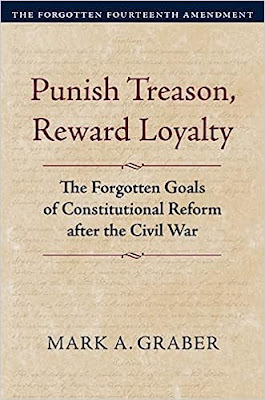
Mark A. Graber, Punish Treason, Reward Loyalty: The Forgotten Goals of Constitutional Reform after the Civil War (University of Kansas Press, 2023)
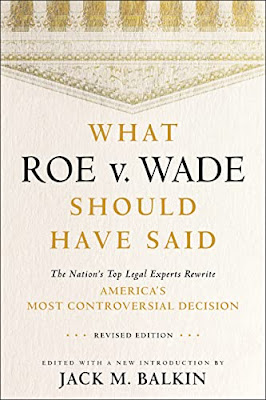
Jack M. Balkin, What Roe v. Wade Should Have Said: The Nation's Top Legal Experts Rewrite America's Most Controversial Decision - Revised Edition (NYU Press, 2023)

Andrew Koppelman, Burning Down the House: How Libertarian Philosophy Was Corrupted by Delusion and Greed (St. Martin’s Press, 2022)

Gerard N. Magliocca, Washington's Heir: The Life of Justice Bushrod Washington (Oxford University Press, 2022)
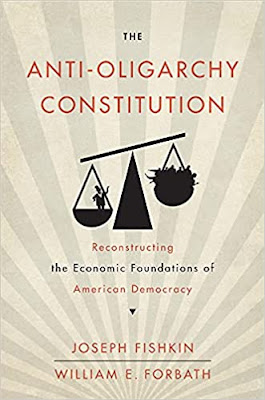
Joseph Fishkin and William E. Forbath, The Anti-Oligarchy Constitution: Reconstructing the Economic Foundations of American Democracy (Harvard University Press, 2022)
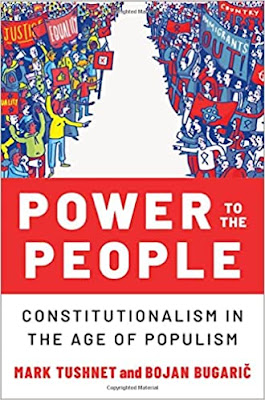
Mark Tushnet and Bojan Bugaric, Power to the People: Constitutionalism in the Age of Populism (Oxford University Press 2021).

Mark Philip Bradley and Mary L. Dudziak, eds., Making the Forever War: Marilyn B. Young on the Culture and Politics of American Militarism Culture and Politics in the Cold War and Beyond (University of Massachusetts Press, 2021).

Jack M. Balkin, What Obergefell v. Hodges Should Have Said: The Nation's Top Legal Experts Rewrite America's Same-Sex Marriage Decision (Yale University Press, 2020)

Frank Pasquale, New Laws of Robotics: Defending Human Expertise in the Age of AI (Belknap Press, 2020)

Jack M. Balkin, The Cycles of Constitutional Time (Oxford University Press, 2020)

Mark Tushnet, Taking Back the Constitution: Activist Judges and the Next Age of American Law (Yale University Press 2020).

Andrew Koppelman, Gay Rights vs. Religious Liberty?: The Unnecessary Conflict (Oxford University Press, 2020)

Ezekiel J Emanuel and Abbe R. Gluck, The Trillion Dollar Revolution: How the Affordable Care Act Transformed Politics, Law, and Health Care in America (PublicAffairs, 2020)

Linda C. McClain, Who's the Bigot?: Learning from Conflicts over Marriage and Civil Rights Law (Oxford University Press, 2020)
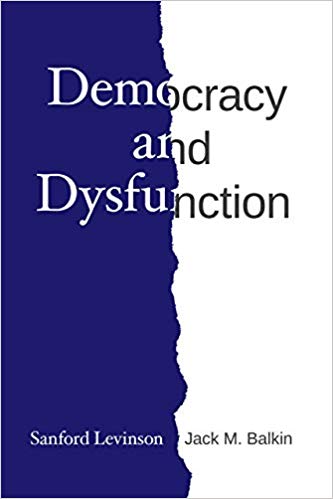
Sanford Levinson and Jack M. Balkin, Democracy and Dysfunction (University of Chicago Press, 2019)

Sanford Levinson, Written in Stone: Public Monuments in Changing Societies (Duke University Press 2018)

Mark A. Graber, Sanford Levinson, and Mark Tushnet, eds., Constitutional Democracy in Crisis? (Oxford University Press 2018)

Gerard Magliocca, The Heart of the Constitution: How the Bill of Rights became the Bill of Rights (Oxford University Press, 2018)

Cynthia Levinson and Sanford Levinson, Fault Lines in the Constitution: The Framers, Their Fights, and the Flaws that Affect Us Today (Peachtree Publishers, 2017)

Brian Z. Tamanaha, A Realistic Theory of Law (Cambridge University Press 2017)

Sanford Levinson, Nullification and Secession in Modern Constitutional Thought (University Press of Kansas 2016)

Sanford Levinson, An Argument Open to All: Reading The Federalist in the 21st Century (Yale University Press 2015)

Stephen M. Griffin, Broken Trust: Dysfunctional Government and Constitutional Reform (University Press of Kansas, 2015)

Frank Pasquale, The Black Box Society: The Secret Algorithms That Control Money and Information (Harvard University Press, 2015)

Bruce Ackerman, We the People, Volume 3: The Civil Rights Revolution (Harvard University Press, 2014)
Balkinization Symposium on We the People, Volume 3: The Civil Rights Revolution

Joseph Fishkin, Bottlenecks: A New Theory of Equal Opportunity (Oxford University Press, 2014)

Mark A. Graber, A New Introduction to American Constitutionalism (Oxford University Press, 2013)

John Mikhail, Elements of Moral Cognition: Rawls' Linguistic Analogy and the Cognitive Science of Moral and Legal Judgment (Cambridge University Press, 2013)

Gerard N. Magliocca, American Founding Son: John Bingham and the Invention of the Fourteenth Amendment (New York University Press, 2013)

Stephen M. Griffin, Long Wars and the Constitution (Harvard University Press, 2013)

Andrew Koppelman, The Tough Luck Constitution and the Assault on Health Care Reform (Oxford University Press, 2013)

James E. Fleming and Linda C. McClain, Ordered Liberty: Rights, Responsibilities, and Virtues (Harvard University Press, 2013)
Balkinization Symposium on Ordered Liberty: Rights, Responsibilities, and Virtues

Andrew Koppelman, Defending American Religious Neutrality (Harvard University Press, 2013)

Brian Z. Tamanaha, Failing Law Schools (University of Chicago Press, 2012)

Sanford Levinson, Framed: America's 51 Constitutions and the Crisis of Governance (Oxford University Press, 2012)

Linda C. McClain and Joanna L. Grossman, Gender Equality: Dimensions of Women's Equal Citizenship (Cambridge University Press, 2012)

Mary Dudziak, War Time: An Idea, Its History, Its Consequences (Oxford University Press, 2012)

Jack M. Balkin, Living Originalism (Harvard University Press, 2011)

Jason Mazzone, Copyfraud and Other Abuses of Intellectual Property Law (Stanford University Press, 2011)

Richard W. Garnett and Andrew Koppelman, First Amendment Stories, (Foundation Press 2011)

Jack M. Balkin, Constitutional Redemption: Political Faith in an Unjust World (Harvard University Press, 2011)

Gerard Magliocca, The Tragedy of William Jennings Bryan: Constitutional Law and the Politics of Backlash (Yale University Press, 2011)

Bernard Harcourt, The Illusion of Free Markets: Punishment and the Myth of Natural Order (Harvard University Press, 2010)

Bruce Ackerman, The Decline and Fall of the American Republic (Harvard University Press, 2010)
Balkinization Symposium on The Decline and Fall of the American Republic

Ian Ayres. Carrots and Sticks: Unlock the Power of Incentives to Get Things Done (Bantam Books, 2010)

Mark Tushnet, Why the Constitution Matters (Yale University Press 2010)

Ian Ayres and Barry Nalebuff: Lifecycle Investing: A New, Safe, and Audacious Way to Improve the Performance of Your Retirement Portfolio (Basic Books, 2010)
.jpg)
Jack M. Balkin, The Laws of Change: I Ching and the Philosophy of Life (2d Edition, Sybil Creek Press 2009)

Brian Z. Tamanaha, Beyond the Formalist-Realist Divide: The Role of Politics in Judging (Princeton University Press 2009)
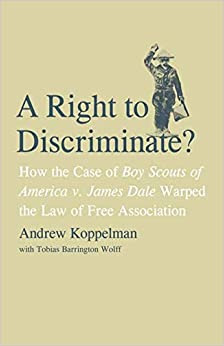
Andrew Koppelman and Tobias Barrington Wolff, A Right to Discriminate?: How the Case of Boy Scouts of America v. James Dale Warped the Law of Free Association (Yale University Press 2009)

Jack M. Balkin and Reva B. Siegel, The Constitution in 2020 (Oxford University Press 2009)

Heather K. Gerken, The Democracy Index: Why Our Election System Is Failing and How to Fix It (Princeton University Press 2009)

Mary Dudziak, Exporting American Dreams: Thurgood Marshall's African Journey (Oxford University Press 2008)

David Luban, Legal Ethics and Human Dignity (Cambridge Univ. Press 2007)

Ian Ayres, Super Crunchers: Why Thinking-By-Numbers is the New Way to be Smart (Bantam 2007)

Jack M. Balkin, James Grimmelmann, Eddan Katz, Nimrod Kozlovski, Shlomit Wagman and Tal Zarsky, eds., Cybercrime: Digital Cops in a Networked Environment (N.Y.U. Press 2007)
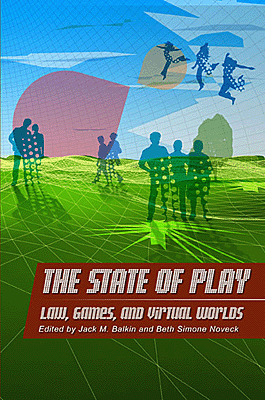
Jack M. Balkin and Beth Simone Noveck, The State of Play: Law, Games, and Virtual Worlds (N.Y.U. Press 2006)

Andrew Koppelman, Same Sex, Different States: When Same-Sex Marriages Cross State Lines (Yale University Press 2006)

Brian Tamanaha, Law as a Means to an End (Cambridge University Press 2006)

Sanford Levinson, Our Undemocratic Constitution (Oxford University Press 2006)

Mark Graber, Dred Scott and the Problem of Constitutional Evil (Cambridge University Press 2006)

Jack M. Balkin, ed., What Roe v. Wade Should Have Said (N.Y.U. Press 2005)

Sanford Levinson, ed., Torture: A Collection (Oxford University Press 2004)
Balkin.com homepage
Bibliography
Conlaw.net
Cultural Software
Writings
Opeds
The Information Society Project
BrownvBoard.com
Useful Links
Syllabi and Exams
