Balkinization
an unanticipated consequence of
Jack M. Balkin
Balkinization Symposiums: A Continuing List
E-mail:
Jack Balkin:
jackbalkin at yahoo.com
Bruce Ackerman
bruce.ackerman at yale.edu
Ian Ayres
ian.ayres at yale.edu
Corey Brettschneider
corey_brettschneider at brown.edu
Mary Dudziak
mary.l.dudziak at emory.edu
Joey Fishkin
joey.fishkin at gmail.com
Heather Gerken heather.gerken at yale.edu
Abbe Gluck abbe.gluck at yale.edu
Mark Graber
mgraber at law.umaryland.edu
Stephen Griffin
sgriffin at tulane.edu
Jonathan Hafetz
jonathan.hafetz at shu.edu
Jeremy Kessler
jkessler at law.columbia.edu
Andrew Koppelman
akoppelman at law.northwestern.edu
Marty Lederman
msl46 at law.georgetown.edu
Sanford Levinson
slevinson at law.utexas.edu
David Luban
david.luban at gmail.com
Gerard Magliocca
gmaglioc at iupui.edu
Jason Mazzone
mazzonej at illinois.edu
Linda McClain
lmcclain at bu.edu
John Mikhail
mikhail at law.georgetown.edu
Frank Pasquale
pasquale.frank at gmail.com
Nate Persily
npersily at gmail.com
Michael Stokes Paulsen
michaelstokespaulsen at gmail.com
Deborah Pearlstein
dpearlst at yu.edu
Rick Pildes
rick.pildes at nyu.edu
David Pozen
dpozen at law.columbia.edu
Richard Primus
raprimus at umich.edu
K. Sabeel Rahmansabeel.rahman at brooklaw.edu
Alice Ristroph
alice.ristroph at shu.edu
Neil Siegel
siegel at law.duke.edu
David Super
david.super at law.georgetown.edu
Brian Tamanaha
btamanaha at wulaw.wustl.edu
Nelson Tebbe
nelson.tebbe at brooklaw.edu
Mark Tushnet
mtushnet at law.harvard.edu
Adam Winkler
winkler at ucla.edu
Compendium of posts on Hobby Lobby and related cases
The Anti-Torture Memos: Balkinization Posts on Torture, Interrogation, Detention, War Powers, and OLC
The Anti-Torture Memos (arranged by topic)
Recent Posts
Rick Hills' Marshall McLuhan Moment
![[Powered by Blogger]](https://lh3.googleusercontent.com/blogger_img_proxy/AEn0k_sTtR-o-mU5OOHjYRMSZU3xAWWJGui3bBC4yi9akdUnrw2SttassVWj4bsmQKS531HCgigo8ODic88PL8wSQd-WXfNc09RI6FhcOG6hhnuB=s0-d)
Just A Few Blogs
ACS Blog
Alas, a Blog
Althouse
Arts and Letters Daily
Atrios (Eschaton)
Bill of Health
Buzzflash.com
Buzz Machine
Cato at Liberty
Juan Cole (Informed Comment)
Concurring Opinions
The Constitution in 2020
Corrente
Crooked Timber
Daily Howler
Daily Kos
Dana Boyd
Brad DeLong
Digby (Hullabaloo)
Discriminations
Daniel Drezner
Kevin Drum (Mother Jones)
Electrolite
En Banc
Eunomia (Daniel Larison)
Fafblog
Michael Froomkin (Discourse.net)
GovLab (Beth Noveck)
Rick Hasen (Election Law)
History News Network
How Appealing
Ignatz (Sam Heldman)
The Importance of (Ernie Miller)
Infolaw
Instapundit
International Economic Law and Policy Blog
IntLawGrrls
Jacob Levy
Jesus' General
Jurisdynamics
The Kitchen Cabinet
Mark Kleiman
Law Blog Central
Larry Lessig
Lawyers, Guns and Money
Liberal Oasis
Brian Leiter's Law School Reports
The Leiter Reports
Marginal Revolution
Megan McArdle
Memeorandum
Metafilter
Mirror of Justice
The New Republic
Newseum
No More Mister Nice Blog
Brendan Nyhan
Opinio Juris
Orcinus
The Originalism Blog
Pandagon
Passport (Foreign Policy)
Overcoming Bias
Political Animal (Washington Monthly)
Political Theory Daily Review
Political Wire (Taegan Goddard)
The Poor Man
Virginia Postrel
Prawfsblawg
Public Reason
Jonathan Rauch
Raw Story
Redstate
ReligiousLeftLaw.com
Reporters Committee For Freedom of the Press
Reproductive Rights Blog
Rothman's Roadmap to the Right of Publicity
SCOTUS Blog
Seeing the Forest
Clay Shirky
The Shifted Librarian
The Situationist
Larry Solum (Legal Theory)
Andrew Sullivan
Talking Points Memo
Talk Left
Tapped
Tbogg
TechPresident
The Paper Chase (Jurist)
Tom Paine
Tom Tomorrow (This Modern World)
Eve Tushnet
Uggabugga
University of Chicago Law School Faculty Blog
Unqualified Offerings
The Volokh Conspiracy
War and Piece (Laura Rozen)
Wampum
Oliver Willis
Wonkette
Written Description
Matthew Yglesias
Yin
Your Choice of Feeds
1. XML
powered by

2. Atom Feed
3. RSS 2.0
Rick Hills' Marshall McLuhan Moment
Guest Blogger
Pam Karlan
Rick Hills’s recent post over at Prawfsblawg on the Supreme Court’s decision in Riley v. Kennedy prompts me to react, not just because I was one of the appellees’ counsel in the case, but also because it brings up a larger point about the legal academy. I’ve never really written a blog post before, so forgive me if this is a bit long.
My co-counsel Sam Heldman, by the way, has written a series of responses to Rick in the Prawsblawg comments section that I highly recommend.
Rick tendentiously titles his post “Civil Rights Lawyers’ Ignorance of Local Government Law.” He claims that the lawyers in the case suffer from such “fundamental inexperience with local government and its peculiar issues” that they – we – cannot understand that the underlying ruling of the Alabama Supreme Court that we challenged “actually advanced minority voting rights.” (Rick’s italics) The U.S. Supreme Court’s decision, Rick writes, “protects minority voters from the ignorance of civil rights lawyers.”
It’s hard to know where to start in responding. So let’s start by discussing the “experience” – not just of the respondents’ counsel, but of the respondents themselves. In the real world, after all, clients, as well as their lawyers, matter. And if Rick had bothered to consider who brought the suit, as well as who litigated it, I would be very surprised – even if he disagrees with us – that he would continue to accuse us of “ignorance.”
Our three clients – Yvonne Kennedy, James Buskey, and William Clark – are as fundamentally experienced with local government and its peculiar issues as it’s possible for human beings to be. All three of them have served, for decades, in the Alabama Legislature. Rep. Clark retired in 2006 after more than 20 years’ service; Reps. Kennedy and Buskey continue to represent districts in Mobile County, Rep. Kennedy since 1982 and Rep. Buskey since 1976. Given their experience over the long haul, I’m not sure why Rick assumes that they’re “short-sighted.” If all politics is local, then local government law is likely to be particularly local. Our clients, who have been firmly rooted in Mobile and who understand Alabama in a way that folks like Rick Hills and I can only imagine, are far likelier than we to assess accurately what’s in minority voters’ best interests. There’s something more than just a little condescending in Rick’s suggesting our clients need to be protected from us by the Supreme Court. Our clients are very savvy.
But what about the lawyers? Rick writes as if we just parachuted into Alabama with a theory and little understanding of the state’s history or political climate. But that’s because Rick knows nothing – and apparently didn’t care to find out – about how voting rights litigation actually works in Alabama. In addition to teaching (my wonderful day job), I’ve spent at least a little bit of nearly every one of the past 22 years doing voting rights cases in Alabama with two of the greatest lawyers I could imagine working with: Ed Still (who, among other things, runs the invaluable votelaw blog) and Jim Blacksher. (And in this case, getting to work with Sam Heldman, who’s as nice as he is smart – which is saying a lot – and his colleagues at the Gardner firm was one of the real joys of this past year.) Anyway, virtually all my work with Jim and Ed for the past two decades is informed by an ongoing relationship with the Alabama Democratic Conference and its members. The ADC is the largest grassroots political organization in Alabama. It has affiliates in every one of the state’s counties. It is intimately familiar with the political realities in every jurisdiction in the state, and over the years I found its recently retired field director, Jerome Gray, to have an immensely sophisticated and wise understanding of both the theory and reality of local and state politics. (Some of you may remember Jerome’s tour de force discussion of offender reenfranchisement legislation and political deals in Alabama at the 2003 Yale Law School reunion.) Of course, Ed, Jim, and I have voting rights theories. One of the best things about voting rights as a field both for litigation and for scholarship is the close relationship between theory and practice. Ed, among other things, wrote one of the first pieces ever to discuss alternative voting systems “Alternatives to Single-Member Districts, in Minority Vote Dilution (Chandler Davidson & Bernard Grofman eds. 1984)); Jim not only co-wrote the piece that provided the intellectual basis for the Gingles test (James U. Blacksher & Larry Menefee, From Reynolds v. Sims to City of Mobile v. Bolden: Have the White Suburbs Commandeered the Fifteenth Amendment?, 34 Hast. L.J. 1 (1982)), but has written some of the most original theoretical scholarship on voting rights as well. (Check out Dred Scott’s Unwon Freedom: The Redistricting Cases as Badges of Slavery, 39 How. L.J. 633 (1996) and Majority Black Districts, Kiryas Joel, and Other Challenges To American Nationalism, 26 Cumb. L. Rev. 407 (1996), if you want to see how a practicing lawyer can write high-level, tenure-quality scholarship in his spare time.) No one is more reflective than Jim and Ed; to work with them is a pleasure beyond measure. And as Ring Lardner would say, You know me, Al: I’ve spent parts of each of the last 22 years writing scholarship on the law of democracy. But our cases always reflect the needs of real, and really sophisticated, clients.
Now let’s turn to Rick’s narrower substantive point. Here’s what Rick says
The Alabama Supreme Court's initial decision that the feds were being asked to veto actually advanced minority voting rights. Why? The state court had declared that the state legislature could not enact "special legislation" authorizing elections to fill vacated commission seats only in Mobile County: Instead, the court held that the state legislature would have to authorize such elections for every county in Alabama (which, indeed, the state legislature later did). This rule against special elections is a common one in state constitutions, and it serves the purpose of enhancing local autonomy by preventing state politicians from micro-managing one jurisdiction's local affairs.
Elections for every county in the state are obviously superior to elections in a single county if you are a minority voter. But the plaintiffs wanted the Feds effectively to nullify the state court's decision that bestowed this boon on minority voters because the state court's decision would prevent the election of a particular county commissioner. In other words, the plaintiffs, pursuing a short-term political advantage, would have vetoed a state constitutional doctrine that benefited minority voters over the longer term.
Let’s start with Rick’s point about the purpose of anti-special legislation provisions. Unlike Rick, I don’t claim to be an expert in local government law. I don’t know what the genesis of other states’ prohibitions was. But think, for just a moment about the genesis of the Alabama provision. The Alabama constitutional provision (art. IV, § 105) was apparently first adopted as part of the Constitution of 1901. In an earlier case before the U.S. Supreme Court, Ed Still showed that the constitutional convention that produced that document was shot through with outright racism. That old civil-rights lawyer William Rehnquist, writing for a unanimous Court in Hunter v. Underwood, 471 U.S. 222, 229 (1985), described things this way, after noting that the “zeal for white supremacy ran rampant”:
The delegates to the all-white convention were not secretive about their purpose. John B. Knox, president of the convention, stated in his opening address: “And what is it that we want to do? Why it is within the limits imposed by the Federal Constitution, to establish white supremacy in this State.”
A lot of stuff that local government folks who don’t know much about the history of racial discrimination might think involves “good government reforms” is marbled with racially discriminatory purposes. So Jim Blacksher, for example, proved that the move in Mobile to at-large elections for the city commission – a move the Supreme Court presupposed in City of Mobile v. Bolden, 446 U.S. 55 (1980), to be part of the Progressive era reforms getting rid of ward politics – was in fact infected with the desire to prevent black voters from electing members of the Commission. Bolden v. City of Mobile, 542 F. Supp. 1050 (S.D. Ala. 1982). Another historical example: some people tout the Australian (secret) ballot as an anti-fraud device; others, with evidence that’s also pretty persuasive, show that it was often used to disenfranchise illiterate (particularly black illiterate) voters. In our day, think about the debate over voter ID that Bob Bauer and Heather Gerken described in a post earlier this week.
So .... Just because the rule on special legislation is “common” – Rick’s term – doesn’t mean it’s good. And it certainly doesn’t mean, even if it has many virtues, that it’s invariably better for minority voters.
Let’s get even more into the “arcane workings” (Rick’s phrase) of Alabama. I’ll concede, much as I disagree with the Court’s resolution of our case, that it was a close question whether the “change” from gubernatorial appointment to special election to fill vacancies on the Mobile County Commission actually went into effect. (That was the narrow legal question at the heart of Riley.) My clients, my co-counsel, three lower-court judges (two from Alabama), and I thought that it had; seven Justices disagreed. But regardless of the question of how section 5 of the Voting Rights Act should be interpreted – a point to which I’ll turn in a moment – Rick is just wrong to suggest that Alabama’s prohibition on special legislation “serve[d] the purpose of enhancing local autonomy by preventing state politicians from micro-managing one jurisdiction's local affairs” or otherwise helped black people.
To understand why, you need to know something about Alabama, and where the local laws at issue in Riley came from. Prior to 1977, as a result of state law (both general state law and some Mobile-specific law), Mobile elected its county commission at large. Needless to say, black voters never succeeded in electing a candidate of their choice. A few years after the initial passage of the Voting Rights Act, black citizens in Mobile County, represented by Jim Blacksher, brought suit in federal court. In a decision from which the county did not appeal, the district court held that the use of at-large elections unconstitutionally diluted black voting strength because the system had been adopted, modified, and maintained with the purpose of preventing black voters from electing a candidate of their choice. The court then ordered a plan to elect the commissioners from districts. One of those districts was majority black, and it has consistently elected a black candidate to represent it.
But once black voters in Mobile County could elect a representative of their choice to the Commission, the question of how vacancies should be filled took on new salience. The general state law provided (and still provides, despite Rick’s suggestion to the contrary) for gubernatorial appointment. At least so far, governors of Alabama have been white; often they are conservatives who would pretty clearly prefer to have someone on the Mobile County Commission with their views, rather than the views of the majority black, Democratic electorate in the district in which my clients live. So in 1985, under the sponsorship of an African-American state senator from Mobile who represented a majority-black single-member district (itself created as a result of voting rights litigation), the legislature passed Act 85-237 to ensure that any vacancies on the commission would be filled by special election and not by gubernatorial appointment. That was the first of the two laws involved in Riley. Whatever else one might say about the 1985 Act, what one can’t say is what Rick Hills does. I honestly don’t understand how, if he knew this history, he would claim that the 1985 Act involved “state politicians . . . micro-managing one jurisdiction's local affairs.” In fact, under Alabama law, a locality can’t manage its own affairs on a question like this: state law determines how vacancies are to be filled. What happened in 1985 is something that happens all the time in Alabama: the state legislators from a particular jurisdiction enact legislation responsive to that jurisdiction’s needs. (That’s why, for example, the Alabama House has “county legislation committees” made up of local legislators to pass local bills.)
For decades, that’s how Alabama worked. But the Alabama Supreme Court struck down the 1985 Act, in one of a series of decisions where that court took a far more skeptical approach to local laws than it had during the heyday of white supremacy (a point not worth discussing at length here, but which makes me at least a little suspicious of the newfound principles of constitutional interpretiation that Rick celebrates). So the state legislature tried again to enable black voters in Mobile to elect a replacement when a vacancy occurred. In 2004, the Alabama state legislature passed, and the Governor signed into law, a statute providing that that vacancies on county commissions were to be filled by gubernatorial appointment “[u]nless a local law authorizes a special election.” Act 2004-455 was cosponsored by, among other people, our clients in Riley – the black legislators from Mobile County, who thought that the 2004 Act cured the problem the Alabama Supreme Court identified with the 1985 Act. What the Alabama Supreme Court held in the second lawsuit at issue in the Riley case before the U.S. Supreme Court was that Act 2004-455 did not, as a matter of state retroactivity doctrine, revive the 1985 Act. Finally, in 2006 and 2007, the Alabama Legislature followed all the formalities necessary to permit local legislation regarding how vacancies on county commissions are filled.
So where are we now? Well, Alabama still has a general law providing for gubernatorial appointment to county commission vacancies (which right now means by appointment by a white Republican) with exceptions carved out for special elections in jurisdictions where the legislature has authorized them instead. (In our clients’ Mobile district, the special election ordered by a state court following the three-judge court’s section 5 decision resulted in the governor’s hand-picked replacement losing to Merceria Ludgood by a 4-to-1 margin.) So nothing about the Alabama Supreme Court decision that Rick lauds “bestowed [any] boon on minority voters ” generally: they still have to persuade the Alabama Legislature to pass (what would now be a permissible piece of) local legislation for their county. Rick just gets the facts wrong about what the state of Alabama law is.
And while I don’t want to revisit the merits of the Supreme Court’s decision in Riley, it’s also worth pointing out that Rick – not content to leave well enough alone in his original posting – has continued to make claims that only someone with fundamental inexperience with section 5 of the Voting Rights Act and its peculiar issues could advance. Rick writes the following with respect to the now-reversed decision by the three-judge district court to require Alabama to preclear the use of gubernatorial appointment to fill vacancies on the Mobile County Commission and the decision by the Department of Justice to object to the use of gubernatorial appointment in Mobile:
But one thing is absolutely certain: No one at DOJ or on the 3-judge panel thought of these long-term considerations, any more than they think of them with annexations. They can't: As the narrative above indicates, the whole thing is just too darn complicated for someone who does not specialize in the topic.
The question before DOJ and the three-judge panel wasn’t “what are the general long-term effects of special legislation vs. general legislation?” The question was whether Alabama had made a change in a voting practice or procedure when it required gubernatorial appointment rather than special elections in Mobile County. That question didn’t depend on whether there was local or general legislation involved. In the end, the Supreme Court concluded that there hadn’t been a change because the 1985 law never went into effect. (I won’t rehash here why we think that’s wrong: Justice Stevens’s dissent does a fine job of explaining the argument, which is orthogonal to my disagreement with Rick in any event.) So nothing about what the 3-judge panel decided or what DOJ did casts any shadow on a state’s ability to permit, or to forbid, special legislation. Nothing at all with respect to bans on special or local legislation that don’t relate to voting practices or procedures. Section 5 addresses only the question whether a change in voting rules – whether prompted by interpretations of anti-special legislation provisions or any other rationale – should be approved.
More fundamentally, section 5 doesn’t ask the abstract sort of question Rick wants to debate. The question is never “is practice X good for minority voters as a general matter?” Rather, it’s whether, under the particular circumstances existing in this jurisdiction this change will lead to a retrogression of the political power of minority voters. The reason the question is posed in the context of specific changes in individual jurisdictions is precisely because the question can’t be answered, at least not accurately, as an abstract matter. Some jurisdictional boundary changes are salutary and will benefit black residents living inside the existing jurisdiction. But others have, as a primary purpose or a major effect, the diminution of minority voting strength. So, too, despite Rick’s sweeping claim, with respect to local legislation: sometimes the ban on local legislation might benefit minority voters; sometimes, as with the black voters of Mobile County who had an unwanted commissioner, foisted on them by a governor whose election they had vigorously opposed, enforcement of that ban hurts them. The Voting Rights Act represents a national commitment to treating the issue not as an academic abstraction for folks who “specialize in the topic” of local government law but through a “searching practical evaluation of the ‘past and present reality’” of politics within a jurisdiction, Thornburg v. Gingles, 478 U.S. 30, 79 (1986) (quoting S. Rep. 97-417, p. 30 (1982)), that “requires “an intensely local appraisal of the design and impact” of the contested practices, Rogers v. Lodge, 458 U.S. 613, 622 (1982). The world, in short, is too darn complicated for someone who simply specializes in the topic of local government law to be so certain that he has a monopoly on the truth.
The Larger Point
The reason I’ve bothered to respond to Rick – the blogosphere is filled with people saying things about cases I’ve worked on that I disagree with, and I’m not prepared to get into a posting war – is because his postings point to a broader problem. Rick is a creative and well-read academic. But he doesn’t know the facts, and even when they’re pointed out to him, he remains enamored of his theories. When Sam Heldman challenged Rick’s account of Alabama, Rick replies that he “teaches Alabama’s Constitution in [his] course on local government law.” Just like the guy in Annie Hall, who announced that he was entitled to spout off about Marshall McLuhan because “I happen to teach a class at Columbia called TV, Media and Culture, so I think that my insights into Mr. McLuhan, well, have a great deal of validity.” Remember what happened to him? (Check out at 2:15) Well, think about how Rick ends his first response to Sam: “The notion that individual plaintiffs with particular political grievances about specific candidates in specific elections should be trusted to act as private attorneys general to vindicate general principles of localism is silly. These plaintiffs represent no one but themselves.” In the most narrow, pedantic, technical sense of first-year civil procedure, that’s true. Riley wasn’t a class action. But in broader context, Rick’s offhand remark reflects precisely the “ignorance” he purports to decry. Representatives Kennedy, Buskey, and Clark ... well, they represent the voters of their districts. They sponsored, in their official capacity and presumably because it benefited the folks in their districts, the legislation the Alabama Supreme Court nullified. Probably Rick didn’t know who Kennedy, Buskey, and Clark are. If he did, then his comments are even more puzzling.
One of the reasons I love the way I do my job now is because I’m doing something that’s become increasingly old-fashioned: I’m litigating cases (all of them pro bono, by the way, and 90% of them through the Stanford Supreme Court Litigation Clinic, where students get to work with us – as Steve Siger, Anna Neill, Alan Bakowski, Erica Ross, and Thomas Haymore did on Riley) as well as doing classroom teaching and traditional scholarship. It’s sometimes exhilarating, sometimes frustrating, and always interesting. But it’s made me far less confident that all my theories – let alone all of anyone else’s theories – reflect the sheer complexity of the real world. It’s made me care a lot more about facts. And it’s also reminded me of what I’ve known since law school: the really good civil rights lawyers – people like Sam Heldman and Ed Still and Jim Blacksher – are every bit as smart, and probably twice as wise, as those of us in the legal academy.
Posted
7:31 AM
by Guest Blogger [link]
The granularity of these intricate issues of what protects minority voting progress is the key idea and it is very well taken by me.
Thanks for taking the time to lay all of that out. It was very useful for me.
Best,
Ben

Or, at least, what's in minority politicians' best interests.
This is a very good point, and as a matter of reading Section 5 you're definitely right. Unfortunately for you, though, and maybe this is what Hills was getting at, I think what you're saying just points to the infirmities of Section 5. There's nothing wrong, per se, with retrogression of minority voting strength. Underrepresentation, descriptive or substantive, may be undesirable, invidious discrimination is always wrong, but retrogression isn't always an evil, particularly if you're not retrogressing to a point of severe dilution or underrepresentation. For example, take this very case. Gubernatorial appointment in case of vacancy isn't exactly a horribly dilutive practice. Yet if you retrogress from special election to gubernatorial appointment, the VRA bans it. Why? Because of a history of bad faith in the preclearance states. When southern states backslid, the assumption in 1965 was that they were doing so for racially discriminatory purposes. The question in the Austin utility district case is whether that assumption remains a valid one. I don't think it does, and I think what Hills was saying is that we've reached a point in the enforcement of Section 5 where all kinds of plainly nondiscriminatory stuff, like going back to gubernatorial appt. in the case of vacancy when it turns out to be required by a state constitution, or a black caucus-endorsed plan that drops the percentage of the black vote in some districts from 60% to 50% (GA v. Ashcroft as overruled by the GA v. Ashcroft "fix"), is getting shot down - even if these retrogressions actually help minority voters in the long run. His ruminations on the possibility of a global special elections law in Alabama may be a little speculative, but what about a situation like the one in Page v. Bartels? There the New Jersey state legislature cured a Republican gerrymander by lowering BVAP in a few districts, ultimately helping black voters see their preferred party obtain a majority in the legislature - and the reauthorized VRA may effectively overrule the decision that upheld that redistricting. Who benefits from that?
Books by Balkinization Bloggers

Mark Tushnet and Bojan Bugaric, Constitutionalism and Its Discontents (University of Chicago Press, 2026)

Gerard N. Magliocca, The Actual Art of Governing: Justice Robert H. Jackson's Concurring Opinion in the Steel Seizure Case (Oxford University Press, 2025)

Linda C. McClain and Aziza Ahmed, The Routledge Companion to Gender and COVID-19 (Routledge, 2024)

David Pozen, The Constitution of the War on Drugs (Oxford University Press, 2024)

Jack M. Balkin, Memory and Authority: The Uses of History in Constitutional Interpretation (Yale University Press, 2024)
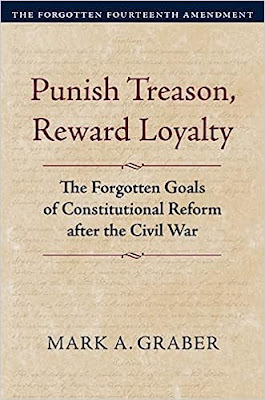
Mark A. Graber, Punish Treason, Reward Loyalty: The Forgotten Goals of Constitutional Reform after the Civil War (University of Kansas Press, 2023)
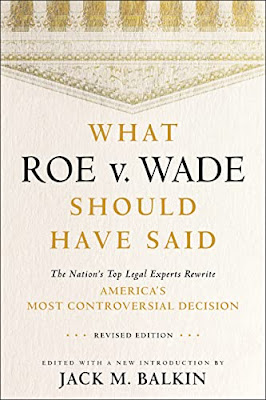
Jack M. Balkin, What Roe v. Wade Should Have Said: The Nation's Top Legal Experts Rewrite America's Most Controversial Decision - Revised Edition (NYU Press, 2023)

Andrew Koppelman, Burning Down the House: How Libertarian Philosophy Was Corrupted by Delusion and Greed (St. Martin’s Press, 2022)

Gerard N. Magliocca, Washington's Heir: The Life of Justice Bushrod Washington (Oxford University Press, 2022)
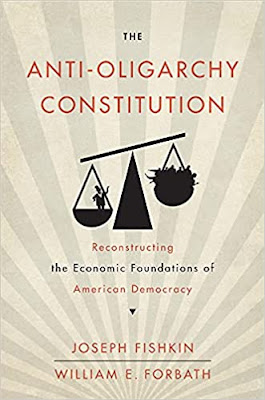
Joseph Fishkin and William E. Forbath, The Anti-Oligarchy Constitution: Reconstructing the Economic Foundations of American Democracy (Harvard University Press, 2022)
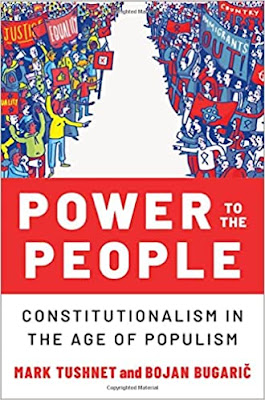
Mark Tushnet and Bojan Bugaric, Power to the People: Constitutionalism in the Age of Populism (Oxford University Press 2021).

Mark Philip Bradley and Mary L. Dudziak, eds., Making the Forever War: Marilyn B. Young on the Culture and Politics of American Militarism Culture and Politics in the Cold War and Beyond (University of Massachusetts Press, 2021).

Jack M. Balkin, What Obergefell v. Hodges Should Have Said: The Nation's Top Legal Experts Rewrite America's Same-Sex Marriage Decision (Yale University Press, 2020)

Frank Pasquale, New Laws of Robotics: Defending Human Expertise in the Age of AI (Belknap Press, 2020)

Jack M. Balkin, The Cycles of Constitutional Time (Oxford University Press, 2020)

Mark Tushnet, Taking Back the Constitution: Activist Judges and the Next Age of American Law (Yale University Press 2020).

Andrew Koppelman, Gay Rights vs. Religious Liberty?: The Unnecessary Conflict (Oxford University Press, 2020)

Ezekiel J Emanuel and Abbe R. Gluck, The Trillion Dollar Revolution: How the Affordable Care Act Transformed Politics, Law, and Health Care in America (PublicAffairs, 2020)

Linda C. McClain, Who's the Bigot?: Learning from Conflicts over Marriage and Civil Rights Law (Oxford University Press, 2020)
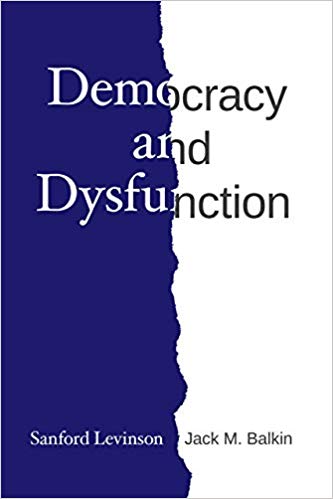
Sanford Levinson and Jack M. Balkin, Democracy and Dysfunction (University of Chicago Press, 2019)

Sanford Levinson, Written in Stone: Public Monuments in Changing Societies (Duke University Press 2018)

Mark A. Graber, Sanford Levinson, and Mark Tushnet, eds., Constitutional Democracy in Crisis? (Oxford University Press 2018)

Gerard Magliocca, The Heart of the Constitution: How the Bill of Rights became the Bill of Rights (Oxford University Press, 2018)

Cynthia Levinson and Sanford Levinson, Fault Lines in the Constitution: The Framers, Their Fights, and the Flaws that Affect Us Today (Peachtree Publishers, 2017)

Brian Z. Tamanaha, A Realistic Theory of Law (Cambridge University Press 2017)

Sanford Levinson, Nullification and Secession in Modern Constitutional Thought (University Press of Kansas 2016)

Sanford Levinson, An Argument Open to All: Reading The Federalist in the 21st Century (Yale University Press 2015)

Stephen M. Griffin, Broken Trust: Dysfunctional Government and Constitutional Reform (University Press of Kansas, 2015)

Frank Pasquale, The Black Box Society: The Secret Algorithms That Control Money and Information (Harvard University Press, 2015)

Bruce Ackerman, We the People, Volume 3: The Civil Rights Revolution (Harvard University Press, 2014)
Balkinization Symposium on We the People, Volume 3: The Civil Rights Revolution

Joseph Fishkin, Bottlenecks: A New Theory of Equal Opportunity (Oxford University Press, 2014)

Mark A. Graber, A New Introduction to American Constitutionalism (Oxford University Press, 2013)

John Mikhail, Elements of Moral Cognition: Rawls' Linguistic Analogy and the Cognitive Science of Moral and Legal Judgment (Cambridge University Press, 2013)

Gerard N. Magliocca, American Founding Son: John Bingham and the Invention of the Fourteenth Amendment (New York University Press, 2013)

Stephen M. Griffin, Long Wars and the Constitution (Harvard University Press, 2013)

Andrew Koppelman, The Tough Luck Constitution and the Assault on Health Care Reform (Oxford University Press, 2013)

James E. Fleming and Linda C. McClain, Ordered Liberty: Rights, Responsibilities, and Virtues (Harvard University Press, 2013)
Balkinization Symposium on Ordered Liberty: Rights, Responsibilities, and Virtues

Andrew Koppelman, Defending American Religious Neutrality (Harvard University Press, 2013)

Brian Z. Tamanaha, Failing Law Schools (University of Chicago Press, 2012)

Sanford Levinson, Framed: America's 51 Constitutions and the Crisis of Governance (Oxford University Press, 2012)

Linda C. McClain and Joanna L. Grossman, Gender Equality: Dimensions of Women's Equal Citizenship (Cambridge University Press, 2012)

Mary Dudziak, War Time: An Idea, Its History, Its Consequences (Oxford University Press, 2012)

Jack M. Balkin, Living Originalism (Harvard University Press, 2011)

Jason Mazzone, Copyfraud and Other Abuses of Intellectual Property Law (Stanford University Press, 2011)

Richard W. Garnett and Andrew Koppelman, First Amendment Stories, (Foundation Press 2011)

Jack M. Balkin, Constitutional Redemption: Political Faith in an Unjust World (Harvard University Press, 2011)

Gerard Magliocca, The Tragedy of William Jennings Bryan: Constitutional Law and the Politics of Backlash (Yale University Press, 2011)

Bernard Harcourt, The Illusion of Free Markets: Punishment and the Myth of Natural Order (Harvard University Press, 2010)

Bruce Ackerman, The Decline and Fall of the American Republic (Harvard University Press, 2010)
Balkinization Symposium on The Decline and Fall of the American Republic

Ian Ayres. Carrots and Sticks: Unlock the Power of Incentives to Get Things Done (Bantam Books, 2010)

Mark Tushnet, Why the Constitution Matters (Yale University Press 2010)

Ian Ayres and Barry Nalebuff: Lifecycle Investing: A New, Safe, and Audacious Way to Improve the Performance of Your Retirement Portfolio (Basic Books, 2010)
.jpg)
Jack M. Balkin, The Laws of Change: I Ching and the Philosophy of Life (2d Edition, Sybil Creek Press 2009)

Brian Z. Tamanaha, Beyond the Formalist-Realist Divide: The Role of Politics in Judging (Princeton University Press 2009)
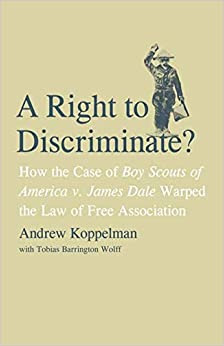
Andrew Koppelman and Tobias Barrington Wolff, A Right to Discriminate?: How the Case of Boy Scouts of America v. James Dale Warped the Law of Free Association (Yale University Press 2009)

Jack M. Balkin and Reva B. Siegel, The Constitution in 2020 (Oxford University Press 2009)

Heather K. Gerken, The Democracy Index: Why Our Election System Is Failing and How to Fix It (Princeton University Press 2009)

Mary Dudziak, Exporting American Dreams: Thurgood Marshall's African Journey (Oxford University Press 2008)

David Luban, Legal Ethics and Human Dignity (Cambridge Univ. Press 2007)

Ian Ayres, Super Crunchers: Why Thinking-By-Numbers is the New Way to be Smart (Bantam 2007)

Jack M. Balkin, James Grimmelmann, Eddan Katz, Nimrod Kozlovski, Shlomit Wagman and Tal Zarsky, eds., Cybercrime: Digital Cops in a Networked Environment (N.Y.U. Press 2007)
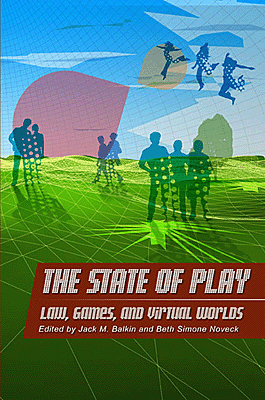
Jack M. Balkin and Beth Simone Noveck, The State of Play: Law, Games, and Virtual Worlds (N.Y.U. Press 2006)

Andrew Koppelman, Same Sex, Different States: When Same-Sex Marriages Cross State Lines (Yale University Press 2006)

Brian Tamanaha, Law as a Means to an End (Cambridge University Press 2006)

Sanford Levinson, Our Undemocratic Constitution (Oxford University Press 2006)

Mark Graber, Dred Scott and the Problem of Constitutional Evil (Cambridge University Press 2006)

Jack M. Balkin, ed., What Roe v. Wade Should Have Said (N.Y.U. Press 2005)

Sanford Levinson, ed., Torture: A Collection (Oxford University Press 2004)
Balkin.com homepage
Bibliography
Conlaw.net
Cultural Software
Writings
Opeds
The Information Society Project
BrownvBoard.com
Useful Links
Syllabi and Exams
