Balkinization
an unanticipated consequence of
Jack M. Balkin
Balkinization Symposiums: A Continuing List
E-mail:
Jack Balkin:
jackbalkin at yahoo.com
Bruce Ackerman
bruce.ackerman at yale.edu
Ian Ayres
ian.ayres at yale.edu
Corey Brettschneider
corey_brettschneider at brown.edu
Mary Dudziak
mary.l.dudziak at emory.edu
Joey Fishkin
joey.fishkin at gmail.com
Heather Gerken heather.gerken at yale.edu
Abbe Gluck abbe.gluck at yale.edu
Mark Graber
mgraber at law.umaryland.edu
Stephen Griffin
sgriffin at tulane.edu
Jonathan Hafetz
jonathan.hafetz at shu.edu
Jeremy Kessler
jkessler at law.columbia.edu
Andrew Koppelman
akoppelman at law.northwestern.edu
Marty Lederman
msl46 at law.georgetown.edu
Sanford Levinson
slevinson at law.utexas.edu
David Luban
david.luban at gmail.com
Gerard Magliocca
gmaglioc at iupui.edu
Jason Mazzone
mazzonej at illinois.edu
Linda McClain
lmcclain at bu.edu
John Mikhail
mikhail at law.georgetown.edu
Frank Pasquale
pasquale.frank at gmail.com
Nate Persily
npersily at gmail.com
Michael Stokes Paulsen
michaelstokespaulsen at gmail.com
Deborah Pearlstein
dpearlst at yu.edu
Rick Pildes
rick.pildes at nyu.edu
David Pozen
dpozen at law.columbia.edu
Richard Primus
raprimus at umich.edu
K. Sabeel Rahmansabeel.rahman at brooklaw.edu
Alice Ristroph
alice.ristroph at shu.edu
Neil Siegel
siegel at law.duke.edu
David Super
david.super at law.georgetown.edu
Brian Tamanaha
btamanaha at wulaw.wustl.edu
Nelson Tebbe
nelson.tebbe at brooklaw.edu
Mark Tushnet
mtushnet at law.harvard.edu
Adam Winkler
winkler at ucla.edu
Compendium of posts on Hobby Lobby and related cases
The Anti-Torture Memos: Balkinization Posts on Torture, Interrogation, Detention, War Powers, and OLC
The Anti-Torture Memos (arranged by topic)
Recent Posts
The Key Questions About the New FISA Bill
![[Powered by Blogger]](https://lh3.googleusercontent.com/blogger_img_proxy/AEn0k_vSBdP-Pgf4TxJJV1Pe4ndKtaZETgHagB8fdz7gAtmHnYiA0jmBZqzUYo6UkWyxFD9R5NGbrzz-lQFmGgSrNFqK--QsTXEeb-0cXZ65rmjO=s0-d)
Just A Few Blogs
ACS Blog
Alas, a Blog
Althouse
Arts and Letters Daily
Atrios (Eschaton)
Bill of Health
Buzzflash.com
Buzz Machine
Cato at Liberty
Juan Cole (Informed Comment)
Concurring Opinions
The Constitution in 2020
Corrente
Crooked Timber
Daily Howler
Daily Kos
Dana Boyd
Brad DeLong
Digby (Hullabaloo)
Discriminations
Daniel Drezner
Kevin Drum (Mother Jones)
Electrolite
En Banc
Eunomia (Daniel Larison)
Fafblog
Michael Froomkin (Discourse.net)
GovLab (Beth Noveck)
Rick Hasen (Election Law)
History News Network
How Appealing
Ignatz (Sam Heldman)
The Importance of (Ernie Miller)
Infolaw
Instapundit
International Economic Law and Policy Blog
IntLawGrrls
Jacob Levy
Jesus' General
Jurisdynamics
The Kitchen Cabinet
Mark Kleiman
Law Blog Central
Larry Lessig
Lawyers, Guns and Money
Liberal Oasis
Brian Leiter's Law School Reports
The Leiter Reports
Marginal Revolution
Megan McArdle
Memeorandum
Metafilter
Mirror of Justice
The New Republic
Newseum
No More Mister Nice Blog
Brendan Nyhan
Opinio Juris
Orcinus
The Originalism Blog
Pandagon
Passport (Foreign Policy)
Overcoming Bias
Political Animal (Washington Monthly)
Political Theory Daily Review
Political Wire (Taegan Goddard)
The Poor Man
Virginia Postrel
Prawfsblawg
Public Reason
Jonathan Rauch
Raw Story
Redstate
ReligiousLeftLaw.com
Reporters Committee For Freedom of the Press
Reproductive Rights Blog
Rothman's Roadmap to the Right of Publicity
SCOTUS Blog
Seeing the Forest
Clay Shirky
The Shifted Librarian
The Situationist
Larry Solum (Legal Theory)
Andrew Sullivan
Talking Points Memo
Talk Left
Tapped
Tbogg
TechPresident
The Paper Chase (Jurist)
Tom Paine
Tom Tomorrow (This Modern World)
Eve Tushnet
Uggabugga
University of Chicago Law School Faculty Blog
Unqualified Offerings
The Volokh Conspiracy
War and Piece (Laura Rozen)
Wampum
Oliver Willis
Wonkette
Written Description
Matthew Yglesias
Yin
Your Choice of Feeds
1. XML
powered by

2. Atom Feed
3. RSS 2.0
The Key Questions About the New FISA Bill
Marty Lederman
We've invited David Kris to publish some posts explaining the new FISA bill. Check out his first two posts, just below David Luban's important Commander in Chief post. David K. was Associate Deputy Attorney General in charge of national security issues from 2000 to 2003, and before that he was in the Criminal Appellate section of the Criminal Division. He was widely regarded as one of the very best lawyers in the Department -- and became one of the most trusted, most well-respected authorities in the Department on criminal law and electronic surveillance issues once he moved on to the DAG's Office. As I've written here before, he's extremely thorough, careful, and impartial. We're thrilled to have his input here.
David's posts have prompted me to think about what might be the most important questions the new law will raise. There is a general sense out there that this new law gives the government substantially more powers to surveille communications of U.S. persons -- perhaps in ways that implicate the Fourth Amendment -- but there is, thus far, very little understanding of how that might be so, and how the new surveillance regime will differ from the one in place from 1978 to 2001.
David has begun to answer some of the more important questions. The answers to others remain hidden in the shadows and the vagaries of the law -- and some might never become public. But I think that the answers must be at the heart of any serious assessment of what Jack calls the "New Surveillance State" under which we will be governed very soon. I would be very grateful to David and other readers and bloggers -- and perhaps even the Congress! -- if they can provide further insight into what those answers might be. [This reminds me: The most troubling thing of all about the new statute is probably that virtually no one outside the executive branch has the slightest idea what it authorizes, or how, exactly it will work in practice. Folks such as David and I can provide our best guesses, but this opaque legislative process shares nothing in common with the extensive, transparent debate that occurred during the three years that FISA was under consideration. For more -- much more -- on these process issues and the possible technological practices that might be underlying this issue, I recommend a "Breakfast Table" discussion that David and I conducted at Slate with Orin Kerr and Patrick Keefe last year. Upon rereading it, it occurs to me that the more things change, the more they . . . remain inscrutable.]
But in any event, let's start with the key questions, below the fold . . .
QUESTION ONE: Why has the Administration been so desperate to "modernize" or to circumvent FISA, when its surveillance capabilities were already so extensive: (i) FISA doesn't regulate international-to-international phone calls at all, as long as a U.S. person in the U.S. is not a target; (ii) FISA doesn't regulate any communications intercepted overseas, even if they are international-to-domestic; (iii) to the extent FISA covers international-to-international e-mails intercepted from facilities in the U.S., everyone agrees it should not, and thus that would be an uncontroversial fix (at least assuming there's some way to identify such e-mails in the first instance); and, most importantly, (iv) the FISA Court must, and does, regularly authorize NSA surveillance whenever the agency can demonstrate probable cause that the target of its surveillance is a foreign power (including al Qaeda) or an agent thereof.
In light of all these significant authorities, why the desperate rush to legislate?
David provides the answer to this question, I think: The NSA wishes to be able to engage in what he calls "vacuum-cleaner" surveillance of U.S. facilities in circumstances where (i) there is no way of knowing in advance which calls are wholly international and (ii) there is no way of knowing in advance which of the targets of such vacuum-cleaner surveillance are foreign powers or their agents. The new law apparently will allow this sort of vacuum-cleaner surveillance by authorizing any and all surveillance "targeting . . . persons reasonably believed to be located outside the United States to acquire foreign intelligence information." Under this new standard, there's no need that the surveillance have any connection to al Qaeda, or terrorism, or even to national security. The only substantial requirements are that someone overseas be a "target" and that one "significant purpose" of the surveillance be to acquire "foreign intelligence information," which is very broadly defined to include most anything that occurs overseas and in which the federal government might have an interest (including information necessary to protect against the full range of foreign threats to national security, including both international terrorism and espionage, and information with respect to a foreign power that is necessary to the national defense or foreign affairs).
This sort of "vacuum" surveillance could not be approved under the old FISA scheme, which requires either that the calls be wholly international, or that the interception be made overseas, or that the NSA demonstrate evidence in advance that the target is an agent of a foreign power. Under the new law, the NSA can engage in surveillance where none of those three criteria are met. [NOTE: Many critics of the bill are focusing on the fact that there is no meaningful judicial review to ensure that each case of surveillance meets the new substantive standards. But because those substantive standards are now defined so broadly -- much, much broader than the "agent of a foreign power" standard under FISA -- I doubt that individualized court review to ensure compliance with the statutory standard would make much difference in terms of limiting the scope of surveillance. The real issue is what is permitted.]
QUESTION TWO: As a practical matter, what will the change in FISA coverage mean for the scope and breadth of NSA's interception of domestic-to-international communications involving U.S. persons?
When FISA was enacted, most Americans made very few international phone calls, and the birth of e-mail was many years away. Thus, the NSA's interceptions overseas did not have much of a practical impact on many communications of U.S. persons. Today, by contrast, many of us make innumerable, regular international communications, by phone, e-mail, and other electronic media. Although the NSA theoretically has the ability to intercept those communications overseas, it remains the case under FISA that not too many of our communications are intercepted -- at least not without proof that we are agents of a foreign power.
Under the new regime, presumably NSA (or its computers, anyway) will be permitted to intercept considerably more communications between U.S. persons here in the States and persons abroad -- perhaps even most of those international phone calls, e-mails and other communications, because the new law allows any interceptions of persons overseas if collecting "foreign intelligence information" is a significant objective.
Am I right about this? What is the real, practical difference between the volume and types of domestic-to-international communications that NSA could intercept under FISA until 2001, and those it can and will intercept under the new law? Is it as vast a difference as I am suggesting? I'm really not sure.
David's posts thus far have not quite addressed that question head-on; I hope he'll be able to speak to it further in future posts. Unless and until we learn the answer to this question in some meaningful detail, it will be very difficult for those of us not "in the know" to accurately evaluate the effect of the new law on our privacy -- and will make Fourth Amendment analysis exceedingly speculative and difficult.
QUESTION THREE: When, in the course of its surveillance of overseas targets, the NSA inevitably obtains vast amounts of information about U.S. persons who communicate with those foreign targets, what can the NSA do with that U.S.-person information? Can it permanently store the information? Allow human analysts to study it? Share the information with other agencies (including law enforcement agencies)? Perhaps most importantly -- Can the NSA plug the communications into its computer programs that search for key words, or for "metadata" patterns," so that those computers can identify U.S. persons for further surveillance?
The answer to this all-important question depends on the nature of the required "minimization." The new law will require the Attorney General to adopt minimization procedures consistent with FISA section 101(h). Section 101(h), in turn, requires that such procedures generally "minimize the acquisition and retention, and prohibit the dissemination, of nonpublicly available information concerning unconsenting United States persons." So far, so good. The trick, however, is that such minimization need only be made "consistent with the need of the United States to obtain, produce, and disseminate foreign intelligence information." (And recall how broadly "foreign intelligence information" is defined.) Moreover, even where the information is not foreign intelligence information, section 101(h) permits "the retention and dissemination of information that is evidence of a crime which has been, is being, or is about to be committed and that is to be retained or disseminated for law enforcement purposes." That is to say, even if you were not the original target of the surveillance, the government can make use of and disseminate information about you if your international phone calls or e-mails reveal evidence of any crime. And, of course, if those same communications provide evidence that you are an agent of a foreign power, that evidence can then be used to obtain an order for surveillance of your own phone and/or computer more broadly, under FISA itself.
The minimization requirements, in other words, are small solace: The government may not use or disseminate the information it incidentally obtains concerning U.S. persons . . . unless it has a (national security, foreign affairs or law enforcement) need to do so.
Now, the government quite understandably responds that these minimization requirements are nothing new: They are exactly the same as the requirements that apply when the government incidentally obtains information about U.S. persons from FISA surveillance, or from surveillance occurring overseas, which is not subject to FISA.
Which is true (I think). However, that fairly minor current problem expands exponentially where, as under the new law, the government has a vastly expanded reservoir of foreign-to-domestic communications from which it can cull information about nontargeted U.S. persons.
It seems to me, then, that "modernizing" and strengthening the old minimization standards, to deal with the vast expansion of NSA authority to "incidentally" obtain U.S. person information, and to deal with the explosion of international communications by U.S. persons, is a critical area for further study and possible amendment.
QUESTION FOUR: How important is the "exclusivity" provision as a check on even broader executive surveillance practices?
Not very important, I think -- not for several years, anyway. It'll probably be surplusage come January, because Senator Obama has virtually pledged that he would not assert a constitutional authority to disregard the law, and Senator McCain has suggested likewise. Even for President Bush in the next few months, it'll be a non-issue, but for a different reason -- namely, that the new law itself will allow him to do everything he wants, and therefore there will be no need for him to assert any constitutional authority to disregard. This passage from George Terwilliger on the News Hour the other night made the point quite well:[The exclusivity provision is] very important. And it's important to understand the balance that was struck as to that provision itself. The reason the president had to resort to the [alleged constitutional] authorities that he used before this legislation was because what needed to be done couldn't be done under the old law. Now the procedures have been changed, and the authorization that's been given has been broadened sufficiently to make it possible to do what the intelligence professionals say we need to do, but to do it under these FISA proceedings.
In other words: The President will only violate the law when he thinks it's too restrictive, and this law is not restrictive at all, so there's nothing to worry about. The "balance that was struck," to which Terwilliger refers, is that the White House acceded to the exclusivity provision, in exchange for substantive standards so permissive as to ensure that the exclusivity provision will never be pertinent.
QUESTION FIVE: How can there ever be a meaningful adequate public accounting of the Bush Administration's lawbreaking from 2001 to 2007? After the telecom immunity goes into effect, the odds of a judicial assessment of the legality of the TSP will become increasingly slim. Thus, whether and when the public can ever find out about the extent of the lawbreaking -- and the evolution of the legal manipulation on which it was based -- will almost certainly depend upon whether the next President decides to allow a public accounting, something that will be very difficult for him to accomplish because of the NSA's and telecoms' insistence that everything about the TSP remain classified.
* * * *
Of course these aren't the only important questions. Others will include: whether the new law adequately protects against wholly domestic warrantless wiretapping; whether there is a sufficiently specific and limiting definition of "targeting"; whether the IG and congressional oversight is sufficiently rigorous; whether, as I suggested earlier, the directive that courts dismiss lawsuits against telecoms, regardless of the merits of such suits, raises an arcane constitutional problem; etc. And I'm sure I've missed several others.
But that's plenty for starters.
Posted
8:27 PM
by Marty Lederman [link]
Since I don't know if David will address those that you haven't mentioned, I will stick to the minimization procedure. The data gathered under the targeting procedure is subject to minimization, and is to be processed in databases with data mining procedures, which include learning algorithms and statistical updates. Since the minimization procedures only require that data that must be minimized not be looked at by people, until their destruction after 4 days, they can be used as input to these data mining programs, updating weights, changing suspicions on people in the database, completing links in link analyses. Nothing in this bill says they need to be rolled back, and that was one thing the administration was adamant about getting, witness their comments on the Senate Judiciary Committee version which did include rollbacks.
The problem is, in a terrorism or threat style database, once in the database, a person's suspicion level will only increase, and it may increase because of data that has not been acquired as a result of any lawful document, just data that was later minimized.
If a person enters the database and subsequently rises to a level of suspicion worth pursuing a warrant for by data that is all unlawful to acquire, but lawful to use before disposing of, the effect is that anyone can become a target of suspicion.
Add to that that the continuation allows them to put together any scheme for data gathering, even one that cannot be approved, and use it until it runs through a complete set of rulings and appeals, again with no rollback if it finally ends up denied or fixed. It is possible to build databases that diffuse the data such that it never exists in a form that constitutes a breach of privacy directly (if read by a human being) but nevertheless exists. Stipulations about aggregate data in minimization procedures are meaningless if the data fits enough categories, because then it can be inverted (in the sense of a Radon transform or Galois connection) to produce individual data.

When FISA was passed, almost all international telecommunications were in the air.
This is not an exaggeration. This is a falsehood. All of these men are supposed to be experts on the subject. Are we to believe that somehow three directors of the NSA and our nation's top national security lawyer are all so woefully misinformed about the history of telecommunications that they inadvertantly made false statements to Congress? I think it is more likely that these men brazenly lied to Congress to achieve a political objective. Mr. Kris is trying to put some lipstick on this pig.
The reforms of FISA offered in this bill would essentially ratify such surveillance.
I'm unsure of the precise architecture of those networks, but here's why I ask:
Would a P2P network that had a node in the US fall under the individualized warrant requirement of FISA?
is kind of like the speculation that the astronauts landed on the Moon.
Or wait, maybe it's more like the controversy in the "smoking and health controversy" that Philip Morris used in its public utterances. Not proven!
Under the new regime, presumably NSA (or its computers, anyway) will be permitted to intercept considerably more communications between U.S. persons here in the States and persons abroad -- perhaps even most of those international phone calls, e-mails and other communications, because the new law allows any interceptions of persons overseas if collecting "foreign intelligence information" is a significant objective.
The same technology needed to Hoover U.S.-to-foreign communications from the U.S. is the technology that will allow Hoovering of U.S.-to-U.S. communications. The only restraint is that of the persons or machinery doing the Hoovering and sifting. As long as that's done without the requirement for cause and oversight by someone other than the NSA and/or executive, expect abuses and line-crossing every time someone sees the need or value for such....
Cheers,
Typos there, "Bart".
"The self-serving leaks concerning the TSP and the statements of the DNI who has already been shown to have lied publicly about FISA and surveillance suggest that...."
Much better. And more accurate.
Cheers,
Books by Balkinization Bloggers

Gerard N. Magliocca, The Actual Art of Governing: Justice Robert H. Jackson's Concurring Opinion in the Steel Seizure Case (Oxford University Press, 2025)

Linda C. McClain and Aziza Ahmed, The Routledge Companion to Gender and COVID-19 (Routledge, 2024)

David Pozen, The Constitution of the War on Drugs (Oxford University Press, 2024)

Jack M. Balkin, Memory and Authority: The Uses of History in Constitutional Interpretation (Yale University Press, 2024)
Mark A. Graber, Punish Treason, Reward Loyalty: The Forgotten Goals of Constitutional Reform after the Civil War (University of Kansas Press, 2023)
Jack M. Balkin, What Roe v. Wade Should Have Said: The Nation's Top Legal Experts Rewrite America's Most Controversial Decision - Revised Edition (NYU Press, 2023)

Andrew Koppelman, Burning Down the House: How Libertarian Philosophy Was Corrupted by Delusion and Greed (St. Martin’s Press, 2022)

Gerard N. Magliocca, Washington's Heir: The Life of Justice Bushrod Washington (Oxford University Press, 2022)
Joseph Fishkin and William E. Forbath, The Anti-Oligarchy Constitution: Reconstructing the Economic Foundations of American Democracy (Harvard University Press, 2022)
Mark Tushnet and Bojan Bugaric, Power to the People: Constitutionalism in the Age of Populism (Oxford University Press 2021).

Mark Philip Bradley and Mary L. Dudziak, eds., Making the Forever War: Marilyn B. Young on the Culture and Politics of American Militarism Culture and Politics in the Cold War and Beyond (University of Massachusetts Press, 2021).

Jack M. Balkin, What Obergefell v. Hodges Should Have Said: The Nation's Top Legal Experts Rewrite America's Same-Sex Marriage Decision (Yale University Press, 2020)

Frank Pasquale, New Laws of Robotics: Defending Human Expertise in the Age of AI (Belknap Press, 2020)

Jack M. Balkin, The Cycles of Constitutional Time (Oxford University Press, 2020)

Mark Tushnet, Taking Back the Constitution: Activist Judges and the Next Age of American Law (Yale University Press 2020).

Andrew Koppelman, Gay Rights vs. Religious Liberty?: The Unnecessary Conflict (Oxford University Press, 2020)

Ezekiel J Emanuel and Abbe R. Gluck, The Trillion Dollar Revolution: How the Affordable Care Act Transformed Politics, Law, and Health Care in America (PublicAffairs, 2020)

Linda C. McClain, Who's the Bigot?: Learning from Conflicts over Marriage and Civil Rights Law (Oxford University Press, 2020)
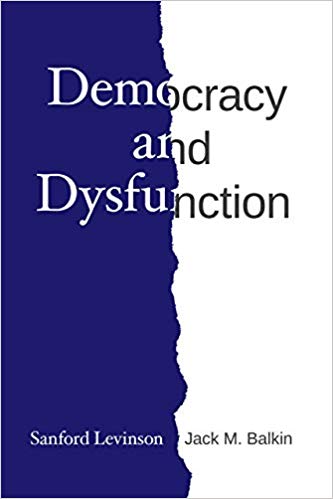
Sanford Levinson and Jack M. Balkin, Democracy and Dysfunction (University of Chicago Press, 2019)

Sanford Levinson, Written in Stone: Public Monuments in Changing Societies (Duke University Press 2018)

Mark A. Graber, Sanford Levinson, and Mark Tushnet, eds., Constitutional Democracy in Crisis? (Oxford University Press 2018)

Gerard Magliocca, The Heart of the Constitution: How the Bill of Rights became the Bill of Rights (Oxford University Press, 2018)

Cynthia Levinson and Sanford Levinson, Fault Lines in the Constitution: The Framers, Their Fights, and the Flaws that Affect Us Today (Peachtree Publishers, 2017)

Brian Z. Tamanaha, A Realistic Theory of Law (Cambridge University Press 2017)

Sanford Levinson, Nullification and Secession in Modern Constitutional Thought (University Press of Kansas 2016)

Sanford Levinson, An Argument Open to All: Reading The Federalist in the 21st Century (Yale University Press 2015)

Stephen M. Griffin, Broken Trust: Dysfunctional Government and Constitutional Reform (University Press of Kansas, 2015)

Frank Pasquale, The Black Box Society: The Secret Algorithms That Control Money and Information (Harvard University Press, 2015)

Bruce Ackerman, We the People, Volume 3: The Civil Rights Revolution (Harvard University Press, 2014)
Balkinization Symposium on We the People, Volume 3: The Civil Rights Revolution

Joseph Fishkin, Bottlenecks: A New Theory of Equal Opportunity (Oxford University Press, 2014)

Mark A. Graber, A New Introduction to American Constitutionalism (Oxford University Press, 2013)

John Mikhail, Elements of Moral Cognition: Rawls' Linguistic Analogy and the Cognitive Science of Moral and Legal Judgment (Cambridge University Press, 2013)

Gerard N. Magliocca, American Founding Son: John Bingham and the Invention of the Fourteenth Amendment (New York University Press, 2013)

Stephen M. Griffin, Long Wars and the Constitution (Harvard University Press, 2013)

Andrew Koppelman, The Tough Luck Constitution and the Assault on Health Care Reform (Oxford University Press, 2013)

James E. Fleming and Linda C. McClain, Ordered Liberty: Rights, Responsibilities, and Virtues (Harvard University Press, 2013)
Balkinization Symposium on Ordered Liberty: Rights, Responsibilities, and Virtues

Andrew Koppelman, Defending American Religious Neutrality (Harvard University Press, 2013)

Brian Z. Tamanaha, Failing Law Schools (University of Chicago Press, 2012)

Sanford Levinson, Framed: America's 51 Constitutions and the Crisis of Governance (Oxford University Press, 2012)

Linda C. McClain and Joanna L. Grossman, Gender Equality: Dimensions of Women's Equal Citizenship (Cambridge University Press, 2012)

Mary Dudziak, War Time: An Idea, Its History, Its Consequences (Oxford University Press, 2012)

Jack M. Balkin, Living Originalism (Harvard University Press, 2011)

Jason Mazzone, Copyfraud and Other Abuses of Intellectual Property Law (Stanford University Press, 2011)

Richard W. Garnett and Andrew Koppelman, First Amendment Stories, (Foundation Press 2011)

Jack M. Balkin, Constitutional Redemption: Political Faith in an Unjust World (Harvard University Press, 2011)

Gerard Magliocca, The Tragedy of William Jennings Bryan: Constitutional Law and the Politics of Backlash (Yale University Press, 2011)

Bernard Harcourt, The Illusion of Free Markets: Punishment and the Myth of Natural Order (Harvard University Press, 2010)

Bruce Ackerman, The Decline and Fall of the American Republic (Harvard University Press, 2010)
Balkinization Symposium on The Decline and Fall of the American Republic

Ian Ayres. Carrots and Sticks: Unlock the Power of Incentives to Get Things Done (Bantam Books, 2010)

Mark Tushnet, Why the Constitution Matters (Yale University Press 2010)

Ian Ayres and Barry Nalebuff: Lifecycle Investing: A New, Safe, and Audacious Way to Improve the Performance of Your Retirement Portfolio (Basic Books, 2010)
.jpg)
Jack M. Balkin, The Laws of Change: I Ching and the Philosophy of Life (2d Edition, Sybil Creek Press 2009)

Brian Z. Tamanaha, Beyond the Formalist-Realist Divide: The Role of Politics in Judging (Princeton University Press 2009)
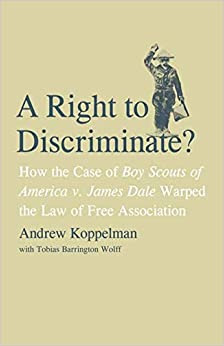
Andrew Koppelman and Tobias Barrington Wolff, A Right to Discriminate?: How the Case of Boy Scouts of America v. James Dale Warped the Law of Free Association (Yale University Press 2009)

Jack M. Balkin and Reva B. Siegel, The Constitution in 2020 (Oxford University Press 2009)

Heather K. Gerken, The Democracy Index: Why Our Election System Is Failing and How to Fix It (Princeton University Press 2009)

Mary Dudziak, Exporting American Dreams: Thurgood Marshall's African Journey (Oxford University Press 2008)

David Luban, Legal Ethics and Human Dignity (Cambridge Univ. Press 2007)

Ian Ayres, Super Crunchers: Why Thinking-By-Numbers is the New Way to be Smart (Bantam 2007)

Jack M. Balkin, James Grimmelmann, Eddan Katz, Nimrod Kozlovski, Shlomit Wagman and Tal Zarsky, eds., Cybercrime: Digital Cops in a Networked Environment (N.Y.U. Press 2007)
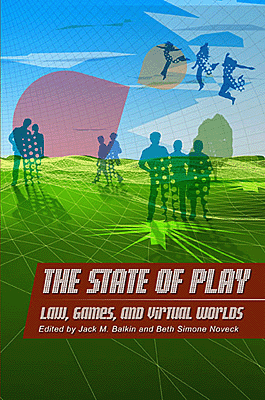
Jack M. Balkin and Beth Simone Noveck, The State of Play: Law, Games, and Virtual Worlds (N.Y.U. Press 2006)

Andrew Koppelman, Same Sex, Different States: When Same-Sex Marriages Cross State Lines (Yale University Press 2006)

Brian Tamanaha, Law as a Means to an End (Cambridge University Press 2006)

Sanford Levinson, Our Undemocratic Constitution (Oxford University Press 2006)

Mark Graber, Dred Scott and the Problem of Constitutional Evil (Cambridge University Press 2006)

Jack M. Balkin, ed., What Roe v. Wade Should Have Said (N.Y.U. Press 2005)

Sanford Levinson, ed., Torture: A Collection (Oxford University Press 2004)
Balkin.com homepage
Bibliography
Conlaw.net
Cultural Software
Writings
Opeds
The Information Society Project
BrownvBoard.com
Useful Links
Syllabi and Exams
