Balkinization
an unanticipated consequence of
Jack M. Balkin
Balkinization Symposiums: A Continuing List
E-mail:
Jack Balkin:
jackbalkin at yahoo.com
Bruce Ackerman
bruce.ackerman at yale.edu
Ian Ayres
ian.ayres at yale.edu
Corey Brettschneider
corey_brettschneider at brown.edu
Mary Dudziak
mary.l.dudziak at emory.edu
Joey Fishkin
joey.fishkin at gmail.com
Heather Gerken heather.gerken at yale.edu
Abbe Gluck abbe.gluck at yale.edu
Mark Graber
mgraber at law.umaryland.edu
Stephen Griffin
sgriffin at tulane.edu
Jonathan Hafetz
jonathan.hafetz at shu.edu
Jeremy Kessler
jkessler at law.columbia.edu
Andrew Koppelman
akoppelman at law.northwestern.edu
Marty Lederman
msl46 at law.georgetown.edu
Sanford Levinson
slevinson at law.utexas.edu
David Luban
david.luban at gmail.com
Gerard Magliocca
gmaglioc at iupui.edu
Jason Mazzone
mazzonej at illinois.edu
Linda McClain
lmcclain at bu.edu
John Mikhail
mikhail at law.georgetown.edu
Frank Pasquale
pasquale.frank at gmail.com
Nate Persily
npersily at gmail.com
Michael Stokes Paulsen
michaelstokespaulsen at gmail.com
Deborah Pearlstein
dpearlst at yu.edu
Rick Pildes
rick.pildes at nyu.edu
David Pozen
dpozen at law.columbia.edu
Richard Primus
raprimus at umich.edu
K. Sabeel Rahmansabeel.rahman at brooklaw.edu
Alice Ristroph
alice.ristroph at shu.edu
Neil Siegel
siegel at law.duke.edu
David Super
david.super at law.georgetown.edu
Brian Tamanaha
btamanaha at wulaw.wustl.edu
Nelson Tebbe
nelson.tebbe at brooklaw.edu
Mark Tushnet
mtushnet at law.harvard.edu
Adam Winkler
winkler at ucla.edu
Compendium of posts on Hobby Lobby and related cases
The Anti-Torture Memos: Balkinization Posts on Torture, Interrogation, Detention, War Powers, and OLC
The Anti-Torture Memos (arranged by topic)
Recent Posts
The Demise of Newspapers: Economics, Copyright, Free Speech
![[Powered by Blogger]](https://lh3.googleusercontent.com/blogger_img_proxy/AEn0k_tu8-ZKkPUR4QhMw1Kr662eZXqDHLfPwf3Z9U7Fh0C6TvI54D8BapQTDYz-fbu8h1F2oN2lTKdxzAOusX_Igahnahebz6qr2gBO2UThwpCP=s0-d)
Just A Few Blogs
ACS Blog
Alas, a Blog
Althouse
Arts and Letters Daily
Atrios (Eschaton)
Bill of Health
Buzzflash.com
Buzz Machine
Cato at Liberty
Juan Cole (Informed Comment)
Concurring Opinions
The Constitution in 2020
Corrente
Crooked Timber
Daily Howler
Daily Kos
Dana Boyd
Brad DeLong
Digby (Hullabaloo)
Discriminations
Daniel Drezner
Kevin Drum (Mother Jones)
Electrolite
En Banc
Eunomia (Daniel Larison)
Fafblog
Michael Froomkin (Discourse.net)
GovLab (Beth Noveck)
Rick Hasen (Election Law)
History News Network
How Appealing
Ignatz (Sam Heldman)
The Importance of (Ernie Miller)
Infolaw
Instapundit
International Economic Law and Policy Blog
IntLawGrrls
Jacob Levy
Jesus' General
Jurisdynamics
The Kitchen Cabinet
Mark Kleiman
Law Blog Central
Larry Lessig
Lawyers, Guns and Money
Liberal Oasis
Brian Leiter's Law School Reports
The Leiter Reports
Marginal Revolution
Megan McArdle
Memeorandum
Metafilter
Mirror of Justice
The New Republic
Newseum
No More Mister Nice Blog
Brendan Nyhan
Opinio Juris
Orcinus
The Originalism Blog
Pandagon
Passport (Foreign Policy)
Overcoming Bias
Political Animal (Washington Monthly)
Political Theory Daily Review
Political Wire (Taegan Goddard)
The Poor Man
Virginia Postrel
Prawfsblawg
Public Reason
Jonathan Rauch
Raw Story
Redstate
ReligiousLeftLaw.com
Reporters Committee For Freedom of the Press
Reproductive Rights Blog
Rothman's Roadmap to the Right of Publicity
SCOTUS Blog
Seeing the Forest
Clay Shirky
The Shifted Librarian
The Situationist
Larry Solum (Legal Theory)
Andrew Sullivan
Talking Points Memo
Talk Left
Tapped
Tbogg
TechPresident
The Paper Chase (Jurist)
Tom Paine
Tom Tomorrow (This Modern World)
Eve Tushnet
Uggabugga
University of Chicago Law School Faculty Blog
Unqualified Offerings
The Volokh Conspiracy
War and Piece (Laura Rozen)
Wampum
Oliver Willis
Wonkette
Written Description
Matthew Yglesias
Yin
Your Choice of Feeds
1. XML
powered by

2. Atom Feed
3. RSS 2.0
The Demise of Newspapers: Economics, Copyright, Free Speech
Neil Netanel
In my last post, I reported on newspapers' likely demise and argued that blogs can act as an important supplement, but not substitute for the fourth estate functions of the traditional press. Here I want to say something about the economics of newspapers' demise and how that is relevant to copyright law and our system of free expression.
Newspapers are in decline for two basic reasons. First, the days in which daily newspapers held virtual monopolies over print news and classified ads in many cities are over. The Internet offers competition from many sources, all of which erode newspapers' (and TV networks') market share. Even papers that successfully transition to the Web face far greater competition for eyeballs than in the print era. And, to add to that, the Internet has decoupled classified ads from newspapers, thus eliminating an old stalwart of newspaper revenue.
Second -- and here is where copyright might come in -- many Internet competitors build on the content and value that newspapers create. The Google News news aggregation site is essentially a combined digital news clipping service and news reader search engine. The Google News home page displays headlines, photos, and story leads from newspaper, news agency, and TV news Web sites (as well as some blogs). It also siphons off ad revenue from those sites. Likewise, news and opinion blogs are largely (but certainly not entirely) parasitic on the institutional press. They copy, quote from, discuss, and criticize stories reported in the press far more than engaging in original reporting or linking to other blogs. And just like peer-to-peer traders of music and movie files, online readers copy and distribute stories from newspaper Web sites to their friends via email and social network sites. Especially for the young, trading copies of newspaper stories often substitutes for visiting the paper's Web site.
Newspapers thus suffer from the classic public goods problem. Producers of quality journalism invest heavily in investigating, reporting, editing, and fact checking. But once they make their work product available, they cannot prevent many others from copying from and reading their work without payment. In the long run, they will lose out to competitors who build on their investment in quality journalism without making a similar investment in original reporting. In fact, newspapers’ public goods problem extends even wider. We all benefit from a society in which quality reporting is produced and disseminated even if we don’t actually read that reporting ourselves.
The traditional means for addressing the public goods problem facing creators of original expression is by giving them exclusive rights in their work product. That is largely the province of copyright, but copyright is limited to the literal form in which ideas and information is expressed; it does not give newspapers the ability to capture the social value of the information they produce. To remedy that gap, some states have recognized, and in its much discussed 1918 decision in International News Service v. Associated Press, the Supreme Court gave its imprimatur to, a newspaper's "quasi-property right" to prevent competitors from appropriating hot news. Following on that legal regime, a number of news agencies have sued Google News for copyright infringement, asserting that Google's copying of news story headlines, photos, and story leads infringed their copyrights in expression. (The primary US case settled.) And one could imagine copyright and hot news misappropriation claims asserted against other Internet "competitors," both commercial and noncommercial.
That aggressive propertization of newspapers' work product would pose significant free speech concerns. It would also run counter to our nation's information policy extending back to the Founding. The first copyright act, the Act of 1790, did not accord copyrights in news stories. In fact, far from recognizing intellectual property rights in news stories, the early federal government subsidized newspapers' sharing of their content. It provided free postal delivery for newspaper publishers to exchange their papers with one another, largely to facilitate editors' common practice of using nonlocal news items from other papers to fill their columns.
But in the digital age newspapers are far more vulnerable to massing copying. And, like Google News, some competitors reap some of the value of newspapers' work product without engaging in original reporting themselves. So what is to be done?
One answer, of course, is nothing. Google News argued that its copying is noninfringing fair use. That is a solid argument under current copyright law. And bloggers who quote from or link to news stories without copying the entire story have an even stronger fair use claim. Perhaps newspapers need to take their lumps and, along with all other traditional media, seek to reconstitute themselves and find new business models suitable to the digital age.
The Pew Research Center’s Project for Excellence in Journalism argues in contrast that news providers should create consortia to "charge Internet providers and aggregators licensing fees for content." As the Project recognizes, "those fees would likely add to the bills consumers pay for Internet access. But the notion that the Internet is free is already false. Those who report the news just aren’t sharing in the fees."
To my mind, giving news providers a proprietary veto over online news aggregators', Internet providers', and bloggers' referencing of news stories would impose an unacceptable burden on speech. I argue in Copyright's Paradox that, all in all, holding such referencing to be fair use or otherwise noninfringing of copyright is the best solution. But I can see advantages to imposing some sort of statutory license or levy on commercial Internet service providers and news aggregators who profit from news providers' investment. Newspapers should not have a veto over who references their stories or how. But ensuring that they receive some compensation for their investment in quality reporting might be our only hope for maintaining that investment and the vital fourth estate benefits that flow from it.
Posted
2:47 PM
by Neil Netanel [link]
I think the reasons are multifold:
1. Newspapers have stopped doing a very good job of reporting facts. They have degenerated into he said/she said stenography. It's worthless to me, the reader, to tell me that Hillary supports a gas tax "holiday" and that Obama opposes it unless the article goes on to explain the issue in detail and the merits of the respective positions. It's this latter function which newspapers have stopped supplying. In its place they offer sound bites from each candidate, apparently under the theory that the reader will decide for herself (based on facts we learn on the street, I suppose, like how we learned about sex).
2. Reporting about government functions, especially at the national level, has become far too incestuous. Reporters grant confidentiality for sources when those sources are merely repeating official policy anyway. There's no good reason for that. Worse yet, the reporters don't challenge the assertions of these anonymous officials. We saw that particularly with Judy Miller's coverage in the run up to the Iraq War, where the NYT essentially became a conduit for propaganda.
3. Reporters must be overworked. I say this because they make blatant, obvious errors when they report on areas like the law. If newspapers want to continue in effect, they need to hire reporters who either understand the topic or who know who to call for advice.
4. To the extent that papers also offer commentary on the news, there's no reason to protect them from competition. Anyone can offer commentary. This gets us back to the problem of expertise. Who in their right mind would want the commentary of the NYT or WSJ on, say, the Heller case if they could read this blog or Volokh?

Of course there is a chicken and the egg problem. Some argue that newspapers' decline stems from drastic cutbacks necessitated by drops in revenues, due in part to the causes I discussed in my post.
Right, newspapers seem to lose their relevance most when expert opinion and multi-faceted analysis is only a click away.
One area that newspapers traditionally have an advantage over, say, the legal blog, is their reach; the typical blog can't afford to send reporters around the world for long-term coverage of an ongoing process. (The typical blog might not be able to send a reporter across the street, for that matter.)
One might put together a team of worldwide bloggers to discuss local issues in a global context, but it still wouldn't be quite the same. That leverage, along with the parasitic nature of blogs that Neil mentions in the previous post, would seem to allow newspapers to remain relevant, even when more detail can be found elsewhere.
Agreed, though with some footnotes:
1. In a few cases where bloggers have tried to cover a particular event, some of them have done very well indeed. Firedoglake, for example, covered the Libby trial far better than the traditional media.
2. The ongoing coverage supplied by newspapers still needs to meet the standards which the better bloggers are enforcing. It does no good for the NYT to "cover the war in Iraq" if it's "coverage" consists of a reporter who stays in the Green Zone and simply repeats what the US military says.
The problem that I see is this. Newspapers still have a niche to supply basic facts about the world. But this has two limits. First, that's not going to provide the public interest or the profit margins that they expect from earlier days. Second, the real action is in those aspects of media which go beyond the basic facts, whether analysis or commentary. The traditional media simply are not meeting the competition; they're trying to sell mainframes when the market is PCs.
Also, a lot of BVD-clad bloggers ( I prefer "BVD-clad" to "pajama-clad" because Hugh Hefner considers pajamas to be formal wear ) have the chutzpah to claim that they are better than the traditional news media even though these bloggers don't even have any ethical standards, let alone the means to perform serious investigations. Ron Steinman wrote,
There is a growing and disturbing movement in the media for a new freedom that promotes the idea that whoever covers news, and believes they are journalists without credentials, can and should be their own editor, writing and saying what he pleases in his self-created Web log [and also arbitrarily censoring comments from those who disagree with him]. Everywhere I turn, those who call themselves serious journalists, some even using that grand and old fashioned phrase, the press, are assaulting us with the virtues of this new-found freedom. Thus, blog, the shortened version, is now the latest gobbledygook noun in the English language. Lewis Carroll would be proud.
. . . .A major problem is bloggers who run items with no sources. When they cite sources, they are so tenuous as to make you pass Go and return the $200. When caught, the blog will sometimes print retractions quickly [a BVD-clad blogger is likely to just delete the comment that pointed out the error]. The problem is that the readers have become so undiscerning it makes no difference. As quickly as an item is found wrong and as quickly as the blog runs a correction, another rises to take its place. Accuracy has no place on many blogs.(bracketed comments are mine)
The notion that blogs have obsoleted the traditional news media is typified by a stupid book titled, "We're All Journalists Now: The Transformation of the Press and Reshaping of the Law in the Internet Age," by Scott Gant.
Carolynne Burkholder wrote,
.
. . . . bloggers’ claims that they are the true citizen-journalists and that they can self-correct their errors is questioned by journalists and ethicists as self-serving rhetoric. Critics note cases where rumours were circulated by blogs and they were not proven to be false until much damage had been done to the reputation or career of a person or group. Self-correction by blogs is an imperfect process [and is made even more imperfect by the arbitrary censorship of comments]. Other critics accuse blogs of hypocrisy by claiming they believe in accuracy but they do not believe in editorial controls on postings prior to publication [BVD-clad bloggers also do not believe in any controls after publication]. Bloggers are also accused of wanting freedom without responsibility -- of reaching thousands of readers but rejecting calls for ethical codes and standards.(emphasis added; bracketed comments are mine)
And one of those "ethical codes and standards" that BVD-clad bloggers are rejecting is, of course, a rule against arbitrary censorship of blog visitors' comments. And, of course, this arbitrary censorship not only impacts factual accuracy but also impacts fairness in the presentation of opinions.
People do know the difference, and the news industry will respond. Which news organization seems the relevant question.
Cara mengobati kanker dengan herbal, Cara mengobati kanker dengan tradisional, Cara mengobati kanker dengan alami, Cara mengobati kanker dengan cepat, Cara mengobati kanker stadium 3, Cara mengobati kanker stadium 4, Cara mengobati kanker stadium awal, Cara mengobati kanker stadium 2, Cara mengobati kanker stadium akhir, Cara mengobati kanker tanpa ke dokter, Gambar obat kanker yang ampuh, Gambar obat kanker yang ampuh, Obat kanker ampuh dengan singkong, Cara mengobati kanker stadium awal tanpa operasi, Obat kanker manjur dari tumbuhan, Cara mengobati kanker stadium 1 tanpa operasi, Obat kanker ampuh dengan daun sirsak, Cara mengobati kanker stadium 2 tanpa operasi, Obat kanker paling mujarab yang efektif, Cara mengobati kanker stadium 3 tanpa operasi, Cara mengobati kanker stadium 3, Cara mengobati kanker stadium 4 tanpa operasi, Obat kanker paling manjur 2016, Cara mengobati kanker stadium akhir tanpa operasi, Pengobatan kanker mujarab tanpa operasi, Cara pengobatan kanker yang manjur, Pengobatan kanker manjur dan aman, Cara pengobatan kanker yang mujarab, Cara pengobatan kanker tanpa operasi, Cara pengobatan kanker yang ampuh, Obat kanker mujarab tanpa operasi, Obat kanker manjur tanpa operasi, Obat De Nature

obat alami untuk mencegah kanker serviks
obat medis untuk kanker serviks
wwwobat kanker serviks
obat vaksin kanker serviks
obat untuk mengatasi kanker serviks
Tumbuhan untuk obat kanker serviks
Obat untuk menyembuhkan kanker serviks
obat untuk penderita kanker serviks
obat tradisional untuk kanker serviks
obat utk kanker serviks
obat untuk kanker serviks
obat tradisional utk kanker serviks
sirsak obat kanker serviks
obat sakit kanker serviks
hello world obat untuk kanker rahim stadium 3
obat herbal kanker rahim stadium 4
obat kanker rahim stadium 1 1
Obat kanker rahim stadium 2
Obat penyakit herpes kelamin pria
obat kanker serviks tradisional jawa sumatera
Obat kanker serviks tradisional sumatera
Obat kanker serviks tradisional kalimantan
obat kanker serviks tradisional herbal jawa
obat kanker serviks tradisional herbal jawa sumatera
obat kanker serviks tradisional herbal sumatera
obat kanker serviks tradisional herbal suku pedalaman
obat kanker serviks tradisional herbal suku pedalaman sumatra
Obat kanker serviks tradisional herbal suku jawa
obat kanker serviks tradisional herbal s
obat kanker serviks tradisional herbal suku minang
obat kanker serviks tradisional herbal suku sunda
Obat kanker serviks tradisional herbal suku irian
obat kanker serviks tradisional herbal suku dayak
obat kanker serviks tradisional herbal suku kubu
obat tradisional kanker serviks suku
obat kanker serviks tradisional herbal suku bugis
obat herbal herpes genital dompo
obat herbal herpes genital dompo simplex
Books by Balkinization Bloggers

Gerard N. Magliocca, The Actual Art of Governing: Justice Robert H. Jackson's Concurring Opinion in the Steel Seizure Case (Oxford University Press, 2025)

Linda C. McClain and Aziza Ahmed, The Routledge Companion to Gender and COVID-19 (Routledge, 2024)

David Pozen, The Constitution of the War on Drugs (Oxford University Press, 2024)

Jack M. Balkin, Memory and Authority: The Uses of History in Constitutional Interpretation (Yale University Press, 2024)
Mark A. Graber, Punish Treason, Reward Loyalty: The Forgotten Goals of Constitutional Reform after the Civil War (University of Kansas Press, 2023)
Jack M. Balkin, What Roe v. Wade Should Have Said: The Nation's Top Legal Experts Rewrite America's Most Controversial Decision - Revised Edition (NYU Press, 2023)

Andrew Koppelman, Burning Down the House: How Libertarian Philosophy Was Corrupted by Delusion and Greed (St. Martin’s Press, 2022)

Gerard N. Magliocca, Washington's Heir: The Life of Justice Bushrod Washington (Oxford University Press, 2022)
Joseph Fishkin and William E. Forbath, The Anti-Oligarchy Constitution: Reconstructing the Economic Foundations of American Democracy (Harvard University Press, 2022)
Mark Tushnet and Bojan Bugaric, Power to the People: Constitutionalism in the Age of Populism (Oxford University Press 2021).

Mark Philip Bradley and Mary L. Dudziak, eds., Making the Forever War: Marilyn B. Young on the Culture and Politics of American Militarism Culture and Politics in the Cold War and Beyond (University of Massachusetts Press, 2021).

Jack M. Balkin, What Obergefell v. Hodges Should Have Said: The Nation's Top Legal Experts Rewrite America's Same-Sex Marriage Decision (Yale University Press, 2020)

Frank Pasquale, New Laws of Robotics: Defending Human Expertise in the Age of AI (Belknap Press, 2020)

Jack M. Balkin, The Cycles of Constitutional Time (Oxford University Press, 2020)

Mark Tushnet, Taking Back the Constitution: Activist Judges and the Next Age of American Law (Yale University Press 2020).

Andrew Koppelman, Gay Rights vs. Religious Liberty?: The Unnecessary Conflict (Oxford University Press, 2020)

Ezekiel J Emanuel and Abbe R. Gluck, The Trillion Dollar Revolution: How the Affordable Care Act Transformed Politics, Law, and Health Care in America (PublicAffairs, 2020)

Linda C. McClain, Who's the Bigot?: Learning from Conflicts over Marriage and Civil Rights Law (Oxford University Press, 2020)
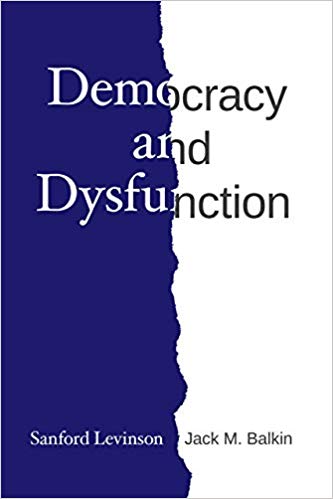
Sanford Levinson and Jack M. Balkin, Democracy and Dysfunction (University of Chicago Press, 2019)

Sanford Levinson, Written in Stone: Public Monuments in Changing Societies (Duke University Press 2018)

Mark A. Graber, Sanford Levinson, and Mark Tushnet, eds., Constitutional Democracy in Crisis? (Oxford University Press 2018)

Gerard Magliocca, The Heart of the Constitution: How the Bill of Rights became the Bill of Rights (Oxford University Press, 2018)

Cynthia Levinson and Sanford Levinson, Fault Lines in the Constitution: The Framers, Their Fights, and the Flaws that Affect Us Today (Peachtree Publishers, 2017)

Brian Z. Tamanaha, A Realistic Theory of Law (Cambridge University Press 2017)

Sanford Levinson, Nullification and Secession in Modern Constitutional Thought (University Press of Kansas 2016)

Sanford Levinson, An Argument Open to All: Reading The Federalist in the 21st Century (Yale University Press 2015)

Stephen M. Griffin, Broken Trust: Dysfunctional Government and Constitutional Reform (University Press of Kansas, 2015)

Frank Pasquale, The Black Box Society: The Secret Algorithms That Control Money and Information (Harvard University Press, 2015)

Bruce Ackerman, We the People, Volume 3: The Civil Rights Revolution (Harvard University Press, 2014)
Balkinization Symposium on We the People, Volume 3: The Civil Rights Revolution

Joseph Fishkin, Bottlenecks: A New Theory of Equal Opportunity (Oxford University Press, 2014)

Mark A. Graber, A New Introduction to American Constitutionalism (Oxford University Press, 2013)

John Mikhail, Elements of Moral Cognition: Rawls' Linguistic Analogy and the Cognitive Science of Moral and Legal Judgment (Cambridge University Press, 2013)

Gerard N. Magliocca, American Founding Son: John Bingham and the Invention of the Fourteenth Amendment (New York University Press, 2013)

Stephen M. Griffin, Long Wars and the Constitution (Harvard University Press, 2013)

Andrew Koppelman, The Tough Luck Constitution and the Assault on Health Care Reform (Oxford University Press, 2013)

James E. Fleming and Linda C. McClain, Ordered Liberty: Rights, Responsibilities, and Virtues (Harvard University Press, 2013)
Balkinization Symposium on Ordered Liberty: Rights, Responsibilities, and Virtues

Andrew Koppelman, Defending American Religious Neutrality (Harvard University Press, 2013)

Brian Z. Tamanaha, Failing Law Schools (University of Chicago Press, 2012)

Sanford Levinson, Framed: America's 51 Constitutions and the Crisis of Governance (Oxford University Press, 2012)

Linda C. McClain and Joanna L. Grossman, Gender Equality: Dimensions of Women's Equal Citizenship (Cambridge University Press, 2012)

Mary Dudziak, War Time: An Idea, Its History, Its Consequences (Oxford University Press, 2012)

Jack M. Balkin, Living Originalism (Harvard University Press, 2011)

Jason Mazzone, Copyfraud and Other Abuses of Intellectual Property Law (Stanford University Press, 2011)

Richard W. Garnett and Andrew Koppelman, First Amendment Stories, (Foundation Press 2011)

Jack M. Balkin, Constitutional Redemption: Political Faith in an Unjust World (Harvard University Press, 2011)

Gerard Magliocca, The Tragedy of William Jennings Bryan: Constitutional Law and the Politics of Backlash (Yale University Press, 2011)

Bernard Harcourt, The Illusion of Free Markets: Punishment and the Myth of Natural Order (Harvard University Press, 2010)

Bruce Ackerman, The Decline and Fall of the American Republic (Harvard University Press, 2010)
Balkinization Symposium on The Decline and Fall of the American Republic

Ian Ayres. Carrots and Sticks: Unlock the Power of Incentives to Get Things Done (Bantam Books, 2010)

Mark Tushnet, Why the Constitution Matters (Yale University Press 2010)

Ian Ayres and Barry Nalebuff: Lifecycle Investing: A New, Safe, and Audacious Way to Improve the Performance of Your Retirement Portfolio (Basic Books, 2010)
.jpg)
Jack M. Balkin, The Laws of Change: I Ching and the Philosophy of Life (2d Edition, Sybil Creek Press 2009)

Brian Z. Tamanaha, Beyond the Formalist-Realist Divide: The Role of Politics in Judging (Princeton University Press 2009)
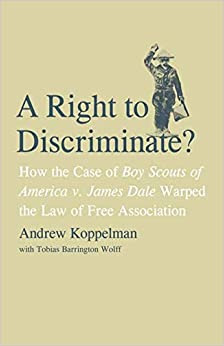
Andrew Koppelman and Tobias Barrington Wolff, A Right to Discriminate?: How the Case of Boy Scouts of America v. James Dale Warped the Law of Free Association (Yale University Press 2009)

Jack M. Balkin and Reva B. Siegel, The Constitution in 2020 (Oxford University Press 2009)

Heather K. Gerken, The Democracy Index: Why Our Election System Is Failing and How to Fix It (Princeton University Press 2009)

Mary Dudziak, Exporting American Dreams: Thurgood Marshall's African Journey (Oxford University Press 2008)

David Luban, Legal Ethics and Human Dignity (Cambridge Univ. Press 2007)

Ian Ayres, Super Crunchers: Why Thinking-By-Numbers is the New Way to be Smart (Bantam 2007)

Jack M. Balkin, James Grimmelmann, Eddan Katz, Nimrod Kozlovski, Shlomit Wagman and Tal Zarsky, eds., Cybercrime: Digital Cops in a Networked Environment (N.Y.U. Press 2007)
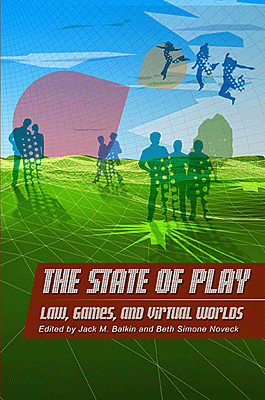
Jack M. Balkin and Beth Simone Noveck, The State of Play: Law, Games, and Virtual Worlds (N.Y.U. Press 2006)

Andrew Koppelman, Same Sex, Different States: When Same-Sex Marriages Cross State Lines (Yale University Press 2006)

Brian Tamanaha, Law as a Means to an End (Cambridge University Press 2006)

Sanford Levinson, Our Undemocratic Constitution (Oxford University Press 2006)

Mark Graber, Dred Scott and the Problem of Constitutional Evil (Cambridge University Press 2006)

Jack M. Balkin, ed., What Roe v. Wade Should Have Said (N.Y.U. Press 2005)

Sanford Levinson, ed., Torture: A Collection (Oxford University Press 2004)
Balkin.com homepage
Bibliography
Conlaw.net
Cultural Software
Writings
Opeds
The Information Society Project
BrownvBoard.com
Useful Links
Syllabi and Exams
