Balkinization
an unanticipated consequence of
Jack M. Balkin
Balkinization Symposiums: A Continuing List
E-mail:
Jack Balkin:
jackbalkin at yahoo.com
Bruce Ackerman
bruce.ackerman at yale.edu
Ian Ayres
ian.ayres at yale.edu
Corey Brettschneider
corey_brettschneider at brown.edu
Mary Dudziak
mary.l.dudziak at emory.edu
Joey Fishkin
joey.fishkin at gmail.com
Heather Gerken heather.gerken at yale.edu
Abbe Gluck abbe.gluck at yale.edu
Mark Graber
mgraber at law.umaryland.edu
Stephen Griffin
sgriffin at tulane.edu
Jonathan Hafetz
jonathan.hafetz at shu.edu
Jeremy Kessler
jkessler at law.columbia.edu
Andrew Koppelman
akoppelman at law.northwestern.edu
Marty Lederman
msl46 at law.georgetown.edu
Sanford Levinson
slevinson at law.utexas.edu
David Luban
david.luban at gmail.com
Gerard Magliocca
gmaglioc at iupui.edu
Jason Mazzone
mazzonej at illinois.edu
Linda McClain
lmcclain at bu.edu
John Mikhail
mikhail at law.georgetown.edu
Frank Pasquale
pasquale.frank at gmail.com
Nate Persily
npersily at gmail.com
Michael Stokes Paulsen
michaelstokespaulsen at gmail.com
Deborah Pearlstein
dpearlst at yu.edu
Rick Pildes
rick.pildes at nyu.edu
David Pozen
dpozen at law.columbia.edu
Richard Primus
raprimus at umich.edu
K. Sabeel Rahmansabeel.rahman at brooklaw.edu
Alice Ristroph
alice.ristroph at shu.edu
Neil Siegel
siegel at law.duke.edu
David Super
david.super at law.georgetown.edu
Brian Tamanaha
btamanaha at wulaw.wustl.edu
Nelson Tebbe
nelson.tebbe at brooklaw.edu
Mark Tushnet
mtushnet at law.harvard.edu
Adam Winkler
winkler at ucla.edu
Compendium of posts on Hobby Lobby and related cases
The Anti-Torture Memos: Balkinization Posts on Torture, Interrogation, Detention, War Powers, and OLC
The Anti-Torture Memos (arranged by topic)
Recent Posts
Who Cares About John McCain-- George Washington Is Unconstitutional!
![[Powered by Blogger]](https://lh3.googleusercontent.com/blogger_img_proxy/AEn0k_u6z99AlG-tCFamD0YV2Gw5LIi028HmcWy7_AtbtlUk4hAPZWfF8I6DQksLKE1Jfyfe6KFH5kPHchWhkm2xfKoBJocsMKcQ2KHGKXopDpql=s0-d)
Just A Few Blogs
ACS Blog
Alas, a Blog
Althouse
Arts and Letters Daily
Atrios (Eschaton)
Bill of Health
Buzzflash.com
Buzz Machine
Cato at Liberty
Juan Cole (Informed Comment)
Concurring Opinions
The Constitution in 2020
Corrente
Crooked Timber
Daily Howler
Daily Kos
Dana Boyd
Brad DeLong
Digby (Hullabaloo)
Discriminations
Daniel Drezner
Kevin Drum (Mother Jones)
Electrolite
En Banc
Eunomia (Daniel Larison)
Fafblog
Michael Froomkin (Discourse.net)
GovLab (Beth Noveck)
Rick Hasen (Election Law)
History News Network
How Appealing
Ignatz (Sam Heldman)
The Importance of (Ernie Miller)
Infolaw
Instapundit
International Economic Law and Policy Blog
IntLawGrrls
Jacob Levy
Jesus' General
Jurisdynamics
The Kitchen Cabinet
Mark Kleiman
Law Blog Central
Larry Lessig
Lawyers, Guns and Money
Liberal Oasis
Brian Leiter's Law School Reports
The Leiter Reports
Marginal Revolution
Megan McArdle
Memeorandum
Metafilter
Mirror of Justice
The New Republic
Newseum
No More Mister Nice Blog
Brendan Nyhan
Opinio Juris
Orcinus
The Originalism Blog
Pandagon
Passport (Foreign Policy)
Overcoming Bias
Political Animal (Washington Monthly)
Political Theory Daily Review
Political Wire (Taegan Goddard)
The Poor Man
Virginia Postrel
Prawfsblawg
Public Reason
Jonathan Rauch
Raw Story
Redstate
ReligiousLeftLaw.com
Reporters Committee For Freedom of the Press
Reproductive Rights Blog
Rothman's Roadmap to the Right of Publicity
SCOTUS Blog
Seeing the Forest
Clay Shirky
The Shifted Librarian
The Situationist
Larry Solum (Legal Theory)
Andrew Sullivan
Talking Points Memo
Talk Left
Tapped
Tbogg
TechPresident
The Paper Chase (Jurist)
Tom Paine
Tom Tomorrow (This Modern World)
Eve Tushnet
Uggabugga
University of Chicago Law School Faculty Blog
Unqualified Offerings
The Volokh Conspiracy
War and Piece (Laura Rozen)
Wampum
Oliver Willis
Wonkette
Written Description
Matthew Yglesias
Yin
Your Choice of Feeds
1. XML
powered by

2. Atom Feed
3. RSS 2.0
Who Cares About John McCain-- George Washington Is Unconstitutional!
JB
Apparently everyone is up in arms over the fact that John McCain was born in the Panama Canal zone in 1936. Is he a "natural born citizen" eligible to be President under Article II, section 1, clause 4 of the Constitution? Q. The Constitution provides, as one of the criteria to be eligible to become president, that a person must be a "natural born Citizen" (or, alternatively, in a provision that long ago ceased to apply to any living persons, "a Citizen of the United States, at the time of the Adoption of this Constitution") How would you figure out what the phrase "natural born Citizen" means?
I have to tell you, frankly, that whether McCain is "natural born" is the least of our worries. If you are truly an originalist, as I am, nobody is eligible to be president today.
I recently took Ed Whelan's simple one question test to determine whether you are really an originalist and confirmed that, yes, I am one of that proud and hardy band.
My answer was D:(D) You would try to determine the public meaning of the "natural born Citizen" requirement at the time that the Constitution was adopted.
Ed explains:If it is obvious to you that the proper response is (D), then you are an originalist. If you think that the answer might be (A), then you are probably Justice Stevens, O'Connor, Kennedy, Souter, Ginsburg, or Breyer.
I ask you, how can you disagree with that?
So I busily tried to figure out the original public meaning of the clause, which is a little more complicated than Ed lets on. The Constitution's text actually says, "No person except a natural born Citizen, or a Citizen of the United States, at the time of the adoption of this Constitution, shall be eligible to the office of President."
Now the key issue for an original meaning originalist, as Sandy Levinson, Jordan Steiker and I pointed out back in 1995, is whether "at the time of adoption of this Constitution" refers only to "Citizen of the United States" or also to the antecedent clause, "a natural born Citizen. We found out that, according to accepted grammatical rules as they existed in 1787, the use of commas marking off the words "or a Citizen of the United States" means that the phrase "at the time of the adoption of this Constitution" refers to both preceding clauses, i.e., both to "natural born Citizen" and to "Citizen of the United States."
In other words, the original public meaning of the clause says that to be President you either have to have been a natural born Citizen at the time of the adoption of the Constitution, or otherwise a citizen of the United States at the time of adoption, i.e., 1789. That means that persons born after 1789 aren't eligible to be President of the United States. And that includes not only John McCain, but Hillary Clinton and Barrack Obama. (In fact, it includes George W. Bush, but everybody knows he wasn't legally elected anyway.)
With a little research, Levinson,Steiker and I found out that according to the original public meaning of the document, the last constitutional President was Zachary Taylor.
You might think that this was just a scrivener's error. No so. We discovered that the commas were removed and then added again to successive drafts of the Constitution, so it was clearly something that the framers thought about. We concluded, reluctantly, that the framers clearly meant to say that the Constitution could have constitutional presidents only for a generation. Presumably this was based on a Jeffersonian idea that constitutions should have a natural sunset, at which point, a new constitutional convention should be called.
But wait-- there's more. The rest of the sentence reads: "neither shall any person be eligible to that office who shall not have attained to the age of thirty-five years, and been fourteen years a resident within the United States." Now Article VII holds that the Constitution comes into being when nine states ratify, which occured on June 21, 1789, when New Hampshire became the ninth state. But this means that nobody could be a resident within the United States until June 21, 1789, and so nobody could be President until June 21, 1805. And that means that Thomas Jefferson, not George Washington, was the first legal President of the United States.
Of course, we could get around this by saying that "the United States" actually comes into being on July 4, 1776, the date of the Declaration of Independence (unless you believe in the compact of states theory, under which the states became, as the Declaration says, "free and independent" sovereigns in 1776.). In any case, if the United States comes into being in 1776, nobody would be eligible to be President until 1790, which means that George Washington was ineligible for his first year in office. And because he was ineligible when elected, the first time he was legally elected President was in 1796. Perhaps we could say that the Constitution comes into being in 1775 with Concord and Lexington, when the War of Independence begins. Then Washington would meet the Constitution's residency requirements. (That is, if he took the oath of office after April 19, 1789. In fact, he took the oath of office on April 30, 1789).
But it's worse than that. Suppose we say that the United States begins in 1775, so that Washington was a resident of the United States for fourteen years before he became President. Nevertheless, that doesn't mean he was a citizen of the United States "at the time of the adoption of this Constitution." If you think the Constitution is a compact of states, which was legally adopted on June 21, 1789 when New Hampshire ratified, then "the time of the adoption of this Constitution" was June 21, 1789. But George Washington's home state of Virginia didn't ratify until June 25th. This means that at "the time of adoption of this Constitution," George Washington was not a citizen of the United States, he was only a citizen of Virginia, and therefore he was ineligible when he took the oath of office. And if he was not a citizen at the time of adoption, he could not be a "natural born Citizen" at the time of adoption either.
So I am afraid we must conclude that George Washington was unconstitutional.
And that means of course, that we need to take him off the one dollar bill, tear down the Washington Monument, and rename the nation's capital after somebody else. Jefferson already has a capital city named after him, in my home state of Missouri. How about James Monroe?
Am I being serious, or is this just a parody of originalism? Read our 1995 essay "Taking Text, History and Structure Really Seriously: Constitutional Interpretation and the Crisis of Presidential Eligibility, 74 Tex. L. Rev. 237 (1995), and find out for yourself.
Posted
5:50 AM
by JB [link]
I would ask Jack whether Congress (with the approval of an illegal President) has the power to define "natural born" for the purposes of eligibility to be President.

This issue is a good test for the merits of originalism, what with sex, geography, biology, etc, intertwined. In addition, there are elements of humor. Just imagine constitutional scholars and law students playing "what if" games regarding "natural born." Some may harken back to the Dred Scott decision on "citizen" as perhaps valid even with the Civil War Amendments.
By the way, Solum made reference to "original ambiguity." Is this phrase original with him?
What if it were Hillary Clinton and not John McCain who had been born outside the 50 states?
What if it were Barack Obama and not John McCain or Hillary who had been born outside the 50 states, especially in a foreign country?
Would the originalism arguments differ?
The provision at issue reads:
"No person except a natural born Citizen, or a Citizen of the United States, at the time of the adoption of this Constitution, shall be eligible to the office of President."
If you read this passage without the commas, common sense recommends that the Presidency was limited to natural born citizens OR citizens who were naturalized at the time of the adoption of the Constitution.
Interpreting the second comma to cause both initial clauses to be modified by the phrase "at the time of the adoption of this Constitution" needlessly creates an absurd impossibility.
The fact that other commas were added and subtracted during successive drafts of the Constitution does not mean that the drafters of the Constitution intended this absurd result to arise from this particular comma.
This exercise does appear to be an attempt to parody textualism into something it is not.
What we need is a Mel Brooks version of his 2000 year old man schtick with Mel playing a Founder and being asked about original intent, etc, on certain aspects of the Constitution. Who might we recommend as Mel's straight (or gay) man?
Accordingly, McCain is the only qualified candidate.
"NATURAL BORN IN THE USA"
in support of either Obama or Clinton.
But wait, isn't the Constitution a "contract," properly approached as one would approach "any other contract?"
At least, that's what the Constitution was yesterday...
...today, it's a statute subject to the "techniques of statutory interpretation."
It is ridiculous to question McCain's citizenship while illegal aliens' children born in the USA are automatically granted US citizenship at birth.
Here is another line of reasoning --
According to the Dred Scott decision, US blacks were not considered to be citizens at the time of the adoption of the Constitution and hence were ineligible to be president according to the clause that only natural-born citizens or citizens when the Constitution was adopted were eligible to be president. This constitutional ineligibility to be president was not implicitly repealed by the 14th Amendment because the Supreme Court said in Posadas v. National City Bank of New York 296 U.S. 497, 503 (1936),
The cardinal rule is that repeals by implication are not favored. Where there are two acts upon the same subject, effect should be given to both if possible. There are two well-settled categories of repeals by implication: (1) Where provisions in the two acts are in irreconcilable conflict, the later act to the extent of the conflict constitutes an implied repeal of the earlier one; and (2) if the later act covers the whole subject of the earlier one and is clearly intended as a substitute, it will operate similarly as a repeal of the earlier act. But, in either case, the intention of the legislature to repeal must be clear and manifest; otherwise, at least as a general thing, the later act is to be construed as a continuation of, and not a substitute for, the first act and will continue to speak, so far as the two acts are the same, from the time of the first enactment.
So Obama is not eligible to be president.
Simple Justice in its take on this has a comment However on March 26, 1790 the First Congress, including a number of the Framers, passed the first naturalization law: "And the children of citizens of the United States that may be born beyond sea, or outside the limits of the United States, shall be considered as natural born citizens."However on March 26, 1790 the First Congress, including a number of the Framers, passed the first naturalization law: "And the children of citizens of the United States that may be born beyond sea, or outside the limits of the United States, shall be considered as natural born citizens."
Anyone know if this is correct?
Link: http://blog.simplejustice.us/2008/02/28/the-panamanian-president-john-mccain.aspx
Hence the genius of the Supreme Court in ruling that corporations are "persons".
However on March 26, 1790 the First Congress, including a number of the Framers, passed the first naturalization law: "And the children of citizens of the United States that may be born beyond sea, or outside the limits of the United States, shall be considered as natural born citizens."
This doesn't solve the problem, because, normally speaking, Congress can't modify a term in the Constitution. For example, Congress can't change the definition of "free speech".
In this particular case, however, there's some originalist basis for thinking Congress DOES have such authority. The reasoning goes like this:
What Blackstone says is that the common law rule was that only persons born within the King's "dominion" were citizens. This rule was then modified by statute to include those born overseas of natural born subjects. Thus, an originalist could argue that the Constitution froze in time both the common law meaning and its statutory amendment.
But there's a more inclusive way to look at it as well. We might also reason that the Constitution in this particular case DID include the power of the legislature to modify the rule. The reasoning would be that if that power weren't part of the meaning, there'd be no reason to accept the statutory amendment to the common law rule.
By this reasoning, Congress could make Arnold a citizen or Henry Kissinger or anyone else. Such a holding would be perfectly consistent with the rule of the Insular Cases (that Congress can define the boundaries of the United States).*
*I'd love to hear from the originalists just why it is that the term "United States" is not frozen as of 1789, but the term "natural born citizen" is.
BD: "It is a basic technique of statutory interpretation that a court will not read absurdities into the text of a law."
But wait, isn't the Constitution a "contract," properly approached as one would approach "any other contract?"
The same rule applies to interpreting contracts.
If McCain was not a US citizen at birth, then exactly when did he become a US citizen?
Was McCain born stateless?
As I understand the accepted grammatical rules on use of commas at that time, you essentially stuck one in wherever you thought somebody would pause to take a breath. They were pretty much devoid of meaning otherwise, which is why you'll see legal documents such as constitutional amendments printed here with these commas, there with other placement.
Aside from the false premise, it was mildly amusing.
"When choosing among plausible interpretive options, we should always choose the one that makes the most sense of the entire Constitution, regardless of the date at which particular provisions were enacted."
Do pure originalists disagree with Ackerman's approach while agreeing with his conclusion?
Bruce Ackerman's Letter to the Editor in today's NYTimes presents a non-originalist view that indeed John McCain is eligible to be President. He uses a holistic approach that ties in the equal protection clause of the 14th Amendment with the eligibility clause, closing with:
"When choosing among plausible interpretive options, we should always choose the one that makes the most sense of the entire Constitution, regardless of the date at which particular provisions were enacted."
Do pure originalists disagree with Ackerman's approach while agreeing with his conclusion?
Do you have a link to the entire letter? Ackerman appears to touch upon a number of interpretive tools in that last paragraph. Based on what you have posted, though, Ackerman is engaging in far too many steps.
There is a rule of construction where, if a provision of law can plausibly be read in two ways, then the way which exists in the most harmony with the other provisions of the law should be used. However, as I posted above, the Eligibility Clause's text is clear and one can pretty readily understand what is required. Thus, there is no need to consult the 14th Amendment unless Ackerman claims that it amended the Eligibility Clause.
http://www.nytimes.com/2008/03/01/opinion/l01mccain.html?_r=1&ref=opinion&oref=slogin
Or link to www.nytimes.com for today and click on "Opinion" and then on "Letters" and scroll. I guess clarity of constitutional text is in the eye of the beholder or the originalist who is clairvoyant.
There is nothing about the "missionary position" (or other "natural position") in the Constitution so I guess in vitro fertilization (even if the egg and sperm embryo is "foreign born" and implanted in a foreign country) and even cloning would retain Presidential eligibility if the deliverer-mother is a U.S. citizen, regardless of where the delivery takes place, even by C-section.
Indeed, couldn’t it be argued (rather more plausibly than in ML’s clever parody of originalism) that Ackerman’s approach should logically favor the narrower reading of “natural born Citizen”? Discriminating against persons based on the location of their birth certainly sounds less invidious than discriminating based on the identity of their parents.
It is also noteworthy that the 14th Amendment refers to “all persons born or naturalized in the United States.” It has been suggested that this language is what has caused the confusion about the meaning of “natural born Citizen,” because the original meaning (ie, any person born as a citizen, regardless of location) is actually quite clear. http://volokh.com/posts/1204265246.shtml
The problem for originalists is that the common law rule equated "native born" and "natural born".
By the way, didn't Republicans make an effort to disquality FDR's eligibility to be President because of questions as to his place of birth? So once again I ask originalists in expounding their views to consider if this situation applied to Obama or to Clinton how would they come down constitutionally? We all have our little biases, don't we?
I think that Professor Balkin's comments seem to be an argument by reduction to absurdity against a certain form of originalism' However, taking the argument at its face value, if "at the time of the adoption of this Constitution" applies to both parts of, "a natural born Citizen or a Citizen of the United States", we are left to explain what "natural born Citizen" was not a "Citizen of the United States" at the time of the adoption of the Constitution. FOr example, were citzens of the CSA eligible?
Of, course, while Bart is right on this narrow point, the real problem with his "contract" analogy is that subsequent conduct of the parties is considered THE MOST RELIABLE means of interpreting a contract. Thus, contracts are interpreted consistent in an analogous manner to the "living constitution" theory that Bart decries.
'When I use a word,' Humpty Dumpty said, in a rather scornful tone,'it means just what I choose it to mean, neither more nor less.'
'The question is,' said Alice, 'whether you can make words mean so many different things.'
'The question is,' said Humpty Dumpty, 'which is to be master - that's all.'
>>>>>> and Guantanamo. The Bush Administration asserted that the US has no sovereignty there, the better to excuse otherwise presumably unwarranted detention processes that are forbidden on American soil. <<<<<<
That is the first time I heard that one. The usual excuse for denying constitutional protections to Guantanamo detainees is that they are allegedly illegal foreign enemy combatants.
One difference is that the Canal Zone had special status and forms available to ensure the citizenship of people born there. That is, statutes exist that have defined the parameters of sovereignty and citizenship more clearly than has been done in Guantanamo Bay.
As a person born in the Canal Zone, this issue is near and dear to me, and I wouldn't wish the adjudication process I had to undergo (because my parents failed to fill out a necessary form at the time of my birth) on my worst enemy.
I say McCain is in the clear on this, although obviously I have my biases. :)
It is high time to remove that silly requirement from the Constitution, anyway.
"The Natural-Born Citizen Clause and Presidential Eligibility: An Approach for Resolving Two Hundred Years of Uncertainty"
that addresses fairly completely the issues involved, some of which were addressed in comments. Originalism and textualism ain't beanbag. Jill should be applauded for her efforts at a time when possible biases regarding a particular Presidential candidate seem not to have been in issue.
Washington
http://ballsnews.com/george-washington-was-ineligible-to-be-president.html
Adams
http://ballsnews.com/john-adams-ineligible-to-be-president.html
Jefferson
http://ballsnews.com/was-thomas-jefferson-eligible-for-president.html
The conclusion is that Adams and Washington may not have been eligible due to the latter restrictions in the eligibility clause. Jefferson, however, appears to have been legit.
thanks so much i like very so much your post
حلي الاوريو الفطر الهندي صور تورتة حلى قهوه طريقة عمل السينابون طريقة عمل بلح الشام بيتزا هت كيكة الزبادي حلا سهل صور كيك
عجينة العشر دقائق
طريقة عمل الدونات طريقة عمل البان كيك طريقة عمل الكنافة طريقة عمل البسبوسة طريقة عمل الكيك طريقة عمل عجينة البيتزا فوائد القرفه
Cara mengobati kanker dengan herbal, Cara mengobati kanker dengan tradisional, Cara mengobati kanker dengan alami, Cara mengobati kanker dengan cepat, Cara mengobati kanker stadium 3, Cara mengobati kanker stadium 4, Cara mengobati kanker stadium awal, Cara mengobati kanker stadium 2, Cara mengobati kanker stadium akhir, Cara mengobati kanker tanpa ke dokter, Gambar obat kanker yang ampuh, Gambar obat kanker yang ampuh, Obat kanker ampuh dengan singkong, Cara mengobati kanker stadium awal tanpa operasi, Obat kanker manjur dari tumbuhan, Cara mengobati kanker stadium 1 tanpa operasi, Obat kanker ampuh dengan daun sirsak, Cara mengobati kanker stadium 2 tanpa operasi, Obat kanker paling mujarab yang efektif, Cara mengobati kanker stadium 3 tanpa operasi, Cara mengobati kanker stadium 3, Cara mengobati kanker stadium 4 tanpa operasi, Obat kanker paling manjur 2016, Cara mengobati kanker stadium akhir tanpa operasi, Pengobatan kanker mujarab tanpa operasi, Cara pengobatan kanker yang manjur, Pengobatan kanker manjur dan aman, Cara pengobatan kanker yang mujarab, Cara pengobatan kanker tanpa operasi, Cara pengobatan kanker yang ampuh, Obat kanker mujarab tanpa operasi, Obat kanker manjur tanpa operasi, Obat De Nature

obat alami untuk mencegah kanker serviks
obat medis untuk kanker serviks
wwwobat kanker serviks
obat vaksin kanker serviks
obat untuk mengatasi kanker serviks
Tumbuhan untuk obat kanker serviks
Obat untuk menyembuhkan kanker serviks
obat untuk penderita kanker serviks
obat tradisional untuk kanker serviks
obat utk kanker serviks
obat untuk kanker serviks
obat tradisional utk kanker serviks
sirsak obat kanker serviks
obat sakit kanker serviks
hello world obat untuk kanker rahim stadium 3
obat herbal kanker rahim stadium 4
obat kanker rahim stadium 1 1
Obat kanker rahim stadium 2
Obat penyakit herpes kelamin pria
obat kanker serviks manjur facebook
obat herpes genital manjur
obat herpes genital manjur
obat herpes genital manjur
obat herpes genital manjur
obat herpes genital manjur
obat herpes genital manjur
obat herpes genital manjur
obat herpes genital manjur
obat herpes genital manjur
obat herpes genital manjur
obat herpes genital manjur
obat herpes genital manjur
obat herpes genital manjur
obat herpes genital manjur
obat herpes genital manjur
obat herpes genital manjur
obat herpes genital manjur
obat herpes genital manjur
obat herpes genital manju
Obat herpes genital manjur
Obat herpes genital manujur di youtube
Obat kanker dan herpes di twitter
obat herpes genital manjur facebook
obat kanker serviks tradisional jawa sumatera
Obat kanker serviks tradisional sumatera
Obat kanker serviks tradisional kalimantan
obat kanker serviks tradisional herbal jawa
obat kanker serviks tradisional herbal jawa sumatera
obat kanker serviks tradisional herbal sumatera
obat kanker serviks tradisional herbal suku pedalaman
obat kanker serviks tradisional herbal suku pedalaman sumatra
Obat kanker serviks tradisional herbal suku jawa
obat kanker serviks tradisional herbal s
obat kanker serviks tradisional herbal suku minang
obat kanker serviks tradisional herbal suku sunda
Obat kanker serviks tradisional herbal suku irian
obat kanker serviks tradisional herbal suku dayak
obat kanker serviks tradisional herbal suku kubu
obat tradisional kanker serviks suku
obat kanker serviks tradisional herbal suku bugis
obat herbal herpes genital dompo
obat herbal herpes genital dompo simplex
fangyanting20151030
true religion jeans
north face jackets
ray ban sunglasses
gucci
nike air force 1
moncler outlet
cheap nba jerseys
louis vuitton outlet
oakley sunglasses
louis vuitton outlet
canada goose jackets
christian louboutin uk
tiffany and co jewelry
oakley
mulberry outlet
the north face uk
ralph lauren outlet
louis vuitton handbags
the north face
air max 2015
roshe run
nfl jerseys wholesale
the north face outlet
michael kors handbags clearance
ugg boots
coach outlet
michael kors factory outlet
michael kors outlet clearance
coach outlet online
ralph lauren uk
KAMI SEKELUARGA MENGUCAPKAN BANYAK TERIMA KASIH ATAS BANTUANNYA MBAH , NOMOR YANG MBAH BERIKAN/ 4D SGP& HK SAYA DAPAT (350) JUTA ALHAMDULILLAH TEMBUS, SELURUH HUTANG2 SAYA SUDAH SAYA LUNAS DAN KAMI BISAH USAHA LAGI. JIKA ANDA INGIN SEPERTI SAYA HUB MBAH_PURO _085_342_734_904_ terima kasih.الالله صلى الله عليه وسلموعليكوتهله صلى الل
KAMI SEKELUARGA MENGUCAPKAN BANYAK TERIMA KASIH ATAS BANTUANNYA MBAH , NOMOR YANG MBAH BERIKAN/ 4D SGP& HK SAYA DAPAT (350) JUTA ALHAMDULILLAH TEMBUS, SELURUH HUTANG2 SAYA SUDAH SAYA LUNAS DAN KAMI BISAH USAHA LAGI. JIKA ANDA INGIN SEPERTI SAYA HUB MBAH_PURO _085_342_734_904_ terima kasih.الالله صلى الله عليه وسلموعليكوتهله صلى الل
Books by Balkinization Bloggers

Gerard N. Magliocca, The Actual Art of Governing: Justice Robert H. Jackson's Concurring Opinion in the Steel Seizure Case (Oxford University Press, 2025)

Linda C. McClain and Aziza Ahmed, The Routledge Companion to Gender and COVID-19 (Routledge, 2024)

David Pozen, The Constitution of the War on Drugs (Oxford University Press, 2024)

Jack M. Balkin, Memory and Authority: The Uses of History in Constitutional Interpretation (Yale University Press, 2024)
Mark A. Graber, Punish Treason, Reward Loyalty: The Forgotten Goals of Constitutional Reform after the Civil War (University of Kansas Press, 2023)
Jack M. Balkin, What Roe v. Wade Should Have Said: The Nation's Top Legal Experts Rewrite America's Most Controversial Decision - Revised Edition (NYU Press, 2023)

Andrew Koppelman, Burning Down the House: How Libertarian Philosophy Was Corrupted by Delusion and Greed (St. Martin’s Press, 2022)

Gerard N. Magliocca, Washington's Heir: The Life of Justice Bushrod Washington (Oxford University Press, 2022)
Joseph Fishkin and William E. Forbath, The Anti-Oligarchy Constitution: Reconstructing the Economic Foundations of American Democracy (Harvard University Press, 2022)
Mark Tushnet and Bojan Bugaric, Power to the People: Constitutionalism in the Age of Populism (Oxford University Press 2021).

Mark Philip Bradley and Mary L. Dudziak, eds., Making the Forever War: Marilyn B. Young on the Culture and Politics of American Militarism Culture and Politics in the Cold War and Beyond (University of Massachusetts Press, 2021).

Jack M. Balkin, What Obergefell v. Hodges Should Have Said: The Nation's Top Legal Experts Rewrite America's Same-Sex Marriage Decision (Yale University Press, 2020)

Frank Pasquale, New Laws of Robotics: Defending Human Expertise in the Age of AI (Belknap Press, 2020)

Jack M. Balkin, The Cycles of Constitutional Time (Oxford University Press, 2020)

Mark Tushnet, Taking Back the Constitution: Activist Judges and the Next Age of American Law (Yale University Press 2020).

Andrew Koppelman, Gay Rights vs. Religious Liberty?: The Unnecessary Conflict (Oxford University Press, 2020)

Ezekiel J Emanuel and Abbe R. Gluck, The Trillion Dollar Revolution: How the Affordable Care Act Transformed Politics, Law, and Health Care in America (PublicAffairs, 2020)

Linda C. McClain, Who's the Bigot?: Learning from Conflicts over Marriage and Civil Rights Law (Oxford University Press, 2020)
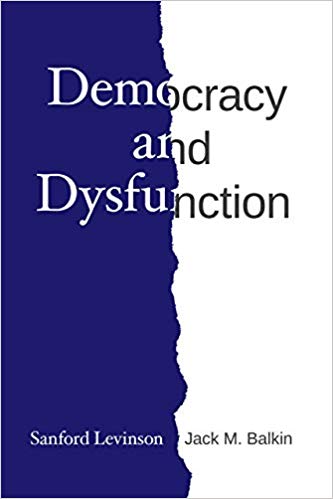
Sanford Levinson and Jack M. Balkin, Democracy and Dysfunction (University of Chicago Press, 2019)

Sanford Levinson, Written in Stone: Public Monuments in Changing Societies (Duke University Press 2018)

Mark A. Graber, Sanford Levinson, and Mark Tushnet, eds., Constitutional Democracy in Crisis? (Oxford University Press 2018)

Gerard Magliocca, The Heart of the Constitution: How the Bill of Rights became the Bill of Rights (Oxford University Press, 2018)

Cynthia Levinson and Sanford Levinson, Fault Lines in the Constitution: The Framers, Their Fights, and the Flaws that Affect Us Today (Peachtree Publishers, 2017)

Brian Z. Tamanaha, A Realistic Theory of Law (Cambridge University Press 2017)

Sanford Levinson, Nullification and Secession in Modern Constitutional Thought (University Press of Kansas 2016)

Sanford Levinson, An Argument Open to All: Reading The Federalist in the 21st Century (Yale University Press 2015)

Stephen M. Griffin, Broken Trust: Dysfunctional Government and Constitutional Reform (University Press of Kansas, 2015)

Frank Pasquale, The Black Box Society: The Secret Algorithms That Control Money and Information (Harvard University Press, 2015)

Bruce Ackerman, We the People, Volume 3: The Civil Rights Revolution (Harvard University Press, 2014)
Balkinization Symposium on We the People, Volume 3: The Civil Rights Revolution

Joseph Fishkin, Bottlenecks: A New Theory of Equal Opportunity (Oxford University Press, 2014)

Mark A. Graber, A New Introduction to American Constitutionalism (Oxford University Press, 2013)

John Mikhail, Elements of Moral Cognition: Rawls' Linguistic Analogy and the Cognitive Science of Moral and Legal Judgment (Cambridge University Press, 2013)

Gerard N. Magliocca, American Founding Son: John Bingham and the Invention of the Fourteenth Amendment (New York University Press, 2013)

Stephen M. Griffin, Long Wars and the Constitution (Harvard University Press, 2013)

Andrew Koppelman, The Tough Luck Constitution and the Assault on Health Care Reform (Oxford University Press, 2013)

James E. Fleming and Linda C. McClain, Ordered Liberty: Rights, Responsibilities, and Virtues (Harvard University Press, 2013)
Balkinization Symposium on Ordered Liberty: Rights, Responsibilities, and Virtues

Andrew Koppelman, Defending American Religious Neutrality (Harvard University Press, 2013)

Brian Z. Tamanaha, Failing Law Schools (University of Chicago Press, 2012)

Sanford Levinson, Framed: America's 51 Constitutions and the Crisis of Governance (Oxford University Press, 2012)

Linda C. McClain and Joanna L. Grossman, Gender Equality: Dimensions of Women's Equal Citizenship (Cambridge University Press, 2012)

Mary Dudziak, War Time: An Idea, Its History, Its Consequences (Oxford University Press, 2012)

Jack M. Balkin, Living Originalism (Harvard University Press, 2011)

Jason Mazzone, Copyfraud and Other Abuses of Intellectual Property Law (Stanford University Press, 2011)

Richard W. Garnett and Andrew Koppelman, First Amendment Stories, (Foundation Press 2011)

Jack M. Balkin, Constitutional Redemption: Political Faith in an Unjust World (Harvard University Press, 2011)

Gerard Magliocca, The Tragedy of William Jennings Bryan: Constitutional Law and the Politics of Backlash (Yale University Press, 2011)

Bernard Harcourt, The Illusion of Free Markets: Punishment and the Myth of Natural Order (Harvard University Press, 2010)

Bruce Ackerman, The Decline and Fall of the American Republic (Harvard University Press, 2010)
Balkinization Symposium on The Decline and Fall of the American Republic

Ian Ayres. Carrots and Sticks: Unlock the Power of Incentives to Get Things Done (Bantam Books, 2010)

Mark Tushnet, Why the Constitution Matters (Yale University Press 2010)

Ian Ayres and Barry Nalebuff: Lifecycle Investing: A New, Safe, and Audacious Way to Improve the Performance of Your Retirement Portfolio (Basic Books, 2010)
.jpg)
Jack M. Balkin, The Laws of Change: I Ching and the Philosophy of Life (2d Edition, Sybil Creek Press 2009)

Brian Z. Tamanaha, Beyond the Formalist-Realist Divide: The Role of Politics in Judging (Princeton University Press 2009)
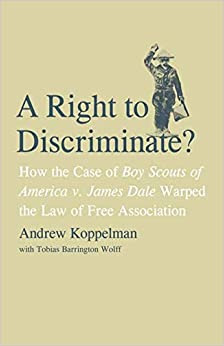
Andrew Koppelman and Tobias Barrington Wolff, A Right to Discriminate?: How the Case of Boy Scouts of America v. James Dale Warped the Law of Free Association (Yale University Press 2009)

Jack M. Balkin and Reva B. Siegel, The Constitution in 2020 (Oxford University Press 2009)

Heather K. Gerken, The Democracy Index: Why Our Election System Is Failing and How to Fix It (Princeton University Press 2009)

Mary Dudziak, Exporting American Dreams: Thurgood Marshall's African Journey (Oxford University Press 2008)

David Luban, Legal Ethics and Human Dignity (Cambridge Univ. Press 2007)

Ian Ayres, Super Crunchers: Why Thinking-By-Numbers is the New Way to be Smart (Bantam 2007)

Jack M. Balkin, James Grimmelmann, Eddan Katz, Nimrod Kozlovski, Shlomit Wagman and Tal Zarsky, eds., Cybercrime: Digital Cops in a Networked Environment (N.Y.U. Press 2007)
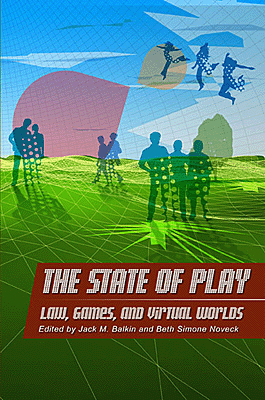
Jack M. Balkin and Beth Simone Noveck, The State of Play: Law, Games, and Virtual Worlds (N.Y.U. Press 2006)

Andrew Koppelman, Same Sex, Different States: When Same-Sex Marriages Cross State Lines (Yale University Press 2006)

Brian Tamanaha, Law as a Means to an End (Cambridge University Press 2006)

Sanford Levinson, Our Undemocratic Constitution (Oxford University Press 2006)

Mark Graber, Dred Scott and the Problem of Constitutional Evil (Cambridge University Press 2006)

Jack M. Balkin, ed., What Roe v. Wade Should Have Said (N.Y.U. Press 2005)

Sanford Levinson, ed., Torture: A Collection (Oxford University Press 2004)
Balkin.com homepage
Bibliography
Conlaw.net
Cultural Software
Writings
Opeds
The Information Society Project
BrownvBoard.com
Useful Links
Syllabi and Exams
