Balkinization
an unanticipated consequence of
Jack M. Balkin
Balkinization Symposiums: A Continuing List
E-mail:
Jack Balkin:
jackbalkin at yahoo.com
Bruce Ackerman
bruce.ackerman at yale.edu
Ian Ayres
ian.ayres at yale.edu
Corey Brettschneider
corey_brettschneider at brown.edu
Mary Dudziak
mary.l.dudziak at emory.edu
Joey Fishkin
joey.fishkin at gmail.com
Heather Gerken heather.gerken at yale.edu
Abbe Gluck abbe.gluck at yale.edu
Mark Graber
mgraber at law.umaryland.edu
Stephen Griffin
sgriffin at tulane.edu
Jonathan Hafetz
jonathan.hafetz at shu.edu
Jeremy Kessler
jkessler at law.columbia.edu
Andrew Koppelman
akoppelman at law.northwestern.edu
Marty Lederman
msl46 at law.georgetown.edu
Sanford Levinson
slevinson at law.utexas.edu
David Luban
david.luban at gmail.com
Gerard Magliocca
gmaglioc at iupui.edu
Jason Mazzone
mazzonej at illinois.edu
Linda McClain
lmcclain at bu.edu
John Mikhail
mikhail at law.georgetown.edu
Frank Pasquale
pasquale.frank at gmail.com
Nate Persily
npersily at gmail.com
Michael Stokes Paulsen
michaelstokespaulsen at gmail.com
Deborah Pearlstein
dpearlst at yu.edu
Rick Pildes
rick.pildes at nyu.edu
David Pozen
dpozen at law.columbia.edu
Richard Primus
raprimus at umich.edu
K. Sabeel Rahmansabeel.rahman at brooklaw.edu
Alice Ristroph
alice.ristroph at shu.edu
Neil Siegel
siegel at law.duke.edu
David Super
david.super at law.georgetown.edu
Brian Tamanaha
btamanaha at wulaw.wustl.edu
Nelson Tebbe
nelson.tebbe at brooklaw.edu
Mark Tushnet
mtushnet at law.harvard.edu
Adam Winkler
winkler at ucla.edu
Compendium of posts on Hobby Lobby and related cases
The Anti-Torture Memos: Balkinization Posts on Torture, Interrogation, Detention, War Powers, and OLC
The Anti-Torture Memos (arranged by topic)
Recent Posts
What Do You Say Now, John McCain?
![[Powered by Blogger]](https://lh3.googleusercontent.com/blogger_img_proxy/AEn0k_vWegMfekE-O_RWiIKfERVvJLFFwGT28R_Rg_rVHrSoagl9R-DulIT7jQwxKU1ZDaztBm3yjjv0lU8c9LuK7fdr2tODPaNRYvA6KE5aBEpl=s0-d)
Just A Few Blogs
ACS Blog
Alas, a Blog
Althouse
Arts and Letters Daily
Atrios (Eschaton)
Bill of Health
Buzzflash.com
Buzz Machine
Cato at Liberty
Juan Cole (Informed Comment)
Concurring Opinions
The Constitution in 2020
Corrente
Crooked Timber
Daily Howler
Daily Kos
Dana Boyd
Brad DeLong
Digby (Hullabaloo)
Discriminations
Daniel Drezner
Kevin Drum (Mother Jones)
Electrolite
En Banc
Eunomia (Daniel Larison)
Fafblog
Michael Froomkin (Discourse.net)
GovLab (Beth Noveck)
Rick Hasen (Election Law)
History News Network
How Appealing
Ignatz (Sam Heldman)
The Importance of (Ernie Miller)
Infolaw
Instapundit
International Economic Law and Policy Blog
IntLawGrrls
Jacob Levy
Jesus' General
Jurisdynamics
The Kitchen Cabinet
Mark Kleiman
Law Blog Central
Larry Lessig
Lawyers, Guns and Money
Liberal Oasis
Brian Leiter's Law School Reports
The Leiter Reports
Marginal Revolution
Megan McArdle
Memeorandum
Metafilter
Mirror of Justice
The New Republic
Newseum
No More Mister Nice Blog
Brendan Nyhan
Opinio Juris
Orcinus
The Originalism Blog
Pandagon
Passport (Foreign Policy)
Overcoming Bias
Political Animal (Washington Monthly)
Political Theory Daily Review
Political Wire (Taegan Goddard)
The Poor Man
Virginia Postrel
Prawfsblawg
Public Reason
Jonathan Rauch
Raw Story
Redstate
ReligiousLeftLaw.com
Reporters Committee For Freedom of the Press
Reproductive Rights Blog
Rothman's Roadmap to the Right of Publicity
SCOTUS Blog
Seeing the Forest
Clay Shirky
The Shifted Librarian
The Situationist
Larry Solum (Legal Theory)
Andrew Sullivan
Talking Points Memo
Talk Left
Tapped
Tbogg
TechPresident
The Paper Chase (Jurist)
Tom Paine
Tom Tomorrow (This Modern World)
Eve Tushnet
Uggabugga
University of Chicago Law School Faculty Blog
Unqualified Offerings
The Volokh Conspiracy
War and Piece (Laura Rozen)
Wampum
Oliver Willis
Wonkette
Written Description
Matthew Yglesias
Yin
Your Choice of Feeds
1. XML
powered by

2. Atom Feed
3. RSS 2.0
What Do You Say Now, John McCain?
JB
Dear Senator McCain:
The White House has now admitted that the United States has waterboarded, that President Bush believes the practice is not torture, and that it violates neither the anti-torture statute, the McCain Amendment (which you sponsored) nor the Military Commissions Act of 2006 (which you voted for).
Will you condemn the White House for its latest admission? Will you say to the President what you said to Rudy Giuliani back in October?"All I can say is that it was used in the Spanish Inquisition, it was used in Pol Pot’s genocide in Cambodia, and there are reports that it is being used against Buddhist monks today," Mr. McCain, who spent more than five years in a North Vietnamese prison camp, said in a telephone interview.
Of presidential candidates like Mr. Giuliani, who say that they are unsure whether waterboarding is torture, Mr. McCain said: "They should know what it is. It is not a complicated procedure. It is torture."
And if that is so, Senator McCain, do you agree that the Administration is subject to criminal liability under the torture statute and the War Crimes statute? Do you agree that the United States, under the leadership of George W. Bush, has committed war crimes and has stated that it sees no obstacle to doing so again?
The country awaits your answer.
Posted
2:34 PM
by JB [link]

McCain had no trouble sacrificing his conservative principles to his presidential ambitions. It is doubtful that he will endanger his presidential ambitions picking a fight on this issue.
I commend to you the works of Burke and Kirk. Conservatism isn't a synonym for chauvinism. Or at least, it didn't used to be.
It is a matter of conservative principle that you ruthlessly prosecute wars against your enemies rather than extending new rights to them.
It is also a matter of conservative principle that vague laws are unenforceable and should not be used as partisan political weapons against our war fighters.
# posted by Bart DePalma : 4:07 PM
Baghdad, there is nothing vague about waterboarding. It's torture. If you don't think so now, I'm sure that tune would change quickly if it was being done to you.
Just because youbelieve something, that doesn't make it a "conservative principle." There are plenty of self-identified liberals that believe we should fight hard if we're going to fight at all, as well as plenty of conservatives who are against the use of torture techniques.
There was an article by Goldberg in the National Review a couple years back on what makes a conservative a conservative. The ultimate answer given was that a conservative--no matter what their particular brand of conservatism was--was "comfortable with contradiction." This quality was juxtaposed against a liberal's preoccupation with consistency and hypocrisy.
I find it interesting then that conservatives should be angry with McCain for sacrificing something for ambition; shouldn't they be comfortable with contradiction? Isn't sacrificing one's principles in order to achieve a goal permissible?
Note that I think this cuts to the quick of the matter. Bart, you always throw out the barb "extend new rights to our enemies," but that's not what the other side is all about. They want consistency--if American interrogators can't waterboard American citizens, then they shouldn't waterboard other people, either. Not because they believe non-citizens should be extended new rights, but because they believe interrogators should be held to the same standards regardless of whom is being interrogated.
It will be interesting to see how/if McCain will deal with the waterboarding question once in office. If Goldberg's thesis is correct, McCain should have no problem forgetting his previous promise, and consider the slight ensuing embarrassment a fair trade off for other political goals. Of course, if it were correct, then Mr. DePalma should have had no problem with McCain's "contradictory" behavior in the first place.
The White House has now admitted that the United States has waterboarded, that President Bush believes the practice is not torture, ...
Dontcha see, it depends on a lot of stuff, like, you know, umm, ... the circumstances: who is carrying out the interrogation... (also at the bottom of my blog entry here).
Isn't that the way all laws work; it depends on who is breaking them and why? I thought I remembered something like that from 1L days....
Cheers,
"... some crappy little country or another. Every ten years or so, the United States needs to pick up some small crappy little country and throw it against the wall, just to show the world we mean business."
It is also a matter of conservative principle that vague laws are unenforceable and should not be used as partisan political weapons against our war fighters....
"... One defining characteristic of vagueness is that it doesn't differentiate between 'we' and 'some tinpot dictator', and this is of enormous importance. We need to know who the laws apply to, or we'll just make shite up. See Arne's post above on Tony Fratto's comments about "who" is doing the acts in question."
Cheers,
Like "Liberal Fascism." That certainly explains Goldberg.
"And if all men are equally right and wrong, an exponent of this view can neither speak nor mean anything, since at the same time he says both 'yes' and 'no.' And if he forms no judgement, but 'thinks' and 'thinks not' indifferently, what difference will there be between him and the vegetables?"
What, indeed? (Aristotle, Metaphysics, bk IV, 1008b.)
Then why the constant accusations that liberals are "moral relativists," "grade on the curve" and "practice situation ethics"? Those do not sound like accusations by people who are comfortable with contradiction.
The fact is, everyone values many different things. Inevitably, one value comes into conflict with another, and the more important one prevails. To people who have a different order of priorities, the outcome seems incomprehensible.
To me, the all-important principle here is respect for universal human rights that extend to everyone -- even terrorists. To others, it is apparent that the top principle is defeating terrorists by fair means or foul.
It is amusing to hear apologists who are attorneys argue for the flouting of the rule of law.
Bart, you always throw out the barb "extend new rights to our enemies," but that's not what the other side is all about. They want consistency--if American interrogators can't waterboard American citizens, then they shouldn't waterboard other people, either. Not because they believe non-citizens should be extended new rights, but because they believe interrogators should be held to the same standards regardless of whom is being interrogated.
That is precisely what post Vietnam liberalism is all about.
It seems to escape liberals that our citizenry and a wartime enemy are in NO WAY similarly situated.
Our citizens enjoy a range of constitutional rights while a wartime enemy enjoys none of these.
In general, our government may not take the life of a citizen without due process, if at all, while a wartime enemy on the battlefield can be killed at will.
A citizen in government custody for a crime has a right to silence while a POW has no such right. Instead, the enemy POW can and should be interrogated for intelligence.
A citizen has a right to be free from coercive interrogation while the GC only extends that privilege to POWs who follow the laws of war and also observe the GC privileges of our captured soldiers. The only right an enemy capture has under the GC which is not earned through reciprocal behavior is not to be killed or tortured.
Treating a wartime enemy like a US citizen criminal defendant is most certainly extending rights to which the enemy is not entitled and did not earn.
I really don't care what you call yourself, you are a moron.
Waterboarding is a form of torture outlawed by international treaties and domestic federal statutes. You may wish that the law were otherwise, but stop pretending that the law is "vague" or somehow idiotic because it gives enemy combatants rights "they're not entitled to."
Aren't you a positive lawyer, i.e., a lawyer who understands what an enacted, positive law is and believes that until changes, such laws should be enforced?
Apparently they have no such clause in Colorado.
Hmm, was it a conservative member of the GOP who dropped the bomb? Or acted as commander in chief during WWII? Was the guy who wrote the torture bill a draft-dodging liberal (or an oft AWOL, coke-snorting, coddled cowboy "member" of the National Guard?) But when a vandal puts up such easily countered "points" it does little good to address either the points or the vandal.
That Goldberg article you mention certainly flies in the face of my personal experience with self-identified conservatives; my experience is closer to that of enlightened layperson's: they breast-beat (or bible-thump) ad nauseam about "absolute values". I suppose one could argue that I've made a category error, that when a right-wing shill cries "relativism!" it is only a tactic born of their "comfort with contradiction" and aimed at the liberal's preoccupation with intellectual honesty. This layered view may actually be the most accurate; who would be surprised at a sophist crying foul on the same tactics they themselves use? Rhetoric as a tool of expediency is the name of the sophist game, right?
"Comfortable with contradiction"...run this by your plausibility meter: Posit adherence to a text chock-full of palpable absurdities and outright contradictions (such as claiming a deity defined as "Love" is the same deity that drowns the world in a fit of pique, or that said deity, "Love", sent she bears to rend 42 kids to bits for making fun of a particular bald man, or that 1=3). Second, posit indoctrination from an early age which says, a) Thou shalt not question these contradictions, b) Thou shalt accept my interpretation of the text as the only true and possible interpretation. This is not "comfort with contradiction," this is supression of the critical faculty by means of authoritarianism. Might such a scenario produce some of the behavior in question?
Any two sine curves drawn on the same axis must occasionally intersect, much as Bart's and my sentiments did at the top of this thread. Heck, he probably even agrees with me that 2+2=4 (although that 1=3 bit might be a tad more contentious.)
In closing, has anyone else had trouble linking to specific comments rather than to the main article to which comments are attached?
Peace.
I've had that problem. It's been extremely frustrating.
Indeed. Our citizens are good white Cris'shuns, and our enemies are swarthy Islamofascists that bugger camels and wear diapers on their heads. Of course they should be treated differently. After all, WWJWB?
Cheers,
However, I still find it to be an interesting exercise to examine the navel-gazing rhetoric of the right to see what they feel makes a conservative a conservative. I also find it germane to the discussion of McCain's possible responses to the administration's admission of waterboarding. In the current "I'm more conservative than you, nyah nyah nyah" battle in the GOP (a gamble at best given the social climate), such rhetoric may help define the borders of permissibility depending on the depth of acceptance. Hypocrisy can become realpolitik, and the opposition could be easily dismissed as cute, but pitiful, ideologues from a long gone era.
... except when someone says they aren't citizens and then they don't....
But FWIW, when the Constitution (as amended) says "person" (and not "citizen"), it means "person". That is, everyone, axe-murdering pederast, alleged "enemy combatant", or lying, scumbag "Deciderator-in-Chief".
Cheers,
I'd note that this claim is inconsistent with the other justification for such treatment being that of "necessity"; if the "coercive interrogation" of an "enemy" is "necessary" to prevent great harm to the nation, and/or to preserve it, then there's no reason why we should not use such "coercive interrogation" on all enemy prisoners. Surely, if we were at war with the Soviet Union (which did have the power to inflict grievous damage on the United States, or even possibly defeat it), or Nazi soldiers in the battle for the world a half century ago, we should be able to use any methods we wanted in order to preserve the nation.
But we don't do that (or at least, we've signed treaties saying we won't).
Cheers,
There was an article by Goldberg in the National Review a couple years back on what makes a conservative a conservative. The ultimate answer given was that a conservative--no matter what their particular brand of conservatism was--was "comfortable with contradiction." This quality was juxtaposed against a liberal's preoccupation with consistency and hypocrisy.
Then why the constant accusations that liberals are "moral relativists," "grade on the curve" and "practice situation ethics"? Those do not sound like accusations by people who are comfortable with contradiction.
The fact is, everyone values many different things. Inevitably, one value comes into conflict with another, and the more important one prevails. To people who have a different order of priorities, the outcome seems incomprehensible.
I also thought that Goldberg's choice of terms was strange. Most conservatives have a strong set of principles and do not think much of moral relativism.
Although a bit rambling, Goldberg's article does hit some salient points:
Modern conservatism in not really a pure ideological movement. Rather, it is a political alliance of convenience which was created in the aftermath of the failed socialist experiment.
Classical liberalism and conservatism were much more clear cut. Liberals believed in minimal government to guarantee personal freedom in moral and economic matters and were comfortable with the rapid change that brought about. Conservatives believed in tradition and using government to regulate morals and the economy.
However, things became muddled when the left abandoned freedom as the path to personal well being and embraced socialism. Socialism is really classical conservative use of government without the tradition. Consequently, modern liberalism ended up being a hybrid of classical conservative use of government and personal freedom in the moral matters.
Modern conservatism is a political marriage of convenience of the groups left out of the modern liberalism - economic classical liberals and traditionalists.
WWII and Vietnam further defined the foreign policy of modern liberalism and conservatism.
In the United States, classical liberalism tended to be internationalist while classical conservatism tended to be isolationist. WWII discredited isolationism and both liberals and conservatives were internationalists for a time. However, Vietnam drove the left to adopt isolationism. Consequently, modern conservatism has become the movement of internationalism and modern liberalism the movement of isolationism.
In sum, Goldberg should not have bothered trying to define modern conservatism ideologically because it is not ideologically consistent. Rather, it is an alliance of classical liberals on economic matters, classical conservatives on moral matters and internationalists.
http://www.msnbc.msn.com/id/23052111/
What a pantload.
I suppose this could be true if by "isolationism", you mean: "a policy of not invading countries that are no threat to us"
"The Myth of a Maverick:" Matt Welch on GOP Frontrunner John McCain, via Democracy Now --
excerpt:
MATT WELCH: . . . The basic McCain strategy– you know in 1999 McCain advocated this policy of rogue-state rollback which is basically preemptive war three and a half years before Bush ever thought of it.
AMY GOODMAN: He threatened North Korea with extinction.
MATT WELCH: He threatened North Korea with extinction, and he elucidated this doctrine by which– wherever there is an authoritarian dictator, we support the insurgents. And, if we support the insurgent and the dictator cracks down, then we have to defend the insurgents with US force. And any time we make a threat and someone calls our bluff, we also have to use US force. It is incredibly interventionist militaristic approach towards foreign policy that he has had all along. That’s the reason why neoconservatives have flocked to his cause and championed it over the years.
So, after September 11th, Bush started to embrace those ideas. That kind of policy structure grafted onto Bush and so it was natural that McCain and Bush would become closer over that time. And then– starting around 2004 and 2005, when McCain started eyeing the presidency in 2008, he began this long, slow suck-up to the right, particularly social conservatives, and also to Bush because he wanted to be the sort of front runner of the Republican establishment.
In a recent GOP presidential debate, McCain said it was inconceivable that "anyone could believe that [waterboarding is] not torture. It's in violation of the Geneva Convention. It's in violation of existing law."
If you are expecting McCain to say that he will prosecute CIA officials who were serving their country and acting in accordance with legal advice from DOJ, then you are clearly out of luck. But why focus on McCain? Have Clinton or Obama suggested that they would conduct such prosecutions if elected? Have they even been as outspoken on the issue as McCain?
"Mr. McCain, do you stand by your statement that waterboarding is torture?"
"Do you agree that torture is a war crime?"
"How do you react to the attorney general's admission that the president has ordered waterboarding?"
حلي الاوريو الفطر الهندي صور تورتة حلى قهوه طريقة عمل السينابون طريقة عمل بلح الشام بيتزا هت كيكة الزبادي حلا سهل صور كيك عجينة العشر دقائق طريقة عمل الدونات طريقة عمل البان كيك طريقة عمل الكنافة طريقة عمل البسبوسة طريقة عمل الكيك طريقة عمل عجينة البيتزا فوائد القرفه
Books by Balkinization Bloggers

Mark Tushnet and Bojan Bugaric, Constitutionalism and Its Discontents (University of Chicago Press, 2026)

Gerard N. Magliocca, The Actual Art of Governing: Justice Robert H. Jackson's Concurring Opinion in the Steel Seizure Case (Oxford University Press, 2025)

Linda C. McClain and Aziza Ahmed, The Routledge Companion to Gender and COVID-19 (Routledge, 2024)

David Pozen, The Constitution of the War on Drugs (Oxford University Press, 2024)

Jack M. Balkin, Memory and Authority: The Uses of History in Constitutional Interpretation (Yale University Press, 2024)
Mark A. Graber, Punish Treason, Reward Loyalty: The Forgotten Goals of Constitutional Reform after the Civil War (University of Kansas Press, 2023)
Jack M. Balkin, What Roe v. Wade Should Have Said: The Nation's Top Legal Experts Rewrite America's Most Controversial Decision - Revised Edition (NYU Press, 2023)

Andrew Koppelman, Burning Down the House: How Libertarian Philosophy Was Corrupted by Delusion and Greed (St. Martin’s Press, 2022)

Gerard N. Magliocca, Washington's Heir: The Life of Justice Bushrod Washington (Oxford University Press, 2022)
Joseph Fishkin and William E. Forbath, The Anti-Oligarchy Constitution: Reconstructing the Economic Foundations of American Democracy (Harvard University Press, 2022)
Mark Tushnet and Bojan Bugaric, Power to the People: Constitutionalism in the Age of Populism (Oxford University Press 2021).

Mark Philip Bradley and Mary L. Dudziak, eds., Making the Forever War: Marilyn B. Young on the Culture and Politics of American Militarism Culture and Politics in the Cold War and Beyond (University of Massachusetts Press, 2021).

Jack M. Balkin, What Obergefell v. Hodges Should Have Said: The Nation's Top Legal Experts Rewrite America's Same-Sex Marriage Decision (Yale University Press, 2020)

Frank Pasquale, New Laws of Robotics: Defending Human Expertise in the Age of AI (Belknap Press, 2020)

Jack M. Balkin, The Cycles of Constitutional Time (Oxford University Press, 2020)

Mark Tushnet, Taking Back the Constitution: Activist Judges and the Next Age of American Law (Yale University Press 2020).

Andrew Koppelman, Gay Rights vs. Religious Liberty?: The Unnecessary Conflict (Oxford University Press, 2020)

Ezekiel J Emanuel and Abbe R. Gluck, The Trillion Dollar Revolution: How the Affordable Care Act Transformed Politics, Law, and Health Care in America (PublicAffairs, 2020)

Linda C. McClain, Who's the Bigot?: Learning from Conflicts over Marriage and Civil Rights Law (Oxford University Press, 2020)
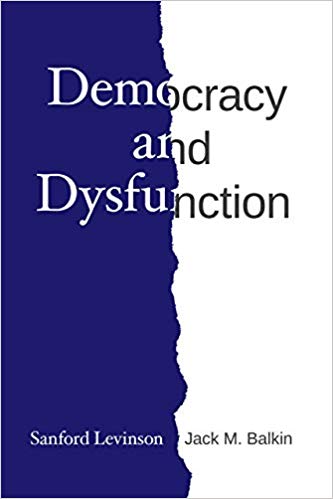
Sanford Levinson and Jack M. Balkin, Democracy and Dysfunction (University of Chicago Press, 2019)

Sanford Levinson, Written in Stone: Public Monuments in Changing Societies (Duke University Press 2018)

Mark A. Graber, Sanford Levinson, and Mark Tushnet, eds., Constitutional Democracy in Crisis? (Oxford University Press 2018)

Gerard Magliocca, The Heart of the Constitution: How the Bill of Rights became the Bill of Rights (Oxford University Press, 2018)

Cynthia Levinson and Sanford Levinson, Fault Lines in the Constitution: The Framers, Their Fights, and the Flaws that Affect Us Today (Peachtree Publishers, 2017)

Brian Z. Tamanaha, A Realistic Theory of Law (Cambridge University Press 2017)

Sanford Levinson, Nullification and Secession in Modern Constitutional Thought (University Press of Kansas 2016)

Sanford Levinson, An Argument Open to All: Reading The Federalist in the 21st Century (Yale University Press 2015)

Stephen M. Griffin, Broken Trust: Dysfunctional Government and Constitutional Reform (University Press of Kansas, 2015)

Frank Pasquale, The Black Box Society: The Secret Algorithms That Control Money and Information (Harvard University Press, 2015)

Bruce Ackerman, We the People, Volume 3: The Civil Rights Revolution (Harvard University Press, 2014)
Balkinization Symposium on We the People, Volume 3: The Civil Rights Revolution

Joseph Fishkin, Bottlenecks: A New Theory of Equal Opportunity (Oxford University Press, 2014)

Mark A. Graber, A New Introduction to American Constitutionalism (Oxford University Press, 2013)

John Mikhail, Elements of Moral Cognition: Rawls' Linguistic Analogy and the Cognitive Science of Moral and Legal Judgment (Cambridge University Press, 2013)

Gerard N. Magliocca, American Founding Son: John Bingham and the Invention of the Fourteenth Amendment (New York University Press, 2013)

Stephen M. Griffin, Long Wars and the Constitution (Harvard University Press, 2013)

Andrew Koppelman, The Tough Luck Constitution and the Assault on Health Care Reform (Oxford University Press, 2013)

James E. Fleming and Linda C. McClain, Ordered Liberty: Rights, Responsibilities, and Virtues (Harvard University Press, 2013)
Balkinization Symposium on Ordered Liberty: Rights, Responsibilities, and Virtues

Andrew Koppelman, Defending American Religious Neutrality (Harvard University Press, 2013)

Brian Z. Tamanaha, Failing Law Schools (University of Chicago Press, 2012)

Sanford Levinson, Framed: America's 51 Constitutions and the Crisis of Governance (Oxford University Press, 2012)

Linda C. McClain and Joanna L. Grossman, Gender Equality: Dimensions of Women's Equal Citizenship (Cambridge University Press, 2012)

Mary Dudziak, War Time: An Idea, Its History, Its Consequences (Oxford University Press, 2012)

Jack M. Balkin, Living Originalism (Harvard University Press, 2011)

Jason Mazzone, Copyfraud and Other Abuses of Intellectual Property Law (Stanford University Press, 2011)

Richard W. Garnett and Andrew Koppelman, First Amendment Stories, (Foundation Press 2011)

Jack M. Balkin, Constitutional Redemption: Political Faith in an Unjust World (Harvard University Press, 2011)

Gerard Magliocca, The Tragedy of William Jennings Bryan: Constitutional Law and the Politics of Backlash (Yale University Press, 2011)

Bernard Harcourt, The Illusion of Free Markets: Punishment and the Myth of Natural Order (Harvard University Press, 2010)

Bruce Ackerman, The Decline and Fall of the American Republic (Harvard University Press, 2010)
Balkinization Symposium on The Decline and Fall of the American Republic

Ian Ayres. Carrots and Sticks: Unlock the Power of Incentives to Get Things Done (Bantam Books, 2010)

Mark Tushnet, Why the Constitution Matters (Yale University Press 2010)

Ian Ayres and Barry Nalebuff: Lifecycle Investing: A New, Safe, and Audacious Way to Improve the Performance of Your Retirement Portfolio (Basic Books, 2010)
.jpg)
Jack M. Balkin, The Laws of Change: I Ching and the Philosophy of Life (2d Edition, Sybil Creek Press 2009)

Brian Z. Tamanaha, Beyond the Formalist-Realist Divide: The Role of Politics in Judging (Princeton University Press 2009)
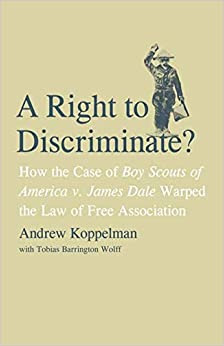
Andrew Koppelman and Tobias Barrington Wolff, A Right to Discriminate?: How the Case of Boy Scouts of America v. James Dale Warped the Law of Free Association (Yale University Press 2009)

Jack M. Balkin and Reva B. Siegel, The Constitution in 2020 (Oxford University Press 2009)

Heather K. Gerken, The Democracy Index: Why Our Election System Is Failing and How to Fix It (Princeton University Press 2009)

Mary Dudziak, Exporting American Dreams: Thurgood Marshall's African Journey (Oxford University Press 2008)

David Luban, Legal Ethics and Human Dignity (Cambridge Univ. Press 2007)

Ian Ayres, Super Crunchers: Why Thinking-By-Numbers is the New Way to be Smart (Bantam 2007)

Jack M. Balkin, James Grimmelmann, Eddan Katz, Nimrod Kozlovski, Shlomit Wagman and Tal Zarsky, eds., Cybercrime: Digital Cops in a Networked Environment (N.Y.U. Press 2007)

Jack M. Balkin and Beth Simone Noveck, The State of Play: Law, Games, and Virtual Worlds (N.Y.U. Press 2006)

Andrew Koppelman, Same Sex, Different States: When Same-Sex Marriages Cross State Lines (Yale University Press 2006)

Brian Tamanaha, Law as a Means to an End (Cambridge University Press 2006)

Sanford Levinson, Our Undemocratic Constitution (Oxford University Press 2006)

Mark Graber, Dred Scott and the Problem of Constitutional Evil (Cambridge University Press 2006)

Jack M. Balkin, ed., What Roe v. Wade Should Have Said (N.Y.U. Press 2005)

Sanford Levinson, ed., Torture: A Collection (Oxford University Press 2004)
Balkin.com homepage
Bibliography
Conlaw.net
Cultural Software
Writings
Opeds
The Information Society Project
BrownvBoard.com
Useful Links
Syllabi and Exams
