Balkinization
an unanticipated consequence of
Jack M. Balkin
Balkinization Symposiums: A Continuing List
E-mail:
Jack Balkin:
jackbalkin at yahoo.com
Bruce Ackerman
bruce.ackerman at yale.edu
Ian Ayres
ian.ayres at yale.edu
Corey Brettschneider
corey_brettschneider at brown.edu
Mary Dudziak
mary.l.dudziak at emory.edu
Joey Fishkin
joey.fishkin at gmail.com
Heather Gerken heather.gerken at yale.edu
Abbe Gluck abbe.gluck at yale.edu
Mark Graber
mgraber at law.umaryland.edu
Stephen Griffin
sgriffin at tulane.edu
Jonathan Hafetz
jonathan.hafetz at shu.edu
Jeremy Kessler
jkessler at law.columbia.edu
Andrew Koppelman
akoppelman at law.northwestern.edu
Marty Lederman
msl46 at law.georgetown.edu
Sanford Levinson
slevinson at law.utexas.edu
David Luban
david.luban at gmail.com
Gerard Magliocca
gmaglioc at iupui.edu
Jason Mazzone
mazzonej at illinois.edu
Linda McClain
lmcclain at bu.edu
John Mikhail
mikhail at law.georgetown.edu
Frank Pasquale
pasquale.frank at gmail.com
Nate Persily
npersily at gmail.com
Michael Stokes Paulsen
michaelstokespaulsen at gmail.com
Deborah Pearlstein
dpearlst at yu.edu
Rick Pildes
rick.pildes at nyu.edu
David Pozen
dpozen at law.columbia.edu
Richard Primus
raprimus at umich.edu
K. Sabeel Rahmansabeel.rahman at brooklaw.edu
Alice Ristroph
alice.ristroph at shu.edu
Neil Siegel
siegel at law.duke.edu
David Super
david.super at law.georgetown.edu
Brian Tamanaha
btamanaha at wulaw.wustl.edu
Nelson Tebbe
nelson.tebbe at brooklaw.edu
Mark Tushnet
mtushnet at law.harvard.edu
Adam Winkler
winkler at ucla.edu
Compendium of posts on Hobby Lobby and related cases
The Anti-Torture Memos: Balkinization Posts on Torture, Interrogation, Detention, War Powers, and OLC
The Anti-Torture Memos (arranged by topic)
Recent Posts
Partisan Entrenchment and the 2008 Election
![[Powered by Blogger]](https://lh3.googleusercontent.com/blogger_img_proxy/AEn0k_tl5Z3gHSosncY6_Gy-oCl22ZuP_lXBzsAxGptId2hF_qVsA2hM63AEmuSPkx-pV6bCXp__vhOU6kMLCJcANNhscBhbxMU-ggbx5QoUxd1r=s0-d)
Just A Few Blogs
ACS Blog
Alas, a Blog
Althouse
Arts and Letters Daily
Atrios (Eschaton)
Bill of Health
Buzzflash.com
Buzz Machine
Cato at Liberty
Juan Cole (Informed Comment)
Concurring Opinions
The Constitution in 2020
Corrente
Crooked Timber
Daily Howler
Daily Kos
Dana Boyd
Brad DeLong
Digby (Hullabaloo)
Discriminations
Daniel Drezner
Kevin Drum (Mother Jones)
Electrolite
En Banc
Eunomia (Daniel Larison)
Fafblog
Michael Froomkin (Discourse.net)
GovLab (Beth Noveck)
Rick Hasen (Election Law)
History News Network
How Appealing
Ignatz (Sam Heldman)
The Importance of (Ernie Miller)
Infolaw
Instapundit
International Economic Law and Policy Blog
IntLawGrrls
Jacob Levy
Jesus' General
Jurisdynamics
The Kitchen Cabinet
Mark Kleiman
Law Blog Central
Larry Lessig
Lawyers, Guns and Money
Liberal Oasis
Brian Leiter's Law School Reports
The Leiter Reports
Marginal Revolution
Megan McArdle
Memeorandum
Metafilter
Mirror of Justice
The New Republic
Newseum
No More Mister Nice Blog
Brendan Nyhan
Opinio Juris
Orcinus
The Originalism Blog
Pandagon
Passport (Foreign Policy)
Overcoming Bias
Political Animal (Washington Monthly)
Political Theory Daily Review
Political Wire (Taegan Goddard)
The Poor Man
Virginia Postrel
Prawfsblawg
Public Reason
Jonathan Rauch
Raw Story
Redstate
ReligiousLeftLaw.com
Reporters Committee For Freedom of the Press
Reproductive Rights Blog
Rothman's Roadmap to the Right of Publicity
SCOTUS Blog
Seeing the Forest
Clay Shirky
The Shifted Librarian
The Situationist
Larry Solum (Legal Theory)
Andrew Sullivan
Talking Points Memo
Talk Left
Tapped
Tbogg
TechPresident
The Paper Chase (Jurist)
Tom Paine
Tom Tomorrow (This Modern World)
Eve Tushnet
Uggabugga
University of Chicago Law School Faculty Blog
Unqualified Offerings
The Volokh Conspiracy
War and Piece (Laura Rozen)
Wampum
Oliver Willis
Wonkette
Written Description
Matthew Yglesias
Yin
Your Choice of Feeds
1. XML
powered by

2. Atom Feed
3. RSS 2.0
Partisan Entrenchment and the 2008 Election
JB
This Wall Street Journal op-ed by Steven Calabresi and John McGinnis argues for John McCain on the grounds that he will appoint the judges who will "restor[e] constitutional government" and prevent Democrats from "threaten[ing] the jurisprudential gains of the past three decades, and provid[ing] new impetus to judicial activism of a kind not seen since the 1960s":The expected value of any presidential candidate for the future of the American judiciary must be discounted by the probability that the candidate will not prevail in the election. For other kinds of issues, it may be argued that it is better to lose with the perfect candidate than to win with an imperfect one. The party lives to fight another day and can reverse the bad policies of an intervening presidency.
The judiciary is different. On Jan. 20, 2009, six of the nine Supreme Court justices will be over 70. Most of them could be replaced by the next president, particularly if he or she is re-elected. Given the prospect of accelerating gains in modern medical technology, some of the new justices may serve for half a century. Even if a more perfect candidate were somehow elected in 2012, he would not be able to undo the damage, especially to the Supreme Court.
Accordingly, for judicial conservatives electability must be a paramount consideration.
I think that Calabresi and McGinnis are a bit over the top in their fear of Democrats as extra-constitutional invaders from Mars. This is not a choice between true constitutional government and constitutional destruction; rather what is at stake a choice between liberal and conservative interpretations of the Constitution. After all, John Roberts and Samuel Alito are neither originalists nor textualists, nor devotees of judicial restraint. (Parents Involved and Wisconsin Right To Life, to take only two examples, are hardly cases involving judicial deference to the elected branches). Rather, Roberts and Alito are very skilled and professional conservative doctrinalists who have fairly systematically promoted a conservative vision of the Constitution through doctrinal development. Calabresi and McGinnis are more candid later in the piece when they shift their language from the fears of judicial activism to the requirements of "judicial conservatives." Conservatism is what they are looking for in judicial appointments, and, given their views, who can blame them?
From my perspective, at least, there is no small irony in Calabresi and McGinnis' call for restoring constitutional government, given the activities of the current occupant of the White House; if anyone has made constitutional restoration necessary, it is not the demon liberals but George W. Bush. But I suspect they probably don't see things the way I do.
In any case, Calabresi and McGinnis somewhat exaggerate the dangers of new Democratic appointments: Given the most likely retirements, the most plausible scenario is that a Democratic President will be able to ensure that Ginsburg, Stevens (and possibly Souter) are replaced by liberals, thus preserving the status quo. On the other hand, it is the Wall Street Journal editorial page, so a degree of foaming about the mouth about the liberal judicial menace and its imminent destruction of the country is de rigeur.
Putting all this to one side, however, I find much to agree with in Calabresi's and McGinnis' appraisal of John McCain. My sense is that Republicans have seen the composition of the federal judiciary as a far more important issue in elections than Democrats have for some time. So it is no surprise that when Republican commentators describe what they want from a candidate, they often mention conservative judicial appointments as one of their top concerns. There has been recent controversy about whether John McCain is really committed to appointing strong conservatives to the Supreme Court. But from my perspective at least, it's hard to think that he would not try. If a Republican is elected president, the most important limitation on judicial appointments will be the composition of the Senate. If the Democrats gain several seats, they will be in a far stronger position to require a Republican President to moderate his nominees, whoever that President might be.
I don't see much reason to think that a Romney Administration or a McCain Administration would be all that different in terms of their judicial choices. To be sure, McCain might want a candidate who wouldn't eviscerate what's left of the McCain-Feingold campaign finance law. But the number of conservatives who wouldn't do that and are reliably conservative on all of the other issues that the base cares about is very small indeed.
Conversely, I have no reason to believe that either McCain or Romney really want to overturn Roe v. Wade, or, for that matter, Lawrence v. Texas or any of the substantive due process cases that drive judicial conservatives nuts. Like their predecessors, I suspect that McCain and Romney would prefer a Court that hollowed out Roe without officially overturning it. All this suggests that the Republican playbook on judicial nominations will pretty much be the same as it has been in recent years: Work hard to stock the federal courts and the Supreme Court with reliable conservatives, who can stay on the bench for many years and reshape the Constitution and federal law in a conservative direction. Indeed-- and this is the whole point of the hallowed strategy of partisan entrenchment-- if you no longer control the Congress, and only intermittently control the Presidency, it is a particularly good idea to entrench yourself in a branch with life tenure. The Federalists understood this in 1800, and so has every other political party after them.
Posted
12:48 PM
by JB [link]
The next President will very likely decide who replaces Stevens and Ginsburg on the Court.
In the short term, a Dem appointing liberals will preserve the status quo and potentially build towards a liberal majority if there is a Dem in office when Scalia and Thomas retire.
However, and this is why I am leaning toward holding my nose and voting for McCain, a GOP President can establish a solid conservative majority for at least a decade even if he misses on one of the two picks.
Conversely, I have no reason to believe that either McCain or Romney really want to overturn Roe v. Wade, or, for that matter, Lawrence v. Texas or any of the substantive due process cases that drive judicial conservatives nuts. Like their predecessors, I suspect that McCain and Romney would prefer a Court that hollowed out Roe without officially overturning it.
The problem is that a President cannot fine tune the judiciary in this way. The President is making his or her best guess as to the general approach of a justice and then can only stand back and see what happens. If you mix a 6-7 member conservative majority with a case contesting a state provision like the Unborn Person Amendment establishing legal personhood at conception and you could very well have a reversal of Roe.

Best,
Ben
I'm not saying the issue is unimportant; only that everyone assumes that there will be more Presidential appointments than there actually will be.
Sen. Cardin is passionately arguing for judicial determinations of whether telecoms may be granted immunity. This is an abomination that we are even having this discussion (see, e.g., Krupps in 1930's Germany), but by far the more damning statements come in the discussions of sunset provision re: the FISA tinkering in PATRIOTs I and II.
The legislature has no authority to sidestep the 4th, much less to make a half-arsed attempt to pass the buck on to subsequent Congresses for determination of whether we are going to honor the letter of the law. I think if anything, the preceding three gleefully fascistic Congresses have demonstrated that sunsets are a legislative tool to have one's cake and eat it too.
The Federalist Society also has installed law clerks for federal judges who were "real lawyers" - rather than ideological government hacks - before those judges were appointed to the federal bench. These law clerks have assured that when former "real lawyer" judges issue opinions on "agenda issues," the clerk's draft of the opinion advances the "modern Republican" goals.
In other words, the Federalist Society has now achieved one of its major goals. It has packed the Supreme Court and the lower federal judiciary with judges whose primary consideration in deciding a case is "What outcome does the 'modern Republican Party' want in this case?" As long as Justice Kennedy (a traditional Republican in Tushnet's classification) remains aligned with the Federalist Four, the Federalist Society agenda will prosper.
The jurisprudential gymnastics that show up frequently in Justice Kennedy's opinions in 5-4 decisions suggest to me that Kennedy still thinks that he is deciding cases as a judge, not as a politician or ideologue.
If McCain or Romney gets to appoint additional Federalist Society clones to replace Stevens and Ginsberg, the judicial branch may sustain the "modern Republican" agenda for a generation after the Democratic Party regains control of the other branches of government. This will happen because of outcome-oriented judges, not because of judges who are "conservative."
I'm not quite sure if this "no reason to believe" language is intended to be taken literally, but if it is, it strikes me as wildly overstated. McCain has said, "I do not support Roe versus Wade. It should be overturned." Or see here: "Throughout his bid for the GOP's 2008 presidential nod, Mitt Romney has called for overturning Roe v. Wade." You might think you have reason to believe they're lying, but I don't think they've shown themselves sufficiently untrustworthy that their statements supply no reason to think that they are true. If I were to regard your statements above as supplying no reason to think that you believe them--if, say, I were to think that you really believe that Calabresi and McGinnis's analysis is spot on, your protestations to the contrary notwithstanding--you'd think it was outrageous, no?
(Earlier comment deleted to remove egregious error in verb agreement!)
Also given those accelerating gains in medical technology, it is pretty easy to see what some of the new frontiers of judicial activism might be. Not only will people be working on technology to extend life, but also to create it and design it, creating a conflict and possibly soon eclipsing natural conception rights.
McCain, Romney, Clinton and Obama might be all over the map on genetic engineering of children and postgendered conception, as well as on the priority of life-extension and immortality. It's anyone's guess which would appoint judges who believed reproductive technology could be restrained by government policy, state or federal. Surely we should ask the candidates feelings on this, and ask if they would nominate judges who agreed with their views about genetic engineering and the rights of scientists dictate the genomes of people, the rights of people to have natural children, the requirement of male and female progenitors, etc.
We know that this is going to be an issue...
tray, you're a master of understatement! "Parents Involved wasn't a model of judicial restraint," indeed!
Kennedy granted relief to the Louisville plaintiff who (1) had not complied with reasonable administrative rules when choice of school was denied initially, but who (2) was granted choice of school the next year when the administrative rules were followed. If any government body other than a moderate school board had denied the request of a citizen who had not complied with reasonable administrative rules, the Federalist Society Four on the Supreme Court would never think of disturbing such a decision.
In the Louisville case, Kennedy and the Four reached out to take and decide a case involving an extremely complicated school assignment system that had been developed to comply with a federal court order that required the school board to eradicate the vestiges of racial segregation in pupil assignment. A favorite slogan of federal judges who are "modern Republicans" is that they do not sit as a "super school board" to review the merits of individual decisions, even when those decisions touch on the constitutional rights of students and teachers. As in the "Bong hits for Jesus" banner case, decided by the same justices in the same week as Parents Involved, great deference is paid by federal courts to the decisions of local school boards. Except when the school board's plan to maintain diverse student populations imposes occasional burdens on white students.
In addition, one year the Louisville student assignment regime was held by a federal court to be constitutionally proper and effective to remove vestiges of racial segregation. Almost immediately after the court found that all "vestiges of racial segregation" had been removed, Kennedy and the Federalist Society Four declared the same plan to be constitutionally defective because the plan supposedly was not "narrowly tailored" to minimize reference to race in pupil assignments.
No wonder Justice Breyer was moved to read from the bench his passionate dissent in the school desegregation cases.
The Louisville decision established that unless a school district is still subject to a court order entered to correct the effects of prior state-caused racial segregation, NO race-conscious pupil assignment scheme will pass constitutional muster if it is reviewed by Justice Kennedy and the Federalist Society Four.
This five-justice majority did not decide these cases on neutral judicial principles. They chose the outcome that fit the "modern Republican" agenda. In the school cases, that Republican agenda sought the result that fit with Justice Kennedy's unexamined personal prejudices, a result that Justice Kennedy reached in his opinion - albeit with some difficulty in explicating a consistent rationale.
Justice O'Connor's decision in Grutter (University of Michigan Law School case) makes clear that she would never have ruled against the Louisville school board. Croson simply did not require the results that Justice Kennedy and the Federalist Society Four reached in the pupil assignment cases. The Court would never have ruled against the Louisville school board when the Federalist Society agenda only had two consistent adherents on the Court (Scalia & Thomas).
Any guess about the Federalist postition? Roberts was quized about this by Schumer in his confirmation hearings, and said he felt that cloning was clearly an interstate commerce issue, so that's good.
Books by Balkinization Bloggers

Mark Tushnet and Bojan Bugaric, Constitutionalism and Its Discontents (University of Chicago Press, 2026)

Gerard N. Magliocca, The Actual Art of Governing: Justice Robert H. Jackson's Concurring Opinion in the Steel Seizure Case (Oxford University Press, 2025)

Linda C. McClain and Aziza Ahmed, The Routledge Companion to Gender and COVID-19 (Routledge, 2024)

David Pozen, The Constitution of the War on Drugs (Oxford University Press, 2024)

Jack M. Balkin, Memory and Authority: The Uses of History in Constitutional Interpretation (Yale University Press, 2024)
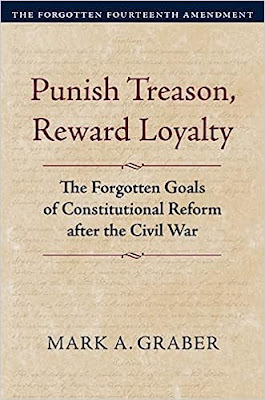
Mark A. Graber, Punish Treason, Reward Loyalty: The Forgotten Goals of Constitutional Reform after the Civil War (University of Kansas Press, 2023)
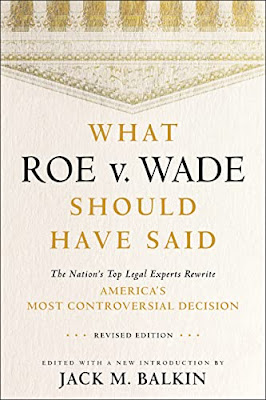
Jack M. Balkin, What Roe v. Wade Should Have Said: The Nation's Top Legal Experts Rewrite America's Most Controversial Decision - Revised Edition (NYU Press, 2023)

Andrew Koppelman, Burning Down the House: How Libertarian Philosophy Was Corrupted by Delusion and Greed (St. Martin’s Press, 2022)

Gerard N. Magliocca, Washington's Heir: The Life of Justice Bushrod Washington (Oxford University Press, 2022)
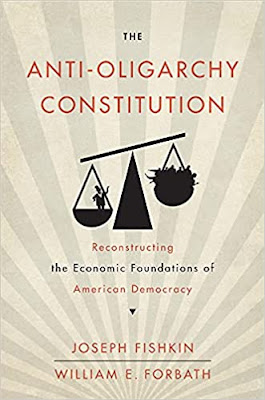
Joseph Fishkin and William E. Forbath, The Anti-Oligarchy Constitution: Reconstructing the Economic Foundations of American Democracy (Harvard University Press, 2022)
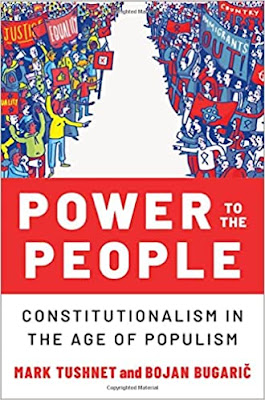
Mark Tushnet and Bojan Bugaric, Power to the People: Constitutionalism in the Age of Populism (Oxford University Press 2021).

Mark Philip Bradley and Mary L. Dudziak, eds., Making the Forever War: Marilyn B. Young on the Culture and Politics of American Militarism Culture and Politics in the Cold War and Beyond (University of Massachusetts Press, 2021).

Jack M. Balkin, What Obergefell v. Hodges Should Have Said: The Nation's Top Legal Experts Rewrite America's Same-Sex Marriage Decision (Yale University Press, 2020)

Frank Pasquale, New Laws of Robotics: Defending Human Expertise in the Age of AI (Belknap Press, 2020)

Jack M. Balkin, The Cycles of Constitutional Time (Oxford University Press, 2020)

Mark Tushnet, Taking Back the Constitution: Activist Judges and the Next Age of American Law (Yale University Press 2020).

Andrew Koppelman, Gay Rights vs. Religious Liberty?: The Unnecessary Conflict (Oxford University Press, 2020)

Ezekiel J Emanuel and Abbe R. Gluck, The Trillion Dollar Revolution: How the Affordable Care Act Transformed Politics, Law, and Health Care in America (PublicAffairs, 2020)

Linda C. McClain, Who's the Bigot?: Learning from Conflicts over Marriage and Civil Rights Law (Oxford University Press, 2020)
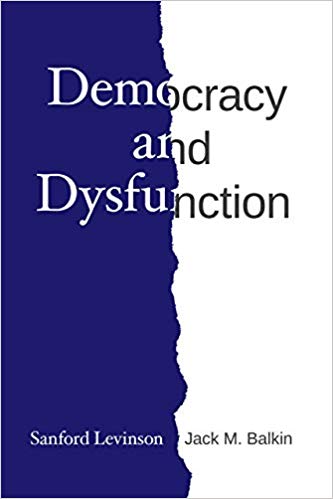
Sanford Levinson and Jack M. Balkin, Democracy and Dysfunction (University of Chicago Press, 2019)

Sanford Levinson, Written in Stone: Public Monuments in Changing Societies (Duke University Press 2018)

Mark A. Graber, Sanford Levinson, and Mark Tushnet, eds., Constitutional Democracy in Crisis? (Oxford University Press 2018)

Gerard Magliocca, The Heart of the Constitution: How the Bill of Rights became the Bill of Rights (Oxford University Press, 2018)

Cynthia Levinson and Sanford Levinson, Fault Lines in the Constitution: The Framers, Their Fights, and the Flaws that Affect Us Today (Peachtree Publishers, 2017)

Brian Z. Tamanaha, A Realistic Theory of Law (Cambridge University Press 2017)

Sanford Levinson, Nullification and Secession in Modern Constitutional Thought (University Press of Kansas 2016)

Sanford Levinson, An Argument Open to All: Reading The Federalist in the 21st Century (Yale University Press 2015)

Stephen M. Griffin, Broken Trust: Dysfunctional Government and Constitutional Reform (University Press of Kansas, 2015)

Frank Pasquale, The Black Box Society: The Secret Algorithms That Control Money and Information (Harvard University Press, 2015)

Bruce Ackerman, We the People, Volume 3: The Civil Rights Revolution (Harvard University Press, 2014)
Balkinization Symposium on We the People, Volume 3: The Civil Rights Revolution

Joseph Fishkin, Bottlenecks: A New Theory of Equal Opportunity (Oxford University Press, 2014)

Mark A. Graber, A New Introduction to American Constitutionalism (Oxford University Press, 2013)

John Mikhail, Elements of Moral Cognition: Rawls' Linguistic Analogy and the Cognitive Science of Moral and Legal Judgment (Cambridge University Press, 2013)

Gerard N. Magliocca, American Founding Son: John Bingham and the Invention of the Fourteenth Amendment (New York University Press, 2013)

Stephen M. Griffin, Long Wars and the Constitution (Harvard University Press, 2013)

Andrew Koppelman, The Tough Luck Constitution and the Assault on Health Care Reform (Oxford University Press, 2013)

James E. Fleming and Linda C. McClain, Ordered Liberty: Rights, Responsibilities, and Virtues (Harvard University Press, 2013)
Balkinization Symposium on Ordered Liberty: Rights, Responsibilities, and Virtues

Andrew Koppelman, Defending American Religious Neutrality (Harvard University Press, 2013)

Brian Z. Tamanaha, Failing Law Schools (University of Chicago Press, 2012)

Sanford Levinson, Framed: America's 51 Constitutions and the Crisis of Governance (Oxford University Press, 2012)

Linda C. McClain and Joanna L. Grossman, Gender Equality: Dimensions of Women's Equal Citizenship (Cambridge University Press, 2012)

Mary Dudziak, War Time: An Idea, Its History, Its Consequences (Oxford University Press, 2012)

Jack M. Balkin, Living Originalism (Harvard University Press, 2011)

Jason Mazzone, Copyfraud and Other Abuses of Intellectual Property Law (Stanford University Press, 2011)

Richard W. Garnett and Andrew Koppelman, First Amendment Stories, (Foundation Press 2011)

Jack M. Balkin, Constitutional Redemption: Political Faith in an Unjust World (Harvard University Press, 2011)

Gerard Magliocca, The Tragedy of William Jennings Bryan: Constitutional Law and the Politics of Backlash (Yale University Press, 2011)

Bernard Harcourt, The Illusion of Free Markets: Punishment and the Myth of Natural Order (Harvard University Press, 2010)

Bruce Ackerman, The Decline and Fall of the American Republic (Harvard University Press, 2010)
Balkinization Symposium on The Decline and Fall of the American Republic

Ian Ayres. Carrots and Sticks: Unlock the Power of Incentives to Get Things Done (Bantam Books, 2010)

Mark Tushnet, Why the Constitution Matters (Yale University Press 2010)

Ian Ayres and Barry Nalebuff: Lifecycle Investing: A New, Safe, and Audacious Way to Improve the Performance of Your Retirement Portfolio (Basic Books, 2010)
.jpg)
Jack M. Balkin, The Laws of Change: I Ching and the Philosophy of Life (2d Edition, Sybil Creek Press 2009)

Brian Z. Tamanaha, Beyond the Formalist-Realist Divide: The Role of Politics in Judging (Princeton University Press 2009)
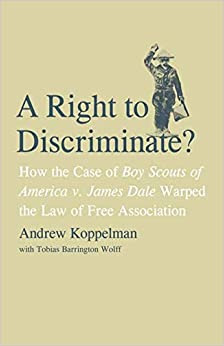
Andrew Koppelman and Tobias Barrington Wolff, A Right to Discriminate?: How the Case of Boy Scouts of America v. James Dale Warped the Law of Free Association (Yale University Press 2009)

Jack M. Balkin and Reva B. Siegel, The Constitution in 2020 (Oxford University Press 2009)

Heather K. Gerken, The Democracy Index: Why Our Election System Is Failing and How to Fix It (Princeton University Press 2009)

Mary Dudziak, Exporting American Dreams: Thurgood Marshall's African Journey (Oxford University Press 2008)

David Luban, Legal Ethics and Human Dignity (Cambridge Univ. Press 2007)

Ian Ayres, Super Crunchers: Why Thinking-By-Numbers is the New Way to be Smart (Bantam 2007)

Jack M. Balkin, James Grimmelmann, Eddan Katz, Nimrod Kozlovski, Shlomit Wagman and Tal Zarsky, eds., Cybercrime: Digital Cops in a Networked Environment (N.Y.U. Press 2007)

Jack M. Balkin and Beth Simone Noveck, The State of Play: Law, Games, and Virtual Worlds (N.Y.U. Press 2006)

Andrew Koppelman, Same Sex, Different States: When Same-Sex Marriages Cross State Lines (Yale University Press 2006)

Brian Tamanaha, Law as a Means to an End (Cambridge University Press 2006)

Sanford Levinson, Our Undemocratic Constitution (Oxford University Press 2006)

Mark Graber, Dred Scott and the Problem of Constitutional Evil (Cambridge University Press 2006)

Jack M. Balkin, ed., What Roe v. Wade Should Have Said (N.Y.U. Press 2005)

Sanford Levinson, ed., Torture: A Collection (Oxford University Press 2004)
Balkin.com homepage
Bibliography
Conlaw.net
Cultural Software
Writings
Opeds
The Information Society Project
BrownvBoard.com
Useful Links
Syllabi and Exams
