Balkinization
an unanticipated consequence of
Jack M. Balkin
Balkinization Symposiums: A Continuing List
E-mail:
Jack Balkin:
jackbalkin at yahoo.com
Bruce Ackerman
bruce.ackerman at yale.edu
Ian Ayres
ian.ayres at yale.edu
Corey Brettschneider
corey_brettschneider at brown.edu
Mary Dudziak
mary.l.dudziak at emory.edu
Joey Fishkin
joey.fishkin at gmail.com
Heather Gerken heather.gerken at yale.edu
Abbe Gluck abbe.gluck at yale.edu
Mark Graber
mgraber at law.umaryland.edu
Stephen Griffin
sgriffin at tulane.edu
Jonathan Hafetz
jonathan.hafetz at shu.edu
Jeremy Kessler
jkessler at law.columbia.edu
Andrew Koppelman
akoppelman at law.northwestern.edu
Marty Lederman
msl46 at law.georgetown.edu
Sanford Levinson
slevinson at law.utexas.edu
David Luban
david.luban at gmail.com
Gerard Magliocca
gmaglioc at iupui.edu
Jason Mazzone
mazzonej at illinois.edu
Linda McClain
lmcclain at bu.edu
John Mikhail
mikhail at law.georgetown.edu
Frank Pasquale
pasquale.frank at gmail.com
Nate Persily
npersily at gmail.com
Michael Stokes Paulsen
michaelstokespaulsen at gmail.com
Deborah Pearlstein
dpearlst at yu.edu
Rick Pildes
rick.pildes at nyu.edu
David Pozen
dpozen at law.columbia.edu
Richard Primus
raprimus at umich.edu
K. Sabeel Rahmansabeel.rahman at brooklaw.edu
Alice Ristroph
alice.ristroph at shu.edu
Neil Siegel
siegel at law.duke.edu
David Super
david.super at law.georgetown.edu
Brian Tamanaha
btamanaha at wulaw.wustl.edu
Nelson Tebbe
nelson.tebbe at brooklaw.edu
Mark Tushnet
mtushnet at law.harvard.edu
Adam Winkler
winkler at ucla.edu
Compendium of posts on Hobby Lobby and related cases
The Anti-Torture Memos: Balkinization Posts on Torture, Interrogation, Detention, War Powers, and OLC
The Anti-Torture Memos (arranged by topic)
Recent Posts
Our Classification Pathologies
![[Powered by Blogger]](https://lh3.googleusercontent.com/blogger_img_proxy/AEn0k_sCMXAUoTkAjmtpNqo1G901wNBYgJxWAb0DsLTdUQJh_8pATvtvL5pCMBSJKEetaKlQ7rhRYChNMAHqbB5kuOKf94HKVnBjq4ezZqtqn5IP=s0-d)
Just A Few Blogs
ACS Blog
Alas, a Blog
Althouse
Arts and Letters Daily
Atrios (Eschaton)
Bill of Health
Buzzflash.com
Buzz Machine
Cato at Liberty
Juan Cole (Informed Comment)
Concurring Opinions
The Constitution in 2020
Corrente
Crooked Timber
Daily Howler
Daily Kos
Dana Boyd
Brad DeLong
Digby (Hullabaloo)
Discriminations
Daniel Drezner
Kevin Drum (Mother Jones)
Electrolite
En Banc
Eunomia (Daniel Larison)
Fafblog
Michael Froomkin (Discourse.net)
GovLab (Beth Noveck)
Rick Hasen (Election Law)
History News Network
How Appealing
Ignatz (Sam Heldman)
The Importance of (Ernie Miller)
Infolaw
Instapundit
International Economic Law and Policy Blog
IntLawGrrls
Jacob Levy
Jesus' General
Jurisdynamics
The Kitchen Cabinet
Mark Kleiman
Law Blog Central
Larry Lessig
Lawyers, Guns and Money
Liberal Oasis
Brian Leiter's Law School Reports
The Leiter Reports
Marginal Revolution
Megan McArdle
Memeorandum
Metafilter
Mirror of Justice
The New Republic
Newseum
No More Mister Nice Blog
Brendan Nyhan
Opinio Juris
Orcinus
The Originalism Blog
Pandagon
Passport (Foreign Policy)
Overcoming Bias
Political Animal (Washington Monthly)
Political Theory Daily Review
Political Wire (Taegan Goddard)
The Poor Man
Virginia Postrel
Prawfsblawg
Public Reason
Jonathan Rauch
Raw Story
Redstate
ReligiousLeftLaw.com
Reporters Committee For Freedom of the Press
Reproductive Rights Blog
Rothman's Roadmap to the Right of Publicity
SCOTUS Blog
Seeing the Forest
Clay Shirky
The Shifted Librarian
The Situationist
Larry Solum (Legal Theory)
Andrew Sullivan
Talking Points Memo
Talk Left
Tapped
Tbogg
TechPresident
The Paper Chase (Jurist)
Tom Paine
Tom Tomorrow (This Modern World)
Eve Tushnet
Uggabugga
University of Chicago Law School Faculty Blog
Unqualified Offerings
The Volokh Conspiracy
War and Piece (Laura Rozen)
Wampum
Oliver Willis
Wonkette
Written Description
Matthew Yglesias
Yin
Your Choice of Feeds
1. XML
powered by

2. Atom Feed
3. RSS 2.0
Our Classification Pathologies
Marty Lederman
One of the high-level CIA detainees, Majid Khan, recently met over eight days with his attorneys from the Center for Constitutional Rights, and told them of the "time he spent in CIA custody." In connection with the Mukasey confirmation vote, his attorneys quite understandably wish to let Congress know how our government has treated their client. But as a condition of being able to speak to their client in the first place, the government required them to agree not to reveal what their client told them, because (as they explained in a letter to Senators today) "everything we learned from our client is presumptively classified."
I've said this before but it's worth saying again: This is absurd, and, assuming that Khan or his attorneys have any First or Sixth Amendment rights (a hard question, perhaps), it's likely unconstitutional, too. Even if it made sense to classify the CIA techniques in the first place, once the government "reveals" its classified information to private persons outside the government, the classification has been compromised. Classification rules restrict what government officials may say. And they restrict what can be said by those (e.g., judges, opposing counsel) who are given the information only on the condition that they not disclose it. But Khan himself did not "ask for" this "information," or agree to any conditions on disclosure before "receiving" it. Therefore, the only reason he cannot publish an account of what the CIA did to him on the front page of the New York Times (or ask his lawyers to do so) is not that he is subject to classification restrictions, but instead that the government has gagged him as part of its detention practice.
If Khan were ever freed -- either because he was wrongly detained, or because the conflict ends, etc.; or if he were put inside the criminal justice system; or if he were detained in the United States; or if he were a U.S. person; he would be able, as a practical and as a legal matter, to publicly reveal what the CIA did to him. (Imagine a criminal defendant raising a defense about being tortured by the state and the state responding that the methods of interrogation were classified . . . .)
Why should that fact change just because Khan is an alien being held in a wholly-U.S.-controlled facility a few miles off the coast of Florida? Here's what I wrote about this previously. It is still relevant -- except that now the Senators have the ability to call a halt to this absurd classification nonsense:
[E]ven if the classification [of the techniques] were itself valid, can it really be the case that the persons against whom the CIA employed its methods may be prevented from disclosing such historical facts to the public?
There is not, to my knowledge, any statute purporting to restrict such publication. Indeed, at least to the extent that the writer's audience includes the U.S. public, I would assume that the victim of U.S. government actions has a First Amendment right to publish the story, even if he is an alien abroad (see Lamont). (Perhaps there's a Sixth Amendment right to counsel implicated, too, but I'm less interested in that just now.)
So, for example, if and when Khan is released from U.S. custody, he will be free -- both legally and as a practical matter -- to publicly describe his treatment at the hands of the CIA, even though a CIA employee, or Senator overseeing the agency, might not be likewise free to do so because of the classification. Indeed, several CIA detainees have publicly told the stories of their detention and interrogation, including the book-length treatment by Moazzam Begg and the declaration, in the Khan case itself, of Khaled al-Masri, who was held with Khan in the "Salt Pit." We could not detain Khan because he threatened to reveal what the CIA did to him -- that would be an impermissible prior restraint. (This information does not, in other words,fall within one of the small handful of categories of information -- such as the direction of future troop movements (see Near v. Minnesota) -- whose publication the government may unconditionally prohibit.)
Therefore, even if Khan is legally detained for other, valid reasons, it seems to me that we cannot use the fact -- the fortuity -- of his detention as an excuse for preventing his public speech that would otherwise be constitutionally privileged.
Posted
5:30 PM
by Marty Lederman [link]
The problems being faced here remind me greatly of the problems lawyers faced in apartheid South Africa.
Best,
Ben

A while back, the gummint walked in ex post facto, said that public key encryptation (PKE) was "classified", and demanded that the PKE scientists not talk about such at symposia and the like on pain of arrest for divulging "classified" material; material they had developed independently and w/o gummint assistance.
And had Howard Mohr actually come too close to a working H-bomb design, you can bet your booties that the Progressive case would have snuffed the story (as it was, they were permitted to publish essentially because the same material had already reached the public in another forum; had that not occurred, the gummint may well have won on pre-publication suppression).
When it comes to "security", that trumps all ... and the gummint gets to say what constitutes "security" (see, e.g., Reynolds).
Cheers,
In light of our experience over the past year, I have to assume this is sarcastic.
The government will likely claim statutory authority under the DNI's statutory obligation to protect "sources and methods."
Regarding the government's willingness to impose classification restrictions on those who do not have a security clearance and are not government employees, look at the current AIPAC prosecution in the Eastern District of Virginia.
--Kathleen Clark
The classification laws do not apply to either Khan of his attorneys.
Khan's attorneys are bound by the contracts into which they voluntarily entered.
As a legal matter, Khan has no rights (including First Amendment rights) under the Constitution as a foreign enemy combatant unless the Supremes reverse Quirin and create some out of whole cloth in the future.
As a practical matter, Khan cannot give press conferences because he is detained. If this terrorist is someday freed, he is can write a book on his experiences as you note others have done.
Meanwhile, the unclassified transcript of Majid's CRST hearing is readily available. The CRST not only took extensive evidence, but it allowed Majid to testify at length without redaction about his "torture."
If you want a review of the classified CIA interrogation of Khan before Khan is freed, contact the chair of the intelligence committee who has jurisdiction over this area.
As an aside, Khan is one of the many al Qaeda swept up a couple weeks after we captured and waterboarded KSM. Connect the dots.
I repeatedly wonder at the alarm expressed here at the inadequacies of our laws, and especially the constitution, when it seems apparent that the inadequacies are of "men" rather than of laws. I've seen here a series of posts indicating the absurdity of calling for the passing of laws against torture when many such laws already exist. It's not the failure of laws (for the most part - I'm not disputing that there are major flaws in our laws, including the constitution) but the failure of malevolent and weak people to observe, abide by and enforce laws in a manner that was their intent and in the best interests of the nation and its people (despite the assurances otherwise).
I wonder about the Lamont case cited. Is this a reference to LAMONT v. POSTMASTER GENERAL, 381 U.S. 301 (1965)? That case dealt with the first amendment rights of US mail addressees, not their foreign correspondents. ("We rest on the narrow ground that the addressee in order to receive his mail must request in writing that it be delivered. This amounts in our judgment to an unconstitutional abridgment of the addressee's First Amendment rights.") Is there another Lamont case? Is this typical for Marty?
I wonder if Marty knows that asking rhetorical questions isn't the same as making an argument. (See?)
According to the attorney's letter, "Under the present court order governing our access to our client and the applicable federal law concerning classified information, however, everything we learned from our client is presumptively classified."
I looked at Khan's CSRT. It is redacted.
I am referring to the page after page of Khan's unredacted whining that his detention conditions amounted to "torture."
from the transcript:
"Exhibit D-b. MAJID KHAN written statement of Torture for Combatant Status Review Tribunal taken March 2007 by PR3. [REDACTED].
For me, things got better [REDACTED], and [REDACTED] I am brought to Guantanamo Bay, Cuba. I swear to God this place in some sense worse than CIA jails. I am being mentally torture here [REDACTED].
[REDACTED]
Since I got here, I have tried to to cut my artery which goes through my elbow, on January 12th, 07 and again on February 22nd, 07..."
What happened from 2003-January 12, 2007? We don't know, as it was all redacted. Apparently Only 4 pages from his 12 page statement made it into the record unredacted (pages 22-26 in the transcript, so I am assuming a 1-1 ratio), and apparently only things which happened since the beginning of 2007, including several attempts at suicide.
Heck, if they wanted to blank out places and names for the missing 3+ years, they could have (as they did in the rest of the document), and left in the detainees allegations for that period (which are only alluded to as CIA prisons).
Books by Balkinization Bloggers

Mark Tushnet and Bojan Bugaric, Constitutionalism and Its Discontents (University of Chicago Press, 2026)

Gerard N. Magliocca, The Actual Art of Governing: Justice Robert H. Jackson's Concurring Opinion in the Steel Seizure Case (Oxford University Press, 2025)

Linda C. McClain and Aziza Ahmed, The Routledge Companion to Gender and COVID-19 (Routledge, 2024)

David Pozen, The Constitution of the War on Drugs (Oxford University Press, 2024)

Jack M. Balkin, Memory and Authority: The Uses of History in Constitutional Interpretation (Yale University Press, 2024)
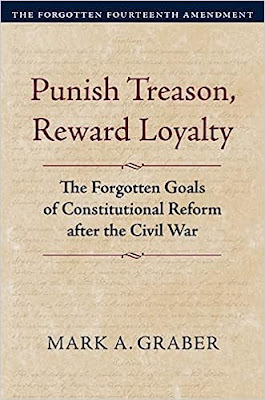
Mark A. Graber, Punish Treason, Reward Loyalty: The Forgotten Goals of Constitutional Reform after the Civil War (University of Kansas Press, 2023)
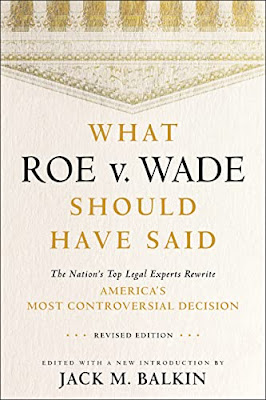
Jack M. Balkin, What Roe v. Wade Should Have Said: The Nation's Top Legal Experts Rewrite America's Most Controversial Decision - Revised Edition (NYU Press, 2023)

Andrew Koppelman, Burning Down the House: How Libertarian Philosophy Was Corrupted by Delusion and Greed (St. Martin’s Press, 2022)

Gerard N. Magliocca, Washington's Heir: The Life of Justice Bushrod Washington (Oxford University Press, 2022)
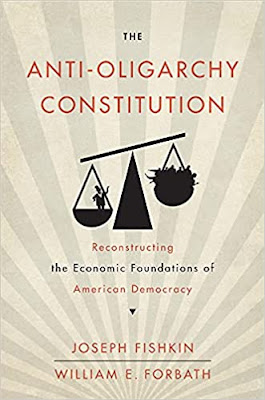
Joseph Fishkin and William E. Forbath, The Anti-Oligarchy Constitution: Reconstructing the Economic Foundations of American Democracy (Harvard University Press, 2022)
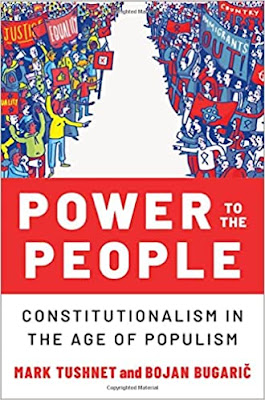
Mark Tushnet and Bojan Bugaric, Power to the People: Constitutionalism in the Age of Populism (Oxford University Press 2021).

Mark Philip Bradley and Mary L. Dudziak, eds., Making the Forever War: Marilyn B. Young on the Culture and Politics of American Militarism Culture and Politics in the Cold War and Beyond (University of Massachusetts Press, 2021).

Jack M. Balkin, What Obergefell v. Hodges Should Have Said: The Nation's Top Legal Experts Rewrite America's Same-Sex Marriage Decision (Yale University Press, 2020)

Frank Pasquale, New Laws of Robotics: Defending Human Expertise in the Age of AI (Belknap Press, 2020)

Jack M. Balkin, The Cycles of Constitutional Time (Oxford University Press, 2020)

Mark Tushnet, Taking Back the Constitution: Activist Judges and the Next Age of American Law (Yale University Press 2020).

Andrew Koppelman, Gay Rights vs. Religious Liberty?: The Unnecessary Conflict (Oxford University Press, 2020)

Ezekiel J Emanuel and Abbe R. Gluck, The Trillion Dollar Revolution: How the Affordable Care Act Transformed Politics, Law, and Health Care in America (PublicAffairs, 2020)

Linda C. McClain, Who's the Bigot?: Learning from Conflicts over Marriage and Civil Rights Law (Oxford University Press, 2020)
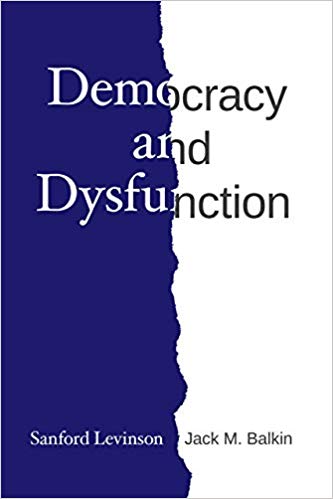
Sanford Levinson and Jack M. Balkin, Democracy and Dysfunction (University of Chicago Press, 2019)

Sanford Levinson, Written in Stone: Public Monuments in Changing Societies (Duke University Press 2018)

Mark A. Graber, Sanford Levinson, and Mark Tushnet, eds., Constitutional Democracy in Crisis? (Oxford University Press 2018)

Gerard Magliocca, The Heart of the Constitution: How the Bill of Rights became the Bill of Rights (Oxford University Press, 2018)

Cynthia Levinson and Sanford Levinson, Fault Lines in the Constitution: The Framers, Their Fights, and the Flaws that Affect Us Today (Peachtree Publishers, 2017)

Brian Z. Tamanaha, A Realistic Theory of Law (Cambridge University Press 2017)

Sanford Levinson, Nullification and Secession in Modern Constitutional Thought (University Press of Kansas 2016)

Sanford Levinson, An Argument Open to All: Reading The Federalist in the 21st Century (Yale University Press 2015)

Stephen M. Griffin, Broken Trust: Dysfunctional Government and Constitutional Reform (University Press of Kansas, 2015)

Frank Pasquale, The Black Box Society: The Secret Algorithms That Control Money and Information (Harvard University Press, 2015)

Bruce Ackerman, We the People, Volume 3: The Civil Rights Revolution (Harvard University Press, 2014)
Balkinization Symposium on We the People, Volume 3: The Civil Rights Revolution

Joseph Fishkin, Bottlenecks: A New Theory of Equal Opportunity (Oxford University Press, 2014)

Mark A. Graber, A New Introduction to American Constitutionalism (Oxford University Press, 2013)

John Mikhail, Elements of Moral Cognition: Rawls' Linguistic Analogy and the Cognitive Science of Moral and Legal Judgment (Cambridge University Press, 2013)

Gerard N. Magliocca, American Founding Son: John Bingham and the Invention of the Fourteenth Amendment (New York University Press, 2013)

Stephen M. Griffin, Long Wars and the Constitution (Harvard University Press, 2013)

Andrew Koppelman, The Tough Luck Constitution and the Assault on Health Care Reform (Oxford University Press, 2013)

James E. Fleming and Linda C. McClain, Ordered Liberty: Rights, Responsibilities, and Virtues (Harvard University Press, 2013)
Balkinization Symposium on Ordered Liberty: Rights, Responsibilities, and Virtues

Andrew Koppelman, Defending American Religious Neutrality (Harvard University Press, 2013)

Brian Z. Tamanaha, Failing Law Schools (University of Chicago Press, 2012)

Sanford Levinson, Framed: America's 51 Constitutions and the Crisis of Governance (Oxford University Press, 2012)

Linda C. McClain and Joanna L. Grossman, Gender Equality: Dimensions of Women's Equal Citizenship (Cambridge University Press, 2012)

Mary Dudziak, War Time: An Idea, Its History, Its Consequences (Oxford University Press, 2012)

Jack M. Balkin, Living Originalism (Harvard University Press, 2011)

Jason Mazzone, Copyfraud and Other Abuses of Intellectual Property Law (Stanford University Press, 2011)

Richard W. Garnett and Andrew Koppelman, First Amendment Stories, (Foundation Press 2011)

Jack M. Balkin, Constitutional Redemption: Political Faith in an Unjust World (Harvard University Press, 2011)

Gerard Magliocca, The Tragedy of William Jennings Bryan: Constitutional Law and the Politics of Backlash (Yale University Press, 2011)

Bernard Harcourt, The Illusion of Free Markets: Punishment and the Myth of Natural Order (Harvard University Press, 2010)

Bruce Ackerman, The Decline and Fall of the American Republic (Harvard University Press, 2010)
Balkinization Symposium on The Decline and Fall of the American Republic

Ian Ayres. Carrots and Sticks: Unlock the Power of Incentives to Get Things Done (Bantam Books, 2010)

Mark Tushnet, Why the Constitution Matters (Yale University Press 2010)

Ian Ayres and Barry Nalebuff: Lifecycle Investing: A New, Safe, and Audacious Way to Improve the Performance of Your Retirement Portfolio (Basic Books, 2010)
.jpg)
Jack M. Balkin, The Laws of Change: I Ching and the Philosophy of Life (2d Edition, Sybil Creek Press 2009)

Brian Z. Tamanaha, Beyond the Formalist-Realist Divide: The Role of Politics in Judging (Princeton University Press 2009)
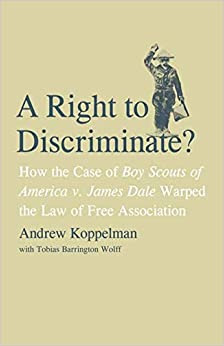
Andrew Koppelman and Tobias Barrington Wolff, A Right to Discriminate?: How the Case of Boy Scouts of America v. James Dale Warped the Law of Free Association (Yale University Press 2009)

Jack M. Balkin and Reva B. Siegel, The Constitution in 2020 (Oxford University Press 2009)

Heather K. Gerken, The Democracy Index: Why Our Election System Is Failing and How to Fix It (Princeton University Press 2009)

Mary Dudziak, Exporting American Dreams: Thurgood Marshall's African Journey (Oxford University Press 2008)

David Luban, Legal Ethics and Human Dignity (Cambridge Univ. Press 2007)

Ian Ayres, Super Crunchers: Why Thinking-By-Numbers is the New Way to be Smart (Bantam 2007)

Jack M. Balkin, James Grimmelmann, Eddan Katz, Nimrod Kozlovski, Shlomit Wagman and Tal Zarsky, eds., Cybercrime: Digital Cops in a Networked Environment (N.Y.U. Press 2007)
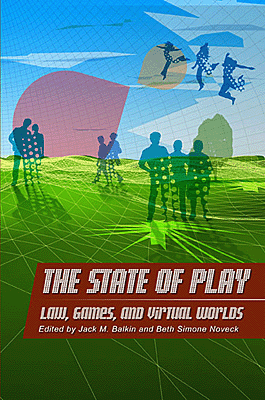
Jack M. Balkin and Beth Simone Noveck, The State of Play: Law, Games, and Virtual Worlds (N.Y.U. Press 2006)

Andrew Koppelman, Same Sex, Different States: When Same-Sex Marriages Cross State Lines (Yale University Press 2006)

Brian Tamanaha, Law as a Means to an End (Cambridge University Press 2006)

Sanford Levinson, Our Undemocratic Constitution (Oxford University Press 2006)

Mark Graber, Dred Scott and the Problem of Constitutional Evil (Cambridge University Press 2006)

Jack M. Balkin, ed., What Roe v. Wade Should Have Said (N.Y.U. Press 2005)

Sanford Levinson, ed., Torture: A Collection (Oxford University Press 2004)
Balkin.com homepage
Bibliography
Conlaw.net
Cultural Software
Writings
Opeds
The Information Society Project
BrownvBoard.com
Useful Links
Syllabi and Exams
