Balkinization
an unanticipated consequence of
Jack M. Balkin
Balkinization Symposiums: A Continuing List
E-mail:
Jack Balkin:
jackbalkin at yahoo.com
Bruce Ackerman
bruce.ackerman at yale.edu
Ian Ayres
ian.ayres at yale.edu
Corey Brettschneider
corey_brettschneider at brown.edu
Mary Dudziak
mary.l.dudziak at emory.edu
Joey Fishkin
joey.fishkin at gmail.com
Heather Gerken heather.gerken at yale.edu
Abbe Gluck abbe.gluck at yale.edu
Mark Graber
mgraber at law.umaryland.edu
Stephen Griffin
sgriffin at tulane.edu
Jonathan Hafetz
jonathan.hafetz at shu.edu
Jeremy Kessler
jkessler at law.columbia.edu
Andrew Koppelman
akoppelman at law.northwestern.edu
Marty Lederman
msl46 at law.georgetown.edu
Sanford Levinson
slevinson at law.utexas.edu
David Luban
david.luban at gmail.com
Gerard Magliocca
gmaglioc at iupui.edu
Jason Mazzone
mazzonej at illinois.edu
Linda McClain
lmcclain at bu.edu
John Mikhail
mikhail at law.georgetown.edu
Frank Pasquale
pasquale.frank at gmail.com
Nate Persily
npersily at gmail.com
Michael Stokes Paulsen
michaelstokespaulsen at gmail.com
Deborah Pearlstein
dpearlst at yu.edu
Rick Pildes
rick.pildes at nyu.edu
David Pozen
dpozen at law.columbia.edu
Richard Primus
raprimus at umich.edu
K. Sabeel Rahmansabeel.rahman at brooklaw.edu
Alice Ristroph
alice.ristroph at shu.edu
Neil Siegel
siegel at law.duke.edu
David Super
david.super at law.georgetown.edu
Brian Tamanaha
btamanaha at wulaw.wustl.edu
Nelson Tebbe
nelson.tebbe at brooklaw.edu
Mark Tushnet
mtushnet at law.harvard.edu
Adam Winkler
winkler at ucla.edu
Compendium of posts on Hobby Lobby and related cases
The Anti-Torture Memos: Balkinization Posts on Torture, Interrogation, Detention, War Powers, and OLC
The Anti-Torture Memos (arranged by topic)
Recent Posts
Matt Explains Himself-- Originalism and Federal Power
![[Powered by Blogger]](https://lh3.googleusercontent.com/blogger_img_proxy/AEn0k_tSTs58hvzzSpvKwqcm0RPWsReUEQe7LAyN1_iCJ9AQBVO-S8hPYAKFgAZgFcB3t3G94V7uliLqqY1KOYkEvX9Kp8Emb54AA1r8rz_clj48=s0-d)
Just A Few Blogs
ACS Blog
Alas, a Blog
Althouse
Arts and Letters Daily
Atrios (Eschaton)
Bill of Health
Buzzflash.com
Buzz Machine
Cato at Liberty
Juan Cole (Informed Comment)
Concurring Opinions
The Constitution in 2020
Corrente
Crooked Timber
Daily Howler
Daily Kos
Dana Boyd
Brad DeLong
Digby (Hullabaloo)
Discriminations
Daniel Drezner
Kevin Drum (Mother Jones)
Electrolite
En Banc
Eunomia (Daniel Larison)
Fafblog
Michael Froomkin (Discourse.net)
GovLab (Beth Noveck)
Rick Hasen (Election Law)
History News Network
How Appealing
Ignatz (Sam Heldman)
The Importance of (Ernie Miller)
Infolaw
Instapundit
International Economic Law and Policy Blog
IntLawGrrls
Jacob Levy
Jesus' General
Jurisdynamics
The Kitchen Cabinet
Mark Kleiman
Law Blog Central
Larry Lessig
Lawyers, Guns and Money
Liberal Oasis
Brian Leiter's Law School Reports
The Leiter Reports
Marginal Revolution
Megan McArdle
Memeorandum
Metafilter
Mirror of Justice
The New Republic
Newseum
No More Mister Nice Blog
Brendan Nyhan
Opinio Juris
Orcinus
The Originalism Blog
Pandagon
Passport (Foreign Policy)
Overcoming Bias
Political Animal (Washington Monthly)
Political Theory Daily Review
Political Wire (Taegan Goddard)
The Poor Man
Virginia Postrel
Prawfsblawg
Public Reason
Jonathan Rauch
Raw Story
Redstate
ReligiousLeftLaw.com
Reporters Committee For Freedom of the Press
Reproductive Rights Blog
Rothman's Roadmap to the Right of Publicity
SCOTUS Blog
Seeing the Forest
Clay Shirky
The Shifted Librarian
The Situationist
Larry Solum (Legal Theory)
Andrew Sullivan
Talking Points Memo
Talk Left
Tapped
Tbogg
TechPresident
The Paper Chase (Jurist)
Tom Paine
Tom Tomorrow (This Modern World)
Eve Tushnet
Uggabugga
University of Chicago Law School Faculty Blog
Unqualified Offerings
The Volokh Conspiracy
War and Piece (Laura Rozen)
Wampum
Oliver Willis
Wonkette
Written Description
Matthew Yglesias
Yin
Your Choice of Feeds
1. XML
powered by

2. Atom Feed
3. RSS 2.0
Matt Explains Himself-- Originalism and Federal Power
JB
The series of posts between myself and Matthew Franck and Ed Whelan over at NRO has turned into a really valuable discussion of different ways to think about originalism and their respective advantages and disadvantages. Both Matt and Ed have offered thoughtful responses to my last set of arguments. In this post, I'll take up Matt's latest discussion.
Matt's version of originalism, as he acknowledges, is strongly focused on limiting judicial review. As he says, although "[o]riginalism and judicial restraint are not the same thing[,] [j]udicial restraint is a conclusion from originalism, or a corollary of it." Matt argues that if we adopt "the original understanding of the purpose, function, and limits of the judicial power under Article III" we will be led "inexorably . . . to a restrained account of what judges may and may not do."
Note that this is not, strictly speaking, an argument from original meaning. It is an argument from original understanding. And it suggests that Matt's originalism is different in important respects from, say, Ed's, which I shall discuss in a later post.
As to the historical record, I think the evidence for Matt's claim is mixed. There is certainly plenty of evidence that many people in the founding generation did not expect that there would be much judicial review. It's also the case that many people assumed that important constitutional questions would be decided in the political realm. But not everyone believed this, especially members of the early Federalist Party, who thought that judicial power was necessary to check populist excesses. Rather, there was disagreement on the scope of judicial review, which was inevitably tangled up-- as it is today-- with political differences, and Matt has chosen to credit some authorities more than others. (I should also point out that whatever the record in 1787, by 1866, the Fourteenth Amendment was drafted under the assumption of fairly strong judicial review. To complete his account of the judicial role, Matt needs to explain how we should synthesize these two different periods of Constitution making in American history.).
But there is much more to Matt's argument. Matt seems to argue that we should make a distinction between constitutional questions that involve individual rights claims and constitutional questions that involve structural claims. Thus, "the limits on the uses of the commerce power are not to be enforced by judges, because such matters are political questions." "This is because in itself, the commerce clause implicates nothing about judicially vindicable rights, and so is, first and last, a matter for legislative judgment." (By "judicially vindicable rights," I assume Matt means individual rights, for otherwise states could claim they had rights under the Ninth and Tenth Amendments. Similarly, in separation of powers claims, the Executive Branch, Congress and the Judiciary could all claim that they had rights created by the Constitution. But I assume that Matt wants to argue that these rights claims aren't what he had in mind.)
Put another way, Matt wants to expand the jurisdictional doctrine of "political questions" to encompass structural issues that do not directly concern individual rights. This makes his version of originalism very different from conservative originalisms that seek to use judicial review to limit federal power in cases like Seminole Tribe, Lopez, Morrison and Printz. (Of course, Matt could be arguing that only the scope of the commerce power is a political question and other structural questions are not, but if so he hasn't explained why that should be).
Arguing that structural issues are, generally speaking, political questions is a bold claim, and I'm not sure the history justifies it. To be sure, in Marbury itself, Marshall distinguished between acts of executive discretion and acts which affected individual vested rights. The former were political questions, the latter were not. But this is not Matt's distinction. There are individual rights which are not vested rights in a late 18th century sense, and there are structural questions that do not concern purely executive discretion.
I would need to hear more from him on why he thinks this claim about judicial review is sufficiently grounded in the history. Matt does offer one example: He quotes Marshall in Gibbons v. Ogden as saying that "the `sole restraints' on the commerce power lie in the political processes, not in courts such as his own." But I don't think Marshall offers anything close to the view that structural issues are political questions. Marshall argued that where something fell within the commerce power Congress had plenary authority to regulate it as it saw fit: "If, as has always been understood, the sovereignty of Congress, though limited to specified objects, is plenary as to those objects, the power over commerce with foreign nations, and among the several States, is vested in Congress as absolutely as it would be in a single government, having in its constitution the same restrictions on the exercise of the power as are found in the constitution of the United States." Marshall then argued that regulation of navigation fell within the commerce power. But Marshall did not say that the question of what was within or outside the commerce power was a political question. Otherwise Marshall's discussion of why navigation was commerce and why the government could regulate commerce that moves between state borders would have been superfluous.
Moreover, as Matt knows, Marshall concludes Gibbons v. Ogden by using the power of judicial review to strike down the New York monopoly statute. This raises a puzzle for me. The Supremacy Clause and the Dormant Commerce Clause are both structural matters. Matt can't be saying that whether a statute is preempted or violates the Dormant Commerce Clause is a political question, can he? That would mean that Gibbons v. Ogden is incorrectly decided. And not only that: if judicial review plays any role in a federated constitutional system, at least judges have to be able to settle very basic disputes between states (for example-- over state restrictions on interstate movement and trade) and between states and the federal government (for example, whether states can tax federal banks in McCulloch, or have to obey federal laws in Gibbons, or have to accept federal judicial review of state supreme court judgments in Martin v. Hunter's Lessee). These are all structural questions; if they were all political questions, I think the American constitutional system would quickly have fallen apart.
I don't think one can respond that the question in Gibbons really involved an individual right, because under that theory all structural questions might be said to involve individual rights. Youngstown involved the rights of steel companies, Morrison involved the rights of women who suffered assaults, Lopez involved the rights of gun owners, and so on.
There is something ironic in Matt's view that judges can decide individual rights questions but not structural questions. As he knows, the view of much of the founding generation was that structural provisions were among the most effective guarantees of individual rights. If judges couldn't enforce them at all, this might undermine the very rights they protected. Matt's dichotomy seems far more like the post-1937 view of judicial power than the view from 1787.
That is, Matt doesn't seem to be an originalist at all. He seems to be a New Dealer who doesn't like the Rights Revolution of the 1960's. Matt isn't James Madison. He's Felix Frankfurter with an attitude. Well, fair enough. There are worse things in life than finding yourself in agreement with Justice Frankfurter.
But there are deeper ironies still. A New Dealer would be happy to insist that all the new fangled federal legislation was perfectly constitutional. But as I read Matt, he is not saying that. He is saying that much of the post-1937 legislation (and the Civil Rights Act) may well be unconstitutional, but there's nothing the courts can do to stop it.
This brings me to what may be a major divide between Matt's version of originalism and my own. As I have stressed, originalism is a theory of how to be faithful to the Constitution, and it is addressed not merely to judges, but to citizens and political officials. Indeed, I argue that we should see judicial interpretation as a special case of the citizen's perspective.
From my standpoint, citizens and politicians have constitutional obligations to decide what the Constitution means for themselves. They should not vote for unconstitutional laws and policies, even if courts would not be willing to strike them down. They shouldn't pass the buck to courts, and especially so if they already believe that courts will do nothing about the problem.
What does Matt think about this? At one point he says:Sometimes [judicial] restraint, grounded in original understanding, will result in rulings that leave intact laws and policies that no originalist should vote for if, say, he serves in Congress. That is not a mark of originalism’s failure, or of the Constitution’s. It is a mark of their success, in leaving large stretches of constitutional interpretation to the people themselves, and not to judges presuming to govern them.
This suggests that Matt agrees with me that a conscientious legislator shouldn't vote for laws that are beyond federal power. If that is so, then given his views about the original understanding, presumably Matt believes that the Civil Rights Act and, indeed, large parts of the edifice of post-New Deal regulation are unconstitutional, and that all of the politicians who supported and put those laws into effect acted unconstitutionally. Perhaps we can't blame them; they hadn't done their history. But they were wrong and we should make no bones about saying it. No matter how much Martin Luther King wanted his Civil Rights Act, he couldn't have it, not, at least, if he was faithful to the American Constitution.
Matt's view, if I understand it, is that most of our contemporary federal legal structure-- including our modern civil rights laws, environmental protection laws, consumer protection, fair labor practices laws, even aspects of Social Security-- is unconstitutional. And a conscientious originalist lawmaker or politician could not vote for many of the laws we have.
Moreover, if these laws are unconstitutional, then presumably, Matt should support the repeal of these laws. And he should support political candidates who support their repeal (but not judges!).
That is to say, if we get rid of the question of what judges can or cannot do, we are still left with the question of what politicians and ordinary citizens must do if they are to remain faithful to the Constitution.
Matt's model of orignalism keeps judges out of the equation, but it seems that it still imposes a duty on everyone in the political system to dismantle unconstitutional laws and practices and not vote for future ones. People may not pay attention to that duty, they may be knaves or fools. But Matt knows that there is something deeply wrong with much of our laws, especially the laws that a great deal of the public supports. I mean, for goodness sake, they named a holiday after Martin Luther King-- who fought for that unconstitutional Civil Rights Act!
Maybe Matt is saying that this is all water under the bridge, and there's nothing we can do about it now. It would be folly to try to get people to repeal the Civil Rights Act, even if it's unconstitutional under the original understanding. Well, maybe so, but it's hard to see why Matt thinks this state of affairs is a success for originalism rather than a failure. This is about as serious a failure for an interpretive theory as I could imagine. It is only a success if you don't care that much about fidelity to originalism but do care about limiting judges and promoting majority rule, which supports my conclusion that Matt is not really an originalist at all but a New Dealer masquerading in originalist clothing.
For me the Constitution involves present day commands that bind current generations just as much as past ones. Therefore if one thinks that great achievements like the Civil Rights Act are an important part of our political and constitutional traditions, one can't adopt a theory of interpretation that renders most of these laws unconstitutional, even if we keep judges from remedying the unconstitutionality.
Matt strongly objects to this sort of reasoning from our existing legal traditions; he regards it as the essence of results-oriented jurisprudence. I disagree. I think that any serious theory of interpretation-- and by serious I mean one that actual judges and actual political officials living in the present can use-- has to recognize key achievements of American law as a starting point for understanding how we interpret our Constitution. Matt's version of originalism is pretty much hopeless from this standpoint.
But there is more to it than mere impracticality. The Constitution's legitimacy comes from the fact that it is our law in the present, and that Americans in the present are attached to it and regard it as their supreme law. A theory of Constitutional interpretation that holds that most of their law-- including the laws they are most proud of-- is illegal and based on a lie, cannot possibly serve the functions of political legitimacy necessary to a constitutional system.
Originalism has always sought to show how interpretation is linked to basic questions of political legitimacy. The text of the Constitution binds us because We the People agreed to it, and the people who live today are the successors of those who lived in the past and have taken on their obligations and structures of government. The Constitution is legitimate because it is not just the Constitution of the adopting generation but our Constitution as well. But Matt's version of originalism tells current generations that much of their handiwork and the institutions they have created is a sham and is illegitimate, even if, as Matt happily reminds them, there is nothing that judges can do about it.
This creates a deep tension in the legitimacy of the present system that Matt's theory of originalism cannot resolve, in part because Matt's theory is the cause of that illegitimacy.
The great advantage of my model of originalism is that it can give an account of why our current structures of law-- not just Roe v. Wade, about which Matt seems particularly concerned-- but the Civil Rights Revolution, the New Deal, and the most significant achievements of the 20th century, are consistent with our constitutional traditions. It shows how we can be faithful to the original meaning of the text and its underlying principles through changing circumstances.
Matt may think these goals are relatively unimportant; he may dismiss them as result-oriented. But I disagree. I tend to think that establishing the connections between our present day laws and our constitutional traditions is what a good interpretative theory is all about.
In this post I've spoken only about Matt's views on governmental power. In my next post I want to say a few words about why his originalist theory is unsatisfactory when it comes to individual rights protection.
Posted
1:50 PM
by JB [link]

I think what we have here is a fundamental failure to understand the function of democratic legitimacy.
The majority, the winners in a democracy, are always going to regard their victories as legitimate, and not inquire too deeply into how they were achieved, or the reasoning they rest on. Winning is it's own justification.
Democratic legitimacy is important for it's effect on the losers. For the minority. Because the minority is seldom so small that they can not, if they decide the game is rigged, render a country ungovernable.
Constitutional reasoning, to confer democratic legitimacy, doesn't have to persuade the majority, who if they won will be persuaded by any old claptrap. It has to persuade the minority. It has to convince them that, while they lost, they lost by the rules.
And the minority has no reason to pretend that the Emperor is fully clothed.
This is the danger of theories of Constitutional 'interpretation' which rationalize that the Constitution really means whatever is acceptable to the majority at any given time. It takes the pressure off the majority to make the Constitution actually conform to the majority's preferences, resulting in a growing gulf between that Constitution and practice. And while the majority has every reason to ignore that gulf, the minority doesn't.
I know Matt Franck, and he is a learned man, but one who is casually dismissive (as all Staussians seem to be) of anyone who does not share his axiomatic postions (which is very odd considering how eccentric, at the least numerically among fellow scholars, these views are). In Franck's book On the Imperial Judiciary he argues that the branches are co-equal constittionally, that they each should have the power to check each other. He does not dwell on the ability of amendments and nominations to shore up the power of the two political branches in this area, but rather actually thinks that certain parts of the Constitution fall under the regulation of different branches. So for example the 1st Amendment, despite its explicit wording that "Congress shall make no law..." is to be reviewed not by judiciary but by...the Congress!! Congress should be its own judge as to whether it has been faithful to the speech, press and religion clauses. This is extraordinary indeed, divesting the text of the countermajoritarianism effect that its wording patently expresses. In talking to him he seemed to think that the judiciary should exercise review over the Amendments that deal with the natural spehere of courts, "criminal justice" amendments, i.e, 4-8, leaving the others be. Perhaps this has to do with his idea that no individual judicially enforceable rights exist under say the First or Third (can you imagne? if a soldier is in my very home one would think that is a violation of my individual right and that a court is the place to issue a writ to throw him out, a more individual right I cannot imagine). Franck did his doctoral work on Marshall and so will draw on him extensively, and so I once asked him, if the judiciary must stick to sections of the Constitution that fall under its natural purview, then why in the world are sections from Sec. 1 Art. 9 explicitly mentioned by Marshall in Marbury as areas prone to judicial review? Why wouldn't Congress decide whether it had overstepped these Article 1 bounds just as he thinks they should with the 1st Amendment, since both sections clearly are "about" the duties of Congress. I asked him about this and he said he was still "working it out." Indeed! But he still rudely shouts down those with whom he disagrees who are tring honestly to work out areas that seem to pose challenges to their overall constitutional theory (such as JB on abortion). Notice he asserts that any original theory that allows Roe is simply plainly incorrect, without arguing the merits of Balkins points, almost simply because it strikes him as unthinkable and odd. Of course his eccentric views, which a majority of legal and political scholars would find more odd and unthinkable, need not be explained in length. In vain you wait to find him apply his "theory" (as far as he has allowed it to develop) to a range of cases which will immediately pop into the head of anyone listening to him as he explains his theory. I suspect it is because he has either not made or cannot made it that far without finding himself in agreement with what he likes to call "a parade of horribles" (though ones that actually happened). Of course that does not stop him from slamming others theory for how they suppoedly fall in line with past cases he considers "horribles" (his reference to Dred Scott and the New Deal cases). So, a waste of time? Yes if by that you are hoping to get Franck to go all the way in an honest explanation of what his theory entails in detail and how it would work out in various hypothetical cases (this is of course how we usually evaluate our theories and need not be a sign of "results oriented" jurisprudence). But no in the sense that these guys on Benchmemo's have needed a public spanking for all too long to expose them for the partisan mental gymnasts they are...
Books by Balkinization Bloggers

Mark Tushnet and Bojan Bugaric, Constitutionalism and Its Discontents (University of Chicago Press, 2026)

Gerard N. Magliocca, The Actual Art of Governing: Justice Robert H. Jackson's Concurring Opinion in the Steel Seizure Case (Oxford University Press, 2025)

Linda C. McClain and Aziza Ahmed, The Routledge Companion to Gender and COVID-19 (Routledge, 2024)

David Pozen, The Constitution of the War on Drugs (Oxford University Press, 2024)

Jack M. Balkin, Memory and Authority: The Uses of History in Constitutional Interpretation (Yale University Press, 2024)
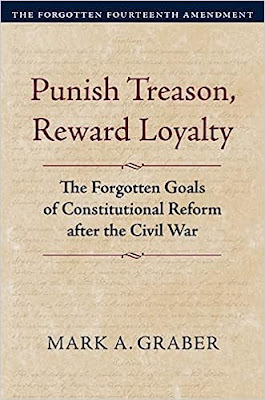
Mark A. Graber, Punish Treason, Reward Loyalty: The Forgotten Goals of Constitutional Reform after the Civil War (University of Kansas Press, 2023)
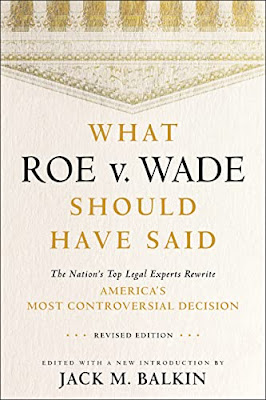
Jack M. Balkin, What Roe v. Wade Should Have Said: The Nation's Top Legal Experts Rewrite America's Most Controversial Decision - Revised Edition (NYU Press, 2023)

Andrew Koppelman, Burning Down the House: How Libertarian Philosophy Was Corrupted by Delusion and Greed (St. Martin’s Press, 2022)

Gerard N. Magliocca, Washington's Heir: The Life of Justice Bushrod Washington (Oxford University Press, 2022)
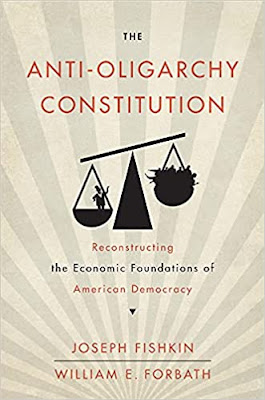
Joseph Fishkin and William E. Forbath, The Anti-Oligarchy Constitution: Reconstructing the Economic Foundations of American Democracy (Harvard University Press, 2022)
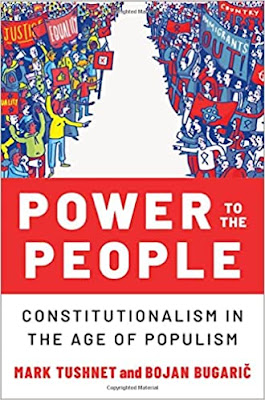
Mark Tushnet and Bojan Bugaric, Power to the People: Constitutionalism in the Age of Populism (Oxford University Press 2021).

Mark Philip Bradley and Mary L. Dudziak, eds., Making the Forever War: Marilyn B. Young on the Culture and Politics of American Militarism Culture and Politics in the Cold War and Beyond (University of Massachusetts Press, 2021).

Jack M. Balkin, What Obergefell v. Hodges Should Have Said: The Nation's Top Legal Experts Rewrite America's Same-Sex Marriage Decision (Yale University Press, 2020)

Frank Pasquale, New Laws of Robotics: Defending Human Expertise in the Age of AI (Belknap Press, 2020)

Jack M. Balkin, The Cycles of Constitutional Time (Oxford University Press, 2020)

Mark Tushnet, Taking Back the Constitution: Activist Judges and the Next Age of American Law (Yale University Press 2020).

Andrew Koppelman, Gay Rights vs. Religious Liberty?: The Unnecessary Conflict (Oxford University Press, 2020)

Ezekiel J Emanuel and Abbe R. Gluck, The Trillion Dollar Revolution: How the Affordable Care Act Transformed Politics, Law, and Health Care in America (PublicAffairs, 2020)

Linda C. McClain, Who's the Bigot?: Learning from Conflicts over Marriage and Civil Rights Law (Oxford University Press, 2020)
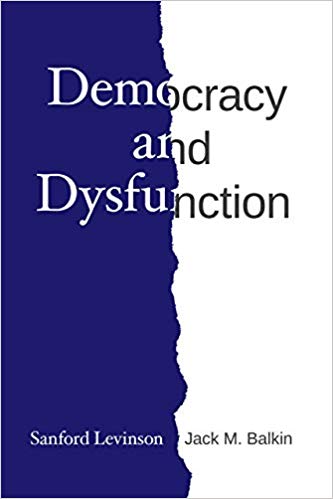
Sanford Levinson and Jack M. Balkin, Democracy and Dysfunction (University of Chicago Press, 2019)

Sanford Levinson, Written in Stone: Public Monuments in Changing Societies (Duke University Press 2018)

Mark A. Graber, Sanford Levinson, and Mark Tushnet, eds., Constitutional Democracy in Crisis? (Oxford University Press 2018)

Gerard Magliocca, The Heart of the Constitution: How the Bill of Rights became the Bill of Rights (Oxford University Press, 2018)

Cynthia Levinson and Sanford Levinson, Fault Lines in the Constitution: The Framers, Their Fights, and the Flaws that Affect Us Today (Peachtree Publishers, 2017)

Brian Z. Tamanaha, A Realistic Theory of Law (Cambridge University Press 2017)

Sanford Levinson, Nullification and Secession in Modern Constitutional Thought (University Press of Kansas 2016)

Sanford Levinson, An Argument Open to All: Reading The Federalist in the 21st Century (Yale University Press 2015)

Stephen M. Griffin, Broken Trust: Dysfunctional Government and Constitutional Reform (University Press of Kansas, 2015)

Frank Pasquale, The Black Box Society: The Secret Algorithms That Control Money and Information (Harvard University Press, 2015)

Bruce Ackerman, We the People, Volume 3: The Civil Rights Revolution (Harvard University Press, 2014)
Balkinization Symposium on We the People, Volume 3: The Civil Rights Revolution

Joseph Fishkin, Bottlenecks: A New Theory of Equal Opportunity (Oxford University Press, 2014)

Mark A. Graber, A New Introduction to American Constitutionalism (Oxford University Press, 2013)

John Mikhail, Elements of Moral Cognition: Rawls' Linguistic Analogy and the Cognitive Science of Moral and Legal Judgment (Cambridge University Press, 2013)

Gerard N. Magliocca, American Founding Son: John Bingham and the Invention of the Fourteenth Amendment (New York University Press, 2013)

Stephen M. Griffin, Long Wars and the Constitution (Harvard University Press, 2013)

Andrew Koppelman, The Tough Luck Constitution and the Assault on Health Care Reform (Oxford University Press, 2013)

James E. Fleming and Linda C. McClain, Ordered Liberty: Rights, Responsibilities, and Virtues (Harvard University Press, 2013)
Balkinization Symposium on Ordered Liberty: Rights, Responsibilities, and Virtues

Andrew Koppelman, Defending American Religious Neutrality (Harvard University Press, 2013)

Brian Z. Tamanaha, Failing Law Schools (University of Chicago Press, 2012)

Sanford Levinson, Framed: America's 51 Constitutions and the Crisis of Governance (Oxford University Press, 2012)

Linda C. McClain and Joanna L. Grossman, Gender Equality: Dimensions of Women's Equal Citizenship (Cambridge University Press, 2012)

Mary Dudziak, War Time: An Idea, Its History, Its Consequences (Oxford University Press, 2012)

Jack M. Balkin, Living Originalism (Harvard University Press, 2011)

Jason Mazzone, Copyfraud and Other Abuses of Intellectual Property Law (Stanford University Press, 2011)

Richard W. Garnett and Andrew Koppelman, First Amendment Stories, (Foundation Press 2011)

Jack M. Balkin, Constitutional Redemption: Political Faith in an Unjust World (Harvard University Press, 2011)

Gerard Magliocca, The Tragedy of William Jennings Bryan: Constitutional Law and the Politics of Backlash (Yale University Press, 2011)

Bernard Harcourt, The Illusion of Free Markets: Punishment and the Myth of Natural Order (Harvard University Press, 2010)

Bruce Ackerman, The Decline and Fall of the American Republic (Harvard University Press, 2010)
Balkinization Symposium on The Decline and Fall of the American Republic

Ian Ayres. Carrots and Sticks: Unlock the Power of Incentives to Get Things Done (Bantam Books, 2010)

Mark Tushnet, Why the Constitution Matters (Yale University Press 2010)

Ian Ayres and Barry Nalebuff: Lifecycle Investing: A New, Safe, and Audacious Way to Improve the Performance of Your Retirement Portfolio (Basic Books, 2010)
.jpg)
Jack M. Balkin, The Laws of Change: I Ching and the Philosophy of Life (2d Edition, Sybil Creek Press 2009)

Brian Z. Tamanaha, Beyond the Formalist-Realist Divide: The Role of Politics in Judging (Princeton University Press 2009)
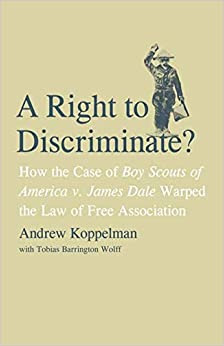
Andrew Koppelman and Tobias Barrington Wolff, A Right to Discriminate?: How the Case of Boy Scouts of America v. James Dale Warped the Law of Free Association (Yale University Press 2009)

Jack M. Balkin and Reva B. Siegel, The Constitution in 2020 (Oxford University Press 2009)

Heather K. Gerken, The Democracy Index: Why Our Election System Is Failing and How to Fix It (Princeton University Press 2009)

Mary Dudziak, Exporting American Dreams: Thurgood Marshall's African Journey (Oxford University Press 2008)

David Luban, Legal Ethics and Human Dignity (Cambridge Univ. Press 2007)

Ian Ayres, Super Crunchers: Why Thinking-By-Numbers is the New Way to be Smart (Bantam 2007)

Jack M. Balkin, James Grimmelmann, Eddan Katz, Nimrod Kozlovski, Shlomit Wagman and Tal Zarsky, eds., Cybercrime: Digital Cops in a Networked Environment (N.Y.U. Press 2007)
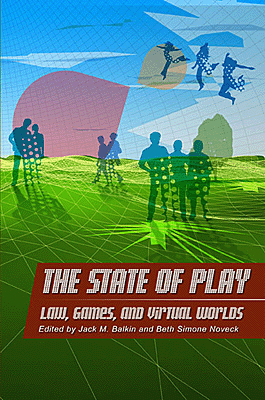
Jack M. Balkin and Beth Simone Noveck, The State of Play: Law, Games, and Virtual Worlds (N.Y.U. Press 2006)

Andrew Koppelman, Same Sex, Different States: When Same-Sex Marriages Cross State Lines (Yale University Press 2006)

Brian Tamanaha, Law as a Means to an End (Cambridge University Press 2006)

Sanford Levinson, Our Undemocratic Constitution (Oxford University Press 2006)

Mark Graber, Dred Scott and the Problem of Constitutional Evil (Cambridge University Press 2006)

Jack M. Balkin, ed., What Roe v. Wade Should Have Said (N.Y.U. Press 2005)

Sanford Levinson, ed., Torture: A Collection (Oxford University Press 2004)
Balkin.com homepage
Bibliography
Conlaw.net
Cultural Software
Writings
Opeds
The Information Society Project
BrownvBoard.com
Useful Links
Syllabi and Exams
