Balkinization
an unanticipated consequence of
Jack M. Balkin
Balkinization Symposiums: A Continuing List
E-mail:
Jack Balkin:
jackbalkin at yahoo.com
Bruce Ackerman
bruce.ackerman at yale.edu
Ian Ayres
ian.ayres at yale.edu
Corey Brettschneider
corey_brettschneider at brown.edu
Mary Dudziak
mary.l.dudziak at emory.edu
Joey Fishkin
joey.fishkin at gmail.com
Heather Gerken heather.gerken at yale.edu
Abbe Gluck abbe.gluck at yale.edu
Mark Graber
mgraber at law.umaryland.edu
Stephen Griffin
sgriffin at tulane.edu
Jonathan Hafetz
jonathan.hafetz at shu.edu
Jeremy Kessler
jkessler at law.columbia.edu
Andrew Koppelman
akoppelman at law.northwestern.edu
Marty Lederman
msl46 at law.georgetown.edu
Sanford Levinson
slevinson at law.utexas.edu
David Luban
david.luban at gmail.com
Gerard Magliocca
gmaglioc at iupui.edu
Jason Mazzone
mazzonej at illinois.edu
Linda McClain
lmcclain at bu.edu
John Mikhail
mikhail at law.georgetown.edu
Frank Pasquale
pasquale.frank at gmail.com
Nate Persily
npersily at gmail.com
Michael Stokes Paulsen
michaelstokespaulsen at gmail.com
Deborah Pearlstein
dpearlst at yu.edu
Rick Pildes
rick.pildes at nyu.edu
David Pozen
dpozen at law.columbia.edu
Richard Primus
raprimus at umich.edu
K. Sabeel Rahmansabeel.rahman at brooklaw.edu
Alice Ristroph
alice.ristroph at shu.edu
Neil Siegel
siegel at law.duke.edu
David Super
david.super at law.georgetown.edu
Brian Tamanaha
btamanaha at wulaw.wustl.edu
Nelson Tebbe
nelson.tebbe at brooklaw.edu
Mark Tushnet
mtushnet at law.harvard.edu
Adam Winkler
winkler at ucla.edu
Compendium of posts on Hobby Lobby and related cases
The Anti-Torture Memos: Balkinization Posts on Torture, Interrogation, Detention, War Powers, and OLC
The Anti-Torture Memos (arranged by topic)
Recent Posts
Scientists prove that Adam Smith was right and that Dick Cheney is brain damaged
![[Powered by Blogger]](https://lh3.googleusercontent.com/blogger_img_proxy/AEn0k_uh6m47vBT0iX5kat8TEFwUvN4fckc1-VSGYmVH29q7HwxJAFBihidPSniWz9JxLeyL6M94q36LMOCEvLIZsfMXWmf3Iqs-aaQG-YbQtWQW=s0-d)
Just A Few Blogs
ACS Blog
Alas, a Blog
Althouse
Arts and Letters Daily
Atrios (Eschaton)
Bill of Health
Buzzflash.com
Buzz Machine
Cato at Liberty
Juan Cole (Informed Comment)
Concurring Opinions
The Constitution in 2020
Corrente
Crooked Timber
Daily Howler
Daily Kos
Dana Boyd
Brad DeLong
Digby (Hullabaloo)
Discriminations
Daniel Drezner
Kevin Drum (Mother Jones)
Electrolite
En Banc
Eunomia (Daniel Larison)
Fafblog
Michael Froomkin (Discourse.net)
GovLab (Beth Noveck)
Rick Hasen (Election Law)
History News Network
How Appealing
Ignatz (Sam Heldman)
The Importance of (Ernie Miller)
Infolaw
Instapundit
International Economic Law and Policy Blog
IntLawGrrls
Jacob Levy
Jesus' General
Jurisdynamics
The Kitchen Cabinet
Mark Kleiman
Law Blog Central
Larry Lessig
Lawyers, Guns and Money
Liberal Oasis
Brian Leiter's Law School Reports
The Leiter Reports
Marginal Revolution
Megan McArdle
Memeorandum
Metafilter
Mirror of Justice
The New Republic
Newseum
No More Mister Nice Blog
Brendan Nyhan
Opinio Juris
Orcinus
The Originalism Blog
Pandagon
Passport (Foreign Policy)
Overcoming Bias
Political Animal (Washington Monthly)
Political Theory Daily Review
Political Wire (Taegan Goddard)
The Poor Man
Virginia Postrel
Prawfsblawg
Public Reason
Jonathan Rauch
Raw Story
Redstate
ReligiousLeftLaw.com
Reporters Committee For Freedom of the Press
Reproductive Rights Blog
Rothman's Roadmap to the Right of Publicity
SCOTUS Blog
Seeing the Forest
Clay Shirky
The Shifted Librarian
The Situationist
Larry Solum (Legal Theory)
Andrew Sullivan
Talking Points Memo
Talk Left
Tapped
Tbogg
TechPresident
The Paper Chase (Jurist)
Tom Paine
Tom Tomorrow (This Modern World)
Eve Tushnet
Uggabugga
University of Chicago Law School Faculty Blog
Unqualified Offerings
The Volokh Conspiracy
War and Piece (Laura Rozen)
Wampum
Oliver Willis
Wonkette
Written Description
Matthew Yglesias
Yin
Your Choice of Feeds
1. XML
powered by

2. Atom Feed
3. RSS 2.0
Scientists prove that Adam Smith was right and that Dick Cheney is brain damaged
JB
Take that, Immanuel Kant:Grafman and others are using brain imaging and psychological experiments to study whether the brain has a built-in moral compass. The results -- many of them published just in recent months -- are showing, unexpectedly, that many aspects of morality appear to be hard-wired in the brain, most likely the result of evolutionary processes that began in other species.
No one can say whether giraffes and lions experience moral qualms in the same way people do because no one has been inside a giraffe's head, but it is known that animals can sacrifice their own interests: One experiment found that if each time a rat is given food, its neighbor receives an electric shock, the first rat will eventually forgo eating.
What the new research is showing is that morality has biological roots -- such as the reward center in the brain that lit up in Grafman's experiment -- that have been around for a very long time.
The more researchers learn, the more it appears that the foundation of morality is empathy. Being able to recognize -- even experience vicariously -- what another creature is going through was an important leap in the evolution of social behavior. And it is only a short step from this awareness to many human notions of right and wrong, says Jean Decety, a neuroscientist at the University of Chicago.
The research enterprise has been viewed with interest by philosophers and theologians, but already some worry that it raises troubling questions. Reducing morality and immorality to brain chemistry -- rather than free will -- might diminish the importance of personal responsibility. Even more important, some wonder whether the very idea of morality is somehow degraded if it turns out to be just another evolutionary tool that nature uses to help species survive and propagate.
Moral decisions can often feel like abstract intellectual challenges, but a number of experiments such as the one by Grafman have shown that emotions are central to moral thinking. In another experiment published in March, University of Southern California neuroscientist Antonio R. Damasio and his colleagues showed that patients with damage to an area of the brain known as the ventromedial prefrontal cortex lack the ability to feel their way to moral answers.
When confronted with moral dilemmas, the brain-damaged patients coldly came up with "end-justifies-the-means" answers. Damasio said the point was not that they reached immoral conclusions, but that when confronted by a difficult issue -- such as whether to shoot down a passenger plane hijacked by terrorists before it hits a major city -- these patients appear to reach decisions without the anguish that afflicts those with normally functioning brains.
Posted
8:59 AM
by JB [link]
Perhaps, the ability to make non conflicted decisions about life and death situations should be counted among the unintended benefits of such brain injury. We spend billions of dollars every year teaching this skill to military and law enforcement recruits so that they can protect themselves and the rest of us from the predators of the world.
Leisurely contemplation may be a luxury law professors enjoy and expect. However, soldiers or police who hesitate because they cannot make up their minds as to which course of action to take get themselves and others killed.

"If there is any issue more important in the current cultural agenda than understanding the mechanisms behind the human moral compass I don't quite know what it is. To date, Hauser's book is the more complete attempt to bring together philosophy, anthropology, cognitive science and neuroscience around that critical issue. The result is both daring and wise." - Antonio Damasio, prof. of neuroscience USC.
Morality, broadly speaking, emerges as a function of greater and greater capacity for reason. Reason, more or less, is the ability to see the world clearly in spite of the obscuring influences of desire and aversion.
Give credit where its due: "Scientists prove David Hume right (again)."
Add this to the previous scientific confirmations:
The Finite Divisibility of Space (Quantum Mechanics)
The Empirical Origin of Geometry (Non-Euclidean Geometry & General Relativity)
The Illusion of Design arising from non-teleological perfections occuring over vast amounts of time (Natural Selection)
Jack, you barely started your post and I already have objections!
1. “Scientists prove...” I think that this oversells and overhypes the findings of the neuroscientists. First of all, the experiment described in the article had to do with only one moral phenomenon, altruism. Other experiments, such as those described by Green and Hauser, also study only a narrow set of moral problems, mostly highly emotive and unusual ones at that (such as trade-offs among human lives). These only scratch the surface of morality – and, so far as I can tell, they have nothing to say about moral issues that may be crucially important but are subtle rather than hot-button issues. For example, Kant thought we have a moral duty to cultivate our talents rather than idling and slacking our days away. None of the neuroscience experiments I’m aware of studies issues like that, or for that matter small-stakes issues of everyday interaction.
Second, some of the experiments strike me as scientifically questionable. For example, Marc Hauser and his collaborators study people’s reactions to hypothetical moral dilemmas using a web-based survey called the “Moral Sense Test.” The title of the test is already a confounder: it tells the subjects that their moral sense is being studied, which may put them on guard and elicit different reactions than the subjects would have if the test was labeled, for example, “Strategic Reasoning Test.”
Third, I also have serious questions about what conclusions can be drawn about moral behavior in reality by studying people’s reactions to hypotheticals posed while they are hooked up to brain-scanning machinery. (In scientists’ jargon: whether the experiments have “ecological validity.”) Remember Stanley Milgram’s famous electrical shock experiments. When he posed the problem to audiences hypothetically, nobody in Milgram’s audiences said they would administer the whole series of electrical shocks, and they guessed that only one in a hundred or one in a thousand people would do so – a clear tip-off that people think administering the shocks is wrong. Move them from the hypothetical to the reality, and almost two-thirds of the subjects administered the whole series of shocks. This suggests that responses to hypotheticals may be bad tests of real-life responses – or, at the very least, that it remains to be shown how good they are as tests. For decades, social psychologists have shown and argued that minute differences in people’s situation can translate into large differences in behavior. Surely, that well-established “situationist” conclusion should make us wonder how much the difference between sitting in a laboratory hooked up to an MRI and any real-life situation might affect people’s responses.
Let me be clear: these are genuine questions, not objections. Presumably, there are scientific ways to evaluate the ecological validity of the experiments. I just haven’t seen it done.
2. Adam Smith’s “sympathy” has a cognitive as a well as an emotional side, so it isn’t totally different from Kant’s idea that morality involves reason. In the opening pages of The Theory of Moral Sentiments, Smith writes:
"Sympathy does not arise so much from the view of the [other person’s] passion, as from that of the situation that excites it. We sometimes feel for another, a passion of which he himself seems to be altogether incapable; because, when we put ourselves in his case, that passion arises in our breast from the imagination, though it does not in his from the reality....
The compassion of the spectator must arise altogether from the consideration of what he himself would feel if he was reduced to the same unhappy situation, and, what perhaps is impossible, was at the same time able to regard it with his present reason and judgment."
So Smith’s sympathy includes reasoning and judging “dispassionately” about the other person’s situation as well as feeling it with that other person. That suggests that the experiments described in the article are as much a disproof as a proof that Smith was right.
3. The experiments show that when people help others they get a nice jolt from their pleasure centers. Does that mean that they are helping others simply in order to get psychic pleasure themselves? Nothing in the experiments suggests anything of the kind. Do we really think that Wesley Autrey jumped in front of a New York subway to save another because he consciously or unconsciously anticipated getting that pleasurable buzz?
If people are NOT acting well in order to get a psychic buzz, then nothing in the experiments rules out Kant's basic claim: that morality consists in acting from duty. It may be that people acting from duty get a psychic buzz. But to identify that with "moral motivation" may mistake cause and effect.
The easiest rejoinder to your defense of Kant is that the duties which he wished to ground purely in reason were still just founded on sympathy & sentiments. Shame, in particular, seemed to be a big part of Kant's morality. You can see this in the *highly* emotive language he uses in discussing morality based on happiness rather than duty (paraphrasing from memory) he claims that grounding a morality on happiness would fill one with self-loathing.
This kind of research should be threatening only to a Cartesian dualist, or anyone else who believes, with no scientific justification, that the human mind is separate and different from the very complicated chemical and electrical systems through which our brain operates.
These studies help us understand the subconscious mechanisms that together lead to conscious ideas. If the materialists are correct, our minds will eventually be understood as comprised entirely of complicated chemical and electrical neural computer elements. This only strengthens the idea that I am an entity, that makes decisions.
The abstract I is not removed from the physical brain chemistry — indeed, these are simply different levels at which the view certain phenomenon — so certainly an I should take responsibility for its actions.
So perhaps Cheney is a sociopath.
As to the first question, the work of Damasio, Hauser, Greene, Jonathan Haidt and others on cognition, morality and empathy seems especially valuable because it helps demonstrate how closely emotion and cognition are interwined by showing that emotions aren't confined to any one area of the brain, but are implicated in a variety of cogntive functions. More specifically, it suggests that moral choices devoid of emotional input may be problematic--not just that the decisions are not accompanied by anguish, but that the decisions themselves are often disastrous. Damasio describes what happens when loss of affect is combined with intact reasoning as "acquired sociopathy."
But although the mapping of the brain functions is fairly new, the insights about reason and emotion are not. Psychologist Paul Bloom, in his interesting book Descartes' Baby, notes that "it is unusual for the techniques of neuroscience to provide insights that we had not already obtained through simpler means." So, I am as excited about this work as Jack is, partly because of its informational value and potential, but part of my excitement stems from the fact that it is causing many more people to take the role of emotion seriously now that science is weighing in and showing us color coded pictures of the brain (what NYU cognitive neuroscientist Elizabeth Phelps memorably called "the cognitive paparazzi.")
Such ends-justify-the-means reasoning (if you can call it that) all to often leads to behavior that includes them in the ranks of the predators from which we need protection.
http://www.newsmax.com/archives/articles/2005/9/23/225810.shtml
(looking for more primary quotes).
This explains a lot.
The main problem that this overlooks is when those do not have the emotive capabilities (either through damage or training) use that for immoral or illegal (or in the administration's case, unconstitutional) decisions.
The risk for removing the emotional responses for our guardians is that we cannot remove the legal and moral dimensions, either; otherwise, the only justification becomes effect.
I'm not sure whether these findings pose much of a threat to Kant's theory. (Kant's theory might be a failure, but not because of these findings.) Kant is widely misinterpreted as saying that someone acting from duty cannot under any circumstances be motivated by her "inclinations"-- that is, her own subjective preferences, feelings, etc. But he doesn't say that. In his Groundwork, it sounds as if that's the claim he's making. But he explicitly concedes that frequently, a person's inclinations and sense of duty coincide. But Kant finds such cases uninformative for the question he's asking, which is whether or not the fact that inclinations and duties coincide means that they are just the same thing. Kant's focus on cases where inclinations and the sense of duty fail to coincide help him answer his question in the negative, i.e. that moral obligations cannot be identified solely with some set of facts about human nature. This is a feature, though, that Kant's theory shares with theories that differ significantly from his (such as utilitarianism).

Kant wants a morality that is universally applicable to all rational beings. The problem for Kant with moralities based on happiness is that such moralities will lead to uncertainty, disagreement and conflict (up to and including war, according to Kant's 3rd Critique). With Euclid's Geometry as his model, Kant believes that pure reason can lead to a system of morals that could be universally agreed upon. Unfortunately for Kantians (though not Kant. who died too soon), non-Euclidean geometry proves that you can have logically rigorous systems based on differing axioms and pure reason can't supply a basis to prefer one set of axioms from another.
What really makes us human as opposed to being merely mammilian, are the traits exemplified by Star Trek's Spock -- our higher order reasoning abilities.
Cara mengobati kanker dengan herbal, Cara mengobati kanker dengan tradisional, Cara mengobati kanker dengan alami, Cara mengobati kanker dengan cepat, Cara mengobati kanker stadium 3, Cara mengobati kanker stadium 4, Cara mengobati kanker stadium awal, Cara mengobati kanker stadium 2, Cara mengobati kanker stadium akhir, Cara mengobati kanker tanpa ke dokter, Gambar obat kanker yang ampuh, Gambar obat kanker yang ampuh, Obat kanker ampuh dengan singkong, Cara mengobati kanker stadium awal tanpa operasi, Obat kanker manjur dari tumbuhan, Cara mengobati kanker stadium 1 tanpa operasi, Obat kanker ampuh dengan daun sirsak, Cara mengobati kanker stadium 2 tanpa operasi, Obat kanker paling mujarab yang efektif, Cara mengobati kanker stadium 3 tanpa operasi, Cara mengobati kanker stadium 3, Cara mengobati kanker stadium 4 tanpa operasi, Obat kanker paling manjur 2016, Cara mengobati kanker stadium akhir tanpa operasi, Pengobatan kanker mujarab tanpa operasi, Cara pengobatan kanker yang manjur, Pengobatan kanker manjur dan aman, Cara pengobatan kanker yang mujarab, Cara pengobatan kanker tanpa operasi, Cara pengobatan kanker yang ampuh, Obat kanker mujarab tanpa operasi, Obat kanker manjur tanpa operasi, Obat De Nature
Obat herbal herpes genital manjuur sembuh 2 hari
Obat herbal herpes genital manjuur sembuh 2 hari
Obat herbal herpes genital manjuur sembuh 2 hari
Obat herbal herpes genital manjuur sembuh 2 hari
Obat herbal herpes genital manjuur sembuh 2 hari
Obat herbal herpes genital manjuur sembuh 2 hari
Obat herbal herpes genital manjuur sembuh 2 hari
Obat herbal herpes genital manjuur sembuh 2 hari
Obat herbal herpes genital manjuur sembuh 2 hari
Obat herbal herpes genital manjuur sembuh 2 hari
Obat herbal herpes genital manjuur sembuh 2 hari
Obat herbal herpes genital manjuur sembuh 2 hari
Obat herbal herpes genital manjuur sembuh 2 hari
Obat herbal herpes genital manjuur sembuh 2 hari
Obat herbal herpes genital manjuur sembuh 2 hari
Obat herbal herpes genital manjuur sembuh 2 hari
obat kanker serviks manjur
obat kanker serviks manjur
obat kanker serviks manjur
obat kanker serviks manjur
obat kanker serviks manjur facebook
obat herpes genital manjur
obat herpes genital manjur
obat herpes genital manjur
obat herpes genital manjur
obat herpes genital manjur
obat herpes genital manjur
obat herpes genital manjur
obat herpes genital manjur
obat herpes genital manjur
obat herpes genital manjur
obat herpes genital manjur
obat herpes genital manjur
obat herpes genital manjur
obat herpes genital manjur
obat herpes genital manjur
obat herpes genital manjur
obat herpes genital manjur
obat herpes genital manjur
obat herpes genital manju
Obat herpes genital manjur
Obat herpes genital manujur di youtube
Obat kanker dan herpes di twitter
obat herpes genital manjur facebook
obat kanker serviks tradisional jawa sumatera
Obat kanker serviks tradisional sumatera
Obat kanker serviks tradisional kalimantan
obat kanker serviks tradisional herbal jawa
obat kanker serviks tradisional herbal jawa sumatera
obat kanker serviks tradisional herbal sumatera
obat kanker serviks tradisional herbal suku pedalaman
obat kanker serviks tradisional herbal suku pedalaman sumatra
Obat kanker serviks tradisional herbal suku jawa
obat kanker serviks tradisional herbal s
obat kanker serviks tradisional herbal suku minang
obat kanker serviks tradisional herbal suku sunda
Obat kanker serviks tradisional herbal suku irian
obat kanker serviks tradisional herbal suku dayak
obat kanker serviks tradisional herbal suku kubu
obat tradisional kanker serviks suku
obat kanker serviks tradisional herbal suku bugis
obat herbal herpes genital dompo
obat herbal herpes genital dompo simplex
ugg clearance
ray ban wayfarer
instyler curling iron
hollister kids
gucci handbags
canada goose outlet
christian louboutin
the north face
cheap oakley sunglasses
coach outlet online
uggs on sale
oakley sunglasses
michael kors outlet
ugg boots
canada goose jackets
oakley sunglasses
north face uk
swarovski jewelry
adidas originals
coach outlet
nike roshe run
timberland boots
michael kors outlet online
toms shoes
christian louboutin outlet
ugg outlet
ugg boots sale
prada uk
canada goose outlet
toms
hollister co
fitflops
abercrombie & fitch
ugg outlet
nike free run
christian louboutin outlet
jordans for sale
ugg boots on sale
abercrombie
fitflops sale clearance
Books by Balkinization Bloggers

Gerard N. Magliocca, The Actual Art of Governing: Justice Robert H. Jackson's Concurring Opinion in the Steel Seizure Case (Oxford University Press, 2025)

Linda C. McClain and Aziza Ahmed, The Routledge Companion to Gender and COVID-19 (Routledge, 2024)

David Pozen, The Constitution of the War on Drugs (Oxford University Press, 2024)

Jack M. Balkin, Memory and Authority: The Uses of History in Constitutional Interpretation (Yale University Press, 2024)
Mark A. Graber, Punish Treason, Reward Loyalty: The Forgotten Goals of Constitutional Reform after the Civil War (University of Kansas Press, 2023)
Jack M. Balkin, What Roe v. Wade Should Have Said: The Nation's Top Legal Experts Rewrite America's Most Controversial Decision - Revised Edition (NYU Press, 2023)

Andrew Koppelman, Burning Down the House: How Libertarian Philosophy Was Corrupted by Delusion and Greed (St. Martin’s Press, 2022)

Gerard N. Magliocca, Washington's Heir: The Life of Justice Bushrod Washington (Oxford University Press, 2022)
Joseph Fishkin and William E. Forbath, The Anti-Oligarchy Constitution: Reconstructing the Economic Foundations of American Democracy (Harvard University Press, 2022)
Mark Tushnet and Bojan Bugaric, Power to the People: Constitutionalism in the Age of Populism (Oxford University Press 2021).

Mark Philip Bradley and Mary L. Dudziak, eds., Making the Forever War: Marilyn B. Young on the Culture and Politics of American Militarism Culture and Politics in the Cold War and Beyond (University of Massachusetts Press, 2021).

Jack M. Balkin, What Obergefell v. Hodges Should Have Said: The Nation's Top Legal Experts Rewrite America's Same-Sex Marriage Decision (Yale University Press, 2020)

Frank Pasquale, New Laws of Robotics: Defending Human Expertise in the Age of AI (Belknap Press, 2020)

Jack M. Balkin, The Cycles of Constitutional Time (Oxford University Press, 2020)

Mark Tushnet, Taking Back the Constitution: Activist Judges and the Next Age of American Law (Yale University Press 2020).

Andrew Koppelman, Gay Rights vs. Religious Liberty?: The Unnecessary Conflict (Oxford University Press, 2020)

Ezekiel J Emanuel and Abbe R. Gluck, The Trillion Dollar Revolution: How the Affordable Care Act Transformed Politics, Law, and Health Care in America (PublicAffairs, 2020)

Linda C. McClain, Who's the Bigot?: Learning from Conflicts over Marriage and Civil Rights Law (Oxford University Press, 2020)
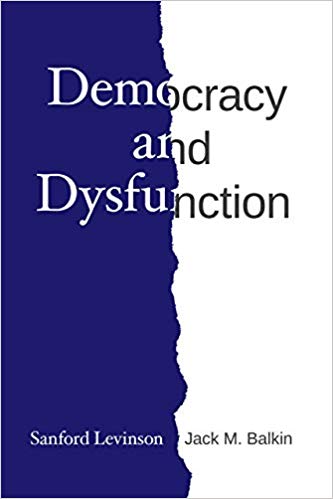
Sanford Levinson and Jack M. Balkin, Democracy and Dysfunction (University of Chicago Press, 2019)

Sanford Levinson, Written in Stone: Public Monuments in Changing Societies (Duke University Press 2018)

Mark A. Graber, Sanford Levinson, and Mark Tushnet, eds., Constitutional Democracy in Crisis? (Oxford University Press 2018)

Gerard Magliocca, The Heart of the Constitution: How the Bill of Rights became the Bill of Rights (Oxford University Press, 2018)

Cynthia Levinson and Sanford Levinson, Fault Lines in the Constitution: The Framers, Their Fights, and the Flaws that Affect Us Today (Peachtree Publishers, 2017)

Brian Z. Tamanaha, A Realistic Theory of Law (Cambridge University Press 2017)

Sanford Levinson, Nullification and Secession in Modern Constitutional Thought (University Press of Kansas 2016)

Sanford Levinson, An Argument Open to All: Reading The Federalist in the 21st Century (Yale University Press 2015)

Stephen M. Griffin, Broken Trust: Dysfunctional Government and Constitutional Reform (University Press of Kansas, 2015)

Frank Pasquale, The Black Box Society: The Secret Algorithms That Control Money and Information (Harvard University Press, 2015)

Bruce Ackerman, We the People, Volume 3: The Civil Rights Revolution (Harvard University Press, 2014)
Balkinization Symposium on We the People, Volume 3: The Civil Rights Revolution

Joseph Fishkin, Bottlenecks: A New Theory of Equal Opportunity (Oxford University Press, 2014)

Mark A. Graber, A New Introduction to American Constitutionalism (Oxford University Press, 2013)

John Mikhail, Elements of Moral Cognition: Rawls' Linguistic Analogy and the Cognitive Science of Moral and Legal Judgment (Cambridge University Press, 2013)

Gerard N. Magliocca, American Founding Son: John Bingham and the Invention of the Fourteenth Amendment (New York University Press, 2013)

Stephen M. Griffin, Long Wars and the Constitution (Harvard University Press, 2013)

Andrew Koppelman, The Tough Luck Constitution and the Assault on Health Care Reform (Oxford University Press, 2013)

James E. Fleming and Linda C. McClain, Ordered Liberty: Rights, Responsibilities, and Virtues (Harvard University Press, 2013)
Balkinization Symposium on Ordered Liberty: Rights, Responsibilities, and Virtues

Andrew Koppelman, Defending American Religious Neutrality (Harvard University Press, 2013)

Brian Z. Tamanaha, Failing Law Schools (University of Chicago Press, 2012)

Sanford Levinson, Framed: America's 51 Constitutions and the Crisis of Governance (Oxford University Press, 2012)

Linda C. McClain and Joanna L. Grossman, Gender Equality: Dimensions of Women's Equal Citizenship (Cambridge University Press, 2012)

Mary Dudziak, War Time: An Idea, Its History, Its Consequences (Oxford University Press, 2012)

Jack M. Balkin, Living Originalism (Harvard University Press, 2011)

Jason Mazzone, Copyfraud and Other Abuses of Intellectual Property Law (Stanford University Press, 2011)

Richard W. Garnett and Andrew Koppelman, First Amendment Stories, (Foundation Press 2011)

Jack M. Balkin, Constitutional Redemption: Political Faith in an Unjust World (Harvard University Press, 2011)

Gerard Magliocca, The Tragedy of William Jennings Bryan: Constitutional Law and the Politics of Backlash (Yale University Press, 2011)

Bernard Harcourt, The Illusion of Free Markets: Punishment and the Myth of Natural Order (Harvard University Press, 2010)

Bruce Ackerman, The Decline and Fall of the American Republic (Harvard University Press, 2010)
Balkinization Symposium on The Decline and Fall of the American Republic

Ian Ayres. Carrots and Sticks: Unlock the Power of Incentives to Get Things Done (Bantam Books, 2010)

Mark Tushnet, Why the Constitution Matters (Yale University Press 2010)

Ian Ayres and Barry Nalebuff: Lifecycle Investing: A New, Safe, and Audacious Way to Improve the Performance of Your Retirement Portfolio (Basic Books, 2010)
.jpg)
Jack M. Balkin, The Laws of Change: I Ching and the Philosophy of Life (2d Edition, Sybil Creek Press 2009)

Brian Z. Tamanaha, Beyond the Formalist-Realist Divide: The Role of Politics in Judging (Princeton University Press 2009)
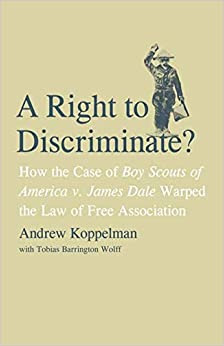
Andrew Koppelman and Tobias Barrington Wolff, A Right to Discriminate?: How the Case of Boy Scouts of America v. James Dale Warped the Law of Free Association (Yale University Press 2009)

Jack M. Balkin and Reva B. Siegel, The Constitution in 2020 (Oxford University Press 2009)

Heather K. Gerken, The Democracy Index: Why Our Election System Is Failing and How to Fix It (Princeton University Press 2009)

Mary Dudziak, Exporting American Dreams: Thurgood Marshall's African Journey (Oxford University Press 2008)

David Luban, Legal Ethics and Human Dignity (Cambridge Univ. Press 2007)

Ian Ayres, Super Crunchers: Why Thinking-By-Numbers is the New Way to be Smart (Bantam 2007)

Jack M. Balkin, James Grimmelmann, Eddan Katz, Nimrod Kozlovski, Shlomit Wagman and Tal Zarsky, eds., Cybercrime: Digital Cops in a Networked Environment (N.Y.U. Press 2007)
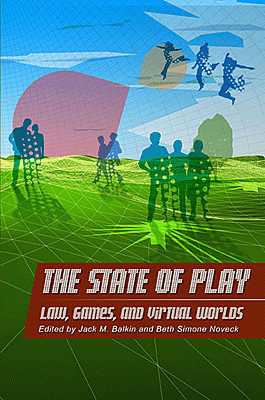
Jack M. Balkin and Beth Simone Noveck, The State of Play: Law, Games, and Virtual Worlds (N.Y.U. Press 2006)

Andrew Koppelman, Same Sex, Different States: When Same-Sex Marriages Cross State Lines (Yale University Press 2006)

Brian Tamanaha, Law as a Means to an End (Cambridge University Press 2006)

Sanford Levinson, Our Undemocratic Constitution (Oxford University Press 2006)

Mark Graber, Dred Scott and the Problem of Constitutional Evil (Cambridge University Press 2006)

Jack M. Balkin, ed., What Roe v. Wade Should Have Said (N.Y.U. Press 2005)

Sanford Levinson, ed., Torture: A Collection (Oxford University Press 2004)
Balkin.com homepage
Bibliography
Conlaw.net
Cultural Software
Writings
Opeds
The Information Society Project
BrownvBoard.com
Useful Links
Syllabi and Exams
