Balkinization
an unanticipated consequence of
Jack M. Balkin
Balkinization Symposiums: A Continuing List
E-mail:
Jack Balkin:
jackbalkin at yahoo.com
Bruce Ackerman
bruce.ackerman at yale.edu
Ian Ayres
ian.ayres at yale.edu
Corey Brettschneider
corey_brettschneider at brown.edu
Mary Dudziak
mary.l.dudziak at emory.edu
Joey Fishkin
joey.fishkin at gmail.com
Heather Gerken heather.gerken at yale.edu
Abbe Gluck abbe.gluck at yale.edu
Mark Graber
mgraber at law.umaryland.edu
Stephen Griffin
sgriffin at tulane.edu
Jonathan Hafetz
jonathan.hafetz at shu.edu
Jeremy Kessler
jkessler at law.columbia.edu
Andrew Koppelman
akoppelman at law.northwestern.edu
Marty Lederman
msl46 at law.georgetown.edu
Sanford Levinson
slevinson at law.utexas.edu
David Luban
david.luban at gmail.com
Gerard Magliocca
gmaglioc at iupui.edu
Jason Mazzone
mazzonej at illinois.edu
Linda McClain
lmcclain at bu.edu
John Mikhail
mikhail at law.georgetown.edu
Frank Pasquale
pasquale.frank at gmail.com
Nate Persily
npersily at gmail.com
Michael Stokes Paulsen
michaelstokespaulsen at gmail.com
Deborah Pearlstein
dpearlst at yu.edu
Rick Pildes
rick.pildes at nyu.edu
David Pozen
dpozen at law.columbia.edu
Richard Primus
raprimus at umich.edu
K. Sabeel Rahmansabeel.rahman at brooklaw.edu
Alice Ristroph
alice.ristroph at shu.edu
Neil Siegel
siegel at law.duke.edu
David Super
david.super at law.georgetown.edu
Brian Tamanaha
btamanaha at wulaw.wustl.edu
Nelson Tebbe
nelson.tebbe at brooklaw.edu
Mark Tushnet
mtushnet at law.harvard.edu
Adam Winkler
winkler at ucla.edu
Compendium of posts on Hobby Lobby and related cases
The Anti-Torture Memos: Balkinization Posts on Torture, Interrogation, Detention, War Powers, and OLC
The Anti-Torture Memos (arranged by topic)
Recent Posts
The Religious Aesthetics of Running for President
![[Powered by Blogger]](https://lh3.googleusercontent.com/blogger_img_proxy/AEn0k_uYUE754NSVcXxhRtGySC02mRY4MukDr_Nm7E_06GOIbRijrw1YBA_RUy8w4S1T40gBL_LkhhFQVmWW3oN5ex6Co1d3Bu9llOvRG-JTJx0_=s0-d)
Just A Few Blogs
ACS Blog
Alas, a Blog
Althouse
Arts and Letters Daily
Atrios (Eschaton)
Bill of Health
Buzzflash.com
Buzz Machine
Cato at Liberty
Juan Cole (Informed Comment)
Concurring Opinions
The Constitution in 2020
Corrente
Crooked Timber
Daily Howler
Daily Kos
Dana Boyd
Brad DeLong
Digby (Hullabaloo)
Discriminations
Daniel Drezner
Kevin Drum (Mother Jones)
Electrolite
En Banc
Eunomia (Daniel Larison)
Fafblog
Michael Froomkin (Discourse.net)
GovLab (Beth Noveck)
Rick Hasen (Election Law)
History News Network
How Appealing
Ignatz (Sam Heldman)
The Importance of (Ernie Miller)
Infolaw
Instapundit
International Economic Law and Policy Blog
IntLawGrrls
Jacob Levy
Jesus' General
Jurisdynamics
The Kitchen Cabinet
Mark Kleiman
Law Blog Central
Larry Lessig
Lawyers, Guns and Money
Liberal Oasis
Brian Leiter's Law School Reports
The Leiter Reports
Marginal Revolution
Megan McArdle
Memeorandum
Metafilter
Mirror of Justice
The New Republic
Newseum
No More Mister Nice Blog
Brendan Nyhan
Opinio Juris
Orcinus
The Originalism Blog
Pandagon
Passport (Foreign Policy)
Overcoming Bias
Political Animal (Washington Monthly)
Political Theory Daily Review
Political Wire (Taegan Goddard)
The Poor Man
Virginia Postrel
Prawfsblawg
Public Reason
Jonathan Rauch
Raw Story
Redstate
ReligiousLeftLaw.com
Reporters Committee For Freedom of the Press
Reproductive Rights Blog
Rothman's Roadmap to the Right of Publicity
SCOTUS Blog
Seeing the Forest
Clay Shirky
The Shifted Librarian
The Situationist
Larry Solum (Legal Theory)
Andrew Sullivan
Talking Points Memo
Talk Left
Tapped
Tbogg
TechPresident
The Paper Chase (Jurist)
Tom Paine
Tom Tomorrow (This Modern World)
Eve Tushnet
Uggabugga
University of Chicago Law School Faculty Blog
Unqualified Offerings
The Volokh Conspiracy
War and Piece (Laura Rozen)
Wampum
Oliver Willis
Wonkette
Written Description
Matthew Yglesias
Yin
Your Choice of Feeds
1. XML
powered by

2. Atom Feed
3. RSS 2.0
The Religious Aesthetics of Running for President
Fred Gedicks
My thanks to Jack Balkin for the invitation to guest blog on Balkinization.
The convergence of Mitt Romney’s unexpected early success as a Republican presidential candidate with current academic and popular interest in Mormonism nicely illustrates some contemporary American attitudes about religious belief. Although I’m a Mormon, my purpose here is not to apologize for Mormon history or theology, whose stranger aspects have drawn criticism not just from the Christian right ("Mormonism is a cult"), but also from the secular left ("Who’s crazy enough to belief this stuff?"). Instead, I think current discussions about Mormonism--and Romney’s Mormonism in particular–-expose a contradiction in popular beliefs about the role of faith in public life.
1. One of Romney’s challenges mirrors that facing the contemporary Mormon church-–how to show Mormonism as a mainstream faith without abandoning its distinctive beliefs and practices. (Another of Romney’s challenges is how to credibly explain that his recent conversion to the conservative Christian social agenda was not influenced by his decision to run for president, but that would be another post.) Mormon angels, gold plates, polygamy, temple rites, etc. make it easy to argue that any person who believes in such nonsense is either scary or irrational (or both), and thus unfit for public office (and, I suppose, much else). But this is really just old-fashioned religious bigotry, whether launched from the right or the left. From the right, it’s simply an attack on religious difference, and not a very persuasive one: The theological bed rocks of conservative Christianity–-the Trinity, resurrection, real presence, virgin birth, atonement for sins and salvation by grace–-are all as bizarre as the strangest Mormon doctrines, but seem "reasonable" because they’ve been around for centuries and are shared by large American majorities. Thus James Dobson argues--without any sense of irony--that the U.S. should be governed by (his version of) the teachings of a God who was born to a virgin, allowed himself to be crucified, and then brought himself back from the dead to an eternal life, at the same time that he suggests that Mormons or Muslims are simply too weird to be trusted with political power or office. From the left, the attack on Mormonism is an attack on religion generally. Unless one is willing to distinguish reasonable extra-rational beliefs from unreasonable ones–-the trap into which Dobson and conservative Christians fall--it’s hard to see how any religion could have survived the Enlightenment. That is, I think, pretty much Sam Harris’s argument.
2. On the other hand, Harris has a point–or, at least, half a point. How comfortable would most Americans be with a President who makes policy decisions by personal revelation and prayer? Not very, I think, and with good reason. One of the things that makes nonbelievers uncomfortable with believing government officials, and conventional believers uncomfortable with unconventionally believing officials, is the fear that such officials will take actions based on spiritual inspiration that is unsupported by, or even inconsistent with, rational argument (as the unbelievers or conventional believers see it). To paraphrase Jon Krakauer, people will do pretty much anything if they think that God is telling them to do it, and that’s pretty scary in a President (and, frankly, in a neighbor). It’s ok, then, for a President to pray for personal "strength," or "insight," or "courage, or even "inspiration," but not to ask God if the U.S. should, say, invade Iraq or raise taxes.
3. What this means is that, despite the desires of the Christian right and the fears of the secular left, the personal religious devotion of presidential candidates functions mostly as an aesthetic. Think Ronald Reagan. Personal religiosity communicates that the candidate is a "good person," meaning that he or she is a person-–more realistically, projects the image of a person--with whom the electorate is comfortable and to whom it can relate at some imagined personal level, but does not govern the candidate’s policy decisions in any but the most abstract, background sense.
Fred Gedicks
Labels: Religious aesthetics
Posted 2:26 PM by Fred Gedicks [link]
Your conclusory point is, "What this means is that, despite the desires of the Christian right and the fears of the secular left, the personal religious devotion of presidential candidates functions mostly as an aesthetic."
Whether that proves true or not depends on how the desires and fears of the left and right are, in fact, contained. If such bigotry does prove significant in practice, it will overwhelm the "aesthetics" you describe.

What this means is that, despite the desires of the Christian right and the fears of the secular left, the personal religious devotion of presidential candidates functions mostly as an aesthetic. Think Ronald Reagan. Personal religiosity communicates that the candidate is a "good person," meaning that he or she is a person-–more realistically, projects the image of a person--with whom the electorate is comfortable and to whom it can relate at some imagined personal level, but does not govern the candidate’s policy decisions in any but the most abstract, background sense.
I know it's not your point here, but I am a bit bothered by the apparent "logic" there: If a person is given the benefit of the doubt of being a "good person" in being religious (absent any other evidence of such), then people who are not religious are, at the very least, not given that same benefit of the doubt. In fact, you'll see in some commentary from some people an assertion that religion doesn't just tend one towards "goodness" but is the sine qua non for such; if you aren't religious, you can't possibly have any morals ... or at least any Morals Worth Speaking About, since these moral haven't been blessed with the authoritative voice of some deity smarter than us (and if it's just us making up these morals, can't we just change our minds when expediency suggests such a course?).
It's been shown that being an atheist is a bigger strike against you if you want to serve in office than being a Muslim (or some other blasphemous "religion"), or even being gay.
Yet the current meme of the Christian RW is that religion (and in particular, Christianity) is under deadly attack from the hordes of secular (and prolly communistic) heathens that are really running the country. Go figure.
Cheers,
I wonder to what degree we can call the harmless affectation of good-guy devotion described above as aesthetics. Certainly, as Arne makes reference to, there's enough proof that a public demonstration of religiosity is almost a prerequisite for being a presidential candidate.
The post makes me think about Kennedy's presidential campaign, where he had to go out of his way to prove his lack of religiosity, or rather, his unwillingness to take orders from the hierarchy of the Catholic church.
Insofar as the public may have an idea of what it expects in a candidate, and shapes the political field through its choices, it makes sense to speak of an aesthetic. Using the candidate as the unit of analysis, however, requires the consideration of religiosity as performance--a manipulation of public perception that allows one to fit the cultural aesthetic of the day. This manipulation is something beyond the mere fronting of an Easter Sunday image that doesn't "govern the candidate's policy decisions."
Whether it's Reagan proposing a constitutional amendment to guarantee the permissibility of school prayer or George W. Bush creating faith-based initiatives that give billions of dollars every year to faith-based organizations, it is clear that the "good person" will also occasionally seek to implement policy changes that are concordant with their reputation.
Some policy decisions are made on the basis of religious commitment, although they may not be revealed to politicians as often in their prayers as in the wishes of the religious lobbies to which they are committed.
Of course, from the point of view of the lobbies, the candidate's religion may indeed appear to function as an aesthetic. For example, over the last few years my religious friends and family members have lamented the current president's lack of success in criminalizing abortion and preventing gay marriage legislation. To them, it was all just an act--simply a way of getting their vote, then leaving them in the lurch.
To others, however, the march in public policy towards the criminalization of abortion and stem-cell research never seems to cease. For these people, the proposition that a candidate that plays up his personal devotion in a campaign won't let that devotion influence his policy decisions in "any but the most abstract, background sense" is laughable.
As long as there is a group with voting power that can hold the candidate accountable for his inactions once in office, it's reasonable to suppose that the candidate is likely to make policy decisions concordant with the wishes of his supporters. (Of course, you touch upon that when making the aside about Romney's "conversion to the conservative Christian social agenda") Given the strength of the religious lobbies in America, I think it's problematic to reduce the role of faith in public life to an aesthetic.
First Century Christian churches, in fact, continued the Jewish temple worship traditions:
1) Baptism of youth (not infants) by immersion by the father of the family
2) Lay clergy
3) Anointing with holy oil after baptism
4) Then clothing in white clothing
A First Century Christian Church has been re-constructed at the Israeli Museum, and the above can be verified. . And read Exodus Ch 29 for Aaron and his sons” ordinances. . Jewish Temple practices were continued by Christians prior to Constantine”s corruption [see St. Cyril of Jerusalem (315-386 A.D.) Lecture XXI]. . . Early Christians were persecuted for keeping their practices sacred, and not allowing non-Christians to witness them
A literal reading of the New Testament points to God and Jesus Christ being separate beings, united in purpose. . To whom was Jesus praying in Gethsemane, and Who was speaking to Him and his apostles on the Mount of Transfiguration?
The Nicene Creed”s definition of the Trinity was influenced by scribes translating the Greek manuscripts into Latin. The scribes embellished on a passage explaining the Trinity, which is the Catholic and Protestant belief that God is Father, Son and Holy Spirit. The oldest versions of the epistle of 1 John, read: "There are three that bear witness: the Spirit, the water and the blood and these three are one."
Scribes later added "the Father, the Word and the Spirit," and it remained in the epistle when it was translated into English for the King James Version, according to Dr. Bart Ehrman, Chairman of the Religion Department at UNC- Chapel Hill. . . .He no longer believes in the Nicene Trinity.
Members of the Church of Jesus Christ (LDS) have concern for their ancestors” spiritual welfare, so they practice proxy baptism. (1 Corinthians 15:29 & Malachi 4:5-6).
Only members of the Church of Jesus Christ (LDS) continue these practices of First Century Christians. But Mormons don”t term Catholics and Protestants “non-Christian”. The dictionary definition of a Christian is “of, pertaining to, believing in, or belonging to a religion based on the teachings of Jesus Christ”:. All of the above denominations are followers of Christ, and consider him the Messiah foretold in the Old Testament.
It”s important to understand the difference between Reformation and Restoration when we consider who might be the more authentic Christian. If members of the Church of Jesus Christ (LDS) embrace early Christian theology, they are likely more “Christian” than their detractors.
* * *
And the National Study of Youth and Religion done by UNC-Chapel Hill in 2005 found that Church of Jesus Christ (LDS) youth (ages 13 to 17) were more likely to exhibit these Christian characteristics than Evangelicals (the next most observant group):
. . . . . . . . . . . . . . . . . . . . . . . . . . . . . . . . . . . . . . . . . . . . . . . . . . . . . LDS Evangelical
Attend Religious Services weekly . . . . . . . . . . . . . . . . . . . . . . . . . . . 71% . . . . 55%
Importance of Religious Faith in shaping daily life –
extremely important . . . 52. . . . . . 28
Believes in life after death . . . . . . . . . . . . . . . . . . . . . . . . . . . . . . . . . 76 . . . . . . 62
Believes in psychics or fortune-tellers . . . . . . . . . . . . . . . . . . . . . . . . 0 . . . . . . 5
Has taught religious education classes . . . . . . . . . . . . . . . . . . . . . . . . 42 . . . . . . 28
Has fasted or denied something as spiritual discipline . . . . . . . . . . . .68 . . . . . . 22
Sabbath Observance . . . . . . . . . . . . . . . . . . . . . . . . . . . . . . . . . . . . . . 67 . . . . . . 40
Shared religious faith with someone not of their faith . . . . . . . . . . . . 72 . . . . . . 56
Family talks about God, scriptures, prayer daily . . . . . . . . . . . . . . . . . 50 . . . . . . 19
Supportiveness of church for parent in trying to raise teen
(very supportive) . . . . . . . . . . . . . . . . . . . . . . . . . . . . . . . . . . . . . . . . .65 . . . . . . 26
Church congregation has done an excellent job in helping
Teens better understand their own sexuality and sexual morality . . . 84 . . . . . . 35
Kennedy found it necessary to distance himself from the Catholic hierarchy specifically because Catholic theology requires submission to the higher authority of the pope and the Roman Catholic Church. Would an American president be able to give ultimate priority to the authority of the constitutional and political requirements of the American enterprise? Or would the president's need to conform to church authority preclude this possibility?
Is it simple coincidence that the five members of the Supreme Court who have now ventured into determining medical decisions are also the same five members who are members of the Catholic church, so long associated with anti-abortion activism? That is certainly a fair topic of discussion and debate in our civil society.
As an active member of a faith that places absolute authority of its members' actions in a single, infallible person--the Prophet--is Mr Romney prepared to demonstrate his independence of that authority and therefore place in jeopardy his perceived place in eternity?
With the election of Mr Romney, limited in his actions by the voice of his Prophet, are we in effect electing the Prophet himself as President?
Who is this Prophet? What does he believe on the important issues facing our country and our world?
But this simply means that the electorate is bigoted. Inferring that someone is a "good person" from the fact that he or she is religious is no different from making the same inferrence from the fact that someone is white.
We have made significant progress fighting bigoted views in other areas, such as race and sex. It is time to eradicate this bigoted view as well.
You will be comforted to know that just as JFK made clear his political independence from the Vatican, Romney already has addressed your specific concerns directly in an interview with Hugh Hewitt:
"Would you ever expect a call from [LDS Church] President Hinckley or his successor?" I asked.
"No," he emphatically replied. "Absolutely not. And I'd also note that when you take the oath of office, that is your highest oath and first responsibility. That's true when you become governor, it's certainly true for anyone who becomes president. When I placed my hand on . . . the Bible . . . when I was sworn in as governor . . . my highest and first responsibility was to honor my oath of office and follow the Constitution and protect the Commonwealth of Massachusetts. For those sworn into national office, their highest obligation is to the nation. It would be inappropriate for Church officials to contact me and it would be less than appropriate for me to take guidance from any institution other than caring first for the oath of office."
I hope that a President would pray and ask God about going to war. God's commandments are so obviously at variance with warfare that I would expect any good Christian to be concerned about God being displeased with a decision to go to war.
If a man didn't feel the need to pray and consult with God about the moral incongruities of launching a war- I don't think I'd trust that man to be a Dog Catcher.
I guess the difference between a believer and an unbeliever is that an unbeliever doesn't understand how a believer thinks or how prayer or personal revelation works. Your depiction seems to be that God whispers in your ear and then you just do that. Like a prayer by a believer is somekind of schizophrenic experience.
Your description of a believer waking up one day and deciding to go to war because "God said to" just doesn't make sense to a believer.
Romney ended up in Massachusetts because his job took him there. It was his state of residence for most of his adult life. (He was raised in Michigan)
If he was a carpetbagger why would a Republican ever choose to run in Massachusetts?
If he was a carpetbagger he would have moved to Utah and run there, as several Utahans urged him to after the Olympics. Instead he returned to Mass.
Books by Balkinization Bloggers

Mark Tushnet and Bojan Bugaric, Constitutionalism and Its Discontents (University of Chicago Press, 2026)

Gerard N. Magliocca, The Actual Art of Governing: Justice Robert H. Jackson's Concurring Opinion in the Steel Seizure Case (Oxford University Press, 2025)

Linda C. McClain and Aziza Ahmed, The Routledge Companion to Gender and COVID-19 (Routledge, 2024)

David Pozen, The Constitution of the War on Drugs (Oxford University Press, 2024)

Jack M. Balkin, Memory and Authority: The Uses of History in Constitutional Interpretation (Yale University Press, 2024)
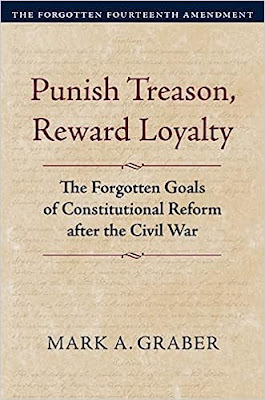
Mark A. Graber, Punish Treason, Reward Loyalty: The Forgotten Goals of Constitutional Reform after the Civil War (University of Kansas Press, 2023)
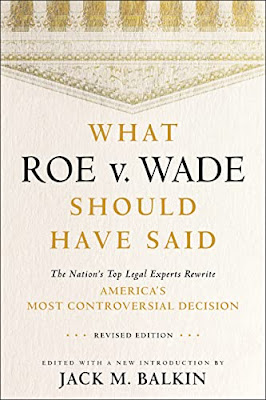
Jack M. Balkin, What Roe v. Wade Should Have Said: The Nation's Top Legal Experts Rewrite America's Most Controversial Decision - Revised Edition (NYU Press, 2023)

Andrew Koppelman, Burning Down the House: How Libertarian Philosophy Was Corrupted by Delusion and Greed (St. Martin’s Press, 2022)

Gerard N. Magliocca, Washington's Heir: The Life of Justice Bushrod Washington (Oxford University Press, 2022)
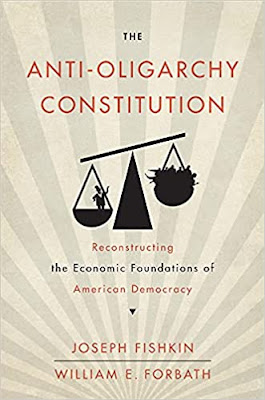
Joseph Fishkin and William E. Forbath, The Anti-Oligarchy Constitution: Reconstructing the Economic Foundations of American Democracy (Harvard University Press, 2022)
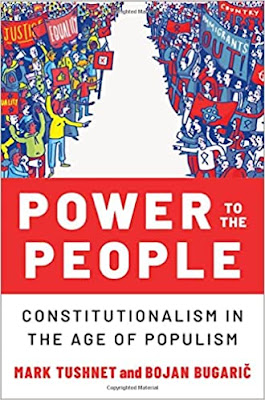
Mark Tushnet and Bojan Bugaric, Power to the People: Constitutionalism in the Age of Populism (Oxford University Press 2021).

Mark Philip Bradley and Mary L. Dudziak, eds., Making the Forever War: Marilyn B. Young on the Culture and Politics of American Militarism Culture and Politics in the Cold War and Beyond (University of Massachusetts Press, 2021).

Jack M. Balkin, What Obergefell v. Hodges Should Have Said: The Nation's Top Legal Experts Rewrite America's Same-Sex Marriage Decision (Yale University Press, 2020)

Frank Pasquale, New Laws of Robotics: Defending Human Expertise in the Age of AI (Belknap Press, 2020)

Jack M. Balkin, The Cycles of Constitutional Time (Oxford University Press, 2020)

Mark Tushnet, Taking Back the Constitution: Activist Judges and the Next Age of American Law (Yale University Press 2020).

Andrew Koppelman, Gay Rights vs. Religious Liberty?: The Unnecessary Conflict (Oxford University Press, 2020)

Ezekiel J Emanuel and Abbe R. Gluck, The Trillion Dollar Revolution: How the Affordable Care Act Transformed Politics, Law, and Health Care in America (PublicAffairs, 2020)

Linda C. McClain, Who's the Bigot?: Learning from Conflicts over Marriage and Civil Rights Law (Oxford University Press, 2020)
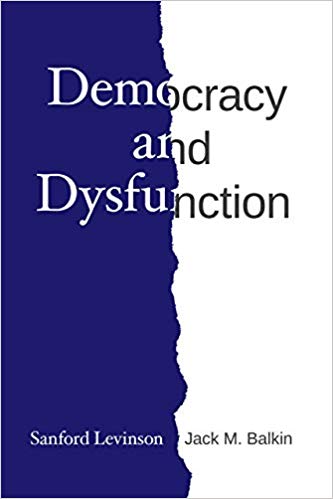
Sanford Levinson and Jack M. Balkin, Democracy and Dysfunction (University of Chicago Press, 2019)

Sanford Levinson, Written in Stone: Public Monuments in Changing Societies (Duke University Press 2018)

Mark A. Graber, Sanford Levinson, and Mark Tushnet, eds., Constitutional Democracy in Crisis? (Oxford University Press 2018)

Gerard Magliocca, The Heart of the Constitution: How the Bill of Rights became the Bill of Rights (Oxford University Press, 2018)

Cynthia Levinson and Sanford Levinson, Fault Lines in the Constitution: The Framers, Their Fights, and the Flaws that Affect Us Today (Peachtree Publishers, 2017)

Brian Z. Tamanaha, A Realistic Theory of Law (Cambridge University Press 2017)

Sanford Levinson, Nullification and Secession in Modern Constitutional Thought (University Press of Kansas 2016)

Sanford Levinson, An Argument Open to All: Reading The Federalist in the 21st Century (Yale University Press 2015)

Stephen M. Griffin, Broken Trust: Dysfunctional Government and Constitutional Reform (University Press of Kansas, 2015)

Frank Pasquale, The Black Box Society: The Secret Algorithms That Control Money and Information (Harvard University Press, 2015)

Bruce Ackerman, We the People, Volume 3: The Civil Rights Revolution (Harvard University Press, 2014)
Balkinization Symposium on We the People, Volume 3: The Civil Rights Revolution

Joseph Fishkin, Bottlenecks: A New Theory of Equal Opportunity (Oxford University Press, 2014)

Mark A. Graber, A New Introduction to American Constitutionalism (Oxford University Press, 2013)

John Mikhail, Elements of Moral Cognition: Rawls' Linguistic Analogy and the Cognitive Science of Moral and Legal Judgment (Cambridge University Press, 2013)

Gerard N. Magliocca, American Founding Son: John Bingham and the Invention of the Fourteenth Amendment (New York University Press, 2013)

Stephen M. Griffin, Long Wars and the Constitution (Harvard University Press, 2013)

Andrew Koppelman, The Tough Luck Constitution and the Assault on Health Care Reform (Oxford University Press, 2013)

James E. Fleming and Linda C. McClain, Ordered Liberty: Rights, Responsibilities, and Virtues (Harvard University Press, 2013)
Balkinization Symposium on Ordered Liberty: Rights, Responsibilities, and Virtues

Andrew Koppelman, Defending American Religious Neutrality (Harvard University Press, 2013)

Brian Z. Tamanaha, Failing Law Schools (University of Chicago Press, 2012)

Sanford Levinson, Framed: America's 51 Constitutions and the Crisis of Governance (Oxford University Press, 2012)

Linda C. McClain and Joanna L. Grossman, Gender Equality: Dimensions of Women's Equal Citizenship (Cambridge University Press, 2012)

Mary Dudziak, War Time: An Idea, Its History, Its Consequences (Oxford University Press, 2012)

Jack M. Balkin, Living Originalism (Harvard University Press, 2011)

Jason Mazzone, Copyfraud and Other Abuses of Intellectual Property Law (Stanford University Press, 2011)

Richard W. Garnett and Andrew Koppelman, First Amendment Stories, (Foundation Press 2011)

Jack M. Balkin, Constitutional Redemption: Political Faith in an Unjust World (Harvard University Press, 2011)

Gerard Magliocca, The Tragedy of William Jennings Bryan: Constitutional Law and the Politics of Backlash (Yale University Press, 2011)

Bernard Harcourt, The Illusion of Free Markets: Punishment and the Myth of Natural Order (Harvard University Press, 2010)

Bruce Ackerman, The Decline and Fall of the American Republic (Harvard University Press, 2010)
Balkinization Symposium on The Decline and Fall of the American Republic

Ian Ayres. Carrots and Sticks: Unlock the Power of Incentives to Get Things Done (Bantam Books, 2010)

Mark Tushnet, Why the Constitution Matters (Yale University Press 2010)

Ian Ayres and Barry Nalebuff: Lifecycle Investing: A New, Safe, and Audacious Way to Improve the Performance of Your Retirement Portfolio (Basic Books, 2010)
.jpg)
Jack M. Balkin, The Laws of Change: I Ching and the Philosophy of Life (2d Edition, Sybil Creek Press 2009)

Brian Z. Tamanaha, Beyond the Formalist-Realist Divide: The Role of Politics in Judging (Princeton University Press 2009)
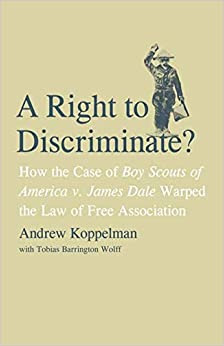
Andrew Koppelman and Tobias Barrington Wolff, A Right to Discriminate?: How the Case of Boy Scouts of America v. James Dale Warped the Law of Free Association (Yale University Press 2009)

Jack M. Balkin and Reva B. Siegel, The Constitution in 2020 (Oxford University Press 2009)

Heather K. Gerken, The Democracy Index: Why Our Election System Is Failing and How to Fix It (Princeton University Press 2009)

Mary Dudziak, Exporting American Dreams: Thurgood Marshall's African Journey (Oxford University Press 2008)

David Luban, Legal Ethics and Human Dignity (Cambridge Univ. Press 2007)

Ian Ayres, Super Crunchers: Why Thinking-By-Numbers is the New Way to be Smart (Bantam 2007)

Jack M. Balkin, James Grimmelmann, Eddan Katz, Nimrod Kozlovski, Shlomit Wagman and Tal Zarsky, eds., Cybercrime: Digital Cops in a Networked Environment (N.Y.U. Press 2007)
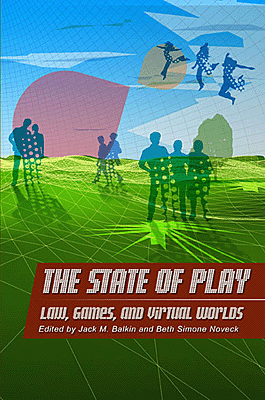
Jack M. Balkin and Beth Simone Noveck, The State of Play: Law, Games, and Virtual Worlds (N.Y.U. Press 2006)

Andrew Koppelman, Same Sex, Different States: When Same-Sex Marriages Cross State Lines (Yale University Press 2006)

Brian Tamanaha, Law as a Means to an End (Cambridge University Press 2006)

Sanford Levinson, Our Undemocratic Constitution (Oxford University Press 2006)

Mark Graber, Dred Scott and the Problem of Constitutional Evil (Cambridge University Press 2006)

Jack M. Balkin, ed., What Roe v. Wade Should Have Said (N.Y.U. Press 2005)

Sanford Levinson, ed., Torture: A Collection (Oxford University Press 2004)
Balkin.com homepage
Bibliography
Conlaw.net
Cultural Software
Writings
Opeds
The Information Society Project
BrownvBoard.com
Useful Links
Syllabi and Exams
