Balkinization
an unanticipated consequence of
Jack M. Balkin
Balkinization Symposiums: A Continuing List
E-mail:
Jack Balkin:
jackbalkin at yahoo.com
Bruce Ackerman
bruce.ackerman at yale.edu
Ian Ayres
ian.ayres at yale.edu
Corey Brettschneider
corey_brettschneider at brown.edu
Mary Dudziak
mary.l.dudziak at emory.edu
Joey Fishkin
joey.fishkin at gmail.com
Heather Gerken heather.gerken at yale.edu
Abbe Gluck abbe.gluck at yale.edu
Mark Graber
mgraber at law.umaryland.edu
Stephen Griffin
sgriffin at tulane.edu
Jonathan Hafetz
jonathan.hafetz at shu.edu
Jeremy Kessler
jkessler at law.columbia.edu
Andrew Koppelman
akoppelman at law.northwestern.edu
Marty Lederman
msl46 at law.georgetown.edu
Sanford Levinson
slevinson at law.utexas.edu
David Luban
david.luban at gmail.com
Gerard Magliocca
gmaglioc at iupui.edu
Jason Mazzone
mazzonej at illinois.edu
Linda McClain
lmcclain at bu.edu
John Mikhail
mikhail at law.georgetown.edu
Frank Pasquale
pasquale.frank at gmail.com
Nate Persily
npersily at gmail.com
Michael Stokes Paulsen
michaelstokespaulsen at gmail.com
Deborah Pearlstein
dpearlst at yu.edu
Rick Pildes
rick.pildes at nyu.edu
David Pozen
dpozen at law.columbia.edu
Richard Primus
raprimus at umich.edu
K. Sabeel Rahmansabeel.rahman at brooklaw.edu
Alice Ristroph
alice.ristroph at shu.edu
Neil Siegel
siegel at law.duke.edu
David Super
david.super at law.georgetown.edu
Brian Tamanaha
btamanaha at wulaw.wustl.edu
Nelson Tebbe
nelson.tebbe at brooklaw.edu
Mark Tushnet
mtushnet at law.harvard.edu
Adam Winkler
winkler at ucla.edu
Compendium of posts on Hobby Lobby and related cases
The Anti-Torture Memos: Balkinization Posts on Torture, Interrogation, Detention, War Powers, and OLC
The Anti-Torture Memos (arranged by topic)
Recent Posts
The Other Side of Critical Legal Theory
![[Powered by Blogger]](https://lh3.googleusercontent.com/blogger_img_proxy/AEn0k_uvm5DTHuSLYoV_ma5coSbJl4JstTBzweyBL9CM7cSE95hocGtdUHwE1BkBt_uE8uHSj01P34Ikcxc6vOK7vLmRleaIJTtoMNxEV8lfVQZs=s0-d)
Just A Few Blogs
ACS Blog
Alas, a Blog
Althouse
Arts and Letters Daily
Atrios (Eschaton)
Bill of Health
Buzzflash.com
Buzz Machine
Cato at Liberty
Juan Cole (Informed Comment)
Concurring Opinions
The Constitution in 2020
Corrente
Crooked Timber
Daily Howler
Daily Kos
Dana Boyd
Brad DeLong
Digby (Hullabaloo)
Discriminations
Daniel Drezner
Kevin Drum (Mother Jones)
Electrolite
En Banc
Eunomia (Daniel Larison)
Fafblog
Michael Froomkin (Discourse.net)
GovLab (Beth Noveck)
Rick Hasen (Election Law)
History News Network
How Appealing
Ignatz (Sam Heldman)
The Importance of (Ernie Miller)
Infolaw
Instapundit
International Economic Law and Policy Blog
IntLawGrrls
Jacob Levy
Jesus' General
Jurisdynamics
The Kitchen Cabinet
Mark Kleiman
Law Blog Central
Larry Lessig
Lawyers, Guns and Money
Liberal Oasis
Brian Leiter's Law School Reports
The Leiter Reports
Marginal Revolution
Megan McArdle
Memeorandum
Metafilter
Mirror of Justice
The New Republic
Newseum
No More Mister Nice Blog
Brendan Nyhan
Opinio Juris
Orcinus
The Originalism Blog
Pandagon
Passport (Foreign Policy)
Overcoming Bias
Political Animal (Washington Monthly)
Political Theory Daily Review
Political Wire (Taegan Goddard)
The Poor Man
Virginia Postrel
Prawfsblawg
Public Reason
Jonathan Rauch
Raw Story
Redstate
ReligiousLeftLaw.com
Reporters Committee For Freedom of the Press
Reproductive Rights Blog
Rothman's Roadmap to the Right of Publicity
SCOTUS Blog
Seeing the Forest
Clay Shirky
The Shifted Librarian
The Situationist
Larry Solum (Legal Theory)
Andrew Sullivan
Talking Points Memo
Talk Left
Tapped
Tbogg
TechPresident
The Paper Chase (Jurist)
Tom Paine
Tom Tomorrow (This Modern World)
Eve Tushnet
Uggabugga
University of Chicago Law School Faculty Blog
Unqualified Offerings
The Volokh Conspiracy
War and Piece (Laura Rozen)
Wampum
Oliver Willis
Wonkette
Written Description
Matthew Yglesias
Yin
Your Choice of Feeds
1. XML
powered by

2. Atom Feed
3. RSS 2.0
The Other Side of Critical Legal Theory
JB
Brian's last post on Critical Legal Studies and the Bush Administration has finally gotten me to write down a few things I have been thinking about for about a number of years about the relationship between Critical Legal Studies and political and legal events since the 2000 election.
CLS was, at least in my understanding and in my scholarship, always premised on the relative autonomy of law from politics. Law was not itself politics, but a surprisingly plastic medium of discourse and power. Law mediated and transformed ordinary political struggle; and through law political struggle and ideological disagreement resurfaced in new guises, facilitating power but also tempering it and redirecting it.
Implicit in this critique were two equally important points. The first-- emphasized most frequently by CLS scholars, was that law would generally tend to reflect the most powerful interests in society at the expense of the weakest interests. The second-- hidden but always present in claims of relative autonomy-- was that law nevertheless served as a discourse of ideas and ideals that could limit, channel and transform the interests of the powerful. (My colleague Robert Gordon's work, and in particular his essays "Law and Ideology" in Tikkun and "Unfreezing Legal Reality" in Florida State Law Review are excellent examples of this second theme.).
The relative autonomy of law from politics-- rather than its complete autonomy-- simultaneously posed a threat and a promise. The threat was that law would fail to do much more than ratify and legitimate the interests of the powerful; the promise was that it could hold off the worst excesses of power by giving people discursive and institutional tools to talk back to power, to restrain its selfishness and inhumanity, and to imagine finer, better visions of human association.
The threat and the promise of law were joined together inseparably. What gave law its power to legitimate was its ability to re-describe unjust and unfair events, social practices and institutions in terms of valued ideals of human association like consent, freedom, equality and fairness. In the hands of lawyers and politicians, law could disguise, mystify and legitimate great injustices using the very ideas and ideals we admire. But law could only do this because it appealed to these values and claimed to be trying to put them into practice through law. That is, the recourse to law forced the powerful to talk in terms in which the powerless could also participate and could also make claims.
The CLS critique of law was thus Janus-faced. On the one hand, powerful people used law to subordinate others and secure their own interests under the guise of promoting laudable goals like freedom, equality, liberty, consent, community and human dignity. On the other hand, by choosing to speak in the language of law, powerful people and interests could be called to account because they tried to legitimate what they were doing in these terms. The people they took advantage of could always argue that this was a misuse of law, an illegitimate attempt at mystifying rhetoric. They could then appeal to the values that law sought to protect to promote better, juster, and more humane practices and forms of human association.
Thus, in my view CLS had-- and should have had-- an ambivalent relationship to law, seeing both its limitations in the face of social forms of power and its possibilities as a means of channeling power and preventing its worst injustices and excesses.
This gave CLS a schizophrenic quality. Some CLS scholars denounced rights talk as sterile, useless and counterproductive. Others, especially feminist and critical race theory scholars (like Pat Williams and Mari Matsuda), pointed out that rights discourse and rule of law values were among the few resources that disempowered people had. Rule of law and rights talk were potentially emancipatory discourses, that held a limited but important potential for liberation and for contesting the arbitrary and unjust use of power.
Two decades after these disputes were first aired, I think it is clear that feminists and critical race theorists had the better of this argument. They understood the deemphasized elements-- the hidden side-- of CLS claims about the relative autonomy of law. They recognized that rule of law values and rights discourse were hardly perfect-- after all, they had been used repeatedly to justify slavery and the subordination of women-- but that they simultaneously allowed people to speak out against and to restrain the worst excesses of power.
This is how I think about the lessons of CLS today. We are in a very different world from the world of the 1970s, when critical legal scholars complained that their liberal colleagues were too readily acquiescing in legal apologia for unjust institutions. Instead, the 2000 election brought a new group of government officials that believed in doing what it took to gain power and wield it, to twist law to avoid accountability and to maximize their discretion. They used a combination of fear and hatred to maintain their political position, to deny basic liberties, to justify torture and abuse, and to poison the basic institutions of government. In this blog we have tried to bear witness to many of their most egregious misdeeds.
In this world, a world of executive arrogance, authoritarian posturing, and blatant disregard for rule of law values, the second, less emphasized feature of the CLS critique necessarily must reemerge. It speaks far more relevantly to today's world. Critical scholars should go back and read what feminists and critical race theorists had to say about the limited but nevertheless important values implicit in the rule of law and rights discourse.
In this era, when we are ruled by arrogant fools who have no respect for law and no sense of their own limitations and failings, who seek to throw off even the minimal constraints on arbitrariness that law affords, those who believe in a critical approach to law must understand the importance of the rule of law and its associated values as an instrument for taming excessive and arbitrary power. The British historian E.P. Thompson famously said that the rule of law was an unqualified human good. It may not be unqualified, but there is no doubt that it is a genuine human good and an indispensable element in a humane civilization.
My views on this subject have been evolving for almost a decade now. My friends and colleagues have noticed that, on the pages of this blog and elsewhere, I have been speaking out ever more loudly and forcefully for a restoration of rule of law values in America. I do not regard this as a rejection of my critical views about law. Indeed, I regard what I have been doing as making salient what was always present in the critical approach to law-- the hidden, less developed side of critical legal theory-- a recognition of our ambivalent relationship to law as simultaneously an inevitable instrument of power and as a necessary check on power.
Posted
2:42 PM
by JB [link]
The endemic disease of legal reasoning back to before Edward Coke is to make false claims about the past in the hope that they will be true about the future.
When you right that "CLS had-- and should have had-- an ambivalent relationship to law, seeing both its limitations in the face of social forms of power and its possibilities as a means of channeling power and preventing its worst injustices and excesses" you are, I think, falling victim to this disease.
I sat in Harvard's Economics Department in the 1980s, looking north at Duncan Kennedy, Roberto Unger, and company. I heard lots of: powerful people use law to subordinate others and secure their own interests under the guise of promoting laudable goals like freedom, equality, liberty, consent, community and human dignity, and it is our duty to demystify the authority of law and unveil that it is all naked politics. I heard very little of: by choosing to speak in the language of law, powerful people and interests can be called to account by being accused of committing injustice.
Perhaps CLS should have been a judo-move, stating that the powerful developed law as a mystifying cloak but we can make it more. But I have no sense that that was what it was.

I might not be your most valued contributor, but at the moment I think I can reasonably vie for title of "biggest fan." Thanks for an exciting post.
I think less "judo-move" and more "got lemons, make lemonade", particularly in an environment where a sated consumer class could never be looked to for a real people's revolution. I think I could get my undergrad prof from Cal State Dominguez Hills to sign off on this summary, the one who introduced me formally to cls in the early 90s. But there's no getting around that cls in the context of a Harvard econ department is bound to vary from that found in the home of gangsta rap. $.02
(For the record, I'm one of those sated consumers, here with my linux computer and verizon dsl, I know. I never put much stock in a "people's revolution" and am on record as saying Marx is the kind of thinker who would divide by zero.)
Peace.
May I offer a humble perspective from a law student, who is quite persuaded by your characterization and defense of the lemons-into-lemonade version of CLS?
I think my response and the response of a good number of similarly situated law students would be: "CLS had enduring lessons?! Really?! Why weren't we told?" I and my ilk have been "awake" to the law for only five years or so. Even those among us with more than a passing interest in various theories of judicial review know of CLS as a mere footnote. I learned much more from my undergraduate economics professor about CLS than I ever will in law school. The first institutional exposure I had to the idea was on a practice LSAT, which used CLS as the topic of a reading comprehension exercise. (I wish I were making that last part up.)
Okay, so CLS is presented to most young minds as a footnote, so what? Well, all we know about it is that it's a widely discredited approach to the law that basically takes whatever interpretation of an outcome is simultaneously the most cynical and left-wing. Maybe some students would be attracted to learning more based on such a description, but I suspect few would follow up on a theory that is both "discredited" and "cynical."
Reams of submissions pour into law reviews, few if any give CLS serious treatment. No one is teaching it. (I think I read Matsuda in a law and sexuality seminar . . . that would be the extent of my CLS exposure since the LSAT encounter mentioned above). Are there students out there interested in the lemony lessons from CLS and all the hard work on behalf of scholars like yourselves in reading and understanding the movement? How will we ever know if someone doesn't teach us about it? Professor Tamanaha has shown that current events amount to a big batch of ripe lemons--if not now, when?
I suspect there are good reasons why the topic is not touched on in mainstream legal education. I just don't know what those reasons are.
~UCLA 2L
This is a nice apotheosis, but I think your co-blogger Kim (at least, I assume she's a co-blogger though I don't see her post; she's listed up there) really beat you to the punch on this one a while ago. :)
Could we get her here to comment on this?
@all: I've indulged myself here far too much this week, and will be reverting to lurker status. Am always happy to hear from folks via private email, which can be found at my blogger profile page.
Peace, and out.
The history of CLS isn't something I spend a lot of time with, but two works from the CLS-era come to mind along those lines: E.P. Thompson's appendix to Whigs & Hunters (the rule of law as an unqualified good) and Mari Matsuda's Looking to the Bottom. The former spoke of ways that law might confine the powerful and the later suggested some ways that traditional legal doctrine might be remade to benefit the most in need.
Cara mengobati kanker dengan herbal, Cara mengobati kanker dengan tradisional, Cara mengobati kanker dengan alami, Cara mengobati kanker dengan cepat, Cara mengobati kanker stadium 3, Cara mengobati kanker stadium 4, Cara mengobati kanker stadium awal, Cara mengobati kanker stadium 2, Cara mengobati kanker stadium akhir, Cara mengobati kanker tanpa ke dokter, Gambar obat kanker yang ampuh, Gambar obat kanker yang ampuh, Obat kanker ampuh dengan singkong, Cara mengobati kanker stadium awal tanpa operasi, Obat kanker manjur dari tumbuhan, Cara mengobati kanker stadium 1 tanpa operasi, Obat kanker ampuh dengan daun sirsak, Cara mengobati kanker stadium 2 tanpa operasi, Obat kanker paling mujarab yang efektif, Cara mengobati kanker stadium 3 tanpa operasi, Cara mengobati kanker stadium 3, Cara mengobati kanker stadium 4 tanpa operasi, Obat kanker paling manjur 2016, Cara mengobati kanker stadium akhir tanpa operasi, Pengobatan kanker mujarab tanpa operasi, Cara pengobatan kanker yang manjur, Pengobatan kanker manjur dan aman, Cara pengobatan kanker yang mujarab, Cara pengobatan kanker tanpa operasi, Cara pengobatan kanker yang ampuh, Obat kanker mujarab tanpa operasi, Obat kanker manjur tanpa operasi, Obat De Nature

obat alami untuk mencegah kanker serviks
obat medis untuk kanker serviks
wwwobat kanker serviks
obat vaksin kanker serviks
obat untuk mengatasi kanker serviks
Tumbuhan untuk obat kanker serviks
Obat untuk menyembuhkan kanker serviks
obat untuk penderita kanker serviks
obat tradisional untuk kanker serviks
obat utk kanker serviks
obat untuk kanker serviks
obat tradisional utk kanker serviks
sirsak obat kanker serviks
obat sakit kanker serviks
hello world obat untuk kanker rahim stadium 3
obat herbal kanker rahim stadium 4
obat kanker rahim stadium 1 1
Obat kanker rahim stadium 2
Obat penyakit herpes kelamin pria
obat herpes tradisional yang ampuh
obat herpes terbaik
obat herpes tangan
obat herpes tercepat
obat herpes tipe 2
obat herpes tradisional untuk bayi
obat herpes tenggorokan
obat herpes terbaru
obat herpes tablet
obat herpes tomcat
obat herpes tumbuhan
Kapur sirih untuk obat kutil kelamin
Obat kutil kelamin medis
Obat menghilangkan kutil kelamin
Obat menyembuhkan kutil kelamin
Obat tradisional menyembuhkan kutil kelamin
Obat minum untuk kutil kelamin
Obat medis untuk kutil kelamin
Merek obat kutil kelamin
Obat kutil kelamin de nature
Nama obat kutil kelamin
Obat tradisional buat sipilis
Obat herbal buat sipilis
Obat dokter buat sipilis
Obat sipilis dengan bayam duri
Obat sipilis yang bagus
Obat china sipilis
Cara obat sipilis di apotik
Cara obat sipilis pada pria
Cari obat sipilis
Contoh obat sipilis
http://agusus1.blogspot.com/
http://agusyafii.blogspot.com/
http://amateursexxxx.blogspot.co.id/
Obat sipilis Obat kutil kelamin obat wasirhttp://oplosanobatkutilkelamin.blogspot.com/
http://www.smaboy.com/u/obatkutil
http://tinyblogs.net/u/obatkutil/
http://tinyblogs.net/u/obatkutil/
http://obatkutil.blogszino.com/
http://obatkutil.over-blog.com/
http://obatkutilkelamin-tradisional.jimdo.com/
http://www.lautanindonesia.com/blog/obatkutilkelamindanjenggerayam/
http://obatkutilmanjur.weebly.com/
http://obatkutilampuh.livejournal.com/
http://obatkutilkelamintradisional123.blogdetik.com/
http://obatkutil12345.edublogs.org/
http://pengobatankutil.blog.planetbiru.com/
http://obatkutil.freeblog.biz/
http://batkutil.blog.com/
Obat herbal herpes genital manjuur sembuh 2 hari
Obat herbal herpes genital manjuur sembuh 2 hari
Obat herbal herpes genital manjuur sembuh 2 hari
Obat herbal herpes genital manjuur sembuh 2 hari
Obat herbal herpes genital manjuur sembuh 2 hari
Obat herbal herpes genital manjuur sembuh 2 hari
Obat herbal herpes genital manjuur sembuh 2 hari
Obat herbal herpes genital manjuur sembuh 2 hari
Obat herbal herpes genital manjuur sembuh 2 hari
Obat herbal herpes genital manjuur sembuh 2 hari
Obat herbal herpes genital manjuur sembuh 2 hari
Obat herbal herpes genital manjuur sembuh 2 hari
Obat herbal herpes genital manjuur sembuh 2 hari
Obat herbal herpes genital manjuur sembuh 2 hari
Obat herbal herpes genital manjuur sembuh 2 hari
Obat herbal herpes genital manjuur sembuh 2 hari
obat kanker serviks manjur
obat kanker serviks manjur
obat kanker serviks manjur
obat kanker serviks manjur
obat kanker serviks manjur facebook
obat herpes genital manjur
obat herpes genital manjur
obat herpes genital manjur
obat herpes genital manjur
obat herpes genital manjur
obat herpes genital manjur
obat herpes genital manjur
obat herpes genital manjur
obat herpes genital manjur
obat herpes genital manjur
obat herpes genital manjur
obat herpes genital manjur
obat herpes genital manjur
obat herpes genital manjur
obat herpes genital manjur
obat herpes genital manjur
obat herpes genital manjur
obat herpes genital manjur
obat herpes genital manju
Obat herpes genital manjur
Obat herpes genital manujur di youtube
Obat kanker dan herpes di twitter
obat herpes genital manjur facebook
obat kanker serviks tradisional jawa sumatera
Obat kanker serviks tradisional sumatera
Obat kanker serviks tradisional kalimantan
obat kanker serviks tradisional herbal jawa
obat kanker serviks tradisional herbal jawa sumatera
obat kanker serviks tradisional herbal sumatera
obat kanker serviks tradisional herbal suku pedalaman
obat kanker serviks tradisional herbal suku pedalaman sumatra
Obat kanker serviks tradisional herbal suku jawa
obat kanker serviks tradisional herbal s
obat kanker serviks tradisional herbal suku minang
obat kanker serviks tradisional herbal suku sunda
Obat kanker serviks tradisional herbal suku irian
obat kanker serviks tradisional herbal suku dayak
obat kanker serviks tradisional herbal suku kubu
obat tradisional kanker serviks suku
obat kanker serviks tradisional herbal suku bugis
obat herbal herpes genital dompo
obat herbal herpes genital dompo simplex
obat alami untuk menghilangkan kutil kelamin
obat alami kutil kelamin
Obat kencing nanah pria
Obat kencing nanah dan darah
Obat kencing nanah apotik
Obat kencing nanah antibiotik
Obat kencing nanah amoxicillin
Obat kencing nanah apa
Obat kencing nanah apa ya
Obat kencing nanah atau gonore
Obat kencing nanah akut
Obat kencing nanah ada di apotik
Obat kencing nanah di apotik umum
Obat kencing nanah paling ampuh
Obat kencing nanah yang ampuh
Obat kencing nanah secara alami
Obat kencing nanah bandung
Obat kencing nanah buatan sendiri
Obat kencing nanah yang bisa dibeli di apotik
Obat herbal untuk mengobati kencing nanah
Obat kencing nanah paling bagus
Obat kencing nanah yang bisa dibeli di apotek
Obat kencing nanah di apotik bebas
Obat kencing nanah yang dijual bebas
Books by Balkinization Bloggers

Gerard N. Magliocca, The Actual Art of Governing: Justice Robert H. Jackson's Concurring Opinion in the Steel Seizure Case (Oxford University Press, 2025)

Linda C. McClain and Aziza Ahmed, The Routledge Companion to Gender and COVID-19 (Routledge, 2024)

David Pozen, The Constitution of the War on Drugs (Oxford University Press, 2024)

Jack M. Balkin, Memory and Authority: The Uses of History in Constitutional Interpretation (Yale University Press, 2024)
Mark A. Graber, Punish Treason, Reward Loyalty: The Forgotten Goals of Constitutional Reform after the Civil War (University of Kansas Press, 2023)
Jack M. Balkin, What Roe v. Wade Should Have Said: The Nation's Top Legal Experts Rewrite America's Most Controversial Decision - Revised Edition (NYU Press, 2023)

Andrew Koppelman, Burning Down the House: How Libertarian Philosophy Was Corrupted by Delusion and Greed (St. Martin’s Press, 2022)

Gerard N. Magliocca, Washington's Heir: The Life of Justice Bushrod Washington (Oxford University Press, 2022)
Joseph Fishkin and William E. Forbath, The Anti-Oligarchy Constitution: Reconstructing the Economic Foundations of American Democracy (Harvard University Press, 2022)
Mark Tushnet and Bojan Bugaric, Power to the People: Constitutionalism in the Age of Populism (Oxford University Press 2021).

Mark Philip Bradley and Mary L. Dudziak, eds., Making the Forever War: Marilyn B. Young on the Culture and Politics of American Militarism Culture and Politics in the Cold War and Beyond (University of Massachusetts Press, 2021).

Jack M. Balkin, What Obergefell v. Hodges Should Have Said: The Nation's Top Legal Experts Rewrite America's Same-Sex Marriage Decision (Yale University Press, 2020)

Frank Pasquale, New Laws of Robotics: Defending Human Expertise in the Age of AI (Belknap Press, 2020)

Jack M. Balkin, The Cycles of Constitutional Time (Oxford University Press, 2020)

Mark Tushnet, Taking Back the Constitution: Activist Judges and the Next Age of American Law (Yale University Press 2020).

Andrew Koppelman, Gay Rights vs. Religious Liberty?: The Unnecessary Conflict (Oxford University Press, 2020)

Ezekiel J Emanuel and Abbe R. Gluck, The Trillion Dollar Revolution: How the Affordable Care Act Transformed Politics, Law, and Health Care in America (PublicAffairs, 2020)

Linda C. McClain, Who's the Bigot?: Learning from Conflicts over Marriage and Civil Rights Law (Oxford University Press, 2020)
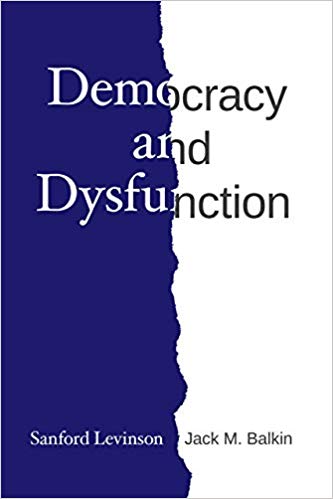
Sanford Levinson and Jack M. Balkin, Democracy and Dysfunction (University of Chicago Press, 2019)

Sanford Levinson, Written in Stone: Public Monuments in Changing Societies (Duke University Press 2018)

Mark A. Graber, Sanford Levinson, and Mark Tushnet, eds., Constitutional Democracy in Crisis? (Oxford University Press 2018)

Gerard Magliocca, The Heart of the Constitution: How the Bill of Rights became the Bill of Rights (Oxford University Press, 2018)

Cynthia Levinson and Sanford Levinson, Fault Lines in the Constitution: The Framers, Their Fights, and the Flaws that Affect Us Today (Peachtree Publishers, 2017)

Brian Z. Tamanaha, A Realistic Theory of Law (Cambridge University Press 2017)

Sanford Levinson, Nullification and Secession in Modern Constitutional Thought (University Press of Kansas 2016)

Sanford Levinson, An Argument Open to All: Reading The Federalist in the 21st Century (Yale University Press 2015)

Stephen M. Griffin, Broken Trust: Dysfunctional Government and Constitutional Reform (University Press of Kansas, 2015)

Frank Pasquale, The Black Box Society: The Secret Algorithms That Control Money and Information (Harvard University Press, 2015)

Bruce Ackerman, We the People, Volume 3: The Civil Rights Revolution (Harvard University Press, 2014)
Balkinization Symposium on We the People, Volume 3: The Civil Rights Revolution

Joseph Fishkin, Bottlenecks: A New Theory of Equal Opportunity (Oxford University Press, 2014)

Mark A. Graber, A New Introduction to American Constitutionalism (Oxford University Press, 2013)

John Mikhail, Elements of Moral Cognition: Rawls' Linguistic Analogy and the Cognitive Science of Moral and Legal Judgment (Cambridge University Press, 2013)

Gerard N. Magliocca, American Founding Son: John Bingham and the Invention of the Fourteenth Amendment (New York University Press, 2013)

Stephen M. Griffin, Long Wars and the Constitution (Harvard University Press, 2013)

Andrew Koppelman, The Tough Luck Constitution and the Assault on Health Care Reform (Oxford University Press, 2013)

James E. Fleming and Linda C. McClain, Ordered Liberty: Rights, Responsibilities, and Virtues (Harvard University Press, 2013)
Balkinization Symposium on Ordered Liberty: Rights, Responsibilities, and Virtues

Andrew Koppelman, Defending American Religious Neutrality (Harvard University Press, 2013)

Brian Z. Tamanaha, Failing Law Schools (University of Chicago Press, 2012)

Sanford Levinson, Framed: America's 51 Constitutions and the Crisis of Governance (Oxford University Press, 2012)

Linda C. McClain and Joanna L. Grossman, Gender Equality: Dimensions of Women's Equal Citizenship (Cambridge University Press, 2012)

Mary Dudziak, War Time: An Idea, Its History, Its Consequences (Oxford University Press, 2012)

Jack M. Balkin, Living Originalism (Harvard University Press, 2011)

Jason Mazzone, Copyfraud and Other Abuses of Intellectual Property Law (Stanford University Press, 2011)

Richard W. Garnett and Andrew Koppelman, First Amendment Stories, (Foundation Press 2011)

Jack M. Balkin, Constitutional Redemption: Political Faith in an Unjust World (Harvard University Press, 2011)

Gerard Magliocca, The Tragedy of William Jennings Bryan: Constitutional Law and the Politics of Backlash (Yale University Press, 2011)

Bernard Harcourt, The Illusion of Free Markets: Punishment and the Myth of Natural Order (Harvard University Press, 2010)

Bruce Ackerman, The Decline and Fall of the American Republic (Harvard University Press, 2010)
Balkinization Symposium on The Decline and Fall of the American Republic

Ian Ayres. Carrots and Sticks: Unlock the Power of Incentives to Get Things Done (Bantam Books, 2010)

Mark Tushnet, Why the Constitution Matters (Yale University Press 2010)

Ian Ayres and Barry Nalebuff: Lifecycle Investing: A New, Safe, and Audacious Way to Improve the Performance of Your Retirement Portfolio (Basic Books, 2010)
.jpg)
Jack M. Balkin, The Laws of Change: I Ching and the Philosophy of Life (2d Edition, Sybil Creek Press 2009)

Brian Z. Tamanaha, Beyond the Formalist-Realist Divide: The Role of Politics in Judging (Princeton University Press 2009)
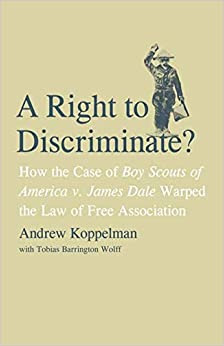
Andrew Koppelman and Tobias Barrington Wolff, A Right to Discriminate?: How the Case of Boy Scouts of America v. James Dale Warped the Law of Free Association (Yale University Press 2009)

Jack M. Balkin and Reva B. Siegel, The Constitution in 2020 (Oxford University Press 2009)

Heather K. Gerken, The Democracy Index: Why Our Election System Is Failing and How to Fix It (Princeton University Press 2009)

Mary Dudziak, Exporting American Dreams: Thurgood Marshall's African Journey (Oxford University Press 2008)

David Luban, Legal Ethics and Human Dignity (Cambridge Univ. Press 2007)

Ian Ayres, Super Crunchers: Why Thinking-By-Numbers is the New Way to be Smart (Bantam 2007)

Jack M. Balkin, James Grimmelmann, Eddan Katz, Nimrod Kozlovski, Shlomit Wagman and Tal Zarsky, eds., Cybercrime: Digital Cops in a Networked Environment (N.Y.U. Press 2007)
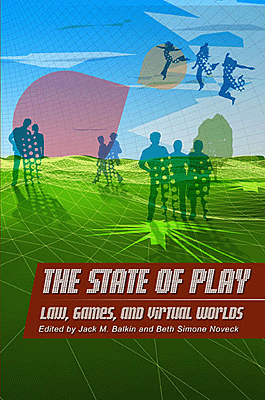
Jack M. Balkin and Beth Simone Noveck, The State of Play: Law, Games, and Virtual Worlds (N.Y.U. Press 2006)

Andrew Koppelman, Same Sex, Different States: When Same-Sex Marriages Cross State Lines (Yale University Press 2006)

Brian Tamanaha, Law as a Means to an End (Cambridge University Press 2006)

Sanford Levinson, Our Undemocratic Constitution (Oxford University Press 2006)

Mark Graber, Dred Scott and the Problem of Constitutional Evil (Cambridge University Press 2006)

Jack M. Balkin, ed., What Roe v. Wade Should Have Said (N.Y.U. Press 2005)

Sanford Levinson, ed., Torture: A Collection (Oxford University Press 2004)
Balkin.com homepage
Bibliography
Conlaw.net
Cultural Software
Writings
Opeds
The Information Society Project
BrownvBoard.com
Useful Links
Syllabi and Exams
