Balkinization
an unanticipated consequence of
Jack M. Balkin
Balkinization Symposiums: A Continuing List
E-mail:
Jack Balkin:
jackbalkin at yahoo.com
Bruce Ackerman
bruce.ackerman at yale.edu
Ian Ayres
ian.ayres at yale.edu
Corey Brettschneider
corey_brettschneider at brown.edu
Mary Dudziak
mary.l.dudziak at emory.edu
Joey Fishkin
joey.fishkin at gmail.com
Heather Gerken heather.gerken at yale.edu
Abbe Gluck abbe.gluck at yale.edu
Mark Graber
mgraber at law.umaryland.edu
Stephen Griffin
sgriffin at tulane.edu
Jonathan Hafetz
jonathan.hafetz at shu.edu
Jeremy Kessler
jkessler at law.columbia.edu
Andrew Koppelman
akoppelman at law.northwestern.edu
Marty Lederman
msl46 at law.georgetown.edu
Sanford Levinson
slevinson at law.utexas.edu
David Luban
david.luban at gmail.com
Gerard Magliocca
gmaglioc at iupui.edu
Jason Mazzone
mazzonej at illinois.edu
Linda McClain
lmcclain at bu.edu
John Mikhail
mikhail at law.georgetown.edu
Frank Pasquale
pasquale.frank at gmail.com
Nate Persily
npersily at gmail.com
Michael Stokes Paulsen
michaelstokespaulsen at gmail.com
Deborah Pearlstein
dpearlst at yu.edu
Rick Pildes
rick.pildes at nyu.edu
David Pozen
dpozen at law.columbia.edu
Richard Primus
raprimus at umich.edu
K. Sabeel Rahmansabeel.rahman at brooklaw.edu
Alice Ristroph
alice.ristroph at shu.edu
Neil Siegel
siegel at law.duke.edu
David Super
david.super at law.georgetown.edu
Brian Tamanaha
btamanaha at wulaw.wustl.edu
Nelson Tebbe
nelson.tebbe at brooklaw.edu
Mark Tushnet
mtushnet at law.harvard.edu
Adam Winkler
winkler at ucla.edu
Compendium of posts on Hobby Lobby and related cases
The Anti-Torture Memos: Balkinization Posts on Torture, Interrogation, Detention, War Powers, and OLC
The Anti-Torture Memos (arranged by topic)
Recent Posts
The Curious Case of Goodling and the Immigration Judges
![[Powered by Blogger]](https://lh3.googleusercontent.com/blogger_img_proxy/AEn0k_tFvw4t_fRjqUV0XMMUos6UupLcQB2nw7ZYQTgxf7H0-zhrsDnBwNJ3uRPFP7C9rge5faDkktWtOhXIuF4MnWGle62ugECDl9rmwlz9t7so=s0-d)
Just A Few Blogs
ACS Blog
Alas, a Blog
Althouse
Arts and Letters Daily
Atrios (Eschaton)
Bill of Health
Buzzflash.com
Buzz Machine
Cato at Liberty
Juan Cole (Informed Comment)
Concurring Opinions
The Constitution in 2020
Corrente
Crooked Timber
Daily Howler
Daily Kos
Dana Boyd
Brad DeLong
Digby (Hullabaloo)
Discriminations
Daniel Drezner
Kevin Drum (Mother Jones)
Electrolite
En Banc
Eunomia (Daniel Larison)
Fafblog
Michael Froomkin (Discourse.net)
GovLab (Beth Noveck)
Rick Hasen (Election Law)
History News Network
How Appealing
Ignatz (Sam Heldman)
The Importance of (Ernie Miller)
Infolaw
Instapundit
International Economic Law and Policy Blog
IntLawGrrls
Jacob Levy
Jesus' General
Jurisdynamics
The Kitchen Cabinet
Mark Kleiman
Law Blog Central
Larry Lessig
Lawyers, Guns and Money
Liberal Oasis
Brian Leiter's Law School Reports
The Leiter Reports
Marginal Revolution
Megan McArdle
Memeorandum
Metafilter
Mirror of Justice
The New Republic
Newseum
No More Mister Nice Blog
Brendan Nyhan
Opinio Juris
Orcinus
The Originalism Blog
Pandagon
Passport (Foreign Policy)
Overcoming Bias
Political Animal (Washington Monthly)
Political Theory Daily Review
Political Wire (Taegan Goddard)
The Poor Man
Virginia Postrel
Prawfsblawg
Public Reason
Jonathan Rauch
Raw Story
Redstate
ReligiousLeftLaw.com
Reporters Committee For Freedom of the Press
Reproductive Rights Blog
Rothman's Roadmap to the Right of Publicity
SCOTUS Blog
Seeing the Forest
Clay Shirky
The Shifted Librarian
The Situationist
Larry Solum (Legal Theory)
Andrew Sullivan
Talking Points Memo
Talk Left
Tapped
Tbogg
TechPresident
The Paper Chase (Jurist)
Tom Paine
Tom Tomorrow (This Modern World)
Eve Tushnet
Uggabugga
University of Chicago Law School Faculty Blog
Unqualified Offerings
The Volokh Conspiracy
War and Piece (Laura Rozen)
Wampum
Oliver Willis
Wonkette
Written Description
Matthew Yglesias
Yin
Your Choice of Feeds
1. XML
powered by

2. Atom Feed
3. RSS 2.0
The Curious Case of Goodling and the Immigration Judges
Marty Lederman
[UPDATED below with a bit of law and today's developments.]
Without any provocation, nor any prior public discussion about the matter, Monica Goodling in her prepared statement acknowledged that she "took political considerations into account in making recommendations for positions as Immigration Judges and members of the Board of Immigration Appeals." See discussion here. She testified that she thought such political criteria could be used because Kyle Sampson had told her that OLC "had provided guidance some years earlier indicating that Immigration Judge appointments were not subject to the civil service rules applicable to other career positions." Goodling further testified, however, that in late 2006 the Civil Division "expressed concerns that the civil service rules might apply" to such immigration judges. In her oral testimony, Goodling specified that "concerns were raised about political criteria for such employment decisions as a result of some litigation, after which "the Civil Division came to a different conclusion" from that allegedly reached by OLC.
There is no published OLC opinion on this question. And according to an article by Rick Schmitt of the L.A. Times, a DOJ spokesperson on Thursday said that no such OLC opinion exists, and further denied outright Goodling's testimony that the hiring of immigration judges was frozen after Civil Division concerns: "'There is no disagreement within the department, including between the Civil Division and the Office of Legal Counsel, about whether the civil-service laws apply to the appointment of immigration judges,' said Dean Boyd, a Justice Department spokesman. 'They do apply.'"
Something is happening here, but we don't don't what it is. Goodling obviously knew that her conduct in this regard was dubious, and testified about it even though no one had raised any question about it previously, so as to ensure that her immunity would extend to this episode, as well. (She was very well-advised by John Dowd.)
Although DOJ now asserts unequivocally that the civil service laws apply to the appointment of IJs (which would presumably mean they cannot be hired with an eye to partisan considerations such as party affiliation, voting and political contribution history), it's not immediately apparent where in federal law that is specified. (I'd be very grateful for any information on the legal question.) And what about the appellate judges -- the members of the BIA that Goodling spoke about? Why did she think there was an OLC opinion? A civil case raising the question? A dispute between OLC and Civil?
We haven't heard the last of this new wrinkle.
[UPDATE on the law and dueling public statements between DOJ and Goodling:
Thanks much to those who have written by e-mail and in the comments with information on the law. I don't have time for research to confirm all this just now, but this appears to be basic outline: 5 U.S.C. 2302(b)(1)(E) prohibits all personnel actions -- including appointments -- with respect to "covered positions," on the basis of political affiliation. "Covered positions," in turn, include "any position in the competitive service, a career appointee position in the Senior Executive Service, or a position in the excepted service." Section 2302(a)(2)(B).
Members of the BIA and IJ judges are part of the "excepted service," and therefore political affiliation cannot be a basis for any personnel actions regarding them, unless those positions are subject to the exception described in subsection 2302(a)(2)(B), i.e., "any position which is, prior to the personnel action--
(i) excepted from the competitive service because of its confidential, policy-determining, policy-making, or policy-advocating character; or
(ii) excluded from the coverage of this section by the President based on a determination by the President that it is necessary and warranted by conditions of good administration."
Until this Administration, BIA members and IJs were not thought to be included within the exception. But there is some reason to think that the Bush Justice Department determined that, because the Attorney General has the authority to appoint members of the BIA and IJs, those positions must therefore be of a "policy-determining [or] policy-making character," and thus exempted from civil service protections. In his recent article in the Cornell Law Review, Deportation and the War on Independence, 91 Cornell L. Rev. 369 (2006), Steve Legomsky points to a 2002 final regulation, 67 Fed. Reg. 54,878, 54,893 (Aug. 26, 2002), as suggesting that, in the view of AG Ashcroft, the AG has virtually unbounded discretion to remove all attorneys in DOJ, including in particular BIA members and IJs. (The commentary to the reg does not quite say that in so many words -- but there's a strong insinuation.) And one year later, Ashcroft in fact removed many BIA members, virtually all of them viewed as liberal or more sympathetic to aliens' claims. Similarly, as Jason McClure reported last June, since 2004, appointments to be IJs have been largely reserved for persons whose principal qualification appears to be that they have been loyal Republicans.
Thus, there is some circumstantial evidence, at least, supporting Goodling's testimony that DOJ had determined that the civil service laws do not protect IJs and members of the BIA.
DOJ now denies any such thing -- it claims that the immigration judges are not excepted and thus are protected by the civil service laws. However, Goodling has obviously hit a nerve. John Dowd, Goodling's lawyer, issued this reply to DOJ today (thanks to TPM):Today, Department of Justice spokesman Dean Boyd stated that the Department had "located no record of an Office of Legal Counsel opinion advising that Immigration Judges may be appointed on the basis of political considerations or that civil service laws do not apply to such appointments."
]
Ms. Goodling is aware of the fact that the Office of Legal Counsel never issued a formal opinion on the matter, and she did not suggest otherwise in her testimony before the House Judiciary Committee. Around the time Ms. Goodling became White House liaison in April 2005, Mr. Kyle Sampson told her that Acting Assistant Attorney General [for OLC] Daniel Levin had advised that Immigration Judgeships were not subject to the civil service rules applicable to other career positions. Ms. Goodling testified consistently with these facts before the House Judiciary Committee.
In her written remarks, Ms. Goodling testified:Around the time I became White House Liaison in April 2005, Mr. Sampson told me that the Office of Legal Counsel (OLC) had provided guidance some years earlier indicating that Immigration Judge appointments were not subject to the civil service rules applicable to other career positions.
This testimony is truthful and accurate.
In response to questions from Representative Nadler, Ms. Goodling stated:I was informed that the Office of Legal Counsel had said that because those were positions under a direct appointment authority of the Attorney General, that we could consider other factors in those cases. Later, concerns were raised as a result of some litigation and the Civil Division came to a different conclusion. As a result of that, we actually froze hiring late in December of last year.
This testimony is truthful and accurate.
In response to questions from Representative Goodlatte, Ms. Goodling stated:In other cases like immigration judges and Board of Immigration appeals, I thought that we could consider other factors because I had been told that, in relation to immigration judges -- and I think my assumption was that that applied to the BIA as well.
This testimony is truthful and accurate.
Finally, in response to questions from Representative Sherman, Ms. Goodling stated:If you're asking about other categories like immigration judges or BIA members, originally, I was told that we could, particularly in relation to the immigration judges. And I assumed it applied to BIA positions as well. I was told that those factors could be considered.
This testimony is truthful and accurate.
Posted
12:50 AM
by Marty Lederman [link]

One clarification: I believe that she only received "use immunity." So testifying on the topic didn't immunize her against prosecution. However, I think you're still right, Marty, that she was very well advised. Having the immunized testimony out there creates all kinds of troubles for prosecutors who might later decide to charge her. See Iran/Contra.
Hmmm, that makes sense. Make sure that you get asked about anything potentially criminal; if it's not in your testimony and they find out about it, you can still be prosecuted (although they'd have to show that they would have found out about it despite what you did say).
Cheers,
http://www.10zenmonkeys.com/2007/05/24/justice-department-scandal-greg-palast/
The Future of America Has Been Stolen
JD: Do you have a wide-angle view of the current Administration’s strategy with the Justice Department, and if so, give us the summary. Is it about election theft, or is it mostly about stocking the lake for future conservative judge appointments?
GP: Yes. First, it’s elections. They don’t want the voters making any foolish choices. Specifically, while the attention’s been focused 100% on the firings, no one is talking about the hirings. That’s what Goodling was trying to get across.
The key: at the Pearl Harbor Day massacre, they replaced one of the prosecutors with Rove-bots, a sleeper cell of anti-Constitutional saboteurs who will explode in 2008, led by the new prosecutor for Arkansas, Tim Griffin.
JD: Talk a little bit about the relevance of Tim Griffin — the perp who became prosecutor — and Arkansas in 2008.
GP: It was Griffin who directed the “caging” ops for the GOP. Caging, by the way, is illegal. Law Professor Bobby Kennedy pointed out it violates the Voting Rights Act of 1965 — and I’d add, as a former racketeering investigator, mail fraud statutes. So Griffin’s a felon — now U.S. Attorney.
IANAL, so forgive me (after correcting me) if I'm way off, folks.
8 CFR 1001.1 defines an "immigration judge" as an attorney appointed by the AG as "an administrative judge within the Executive Office
for Immigration Review...subject to such supervision and (who) shall perform such duties as the Attorney General shall prescribe..."
5 USC 2302 prohibits the use of political affiliation in hiring decisions for any covered position, which includes competitive service positions, career appointees in the Senior Executive service, or a position in the excepted service, unless it has been specifically excluded from coverage by dint of Presidential decree or the confidential policy-making nature of the position.
In the revision notes for 5 USC 3105 ("Appointment of Administrative law judges"), it says "The words “Subject to the civil service” are omitted as unnecessary inasmuch as appointments are made subject to the civil service laws unless specifically excepted."
In short, unless there's a specific statute that excludes immigration judges from coverage under 5 USC 2301-2, the appointments do seem to be subject to the civil service rules. Wading through the code, I'm not really sure where anyone could get a contrary opinion.
IANAL, but I do know that in the private sector, asking indirect questions to determine information that can be used to discriminate against protected classes is also frowned upon by HR departments, if not outright prohibited.
Of course, IIRC, if you had asked Arne a few years back if he was a member of the Federalist Society (in order to discreetly determine if he was a good conservative) you may have been shocked with what you got if that was your sole criterion.
I'm taking a late lunch so I had time to pull the relevant volume of the U.S. Code off the library shelf.
If we are talking about a violation of 5 U.S.C. 2302(b)(1)(E), that paragraph prohibits discriminating in personal actions related to covered positions based on political affiliation. I don't see how any question would be a prima faci violation of this provision. Instead, the questions provide evidence of discrimination. The further that the question moves from soliciting information about political affiliation, the weaker the evidence would be.
I don't practice in the field of labor law though; I just pulled the title off the library shelf.
Note: 5 USC 2302(b)(1)(E) requires that the discrimination be "prohibited under any law, rule, or regulation." The other law that applies here (and I am not sure what it is) may tell us more.
Typically, an HR person would ask a question like "to what professional organizations do you belong?" So, it's more or less a legal question.
However, if the political leaning inferred from those sorts of questions are used as criteria of evaluation in the hiring process, I think that yes, it would be illegal under the limited amount of statutes and code that I've researched.
selection and advancement should be determined solely on the basis of relative ability, knowledge, and skills, after fair and open competition which assures that all receive equal opportunity.
Nothing in there about favorite justices or political alignment at all.
Note that Goodling didn't claim to have asked a couple of irrelevant politically-oriented questions and let it drop. Rather, she said explicitly that she "took political considerations into account in making recommendations for positions as Immigration Judges and members of the Board of Immigration Appeals."
Based on my awe-inspiring minutes of research, her action would seem to be clearly illegal.
I'd love to see what justification Levin has/had for excluding IJs from the civil service rules.
Maybe he'll announce that he said no such thing?
Even if Daniel Levin denies it, that's just one more thing Goodling is pegging on Kyle Sampson. You (and QuiteAlarmed) have a good point that no interviewee should ever be asked these questions. I'd go right to the Federalist Society member lists (although we all know in John Roberts' case, that was not completely reliable) and other indepedent sources. For instance, you can easily verify anyone's party registration e.g. www.voterlistsonline.com (although Arizona and Pennsylvania records cannot be directly downloaded). Of course, I'm not in charge of hiring Immigration Judges ; )
QuiteAlarmed:
No, but we don't get to pick and choose our facts, do we?
Really? I thought that Mr. DePalma had elected to proceed pro se.
1) That the witness was scheduled to be a witness in court;
2) That the person used intimidation/physical force against such witness; and
3) That the person did so knowingly and willfully with the intent to influence the testimony of the witness.
To act with intent to "influence" the testimony of a witness means to act for the purpose of getting the witness to change or color or shade his or her testimony in some way;
A growing number of the jurists have little or no experience in that area of law. Some have strong Republican resumes"
http://www.latimes.com/news/politics/la-na-usattys26may26,0,7211442.story?coll=la-home-center
That "nothing illegal" or "nothing much illegal" was done will be a fine epitaph for this administration.
"Based on my awe-inspiring minutes of research, her action would seem to be clearly illegal."
"# posted by PMS_Chicago : 2:13 PM"
In view of the fact that the DOJ responded to her claim that she'd been told (cum laude, and she didn't ask to read the opinion for herself?) it wasn't illegal to apply political criteria, her admission of having done so raises several possibilities:
1. It's illegal.
2. It was and is uncertain, but it may be, or be found to be, illegal.
3. Bushit decreed it legal; but that stems, as so much else with his actions, from a nub of illegality.
So her lawyer has her playing it safe by admitting that which will likely be found by investigation.
But let's not pretend she didn't know at the time that there was at least a question about its legality.
And why does Samson -- the vicious facial cast -- remind me of Erlichman?
"# posted by Charles : 7:53 PM"
I'll bite: what complaints have you seen from a _credible_ source?
Fine with me. If anyone else wants to discuss 18 USC 1512(b) or any other alleged lawbreaking by the Attorney General, please let me know.
JohnLopresti:
Please provide even ONE example of a Republican being nominated by Clinton for federal District, Appeals, or Supreme Court Justice. If the ABA was consistently refusing to qualify DEMOCRATS, would it be O.K. to ignore them then?
JNagarya:
Is a United Stated Congressman NOT "a _credible_ source" just because he's a Republican? The ABA is looking for a few good people just like you.
Cara mengobati kanker dengan herbal, Cara mengobati kanker dengan tradisional, Cara mengobati kanker dengan alami, Cara mengobati kanker dengan cepat, Cara mengobati kanker stadium 3, Cara mengobati kanker stadium 4, Cara mengobati kanker stadium awal, Cara mengobati kanker stadium 2, Cara mengobati kanker stadium akhir, Cara mengobati kanker tanpa ke dokter, Gambar obat kanker yang ampuh, Gambar obat kanker yang ampuh, Obat kanker ampuh dengan singkong, Cara mengobati kanker stadium awal tanpa operasi, Obat kanker manjur dari tumbuhan, Cara mengobati kanker stadium 1 tanpa operasi, Obat kanker ampuh dengan daun sirsak, Cara mengobati kanker stadium 2 tanpa operasi, Obat kanker paling mujarab yang efektif, Cara mengobati kanker stadium 3 tanpa operasi, Cara mengobati kanker stadium 3, Cara mengobati kanker stadium 4 tanpa operasi, Obat kanker paling manjur 2016, Cara mengobati kanker stadium akhir tanpa operasi, Pengobatan kanker mujarab tanpa operasi, Cara pengobatan kanker yang manjur, Pengobatan kanker manjur dan aman, Cara pengobatan kanker yang mujarab, Cara pengobatan kanker tanpa operasi, Cara pengobatan kanker yang ampuh, Obat kanker mujarab tanpa operasi, Obat kanker manjur tanpa operasi, Obat De Nature

obat alami untuk mencegah kanker serviks
obat medis untuk kanker serviks
wwwobat kanker serviks
obat vaksin kanker serviks
obat untuk mengatasi kanker serviks
Tumbuhan untuk obat kanker serviks
Obat untuk menyembuhkan kanker serviks
obat untuk penderita kanker serviks
obat tradisional untuk kanker serviks
obat utk kanker serviks
obat untuk kanker serviks
obat tradisional utk kanker serviks
sirsak obat kanker serviks
obat sakit kanker serviks
hello world obat untuk kanker rahim stadium 3
obat herbal kanker rahim stadium 4
obat kanker rahim stadium 1 1
Obat kanker rahim stadium 2
Obat penyakit herpes kelamin pria
Obat herbal herpes genital manjuur sembuh 2 hari
Obat herbal herpes genital manjuur sembuh 2 hari
Obat herbal herpes genital manjuur sembuh 2 hari
Obat herbal herpes genital manjuur sembuh 2 hari
Obat herbal herpes genital manjuur sembuh 2 hari
Obat herbal herpes genital manjuur sembuh 2 hari
Obat herbal herpes genital manjuur sembuh 2 hari
Obat herbal herpes genital manjuur sembuh 2 hari
Obat herbal herpes genital manjuur sembuh 2 hari
Obat herbal herpes genital manjuur sembuh 2 hari
Obat herbal herpes genital manjuur sembuh 2 hari
Obat herbal herpes genital manjuur sembuh 2 hari
Obat herbal herpes genital manjuur sembuh 2 hari
Obat herbal herpes genital manjuur sembuh 2 hari
Obat herbal herpes genital manjuur sembuh 2 hari
Obat herbal herpes genital manjuur sembuh 2 hari
obat kanker serviks manjur
obat kanker serviks manjur
obat kanker serviks manjur
obat kanker serviks manjur
obat kanker serviks tradisional jawa sumatera
Obat kanker serviks tradisional sumatera
Obat kanker serviks tradisional kalimantan
obat kanker serviks tradisional herbal jawa
obat kanker serviks tradisional herbal jawa sumatera
obat kanker serviks tradisional herbal sumatera
obat kanker serviks tradisional herbal suku pedalaman
obat kanker serviks tradisional herbal suku pedalaman sumatra
Obat kanker serviks tradisional herbal suku jawa
obat kanker serviks tradisional herbal s
obat kanker serviks tradisional herbal suku minang
obat kanker serviks tradisional herbal suku sunda
Obat kanker serviks tradisional herbal suku irian
obat kanker serviks tradisional herbal suku dayak
obat kanker serviks tradisional herbal suku kubu
obat tradisional kanker serviks suku
obat kanker serviks tradisional herbal suku bugis
obat herbal herpes genital dompo
obat herbal herpes genital dompo simplex
Books by Balkinization Bloggers

Gerard N. Magliocca, The Actual Art of Governing: Justice Robert H. Jackson's Concurring Opinion in the Steel Seizure Case (Oxford University Press, 2025)

Linda C. McClain and Aziza Ahmed, The Routledge Companion to Gender and COVID-19 (Routledge, 2024)

David Pozen, The Constitution of the War on Drugs (Oxford University Press, 2024)

Jack M. Balkin, Memory and Authority: The Uses of History in Constitutional Interpretation (Yale University Press, 2024)
Mark A. Graber, Punish Treason, Reward Loyalty: The Forgotten Goals of Constitutional Reform after the Civil War (University of Kansas Press, 2023)
Jack M. Balkin, What Roe v. Wade Should Have Said: The Nation's Top Legal Experts Rewrite America's Most Controversial Decision - Revised Edition (NYU Press, 2023)

Andrew Koppelman, Burning Down the House: How Libertarian Philosophy Was Corrupted by Delusion and Greed (St. Martin’s Press, 2022)

Gerard N. Magliocca, Washington's Heir: The Life of Justice Bushrod Washington (Oxford University Press, 2022)
Joseph Fishkin and William E. Forbath, The Anti-Oligarchy Constitution: Reconstructing the Economic Foundations of American Democracy (Harvard University Press, 2022)
Mark Tushnet and Bojan Bugaric, Power to the People: Constitutionalism in the Age of Populism (Oxford University Press 2021).

Mark Philip Bradley and Mary L. Dudziak, eds., Making the Forever War: Marilyn B. Young on the Culture and Politics of American Militarism Culture and Politics in the Cold War and Beyond (University of Massachusetts Press, 2021).

Jack M. Balkin, What Obergefell v. Hodges Should Have Said: The Nation's Top Legal Experts Rewrite America's Same-Sex Marriage Decision (Yale University Press, 2020)

Frank Pasquale, New Laws of Robotics: Defending Human Expertise in the Age of AI (Belknap Press, 2020)

Jack M. Balkin, The Cycles of Constitutional Time (Oxford University Press, 2020)

Mark Tushnet, Taking Back the Constitution: Activist Judges and the Next Age of American Law (Yale University Press 2020).

Andrew Koppelman, Gay Rights vs. Religious Liberty?: The Unnecessary Conflict (Oxford University Press, 2020)

Ezekiel J Emanuel and Abbe R. Gluck, The Trillion Dollar Revolution: How the Affordable Care Act Transformed Politics, Law, and Health Care in America (PublicAffairs, 2020)

Linda C. McClain, Who's the Bigot?: Learning from Conflicts over Marriage and Civil Rights Law (Oxford University Press, 2020)
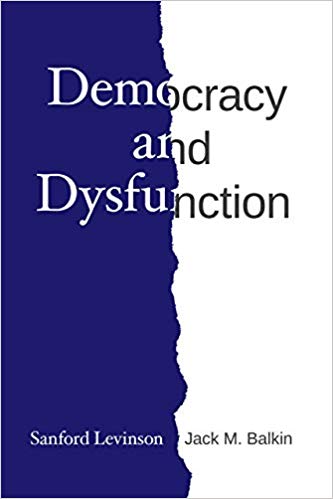
Sanford Levinson and Jack M. Balkin, Democracy and Dysfunction (University of Chicago Press, 2019)

Sanford Levinson, Written in Stone: Public Monuments in Changing Societies (Duke University Press 2018)

Mark A. Graber, Sanford Levinson, and Mark Tushnet, eds., Constitutional Democracy in Crisis? (Oxford University Press 2018)

Gerard Magliocca, The Heart of the Constitution: How the Bill of Rights became the Bill of Rights (Oxford University Press, 2018)

Cynthia Levinson and Sanford Levinson, Fault Lines in the Constitution: The Framers, Their Fights, and the Flaws that Affect Us Today (Peachtree Publishers, 2017)

Brian Z. Tamanaha, A Realistic Theory of Law (Cambridge University Press 2017)

Sanford Levinson, Nullification and Secession in Modern Constitutional Thought (University Press of Kansas 2016)

Sanford Levinson, An Argument Open to All: Reading The Federalist in the 21st Century (Yale University Press 2015)

Stephen M. Griffin, Broken Trust: Dysfunctional Government and Constitutional Reform (University Press of Kansas, 2015)

Frank Pasquale, The Black Box Society: The Secret Algorithms That Control Money and Information (Harvard University Press, 2015)

Bruce Ackerman, We the People, Volume 3: The Civil Rights Revolution (Harvard University Press, 2014)
Balkinization Symposium on We the People, Volume 3: The Civil Rights Revolution

Joseph Fishkin, Bottlenecks: A New Theory of Equal Opportunity (Oxford University Press, 2014)

Mark A. Graber, A New Introduction to American Constitutionalism (Oxford University Press, 2013)

John Mikhail, Elements of Moral Cognition: Rawls' Linguistic Analogy and the Cognitive Science of Moral and Legal Judgment (Cambridge University Press, 2013)

Gerard N. Magliocca, American Founding Son: John Bingham and the Invention of the Fourteenth Amendment (New York University Press, 2013)

Stephen M. Griffin, Long Wars and the Constitution (Harvard University Press, 2013)

Andrew Koppelman, The Tough Luck Constitution and the Assault on Health Care Reform (Oxford University Press, 2013)

James E. Fleming and Linda C. McClain, Ordered Liberty: Rights, Responsibilities, and Virtues (Harvard University Press, 2013)
Balkinization Symposium on Ordered Liberty: Rights, Responsibilities, and Virtues

Andrew Koppelman, Defending American Religious Neutrality (Harvard University Press, 2013)

Brian Z. Tamanaha, Failing Law Schools (University of Chicago Press, 2012)

Sanford Levinson, Framed: America's 51 Constitutions and the Crisis of Governance (Oxford University Press, 2012)

Linda C. McClain and Joanna L. Grossman, Gender Equality: Dimensions of Women's Equal Citizenship (Cambridge University Press, 2012)

Mary Dudziak, War Time: An Idea, Its History, Its Consequences (Oxford University Press, 2012)

Jack M. Balkin, Living Originalism (Harvard University Press, 2011)

Jason Mazzone, Copyfraud and Other Abuses of Intellectual Property Law (Stanford University Press, 2011)

Richard W. Garnett and Andrew Koppelman, First Amendment Stories, (Foundation Press 2011)

Jack M. Balkin, Constitutional Redemption: Political Faith in an Unjust World (Harvard University Press, 2011)

Gerard Magliocca, The Tragedy of William Jennings Bryan: Constitutional Law and the Politics of Backlash (Yale University Press, 2011)

Bernard Harcourt, The Illusion of Free Markets: Punishment and the Myth of Natural Order (Harvard University Press, 2010)

Bruce Ackerman, The Decline and Fall of the American Republic (Harvard University Press, 2010)
Balkinization Symposium on The Decline and Fall of the American Republic

Ian Ayres. Carrots and Sticks: Unlock the Power of Incentives to Get Things Done (Bantam Books, 2010)

Mark Tushnet, Why the Constitution Matters (Yale University Press 2010)

Ian Ayres and Barry Nalebuff: Lifecycle Investing: A New, Safe, and Audacious Way to Improve the Performance of Your Retirement Portfolio (Basic Books, 2010)
.jpg)
Jack M. Balkin, The Laws of Change: I Ching and the Philosophy of Life (2d Edition, Sybil Creek Press 2009)

Brian Z. Tamanaha, Beyond the Formalist-Realist Divide: The Role of Politics in Judging (Princeton University Press 2009)
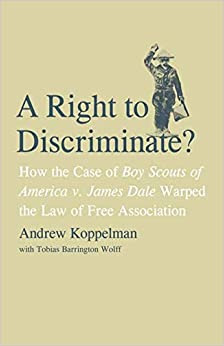
Andrew Koppelman and Tobias Barrington Wolff, A Right to Discriminate?: How the Case of Boy Scouts of America v. James Dale Warped the Law of Free Association (Yale University Press 2009)

Jack M. Balkin and Reva B. Siegel, The Constitution in 2020 (Oxford University Press 2009)

Heather K. Gerken, The Democracy Index: Why Our Election System Is Failing and How to Fix It (Princeton University Press 2009)

Mary Dudziak, Exporting American Dreams: Thurgood Marshall's African Journey (Oxford University Press 2008)

David Luban, Legal Ethics and Human Dignity (Cambridge Univ. Press 2007)

Ian Ayres, Super Crunchers: Why Thinking-By-Numbers is the New Way to be Smart (Bantam 2007)

Jack M. Balkin, James Grimmelmann, Eddan Katz, Nimrod Kozlovski, Shlomit Wagman and Tal Zarsky, eds., Cybercrime: Digital Cops in a Networked Environment (N.Y.U. Press 2007)

Jack M. Balkin and Beth Simone Noveck, The State of Play: Law, Games, and Virtual Worlds (N.Y.U. Press 2006)

Andrew Koppelman, Same Sex, Different States: When Same-Sex Marriages Cross State Lines (Yale University Press 2006)

Brian Tamanaha, Law as a Means to an End (Cambridge University Press 2006)

Sanford Levinson, Our Undemocratic Constitution (Oxford University Press 2006)

Mark Graber, Dred Scott and the Problem of Constitutional Evil (Cambridge University Press 2006)

Jack M. Balkin, ed., What Roe v. Wade Should Have Said (N.Y.U. Press 2005)

Sanford Levinson, ed., Torture: A Collection (Oxford University Press 2004)
Balkin.com homepage
Bibliography
Conlaw.net
Cultural Software
Writings
Opeds
The Information Society Project
BrownvBoard.com
Useful Links
Syllabi and Exams
