Balkinization
an unanticipated consequence of
Jack M. Balkin
Balkinization Symposiums: A Continuing List
E-mail:
Jack Balkin:
jackbalkin at yahoo.com
Bruce Ackerman
bruce.ackerman at yale.edu
Ian Ayres
ian.ayres at yale.edu
Corey Brettschneider
corey_brettschneider at brown.edu
Mary Dudziak
mary.l.dudziak at emory.edu
Joey Fishkin
joey.fishkin at gmail.com
Heather Gerken heather.gerken at yale.edu
Abbe Gluck abbe.gluck at yale.edu
Mark Graber
mgraber at law.umaryland.edu
Stephen Griffin
sgriffin at tulane.edu
Jonathan Hafetz
jonathan.hafetz at shu.edu
Jeremy Kessler
jkessler at law.columbia.edu
Andrew Koppelman
akoppelman at law.northwestern.edu
Marty Lederman
msl46 at law.georgetown.edu
Sanford Levinson
slevinson at law.utexas.edu
David Luban
david.luban at gmail.com
Gerard Magliocca
gmaglioc at iupui.edu
Jason Mazzone
mazzonej at illinois.edu
Linda McClain
lmcclain at bu.edu
John Mikhail
mikhail at law.georgetown.edu
Frank Pasquale
pasquale.frank at gmail.com
Nate Persily
npersily at gmail.com
Michael Stokes Paulsen
michaelstokespaulsen at gmail.com
Deborah Pearlstein
dpearlst at yu.edu
Rick Pildes
rick.pildes at nyu.edu
David Pozen
dpozen at law.columbia.edu
Richard Primus
raprimus at umich.edu
K. Sabeel Rahmansabeel.rahman at brooklaw.edu
Alice Ristroph
alice.ristroph at shu.edu
Neil Siegel
siegel at law.duke.edu
David Super
david.super at law.georgetown.edu
Brian Tamanaha
btamanaha at wulaw.wustl.edu
Nelson Tebbe
nelson.tebbe at brooklaw.edu
Mark Tushnet
mtushnet at law.harvard.edu
Adam Winkler
winkler at ucla.edu
Compendium of posts on Hobby Lobby and related cases
The Anti-Torture Memos: Balkinization Posts on Torture, Interrogation, Detention, War Powers, and OLC
The Anti-Torture Memos (arranged by topic)
Recent Posts
The Devil's Pitch: Sell Your Soul to Save Yourself
![[Powered by Blogger]](https://lh3.googleusercontent.com/blogger_img_proxy/AEn0k_uGt9weFR5BsIpqoGDczEqPnIgPLEqNcr5cW2VN2dplix3_iMp4Auddbeww4VHsMBC2rocerTym4DpH8x_2k5jgb1hy_VVMEZEkIC0Oi_dQ=s0-d)
Just A Few Blogs
ACS Blog
Alas, a Blog
Althouse
Arts and Letters Daily
Atrios (Eschaton)
Bill of Health
Buzzflash.com
Buzz Machine
Cato at Liberty
Juan Cole (Informed Comment)
Concurring Opinions
The Constitution in 2020
Corrente
Crooked Timber
Daily Howler
Daily Kos
Dana Boyd
Brad DeLong
Digby (Hullabaloo)
Discriminations
Daniel Drezner
Kevin Drum (Mother Jones)
Electrolite
En Banc
Eunomia (Daniel Larison)
Fafblog
Michael Froomkin (Discourse.net)
GovLab (Beth Noveck)
Rick Hasen (Election Law)
History News Network
How Appealing
Ignatz (Sam Heldman)
The Importance of (Ernie Miller)
Infolaw
Instapundit
International Economic Law and Policy Blog
IntLawGrrls
Jacob Levy
Jesus' General
Jurisdynamics
The Kitchen Cabinet
Mark Kleiman
Law Blog Central
Larry Lessig
Lawyers, Guns and Money
Liberal Oasis
Brian Leiter's Law School Reports
The Leiter Reports
Marginal Revolution
Megan McArdle
Memeorandum
Metafilter
Mirror of Justice
The New Republic
Newseum
No More Mister Nice Blog
Brendan Nyhan
Opinio Juris
Orcinus
The Originalism Blog
Pandagon
Passport (Foreign Policy)
Overcoming Bias
Political Animal (Washington Monthly)
Political Theory Daily Review
Political Wire (Taegan Goddard)
The Poor Man
Virginia Postrel
Prawfsblawg
Public Reason
Jonathan Rauch
Raw Story
Redstate
ReligiousLeftLaw.com
Reporters Committee For Freedom of the Press
Reproductive Rights Blog
Rothman's Roadmap to the Right of Publicity
SCOTUS Blog
Seeing the Forest
Clay Shirky
The Shifted Librarian
The Situationist
Larry Solum (Legal Theory)
Andrew Sullivan
Talking Points Memo
Talk Left
Tapped
Tbogg
TechPresident
The Paper Chase (Jurist)
Tom Paine
Tom Tomorrow (This Modern World)
Eve Tushnet
Uggabugga
University of Chicago Law School Faculty Blog
Unqualified Offerings
The Volokh Conspiracy
War and Piece (Laura Rozen)
Wampum
Oliver Willis
Wonkette
Written Description
Matthew Yglesias
Yin
Your Choice of Feeds
1. XML
powered by

2. Atom Feed
3. RSS 2.0
The Devil's Pitch: Sell Your Soul to Save Yourself
Brian Tamanaha
In a familiar movie scene, the Devil appears before the dying man with a compelling proposition: "I will save your life,...in exchange for your eternal soul."
Predictably, a weak character will take the deal. And the audience knows that, even though he has bought some extra time, he is lost forever.
The hero, who loves life just as dearly, feels the temptation, but ultimately says "no," knowing that death is preferable to losing one's soul. The audience applauds this decision, for living--and sometimes dying--with integrity is what defines a hero.
The Bush Administration's pitch is this: "I will do whatever it takes to save the American people,...even if that involves ignoring the law and torturing suspected terrorists."
This is a powerful pitch, for who does not feel anger at the idea that the lives of our fellow citizens is being threatened by our enemies. In exchange for our survival, however, we being asked to sacrifice the commitment to moral and legal ideals that define America.
But there is an additional twist here. By many accounts, it is a false dilemma, because we can save ourselves with methods that are consistent with our moral and legal ideals. It is like the trickster Devil who, knowing that the person's wounds are not fatal and that rescue is just around the corner, offers the proposition to a person who falsely believes that death is imminent. It was never necessary to make the deal.
We know what the hero would do. But that's in the movies. The choice now facing Congress and the American people is real.
Posted
3:49 PM
by Brian Tamanaha [link]

You're right, we didn't as a matter of official policy, because there wasn't an official policy that expressly stated the use of torture.
Instead, some captured and surrendering soldiers were just shot without a seconds thought.
Even more important, take the firebombing of German cities, particularly Dresden. Untold tens of thousands were killed to specifically demoralize the German population. The city itself was of little military value. While there was not an American law affirmatively allowing the mass killing of innocent German civilans, it happened nonetheless, repeatedly, and for all intents was "official policy."
If, as you posit, some did think Islamicism is a greater threat, maybe they would advocate the mass destruction of particular Arab cities, notorious for housing terrorists. But, wait, they don't.
So, in your perspective, its okay to kill/injure hundreds of thousands of innocent civilans, but not okay to apply harsh techniques to individuals we think can provide information that will save the lives of other innocents.
Now, you may try to argue that the above isn't relevant because you restricted the scope of your comments to official policies during WW2 as related to torture. Nevertheless, this restriction, if true, destroys the effectiveness of your analogy because it limits the analogy's scope so much as to make it worthless, e.g. the US used policies far worse in WW2 than the mild torture of a few suspected terrorists.
Is that a point in response? If so, its a complete canard.
I only raised our tactics in WW2 in comparison to the authority requested by Bush today. There was no comparison between our tactics in WW2 to the Nazis. I take it for granted that the US was right and fought a far more justly war than Germany.
I think that I have earlier posted with regard to Elaine Scarry's magnificent The Body in Pain, which includes not only the classic critique of torture, but also a tremendously important and moving analysis of war in general. I do think that non-pacifists must explain, more than they have been wont to do, precisely why "collateral damage" is acceptable, but all acts of torture are equally unacceptable. I've posted on this before and will not rehearse all of the arguments. But dismissing "humblelawstudent" as an agent of Karl Rove is much too facile.
For the record, I think that it is important to maintain the absolute ban on torture, but I do not regard people who disagree, like Alan Dershowitz, as moral monsters. The only true "purists," I believe, are pacifists, and I'm not sure that anyone who has contributed to Balkinization takes such a position. Everyone else is necessarily implicated in what Harry Blackmun once so memorably called "the machinery of death," and we have to figure out where we draw our lines.
"So, in your perspective, its okay to kill/injure hundreds of thousands of innocent civilans, but not okay to apply harsh techniques to individuals we think can provide information that will save the lives of other innocents."
This doesn't follow from SL's comments. They simply did not spell out he found it "okay" to firebomb cities per se, or in individual cases. His concern with possibly torturing one man suggests the point.
I think a reasonable stance can be taken that under modern rules firebombing of that sort is truly questionable. Certain people at the time, including here, thought so in fact.
I also think in many cases once a person is taken into custody different rules apply. Thus, lethal force might be used on a person to capture them in certain cases, but care must be taken once they are in custody. Given the person involved is rarely if ever the proverbial "Werner" this is surely the case.
I also find the term "mild torture" a bit amusing -- how many here agree with that little toss in? Tricky. Along with the combative tone and arguably strawman sounding argument, I don't find the comment neutral by any means. Rovian? Well, that is a bit facile.
As to "purists," so hard to find them. We are talking about treatment, not even war per se possibly, making it even harder.
But, no, I don't think many of the tactics used during WWII -- including firebombing -- is apt here. I might even say that I'd find some of them rather hard to justify. But, either way, we managed to give some due process to even saboteurs back then.
U.S. v. Ohlendorf ("The Einsatzgruppen Case"), Nuernberg Military Tribunal Vol. 4, 466-470.
The section on "Death of Noncombatants by Bombing".
A prisoner is defenseless and out of action. A city which has not surrendered is a legitimate military target. You kill civilians by attacking the city, but the object isn't to kill the civilians per se, it's to defeat the enemy power. If a city has surrendered, to attack it is clearly a war crime.
Each prisoner is a specific individual, and an attack on a prisoner is an assault on that individual as a person. Under Geneva, all prisoners are protected one way or another.
Now you can argue these things one way or another, but distinctions are possible.
Look up the bombing of Dresden. The city was of negligible military value. It was chosen specifically to demoralize the German people. It was also known that many refugees packed the streets and would likely die in an attack. They specifically picked conditions in an effort to create the enormous fire that consumed the city. There is a specific term for it that I forget at the moment. But, the point is, it was purposefully chosen and bombed to cause the greatest possible civilians causalties - with negligible military value.
"On January 27 Sinclair replied [to Churchill]:
"The Air Staff have now arranged that, subject to the overriding claims of attacks on enemy oil production and other approved target systems within the current directive, available effort should be directed against Berlin, Dresden, Chemnitz and Leipzig or against other cities where severe bombing would not only destroy communications vital to the evacuation from the east, but would also hamper the movement of troops from the west."[6][7]
The Joint Intelligence Committee (JIC) had come to the conclusion that the Germans could reinforce their eastern front with up to 42 divisions (half a million men) from other fronts and that, if the Soviet advance could be helped by hindering that movement, it could shorten the war. They thought that the Germans could complete the reinforcement by March 1945. The JIC's analysis was backed up by Ultra Enigma-code intercepts, which confirmed that the Germans had such plans. Their recommendation was:
"We consider, therefore, that the assistance which might be given to the Russians during the next few weeks by the British and American strategic bomber forces justifies an urgent review of their employment to this end. …Attacks against oil targets should continue to take precedence over everything else,…"[8]
The Soviets had several discussions with the Allies on how the strategic bomber force could help their ground offensives once the eastern front line approached Germany. The US ambassador to Russia, W. Averell Harriman, discussed it with Joseph Stalin as did General Eisenhower's deputy at SHAEF, British Air Marshal Arthur W. Tedder in January 1945, when he explained how the strategic bomber could support the Soviet attack as Germany began to shuffle forces between the fronts. On January 31 after studying the JIC recommendation which was contained in a document entitled "Strategic Bombing in Relation to the Present Russian Offensive" and consulting with the Soviets, Tedder and his air staff concurred and issued a recommendation that Berlin, Leipzig, Dresden, and associated cities should be attacked. The intention to use the strategic bomber forces in a tactical air-support role was similar to that for which Eisenhower had employed them before the Normandy invasion in 1944. He was counting on strategic airpower in 1945 to "prevent the enemy from switching forces back and forth at will" from one front to the other.[9][10]
When the Allies met at the Yalta Conference on February 4, the Western Allies had already decided to target Dresden. The Deputy Chief of the Soviet General Staff, General Aleksei Antonov raised two issues at the conference relating to the Western Allied strategic bomber force. The first was the demarcation of a bomb-line running north to south where to avoid accidentally bombing Soviet forces, Western Allied aircraft would not bomb east of the line without specific Soviet permission. The second was to hamper the movement of troops from the western front, Norway and Italy, in particular by paralysing the junctions of Berlin and Leipzig with aerial bombardment. In response to the Soviet requests, Portal (who was in Yalta) sent a request to Bottomley to send him a list of objectives which could be discussed with the Soviets. The list sent back to him included oil plants, tank and aircraft factories and the cities of Berlin and Dresden. In the discussions which followed, the Western Allies pointed out that unless Dresden was bombed as well, the Germans could route rail traffic through Dresden to compensate for any damage caused to Berlin and Leipzig. Antonov agreed and requested that Dresden be added to his list of requests. Once the targets had been agreed at Yalta, the Combined Strategic Targets Committee, SHAEF (Air), informed the USAAF and the RAF Bomber commands that Dresden was among the targets selected to degrade German lines of communication. Their authority to do this came directly from the Western Allies' Combined Chiefs of Staff.
RAF Air Staff documents state that it was their intention to use RAF bomber command to "destroy communications" to hinder the eastward deployment of German troops, and to hamper evacuation, not to kill the evacuees. The priority list drafted by Bottomley for Portal, so that he could discuss targets with the Soviets at Yalta, included only two eastern cities with a high enough priority to fit into the RAF targeting list as both transportation and industrial areas. These were Berlin and Dresden. Both were bombed after Yalta.
Soviet military intelligence asserted that trains stuck in the main station were troop trains passing through Dresden to the front. This proved incorrect, as they were trains evacuating refugees from the east[11]. RAF briefing notes mentioned a desire to show "the Russians, when they arrive, what Bomber Command can do." The specific intent of this statement is now unclear, and there are different possible interpretations: a statement of pride in the RAF's abilities; or to show the Soviets that the Western Allies were doing all they could to aid the Soviet advance; or an early cold war warning."
I have my doubts about this bombing and others in WWII (e.g., Tokyo), but I don't think the case is as clearcut as torture.
Cara mengobati kanker dengan herbal, Cara mengobati kanker dengan tradisional, Cara mengobati kanker dengan alami, Cara mengobati kanker dengan cepat, Cara mengobati kanker stadium 3, Cara mengobati kanker stadium 4, Cara mengobati kanker stadium awal, Cara mengobati kanker stadium 2, Cara mengobati kanker stadium akhir, Cara mengobati kanker tanpa ke dokter, Gambar obat kanker yang ampuh, Gambar obat kanker yang ampuh, Obat kanker ampuh dengan singkong, Cara mengobati kanker stadium awal tanpa operasi, Obat kanker manjur dari tumbuhan, Cara mengobati kanker stadium 1 tanpa operasi, Obat kanker ampuh dengan daun sirsak, Cara mengobati kanker stadium 2 tanpa operasi, Obat kanker paling mujarab yang efektif, Cara mengobati kanker stadium 3 tanpa operasi, Cara mengobati kanker stadium 3, Cara mengobati kanker stadium 4 tanpa operasi, Obat kanker paling manjur 2016, Cara mengobati kanker stadium akhir tanpa operasi, Pengobatan kanker mujarab tanpa operasi, Cara pengobatan kanker yang manjur, Pengobatan kanker manjur dan aman, Cara pengobatan kanker yang mujarab, Cara pengobatan kanker tanpa operasi, Cara pengobatan kanker yang ampuh, Obat kanker mujarab tanpa operasi, Obat kanker manjur tanpa operasi, Obat De Nature

obat alami untuk mencegah kanker serviks
obat medis untuk kanker serviks
wwwobat kanker serviks
obat vaksin kanker serviks
obat untuk mengatasi kanker serviks
Tumbuhan untuk obat kanker serviks
Obat untuk menyembuhkan kanker serviks
obat untuk penderita kanker serviks
obat tradisional untuk kanker serviks
obat utk kanker serviks
obat untuk kanker serviks
obat tradisional utk kanker serviks
sirsak obat kanker serviks
obat sakit kanker serviks
hello world obat untuk kanker rahim stadium 3
obat herbal kanker rahim stadium 4
obat kanker rahim stadium 1 1
Obat kanker rahim stadium 2
Obat penyakit herpes kelamin pria
obat herbal kanker serviks ampuh
Obat herbal kanker serviks paten
obat herbal kanker serviks manjur
obat herbal kanker serviks mujarab
obat herbal kanker serviks terpercaya
obat herbal kanker servik
obat herbal kanker servik ampuh
obat herbal kanker servik manjur
Obat herbal kanker servik mujarab
obat herbal kanker servik paten
obat herbal kanker servik terpercaya
obat herbal herpes genital klik disini
Obat herbal herpes genital baca sekarang
obat herbal herpes genital manjur
obat herbal herpes genital ampuh
obat herbal herpes genital 2016
obat herpes genital herbal 2015
obat herpes genital herbal 2016
Obat herpes genital herbal bulan ini
obat herpes genital herbal klik sekarang
obat herpes genital herbal 1945
obat herpes genital herbal manjur
obat herbal herpes genital berkhasiat
Obat herbal herpes genital manjuur sembuh 2 hari
Obat herbal herpes genital manjuur sembuh 2 hari
Obat herbal herpes genital manjuur sembuh 2 hari
Obat herbal herpes genital manjuur sembuh 2 hari
Obat herbal herpes genital manjuur sembuh 2 hari
Obat herbal herpes genital manjuur sembuh 2 hari
Obat herbal herpes genital manjuur sembuh 2 hari
Obat herbal herpes genital manjuur sembuh 2 hari
Obat herbal herpes genital manjuur sembuh 2 hari
Obat herbal herpes genital manjuur sembuh 2 hari
Obat herbal herpes genital manjuur sembuh 2 hari
Obat herbal herpes genital manjuur sembuh 2 hari
Obat herbal herpes genital manjuur sembuh 2 hari
Obat herbal herpes genital manjuur sembuh 2 hari
Obat herbal herpes genital manjuur sembuh 2 hari
Obat herbal herpes genital manjuur sembuh 2 hari
obat kanker serviks manjur
obat kanker serviks manjur
obat kanker serviks manjur
obat kanker serviks manjur
obat kanker serviks tradisional jawa sumatera
Obat kanker serviks tradisional sumatera
Obat kanker serviks tradisional kalimantan
obat kanker serviks tradisional herbal jawa
obat kanker serviks tradisional herbal jawa sumatera
obat kanker serviks tradisional herbal sumatera
obat kanker serviks tradisional herbal suku pedalaman
obat kanker serviks tradisional herbal suku pedalaman sumatra
Obat kanker serviks tradisional herbal suku jawa
obat kanker serviks tradisional herbal s
obat kanker serviks tradisional herbal suku minang
obat kanker serviks tradisional herbal suku sunda
Obat kanker serviks tradisional herbal suku irian
obat kanker serviks tradisional herbal suku dayak
obat kanker serviks tradisional herbal suku kubu
obat tradisional kanker serviks suku
obat kanker serviks tradisional herbal suku bugis
obat herbal herpes genital dompo
obat herbal herpes genital dompo simplex
Books by Balkinization Bloggers

Mark Tushnet and Bojan Bugaric, Constitutionalism and Its Discontents (University of Chicago Press, 2026)

Gerard N. Magliocca, The Actual Art of Governing: Justice Robert H. Jackson's Concurring Opinion in the Steel Seizure Case (Oxford University Press, 2025)

Linda C. McClain and Aziza Ahmed, The Routledge Companion to Gender and COVID-19 (Routledge, 2024)

David Pozen, The Constitution of the War on Drugs (Oxford University Press, 2024)

Jack M. Balkin, Memory and Authority: The Uses of History in Constitutional Interpretation (Yale University Press, 2024)
Mark A. Graber, Punish Treason, Reward Loyalty: The Forgotten Goals of Constitutional Reform after the Civil War (University of Kansas Press, 2023)
Jack M. Balkin, What Roe v. Wade Should Have Said: The Nation's Top Legal Experts Rewrite America's Most Controversial Decision - Revised Edition (NYU Press, 2023)

Andrew Koppelman, Burning Down the House: How Libertarian Philosophy Was Corrupted by Delusion and Greed (St. Martin’s Press, 2022)

Gerard N. Magliocca, Washington's Heir: The Life of Justice Bushrod Washington (Oxford University Press, 2022)
Joseph Fishkin and William E. Forbath, The Anti-Oligarchy Constitution: Reconstructing the Economic Foundations of American Democracy (Harvard University Press, 2022)
Mark Tushnet and Bojan Bugaric, Power to the People: Constitutionalism in the Age of Populism (Oxford University Press 2021).

Mark Philip Bradley and Mary L. Dudziak, eds., Making the Forever War: Marilyn B. Young on the Culture and Politics of American Militarism Culture and Politics in the Cold War and Beyond (University of Massachusetts Press, 2021).

Jack M. Balkin, What Obergefell v. Hodges Should Have Said: The Nation's Top Legal Experts Rewrite America's Same-Sex Marriage Decision (Yale University Press, 2020)

Frank Pasquale, New Laws of Robotics: Defending Human Expertise in the Age of AI (Belknap Press, 2020)

Jack M. Balkin, The Cycles of Constitutional Time (Oxford University Press, 2020)

Mark Tushnet, Taking Back the Constitution: Activist Judges and the Next Age of American Law (Yale University Press 2020).

Andrew Koppelman, Gay Rights vs. Religious Liberty?: The Unnecessary Conflict (Oxford University Press, 2020)

Ezekiel J Emanuel and Abbe R. Gluck, The Trillion Dollar Revolution: How the Affordable Care Act Transformed Politics, Law, and Health Care in America (PublicAffairs, 2020)

Linda C. McClain, Who's the Bigot?: Learning from Conflicts over Marriage and Civil Rights Law (Oxford University Press, 2020)
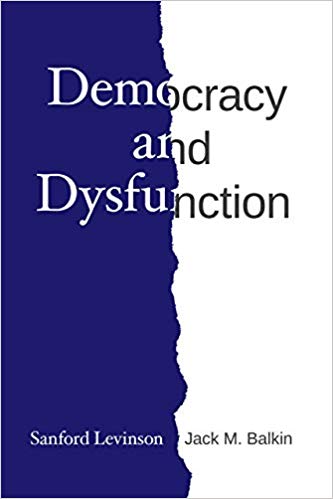
Sanford Levinson and Jack M. Balkin, Democracy and Dysfunction (University of Chicago Press, 2019)

Sanford Levinson, Written in Stone: Public Monuments in Changing Societies (Duke University Press 2018)

Mark A. Graber, Sanford Levinson, and Mark Tushnet, eds., Constitutional Democracy in Crisis? (Oxford University Press 2018)

Gerard Magliocca, The Heart of the Constitution: How the Bill of Rights became the Bill of Rights (Oxford University Press, 2018)

Cynthia Levinson and Sanford Levinson, Fault Lines in the Constitution: The Framers, Their Fights, and the Flaws that Affect Us Today (Peachtree Publishers, 2017)

Brian Z. Tamanaha, A Realistic Theory of Law (Cambridge University Press 2017)

Sanford Levinson, Nullification and Secession in Modern Constitutional Thought (University Press of Kansas 2016)

Sanford Levinson, An Argument Open to All: Reading The Federalist in the 21st Century (Yale University Press 2015)

Stephen M. Griffin, Broken Trust: Dysfunctional Government and Constitutional Reform (University Press of Kansas, 2015)

Frank Pasquale, The Black Box Society: The Secret Algorithms That Control Money and Information (Harvard University Press, 2015)

Bruce Ackerman, We the People, Volume 3: The Civil Rights Revolution (Harvard University Press, 2014)
Balkinization Symposium on We the People, Volume 3: The Civil Rights Revolution

Joseph Fishkin, Bottlenecks: A New Theory of Equal Opportunity (Oxford University Press, 2014)

Mark A. Graber, A New Introduction to American Constitutionalism (Oxford University Press, 2013)

John Mikhail, Elements of Moral Cognition: Rawls' Linguistic Analogy and the Cognitive Science of Moral and Legal Judgment (Cambridge University Press, 2013)

Gerard N. Magliocca, American Founding Son: John Bingham and the Invention of the Fourteenth Amendment (New York University Press, 2013)

Stephen M. Griffin, Long Wars and the Constitution (Harvard University Press, 2013)

Andrew Koppelman, The Tough Luck Constitution and the Assault on Health Care Reform (Oxford University Press, 2013)

James E. Fleming and Linda C. McClain, Ordered Liberty: Rights, Responsibilities, and Virtues (Harvard University Press, 2013)
Balkinization Symposium on Ordered Liberty: Rights, Responsibilities, and Virtues

Andrew Koppelman, Defending American Religious Neutrality (Harvard University Press, 2013)

Brian Z. Tamanaha, Failing Law Schools (University of Chicago Press, 2012)

Sanford Levinson, Framed: America's 51 Constitutions and the Crisis of Governance (Oxford University Press, 2012)

Linda C. McClain and Joanna L. Grossman, Gender Equality: Dimensions of Women's Equal Citizenship (Cambridge University Press, 2012)

Mary Dudziak, War Time: An Idea, Its History, Its Consequences (Oxford University Press, 2012)

Jack M. Balkin, Living Originalism (Harvard University Press, 2011)

Jason Mazzone, Copyfraud and Other Abuses of Intellectual Property Law (Stanford University Press, 2011)

Richard W. Garnett and Andrew Koppelman, First Amendment Stories, (Foundation Press 2011)

Jack M. Balkin, Constitutional Redemption: Political Faith in an Unjust World (Harvard University Press, 2011)

Gerard Magliocca, The Tragedy of William Jennings Bryan: Constitutional Law and the Politics of Backlash (Yale University Press, 2011)

Bernard Harcourt, The Illusion of Free Markets: Punishment and the Myth of Natural Order (Harvard University Press, 2010)

Bruce Ackerman, The Decline and Fall of the American Republic (Harvard University Press, 2010)
Balkinization Symposium on The Decline and Fall of the American Republic

Ian Ayres. Carrots and Sticks: Unlock the Power of Incentives to Get Things Done (Bantam Books, 2010)

Mark Tushnet, Why the Constitution Matters (Yale University Press 2010)

Ian Ayres and Barry Nalebuff: Lifecycle Investing: A New, Safe, and Audacious Way to Improve the Performance of Your Retirement Portfolio (Basic Books, 2010)
.jpg)
Jack M. Balkin, The Laws of Change: I Ching and the Philosophy of Life (2d Edition, Sybil Creek Press 2009)

Brian Z. Tamanaha, Beyond the Formalist-Realist Divide: The Role of Politics in Judging (Princeton University Press 2009)
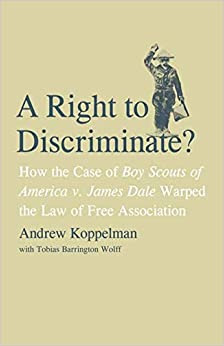
Andrew Koppelman and Tobias Barrington Wolff, A Right to Discriminate?: How the Case of Boy Scouts of America v. James Dale Warped the Law of Free Association (Yale University Press 2009)

Jack M. Balkin and Reva B. Siegel, The Constitution in 2020 (Oxford University Press 2009)

Heather K. Gerken, The Democracy Index: Why Our Election System Is Failing and How to Fix It (Princeton University Press 2009)

Mary Dudziak, Exporting American Dreams: Thurgood Marshall's African Journey (Oxford University Press 2008)

David Luban, Legal Ethics and Human Dignity (Cambridge Univ. Press 2007)

Ian Ayres, Super Crunchers: Why Thinking-By-Numbers is the New Way to be Smart (Bantam 2007)

Jack M. Balkin, James Grimmelmann, Eddan Katz, Nimrod Kozlovski, Shlomit Wagman and Tal Zarsky, eds., Cybercrime: Digital Cops in a Networked Environment (N.Y.U. Press 2007)
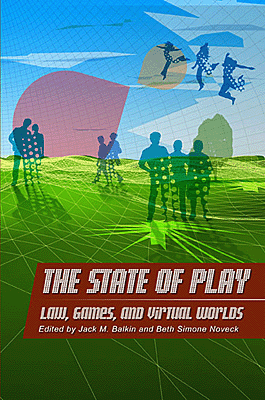
Jack M. Balkin and Beth Simone Noveck, The State of Play: Law, Games, and Virtual Worlds (N.Y.U. Press 2006)

Andrew Koppelman, Same Sex, Different States: When Same-Sex Marriages Cross State Lines (Yale University Press 2006)

Brian Tamanaha, Law as a Means to an End (Cambridge University Press 2006)

Sanford Levinson, Our Undemocratic Constitution (Oxford University Press 2006)

Mark Graber, Dred Scott and the Problem of Constitutional Evil (Cambridge University Press 2006)

Jack M. Balkin, ed., What Roe v. Wade Should Have Said (N.Y.U. Press 2005)

Sanford Levinson, ed., Torture: A Collection (Oxford University Press 2004)
Balkin.com homepage
Bibliography
Conlaw.net
Cultural Software
Writings
Opeds
The Information Society Project
BrownvBoard.com
Useful Links
Syllabi and Exams
