Balkinization
an unanticipated consequence of
Jack M. Balkin
Balkinization Symposiums: A Continuing List
E-mail:
Jack Balkin:
jackbalkin at yahoo.com
Bruce Ackerman
bruce.ackerman at yale.edu
Ian Ayres
ian.ayres at yale.edu
Corey Brettschneider
corey_brettschneider at brown.edu
Mary Dudziak
mary.l.dudziak at emory.edu
Joey Fishkin
joey.fishkin at gmail.com
Heather Gerken heather.gerken at yale.edu
Abbe Gluck abbe.gluck at yale.edu
Mark Graber
mgraber at law.umaryland.edu
Stephen Griffin
sgriffin at tulane.edu
Jonathan Hafetz
jonathan.hafetz at shu.edu
Jeremy Kessler
jkessler at law.columbia.edu
Andrew Koppelman
akoppelman at law.northwestern.edu
Marty Lederman
msl46 at law.georgetown.edu
Sanford Levinson
slevinson at law.utexas.edu
David Luban
david.luban at gmail.com
Gerard Magliocca
gmaglioc at iupui.edu
Jason Mazzone
mazzonej at illinois.edu
Linda McClain
lmcclain at bu.edu
John Mikhail
mikhail at law.georgetown.edu
Frank Pasquale
pasquale.frank at gmail.com
Nate Persily
npersily at gmail.com
Michael Stokes Paulsen
michaelstokespaulsen at gmail.com
Deborah Pearlstein
dpearlst at yu.edu
Rick Pildes
rick.pildes at nyu.edu
David Pozen
dpozen at law.columbia.edu
Richard Primus
raprimus at umich.edu
K. Sabeel Rahmansabeel.rahman at brooklaw.edu
Alice Ristroph
alice.ristroph at shu.edu
Neil Siegel
siegel at law.duke.edu
David Super
david.super at law.georgetown.edu
Brian Tamanaha
btamanaha at wulaw.wustl.edu
Nelson Tebbe
nelson.tebbe at brooklaw.edu
Mark Tushnet
mtushnet at law.harvard.edu
Adam Winkler
winkler at ucla.edu
Compendium of posts on Hobby Lobby and related cases
The Anti-Torture Memos: Balkinization Posts on Torture, Interrogation, Detention, War Powers, and OLC
The Anti-Torture Memos (arranged by topic)
Recent Posts
The CIA's "Alternative Set of Procedures": Calling Things by Their Right Names
![[Powered by Blogger]](https://lh3.googleusercontent.com/blogger_img_proxy/AEn0k_tLH3xVE4jdp770i-H-SOi5oVEA2ggiNoAGPBXTgkzCAqKAmyPTuXqRUAatK1wSh3tM6xc-g2qMv-Y-21AHNGEdTIjT5mkpFWEjh9KPbb0P=s0-d)
Just A Few Blogs
ACS Blog
Alas, a Blog
Althouse
Arts and Letters Daily
Atrios (Eschaton)
Bill of Health
Buzzflash.com
Buzz Machine
Cato at Liberty
Juan Cole (Informed Comment)
Concurring Opinions
The Constitution in 2020
Corrente
Crooked Timber
Daily Howler
Daily Kos
Dana Boyd
Brad DeLong
Digby (Hullabaloo)
Discriminations
Daniel Drezner
Kevin Drum (Mother Jones)
Electrolite
En Banc
Eunomia (Daniel Larison)
Fafblog
Michael Froomkin (Discourse.net)
GovLab (Beth Noveck)
Rick Hasen (Election Law)
History News Network
How Appealing
Ignatz (Sam Heldman)
The Importance of (Ernie Miller)
Infolaw
Instapundit
International Economic Law and Policy Blog
IntLawGrrls
Jacob Levy
Jesus' General
Jurisdynamics
The Kitchen Cabinet
Mark Kleiman
Law Blog Central
Larry Lessig
Lawyers, Guns and Money
Liberal Oasis
Brian Leiter's Law School Reports
The Leiter Reports
Marginal Revolution
Megan McArdle
Memeorandum
Metafilter
Mirror of Justice
The New Republic
Newseum
No More Mister Nice Blog
Brendan Nyhan
Opinio Juris
Orcinus
The Originalism Blog
Pandagon
Passport (Foreign Policy)
Overcoming Bias
Political Animal (Washington Monthly)
Political Theory Daily Review
Political Wire (Taegan Goddard)
The Poor Man
Virginia Postrel
Prawfsblawg
Public Reason
Jonathan Rauch
Raw Story
Redstate
ReligiousLeftLaw.com
Reporters Committee For Freedom of the Press
Reproductive Rights Blog
Rothman's Roadmap to the Right of Publicity
SCOTUS Blog
Seeing the Forest
Clay Shirky
The Shifted Librarian
The Situationist
Larry Solum (Legal Theory)
Andrew Sullivan
Talking Points Memo
Talk Left
Tapped
Tbogg
TechPresident
The Paper Chase (Jurist)
Tom Paine
Tom Tomorrow (This Modern World)
Eve Tushnet
Uggabugga
University of Chicago Law School Faculty Blog
Unqualified Offerings
The Volokh Conspiracy
War and Piece (Laura Rozen)
Wampum
Oliver Willis
Wonkette
Written Description
Matthew Yglesias
Yin
Your Choice of Feeds
1. XML
powered by

2. Atom Feed
3. RSS 2.0
The CIA's "Alternative Set of Procedures": Calling Things by Their Right Names
Marty Lederman
There was some very good news today -- namely, that in its revised Army Field Manual, and accompanying Directive 2310.01E, the Department of Defense appears to have committed, at least for the time being, to prohibiting the use of unlawful and abusive techniques, and to compliance with Common Article 3 of the Geneva Conventions. The new Army Field Manual goes even further, providing numerous examples of techniques -- many of which Donald Rumsfeld and Jim Haynes had previously (and eroneously) approved as "legally available" -- that will will now be off limits for all detainess in DoD custody, including: forcing a detainee to be naked or perform sexual acts; using beatings and other forms of causing pain, including electric shocks; placing hoods over prisoners’ heads or tape on their eyes; mock executions; withholding food, water or medical care; using dogs against detainees; and waterboarding.
Josh White has a thorough round-up here. According to Deputy Assistant Secretary of defense Charles Stimson, this new Pentagon policy "unambiguously articulates the values and traditions of our nation, values that John Adams called 'the policy of humanity,' which has been the cornerstone of the American ethos of warfare."
As I explain below, however, that's only half the story, because the draft Administration bill would (i) retroactively legalize all the unlawful acts that were approved and performed from 2001 to the present day (see section 9, page 86); (ii) would cut off all judicial review of U.S. compliance with the Geneva Conventions (section 6(b), page 79); and, most importantly, (iii) would authorize the CIA -- and, for that matter, other agencies, including DoD itself -- to engage in what the President today euphemistically referred to as the CIA's "alternative set of [interrogation] procedures." Those proceudres include many techniques that today's Army Field Manual would purport to prohibit for the military. According to numerous previous reports, quoting Administration officials, such techniques have included hypothermia, threats of violence to the detainee and his family, prolonged sleep deprivation, "stress positions," and waterboarding.
The Administration draft bill would effectively authorize these techniques by conspicuously excluding them from the list of techniques that would constitute war crimes violations of Common Article 3 (section 7, pages 79-84), and also by purporting to provide -- unconvincingly -- that compliance with the McCain Amendment's "shocks the conscience" standard will satisfy the U.S.'s obligations under Common Article 3 (section 6(a), pages 78-79), even though (as I've previously explained) the Administration apparently has construed the McCain Amendment, which has governed the CIA since late December 2005, to permit the "alternative" CIA techniques.
But the draft bill would not actually identify these techniques. Such obfuscation would allow the Administration (and Congress) to nominally continue the pretense of U.S. compliance with our treaty obligations, while at the same time immunizing conduct that would appear by any reasonable account to violate the Geneva Conventions' prohibition on all "cruel treatment and torture."
On this score, Dana Priest has a very intriguing article in tomorrow's Washington Post. Priest reports that in addition to the techniques listed above (e.g., waterboarding), the CIA "alternative" techniques may also have included "extreme isolation, slapping, . . . reduced food intake, and light and sound bombardment." Whether Common Article 3 prohibits some of these techniques might be a bit more uncertain (depending, of course, on the details of how they are implemented). The most important part of Priest's article is this passage:In the past year, the CIA has studied more closely the effectiveness of harsh interrogation techniques that it and other agencies have used and concluded that some of those were worth discarding. CIA officials have eliminated some of those techniques and, within the past two months, have begun to consult for the first time with the full Senate and House intelligence committees about creating a new list of techniques. . . . The administration will ask the intelligence committees to give it guidance to draw up a separate, shorter list of harsh techniques it might still employee under certain circumstances. The point, said one senior official, "is to make the program more durable" and not "subject to the pendulum swings" of Congress or the president.
This is potentially good news. Perhaps the techniques the Administration wishes to authorize for the CIA will not include those that are plainly illegal under Geneva. Or perhaps those techniques will include what Common Article 3 calls "cruel treatment and torture." There's no way to tell for sure based solely on the cryptic words of the Administration draft bill.
But the possibility that the congressional intelligence committees would identify the specific list of approved techniques -- presumably in the form of some proposed legislation -- would be a very positive development. That way, we could actually have a public debate about whether Congress is authorizing cruel treatment, and whether we are thus de facto breaching the Geneva Conventions. If, as the President insists, certain techniques are necessary to use in this war -- even though we have never found the need to use them in previous conflicts, and even though the Pentagon just today that "nothing good will come from" such techniques -- then at the very least we should have the decency to acknowledge what we are doing, and to stop hiding behind transparently ridiculous claims that we treat all detainees "humanely," that we do not "torture," and that all of the (undisclosed) CIA techniques are Geneva-compliant.
In his speech today, the President once again insisted that we "cannot describe the specific methods used -- I think you understand why -- if I did, it would help the terrorists learn how to resist questioning." In other words, if the detainees know what our legal limits are, they will know precisely which techniques they must resist in order to avoid revealing valuable information.
But this argument is no longer tenable (if it ever was), because we are now obviously very willing to disclose all sorts of limits beyond which we cannot go. The Administration's own bill today lists 27 specific forms of conduct that we ourselves will consider "war crimes" triable by military commission (pages 65-76). The Administration's draft amendment to the War Crimes Act (pages 79-84) contains nine categories of meticulously described conduct that could be punished as war crimes in the civilian criminal justice system. And, as noted above, the Army Field Manual released today goes into great and specific detail about what the military can, and cannot do, to its detainees. After all of these highly specific provisions are in the public record specifying what can and cannot be done within the law, it's no longer very persuasive to assert that the CIA's techniques cannot likewise be codified. It's no secret that the CIA has used waterboarding, hypothermia and threats to detainees' families. Knowing that such techniques are legal would not make it any easier for detainees to resist them.
So please, if we're going to take such a momentous step -- breaching our Geneva obligations or coming awfully close to that line -- let us do so openly and candidly, with a full public record of which legislators approve the use of waterboarding, threats, stress positions, et al., and which oppose them.
Posted
11:11 PM
by Marty Lederman [link]
I don't think there's any mileage in demanding that all members of the military who violated the Geneva Conventions be exposed to criminal liability, even if by rights they should be. A better alternative would be to immunize anyone with a rank below, say, Major or Lieutenant Commander for acts performed under orders.

As the President has now made his long awaited admission that there have been secret CIA prisons around the world in which individuals have been held in prolonged, secret incommunicado detention in clear violation of international law (see American Society of International Law Centennial Resolution at http://www.asil.org/events/am06/resolutions.html), one has a sense of relief that the coverup is lifting and the truth at least in part has finally started to come out. In due course I am certain we will learn that the “tough” interrogation techniques admittedly used in these secret detention facilities violated Common Article 3 of the Geneva Conventions. Thus, if one was somehow still in denial, one must come to terms with the dawning realization through these admissions that violations of international humanitarian law and war crimes have been committed by the United States that were authorized by the highest levels of civilian authority of the United States.
It is important that we do not think of this failure of our leadership to respect the most elemental aspects of international law as a failure of the Executive. In time, I hope that the ranking members of the Senate and House committees (Armed Services and Intelligence Committees and possibly others) and others (dare I say the Chief Justice of the Supreme Court and/or FISA Court?) who were briefed in some manner about these practices will also come forward and tell the American people and the world (1) what did they know? (2) when did they know it? This failure is a failure of the United States and falls on each of our shoulders as a collective shame.
I hope there will come a day when on the floor of the Senate, the Senators will reveal what they knew and on the floor of the House the House members will reveal what they knew and apologize. I hope there will be a day when the United States will make an apology to the world for its weakening of the rule of law through these types of actions.
We can recognize the good intentions behind these illegal orders – to protect the American people. But the departure from civilized standards that they demonstrate in the face of substantial credible internal opposition suggests a terrible failure of character that has besmirched American honor. We ask them also to keep our honor clean and faithfully execute our laws.
How do we get back to being our selves? Might I suggest that Congress start by rejecting the Bush Administration’s Military Commission legislation which is a thinly veiled effort to amnesty actions that were done in the 2001-2006 period. Second, Congress should take its lead from the Military JAG Officers testimony this summer in fashioning a set of military commissions that start from the Uniform Code of Military Justice. We should not go off half-cocked but rather draw on the history and experience under that Code to fashion an adequate procedure that meets the strictures of our statutory and international law obligations as Hamdan has reminded all again. Third, Congress should simply refrain from any measures which would have the effect of amnestying or reducing the criminal and/or civil liability of those who authorized or engaged over the past years in the departures from civilized standards that are coming to light. The full extent of those departures (extraordinary renditions, torture and cruel inhuman and degrading treatment etc) from civilized standards are still far too unknown and merit serious examination and, as warranted, prosecution. The operative rule should be that the only salvation for those seeking to escape criminal and/or civil liability for their actions should be the Presidential pardon – not Congressional cravenness.
Ben
Obat herpes selain acyclovir
Obat herpes di wajah
Obat herpes alami
Obat herpes di leher
Obat salep buat kutil kelamin
Obat cina kutil kelamin
Cuka obat kutil kelamin
Obat cina untuk kutil kelamin
Obat cina penghilang kutil kelamin
Obat china untuk kutil kelamin
Obat kutil di kelamin pria
Obat tradisional kutil di kelamin
Obat kutil di daerah kelamin
Obat untuk menghilangkan kutil di kelamin
Obat sipilis
Obat sipilis Yang manjur
obat sipilis denature indonesia
Obat sipilis resep dokter
Obat sipilis paling manjur
Obat sipilis pada wanita
Obat sipilis paling ampuh
Obat sipilis manjur
Obat sipilis ampuh
Obat sipilis atau raja singa
Obat sipilis herbal
Obat sipilis murah
Obat sipilis anjuran dokter
Obat sipilis apa namanya
Obat sipilis dijual di apotik
Obat alami sipilis pada pria
Obat sifilis ampuh
Obat sipilis buat wanita
Obat sipilis bagi wanita
Obat buat sipilis
Books by Balkinization Bloggers

Gerard N. Magliocca, The Actual Art of Governing: Justice Robert H. Jackson's Concurring Opinion in the Steel Seizure Case (Oxford University Press, 2025)

Linda C. McClain and Aziza Ahmed, The Routledge Companion to Gender and COVID-19 (Routledge, 2024)

David Pozen, The Constitution of the War on Drugs (Oxford University Press, 2024)

Jack M. Balkin, Memory and Authority: The Uses of History in Constitutional Interpretation (Yale University Press, 2024)
Mark A. Graber, Punish Treason, Reward Loyalty: The Forgotten Goals of Constitutional Reform after the Civil War (University of Kansas Press, 2023)
Jack M. Balkin, What Roe v. Wade Should Have Said: The Nation's Top Legal Experts Rewrite America's Most Controversial Decision - Revised Edition (NYU Press, 2023)

Andrew Koppelman, Burning Down the House: How Libertarian Philosophy Was Corrupted by Delusion and Greed (St. Martin’s Press, 2022)

Gerard N. Magliocca, Washington's Heir: The Life of Justice Bushrod Washington (Oxford University Press, 2022)
Joseph Fishkin and William E. Forbath, The Anti-Oligarchy Constitution: Reconstructing the Economic Foundations of American Democracy (Harvard University Press, 2022)
Mark Tushnet and Bojan Bugaric, Power to the People: Constitutionalism in the Age of Populism (Oxford University Press 2021).

Mark Philip Bradley and Mary L. Dudziak, eds., Making the Forever War: Marilyn B. Young on the Culture and Politics of American Militarism Culture and Politics in the Cold War and Beyond (University of Massachusetts Press, 2021).

Jack M. Balkin, What Obergefell v. Hodges Should Have Said: The Nation's Top Legal Experts Rewrite America's Same-Sex Marriage Decision (Yale University Press, 2020)

Frank Pasquale, New Laws of Robotics: Defending Human Expertise in the Age of AI (Belknap Press, 2020)

Jack M. Balkin, The Cycles of Constitutional Time (Oxford University Press, 2020)

Mark Tushnet, Taking Back the Constitution: Activist Judges and the Next Age of American Law (Yale University Press 2020).

Andrew Koppelman, Gay Rights vs. Religious Liberty?: The Unnecessary Conflict (Oxford University Press, 2020)

Ezekiel J Emanuel and Abbe R. Gluck, The Trillion Dollar Revolution: How the Affordable Care Act Transformed Politics, Law, and Health Care in America (PublicAffairs, 2020)

Linda C. McClain, Who's the Bigot?: Learning from Conflicts over Marriage and Civil Rights Law (Oxford University Press, 2020)
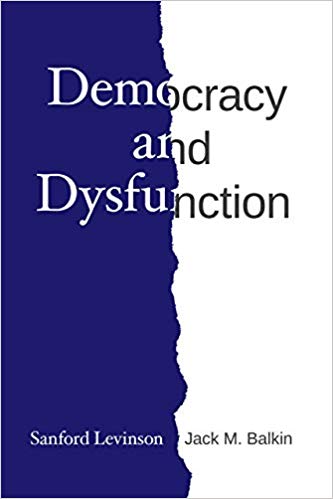
Sanford Levinson and Jack M. Balkin, Democracy and Dysfunction (University of Chicago Press, 2019)

Sanford Levinson, Written in Stone: Public Monuments in Changing Societies (Duke University Press 2018)

Mark A. Graber, Sanford Levinson, and Mark Tushnet, eds., Constitutional Democracy in Crisis? (Oxford University Press 2018)

Gerard Magliocca, The Heart of the Constitution: How the Bill of Rights became the Bill of Rights (Oxford University Press, 2018)

Cynthia Levinson and Sanford Levinson, Fault Lines in the Constitution: The Framers, Their Fights, and the Flaws that Affect Us Today (Peachtree Publishers, 2017)

Brian Z. Tamanaha, A Realistic Theory of Law (Cambridge University Press 2017)

Sanford Levinson, Nullification and Secession in Modern Constitutional Thought (University Press of Kansas 2016)

Sanford Levinson, An Argument Open to All: Reading The Federalist in the 21st Century (Yale University Press 2015)

Stephen M. Griffin, Broken Trust: Dysfunctional Government and Constitutional Reform (University Press of Kansas, 2015)

Frank Pasquale, The Black Box Society: The Secret Algorithms That Control Money and Information (Harvard University Press, 2015)

Bruce Ackerman, We the People, Volume 3: The Civil Rights Revolution (Harvard University Press, 2014)
Balkinization Symposium on We the People, Volume 3: The Civil Rights Revolution

Joseph Fishkin, Bottlenecks: A New Theory of Equal Opportunity (Oxford University Press, 2014)

Mark A. Graber, A New Introduction to American Constitutionalism (Oxford University Press, 2013)

John Mikhail, Elements of Moral Cognition: Rawls' Linguistic Analogy and the Cognitive Science of Moral and Legal Judgment (Cambridge University Press, 2013)

Gerard N. Magliocca, American Founding Son: John Bingham and the Invention of the Fourteenth Amendment (New York University Press, 2013)

Stephen M. Griffin, Long Wars and the Constitution (Harvard University Press, 2013)

Andrew Koppelman, The Tough Luck Constitution and the Assault on Health Care Reform (Oxford University Press, 2013)

James E. Fleming and Linda C. McClain, Ordered Liberty: Rights, Responsibilities, and Virtues (Harvard University Press, 2013)
Balkinization Symposium on Ordered Liberty: Rights, Responsibilities, and Virtues

Andrew Koppelman, Defending American Religious Neutrality (Harvard University Press, 2013)

Brian Z. Tamanaha, Failing Law Schools (University of Chicago Press, 2012)

Sanford Levinson, Framed: America's 51 Constitutions and the Crisis of Governance (Oxford University Press, 2012)

Linda C. McClain and Joanna L. Grossman, Gender Equality: Dimensions of Women's Equal Citizenship (Cambridge University Press, 2012)

Mary Dudziak, War Time: An Idea, Its History, Its Consequences (Oxford University Press, 2012)

Jack M. Balkin, Living Originalism (Harvard University Press, 2011)

Jason Mazzone, Copyfraud and Other Abuses of Intellectual Property Law (Stanford University Press, 2011)

Richard W. Garnett and Andrew Koppelman, First Amendment Stories, (Foundation Press 2011)

Jack M. Balkin, Constitutional Redemption: Political Faith in an Unjust World (Harvard University Press, 2011)

Gerard Magliocca, The Tragedy of William Jennings Bryan: Constitutional Law and the Politics of Backlash (Yale University Press, 2011)

Bernard Harcourt, The Illusion of Free Markets: Punishment and the Myth of Natural Order (Harvard University Press, 2010)

Bruce Ackerman, The Decline and Fall of the American Republic (Harvard University Press, 2010)
Balkinization Symposium on The Decline and Fall of the American Republic

Ian Ayres. Carrots and Sticks: Unlock the Power of Incentives to Get Things Done (Bantam Books, 2010)

Mark Tushnet, Why the Constitution Matters (Yale University Press 2010)

Ian Ayres and Barry Nalebuff: Lifecycle Investing: A New, Safe, and Audacious Way to Improve the Performance of Your Retirement Portfolio (Basic Books, 2010)
.jpg)
Jack M. Balkin, The Laws of Change: I Ching and the Philosophy of Life (2d Edition, Sybil Creek Press 2009)

Brian Z. Tamanaha, Beyond the Formalist-Realist Divide: The Role of Politics in Judging (Princeton University Press 2009)
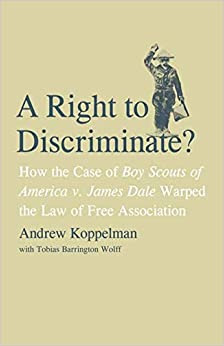
Andrew Koppelman and Tobias Barrington Wolff, A Right to Discriminate?: How the Case of Boy Scouts of America v. James Dale Warped the Law of Free Association (Yale University Press 2009)

Jack M. Balkin and Reva B. Siegel, The Constitution in 2020 (Oxford University Press 2009)

Heather K. Gerken, The Democracy Index: Why Our Election System Is Failing and How to Fix It (Princeton University Press 2009)

Mary Dudziak, Exporting American Dreams: Thurgood Marshall's African Journey (Oxford University Press 2008)

David Luban, Legal Ethics and Human Dignity (Cambridge Univ. Press 2007)

Ian Ayres, Super Crunchers: Why Thinking-By-Numbers is the New Way to be Smart (Bantam 2007)

Jack M. Balkin, James Grimmelmann, Eddan Katz, Nimrod Kozlovski, Shlomit Wagman and Tal Zarsky, eds., Cybercrime: Digital Cops in a Networked Environment (N.Y.U. Press 2007)
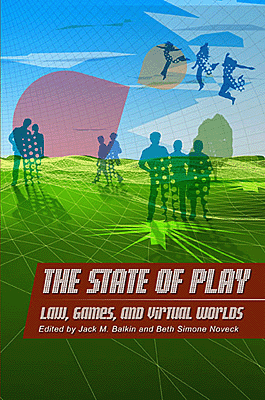
Jack M. Balkin and Beth Simone Noveck, The State of Play: Law, Games, and Virtual Worlds (N.Y.U. Press 2006)

Andrew Koppelman, Same Sex, Different States: When Same-Sex Marriages Cross State Lines (Yale University Press 2006)

Brian Tamanaha, Law as a Means to an End (Cambridge University Press 2006)

Sanford Levinson, Our Undemocratic Constitution (Oxford University Press 2006)

Mark Graber, Dred Scott and the Problem of Constitutional Evil (Cambridge University Press 2006)

Jack M. Balkin, ed., What Roe v. Wade Should Have Said (N.Y.U. Press 2005)

Sanford Levinson, ed., Torture: A Collection (Oxford University Press 2004)
Balkin.com homepage
Bibliography
Conlaw.net
Cultural Software
Writings
Opeds
The Information Society Project
BrownvBoard.com
Useful Links
Syllabi and Exams
