Balkinization
an unanticipated consequence of
Jack M. Balkin
Balkinization Symposiums: A Continuing List
E-mail:
Jack Balkin:
jackbalkin at yahoo.com
Bruce Ackerman
bruce.ackerman at yale.edu
Ian Ayres
ian.ayres at yale.edu
Corey Brettschneider
corey_brettschneider at brown.edu
Mary Dudziak
mary.l.dudziak at emory.edu
Joey Fishkin
joey.fishkin at gmail.com
Heather Gerken heather.gerken at yale.edu
Abbe Gluck abbe.gluck at yale.edu
Mark Graber
mgraber at law.umaryland.edu
Stephen Griffin
sgriffin at tulane.edu
Jonathan Hafetz
jonathan.hafetz at shu.edu
Jeremy Kessler
jkessler at law.columbia.edu
Andrew Koppelman
akoppelman at law.northwestern.edu
Marty Lederman
msl46 at law.georgetown.edu
Sanford Levinson
slevinson at law.utexas.edu
David Luban
david.luban at gmail.com
Gerard Magliocca
gmaglioc at iupui.edu
Jason Mazzone
mazzonej at illinois.edu
Linda McClain
lmcclain at bu.edu
John Mikhail
mikhail at law.georgetown.edu
Frank Pasquale
pasquale.frank at gmail.com
Nate Persily
npersily at gmail.com
Michael Stokes Paulsen
michaelstokespaulsen at gmail.com
Deborah Pearlstein
dpearlst at yu.edu
Rick Pildes
rick.pildes at nyu.edu
David Pozen
dpozen at law.columbia.edu
Richard Primus
raprimus at umich.edu
K. Sabeel Rahmansabeel.rahman at brooklaw.edu
Alice Ristroph
alice.ristroph at shu.edu
Neil Siegel
siegel at law.duke.edu
David Super
david.super at law.georgetown.edu
Brian Tamanaha
btamanaha at wulaw.wustl.edu
Nelson Tebbe
nelson.tebbe at brooklaw.edu
Mark Tushnet
mtushnet at law.harvard.edu
Adam Winkler
winkler at ucla.edu
Compendium of posts on Hobby Lobby and related cases
The Anti-Torture Memos: Balkinization Posts on Torture, Interrogation, Detention, War Powers, and OLC
The Anti-Torture Memos (arranged by topic)
Recent Posts
The Basic Case Against Alito
![[Powered by Blogger]](https://lh3.googleusercontent.com/blogger_img_proxy/AEn0k_tFyrieCQsKYNQRTFaXI7COzr4j1JJxSXtMRUXwXh4HgEfxr1DhMwnShzDFp07fGQ9S12BLkpqm58vDQBVM04tD-BqkQR-g93Oe1-ALZlvP=s0-d)
Just A Few Blogs
ACS Blog
Alas, a Blog
Althouse
Arts and Letters Daily
Atrios (Eschaton)
Bill of Health
Buzzflash.com
Buzz Machine
Cato at Liberty
Juan Cole (Informed Comment)
Concurring Opinions
The Constitution in 2020
Corrente
Crooked Timber
Daily Howler
Daily Kos
Dana Boyd
Brad DeLong
Digby (Hullabaloo)
Discriminations
Daniel Drezner
Kevin Drum (Mother Jones)
Electrolite
En Banc
Eunomia (Daniel Larison)
Fafblog
Michael Froomkin (Discourse.net)
GovLab (Beth Noveck)
Rick Hasen (Election Law)
History News Network
How Appealing
Ignatz (Sam Heldman)
The Importance of (Ernie Miller)
Infolaw
Instapundit
International Economic Law and Policy Blog
IntLawGrrls
Jacob Levy
Jesus' General
Jurisdynamics
The Kitchen Cabinet
Mark Kleiman
Law Blog Central
Larry Lessig
Lawyers, Guns and Money
Liberal Oasis
Brian Leiter's Law School Reports
The Leiter Reports
Marginal Revolution
Megan McArdle
Memeorandum
Metafilter
Mirror of Justice
The New Republic
Newseum
No More Mister Nice Blog
Brendan Nyhan
Opinio Juris
Orcinus
The Originalism Blog
Pandagon
Passport (Foreign Policy)
Overcoming Bias
Political Animal (Washington Monthly)
Political Theory Daily Review
Political Wire (Taegan Goddard)
The Poor Man
Virginia Postrel
Prawfsblawg
Public Reason
Jonathan Rauch
Raw Story
Redstate
ReligiousLeftLaw.com
Reporters Committee For Freedom of the Press
Reproductive Rights Blog
Rothman's Roadmap to the Right of Publicity
SCOTUS Blog
Seeing the Forest
Clay Shirky
The Shifted Librarian
The Situationist
Larry Solum (Legal Theory)
Andrew Sullivan
Talking Points Memo
Talk Left
Tapped
Tbogg
TechPresident
The Paper Chase (Jurist)
Tom Paine
Tom Tomorrow (This Modern World)
Eve Tushnet
Uggabugga
University of Chicago Law School Faculty Blog
Unqualified Offerings
The Volokh Conspiracy
War and Piece (Laura Rozen)
Wampum
Oliver Willis
Wonkette
Written Description
Matthew Yglesias
Yin
Your Choice of Feeds
1. XML
powered by

2. Atom Feed
3. RSS 2.0
The Basic Case Against Alito
Anonymous
I have nothing very novel or surprising to say about the Alito nomination. But on the eve of his hearings it may be useful to summarize the essential case against him.
When Samuel Alito applied for a political job in the Justice Department in 1985, he wrote that he had been inspired to go into law by disagreement with the "activist" decisions of the Supreme Court under Earl Warren and other liberal policies. He mentioned particularly decisions in the areas of "criminal procedure, the Establishment Clause, and reapportionment." He said he believes strongly in "limited government, federalism, free enterprise, the supremacy of the elected branches of government, the need for a strong defense and effective law enforcement, and the legitimacy of a government role in protecting traditional values." He added: "I am particularly proud of my contributions in recent cases [in the Solicitor General's office under Reagan] in which the government has argued in the Supreme Court that racial and ethnic quotas should not be allowed and that the Constitution does not protect the right to an abortion." He advertised his membership in a group of Princeton alumni who objected to opening up Princeton to women and minorities.
Now Alito is saying that the job memo doesn't tell us anything about how he would act as a judge because he wrote it as an "advocate" --- an advocate for himself, apparently -- applying for a political job in a conservative administration. He says his briefs and arguments and legal opinions for the Justice Department are also irrelevant because he was just acting as an advocate for the executive branch. He says that even his deeply held personal views on abortion and civil rights are irrelevant because he will be acting as a judge, not a person. (He also says he can't remember belonging to the Princeton alumni group, which I find rather hard to believe, since he was proud enough of it to put it on his job application.)
It's disturbing in itself that Alito, like John Roberts before him, will not take responsibility for or own up to his own beliefs. He's always claiming, "That was somebody else back then" - but without saying how or whether he has changed, except that he is now a judge. The argument that he was just saying whatever it was convenient for him to say in order to get a job doesn't sound too good coming from somebody who is now trying to get another job. There is something really slippery, or at least less than forthright, about his approach to his own record of actions and opinions.
Anyway, nobody can seriously suppose that Alito's beliefs will have no effect on his decisions, because they already have. His manifesto of 1985 is a pretty reliable road map not only to his work for the Reagan Justice Department, but to his decisions as an appellate court judge.
Backers of Bush's judicial nominees like to argue that, having won the election, Bush is entitled to put conservatives on the bench; but that, not to worry, his nominees will decide cases fairly and impartially. But is Alito likely to be the kind of judge who so completely subdues his convictions to his role that nobody looking at his record - as John Roberts claimed was true of his old boss, Henry Friendly - could tell if he were liberal or conservative? Or the kind of "conservative" judge in the mold of Frankfurter or the younger Harlan, who treads cautiously, defers to legislatures, sticks close to precedents, and construes statutes narrowly to avoid Constitutional questions? Or a judge like Powell or O'Connor, who approaches every case as unique and different, and decides on nuances of particular fact? Or even a judge whose views may generally accord with his party's, and who tilts towards the results his political sponsors prefer in close cases, but who does not actively seek to stretch or bend the law to pursue an ideological agenda? If Alito were any of these, I doubt there would be much opposition to him. I also doubt whether Bush would have wanted to appoint him.
By all indications Alito is none of these. He is not "conservative" in any plausible sense of the word except in style. Unlike Scalia, with whom he is often compared, he is not given to announcing flamboyant declarations of principle or sweeping legislative-like rules, or lobbing rhetorical stink-bombs at his fellow judges. By all accounts he is a low-key, pleasant man who respects disagreement and does not insult his colleagues on the bench. He is a cautious craftsman who takes small discrete steps towards his objectives rather than daring leaps. Where the law is hard and clear, he does not defy it or try to amend it judicially - though of course as a Supreme Court justice he will have scope to modify even well-settled law.
But wherever there is running room - opened up by gaps in application, conflicts in precedents, ambiguities in statutes - Alito is an activist who works steadily to push the law well beyond conventional boundaries of precedent. There is nothing "restrained" about his opinions proposing to strike down one federal law banning machine guns for exceeding Congress's power under the Commerce Clause (U.S. v. Rybar, 1996); to strike down another mandating employers to grant medical leave to parents of newborn children for exceeding Congress's power under the Fourteenth Amendment (Chittister, 2000); and to construe regulatory and civil rights laws so restrictively as to frustrate their purposes. He is for "limited government" and "federalism" when those principles point to less regulation of business and religious expression; but for authoritarian government when it acts in the causes of protecting national security or law enforcement and regulating morals. He is in short a judge with an agenda, and the agenda is not "conservative" but right-wing-Republican.
Now of course the liberal lions of the Warren Court - Warren, Brennan, Black, Douglas, Goldberg, Fortas, Marshall -- were judges with an agenda too. Their agenda was to push the polity toward treating subordinated, excluded and marginalized people with dignity and as civic equals. In this cause they construed the Constitution as a charter of equal rights and due process protections for the vulnerable; which limited the state's freedom to abuse and discriminate against those subject to its authority, but licensed a large governmental role in regulating the economy, expanding social security and health care, and promoting civil rights. Their agenda, and that of the liberal Congresses of the 1960s and 70s that wrote the legislation to make it effective, is of course what provoked the revolt of the conservatives and inspired the young Samuel Alito to join it. Alito and his comrades went into law to dismantle the achievements of the New Deal, Warren Court and Great Society, the social policies and civil rights protections and both the restrictions on and expansion of government authority of the liberal state. Some of us may regard this as a rather pinched and negative set of ideals, but to them it was a noble crusade.
So now they are in power, why shouldn't it be their turn? Why - as exasperated conservatives like Bruce Fein keep asking -- do their nominees have to conceal their activism, pretend that they are "mainstream" judges, really hardly distinguishable from liberals? Why does Bush pick stealth candidates like Roberts and Alito, rather than open and forthright radicals like Michael Luttig of the 4th Circuit or Edith Jones of the 5th Circuit or Janice Rogers Brown of the D.C. Circuit? The obvious reason is that large parts of the conservative agenda are quite unpopular, and candidates who openly avowed it would risk being voted down. Polls say that around 70 per cent of the public does not want Roe v. Wade, the decision conferring a constitutional right to abortion, overruled. So a pro-life nominee has to send signals to backers on the cultural right that he is a reliable vote on the abortion issue while at the same time reassuring liberal pro-choice Senators that he has not made up his mind. And the backers who have picked him because they think he's a vote for their side on the abortion issue have to pretend along with him that they think he has an open mind, even though they would never have pushed for and supported his nomination if they actually believed he had an open mind. (Harriet Miers really did seem to have an open mind on issues like gay rights, and look where that got her!) Alito has made this straddle very difficult by previous statements that he thought the Constitution did not protect the right to an abortion; by recommending litigation strategies in the Justice Department for getting Roe dismantled stage-by-stage and ultimately overruled; and finally, by writing a dissent as a judge on the 3d Circuit in an abortion case that would have allowed a state to restrict abortion rights by requiring a woman to notify her husband first - an issue that, on appeal, the Supreme Court decided the other way, 6 to 3.
In short, the Bush people's strategy with judicial nominees is the same as their strategy with the other legacies of the liberal state. As the fiasco of his proposals to revise Social Security made clear, Bush cannot get the legislative votes to repeal the New Deal and Great Society social safety nets, or legislative protections of labor, work safety and the environment and regulation of corporate frauds and torts. As protests mount over torture, indefinite detentions, spying without warrants, and the Patriot Act, he cannot count on Congress to ratify his claims of unlimited executive power in wartime. But he can appoint people in the executive and judicial branches who will work toward these aims covertly, gradually, and under the radar, while feigning otherwise.
In two broad areas especially, Alito promises to be a dangerous servant of the agenda.
Executive Power
1. The first and most important is executive power. As Dahlia Lithwick and Sandy Levinson have astutely pointed out, there's reason to think that Alito's views on executive power are the main reasons Bush wants him on the Court. Alito has not decided any cases squarely on point. But everything in his background and record suggests he is likely to be extremely deferential to executive power and reluctant to assert a strong judicial role in checking it.
In the Justice Department, he was a consistent supporter of executive power. In one (by now well-known) opinion he argued that the Attorney General should be immune from civil suits for authorizing warrantless domestic wiretaps (though with characteristic caution he advised against litigating the issue to the Supreme Court). He proposed that the President regularly attach "signing statements" to the bills he signs suggesting how he thinks legislation should be construed. Bush most recently used a signing statement to indicate that he construes the McCain law prohibiting torture not to limit his discretion to ignore it.
Almost every time law enforcement clashed with individual rights to due process, Alito supported law enforcement. He gave an opinion that there was no constitutional issue raised when a police officer shot and killed a 15 year old boy who ran away from the police after having stolen only $10: Alito said, the officer didn't know that, and it might have been a more serious felony. (The Supreme Court disagreed, in a 6-3 opinion by Justice White, who said, "It is not better that all felony suspects die than that they escape….A police officer may not seize an unarmed, non-dangerous suspect by shooting him dead.") He consistently pressed for interpreting law enforcement authority broadly, finding loopholes and wiggle room in statutes and court cases that construed it narrowly. He wrote another opinion approving the FBI's plan to compile fingerprint information of refugees living in Canada, on the ground that illegal aliens and foreigners living outside their countries are not entitled to any of the constitutional rights of Americans - notwithstanding the fact that the Constitution's due process clause protects "persons", not "citizens."
As a U.S. Attorney in 1989, Alito expressed strong approval for the theory of the "unitary executive" - the view that the President is the sole boss of the executive branch, and that attempts to make him share power with other branches such as Congress or the courts violate the "separation of powers." This doctrine would - as its strong proponents in the Federalist Society admit - make all the so-called "independent" agencies such as the FCC and the SEC and the Federal reserve unconstitutional, because the statutes creating them limit the President's authority to remove their heads. The theory similarly supports the incredible claims that Bush's lawyers are now making, that when the President is carrying out a specifically executive function, such as that of commander in chief, no other branch may limit his authority. Congress has of course never accepted this claim, and the Supreme Court hasn't either, despite a few cases partially supporting it. The accepted, conventional - and from a historical point of view manifestly correct - doctrine is that in even in national security and foreign-policy affairs, the Constitution contemplates a system of shared, overlapping power and mutually checking powers.
Well that was the Justice Department, where arguably it was Alito's job to uphold and expand executive authority. But as a judge he is not noticeably any different. With a few exceptions, he virtually always supports law enforcement - police, prison authorities, prosecutors, immigration authorities. Even when they violate their own rules, as when the cops strip-search persons not described in their warrant requests, he says the violations are technical, minor, no big deal. (See Doe v. Groody, 2004). Other federal judges have been very critical of the Board of Immigration Appeals for its harsh, sloppy, negligent dismissal of even deserving claims of asylum; but Alito, even when he thinks immigrants have strong claims on the merits, routinely sustains the Board's decisions. Alito dissented when the majority on his court reversed the conviction of a black man because the prosecutors in that county used peremptory challenges to keep blacks off the jury - which is illegal, if done to exclude a particular race or ethnic group. The majority noted that in a county that was 18% black, blacks were constantly being struck from juries. Alito said, that could be just a coincidence - you wouldn't infer some sinister design if a jury pool was mostly left-handed. Quite right - but that's because there's no history of discrimination against left-handers, whereas the practice of using peremptory challenges and other devices to keep blacks off juries is older than Jim Crow and a continuing problem. (Riley v. Taylor, 2001.)
This pattern is especially alarming because if he gets on the Supreme Court, Alito will be taking part in momentous decisions regarding the scope of executive authority in national security matters - cases like those involving "enemy combatants" and detainees and surveillance in what's called the war against terror. The executive branch under Bush, as under Nixon, has claimed an extraordinary authority for the President in wartime - that on his own authority, he can have picked up off the street and detained indefinitely, with no access to a lawyer or the courts or the writ of habeas corpus, anyone he suspects may be aiding terrorists, however indirectly, whether citizen or alien; that he may subject anyone he (or a shift supervisor at the National Security Agency) thinks may have some connection to a foreign threat to surveillance without a court order; and that in his capacity of commander-in-chief he may not be restrained by domestic law, Congressional action, prior court precedents, or international law in his conduct of the "war on terror", which is likely to last forever. He claims emergency powers for a perpetual emergency. In short the doctrine is that the president is a law unto himself, or rather operates in a law-free zone, and is the sole judge of his own jurisdiction and the actions taken within it. This doctrine is the old doctrine of royal absolutism, which was developed by Nazi jurists like Carl Schmitt into a doctrine of executive emergency powers - the doctrine that the executive protecting the nation's security is outside the law. The Supreme Court as it was last year, with Rehnquist and O'Connor still on it, had a majority that clearly disapproved of this doctrine. Even Justice Scalia believes that the President may not detain citizens indefinitely without charging them unless Congress has acted to suspend habeas corpus. Would a Court with Roberts and Alito taking their places do the same?
The Senators have got to ask Alito what he thinks the limits of this doctrine of executive emergency powers are, if any; and what those limits are. He cannot be allowed to evade the question by saying that the issues must be decided case by case. The claim that Bush and his lawyers like John Yoo make for executive power is a categorical one that the President may disregard even specific statutes limiting or regulating his authority. They have invited a general debate on the issue, and the Alito hearings are an ideally appropriate vehicle to conduct that debate.
2. Protections of the Vulnerable
I've mentioned that the legal agenda of the conservative movement, articulated by young conservative lawyers like Alito in the Reagan Administration, was to roll back the Rights Revolution and New Social Regulation of the 1960s and 70s. The justices they appointed made some headway on this agenda, but have been thwarted by their more liberal colleagues and the Congress. Alito, it seems clear, is still pursuing this agenda.
The clearest example is civil rights enforcement. Alito is regularly hostile to claims of discrimination on the basis of race, sex, age or disability. Indeed, as mentioned earlier, for all his respect for legislatures, he's even hostile to Congress when it tries to do something about discrimination. Congress passed the Family Medical Leave Act in 1993, requiring employers to rehire employees who take leave to have children. Congress found that without such policies, many employers would not take back many employees, and that this was a civil rights issue because the burden of child care falls disproportionately on women, who are therefore most likely to lose their jobs and have their employment opportunities truncated. Alito voted to invalidate parts of the Family Medical Leave Act (abrogating sovereign immunity for states that violated the law) on the ground that Congress had not put forward enough evidence that employer leave policies intentionally disfavored women. This is a very narrow view of what it means to discriminate. How much evidence would you need that the burden of firing workers who take leave to take care of children falls disproportionately on women? The Supreme Court decided this case the other way, with Rehnquist writing the opinion, reasoning that Congress had plenty of reason to think that Congress could reasonably have found that "mutually reinforcing stereotypes created a self-fulfilling cycle of discrimination that forced women to continue to assume the role of primary family caregiver, and fostered employers' stereotypical views about women's commitment to work and their value as employees." (Nevada Dept. of Human Resources v. Hibbs, 2003).
Like most of the judges Bush has appointed to the federal courts, Alito is generally unfriendly to employees who sue employers for discrimination. I should say there are exceptions - he sometimes rules in favor of plaintiffs in such cases - but the general pattern is one of hostility. Again, Alito doesn't make sweeping pronouncements - that's not his style. He simply increases the burden of proof on employees to prove discrimination and makes it relatively easy for employers to prove they did not discriminate. Generally he favors having courts dismiss such complaints without allowing them to get to juries.
One example will illustrate his technique. Barbara Sheridan worked for the Hotel DuPont. She had been regularly promoted. When she complained of sexual harassment, she was demoted to a non-supervisory position. The precedents in this area of law hold that if an employee claims discrimination, the employer has to come forward with an innocent explanation for firing or not promoting or demoting an employee. In this case the hotel said her performance was deficient. Sheridan showed these explanations were false. The cases then say that if the employer's reasons for its actions seem to be pretexts, then the plaintiff gets to a jury to decide if there is discrimination. Judge Alito was the lone dissenter, in a 10-1 ruling for the plaintiff. Alito wanted a rule that once the employer produces a legitimate reason, whether based on a pretext or not, the employee would be back at Square 1, and have to produce further specific proof of discrimination. (Sheridan v. DuPont, 1996.) This sounds like a technical quarrel, but it's not. Employees can rarely prove intentional discrimination directly, because companies don't keep records with smoking guns in them. Courts have to infer discrimination - and giving fake evidence about why someone is fired, under traditional law, is enough to get the case past dismissal.
Nathan Newman has documented Alito's consistent hostility to workers' rights. In 35 labor and employment cases on which Alito has written an opinion, he has favored the employee or union side in only five. He regularly construes statutes to narrow the scope of protections for labor; and in reviewing facts defers to employers' discretion. In Delli Santi v. CAN Insurance Cos. (1996), for example, Alito in dissent agreed that the employer had fired someone with discriminatory intent, then covered the firing by saying the employee had violated company expense report policy. Alito would still have held the firing legitimate because it furthered an actual employment policy.
These cases illustrate a more general pattern in Alito's thinking - which is that people in authority usually have good reasons for what they do, and that the legal system should cut them a lot of slack and give them a lot of discretion. Employers, prison authorities, immigration judges, the police, don't have to give specific reasons or put forward evidence justifying what they do. Anyone who challenges such authorities, however, has to follow strict procedural requirements and satisfy high burdens of proof. - even if he is a pro se litigant or defendant facing the death penalty who has been saddled with incompetent counsel.
The exceptions are as revealing as the patterns. Alito, as we've seen, will not defer even to the Congress when it gives what he thinks are inadequate reasons for federal regulation that carries out liberal social policies. In reviewing decisions of the National Labor Relations Board, Alito is rarely deferential, though he defers to virtually every other government agency, even horridly malign and incompetent agencies like the Board of Immigration Appeals. And if the people challenging authority are claiming religious discrimination or interference with religious liberty, Alito proves very sympathetic to their claims and inclined to help them overcome procedural obstacles.
One can quite confidently predict that where governments and businesses confront individuals, on the whole individuals will lose Alito's vote except where they are claiming rights to free speech or religious liberty; and that Alito will be friendly to state authority when it tries to regulate morals or social order, but unfriendly when it tries to regulate business.
Conclusion
Alito tends to looks reasonable and moderate because of his style. But his style conceals a strategy. In his Justice Department days, Alito was up front about this. He often advised his superiors not to seek direct overruling of the cases they disliked, such as Roe v. Wade, but to pursue an incremental strategy -- to whittle away, case by case, at the surviving legal legacies of the liberal period. In the current political stalemate, where neither side can muster the votes to significantly amend legislation, whoever controls executive agencies and the courts can accomplish repeal of liberal policies, even those that command widespread public support, by stealth. At present the stakes in this battle are about as high as they can be, because the courts are assigned an essential role in preserving the Constitutional balance of power and the rule of law, against an executive that claims for itself dictatorial discretion. In particular, if the courts will not protect the liberties of unpopular subjects, such as those accused of aiding terrorists, no one will.
John Roberts played for Democratic votes in the Senate simply by asserting his independence from factions and patrons and declaring, "I am not an ideologue". This seemed to work in his case, and now only time will tell if it is true. Clarence Thomas told the Senate the same thing, that he had an open mind and no agenda. In his case it turned out not to be true. In Alito's case, unfortunately, almost nothing indicates that he has the independence to deviate from the causes that impelled him into law and a lifetime of federal service as a soldier in the conservative movement. If he is unwilling firmly and forthrightly to declare his independence from the ideologies and executive authorities he has served his entire career, the Democrats should try to keep him off the Court by filibuster.
Posted
10:18 AM
by Anonymous [link]
A court-packing fight every time there is a Supreme Court vacancy? With whoever has the most votes wins? What does this do the institution of the Supreme Court? It has no imperium. Its orders are obeyed because people in power think they should be obeyed. If it becomes just another extension of the ruling group in power ... did Andrew Jackson actually say "John Marshall made his ruling [over the Seminole wars]. Now let him enforce it."
Perhaps Justices should be chosen only based on their legal credentials, character and integrity and no inquiry should be allowed at all on their politics. (I refuse to say judicial philosophy. It is a political viewpoint.) As a second question, should Justices be at the mercy of politicians who are not fit to carry their briefcases when it comes to legal ability, character and integrity? I listened to the opening statements today? The opponents of Judge Alito talked about recent headlines. Can we say "Abramoff" when it comes to them?

Look, most Americans disagree with a whole host of things believed by Ginsburg and Breyer. Why don't you look at polls about the Kelo decision, for example. But, Republicans essentially did not oppose them for the bench, even though they were the ones who controlled the Senate. Ginsburg and Breyer are considerably more "radical" than Alito is.
Look at what you are proposing. Do you understand that if your advice is heeded, then the next time a Democratic president proposes a liberal nominee, the same standards will apply. I'm sure that we can dig up some choice quotes from whatever nominee you guys put up (likely someone who has been a law prof) that would make your side look bad, vain, stupid, communist, etc. How shortsighted can you be? And how shortsighted could Jack Balkin be for giving you a forum for your inanity.
Yeah, Robert Gordon: enemy of cancer patients everywhere. Robert Gordon: wants people with terminal brain cancer to suffer. Does that feel good? I doubt it. But that's basically how you've been arguing about Roberts and Alito.
I am not as familiar as I should be with the actual opinions on the case, but it stands to reason that, since the Constitutional standard is that searches must be reasonable and/or warranted, the issue is not just whether the officers interpreted the scope of the warrant correctly but also whether or not it was, in fact, reasonable to strip search the girl.
Presumably, if the officers did not strip search the girl, it would have been a more reasonable search and it would (1) be more likely justified in spite of the more limitted scope of the warrant and (2) the judge issuing the warrant would have been more likely to consider that the warrant had the same scope as the affidavit if the affidavit was only suggesting that all occupants be non-stripped searched over being strip-searched.
Remember, the issue in this case was that the warrant requested did not have the same scope as the affidavit filed in support of the request. Strip searching a minor is inherently more obtrusive than if it were not a strip search nor a minor, so obviously greater justification would be required for such a search to be reasonable. Presumably, then, the judge issuing the warrant might not have objected to including additional searches not mentioned in the warrant request but under the scope of the supporting affidavit so long as it didn't involve strip searching minors -- for which, one would hope, the judge would have required a higher standard of cause to allow.
So that it was a strip search of a minor is not irrelevent or mere sensationalism but does strike right at the heart of the issue. For instance, the Bush admin claims their wiretaps are under the scope of the 4th ammendment 'cause even though they are not warranted, they are "reasonable". But who decides what is reasonable and how? If Alito thinks that strip searching a minor is a reasonable thing to do without the police first requesting a warrant to specifically do exactly that (rather than trying to sneak it in under the affidavit), that says something very concerning about what Alito will find to be a reasonable search whenever he ends up ruling on Bush admin wiretaps, now, don't it? To some degree I don't care whether Alito found the search unfortunate or whether he was hoping to win the support of pedophiles everywhere -- the fact of the matter is that he found this particular search to be a reasonable extention of the warrant even though one would hope that such a request on the actual warrant application would have raised a red flag to the warrant issuing judge of "do you have enough cause to strip search a minor?".
Would Justice Alito decide, for example, that it is reasonable to further investigate and possibly detain, due to "probable cause" anybody who used the word "bomb" in a call to a foreign country even though they might be talking about the failure of the latest Hollywood flick to play in Peoria?
The nature of the search is precisely what determined whether it was reasonable -- it's not grandstanding to point that out.
As a liberal who often finds Republicans, especially on social matters, to be courting with wanting a tyranny of the majority, I couldn't agree more with you.
But I think the point the post's author is trying to make with this statistic is not that a right should or should not exist because of what the majority thinks but rather that the reason why reactionary ideological justices have had to keep their beliefs on the down-low while liberal judges could get away with being open about their beliefs (which many point out is kinda unfair when you think about it) is that, contrary to what social conservatives may claim about a "silent majority" in fact the majority of people are, in spite of both identifying themselves and voting otherwise, actually rather liberal even on social issues. If reactionaries, especially reactionary judges, were to be as open about their real agendas as certain liberals have been, they would fail to get the support needed to win elections, confirmations, etc. -- so they still feel the need to speak in code, as it were.
Obat sipilis herbal
Obat sipilis murah
Obat sipilis manjur
Obat sipilis antibiotik
Obat sipilis adalah
Obat sipilis generik
Obat sipilis ampuh
Obat sipilis atau raja singa
Obat sipilis herbal
Obat sipilis murah
Obat sipilis jogja
Obat sipilis Yang manjur
obat sipilis denature indonesia
Obat sipilis resep dokter
Obat sipilis paling manjur
Obat sipilis pada wanita
Obat sipilis paling ampuh
Obat sipilis manjur
Obat sipilis ampuh
Obat sipilis atau raja singa
Obat sipilis herbal
Obat sipilis murah
Obat sipilis ampuh
Obat sipilis atau raja singa
Obat sipilis herbal
Obat sipilis murah
Obat sipilis jogja
Obat sipilis apotik
Obat sipilis apa ya
Obat sipilis akut
Obat sipilis amoxilin
resep obat herpes
ramuan obat herpes
obat herpes kulit ringan
obat herpes selain acyclovir
obat herpes salep acyclovir
obat herpes secara alami
obat herpes sembuh total
obat herpes selangkangan
Obat kutil kelamin/jengger ayam
Obat kutil kelamin paling murah
Obat kutil kelamin dari dalam
Obat antibiotik kutil kelamin
Obat kutil kelamin yang dijual di apotik
Beli obat kutil kelamin di apotik
Nama obat kutil kelamin di apotek
Obat kutil kelamin yang tersedia di apotik
Cuka apel obat kutil kelamin
Obat ampuh menghilangkan kutil kelamin
Obat alami menyembuhkan kutil kelamin
Obat apotek untuk kutil kelamin
Apa obat untuk kutil kelamin
Obat alami untuk mengobati kutil kelamin
Obat kutil kelamin yang ada di apotik
Obat kutil kelamin bandung
Beli obat kutil kelamin
Dimana beli obat kutil kelamin
Obat salep buat kutil kelamin
Www.obat kutil kelamin.com
Obat cina kutil kelamin
Cuka obat kutil kelamin
Obat cina untuk kutil kelamin
obat herpes secara tradisional
obat herpes soster
obat herpes selain asiklovir
obat herpes simplex untuk ibu hamil
obat herpes simplex pada anak
obat herpes simplex adalah
obat sakit herpes kulit
obat salep herpes zoster
obat salep herpes kelamin
obat herpes tradisional
Obat kutil kelamin yang untuk wanita hamil
obat kutil di sekitar kelamin
obat sakit kutil kelamin
obat kutil kelamin terbaik
obat kutil kelamin salep
obat kutil kelamin terbaru
obat tradisional kutil kelamin
obat tradisional untuk kutil kelamin
obat herbal untuk kutil kelamin
obat tradisional untuk menyembuhkan kutil kelamin
obat kutil kelamin yang tersedia di apotek
Obat kutil kelamin yang ada di apotik
Dimana beli obat kutil kelamin
Obat tradisional buat kutil kelamin
Beli obat kutil kelamin
Obat salep buat kutil kelamin
Www.obat kutil kelamin.com
Obat cina kutil kelamin
Cuka obat kutil kelamin
Obat cina untuk kutil kelamin
Obat cina penghilang kutil kelamin
Obat china untuk kutil kelamin
Obat kutil di kelamin pria
Obat tradisional kutil di kelamin
Obat kutil di daerah kelamin
Obat untuk menghilangkan kutil di kelamin
Obat dokter untuk kutil kelamin
Obat kutil di sekitar kelamin
Obat farmasi untuk kutil kelamin
Obat generik untuk kutil kelamin
Obat kutil kelamin imiquimod
Jual obat kutil kelamin
Jual obat kutil kelamin murah
Obat kutil kelamin yg di jual di apotik
Jual obat penghilang kutil kelamin
Obat herpes selain acyclovir
Obat herpes di wajah
Obat herpes alami
Obat herpes di leher
Obat salep buat kutil kelamin
Obat cina kutil kelamin
Cuka obat kutil kelamin
Obat cina untuk kutil kelamin
Obat cina penghilang kutil kelamin
Obat china untuk kutil kelamin
Obat kutil di kelamin pria
Obat tradisional kutil di kelamin
Obat kutil di daerah kelamin
Obat untuk menghilangkan kutil di kelamin
Obat sipilis
Obat sipilis Yang manjur
obat sipilis denature indonesia
Obat sipilis resep dokter
Obat sipilis paling manjur
Obat sipilis pada wanita
Obat sipilis paling ampuh
Obat sipilis manjur
Obat sipilis ampuh
Obat sipilis atau raja singa
Obat sipilis herbal
Obat sipilis murah
Obat sipilis anjuran dokter
Obat sipilis apa namanya
Obat sipilis dijual di apotik
Obat alami sipilis pada pria
Obat sifilis ampuh
Obat sipilis buat wanita
Obat sipilis bagi wanita
Obat buat sipilis
http://obatkutil.over-blog.com/
http://obatkutilkelamin-tradisional.jimdo.com/
http://www.lautanindonesia.com/blog/obatkutilkelamindanjenggerayam/
http://obatkutilmanjur.weebly.com/
http://obatkutilampuh.livejournal.com/
http://obatkutilkelamintradisional123.blogdetik.com/
http://obatkutil12345.edublogs.org/
http://pengobatankutil.blog.planetbiru.com/
http://obatkutil.freeblog.biz/
http://batkutil.blog.com/
Pengobatan kencing nanah atau gonore manjur
Obat kencing nanah pada pria
Obat kencing nanah pada pria di apotik
Obat kencing nanah di apotik
Obat kencing nanah di apotek
Obat kencing nanah herbal
Obat kencing nanah yang ada di apotik
Obat kencing nanah di apotik kimia farma
Obat kencing nanah yang di jual di apotik
Obat kencing nanah dari dokter
Obat kencing nanah ampuh
Obat kencing nanah kaskus
Obat kencing nanah surabaya
Obat kencing nanah jogja
Obat kencing nanah yang tersedia di apotik
Obat kencing nanah apotek
Obat kencing nanah yang ada di apotek
Cara mengobati sipilis atau gonore (GO)
Cara pengobatan kencing nanah dan sipilis
Books by Balkinization Bloggers

Mark Tushnet and Bojan Bugaric, Constitutionalism and Its Discontents (University of Chicago Press, 2026)

Gerard N. Magliocca, The Actual Art of Governing: Justice Robert H. Jackson's Concurring Opinion in the Steel Seizure Case (Oxford University Press, 2025)

Linda C. McClain and Aziza Ahmed, The Routledge Companion to Gender and COVID-19 (Routledge, 2024)

David Pozen, The Constitution of the War on Drugs (Oxford University Press, 2024)

Jack M. Balkin, Memory and Authority: The Uses of History in Constitutional Interpretation (Yale University Press, 2024)
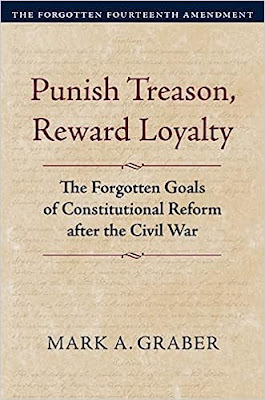
Mark A. Graber, Punish Treason, Reward Loyalty: The Forgotten Goals of Constitutional Reform after the Civil War (University of Kansas Press, 2023)
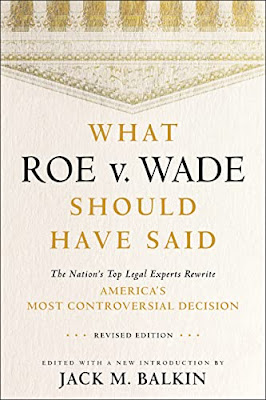
Jack M. Balkin, What Roe v. Wade Should Have Said: The Nation's Top Legal Experts Rewrite America's Most Controversial Decision - Revised Edition (NYU Press, 2023)

Andrew Koppelman, Burning Down the House: How Libertarian Philosophy Was Corrupted by Delusion and Greed (St. Martin’s Press, 2022)

Gerard N. Magliocca, Washington's Heir: The Life of Justice Bushrod Washington (Oxford University Press, 2022)
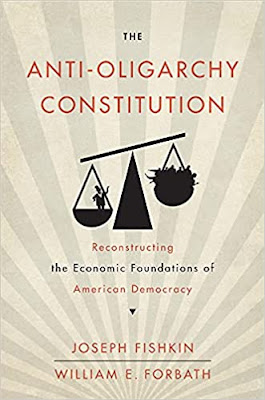
Joseph Fishkin and William E. Forbath, The Anti-Oligarchy Constitution: Reconstructing the Economic Foundations of American Democracy (Harvard University Press, 2022)
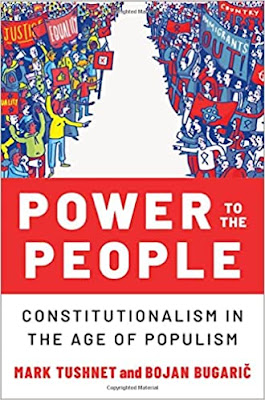
Mark Tushnet and Bojan Bugaric, Power to the People: Constitutionalism in the Age of Populism (Oxford University Press 2021).

Mark Philip Bradley and Mary L. Dudziak, eds., Making the Forever War: Marilyn B. Young on the Culture and Politics of American Militarism Culture and Politics in the Cold War and Beyond (University of Massachusetts Press, 2021).

Jack M. Balkin, What Obergefell v. Hodges Should Have Said: The Nation's Top Legal Experts Rewrite America's Same-Sex Marriage Decision (Yale University Press, 2020)

Frank Pasquale, New Laws of Robotics: Defending Human Expertise in the Age of AI (Belknap Press, 2020)

Jack M. Balkin, The Cycles of Constitutional Time (Oxford University Press, 2020)

Mark Tushnet, Taking Back the Constitution: Activist Judges and the Next Age of American Law (Yale University Press 2020).

Andrew Koppelman, Gay Rights vs. Religious Liberty?: The Unnecessary Conflict (Oxford University Press, 2020)

Ezekiel J Emanuel and Abbe R. Gluck, The Trillion Dollar Revolution: How the Affordable Care Act Transformed Politics, Law, and Health Care in America (PublicAffairs, 2020)

Linda C. McClain, Who's the Bigot?: Learning from Conflicts over Marriage and Civil Rights Law (Oxford University Press, 2020)
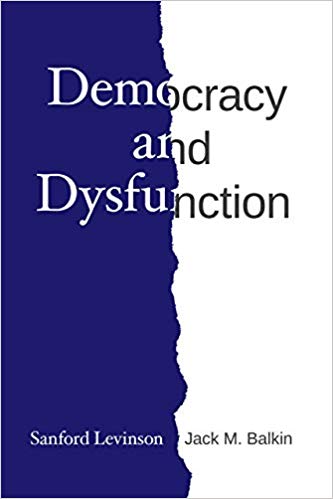
Sanford Levinson and Jack M. Balkin, Democracy and Dysfunction (University of Chicago Press, 2019)

Sanford Levinson, Written in Stone: Public Monuments in Changing Societies (Duke University Press 2018)

Mark A. Graber, Sanford Levinson, and Mark Tushnet, eds., Constitutional Democracy in Crisis? (Oxford University Press 2018)

Gerard Magliocca, The Heart of the Constitution: How the Bill of Rights became the Bill of Rights (Oxford University Press, 2018)

Cynthia Levinson and Sanford Levinson, Fault Lines in the Constitution: The Framers, Their Fights, and the Flaws that Affect Us Today (Peachtree Publishers, 2017)

Brian Z. Tamanaha, A Realistic Theory of Law (Cambridge University Press 2017)

Sanford Levinson, Nullification and Secession in Modern Constitutional Thought (University Press of Kansas 2016)

Sanford Levinson, An Argument Open to All: Reading The Federalist in the 21st Century (Yale University Press 2015)

Stephen M. Griffin, Broken Trust: Dysfunctional Government and Constitutional Reform (University Press of Kansas, 2015)

Frank Pasquale, The Black Box Society: The Secret Algorithms That Control Money and Information (Harvard University Press, 2015)

Bruce Ackerman, We the People, Volume 3: The Civil Rights Revolution (Harvard University Press, 2014)
Balkinization Symposium on We the People, Volume 3: The Civil Rights Revolution

Joseph Fishkin, Bottlenecks: A New Theory of Equal Opportunity (Oxford University Press, 2014)

Mark A. Graber, A New Introduction to American Constitutionalism (Oxford University Press, 2013)

John Mikhail, Elements of Moral Cognition: Rawls' Linguistic Analogy and the Cognitive Science of Moral and Legal Judgment (Cambridge University Press, 2013)

Gerard N. Magliocca, American Founding Son: John Bingham and the Invention of the Fourteenth Amendment (New York University Press, 2013)

Stephen M. Griffin, Long Wars and the Constitution (Harvard University Press, 2013)

Andrew Koppelman, The Tough Luck Constitution and the Assault on Health Care Reform (Oxford University Press, 2013)

James E. Fleming and Linda C. McClain, Ordered Liberty: Rights, Responsibilities, and Virtues (Harvard University Press, 2013)
Balkinization Symposium on Ordered Liberty: Rights, Responsibilities, and Virtues

Andrew Koppelman, Defending American Religious Neutrality (Harvard University Press, 2013)

Brian Z. Tamanaha, Failing Law Schools (University of Chicago Press, 2012)

Sanford Levinson, Framed: America's 51 Constitutions and the Crisis of Governance (Oxford University Press, 2012)

Linda C. McClain and Joanna L. Grossman, Gender Equality: Dimensions of Women's Equal Citizenship (Cambridge University Press, 2012)

Mary Dudziak, War Time: An Idea, Its History, Its Consequences (Oxford University Press, 2012)

Jack M. Balkin, Living Originalism (Harvard University Press, 2011)

Jason Mazzone, Copyfraud and Other Abuses of Intellectual Property Law (Stanford University Press, 2011)

Richard W. Garnett and Andrew Koppelman, First Amendment Stories, (Foundation Press 2011)

Jack M. Balkin, Constitutional Redemption: Political Faith in an Unjust World (Harvard University Press, 2011)

Gerard Magliocca, The Tragedy of William Jennings Bryan: Constitutional Law and the Politics of Backlash (Yale University Press, 2011)

Bernard Harcourt, The Illusion of Free Markets: Punishment and the Myth of Natural Order (Harvard University Press, 2010)

Bruce Ackerman, The Decline and Fall of the American Republic (Harvard University Press, 2010)
Balkinization Symposium on The Decline and Fall of the American Republic

Ian Ayres. Carrots and Sticks: Unlock the Power of Incentives to Get Things Done (Bantam Books, 2010)

Mark Tushnet, Why the Constitution Matters (Yale University Press 2010)

Ian Ayres and Barry Nalebuff: Lifecycle Investing: A New, Safe, and Audacious Way to Improve the Performance of Your Retirement Portfolio (Basic Books, 2010)
.jpg)
Jack M. Balkin, The Laws of Change: I Ching and the Philosophy of Life (2d Edition, Sybil Creek Press 2009)

Brian Z. Tamanaha, Beyond the Formalist-Realist Divide: The Role of Politics in Judging (Princeton University Press 2009)
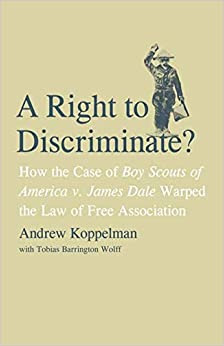
Andrew Koppelman and Tobias Barrington Wolff, A Right to Discriminate?: How the Case of Boy Scouts of America v. James Dale Warped the Law of Free Association (Yale University Press 2009)

Jack M. Balkin and Reva B. Siegel, The Constitution in 2020 (Oxford University Press 2009)

Heather K. Gerken, The Democracy Index: Why Our Election System Is Failing and How to Fix It (Princeton University Press 2009)

Mary Dudziak, Exporting American Dreams: Thurgood Marshall's African Journey (Oxford University Press 2008)

David Luban, Legal Ethics and Human Dignity (Cambridge Univ. Press 2007)

Ian Ayres, Super Crunchers: Why Thinking-By-Numbers is the New Way to be Smart (Bantam 2007)

Jack M. Balkin, James Grimmelmann, Eddan Katz, Nimrod Kozlovski, Shlomit Wagman and Tal Zarsky, eds., Cybercrime: Digital Cops in a Networked Environment (N.Y.U. Press 2007)
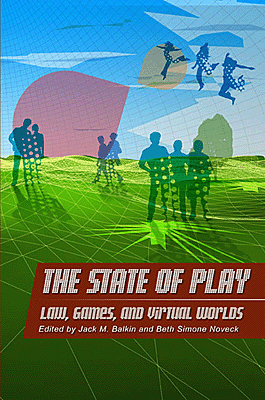
Jack M. Balkin and Beth Simone Noveck, The State of Play: Law, Games, and Virtual Worlds (N.Y.U. Press 2006)

Andrew Koppelman, Same Sex, Different States: When Same-Sex Marriages Cross State Lines (Yale University Press 2006)

Brian Tamanaha, Law as a Means to an End (Cambridge University Press 2006)

Sanford Levinson, Our Undemocratic Constitution (Oxford University Press 2006)

Mark Graber, Dred Scott and the Problem of Constitutional Evil (Cambridge University Press 2006)

Jack M. Balkin, ed., What Roe v. Wade Should Have Said (N.Y.U. Press 2005)

Sanford Levinson, ed., Torture: A Collection (Oxford University Press 2004)
Balkin.com homepage
Bibliography
Conlaw.net
Cultural Software
Writings
Opeds
The Information Society Project
BrownvBoard.com
Useful Links
Syllabi and Exams
