Balkinization
an unanticipated consequence of
Jack M. Balkin
Balkinization Symposiums: A Continuing List
E-mail:
Jack Balkin:
jackbalkin at yahoo.com
Bruce Ackerman
bruce.ackerman at yale.edu
Ian Ayres
ian.ayres at yale.edu
Corey Brettschneider
corey_brettschneider at brown.edu
Mary Dudziak
mary.l.dudziak at emory.edu
Joey Fishkin
joey.fishkin at gmail.com
Heather Gerken heather.gerken at yale.edu
Abbe Gluck abbe.gluck at yale.edu
Mark Graber
mgraber at law.umaryland.edu
Stephen Griffin
sgriffin at tulane.edu
Jonathan Hafetz
jonathan.hafetz at shu.edu
Jeremy Kessler
jkessler at law.columbia.edu
Andrew Koppelman
akoppelman at law.northwestern.edu
Marty Lederman
msl46 at law.georgetown.edu
Sanford Levinson
slevinson at law.utexas.edu
David Luban
david.luban at gmail.com
Gerard Magliocca
gmaglioc at iupui.edu
Jason Mazzone
mazzonej at illinois.edu
Linda McClain
lmcclain at bu.edu
John Mikhail
mikhail at law.georgetown.edu
Frank Pasquale
pasquale.frank at gmail.com
Nate Persily
npersily at gmail.com
Michael Stokes Paulsen
michaelstokespaulsen at gmail.com
Deborah Pearlstein
dpearlst at yu.edu
Rick Pildes
rick.pildes at nyu.edu
David Pozen
dpozen at law.columbia.edu
Richard Primus
raprimus at umich.edu
K. Sabeel Rahmansabeel.rahman at brooklaw.edu
Alice Ristroph
alice.ristroph at shu.edu
Neil Siegel
siegel at law.duke.edu
David Super
david.super at law.georgetown.edu
Brian Tamanaha
btamanaha at wulaw.wustl.edu
Nelson Tebbe
nelson.tebbe at brooklaw.edu
Mark Tushnet
mtushnet at law.harvard.edu
Adam Winkler
winkler at ucla.edu
Compendium of posts on Hobby Lobby and related cases
The Anti-Torture Memos: Balkinization Posts on Torture, Interrogation, Detention, War Powers, and OLC
The Anti-Torture Memos (arranged by topic)
Recent Posts
Key Questions for Regulators Rise with the Dawn of AI-Driven Healthcare
Organizing the Federal Government’s Regulation of AI
Four Roles for Artificial Intelligence in the Medical System
Non-Diagnosis: An Unappreciated but Critical Role for AI in Healthcare
Call for Papers
The Algorithm Will See You Now
Symposium on Artificial Intelligence, Robotics, and Health Care at Yale Law School
Fixing the Constitution's Implied Powers
Were the framers originalists (and does it matter)?
A Marker of a Disjunctive President
Our inevitably living Constitution
Fixation as a Constitutional Rhetoric
The Invention of the Archival Constitution
Training Academies and the Rule of Law
![[Powered by Blogger]](https://lh3.googleusercontent.com/blogger_img_proxy/AEn0k_v5QlPLFj5auqAqXNQz4ffpDhmhQpW3KHO7FVPdjApRCdRPUUpQHNfUvH2YNSiLP8qjriYeS_lztsgXDde9O33jH-NiGh0MPqVh3KiDk6-W=s0-d)
Just A Few Blogs
ACS Blog
Alas, a Blog
Althouse
Arts and Letters Daily
Atrios (Eschaton)
Bill of Health
Buzzflash.com
Buzz Machine
Cato at Liberty
Juan Cole (Informed Comment)
Concurring Opinions
The Constitution in 2020
Corrente
Crooked Timber
Daily Howler
Daily Kos
Dana Boyd
Brad DeLong
Digby (Hullabaloo)
Discriminations
Daniel Drezner
Kevin Drum (Mother Jones)
Electrolite
En Banc
Eunomia (Daniel Larison)
Fafblog
Michael Froomkin (Discourse.net)
GovLab (Beth Noveck)
Rick Hasen (Election Law)
History News Network
How Appealing
Ignatz (Sam Heldman)
The Importance of (Ernie Miller)
Infolaw
Instapundit
International Economic Law and Policy Blog
IntLawGrrls
Jacob Levy
Jesus' General
Jurisdynamics
The Kitchen Cabinet
Mark Kleiman
Law Blog Central
Larry Lessig
Lawyers, Guns and Money
Liberal Oasis
Brian Leiter's Law School Reports
The Leiter Reports
Marginal Revolution
Megan McArdle
Memeorandum
Metafilter
Mirror of Justice
The New Republic
Newseum
No More Mister Nice Blog
Brendan Nyhan
Opinio Juris
Orcinus
The Originalism Blog
Pandagon
Passport (Foreign Policy)
Overcoming Bias
Political Animal (Washington Monthly)
Political Theory Daily Review
Political Wire (Taegan Goddard)
The Poor Man
Virginia Postrel
Prawfsblawg
Public Reason
Jonathan Rauch
Raw Story
Redstate
ReligiousLeftLaw.com
Reporters Committee For Freedom of the Press
Reproductive Rights Blog
Rothman's Roadmap to the Right of Publicity
SCOTUS Blog
Seeing the Forest
Clay Shirky
The Shifted Librarian
The Situationist
Larry Solum (Legal Theory)
Andrew Sullivan
Talking Points Memo
Talk Left
Tapped
Tbogg
TechPresident
The Paper Chase (Jurist)
Tom Paine
Tom Tomorrow (This Modern World)
Eve Tushnet
Uggabugga
University of Chicago Law School Faculty Blog
Unqualified Offerings
The Volokh Conspiracy
War and Piece (Laura Rozen)
Wampum
Oliver Willis
Wonkette
Written Description
Matthew Yglesias
Yin
Your Choice of Feeds
1. XML
powered by

2. Atom Feed
3. RSS 2.0
Key Questions for Regulators Rise with the Dawn of AI-Driven Healthcare
Guest Blogger
Eric
M. Fish
Posted
11:00 AM
by Guest Blogger [link]
Organizing the Federal Government’s Regulation of AI
Guest Blogger
A. Michael Froomkin
For the Symposium on The Law And Policy Of AI, Robotics, and Telemedicine In Health Care.
Posted
9:00 AM
by Guest Blogger [link]
Four Roles for Artificial Intelligence in the Medical System
Guest Blogger
W. Nicholson Price II
For the Symposium on The Law And Policy Of AI, Robotics, and Telemedicine In Health Care.
How will artificial intelligence (AI) change medicine? AI, powered by “big data” in health, promises
to transform medical practice, but specifics remain inchoate. Reports that AI performs certain tasks
at the level of specialists stoke
worries
that AI will “replace”
physicians. These worries are probably
overblown; AI is unlikely to replace many physicians in
the foreseeable future. A more
productive set of
questions considers how AI and physicians should interact, including how AI
can improve the care physicians deliver, how AI can best enable physicians to
focus on the patient relationship, and how physicians should review the
recommendations and predictions of AI.
Answering those questions requires clarity about the larger function of
AI: not just what
tasks AI can do or how it can do them, but what role it will play in the
context of physicians, other patients, and providers within the overall medical
system. Medical AI can improve for
patients and improve the practice of medicine for providers—as long as its
development is supported by an understanding of what role it can and should play. Four different roles each have the
possibility to be transformative for providers and patients: AI can push the
frontiers of medicine; it can replicate and democratize medical expertise; it
can automate medical drudgery; and it can allocate medical resources.
Read more »
Posted
9:00 AM
by Guest Blogger [link]
Non-Diagnosis: An Unappreciated but Critical Role for AI in Healthcare
Guest Blogger
Posted
9:00 AM
by Guest Blogger [link]
Call for Papers
Jason Mazzone
An international conference sponsored by:
Paper proposals are invited for the Fourth Illinois-Bologna conference on Constitutional History: Comparative Perspectives. The conference will be held in Chicago on April 29 & 30, 2019.
The conference keynote speaker will be Justice Grant Huscroft of the Court of Appeal for Ontario (Canada).
Accompanying the spread of constitutional government around the world has been a profound interest in the comparative aspects of constitutional law. Scholars have catalogued the differing features of national constitutions and examined how different constitutional systems resolve common legal issues. So, too, judges faced with legal questions have sought guidance in the decisions of constitutional courts of other nations. While comparative constitutional law is therefore a well-established field, less attention has been paid so far to the comparative dimensions of constitutional history. This international conference series aims to address that shortcoming by energizing the study and analysis of constitutional history from comparative perspectives. It provides a forum for presentation and discussion of current research on issues of constitutional history that crosses national boundaries. It also bring together scholars who, at present, are working on constitutional histories of single jurisdictions—with the expectation that conversations among these scholars will allow for sharing of methodologies and point also to fresh areas of research that may transcend national boundaries.
For 2019, the focus of the conference is on Uses of History in Constitutional Adjudication.
We therefore welcome papers that shed light on the myriad ways in which courts around the world make use of—or ignore—history as they go about deciding cases and the implications and effects of such efforts.
In some nations, the historical meaning of a constitutional provision plays an important role in how courts interpret that provision and then resolve questions of constitutional law. In other nations, historical meaning has relatively little relevance to adjudicating contemporary disputes. A nation’s history can also provide background themes—whether acknowledged or not—that shape how courts approach and situate cases and how they conceive of the role they themselves play in the constitutional system. Historical legacies might provide justification for one outcome over another or limit the options available to a court. Courts might themselves play a role in shaping historical memory by providing in the course of resolving disputes their own reflections upon a nation’s past. Judicial opinions might even be a context for airing of disagreements over the historical record or its lessons. Sometimes courts might decide cases in a way that suggests ignorance of a historical tradition. This might be deliberate: perhaps no institutional actor wants to dredge up the past. Uses of history in constitutional adjudication also raise questions of methodology, including the capacity of courts to conduct historical research and analysis and variations in that regard across national systems. There are also issues of legitimacy: for instance, which kinds of uses of history are defensible in a constitutional regime? And which kinds of history? And when might invocation of history generate public support or opposition? Assessments of current practices, particularly from a comparative perspective, can generate lessons for the future practices of courts—whether longstanding or newly-established—as they adjudicate constitutional cases. These are among the topics papers for the conference could usefully address.
Scholars interested in presenting a paper at the conference should first e-mail a title and summary of the proposed paper along with a CV to Professor Jason Mazzone at mazzonej[@]illinois.edu. There is no word limit for the proposals but proposals in the range of 500-1,000 words are typical. Proposals received by December 15, 2018 will receive priority. After that date, submitted proposals will be considered if space remains.
For those whose abstracts are accepted, draft papers will be due for circulation three weeks prior to the conference.
Subject to the usual requirements of peer review, papers from the conference will be published as a single volume by Brill. Authors who accept an invitation to present a paper at the conference must agree to have the paper included in the published volume. Additional information about length and formatting requirements for the final versions of the papers will be provided to authors.
Conference participants are responsible for their own travel and accommodation expenses.
Posted
2:53 PM
by Jason Mazzone [link]
The Algorithm Will See You Now
Guest Blogger
Claudia Haupt
For the Symposium on The Law And Policy Of AI, Robotics, and Telemedicine In Health Care.
Artificial
intelligence (AI) may well turn out to have a transformative effect on the
delivery of healthcare services.
Various mobile devices now feature “mHealth” applications, prompting healthcare
providers to explore novel ways to incorporate these functions into medical
care. Technology companies are connecting existing consumer-facing technologies
like Alexa to diagnostics AI, creating new avenues of medical advice-giving.
Similarly, professional-use algorithms and AI are available on the provider
side. As we may be moving from computer-aided diagnosis to algorithm-generated
advice, new technical, medical, and legal questions emerge.
What seems like a new frontier in the delivery of healthcare services
actually takes us back to the early days of AI—after all, ELIZA’s DOCTOR
script, developed in the mid-twentieth century, simulated a psychotherapist.
Technological innovation in
healthcare occurs in a densely regulated space dominated by asymmetries of
knowledge and social relationships based on trust. Professional
advice is valuable to patients and clients because of the asymmetry between lay
and expert knowledge. Professionals have knowledge that clients lack, but need
to make important life decisions. These
relationships are governed by a legal framework of professional advice-giving
consisting of several elements, including professional
licensing,
fiduciary duties, informed consent, and professional
malpractice liability.
The regulatory goal is to ensure that the patient (or client) receives
comprehensive, accurate, reliable advice from the doctor (or other
advice-giving professional). Traditionally, this framework assumed interactions
between human actors. Introducing AI challenges this assumption, though I will
stipulate that AI does not entirely replace human doctors for now.
Posted
11:00 AM
by Guest Blogger [link]
Symposium on Artificial Intelligence, Robotics, and Health Care at Yale Law School
JB

This week on Balkinization we will post essays by some of the conference participants on how Artificial Intelligence and Robotics are changing medicine and health care.
Posted
9:55 AM
by JB [link]
Fixing the Constitution's Implied Powers
John Mikhail
For the Symposium on Jonathan Gienapp, The Second Creation: Fixing the American Constitution in the Founding Era (Belknap Press, 2018).
Posted
9:00 AM
by John Mikhail [link]
Were the framers originalists (and does it matter)?
Guest Blogger
William Baude
For the Symposium on Jonathan Gienapp, The Second Creation: Fixing the American Constitution in the Founding Era (Belknap Press, 2018).
Posted
9:00 AM
by Guest Blogger [link]
A Marker of a Disjunctive President
Gerard N. Magliocca
We have a long-running debate on the blog about whether Donald Trump is a disjunctive president. In other words, does he represent the end of a particular party system (the Reagan coalition)? This label comes from the influential work of Stephen Skowronek, who analyzed the presidency in relation to the prevailing party system of the day.
A common theme that links the disjunctive presidents is that their party did poorly in the first set of midterm elections following their own election. This foreshadowed their defeat for reelection two years later. Skowronek identifies four disjunctive presidents (John Quincy Adams, Franklin Pierce, Herbert Hoover, Jimmy Carter). If you examine the midterm elections that followed all of their victories (1826, 1854, 1930, 1978), their parties all did poorly. They did not all lose control of Congress as a result, but the trend was unmistakable.
We'll see how the results in two weeks compare.
UPDATE: As Jack rightly pointed out to me, most Presidents see their party lose seats in their first midterm election. I didn't mean to suggest that only disjunctive presidents see significant party losses in their first midterm election. The point is that no disjunctive president led their party to victory or even just a so-so result in their first midterm election. Consequently, if the GOP gains Senate seats in November (a possibility) and holds the House (also possible), then that would tend to suggest that the collapse of the Reagan coalition is not imminent.
Posted
7:23 AM
by Gerard N. Magliocca [link]
(17) comments
Our inevitably living Constitution
Sandy Levinson
No one in the future can be considered a literate commentator on the history of the Constitution and American constitutional development who has not carefully read and reflected on Jonathan Gienapp’s stunning book The Second Creation: Fixing the American Constitution in the Founding Era. The title itself is extraordinarily rich. It requires us to stop regarding the Philadelphia Convention, or even the various state ratifying conventions, as the singular moment (or even moments) of “creation” of the Constitution (whatever exactly that might be thought to mean). They were important, to be sure, but Gienapp is convincingly insistent that the Congress that convened in 1789 and made crucially important decisions for several years thereafter (including, for example, responding to the Jay Treaty of 1795) played an essential role in “fixing” the Constitution.
Posted
9:00 AM
by Sandy Levinson [link]
(55) comments
Fixation as a Constitutional Rhetoric
Mark Graber
For the Symposium on Jonathan Gienapp, The Second Creation: Fixing the American Constitution in the Founding Era (Belknap Press, 2018).
Abraham
Lincoln’s speeches and writings frequently confirm but sometimes confound the central
thesis of Jonathan Gienapp’s magisterial The
Second Creation. Gienapp in that
superb study of constitutional language and linguistics details how Americans during
the years immediately before, during and immediately after they ratified the
Constitution of the United States came to regard constitutions as texts with fixed
meanings. Lincoln before assuming the
presidency consistently referred to such a constitution when asserting that the
American framers intended to put slavery in “the course of ultimate extinction”
and plainly vested Congress with the power to ban human bondage in American
territories. Upon assuming the
presidency, Lincoln rejected constitutional fixity, treating the
Constitution as incomplete and mutable.
His first inaugural declared, “But no organic
law can ever be framed with a provision specifically applicable to every question which may
occur in practical administration. No foresight can anticipate, nor any
document of reasonable length contain express provisions for all possible
questions. Shall fugitives from labor be surrendered by national or by State
authority? The Constitution does not expressly say. May Congress prohibit slavery in the territories? The Constitution does not expressly say. Must Congress protect slavery in the territories? The Constitution does not expressly say.”
Lincoln’s
presidential rejection of constitutional fixation stemmed from a change in the purpose
of his constitutional arguments rather than an abandonment of his previous
understanding concerning the nature of that constitution. Lincoln’s constitutional arguments before
assuming the presidency made assertions about constitutional policy and practice, about how the Constitution of the United States should
implemented in particular circumstances. Such arguments from the 1790s to the present,
Gienapp lovingly details, treat the Constitution as a text with a fixed
meaning. Lincoln’s first inaugural made
arguments about constitutional authority.
Such arguments routinely assume that the framers did not resolve all
constitutional questions in advance, that some entity or combination of
entities must be empowered to settle at least temporarily good faith disputes
over constitutional meaning.
Arguments
over how the Constitution should be implemented in particular circumstances are
prone to treat constitutions as texts with fixed meanings. The point of such arguments is to justify
political action or constrain the political action of others. Authority comes from settled law rather than from
personal beliefs about good policy or justice.
Presidents claim they are empowered by the past to engage in military
hostilities without a congressional declaration of war. Supreme Court justices insist the persons
responsible for the Constitution empowered them to strike down bans on abortion
or handguns. Persons may base political
action on beliefs about good policy or justice in a regime committed to rule by
law only when authorized by the past to take such actions.
Constitutional arguments with different purposes are far less prone to treat the Constitution as a text with a fixed
meaning. Historians commonly claim that
the framers did not resolve certain disputes.
Social scientists routinely point out how personal beliefs about good
policy and justice influence particular constitutional decisions and the path
of constitutional development. Framers
designing a constitution must decide between provisions likely capable of only
one interpretation that will become part of what Sandy Levinson calls the
Constitution of Settlement or provisions whose interpretation will be disputed that
will become part of what Sandy Levinson calls the Constitution of
Conversation. Arguments over how
constitutional disputes should be settled assume the probability that the words
of the Constitution, no matter how much excavation is done to determine their
meaning, do not in practice settle all constitutional controversies.
The Second
Creation partly details a natural shift in the purpose of constitutional argumentation as well as a greater
tendency for Americans to perceive the Constitution of the United States as a
text with a fixed meaning. During the
drafting and ratification debates, many central questions concerned whether Americans wanted a constitution whose central provisions had clear
fixed meanings. Federalists preferred to
fashion a Constitution of Conversation containing multiple provisions whose
import would continually be worked out through a well-structured constitutional
politics. Anti-Federalists preferred a
Constitution of Settlement containing only provisions capable of one
interpretation. When explaining why a
Constitution of Conversation was superior to a Constitution of Settlement,
Federalists unsurprisingly rejected claims that the Constitution of the United
States should be a text with fixed meanings.
Once the drafting and ratification debates were over, constitutional
argument shifted to implementing the various provisions of the
Constitution. During this debate, Federalists unsurprisingly began treating the Constitution as a text with fixed meanings because persons wishing to claim constitutional authority or constrain rival
political actors routinely insist that their claims are rooted in a Constitution
framed in the past that, interpreted properly, authorize or forbid such matters as presidential decisions to cashier cabinet members without congressional consent, legislative decisions to establishment a national bank, and congressional involvement in implementing treaties. Federalists did not necessarily change their
beliefs about constitutionalism as much as adjust to a different form of
constitutional argument with different constitutional purposes
The
English constitutional practice Americans inherited exhibited a similar
structure. Whether the English
Constitution had a fixed meaning depended on the purpose of the constitutional
argument being made. Gienapp is right to
note the many seventeenth and eighteenth century commentaries do not describe
the English constitution as a text with a fixed meaning. During the upheavals of the seventeenth
century, however, prominent royal and parliamentary authorities debating
political actions done in the name of the constitution were as committed to
constitutional fixation as members of Congress debating the national bank and
the Jay Treaty. Edward Coke and his
Parliamentary allies spoke of Magna Carta as provided fixed limits on regal
power to tax, imprison and detain. James
I and Charles I were just as adamant that the law of the land placed fixed
limits on parliamentary capacity to constrain royal prerogative.
Gienapp’s
rich history of American constitutional rhetoric demonstrates that changes in
the purposes of constitutional argument cannot explain various attitudes
towards the nature of constitutions. He details
how state constitutional arguments before the Constitution of the United States
was ratified were far less inclined to treat constitutions as texts with fixed
meaning than constitutional arguments after ratification. Development is clearly taking place, and not just the nature change in the purposes of constitutional argumentation as the focus of constitutional argument shifts from constitutional design to constitutional action. For this reason, as well as the stunning rich and sophisticated treatment of constitutional argument, The Second Creation belongs which such works as Rakove, Original Meanings in the constitutional canon.
Distinguishing between the purposes of
constitutional argument is nevertheless important to the study of American constitutional development. Lincoln, the
English experience and the last fifteen years of the eighteenth century in the
United States suggest that what people are doing when they make constitutional
arguments matters. The fixation thesis
is far more prevalent when persons make arguments about implementing the
Constitution or at times when most constitutional arguments are about
implementing the Constitution than when persons make arguments that describe
the Constitution, are concerned with constitution design or focus on
constitutional authority. We acknowledge
the Constitution of Conversation when describing actual practice, when deciding
whether to use general phrases in constitutional texts and when determining who
will settle, at least temporarily, a particular constitutional dispute. When actually engaged in arguments about the meaning of the Constitution of Conversation, we speak as if we are discussing the Constitution of Settlement.
Lincoln,
the English experience and American constitutional politics during and
immediately after ratification suggest that constitutions, written
constitutions in particular, foster fixation rhetoric, but that fixation is a rhetoric
rather than an actual description. Legal
and political rhetoric almost always present as clear what are in fact
difficult political choices. Few
participants in the culture wars admit that any moral or legal unclarity exists
on such questions as whether women ought to have a right to terminate
pregnancies or conservative Christians ought to have a right not to bake
wedding cakes for same-sex couples. That
fixation on these matters is rhetoric rather than reality becomes clear only
when the purpose of the constitutional or political conversation changes. Faculty routinely vote with enthusiasm for
job candidates whose positions they describe in law review articles as
unreasonable. Most partisans recognize
the right of the rival coalitions to enact their constitutional vision into law
if they have gained legitimate control of governing institutions.
Gienapp
may end his study too early, Five years
after the Jay Treat debate, Thomas Jefferson anticipated Lincoln when acknowledging
how the meaning of the Constitution is subject to politics and not fixed in
advance. Jefferson’s first inaugural
declared, “During the contest of opinion through which we have passed the
animation of discussions and of exertions has sometimes worn an aspect which
might impose on strangers unused to think freely and to speak and to write what
they think; but this being now decided by the voice of the nation, announced
according to the rules of the Constitution all will, of course, arrange themselves under the will of the law, and unite in
common efforts for the common good. All, too, will bear in mind this sacred
principle, that though the will of the majority is in all cases to prevail,
that will to be rightful must be reasonable; that the minority possess their
equal rights, which equal law must protect, and to violate would be oppression.” Like Lincoln, Jefferson as president did claim
authority solely on the ground that his principles were fixed in 1789. Rather, Jefferson’s and Lincoln’s first inaugurals
recognized that not all constitutional issues are settled during the first
creation, that some mechanism is necessary for at least temporarily resolving
what remains unsettled, and that the possibility exists that such settlements will eventually
become unsettled. Having made those
points in their first inaugurals, both Jefferson and Lincoln frequently
returned to those constitutional arguments whose purposes require reference to
constitutions as texts with fixed meanings.
The
problem with the constitutional rhetoric of fixation has little to do with the
interpretive struggles between originalists of all stripes, living
constitutionalists and those who claim to practice both simultaneously. Legal confidence is a feature of legal
practice. We teach our law students to
express with unwavering certainty that the Constitution compels the justices to
strike down bans on abortion or handguns, just as we train them to assert with unwavering
confidence that justice demands a guilty verdict in any criminal case they
prosecute. The danger occurs only, in
the absence of a Lincoln or a Jefferson, citizens take that rhetoric seriously
and actually regard their political and legal rivals as usurpers rather than
persons engaged in good faith debate over how to interpret a constitution that
does not actually provide fixed answers to all constitutional questions.
Posted
9:00 AM
by Mark Graber [link]
The Invention of the Archival Constitution
Guest Blogger
Alison L. LaCroix
For the Symposium on Jonathan Gienapp, The Second Creation: Fixing the American Constitution in the Founding Era (Belknap Press, 2018).
Among the
many achievements of Jonathan Gienapp’s Second
Creation is the book’s elegant and decisive dismantling of many tidy
just-so stories that constitutional law scholars tend to tell themselves about
the period between 1787 and 1796.
Posted
9:00 AM
by Guest Blogger [link]
Training Academies and the Rule of Law
Richard Primus
Here's a report recently out in The New York Times about a training academy for law clerks, run by the Heritage Foundation:
https://www.nytimes.com/2018/10/18/us/politics/heritage-foundation-clerks-judges-training.html
Posted
3:39 PM
by Richard Primus [link]
Books by Balkinization Bloggers

Gerard N. Magliocca, The Actual Art of Governing: Justice Robert H. Jackson's Concurring Opinion in the Steel Seizure Case (Oxford University Press, 2025)

Linda C. McClain and Aziza Ahmed, The Routledge Companion to Gender and COVID-19 (Routledge, 2024)

David Pozen, The Constitution of the War on Drugs (Oxford University Press, 2024)

Jack M. Balkin, Memory and Authority: The Uses of History in Constitutional Interpretation (Yale University Press, 2024)
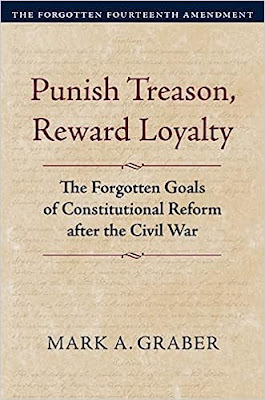
Mark A. Graber, Punish Treason, Reward Loyalty: The Forgotten Goals of Constitutional Reform after the Civil War (University of Kansas Press, 2023)
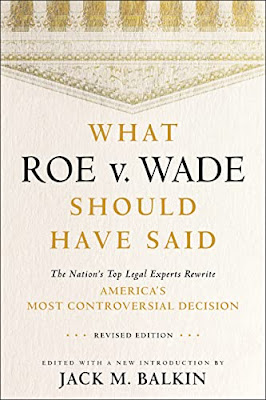
Jack M. Balkin, What Roe v. Wade Should Have Said: The Nation's Top Legal Experts Rewrite America's Most Controversial Decision - Revised Edition (NYU Press, 2023)

Andrew Koppelman, Burning Down the House: How Libertarian Philosophy Was Corrupted by Delusion and Greed (St. Martin’s Press, 2022)

Gerard N. Magliocca, Washington's Heir: The Life of Justice Bushrod Washington (Oxford University Press, 2022)
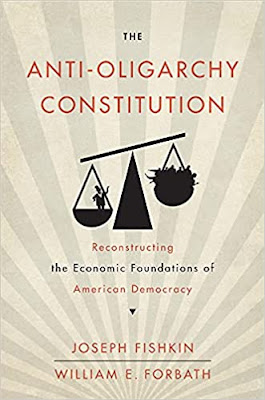
Joseph Fishkin and William E. Forbath, The Anti-Oligarchy Constitution: Reconstructing the Economic Foundations of American Democracy (Harvard University Press, 2022)
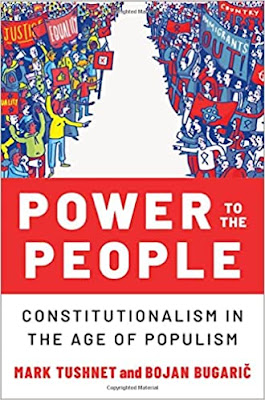
Mark Tushnet and Bojan Bugaric, Power to the People: Constitutionalism in the Age of Populism (Oxford University Press 2021).

Mark Philip Bradley and Mary L. Dudziak, eds., Making the Forever War: Marilyn B. Young on the Culture and Politics of American Militarism Culture and Politics in the Cold War and Beyond (University of Massachusetts Press, 2021).

Jack M. Balkin, What Obergefell v. Hodges Should Have Said: The Nation's Top Legal Experts Rewrite America's Same-Sex Marriage Decision (Yale University Press, 2020)

Frank Pasquale, New Laws of Robotics: Defending Human Expertise in the Age of AI (Belknap Press, 2020)

Jack M. Balkin, The Cycles of Constitutional Time (Oxford University Press, 2020)

Mark Tushnet, Taking Back the Constitution: Activist Judges and the Next Age of American Law (Yale University Press 2020).

Andrew Koppelman, Gay Rights vs. Religious Liberty?: The Unnecessary Conflict (Oxford University Press, 2020)

Ezekiel J Emanuel and Abbe R. Gluck, The Trillion Dollar Revolution: How the Affordable Care Act Transformed Politics, Law, and Health Care in America (PublicAffairs, 2020)

Linda C. McClain, Who's the Bigot?: Learning from Conflicts over Marriage and Civil Rights Law (Oxford University Press, 2020)
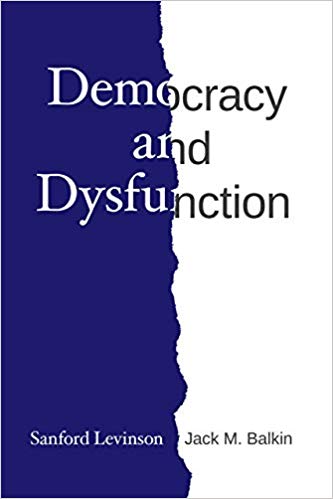
Sanford Levinson and Jack M. Balkin, Democracy and Dysfunction (University of Chicago Press, 2019)

Sanford Levinson, Written in Stone: Public Monuments in Changing Societies (Duke University Press 2018)

Mark A. Graber, Sanford Levinson, and Mark Tushnet, eds., Constitutional Democracy in Crisis? (Oxford University Press 2018)

Gerard Magliocca, The Heart of the Constitution: How the Bill of Rights became the Bill of Rights (Oxford University Press, 2018)

Cynthia Levinson and Sanford Levinson, Fault Lines in the Constitution: The Framers, Their Fights, and the Flaws that Affect Us Today (Peachtree Publishers, 2017)

Brian Z. Tamanaha, A Realistic Theory of Law (Cambridge University Press 2017)

Sanford Levinson, Nullification and Secession in Modern Constitutional Thought (University Press of Kansas 2016)

Sanford Levinson, An Argument Open to All: Reading The Federalist in the 21st Century (Yale University Press 2015)

Stephen M. Griffin, Broken Trust: Dysfunctional Government and Constitutional Reform (University Press of Kansas, 2015)

Frank Pasquale, The Black Box Society: The Secret Algorithms That Control Money and Information (Harvard University Press, 2015)

Bruce Ackerman, We the People, Volume 3: The Civil Rights Revolution (Harvard University Press, 2014)
Balkinization Symposium on We the People, Volume 3: The Civil Rights Revolution

Joseph Fishkin, Bottlenecks: A New Theory of Equal Opportunity (Oxford University Press, 2014)

Mark A. Graber, A New Introduction to American Constitutionalism (Oxford University Press, 2013)

John Mikhail, Elements of Moral Cognition: Rawls' Linguistic Analogy and the Cognitive Science of Moral and Legal Judgment (Cambridge University Press, 2013)

Gerard N. Magliocca, American Founding Son: John Bingham and the Invention of the Fourteenth Amendment (New York University Press, 2013)

Stephen M. Griffin, Long Wars and the Constitution (Harvard University Press, 2013)

Andrew Koppelman, The Tough Luck Constitution and the Assault on Health Care Reform (Oxford University Press, 2013)

James E. Fleming and Linda C. McClain, Ordered Liberty: Rights, Responsibilities, and Virtues (Harvard University Press, 2013)
Balkinization Symposium on Ordered Liberty: Rights, Responsibilities, and Virtues

Andrew Koppelman, Defending American Religious Neutrality (Harvard University Press, 2013)

Brian Z. Tamanaha, Failing Law Schools (University of Chicago Press, 2012)

Sanford Levinson, Framed: America's 51 Constitutions and the Crisis of Governance (Oxford University Press, 2012)

Linda C. McClain and Joanna L. Grossman, Gender Equality: Dimensions of Women's Equal Citizenship (Cambridge University Press, 2012)

Mary Dudziak, War Time: An Idea, Its History, Its Consequences (Oxford University Press, 2012)

Jack M. Balkin, Living Originalism (Harvard University Press, 2011)

Jason Mazzone, Copyfraud and Other Abuses of Intellectual Property Law (Stanford University Press, 2011)

Richard W. Garnett and Andrew Koppelman, First Amendment Stories, (Foundation Press 2011)

Jack M. Balkin, Constitutional Redemption: Political Faith in an Unjust World (Harvard University Press, 2011)

Gerard Magliocca, The Tragedy of William Jennings Bryan: Constitutional Law and the Politics of Backlash (Yale University Press, 2011)

Bernard Harcourt, The Illusion of Free Markets: Punishment and the Myth of Natural Order (Harvard University Press, 2010)

Bruce Ackerman, The Decline and Fall of the American Republic (Harvard University Press, 2010)
Balkinization Symposium on The Decline and Fall of the American Republic

Ian Ayres. Carrots and Sticks: Unlock the Power of Incentives to Get Things Done (Bantam Books, 2010)

Mark Tushnet, Why the Constitution Matters (Yale University Press 2010)

Ian Ayres and Barry Nalebuff: Lifecycle Investing: A New, Safe, and Audacious Way to Improve the Performance of Your Retirement Portfolio (Basic Books, 2010)
.jpg)
Jack M. Balkin, The Laws of Change: I Ching and the Philosophy of Life (2d Edition, Sybil Creek Press 2009)

Brian Z. Tamanaha, Beyond the Formalist-Realist Divide: The Role of Politics in Judging (Princeton University Press 2009)
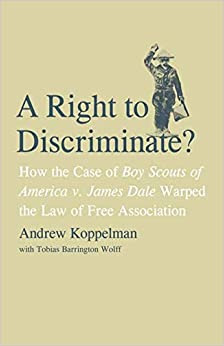
Andrew Koppelman and Tobias Barrington Wolff, A Right to Discriminate?: How the Case of Boy Scouts of America v. James Dale Warped the Law of Free Association (Yale University Press 2009)

Jack M. Balkin and Reva B. Siegel, The Constitution in 2020 (Oxford University Press 2009)

Heather K. Gerken, The Democracy Index: Why Our Election System Is Failing and How to Fix It (Princeton University Press 2009)

Mary Dudziak, Exporting American Dreams: Thurgood Marshall's African Journey (Oxford University Press 2008)

David Luban, Legal Ethics and Human Dignity (Cambridge Univ. Press 2007)

Ian Ayres, Super Crunchers: Why Thinking-By-Numbers is the New Way to be Smart (Bantam 2007)

Jack M. Balkin, James Grimmelmann, Eddan Katz, Nimrod Kozlovski, Shlomit Wagman and Tal Zarsky, eds., Cybercrime: Digital Cops in a Networked Environment (N.Y.U. Press 2007)
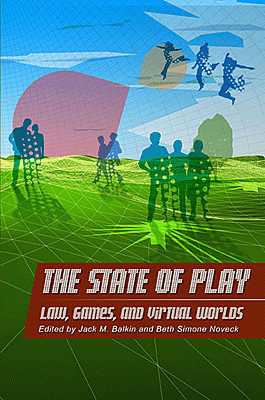
Jack M. Balkin and Beth Simone Noveck, The State of Play: Law, Games, and Virtual Worlds (N.Y.U. Press 2006)

Andrew Koppelman, Same Sex, Different States: When Same-Sex Marriages Cross State Lines (Yale University Press 2006)

Brian Tamanaha, Law as a Means to an End (Cambridge University Press 2006)

Sanford Levinson, Our Undemocratic Constitution (Oxford University Press 2006)

Mark Graber, Dred Scott and the Problem of Constitutional Evil (Cambridge University Press 2006)

Jack M. Balkin, ed., What Roe v. Wade Should Have Said (N.Y.U. Press 2005)

Sanford Levinson, ed., Torture: A Collection (Oxford University Press 2004)
Balkin.com homepage
Bibliography
Conlaw.net
Cultural Software
Writings
Opeds
The Information Society Project
BrownvBoard.com
Useful Links
Syllabi and Exams
