Balkinization
an unanticipated consequence of
Jack M. Balkin
Balkinization Symposiums: A Continuing List
E-mail:
Jack Balkin:
jackbalkin at yahoo.com
Bruce Ackerman
bruce.ackerman at yale.edu
Ian Ayres
ian.ayres at yale.edu
Corey Brettschneider
corey_brettschneider at brown.edu
Mary Dudziak
mary.l.dudziak at emory.edu
Joey Fishkin
joey.fishkin at gmail.com
Heather Gerken heather.gerken at yale.edu
Abbe Gluck abbe.gluck at yale.edu
Mark Graber
mgraber at law.umaryland.edu
Stephen Griffin
sgriffin at tulane.edu
Jonathan Hafetz
jonathan.hafetz at shu.edu
Jeremy Kessler
jkessler at law.columbia.edu
Andrew Koppelman
akoppelman at law.northwestern.edu
Marty Lederman
msl46 at law.georgetown.edu
Sanford Levinson
slevinson at law.utexas.edu
David Luban
david.luban at gmail.com
Gerard Magliocca
gmaglioc at iupui.edu
Jason Mazzone
mazzonej at illinois.edu
Linda McClain
lmcclain at bu.edu
John Mikhail
mikhail at law.georgetown.edu
Frank Pasquale
pasquale.frank at gmail.com
Nate Persily
npersily at gmail.com
Michael Stokes Paulsen
michaelstokespaulsen at gmail.com
Deborah Pearlstein
dpearlst at yu.edu
Rick Pildes
rick.pildes at nyu.edu
David Pozen
dpozen at law.columbia.edu
Richard Primus
raprimus at umich.edu
K. Sabeel Rahmansabeel.rahman at brooklaw.edu
Alice Ristroph
alice.ristroph at shu.edu
Neil Siegel
siegel at law.duke.edu
David Super
david.super at law.georgetown.edu
Brian Tamanaha
btamanaha at wulaw.wustl.edu
Nelson Tebbe
nelson.tebbe at brooklaw.edu
Mark Tushnet
mtushnet at law.harvard.edu
Adam Winkler
winkler at ucla.edu
Compendium of posts on Hobby Lobby and related cases
The Anti-Torture Memos: Balkinization Posts on Torture, Interrogation, Detention, War Powers, and OLC
The Anti-Torture Memos (arranged by topic)
Recent Posts
A Message from the Founder of PIMCO
Symposium on Access to Knowledge in the Age of Intellectual Property
Non sequiturs in the Florida health care decision
Reading the Tea Leaves in Vinson's Ruling
Giving Originalism a Bad Name
The Civic Republican Roots of the Individual Mandate
The Next Preemptive Opinion?
A brief note on the rule of law and judicial activism
Hall's New Article on Commerce Clause Challenges to the ACA
The Politics of "Constitutional Law"
Et tu, Garrett
Does Virginia's challenge to the individual mandate lack subject matter jurisdiction?
Ghailani and the Lost Lesson of Federal Prosecutions
Hasen: "leave the question of who should be Chicago's mayor to the voters"
The Economics of Tiger Parenting
The Obama Generation
Reforming congress
"Finally Able to Capture Their Fair Share"
Linnaean Regulation in Health Insurance and Information Technology
Health care reform: the Broccoli Objection

Just A Few Blogs
ACS Blog
Alas, a Blog
Althouse
Arts and Letters Daily
Atrios (Eschaton)
Bill of Health
Buzzflash.com
Buzz Machine
Cato at Liberty
Juan Cole (Informed Comment)
Concurring Opinions
The Constitution in 2020
Corrente
Crooked Timber
Daily Howler
Daily Kos
Dana Boyd
Brad DeLong
Digby (Hullabaloo)
Discriminations
Daniel Drezner
Kevin Drum (Mother Jones)
Electrolite
En Banc
Eunomia (Daniel Larison)
Fafblog
Michael Froomkin (Discourse.net)
GovLab (Beth Noveck)
Rick Hasen (Election Law)
History News Network
How Appealing
Ignatz (Sam Heldman)
The Importance of (Ernie Miller)
Infolaw
Instapundit
International Economic Law and Policy Blog
IntLawGrrls
Jacob Levy
Jesus' General
Jurisdynamics
The Kitchen Cabinet
Mark Kleiman
Law Blog Central
Larry Lessig
Lawyers, Guns and Money
Liberal Oasis
Brian Leiter's Law School Reports
The Leiter Reports
Marginal Revolution
Megan McArdle
Memeorandum
Metafilter
Mirror of Justice
The New Republic
Newseum
No More Mister Nice Blog
Brendan Nyhan
Opinio Juris
Orcinus
The Originalism Blog
Pandagon
Passport (Foreign Policy)
Overcoming Bias
Political Animal (Washington Monthly)
Political Theory Daily Review
Political Wire (Taegan Goddard)
The Poor Man
Virginia Postrel
Prawfsblawg
Public Reason
Jonathan Rauch
Raw Story
Redstate
ReligiousLeftLaw.com
Reporters Committee For Freedom of the Press
Reproductive Rights Blog
Rothman's Roadmap to the Right of Publicity
SCOTUS Blog
Seeing the Forest
Clay Shirky
The Shifted Librarian
The Situationist
Larry Solum (Legal Theory)
Andrew Sullivan
Talking Points Memo
Talk Left
Tapped
Tbogg
TechPresident
The Paper Chase (Jurist)
Tom Paine
Tom Tomorrow (This Modern World)
Eve Tushnet
Uggabugga
University of Chicago Law School Faculty Blog
Unqualified Offerings
The Volokh Conspiracy
War and Piece (Laura Rozen)
Wampum
Oliver Willis
Wonkette
Written Description
Matthew Yglesias
Yin
Your Choice of Feeds
1. XML
powered by

2. Atom Feed
3. RSS 2.0
A Message from the Founder of PIMCO
Frank Pasquale
As Bryce Covert notes, "pay on Wall Street broke a record last year, hitting $135 billion" out of firm revenue of $417 billion. "Legerdemath" helps drive those results; as one former member of a corporate derivatives team puts it, "whenever possible we used our superior knowledge to manipulate the pricing of the trade in our favor." And pity the poor pension fund that asks for some help in currency trading.
Folks like Jack Bogle have long lamented these sharp practices. Now Bill Gross, the founder of PIMCO, has a stinging indictment of Wall Street as well: As a profession we have failed miserably at our primary function – the efficient and productive allocation of capital: The S&L debacle of the early 1980s, the Asian crisis, LTCM, dotcoms, subprimes, Lehman and the resurrection, instead of the reformation, of Wall Street, are major sins of the modern era of money. . . .
Read more »
Posted
3:42 PM
by Frank Pasquale [link]
Symposium on Access to Knowledge in the Age of Intellectual Property
Frank Pasquale
Readers interested in the Access to Knowledge movement may want to take a look at an online symposium on the new book Access to Knowledge in the Age of Intellectual Property. It's running till Thursday at Concurring Opinions. This book, edited by Gaëlle Krikorian and Amy Kapczynski, is available for free download here, and can also be purchased here. Here is a quote from the introduction that gives a sense of the book's themes: In a hospital in South Korea, leukemia patients are expelled as untreatable because a multinational drug company refuses to lower the price of a life-saving drug. Thousands of miles away, a U.S. group called the Rational Response Squad is forced by the threat of a copyright lawsuit to take down a YouTube video criticizing the paranormalist Uri Geller. Could we—should we—see these two events, so seemingly remote from one another, as related? Yes—or such is the premise of a new political formation on the global stage, one that goes under the name of the “access to knowledge movement”—or more simply, A2K.
A2K is an emerging mobilization that includes software programmers who took to the streets to defeat software patents in Europe, AIDS activists who forced multinational pharmaceutical companies to permit copies of their medicines to be sold in South Africa, and college students who have created a new “free culture” movement to “defend the digital commons”—to select just a few. A2K can also be seen as an emerging set of theoretical commitments that both respond to and reject the key justifications for “intellectual property” law and that seek to develop an alternative account of the operation and importance of information and knowledge, creativity and innovation in the contemporary world.
Krikorian and Kapczynski have assembled a top-notch group of contributors, and this work is one of the definitive collections on global social justice movements in the digital age.
Posted
9:02 PM
by Frank Pasquale [link]
Non sequiturs in the Florida health care decision
Andrew Koppelman
The debate over the constitutionality of mandatory health insurance is a placeholder for two different constitutional visions. Health care reform is only the latest manifestation of the New Deal vision of a society whose members are economically secure and protected from the otherwise brutal effects of market forces. Opponents of the mandate envision a radical revision of constitutional law that severely restricts Congress’s authority: if market forces step on you, you’re on your own. Which vision one adopts is, perhaps, a matter of ultimate value judgment, immune to argument. One can, however, ask whether the radicals’ constitutional vision is internally consistent and hangs together logically.
So Judge Roger Vinson’s recent opinion invalidating the law is revealing. The decision is such a bizarre collection of non sequiturs that reading it should have a sobering effect even on those who share his political vision.
Read more »
Posted
2:42 PM
by Andrew Koppelman [link]
Reading the Tea Leaves in Vinson's Ruling
Frank Pasquale
NYT reporter Kevin Sack notes that Judge Vinson tips his hand in his health care ruling by referencing, out of the blue, colonial tea policy. This isn't dog-whistle opinion writing, but red meat for those with a certain vision of red America.
At Health Affairs, Tim Jost patiently dismantles the opinion. He concludes: This is a radical decision. Judge Vinson has a clear vision of the limited federal government the founders intended that is very much in line with that espoused by the Tea Party Movement. He mourns the fact that the Supreme Court has allowed Congress to assume control over much of the American economy, and grasps any toehold he can find in precedent to push back against that authority. Despite repeated cautions in governing precedent that the courts should defer to congressional judgments in economic matters where rational, Judge Vinson is confident in the wisdom of his own judgments and readily substitutes them for those of Congress. . . .
But the ramifications of this case go far beyond the minimum coverage requirement. We will see what the courts of appeal and ultimately the Supreme Court do with this opinion. If it is upheld, it will mean a dramatic contraction of the authority of Congress. . . .
What I find most disheartening is that someone with the health care knowledge of Jost has to get bogged down in a fight like this. He's written a series of excellent posts on topics including medical loss ratios, preventive services, a patient bill of rights, grandfathered plans, tax exempt hospitals, the small employer tax credit, the Web portal, reinsurance for early retirees, and young adult coverage. If we had a rational health care debate, we'd be focusing on practical issues like these--rather than, as Jack puts it, a faux "defense of liberty" that is little more than a "defense of selfishness."
Posted
6:59 PM
by Frank Pasquale [link]
Giving Originalism a Bad Name
David Gans
Chief Judge Vinson’s opinion, issued yesterday, profoundly misinterpreted the Constitution in order to justify striking down the Patient Protection and Affordable Care Act. In his opinion, Judge Vinson invoked a highly selective, skewed version of our Constitution’s text and history. Relying heavily on the work of a few conservative originalists, Chief Judge Vinson’s opinion ignored or dismissed every piece of evidence to the contrary, including the Framers’ understandings of the scope of the powers of the federal government and Marshall Court’s canonical cases construing the Commerce Clause and the Necessary and Proper Clause.
In Vinson’s telling, the Commerce Clause was designed by the Framers of the Constitution to be a narrow grant of power, which permitted Congress to regulate trade between the states, and to eliminate discriminatory trade restrictions between the states. But his suggestion that Congress’ authority under the Commerce Clause was limited to matters of trade has no support in history, and is contrary to binding Supreme Court precedent, rulings that Vinson, as a lower court judge, is supposed to follow.
In 1824, in Gibbons v. Ogden, one of the most important Supreme Court cases interpreting the Commerce Clause, the Court considered and rejected the very same argument. As Chief Justice Marshall explained in Gibbons: “This would restrict a general term, applicable to many objects, to one of its significations. Commerce, undoubtedly is traffic, but it is something more: it is intercourse. It describes the commercial intercourse between nations, and parts of nations in all its branches . . . .” In the Federalist Papers, James Madison said much the same thing, making clear that the Commerce Clause gave the federal government the power to regulate intercourse between the states.
Marshall rejected a narrow construction of the Commerce Clause, and for good reason. A cramped understanding of Congress’ explicitly enumerated powers would thwart the Framers’ allocation of powers between the federal government and the states. While states were to retain very wide authority, the Constitution gave Congress broad powers in Article I, including the power to regulate commerce among the states, to give the federal government the power to solve national problems that states could not solve on their own. The Constitution’s Framers recognized that Congress should enjoy the authority to “legislate in all Cases for the general interests of the Union, and also in those cases to which the States are separately incompetent, or in which the Harmony of the United States may be interrupted by the Exercise of individual legislation.” This history has been told lately in superb works by Akhil Amar and Jack Balkin, but Vinson ignored it.
Vinson’s trade theory is inconsistent with not one, but two, of Chief Justice Marshall’s landmark opinions. In McCulloch v. Maryland, a few years before Gibbons, Chief Justice Marshall embraced a broad understanding of congressional power under Article I, holding that the Constitution gave Congress the power to charter a national bank. “[A]mong the enumerated powers of government . . ., we find the great powers, to lay and collect taxes; to borrow money; to regulate commerce . . . . The sword and the purse, all the external relations, and no inconsiderable portion of the industry of the nation, are intrusted to the government. . . .[A] government, intrusted with such ample powers, on due execution of which the happiness and prosperity of the nation so vitally depends, must also be intrusted with ample means for their execution.” Vinson’s opinion does not reflect this broad understanding of federal power under the Commerce and Necessary and Proper Clauses.
In Chief Judge Vinson’s version of Supreme Court history, the Marshall Court hardly figures at all. According to Vinson, the history of the Commerce Clause in the Supreme Court begins with the Lochner era, which repeatedly limited the power of the federal government under the Commerce Clause, invalidating federal legislation designed to protect workers and consumers from powerful corporations. Vinson writes, “for most of the first century and a half of Constitutional government . . . the Clause was given a ‘miserly construction,’” quoting with approval a 1983 concurring opinion authored by Justice John Paul Stevens. In the process, Vinson turns the Stevens opinion on its head. Justice Stevens called the Lochner era precedents “miserly” because they departed from the Framers’ design “to confer a power on the Federal Government adequate to discharge its central mission,” and were properly repudiated on that basis, but for Vinson, the Lochner era precedents are foundational, and correct. Chief Judge Vinson looks to them precisely because they gave a cramped reading to the powers of the federal government. Guided by the rulings of the Lochner era, it’s no wonder that Chief Judge Vinson finds the Patient Protection and Affordable Care Act wanting.
It’s rare to find a lower court ruling that is so badly out of line with both text and history and so many foundational Supreme Court precedents. Vinson’s opinion should arrive at the Eleventh Circuit dead on arrival.
David Gans is the Director of the Human Rights, Civil Rights & Citizenship Program at the Constitutional Accountability Center. This post is cross-posted at Text and History.
Posted
5:32 PM
by David Gans [link]
The Civic Republican Roots of the Individual Mandate
JB
As a protest against the individual mandate, several South Dakota legislators have introduced a bill requiring citizens to purchase a gun for self-defense.Rep. Hal Wick, R-Sioux Falls, is sponsoring the bill and knows it will be killed. But he said he is introducing it to prove a point that the federal health care reform mandate passed last year is unconstitutional.
The irony, of course, is that this is an example of what the federal government could require citizens to do at the founding. All able bodied male citizens were part of the militia, and therefore were required to bear arms in defense of the state. In fact, the federal government passed a militia act in 1792 that required that every citizen purchase a weapon and ammunition.
“Do I or the other cosponsors believe that the State of South Dakota can require citizens to buy firearms? Of course not. But at the same time, we do not believe the federal government can order every citizen to buy health insurance,” he said.Be it enacted by the Senate and House of Representatives of the United States of America, in Congress assembled, That each and every free able-bodied white male citizen of the respective States, resident therein, who is or shall be of age of eighteen years, and under the age of forty-five years (except as is herein after excepted) shall severally and respectively be enrolled in the militia . . . That every citizen, so enrolled and notified, shall, within six months thereafter, provide himself with a good musket or firelock, a sufficient bayonet and belt, two spare flints, and a knapsack, a pouch, with a box therein, to contain not less than twenty four cartridges, suited to the bore of his musket or firelock, each cartridge to contain a proper quantity of powder and ball; or with a good rifle, knapsack, shot-pouch, and powder-horn, twenty balls suited to the bore of his rifle, and a quarter of a pound of powder; and shall appear so armed, accoutred and provided, when called out to exercise or into service . . . .
The requirement to join the militia (and purchase arms for the defense of the state) was an aspect of civic republicanism-- the political idea that citizens had a duty to work toward the public good and make sacrifices on behalf of their fellow citizens and the republic (the res publica, or public thing). Hence citizens were automatically made part of the militia, and this mean that they might be called upon to lay down their lives for their fellow citizens and the republic. The country was founded on this civic republican ideal as well as a belief in individual liberty and democratic self government.
What is lost in the debate over the individual mandate is that the point of the individual mandate is also civic republican in nature. It requires citizens to make a far less significant but also public-spirited sacrifice on behalf of other Americans who cannot afford health insurance. Individuals must join health insurance risk pools to make health care affordable for more of their fellow citizens. This is a very modest request that individuals not be entirely selfish and that they contribute to the public good in a small way by helping to make health care accessible and affordable for all Americans. Indeed, under the terms of the Affordable Care Act, one doesn't even have to purchase insurance; one can simply pay a small tax instead. And one doesn't have to pay at all if one is too poor to do so or has a religious objection.
The notion that being asked to either buy health insurance and make health care accessible for one's fellow citizens--or to pay a small tax-- is a form of tyranny akin to George III's regime is simply bizarre: it shows how perverted and twisted public discourse has become in the United States. The assault on the individual mandate is really an assault on the public duty to assist other Americans in need, and in particular, an assault on the legal obligation to pay taxes to contribute to the general welfare. The assault on the health care bill is not a defense of liberty. It is a defense of selfishness.
Posted
2:31 PM
by JB [link]
The Next Preemptive Opinion?
Gerard N. Magliocca
One important issue in my scholarship is the place of "preemptive opinions" in constitutional law. A preemptive opinion is one in which the Supreme Court invalidates the major initiative or policy plank of the opposition party immediately preceding or following an electoral realignment. These decisions that have three characteristics: (1) they reach out to decide unnecessary constitutional questions (so that they can make a political statement); (2) they decide those unnecessary issues in a extraordinarily broad manner (so that they can make a political statement and create powerful doctrine); and (3) they develop some new understanding of liberty or equality to buttress their arguments (as precedent is usually strongly against the reasoning). The three leading examples of this phenomenon are Worcester v. Georgia (John Marshall vs. Jacksonian Democracy), Dred Scott (Roger Taney vs. the Republican Party), and Pollock v. Farmers' Loan & Trust (Melville Fuller vs. William Jennings Bryan). The New Deal (The Four Horsemen vs. FDR) also saw this kind of unorthodox action, though I'm not familiar enough with those cases to single one out as the best representative.
Will the individual mandate be the vehicle for the next preemptive opinion? Well, a few things point to yes. First, the health care reform is obviously the signature law of the Obama Administration. Second, there is a plausible argument that the 2008 election was a realignment, so we are in the crucial window. Third, the courts that have considered the statute thus far have blown past the various ways that they could use to decline to decide the merits now. Fourth, yesterday's District Court opinion invalidated the entire statute (not just the individual mandate), which is an exceptionally broad remedy even though the reasoning did not call into question other federal laws on the books. Finally, the critical decisions have articulated an inchoate liberty interest against the forced purchase of goods (compulsory commerce) that is new to our jurisprudence.
None of this, though, answers the question of whether the Justices will issue a preemptive opinion here. It is not possible to predict whether an opinion will be broad or narrow, for instance, when different choices are available. All we can say is that there is a real chance that this kind of decision will come in the near future, and thus more attention must be given to the (admittedly few) precedents in this category. They will tell us more than the leading Commerce Clause cases about what the Court will do next year or in 2013.
Posted
8:08 PM
by Gerard N. Magliocca [link]
A brief note on the rule of law and judicial activism
JB
Compare:
The individual mandate cannot be severed. This conclusion is reached with full appreciation for the “normal rule” that reviewing courts should ordinarily refrain from invalidating more than the unconstitutional part of a statute, but non-severability is required based on the unique facts of this case and the particular aspects of the Act. This is not a situation that is likely to be repeated.
-- Judge Vinson in Florida v. HHS
Our consideration is limited to the present circumstances, for the problem of equal protection in election processes generally presents many complexities.
-- Per Curiam opinion in Bush v. Gore.
It is hard to see Judge Vinson's opinion on the question of severability as entirely unaffected by partisan considerations, just as it is hard to reach the same conclusion about the 5-4 decision on the remedy in Bush v. Gore. When a judge informs you that a particular decision is unique, and unlikely ever to be repeated again--a ticket good for this day only--one begins to suspect that something other than the dispassionate application of the rule of law is going on. And of course, there is a remarkable congruence between what the Republican Party wants and what Judge Vinson has done (not to mention what the conservative majority did in Bush v. Gore).
The Republican Party does not want to excise the individual mandate but keep the most popular features of the ACA; it wants to get rid of the entire statute. This is something that Judge Hudson, who also declared the individual mandate unconstitutional in Virginia v. Sebelius, was unwilling to provide. In these "unique" circumstances, however, Judge Vinson was happy to be of service.
I never thought I'd say this, but compared to Judge Vinson, Judge Hudson is starting to look like an apostle of judicial restraint.
Posted
6:21 PM
by JB [link]
Hall's New Article on Commerce Clause Challenges to the ACA
Frank Pasquale
Another federal judge has called the ACA unconstitutional. Digby offers some realpolitik. For those interested in the Commerce Clause issue, Mark A. Hall's new article, forthcoming in the University of Pennsylvania Law Review, pinpoints the strongest arguments for and against federal power under the Commerce Clause to mandate the purchase of health insurance. His key points in defense of the law appear below:
Read more »
Posted
5:42 PM
by Frank Pasquale [link]
The Politics of "Constitutional Law"
Mark Tushnet
Here's something between a genuine question and a thought-experiment: Would the dynamics of the discussion among people who pay attention to these sorts of things change were a Republican-appointed judge to uphold the Affordable Care Act, or a Democratic-appointed judge to hold it unconstitutional? (I put it this way to avoid using the freighted term "legitimacy.")
Posted
4:27 PM
by Mark Tushnet [link]
Et tu, Garrett
Sandy Levinson
Garrett Epps, whom I very much like personally and whose work I greatly admire, has an article in the current Nation justifiably attacking some Tea Partiers (think of Michelle Bachman) for their wacky, and often pernicious, views of the Constitution. The subtite of his piece (I assume the product of Nation headline writers) is "Inside the right's cammpaign to hijack our country's founding text--and how to fight back." So, given that I agree with a great deal of the piece, including, for example, his takedown of Antonin Scalia for basic dishonesty in the way he actually operationalizes his vaunted commitment to "originalism" and a "dead Constitution" (Scalia's term, not his critics'), why am I left so dismayed after reading the piece?
The quick answer is that Epps cannot forbear from engaging in his own version of Constitution worship. If the response of the Left to Bachman and her ilk is to claim only that we love the "real" Constitution more than they do--and to ridicule without discussion the desires of some of the Tea Partiers to amend the Constitution--then I we only slip further into the reverie of Madisonian "veneration" of the Constitution instead of adopting Thomas Jefferson's injunction not to treat it as an "ark of the Covenant." When all is said and done, Epps, like most contemporary leftists, including the American Constitution Society (an organization that I happy to financially support), is almost entirely Madisonian, which, for me, obviously, is no compliment. (Hope springs eternal that the ACS will become more critical of the Constitution.)
So here's the bill of particulars with regard to Epps's essay:
"Our Constitution wasn't written to rig the political game but to play it without killing one another. It created a government and gave that government the power it needed to function." First, it is patently false to say that the Constitution "wasn't written to rig the political game." After all, as he himself notes (contra the ridiculous claims of Bachman), the Constitution was written to rig the game in favor of slaveowners and the states they lived in, who got a huge bonus in the House of Representatives (and, therefore, the electoral college and, ultimately, because it's the President who chooses nominees for the Supreme Court, that institution as well). And, of course, as he well knows, having written a fine book on the Fourteenth Amendment, it took a bloody war that killed two percent of the entire population of the United States in order to overcome this particular aspect of the Constitution. But, as he also well knows, the South actually won greater political power by losing the war, inasmuch as the former slaves who had been treated as only 3/5 of a whole person now indeed became "whole persons," but since by the end of the 19th century, they were disallowed from voting, the South got a huge "segregation" bonus that was even bigger than the slavery bonus, which, of course, rigged American politics until at least the time of Lyndon Johnson and the passage of the Voting Rights Act. Moreover, the Senate was obviously rigged in order to protect the political interests of small states, and we play the price for this every single day with regard, to take only the most obvious example, an indefensible (and expensive) agricultural policy that is passed at the "bipartisan" behest of upper Middle West Senators who care more deeply about agricultural subsides than anything else.
I agree withi Epps that the Constitution "gave the government the power it needed to function." Marshall was correct in McCulloch v. Maryland, which is enough to establish the constitutionality of the Affordable Care Act. Period. The problem is not "interpretation" of Article I, Section 8, but, rather, the egregious set of political structures that make it next to impossible actually to pass the kind of progressive legislation we so desperately need. In fact the ACA is both of historic importance and thoroughly mediocre as a genuine attack on the ever rising costs of medical care, and the reason it is so mediocre is the ridiculous power given small state senators, plus, of course, the indefensible filibuster rule, which is the result of the Constitution's grant of a power to each House of Congress to establish its own rules. One can say "you lie" (correctly) to Bachman, Glenn Beck, and their minions, but that has precious little to do with addressing the extent to which the Constitution is shamefully rigged in favor of maintaining the status quo in domestic politics. (Foreign and military policy raise different issues, though, of course, one could argue that we continue our idiotic policy toward Cuba--this is literally the 50th anniversay of the embargo established against that country--because of the structures of American politics such as the electoral college andthe inordinate power given "battleground states" like Florida, not because most rational analysts believe it makes the slightest bit of sense in today's world.)
"The framers wanted to impel change, not prevent it." Well, yes and no. The fact is that many of the Federalist Papers are full of language denouncing the tendency of legislatures, particularly the House of Representatives and its greater sensitivity to ordinary (and passionate, basically irrational) electors, to pass unwise legislation. That is, after all, why we have a bicameral system in which the Senate has a death-ray veto over anything passed by the House, and then, for good measure, the also undemocratically-chosen (in the 1787 Constitution) President would also have a veto power. (I put judicial review to one side.)
"The original Constitution prohibited oppressive practices...." Surely Epps should have rewritten this sentence, given that it so notably protected slavery, writing in a special protection for the international slave trade until 1808.
"[T]he Constitution allowed for a government adequate to the challenges facing a modern nation." No, not really. Or, to justify such an optimistic statement, one first has to create a list of "challenges" to the nation since 1789, when Washington was inaugurated, and then assess how well the government responded to them and the extent to which inadequate responses might have something to do with defects in the constitutional design. One challenge, of course, was the fact that American Indians weren't fans of American expansion, and Andrew Jackson did indeed "solve" that problem by an American version of "ethnic cleansing." But, just as obviously, in no way did the government adequately respond to the problem of slavery or the aftermath of slavery. Again, it's not that the Constitution estops the government from doing so by saying it doesn't have the power. Rather, it creates a structure within which politics occur that make this highly unlikely.
"The idea that states have rights. . . appears nowhere in the original Constitution." As a matter of fact, the Constitution very clearly does give states some genuine rights. Article VII makes ratification a matter of decision by state polities, not by the people at large. And Article IV requires, for example, the assent of a state before it can either lose territory (by division into more than one state) or gain territory (by amalgamation with another state). This is why, for example, we can't simply force the Dakotas to become one state, which would still be overrpresented with two senators. I agree strongly with Epps that the actual number of rights specified for states is astonishingly few, that most notions of states rights are made up by the Supreme Court, but why can't one settle for this rather than claiming that the Constitution is totally silent as to states possessing at least some rights (including, for that matter, a right to have its own miitia, under the Second Amendment. Today, this is viewed as a "minimalist" interpretation of the Amendment, but, as I've written on other occasions, there is nothing minimalist in the real world about sub-national units having a right in effect to have their own quasi-armies).
"The most important truth about the Constitution is that it was written as a set of rules by which living people could solve their own problems, not as a 'dead hand' restricitng their options." With respect, I think that "the most important truth about the Constitution" is that it is the most difficult to amend Constitutoin in the entire world and therefore makes it next to impossible for "living people" to "solve their own problems" if, God forbid, solution might require formal amendment of the sacred text. We are confined in an "iron cage" developed by long dead people from 1787 who had no comprehension of the way that the United States would actually develop and what kinds of political structures might be necessary to new realities.
Although Epps is critical of unnamed"progressive legal scholars" who "hold forth with polysyllabic theories of hermentics that ordinary citizens can't fathom," I am afraid that he commits the basic sin of almost every law professor, which is focus exclusively on what I have come to call the Constitution of Interpretation--i.e., the Constitution that law professors love to talk about and that is the subject of endless litigation and law review articles--rather than the Constitutoin of Settlement that never rises to the top of a law professor's consciousness because there really isn't anything to "interpret" (what part of "two senators" or "January 20" do you not understand) and, of course, this is never of interest to the judiciary.
One obvious response to this critique is simply that he didn't write the article I wish he had written. So what? Unfortunately, I think it matters. He concludes his article by writing "Ordinary Americans love the Constitution as leawst as much as far-right ideologues. It's our Constitution too. It's time to take it back." Well, as everyone who follows Balkinization knows, I very definitely do not love the Constitution, and I don't think that anyone else should either, except those who benefit from the status quo. Otherwise, we're all like deluded spouses who accept being battered as simply part of what the trials and tribulations of marriage/politics are all about. Ordinary Americans should learn that it is far past time to dispense with their mindless love and instead to engage in cold-blooded analysis. Ironically or not, the best model for that is that of the Framing generation itself, which ruthlessly dispensed with our first constitution, the Articles of Confederation, because it was viewed as thoroughly dysfunctional. There is, alas, not an iota of that most valulable lesson of 1787 in Epps's essay.
I obviously hope that he responds to this critique, either here or on his own indispensable blog site at the Atlantic. He is always worth reading (not least because, as a former reporter, he writes extremely well). But this time, at least, I do conclude, "et tu, Garrett?"
Posted
11:30 PM
by Sandy Levinson [link]
(50) comments
Does Virginia's challenge to the individual mandate lack subject matter jurisdiction?
JB
Kevin Walsh at the University of Richmond argues that because of previous Supreme Court precedents, subject matter jurisdiction doesn't exist and that the case, Virginia v. Sebelius, should therefore be dismissed.
Virginia's source of standing in the constitutional attack on the individual mandate is a recently-passed state statute that seeks to shield Virginia's citizens from the gulag-like horror that is the individual mandate; Virginia argues that the individual mandate is unconstitutional if it preempts Virginia's new law. Virginia claims this gives it the necessary hook to challenge the individual mandate in federal court even though the law doesn't require it to purchase health insurance.
Walsh argues that the law of federal courts puts limits on declaratory judgment actions like Virginia's in order to "insulate federal courts from the strong political forces surrounding lawsuits that seek federal court validation of state nullification statutes." Is he right? Read it and decide for yourselves. Federal courts buffs, this one's for you.
Posted
3:00 PM
by JB [link]
Ghailani and the Lost Lesson of Federal Prosecutions
Jonathan Hafetz
Federal district judge Lewis A. Kaplan today sentenced Ahmed Khalfan Ghailani to life in prison for his role in the 1998 bombings of two U.S. embassies in East Africa. To date, Ghailani is the only Guantanamo detainee to be prosecuted in federal court.
Ghailani’s case demonstrates the feasibility of Article III trials for even the most challenging terrorism cases. Ghailani’s prosecution was severely compromised by his prolonged imprisonment in a secret CIA jail and at Guantanamo, all while he was under federal indictment. Ghailani’s coercive interrogations led to the exclusion of one government witness; two other witnesses who had testified against Ghailani’s co-defendants died during Ghailani’s years of extrajudicial detention. Although the jury acquitted Ghailani of all charges of murder and conspiracy, it still convicted him of a count serious enough to result in a life sentence.
The Ghailani conviction, however, will likely have limited impact, at least in the short term. Defense Secretary Robert Gates is expected to issue an order authorizing new military commission trials at Guantanamo. Congress, moreover, has enacted legislation barring the administration from using defense department funds to prosecute any Guantanamo detainee in federal court for at least the current fiscal year, thus dealing a critical blow to Attorney General Holder’s plan to prosecute Khalid Sheikh Mohammed and the other alleged 9/11 plotters.
Stripped to its essence, the choice is as follows. Should the United States charge those responsible for the worst domestic terrorist attacks in the nation’s history in a time-tested and credible adjudicatory system? Or should it instead continue to hold them in legal limbo (via military detention) or try them before military tribunals whose rules remain in flux and legitimacy open to question? Law and logic dictate the former. But if past is prologue, partisan gamesmanship and the politics of fear will continue to prevail, and federal prosecutions of Guantanamo detainees will remain the exception not the norm.
Posted
3:41 PM
by Jonathan Hafetz [link]
Hasen: "leave the question of who should be Chicago's mayor to the voters"
Mary L. Dudziak
Rick Hasen has a sensible reaction to the Illinois Appellate Court ruling knocking Rahm Emanuel off the ballot for Chicago Mayor. Here's his bottom line:
Today's decision is wrong on many levels. Whether Emanuel's move to D.C. for a year should affect his mayoral chances is a question for the voters, not the courts, to decide. Emanuel's residency is no secret--it has been a defining campaign issue. If Chicago voters don't want to vote for Emanuel because they think he's a carpetbagger (even though this strains credulity given his longstanding Chicago ties), they can reject him at the ballot box. Now, in a nonpartisan election, they'll have to choose among a long list of candidates, none of whom has polled as strongly as Emanuel. Finally, should a politician really face a penalty like this for serving the president? Is it really true that no good deed goes unpunished?
The appellate court's overly technical reading of Illinois law risks denying Chicago voters their first-choice candidate for mayor. For no good reason, the court has thrust itself into the political thicket. If there's time, the Illinois Supreme Court should get the judiciary out of the fray and leave the question of who should be Chicago's mayor to the voters.
The rest is on Slate. Hasen's Election Law blog is the best place to follow breaking news on election snafus.
Posted
10:33 AM
by Mary L. Dudziak [link]
The Economics of Tiger Parenting
Ian Ayres
Crosspost from Freakonomics: When my daughter Anna was 7, she told me she desperately wanted a dog. I looked her in the eye and said, “You can have a dog if you publish an article in an academic peer-reviewed journal.” I wasn’t kidding. I really, really didn’t want a dog because I thought it would disrupt our family routine, which included large dollops of what Amy Chua’s controversial new book, Battle Hymn of the Tiger Mother, refers to as Tiger parenting. (Full disclosure: I am a friend and colleague of Amy Chua. Her book had me in tears at times. I predict that it will be made into a movie — after several weeks on the bestseller list.) But I was willing to put up with the disruption if Anna was willing to do something extraordinary. So, for the next year-and-a-half, I worked hard with Anna and her brother, Henry — first in teaching them statistics and then in co-authoring a study based on survey data the kids collected concerning perceptions about the variability of women’s height. (BTW, we found that the response rate is very high when an 8-year-old asks you “Would you answer four questions for a Snickers bar?”) One of my happiest days as an academic was when the study was accepted for publication by Chance, a Journal of the American Statistical Association. As I write this, our beloved family dog, Cheby (who is named for the mathematician that discovered Chebychev’s inequality), is lying at my feet.
Posted
4:15 PM
by Ian Ayres [link]
The Obama Generation
Gerard N. Magliocca
We are now in the second half of President Obama's term. This is probably a good time to think about how the last two years fit into broader patterns of constitutional development, with an eye towards what will happen in 2012.
In my books on Jacksonian Democracy and Populism, I set forth a detailed descriptive model of "generational change." The claim is that there is a pattern tied to the realignment of the party system that recurs approximately every thirty years and results in major constitutional reform.
What does this framework have to say about the Obama Administration? Well, here's what it suggested to me in 2008: (1) Obama would win the presidency decisively; (2) a transformative statute would be enacted by Congress in the first year or two of his Administration with some procedural irregularities; and (3) that statute would generate a powerful backlash in favor of the President's political opponents. I knew this because that is how every new constitutional generation begins. My premise, of course, was that the 2008 election was a realignment. The generational model, though, contains a handy diagnostic for making that assumption; namely, that about thirty years had passed since Ronald Reagan's watershed election in 1980. (I'll explain how I arrived at that yardstick in some future posts. It works for every fundamental shift in the party system except for what occurred between the 1960s and the 1980s.)
What does this framework tell us about the next two years? Well, it suggests to me that: (1) there will be a sharp conflict over the Affordable Care Act in this Congress focused on the Spending Clause; (2) the probability that the Court will strike down the individual mandate is relatively high if the case is decided prior to the next presidential election; and (3) President Obama will be reelected with more than 55% of the vote. The reasoning is the same as stated above--that is how the pattern has played out before if you adjust for certain variables.
So why haven't I written this up in a law review article or a book? One reason is that the size of the Republican victory in 2010 calls into question the premise that 2008 was a realignment. It is possible, though not probable, that the backlash against the President will carry through until 2012. More fundamentally, the historical pattern that I am relying upon only has eight data points (the Founding, Jeffersonian Democracy, Jacksonian Democracy, Reconstruction, Populism, the New Deal, the Civil Rights Movement, and the Reagan Revolution). No serious social scientist would say that is enough for a robust model. Nevertheless, I think that I am going to write this up. After all, at least I have some predictions that can be tested clearly.
Posted
3:03 PM
by Gerard N. Magliocca [link]
Reforming congress
Sandy Levinson
There is a very interesting op-ed in today's NYTimes on Congress's dereliction of duty in not raising the number of members of the House of Representatives in almost 100 years (!!). The average district is now over 700,000, and Delaware and Montana a single-district states with over 900,000 population. The "cube-root law" of districting, which suggests that representatives bodies should the cube root of the total population, would generate a House of around 676 members. The authors of the op-ed, Dalton Conley and Jacqueline Stevens, note that a House with the same average population as was the case when it became a 435-member entity following the admission of Arizona and New Mexico in 1912, would have about 1500 members. One might well believe that that is too many.
Another Times article, titled "While the House is Abuzz, Senate Hits Snooze Button," concludes by noting the unanticipated "alliance" between Socialist Rep. Victor Berger, who in 1911 proposed abolishing the Senate, described as an "obstructive and useless body," and Republican Rep. Michele Bachman, who apparently suggested last week that the House should propose the same thing. (It would take a constitutional amendment, of course, but only a "regular" amendment, since abolition wouldn't violatel the "equality" provision of Article V requires unanimity to amend.) Perhaps this is an illustration of the "stopped clocks are right twice a day" principle, but I hope that this suggestion of Rep. Bachman's is actually discussed rather than being dismissed as simply loony. To be sure, I presume that her abolitionist instincts were dormant in the last session, when Republican mad-dogs in the Senate were able to wreak havoc against a Democratic House. And, all things considered, I do believe, as I've said on many previous occasion, that the country is far too large and diverse to be governed effectively by only one legislative house. But none of this vitiates Berger's observation about the Senate we have (as against other Senates that might well be designed). No doubt most readers of Balkinization applaud the "obstructive" role the Senate will play against the mad-dog House, but "we" should recognize that such applause carries a real cost in legitimizing what has become an indefensible institution.
Incidentally, returning to the theme of the first paragraph, Larry Sabato, whose valuable book (available online for $11.79) proposes many specific constitutional changes, advocates increasing the size of the Senate as well as the House, and I think he's clearly correct. Even assuming the present alloction of power, I'd rather there be 200 senators (with Wyoming having four of them) than the present 100.
Posted
12:06 PM
by Sandy Levinson [link]
(11) comments
"Finally Able to Capture Their Fair Share"
Frank Pasquale
In his inaugural address, President Obama stated that "a nation cannot prosper long when it favors only the prosperous." But virtually every critical personnel choice he's made in recent months suggests little, if any, concern about addressing the root causes of American inequality. The turn to Jeff Immelt and Bill Daley reminds me of the worldview of Larry Summers, as summarized by the president of a well-connected international advisory firm: [While traveling in Chile,] I thought back to [a] conversation with Lawrence Summers at the Charles Hotel in Cambridge, Massachusetts. Summers had suggested that the reason the most economically successful members of society are getting so much more might be that the world is actually becoming more efficient: the system is rewarding the more skilled at proportionally higher rates, giving those with access to technology greater rewards for their heightened productivity, and giving those leading enterprises of growing scale greater returns for their companies' incremental growth. Unfettered markets are doing their job. Isn't it possible, he was positing, the overachievers are now finally able to capture their fair share of returns given their relative talents, productivity, and contribution of valued economic outcomes? (55)
A Summersian economist might lament the mere $101 million earned by Verizon's CEO over the past 5 years. Between 2006 and 2007, Mexican communications mogul Carlos Slim Helu grew his fortune by $19 billion, a sum equivalent to about 2.5 percent of Mexico's GDP. Perhaps if Verizon's CEO can make that much, he'll finally be able to capture his fair share, too.
Read more »
Posted
12:10 PM
by Frank Pasquale [link]
Linnaean Regulation in Health Insurance and Information Technology
Frank Pasquale
I was recently listening to Health Affairs's "Newsmaker Breakfast with Karen Pollitz." She gave a fascinating presentation on the challenges she faces as she develops HealthCare.Gov as a portal for information about health insurance. As I noted a few years ago, health insurers can easily mislead consumers about the nature of their coverage, and disclosure charts can be very helpful.
But even disclosure charts run up against the slipperiness of language. Pollitz noted that for some plans, a "deductible" was not really a deductible; you could easily spend much more out-of-pocket on health care than the stated "deductible level" before coverage kicked in.
How can an individual make an informed choice when words lose their meaning in a tangle of qualifications and conditions? At what point does a deductible cease being a deductible? While this might seem like a relatively technical question of insurance regulation, it is reflects a more general information-gathering problem that will confront regulators in coming years. Scientists could only predict and control aspects of the natural world when they could be named and classified. Any successful regime of healthcare reform will depend, at a bare minimum, on a flexible yet standardized classification system that can map what health insurers are doing. Like Linnaeus patiently organizing a welter of living forms, regulators will need to taxonomize pullulating permutations of insurer practices.
Read more »
Posted
10:48 PM
by Frank Pasquale [link]
Health care reform: the Broccoli Objection
Andrew Koppelman
One of the most rhetorically effective arguments that has been made against President Obama’s health insurance mandate is that it places us on a slippery slope to totalitarian government. If the federal government can make us buy insurance, what can’t it do? Thus the principle, endorsed by the Supreme Court only a few years ago, that the commerce clause gives Congress plenary authority over the economy is now seen as dangerous. "In the broadest sense every decision we make is economic. The decision to marry. The decision to keep a job or not has an economic effect," Judge Roger Vinson of the Florida District said in December. "If [the federal government] decided everybody needs to eat broccoli because broccoli makes us healthy, they could mandate that everybody has to eat broccoli each week?"
It is for this reason that opponents feel it is necessary to invent new limits on Congressional power – limits that just happen to invalidate the mandate. The Eastern Virginia judge who declared the mandate unconstitutional, Henry Hudson, declared that in order to be subject to regulation by Congress, an individual had to engage in “some type of self-initiated action.” He cited no authority for this proposition, and there is none. He invented it in order to invalidate the mandate. He was also worried about overreaching federal power. The Broccoli Objection generates the Self-Initiated Action Principle.
The Broccoli Objection, as I will call it, rests on a simple mistake: treating a slippery slope argument as a logical one, when in fact it is an empirical one.
Read more »
Posted
4:48 PM
by Andrew Koppelman [link]
Books by Balkinization Bloggers

Mark Tushnet and Bojan Bugaric, Constitutionalism and Its Discontents (University of Chicago Press, 2026)

Gerard N. Magliocca, The Actual Art of Governing: Justice Robert H. Jackson's Concurring Opinion in the Steel Seizure Case (Oxford University Press, 2025)

Linda C. McClain and Aziza Ahmed, The Routledge Companion to Gender and COVID-19 (Routledge, 2024)

David Pozen, The Constitution of the War on Drugs (Oxford University Press, 2024)

Jack M. Balkin, Memory and Authority: The Uses of History in Constitutional Interpretation (Yale University Press, 2024)
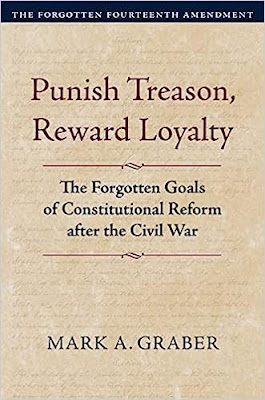
Mark A. Graber, Punish Treason, Reward Loyalty: The Forgotten Goals of Constitutional Reform after the Civil War (University of Kansas Press, 2023)
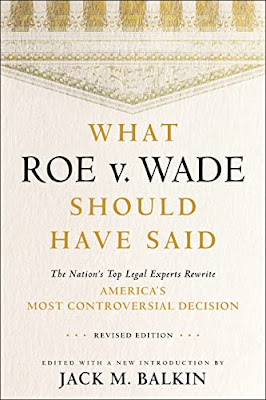
Jack M. Balkin, What Roe v. Wade Should Have Said: The Nation's Top Legal Experts Rewrite America's Most Controversial Decision - Revised Edition (NYU Press, 2023)

Andrew Koppelman, Burning Down the House: How Libertarian Philosophy Was Corrupted by Delusion and Greed (St. Martin’s Press, 2022)

Gerard N. Magliocca, Washington's Heir: The Life of Justice Bushrod Washington (Oxford University Press, 2022)
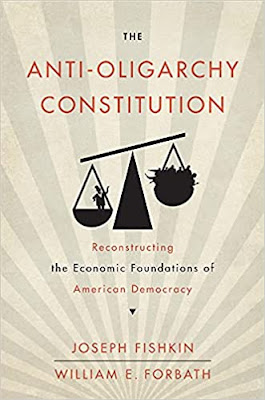
Joseph Fishkin and William E. Forbath, The Anti-Oligarchy Constitution: Reconstructing the Economic Foundations of American Democracy (Harvard University Press, 2022)
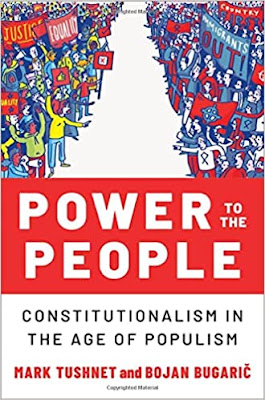
Mark Tushnet and Bojan Bugaric, Power to the People: Constitutionalism in the Age of Populism (Oxford University Press 2021).

Mark Philip Bradley and Mary L. Dudziak, eds., Making the Forever War: Marilyn B. Young on the Culture and Politics of American Militarism Culture and Politics in the Cold War and Beyond (University of Massachusetts Press, 2021).

Jack M. Balkin, What Obergefell v. Hodges Should Have Said: The Nation's Top Legal Experts Rewrite America's Same-Sex Marriage Decision (Yale University Press, 2020)

Frank Pasquale, New Laws of Robotics: Defending Human Expertise in the Age of AI (Belknap Press, 2020)

Jack M. Balkin, The Cycles of Constitutional Time (Oxford University Press, 2020)

Mark Tushnet, Taking Back the Constitution: Activist Judges and the Next Age of American Law (Yale University Press 2020).

Andrew Koppelman, Gay Rights vs. Religious Liberty?: The Unnecessary Conflict (Oxford University Press, 2020)

Ezekiel J Emanuel and Abbe R. Gluck, The Trillion Dollar Revolution: How the Affordable Care Act Transformed Politics, Law, and Health Care in America (PublicAffairs, 2020)

Linda C. McClain, Who's the Bigot?: Learning from Conflicts over Marriage and Civil Rights Law (Oxford University Press, 2020)
Sanford Levinson and Jack M. Balkin, Democracy and Dysfunction (University of Chicago Press, 2019)

Sanford Levinson, Written in Stone: Public Monuments in Changing Societies (Duke University Press 2018)

Mark A. Graber, Sanford Levinson, and Mark Tushnet, eds., Constitutional Democracy in Crisis? (Oxford University Press 2018)

Gerard Magliocca, The Heart of the Constitution: How the Bill of Rights became the Bill of Rights (Oxford University Press, 2018)

Cynthia Levinson and Sanford Levinson, Fault Lines in the Constitution: The Framers, Their Fights, and the Flaws that Affect Us Today (Peachtree Publishers, 2017)

Brian Z. Tamanaha, A Realistic Theory of Law (Cambridge University Press 2017)

Sanford Levinson, Nullification and Secession in Modern Constitutional Thought (University Press of Kansas 2016)

Sanford Levinson, An Argument Open to All: Reading The Federalist in the 21st Century (Yale University Press 2015)

Stephen M. Griffin, Broken Trust: Dysfunctional Government and Constitutional Reform (University Press of Kansas, 2015)

Frank Pasquale, The Black Box Society: The Secret Algorithms That Control Money and Information (Harvard University Press, 2015)

Bruce Ackerman, We the People, Volume 3: The Civil Rights Revolution (Harvard University Press, 2014)
Balkinization Symposium on We the People, Volume 3: The Civil Rights Revolution

Joseph Fishkin, Bottlenecks: A New Theory of Equal Opportunity (Oxford University Press, 2014)

Mark A. Graber, A New Introduction to American Constitutionalism (Oxford University Press, 2013)

John Mikhail, Elements of Moral Cognition: Rawls' Linguistic Analogy and the Cognitive Science of Moral and Legal Judgment (Cambridge University Press, 2013)

Gerard N. Magliocca, American Founding Son: John Bingham and the Invention of the Fourteenth Amendment (New York University Press, 2013)

Stephen M. Griffin, Long Wars and the Constitution (Harvard University Press, 2013)

Andrew Koppelman, The Tough Luck Constitution and the Assault on Health Care Reform (Oxford University Press, 2013)

James E. Fleming and Linda C. McClain, Ordered Liberty: Rights, Responsibilities, and Virtues (Harvard University Press, 2013)
Balkinization Symposium on Ordered Liberty: Rights, Responsibilities, and Virtues

Andrew Koppelman, Defending American Religious Neutrality (Harvard University Press, 2013)

Brian Z. Tamanaha, Failing Law Schools (University of Chicago Press, 2012)

Sanford Levinson, Framed: America's 51 Constitutions and the Crisis of Governance (Oxford University Press, 2012)

Linda C. McClain and Joanna L. Grossman, Gender Equality: Dimensions of Women's Equal Citizenship (Cambridge University Press, 2012)

Mary Dudziak, War Time: An Idea, Its History, Its Consequences (Oxford University Press, 2012)

Jack M. Balkin, Living Originalism (Harvard University Press, 2011)

Jason Mazzone, Copyfraud and Other Abuses of Intellectual Property Law (Stanford University Press, 2011)

Richard W. Garnett and Andrew Koppelman, First Amendment Stories, (Foundation Press 2011)

Jack M. Balkin, Constitutional Redemption: Political Faith in an Unjust World (Harvard University Press, 2011)

Gerard Magliocca, The Tragedy of William Jennings Bryan: Constitutional Law and the Politics of Backlash (Yale University Press, 2011)

Bernard Harcourt, The Illusion of Free Markets: Punishment and the Myth of Natural Order (Harvard University Press, 2010)

Bruce Ackerman, The Decline and Fall of the American Republic (Harvard University Press, 2010)
Balkinization Symposium on The Decline and Fall of the American Republic

Ian Ayres. Carrots and Sticks: Unlock the Power of Incentives to Get Things Done (Bantam Books, 2010)

Mark Tushnet, Why the Constitution Matters (Yale University Press 2010)

Ian Ayres and Barry Nalebuff: Lifecycle Investing: A New, Safe, and Audacious Way to Improve the Performance of Your Retirement Portfolio (Basic Books, 2010)

Jack M. Balkin, The Laws of Change: I Ching and the Philosophy of Life (2d Edition, Sybil Creek Press 2009)

Brian Z. Tamanaha, Beyond the Formalist-Realist Divide: The Role of Politics in Judging (Princeton University Press 2009)
Andrew Koppelman and Tobias Barrington Wolff, A Right to Discriminate?: How the Case of Boy Scouts of America v. James Dale Warped the Law of Free Association (Yale University Press 2009)

Jack M. Balkin and Reva B. Siegel, The Constitution in 2020 (Oxford University Press 2009)

Heather K. Gerken, The Democracy Index: Why Our Election System Is Failing and How to Fix It (Princeton University Press 2009)

Mary Dudziak, Exporting American Dreams: Thurgood Marshall's African Journey (Oxford University Press 2008)

David Luban, Legal Ethics and Human Dignity (Cambridge Univ. Press 2007)

Ian Ayres, Super Crunchers: Why Thinking-By-Numbers is the New Way to be Smart (Bantam 2007)

Jack M. Balkin, James Grimmelmann, Eddan Katz, Nimrod Kozlovski, Shlomit Wagman and Tal Zarsky, eds., Cybercrime: Digital Cops in a Networked Environment (N.Y.U. Press 2007)

Jack M. Balkin and Beth Simone Noveck, The State of Play: Law, Games, and Virtual Worlds (N.Y.U. Press 2006)

Andrew Koppelman, Same Sex, Different States: When Same-Sex Marriages Cross State Lines (Yale University Press 2006)

Brian Tamanaha, Law as a Means to an End (Cambridge University Press 2006)

Sanford Levinson, Our Undemocratic Constitution (Oxford University Press 2006)

Mark Graber, Dred Scott and the Problem of Constitutional Evil (Cambridge University Press 2006)

Jack M. Balkin, ed., What Roe v. Wade Should Have Said (N.Y.U. Press 2005)

Sanford Levinson, ed., Torture: A Collection (Oxford University Press 2004)
Balkin.com homepage
Bibliography
Conlaw.net
Cultural Software
Writings
Opeds
The Information Society Project
BrownvBoard.com
Useful Links
Syllabi and Exams
