Balkinization
an unanticipated consequence of
Jack M. Balkin
Balkinization Symposiums: A Continuing List
E-mail:
Jack Balkin:
jackbalkin at yahoo.com
Bruce Ackerman
bruce.ackerman at yale.edu
Ian Ayres
ian.ayres at yale.edu
Corey Brettschneider
corey_brettschneider at brown.edu
Mary Dudziak
mary.l.dudziak at emory.edu
Joey Fishkin
joey.fishkin at gmail.com
Heather Gerken heather.gerken at yale.edu
Abbe Gluck abbe.gluck at yale.edu
Mark Graber
mgraber at law.umaryland.edu
Stephen Griffin
sgriffin at tulane.edu
Jonathan Hafetz
jonathan.hafetz at shu.edu
Jeremy Kessler
jkessler at law.columbia.edu
Andrew Koppelman
akoppelman at law.northwestern.edu
Marty Lederman
msl46 at law.georgetown.edu
Sanford Levinson
slevinson at law.utexas.edu
David Luban
david.luban at gmail.com
Gerard Magliocca
gmaglioc at iupui.edu
Jason Mazzone
mazzonej at illinois.edu
Linda McClain
lmcclain at bu.edu
John Mikhail
mikhail at law.georgetown.edu
Frank Pasquale
pasquale.frank at gmail.com
Nate Persily
npersily at gmail.com
Michael Stokes Paulsen
michaelstokespaulsen at gmail.com
Deborah Pearlstein
dpearlst at yu.edu
Rick Pildes
rick.pildes at nyu.edu
David Pozen
dpozen at law.columbia.edu
Richard Primus
raprimus at umich.edu
K. Sabeel Rahmansabeel.rahman at brooklaw.edu
Alice Ristroph
alice.ristroph at shu.edu
Neil Siegel
siegel at law.duke.edu
David Super
david.super at law.georgetown.edu
Brian Tamanaha
btamanaha at wulaw.wustl.edu
Nelson Tebbe
nelson.tebbe at brooklaw.edu
Mark Tushnet
mtushnet at law.harvard.edu
Adam Winkler
winkler at ucla.edu
Compendium of posts on Hobby Lobby and related cases
The Anti-Torture Memos: Balkinization Posts on Torture, Interrogation, Detention, War Powers, and OLC
The Anti-Torture Memos (arranged by topic)
Recent Posts
![[Powered by Blogger]](https://lh3.googleusercontent.com/blogger_img_proxy/AEn0k_uOrCEWJQBTGAwm-Fp6zoeV3_Q3su7vvQEoZxFfUrn3KEvFRPIs7NkFE-Ewqaml0OCUHx-E7J_fMWF1ZK90Ny6u_KlMxkgyL290JcULVAN_=s0-d)
Just A Few Blogs
ACS Blog
Alas, a Blog
Althouse
Arts and Letters Daily
Atrios (Eschaton)
Bill of Health
Buzzflash.com
Buzz Machine
Cato at Liberty
Juan Cole (Informed Comment)
Concurring Opinions
The Constitution in 2020
Corrente
Crooked Timber
Daily Howler
Daily Kos
Dana Boyd
Brad DeLong
Digby (Hullabaloo)
Discriminations
Daniel Drezner
Kevin Drum (Mother Jones)
Electrolite
En Banc
Eunomia (Daniel Larison)
Fafblog
Michael Froomkin (Discourse.net)
GovLab (Beth Noveck)
Rick Hasen (Election Law)
History News Network
How Appealing
Ignatz (Sam Heldman)
The Importance of (Ernie Miller)
Infolaw
Instapundit
International Economic Law and Policy Blog
IntLawGrrls
Jacob Levy
Jesus' General
Jurisdynamics
The Kitchen Cabinet
Mark Kleiman
Law Blog Central
Larry Lessig
Lawyers, Guns and Money
Liberal Oasis
Brian Leiter's Law School Reports
The Leiter Reports
Marginal Revolution
Megan McArdle
Memeorandum
Metafilter
Mirror of Justice
The New Republic
Newseum
No More Mister Nice Blog
Brendan Nyhan
Opinio Juris
Orcinus
The Originalism Blog
Pandagon
Passport (Foreign Policy)
Overcoming Bias
Political Animal (Washington Monthly)
Political Theory Daily Review
Political Wire (Taegan Goddard)
The Poor Man
Virginia Postrel
Prawfsblawg
Public Reason
Jonathan Rauch
Raw Story
Redstate
ReligiousLeftLaw.com
Reporters Committee For Freedom of the Press
Reproductive Rights Blog
Rothman's Roadmap to the Right of Publicity
SCOTUS Blog
Seeing the Forest
Clay Shirky
The Shifted Librarian
The Situationist
Larry Solum (Legal Theory)
Andrew Sullivan
Talking Points Memo
Talk Left
Tapped
Tbogg
TechPresident
The Paper Chase (Jurist)
Tom Paine
Tom Tomorrow (This Modern World)
Eve Tushnet
Uggabugga
University of Chicago Law School Faculty Blog
Unqualified Offerings
The Volokh Conspiracy
War and Piece (Laura Rozen)
Wampum
Oliver Willis
Wonkette
Written Description
Matthew Yglesias
Yin
Your Choice of Feeds
1. XML
powered by

2. Atom Feed
3. RSS 2.0
JB
Is Atrios Responsible for Libel?
The blogosphere has been abuzz over the cease and desist letter issued to Atrios by Jeffrey J. Upton, an attorney purporting to represent Donald Luskin, an NRO Online Contributor:
You recently linked to Mr. Luskin's October 7, 2003, posting on his website entitled "Face To Face With Evil," in which he chronicles his attendance at a lecture and book signing presented by Paul Krugman. You chose the unfortunate caption "Diary of a Stalker" for your link. More importantly, your readers, in responding to your invitation to comment, have posted numerous libelous statements regarding Mr. Luskin. Picking up on the theme you introduced, several have made false assertions that Mr. Luskin has committed the crime of stalking. Such a statement constitutes libel per se, an actionable tort subjecting both the author and the publisher to liability for both actual and punitive damages. As a result of your control over and participation in the comment section of your site, as well as the fact that Mr. Luskin has personally brought these libelous comments to your attention already, you face personal liability for their distribution. Determining your identity for the purpose of making service of process can be easily accomplished through a subpoena to Blogspot.com. This is a nuisance suit. Unfortunately, Atrios will have to hire an attorney, but he should win easily. Despite Mr. Upton's suggestions to the contrary, Atrios is not liable for the postings in the comments section. And he has no duty to take them down. This is a consequence of section 230 of the 1996 Telecom Act. See my previous discussion on when bloggers can be sued for libel:
This does not mean that bloggers are immune from libels they themselves write. It means
So if bloggers defame somebody, they can still be sued for what they say, just not for what
Of course, Luskin could sue Atrios for Atrios's own comments, for example, that Atrios suggested that Luskin was a stalker. But read in context, Atrios' post is (a) not an allegation of actual criminal behavior, and (b) is a protected statement of satire and opinion. He is making fun of Luskin's own comparison of himself as someone who stalks Paul Krugman. Luskin's argument that Atrios has libeled him shouldn't survive a motion for summary judgment. Of course, the real problem is that getting to that point will cost Atrios money to defend himself.
Luskin should be ashamed of himself for having any part in sending this letter. It's a disservice to the blogging community, and inconsistent with respect for freedom of expression.
What's most upsetting is that he is employing a frivolous lawsuit in order to punish someone for exercising their First Amendment rights and that he is piggybacking an abusive subpoena to expose Atrios' identity. So he's not only engaged in frivolous litigation (aren't conservatives against frivolous lawsuits?), but also an abuse of the discovery process (aren't conservatives opposed to the dirty tricks of trial lawyers?). I guess Luskin is only opposed to frivolous lawsuits by other people, and dirty tricks by lawyers who are not representing him.
That's a protected statement of opinion too, by the way.
What the 9th Circuit held (and what the 4th Circuit also held before them) is that section 230 of the 1996 Telecom Act protects people who run websites from being sued for republishing the libels of another person. Section 230 states that " no provider or user of an interactive computer service shall be treated as the publisher or speaker of any information provided by another information content provider."
that they are immune from (for example) libels published in their comments section (if they have one) because these comments are written by other people and the blogger is merely providing a space for them to be published. Congress wanted to treat operators of chatrooms and other interactive computer services differently from letters to the editor columns in a local newspaper.
someone else who publishes on the blogger's site says.
Posted
10:51 AM
by JB [link]
(5) comments
JB
Not Even A Program?
The Washington Post reports that Iraq did not even have an active program to construct nuclear weapons:
According to records made available to The Washington Post and interviews with arms investigators from the United States, Britain and Australia, it did not require a comprehensive survey to find the central assertions of the Bush administration's prewar nuclear case to be insubstantial or untrue. Although Hussein did not relinquish his nuclear ambitions or technical records, investigators said, it is now clear he had no active program to build a weapon, produce its key materials or obtain the technology he needed for either.
Posted
8:06 AM
by JB [link]
(2) comments
JB
Headscarves and Religious Accommodation
CNN reports that an 11-year-old Oklahoma girl, Nashala "Tallah" Hern, has been suspended from a public school because officials said her Muslim head scarf violates dress code policies, originally instituted to prevent wearing gang paraphenalia. The school's policy makes no exception for religious headgear, and school officials stated that they would not create one:
He added that, under the dress code, a Jewish child would not be allowed to wear a yarmulke, the skullcap traditionally worn by orthodox Jews, to school. Because of a 1990 Supreme Court decision, Employment Division v. Smith, rules of general application do not violate the Free Exercise Clause even if they impinge more heavily on minority religions. That case is, I think, wrongly decided. But, in any case, there is no constitutional problem with a school making religious accommodation for religious headgear. When the Supreme Court held that the military's interest in esprit de corps allowed it to keep a serviceman from wearing a yarmulke without violating the Free exercise Clause (this was before the 1990 decision in Smith), Congress promptly passed a bill mandating accommodation for religious items to be worn with uniforms. Generally speaking, the Establishment Clause does not prevent government from lifting a burden on religion it has itself imposed through a rule of general applicability. Such a rule could be unconstitutional if it specifically mentioned particular religions by name for exemption, or if it gerrymandered the exemption with the intention of benefiting some religions for accommodation but not others. But a well drafted rule can usually avoid such problems.
Congress passed a statute, the Religious Freedom Restoration Act (RFRA) in 1993, to counteract the Smith decision, and to require the federal and state governments to make religious exemptions under certain conditions, but the Supreme Court struck it down in 1997 as beyond Congress's powers as applied to state governments. Many states then passed their own versions of RFRA. Oklahoma is one of them. If the Oklahoma statute is like the federal one, then the student has a strong case for arguing that failure to make an exemption for religious headgear in the school dress code violates the law.
I'm not sure whether the above quote is simply due to a mindless bureaucratic mentality or is due to the fact that the school officials in question are implementing a regulation created at a state level that they do not have authority to change. If the former, their argument that they must treat religious clothing the same as all other clothing is specious. If the latter, I would think that school officials should do everything in their power to interpret the law so as not to apply to religious headgear, and, as I have noted, it's quite possible that the law violates Oklahoma's version of RFRA.
Other accounts of the story seem to suggest that the dress code is not statewide but is the policy of Benjamin Franklin Science Academy, and that the school has defended its decision on the grounds that there is no federal right to religious exemption. That may well be true, but it is irrelevant to the question whether the school is *permitted* to make such an exemption under the Establishment Clause.
"As I see it right now, I don't think we can make a special accommodation for religious wear," said school attorney D.D. Hayes. "You treat religious items the same as you would as any other item, no better, no worse. Our dress code prohibits headgear, period."
Posted
10:52 AM
by JB [link]
(7) comments
JB
Rush Limbaugh Explains the Importance of Colorblindness
From an October 5th, 1995 radio show (courtesy of Ellis Henican and Newsday):
"What this says to me," he told his listeners that day, "is that too many whites are getting away with drug use. Too many whites are getting away with drug sales. Too many whites are getting away with trafficking in this stuff. The answer to this disparity is not to start letting people out of jail because we're not putting others in jail who are breaking the law. The answer is to go out and find the ones who are getting away with it, convict them and send them up the river, too." I think we've been taking Limbaugh's remarks about Donovan McNabb out of context. It's now clear that they were much more than the smug posturings of a rabble rouser who simply wants attention. Rather, they reflect a deep moral commitment: Just as Limbaugh doesn't want black quarterbacks to get a free pass from the sports media, he doesn't want white drug abusers like himself to get a pass from the criminal justice system.
When Limbaugh turns himself into authorities and demands to be treated no differently than African-Americans arrested and convicted of drug offenses, we will all see how wrong we all were about this man.
UPDATE: All sarcasm aside, if Limbaugh has become addicted to drugs, he deserves our sympathy, no matter what our views about his politics, and no matter whether he broke the law. As the above quote suggests, in the past Limbaugh himself has had nothing but scorn for people who have come to that sorry state. That disdain reflects less his conservative political views than the fact that he has, for most of his public life, been a callous, insensitive bully. Moreover, he has learned that being a callous, insensitive bully has gotten him a loyal audience and enormous adulation from a public that likes raw, obnoxious ranting from their political commentators. He has learned to enjoy the high he gets from being outrageous and merciless and goading his listeners into similar feelings of outrage and mercilessness. That is to say, Limbaugh has become as addicted to verbal thuggery as he has to painkillers.
If he is now addicted to drugs, we should be sympathetic to his plight, for addiction is no small matter, and living with it is a lifelong struggle. But we should also hope that he learns something from the troubles that are now raining down upon him-- that he, like the rest of us, is fallible and imperfect, and therefore deserving of love, and deserving of mercy. It is true that he is not a man much given to forgiveness, and that he has made a very successful living out of bullying, aggression and hatred. But perhaps he will discover, in a time of darkness, that there is more to life than aggression and demagoguery, and we, in turn, will discover that there is much more to him than the rather obnoxious and unsympathetic character he portrays on the radio. If he can turn his life around, and learn to bestow mercy on others as well as receive it, he might be well on his way to ridding himself of both of his addictions.
Even though blacks and whites break the drug laws in roughly equal percentages, [Limbaugh] noted, black druggies go to prison far more often than white druggies do. But to the liberal-bashing host, this was no reason to ease up on blacks.
Posted
1:25 PM
by JB [link]
(6) comments
JB
Fair and Balanced Pays Off
James Grimmelman writes about a new report concerning how mass media affect the American public’s attitudes toward the Iraq war. The study, conducted by the Program on International Policy Attitudes, finds that a significant proportions of the American public had false beliefs about (1) whether Saddam Hussein was working closely with al Qaeda before the war; (2) whether weapons of mass destruction have been found in Iraq; and (3) whether world public opinion favored the U.S. invasion. (For those who are wondering, no evidence has been found linking Saddam to 9/11 or demonstrating that that he was working closely with al Qaeda before the war, no WMD’s have been found in Iraq, and world opinion did not favor what the U.S. did.).
Sixty percent of the American public held one or more of these misperceptions, although only 20% held two and 8% held all three. The study further suggests that support for the war is highly correlated to holding one or more of these misperceptions. Among those who held none of these misperceptions, only 23% supported the war.
The extent of these misperceptions, the study reports, varies considerably based on Americans’ sources of news about the war. Those receiving most of their information about the war from NPR or PBS were least likely to have these three misperceptions about the war (Only 23% did followed by people who read the print media generally at 47%). On the other hand, those who received most of their information from Fox News are more likely than average to hold one or more of these misperceptions. (80 percent did, followed by 71 percent for CBS). The study corrected for demographic differences between the different sets of audiences, and found that the pattern held even when comparing the views of particular demographic subgroups. People who support the President are much more likely to hold one or more of these misperceptions, regardless of their party affiliation.
The study suggests that disinformation conveyed by the news media can shape public attitudes about important questions before the public. It also suggests what politicians have long known: propaganda works.
Posted
10:23 AM
by JB [link]
(4) comments
JB
Why Preemption Was Such A Good Idea
David Kay gave his long awaited interim report from the Iraq Survey Group, explaining that none of the chemical and biological weapons that were a primary justification for the war against Iraq had been found.
``We have not yet found stocks of weapons, but we are not yet at the point where we can say definitively either that such weapons stocks do not exist or that they existed before the war, and our only task is to find where they have gone,'' Kay said in an unclassified version of his testimony released by the CIA.
Members of his Iraq Survey Group, Kay said, have discovered weapons ``activities'' and equipment that were concealed from U.N. inspectors when they returned to Iraq late last year. Those include apparent biological weapons research and Iraqi attempts between 1999 and 2002 to import technology for 900-mile range missiles from North Korea, he said.
Reaction from intelligence committee members ranged from support for Kay's work to frustration over the limited findings, to dismay that one of the central justifications for war had not been proved.
``This raises real questions about the doctrine of pre-emption,'' said Sen. Jay Rockefeller, of West Virginia, the ranking Democrat on the Senate intelligence committee. ``You just don't make decisions like we do and put our nation's youth at risk based upon something that appears not to have existed.''
The committee chair, Sen. Pat Roberts, R-Kan., declared himself ``not pleased with what I heard today.''
``Everybody involved in this effort would have hoped by now there would have been a breakthrough,'' he said. Jay Rockefeller is on to something. If you are going to employ a doctrine of pre-emption, you had better have confidence that the threat you are facing is real and worth the risks of war. If you go to war on the basis of bad intelligence, or, even worse, if you engage in wishful thinking and employ trumped up intelligence reports to justify your support for war, you may cause yourself a great deal of trouble in the long run. For example, you may get stuck in a costly occupation with no end in sight, and instead of being hailed as liberators, you may find yourself bogged down in a lengthy guerilla war.
Nah, couldn't happen.
Kay's report is likely to intensify the debate over whether the administration intentionally misled the public on the threat posed by Iraq's weapons programs.
Posted
6:45 AM
by JB [link]
(3) comments
JB
What Caused Wilsongate? Some Thoughts About Institutional Incentives
What caused the Wilson scandal, and why did the story break into the mainstream press when it did? We can start to answer these questions by thinking in terms of institutions rather than individuals. The institutions are the Bush Administration, the CIA, and the mainstream press.
Begin first with the Bush Administration’s attempt to divert blame. Administration officials originally claimed that Saddam’s weapons of mass destruction and likely nuclear capabilities fully supported their decision to go to war. Later, when no WMD’s were uncovered, they argued either that their decisions were reasonable extrapolations from available intelligence, or failing that, that there was an intelligence failure; i.e., that the CIA had not done its job correctly.
The latter claim cast aspersions on the professionalism of the CIA. The CIA resented the Bush Administration’s attempt to use them as a scapegoat. But after Wilson wrote his op-ed on July 9th, responding to insinuations of CIA incompetence, senior members of the Bush Administration went one step further. They leaked information about Wilson’s wife’s identity as a CIA operative. The evident purpose of this was to say, both to Wilson, and to anyone who might have similar ideas in the future: “Screw with us and we will screw with you.”
At this point, however, the Bush Administration stepped over the line, at least from the CIA’s perspective. It was bad enough that the Administration attempted to impugn their professionalism and shift the blame to them. But now Administration officials had outed a CIA operative in response to criticism, partly as payback and partly as a warning. As a result, the CIA has struck back by requesting that the Justice Department investigate the leak.
Two questions:
Why did the CIA take so long to respond, from July 22d, when Novak’s story was published, to the end of September?
Why did the mainstream press take so long to take up this story?
The answers to both these questions concern institutional incentives.
When Novak’s story was first published, several bloggers complained vigorously about the administration’s leak, but the mainstream press paid very little attention (and at that point Novak himself obviously believed that the Administration had done nothing very seriously wrong). Why did the press hesitate? To answer this question we have to recognize the institutional incentives of the Washington press. Reporters do not like to disclose their sources. The more important a story becomes, the greater the chance that reporters will be called to testify before a grand jury, because, obviously, they know who leaked the story to them. Given their professional norms, the reporters will then refuse to disclose their sources, and the press will look bad for breaking the story and then refusing to assist with ascertaining the truth. That is, if the matter goes to the grand jury, there is a danger that the press itself will become the story, not the miscreants who leaked the information to the press.
All of this explains why, in the run of the mill story about leaks, the press is less than interested. The mainstream press has no incentive to make a big deal about leaks *to the press itself.* For this reason, it is often said that investigations about leaks in Washington tend to go nowhere. But they go nowhere not because the information is not readily available– it is readily available, the reporters have it! They go nowhere because reporters don’t want to testify about their sources, and government officials are usually not willing to take the political heat for putting them in jail if they don’t testify. (The institutional calculus is somewhat different with respect to local reporters in jurisdictions outside of the Beltway, so you actually do see the occasional reporter jailed for refusal to testify). Put another way, the ongoing (some would say incestuous) relationship between national politicians and the Washington press corps leads to the received wisdom that the source of leaks cannot be uncovered. And it also led to the mainstream press not picking up on the story for over two months after the Novak column originally appeared.
The CIA’s request to the Justice Department, however, changed the equation considerably. Once the CIA started to push back at the Bush Administration in order to defend its reputation and its institutional prerogatives, it produced a story that could not be buried. The story had to be covered, even though the idea of putting mainstream reporters in harm’s way makes the institutional press quite nervous. The Bush Administration, recognizing the natural hesitancy of the mainstream press to push hard on stories where the press’s own interests are involved, has wanted this to be a story about leaks, which are a common enough occurrence in Washington, and which are governed by the unspoken rules between politicians and the Washington press corps. Thus, if this remains a story about leaks, then it will go nowhere.
It is likely that Valerie Plame and her immediate superiors wanted to push back at the Administration almost immediately after she was outed. But the CIA bureaucracy may have resisted for some time, hoping that the press would pick up the story. The mainstream press did not do so, for the institutional reasons I have just recounted, and therefore at some point the CIA felt it necessary to force matters into the open by requesting an investigation from the Justice Department.
Many people, I suspect, will want to see this story as about political machinations between Democrats and Republicans. Surely there is plenty of that going on. But if one focuses only on the partisan aspects of the story, one will miss the much more interesting and intricate conflicts between institutions that have set these events in motion.
UPDATE: Jerry Newmark writes that the CIA actually did make an informal request for an investigation within a week of Novak's story. An account appears here. He argues that the CIA only made a formal request (thus bringning on press scrutiny and, possibly, a full criminal investigation) only after the White House and the Justice Department failed to respond to its informal suggestion:
The CIA’s decision to complain, on the other hand, suggests that to the CIA, at least, this is a story about the Administration trying to push the CIA around, and interfere with its professional status and its prerogatives. For that reason, if the Administration pushes the CIA, the CIA is going to push back. From the CIA’s standpoint, the Bush Administration (and all future administrations) must be shown that if it screws with the CIA, the CIA will screw with them. Karl Rove may think that he is Don Corleone, and that he can put the metaphorical equivalent of a horse’s head in Joseph Wilson’s bed, but two can play at that game. And, given the fact that the CIA probably has enough evidence in its files to undermine any sitting president, it is probably not a good idea for the Bush Administration– or any administration for that matter-- to use the CIA as a whipping boy.
Along the lines you've presented, I've got a slightly different take on why
it took so long for the CIA to submit a formal request (and publicize it in
a way that is unusual for them). The CIA did make an informal request for a
Justice Department review shortly after the Novak article was published.
This may be seen as message to the White House that while the CIA wanted
someone's head to roll, they would rather not pursue a criminal
investigation. There are good institutional reasons for this - a formal
investigation would necessarily involve having the FBI investigate CIA as
well as White House personnel and the animosity between the CIA and FBI is
well known - as well as practical concerns about being able to control the
scope of an investigation once it has begun. Only after it was clear that
Justice and the White House were not going to act on their own accord did
the CIA raise the stakes.
Posted
2:54 PM
by JB [link]
(5) comments
JB
If At First You Don't Succeed, Spend, Spend Again
The New York Times reports that President Bush will ask Congress for 600 million dollars to continue the search for weapons of mass destruction in light of the interim report of the Iraq Survey Group which is expected to state that no such weapons have been found.
Approximately 300 million dollars has already been spent in a so far fruitless search for weapons of mass destruction. The Administration wants to double that amount, in what is reported to be a classified portion of the Pentagon's appropriation request to Congress.
One suspects that if the Administration is willing to spend that much money, they could simply purchase the weapons of mass destruction and deposit them in Iraq.
Posted
12:04 AM
by JB [link]
(5) comments
JB
Precision Worthy Of A Lawyer
Columnist Robert Novak reported in July that Valerie Plame, the wife of diplomat Joseph Wilson, was an undercover CIA operative specializing in weapons of mass destruction. Wilson believes that his wife's name was publicized by administration officials either to discredit him or as revenge for Wilson's statement that the Bush Administration exaggerated intelligence claims in order to justify the Iraqi war. The Justice Department is now investigating the matter.
In a recent statement, Novak defended the Bush Administration
"They asked me not to use her name, but never indicated it would endanger her or anybody else. According to a confidential source at the CIA, Mrs. Wilson was an analyst, not a spy, not a covert operative and not in charge of undercover operators," Novak said. What Novak did not say is as important as what he did say. He did not say that Bush Adminstration officials did not leak the information to him. Rather, he said that they did not call him to leak it. He did not say that they mistakenly divulged the information in a slip of the tongue. Rather he said that after disclosing the information, they asked him not to divulge it.
This is completely consistent with Administration officials intending to leak the information to discredit or seek revenge against Wilson by revealing his wife's identity as a CIA operative. Officials do not have to call columnists like Novak to leak information; rather the columnists are continuously attempting to contact them. Officials know this. Moreover, to reveal such information in the course of a conversation about another topic is probably the most prudent way to leak information. Finally, a request not to disclose the information is not the same as a demand that the information not be disclosed or the reporter will suffer consequences.
Like any good journalist, Novak is defending his sources. He is not only defending their identities, but also any claim that the officials have violated the law by deliberately leaking the information. However, read carefully, what he said is not an adequate defense.
UPDATE: Compare Novak's recent statement with the one published shortly after his story appeared, on July 22 (thanks to Atrios for the link):
"Nobody in the Bush administration called me to leak this," Novak said on CNN's "Crossfire," of which he is a co-host. "There is no great crime here."
Novak, in an interview, said his sources had come to him with the information. "I didn't dig it out, it was given to me," he said. "They thought it was significant, they gave me the name and I used it."
Posted
11:55 AM
by JB [link]
(3) comments
JB
Colin Powell, Diplomat
A nice quote from today's New York Times editorial on the interim Iraq Survey Report:
This is clearly an uncomfortable question for the Bush administration. Yesterday, Secretary of State Colin Powell met with Times editors. Asked whether Americans would have supported this war if weapons of mass destruction had not been at issue, Mr. Powell said the question was too hypothetical to answer. Asked if he, personally, would have supported it, he smiled, thrust his hand out and said, "It was good to meet you."[I]t was the fear of weapons of mass destruction placed in the hands of enemy terrorists that made doing something about Iraq seem urgent. If it had seemed unlikely that Mr. Hussein had them, we doubt that Congress or the American people would have endorsed the war.
Posted
10:01 AM
by JB [link]
(4) comments
JB
And, Apparently, No Weapons of Mass Destruction of Any Kind
The BBC now reports that the interim report of the Iraq Survey Group will state that they have discovered no weapons of mass destruction in Iraq and that it is very likely unlikely that Iraq distributed such weapons to Syria before the war began.
They have also not uncovered any laboratories involved in deploying weapons of mass destruction and no delivery systems for the weapons.
But, Mr Neil added, the report would publish computer programmes, files, pictures and paperwork which it says shows that Saddam Hussein's regime was attempting to develop a weapons of mass destruction programme.
My greatest concern had been that the reason why no WMD's were found is because they were spirited out of the country by terrorists during the chaos of the war. But if this report about the Iraq Survey Report is to be believed, there were no weapons to spirit out at all. At most there was were plans for a program that was in "suspended animation"-- i.e., with various elements placed around the country so that Iraqi scientists could begin working on starting up a weapons program as soon as international inspectors turned their attention away from Iraq. This is the dispersion and reassembly theory mentioned in my previous post.
In my previous post I suggested that such a discovery might take some of the heat off the Administration. But on further reflection, I am not so sure anymore. If the weapons programs would remain in suspended animation as long as eyes were on Iraq, then a strategy of containment was probably fully adequate to deal with the future threat posed by Iraq, precisely what the Bush Administration denied in the months leading up to the war. Thus, even though the Administration may want to take some comfort out of findings of a dormant weapons program, those very findings suggest that it badly misjudged the situation in Iraq and chose the wrong strategy for dealing with the threat of WMD's.
Mr Neil said that according to the source, the report will say its inspectors have not even unearthed "minute amounts of nuclear, chemical or biological weapons material".
Posted
11:24 PM
by JB [link]
(4) comments
JB
And No Smallpox, Either
The Guardian reports:
"Team Pox", a six-member group hunting for laboratories manufacturing the deadly virus, found nothing more sinister than equipment covered in cobwebs, and nothing to suggest a smallpox programme, according to military officials involved in the project, who leaked the information to the Associated Press.
"We found no physical or new anecdotal evidence to suggest Iraq was producing smallpox or had stocks of it in its possession," one military official said.
In the run-up to the conflict, George Bush regularly used the smallpox example to drive home the immediacy of Iraq's threat to ordinary Americans. Nevertheless, according to a report by the Washington Times, David Kay, who is heading the Iraq Survey Report, has told senators that his report will conclude that Iraq did have an active biological weapons *program* at the time the United States attacked Iraq, although he has not yet offered any proof for this claim. Apparently, according to a report by the Boston Globe at the end of August, Kay will argue that Hussein spread plans and parts for the manufacture of chemical, biological and nuclear weapons around various parts of Iraq with the idea of assembling them to produce weapons of mass destruction when U.N. inspectors left the country. This dispersion and reassembly theory would take some of the political heat off the Administration by offering an explanation of why Saddam was as dangerous as the Admnistration claimed even though no actual weapons of mass destruction were found. Needless to say, a great deal is at stake in the results of the Iraq Survey Report, for if Kay can make a convincing case that WMD's were in a ready to be manufactured state, his report could not come at a better time for the Bush Administration, which has lost considerable credibility on this issue.
A team of US government scientists has turned up no evidence that Saddam Hussein was making or stockpiling smallpox.
Posted
11:27 PM
by JB [link]
(5) comments
JB
Blix: No Iraq WMD's since 1991
Chief U.N. Arms Inspector Hans Blix has concluded that Iraq probably had destroyed its weapons of mass destruction by 1991 and had none in its possession for over a decade, the Belfast Telegraph reports (also see this story from ABC News (Australian):
Mr Blix, speaking from his home in Sweden, said that he thought it unlikely that non-UN experts deployed by the coalition forces to search for weapons of mass destruction would find anything beyond "some documents of interest". He added: "The more time that has passed, the more I think it's unlikely that anything will be found." Blix also criticized the American and British governments for their decision to go to war on insufficient evidence of weapons of mass destruction, Reuters reports:
Blix, who said this week he believed Iraq had destroyed such weapons 10 years ago, told BBC radio that Washington and London "over- interpreted" intelligence.
Comparing them to medieval witch-hunters, he said the two countries convinced themselves on the basis of evidence that was later discredited.
"In the Middle Ages when people were convinced there were witches they certainly found them. This is a bit risky," said Blix, whose inspectors left Iraq on the eve of war in March after just a few months of inspections. I should note that despite Blix's confidence that there were no WMD's in Iraq when the Americans and British attacked, the Iraq Survey Group's report has yet to be released, and we will see whether any new evidence has emerged. Certainly the members of the survey have every incentive to find weapons of mass destruction if they are in fact there.
Mr Blix, who retired in June, told the Australian state broadcaster ABC: "I'm certainly more and more to the conclusion that Iraq has, as they maintained, destroyed all, almost, of what they had in the summer of 1991." . . .
Blix attacked the "spin and hype" behind the U.S. and British allegations that Iraq had weapons of mass destruction.
Posted
11:11 PM
by JB [link]
(3) comments
JB
To The Max!
Former Senator (and head of the Veterans' Administration) Max Cleland's op-ed in the Atlanta Journal Constitution (via Daily Kos) pretty much nails it:
They attacked a country that had not attacked us. They did so on intelligence that was faulty, misrepresented and highly questionable.
A key piece of that intelligence was an outright lie that the White House put into the president's State of the Union speech. These officials have overextended the American military, including the National Guard and the Reserve, and have expanded the U.S. Army to the breaking point.
A quarter of a million troops are committed to the Iraq war theater, most of them bogged down in Baghdad. Morale is declining and casualties continue to increase.
In addition to the human cost, the war in dollars costs $1 billion a week, adding to the additional burden of an already depressed economy.
The president has declared "major combat over" and sent a message to every terrorist, "Bring them on." As a result, he has lost more people in his war than his father did in his and there is no end in sight.
Military commanders are left with extended tours of duty for servicemen and women who were told long ago they were going home. We are keeping American forces on the ground, where they have become sitting ducks in a shooting gallery for every terrorist in the Middle East.
Welcome to Vietnam, Mr. President. Sorry you didn't go when you had the chance.
Instead of learning the lessons of Vietnam, . . . , the president, the vice president, the secretary of defense and the deputy secretary of defense have gotten this country into a disaster in the desert.
Posted
10:56 PM
by JB [link]
(4) comments
JB
The Return of Bush v. Gore
Today the Ninth Circuit Court of Appeals issued an injunction staying the California recall election on the grounds that about 44 percent of the California population will be using outmoded punch card technology to cast their ballots, leading to the likelihood that many of their votes will not be counted. (More on the court's decision here). The court argued that this violated the Equal Protection Clause of the Fourteenth Amendment, citing prominently as justification the Supreme Court's decision in Bush v. Gore.
For those of us who were deeply skeptical of the politics if not the reasoning of the Bush v. Gore opinion, the 9th Circuit's use of it to delay-- at least for the moment-- a Republican plan to replace California's elected Democratic governor with a Republican candidate is deeply amusing. Nevertheless, there are several important differences that are worth noting.
First, the objectionable portion of Bush v. Gore was not its equal protection holding, but rather the remedy, which was inconsistent with the equal protection theory. Indeed, the only thing odd about the equal protection holding was that it was a liberal innovation supported by the Court's most conservative members, who usually fight shy of such social engineering, at least where election of Republican Presidential candidates is not at stake.
Second, the Bush v. Gore decision, by its own terms, limited the scope of its equal protection holding to the precise facts of the case, that is, the rules governing hand recounts by the judiciary. Although the case made noises about the fact that punch card ballots were more likely to be spoiled than other forms of balloting, the court stopped well short of holding that different voting technologies violated the equal protection clause. For had it so held, it would have opened the door to a much more extensive complaint about the Florida election. Nevertheless, the dissenting justices noted that the logic of Bush v. Gore might well apply to technological differences as well.
One possible distinction is that technological differences in ballot spoilage do not necessarily mean that there has been any sort of deliberate intent to discriminate against voters or deny them the right to have their ballots counted. The Bush v. Gore holding could be read narrowly to hold that judicial hand recounts required a single standard in order to avoid invidious discrimination against voters. That is to say, the Bush v. Gore opinion may be about the Court's distrust of the Florida judiciary's bona fides in conducting the recount. That would pose a different problem than the problem of different voting technologies used in different parts of the state.
Nevertheless, the Court's precedents in the voting area do not always require bad intent in order to find a violation of voting rights under the Fourteenth Amendment. The principle of one person, one vote should, in theory, apply whether the dilution of the voter's rights was deliberate or negligent. Hence the Ninth Circuit's argument, even though it does not follow directly from Bush v. Gore, nevertheless makes some sense in the light of the Court's other voting rights precedents.
Nevertheless, there is a delicious irony in watching Bush v. Gore used in this way. The Supreme Court apparently believed that it could resolve the 2000 election by issuing an opinon that would never be used or cited by any court again. It hoped to expand equal protection doctrine for this one case but then hold that the decision was limited to the precise facts of Bush v. Gore. The Ninth Circuit has called its bluff, suggesting, in effect, that if the Supreme Court wants us to believe that Bush v. Gore was a legal opinon, then it should be treated as law, with real precedental consequences, rather than as a one-time imposition of will by five Justices who wanted to install the Republican candidate, George W. Bush, as President.
Long live the rule of law!
Posted
7:12 PM
by JB [link]
(3) comments
JB
Report On WMD's Will Surface After All
The London Times reported Sunday (an abbreviated account can be found here) that both the U.S. and Great Britain had blocked release of the Iraq Survey Group report on WMD's because the report failed to find any evidence of WMD's. CBS News now reports that the report will be published after all, but that it will be inconclusive.
In July, David Kay, the survey group's leader, suggested that he had seen enough evidence to convince himself that Saddam Hussein had had a program to produce weapons of mass destruction. He expected to find "strong" evidence of missile delivery systems and "probably" evidence of biological weapons.
But last week, Defense Secretary Donald Rumsfeld said he had met with Kay, and that the onetime weapons inspector had not informed him of any finds.
UPDATE: CBS originally reported, consistent with the Times article, that the WMD report would be blocked indefinitely, but later was informed that the report would in fact be issued. It seems clear, at any rate, that once the original story alleging that the report would be blocked ran in the London Times, the report would eventually have to be released to the public whatever the Bush and Blair Adminstrations' qualms about it might have been.
The Times reports the decision by Britain and America to delay the report's release comes after efforts by the Iraq Survey Group, a team of 1,400 scientists, military and intelligence experts, to search Iraq for the past four months to uncover evidence of chemical or biological weapons ended in failure.
Posted
12:37 PM
by JB [link]
(4) comments
JB
No Nukes in Iraq
A UN arms inspectors report leaked to the Associated Press suggests that Iraq had no nuclear program worth worrying about:
"In the areas of uranium acquisition, concentration and centrifuge enrichment, extensive field investigation and document analysis revealed no evidence that Iraq had resumed such activities," ElBaradei said in the report, made available to the AP by a diplomat.
"No indication of post-1991 weaponization activities was uncovered in Iraq," he said.International Atomic Energy Agency chief Mohamed ElBaradei reiterated that his experts uncovered no signs of a nuclear weapons program before they withdrew from Iraq just before the war began in March.
Posted
12:17 PM
by JB [link]
(3) comments
JB
Ah, February
As Jay Bookman explains:
"Every day you get past three months, you've got to expect peacekeepers to have a bull's-eye on their head," the sources explained.
Even at the time, a spokesman for Defense Undersecretary Douglas Feith suggested that three months might be too optimistic. It was probably wiser to think five or six months on the outside, Lt. Col. Michael Humm said.
At the time, Pentagon officials also claimed that Iraq's oil wealth would make it unnecessary to ask other countries for financial help with reconstruction. "I don't see the need for panhandling like that," the Pentagon source said.
A month later, in a speech to the Veterans of Foreign Wars, Deputy Defense Secretary Paul Wolfowitz issued his own warning of how tough the occupation would be. Ruling Iraq, he said, would be like ruling liberated France after World War II.
He and his colleagues ought to be fired. Not only did they believe those fantasies, they also made their ideological pipe dreams the basis of our postwar planning, and today we're reaping the consequences.
And, to make you feel even more nostalglic, USA Today reports that the monthly expense of the Iraq and Afghanistan wars (*not* including the costs of reconstruction) is now comparable to the monthly expenses of the Vietnam War, adjusted for inflation.
Well, we should have the money for this. It's not as if we're running humongous deficits due to ill-advised tax cuts largely benefitting the rich.
Last February, with invasion just weeks away, sources in the Bush administration told Newsweek that they were expecting a postwar occupation of Iraq of 30 to 90 days.
Posted
7:46 PM
by JB [link]
(3) comments
JB
Questions About Same Sex Marriage and DOMA
The noted copyright theorist Siva Vaidhyanathan asks whether if the Massachusetts courts hold that the state may not refuse marriage to same sex couples, this will have ramifications around the country under the federal constitution. The answer is that the decision would probably be rendered under the Massachusetts constitution, and therefore would not directly affect the construction of the Federal Constitution. If for some reason the Federal Constitution were invoked as a justification, the court will probably also find independent grounds under the Massachusetts Constitution to prevent an appeal to the U.S. Supreme Court.
Siva's other question has to do with the effect of the Defense of Marriage Act (DOMA) and Article IV of the U.S. Constitution. The Defense of Marriage Act is designed to alleviate any responsibility that other states might have for recognizing same-sex marriage if one state legalizes it.
Siva wants to know if the Privileges and Immunities Clause of Article IV, section 2 would require states to recognize same sex marriages despite DOMA.
The Privileges and Immunities Clause of Article IV, section 2 does not apply because a state that does not recognize same-sex marriage is not treating outsiders from other states differently than it treats its own citizens, who cannot engage in same-sex marriages.
It is more likely that if DOMA is unconstitutional it is because of the Full Faith and Credit Clause of Article IV section 1, which provides that "Full Faith and Credit shall be given in each State to the public Acts, and Records, and judicial Proceedings of every other State." Although the Supreme Court has held that divorces are "judgments" that must be recognized in all states, unless the state of divorce lacked subject matter jurisdiction, Williams v. North Carolina, 317 U.S. 287 (1942), it has never held the same for marriages. However, marriages are arguably "acts" or "records" for Full Faith and Credit Purposes. If so, then one important question is whether the Clause means what it says or whether states may refuse to give recognition to marriages that violate their public policy. This question is unsettled.
Assuming that marriages are "acts" and that there is no public policy exception, then DOMA arguably allows States to refuse to give effect to rights protected by Article IV of the Constitution, and is therefore unconstitutional. Nevertheless, the next sentence of Article IV, section 1 states that "And the Congress may by general Laws prescribe the Manner in which such Acts, Records, and Proceedings shall be proved, and the Effect thereof." Supporters of DOMA could argue that Congress is merely refusing to give effect to same-sex marriages or other forms of domestic partnership. The problem with this argument is that if Congress can by legislation let states refuse to give same-sex marriages any effect at all, (as to opposed to specifying the nature of the effect) it has undermined the purpose of the Full Faith and Credit Clause. This question is also unsettled. Congress has invoked its powers under the Clause to require states to give effect to certain judgments (e.g., child support judgments) but the question is whether it may permit states to refuse to give any effect at all to out of state judgments.
Posted
11:46 AM
by JB [link]
(5) comments
JB
Why Dissent Remains Important
Secretary of Defense Donald Rumsfeld has recently grumbled to reporters that criticism of the Administration's war policies can encourage terrorists and make America's war on terrorism more difficult, Newsday reports.
Many, I assume, will accuse Rumsfeld of trying to stifle dissent. My objection is somewhat different. I think Rumsfeld does not properly recognize the reason why dissent about the war can be important to the success of American foreign policy, even if it does complicate the Administration's efforts.
Rumsfeld and other members of the Administration have shown a decided penchant for disdaining the views of people who disagree with them. They were supremely confident about how easy it would be to topple Saddam and install a friendly democratic state in Iraq. We would be greeted as liberators, we were told, and our victory would smooth the Israeli-Palestinian peace process. How naive these assertions now sound in light of recent events.
The Administration also refused to disclose how much its Iraq adventure would cost, and how long American troops would have to stay. Rumsfeld was determined to show that a war of preemption could be performed on the cheap, with minimal forces, and without dragging the U.S. into a quagmire. He and others in the Administration wanted to show that preemption was a viable policy for the future, and that we could act without very much international cooperation.
The Administration's critics protested repeatedly that the Administration was underestimating the dangers of a preemptive attack on Iraq, that even if victory would be swift, stabilizing the country would take many years and great expense, and that an unacceptable number of American lives would be lost in the process. Critics also argued that the Administration's overconfidence, its refusal to level with the American people about how much the war woud cost and how long it would take, and its thumbing its nose at nations that disagreed with its policies would come back to haunt it someday.
Almost all of these warnings of critics have come to pass. The President has given up the triumphalist tone of his May 1st strut around the deck of the U.S.S. Abraham Lincoln, in which he asserted "Mission Accomplished." He now has somberly informed the American public that he will need 87 billion dollars to stabilize the country, an astonishing sum if you consider that it is more than the cost of the 1991 Persian Gulf War. He has grudgingly come to agree that international assistance will be necessary, although he cannot yet bring himself to request help. Instead he simply notes that other countries "should" help the United States.
This brings me to the value of dissent. If the President and his Administration had listened to the dissenters in this country and throughout the world, and taken their arguments seriously, he might well have chosen a wiser path, even if he did not follow their advice in all respects. He might have prepared more thoroughly for the occupation. He might have spent more time working out the details of how to search for weapons of mass destruction in the chaos of war. He might have waited until October and picked up the support of more countries, or even gotten the U.N.'s blessing.
The President and his advisors did not listen to dissenters before, dismissing them as pessimists and mere impediments to the realization of his grand plan. They proved to be much more able and prescient than he was willing to believe. He has now grudgingly come to see the value in much of what they said.
Given this lesson, perhaps the President might try listening more closely to those who disagree with him and consider their objections and concerns more seriously. Dissent provides a crucial counterweight to wishful thinking. If the Administration simply dismisses the dissenter today, as it did in the past, it risks making the same mistakes it made in the past two years-- the mistakes of hubris, the mistakes of overconfidence, the mistakes of a naive belief that the truth and good and righteousness lie only on your side, and that all those who disagree with you are either fools or knaves.
The Administration has made those mistakes once before, and now is beginning to see the consequences of its arrogance and its blindness. Isn't it time for it to gain a bit of humility, and begin recognizing the practical value of dissent?
UPDATE In my original posting, I posted to a Washington Post story at the following location that had the same quotes as the Newsday story. (A version of that story from Reuters, by Tabassum Zakaria, is here.) However, a day later, a different story by Dana Milbank, which omitted all of Rumsfeld's quotes about dissent, had replaced the original story. Does anyone know why this would be the case?
Posted
6:28 PM
by JB [link]
(5) comments
Books by Balkinization Bloggers

Mark Tushnet and Bojan Bugaric, Constitutionalism and Its Discontents (University of Chicago Press, 2026)

Gerard N. Magliocca, The Actual Art of Governing: Justice Robert H. Jackson's Concurring Opinion in the Steel Seizure Case (Oxford University Press, 2025)

Linda C. McClain and Aziza Ahmed, The Routledge Companion to Gender and COVID-19 (Routledge, 2024)

David Pozen, The Constitution of the War on Drugs (Oxford University Press, 2024)

Jack M. Balkin, Memory and Authority: The Uses of History in Constitutional Interpretation (Yale University Press, 2024)
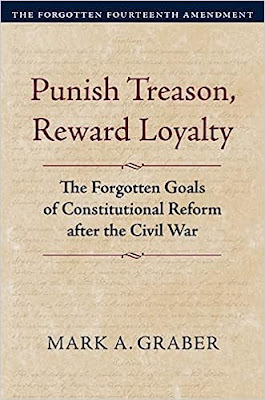
Mark A. Graber, Punish Treason, Reward Loyalty: The Forgotten Goals of Constitutional Reform after the Civil War (University of Kansas Press, 2023)
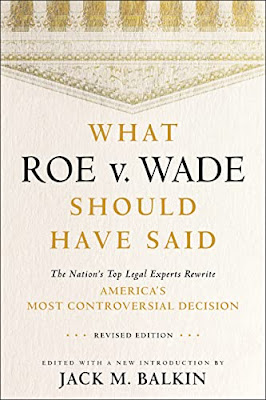
Jack M. Balkin, What Roe v. Wade Should Have Said: The Nation's Top Legal Experts Rewrite America's Most Controversial Decision - Revised Edition (NYU Press, 2023)

Andrew Koppelman, Burning Down the House: How Libertarian Philosophy Was Corrupted by Delusion and Greed (St. Martin’s Press, 2022)

Gerard N. Magliocca, Washington's Heir: The Life of Justice Bushrod Washington (Oxford University Press, 2022)
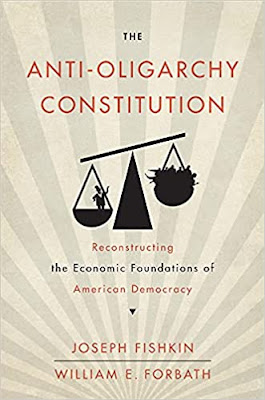
Joseph Fishkin and William E. Forbath, The Anti-Oligarchy Constitution: Reconstructing the Economic Foundations of American Democracy (Harvard University Press, 2022)
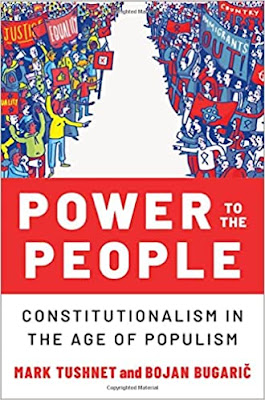
Mark Tushnet and Bojan Bugaric, Power to the People: Constitutionalism in the Age of Populism (Oxford University Press 2021).

Mark Philip Bradley and Mary L. Dudziak, eds., Making the Forever War: Marilyn B. Young on the Culture and Politics of American Militarism Culture and Politics in the Cold War and Beyond (University of Massachusetts Press, 2021).

Jack M. Balkin, What Obergefell v. Hodges Should Have Said: The Nation's Top Legal Experts Rewrite America's Same-Sex Marriage Decision (Yale University Press, 2020)

Frank Pasquale, New Laws of Robotics: Defending Human Expertise in the Age of AI (Belknap Press, 2020)

Jack M. Balkin, The Cycles of Constitutional Time (Oxford University Press, 2020)

Mark Tushnet, Taking Back the Constitution: Activist Judges and the Next Age of American Law (Yale University Press 2020).

Andrew Koppelman, Gay Rights vs. Religious Liberty?: The Unnecessary Conflict (Oxford University Press, 2020)

Ezekiel J Emanuel and Abbe R. Gluck, The Trillion Dollar Revolution: How the Affordable Care Act Transformed Politics, Law, and Health Care in America (PublicAffairs, 2020)

Linda C. McClain, Who's the Bigot?: Learning from Conflicts over Marriage and Civil Rights Law (Oxford University Press, 2020)
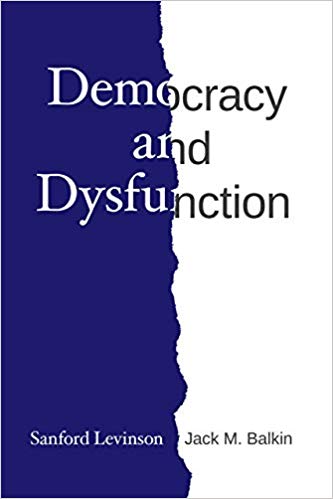
Sanford Levinson and Jack M. Balkin, Democracy and Dysfunction (University of Chicago Press, 2019)

Sanford Levinson, Written in Stone: Public Monuments in Changing Societies (Duke University Press 2018)

Mark A. Graber, Sanford Levinson, and Mark Tushnet, eds., Constitutional Democracy in Crisis? (Oxford University Press 2018)

Gerard Magliocca, The Heart of the Constitution: How the Bill of Rights became the Bill of Rights (Oxford University Press, 2018)

Cynthia Levinson and Sanford Levinson, Fault Lines in the Constitution: The Framers, Their Fights, and the Flaws that Affect Us Today (Peachtree Publishers, 2017)

Brian Z. Tamanaha, A Realistic Theory of Law (Cambridge University Press 2017)

Sanford Levinson, Nullification and Secession in Modern Constitutional Thought (University Press of Kansas 2016)

Sanford Levinson, An Argument Open to All: Reading The Federalist in the 21st Century (Yale University Press 2015)

Stephen M. Griffin, Broken Trust: Dysfunctional Government and Constitutional Reform (University Press of Kansas, 2015)

Frank Pasquale, The Black Box Society: The Secret Algorithms That Control Money and Information (Harvard University Press, 2015)

Bruce Ackerman, We the People, Volume 3: The Civil Rights Revolution (Harvard University Press, 2014)
Balkinization Symposium on We the People, Volume 3: The Civil Rights Revolution

Joseph Fishkin, Bottlenecks: A New Theory of Equal Opportunity (Oxford University Press, 2014)

Mark A. Graber, A New Introduction to American Constitutionalism (Oxford University Press, 2013)

John Mikhail, Elements of Moral Cognition: Rawls' Linguistic Analogy and the Cognitive Science of Moral and Legal Judgment (Cambridge University Press, 2013)

Gerard N. Magliocca, American Founding Son: John Bingham and the Invention of the Fourteenth Amendment (New York University Press, 2013)

Stephen M. Griffin, Long Wars and the Constitution (Harvard University Press, 2013)

Andrew Koppelman, The Tough Luck Constitution and the Assault on Health Care Reform (Oxford University Press, 2013)

James E. Fleming and Linda C. McClain, Ordered Liberty: Rights, Responsibilities, and Virtues (Harvard University Press, 2013)
Balkinization Symposium on Ordered Liberty: Rights, Responsibilities, and Virtues

Andrew Koppelman, Defending American Religious Neutrality (Harvard University Press, 2013)

Brian Z. Tamanaha, Failing Law Schools (University of Chicago Press, 2012)

Sanford Levinson, Framed: America's 51 Constitutions and the Crisis of Governance (Oxford University Press, 2012)

Linda C. McClain and Joanna L. Grossman, Gender Equality: Dimensions of Women's Equal Citizenship (Cambridge University Press, 2012)

Mary Dudziak, War Time: An Idea, Its History, Its Consequences (Oxford University Press, 2012)

Jack M. Balkin, Living Originalism (Harvard University Press, 2011)

Jason Mazzone, Copyfraud and Other Abuses of Intellectual Property Law (Stanford University Press, 2011)

Richard W. Garnett and Andrew Koppelman, First Amendment Stories, (Foundation Press 2011)

Jack M. Balkin, Constitutional Redemption: Political Faith in an Unjust World (Harvard University Press, 2011)

Gerard Magliocca, The Tragedy of William Jennings Bryan: Constitutional Law and the Politics of Backlash (Yale University Press, 2011)

Bernard Harcourt, The Illusion of Free Markets: Punishment and the Myth of Natural Order (Harvard University Press, 2010)

Bruce Ackerman, The Decline and Fall of the American Republic (Harvard University Press, 2010)
Balkinization Symposium on The Decline and Fall of the American Republic

Ian Ayres. Carrots and Sticks: Unlock the Power of Incentives to Get Things Done (Bantam Books, 2010)

Mark Tushnet, Why the Constitution Matters (Yale University Press 2010)

Ian Ayres and Barry Nalebuff: Lifecycle Investing: A New, Safe, and Audacious Way to Improve the Performance of Your Retirement Portfolio (Basic Books, 2010)
.jpg)
Jack M. Balkin, The Laws of Change: I Ching and the Philosophy of Life (2d Edition, Sybil Creek Press 2009)

Brian Z. Tamanaha, Beyond the Formalist-Realist Divide: The Role of Politics in Judging (Princeton University Press 2009)
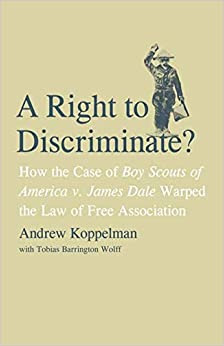
Andrew Koppelman and Tobias Barrington Wolff, A Right to Discriminate?: How the Case of Boy Scouts of America v. James Dale Warped the Law of Free Association (Yale University Press 2009)

Jack M. Balkin and Reva B. Siegel, The Constitution in 2020 (Oxford University Press 2009)

Heather K. Gerken, The Democracy Index: Why Our Election System Is Failing and How to Fix It (Princeton University Press 2009)

Mary Dudziak, Exporting American Dreams: Thurgood Marshall's African Journey (Oxford University Press 2008)

David Luban, Legal Ethics and Human Dignity (Cambridge Univ. Press 2007)

Ian Ayres, Super Crunchers: Why Thinking-By-Numbers is the New Way to be Smart (Bantam 2007)

Jack M. Balkin, James Grimmelmann, Eddan Katz, Nimrod Kozlovski, Shlomit Wagman and Tal Zarsky, eds., Cybercrime: Digital Cops in a Networked Environment (N.Y.U. Press 2007)
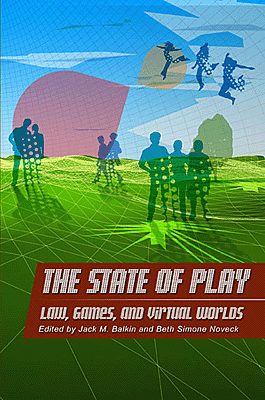
Jack M. Balkin and Beth Simone Noveck, The State of Play: Law, Games, and Virtual Worlds (N.Y.U. Press 2006)

Andrew Koppelman, Same Sex, Different States: When Same-Sex Marriages Cross State Lines (Yale University Press 2006)

Brian Tamanaha, Law as a Means to an End (Cambridge University Press 2006)

Sanford Levinson, Our Undemocratic Constitution (Oxford University Press 2006)

Mark Graber, Dred Scott and the Problem of Constitutional Evil (Cambridge University Press 2006)

Jack M. Balkin, ed., What Roe v. Wade Should Have Said (N.Y.U. Press 2005)

Sanford Levinson, ed., Torture: A Collection (Oxford University Press 2004)
Balkin.com homepage
Bibliography
Conlaw.net
Cultural Software
Writings
Opeds
The Information Society Project
BrownvBoard.com
Useful Links
Syllabi and Exams
