Balkinization
an unanticipated consequence of
Jack M. Balkin
Balkinization Symposiums: A Continuing List
E-mail:
Jack Balkin:
jackbalkin at yahoo.com
Bruce Ackerman
bruce.ackerman at yale.edu
Ian Ayres
ian.ayres at yale.edu
Corey Brettschneider
corey_brettschneider at brown.edu
Mary Dudziak
mary.l.dudziak at emory.edu
Joey Fishkin
joey.fishkin at gmail.com
Heather Gerken heather.gerken at yale.edu
Abbe Gluck abbe.gluck at yale.edu
Mark Graber
mgraber at law.umaryland.edu
Stephen Griffin
sgriffin at tulane.edu
Jonathan Hafetz
jonathan.hafetz at shu.edu
Jeremy Kessler
jkessler at law.columbia.edu
Andrew Koppelman
akoppelman at law.northwestern.edu
Marty Lederman
msl46 at law.georgetown.edu
Sanford Levinson
slevinson at law.utexas.edu
David Luban
david.luban at gmail.com
Gerard Magliocca
gmaglioc at iupui.edu
Jason Mazzone
mazzonej at illinois.edu
Linda McClain
lmcclain at bu.edu
John Mikhail
mikhail at law.georgetown.edu
Frank Pasquale
pasquale.frank at gmail.com
Nate Persily
npersily at gmail.com
Michael Stokes Paulsen
michaelstokespaulsen at gmail.com
Deborah Pearlstein
dpearlst at yu.edu
Rick Pildes
rick.pildes at nyu.edu
David Pozen
dpozen at law.columbia.edu
Richard Primus
raprimus at umich.edu
K. Sabeel Rahmansabeel.rahman at brooklaw.edu
Alice Ristroph
alice.ristroph at shu.edu
Neil Siegel
siegel at law.duke.edu
David Super
david.super at law.georgetown.edu
Brian Tamanaha
btamanaha at wulaw.wustl.edu
Nelson Tebbe
nelson.tebbe at brooklaw.edu
Mark Tushnet
mtushnet at law.harvard.edu
Adam Winkler
winkler at ucla.edu
Compendium of posts on Hobby Lobby and related cases
The Anti-Torture Memos: Balkinization Posts on Torture, Interrogation, Detention, War Powers, and OLC
The Anti-Torture Memos (arranged by topic)
Recent Posts
Procedural Implications of the Midterm Elections
Affirmative action and racial tribalism
For those of you interested in the actual merits of the Census Citizenship-Question case . . .
"We do not have Obama judges or Trump judges, Bush judges or Clinton judges."
Chief Justice Roberts' Press Statement
[UPDATED] The Odd Supreme Court Grant in the Census Citizenship Question Case
The Motion to Substitute
Jack Balkin on Original Methods Originalism: A Response
Matthew Whitaker and the No Religious Test Clause
Minority Rule: How Long?
How Could Religious Liberty Be a Human Right?
Interview for The Point Magazine
Who is the Attorney General?
Our American Story
Symposium on The Law And Policy Of AI, Robotics, and Telemedicine In Health Care -- Collected Posts
Content Moderation, The Press, and the First Amendment - A Discussion with Ben Smith and Josh Marshall
A Backdoor Approach to Calling an Article V Convention
The Devil is in the Data
Regulating Social Robots in Health Care
Balkinization Symposium on Jonathan Gienapp, The Second Creation-- Collected Posts
The Constitutional Challenge to Robert Mueller's Appointment
Artificial Intelligence and Predictive Data: The Need for A New Anti-Discrimination Mandate
AIs as Substitute Decision Makers
![[Powered by Blogger]](https://lh3.googleusercontent.com/blogger_img_proxy/AEn0k_v5QlPLFj5auqAqXNQz4ffpDhmhQpW3KHO7FVPdjApRCdRPUUpQHNfUvH2YNSiLP8qjriYeS_lztsgXDde9O33jH-NiGh0MPqVh3KiDk6-W=s0-d)
Just A Few Blogs
ACS Blog
Alas, a Blog
Althouse
Arts and Letters Daily
Atrios (Eschaton)
Bill of Health
Buzzflash.com
Buzz Machine
Cato at Liberty
Juan Cole (Informed Comment)
Concurring Opinions
The Constitution in 2020
Corrente
Crooked Timber
Daily Howler
Daily Kos
Dana Boyd
Brad DeLong
Digby (Hullabaloo)
Discriminations
Daniel Drezner
Kevin Drum (Mother Jones)
Electrolite
En Banc
Eunomia (Daniel Larison)
Fafblog
Michael Froomkin (Discourse.net)
GovLab (Beth Noveck)
Rick Hasen (Election Law)
History News Network
How Appealing
Ignatz (Sam Heldman)
The Importance of (Ernie Miller)
Infolaw
Instapundit
International Economic Law and Policy Blog
IntLawGrrls
Jacob Levy
Jesus' General
Jurisdynamics
The Kitchen Cabinet
Mark Kleiman
Law Blog Central
Larry Lessig
Lawyers, Guns and Money
Liberal Oasis
Brian Leiter's Law School Reports
The Leiter Reports
Marginal Revolution
Megan McArdle
Memeorandum
Metafilter
Mirror of Justice
The New Republic
Newseum
No More Mister Nice Blog
Brendan Nyhan
Opinio Juris
Orcinus
The Originalism Blog
Pandagon
Passport (Foreign Policy)
Overcoming Bias
Political Animal (Washington Monthly)
Political Theory Daily Review
Political Wire (Taegan Goddard)
The Poor Man
Virginia Postrel
Prawfsblawg
Public Reason
Jonathan Rauch
Raw Story
Redstate
ReligiousLeftLaw.com
Reporters Committee For Freedom of the Press
Reproductive Rights Blog
Rothman's Roadmap to the Right of Publicity
SCOTUS Blog
Seeing the Forest
Clay Shirky
The Shifted Librarian
The Situationist
Larry Solum (Legal Theory)
Andrew Sullivan
Talking Points Memo
Talk Left
Tapped
Tbogg
TechPresident
The Paper Chase (Jurist)
Tom Paine
Tom Tomorrow (This Modern World)
Eve Tushnet
Uggabugga
University of Chicago Law School Faculty Blog
Unqualified Offerings
The Volokh Conspiracy
War and Piece (Laura Rozen)
Wampum
Oliver Willis
Wonkette
Written Description
Matthew Yglesias
Yin
Your Choice of Feeds
1. XML
powered by

2. Atom Feed
3. RSS 2.0
Procedural Implications of the Midterm Elections
David Super
Posted
6:19 PM
by David Super [link]
Affirmative action and racial tribalism
Andrew Koppelman
Posted
10:04 AM
by Andrew Koppelman [link]
For those of you interested in the actual merits of the Census Citizenship-Question case . . .
Marty Lederman
The parties just filed their post-trial memoranda with proposed findings of fact and conclusions of law, linked below. Judge Furman will hear oral argument next Tuesday, November 26, and then issue a judgment . . . unless the government seeks a stay in the Supreme Court and the Court, for some inexplicable reason, orders the court not to issue a judgment in the case.
Plaintiffs' Proposed Findings of Facts
Plaintiffs' Proposed Conclusions of Law
Defendants' Proposed Findings of Facts and Conclusions of Law
Posted
12:26 AM
by Marty Lederman [link]
"We do not have Obama judges or Trump judges, Bush judges or Clinton judges."
Mark Tushnet
Posted
3:16 PM
by Mark Tushnet [link]
Chief Justice Roberts' Press Statement
Gerard N. Magliocca
I'd be fascinated to hear more about how these comments to the Associated Press came about. Surely the Chief Justice must have told someone to tell the journalist to call him for this statement. I doubt very much that intrepid reporters are constantly calling his chambers looking for comments and--at long last--hit the jackpot.
Posted
2:43 PM
by Gerard N. Magliocca [link]
(60) comments
[UPDATED] The Odd Supreme Court Grant in the Census Citizenship Question Case
Marty Lederman
Two important things happened in that case on Friday.
First, District Judge Furman completed the trial in the case, and scheduled post-trial oral argument for next Tuesday, November 27.
Later that same day, however, the Supreme Court treated the government's pending petition for mandamus as a petition for certiorari, granted the petition, and set an expedited briefing schedule with oral argument scheduled for February 19, 2019. It's important to understand that the Supreme Court petition is not about the merits of the case. It was filed before the trial started, and the only question it presents is with respect to the proper scope of discovery. This is the Question Presented:
Whether, in an action seeking to set aside agency action under the Administrative Procedure Act, 5 U.S.C. 701 et seq., a district court may order discovery outside the administrative record to probe the mental processes of the agency decisionmaker—including by compelling the testimony of high-ranking Executive Branch officials —when there is no evidence that the decisionmaker disbelieved the objective reasons in the administrative record, irreversibly prejudged the issue, or acted on a legally forbidden basis.
The Court has ordered the government to submit its opening brief by December 17.
This is, I believe, a very strange, almost inexplicable, grant, in light of two things:
First, on October 22, the Supreme Court denied a government motion to stay discovery of matters outside the administrative record (with the exception of the deposition of the Secretary of Commerce, which therefore did not occur). The Solicitor General then made another motion to stay the district court proceedings, and once again, on November 2, the Supreme Court denied that motion, too. Accordingly, the discovery at the heart of the petition then occurred and, as noted above, the trial is now finished, with oral argument to be held next week.
Second, the district court judge has already announced his expectation that in any findings of fact and conclusions of law that he makes in his post-trial judgment, he'll "differentiat[e]" between evidence that's within the administrative record and evidence adduced at trial that's outside the administrative record. [UPDATE: Here's a handy chart the plaintiffs submitted on Saturday identifying the submitted evidence from inside and outside the administrative record.] That is to say, the judge will explain whether the plaintiffs should prevail on the administrative record alone and, if not, how any evidence outside that record might or might not affect the judgment. The court added that "Defendants remain free to argue . . . that the Court should disregard all evidence outside the administrative record and, if unsuccessful, can argue on appeal that the Court erred in considering extra-record evidence." Accordingly, as Judge Furman explained, "if the Court rules against Defendants on the basis of extra-record materials and a higher court holds that the Court should not have considered those materials, Defendants would be able to get complete relief" from the appellate courts, including the Supreme Court, after final judgment--no retrial would be necessary.
So what's the point of the Supreme Court's cert. grant, to review the propriety of discovery that has already been completed and to do so before the trial court enters judgment? Why didn't the Court at least wait until Judge Furman issued his judgment? If the district court has issued its judgment before December 17, when the government's opening brief in the Supreme Court is due, does the Court expect the parties simply to treat the proceedings in the Court as a sort of direct appeal from the district court on the merits--transforming the case into one involving a de facto certiorari before judgment of sorts--thereby circumventing the court of appeals? That seems unlikely. (And that's assuming the district court rules against the government. If Judge Furman rules in favor of the government, what happens to the Supreme Court case? Presumably the plaintiffs--unlike the government(?)--would be required to initially appeal to the court of appeals. But if so, why is the government's evidence-based petition ripe for SCOTUS review now?)
And if Judge Furman's judgment comes after December 17, what are the parties supposed to do about it during their remaining briefing schedule in the Supreme Court? Begin treating the SCOTUS case as if it were an appeal on the merits? Simultaneously go up to the Second Circuit on the merits while the ancillary evidentiary question about what evidence the district court should have considered is pending in the Supreme Court?
I sense that I must be missing something here, but I've asked these questions of a bunch of people following the case, and no one's had a clue about what the Court has in mind. [One wild speculation: Perhaps the Court fully expects to dismiss the petition as moot once Judge Furman issues his judgment, but is merely trying to spur him to rule expeditiously--something the Court presumably cannot simply order a trial judge to do--to make it more likely the appellate courts can opine on the merits before the end of June. If that's the reason, however, it seems unnecessary--as far as I know Judge Furman has been moving things along very briskly, with the summer deadline in mind.]
Meanwhile, just a few hours ago (yes, on a Sunday), the government defendants asked Judge Furman to revisit his prior decision to proceed toward final judgment, and moved him to stay all proceedings until the Supreme Court issues its decision on the evidentiary questions sometime between next March and June. I must confess that I don't see the point in such a delay, especially in light of the court's determination to specify, in his forthcoming judgment, whether and how the plaintiffs' claims are affected by any materials outside the administrative record. A four- to seven-month delay before the court enters its final judgment would effectively preclude the courts from being able to carefully consider the merits of the case before the new census forms are to be printed up in June. Why would that be (in the government's words) "the most prudent course"?
[UPDATE: Judge Furman has instructed the plaintiffs to file their response to the government's new motion by 4:00 p.m. on Tuesday, November 20. Here is that opposition. Not satisfied with such a rapid schedule, DOJ has now gone to the U.S. Court of Appeals with a motion to stay the district court proceedings. Others may disagree, but I don't see in that motion any persuasive basis for a stay.]
[UPDATE, Nov. 20: Here's the plaintiffs' opposition to the stay motion. Meanwhile the U.S. Court of Appeals for the Second Circuit has instructed the government to be patient:
The Government moved yesterday for a stay of proceedings in two consolidated district court cases pending the Supreme Court’s resolution of In re Department of Commerce, No. 18-557. A similar motion for a stay of proceedings, filed only two days ago, remains pending before the District Court, which set a deadline for filing any opposition to the motion by today at 4 p.m. Upon due consideration, it is hereby ORDERED that the motions for a stay are DENIED as premature, without prejudice to renewing the motions for the Court’s consideration in the event the District Court denies the stay motion pending before it. In the event the District Court denies the motion, this appeal will be deemed automatically renewed for our consideration.
Late this afternoon, Judge Furman denied the motion for stay and didn't mince words about his views of the government's conduct:
"Unless burdening Plaintiffs and the federal courts with make-work is a feature of Defendants’ litigation strategy, as opposed to a bug, it is hard to see the point."
"To borrow from Camus, '[o]ne must imagine Sisyphus happy.'"
"The words 'harm' and 'injury' do not appear anywhere in their motion . . . for good reason, as the notion that they—or anyone else—would suffer 'irreparable harm' without a stay is laughable."
"Defendants’ motion makes so little sense, even on its own terms, that it is hard to understand as anything but an attempt to avoid a timely decision on the merits altogether."
"If Defendants’ motion in this Court comes close to the sanctionable line, [their CTA2] filing would sure seem to cross it."
"Defendants’ motion is most galling insofar as it is premised on the suggestion that granting a stay would help conserve judicial resources. It is plainly more efficient for this Court to rule expeditiously."
"If Defendants were truly interested in conserving judicial resources, they could have avoided burdening this Court, the Second Circuit, and the Supreme Court with twelve stay applications over the last eleven weeks that, with one narrow exception, have been repeatedly rejected as meritless. Instead, Defendants would have focused their attention on the ultimate issues in this case, where the attention of the parties and the Court now belongs."
"Enough is enough."
And still later this afternoon, the government, undeterred, went back to the Second Circuit and asked that court to now treat its earlier motion for stay as "automatically renewed."]
[UPDATE 11/21: Here's the opposition to stay in the court of appeals from the city, county and state plaintiffs.
This afternoon the Court of Appeals for the Second Circuit quickly and unceremoniously rejected the DOJ/DOC motion to stay Judge Furman's proceedings "substantially for the reasons set forth in the District Court’s brief opinion."]
[FURTHER UPDATE: Just before midnight, the parties filed their post-trial memoranda--with oral argument to be held next Tuesday, Nov. 26:
Plaintiffs' Proposed Findings of Facts
Plaintiffs' Proposed Findings of Law
Defendants' Proposed Findings of Facts and Law]
Posted
11:46 PM
by Marty Lederman [link]
The Motion to Substitute
Gerard N. Magliocca
The Supreme Court would be doing everyone a favor by ordering briefing on the motion to substitute that Tom Goldstein has filed challenging the legality of the Acting Attorney General's appointment. I doubt that the Court would ever have to resolve this dispute. The mere order of briefing probably will hasten either the nomination of the next Attorney General or the withdrawal of Whitaker in favor of Rod Rosenstein, whom everyone agrees can serve as the Acting Attorney General.
Posted
4:32 PM
by Gerard N. Magliocca [link]
(28) comments
Jack Balkin on Original Methods Originalism: A Response
Guest Blogger
Posted
2:45 PM
by Guest Blogger [link]
Matthew Whitaker and the No Religious Test Clause
Guest Blogger
Philip Bobbitt
I gather a spokesperson for the Department of Justice---who declined to speak on the record--has been clarifying remarks made by the acting Attorney General, Matthew Whitaker, on a number of constitutional subjects. Among these is the statement, made in a 2014 debate when Whitaker was a candidate for the Republican nomination for senator from Iowa, in response to a question as to “what criteria” a senator should use in evaluating judicial nominees. Whitaker is reported to have said, “I’d like to see things like their world view, what informs them. Are they people of faith? Do they have a biblical view of justice, which I think is very important…And what I know is as long as they have that world view, they’ll be good judge. And if they have a secular world view, where this is all we have here on Earth, then I’m going to be very concerned about that judge.”
In the various published commentaries made attacking or defending this position, I have been surprised not to have come across anyone who quotes Article VI of the Constitution that provides that “no religious Test shall ever be required as a Qualification to any Office or public Trust under the United States.”
Nor is this omission irrelevant to persons interested in constitutional interpretation. To those who think that the standards for Senatorial confirmation are constitutional in nature, even if there is no role for litigating the matter, ignoring the plain text of the Constitution is disheartening. It gives further impetus to claims like, "the standards for impeachment are whatever the House finds them to be," "because the pardon power is by its terms unlimited, a president can pardon for any reason he wishes," despite textual commitments to the contrary.
Philip C. Bobbitt is the Herbert Wechsler Professor of Federal Jurisprudence and director for the Center for National Security at Columbia Law School. You can reach him by e-mail at pbobbi at law.columbia.edu
Posted
6:43 PM
by Guest Blogger [link]
Minority Rule: How Long?
Joseph Fishkin
I don’t usually do this, but I thought I’d re-up a prior post from before the election: majority leverage against minority rule.
The reason is the following simple point. The current Senate math suggests it is just possible—if almost everything breaks right—for Democrats to imagine potentially being in a position to govern the country in January 2021. Making plausible assumptions as I write this (Sinema in Arizona, Hyde-Smith in Mississippi, uncertainty in Florida), the Republicans will have a Senate majority in January 2019 of either 52 or 53.
Under current conditions of radical polarization, enacting any serious legislative agenda requires control of all three branches. That is even more true for any Democratic efforts to reform the political system in ways that make it less prone to minority rule—a federal statute protecting the right to vote, admitting new states such as Puerto Rico, limiting gerrymandering, enacting campaign finance laws compatible with current Court doctrine such as public financing, and so on. For Democrats to have any possibility of enacting such reforms in 2021, they will need a lot of unity and focus; they will need to win the presidential election; and they will need to net either +2 or +3 seats (at a minimum) in the Senate. Then they will need to enter the chamber in 2021 and immediately set rules that would protect the necessary reforms from filibuster. That is how a Democratic majority could use temporary leverage to put the brakes on minority rule.
This scenario is possible—but just barely. There are Republican incumbents in only a few purplish states facing the voters in 2020: Maine, Colorado, North Carolina, Arizona, Iowa. Meanwhile, Doug Jones (D-AL) will have a very uphill battle to retain his seat. So, under radically polarized conditions, the likely horizon of Democratic gains in a good year—and here we have to assume a year where Democrats are winning the White House—is just barely above the minimum required to regain a majority. If Democrats fail to win those races despite winning the votes of most voters in 2020, we will settle in for a considerably longer stretch of minority rule.
Posted
12:36 AM
by Joseph Fishkin [link]
How Could Religious Liberty Be a Human Right?
Andrew Koppelman
Posted
12:26 PM
by Andrew Koppelman [link]
Interview for The Point Magazine
Corey Brettschneider
Here is my interview with The Point Magazine about my new book The Oath and the Office: A Guide To The Constitution For Future Presidents: https://thepointmag.com/2018/dialogue/executive-decisions-american-politics-presidency
Posted
3:52 PM
by Corey Brettschneider [link]
Who is the Attorney General?
Gerard N. Magliocca
Neal Katyal and George Conway have an op-ed in The New York Times arguing that the appointment of Acting Attorney General Whitaker is illegal and that any actions that he takes are null and void. I want to make one observation about their argument.
The Constitution sets forth a way to fill a vacancy created when a Cabinet member resigns, dies, or is fired. The President can make a recess appointment under Article Two, Section Three. In 2014, the Supreme Court held in Noel Canning that the Senate gets to decide when that body is in recess and, thus, when the President can make a recess appointment. This means that if the Senate was in recess yesterday, Mr. Whitaker's appointment is lawful but will expire at the end of the year. But was the Senate in recess yesterday? The Senate was not in session yesterday. but I am unclear whether the Senate's adjournment on Tuesday (scheduled to last until Friday) is a recess.
If the Senate was not in recess yesterday, then I'm having a hard time understanding how the Federal Vacanies Reform Act does not present a constitutional problem as applied to Whitaker's appointment. What is the point of the Senate staying in session to prevent recess appointments if the President can make the same pick under the Act? Moreover, the Act in this instance may be increasing the scope of the President's temporary appointment power beyond what the Constitution would give (less than two months), and I'm not so sure that Congress can do that.
Posted
1:57 PM
by Gerard N. Magliocca [link]
(52) comments
Our American Story
Gerard N. Magliocca
I am proud to tell you about a forthcoming book called Our American Story: The Search for a Shared National Narrative, which is now available for pre-order on Amazon. Scholars and elected officials from the left and right (including me) have contributed essays explaining how we think Americans might find common ground in this polarized age. Here is the Abstract:
Over the past few decades, the complicated divides of geography, class, religion, and race created deep fractures in the United States, each side fighting to advance its own mythology and political interests. We lack a central story, a common ground we can celebrate and enrich with deeper meaning. Unable to agree on first principles, we cannot agree on what it means to be American. As we dismantle or disregard symbols and themes that previously united us, can we replace them with stories and rites that unite our tribes and maintain meaning in our American identity?
Against this backdrop, Our American Story features leading thinkers from across the political spectrum--Jim Banks, David W. Blight, Spencer P. Boyer, Eleanor Clift, John C. Danforth, Cody Delistraty, Richard A. Epstein, Nikolas Gvosdev, Cherie Harder, Jason Kuznicki, Gerard N. Magliocca, Markos Moulitsas, Ilya Somin, Cass R. Sunstein, Alan Taylor, James V. Wertsch, Gordon S. Wood, and Ali Wyne. Each draws on expertise within their respective fields of history, law, politics, and public policy to contribute a unique perspective about the American story. This collection explores whether a unifying story can be achieved and, if so, what that story could be.
Posted
9:51 AM
by Gerard N. Magliocca [link]
Symposium on The Law And Policy Of AI, Robotics, and Telemedicine In Health Care -- Collected Posts
JB
Here are collected posts published in conjunction with a Solomon Center symposium on The Law And Policy Of AI, Robotics, and Telemedicine In Health Care. 1. Jack Balkin, Introduction to the Symposium 2. Claudia Haupt, The Algorithm Will See You Now 3. William M. Sage, Non-Diagnosis: An Unappreciated but Critical Role for AI in Healthcare 4. W. Nicholson Price II, Four Roles for Artificial Intelligence in the Medical System 5. A. Michael Froomkin, Organizing the Federal Government’s Regulation of AI 6. Eric M. Fish, Key Questions for Regulators Rise with the Dawn of AI-Driven Healthcare 7. Mason Marks, Artificial Intelligence for Suicide Prediction 8. Bonnie Kaplan, Seeing Transparency Through: Healthcare Software, Data Privacy, and Regulation 9. Frank Pasquale, Who is Your Therapy App Working For? 10. Paul Vincent Tongsy, Care Robots 11. A. Michael Froomkin, Big Data: Destroyer of Informed Consent 12. Fazal Khan, Regulating Carebots for the Elderly: Are Safety and Efficacy Sufficient Standards of Review? 13. Ian Kerr, AIs as Substitute Decision Makers 14. Sharona Hoffman, Artificial Intelligence and Predictive Data: The Need for A New Anti-Discrimination Mandate 15. Valarie K. Blake, Regulating Social Robots in Health Care
Posted
9:30 AM
by JB [link]
Content Moderation, The Press, and the First Amendment - A Discussion with Ben Smith and Josh Marshall
JB
It was a great conversation, and it ranged widely over a number of very interesting subjects, including (1) how platforms are being dragged into becoming professional curators of the public sphere; (2) how journalistic organizations adjust to policies of platform companies that are not particularly focused on journalism, much less the survival of journalism; and (3) how platforms affect the economics of digital journalism for better and for worse.
Both Smith and Marshall also had important insights about their work in a media environment dominated by platforms.
Posted
9:00 AM
by JB [link]
A Backdoor Approach to Calling an Article V Convention
David Super
Posted
11:09 PM
by David Super [link]
The Devil is in the Data
Guest Blogger
Posted
11:00 AM
by Guest Blogger [link]
Regulating Social Robots in Health Care
Guest Blogger
Valarie K. Blake
For the Symposium on The Law And Policy Of AI, Robotics, and Telemedicine In Health Care.
Posted
1:07 PM
by Guest Blogger [link]
Balkinization Symposium on Jonathan Gienapp, The Second Creation-- Collected Posts
JB

Here are the collected posts for our Balkinization symposium on Jonathan Gienapp's new book, The Second Creation: Fixing the American Constitution in the Founding Era (Belknap Press 2018).
Jack Balkin, Introduction to Symposium on Jonathan Gienapp, The Second Creation
Jack Balkin, The Second Creation and Orignalist Theory
Gerard Magliocca, Fixation and Legitimacy
Bernadette Meyler, The Second Creation and Its Implications
Christina Mulligan, Evolving into the Fixed Constitution
Alison L. LaCroix, The Invention of the Archival Constitution
Jonathan Gienapp, The Founding and the Origins of Our Constitutionalism, Part II
Jonathan Gienapp, The Founding and the Origins of Our Constitutionalism, Part III
Posted
11:00 AM
by JB [link]
The Constitutional Challenge to Robert Mueller's Appointment
Marty Lederman
One week from today, on Thursday, November 8 at 1:00, a panel of the U.S. Court of Appeals for the D.C. Circuit (Judges Henderson, Rogers and Srinivasan) will hear argument in Miller v. United States, No. 18-3052, a case challenging the constitutionality of Robert Mueller’s appointment to serve as “Special Counsel” for the Russia investigation.
The appellant is Andrew Miller, a potential grand jury witness who refused to comply with a pair of subpoenas requiring him to provide testimony and documents to the grand jury. Miller argued, among other things, that the subpoenas should be quashed because Mueller was not lawfully appointed. Miller continued to refuse to comply with the subpoenas even after Chief Judge Howell denied his motion to quash them, and so the Judge held him in contempt. Miller has appealed from that contempt order.
He makes three separate arguments that Rosenstein’s appointment of Mueller purportedly violated the Appointments Clause of the Constitution, Art. II, § 2, cl. 2, which provides that:
[The President] shall nominate, and by and with the Advice and Consent of the Senate, shall appoint Ambassadors, other public Ministers and Consuls, Judges of the supreme Court, and all other Officers of the United States, whose Appointments are not herein otherwise provided for, and which shall be established by Law: but the Congress may by Law vest the Appointment of such inferior Officers, as they think proper, in the President alone, in the Courts of Law, or in the Heads of Departments.
First, and most fundamentally, Miller argues that Special Counsel Mueller is a “principal” officer and therefore could only be appointed by the President, by and with the advice and consent of the Senate, which was not done here.
Second, Miller argues that even if Special Counsel Mueller is an “inferior” officer, his appointment was nevertheless unconstitutional because Congress has not “by law” vested the Attorney General with the authority to appoint such a Special Counsel (in effect, a question of statutory interpretation, about whether the appointment was ultra vires).
Third, Miller argues that even if Special Counsel Mueller is an “inferior” officer, and even if Congress authorized the Attorney General to appoint him, the Deputy Attorney General, Rod Rosenstein, may not make the appointment because he is not the “Head” of the Department of Justice, even where, as here, he’s exercising the functions of the Office of the Attorney General because the Attorney General himself, Jeff Sessions, is recused from the investigation and is therefore unable to exercise those functions.
If the court of appeals were to hold that the Mueller appointment was unconstitutional, that would, of course, be a very big deal. In a series of posts over at Just Security, however, I do something of a "deep dive" into Appointments Clause arcana in order to explain why that’s a very unlikely outcome. I also identify two or three questions the court of appeals need not, and probably should not, try to answer definitively that might have greater implications for developments apart from the case on appeal—including, importantly, the nature and scope of the Acting Attorney General’s authority to remove Mueller.
The first post offers a general overview of the case, with links to the lower court opinions and the briefs on appeal.
In my second post, I explain why there’s actually a serious question, not briefed by the parties, about whether the Appointments Clause applies to Mueller at all (a question the court of appeals can likely avoid by simply assuming, without deciding, that Mueller is a constitutional “officer”).
The third post is perhaps the most important—not for purposes of resolving the Miller appeal itself, but more broadly for what it says about the officers throughout the government, including Mueller, whose independence is secured in part by tenure protections that preclude “at will” removal. In that post, I take issue with the tentative suggestion in Chief Judge Howell’s opinion that it might be proper—or necessary to avoid a difficult constitutional question—for the court to construe expansively the Acting Attorney General’s authority to remove Mueller under the DOJ Special Counsel regulations.
My fourth post addresses a handful of issues raised by Judge Friedrich in her opinion in a related case raising similar Appointments Clause challenges to Mueller, including: whether the Supreme Court’s decision in Morrison v. Olson (1988) is still "good law"; whether a bipartisan consensus has emerged that Morrison was wrongly decided; whether the Special Counsel is an inferior officer whose appointment was constitutional even under the analysis of the Court’s later decision in Edmond v. United States (1999); and whether the prospect of a possible rescission or amendment of the Special Counsel regulations affords Rosenstein greater control over the conduct of the Mueller investigation, and whether that question has any bearing on the Appointments Clause questions in the Miller case.
In my final post, I briefly discuss what I’ve labeled above as the second and third of Miller’s three Appointments Clause arguments, both of which are predicated on the assumption that the Appointments Clause applies and that Mueller is an inferior officer.
Posted
9:15 AM
by Marty Lederman [link]
Artificial Intelligence and Predictive Data: The Need for A New Anti-Discrimination Mandate
Guest Blogger
Sharona Hoffman
For the Symposium on The Law And Policy Of AI, Robotics, and Telemedicine In Health Care.
A large
number of U.S. laws prohibit disability-based discrimination. At the federal level, examples are the
Americans with Disabilities Act (ADA), the Fair Housing Act, the Rehabilitation
Act of 1973, Section 1557 of the Affordable Care Act, and the Genetic
Information Nondiscrimination Act. In
addition, almost all of the states have adopted disability discrimination laws. This might lead to the conclusion that we
enjoy comprehensive legislative protection against discrimination associated
with health status. Unfortunately, in
the era of big data and artificial intelligence (AI) that is no longer true.
The problem
is that the laws protect individuals based on their present or past health
conditions and do not reach discrimination based on predictions of future
medical ailments. The ADA, for example,
defines disability as follows: a) a physical or mental impairment that
substantially limits a major life activity, b) a record of such an impairment,
or c) being regarded as having such an impairment. This language focuses only on employers’
perceptions concerning workers’ current or past health status.
AI can be of
great benefit to patients, health care providers, and other stakeholders. Machine learning algorithms have been used to
predict patients’ risk of heart disease, stroke, and diabetes based on their
electronic health record data. Google has used deep-learning algorithms to
predict heart disease by analyzing photographs of individuals’ retinas. IBM has used AI to model the speech patterns
of high-risk patients who later developed psychosis. In 2016, researchers from
the University of California, Los Angeles announced that they had used data
from the National Health and Nutrition Examination Survey to build a statistical
model to predict prediabetes. Armed with
such means, physicians can identify their at-risk patients and counsel them
about lifestyle changes and other preventive measures. Likewise, employers can use predictive
analytics to more accurately forecast future health insurance costs for
budgetary purposes.
Unfortunately,
however, AI and predictive analytics generally may also be used for
discriminatory purposes. Take employers
as an example. Employers are highly motivated
to hire healthy employees who will not have productivity or absenteeism
problems and will not generate high health insurance costs. The ADA permits employers to conduct
wide-ranging pre-employment examinations. Thus, employers may have individuals’
retinas and speech patterns examined in order to identify desirable and
undesirable job applicants. The ADA
forbids employers from discriminating based on existing or past serious health
problems. But no provision prohibits them from using such data to discriminate
against currently healthy employees who may be at risk of later illnesses and thus
could possibly turn out to have low productivity and high medical costs.
This is
especially problematic because statistical predictions based on AI algorithms
may be wrong. They may be tainted by
inaccurate data inputs or by biases. For
example, a prediction might be based on information contained in an
individual’s electronic health record (EHR).
Yet, unfortunately, these records are often rife with errors that can
skew analysis. Moreover, EHRs are often
designed to maximize charge capture for billing purposes. Reimbursement concerns may therefore drive
EHR coding in ways that bias
statistical predictions. So too,
predictive algorithms themselves may be flawed if they have been trained using
unreliable data. Discrimination based on
AI forecasts, therefore, may not only harm data subjects, it may also be based
on entirely false assumptions.
One might object that the suggested approach
would unacceptably broaden the anti-discrimination mandate because it would potentially
extend to all Americans rather than to a “discrete and insular minority” of
individuals with disabilities. After
all, anyone, including the healthiest of humans, could be found to have signs
that forecast some future frailty.
However, the
ADA’s “regarded as” provision is already far-reaching because any individual
could be wrongly perceived as having a mental or physical impairment. Similarly, Title VII of the Civil Rights Act
of 1964 covers discrimination based on race, color, national origin, sex, and
religion. Given that all individuals
have these attributes (religion includes non-practice of religion), the law
reaches all Americans. Consequently, banning
discrimination rooted in predictive data would not constitute a departure from
other, well-established anti-discrimination mandates.
It is noteworthy
that under the Genetic Information Nondiscrimination Act, employers and health
insurers are already prohibited from discriminating based on one type of
predictive data: genetic information.
Genetic information is off-limits not only insofar as it can reveal what
conditions individuals presently have, but also with respects to its ability to
identify perfectly healthy people’s vulnerabilities to a myriad of diseases in
the future.
In the
contemporary world it makes little sense to outlaw discrimination based on
genetic information but not discrimination based on AI algorithms with powerful
predictive capabilities. The proposed
change would render the ADA and other disability discrimination provisions more
consistent with GINA’s prudent approach.
Posted
9:00 AM
by Guest Blogger [link]
AIs as Substitute Decision Makers
Guest Blogger
Ian Kerr
For the Symposium on The Law And Policy Of AI, Robotics, and Telemedicine In Health Care.
“Why, would it be unthinkable that I should stay in the saddle however much the facts bucked?”
- Ludwig Wittgenstein, On Certainty
Posted
9:00 AM
by Guest Blogger [link]
Books by Balkinization Bloggers

Gerard N. Magliocca, The Actual Art of Governing: Justice Robert H. Jackson's Concurring Opinion in the Steel Seizure Case (Oxford University Press, 2025)

Linda C. McClain and Aziza Ahmed, The Routledge Companion to Gender and COVID-19 (Routledge, 2024)

David Pozen, The Constitution of the War on Drugs (Oxford University Press, 2024)

Jack M. Balkin, Memory and Authority: The Uses of History in Constitutional Interpretation (Yale University Press, 2024)
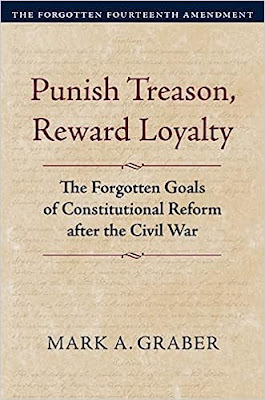
Mark A. Graber, Punish Treason, Reward Loyalty: The Forgotten Goals of Constitutional Reform after the Civil War (University of Kansas Press, 2023)
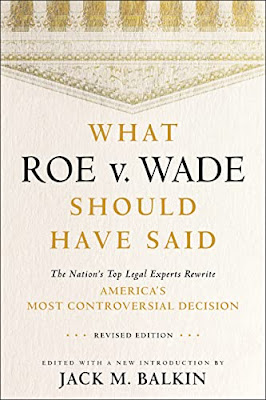
Jack M. Balkin, What Roe v. Wade Should Have Said: The Nation's Top Legal Experts Rewrite America's Most Controversial Decision - Revised Edition (NYU Press, 2023)

Andrew Koppelman, Burning Down the House: How Libertarian Philosophy Was Corrupted by Delusion and Greed (St. Martin’s Press, 2022)

Gerard N. Magliocca, Washington's Heir: The Life of Justice Bushrod Washington (Oxford University Press, 2022)
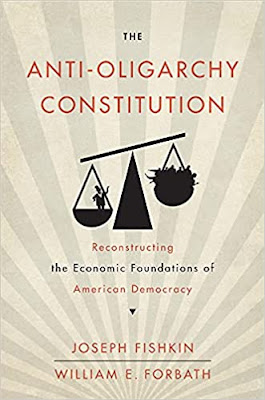
Joseph Fishkin and William E. Forbath, The Anti-Oligarchy Constitution: Reconstructing the Economic Foundations of American Democracy (Harvard University Press, 2022)
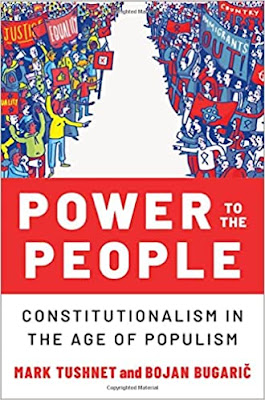
Mark Tushnet and Bojan Bugaric, Power to the People: Constitutionalism in the Age of Populism (Oxford University Press 2021).

Mark Philip Bradley and Mary L. Dudziak, eds., Making the Forever War: Marilyn B. Young on the Culture and Politics of American Militarism Culture and Politics in the Cold War and Beyond (University of Massachusetts Press, 2021).

Jack M. Balkin, What Obergefell v. Hodges Should Have Said: The Nation's Top Legal Experts Rewrite America's Same-Sex Marriage Decision (Yale University Press, 2020)

Frank Pasquale, New Laws of Robotics: Defending Human Expertise in the Age of AI (Belknap Press, 2020)

Jack M. Balkin, The Cycles of Constitutional Time (Oxford University Press, 2020)

Mark Tushnet, Taking Back the Constitution: Activist Judges and the Next Age of American Law (Yale University Press 2020).

Andrew Koppelman, Gay Rights vs. Religious Liberty?: The Unnecessary Conflict (Oxford University Press, 2020)

Ezekiel J Emanuel and Abbe R. Gluck, The Trillion Dollar Revolution: How the Affordable Care Act Transformed Politics, Law, and Health Care in America (PublicAffairs, 2020)

Linda C. McClain, Who's the Bigot?: Learning from Conflicts over Marriage and Civil Rights Law (Oxford University Press, 2020)
Sanford Levinson and Jack M. Balkin, Democracy and Dysfunction (University of Chicago Press, 2019)

Sanford Levinson, Written in Stone: Public Monuments in Changing Societies (Duke University Press 2018)

Mark A. Graber, Sanford Levinson, and Mark Tushnet, eds., Constitutional Democracy in Crisis? (Oxford University Press 2018)

Gerard Magliocca, The Heart of the Constitution: How the Bill of Rights became the Bill of Rights (Oxford University Press, 2018)

Cynthia Levinson and Sanford Levinson, Fault Lines in the Constitution: The Framers, Their Fights, and the Flaws that Affect Us Today (Peachtree Publishers, 2017)

Brian Z. Tamanaha, A Realistic Theory of Law (Cambridge University Press 2017)

Sanford Levinson, Nullification and Secession in Modern Constitutional Thought (University Press of Kansas 2016)

Sanford Levinson, An Argument Open to All: Reading The Federalist in the 21st Century (Yale University Press 2015)

Stephen M. Griffin, Broken Trust: Dysfunctional Government and Constitutional Reform (University Press of Kansas, 2015)

Frank Pasquale, The Black Box Society: The Secret Algorithms That Control Money and Information (Harvard University Press, 2015)

Bruce Ackerman, We the People, Volume 3: The Civil Rights Revolution (Harvard University Press, 2014)
Balkinization Symposium on We the People, Volume 3: The Civil Rights Revolution

Joseph Fishkin, Bottlenecks: A New Theory of Equal Opportunity (Oxford University Press, 2014)

Mark A. Graber, A New Introduction to American Constitutionalism (Oxford University Press, 2013)

John Mikhail, Elements of Moral Cognition: Rawls' Linguistic Analogy and the Cognitive Science of Moral and Legal Judgment (Cambridge University Press, 2013)

Gerard N. Magliocca, American Founding Son: John Bingham and the Invention of the Fourteenth Amendment (New York University Press, 2013)

Stephen M. Griffin, Long Wars and the Constitution (Harvard University Press, 2013)

Andrew Koppelman, The Tough Luck Constitution and the Assault on Health Care Reform (Oxford University Press, 2013)

James E. Fleming and Linda C. McClain, Ordered Liberty: Rights, Responsibilities, and Virtues (Harvard University Press, 2013)
Balkinization Symposium on Ordered Liberty: Rights, Responsibilities, and Virtues

Andrew Koppelman, Defending American Religious Neutrality (Harvard University Press, 2013)

Brian Z. Tamanaha, Failing Law Schools (University of Chicago Press, 2012)

Sanford Levinson, Framed: America's 51 Constitutions and the Crisis of Governance (Oxford University Press, 2012)

Linda C. McClain and Joanna L. Grossman, Gender Equality: Dimensions of Women's Equal Citizenship (Cambridge University Press, 2012)

Mary Dudziak, War Time: An Idea, Its History, Its Consequences (Oxford University Press, 2012)

Jack M. Balkin, Living Originalism (Harvard University Press, 2011)

Jason Mazzone, Copyfraud and Other Abuses of Intellectual Property Law (Stanford University Press, 2011)

Richard W. Garnett and Andrew Koppelman, First Amendment Stories, (Foundation Press 2011)

Jack M. Balkin, Constitutional Redemption: Political Faith in an Unjust World (Harvard University Press, 2011)

Gerard Magliocca, The Tragedy of William Jennings Bryan: Constitutional Law and the Politics of Backlash (Yale University Press, 2011)

Bernard Harcourt, The Illusion of Free Markets: Punishment and the Myth of Natural Order (Harvard University Press, 2010)

Bruce Ackerman, The Decline and Fall of the American Republic (Harvard University Press, 2010)
Balkinization Symposium on The Decline and Fall of the American Republic

Ian Ayres. Carrots and Sticks: Unlock the Power of Incentives to Get Things Done (Bantam Books, 2010)

Mark Tushnet, Why the Constitution Matters (Yale University Press 2010)

Ian Ayres and Barry Nalebuff: Lifecycle Investing: A New, Safe, and Audacious Way to Improve the Performance of Your Retirement Portfolio (Basic Books, 2010)
.jpg)
Jack M. Balkin, The Laws of Change: I Ching and the Philosophy of Life (2d Edition, Sybil Creek Press 2009)

Brian Z. Tamanaha, Beyond the Formalist-Realist Divide: The Role of Politics in Judging (Princeton University Press 2009)
Andrew Koppelman and Tobias Barrington Wolff, A Right to Discriminate?: How the Case of Boy Scouts of America v. James Dale Warped the Law of Free Association (Yale University Press 2009)

Jack M. Balkin and Reva B. Siegel, The Constitution in 2020 (Oxford University Press 2009)

Heather K. Gerken, The Democracy Index: Why Our Election System Is Failing and How to Fix It (Princeton University Press 2009)

Mary Dudziak, Exporting American Dreams: Thurgood Marshall's African Journey (Oxford University Press 2008)

David Luban, Legal Ethics and Human Dignity (Cambridge Univ. Press 2007)

Ian Ayres, Super Crunchers: Why Thinking-By-Numbers is the New Way to be Smart (Bantam 2007)

Jack M. Balkin, James Grimmelmann, Eddan Katz, Nimrod Kozlovski, Shlomit Wagman and Tal Zarsky, eds., Cybercrime: Digital Cops in a Networked Environment (N.Y.U. Press 2007)
Jack M. Balkin and Beth Simone Noveck, The State of Play: Law, Games, and Virtual Worlds (N.Y.U. Press 2006)

Andrew Koppelman, Same Sex, Different States: When Same-Sex Marriages Cross State Lines (Yale University Press 2006)

Brian Tamanaha, Law as a Means to an End (Cambridge University Press 2006)

Sanford Levinson, Our Undemocratic Constitution (Oxford University Press 2006)

Mark Graber, Dred Scott and the Problem of Constitutional Evil (Cambridge University Press 2006)

Jack M. Balkin, ed., What Roe v. Wade Should Have Said (N.Y.U. Press 2005)

Sanford Levinson, ed., Torture: A Collection (Oxford University Press 2004)
Balkin.com homepage
Bibliography
Conlaw.net
Cultural Software
Writings
Opeds
The Information Society Project
BrownvBoard.com
Useful Links
Syllabi and Exams
