Balkinization
an unanticipated consequence of
Jack M. Balkin
Balkinization Symposiums: A Continuing List
E-mail:
Jack Balkin:
jackbalkin at yahoo.com
Bruce Ackerman
bruce.ackerman at yale.edu
Ian Ayres
ian.ayres at yale.edu
Corey Brettschneider
corey_brettschneider at brown.edu
Mary Dudziak
mary.l.dudziak at emory.edu
Joey Fishkin
joey.fishkin at gmail.com
Heather Gerken heather.gerken at yale.edu
Abbe Gluck abbe.gluck at yale.edu
Mark Graber
mgraber at law.umaryland.edu
Stephen Griffin
sgriffin at tulane.edu
Jonathan Hafetz
jonathan.hafetz at shu.edu
Jeremy Kessler
jkessler at law.columbia.edu
Andrew Koppelman
akoppelman at law.northwestern.edu
Marty Lederman
msl46 at law.georgetown.edu
Sanford Levinson
slevinson at law.utexas.edu
David Luban
david.luban at gmail.com
Gerard Magliocca
gmaglioc at iupui.edu
Jason Mazzone
mazzonej at illinois.edu
Linda McClain
lmcclain at bu.edu
John Mikhail
mikhail at law.georgetown.edu
Frank Pasquale
pasquale.frank at gmail.com
Nate Persily
npersily at gmail.com
Michael Stokes Paulsen
michaelstokespaulsen at gmail.com
Deborah Pearlstein
dpearlst at yu.edu
Rick Pildes
rick.pildes at nyu.edu
David Pozen
dpozen at law.columbia.edu
Richard Primus
raprimus at umich.edu
K. Sabeel Rahmansabeel.rahman at brooklaw.edu
Alice Ristroph
alice.ristroph at shu.edu
Neil Siegel
siegel at law.duke.edu
David Super
david.super at law.georgetown.edu
Brian Tamanaha
btamanaha at wulaw.wustl.edu
Nelson Tebbe
nelson.tebbe at brooklaw.edu
Mark Tushnet
mtushnet at law.harvard.edu
Adam Winkler
winkler at ucla.edu
Compendium of posts on Hobby Lobby and related cases
The Anti-Torture Memos: Balkinization Posts on Torture, Interrogation, Detention, War Powers, and OLC
The Anti-Torture Memos (arranged by topic)
Recent Posts
Trump and Cruz have no incentives to change the GOP convention rules to benefit anyone but themselves
Fair Value Accounting Debunked Again--Will the Congressional Budget Office End its FVA Crusade?
Machine Learning as a Challenge to the Legal Profession (and vice versa)
There Aren't Any Pledged Delegates
With Scalia Gone, Who’s Wearing the Thick Grammarian’s Spectacles Now?
A Law Unto Itself
Automating Authority? Algorithmic Practices, Knowledge, and Journalistic Professionalism
Privacy and Accountability in Black-Box Medicine
An FDA For Algorithms
The Alabama marriage mess gets messier (although in practice . . . perhaps not so much)
Confronting the Interpreter
Who Voted for David Duke?
Republicans Play Liar's Poker
The Problems of a Contested Nominating Convention
The United States's opening brief in the DAPA case (U.S. v. Texas)
The Persistence of Memory (recalling Salvador Dali and Antonin Scalia)
Mark Rylance and the Law
![[Powered by Blogger]](https://lh3.googleusercontent.com/blogger_img_proxy/AEn0k_u1dGpHlrmfISZR5jCjbHIsnGNoelV3SyaN_tLamWEb6kpit_GJPwcfZO9Gi_ivs9Wl07IBM_QrALHGufHqapJEoX0FCRaXOZXAazbFoWwH=s0-d)
Just A Few Blogs
ACS Blog
Alas, a Blog
Althouse
Arts and Letters Daily
Atrios (Eschaton)
Bill of Health
Buzzflash.com
Buzz Machine
Cato at Liberty
Juan Cole (Informed Comment)
Concurring Opinions
The Constitution in 2020
Corrente
Crooked Timber
Daily Howler
Daily Kos
Dana Boyd
Brad DeLong
Digby (Hullabaloo)
Discriminations
Daniel Drezner
Kevin Drum (Mother Jones)
Electrolite
En Banc
Eunomia (Daniel Larison)
Fafblog
Michael Froomkin (Discourse.net)
GovLab (Beth Noveck)
Rick Hasen (Election Law)
History News Network
How Appealing
Ignatz (Sam Heldman)
The Importance of (Ernie Miller)
Infolaw
Instapundit
International Economic Law and Policy Blog
IntLawGrrls
Jacob Levy
Jesus' General
Jurisdynamics
The Kitchen Cabinet
Mark Kleiman
Law Blog Central
Larry Lessig
Lawyers, Guns and Money
Liberal Oasis
Brian Leiter's Law School Reports
The Leiter Reports
Marginal Revolution
Megan McArdle
Memeorandum
Metafilter
Mirror of Justice
The New Republic
Newseum
No More Mister Nice Blog
Brendan Nyhan
Opinio Juris
Orcinus
The Originalism Blog
Pandagon
Passport (Foreign Policy)
Overcoming Bias
Political Animal (Washington Monthly)
Political Theory Daily Review
Political Wire (Taegan Goddard)
The Poor Man
Virginia Postrel
Prawfsblawg
Public Reason
Jonathan Rauch
Raw Story
Redstate
ReligiousLeftLaw.com
Reporters Committee For Freedom of the Press
Reproductive Rights Blog
Rothman's Roadmap to the Right of Publicity
SCOTUS Blog
Seeing the Forest
Clay Shirky
The Shifted Librarian
The Situationist
Larry Solum (Legal Theory)
Andrew Sullivan
Talking Points Memo
Talk Left
Tapped
Tbogg
TechPresident
The Paper Chase (Jurist)
Tom Paine
Tom Tomorrow (This Modern World)
Eve Tushnet
Uggabugga
University of Chicago Law School Faculty Blog
Unqualified Offerings
The Volokh Conspiracy
War and Piece (Laura Rozen)
Wampum
Oliver Willis
Wonkette
Written Description
Matthew Yglesias
Yin
Your Choice of Feeds
1. XML
powered by

2. Atom Feed
3. RSS 2.0
Trump and Cruz have no incentives to change the GOP convention rules to benefit anyone but themselves
JB
The Republican Party's convention rules, drafted in 2012, can't be changed until the 2016 convention begins. In theory, they can be changed in any way the delegates like, as Gerard points out.
In practice, there are good reasons to think that the convention won't change them in ways that would benefit opponents to either Trump or Cruz, the two leading candidates.
That means that Trump and Cruz will likely be the only two names the delegates will ever get to vote on.
Why is this? After all, for weeks the pundits have been spinning out scenarios in which a host of other candidates emerge and fight things out on the convention floor. (John Boehner just endorsed Paul Ryan.)
The problem is that Trump and Cruz will use their muscle to prevent this from happening.
Rule 40(b) of the current rules says that no one can be placed on the ballot for nomination unless they have won a majority (not a plurality) of delegates in eight different states (or state equivalents, like the Northern Mariana Islands, recently won by Trump).
This rule was originally adopted by Romney supporters to head off the nomination of Ron Paul at the 2016 GOP convention in the 2016 reelection campaign of Mitt Romney. As you can see from that last sentence, things didn't turn out precisely as expected.
As of now, only Trump has gotten over Rule 40(b)'s hurdle. Cruz has won a majority of delegates in four state delegations, Kasich, only one.
Cruz still hopes that he can win a majority in four more states; Kasich is hoping for a rules change. So too are Mitt Romney, Paul Ryan, and almost everyone else in the party who wants to avoid nominating Donald Trump.
But if Trump enters the convention with a little less than 1237 delegates (a majority), and Cruz has something like 600 delegates or more, they will control three quarters or more of the delegates.
At that point they might support changing any number of convention rules. But they don't have an interest in changing Rule 40(b) in a way that would allow anyone else to be eligible to be nominated for president.
That's because they want to avoid the nomination of anyone whom the delegates might believe is a more attractive general election candidate.
This is obvious for Trump. It is also true of Cruz, for different reasons.
Assume once again that neither candidate has a majority of the delegates, but that Trump has close to a half and Cruz has a quarter or more.
Suppose that Cruz gets majorities in 8 jurisdictions. Then he wants only two nominations from the floor--himself and Trump. He hopes that, faced with the choice of The Donald or him, delegates on the first ballot or thereafter will swallow hard and choose him. (Note that Rule 40(b) is not limited to the first ballot).
Suppose that Cruz falls just short of majority support in 8 jurisdictions, but that he is far closer to satisfying Rule 40(b) than Kasich. Then we have a crucial divergence of interests among Trump's opponents. All of them-- controlling a little more than a majority of the delegates--want to amend Rule 40(b) and open up the nominations process. But they want this to differing degrees.
Cruz still wants as little competition as possible, and if he controls over a quarter of the delegates (that is, over half of the delegates needed to outvote Trump on a rules change on the convention floor), his views are likely to dominate. The last thing he would agree to is a rule that allows someone like Paul Ryan to be nominated from the convention floor. So he will likely only agree to changes in the rules that allow him to pass the new requirements but (almost) nobody else.
We will see if this logic holds at the GOP Convention.
UPDATE: Several readers have pointed out that the fact that Trump or Cruz have been assigned delegates who will vote for them on the first ballot does not mean that these delegates will support Trump or Cruz in rules changes when they come to the floor of the convention. These changes will be voted on before the first ballot. So it is theoretically possible that even if Trump and Cruz collectively control, say, 80 percent of the delegates who will vote on the first ballot, many of these delegates will desert them on rules votes. In theory, then, the two candidates could still lose a rules battle on the floor, opening up nominations to a flood of new candidates.
This is certainly true as a formal matter. But it overlooks the fact that Trump and Cruz also know this, and that they have been busily working at installing as many of their allies as possible as convention delegates, both in state conventions and in members of state delegations chosen separately from presidential preference primaries. (My understanding is that Cruz, in particular, has been particularly attentive to these features of the system.) Trump and Cruz are also making and will continue to make side deals with delegates in order to win their support in potential rules battles.
Moreover, convention delegates understand that flouting both Trump and Cruz and handing the nomination to a third party risks breaking the party apart. Trump has not been particularly subtle about this, noting the possibility of "riots" if he isn't nominated. Like a mafia don, he has been saying in effect: "Nice little political party you have there. It would be a shame if something were to happen to it." (In fact, I'm surprised that people haven't started calling him Mafia Don.)
Perhaps even more important, both Trump and Cruz (and Kasich) are using their influence to gain as many seats as possible on the all-important rules committee, which submits proposed rules changes to the convention as a whole. Supporters of open nominations have to win both in the rules committee and on the convention floor. Trump and Cruz only have to win in one location.
In order for Trump and Cruz to have a practical veto on rules changes that would open up the nomination process, it is not necessary that all of the delegates pledged to vote for them on the first ballot must be loyal to them in votes on convention rules. It is only necessary that, taken together, at least half of the total delegates are loyal to one or to the other of them. By June, I predict that that burden will be pretty easy for them to meet. Moreover, if Trump and Cruz together are able to gain significant support on the rules committee--and there is no reason to think that they aren't paying extra special attention to this--nothing damaging their interests will ever make it to the convention floor in the first place.
The collective action problem of the anti-Trump forces is still in play. Cruz wants to be the only person nominated on the floor other than Trump. So he has no reason to support anti-Trump forces who want more than this.
Again, we will see what happens when the convention opens.
Posted
11:21 AM
by JB [link]
Fair Value Accounting Debunked Again--Will the Congressional Budget Office End its FVA Crusade?
Frank Pasquale
Do public finances suffer when the government fails to charge the maximum interest rate it could impose for its credit programs? For advocates of "fair value accounting" (FVA), the answer is yes. They believe that if, say, banks are offering loans to solar panel manufacturers at 10%, and government offers them loans at 5%, the government should account for the resulting "loss" in its deficit projections. That would require making up for the "loss" via higher taxes, or lower spending, or higher interest rates on the federal credit. We know that higher taxes are, by and large, a non-starter. So FVA becomes an excuse for austerity, or imposing higher interest rates on federal loans.
The implications here for student loans should be obvious. Students are already saddled with unduly high rates. FVA would just push those rates higher. I describe in detail how problematic FVA is in my recent article, Democratizing Higher Education.
Today I learned that the Government Accountability Office has further bolstered criticism of FVA with a detailed report on its shortcomings. Reviewing the report, financial journalist Dave Dayen offers a tough assessment of FVA bitter-enders:
[F]air value accounting advocates . . . want to discourage the use of federal credit programs, to shift the loans – and the profits – to private lenders. Of course, this would also prove much more costly for borrowers, as we’ve already seen when banks were the middlemen in student loans. The advocates can’t come out and say “we want private companies to make more expensive loans for people,” so they concocted this claim about government accounting practices. And GAO, as objective a source as you’ll find, just came as close as a government report gets to calling them liars.
I know this is a rather wonky topic, but it's an important one for the future of public finance. The Congressional Budget Office has repeatedly advocated for Fair Value Accounting, abandoning its traditional role as neutral arbiter on the cost of legislation in order to advance austerity ideology.* As I observed here about seven years ago, this politicization of accounting has undermined sensible health policy. It is time for CBO to simply do its job and estimate costs of programs pursuant to legislatively mandated standards.
*The google search [site:nakedcapitalism.com congressional budget office] offers an extraordinary roundup of exposes on the increasingly discredited CBO.
Posted
9:01 PM
by Frank Pasquale [link]
Machine Learning as a Challenge to the Legal Profession (and vice versa)
Frank Pasquale
In an earlier post, I described our upcoming Yale ISP conference on algorithmic accountability in the professions. We've already featured some blog posts from speakers, and have more on the way.In my earlier post, I described the community of scholars engaged in the study of algorithmic processes of ordering and ranking information. Today, I want to give a sense of the intellectual stakes of our work. Labels: Black Box
By and large, the lawyers pressing for algorithmic accountability (#algacc, for short) want to see basic principles of due process, anti-discrimination, and transparency imposed on processes like search engine data processing, credit scoring, and terrorist threat assessments. This is fundamentally an effort to make technology accountable to legal values.
Meanwhile, a different, much more dominant movement has been focused on the converse: forcing attorneys to speed up their work with new technology. This legal technology (or #legaltech) movement is extraordinarily influential for several reasons. Many consumers are justifiably frustrated by the slow pace of ordinary legal transactions. Many investors believe that software can do the work of several types of attorneys at, say, one-tenth their current costs, that they can still charge one-half that cost, and make outsized returns. (Far fewer acknowledge the role of this kind of legal process automation and acceleration in troubling denials of benefits or due process.)
At present, there is very little interaction between the #algacc and #legaltech communities. I have tried to begin that conversation with a review of a book co-authored by a leading #legaltech thinker, Richard Susskind, and his son Daniel. As I discuss there:
There is more in the review, particularly with respect to law and medicine as professions. But I hope the excerpt above makes my main point: professional values are just as important to the deployment of technology, as technology is to the further development of professionals' expertise and effectiveness.
Of course, more widespread deployment of technology can make professional work more difficult. But that does not reduce its importance--indeed, it may well increase it. A critical goal now for legal professionals (and skilled workers of all kinds) is to assure that their values, norms, and skills are reflected in deployments of software and predictive analytics. I hope our conference "Unlocking the Black Box" can showcase cutting edge research on how that may be done--and the unfortunate consequences when it is not.
Posted
11:26 AM
by Frank Pasquale [link]
There Aren't Any Pledged Delegates
Gerard N. Magliocca
Just to build on a point that I made in an earlier post, what might happen if Donald Trump does not win a majority of the delegates heading into the Republican National Convention is far from clear because that body can adopt any rules that it wants to count its votes.
Here's a simple example. In 1980, Ted Kennedy put a motion on the floor of the Democratic National Convention to amend the rules and say that the delegates could vote for anyone on the first ballot. He did this because he was far behind President Carter after the primaries. Given that the President had a majority in that Convention, the motion to amend the rules went nowhere. In a convention where no candidate has a majority, though, this sort of proposal could easily pass. Some states purport to have rules that bind its party delegates to vote for candidates on the first ballot of the national convention, but the Supreme Court's cases on how state law may regulate national conventions suggest strongly that the state's interest is trumped (ahem) by the party's First Amendment right of association. See Democratic Party v. Wisconsin, 450 U.S. 107 (1981).
Posted
11:58 AM
by Gerard N. Magliocca [link]
(96) comments
With Scalia Gone, Who’s Wearing the Thick Grammarian’s Spectacles Now?
Lawrence Solan
Justice
Stevens dissented. The fee-shifting
statute was actually a congressional reaction to an earlier stingy ruling by
the Supreme Court. Offering once again
the least generous interpretation of the civil rights law, Stevens argued,
would undermine the congressional effort to override the Court. Stevens then noted that congressional
overrides of the Supreme Court come primarily when “the Court has put on its thick grammarian's spectacles
and ignored the available evidence of congressional purpose and the teaching of
prior cases construing a statute.” And that is exactly what happened. Congress quickly overrode this decision too,
making it clear that expert fees were to be recoverable by a winning plaintiff
in a civil rights case.
3.
The young child
was with Bill.
Posted
11:02 PM
by Lawrence Solan [link]
A Law Unto Itself
Gerard N. Magliocca
I think that there is a significant misunderstanding in the works about how party conventions function when they are actually called upon to choose a national ticket. Some of the commentary is treating this as nothing more than a Nate Silver-esque number crunching formula. At the end of the caucuses and primaries, so this argument goes, each remaining candidate will have a certain number of pledged delegates. This tally is something that can be tracked and assessed as you go along and we will know the final result. Not necessarily true.
Posted
2:01 PM
by Gerard N. Magliocca [link]
(116) comments
Automating Authority? Algorithmic Practices, Knowledge, and Journalistic Professionalism
Guest Blogger
Labels: Black Box
Posted
1:45 PM
by Guest Blogger [link]
Privacy and Accountability in Black-Box Medicine
Guest Blogger
Roger Ford and Nicholson Price Labels: Black Box
Posted
1:42 PM
by Guest Blogger [link]
An FDA For Algorithms
Guest Blogger
Labels: Black Box
Posted
1:36 PM
by Guest Blogger [link]
The Alabama marriage mess gets messier (although in practice . . . perhaps not so much)
Marty Lederman
In Alabama, state probate judges issue marriage licenses. A few weeks back, I explained that those probate judges were subject to three inconsistent orders with respect to whether they should grant marriage licenses to same-sex couples:
(i) a federal district court injunction, which went into effect on July 1, after Obergefell, and was later affirmed by the U.S. Court of Appeals for the Eleventh Circuit, requires the probate judges to issue such licenses;
(ii) a writ of the Alabama Supreme Court, issued one year ago, on March 3, 2015 [and related writs the Court filed later that month], prohibits those probate judges from issuing such licenses;
and
(iii) an order issued on January 6, 2016, by Alabama Chief Justice Roy Moore acting in his capacity as "Administrative Head of the Unified Judicial System of Alabama," purports to "direct" the probate judges that "[u]ntil further decision by the Alabama Supreme Court, the existing orders of the Alabama Supreme Court that Alabama probate judges have a ministerial duty not to issue any marriage license contrary to the Alabama Sanctity of Marriage Amendment or the Alabama Marriage Protection Act remain in full force and effect."
Once the U.S. Supreme Court decided Obergefell, the Alabama Supreme Court should simply have withdrawn its own March 2015 writs--in effect, injunctions--against the probate judges, which would have settled the matter and precluded the confusion of these multiple, inconsistent orders. Instead, the state court invited parties to brief the question of Obergefell's effects on the March 2015 orders. The parties filed those briefs in September.
Finally, on Friday, the Alabama Supreme Court responded to that briefing by . . . doing nothing to change the status quo. It merely issued an Order that states, in conclusory fashion: "ORDERED that all pending motions and petitions are DISMISSED."' The state Supreme Court also issued a Certificate of Judgment Friday, certifying the judgments that it issued last March against the Alabama probate judges. Those judgments, therefore, apparently continue to apply . . . and they are in direct conflict with the subsequent injunction of the federal district court.*
That explains why Chief Judge Roy Moore felt free to write yesterday, in one of his separate opinions, that "the certificate of judgment in this case . . . does not disturb the March 2015 orders of this Court."
This irresponsible "disposition" by the Alabama Supreme Court--which did not even address Obergefell, let alone explain why its March 2015 orders should remain in place after Obergefell--leaves the Alabama probate judges in a quandary, or at least an unenviable position: They presumably have a state-law duty to abide by an order of their state Supreme Court. Yet if they violate the federal court order by refusing to issue licenses to same-sex couples, they will almost surely be held in contempt, and perhaps punished severely (whereas it's not obvious what sanctions, if any, they would suffer if they disobey the Alabama Supreme Court orders).
In his separate opinion on Friday, Justice Greg Shaw reports that "no probate court in this State is currently complying with API [the March 2015 decision of the Alabama Supreme Court] or . . . [Chief Justice Roy Moore]'s January 6 administrative order and issuing government-marriage licenses to opposite-sex couples but not to same-sex couples." In other words, the probate judges, faced with inconsistent state- and federal-court orders, are quite reasonably abiding by the one that is consistent with the Supreme Court's decision in Obergefell. This isn't very surprising; and presumably the probate judges will continue to do the right thing, even after Friday's (non)development. But their job certainly hasn't been made any easier by the inexplicable actions of the Alabama Supreme Court.
________________________________
* In his separate opinion, Judge Shaw insists that the principal March 2015 order of the Alabama Supreme Court, "by its own terms," does not apply to probate judges who are thereafter subject to a conflicting federal court order (as all of them now are). I don't think that's a plausible reading, however -- and it's not one that any other member of the Alabama Court endorses. To be sure, the first API order did not require one particular probate judge (Don Davis) to violate a preexisting federal court order requiring him to grant licenses to four particular named couples. But the Alabama Supreme Court shortly thereafter made it clear that Judge Davis, like all other probate judges, is otherwise subject to the state court injunction. And the Court's Certificate of Judgment on Friday certainly appears to confirm that understanding of the Alabama Supreme Court.
Posted
8:30 AM
by Marty Lederman [link]
Confronting the Interpreter
Lawrence Solan
In United States v. Aifang Ye (No.
12-10576 (9th Cir. 2015)), the Ninth Circuit ruled that there is no right to
confront the interpreter under the Sixth Amendment standards set out in Crawford, since the interpreter’s
statements are not testimonial – rather, they are merely a conduit from one
language to another. Ye was convicted of
aiding and abetting in providing false information for a passport application. Some of the evidence against her came from
what she said in an interview conducted by an agent of the Department of
Homeland Security. Questions were asked
in English, answered in Mandarin Chinese, and interpreted over the phone by
Language Line, an agent of the U.S. immigration service. The interpreter then reduced the interview to
a written statement. Ye claimed that
there was a mistranslation because she never would have said that there had been
a forgery, a word used by the interpreter.
However Ms.
Ye’s case is resolved, courts should be more realistic in their understanding
of what interpreters and translators can do.
First, courts should stop relying on the “conduit” theory of
translation. Compare two reputable
translations of any work of literature.
They will be similar in some ways, different in others. To the extent that word choice matters in the
context of a criminal prosecution, nuanced differences may affect a case’s
outcome. Second, interpreters make errors.
The legal system should recognize this.
Third, courts should not accept as accurate representations that the
entire professional staff of a private firm retained by the government is dispassionate
and of high professional character.
Surely the defendant need not accept such representations.
On the whole, this system will result in
significant savings to law enforcement agencies when compared to the cost of
hiring live interpreters in each instance.
Complying with the Constitution in all instances, however, may not be cost--free.
Posted
8:35 PM
by Lawrence Solan [link]
Who Voted for David Duke?
Stephen Griffin
If your question is why would anyone vote for Trump, you might keep in mind the results of the 1991 election for governor of Louisiana, the runoff between Edwin Edwards and David Duke (there was a notable bumper sticker: "Vote for the Crook. It's Important"). I was living here and recall well-documented New Orleans Times-Picayune articles showing that Duke was a white supremacist, an anti-Semite, and an admirer of Adolf Hitler. Duke received 39% of the statewide vote. Not even close to winning, of course, but still, in the end over 670,000 people voted for a person with these views. Most of them are doubtless still voting, I don't think they went anywhere. I generally doubt whether all of these citizens were really white supremacists. Rather, they were willing to overlook Duke's reprehensible views because he articulated a viewpoint important to them on other grounds (although grounds still race-related I'm sure, let's put it that way). This may be relevant to understanding the Trump phenomenon. So even if Trump didn't "disavow" Duke, I doubt whether his vote totals would be much affected.
Posted
3:47 PM
by Stephen Griffin [link]
Republicans Play Liar's Poker
Mark Graber
Posted
12:45 PM
by Mark Graber [link]
The Problems of a Contested Nominating Convention
Gerard N. Magliocca
There are two plausible scenarios for the Republican presidential race. One is that Donald Trump will be the nominee. The other is that Trump will have a plurality but not a majority of the delegates when the GOP goes into its convention in Cleveland. This sort of "brokered convention" would be a dream for many political enthusiasts, but there are some tricky problems that I want to discuss.
The last national convention that went to a second ballot for its presidential candidate was in 1952. (In 1976, Gerald Ford and Ronald Reagan went into the convention separated by a small number of delegates, but Ford won the first ballot.) This means that there is nobody alive with experience at attending or managing a convention with multiple ballots. This is bound to lead to confusion.
Now you might respond to the first point by saying "Surely there are rules in place to deal with a situation in which no candidate receives a majority on the first ballot." Yes there are. But the rules in place are not necessarily the rules that will govern the convention. The Convention can adopt its own rules. This is why in the days of yore, the election of the Convention Chair was crucial because that person made all of the initial rulings (subject to being overruled by a floor vote). Likewise, there can be challenges to delegate credentials on the floor. When you see a news report that says Cruz won 10 delegates in a state, that is only a provisional figure. Maybe the Convention will decide that he won 8. This is why control of the credentials committee was also traditionally vital--go back and read how President Taft excluded lots of Teddy Roosevelt's delegates in 1912 to block his nomination.
All of this raises a deeper question. What if an unhappy candidate decides to sue the RNC over something that happened at the convention? The contested conventions of old occurred in an era when everybody accepted the norm that the Convention's decisions were final. I think that is still the correct rule, but you can see how a candidate might plausibly seek a judicial remedy if, say, the rules of the Convention were not followed, changed on the fly, or were blatantly unfair. Where would that sort of litigation leave the fall campaign?
Posted
12:28 PM
by Gerard N. Magliocca [link]
(108) comments
The Persistence of Memory (recalling Salvador Dali and Antonin Scalia)
Mark Tushnet
Posted
11:55 PM
by Mark Tushnet [link]
Mark Rylance and the Law
Mark Tushnet
But I think there's something more to be said. A few years ago I saw a production of "Waiting for Godot," and realized/understood something that serious literary critics probably had known for a long time. To put it somewhat crudely: Each and every line in the play could be given widely different readings, and one reading having been given to a specific line, the next line could still be given widely different readings. In that sense there is no single play "Waiting for Godot," but an enormously large number, with variant readings of lines throughout.
Now go back to constitutional theory and Ronald Dworkin's account of the law as a chain novel, in which what was written just before you come on the scene powerfully limits what you can plausibly add to the novel. If "Waiting for Godot" is the model for literary composition, then the analogy between law and a chain novel doesn't establish what Dworkin apparently thought it did: What came before doesn't constrain what comes after much if at all.
Put in somewhat more traditional terms, which I associate with Karl Llewellyn and Jan Deutsch, we know what has come before only by seeing what comes after. What a precedent or other legal text (the Constitution and statutes, specifically) means is something we can know only after we have used/applied/worked with the text.
Posted
7:09 PM
by Mark Tushnet [link]
Books by Balkinization Bloggers

Gerard N. Magliocca, The Actual Art of Governing: Justice Robert H. Jackson's Concurring Opinion in the Steel Seizure Case (Oxford University Press, 2025)

Linda C. McClain and Aziza Ahmed, The Routledge Companion to Gender and COVID-19 (Routledge, 2024)

David Pozen, The Constitution of the War on Drugs (Oxford University Press, 2024)

Jack M. Balkin, Memory and Authority: The Uses of History in Constitutional Interpretation (Yale University Press, 2024)
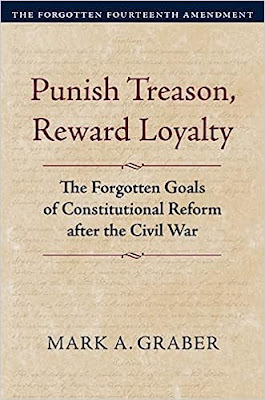
Mark A. Graber, Punish Treason, Reward Loyalty: The Forgotten Goals of Constitutional Reform after the Civil War (University of Kansas Press, 2023)
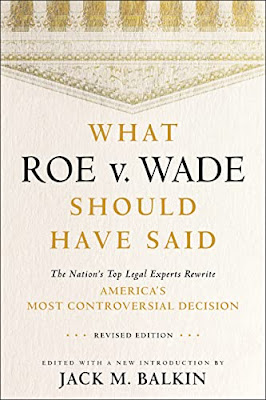
Jack M. Balkin, What Roe v. Wade Should Have Said: The Nation's Top Legal Experts Rewrite America's Most Controversial Decision - Revised Edition (NYU Press, 2023)

Andrew Koppelman, Burning Down the House: How Libertarian Philosophy Was Corrupted by Delusion and Greed (St. Martin’s Press, 2022)

Gerard N. Magliocca, Washington's Heir: The Life of Justice Bushrod Washington (Oxford University Press, 2022)
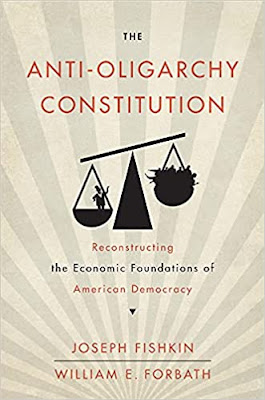
Joseph Fishkin and William E. Forbath, The Anti-Oligarchy Constitution: Reconstructing the Economic Foundations of American Democracy (Harvard University Press, 2022)
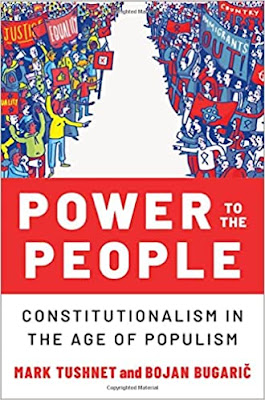
Mark Tushnet and Bojan Bugaric, Power to the People: Constitutionalism in the Age of Populism (Oxford University Press 2021).

Mark Philip Bradley and Mary L. Dudziak, eds., Making the Forever War: Marilyn B. Young on the Culture and Politics of American Militarism Culture and Politics in the Cold War and Beyond (University of Massachusetts Press, 2021).

Jack M. Balkin, What Obergefell v. Hodges Should Have Said: The Nation's Top Legal Experts Rewrite America's Same-Sex Marriage Decision (Yale University Press, 2020)

Frank Pasquale, New Laws of Robotics: Defending Human Expertise in the Age of AI (Belknap Press, 2020)

Jack M. Balkin, The Cycles of Constitutional Time (Oxford University Press, 2020)

Mark Tushnet, Taking Back the Constitution: Activist Judges and the Next Age of American Law (Yale University Press 2020).

Andrew Koppelman, Gay Rights vs. Religious Liberty?: The Unnecessary Conflict (Oxford University Press, 2020)

Ezekiel J Emanuel and Abbe R. Gluck, The Trillion Dollar Revolution: How the Affordable Care Act Transformed Politics, Law, and Health Care in America (PublicAffairs, 2020)

Linda C. McClain, Who's the Bigot?: Learning from Conflicts over Marriage and Civil Rights Law (Oxford University Press, 2020)
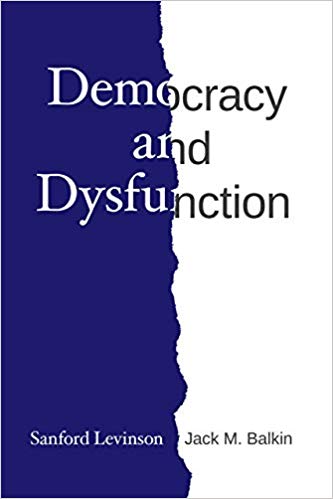
Sanford Levinson and Jack M. Balkin, Democracy and Dysfunction (University of Chicago Press, 2019)

Sanford Levinson, Written in Stone: Public Monuments in Changing Societies (Duke University Press 2018)

Mark A. Graber, Sanford Levinson, and Mark Tushnet, eds., Constitutional Democracy in Crisis? (Oxford University Press 2018)

Gerard Magliocca, The Heart of the Constitution: How the Bill of Rights became the Bill of Rights (Oxford University Press, 2018)

Cynthia Levinson and Sanford Levinson, Fault Lines in the Constitution: The Framers, Their Fights, and the Flaws that Affect Us Today (Peachtree Publishers, 2017)

Brian Z. Tamanaha, A Realistic Theory of Law (Cambridge University Press 2017)

Sanford Levinson, Nullification and Secession in Modern Constitutional Thought (University Press of Kansas 2016)

Sanford Levinson, An Argument Open to All: Reading The Federalist in the 21st Century (Yale University Press 2015)

Stephen M. Griffin, Broken Trust: Dysfunctional Government and Constitutional Reform (University Press of Kansas, 2015)

Frank Pasquale, The Black Box Society: The Secret Algorithms That Control Money and Information (Harvard University Press, 2015)

Bruce Ackerman, We the People, Volume 3: The Civil Rights Revolution (Harvard University Press, 2014)
Balkinization Symposium on We the People, Volume 3: The Civil Rights Revolution

Joseph Fishkin, Bottlenecks: A New Theory of Equal Opportunity (Oxford University Press, 2014)

Mark A. Graber, A New Introduction to American Constitutionalism (Oxford University Press, 2013)

John Mikhail, Elements of Moral Cognition: Rawls' Linguistic Analogy and the Cognitive Science of Moral and Legal Judgment (Cambridge University Press, 2013)

Gerard N. Magliocca, American Founding Son: John Bingham and the Invention of the Fourteenth Amendment (New York University Press, 2013)

Stephen M. Griffin, Long Wars and the Constitution (Harvard University Press, 2013)

Andrew Koppelman, The Tough Luck Constitution and the Assault on Health Care Reform (Oxford University Press, 2013)

James E. Fleming and Linda C. McClain, Ordered Liberty: Rights, Responsibilities, and Virtues (Harvard University Press, 2013)
Balkinization Symposium on Ordered Liberty: Rights, Responsibilities, and Virtues

Andrew Koppelman, Defending American Religious Neutrality (Harvard University Press, 2013)

Brian Z. Tamanaha, Failing Law Schools (University of Chicago Press, 2012)

Sanford Levinson, Framed: America's 51 Constitutions and the Crisis of Governance (Oxford University Press, 2012)

Linda C. McClain and Joanna L. Grossman, Gender Equality: Dimensions of Women's Equal Citizenship (Cambridge University Press, 2012)

Mary Dudziak, War Time: An Idea, Its History, Its Consequences (Oxford University Press, 2012)

Jack M. Balkin, Living Originalism (Harvard University Press, 2011)

Jason Mazzone, Copyfraud and Other Abuses of Intellectual Property Law (Stanford University Press, 2011)

Richard W. Garnett and Andrew Koppelman, First Amendment Stories, (Foundation Press 2011)

Jack M. Balkin, Constitutional Redemption: Political Faith in an Unjust World (Harvard University Press, 2011)

Gerard Magliocca, The Tragedy of William Jennings Bryan: Constitutional Law and the Politics of Backlash (Yale University Press, 2011)

Bernard Harcourt, The Illusion of Free Markets: Punishment and the Myth of Natural Order (Harvard University Press, 2010)

Bruce Ackerman, The Decline and Fall of the American Republic (Harvard University Press, 2010)
Balkinization Symposium on The Decline and Fall of the American Republic

Ian Ayres. Carrots and Sticks: Unlock the Power of Incentives to Get Things Done (Bantam Books, 2010)

Mark Tushnet, Why the Constitution Matters (Yale University Press 2010)

Ian Ayres and Barry Nalebuff: Lifecycle Investing: A New, Safe, and Audacious Way to Improve the Performance of Your Retirement Portfolio (Basic Books, 2010)
.jpg)
Jack M. Balkin, The Laws of Change: I Ching and the Philosophy of Life (2d Edition, Sybil Creek Press 2009)

Brian Z. Tamanaha, Beyond the Formalist-Realist Divide: The Role of Politics in Judging (Princeton University Press 2009)
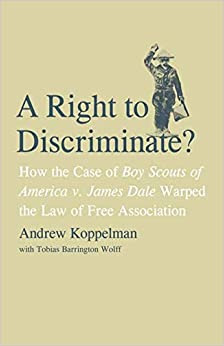
Andrew Koppelman and Tobias Barrington Wolff, A Right to Discriminate?: How the Case of Boy Scouts of America v. James Dale Warped the Law of Free Association (Yale University Press 2009)

Jack M. Balkin and Reva B. Siegel, The Constitution in 2020 (Oxford University Press 2009)

Heather K. Gerken, The Democracy Index: Why Our Election System Is Failing and How to Fix It (Princeton University Press 2009)

Mary Dudziak, Exporting American Dreams: Thurgood Marshall's African Journey (Oxford University Press 2008)

David Luban, Legal Ethics and Human Dignity (Cambridge Univ. Press 2007)

Ian Ayres, Super Crunchers: Why Thinking-By-Numbers is the New Way to be Smart (Bantam 2007)

Jack M. Balkin, James Grimmelmann, Eddan Katz, Nimrod Kozlovski, Shlomit Wagman and Tal Zarsky, eds., Cybercrime: Digital Cops in a Networked Environment (N.Y.U. Press 2007)

Jack M. Balkin and Beth Simone Noveck, The State of Play: Law, Games, and Virtual Worlds (N.Y.U. Press 2006)

Andrew Koppelman, Same Sex, Different States: When Same-Sex Marriages Cross State Lines (Yale University Press 2006)

Brian Tamanaha, Law as a Means to an End (Cambridge University Press 2006)

Sanford Levinson, Our Undemocratic Constitution (Oxford University Press 2006)

Mark Graber, Dred Scott and the Problem of Constitutional Evil (Cambridge University Press 2006)

Jack M. Balkin, ed., What Roe v. Wade Should Have Said (N.Y.U. Press 2005)

Sanford Levinson, ed., Torture: A Collection (Oxford University Press 2004)
Balkin.com homepage
Bibliography
Conlaw.net
Cultural Software
Writings
Opeds
The Information Society Project
BrownvBoard.com
Useful Links
Syllabi and Exams
