Balkinization
an unanticipated consequence of
Jack M. Balkin
Balkinization Symposiums: A Continuing List
E-mail:
Jack Balkin:
jackbalkin at yahoo.com
Bruce Ackerman
bruce.ackerman at yale.edu
Ian Ayres
ian.ayres at yale.edu
Corey Brettschneider
corey_brettschneider at brown.edu
Mary Dudziak
mary.l.dudziak at emory.edu
Joey Fishkin
joey.fishkin at gmail.com
Heather Gerken heather.gerken at yale.edu
Abbe Gluck abbe.gluck at yale.edu
Mark Graber
mgraber at law.umaryland.edu
Stephen Griffin
sgriffin at tulane.edu
Jonathan Hafetz
jonathan.hafetz at shu.edu
Jeremy Kessler
jkessler at law.columbia.edu
Andrew Koppelman
akoppelman at law.northwestern.edu
Marty Lederman
msl46 at law.georgetown.edu
Sanford Levinson
slevinson at law.utexas.edu
David Luban
david.luban at gmail.com
Gerard Magliocca
gmaglioc at iupui.edu
Jason Mazzone
mazzonej at illinois.edu
Linda McClain
lmcclain at bu.edu
John Mikhail
mikhail at law.georgetown.edu
Frank Pasquale
pasquale.frank at gmail.com
Nate Persily
npersily at gmail.com
Michael Stokes Paulsen
michaelstokespaulsen at gmail.com
Deborah Pearlstein
dpearlst at yu.edu
Rick Pildes
rick.pildes at nyu.edu
David Pozen
dpozen at law.columbia.edu
Richard Primus
raprimus at umich.edu
K. Sabeel Rahmansabeel.rahman at brooklaw.edu
Alice Ristroph
alice.ristroph at shu.edu
Neil Siegel
siegel at law.duke.edu
David Super
david.super at law.georgetown.edu
Brian Tamanaha
btamanaha at wulaw.wustl.edu
Nelson Tebbe
nelson.tebbe at brooklaw.edu
Mark Tushnet
mtushnet at law.harvard.edu
Adam Winkler
winkler at ucla.edu
Compendium of posts on Hobby Lobby and related cases
The Anti-Torture Memos: Balkinization Posts on Torture, Interrogation, Detention, War Powers, and OLC
The Anti-Torture Memos (arranged by topic)
Recent Posts
![[Powered by Blogger]](https://lh3.googleusercontent.com/blogger_img_proxy/AEn0k_vIG07BsYirBitI4YWyT-qyXp_-gRjrZF44ZCWUVo4vfYaHiKuFybVlhQPZ593CtWJiIl_P-CxmgbvTCTkmNcyvMOaGf9oNMIJDkmoUq8iR=s0-d)
Just A Few Blogs
ACS Blog
Alas, a Blog
Althouse
Arts and Letters Daily
Atrios (Eschaton)
Bill of Health
Buzzflash.com
Buzz Machine
Cato at Liberty
Juan Cole (Informed Comment)
Concurring Opinions
The Constitution in 2020
Corrente
Crooked Timber
Daily Howler
Daily Kos
Dana Boyd
Brad DeLong
Digby (Hullabaloo)
Discriminations
Daniel Drezner
Kevin Drum (Mother Jones)
Electrolite
En Banc
Eunomia (Daniel Larison)
Fafblog
Michael Froomkin (Discourse.net)
GovLab (Beth Noveck)
Rick Hasen (Election Law)
History News Network
How Appealing
Ignatz (Sam Heldman)
The Importance of (Ernie Miller)
Infolaw
Instapundit
International Economic Law and Policy Blog
IntLawGrrls
Jacob Levy
Jesus' General
Jurisdynamics
The Kitchen Cabinet
Mark Kleiman
Law Blog Central
Larry Lessig
Lawyers, Guns and Money
Liberal Oasis
Brian Leiter's Law School Reports
The Leiter Reports
Marginal Revolution
Megan McArdle
Memeorandum
Metafilter
Mirror of Justice
The New Republic
Newseum
No More Mister Nice Blog
Brendan Nyhan
Opinio Juris
Orcinus
The Originalism Blog
Pandagon
Passport (Foreign Policy)
Overcoming Bias
Political Animal (Washington Monthly)
Political Theory Daily Review
Political Wire (Taegan Goddard)
The Poor Man
Virginia Postrel
Prawfsblawg
Public Reason
Jonathan Rauch
Raw Story
Redstate
ReligiousLeftLaw.com
Reporters Committee For Freedom of the Press
Reproductive Rights Blog
Rothman's Roadmap to the Right of Publicity
SCOTUS Blog
Seeing the Forest
Clay Shirky
The Shifted Librarian
The Situationist
Larry Solum (Legal Theory)
Andrew Sullivan
Talking Points Memo
Talk Left
Tapped
Tbogg
TechPresident
The Paper Chase (Jurist)
Tom Paine
Tom Tomorrow (This Modern World)
Eve Tushnet
Uggabugga
University of Chicago Law School Faculty Blog
Unqualified Offerings
The Volokh Conspiracy
War and Piece (Laura Rozen)
Wampum
Oliver Willis
Wonkette
Written Description
Matthew Yglesias
Yin
Your Choice of Feeds
1. XML
powered by

2. Atom Feed
3. RSS 2.0
JB
Niccolo's Advice for the Mayberry Machiavellis
Since the term "Mayberry Machiavelli" has been bandied about so much in recent times to describe President Bush and his administration, I thought it might be useful to go back to the source to see how well the President has been following Niccolo's advice. The answer is, quite well in some respects. However, as I shall also suggest at the end of this post, Machiavelli also shows how George W. Bush is vulnerable:
Here is what Machiavelli has to say about leadership in the eighteenth chapter of The Prince:
But it is necessary to know well how to disguise this characteristic, and to be a great pretender and dissembler; and men are so simple, and so subject to present necessities, that he who seeks to deceive will always find someone who will allow himself to be deceived. One recent example I cannot pass over in silence. Alexander VI did nothing else but deceive men, nor ever thought of doing otherwise, and he always found victims; for there never was a man who had greater power in asserting, or who with greater oaths would affirm a thing, yet would observe it less; nevertheless his deceits always succeeded according to his wishes, because he well understood this side of mankind.
Therefore it is unnecessary for a prince to have all the good qualities I have enumerated, but it is very necessary to appear to have them. And I shall dare to say this also, that to have them and always to observe them is injurious, and that to appear to have them is useful; to appear merciful, faithful, humane, religious, upright, and to be so, but with a mind so framed that should you require not to be so, you may be able and know how to change to the opposite. . . .
For this reason a prince ought to take care that he never lets anything slip from his lips that is not replete with the above-named five qualities, that he may appear to him who sees and hears him altogether merciful, faithful, humane, upright, and religious. There is nothing more necessary to appear to have than this last quality, inasmuch as men judge generally more by the eye than by the hand, because it belongs to everybody to see you, to few to come in touch with you. Every one sees what you appear to be, few really know what you are, and those few dare not oppose themselves to the opinion of the many, who have the majesty of the state to defend them; and in the actions of all men, and especially of princes, which it is not prudent to challenge, one judges by the result. All of this sounds quite familiar: The judicious manipulation of religious language in Bush's speeches, the secrecy, the refusal publicly to admit mistakes, the blatant dissembling, the flagrant hypocrisy exercised before a fawning coterie of admirers.
But Machiavelli is far more important for other reasons. He has a great deal to tell us about how leaders succeed and how they ultimately fail. This from the twenty-fifth chapter of The Prince:
But a man is not often found sufficiently circumspect to know how to accommodate himself to the change, both because he cannot deviate from what nature inclines him to, and also because, having always prospered by acting in one way, he cannot be persuaded that it is well to leave it; and, therefore, the cautious man, when it is time to turn adventurous, does not know how to do it, hence he is ruined; but had he changed his conduct with the times fortune would not have changed.
Pope Julius II went to work impetuously in all his affairs, and found the times and circumstances conform so well to that line of action that he always met with success. . . . [T]he shortness of his life did not let him experience the contrary; but if circumstances had arisen which required him to go cautiously, his ruin would have followed, because he would never have deviated from those ways to which nature inclined him.
I conclude therefore that, fortune being changeful and mankind steadfast in their ways, so long as the two are in agreement men are successful, but unsuccessful when they fall out. For my part I consider that it is better to be adventurous than cautious, because fortune is a woman, and if you wish to keep her under it is necessary to beat and ill-use her; and it is seen that she allows herself to be mastered by the adventurous rather than by those who go to work more coldly. She is, therefore, always, woman-like, a lover of young men, because they are less cautious, more violent, and with more audacity command her. These final passages sum up Machiavelli's most important views on the world of politics: Politicians follow the stratagems and approaches that stem naturally from their character; they succeed if their tendencies are in tune with the tendencies of the time. But no one succeeds forever, because people are insufficiently flexible to go against their natural tendencies. Given this fact, fortune favors the bold and impetuous, because by taking the offensive they have a greater chance of reshaping the situation to their advantage; acting agressively and forcefully requires others to respond to them and play their game. But even the bold and impetuous fail when the times call for caution and circumspection.
Looking over the three years of the Bush Administration so far, it seems clear (to me at any rate) that Bush has followed Machiavelli's advice admirably. He has shown himself by nature bold and reckless; by acting decisively, and refusing to compromise, he has forced first Congress, and later the world to dance to his tune. His domestic policies show little concern for what tomorrow may bring; and his bold maneuver into Iraq was made heedless of the consequences of a long occupation. In conformity with Machiavelli's remarks on fortune, Bush has acted "less cautious, more violent, and with more audacity;" he has treated fortune like a woman. And he has brazenly dissembled whenever dissembling was required to promote his aims. This is the source of his considerable success.
But Machiavelli warns that this course of action pursued consistently will eventually run into trouble. At some point conditions change; audacity fails to work as it did before; the piper must be paid. The President seems willing to bluff through his current difficulties, attempting to defer every looming problem and inconvenient fact until after the 2004 elections. The great question of the present moment is whether the strategy of the first three years will continue to be the right strategy for the next nine months, or whether the President, given his natural tendencies toward recklessness and gambling, will have played his hand too boldly too often. Only time will tell. But it is worth noting, with a certain degree of Machiavellian admiration, an Administration that, for a time, kept the country in sycophantic submission through bold moves and brazen deceit. Bush arrived at a point in American history when bullying and thuggishness were rewarded, when both his opponents and the press proved cowardly, corrupt, feckless and effete. He took advantage of those facts, and thus took advantage of us. We must marvel not only at his facility in gaining and holding power, but at the features of American politics that allowed such a man to seize the moment and misuse the country so badly in three short years while a servile press and the public fell fawning at his feet, his political opponents, corrupt and cowardly, ran for cover, and no one raised a finger to stop him.
Everyone admits how praiseworthy it is in a prince to keep faith, and to live with integrity and not with craft. Nevertheless our experience has been that those princes who have done great things have held good faith of little account, and have known how to circumvent the intellect of men by craft, and in the end have overcome those who have relied on their word. . . .
[T]he prince who relies entirely upon fortune is lost when it changes. . . .[H]e will be successful who directs his actions according to the spirit of the times, and . . . he whose actions do not accord with the times will not be successful. . . .
Posted
9:26 AM
by JB [link]
(1) comments
JB
Internet Porn's Solution to Digital Piracy
The New York Times reports that the porn industry is taking a very different approach to digital piracy than the Motion Picture Association of America and the RIAA. They are focusing primarily on people who attempt to resell pirated pornography for profit. Instead of suing individual not-for-profit infringers, a few porn providers are giving people the option to join their pay sites.
These strategies suggest the two major ways that mainstream industries should deal with digital piracy. The first is to give up on tracking down individual not for profit users and instead focus on commercial pirates. The distinction between commercial and non-commercial piracy makes a great deal of sense in terms of public relations, and, perhaps more controversially, it also is consistent with what I take to be the larger purposes of intellectual property law. (Moreover, although the story does not mention it, it's also possible to raise money in other ways, for example, through a grand bargain in which copyright holders get a share of taxes on CD's or CD burners, which spreads some of the cost, albeit very imperfectly, onto non-commercial infringers.) The second strategy is to try to coax end users into pay sites by offering easier searches, wider selection, and guarantees of reliable products. Because the effective cost of any particular digital item is zero given the existence of P2P, what users are really paying for is not the information itself but convenience, selection, and reliability. (They might also pay for information about digital information, if it helps them make good decisions about what to download). If pay sites can provide these things better than P2P sites, they can make a living.
Posted
7:21 PM
by JB [link]
(1) comments
JB
Rumsfeld Blusters
The New York Times reports his fervent defense of the Iraq War despite the obvious failures of intelligence:
Mr. Rumsfeld's remarks drew several pointed questions from the audience challenging how the administration could defend its doctrine of pre-emptive strikes against perceived threats when the precise intelligence needed for such a strategy apparently failed in the case of Iraq.
"If you're going to live in this world, and it is a dangerous world, you do have to have elegant intelligence," Mr. Rumsfeld acknowledged.
But he repeatedly defended the get-them-before-they-get-us doctrine in an age when terrorists are threatening to acquire and use biological, chemical and nuclear weapons as "something that has to be weighed and considered by all of us" given the possible catastrophic consequences. Rumsfeld's arrogant (and alarming) performance suggests that the Administration is not too worried about false positives, other than as a potential source of (undeserved) bad publicity. But false positives can (1) bankrupt a national treasury, (2) stretch your military resources too thin and make you vulnerable elsewhere, (3) poison your relations with other nations, and (4) inflict needless suffering that you-- and not your enemy-- will get blamed for. If Rumsfeld is aware of these dangers, he does not seem to be willing to admit them in public. And his refusal to do so does the American cause no good:
Asked in a question-and-answer session afterward about apparent American intelligence failures in Iraq, he acknowledged that it was a question of crucial importance that would be examined by the commission appointed Friday by President Bush, but emphasized that the panel would look at intelligence successes as well as shortcomings.
If there were a knock down argument against the preemption doctrine, it would be Donald Rumsfeld. The preemption doctrine is a careful balance of two considerations: the need to prevent serious threats before they occur, and the danger of wasting resources, destroying human lives and damaging international relations if one guesses wrong. That is to say, although the point of the preemption doctrine is to prevent false negatives (times you should have attacked when you didn't) it only becomes a rational strategy if you also worry about false positives (times you were wrong to think there was a looming threat). Bad intelligence can hurt you in *both* directions, and greatly undermines the success of a preemption strategy.
Asked whether America's stature in the world had been diminished since the war, he acknowledged the Iraq war had taken its toll, but contended that it was more because of biased reporting by Arab media like Al Jazeera than anything the United States had done. "I know in my heart and my brain that America ain't what's wrong in the world," he said.
It simply will not do to blame Al Jazeera for mistakes of American intelligence. If we don't learn from the lessons of this intelligence failure, we will be sowing chaos around the world.
Posted
6:54 PM
by JB [link]
(1) comments
JB
Bush to Endorse Federal Marriage Amendment
The New York Times reports that he's almost there. It's just a matter of choosing the most politically propitious time.
In a sense, this was inevitable. Bush has angered the small government crowd by his enormous budget deficits and his attempt to blame (a Republican controlled) Congress for them. He can't afford to anger social and religious conservatives (who overlap with the former group). He also remembers what happened to his father when the party's conservative base deserted him. So he will come out in favor of the FMA. The only questions are when he will do it and whether he will emphasize it strongly in the upcoming campaign.
Bush may also be counting on the fact that most Americans oppose same sex marriage, and almost no Americans do who would otherwise vote for him (except perhaps for Andrew Sullivan). So it looks like an easy decision. On the other hand, as I noted in my previous post on this subject, there are real costs to this strategy. Many Americans don't want to think of themselves as intolerant, and if support for the FMA becomes tangled up in support for the religious right and opposition to gay rights generally, or is seen to be tangled up with those causes, Bush will lose the support of many moderate voters.
Posted
10:35 AM
by JB [link]
(27) comments
JB
Good Ol' Boy Fools Matt Yet Again
The incomparable Matthew Yglesias is, unfortunately, still in the thrall of the "Bush is stupid meme." Would liberals and progressives please stop doing this? This is how you wind up flat on the pavement with your hands pinned behind your back and your pockets picked.
I've said this before and I will say it again: just because someone doesn't care a hoot about public policy debates doesn't mean they lack intelligence. Thinking that way may be comforting to liberals' sense of superiority, but it will cause them to miss out on what Bush is about, which is not good policy but the exercise and maintenance of power. Yeah, maybe George don't know much about history, but he does know how to kick the left's behind and pull the wool over the country's eyes.
So stop telling yourself that this guy is stupid. What liberals should be reminding each other is that Bush is shrewd, crafty, cunning and ruthless.
Like lots of good old boys in the South, George W. Bush wants us, as he himself says, to "misunderestimate" him. And whenever we do that, he takes advantage of us, time and time again. Ann Richards misunderestimated George W. Bush and she got booted out of the Texas governor's mansion. Al Gore misunderestimated Bush and he ended up losing the presidency not once but twice, once in November 2000 and once again in December.
I'm a liberal, and an academic, and I know that both groups tend to look up to expertise. They admire people who know the facts and have a firm grasp of the important issues of the day. But that's not the only kind of smarts in the world. In his own way, Bush is as clever a politician as Bill Clinton was, although his style is different in important respects. What he understands is not policy but power: how to get it, how to keep it, and how to wield it. That's why his White House is secretive and disciplined almost to the point of parody, and that's why he keeps getting his way even though he can't talk about the most basic policy debates without stumbling. He leaves policy to the wonks and intellectuals he despises. He's after bigger game: political control. While you have a good laugh making fun of how he mispronounces words and mangles policy questions, he's going to use every trick in the book to bury you. And believe me, he knows a lot of tricks that you don't. It's time to take this guy seriously. Telling yourself how stupid Bush is may be a good way to make yourself feel better about the fact that you are out of power. But it's not going to help you defeat him in November.
Posted
10:45 PM
by JB [link]
(0) comments
JB
Mass SJC Forces the Issue and Bungles the Job
The Massachusetts Supreme Judicial Court today stated in an advisory opinion that a civil unions bill that gave same sex couples substantially all of the same rights as opposite sex couples did not comply with its previous ruling in Goodridge v. Department of Public Health.
I support the idea of same sex marriage as a matter of legislative policy, but I have a bone to pick with what the SJC did here. Through its two opinions it has sent conflicting signals that may have ultimately damaged the cause of gay rights. Here's why.
After holding that Masschusetts' existing law was unconstitutional for excluding same sex couples, the SJC could simply have awarded marriage licenses to the plaintiffs. Instead it refused to do so, staying its mandate until the middle of May (May 17th, the 50th anniversary of Brown v. Board of Education, by the way) for the Massachusetts Legislature to respond.
This feature of the opinion confused many people. It seemed to signal that the legislature would be free to experiment with different solutions, including possibly a civil unions law like the one passed in neighboring Vermont. The purpose of giving the issue back to the legislature, many people assumed, was to allow the legislature to debate the issue, and reach a political compromise instead of the SJC forcing the issue. The idea would be to make the same-sex marriage bill a product of a democratic process rather than a court mandate. When courts make important and controversial decisions, they are on firmest ground when they act with the blessing of the legislature. What legislatures do often ratifies what courts have done before. For example, the Civil Rights Act of 1964 effectively ratified the Court's 1954 decision in Brown v. Board of Education, making opposition to segregation not only the demand of the Supreme Court but also official U.S. legislative policy. It was the Civil Rights Act of 1964, and not Brown, that did the most to desegregate the South.
The Supreme Judicial Court of Massachusetts might have tried, as the Vermont Court did, to coax the state legislature into ratifying its decision by passing a bill based on the Legislature's own judgment about the best way to enforce the Court's order. But in its latest opinion, the SJC has essentially said that there is only one way to enforce its order. It has given the legislature no discretion at all. It has insisted on what is effectively a rubber stamp, which will achieve no additional democratic legitimacy.
Indeed, having issued its advisory opinion today, it is now clear that there was no particularly good reason for delaying its mandate in the original Goodridge opinion. It might as well have just issued marriage licenses to the plaintiffs in the first place. (To be sure, the Court might have feared that issuing the mandate immediately would be interpreted as striking down the marriage laws in Massachusetts, but that is not the only possible remedy and the Court could have dispelled any confusion on that score). In effect, the SJC has made any attempt at dialogue with the Massachusetts legislature into a sham.
Not surprisingly, many Massachusetts legislators who would have supported a civil unions bill now will vote for a amendment to the Massachsetts state constitution defining marriage as the union of one man and one woman. Such an amendment could not take effect until at least 2006. Nevertheless, the Court has wasted an opportunity to get half a loaf (and possibly a full one) when it may well end up with none in the long run.
The SJC may have been gambling that by forcing the issue, tempers will eventually cool and the residents of Massachusetts will come to accept same sex-marriage. That may turn out to be the case. Or it may not. But the Court shouldn't send out confusing signals in the way it has done. It either should have issued marriage licenses last fall or it should have allowed the Massachusetts legislature to come up with a solution with some democratic legitimacy. It has done neither, and in this respect it has made a grievous political error that may ultimately undermine its authority and lead to the overturning of its Goodridge decision.
It is possible that the Court will not have to pay for its political mistake. The Massachusetts Legislature may pass a same sex marriage act and the proposed amendment may fail. But if the amendment passes, it will be the Supreme Judicial Court's fault for bungling the situation.
A final word about the national implications of this decision. It may look at first as if this decision harms the Democrats, as President Bush will be able to run against what the SJC has done. But in fact it may have the opposite effect. Bush has tried to avoid directly stating that he supports the Federal Marriage Amendment (which I have analyzed in previous posts, here and here). He has inched toward endorsing it without doing so directly because he fears that endorsing it will make him look intolerant to swing voters. But the SJC's decision will result in increased pressure from social conservatives in the party to come out firmly in favor of the FMA. Thus, the SJC may have simultaneously made things difficult for both the Democrat nominee and for President Bush.
Posted
9:17 PM
by JB [link]
(0) comments
JB
AWOL Controversy Heats Up
Although the Bush was AWOL story was circulating in the blogosphere for sometime, it took Terry McAuliffe's statement on Sunday to put it in the mainstream press. Dan Froomkin has the details. There's also this story in today's Washington Post. The folks at factcheck.org conclude that "Bush was honorably discharged without ever being officially accused of desertion or being away without official leave." (emphasis supplied). Of course, not being officially accused of something is not quite the same thing as not having done it. And the real story here is whether the same preferential treatment that got Bush what was then a conveted position in the Texas National Guard (and a position in flight training school after he had received the lowest possible score for admission) also resulted in Alabama National Guard officials conveniently looking the other way when he disappeared for long stretches of time. There is also the fact that he was grounded in August 1972 because he failed to complete an annual medical exam.
If Bush consented to release his military records, as all candidates have done in the past, they would shed some light on these questions, and possibly resolve the controversy once and for all. However, Bush has refused to make his military recorts public, calculating that the controversy ultimately will die down without his having to make any disclosures that might be personally embarassing to him.
Ultimately, I think, this controversy will not by itself prove decisive. It will matter to the extent that it resonates the with public's other doubts about Bush's character, honesty, and his Administration's penchant for secrecy and dissembling. It is much more important that the President is keeping many other things secret and is stonewalling other investigations-- including the work of the 9/11 Commission, whose findings about preparedness might be much more embarassing to his Administration.
Posted
2:14 PM
by JB [link]
(33) comments
JB
Symbolic Savings, Gargantuan Giveaways
This Washington Post story on Bush's proposed budget confirms my suspicions about Bush's political strategy. To please his right wing he is proposing cuts in a whole host of social programs which will actually add up to a comparatively small amount (less than one percent of the predicted budget deficit of 521 billion dollars) while at the same time accelerating military spending (read here defense contracting) and lowering taxes yet again for the wealthy. It's pure symbolic politics that has nothing to do with fiscal discipline. By selectively picking out and gutting programs that his conservative base identifies with a liberal social agenda, President Bush he appears to stand for budgetary restraint and for making tough decisions about government expenditures when in reality he is running enormous deficits and lining the pockets of his wealthiest supporters.
Posted
12:04 AM
by JB [link]
(0) comments
JB
Halliburton's Happy Meals
Harry Truman once equated various forms of war profiteering with treason. As a senator from Missouri he vigorously investigated defense contractors during World War II even while the Democrats were in the White House.
Isn't it time for a Truman Commission to investigate how much money the President's and Vice-President's friends have made off of Iraq? And shouldn't the President be the first person to call for such an investigation? Do you think there's any chance that he will?
Posted
10:44 AM
by JB [link]
(28) comments
JB
Shameless
Reuters reports:
Bush has seen a dramatic deterioration in the nation's budget picture since a record surplus was reported in 2000. He hopes to improve his fiscal image before the November presidential election by promising to reduce the deficit by one-third by 2005 and by more than half within five years.
But fiscal conservatives in both parties have doubts Bush can deliver. He will leave out of his fiscal 2005 budget the tens of billions of dollars that will almost certainly be needed next year to keep U.S. troops in Iraq (news - web sites), as well as a costly tax system overhaul that Republicans and Democrats say will soon become politically imperative to keep taxes from rising on the nation's middle class.
In line with Bush's election-year priorities, homeland security and the military will be the budget's biggest winners. Defense contractors including Lockheed Martin Corp., Boeing Co., Northrop Grumman Corp., Raytheon Co. and General Dynamics Corp. stand to benefit as Bush's $401.7 billion military budget sharply increases spending on missile defense and on modernizing the Army.
The biggest losers will be environmental, agricultural and energy programs. Facing the prospects of a revolt by fiscal conservatives, Bush will call for limiting growth in discretionary spending -- outside of homeland security and defense -- to just 0.5 percent. Because that is well below the rate of inflation, it will amount to a cut in domestic programs.
In a tacit acknowledgment that deficits are here to stay, Bush will set the goal of bringing this year's record $521 billion shortfall down to $364 billion in fiscal 2005 and eventually to $237 billion in fiscal 2009. There is no talk of returning to surpluses in the foreseeable future. Oh, and by the way, while he's running up those huge deficits, he also wants to wants to make the tax cuts that caused the problem permanent.
Boxed in by a record $521 billion deficit, President Bush (news - web sites) will propose a $2.4 trillion election- year budget on Monday that will cut dozens of government programs and set deficit-reduction goals that even fellow Republicans are skeptical he can meet.
Posted
10:35 AM
by JB [link]
(0) comments
JB
Oh My Freaking Goodness!
The Chairman of the Democratic Party is actually attacking President Bush on his military record, the New York Times reports. Instead of cowering in the corner when the media said that the charge of desertion was false, Terry McAuliffe is raising the more plausible question whether the President was AWOL while in Alabama. Nevertheless, it is particularly strange to me that McAuliffe chose to break this story on Super Bowl Sunday, which is not a good time to cover a political event.
The Times reports that Terry McAuliffe's statement "came two days after a scathing attack on President Bush's war record, delivered by Senator Max Cleland of Georgia on behalf of Mr. Kerry." Cleland said "Mr. Kerry was "a real deal" and President Bush was "a raw deal." He added, "We need somebody who felt the sting of battle — not someone who didn't even complete his tour stateside in the Guard.""
What is remarkable is that the Dems are making such a gamble now when the issue was first raised in June of 2000. By having the Chairman of the Democratic Party take up this line, they are making it impossible for the media not to pay attention to it. Of course, it may seriously backfire, if it turns out that Bush's unexplained absences were accounted for. But even if Bush made up the lost time later, (as the New York Times suggested in November 2000, see my previous post here) the real issue will be (1) whether he used his family connections to get special treatment that allowed him to make up the lost time that would not have been extended to the average Joe, and (2) whether there is a reason why he would not submit to a physical examination for a substantial period of time during his National Guard service. (In fact, Joe Conason reports that Bush was eventually grounded because he wouldn't submit to a physical examination.). The key issues, therefore, are not whether Bush met the technical definition of AWOL (for he might have made up the lost days later on) but the use of family connections to get special treatment and the refusal to take a physical exam. It will be interesting to see whether the media picks up on these features of the controversy or buries them.
I had long expected that this was going to be the dirtiest presidential campaign since 1988, when Lee Atwater pounded Michael Dukakis into the ground. I had no idea that the Dems would be giving back as good as they get.
Posted
4:47 PM
by JB [link]
(28) comments
JB
Will Dubya Dump Dick?
The Asia Times wants to know, (link via MaxSpeak) and gives reasons why Cheney is in more trouble than most people think.
Dumping Cheney, however, would probably cause more problems for Bush than keeping him, unless Cheney falls victim to a significant scandal, involving, for example, his former company Halliburton, from which he still receives deferred income.
But Bush is a gambler, and he might try a bold move to split the Democratic coalition in half. The boldest of the bold choices? None other than Condi Rice, the National Security Advisor, who would be the first African-American (and only the second woman) on a national ticket. Take that, Democrats!
Posted
2:23 PM
by JB [link]
(34) comments
JB
Free Lunch Conservatism
I agree with Nick Confessore's observation (also made here) that President Bush's spending policies make perfect sense if you stop thinking of him as a fiscal conservative. Rather, he is a social and religious conservative who also happens to be a very canny politician and who believes in doing whatever is necessary to stay in power. Bush has hit on the perfect formula for doing this: free lunch conservatism:
Sometimes this has involved traditionally conservative mechanisms, such as cutting taxes or reducing regulation. Sometimes it's involved traditionally liberal methods, such as new government spending. There has been no consistent principle involved, except the determination to stay in power. Nor has there been much attention to the long-term effects of the inherent contradictions in such a policy. So the administration passed a Medicare "reform" that buys off seniors with a drug benefit and hands billions of dollars in subsidies and government spending to HMOs, drug companies, and doctors -- all while specifically prohibiting cost-saving measures like using federal bargaining power to reduce the price of pharmaceuticals. The result is -- all at once -- generous corporate pork; a massive entitlement program; and deregulation. It's a combination that boosts the GOP's ability to stay in power in Washington. But the resulting cost -- ballooning health care costs that in turn will further balloon the deficit -- gets kicked down the road. If a Democrat president is elected to clean up the mess, that's about all he'll be able to accomplish before the next Republican is elected. But wait, you might object, how can this be good politics? The election of 2004 may turn out to be very close if the economy doesn't recover soon. The key point, as articulated by political scientist William Riker (no, not the Star Trek first officer) many years ago, is that the most efficient way to stay in power is to form a coalition of approximately 51 percent, not 90 percent. The reason is that if you plan to stay in power by distributing money from your enemies to your allies, you want to give your allies as much as you can to keep them on your side. The spoils of power must be spread more thinly the larger your coalition gets, but you can lay it on thicker if your coalition is smaller. The sweet spot is a coalition of exactly 51 percent. Conversely, the smaller your opposition, the less resources they have to bleed that you can distribute to your allies; so you don't want them too small. The magic number for your opponents, it turns out is 49 percent.
Does this sound familiar? A recent New York Times op-ed by former Al Gore speech writer Daniel Pink showed that the majority of Bush Red states were net recipients of federal largesse, while the majority of Gore Blue states were net givers. Bush has formed a coalition of states that mostly suckle at the national teat, paid for disproportionately by his political adversaries, states that vote Democratic.
I know that many liberals and progressives like to comfort themselves with the notion that President Bush is not very intelligent. This continues to be the most dangerous myth about the man. He is, in fact, quite shrewd and cunning. He's just not interested in public policy debates. (Remember, there's more than one way to possess intelligence.) The term "Mayberry Machiavelli" is entirely apt, although I suspect that for many lefties the use of the term "Mayberry" suggests that he is a dumbed down version who isn't quite as smart as he thinks he is. This is, I repeat, a dangerous delusion. George W. Bush is a political animal par excellence. Liberals and progressives argue that he can't be very smart because his policies are so stupid. But what they don't understand is that Bush is not particularly interested in good policy in their sense of the word; good policy is always secondary to staying in power. The policies he has adopted make sense if you start with the assumption that he wants to cement a durable 51 percent majority coalition using federal pork and redistributive programs as a central ingredient.
Recently David Bernstein of the Volokh Conspiracy wondered aloud why liberals don't like George W. Bush more since it seems clear that he likes to spend lots of government money, particularly on programs like education and drug benefits that liberals should like. The answer by now should be clear: George W. Bush doesn't like to spend government money in ways that liberals think are wise and good for the country's long term interests. (For example, liberal Dems tend to think that No Child Left Behind is underfunded and uses the wrong incentives, while the recent Medicare bill has too much privitization and will shift too much money to drug and insurance companies) Rather, Bush likes to spend lots of money (and redistribute lots of money from liberal states) in ways that satisfy core Republican constituencies and help keep him and the Republican party in power.
From the standpoint of pure power politics, the objection to Bush's strategy is whether he can keep it going long enough to get reelected and, if reelected, whether the Republicans will be punished in the 2008 and 2012 elections when the bill starts to come due. Most liberals who fulminate about these unwise policies believe that eventually the Republicans will be punished. But I am not so sure. Bush may be counting on the fact that no one will remember that the fiscal crisis of 2008 or 2012 is largely his fault, just as Reagan does not get enough blame for his huge deficits and deregulatory policies that helped foster the huge S&L scandal later on. Moreover, Bush may be counting on the fact that even if the Democrats are returned to office for a short time, they will find themselves largely devoted to acting like adults and cleaning up the mess Bush has created. The fiscal discipline required will not be popular, and thus it will not help them form a majority coalition through spending in the way that Bush has done. Thus, Bush may believe that he and his party will escape most of the blame for any fiscal problems his policies create down the road because (1) the public's memory is short, (2) the Democrats will be prohibited from making any new spending initiatives that would gain them a new majority coalition because of the huge deficits Bush has created, and (3) the image of the Republicans as the party of fiscal discipline will remain firmly ingrained in the public's imagination.
Many liberals have believed that Bush's deficits are designed to "starve the beast," i.e., to prevent the Democrats from spending money on egalitarian social and economic programs. What they have not sufficiently considered is that the "starve the beast" approach has another goal besides the promotion of an anti-New Deal/Great Society ideology. It seeks to keep the opposition from using the public purse in the future to create their own 51 percent coalition in the same way that Bush is now soaking (mostly) Blue states to pay (mostly) Red states. If you stop thinking about what Bush is doing in terms of ideology and start thinking about his actions in terms of pure power and how to maintain it, he doesn't seem so stupid after all. The Democrats fail to understand this at their peril.
The key concept is not that Bush is a traditional small-government conservative -- which would involve difficult and politically costly policy trade-offs -- but that he and his party have consistently and unabashedly used the mechanisms of government to reward and enrich key allies, mainly business interests, wealthy individuals, and -- to a lesser extent -- religious conservatives.
Put in these terms, most of Bush's fiscal decisions during his Presidency make perfect sense. They may not be good policy, but they are good politics, especially if the goal is to win a second term, and your governing motto is apres moi, le deluge.
Posted
10:31 AM
by JB [link]
(3) comments
JB
You say Missouree, and I say Missourah
Jacob Levy has a fun post on the question of how to pronounce "Missouri." Is it Missouree or Missourah?
I grew up in Kansas City, Missouri, and everyone I knew always pronounced it Missouree. Only people from Cape Girardeau in the southeast pronounced it Missourah. (Other people, by the way, swear that only people in the southwest say Missourah).
There was, however, one major exception to this rule:
During campaign season, when politicians wanted to engage in a little faux populism, they would sometimes affect a bit more of a drawl and say Missourah.
This was their way of showing that they were in touch with the people. But I have to confess that whenever I heard a politician do that, I always wished that they would just support policies that were good for the average citizen and pronounce the name of the State any way they wanted.
Posted
11:12 AM
by JB [link]
(1) comments
JB
Bill O'Reilly Avoids Apology But Blasts "Right-Wing Spin"
On March 18, 2003, on Good Morning America, Fox News political commentator Bill O'Reilly made the following promise:
He made a similar claim in this interview with Condoleeza Rice:
Now that David Kay has confirmed that Saddam destroyed his WMD's long before the invasion, O'Reilly has not apologized or confessed that he no longer trusts the Bush Administration. Rather, he has argued that the Bush Administration was hoodwinked by the CIA's lax intelligence gathering into believing that the WMD's were real and therefore the President should investigate the reason why this occured. Because of the intelligence failure, Bush cannot be said to have lied to the American public.
Unfortunately, O'Reilly's argument overlooks the fact that the Administration cherrypicked CIA reports to hear what they wanted to hear, and conveyed this information to the American public, and in some cases relied on questionable or completely bogus information that they knew was unreliable in order to justify repeated statements to the American people that Saddam was creating WMD's-- including nuclear weapons. So O'Reilly's portrait of the Bush Administration as having been completely hoodwinked by the CIA and having made all of these representations to the country through no fault of their own is simply not plausible.
O'Reilly should apologize as he promised. He should criticize the President for hyping the intelligence sources and relying on information he should have known was unreliable. Even if Bush did not lie, he seriously misled the public. O'Reilly needs to confront that fact.
Nevertheless, O'Reilly does come out strongly in favor of having the President publicly admit that there was a mistake and publicly investigate the causes of the intelligence failure, something which the Bush Administration has so far been unwilling to do. Indeed, Administration officials have tried to bluff their way through the problem. Dick Cheney has brazenly insisted that the WMD's are there after all, while the President has been reduced to talking about the existence of "weapons of mass destruction related program activities." (Does the President really think he's fooling anyone when he talks like that?)
And in the following interview with Clifford May, president of the Foundation for the Defense of Democracies, O'Reilly bluntly tells conservative defenders of the President to stop making excuses and that there must be some public accountability in light of the Kay report:
MAY: I think we need to totally refurbish the CIA. The question is whether George Tenet, who served Clinton, served Bush, is the best man to do it. And if somebody thinks not in the Democratic party, they should say what they're going to do the about it.
O'REILLY: Well, what about Bush, though? Why isn't he doing it now? He knows the 9- 11 situation better than anyone on the planet. . . .
. . . And he knows this is a screw-up.
MAY: His marching orders to George Tenet ought to be, we need to do - - overhaul the CIA so they can do the kind of intelligence gathering we need. . . . the most important thing to understand, it seems to me is this. Saddam Hussein was himself a weapon of mass destruction.
O'REILLY: No, that's baloney. That is right-wing spin. And a guy as smart as you, I don't want to hear you say that.
MAY: No, no, no, no.
O'REILLY: I don't want to hear you say that right-wing talking point business. Look, let's get back to the issue here.
. . . The Americans can decide for themselves whether that policy was good for America or not. But we got hurt overseas. We still hurt overseas. This Colin Powell went to the U.N., put this big WMD scenario in play. And it turned out not to be true. Our image overseas is hurt. OK?
O'REILLY: But here's the fundamental constitutional question. All right? You have an administration, which is closed. The Bush administration is not open with the folks. Everybody knows that. All right? Now you have, and I believe this report, and I've got to say, I will say this in President Bush's defense, President Bush could have booted this. He could have said to Kay, hey, find something and this and that. He wanted the truth. He told Kay, even if it's black and bad and going to hurt me, you get it. I think we all -- that reflects very, very well on the president, but he's got to now step up. And he's got to admit the mistake. And he's got to take strong action to protect us, Mr. May.
I still think O'Reilly should apologize. But I think that he is starting to get it. The problem is that this President does not like to be open or honest with the American people on any number of issues, including Iraq. And his Administration never likes to admit that it has ever made a mistake: The Washington Post reports that at a recent "private meeting between Bush and congressional leaders," Bush and Tom Daschle had what sources described as a "testy exchange" when Daschle dared to suggest that "it is important to determine what went wrong to produce the flawed prewar weapons charges." Acting like a petulant child when someone shows real flaws in your decisionmaking process is not leadership.
"Here's, here's the bottom line on this for every American and everybody in the world, nobody knows for sure, all right? We don't know what he has. We think he has 8,500 liters of anthrax. But let's see. But there's a doubt on both sides. And I said on my program, if, if the Americans go in and overthrow Saddam Hussein and it's clean, he has nothing, I will apologize to the nation, and I will not trust the Bush Administration again, all right? But I'm giving my government the benefit of the doubt."
Last March, I stuck up for you guys. After Colin Powell (search) went to the United Nations -- and I said on "Good Morning America" that I believed that we were right to go to war, the United States, based upon weapons of mass destruction and the danger that Saddam posed. And I also said to "Good Morning America" if the weapons found to be bogus, I'd have to apologize for my stance.
O'REILLY: [H]ere is the problem. We live in a republic where the people are supposed to decide crucial issues, all right? And the people can't decide the issue if they're given erroneous information. And the Bush administration gave us erroneous information, not because they lied, but because they got erroneous information from the Central Intelligence Agency. And I believe President Bush hasn't been nearly aggressive enough in holding those people in the agency accountable.
. . . .
. . .
O'REILLY: That's right. But we also need openness on the part of the president. And he can't be sitting up in the White House not saying anything about it.
Posted
11:41 PM
by JB [link]
(0) comments
JB
The Price of Loyalty, or, Why Iraq is Such a Mess
An article in today's Washington Post and a longer story in the Atlantic Monthly explain why (links via Atrios): The Bush Administration refused to listen to contingency planners, shut out or stepped on people who told them unpleasant truths, and promoted people who told them what they wanted to hear.
Posted
3:00 PM
by JB [link]
(2) comments
JB
Has the Media gone AWOL?
Earlier I noted that Bush's 1970's service record is less important than what he is doing today, for example, in stonewalling and hampering the 9/11 Commission's work. Nevertheless, I have to agree that Jonathan Chait is probably right when he says that the media have applied a double standard and given Bush too much slack on the fact that he didn't show up for National Guard service during 1972 and 1973.
Consider this bizarre passage in a recent New York Times article focusing on slip ups by General Wesley Clark:
Mr. Bush's actions did not meet the technical definition of desertion.
"President Bush was not a deserter," said Eugene Fidell, a Washington expert on military law. "To desert in wartime is a serious offense, potentially punishable by death. It requires an intent to remain away permanently." The article is trying to show that Moore's statement was technically inaccurate as a matter of military law and an exaggeration. But in doing so, it certainly makes one think "well, why was his absence unexplained?" So he's not technically a deserter. Well, so what? Being able to say that you were "not technically a deserter" is not exactly a badge of honor. And yet there's no hint in this story that any of this might be a problem for the Commander-in-Chief.
Although to my knowledge George W. Bush was not ever formally charged with being AWOL (absent without leave, which is different from being a deserter), you don't have to be formally charged to be in violation of military regulations that prohibit skipping out on military service. Why didn't the press make more of it in 2000? Perhaps it was because foreign policy wasn't a big issue in that election (although you may recall that one of Bush's campaign themes that year was strengthening the military). In any case, given that the President has shown little compunction about sending American troops into dangerous combat situations, it certainly seems worth a look today. Let me put it this way: If any of the Democratic candidates (or Bill Clinton for that matter) was thought to have skipped out on months of military service, the press would be all over it.
UPDATE: Paul Waldman compares media treatment of Clinton in 1992 and Bush in 2000.
And in the interests of fairness to George W. Bush, here is the New York Times story from November 3rd, 2000 which criticized the Boston Globe story that originally raised the allegations. Although it does not completely rebut the Globe story, it does argue that some of the Globe's concerns may be unfounded. Clearly one has to take this story into account in assessing the seriousness of the allegations made against Bush:
But a review of records by The New York Times indicated that some of those concerns may be unfounded. Documents reviewed by The Times showed that Mr. Bush served in at least 9 of the 17 months in question.
Dan Bartlett, a Bush spokesman, said that Mr. Bush had fulfilled his military obligations "or he would not have been honorably discharged."
The senators, Daniel K. Inouye of Hawaii and Bob Kerrey of Nebraska, both Medal of Honor winners, were responding, in a telephone conference with reporters, to an article in The Boston Globe on Tuesday.
The article, citing military records for Mr. Bush, raised questions about whether Mr. Bush performed any duty from April 1972 until September 1973, when he entered Harvard Business School.
A review by The Times showed that after a seven-month gap, he appeared for duty in late November 1972 at least through July 1973.
Mr. Bush was assigned to the 111th Fighter-Interceptor Squadron at Ellington Air Force Base near Houston, from November 1969, last flying there on April 16, 1972.
In a report dated May 26, 1972, his commander, Maj. William D. Harris Jr., said Mr. Bush had "recently accepted the position as campaign manager for a candidate for the United States Senate."
Mr. Bush went to work for Winton M. Blount a few days after Mr. Blount won the Republican primary in Alabama on May 2, 1972.
From that time until after the election that November, Mr. Bush did not appear for duty, even after being told to report for training with an Alabama unit in October and November.
Mr. Bartlett said Mr. Bush had been too busy with the campaign to report in those months but made up the time later.
On Sept. 5, 1972, Mr. Bush asked his Texas Air National Guard superiors for assignment to the 187th Tactical Recon Group in Montgomery "for the months of September, October and November."
Capt. Kenneth K. Lott, chief of the personnel branch of the 187th Tactical Recon Group, told the Texas commanders that training in September had already occurred but that more training was scheduled for Oct. 7 and 8 and Nov. 4 and 5. But Mr. Bartlett said Mr. Bush did not serve on those dates because he was involved in the Senate campaign, but he made up those dates later.
Colonel Turnipseed, who retired as a general, said in an interview that regulations allowed Guard members to miss duty as long as it was made up within the same quarter.
Mr. Bartlett pointed to a document in Mr. Bush's military records that showed credit for four days of duty ending Nov. 29 and for eight days ending Dec. 14, 1972, and, after he moved back to Houston, on dates in January, April and May.
The May dates correlated with orders sent to Mr. Bush at his Houston apartment on April 23, 1973, in which Sgt. Billy B. Lamar told Mr. Bush to report for active duty on May 1-3 and May 8-10.
Another document showed that Mr. Bush served at various times from May 29, 1973, through July 30, 1973, a period of time questioned by The Globe.
But General Clark has spent much of his time here explaining controversial statements. Perhaps most damaging has been his failure to repudiate comments by Mr. Moore, who called Mr. Bush a deserter for his unexplained absence from the Air National Guard between April 1972 and September 1973.
Two Democratic senators today called on Gov. George W. Bush to release his full military record to resolve doubts raised by a newspaper about whether he reported for required drills when he was in the Air National Guard in 1972 and 1973.
Posted
10:55 AM
by JB [link]
(0) comments
JB
Political Organization and Political Discussion on the Internet
This is a follow up to my previous post on Internet speech.
The New York Times ran a provocative article today noting the familiar claims that the Internet divides people, and prevents democratic deliberation:
The article runs together two different kinds of democratic activities: One is organizing followers for a political campaign, where you want people of like minds to get together, the other is engaging in democratic discussion about public issues with people who may disagree (and disagree strongly) with you. These two activities are part of democracy, *but they are not the same activity.* Both are necessary, but it is often difficult to do both at the same time.
As the key examples of the trend toward cyberbalkanization on the Internet (I love that word, for obvious reasons) the article points to sites like Wesley Clark's website, Clark04.com, Meetup.com, and MoveOn.org. The problem with these sites, the article suggests is that people only want talk to people who think the way they do, and people who have different views are shunned.
That may well be the case, but these websites are being used for *political organizing* of like minded people, so this is to be expected. It does not prove the claim that online deliberation is rapidly becoming fractured and that "the Internet is in danger of narrowing the spectrum of debate." What it shows is that the Internet can be used for and is quite good at bringing like minded people together. And if you look at the way sites like Meetup.com and MoveOn.org are designed, you can see that they are designed for this purpose.
It certainly does not follow, however, that Internet sites do not promote discussion among people with different views, or that sites can't be designed to facilitate this purpose. I've already spoken about how weblogs facilitate exposure to a variety of sources in my previous posting. The argument the article is making is somewhat like saying that automobiles are bad for families because you can't seat more than two people in them comfortably, and then offering as your key examples sports cars. Sports cars are not designed for families; that's why we have station wagons.
The key point is that the Internet is protean. It does not have to be any particular way, and different combinations of code can facilitate different forms of democratic activity better than others. Weblogs-- in conjunction with other technologies that allow you to see who is linking to you-- are a good example of a code that is structured to promote discussion of public issues, even if the discussion is often quite heated.
At one point the article does refer to blogs, but in a misleading and potentially self-contradictory way:
Note that in this passage the one example given of a blog is distinguished from "most online journals" on the grounds that it does not have a comments section. This sentence is quite misleading to people who don't know anything about the blogosphere. Blogs are online journals. Some blogs have comments sections, others don't. Kos and Atrios have comments sections, this blog and Instapundit do not. President Bush's campaign reelection blog is not a very good example of the form, and it is a terrible example if you want to understand how democratic discussion online occurs.
Perhaps more important, it is deeply mistaken to infer from the fact that some blogs don't have comments sections that the blogosphere is monologic. As I noted in my previous post, individual blogs link to each other and comment on each other all the time, just as they link to and comment on stories from the mass media. That is precisely what I am doing right now. The practice of linking and commenting is the most characteristic feature of democratic deliberation in the blogosphere. Comments sections help that, but they are not necessary. Tools like Site meter and Technorati allow bloggers to discover who is talking about them and responding to them and what they are saying. The claim that blogs are "more about monologue than discussion" is exploded by even a casual acquaintance with what it means to operate a weblog devoted to the discussion of political issues.
I must also note that the article quotes only people who believe that the Internet technology is bad for democratic discussion. In particular, the article highlights Cass Sunstein's arguments in Republic.com, which, as I noted in my previous post, were technologically naive. In this way, ironically, this newspaper article enacts the very thing it accuses the Internet of: listening to and presenting the views only of people who share one point of view.
Unfortunately, this article continues a meme that I have often found among progressive people-- that the Internet is bad for democracy. I think that this view is deeply mistaken. The Internet has its strengths and weaknesses, just like the traditional mass media have. The question is not whether the Internet is good or is bad for democracy. The key question is how the Internet changes the ways that democratic activities of organization, discussion, protest, and decisionmaking occur, and how the code of the Internet can be altered in different ways and different contexts to promote these different forms of democratic activity.The Internet became the ultimate tool for finding like minds and blocking out others long before supporters of candidates began seeking one another out on Meetup.com. With online dating sites where searches can be tailored by age and income, e-mail forums for the most narrow band of subjects, bookmarked sites and even spam filters, the Web allows users to tailor the information they consume more than any other medium. Social scientists even have a term for it: cyberbalkanization.
Blogs - or Web journals - are also more about monologue than discussion. President Bush's re-election campaign blog, for instance, does not include a largely standard feature that most online journals have: the ability for readers to reply to the posts.
Posted
10:33 AM
by JB [link]
(6) comments
JB
Stonewall on 9/11?
Several people in the blogosphere are upset that the media have given George W. Bush a pass on stories indicating that he was AWOL when he was supposed to be serving in the Texas National Guard.
Quite frankly, I'm much more upset that the press is giving Bush a pass on his repeated attempts to stonewall and derail the investigations of the bipartisan commission on 9/11, and to keep any report that might be critical of the Administration secret until after the November elections.
The story about Bush being AWOL tends to prove only that he's a hypocrite, something which many people already suspected. The stonewalling of the 9/11 commission, however, raises much more serious questions about how democracy is supposed to function. The point of regular elections is to hold government officials accountable for their mistakes. Letting officials hide potentially damaging information about their actions with impunity undercuts the premises of democratic government. Where is the media on this one?
Particularly because the election of 2000 was hotly disputed, Bush's legitimacy as president stems from his ability to rally the country in the wake of 9/11. It would be ironic indeed if that event was caused in part by the negligence of his own officials. The public has a right to know if anything like that is the case, and they have a right to know it before the November elections.
Posted
2:49 PM
by JB [link]
(28) comments
JB
Could the Federal Marriage Amendment Pass?
Eugene Volokh has been concerned that the Federal Marriage Amendment, which I've discussed in a previous post, has a decent shot at passage. I don't think there is a very good chance at all. Let me explain why.
Article V was designed to make it very difficult to amend the Constitution. If you compare the number of bills that have become federal law (endless) with the number of amendments that have been enacted (27, and some would say only 26), you will see that the requirement of a two thirds majority of both Houses of Congress plus three quarters of the states makes a big difference. Note as well that 10 of the 27 amendments were virtually contemporaneous with ratification and were part of the price of ratification. Three more were the result of a Civil War. So if you take those thirteen away, you get only 14 amendments during periods of relatively normal politics in 216 years of the Constitution's history. Most constitutional change has occurred through Article III, not Article V. One reason why courts make constitutional law in the way that they do is because our Constitution is so difficult to amend. Judicial review (as we have it today, not as it was originally imagined) is an institutional alternative to Article V amendment.
But I digress. The requirement of two thirds plus three fourths is even more stringent than it first looks. For an amendment can fail if one third plus one of either the Senators or Congressmen oppose it. It can also fail if one house of the state legislature in 13 states fails to ratify. Nebraska has a unicameral legislature-- all the rest of the States require the concurrence of both the House and the Senate in order to ratify. Thus, counting Nebraska, there are 99 state legislative houses. (49 x 2 plus 1). If only 13 of these houses (in 13 separate states) fail to ratify, the amendment fails.
When you put it this way, it's a wonder that any constitutional amendments ever pass at all. Because of the many veto points in the amendment process, it takes overwhelming public support for an amendment before it can be ratified. So even if we see polls showing that 55 percent of Americans are opposed to gay marriage, that does not necessarily translate into two thirds support in both the House and the Senate. And it certainly does not mean that there will not be 13 states where one or the other house does not support the proposed amendment. I would wager that for the FMA to pass, there would have to be 70 to 80 percent support in public opinion polls. I don't think there is that degree of support.
There is one final consideration that I think strongly suggests that the FMA will never be ratified: Mores change over time. Although court decisions protecting homosexual rights usually produce temporary spikes of opposition, the long term trend is toward increasing acceptance of homosexuality in the United States. As time goes on, public discomfort with the idea of same-sex marriage will almost certainly decrease, and support for the amendment will become increasingly lukewarm. Moreover, although there are exceptions, the younger the age cohort polled, the more tolerant the group is toward homosexuality. As older people die off and are replaced with socially more tolerant ones, the trend toward acceptance is likely to increase. That means that time to pass something like the FMA is now. The longer the proponents wait, the fewer Americans will think it is a good idea.
All this could change if the Supreme Court of the United States were to hold that the U.S. Constitution requires that states must award marriage licenses to same sex couples. But that is not going to happen anytime soon. Instead, my prediction is that the question of same-sex marriage will be worked out at the state level for years to come.
Posted
1:05 AM
by JB [link]
(3) comments
JB
Kay: Iraq Had No WMD's When War Started
David Kay, head of the Iraq Survey Group, an arms inspection team has concluded that Iraq had gotten rid of its WMD's years before the war began, the New York Times reports:
In an interview with Reuters, Dr. Kay said he now thought that Iraq had illicit weapons at the end of the 1991 Persian Gulf war, but that the subsequent combination of United Nations inspections and Iraq's own decisions "got rid of them."
Scott McClellan, the White House spokesman, said the administration stood by its previous assessments that Mr. Hussein had both weapons programs and stores of banned weapons.
"Yes, we believe he had them, and yes we believe they will be found," Mr. McClellan said. "We believe the truth will come out."
With Dr. Kay's departure, the administration on Friday handed over the weapons search to Charles A. Duelfer, a former United Nations weapons inspector who has expressed skepticism that the United States and its allies would find any banned chemicals or biological agents. At some point, the Administration is going to have to fess up. The only question is when.
David Kay, who led the American effort to find banned weapons in Iraq, said Friday after stepping down from his post that he has concluded that Iraq had no stockpiles of chemical and biological weapons at the start of the war last year.
. . .
Posted
12:14 AM
by JB [link]
(3) comments
JB
What I learned about blogging in a year
On January 10th, Balkinization celebrated its one year anniversary. That is when the blog began; my first substantive post was not until January 13th. In this posting, and a few later ones, I hope to share some of the things I learned about blogging and Internet speech generally from my experience as a blogger.
The development of the blogosphere mitigates, to a considerable degree, two key concerns about freedom of speech on the Internet. University of Chicago legal scholar Cass Sunstein made both of these points eloquently in his book Republic.com. The first concern was that the public sphere would become fragmented because there were so many speakers, no common sources that everyone was exposed to, and new filtering technologies allowed people to filter out the speech they did not like and only read the topics and opinions that interested them. The second concern was that people would become increasingly extreme in their views because there is no Internet equivalent to the fairness doctrine. Liberals would listen only to liberals, conservatives would listen only to conservatives, and the resulting ideological division would produce ideological polarization with increasingly extreme positions, further fracturing the public sphere and preventing democratic deliberation. For this reason, Sunstein at one point suggested requiring people with websites to include links to people with contrary views, or, if that posed constitutional difficulties (it would) at the least giving tax or other incentives for people to add links to others. Sunstein imagined a sort of Fairness Doctrine in Cyberspace. When it was pointed out that Cass didn't have any such links on his own site, he promptly placed a link to Richard Epstein and Catharine Mackinnon on his home page.
In hindsight, both of Sunstein's concerns about freedom of speech seem overstated and his proposed remedy seems not only ineffectual but beside the point because it misunderstood how the Internet differs from traditional mass media. The development of the blogosphere helps us see why this is so.
Let me preface my remarks by noting the obvious: Not all political speech on the Internet occurs through blogs or though technologies similar to blogs. But a very significant amount does. Indeed, I'd say that the blog and its cousins (including threaded discussions and comments sections on political websites that allow for links) are the most characteristic form of Internet political commentary. So paying attention to the blogosphere tells you a lot about how the public sphere is actually playing out on the Internet.
Sunstein assumed that speakers on the Internet would in some respects be like radio and television broadcasters who could simply deny access to viewpoints they did not agree with. That is why he wanted to transpose the Fairness Doctrine into cyberspace. That is why he put links to Epstein and MacKinnon on his own website. He was working with the paradigm of broadcast television, a unidirectional non-interactive and non-participatory mass medium in which it is relatively easy to exclude speakers.
But most bloggers who write about political subjects cannot avoid addressing (and, more importantly, linking to) arguments made by people with different views. The reason is that much of the blogosphere is devoted to criticizing what other people have to say. It's hard to argue with what the folks at National Review Online or Salon are saying unless you go read their articles, and, in writing a post about them, you will almost always either quote or link to the article, or both. Ditto for people who criticize Glenn Reynolds, Andrew Sullivan, or Kos, or Atrios. If you don't like what Glenn said about Iraq, you quote a bit of his posting, link to it, and then make fun of him. These links are the most important way that people travel on the Web from one view to its opposite. (And linking also produces a good check on criticism because you can actually go and read what the person being criticized has said.).
In addition, most bloggers have blogrolls which include a wide variety of different sources with very different ideological views. If you check my blogroll, you will see that it contains both lefties and righties, and among the righties, a fair dose of libertarians like my favorite freedom loving gang at the Volokh Conspiracy. Because I am a lefty, I probably have more lefties than righties on that blogroll, but what's important is not whether there's a perfectly proportional distribution but whether there's a substantial variety of different views. There is, and I would wager that my blogroll is not at all unusual in that respect. The customs of the blogosphere produce this pluralism.
Nevertheless, one might object, this argument is premised on the idea that the blogosphere has customs of linking that encourage give and take. What is to guarantee that these customs will continue? Obviously bloggers could give up their customs, and stop linking to each other. But I doubt this will happen; the customs make sense given the way the technology works. And worrying about whether people will or won't continue to link absent a government regulatory apparatus that encourages linking completely misses the point about how Internet speech works: The fact that these customs developed says a lot about the health and vibrancy and pluralism of the public sphere in cyberspace. What is perhaps equally important is that the production of these customs of cross linking was spurred on not by an initial government requirement or a program of tax incentives, but by the design of weblogs themselves. Here is a key example in which architecture matters greatly to the production of a more democratic culture on the Internet. What we should be worrying about is not government programs but the government of programmers. We should be applauding and promoting Internet technologies like blogs that promote interactivity, participation and give and take.
The other fear often expressed is that Internet speech will become more extreme. There is a lot of extreme speech on the Internet. And there is a lot of personal invective, too. The Internet is not a debating society held in the Senior Common Room. It is often quite raucous and unpleasant. But the reason for this is *not* the group polarization mechanism Sunstein is concerned with-- the notion that people of different views aren't talking to each other so they gravitate to increasingly extreme positions. The reason why Internet speech is often sharp and unpleasant comes from the fact that people are talking to each other but are *distanced* from each other. It's very different saying something nasty to someone in a blog posting and saying the same thing to their face. (It's even easier to be nasty when one is anonymous, but even non-anonymous postings on the Internet give people greater license to vent than in-person interactions.).
Even if Internet speech has its share of heated and unpleasant exchanges, the blogosphere has also shown, I think, that fears of group polarization produced by the Internet are overstated. It's important to distinguish distribution of viewpoints from polarization of viewpoints. The Internet allows for a much wider distribution of ideas to be expressed than in the traditional unidirectional mass media, but that is not the same as increasing group polarization. Indeed, wider distribution along multiple dimensions is the opposite of polarization, which is an increasingly tight bimodal distribution along a single dimension.
We should also distinguish extremism among relatively small groups (like neo-Nazis) from society-wide group polarization. The Internet does allow like-minded people with extreme views to find each other. But that is not the same thing as group polarization in the Internet as a whole. If the concern is that *a small group of people* with extreme views will be able to meet others of similar views on the Internet and that their views will become even more extreme in the process, that may well occur. In that case, however, what you are really worried about is that people with extreme views might find each other in the first place and recruit other impressionable people, and preventing *that*, I would submit, is a blatantly unconstitutional goal. If the concern, on the other hand, is that *society as a whole* will become more polarized as a result of Internet speech, I think the fears are greatly overstated. The blogosphere continually provides a check on people's more extreme claims. It continually throws people together who have clashing views. Its architecture allows a wide dispersion of views to contend, a phenomenon which should not be confused either with an echo chamber or with group polarization.
I'm not trying to be a Polyanna here. I'm not claiming that no group polarization effects could ever occur on the Internet, or that Internet speech is necessarily going to make the world a better, safer place for democracy and/or reasoned discussion. What I am claiming is that fears that the Internet was going to produce a significantly greater tendency toward group polarization seems wrong. I think, in fact, that people's fears and anxieties about loss of control over the traditional public sphere governed by mass media have been projected onto the Internet.
A final concern that Sunstein raised is the loss of a common public culture-- and in particular a common culture for discussion of public issues. This was supposed to be caused by two factors: (1) the proliferation of Internet sites so that there are no common sources of news and opinion; and (2) the possibility that large numbers of people will tailor their news through the use of various filters. These fears, too seem to me to be greatly overstated, and for two reasons. First, the tailoring of news based on subject matters (sports, gardening, fashion) occurred long ago in the traditional mass media, and the tailoring of news for particular ideological constituencies does not seem to have developed on the Internet in the way that Sunstein imagined. We now have a conservative news network, Fox News, but Fox is not a website; it is a cable channel. We cannot blame the Internet for Fox News. More to the point, the sources from which Internet news feeds are drawn still seem to be dominated by a relatively small number of traditional mass media corporations, including AP, UPI, Fox, CNN, and the major networks and newspapers.
It is important to distinguish news commentary from news sources. *Commentary* on news comes from all over the place, but the actual *production* of news and the work of reporting and journalism by news organizations seems still to be relatively constricted. Economies of scale are the most likely reason. There are lots of bloggers who write commentary, but very few bloggers that go out and report their own stories. That may change in time, but there is reason to believe that economies of scale in journalism are not temporary. Thus, Internet speech does not seem to have displaced mass media organizations as a *source* of the vast majority of news reporting; rather it has used the mass media as a substrate; it gloms onto the mass media and uses it as a source for commentary, while mass media organizations like CBS, the New York Times, and Reuters run websites and provide news feeds that provide the Internet and its commentators with grist for their mills.
In sum, people who want to read only conservative commentaries on the news can easily do so, but for reasons having to do with how journalism is produced the Internet has not yet produced the widespread adoption of a "Daily Me" that blocks out everything extraneous to our ideological interests. The closest thing (in the view of many liberals) is Fox News, but that development is not, as I have noted before, something for which the Internet can be blamed.
The second reason why the fears of the fracturing of the public sphere seem overstated is the nature of network topologies. The Internet, and in particular, the blogosphere, has a scale free topology. As the Internet expands, and more links are added, a larger proportion of links are made to a relatively small number of sites. The result is that, over time, a relatively small number of sites receive the lion's share of links. They are hubs in the network that forms the Internet's public sphere. Go to The Truth Laid Bear and look at the blogosphere ecosystem and traffic rankings and you will see what I mean. A handful of blogs have an enormous number of links to them and a considerable amount of traffic, and as you go down the list, the number of links and amount of traffic rapidly diminishes after the first dozen or so sites, until you get to a fairly flat curve.
As long as the Internet, and in particular, that portion of the Internet where people get their news, has a scale free topology, Sunstein's fear of an unacceptably fractured public sphere is overstated. Indeed, the problem may be precisely the opposite of the one he imagines: A relative handful of news sites, or a relative handful of bloggers may have a very large amount of power over public opinion because they are the key hubs or nodes in the network of Internet public opinion. That, in some ways, is similar to (although not identical with) the condition we had with the traditional mass media. While the dominance of the traditional mass media in the public sphere was created by government's control over the air waves (in the case of radio and television) and economies of scale and the effects of local advertising (in the case of newspapers), the dominance of a small number of hubs or nodes in the public sphere on the Internet is caused by power laws that apply to certain types of communications networks, of which the Internet is a particularly salient example. To be sure, the concentration of influence over public opinion on the Internet is much less than we had in the traditional mass media. But is not at all clear to me that this is necessarily a bad thing.
Posted
12:06 AM
by JB [link]
(3) comments
JB
Hackergate
The Boston Globe reports that spying on Democratic Senators' internal memos concerning judicial appointments was extensive:
From the spring of 2002 until at least April 2003, members of the GOP committee staff exploited a computer glitch that allowed them to access restricted Democratic communications without a password. Trolling through hundreds of memos, they were able to read talking points and accounts of private meetings discussing which judicial nominees Democrats would fight -- and with what tactics. Didn't one political party try to break into the other's national headquarters about thirty years ago, back in 1972? Which political party was that again?
Republican staff members of the US Senate Judiciary Commitee infiltrated opposition computer files for a year, monitoring secret strategy memos and periodically passing on copies to the media, Senate officials told The Globe.
Posted
5:12 PM
by JB [link]
(1) comments
JB
Dean is being Muskied
The media are piling on Howard Dean for his passionate speech (and yelp) following his third place finish in Iowa. The San Diego Union Tribune sums up the conventional wisdom. I haven't picked a favorite candidate among the Democrats yet, but I think Dean's being treated shabbily. I remember how the press turned on Edmund Muskie in 1972 after he was said to be crying after someone attacked his wife. Muskie would have been a fine president, at least as good as Richard Nixon turned out to be in his second term. I thought that was unfair then, and I think this is unfair now. Dean, to be sure, is a very different kind of person than Muskie-- one can't imagine Dean as secretary of state, for example. But there are many kinds of successful presidents. I suspect the reason why we are getting the piling on is a combination of different factors and different interests, including the other candidates' desire to sink the person with the most money, the press's desire to make the Democratic nomination a genuine horse race, and the talk shows' discovery of a funny and effective way to portray Dean in a few broad strokes.
In 2000, the talk shows (and Saturday Night Live) portrayed Bush as well meaning but stupid and Gore as a robot. Both of these portrayals turned out to be inaccurate, particularly the portrayal of Bush, who has shown himself to be neither well-meaning nor stupid. On the contrary, for anyone with eyes to see, Bush proven himself to be ruthless, vindictive, and cunning. That is one reason why he has done so well.
UPDATE: The Miami Herald's Jim Morin puts things in perspective.
Posted
10:51 AM
by JB [link]
(1) comments
JB
The House of Bush and the House of Saud
Richard Perle and former Bush speechwriter David Frum have a very strange op-ed in today's New York Times. The argument is that none of the Democratic candidates gets what President Bush gets: "that we would not distinguish between the terrorists and the states that harbor them." According to Perle and Frum, "[]t]his is a point Mr. Bush has held steadfastly to from [the September 11th attacks] through last night's State of the Union address. And he is right: no longer can we afford to hunt down individual terrorists while leaving the states that sheltered them unmolested."
But then Perle and Frum go on to note that in their opinon the most salient example of a nation harboring or encouraging terrorism within its borders is Saudi Arabia:
If the Democrats are serious about their stated analyses of the terrorist threat, then they need to tell America their plan to destroy the terrorists and change the policies — or, if necessary, the regimes — of the states that support them. In addition, they need to propose a policy toward Saudi Arabia equal to the magnitude of the Saudi problem. Such a policy would be based on this direct challenge: either the Saudis put an end to the direct flow of money from the kingdom to extremist organizations or else the United States will no longer have an interest in the continued tenure of the present regime.
Can the Democrats credibly convey this message to the Saudis? Will they fight terrorism rather than chase terrorists? These are tests that they have thus far refused to take
Could it be that Perle and Frum have different standards of consistency for Republicans and Democrats? Nah, couldn't be.
Rather, we must prevail on the Saudis to stop financing the extremism that breeds holy warriors, young men willing to die in order to realize their vision of an Islamist universe. The United States is the main obstacle to this extremist vision, which is why we are engaged in a war on terrorism.
Why, one wonders, are Perle and Frum going on about the Democrats? Given their argument, the main culprit here President George W. Bush and his father. There's no reason to think that the Bush family wants to take on Saudi Arabia; nor for that matter, is there much reason to think that the President wants regime change in that country. And, unless Perle and Frum have forgotten, Bush is the person who is in the White House right now. It was Bush, after all, that suppressed 28 pages of a Congressional report on the 9/11 attacks because it might have embarassed the Saudis. Indeed, Bush's continuous policy of looking the other way when it comes to the Saudis completely undermines Perle and Frum's argument that the President has been steadfast on going after countries that foster terrorism since 9/11. So why isn't this editorial a broadside against the Bush Administration rather than a taunt against the Democrats?
Posted
12:37 PM
by JB [link]
(24) comments
JB
Indicting A Vice President
The Nation is wondering out loud whether a French investigation into bribery of Nigerian officials by Halliburton will lead to an indictment of Vice-President Dick Cheney.
We know from Clinton v. Jones that the President may be sued civily while in office. A different question is whether the Vice-President is immune from criminal indictment (and by a foreign government, no less) during his term in office.
Clinton v. Jones ranks as one of the most naive opinions in the Supreme Court's history. The Court assumed that lawsuits against a sitting President would not detract from the performance of his official duties. You have to ask yourself, what were these people thinking?
There is a fairly good but not conclusive structural argument that the President may not be indicted criminally before being impeached and removed from office, because otherwise a single local prosecutor could bring down the government. Nevertheless, this argument does not seem to apply to Vice-Presidents, whose job is much less important to the continuation of the government. For example, Vice President Spiro Agnew was indicted and pled nolo contendre to a single count of tax evasion in October of 1973 (the unreported income in question was a bribe).
Posted
10:20 AM
by JB [link]
(28) comments
JB
Bush Does End Run, Appoints Pickering To Fifth Circuit
The New York Times has the story.
Pickering was one of a handful of lower court nominees that the Democrats filibustered. In some ways, Bush's decision to appoint Pickering (on a Friday afternoon, in order to avoid substantial press coverage) is not a surprise. In the past Presidents have appointed a number of judges to recess appointments for various and sundry political reasons.
What are the reasons in this case? Recess appointments last until the next session of Congress begins, in this case, in January 2005. Bush may be hoping that he will will some seats in the Senate in the 2004 elections and that will allow him to break through the Senate fillibuster. He would have to pick up a lot of seats for this to happen, or else he would have to cow the Democrats so much that they simply give up their opposition. Nevertheless, even if Pickering is not appointed to a life tenured slot in 2005, Bush will have thrown red meat to his most conservative supporters, showing them that he is standing up to Ted Kennedy and the liberal Democrats.
Bush is well aware that the Democrats will criticize him for this, but at this point he does not care much, thinking that the Pickering nomination will go unnoticed by moderate voters while it will be noticed by social and religious conservatives.
In this sense, what Bush has done has a high payoff with comparatively little risk.
There is an ongoing and quite interesting academic debate about whether recess appointments of Article III judges should be constitutional. The argument is that Article III judges should be independent; that is why they are given life tenure. If Article III judges serve for only a year appointment until the Senate can confirm them they may be tempted to decide cases in ways that they believe that some Senators might like. This is a good structural argument against the practice. The argument on the other side is that the practice of recess appointments for Article III judges is farily well established and it has not led to a very significant degree of judicial corruption. I assume that as Pickering's appointment hits the blogosphere this debate will be renewed.
I don't have much of a problem with Bush appointing judges he believes in to recess appointments. Presidents should appoint the best people possible to the federal judiciary. My problem, rather, is that the fact that Bush believes so strongly in Pickering says something deeply troubling about Bush's politics.
Posted
4:04 PM
by JB [link]
(1) comments
JB
The Top Ten Reasons Why Bush Wants to Go to Mars
10. American troops sure to be greeted as liberators.
9. Barren Martian landscape resembles top of Dick Cheney's head.
8. Secret campaign contributions by Mars Candy Company.
7. Martian officials have repeatedly refused to respond when Bush accused them of possessing weapons of mass destruction.
6. Paul Wolfowitz theorizes that bringing democracy to Mars will have domino effect throughout Solar System!
5. President thinks it would be really cool to dress up in space suit and shout "Mission Accomplished!"
4. No space contracts for Frenchies!
3. Ashcroft suggests Mars is great place to hold enemy combatants.
2. Large desert spaces with no water or intelligent life remind Bush of his Crawford ranch.
1. New Martian territories guaranteed to be Red states.
Posted
11:08 AM
by JB [link]
(2) comments
JB
Paper WMD's
According to this Washington Post report, Iraq got rid of all of its biological and chemical weapons in 1991. The only thing that Hussein's government had were drawings of weapons of mass destruction, with no present ability to make those drawings into a reality. American and British intelligence reports were apparently hoodwinked by the fact that Hussein's underlings didn't want to tell him any bad news, so when he asked whether they could develop weapons or were in the process of developing them, they told him what he wanted to hear.
One doesn't know whether to laugh or cry about this.
On the Washington Post website, just below this story, is the following headline: "Mortar Attack Wounds 35 GIs in Iraq."
We are going to be in that country for a very long time, at great cost, and all because of a threat that never existed.
UPDATE: Meanwhile, this story from the Guardian notes that the Carnegie Endowment for International Peace is about to issue a report which accuses the Bush administration of "systematically misrepresenting" the threat posed by "Iraq's weapons of mass destruction."
Posted
10:47 PM
by JB [link]
(4) comments
Books by Balkinization Bloggers

Mark Tushnet and Bojan Bugaric, Constitutionalism and Its Discontents (University of Chicago Press, 2026)

Gerard N. Magliocca, The Actual Art of Governing: Justice Robert H. Jackson's Concurring Opinion in the Steel Seizure Case (Oxford University Press, 2025)

Linda C. McClain and Aziza Ahmed, The Routledge Companion to Gender and COVID-19 (Routledge, 2024)

David Pozen, The Constitution of the War on Drugs (Oxford University Press, 2024)

Jack M. Balkin, Memory and Authority: The Uses of History in Constitutional Interpretation (Yale University Press, 2024)
Mark A. Graber, Punish Treason, Reward Loyalty: The Forgotten Goals of Constitutional Reform after the Civil War (University of Kansas Press, 2023)
Jack M. Balkin, What Roe v. Wade Should Have Said: The Nation's Top Legal Experts Rewrite America's Most Controversial Decision - Revised Edition (NYU Press, 2023)

Andrew Koppelman, Burning Down the House: How Libertarian Philosophy Was Corrupted by Delusion and Greed (St. Martin’s Press, 2022)

Gerard N. Magliocca, Washington's Heir: The Life of Justice Bushrod Washington (Oxford University Press, 2022)
Joseph Fishkin and William E. Forbath, The Anti-Oligarchy Constitution: Reconstructing the Economic Foundations of American Democracy (Harvard University Press, 2022)
Mark Tushnet and Bojan Bugaric, Power to the People: Constitutionalism in the Age of Populism (Oxford University Press 2021).

Mark Philip Bradley and Mary L. Dudziak, eds., Making the Forever War: Marilyn B. Young on the Culture and Politics of American Militarism Culture and Politics in the Cold War and Beyond (University of Massachusetts Press, 2021).

Jack M. Balkin, What Obergefell v. Hodges Should Have Said: The Nation's Top Legal Experts Rewrite America's Same-Sex Marriage Decision (Yale University Press, 2020)

Frank Pasquale, New Laws of Robotics: Defending Human Expertise in the Age of AI (Belknap Press, 2020)

Jack M. Balkin, The Cycles of Constitutional Time (Oxford University Press, 2020)

Mark Tushnet, Taking Back the Constitution: Activist Judges and the Next Age of American Law (Yale University Press 2020).

Andrew Koppelman, Gay Rights vs. Religious Liberty?: The Unnecessary Conflict (Oxford University Press, 2020)

Ezekiel J Emanuel and Abbe R. Gluck, The Trillion Dollar Revolution: How the Affordable Care Act Transformed Politics, Law, and Health Care in America (PublicAffairs, 2020)

Linda C. McClain, Who's the Bigot?: Learning from Conflicts over Marriage and Civil Rights Law (Oxford University Press, 2020)
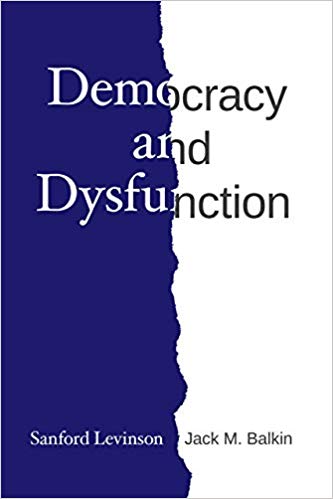
Sanford Levinson and Jack M. Balkin, Democracy and Dysfunction (University of Chicago Press, 2019)

Sanford Levinson, Written in Stone: Public Monuments in Changing Societies (Duke University Press 2018)

Mark A. Graber, Sanford Levinson, and Mark Tushnet, eds., Constitutional Democracy in Crisis? (Oxford University Press 2018)

Gerard Magliocca, The Heart of the Constitution: How the Bill of Rights became the Bill of Rights (Oxford University Press, 2018)

Cynthia Levinson and Sanford Levinson, Fault Lines in the Constitution: The Framers, Their Fights, and the Flaws that Affect Us Today (Peachtree Publishers, 2017)

Brian Z. Tamanaha, A Realistic Theory of Law (Cambridge University Press 2017)

Sanford Levinson, Nullification and Secession in Modern Constitutional Thought (University Press of Kansas 2016)

Sanford Levinson, An Argument Open to All: Reading The Federalist in the 21st Century (Yale University Press 2015)

Stephen M. Griffin, Broken Trust: Dysfunctional Government and Constitutional Reform (University Press of Kansas, 2015)

Frank Pasquale, The Black Box Society: The Secret Algorithms That Control Money and Information (Harvard University Press, 2015)

Bruce Ackerman, We the People, Volume 3: The Civil Rights Revolution (Harvard University Press, 2014)
Balkinization Symposium on We the People, Volume 3: The Civil Rights Revolution

Joseph Fishkin, Bottlenecks: A New Theory of Equal Opportunity (Oxford University Press, 2014)

Mark A. Graber, A New Introduction to American Constitutionalism (Oxford University Press, 2013)

John Mikhail, Elements of Moral Cognition: Rawls' Linguistic Analogy and the Cognitive Science of Moral and Legal Judgment (Cambridge University Press, 2013)

Gerard N. Magliocca, American Founding Son: John Bingham and the Invention of the Fourteenth Amendment (New York University Press, 2013)

Stephen M. Griffin, Long Wars and the Constitution (Harvard University Press, 2013)

Andrew Koppelman, The Tough Luck Constitution and the Assault on Health Care Reform (Oxford University Press, 2013)

James E. Fleming and Linda C. McClain, Ordered Liberty: Rights, Responsibilities, and Virtues (Harvard University Press, 2013)
Balkinization Symposium on Ordered Liberty: Rights, Responsibilities, and Virtues

Andrew Koppelman, Defending American Religious Neutrality (Harvard University Press, 2013)

Brian Z. Tamanaha, Failing Law Schools (University of Chicago Press, 2012)

Sanford Levinson, Framed: America's 51 Constitutions and the Crisis of Governance (Oxford University Press, 2012)

Linda C. McClain and Joanna L. Grossman, Gender Equality: Dimensions of Women's Equal Citizenship (Cambridge University Press, 2012)

Mary Dudziak, War Time: An Idea, Its History, Its Consequences (Oxford University Press, 2012)

Jack M. Balkin, Living Originalism (Harvard University Press, 2011)

Jason Mazzone, Copyfraud and Other Abuses of Intellectual Property Law (Stanford University Press, 2011)

Richard W. Garnett and Andrew Koppelman, First Amendment Stories, (Foundation Press 2011)

Jack M. Balkin, Constitutional Redemption: Political Faith in an Unjust World (Harvard University Press, 2011)

Gerard Magliocca, The Tragedy of William Jennings Bryan: Constitutional Law and the Politics of Backlash (Yale University Press, 2011)

Bernard Harcourt, The Illusion of Free Markets: Punishment and the Myth of Natural Order (Harvard University Press, 2010)

Bruce Ackerman, The Decline and Fall of the American Republic (Harvard University Press, 2010)
Balkinization Symposium on The Decline and Fall of the American Republic

Ian Ayres. Carrots and Sticks: Unlock the Power of Incentives to Get Things Done (Bantam Books, 2010)

Mark Tushnet, Why the Constitution Matters (Yale University Press 2010)

Ian Ayres and Barry Nalebuff: Lifecycle Investing: A New, Safe, and Audacious Way to Improve the Performance of Your Retirement Portfolio (Basic Books, 2010)
.jpg)
Jack M. Balkin, The Laws of Change: I Ching and the Philosophy of Life (2d Edition, Sybil Creek Press 2009)

Brian Z. Tamanaha, Beyond the Formalist-Realist Divide: The Role of Politics in Judging (Princeton University Press 2009)
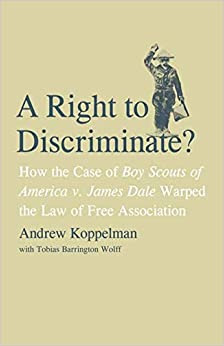
Andrew Koppelman and Tobias Barrington Wolff, A Right to Discriminate?: How the Case of Boy Scouts of America v. James Dale Warped the Law of Free Association (Yale University Press 2009)

Jack M. Balkin and Reva B. Siegel, The Constitution in 2020 (Oxford University Press 2009)

Heather K. Gerken, The Democracy Index: Why Our Election System Is Failing and How to Fix It (Princeton University Press 2009)

Mary Dudziak, Exporting American Dreams: Thurgood Marshall's African Journey (Oxford University Press 2008)

David Luban, Legal Ethics and Human Dignity (Cambridge Univ. Press 2007)

Ian Ayres, Super Crunchers: Why Thinking-By-Numbers is the New Way to be Smart (Bantam 2007)

Jack M. Balkin, James Grimmelmann, Eddan Katz, Nimrod Kozlovski, Shlomit Wagman and Tal Zarsky, eds., Cybercrime: Digital Cops in a Networked Environment (N.Y.U. Press 2007)

Jack M. Balkin and Beth Simone Noveck, The State of Play: Law, Games, and Virtual Worlds (N.Y.U. Press 2006)

Andrew Koppelman, Same Sex, Different States: When Same-Sex Marriages Cross State Lines (Yale University Press 2006)

Brian Tamanaha, Law as a Means to an End (Cambridge University Press 2006)

Sanford Levinson, Our Undemocratic Constitution (Oxford University Press 2006)

Mark Graber, Dred Scott and the Problem of Constitutional Evil (Cambridge University Press 2006)

Jack M. Balkin, ed., What Roe v. Wade Should Have Said (N.Y.U. Press 2005)

Sanford Levinson, ed., Torture: A Collection (Oxford University Press 2004)
Balkin.com homepage
Bibliography
Conlaw.net
Cultural Software
Writings
Opeds
The Information Society Project
BrownvBoard.com
Useful Links
Syllabi and Exams
