Balkinization
an unanticipated consequence of
Jack M. Balkin
Balkinization Symposiums: A Continuing List
E-mail:
Jack Balkin:
jackbalkin at yahoo.com
Bruce Ackerman
bruce.ackerman at yale.edu
Ian Ayres
ian.ayres at yale.edu
Corey Brettschneider
corey_brettschneider at brown.edu
Mary Dudziak
mary.l.dudziak at emory.edu
Joey Fishkin
joey.fishkin at gmail.com
Heather Gerken heather.gerken at yale.edu
Abbe Gluck abbe.gluck at yale.edu
Mark Graber
mgraber at law.umaryland.edu
Stephen Griffin
sgriffin at tulane.edu
Jonathan Hafetz
jonathan.hafetz at shu.edu
Jeremy Kessler
jkessler at law.columbia.edu
Andrew Koppelman
akoppelman at law.northwestern.edu
Marty Lederman
msl46 at law.georgetown.edu
Sanford Levinson
slevinson at law.utexas.edu
David Luban
david.luban at gmail.com
Gerard Magliocca
gmaglioc at iupui.edu
Jason Mazzone
mazzonej at illinois.edu
Linda McClain
lmcclain at bu.edu
John Mikhail
mikhail at law.georgetown.edu
Frank Pasquale
pasquale.frank at gmail.com
Nate Persily
npersily at gmail.com
Michael Stokes Paulsen
michaelstokespaulsen at gmail.com
Deborah Pearlstein
dpearlst at yu.edu
Rick Pildes
rick.pildes at nyu.edu
David Pozen
dpozen at law.columbia.edu
Richard Primus
raprimus at umich.edu
K. Sabeel Rahmansabeel.rahman at brooklaw.edu
Alice Ristroph
alice.ristroph at shu.edu
Neil Siegel
siegel at law.duke.edu
David Super
david.super at law.georgetown.edu
Brian Tamanaha
btamanaha at wulaw.wustl.edu
Nelson Tebbe
nelson.tebbe at brooklaw.edu
Mark Tushnet
mtushnet at law.harvard.edu
Adam Winkler
winkler at ucla.edu
Compendium of posts on Hobby Lobby and related cases
The Anti-Torture Memos: Balkinization Posts on Torture, Interrogation, Detention, War Powers, and OLC
The Anti-Torture Memos (arranged by topic)
Recent Posts
Structural Similarities Between Conservative and Liberal Constitutional Arguments
The Legislative History of Section Four of the Fourteenth Amendment
The Health Care Mandate’s Big Win in the Sixth Circuit
A Possible Compromise on Libya and War Powers
The Coming Crunch for Law Schools
Harold Koh's Prepared Testimony on Libya and War Powers Resolution
Finally!
Did the WPR Make a Difference?
Libertarian premises and campaign finance
More Evidence That the Court Is Not Simply a "Majoritarian" Institution: Today's Decision on Public Financing of Elections
More on the Roberts-Kagan exchange
Campaign Finance and the Doctrinal Death Match
The Debt Ceiling
Silly Rhetoric in Supreme Court Opinions
Procedures matter!!! And the New York Times misleads its readers
Sorrell v. IMS Health: Corporate Commercial Speech in the Age of Citizens United
War From an Executive Perspective
Tom Friedman's constitutional inability to connect the dots
Wal-Mart v. Dukes and the future of meritocracy
The 1980 OLC Opinion on the Constitutionality of the War Powers Resolution
Life in a constitutional dictatorship (Again)
Peter Baker's complacence
How the WPR Became "Unconstitutional"
George W. Obama and the OLC
When Congress Terminates a “War” By Doing Nothing: The 60-Day Clock of the War Powers Resolution
The Bill of Rights and Illegal Immigrants
What Should Responsible Journalists Say About the Constitutionality of the War Powers Resolution?
American heroes
Why power isn’t speech: Nevada Commission on Ethics v. Carrigan and the unraveling of campaign finance doctrine
Justice Scalia as Stylist
David Brooks's incomplete Hamiltonianism
The Holder Letter's Salutary Effect
The Origins of the War Powers Resolution: Some Notes
Constitution Making In the Modern Era?
Was the Warren Court an "Emergency Court" for the Problem of Race?
The $26 Oral Argument
Taking republicanism seriously
Power and Productivity after the Great Recession
Your First Amendment Right to Privacy
The Crisis of Presidential Legality: The Libyan War as a Test Case
Avoiding Local Constitutional Difficulties
![[Powered by Blogger]](https://lh3.googleusercontent.com/blogger_img_proxy/AEn0k_t7__VV9m78Ahk2g5k4_XoIMQbd7sg2urZPKcSCTkPzHVPVfLMoQk8RbSBSoaGocHZcSWkQhjVHuKpKNpdcmZRYKy79SN0rFjdpkbn9Wug_=s0-d)
Just A Few Blogs
ACS Blog
Alas, a Blog
Althouse
Arts and Letters Daily
Atrios (Eschaton)
Bill of Health
Buzzflash.com
Buzz Machine
Cato at Liberty
Juan Cole (Informed Comment)
Concurring Opinions
The Constitution in 2020
Corrente
Crooked Timber
Daily Howler
Daily Kos
Dana Boyd
Brad DeLong
Digby (Hullabaloo)
Discriminations
Daniel Drezner
Kevin Drum (Mother Jones)
Electrolite
En Banc
Eunomia (Daniel Larison)
Fafblog
Michael Froomkin (Discourse.net)
GovLab (Beth Noveck)
Rick Hasen (Election Law)
History News Network
How Appealing
Ignatz (Sam Heldman)
The Importance of (Ernie Miller)
Infolaw
Instapundit
International Economic Law and Policy Blog
IntLawGrrls
Jacob Levy
Jesus' General
Jurisdynamics
The Kitchen Cabinet
Mark Kleiman
Law Blog Central
Larry Lessig
Lawyers, Guns and Money
Liberal Oasis
Brian Leiter's Law School Reports
The Leiter Reports
Marginal Revolution
Megan McArdle
Memeorandum
Metafilter
Mirror of Justice
The New Republic
Newseum
No More Mister Nice Blog
Brendan Nyhan
Opinio Juris
Orcinus
The Originalism Blog
Pandagon
Passport (Foreign Policy)
Overcoming Bias
Political Animal (Washington Monthly)
Political Theory Daily Review
Political Wire (Taegan Goddard)
The Poor Man
Virginia Postrel
Prawfsblawg
Public Reason
Jonathan Rauch
Raw Story
Redstate
ReligiousLeftLaw.com
Reporters Committee For Freedom of the Press
Reproductive Rights Blog
Rothman's Roadmap to the Right of Publicity
SCOTUS Blog
Seeing the Forest
Clay Shirky
The Shifted Librarian
The Situationist
Larry Solum (Legal Theory)
Andrew Sullivan
Talking Points Memo
Talk Left
Tapped
Tbogg
TechPresident
The Paper Chase (Jurist)
Tom Paine
Tom Tomorrow (This Modern World)
Eve Tushnet
Uggabugga
University of Chicago Law School Faculty Blog
Unqualified Offerings
The Volokh Conspiracy
War and Piece (Laura Rozen)
Wampum
Oliver Willis
Wonkette
Written Description
Matthew Yglesias
Yin
Your Choice of Feeds
1. XML
powered by

2. Atom Feed
3. RSS 2.0
Structural Similarities Between Conservative and Liberal Constitutional Arguments
Mark Tushnet
Jeesh -- I go two days without internet access, and constitutional hell breaks loose. Apparently taking a lesson from conservatives, liberals now appear to be trying to put an off-the-wall idea on the table. (For the record, the developing practice of contrasting "off the wall" arguments with "on the wall" ones seems to me completely ridiculous; the way to put the idea is that ideas move from being off the wall to being on the table.)
Posted
11:05 PM
by Mark Tushnet [link]
The Legislative History of Section Four of the Fourteenth Amendment
JB
The recent debate over the debt ceiling has led various commentators, journalists and politicians to consider the relevance of section Four of the Fourteenth Amendment, which provides:The validity of the public debt of the United States, authorized by law, including debts incurred for payment of pensions and bounties for services in suppressing insurrection or rebellion, shall not be questioned. But neither the United States nor any State shall assume or pay any debt or obligation incurred in aid of insurrection or rebellion against the United States, or any claim for the loss or emancipation of any slave; but all such debts, obligations and claims shall be held illegal and void.
Does Section Four prevent Congress from refusing to raise the debt ceiling? Does it authorize the President to keep paying debts regardless of what Congress does?
This essay does not attempt to answer these questions in detail; I leave that to a future discussion. My goal here is to offer a basic account of the legislative history of Section 4. This discussion, I hope, will be of interest both to originalists and to non-originalists who believe that text, structure and history matter, even if they are not always dispositive of current constitutional questions.
The original purpose of Section Four, which is reflected in its text, was to prevent political disruption and party wrangling over the public debt following the Civil War. However, the language of the Amendment went beyond this particular historical concern. It was stated in broad terms in order to prevent future majorities in Congress from repudiating the federal debt to gain political advantage, to seek political revenge, or to try to disavow previous financial obligations because of changed policy priorities.
Read more »
Posted
1:59 PM
by JB [link]
The Health Care Mandate’s Big Win in the Sixth Circuit
Andrew Koppelman
On Wednesday, the Obama Administration won its first Court of Appeals battle over the constitutionality of the health care mandate. A divided three-judge panel of the Sixth Circuit held that Congress has the power to require individuals to purchase health insurance or pay a penalty. The result is obviously correct, for reasons I’ve explained elsewhere (see “Bad News for Mail Robbers: The Obvious Constitutionality of Health Care Reform,” Yale Law Journal Online), and Judge Boyce Martin’s lead opinion is brief and elegantly reasoned. The other opinions, however, contained some strange claims about constitutional law.
Let’s begin with the scorecard. The Administration defended the mandate on two grounds: It is a permissible exercise of the Article I power to “regulate Commerce … among the several states,” and the penalty is a tax, which is also specifically authorized. Judge Martin accepted the first argument, and so deemed it unnecessary to address the second one. Judge Jeffrey Sutton rejected the tax argument, but accepted the commerce argument. Judge James L. Graham, a District Court judge on temporary assignment to the Sixth Circuit, rejected both arguments and thought the law unconstitutional. The panel’s holding thus is identical with Sutton’s, since he had a majority (Martin’s vote on the commerce question, Graham’s on the tax question) to support each of his conclusions.
The big news is Sutton’s vote to uphold the law. This is the first time in this protracted battle that voting on the constitutionality of health care did not follow party lines. And Judge Sutton is no ordinary Republican: He is a former law clerk for Antonin Scalia and a George W. Bush appointee, far enough to the right that 41 Senators voted against his confirmation. (He was the only exception to the partisan pattern of health care decisions. Martin is a Democrat; Graham is a Republican.)
Martin’s analysis is the simplest, relying on two well-established doctrines: “Congress may regulate economic activity, even if wholly intrastate, if it substantially affects interstate commerce,” and “Congress may also regulate even non-economic intrastate activity if doing so is essential to a larger scheme that regulates economic activity.” The decision to go uninsured has a massively substantial effect: “Congress found that the aggregate cost of providing uncompensated care to the uninsured in 2008 was $43 billion.” This private conduct has to be regulated in order to effectuate the larger legislative scheme, just as, for example, the ban on private possession of child pornography is necessary to regulate that market. Martin relies on clear and very recent Supreme Court authority.
Sutton joins the result, but he agonizes about it. He works through the arguments intelligently and conscientiously, and his courage is admirable. He won’t be treated so nicely at Federalist Society meetings from now on. But some of his claims should not go unchallenged.
His reasoning on the tax question is strained. He places enormous weight on the fact that Congress did not call the mandate a tax, even though he acknowledges that the Supreme Court said in 1948 that “[t]he question of the constitutionality of action taken by Congress does not depend on recitals of the power which it undertakes to exercise.” He dismisses as dictum the Court’s declaration in 1974 that it has “abandoned” the “distinction … between regulatory and revenue-raising taxes.” And he concedes that the distinction is entirely formalist and meaningless, since Congress could have imposed exactly the same result by using different language: “Congress might have raised taxes on everyone in an amount equivalent to the current penalty, then offered credits to those with minimum essential insurance. Or it might have imposed a lower tax rate on people with health insurance than those without it.” This is the kind of thing that gives formalism a bad name.
He also is oddly respectful of the bizarre and often-repeated claim that the commerce power applies only to individuals who are already engaged in commerce. “Of all the arguments auditioning to invalidate the individual mandate, this is the most compelling.” But he punctures it summarily, noting that the Supreme Court upheld regulation of medical marijuana even though Angel Raich, the defendant who grew her own medical marijuana, “never entered any markets, whether interstate or intrastate.”
For the most part, his reasoning is sound. He systematically demolishes the notion that Congress can only regulate activity, not inactivity. He observes that this distinction appears nowhere in the Constitution, and spends several pages showing how unworkable it is in practice. He notes its strange results: Does this mean that courts must invalidate the federal law enforcing interstate child support obligations? Inactivity, after all, is what deadbeat dads are all about.
He acknowledges “the lingering intuition … that Congress should not be able to compel citizens to buy products they do not want.” States, however, may require individuals to buy health insurance, and two have. “Sometimes an intuition is just an intuition.”
Judge Graham, too, was unable to digest the activity/inactivity distinction. He also admits that there is a national problem that only Congress can solve. Then his reasoning goes completely off the rails. “That problems are felt nationwide,” however, “does not mean that Congress can try to solve them in any fashion it pleases.” This flies in the face of the basic principle, first articulated by the Supreme Court in 1819 and reaffirmed just last year, that Congress can choose any convenient means for carrying out its enumerated powers, without micromanagement by the courts.
Graham thinks that those who go without health insurance are immune from regulation because they have done nothing economic. They “are strangers to the health insurance market,” and they have merely “made a decision to accept risk.” Evidently it doesn’t matter that their decision to go without insurance is an economic one with economic effects, or that the risk they are accepting is the risk of imposing large health care costs on other people. The fact that they are getting a free ride at everyone else’s expense is a “problem … of Congress’s own creation,” because federal law requires emergency rooms to provide care regardless of ability to pay. Evidently, if we were only willing to let people bleed to death on the street, all this unpleasantness could have been avoided.
This piece was cross-posted to Jonathan Cohn's New Republic blog.
Posted
10:08 PM
by Andrew Koppelman [link]
A Possible Compromise on Libya and War Powers
Marty Lederman
The Senate Foreign Relations Committee yesterday approved (by a 14-5 vote) S.J. Res. 20, the Kerry/McCain authorization for the operation in Libya. Section 2(a) of that bill would authorize the President "to continue the limited use of the United States Armed Forces in Libya, in support of United States national security policy interests, as part of the NATO mission to enforce United Nations Security Council Resolution 1973 (2011) as requested by the Transitional National Council, the Gulf Cooperation Council, and the Arab League"--an authorization that would expire one year after enactment.
Even if the full Senate were to approve that authorization, it would not likely become law, because the House overwhelmingly rejected a virtually identical bill last Friday.
But the Senate bill will not be identical to the one the House rejected, because just before voting on that resolution, the SFRC also approved two amendments thereto offered by Senator Lugar that just might be the key to a successful compromise. The first approved Lugar amendment would add a specific restriction to the authorization in S.J. Res. 20, to wit: "None of the funds appropriated under any provision of law may be obligated or expended to deploy, establish, or maintain the presence of units and members of the United States Armed Forces on the ground in Libya unless the purpose of the presence is limited to the immediate personal defense of United States Government officials (including diplomatic representatives) or to rescuing members of NATO forces from imminent danger." The Kerry-McCain version of the resolution that the House rejected contains a statement that "Congress does not support" such use of grounds forces; but the Lugar Amendment goes beyond that, establishing a binding legal restriction on such use. As such, it might be more palatable to some House members.
Perhaps of greater importance, the second adopted Lugar amendment would specifically provide that "United States military operations in Libya since April 4, 2011, which have included non-kinetic support to the NATO-led operations, including intelligence, logistical support, and search and rescue assistance, United States aircraft assisting in the suppression and destruction of air defenses in support of the no-fly zone, and precision strikes by unmanned aerial vehicles, constitute hostilities within the meaning of the War Powers Resolution, and may be carried out only under the conditions specified in section 5(b) of the War Powers Resolution (50 U.S.C. 1544(b))."
The effect of this second Lugar Amendment, were it to become law, would be not only to reflect a congressional disagreement with the President's views on whether the Libya operations since April 4th have constituted "hostilities" for purposes of the War Powers Resolution, but also to establish going forward, as a matter of law, that those operations constituted "hostilities"--an interpretation of the the WPR that would (unlike the Executive's contrary reading) be binding in the future. Accordingly, not only would it stand as a legislative rebuke to the President's construction of the statute, but in addition it would establish a legal precedent on the meaning of the term "hostilities" that the Executive would be compelled to take into account in assessing the application of the WPR 60-day clock for future military operations. In that respect, the Kerry/McCain resolution, with this Lugar Amendment, would be both an authorization of the current Libya operation, and a statutory constraint on the Executive--a rare congressional pushback that serves, as a practical matter, to "enforce" the WPR. [UPDATE: It is, in fact, the sort of "grand bargain" that Bruce Ackerman and Oona Hathaway proposed several weeks ago.]
The Lugar Amendments, therefore, might prove to be an ingenious compromise that might be acceptable to a majority of House members, in a way the stand-alone Kerry/McCain resolution was not.
One other loose end:
The second Lugar amendment also provides that, "[c]onsistent with section 8(a)(1) of the War Powers Resolution (50 U.S.C. 1547(a)(1)), Congress declares that [the authorization in S.J. Res. 20] is intended to constitute specific statutory authorization within the meaning of section 5(b) of the War Powers Resolution (50 U.S.C. 1544(b))," and further provides that "[n]othing in this joint resolution supersedes any requirement of the War Powers Resolution." Accordingly, if it were to become law, it appears that S.J. Res. 20 would be the rare example of Congress actually acting as the War Powers Resolution contemplates, i.e., to satisfy that law's conditions--rather than enacting a separate authorization law that does not satisfy the terms of the WPR but instead supersedes its requirements (which is what Congress did through an appropriations law respecting Kosovo in 1999).
Posted
1:11 AM
by Marty Lederman [link]
The Coming Crunch for Law Schools
Brian Tamanaha
The New York Times released a chart yesterday showing that law schools are churning out far more lawyers than the number of available legal positions. That is old news, of course. What's worse is that the oversupply promises to continue. In 2010, Georgetown enrolled 591 first year JD students, Harvard enrolled 531, Fordham enrolled 477, and NYU enrolled 476. Large classes are not limited to top schools: New York Law School took in 641, John Marshall (Chicago) enrolled 539, and Suffolk enrolled 531. (Let's not talk about the 808 first year students taken by Florida Coastal and 1,583 by Cooley.) Law schools now pump out about 45,000 graduates annually at a time when the Bureau of Labor Statistics projects about 28,000 new lawyer positions per year.
Why are law schools enrolling so many students when employment prospects for graduates are so poor? Because they must. In the past two decades law faculties have gotten bigger. AALS tallied 7,421 full time faculty in 1990, and 10,965 in 2008. Some of this overall increase comes from newly accredited schools, but most of it is faculty expansion: student-faculty ratios have been cut almost by half during this period.
Bigger faculties must be paid for through some combination of more bodies (J.D. and LL.M) and higher tuition. Tuition already goes up every year as it is, so the number of revenue paying students cannot be reduced substantially. It's that basic. (Administrations have also gotten bigger, but I focus on faculties because faculty expenses typically comprise more than half of the total budget and are hard to trim owing to tenure and long term contracts.)
Law schools will soon suffer the consequences of this expansion. The chart below tracks the number of applicants against the number of first year students from 1990 to the present. As it shows, law schools exhibit a one-way ratchet: when applications drop, enrollment remains steady; when applications rise, enrollment goes up. Read more »
Posted
3:00 PM
by Brian Tamanaha [link]
(36) comments
Harold Koh's Prepared Testimony on Libya and War Powers Resolution
Marty Lederman
is here. The Senate Foreign Relations Committee Hearing can be seen here; and Bobby Chesney has a partial live-blog about it here.
Posted
1:28 PM
by Marty Lederman [link]
Finally!
Marty Lederman
The Senate just confirmed, by voice vote, Virginia Seitz as Assistant Attorney General for the Office of Legal Counsel. The Office has had a confirmed AAG for less than three of the past 15 years, and not since 2004 [UPDATE: John Elwood calculates that it's been 2524 days -- and who am I differ?]. My friends David Barron, Jonathan Cedarbaum and Caroline Krass have served with the greatest distinction and dedication as acting heads of the Office over the past two years. Nevertheless, completion of the constitutional process is long overdue.
Virginia is an old colleague and friend of mine. I can attest with the greatest confidence that she -- like Dawn Johnsen, who should have been afforded a Senate vote two years ago -- is a person and attorney of impeccable integrity, with superlative judgment and deep devotion to the best traditions and practices of the Office, in addition to being simply one of the finest lawyers around, by universal acclamation (see letters here). She is a perfect fit, and joins an extraordinary group of career and appointed lawyers currently at OLC. (I'm biased.) The Office, the Department and the President will benefit enormously from her service.
Posted
1:05 PM
by Marty Lederman [link]
Did the WPR Make a Difference?
Stephen Griffin
To wind up my round of posts on the WPR, let's ask whether it made a difference. As was the case last time, I want to take several steps back from the standard debate. This debate proceeds in terms of multiple examples of presidential military action in which the WPR was either basically invoked (Reagan in Lebanon) or not (reflagging Kuwaiti tankers) or wasn't relevant because the action was quick (Grenada-Panama). While scholars have drawn different conclusions from different examples, no one argues the WPR was a success story. At the same time, this observation has to be taken with a grain of salt, given that few set forth realistic criteria for success.
The WPR's supporters saw it as a constraint on presidential action, although some leeway was given in terms of the 60 day clock. Given the evidence available, we have to ask whether the WPR was more of an effect rather than a cause. The history of the period seems pretty clear that all post-Nixon presidents were very well aware that the public wanted "no more Vietnams." Slightly more pejoratively, this was known as the "Vietnam Syndrome." At least within the period of the cold war, the public got what it wanted. There was never again a war that cost anything even remotely close to the 55,000 names that are inscribed on the wall on the Mall. There is a line of analysis that says this was inevitable. We could not have another draftee army being chewed up in a foreign locale once the all-volunteer military was adopted. But surely it was still possible to have a lengthy unproductive military involvement on a major scale even with the AVF. We learned this eventually in Iraq. Again, however, within the cold war nothing like Vietnam ever happened again. It's striking how many times a fear of Vietnam was raised in the 1980s in implausible circumstances like Grenada and worrying about advisers in El Salvador.
No more Vietnams was in fact officially adopted by at least part of the executive branch. It was codified in the Weinberger-Powell doctrine. This doctrine included the principle that any major military action must be supported by the public. Because this was also the basic purpose of the WPR, one would think that liberals might have hailed this doctrine as accepting the basic premise of the WPR and we might as well all go home friends. I haven't found any evidence of this. Perhaps Weinberger had too little credibility in Congress for anyone to pay serious attention to his criteria. But surely it had to dawn on some supporters of the WPR in the 1980s that the military and the civilians running the DOD were in earnest about not fighting any more wars without public support. That would entail at least some sort of congressional authorization, which would satisfy the WPR.
Even after the cold war, President GHW Bush likely only felt safe approving the Gulf War in the belief that it would be relatively brief. James Baker's memoirs record a suggestion made at one point in executive branch deliberations over whether to go to war -- invoke the WPR and just make sure the war lasted less than 90 days! That way, Congress would be left hanging with no objection even if Bush never asked for authorization. Baker says this was considered too clever and I agree. And despite Bush's clear resolve to initiate war without congressional authorization, it is true that in the end he did not bypass Congress. He expended a great deal of effort making sure he would win the vote to authorize the war, as you would expect from a political point of view.
Although I don't agree with much in the recent Posner-Vermuele book on executive power, I have to admit that the "no Vietnams" saga illustrates the primacy and relevance of political, as opposed to legal, constraints on the executive. Quite a lot of evidence supports the idea that presidents were restrained in the exercise of military power post-Nixon. But not primarily because of the WPR. Presidents did not ignore the WPR, as often implied in overly general journalistic accounts. But the reason Ford, Carter, Reagan and Bush avoided a major war was because of an enormous consensus that the country wanted no more. This consensus had positive and negative consequences for foreign policy. It seems difficult to deny, however, that this political consensus was the motive force behind many presidential decisions of the period, not the WPR. Perhaps we should pay less attention to whether presidents complied with the details of the WPR, and more to the political context in which presidential decisions were made.
Posted
7:54 PM
by Stephen Griffin [link]
Libertarian premises and campaign finance
Joseph Fishkin
The Supreme Court's latest campaign finance blockbuster Arizona Free Enterprise v. Bennett, which came down this morning, brings to mind an essay by the late, great political theorist Jerry Cohen. In the essay, "Freedom and Money," Cohen explains how poverty, and more generally, lack of money, limits freedom. "The value of money is that it gives you freedom," he writes. I'll give you just one footnote that gives a flavor of the argument: "Suppose that two people are prevented from boarding a plane, one because she lacks a passport and the other because she lacks a ticket. Was only the first unfree to board it? What the airline does to the ticketless passenger is exactly what the state does to the passportless one: block her way." (Cohen, Freedom and Money, reprinted in On The Currency of Egalitarian Justice and Other Essays in Political Philosophy, p. 179 n.29 (2011)).
To most libertarians, this is nonsense. "Freedom" means freedom from government interference, they argue -- not freedom from all interference. Or at any rate, while there are various possible definitions of the word "freedom," the freedom we ought to care about is freedom from government interference. Cohen disagrees; in his view, the freedom that matters most is actually getting to do things we want to do. People who complain that corporations, employers, Internet Service Providers, or other non-governmental actors are interfering with their freedom of speech are embracing Cohen's side of this debate. What does this have to do with campaign finance? (More after the jump.)
Read more »
Posted
7:42 PM
by Joseph Fishkin [link]
More Evidence That the Court Is Not Simply a "Majoritarian" Institution: Today's Decision on Public Financing of Elections
Rick Pildes
One aspect of the Court's 5-4 decision today striking down Arizona's public financing system for elections is what the decision tells us about how much the Court is or is not constrained by the view of national political majorities. The "majoritarian" thesis about the Supreme Court, which has become more popular in recent years among legal academics and has been absorbed by many p0pular commentators, maintains that the Court does not stray far from the preferences of national political majorities on issues. The Court's decision last year in Citizens United was something of an embarrassment for this thesis (or certain versions of the thesis). When the Citizens United Court held unconstitutional restrictions on corporate electioneering spending, the Court issued a decision that (whatever its merits as a legal matter) certainly stood in the face of the bulk of public opinion, both before and after the opinion.
In response, defenders of the majoritarian thesis, such as my colleague Barry Friedman and his co-author, Dahlia Lithwick, argued that the Court must have been taken by surprise in the reaction to Citizens United; the Court mistakenly failed to realize how strong the negative reactions to the decision would have been. Indeed, the subtitle of their writing on the case was Did the Roberts Court Misjudge the Public Mood On Campaign Finance Reform? If that view is right, one would expect the Court to back off in later cases from its position on campaign finance laws.
Yet today's decision, along with other post-Citizens United decisions of the Court, confirms that the 5-4 majority remains as firmly committed as ever to the positions reflected in Citizens United. Indeed, my sometimes co-teacher, Paul Clement, suggests that the Arizona case might reveal that the backlash has made the Citizens United even more "energetic" and committed to its views. Today's decision certainly confirms that the 5-4 Court is not backing off in any way at all from its aggressive constitutional stance towards campaign finance laws. In an article titled Is the Supreme Court a "Majoritarian" Institution, I pointed to the Citizens United decision as powerful evidence that the Court does not merely reflect majoritarian preferences, even on highly visible and momentous political issues, at least in the way some accounts of the "majoritarian thesis" envision the relationship between the Court and public opinion. I see no signs that the Court majority is trying to backtrack from its decision in Citizens United; indeed, the Roberts Court has now struck down all five campaign finance laws it has confronted, in cases both before and after Citizens United. Among all the other things that can be said about today's decision, what further insight it provides into the relationship of the Court to "public opinion" is worth considering.
Posted
2:44 PM
by Rick Pildes [link]
(22) comments
More on the Roberts-Kagan exchange
Sandy Levinson
Apropos of Heather Gerken's prior posting, which I think is spot on, I offer two further observations: The Roberts-Kagan exchange, though sharp, doesn't begin to compare in venom to that between Roberts and Breyer in Parents Iinvolved. At the very least, those pundits who initially viewed Roberts as likely to take the Court in a more civil direction might further reconsider their view. Secondly, Kagan's opinion is marvelously written, the first opinion almost literally in years that I've genuinely enjoyed reading, for reasons that are at least partially independent of my agreement with its argument. Most of it, I believe, is fully readable by someone without legal training. Which is not to to say, of course, that it suffers with regard to its more legalistic arguments. One should remember that as a professor she wrote one of the very best (and very long) articles on the core meaning of the First Amendment. I presume that it would have been regarded as tacky for her to have cited it, but there's no doubt that she has a deeper theoretical understanding of the First Amendment than any of the other justices, which, I suspect, helps to account for the impatience that Heather detects with regard to the majority's failure to acknowledge that in no way at all is the Arizona scheme content-discriminatory.
Posted
2:26 PM
by Sandy Levinson [link]
(26) comments
Campaign Finance and the Doctrinal Death Match
Heather K. Gerken
I just finished reading Arizona Free Enterprise Club's Freedom Club Pac v. Bennett, today's Supreme Court decision invalidating Arizona's public financing scheme under the First Amendment. I was struck by how strongly worded the opinions were. The majority and the dissent bordered on vituperative. Chief Justice Roberts and Justice Kagan write as if they were exasperated with one another. Each accuses the other of ignoring facts, ignoring doctrine, even ignoring the basic principles undergirding the First Amendment. The two go so far as to invoke each other's rhetorical flourishes ironically, even sarcastically.
Why so much heat? It may be a sign of a nascent rivalry between Chief Justice Roberts and Kagan. But I think it also has to do with the state of campaign finance doctrine. What we are witnessing is not a doctrinal framework developing and moving toward a shared middle ground. What we are witnessing is a doctrinal death match between two incompatible world views. The stakes are high, and so is the rhetoric.
A bit of background is in order. Arizona, like several other states, has a voluntary public finance system. Candidates who accept public financing receive lump-sum grants in exchange for foregoing the opportunity to raise many privately. A publicly financed candidate is eligible to receive additional funds if his opposition outspends him. And by the term “opposition,” I mean both the privately financed candidates and the independent groups supporting the privately financed candidate.
The Court, per Chief Justice Roberts, held that this matching provision violated the First Amendment because, in effect, it “punished” candidates and groups for spending money by awarding funds to their opponents each time they did so. The decision turned largely on one, key case: Davis v. FEC, which struck down the "Millionaire’s Amendment" of McCain-Feingold. The federal provision had trebled the individual contribution limit for congressional candidates whose opponents were able to self-finance their elections. The Court held that the burden imposed by the Arizona scheme was more severe than that imposed by the Millionaire's Amendment. That's because the latter only allowed candidates to raise more money, whereas the Arizona scheme automatically gave them more funds.
In many ways, the Arizona case may be a stand-in for a larger divide in campaign finance. For many years, the two sides have been unable to find common ground. They simply begin with a different premise about what role money plays in elections. One side sees substantial expressive dimensions to contributions and expenditures, and the other doesn't. It would be too crude to boil the debate down to slogans like "money is speech" and "money is money" -- the positions on both sides are more nuanced than that. Nonetheless, the only middle ground that has been found in this fight has been to stick with Buckley v. Valeo's split-the-baby approach, which treats contributions and expenditures differently for First Amendment purposes. No one admires Buckley, and while the compromise garnered votes, it hasn't helped build a common intellectual framework.
Davis and now Arizona Free Enterprise look like the "money is speech" debate writ small. Chief Justice Roberts and his fellow conservatives find it very easy to imagine provisions like the Millionaire's Amendment or Arizona's matching funds as punitive -- punishing a candidate for his successes. Petitioner's "summary of argument," for example, led with an anecdote about Janet Napolitano when she was running for governor. At a debate with her opponent, Napolitano pulled him aside and thanked him for his fundraising efforts because his $750,000 fundraiser had ensured she had an additional $750,000 for the campaign. Napolitano noted, "I am quite certain I am the only Democratic Governor in the country for whom George Bush held a fundraiser."
Justice Kagan and the three other liberals, in contrast, find it very hard to figure out why public finance systems that impose no constraints on privately financed candidates are remotely troubling. Justice Kagan said in oral argument that it seemed like the system promote "more speech all around," and her blistering dissent makes precisely the same point.
That is the core problem, in my view, in campaign finance. If the Justices cannot agree on the basic premises of the doctrine, no balancing test or factual record or choice about the level of scrutiny is going to bring agreement. This just isn't an area where a middle ground is likely to be found. One is tempted to quote from Harry Potter: "neither can win while the other survives." One view or another is going to have to win out. The Justices know it's a fight to the finish, and they are writing their opinions accordingly.
Posted
11:18 AM
by Heather K. Gerken [link]
The Debt Ceiling
Gerard N. Magliocca
I am struck by two aspects of the debate over raising the debt ceiling. First, any ceiling smaller than infinity is nothing more than a device for politicians to posture and extract sugarplums from taxpayers. Second, there are serious constitutional problems with any interpretation of the current debt ceiling statute that would cause a default.
To restate the first point, why have a debt ceiling that is less than infinity given that every time we approach the limit, Congress raises the amount that we can owe. There are two explanations that make sense. One is that it gives elected officials a chance to huff and puff about our debt and mobilize voters. This is also why the minimum wage is not indexed to inflation. If Congress did that, then "raising the minimum wage" could not be wheeled out as a political issue every few years. The other answer is that the bargaining over the debt ceiling gives Members the opportunity to extract goodies from the Treasury in exchange for their votes. If John McCain were President, Senate Democrats would be doing the same thing that House Republicans are doing now. In short, there is no public policy reason to have a debt limit less than infinity--it's all about political rent-seeking.
On the constitutional question, Section Four of the Fourteenth Amendment and the Court's analysis in Perry v. United States casts significant doubt on the Federal Government's authority to suspend payments on its bonds. Congress can say that no more money may be borrowed to fund other appropriations, but the same cannot be said for debt that is incurred to pay off existing obligations. Accordingly, the Treasury should announce that it will continue to issue new bonds to pay the interest and principal of the national debt if Congress fails to raise the ceiling. This would calm the markets and avoid a grave constitutional breach.
Posted
6:53 AM
by Gerard N. Magliocca [link]
(35) comments
Silly Rhetoric in Supreme Court Opinions
Mark Tushnet
Several Supreme Court justices appear committed to an exceedingly annoying rhetorical trope. (For reasons that will appear, “annoyance” rather than “silliness” is the right term, which makes this post’s heading attention-getting but inapt – precisely the problem with the trope I’m about to describe.)
The trope’s most recent appearance was in Sorrell v. IMS Health, where – in implied rebuke to Justice Breyer’s dissent -- Justice Kennedy wrote, “The Constitution ‘does not enact Mr. Herbert Spencer’s Social Statics.’ It does enact the First Amendment.” The Chief Justice offered a slight variant in Snyder v. Phelps: “As a Nation we have chosen a different course – to protect even hurtful speech on public issues to ensure that we do not stifle public debate.” Another variant is from Justice Scalia in District of Columbia v. Heller: “the enshrinement of constitutional rights necessarily takes certain policy choices off the table.” And, I suppose, the classic is, again, from Justice Kennedy, in Texas v. Johnson: “we are presented with a clear and simple statute to be judged against a pure command of the Constitution. The outcome can be laid at no door but ours.”
What makes the trope so annoying is that it seems, but only seems, to make an argument in support of a result. Of course the Constitution enacts the First Amendment, and enshrinement in the Constitution takes certain policy choices off the table, and so on. But, the issue in all these cases is precisely what the Constitution enshrines (or precisely what the First Amendment enacts, or precisely what choice the Nation has made.) The trope tells us exactly nothing about that question – which is, after all, the one the Court is purporting to answer.
What the trope does, of course, is provide a snappy sound-bite for reporters to quote. As a contribution to legal analysis, it is completely empty. Of course, rhetoric that works – as this trope apparently does, in light of the justices’ attraction to it – can’t be silly. But, all in all, the trope is rhetorical in a pejorative sense.
Posted
4:02 PM
by Mark Tushnet [link]
Procedures matter!!! And the New York Times misleads its readers
Sandy Levinson
The New York Times reports, in a story headlined "Connecticut Budget is Upended as State Workers Reject Deal," on the "rejection" by Connecticut's public employee labor unions of a deal crafted by the Democratic governor that would have, he says, avoided the necessity to lay off 7500 public employees (and throw the state into a renewed recession). So why do I have scare quotes around the word "rejection"? The answer is simple, although one has to go deeply into the story to discover this absolutely vital information:But the rejection reflected a complicated whirl of factors, not least of them the approval process itself, in which about 60 percent of workers voted in favor of the agreement only to have it fail.
Under longstanding collective bargaining rules, the agreement needed to be approved by 14 of the 15 unions in the State Employees Bargaining Agent Coalition, with the bargaining units voting in favor representing 80 percent of the 45,000 state workers covered by the deal.
What doomed the package was its rejection by two unions —including, notably, the American Federation of State, County and Municipal Employees Council 4, which covers about one-third of all unionized state employees.
Read more »
Posted
3:55 PM
by Sandy Levinson [link]
(17) comments
Sorrell v. IMS Health: Corporate Commercial Speech in the Age of Citizens United
David Gans
Monday – the last day of the Court’s Term – is shaping up to be First Amendment Day at the Supreme Court. Two of the four remaining cases to be decided raise important questions concerning the meaning of the First Amendment. The Court is expected to release its long awaited opinions in Brown v. EMA, concerning the constitutionality of state regulation of violent video games, and McComish v. Bennett, the sequel to last Term’s blockbuster campaign finance ruling in Citizens United v. FEC. With these landmark rulings still to come, it would be easy to lose sight of today’s ruling in Sorrell v. IMS Health, a commercial speech case that has gotten almost no attention this Term. But Sorrell should not be missed. The 6-3 ruling written by Justice Kennedy – also the author of Citizens United – lays the framework for a major expansion in the protection the First Amendment affords to commercial speech by corporations and other businesses.
Read more »
Posted
6:33 PM
by David Gans [link]
(29) comments
War From an Executive Perspective
Stephen Griffin
Given that President Obama's Libya policy does not seem too popular these days, I want to take a step back from the current situation to consider more generally the perspective presidents have taken since WWII. We can start by asking why presidents thought the WPR was unconstitutional. One standard answer is that the 60 day clock conflicts with the C-in-C power. I think it is more helpful and goes a long way to explaining why presidents have acted as they have if we see what some are calling a "war" in light of the president's power to conduct foreign affairs. Growing up as I did during the days when ideas of the "imperial presidency" held sway, I've had difficulty channeling the presidential perspective I set forth below. But I'm convinced that it lies at the heart of what pro-Congress scholars call the "war powers" debate.
Read more »
Posted
3:58 PM
by Stephen Griffin [link]
Tom Friedman's constitutional inability to connect the dots
Sandy Levinson
Tom Friedman has another column in today's Times lamenting (altogether correctly) the decadent state of contemporary politics in the United States. It begins, "There is something crazy about what is going on in our country today." He, like any sane individual, certainly doesn't believe that the country is "going in the right direction." His nostrum, though, is a third-party candidate for the presidency who will presumably be truly serious in a way that, according to Friedman, is beyond the capacity of the institutional Democratic or Republican parties and their respective leaders, President Obama in one case and God knows whom in the other. Yet, once more, Friedman is incapable of even suggesting that our malaise might have something to do with a dysfunctional Constitution drafted almost 2-1/4 centuries ago in a remarkably different world, both materially and conceptually (i.e., the disdain for the very idea of political parties and the ultimate reliance on the political virtue of national political elites). The one and only mainstream pundit who is capable (or, more to the point perhaps, willing) to connect the odts is Fareed Zakaria, who had a superb commentary on CNN on Sunday, taking off from Iceland's totally admirable efforts to revise its 1945 constitution.
It's also worth mentionng a piece by former Oklahoma Representative Mickey Edwards (who used ot be thought of as a moderately conservative Republican) in the current Atlantic, "How to Turn Republicans and Democrats into Americans," a screed against hyperpartisanship. He has some interesting ideas, but, needless to say (alas), there is no suggestion that we might actually think of constitutional reform in light of the fact that political parties are not (and should not) go away.
I see no particular point in eliciting comments on this posting, since, to put it mildly, it doesn't raise any new points that I haven't offered repeatedly. But there are always new examples of Friedman's obtuseness, even as he deserves great credit for trying, in his own way, to play Paul Revere in warning us of the genuine problems facing the country that the political system seems incapable of confronting in any serious way.
Posted
9:28 AM
by Sandy Levinson [link]
Wal-Mart v. Dukes and the future of meritocracy
Joseph Fishkin
Labels: class actions, employment discrimination, implicit bias, Wal-Mart v. Dukes
Posted
3:07 AM
by Joseph Fishkin [link]
(13) comments
The 1980 OLC Opinion on the Constitutionality of the War Powers Resolution
JB
Many recent commentators on the Libya intervention have referred to the 1980 OLC opinion discussing the War Powers Resolution, Presidential Power to Use the Armed Forces Abroad Without Statutory Authorization, 4A Op. O.L.C. 185, (1980) but the opinion is not available for free online. Here is a copy.
Read more »
Posted
2:55 PM
by JB [link]
Life in a constitutional dictatorship (Again)
Sandy Levinson
It is time, alas, to reopen a new series of postings on the theme of how our constitutional dictatorship operates. It is now crystal clear that Obama does not represent a true repudiation of the Bush Administration, but, rather, a (somewhat) kindler and gentler version of its claims vis-a-vis presidential power and what is defined by the White House as "national security." James Fallows, in an excellent comment on the remarkable assertion that the War Powers Act is irrelevant because Libya doesn't constitute the kind of "hostilities" adverted to, writes that "[t]he central concern, and the major threat to our politics, is that once again we are going to war essentially on one person's say-so." He is correct, even if one grants full credit for Obama's having sought out acquiescent lawyers who turn out, however, not to be employed by the Office of Legal Counsel or the Department of Defense.
One also wonders who precisely has been making the decisions to go after "leakers." As Jane Mayer has noted, the Obama Administration has conducted more such prosecutions than all other administrations combined, which, by definition, includes the Bush Administration. Not to mention what the NYTimes has aptly described as "backward" steps with regard to surveillance authorization by the FBI. And is Robert Mueller really so "indispensable" that he should be given an extra two years (until after the election, note). I'm not necessarily a believer in hard-and-fast term limits, given that I've argued elsewhere that a real problem with the 22nd Amendment is that we can't "suspend" its operation in circumstances--during time of war, say,--when it's really stupid to evict a really talented Commander/Diplomat-in-Chief simply because it's two terms and out. But it should take something truly extraordinary, and I see no reason to think that such circumstances are currently present. Surely, the President could find someone capable of taking the helm at the FBI. Perhaps he fears that Republicans would simply refuse to confirm anyone. After all, another indispensable NYTimes article is tellingly titled "Nominees at Standstill as G.O.P. Flexes Its Muscle." Perhaps Peter Baker (see previous posting) should read his own newspaper before he waxes rhapsodic about our Madisonian system (but the 1787 Madison hated the idea of political parties).
Where, or where, is "the change we can believe in" regarding the "national surveillance" and "national security" states? Or, as Jack and I have argued, is the real message that deep structures of politics inevitably dominate the ephemera of different "leaders"?
Update: Garrett Epps has an excellent posting on his Atlantic site. He makes the valuable point that the Obama reading makes sense if and only if one assumes that the sole purpose was to protect American troops who might be placed in harms way. But if one believes that a second(ary) purpose was to prevent others from being the victims of harm at the unilateral decision of the President--and if, in addition, one might reasonably fear that adventures that being with, say, drones might end up escalating if it appers that we won't actually prevail with only drones (the latest fantasy of "victory through air power alone"), one might believe that sooner or later, the US will be faced with a decision either to "cut and run," with significantly adverse consequences, or to send the boots in on the ground, with other kinds of adverse consequences.
Posted
12:17 PM
by Sandy Levinson [link]
(48) comments
Peter Baker's complacence
Sandy Levinson
Peter Baker has the lead article in yesterday's NYTimes "Week in Review" section. At one level, it is on the money inasmuch as he argues that the Constitution was designed to make governance difficult (though, presumably, not impossible). What is astonishing, though, is the stunning complacence he seems to display. For him Madison almost literally seems the last word (and, of course, he pays no attention at all to the Madison who spoke of the importance of learning the "lessons of experience"). Baker does quote some critics of the present gridlocked system, including Norman Ornstein, though his own heart seems to be with the pabulum dispensed by Vice President Biden and others about how the system really works quite well. And, of course, there is no mention at all of people like Dan Lazare, Larry Sabato, or myself (or, for that matter, Texas Sen. John Cornyn, who has come out for a new constitutional convention in order to propose a balanced budget amendment).
Baker's aricle is almost enough to make one sympathetic to some of Sarah Palin's attacks on the ideological blinkers of MSM, but, as Richard Nixon might remind us, "that would be wrong."
Posted
10:57 AM
by Sandy Levinson [link]
(5) comments
How the WPR Became "Unconstitutional"
Stephen Griffin
The June 15 NYT article by Charlie Savage and Mark Landler stated: "While many presidents have challenged the constitutionality of other aspects of the War Powers Resolution--which Congress enacted over President Richard M. Nixon's veto--no administration has declared that the section imposing the 60 day clock is unconstitutional." I think it's more complicated than that. I know, it's confusing! Why can't we just rely on the Carter OLC opinion that states the WPR is constitutional? The rough answer is that Republican administrations never have. There was a split in the 1980s between liberals and conservatives on the constitutionality of the WPR. That's one reason the Republican-controlled House tried to repeal the WPR in 1995. By then, plenty of Republicans thought it was unconstitutional. How did this become conventional wisdom among conservatives?
The position of presidents on the constitutionality of the WPR, including the 60 day clock, can be difficult to figure out. Keep in mind that presidents are not normally given to making statements about the scope of their constitutional powers. Each administration has no reason to put out a "white paper" or OLC opinion addressing the constitutionality of the WPR in the abstract. So I don't think we can track the position of the Reagan-Bush-Bush administrations through such opinions.
Read more »
Posted
9:20 AM
by Stephen Griffin [link]
George W. Obama and the OLC
JB
Charlie Savage writes that President Obama took the unusual step of overruling the head of the Justice Department's Office of Legal Counsel and the top counsel for the Defense Department in order to conclude that the U.S.'s participation in the war in Libya did not amount to "hostilities or "imminent hostilities." This meant that the 60 day clock in the War Powers Resolution did not continue to run. Hence, Obama was able to conclude that he was not in violation of the WPR's 60 day requirement because "hostilities" or "imminent hostilities" had not occurred since the beginning of April.But Mr. Obama decided instead to adopt the legal analysis of several other senior members of his legal team — including the White House counsel, Robert Bauer, and the State Department legal adviser, Harold H. Koh — who argued that the United States military’s activities fell short of “hostilities.” Under that view, Mr. Obama needed no permission from Congress to continue the mission unchanged.
It is instructive to compare President Obama's actions with those of his predecessor, George W. Bush, who sought legal justification for his decision to engage in waterboarding and other "enhanced interrogation techniques," which constituted torture. Bush wanted above all to be able to deny that he was violating the anti-torture statute and other laws and treaties. So he found a small group of lawyers in the OLC, headed by John Yoo, and asked for their opinions. This short-circuited the usual process through which the OLC collected views from various agencies and then used them to develop legal opinions for the executive branch. That is, Bush (assisted by his Vice-President, Dick Cheney) arranged matters so that decisions about waterboarding and enhanced interrogation techniques would be in the hands of lawyers he knew would tell him yes; the normal process of collating opinions was short-circuited and other lawyers were effectively frozen out.
Presidents have the legal authority to override the legal conclusions of the Office of Legal Counsel and to act in a manner that is contrary to its advice, but it is extraordinarily rare for that to happen. Under normal circumstances, the office’s interpretation of the law is legally binding on the executive branch.
Obama's practice is different, but it has disturbing similarities. Normally, Obama would have asked the OLC for its opinion, and as noted above, the OLC would have polled legal expertise in various agencies, consulted its precedents, had long discussions, and then come up with a scholarly opinion that is normally binding on the executive branch. Instead, Obama routed around the OLC, asking for opinions from various lawyers, including the White House Counsel and the Attorney-Advisor for the State Department. It is difficult to escape the conclusion that from the outset Obama was prospecting for opinions that would tell him that his actions were legal, and once he found them, he felt comfortable in rejecting the opinion of the OLC.
Obama's strategy, like Bush's, also short circuits the normal process of seeking opinions from the OLC; it simply does so in a different way.
Read more »
Posted
8:35 AM
by JB [link]
When Congress Terminates a “War” By Doing Nothing: The 60-Day Clock of the War Powers Resolution
Rick Pildes
As the legal and political debate develops over whether the American role in the current Libya operation constitutes “hostilities” within the meaning of the War Powers Resolution (WPR), I want to shift the focus to a policy discussion of the 60-day clock provision in the WPR. With all the initial attention centered on what constitutes “hostilities,” it is easy to lose track of what’s at stake in that debate. The consequence, of course, of concluding that the Libya operation does constitute “hostilities” is that the WPR then states that the President must disengage from the actions that constitute those “hostilities,” unless Congress affirmatively acts to authorize these military operations. By design, the WPR makes Congress’s silence – its failure to act to take any position one way or the other about the Libya operation – tantamount to a decision by Congress to prohibit the United States from participating in “hostilities” in conjunction with the Libya operation. Thus, Congress’s failure to act has all the consequences, as a practical matter, of an affirmative decision by Congress to cut off the Libya operation, though without Congress actually making such a decision or having to take direct responsibility, through the act of voting, for such a decision and its ensuing consequences.
As a policy matter, is this a well-thought through and wise legal structure for dealing with such freighted judgments about the use of military force? The structure has never been tested. No President has ever withdrawn from active military engagements because the 60-day clock had run without congressional authorization; indeed, to my knowledge, no President has ever realistically been on the verge of having to do so. In all prior contexts since the 1973 WPR, the President has either received at least arguable authorization from Congress (including through the appropriations process in the Kosovo bombings during the Clinton years), the action was of shorter duration than 60 days, or the President’s claim that the action was too limited to constitute “hostilities” was widely enough accepted, particularly within Congress, even if there were some dissenting voices, that the President as a political matter did not face extraordinary pressure to disengage at 60 days in conjunction with congressional silence. Nor, to my knowledge, has a President taken the position that this specific provision, the 60-day clock, is an unconstitutional intrusion on the President’s Art. II powers, though as noted, no President has been faced concretely with the obligation to withdraw.
Read more »
Posted
9:37 AM
by Rick Pildes [link]
(36) comments
The Bill of Rights and Illegal Immigrants
Gerard N. Magliocca
This week a divided panel of the Fifth Circuit held in United States v. Portillo-Munoz that illegal aliens are not part of the "people" protected by the Second Amendment and thus have no constitutional right to bear arms. Since the term "people" is also used in the First, Fourth, and Ninth Amendments, this decision has sweeping implications. I thought I'd make some preliminary observations about the case.
First, the decision raises the question of how broadly Pyler v. Doe should be read. Pyler held that undocumented workers (I'll use every synonym in this post) are "persons" for purposes of the Equal Protection Clause. You don't have to be a genius to see how this could mean that they are "people" with respect to other constitutional provisions. (Indeed, the dissent in Portillo-Munoz made this point.) On the other hand, "people" could be read as a term of art that means more than just the plural of person. Dred Scott, for example, argued that "[t]he words ‘people of the United States‘ and ‘citizens‘ are synonymous terms." That interpretation would not stand up today, but if people does mean something more than persons, then lawful residence could well be the place to draw the line.
Second, an illegal alien claim against state action (as opposed to Portillo-Munoz's attack on a federal statute) is one of the rare instances where the method of incorporating the Bill of Rights matters. If the Bill had been applied to the States through the Privileges or Immunities Clause of the Fourteenth Amendment, then those protections would apply only to citizens. Since the Court used the Due Process Clause for incorporation, however, we must figure out how the term person, which of course is in that textual provision, relates to the word people in other textual provisions.
Third, I am unpersuaded by the Fifth Circuit's argument that "people" can mean different things in different parts of the Constitution. It may be that illegal aliens should get no protection from the Bill of Rights or less than what those who are lawfully here get, but I don't see any support for the proposition that illegal aliens would, for example, get Fourth Amendment rights but no First or Second Amendment rights.
UPDATE: Come to think of it, the fact that Section One of the Fourteenth Amendment uses the word "persons" in the Citizenship Clause could be evidence that "people" means something more than "persons."
Posted
9:04 AM
by Gerard N. Magliocca [link]
(13) comments
What Should Responsible Journalists Say About the Constitutionality of the War Powers Resolution?
Stephen Griffin
Let's start with an example of what they should not say: "The law was passed over President Nixon's veto when Congress was incensed about Vietnam and Nixon was weakened by Watergate, and all presidents since then have considered it a usurpation of executive authority." That's respected journalist Lou Cannon, in his biography of President Reagan.
As David Barron and Marty Lederman have shown, this is wrong. Presidents Ford and Carter did not dispute that the WPR was constitutional. Carter's OLC produced an opinion saying it was constitutional. The Clinton-Obama OLCs have produced opinions that don't dispute the WPR's constitutionality. So what's going on here? When did this meme start? When did the WPR become unconstitutional according to "all presidents?"
In this post, I will try to answer these questions and provide a draft of a standard comment that journalists might think about using in the future. Many different confusions are responsible for the meme quoted above. Let's start with Nixon. He vetoed the WPR and had objected to the provision that said the president must terminate the use of the armed forces upon expiration of the 60 day clock. Congress disagreed with Nixon's argument and overrode his veto. It had suggested one constitutional basis for the WPR in the statute itself -- the necessary and proper clause. So ordinarily, this would be the end of the matter. No president could refuse to enforce the WPR without creating the kind of absolute veto that the framers specifically rejected.
Ford and Carter interacted with Congresses filled with partisans of the WPR who were vigilant, one might say hypervigilant, about enforcing it. It would not have been a good move politically for them to defy the law and they did not. During the various evacuations in Southeast Asia in spring 1975, Ford specifically stated that he would comply with the WPR. Last fall, the State Department's Office of the Historian published the final volume which covers this period in the diplomatic record of the Vietnam war. My review of those documents shows both Ford and Secretary of State Kissinger well aware of the WPR and making every effort to show Congress that they would respect the law. They were wise to do so, because they wanted Congress to approve $722 million to help South Vietnam and fund the evacuations. Ford did have his problems with the law as a matter of policy. The WPR called for "Congress" to be consulted and it was not clear how that requirement could be satisfied. After he left office, Ford claimed that he had never conceded the constitutionality of the WPR, although it is not clear what he meant by this. Perhaps I am being overliteral, but once a law is enacted its validity does not depend on presidential consent.
There are two lessons here. First, as long as there were strong believers in the WPR in positions of authority in Congress, it was not wise for presidents to throw down the gauntlet (especially if they wanted something). Tip O'Neill, Speaker of the House until 1987, was a strong proponent of the WPR. And Reagan did not throw down any gauntlet. Second, policy objections to the WPR are not the same as constitutional objections. Strange as it may seem and in spite of the popularity of the meme, there is no public "white paper" or other document one can point to in which any president actually states that the WPR is unconstitutional and makes an argument to that effect. There is a 1990 memo by White House Counsel C. Boyden Gray in the Bush I administration that I will review in the next post.
Nonetheless, the meme was a product of the Reagan era. A review of the NYT shows this pretty clearly. Reagan was put in the position of having to sign legislation in fall 1983 which invoked the WPR and authorized marines to stay in Lebanon for 18 months. His signing statement "hinted" that the WPR was unconstitutional, according reporter Stuart Taylor. Clearly, some administration officials took their cue from this signing statement and by April 1984 were stating baldly that the WPR was unconstitutional. By March 1986, the NYT was stating flatly that the WPR had been opposed by every president since enactment. And finally, in October 1987, the well-informed journalist Steven Roberts wrote an article which asked what had happened to the WPR. He claimed: "All Presidents since Mr. Nixon have challenged the constitutionality of the law."
Well, it isn't true. I'll have more to say about the argument some presidents seem to be making in another post. For now, here's my suggestion to journalists for a standard comment on the WPR:
"While President Nixon objected to the WPR on constitutional grounds, his veto was overridden by Congress. Presidents Ford and Carter accepted the law's constitutionality while in office, although they doubted its practicality in some respects. President Reagan was the first to indicate a possible constitutional objection after the WPR's enactment, but he provided few details. His Department of Justice never filed a formal opinion challenging the law. No president has proposed that the WPR be repealed."
Posted
7:04 PM
by Stephen Griffin [link]
(15) comments
American heroes
Sandy Levinson
Yesterday, viewers of the Republican debate were treated to what has become a standard trope in American politics: A retired military officer (with two sons serving in the armed forces) asked a good question about why we're still in Afghanistan. Rather than answer it, the candidates began with lavish praise of the military officer for having served his country and countenanced the "sacrifice," both metaphorical and perhaps literal, of his two children. I don't want to denigrate those who serve. But, just once, I'd like to see a candidate, asked a question by a school teacher faced with the loss of his/her job because of insane budget cuts (in Texas and elsewhere) and wondering if any sane country would so destroy its public school system, refer to the teacher as an "American hero" without whom this country would be far worse off. I invite discussants to make other nominations. General practitioners who accept Medicare patients increasingly count as American heroes, and so on. I recall some of Jesse Jackson's great speeches about the people who actually work in nursing homes or even clean our hotel rooms, and so on. But I am afraid we're getting more and more militarized, so that to be a recognized "hero," one has to be willing to kill and risk being killed (though some would say, of course, that the principal mission of the modern Army is becoming nation-building).
Posted
5:59 PM
by Sandy Levinson [link]
(8) comments
Why power isn’t speech: Nevada Commission on Ethics v. Carrigan and the unraveling of campaign finance doctrine
Guest Blogger
Deborah Hellman
In an uncharacteristically short opinion, a unanimous Supreme Court decided Monday that Nevada’s Ethics in Government Law does not violate the First Amendment, and rightly so. The law requires that legislators abstain from voting on legislation when they have a conflict of interest. But the shortness of the opinion, and the unanimity of the judgment, suggest that the Court views the case as insignificant. This is a mistake. The decision, and more importantly its rationale, directly conflicts in two important respects with the Court’s recent holdings in campaign finance cases, including Citizens United.
Read more »
Posted
3:56 PM
by Guest Blogger [link]
Justice Scalia as Stylist
Mark Tushnet
I'm not a big fan of Justice Scalia's widely admired (by others) writing style, finding it too often over-the-top, striving to be "cute" and "clever," and snarky in a bad way. But, in Nevada Commission on Ethics v. Carrigan, he approached elegance, with this: "The Nevada Supreme Court thought a legislator's vote to be protected speech because voting 'is a core legislative function.' We disagree, for the same reason."
Posted
12:59 PM
by Mark Tushnet [link]
David Brooks's incomplete Hamiltonianism
Sandy Levinson
David Brooks has an interesting column in today's Times berating both political parties for forsaking what he calls Hamiltonian "national greatness" policies. Along the way, he refers to "ouor dysfunctional political system." Needless to say, he nowhere suggests that that political system is at all traceable to the Constitution that Hamilton so notably defended (sincerely or not) in The Federalist. Consider, though, that Hamiltonwas was savagely critical of the political system created by the Articles of Confederation (see, e.g., Federalist #15). I believe that he once referred to the existing American political system in 1787 as "imbecilic." He believed, probably correctly, that "national greatness" of any kind, including the basic ability to create a military that could defend us from adversaries, was impossible under that system, and it needed immediate replacement. One need not argue that the Constitution is as bad as the Articles (though it's closer than most people think) in order to believe that Brooks and other pundits who so regularly write about the "dysfunctionalities" of our present political order might profit from actually thinking about the Constitution and, concomitantly, about possible changes.
The Founders, as I've written too many times before, are models for us not because of the particular system they designed--they did not think they were demigods who were getting it right for all time--but because they were willing to look at their situation with unblinking seriousness and do what they thought was necessary to rectify it. That is, they were capable of learning the "lessons of experience." In our orgy of Founder and Constitution veneration, we are rejecting the most important lesson they had to teach us. (It is as if we had an entrepeneurial grandparent whom we revered and drew from his legacy the lesson that one should invest in buggy whips or typewriters, since that's how he made his own fortune.)
Given that Brooks is so interested in social psychology and neurology, the obvious question he might ask himself is why someone so well educated (University of Chicago) and intellectually curious should be unable to see the elephant in the room. What does that tell us about evolutionary psychology, etc.?
Posted
10:06 AM
by Sandy Levinson [link]
(9) comments
The Holder Letter's Salutary Effect
Adam Winkler
Although there may be reason to worry about the precedent set by President Obama’s decision not to defend the Defense of Marriage Act (DOMA), there can be little doubt that his move will be good for gay rights. Monday brought forth fresh evidence of such a salutary effect in the form of a U.S. Bankruptcy Court decision that invalidated DOMA as applied to a lawfully married gay couple in California who sought to file jointly for bankruptcy.
Although the relevant section of DOMA declares that all federal laws concerning marriage shall apply only to opposite-sex couples, the Bankruptcy Court explicitly adopted the reasoning and language of the letter released by Attorney General Eric Holder announcing the administration’s shift. The Holder letter explained that any law discriminating against people on the basis of their sexual orientation must satisfy “heightened scrutiny.” Gays and lesbians meet the traditional requirements for a more searching judicial review: they have historically suffered discrimination; their sexual orientation is essentially an immutable characteristic; and they are often victims of negative stereotypes that do not reflect their actual abilities. And while the Holder letter didn’t specify exactly what form of heightened scrutiny should apply – intermediate scrutiny, strict scrutiny, or something else – it did argue that discriminatory laws must at least be backed by “a tenable justification” that rests on the “actual” purposes of the law and not post-hoc “rationalizations.”
In the bankruptcy case, In re Balas, the judge explained that DOMA could not be constitutionally applied to this particular gay couple, who were lawfully married during the brief time when California allowed same-sex marriage. The two men presented none of the dangers Congress was seeking to remedy by limiting marriage to heterosexual couples. Congress said it meant to encourage responsible procreation and childrearing, but the couple has no children. Congress said it wanted to protect the institution of traditional marriage, but because the couple was already married the judge said any damage had already been done and allowing them to file jointly for bankruptcy posed no additional harm. Congress said it wanted to defend traditional notions of morality, but the judge recognized that a “joint bankruptcy filing is in no sense discernible to the court to be a validly challengeable affront to morality, traditional or otherwise.”
When asked to explain Brown v. Board of Education, law professors routinely point out that the Supreme Court did not act alone. The executive branch had also made important moves that significantly advanced civil rights, like President Truman’s Executive Order 9981, which desegregated the armed forces. If the Supreme Court declares bans on gay marriage unconstitutional—what would be the Brown for gays and lesbians—In re Balas suggests that the Holder letter is likely to be, like Truman’s executive order, an influential and historic turning point.
Posted
4:09 AM
by Adam Winkler [link]
(4) comments
The Origins of the War Powers Resolution: Some Notes
Stephen Griffin
The WPR is back in the news, despite having been declared definitely "dead" at least (by my count) on three widely separated occasions by members of Congress prior to the NATO operation in Libya. The WPR seems to be infrequently complied with, yet it is hard to kill. I've been reviewing the early history of the WPR for a book on war powers. Looking at the historical record can have the effect of throwing blurry generalizations into sharp relief. Such as: the WPR was the result of the Vietnam war. Certainly, but it seems likely that the WPR would not have been considered by a Democratic Congress had LBJ remained president or Humphrey had become president in 1968. Even after multiple years of Vietnam, it was probable that a Democratic Congress was not going to embarrass one of its own. We owe the WPR to Richard Nixon. What made the WPR possible was Nixon's 1970 invasion of Cambodia and the cumulative effect of Nixon conducting his Vietnam policy in secret. Cambodia was a political and policy disaster for Nixon and he never had strong support from Congress again for his Vietnam policy. The publication of the Pentagon Papers in 1971 didn't help either, as it reminded members of Congress that they had been misled. Who in Congress was responsible for the WPR? Most accounts naturally tend to focus on the sponsors, such as Senator Jacob Javits and some who actually opposed the finished product like Senator Tom Eagleton. But the conversion of conservative senators like John Stennis was equally crucial to the WPR's passage. Stennis was widely revered in the Senate, a stalwart of national defense (an aircraft carrier is named after him), yet he came to believe that the principle that Congress had to be involved with the decision to go to war had been violated too many times. This called for redressing the balance between the branches. But this principled stand led to inattention to some other possible rationales for the WPR. What stands out after several readings of the debates is the relatively abstract quality of the rationales offered for it. There was much talk of congressional prerogatives and acquiescence to the executive in the past. There was not much discussion of how the WPR would make a concrete difference in the future. I'm sure members of Congress did not mean it this way, but to the extent they sold the WPR to the public at all, it was on the basis of getting Congress back in the game, not saving the lives of American men and women in uniform. Some greater attention to the latter would have helped build public support for the WPR over time on a bipartisan basis. While the WPR had overwhelming public support when it was passed, over time it became the object of partisan attack. How was the WPR supposed to work? This is one of the more puzzling aspects of the WPR's legislative history. There is no doubt that the WPR was inspired by Vietnam. But would the WPR have prevented Vietnam? There was no close examination of executive decisionmaking on Vietnam and executive-legislative interaction to enable future Congresses to understand the expectations of those who passed the WPR. There was no "test bed" for the WPR, a series of historical examples designed to show how the WPR would have worked in the past. This perhaps accounts for why there was no practical implementation of the consultation requirement. Members of Congress clearly expected a different situation to prevail in executive-legislative relations after the WPR was passed. "Congress" was supposed to be consulted for its advice prior to any military action. This gave no practical guidance to presidents about who to consult and how extensive the consultation should be. Members of Congress often complained subsequently about a lack of consultation, but they had never provided much guidance as to what sort of consultation would satisfy the statute. It's true the sponsors of the WPR did not get much help from the executive branch (despite repeated requests). Nixon stonewalled the WPR for three years. He had plenty of time to formulate a response. All he was willing to agree to were nonbinding resolutions. Perhaps he expected his veto to prevail, but in practical terms this meant there was no executive input to the WPR. Somewhat curiously, no president has ever offered help in either reforming or repealing the law, at least while in office. Presidents Ford, Carter, and Bush I contributed letters to a repeal effort in 1995 sponsored by Rep. Henry Hyde which came close to success. But if presidents have such difficulty with the WPR, if they believe it to be "unconstitutional," why haven't they been willing to step up to the legislative plate? This is one of the unsolved puzzles of the WPR. In the next post, I'll address how the WPR became "unconstitutional."
Posted
6:32 PM
by Stephen Griffin [link]
Constitution Making In the Modern Era?
Rick Pildes
In the wake of its devastating financial meltdown, Iceland is drawing up a new constitution. Apparently Iceland is "crowdsourcing" the drafting of this constitution. Here's a brief excerpt, from the online journal Good Politics, of the exceptionally participatory process involved; the full story is here. Labels: http://www.blogger.cohttp://www.blogger.com/img/blank.gifm/img/blank.gif
"The country's 25-member constitutional council is posting draft clauses on its website and inviting the public to comment on them there or on its Facebook page. And their comments are actually being incorporated into the document. The council also has Twitter, YouTube, and Flickr accounts and is streaming all of its meetings live. It's perhaps the most open and participatory constitutional process in modern history (the Greeks were pretty good at democracy in their time)."
Is this the ideal of how constitutions should be designed in the modern age (even if possible, if at all, only in small countries)? Or a nightmare vision of participatory democracy run amok?
Posted
3:46 PM
by Rick Pildes [link]
(5) comments
Was the Warren Court an "Emergency Court" for the Problem of Race?
Rick Pildes
Coming to terms with the Warren Court continues to be central to constitutional doctrine today, as well as to debates over the proper role of the Court in American democracy. Defenders of the Warren Court look to its decisions as a model for how the Court ought to address issues ranging from the scope of national powers, to individual rights, to protection of minority interests under the Equal Protection clause. These defenders also see the Warren Court as offering a general vision for the role the Court ought to play; they ask where are the Justices today like Warren, or Brennan, or Douglas, or Marshall, and why are Democratic Presidents not appointing them? Critics of the Warren Court, in turn, view many of that Court's decisions as inappropriate or illegitimate: distortions of the Constitution and the proper role of the Court that led the Court to take over decisions that ought instead to be resolved by democratically-elected bodies.
In a provocative new article in the 50th anniversary issue of the Supreme Court Review, my colleague, Burt Neuborne, argues that both of these views are, in essence, wrong. Read more »
Posted
9:14 PM
by Rick Pildes [link]
(9) comments
The $26 Oral Argument
Jason Mazzone
On Wednesday, the U.S. Court of Appeals for the 11th Circuit heard oral argument on the constitutionality of the new health care law. According to a news report:A crush of people gathered outside the 11th Circuit nearly three hours before the arguments were held to guarantee a spot, and the court opened an adjoining courtroom for the spillover crowd. The cramped room was packed with high-profile attorneys and politicians, including Georgia Attorney General Sam Olens, who sat in the front row. In a rare move, the court decided to sell $26 audiotapes of the arguments for those who missed out.
Posted
1:47 AM
by Jason Mazzone [link]
Taking republicanism seriously
Sandy Levinson
Rep. Anthony Weiner should resign, immediately, for the same reason that Bill Clinton should have resigned in 1998. The reason is not their sexual exploits, distasteful as they may have been, but, rather, their cold-blooded lying to their constituents, the American people, and, in Clinton's case, his cabinet, who were therefore recruited to support what turned out to be his mendacious lying. It is hard to detail what a "republican form of government" is, but, surely, it means that one's elected representatives do not engage in cold-blooded lying about verifiable facts (as opposed to used-car-salesman-like puffery about disputed matters of politics). I do not blame the United States Constitution for this latest turn in public affairs. I do blame a political culture that has lost any sense of personal accountability for the basics of what either a democratic or a republican form of government is, which relies on elemental trust in one's elected representatives. Anthony Weiner has forfeited any claim he might have to the people's trust, just as Bill Clinton did. Clinton was able to hang on, of course, and I admit that by the time of the actual impeachment, I was cheering him on because of the disgusting nature of the Republican overreaching. That only reinforces the point that there are precious few people in contemporary American politics who instantiate the vision of "republican" politics. We are much the worse for this. (I will be curious, incidentally, at who might be nominated as fulfilling that vision by any commentators. I am tempted to nominate Barack Obama, whom I still admire greatly even I as I am increasingly disappointed in many of his (in)actions.)
Posted
10:11 PM
by Sandy Levinson [link]
(70) comments
Power and Productivity after the Great Recession
Frank Pasquale
The economic news is bleak. Dean Baker warns that we are very close to a second Great Depression. Tim Duy says that the economy is "circling the drain." Doug Henwood observes that while the US economy used to be a "brutal but dynamic place" for workers, now it's just brutal. If employment growth continues at May's pace (a rate typical of post-financial-crash economies), it will take us a decade just to gain back the jobs lost in the Great Recession.
Back in 2008, many weighed the relative likelihood of deflation or hyperinflation. Today's via media is stagflation. Commodities are becoming dearer, and consumers feel the squeeze, whatever the mathemagicians behind inflation stats say. We have entered a "great stagnation," and our political leaders are content to utter platitudes about "expansionary austerity" or "innovating our way" to "win the future." How either strategy will save the 22 to 29% of US jobs that are offshorable remains unclear.
Since nobody likes an unhappy ending, a boomlet of "soft landing" stories has emerged, explaining why (as Tyler Cowen puts it) "we'll feel better" eventually. I want to take a look at a few of these, discuss why I think they're implausible, and turn our attention to what the real stakes of the crisis are.
Read more »
Posted
12:56 PM
by Frank Pasquale [link]
Your First Amendment Right to Privacy
Frank Pasquale
(Review of Daniel J. Solove, Nothing to Hide: The False Tradeoff Between Privacy and Security (Yale University Press, 2011)). [Disclosure: Both Solove and I write regularly at Concurring Opinions, a legal blog that has 11 permanent members and a rotating roster of guest bloggers.] It’s hard to motivate Americans to care about surveillance technology. Defeatism and denial are common responses to the privacy invasion du jour. Why complain about warrantless wiretaps when there is bipartisan consensus for an expanding surveillance state? Many argue that good people don’t need privacy: if you’ve got nothing to hide, why worry about government looking through your business? Daniel J. Solove’s new book shatters that myth. Nothing to Hide reaffirms the value of privacy, shows how endangered it is, and proposes real solutions. Before giving away any more of it for a mess of security theater, we need to hear his arguments. The power to watch is the power to attack, embarrass, and destroy reputations. Solove shows that the “nothing to hide” caucus misunderstands privacy as a problem of concealing isolated facts. What we really should be thinking about is a critical mass of data. Our lives are starting to become an open book for those powerful or rich enough to demand our profiles. 
Read more »
Posted
7:08 PM
by Frank Pasquale [link]
The Crisis of Presidential Legality: The Libyan War as a Test Case
Bruce Ackerman
Labels: libya, office of legal counsel, war powers act, white house counsel
In a recently published book review of The Decline and Fall of the American Republic, Professor Trevor Morrison vigorously contested my critique of the Office of Legal Counsel and the Office of White House Counsel . Given the seriousness of his effort – 62 pages in the Harvard Law Review –I owe him a response, which has just been published on-line by the Review.
I’m curious to hear how well you think I’ve done countering his critique. But for now, I want to relate the larger themes of the Morrison-Ackerman debate to the current issues raised by President Obama’s breach of the War Powers Act. The statute famously requires presidents to gain Congressional consent within 60-days of his initiation of “hostilities.” But Obama hasn't done so.
Posted
1:21 PM
by Bruce Ackerman [link]
Avoiding Local Constitutional Difficulties
Gerard N. Magliocca
Not long ago I did a series of posts about situations in which constitutional interests are regulated by offering an institution a constrained choice that is between a command and an unfettered choice. While I described that idea as a "constitutional liability rule," I now think it should be called a "constitutional property rule," because what is at issue is how bodies bargain over the cost of autonomy. Basically, the point is that sometimes we are better off with a structure that permits certain outcomes but makes them more costly to achieve.
The application of this concept that I have in mind involves local government. With respect to federal and state statutes, courts apply (albeit inconsistently) an interpretive canon that the text should be read, if possible, to avoid constitutional difficulties. We have also have clear statement rules in certain contexts that further a similar goal. And federal courts will sometimes certify ambiguous state law issues when doing so might eliminate the need for a sensitive federal constitutional ruling.
One area where we do not take this cautious approach is where a local government enacts a controversial policy pursuant to its "police power" authority from the state. Suppose a city council or school board wants to use race-conscious remedies, put the Ten Commandments on local property, or ban guns from a certain area. A federal court reviewing a challenge to such a policy almost never asks whether the town was authorized by the state to do these things. The assumption is that unless an action is prohibited by state law, local bodies are free to do as they wish under whatever general enabling statute or state constitutional provision gives cities the power to be cities.
Why should this be the presumption? Why doesn't it make more sense to read a town's authority narrowly when constitutional rights are at stake? The upshot of this is that certain local practices would only be permissible if the state expressly authorizes that city (or all cities within the state) to undertake the practice. This would, of course, make it less likely that a constitutional question would arise, because the underlying decision would need wider support and receive greater scrutiny. Put another way, this interpretive approach would raise the cost of doing certain problematic things without prohibiting them.
The current approach to constitutional avoidance has things somewhat backwards. We care a lot about ensuring that Congress speaks clearly on difficult subjects, even though its internal political and institutional checks are relatively robust. With respect to local government, those kinds of constraints are far more limited (or nonexistent), yet we don't impose an equivalent limit on the law that typically gives cities their authority. I think that this is misguided, at least when a party is making a facial challenge to a local ordinance.
Posted
1:27 PM
by Gerard N. Magliocca [link]
(4) comments
Books by Balkinization Bloggers

Gerard N. Magliocca, The Actual Art of Governing: Justice Robert H. Jackson's Concurring Opinion in the Steel Seizure Case (Oxford University Press, 2025)

Linda C. McClain and Aziza Ahmed, The Routledge Companion to Gender and COVID-19 (Routledge, 2024)

David Pozen, The Constitution of the War on Drugs (Oxford University Press, 2024)

Jack M. Balkin, Memory and Authority: The Uses of History in Constitutional Interpretation (Yale University Press, 2024)
Mark A. Graber, Punish Treason, Reward Loyalty: The Forgotten Goals of Constitutional Reform after the Civil War (University of Kansas Press, 2023)
Jack M. Balkin, What Roe v. Wade Should Have Said: The Nation's Top Legal Experts Rewrite America's Most Controversial Decision - Revised Edition (NYU Press, 2023)

Andrew Koppelman, Burning Down the House: How Libertarian Philosophy Was Corrupted by Delusion and Greed (St. Martin’s Press, 2022)

Gerard N. Magliocca, Washington's Heir: The Life of Justice Bushrod Washington (Oxford University Press, 2022)
Joseph Fishkin and William E. Forbath, The Anti-Oligarchy Constitution: Reconstructing the Economic Foundations of American Democracy (Harvard University Press, 2022)
Mark Tushnet and Bojan Bugaric, Power to the People: Constitutionalism in the Age of Populism (Oxford University Press 2021).

Mark Philip Bradley and Mary L. Dudziak, eds., Making the Forever War: Marilyn B. Young on the Culture and Politics of American Militarism Culture and Politics in the Cold War and Beyond (University of Massachusetts Press, 2021).

Jack M. Balkin, What Obergefell v. Hodges Should Have Said: The Nation's Top Legal Experts Rewrite America's Same-Sex Marriage Decision (Yale University Press, 2020)

Frank Pasquale, New Laws of Robotics: Defending Human Expertise in the Age of AI (Belknap Press, 2020)

Jack M. Balkin, The Cycles of Constitutional Time (Oxford University Press, 2020)

Mark Tushnet, Taking Back the Constitution: Activist Judges and the Next Age of American Law (Yale University Press 2020).

Andrew Koppelman, Gay Rights vs. Religious Liberty?: The Unnecessary Conflict (Oxford University Press, 2020)

Ezekiel J Emanuel and Abbe R. Gluck, The Trillion Dollar Revolution: How the Affordable Care Act Transformed Politics, Law, and Health Care in America (PublicAffairs, 2020)

Linda C. McClain, Who's the Bigot?: Learning from Conflicts over Marriage and Civil Rights Law (Oxford University Press, 2020)
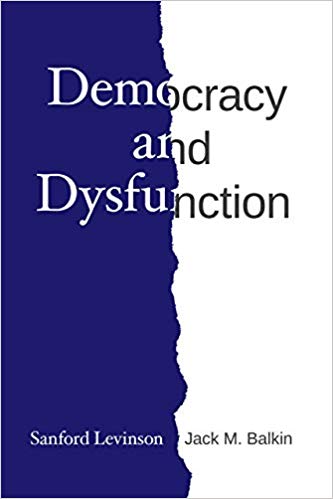
Sanford Levinson and Jack M. Balkin, Democracy and Dysfunction (University of Chicago Press, 2019)

Sanford Levinson, Written in Stone: Public Monuments in Changing Societies (Duke University Press 2018)

Mark A. Graber, Sanford Levinson, and Mark Tushnet, eds., Constitutional Democracy in Crisis? (Oxford University Press 2018)

Gerard Magliocca, The Heart of the Constitution: How the Bill of Rights became the Bill of Rights (Oxford University Press, 2018)

Cynthia Levinson and Sanford Levinson, Fault Lines in the Constitution: The Framers, Their Fights, and the Flaws that Affect Us Today (Peachtree Publishers, 2017)

Brian Z. Tamanaha, A Realistic Theory of Law (Cambridge University Press 2017)

Sanford Levinson, Nullification and Secession in Modern Constitutional Thought (University Press of Kansas 2016)

Sanford Levinson, An Argument Open to All: Reading The Federalist in the 21st Century (Yale University Press 2015)

Stephen M. Griffin, Broken Trust: Dysfunctional Government and Constitutional Reform (University Press of Kansas, 2015)

Frank Pasquale, The Black Box Society: The Secret Algorithms That Control Money and Information (Harvard University Press, 2015)

Bruce Ackerman, We the People, Volume 3: The Civil Rights Revolution (Harvard University Press, 2014)
Balkinization Symposium on We the People, Volume 3: The Civil Rights Revolution

Joseph Fishkin, Bottlenecks: A New Theory of Equal Opportunity (Oxford University Press, 2014)

Mark A. Graber, A New Introduction to American Constitutionalism (Oxford University Press, 2013)

John Mikhail, Elements of Moral Cognition: Rawls' Linguistic Analogy and the Cognitive Science of Moral and Legal Judgment (Cambridge University Press, 2013)

Gerard N. Magliocca, American Founding Son: John Bingham and the Invention of the Fourteenth Amendment (New York University Press, 2013)

Stephen M. Griffin, Long Wars and the Constitution (Harvard University Press, 2013)

Andrew Koppelman, The Tough Luck Constitution and the Assault on Health Care Reform (Oxford University Press, 2013)

James E. Fleming and Linda C. McClain, Ordered Liberty: Rights, Responsibilities, and Virtues (Harvard University Press, 2013)
Balkinization Symposium on Ordered Liberty: Rights, Responsibilities, and Virtues

Andrew Koppelman, Defending American Religious Neutrality (Harvard University Press, 2013)

Brian Z. Tamanaha, Failing Law Schools (University of Chicago Press, 2012)

Sanford Levinson, Framed: America's 51 Constitutions and the Crisis of Governance (Oxford University Press, 2012)

Linda C. McClain and Joanna L. Grossman, Gender Equality: Dimensions of Women's Equal Citizenship (Cambridge University Press, 2012)

Mary Dudziak, War Time: An Idea, Its History, Its Consequences (Oxford University Press, 2012)

Jack M. Balkin, Living Originalism (Harvard University Press, 2011)

Jason Mazzone, Copyfraud and Other Abuses of Intellectual Property Law (Stanford University Press, 2011)

Richard W. Garnett and Andrew Koppelman, First Amendment Stories, (Foundation Press 2011)

Jack M. Balkin, Constitutional Redemption: Political Faith in an Unjust World (Harvard University Press, 2011)

Gerard Magliocca, The Tragedy of William Jennings Bryan: Constitutional Law and the Politics of Backlash (Yale University Press, 2011)

Bernard Harcourt, The Illusion of Free Markets: Punishment and the Myth of Natural Order (Harvard University Press, 2010)

Bruce Ackerman, The Decline and Fall of the American Republic (Harvard University Press, 2010)
Balkinization Symposium on The Decline and Fall of the American Republic

Ian Ayres. Carrots and Sticks: Unlock the Power of Incentives to Get Things Done (Bantam Books, 2010)

Mark Tushnet, Why the Constitution Matters (Yale University Press 2010)

Ian Ayres and Barry Nalebuff: Lifecycle Investing: A New, Safe, and Audacious Way to Improve the Performance of Your Retirement Portfolio (Basic Books, 2010)
.jpg)
Jack M. Balkin, The Laws of Change: I Ching and the Philosophy of Life (2d Edition, Sybil Creek Press 2009)

Brian Z. Tamanaha, Beyond the Formalist-Realist Divide: The Role of Politics in Judging (Princeton University Press 2009)
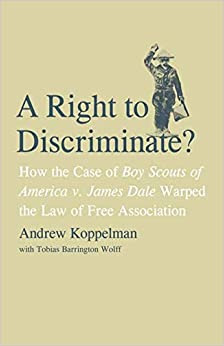
Andrew Koppelman and Tobias Barrington Wolff, A Right to Discriminate?: How the Case of Boy Scouts of America v. James Dale Warped the Law of Free Association (Yale University Press 2009)

Jack M. Balkin and Reva B. Siegel, The Constitution in 2020 (Oxford University Press 2009)

Heather K. Gerken, The Democracy Index: Why Our Election System Is Failing and How to Fix It (Princeton University Press 2009)

Mary Dudziak, Exporting American Dreams: Thurgood Marshall's African Journey (Oxford University Press 2008)

David Luban, Legal Ethics and Human Dignity (Cambridge Univ. Press 2007)

Ian Ayres, Super Crunchers: Why Thinking-By-Numbers is the New Way to be Smart (Bantam 2007)

Jack M. Balkin, James Grimmelmann, Eddan Katz, Nimrod Kozlovski, Shlomit Wagman and Tal Zarsky, eds., Cybercrime: Digital Cops in a Networked Environment (N.Y.U. Press 2007)

Jack M. Balkin and Beth Simone Noveck, The State of Play: Law, Games, and Virtual Worlds (N.Y.U. Press 2006)

Andrew Koppelman, Same Sex, Different States: When Same-Sex Marriages Cross State Lines (Yale University Press 2006)

Brian Tamanaha, Law as a Means to an End (Cambridge University Press 2006)

Sanford Levinson, Our Undemocratic Constitution (Oxford University Press 2006)

Mark Graber, Dred Scott and the Problem of Constitutional Evil (Cambridge University Press 2006)

Jack M. Balkin, ed., What Roe v. Wade Should Have Said (N.Y.U. Press 2005)

Sanford Levinson, ed., Torture: A Collection (Oxford University Press 2004)
Balkin.com homepage
Bibliography
Conlaw.net
Cultural Software
Writings
Opeds
The Information Society Project
BrownvBoard.com
Useful Links
Syllabi and Exams

