Balkinization
an unanticipated consequence of
Jack M. Balkin
Balkinization Symposiums: A Continuing List
E-mail:
Jack Balkin:
jackbalkin at yahoo.com
Bruce Ackerman
bruce.ackerman at yale.edu
Ian Ayres
ian.ayres at yale.edu
Corey Brettschneider
corey_brettschneider at brown.edu
Mary Dudziak
mary.l.dudziak at emory.edu
Joey Fishkin
joey.fishkin at gmail.com
Heather Gerken heather.gerken at yale.edu
Abbe Gluck abbe.gluck at yale.edu
Mark Graber
mgraber at law.umaryland.edu
Stephen Griffin
sgriffin at tulane.edu
Jonathan Hafetz
jonathan.hafetz at shu.edu
Jeremy Kessler
jkessler at law.columbia.edu
Andrew Koppelman
akoppelman at law.northwestern.edu
Marty Lederman
msl46 at law.georgetown.edu
Sanford Levinson
slevinson at law.utexas.edu
David Luban
david.luban at gmail.com
Gerard Magliocca
gmaglioc at iupui.edu
Jason Mazzone
mazzonej at illinois.edu
Linda McClain
lmcclain at bu.edu
John Mikhail
mikhail at law.georgetown.edu
Frank Pasquale
pasquale.frank at gmail.com
Nate Persily
npersily at gmail.com
Michael Stokes Paulsen
michaelstokespaulsen at gmail.com
Deborah Pearlstein
dpearlst at yu.edu
Rick Pildes
rick.pildes at nyu.edu
David Pozen
dpozen at law.columbia.edu
Richard Primus
raprimus at umich.edu
K. Sabeel Rahmansabeel.rahman at brooklaw.edu
Alice Ristroph
alice.ristroph at shu.edu
Neil Siegel
siegel at law.duke.edu
David Super
david.super at law.georgetown.edu
Brian Tamanaha
btamanaha at wulaw.wustl.edu
Nelson Tebbe
nelson.tebbe at brooklaw.edu
Mark Tushnet
mtushnet at law.harvard.edu
Adam Winkler
winkler at ucla.edu
Compendium of posts on Hobby Lobby and related cases
The Anti-Torture Memos: Balkinization Posts on Torture, Interrogation, Detention, War Powers, and OLC
The Anti-Torture Memos (arranged by topic)
Recent Posts
Bad News for Mail Robbers, final version
Invisible Hand or Hidden Fist?
How Long Should Tenure Last?
“Politics is the shadow cast on society by Big Business”
The Future of the Federal Reserve
Rethinking Sorrell v. IMS Health: Privacy as a First Amendment Value
Originalism and Article Five
Tri-Faith America
Why Reduce Health Care Costs?
Enforcing but Not Defending DOMA
Law Reviews State New Policy on Exploding Offers
Congratulations to ProPublica on its Pulitzer
The Unraveling of Boumediene: Habeas Still a Right without a Remedy
John Peter Altgeld
Tax Day Stats
ClassCrits Conference Call for Papers
Grandma Got Run Over By a Voucher
Barack Obama as colonial master
Road to No Fair Use
Judicial elections
Fed & OCC vs. Transparency
Fareed Zakaria connects the dots!!
More Constitutional Liability Rules
Neoliberalism and Punishment Theory
Economic Policy for the Worried Wealthy
Constitutional Liability Rules -- Part IV
The Hugo Black Lecture, Part V
![[Powered by Blogger]](https://lh3.googleusercontent.com/blogger_img_proxy/AEn0k_t7__VV9m78Ahk2g5k4_XoIMQbd7sg2urZPKcSCTkPzHVPVfLMoQk8RbSBSoaGocHZcSWkQhjVHuKpKNpdcmZRYKy79SN0rFjdpkbn9Wug_=s0-d)
Just A Few Blogs
ACS Blog
Alas, a Blog
Althouse
Arts and Letters Daily
Atrios (Eschaton)
Bill of Health
Buzzflash.com
Buzz Machine
Cato at Liberty
Juan Cole (Informed Comment)
Concurring Opinions
The Constitution in 2020
Corrente
Crooked Timber
Daily Howler
Daily Kos
Dana Boyd
Brad DeLong
Digby (Hullabaloo)
Discriminations
Daniel Drezner
Kevin Drum (Mother Jones)
Electrolite
En Banc
Eunomia (Daniel Larison)
Fafblog
Michael Froomkin (Discourse.net)
GovLab (Beth Noveck)
Rick Hasen (Election Law)
History News Network
How Appealing
Ignatz (Sam Heldman)
The Importance of (Ernie Miller)
Infolaw
Instapundit
International Economic Law and Policy Blog
IntLawGrrls
Jacob Levy
Jesus' General
Jurisdynamics
The Kitchen Cabinet
Mark Kleiman
Law Blog Central
Larry Lessig
Lawyers, Guns and Money
Liberal Oasis
Brian Leiter's Law School Reports
The Leiter Reports
Marginal Revolution
Megan McArdle
Memeorandum
Metafilter
Mirror of Justice
The New Republic
Newseum
No More Mister Nice Blog
Brendan Nyhan
Opinio Juris
Orcinus
The Originalism Blog
Pandagon
Passport (Foreign Policy)
Overcoming Bias
Political Animal (Washington Monthly)
Political Theory Daily Review
Political Wire (Taegan Goddard)
The Poor Man
Virginia Postrel
Prawfsblawg
Public Reason
Jonathan Rauch
Raw Story
Redstate
ReligiousLeftLaw.com
Reporters Committee For Freedom of the Press
Reproductive Rights Blog
Rothman's Roadmap to the Right of Publicity
SCOTUS Blog
Seeing the Forest
Clay Shirky
The Shifted Librarian
The Situationist
Larry Solum (Legal Theory)
Andrew Sullivan
Talking Points Memo
Talk Left
Tapped
Tbogg
TechPresident
The Paper Chase (Jurist)
Tom Paine
Tom Tomorrow (This Modern World)
Eve Tushnet
Uggabugga
University of Chicago Law School Faculty Blog
Unqualified Offerings
The Volokh Conspiracy
War and Piece (Laura Rozen)
Wampum
Oliver Willis
Wonkette
Written Description
Matthew Yglesias
Yin
Your Choice of Feeds
1. XML
powered by

2. Atom Feed
3. RSS 2.0
Bad News for Mail Robbers, final version
Andrew Koppelman
My argument for the obvious constitutionality of the health care mandate, somewhat augmented from the earlier SSRN version to explain why the states could not separately address the insurance issue (and why Congressional action was therefore warranted), is now available in its final version at the Yale Law Journal Online, here.
Posted
4:51 PM
by Andrew Koppelman [link]
Invisible Hand or Hidden Fist?
Frank Pasquale
In his press conference last week, Ben Bernanke concluded on an upbeat note. He had high hopes for a US recovery, since he believed that the Great Financial Crisis (GFC) of 2008 hadn't taken from the US any of its basic productive capacity.
Whatever the merits of that view, the GFC did highlight debilitating trends in US finance infrastructure that have been intensifying for years. In this week's Businessweek, Hernando de Soto (with Karen Weise) highlights one of the most important: the opacity of key markets and relationships. With scant exaggeration, de Soto warns that the US is on its way to levels of uncertainty more common in developing and communist countries: During the second half of the 19th century, the world's biggest economies endured a series of brutal recessions. At the time, most forms of reliable economic knowledge were organized within feudal, patrimonial, and tribal relationships. . . . The result was a huge rift between the old, fragmented social order and the needs of a rising, globalizing market economy.
To prevent the breakdown of industrial and commercial progress, hundreds of creative reformers concluded that the world needed a shared set of facts. . . . The result was the invention of the first massive "public memory systems" to record and classify—in rule-bound, certified, and publicly accessible registries, titles, balance sheets, and statements of account—all the relevant knowledge available, whether intangible (stocks, commercial paper, [etc]), or tangible (land, buildings, boats, machines, etc.). Knowing who owned and owed, and fixing that information in public records, made it possible for investors to infer value, take risks, and track results. The final product was a revolutionary form of knowledge: "economic facts."
Read more »
Posted
4:49 PM
by Frank Pasquale [link]
How Long Should Tenure Last?
Jason Mazzone
There is a lot of talk these days about tenure in law schools. Not surprisingly, law school employees favor tenure. Michael Olivas, current President of the Association of American Law Schools (essentially a union boss), has written a strong defense of tenure (and similar job security mechanisms) in response to an ABA proposal for schools to have greater flexibility to hire and fire as they prepare students for the new realities of the legal profession. (Brian Tamanaha has offered a thoughtful response to Olivas's position.)
Posted
3:02 PM
by Jason Mazzone [link]
“Politics is the shadow cast on society by Big Business”
Frank Pasquale
In the run-up to passage of financial reform, internal tensions among Democrats were frequently on display. (The GOP political landscape appears much simpler: whatever can be labelled as "anti-regulation" gets approval from both the leadership and the Tea Party freshmen.) Now the grand guignol over interchange fees has exposed growing faultlines among Senate Democrats. The future of the party lies either with Chuck "Wall Street" Schumer, or Dick "Austerity" Durbin. Their struggle illuminates a great deal about the modern legislative process.
Ryan Grim and Zach Carter lay out the contours of the battle: Delivery surcharge. Paper charge. Equipment charge. There’s an additional fee for using cards from banks outside his contract, but [retailer Charlie] Chung says he has no way of knowing until he’s gotten his bill how much of that pricier plastic has been swiped. The fees Chung pays are a tiny fraction of Wall Street’s swipe fee windfall; banks take in a combined $48 billion a year from these “interchange” fees on debit and credit cards, according to analysts at The Nilson Report. That money comes out of the pockets of consumers as well as merchants, as stores pass on whatever costs they can to their customers.
Last year’s financial reform bill ordered the Federal Reserve to crack down on debit card swipe fees, a $16 billion pool of money from which $8 billion flows to just 10 banks. As a concession to Wall Street, credit card fees were left unscathed. But the clock never ticks down to zero in Washington: one year’s law is the next year’s repeal target.
Mike Konczal and Adam Levitin have exhaustively analyzed the interchange battles; suffice it to say, it's hard to read their work (and compare fees internationally) without getting the sense that banks are getting a massive windfall here. Usually that kind of extractive industry can use its profits to buy endless favors in DC. But the extremely high rates started irking retailers, who had enough leverage to push for legislation that required the Fed to reduce the swipe fees. Now Chuck Schumer (and his surrogate, Jon Tester) want to delay that reduction; Illinois Senator Dick Durbin, who sponsored it, is fighting back. According to Carter & Grim, "118 ex-government officials and aides are currently registered to lobby on behalf of banks in the fee fight," and retailers "have signed up at least 124 revolving-door lobbyists."
In phrasing a bit less poetic than the Dewey quote I titled this post with, a "frustrated moderate Democratic senator" described the battle as emblematic of the broader tone in Washington:
Read more »
Posted
10:56 PM
by Frank Pasquale [link]
The Future of the Federal Reserve
Frank Pasquale
The Roosevelt Institute will be hosting an event on the Future of the Federal Reserve tomorrow. They've got an extraordinary lineup of speakers, including Joe Stiglitz, Mike Konczal, Matt Yglesias, and law prof Tim Canova, who's done very interesting work on central bank independence and Fed history. The conference could not be more topical, given a number of recent developments:
1) Shahien Nasiripour has reported that "newly-released study from the Congressional Research Service bolsters claims that the nation's largest banks profited off the Federal Reserve's financial crisis-era programs by borrowing cash for next to nothing, then lending it back to the federal government at substantially higher rates." Nasiripour has repeatedly broken important news about unaccountable Fed and Treasury behavior. Though this article does not indicate the term of the banks' loans back to the government, it does raise troubling questions about the role of Fed policy in propping up balance sheets.
2) Tomorrrow is also the first press conference for a Federal Reserve Chairman. As Yves Smith notes, "It’s remarkable that an official widely described as 'the second most powerful person in America' has managed to sidestep basic measures of accountability to the public and transparency like this for so long." I hope someone asks her proposed question for Bernanke: Given the extraordinary level of support extended to major banks during the crisis and now, via measures like super low interest rates and continued regulatory forbearance, why does the Fed continue to maintain the fiction that they are private companies? Why doesn’t the Fed treat them as humble utilities and regulate them accordingly?
Read more »
Posted
10:36 PM
by Frank Pasquale [link]
Rethinking Sorrell v. IMS Health: Privacy as a First Amendment Value
Frank Pasquale
The Supreme Court will soon hear oral arguments in Sorrell v. IMS Health. The case pits medical data giant IMS Health (and some other plaintiffs) against the state of Vermont, which restricted the distribution of certain "physician-identified" medical data if the doctors who generated the data failed to affirmatively permit its distribution.* I have contributed to an amicus brief submitted on behalf of the New England Journal of Medicine regarding the case, and I agree with the views expressed by brief co-author David Orentlicher in his excellent article Prescription Data Mining and the Protection of Patients' Interests. I think he, Sean Flynn, and Kevin Outterson have, in various venues, made a compelling case for Vermont's restrictions. But I think it is easy to "miss the forest for the trees" in this complex case, and want to make some points below about its stakes.**
Privacy Promotes Free Expression
Privacy has repeatedly been subordinated to other, competing values. Priscilla Regan chronicles how efficiency has trumped privacy in U.S. legislative contexts. In campaign finance and citizen petition cases, democracy has trumped the right of donors and signers to keep their identities secret. Numerous tech law commentators chronicle a tension between privacy and innovation. And now Sorrell is billed as a case pitting privacy against the First Amendment.
Read more »
Posted
10:37 PM
by Frank Pasquale [link]
Originalism and Article Five
Gerard N. Magliocca
I am neither an originalist nor a constitutional theorist, though I am often mistaken for one or the other. Nevertheless, there is something about the ongoing interpretative debate that strikes me as worth talking about.
There are, I think, two abstract questions that divide traditional originalists from living constitutionalists or Jack's version of originalism. (The concrete question that divides them is whether Roe v. Wade was correctly decided, but leave that aside.) One concerns the best mode of changing the Constitution. Everyone agrees that the Constitution must change from time to time, but how? Traditional originalists want that change to come exclusively through Article Five. That could be because they think that text is a better anchor for legal authority, or because they think that an amendment is more legitimate because many democratic bodies (and a supermajority in Congress) must vote yes. By contrast, living constitutionalists tend to think that text is a clumsy way of formulating legal principles as compared to judicial opinions, or that there is adequate democratic ratification from social movements that win several elections and place their sympathizers on the Court.
The other question is about how hard it should be to change the Constitution. A living constitutionalist thinks that Article Five makes it too hard. Traditional originalists do not agree. (Indeed, that may explain why they want major changes to go through that process.) Nevertheless, people spend relatively little time talking about how Article Five works and how it can be improved. I wonder whether traditional originalists would do better to concentrate on lowering the threshold for amendments instead of arguing about the alleged superiority of their method. And I wonder how living constitutionalists feel about interpretation in states where a majority can amend through a referendum. In other words, is their argument still about the use of text or not?
My contribution to this discussion, though I wasn't fully aware of it at the time, comes in two papers. One is in Constitutional Commentary and explores how people came to the conclusion that amendments are hard to ratify. People didn't always feel that way--the current view basically developed during the Court-packing crisis of 1937. Another explores how state legislatures call for a constitutional convention to pressure Congress into action under Article Five. There are other workarounds in the Article Five process that I hope to explore in a paper that I'm working on now.
Posted
1:55 PM
by Gerard N. Magliocca [link]
Tri-Faith America
Andrew Koppelman
Kevin Schultz’s marvelous new book, Tri-Faith America: How Catholics and Jews Held Postwar America to its Protestant Promise, nicely illuminates the pre-World War II origins of contemporary ideals of tolerance and inclusion. It also sheds useful light on Justice Scalia’s recent efforts to reconceptualize the Establishment Clause.
Read more »
Posted
2:46 PM
by Andrew Koppelman [link]
Why Reduce Health Care Costs?
Frank Pasquale
One rare point of elite consensus is that the US needs to reduce health care costs. Frightening graphs expose America as a spendthrift outlier. The President's first OMB director tirelessly tried to "bend the cost curve." The President's opponents are even more passionate about austerity.
Journalists and academics support that political consensus. Andrew Sullivan calls health spending a "giant suck from the rest of the working economy." Gregg Bloche estimates that "the 30% of health care spending that's wasted on worthless care" is "about the price of the $700 billion mortgage bailout, squandered every year." He calls rising health spending an "existential challenge," menacing other "national priorities." Perhaps inspired by Children of the Corn, George Mason economist Robin Hanson compares modern medicine to a voracious brat: King Solomon famously threatened to cut a disputed baby in half, to expose the fake mother who would permit such a thing. The debate over medicine today is like that baby, but with disputants who won’t fall for Solomon’s trick. The left says markets won’t ensure everyone gets enough of the precious medical baby. The right says governments produce a much inferior baby. I say: cut the baby in half, dollar-wise, and throw half away! Our “precious” medical baby is in fact a vast monster filling our great temple, whose feeding starves our people and future. Half a monster is plenty.
But when you scratch the surface of these sentiments, you have to wonder: is the overall level of health care spending really the most important threat facing the country? Is it one of the most important threats? There are many ways to raise revenue to pay for rising health costs. Aspects of the Affordable Care Act, like ACOs and pilot projects, are designed to help root out unnecessary care.
I am happy to join the crusade against waste. But why focus on total health spending as particularly egregious or worrisome? Let's explore some of the usual rationales.
Read more »
Posted
9:10 AM
by Frank Pasquale [link]
Enforcing but Not Defending DOMA
Mark Tushnet
The decision by the House leadership to hire (expensive) outside counsel to defend DOMA brings back some questions about the Obama administration's position. (One reason I'm a bad blogger is that it takes me time to think through what often seem to me complicated legal questions.) One such question is whether the administration's decision not to defend DOMA but to enforce it makes sense.
Posted
10:37 PM
by Mark Tushnet [link]
Law Reviews State New Policy on Exploding Offers
JB
A number of U.S. law reviews, including the Harvard Law Review, Yale Law Journal, Stanford Law Review, University of Chicago Law Review, Boston University Law Review, Minnesota Law Review, and William and Mary Law Review, have decided to end the practice of "exploding offers" and commit to give every author seven days to respond to an offer of publication.
Read more »
Posted
1:37 PM
by JB [link]
Congratulations to ProPublica on its Pulitzer
Frank Pasquale
Though executive branch officials have disappointed many with their investigations of the financial crisis, some journalists have done an outstanding job. Over the past year, I've frequently linked to stories from The Wall Street Money Machine, an exceptional series by reporters at ProPublica. Today, the Pulitzer Committee recognized their efforts, giving the first award in its storied history to a series that never appeared in print: ProPublica reporters Jesse Eisinger and Jake Bernstein have been awarded a Pulitzer Prize for National Reporting for their stories on how some Wall Street bankers, seeking to enrich themselves at the expense of their clients and sometimes even their own firms, at first delayed but then worsened the financial crisis.
The Eisinger and Bernstein series was essential because it helped challenge the idea that all "banks" or "hedge funds" are stable, self-preserving entities that would guard against bad behavior to preserve their reputations. Anyone familiar with the work of Karen Ho or Satyajit Das would take a darker and more realistic view: that is often in the interest of individuals in the industry to be part of shadowy and unstable ensembles of desks and divisions whose main goal is slipping by whatever bonus-maximizing scheme won’t set off alarms among risk managers and regulators. In a piece called "The Subsidy," Eisinger and Bernstein explained how payments of a few million in “bonuses” to employees running one division of Merrill Lynch helped those running another division “offload” billions of dollars in toxic assets to their own firm:
Read more »
Posted
8:01 PM
by Frank Pasquale [link]
The Unraveling of Boumediene: Habeas Still a Right without a Remedy
Jonathan Hafetz
The Supreme Court today denied the certiorari petition in Kiyemba v. Obama, the long-running battle involving Uighur prisoners detained at Guantanamo Bay. Four Justices (Breyer, Kennedy, Ginsburg, and Sotomayor) issued a separate statement, however, leaving the door open to future challenges by the five remaining Uighurs (or others) seeking release from unlawful detention at Guantanamo. (Kagan did not take part in the consideration of the petition, presumably based on her prior involvement in the case as Solicitor General).
The issue raised by the Uighur litigation is central: does a federal habeas judge have the authority to order the release of a prisoner unlawfully detained at Guantanamo Bay? The Court previously granted certiorari in Kiyemba to decide this question—where an order of release to the United States was the only available remedy. The problem was that after certiorari was granted, but before argument, the Obama administration found at least one country--Palau--willing to accept the Uighur petitioners. Several Uighurs took the offer; others did not. The Court vacated the D.C. Circuit’s opinion denying relief and remanded for reconsideration in light of these new facts. The D.C. Circuit essentially reinstated its earlier opinion, which denied that federal judges have any power to order the release of a Guantanamo detainee into the United States, even if that was the only alternative to continued unlawful detention. Judge Rogers concurred, reasoning that while a habeas judge has the power to order the release of a Guantanamo prisoner into the United States, that power should not have been exercised in Kiyemba in light of the offer of repatriation elsewhere. Today’s separate statement largely endorses Rogers’ approach. Although Palau’s offer is no longer on the table, the four Justices noted the government’s offer to renew discussions with Palau as well as its continuing effort to find other options for resettlement. (Presumably, if none of those options materialize, the Uighurs can again seek Supreme Court review).
The D.C. Circuit panel’s approach in Kiyemba flatly contradicts the Supreme Court’s decision in Boumediene v. Bush, which said that the right of habeas corpus protected by the Suspension Clause must include the power “to formulate and issue appropriate orders for relief, including, if necessary, an order directing the prisoner’s release.” Today’s separate statement, like the Court’s prior grant of certiorari in Kiyemba, acknowledges as much. The problem is that no case presents the factual posture the Court considers appropriate to affirm that right.
On one level, Kiyemba highlights a broader problem in the “enemy combatant” habeas litigation: the government’s ability to maintain control of detention decisions, and avoid adverse results, by altering factual patterns at the eleventh hour to evade Supreme Court review. As it stands, district judges have no authority to order the release of a detainee to the United States even when it is the only remedy. Moreover, they lack the authority to influence the repatriation process, including by placing the type of pressure district judges routinely place on litigants to resolve disputes. So, while the question of who may be detained is a judicial one, the question of who actually leaves Guantanamo is still within the control of the executive, nearly three years after Boumediene.
More broadly, Kiyemba reflects the D.C. Circuit’s continued defiance of the Supreme Court. Last week’s concurring opinion by Judge Silberman in Esmail v. Obama provided the most audacious example yet. Silberman described the Guantanamo habeas litigation as a “charade prompted by the Supreme Court’s defiant—if only theoretical—assertion of judicial supremacy.” (Randolph, another leader of the D.C. Circuit’s conservative wing, has lambasted Boumediene as a “mess”). Meanwhile, the Circuit continues to reverse district court habeas grants and affirm district court denials of habeas, virtually without exception.
The Supreme Court, however, has declined to review any D.C. Circuit decision since Boumediene. To be sure, one can say that none of the appeals have presented a cert-worthy issue or good vehicle for resolving important underlying questions, such as the legal category of who may be detained and the standard of proof necessary to justify indefinite imprisonment. But, even if that were true, the problem remains that the Supreme Court’s decision in Boumediene—widely regarded as a landmark separation of powers ruling—continues to be implemented by a Circuit that includes several judges who believe it was wrongly decided and who are determined to gut it.
Posted
12:36 PM
by Jonathan Hafetz [link]
John Peter Altgeld
Gerard N. Magliocca
Today marks the official release of my new book (psst--top right of your screen) and I wanted to mark that with a slightly quirky post that links up to themes that are frequently expressed here. So let's talk about the constitutional rule that only natural-born citizens (as opposed to naturalized ones) can be President. Sandy has written at length about the stupidity of this provision, and I certainly agree. Indeed, this is probably the least defensible clause in the text.
The "natural-born" provision, though, is usually discussed in a political vacuum. What I mean by that is those who oppose the rule typically list famous leaders who were barred from running for President as proof that no such requirement should be imposed. For example, there's Henry Kissinger, Madeleine Albright, Albert Gallatin (the Treasury Secretary under Jefferson and Madison), and Arnold Schwarzenegger. The problem is that none of these people had a prayer of being elected President. Since that is true, it is hard to make the case that barring naturalized citizens from the White House inflicts a concrete harm, even though the exclusion is at odds with the principle that all citizens are equal before the law.
What does this have to do with William Jennings Bryan? The answer is that, but for the "natural-born" rule, the Democratic presidential nominee in 1896 could well have been John Peter Altgeld, the Governor of Illinois. Altgeld was very popular with liberals because of his decision to give clemency to the Haymarket Rioters, who were convicted of a bombing in Chicago after a deeply flawed trial that was close to a lynch mob. He also strongly supported the Pullman Railroad Strike of 1894, led by Eugene V. Debs, and fought against President Cleveland's decision to send troops into Chicago to break the strike. More important, the Democratic Convention in 1896 was in Chicago, and the ability of a home-state favorite to influence the convention was well-established at that time (Lincoln did this at the 1860 GOP Convention in Chicago).
Alas, Altgeld was born in Germany. Who knows if he would have won the Presidency, but he is probably the most consequential person ever ensnared by the Natural-Born Citizen Clause. And given the importance of the 1896 election for constitutional law, as my book discusses at length, the impact of substituting Altgeld for Bryan could have been profound.
Posted
12:26 PM
by Gerard N. Magliocca [link]
Tax Day Stats
Frank Pasquale
A few stats & stories in honor of Tax Day: 17% . . . was the effective tax rate paid by the 400 Americans with the highest adjusted gross income in 2007, the most recent year with IRS data available. The figure is down from almost 30 percent in 2005. [W]ith top rates on ordinary income, capital gains, dividends, estates and gifts at or near historic lows [this year could be even better].
A. This "could be the best tax day for rich since '30s:"
B. A tax loophole for the top 25 hedge funders is worth about 120,000 teachers' salaries.
C. Here are the favorite shelters and dodges of America's wealthiest.
D. A journalist states that "Tax havens have grown so fast in the era of globalization, since the 1970s, that they are now right at the heart of the global economy."
Read more »
Posted
8:41 PM
by Frank Pasquale [link]
ClassCrits Conference Call for Papers
Frank Pasquale
The ClassCrits blog has a number of interesting posts up recently. The group has announced a call for papers for a September conference; here is the notice:
Read more »
Posted
1:14 PM
by Frank Pasquale [link]
Grandma Got Run Over By a Voucher
Frank Pasquale
The "sensible liberaltarian" blogosphere is debating the wisdom of turning Medicare into direct cash payments to seniors. I guess everyone's forgotten about the bargaining power of a public option like Medicare vis a vis increasingly concentrated providers. And hey, why bother with the boring big picture of health industry trends when you can spin out thought experiments about brave individuals risking cancer nontreatment by buying cheap insurance? Somehow the hypotheticals never specify whether those who "prefer" cheap insurance do so to buy a few more rounds of golf at the country club, or to find a dinner more satisfying than catfood.
Kudos to Ezra Klein for explaining some kinks in the voucher concept: Let’s run through the cash-grant world: At age 65, grandma decides to purchase no health-care plan, as she figures she’ll just get one when she gets sick, or maybe just get one next year, or perhaps she just doesn’t want to spend money extending decrepitude. But then she has a stroke and gets rushed to the hospital. Someone is paying for that emergency care. It might be the hospital. It might be the taxpayers. But it’s someone: The paramedics aren’t going to refuse to lift her onto the gurney. And then she needs rehabilitation. Someone is going to end up paying for that, too. Or perhaps she gets leukemia and, in a display of consistency, doesn’t want heroic efforts made to fight it. But are we really prepared to deny her pain meds? Or hospice?
A Limbaughvian social Darwinist might deny the meds, but that position doesn't have much political (let alone moral) appeal. As Ryan Avent notes, the "plan is a good one right up to the point at which society is unable to tolerate preventable deaths on the sidewalk outside of the hospital for those who took it."
For a more serious consideration of the cost-control issue, check out Gregg Bloche's work. In his new book The Hippocratic Myth, he explores the rationing issue in some depth. He also looks at the promises and limits of more macro-level approaches to cost control:
Read more »
Posted
12:06 PM
by Frank Pasquale [link]
Barack Obama as colonial master
Sandy Levinson
Thanks to the Constitution, the District of Columbia has an anomolous status. It is, for some purposes of federal jurisdiction, a "state," and, of course, thanks to the 23rd Amendment, DC gets three electoral votes. However, as any resident of DC emphasizes, it continues to be treated as a ward of the national government, the equivalent of a colony without voting representation in the House or Senate or, more to the point, any of the autonomy that is presumably attached to being a state in our particular federal system. "Taxation without Representation" is the slogan on DC license plates, to capture this situation.
The City Council of DC has voted to spend the tax money of its own citizens to help pay for abortions of presumably poor and vulnerable women. Whatever one's views on abortion, there's no doubt at all that what John Marshall once called a "sovereign state" could choose to spend its own tax dollars on such a public policy (unless, of course, the Court holds that fetuses are "persons" protected by the Fourteenth Amendment, which not even Scalia has advocated). Only a colony, without any rights that the administering power need respect, could be prevented from passing such a program.
And that is exactly what Barack Obama and congressional negotiators decided to make clear. Forget the craven Congress; Barack Obama betrayed not only his contituents in DC, but also his ostensible and ostentatious devotion to "democracy" around the world by acquiscing to the denial of self-government to the District of Columbia. He should be completely ashamed of himself, as should any Democrat (or, more to the point, "democrat") who votes for the "compromise." Perhaps they should vote for it anyway; after all, there would have been no Constitution in 1787 without a willingness to collaborate with slaveowners and submit to the extortionate demands of small states re allocation of power in the Senate, and maybe (but only maybe) the Constitution was worth such compromises. I obviously find this an open question. But we should have no illusions about the character of the President's disregard for self-government by Washingtonians. From his perspective (albeit, no doubt, with genuine regret, like the Walrus and the Carpenter vis-a-vis their oysters), they are mere colonists, to be ruthlessly dismissed when other political interests demand it. Change we can believe in, indeed!
Posted
5:23 PM
by Sandy Levinson [link]
(40) comments
Road to No Fair Use
Jason Mazzone
Former Florida Governor Charlie Crist has issued a bizarre video apology (telepology?) for using a David Byrne song, "Road to Nowhere," as part of Crist's Senate 2010 campaign ad. Crist's apology is presumably part of the settlement, announced yesterday, of Byrne's $1 million lawsuit against the Crist campaign.
Posted
3:00 PM
by Jason Mazzone [link]
Judicial elections
Sandy Levinson
So what should right- (or left-)minded people think of elected judiciaries? The conventional wisdom among traditional elites is "not much." They politicize a process that should, ideally, be devoted to discovering and then placing on the bench the "best men and women" who will perform the tasks of judging in a suitably non-political manner. The problem, of course, is that there's no reason at all to believe that turning appointment over to presidents or governors "depoliticizes" the process, though it might make it more opaque. Consider Sandra Day O'Connor, currently leading a national campaign against elected judiciaries. At an Aspen gathering almost two years ago, during which I moderated a panel that she and Justice Stephen Breyer were on, she forthrightly introduced herself by telling the story of her own nomination: Ronald Reagan wanted to name a woman, and he tasked William French Smith, his first Attorney General, to find a "Republican woman" who might be qualified for the Supreme Court. As a matter of fact, as of 1981, the list wasn't very long, and she emerged at the top of it. Perhaps one could have a less "political" judicial selection process by, say, requiring 2/3 votes for confirmation or by turning appointment over to "non-partisan commissions" (though how exactly would they be selected, and what does "non-partisanship" mean, exactly). But as between unfettered executive branch selection (even with Senate confirmation) and elections, I think it's a closer call than many people concede. I warmly recommend a forthcoming book by Harvard legal historian Jed Shugerman, The People's Courts: The Rise of Judicial Elections and the Judicial Power in America (Harvard U. Press), which notes that the "Barnburners," at the 1846 constitutional convention in New York, fought for judicial elections precisely to clip the power of New York governors and his legislative cronies to place their supporters on the bench, where they would simply rubberstamp their patrons policies. Judicial elections were viewed as a way of reinforcing judicial independence and, indeed, judicial supremacy vis-a-vis legislatures and executives inclined to push the envelope.
Now, for good reason, we are well aware of a lot of less desirable features of judicial elections, but I still find it a genuinely debatable issue. All of this is by way of congratulating the (bare) majority of Wisconsin voters, who appear to have voted out of office a distinctly conservative Republican judge in favor of a Democratic replacement. It was a bit of truly good news for many of us, and I presume that it must put the fear of God (or at least an aroused electorate) in the calculations of many otherwise supine Republicans. It's really quite nonsensical for Republicans to take pleasure in the fact that Prosser was able to achieve basically a tie vote, inasmuch as he was initially favored to win in a walk, as a long-time incumbent, running in ostensibly non-partisan elections, against what appears to be a somewhat less than overwhelmingly impressive Democratic opponent. I'm not sure how truly interesting next year's presidential election will be, because at this moment it remains impossible to identify a Republican candidate (other than David Petraeus) who might actually beat Obama. But there will be a host of absolutely riveting elections down the ballot, including recall elections and, for the cognescenti, the option in Ohio for voters to call a new state constitutional convention.
One of the things this demonstrates, of course, is how truly different (and more democratic) almost all state constitutions are than the national Constitution, the least democratic of America's 51 constitutions. Maybe this is good, maybe not, but it certainly gives rise to such events as yesterday's important face-off in Wisconsin,, and, at this moment at least, I find it hard to argue that that is not a good thing. Less good, from my perspective, was the firing of three capable Iowa judges because they joined in the same-sex marriage decision in the Iowa Supreme Court, but, of course, there are no perfect constitutions, and one has to make "all things considered" calcuations about what systems are preferable.
Posted
10:18 PM
by Sandy Levinson [link]
(71) comments
Fed & OCC vs. Transparency
Frank Pasquale
The Obama Administration has been no great friend of transparency, as Danielle Citron, David Levine, and Glenn Greenwald have shown. Obama paradoxically "accepted [a] 'transparency' award [last week] in a closed, undisclosed meeting at the White House."
Unfortunately, secrecy has also been a troubling practice at the Fed and other financial regulators over the past few years. As Gretchen Morgenson has noted, In August 2007, as world financial markets were seizing up, domestic and foreign banks began lining up for cash from the Federal Reserve Bank of New York. . . . Thus began the bank run that set off the financial crisis of 2008. But unlike other bank runs, this one was invisible to most Americans. Until last week, that is, when the Fed pulled back the curtain. Responding to a court ruling, it made public thousands of pages of confidential lending documents from the crisis. The data dump arose from a lawsuit initiated by Mark Pittman, a reporter at Bloomberg News, who died in November 2009. Upon receiving his request for details on the central bank’s lending, the Fed argued that the public had no right to know. The courts disagreed.
It's not just the Fed that's been opaque. I've previously discussed the Office of the Comptroller of the Currency here and here. Given those accounts, it's no surprise that the agency continues to serve, rather than police, big banks. The Maryland Commissioner of Financial Regulation has testified that OCC "forbade national banks from providing loss mitigation data to the states." Matt Stoller explains the significance of that decision. Without loss mitigation data, regulators found it difficult to detect and deter loan modifications that hurt struggling homeowners. Once reported, officials like Kaufman could identify the practices that led to redefaults. As Stoller explains:
Read more »
Posted
6:39 PM
by Frank Pasquale [link]
Fareed Zakaria connects the dots!!
Sandy Levinson
Fareed Zakaria has indeed connected the dots in a remarkable essay in Time. We finally have a major-league pundit who is willing to criticize our 18th century Constitution. As we prepare for a government breakdown and the potential collapse of the world financial market should House Republicans refuse to increase the debt limit, will others join him in recognizing that the Constitution, in all too many ways, is comparable to the Articles of Confederation in terms of the dysfunctional political system it has helped (even if, surely, not solely caused) bring about? Or will we settle for almost pointless denunciations, depending on one's political views, of President Obama, John Boehner, Mitch McConnell, etc. (Perhaps I should refrain from blaming "House Republicans" for threatening financial collapse, since a better-designed political system might have saved us from being held hostage by political and economic lunatics. I see no particular point in opening this short rant to comments. When I offer a more truly substantial argument, I will happily receive comments. The most important thing is to encourage everyonen to read Mr. Zakaria and to reflect on the rather dismal picture he paints of the present United States.
Posted
5:25 PM
by Sandy Levinson [link]
More Constitutional Liability Rules
Gerard N. Magliocca
(Cross-posted at Concurring Opinions)
Last week I did a series of posts about "constitutional liability rules." The upshot is that sometimes the best way to design relationships between or among institutions is to allow one of them to exercise a right but face a penalty if it does. This can be, though is not always, better than allowing one body to issue a direct command that another must obey. That may be because it is easier to get political agreement on a liability rule, because a liability rule is more protective of institutional rights than a command but facilitates action more than a property rule (giving an institution an unfettered choice), or because an organ possesses some kind of veto that cannot be overridden by a command without massive costs. Here are some examples from my prior posts:
1. The Spending Clause and the "anti-commandeering/sovereign immunity" cases (Congress cannot order the states or state officials to do certain things, but they can impose costs on them if they do not.)
2. Section Two of the Fourteenth Amendment (A state could discriminate on the basis of race in voting, but if it did its representation in the Electoral College and the House of Representatives would be reduced).
3. Lords-packing in 1832 and 1911 (The House of Lords could reject crucial legislation, but if it did so its voting power would be diluted.) See also Court-packing in 1937.
4. Congress's threat to impose an economic embargo on Rhode Island in 1790 because it refused to ratify the Constitution (Rhode Island could continue to hold out, but would pay a cost).
5. The ratification of the Fourteenth Amendment in the South (A state could reject the Amendment, but if it did then it would remain under military occupation). See also the Treaty of New Echota, basically presenting the same choice to the Cherokee Nation if it refused to accept removal to the West.
Now I want to explore two more examples--the Direct Tax Clause and the Equal Protection Clause.
The Direct Tax Clause is an example of a constitutional liability rule that is in the text. The purpose of the Clause was to prevent the taxation of slaves by Congress (though it covers more than that). Now the Framers could have just prohibited such a tax, but they did not. Instead, they established a rule that made states without slaves pay if a tax was imposed on slaves by providing that the revenue collected had to be apportioned among states according to their respective populations.
The more intriguing example is the Equal Protection Clause. You can find language from the Court (most notably from Robert H. Jackson and Antonin Scalia) explaining that the requirement that laws be of general application makes it less likely than unpopular or pernicious policies will be enacted. In other words, there are instances in which we will allow Congress (or state legislatures) to pass certain statutes but we make that more costly from a political standpoint through a constitutional rule of equality.
That leads to this question: Can we derive an interpretive principle from that idea? Suppose we said that courts should invalidate a statute on equal protection grounds when they thought that such a law passed only because it was not applied generally. This obviously does not cover all of the situations in which the EPC applies ("separate-but-equal" covers everyone, but that doesn't make it lawful), but it is worth considering further.
Posted
9:08 AM
by Gerard N. Magliocca [link]
Neoliberalism and Punishment Theory
Bernard E. Harcourt
Thanks to Jeremy Kaplan-Lyman and Trevor Stutz, we had a fascinating workshop at Yale Law School last Thursday March 31st on the topic “Theorizing Punishment: From Mass Incarceration to the Death Penalty” along with David Garland from NYU and James Whitman and Tracey Meares from Yale Law School. David Garland and I got into a heated argument about the role of neoliberalism in punishment which was extremely productive, in my opinion, especially in clarifying the central argument of my book, The Illusion of Free Markets: Punishment and the Myth of Natural Order.
David Garland projected onto my book, incorrectly, a simplistic story about neoliberalism. Garland suggested that the book argues that mass incarceration can be explained, in his words, “as a function of the effect of neoliberal policies;” or, in other words, that it is the privatization of prisons and the application of neoliberal cost-benefit analyses that fueled prison expansion over the last 40 years. Garland then argued that this cannot be the case because mass incarceration is, again in his words, “an affront to neoliberal principles” of cost efficiency; and he suggested, to my great surprise, that neoliberal principles “may be an antidote” to the problems of mass incarceration.
Garland clearly has the argument of the book wrong, but his error is productive and reflects a common misperception about the role of neoliberalism in punishment theory more generally. His second argument (that neoliberalism "may be an antidote") reflects a fundamental misunderstanding about neoliberalism (reflected as well in many of the comments here) that is also enlightening. Clarifying these multiple errors may be a step forward in the debate, so I thought I would give it a try.
Read more »
Posted
8:28 PM
by Bernard E. Harcourt [link]
Economic Policy for the Worried Wealthy
Frank Pasquale
Why is the austerity movement so powerful in the US? Many people are hurting, and corporate, CEO, and finance sector gains since 2008 have been enormous. Why not expect a little more from the wealthy? Why are states from Arizona to New York going after poor Medicaid patients and schools instead? We know the economic case for austerity in a deep recession is bunk. Why its enduring appeal?
Perhaps voters have lost faith in the ability of the state to do anything competently, including redistribution. The always-insightful Elisabeth Young-Bruehl suggests as much, noting: [Americans] have been led to believe that their well-being and their democracy depend upon the success of capitalism, with its limitless growth ideology; but this very capitalism is taking over their state. They have been promised that if America has a strong, competitive, innovative economy, the benefit of that will trickle down to all, just as Ronald Reagan promised it would. Even Barack Obama speaks this language. But it is becoming obvious that there is not going to be any trickle down. . . . [The system] is a closed loop, which is not designed to trickle anything much down to support those who are not in the loop[.]
As plutonomy advances, buying power is being segregated by the very wealthy into closed circuits of spending and investment. Young-Bruehl makes a similar case about political power in a post-Citizens United world. As Martin Gilens has shown, in the US, "actual policy outcomes strongly reflect the preferences of the most affluent but bear virtually no relationship to the preferences of poor or middle income Americans."
Yet that still leaves a puzzle. The wealthy in the US may have extraordinary influence over the political process, but they could use it in many different ways. Warren Buffett complained about being taxed less than his secretary, and Bill Gates's father has fought for the estate tax. Progressive thinkers like Bruce Judson, Robert Reich, and David Callahan have all hoped for the rise of a conscientious superclass. At some point the marginal value of money diminishes; why not spread it around a bit?
Anxious at the Top
I think Reich, Callahan, and Judson have failed to take into account the enduring anxietes of of America's rich. Consider two studies, and an anecdote, reflecting worry at the top of the income scale:
Read more »
Posted
3:47 PM
by Frank Pasquale [link]
Constitutional Liability Rules -- Part IV
Gerard N. Magliocca
This is the final post in a series about what I am calling "constitutional liability rules." The idea is that in certain situations the best design involves allowing government institutions to retain their right to act but imposing a penalty on them if they do. We see that with the Spending Clause and other textual provisions (e.g., the Direct Tax Clause), and we see that in the historical examples that my prior posts described. The obvious question is whether there is any room for this concept to expand. (I should add that there are portions of the text where the Framers anticipated and rejected this option, most notably in the provisions barring Congress from reducing the salaries of judges or the President.)
One thought is that the Article Five process could be streamlined (for those who think that ratifying amendments in the states is too difficult) by adopting a practice whereby Congress would declare after passing an amendment by the requisite two-thirds that states will suffer an appropriations penalty of some sort if they refuse to sign up. This would be a reasonable workaround because the states would retain their right to veto a textual amendment but only if they felt that the expression of national will in Congress was totally misplaced. There may be others, but I'm not sure. That is why this is a work-in-progress.
Posted
11:46 AM
by Gerard N. Magliocca [link]
The Hugo Black Lecture, Part V
JB
[On March 23, 2011, I delivered the 20th annual Hugo L. Black lecture on freedom of expression at Wesleyan University. I'm publishing the prepared text of the lecture in installments this week on Balkinization. Part One, Part Two, and Part Three, and Part Four have already appeared.]
VII. The Difference Infrastructure Makes
The story of Wikileaks, like the story of the Egyptian protests, is about the infrastructure of free expression and how it helps or hinders the activities of democracy.
The government did not seek an injunction against Wikileaks largely because the digital infrastructure makes it futile. Assange did not have to rely on the facilities of a major newspaper to publish his revelations. He created mirror sites in multiple countries around the world that made it impossible to block all of his copies. He worked with newspapers for a different reason: to give himself political cover.
Professor Benkler has pointed out another important feature of the new digital infrastructure: Once the leaker (we assume Private Manning) uploaded the materials on the Wikileaks website, Assange could not be co-opted in the same way that traditional media organizations could. Assange picked newspapers in different countries and promised them a scoop in their counties in return for helping him sort through the materials. Because the papers knew that someone else in their country would get the scoop if they refused, they had incentives to cooperate. And because Assange worked with multiple newspapers in different countries, his disclosures would not be prevented if one or two of them were coopted by their governments.
Read more »
Posted
11:05 AM
by JB [link]
Books by Balkinization Bloggers

Gerard N. Magliocca, The Actual Art of Governing: Justice Robert H. Jackson's Concurring Opinion in the Steel Seizure Case (Oxford University Press, 2025)

Linda C. McClain and Aziza Ahmed, The Routledge Companion to Gender and COVID-19 (Routledge, 2024)

David Pozen, The Constitution of the War on Drugs (Oxford University Press, 2024)

Jack M. Balkin, Memory and Authority: The Uses of History in Constitutional Interpretation (Yale University Press, 2024)
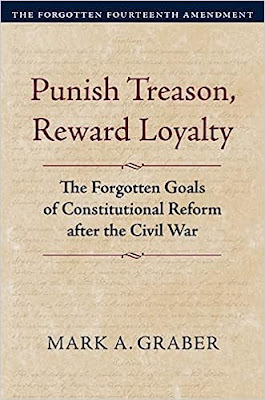
Mark A. Graber, Punish Treason, Reward Loyalty: The Forgotten Goals of Constitutional Reform after the Civil War (University of Kansas Press, 2023)
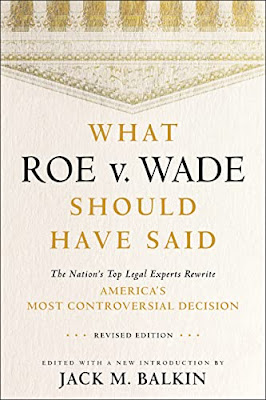
Jack M. Balkin, What Roe v. Wade Should Have Said: The Nation's Top Legal Experts Rewrite America's Most Controversial Decision - Revised Edition (NYU Press, 2023)

Andrew Koppelman, Burning Down the House: How Libertarian Philosophy Was Corrupted by Delusion and Greed (St. Martin’s Press, 2022)

Gerard N. Magliocca, Washington's Heir: The Life of Justice Bushrod Washington (Oxford University Press, 2022)
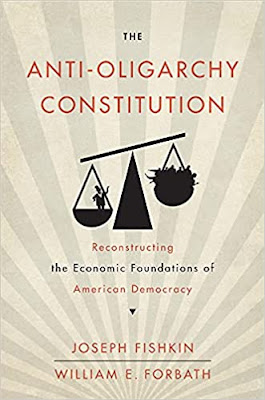
Joseph Fishkin and William E. Forbath, The Anti-Oligarchy Constitution: Reconstructing the Economic Foundations of American Democracy (Harvard University Press, 2022)
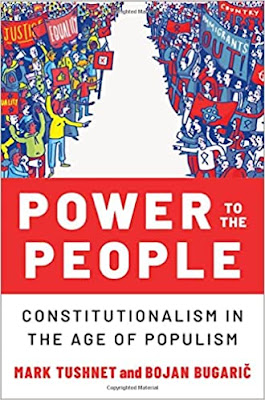
Mark Tushnet and Bojan Bugaric, Power to the People: Constitutionalism in the Age of Populism (Oxford University Press 2021).

Mark Philip Bradley and Mary L. Dudziak, eds., Making the Forever War: Marilyn B. Young on the Culture and Politics of American Militarism Culture and Politics in the Cold War and Beyond (University of Massachusetts Press, 2021).

Jack M. Balkin, What Obergefell v. Hodges Should Have Said: The Nation's Top Legal Experts Rewrite America's Same-Sex Marriage Decision (Yale University Press, 2020)

Frank Pasquale, New Laws of Robotics: Defending Human Expertise in the Age of AI (Belknap Press, 2020)

Jack M. Balkin, The Cycles of Constitutional Time (Oxford University Press, 2020)

Mark Tushnet, Taking Back the Constitution: Activist Judges and the Next Age of American Law (Yale University Press 2020).

Andrew Koppelman, Gay Rights vs. Religious Liberty?: The Unnecessary Conflict (Oxford University Press, 2020)

Ezekiel J Emanuel and Abbe R. Gluck, The Trillion Dollar Revolution: How the Affordable Care Act Transformed Politics, Law, and Health Care in America (PublicAffairs, 2020)

Linda C. McClain, Who's the Bigot?: Learning from Conflicts over Marriage and Civil Rights Law (Oxford University Press, 2020)
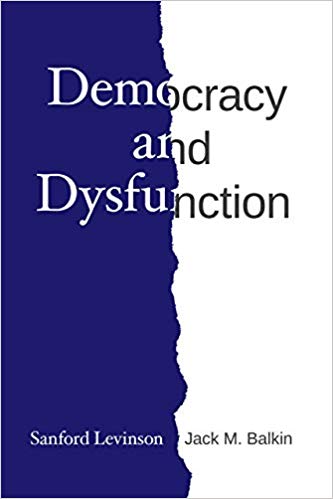
Sanford Levinson and Jack M. Balkin, Democracy and Dysfunction (University of Chicago Press, 2019)

Sanford Levinson, Written in Stone: Public Monuments in Changing Societies (Duke University Press 2018)

Mark A. Graber, Sanford Levinson, and Mark Tushnet, eds., Constitutional Democracy in Crisis? (Oxford University Press 2018)

Gerard Magliocca, The Heart of the Constitution: How the Bill of Rights became the Bill of Rights (Oxford University Press, 2018)

Cynthia Levinson and Sanford Levinson, Fault Lines in the Constitution: The Framers, Their Fights, and the Flaws that Affect Us Today (Peachtree Publishers, 2017)

Brian Z. Tamanaha, A Realistic Theory of Law (Cambridge University Press 2017)

Sanford Levinson, Nullification and Secession in Modern Constitutional Thought (University Press of Kansas 2016)

Sanford Levinson, An Argument Open to All: Reading The Federalist in the 21st Century (Yale University Press 2015)

Stephen M. Griffin, Broken Trust: Dysfunctional Government and Constitutional Reform (University Press of Kansas, 2015)

Frank Pasquale, The Black Box Society: The Secret Algorithms That Control Money and Information (Harvard University Press, 2015)

Bruce Ackerman, We the People, Volume 3: The Civil Rights Revolution (Harvard University Press, 2014)
Balkinization Symposium on We the People, Volume 3: The Civil Rights Revolution

Joseph Fishkin, Bottlenecks: A New Theory of Equal Opportunity (Oxford University Press, 2014)

Mark A. Graber, A New Introduction to American Constitutionalism (Oxford University Press, 2013)

John Mikhail, Elements of Moral Cognition: Rawls' Linguistic Analogy and the Cognitive Science of Moral and Legal Judgment (Cambridge University Press, 2013)

Gerard N. Magliocca, American Founding Son: John Bingham and the Invention of the Fourteenth Amendment (New York University Press, 2013)

Stephen M. Griffin, Long Wars and the Constitution (Harvard University Press, 2013)

Andrew Koppelman, The Tough Luck Constitution and the Assault on Health Care Reform (Oxford University Press, 2013)

James E. Fleming and Linda C. McClain, Ordered Liberty: Rights, Responsibilities, and Virtues (Harvard University Press, 2013)
Balkinization Symposium on Ordered Liberty: Rights, Responsibilities, and Virtues

Andrew Koppelman, Defending American Religious Neutrality (Harvard University Press, 2013)

Brian Z. Tamanaha, Failing Law Schools (University of Chicago Press, 2012)

Sanford Levinson, Framed: America's 51 Constitutions and the Crisis of Governance (Oxford University Press, 2012)

Linda C. McClain and Joanna L. Grossman, Gender Equality: Dimensions of Women's Equal Citizenship (Cambridge University Press, 2012)

Mary Dudziak, War Time: An Idea, Its History, Its Consequences (Oxford University Press, 2012)

Jack M. Balkin, Living Originalism (Harvard University Press, 2011)

Jason Mazzone, Copyfraud and Other Abuses of Intellectual Property Law (Stanford University Press, 2011)

Richard W. Garnett and Andrew Koppelman, First Amendment Stories, (Foundation Press 2011)

Jack M. Balkin, Constitutional Redemption: Political Faith in an Unjust World (Harvard University Press, 2011)

Gerard Magliocca, The Tragedy of William Jennings Bryan: Constitutional Law and the Politics of Backlash (Yale University Press, 2011)

Bernard Harcourt, The Illusion of Free Markets: Punishment and the Myth of Natural Order (Harvard University Press, 2010)

Bruce Ackerman, The Decline and Fall of the American Republic (Harvard University Press, 2010)
Balkinization Symposium on The Decline and Fall of the American Republic

Ian Ayres. Carrots and Sticks: Unlock the Power of Incentives to Get Things Done (Bantam Books, 2010)

Mark Tushnet, Why the Constitution Matters (Yale University Press 2010)

Ian Ayres and Barry Nalebuff: Lifecycle Investing: A New, Safe, and Audacious Way to Improve the Performance of Your Retirement Portfolio (Basic Books, 2010)
.jpg)
Jack M. Balkin, The Laws of Change: I Ching and the Philosophy of Life (2d Edition, Sybil Creek Press 2009)

Brian Z. Tamanaha, Beyond the Formalist-Realist Divide: The Role of Politics in Judging (Princeton University Press 2009)
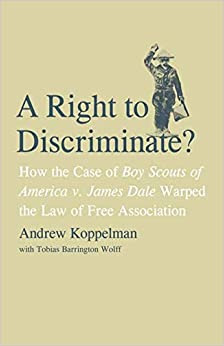
Andrew Koppelman and Tobias Barrington Wolff, A Right to Discriminate?: How the Case of Boy Scouts of America v. James Dale Warped the Law of Free Association (Yale University Press 2009)

Jack M. Balkin and Reva B. Siegel, The Constitution in 2020 (Oxford University Press 2009)

Heather K. Gerken, The Democracy Index: Why Our Election System Is Failing and How to Fix It (Princeton University Press 2009)

Mary Dudziak, Exporting American Dreams: Thurgood Marshall's African Journey (Oxford University Press 2008)

David Luban, Legal Ethics and Human Dignity (Cambridge Univ. Press 2007)

Ian Ayres, Super Crunchers: Why Thinking-By-Numbers is the New Way to be Smart (Bantam 2007)

Jack M. Balkin, James Grimmelmann, Eddan Katz, Nimrod Kozlovski, Shlomit Wagman and Tal Zarsky, eds., Cybercrime: Digital Cops in a Networked Environment (N.Y.U. Press 2007)
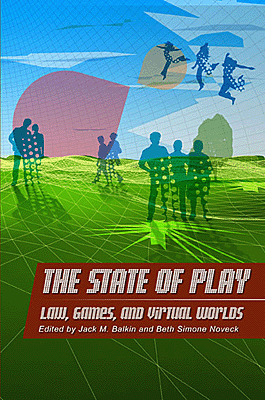
Jack M. Balkin and Beth Simone Noveck, The State of Play: Law, Games, and Virtual Worlds (N.Y.U. Press 2006)

Andrew Koppelman, Same Sex, Different States: When Same-Sex Marriages Cross State Lines (Yale University Press 2006)

Brian Tamanaha, Law as a Means to an End (Cambridge University Press 2006)

Sanford Levinson, Our Undemocratic Constitution (Oxford University Press 2006)

Mark Graber, Dred Scott and the Problem of Constitutional Evil (Cambridge University Press 2006)

Jack M. Balkin, ed., What Roe v. Wade Should Have Said (N.Y.U. Press 2005)

Sanford Levinson, ed., Torture: A Collection (Oxford University Press 2004)
Balkin.com homepage
Bibliography
Conlaw.net
Cultural Software
Writings
Opeds
The Information Society Project
BrownvBoard.com
Useful Links
Syllabi and Exams
