Balkinization
an unanticipated consequence of
Jack M. Balkin
Balkinization Symposiums: A Continuing List
E-mail:
Jack Balkin:
jackbalkin at yahoo.com
Bruce Ackerman
bruce.ackerman at yale.edu
Ian Ayres
ian.ayres at yale.edu
Corey Brettschneider
corey_brettschneider at brown.edu
Mary Dudziak
mary.l.dudziak at emory.edu
Joey Fishkin
joey.fishkin at gmail.com
Heather Gerken heather.gerken at yale.edu
Abbe Gluck abbe.gluck at yale.edu
Mark Graber
mgraber at law.umaryland.edu
Stephen Griffin
sgriffin at tulane.edu
Jonathan Hafetz
jonathan.hafetz at shu.edu
Jeremy Kessler
jkessler at law.columbia.edu
Andrew Koppelman
akoppelman at law.northwestern.edu
Marty Lederman
msl46 at law.georgetown.edu
Sanford Levinson
slevinson at law.utexas.edu
David Luban
david.luban at gmail.com
Gerard Magliocca
gmaglioc at iupui.edu
Jason Mazzone
mazzonej at illinois.edu
Linda McClain
lmcclain at bu.edu
John Mikhail
mikhail at law.georgetown.edu
Frank Pasquale
pasquale.frank at gmail.com
Nate Persily
npersily at gmail.com
Michael Stokes Paulsen
michaelstokespaulsen at gmail.com
Deborah Pearlstein
dpearlst at yu.edu
Rick Pildes
rick.pildes at nyu.edu
David Pozen
dpozen at law.columbia.edu
Richard Primus
raprimus at umich.edu
K. Sabeel Rahmansabeel.rahman at brooklaw.edu
Alice Ristroph
alice.ristroph at shu.edu
Neil Siegel
siegel at law.duke.edu
David Super
david.super at law.georgetown.edu
Brian Tamanaha
btamanaha at wulaw.wustl.edu
Nelson Tebbe
nelson.tebbe at brooklaw.edu
Mark Tushnet
mtushnet at law.harvard.edu
Adam Winkler
winkler at ucla.edu
Compendium of posts on Hobby Lobby and related cases
The Anti-Torture Memos: Balkinization Posts on Torture, Interrogation, Detention, War Powers, and OLC
The Anti-Torture Memos (arranged by topic)
Recent Posts
The Hugo Black Lecture, Part IV
Are Law Professors "Selfless" Teachers and Scholars Engaged in "Public Service"? The Fight Against Change in Law Schools
Constitutional Liability Rules -- Part III
The Hugo Black Lecture, Part III
Constitutional Liability Rules -- Part II
The Hugo Black Lecture, Part II
What's a "War"?
The Anti-Stereotyping Principle
Constitutional Liability Rules
The Hugo Black Lecture, Part I
Winning Through Losing: Life After Perry
From Colorblindness to Antibalkanization: An Emerging Ground of Decision in Race Equality Cases
The New Equal Protection
The Obama Administration's New Approach to Miranda in Terrorism Cases
Religious Neutrality in American Law
Pro Bono and Big Law Firms (or Who Exactly Was Cory Maples’s Lawyer?)
Google Books Settlement: Copyright, Congress, and Information Monopolies
Discrimination, Immigration Law and the Constitution in 2020
Can courts advance equality?
The United States’ Rights Tradition and State Constitutions
The Death (and Life?) of School Desegregation
The Constitution in 2020: The Future of Equality
The Diversity Honor Roll?
Bradley Manning, Barack Obama and the National Surveillance State
A Statement on Private Manning's Detention
Coase Goes to War
Memo to Syria
"Linking Skepticisms" About the Finance Sector
Further Thoughts on the Guantanamo Executive Order
What Does Snyder v. Phelps Mean for Privacy Law?
Egypt’s “Leaderless Revolution” and Presidentialism: A Toxic Combination
DOMA: The Politics of Scrutiny
Paradoxical Notions of Liberty
DrawCongress.org
![[Powered by Blogger]](https://lh3.googleusercontent.com/blogger_img_proxy/AEn0k_t7__VV9m78Ahk2g5k4_XoIMQbd7sg2urZPKcSCTkPzHVPVfLMoQk8RbSBSoaGocHZcSWkQhjVHuKpKNpdcmZRYKy79SN0rFjdpkbn9Wug_=s0-d)
Just A Few Blogs
ACS Blog
Alas, a Blog
Althouse
Arts and Letters Daily
Atrios (Eschaton)
Bill of Health
Buzzflash.com
Buzz Machine
Cato at Liberty
Juan Cole (Informed Comment)
Concurring Opinions
The Constitution in 2020
Corrente
Crooked Timber
Daily Howler
Daily Kos
Dana Boyd
Brad DeLong
Digby (Hullabaloo)
Discriminations
Daniel Drezner
Kevin Drum (Mother Jones)
Electrolite
En Banc
Eunomia (Daniel Larison)
Fafblog
Michael Froomkin (Discourse.net)
GovLab (Beth Noveck)
Rick Hasen (Election Law)
History News Network
How Appealing
Ignatz (Sam Heldman)
The Importance of (Ernie Miller)
Infolaw
Instapundit
International Economic Law and Policy Blog
IntLawGrrls
Jacob Levy
Jesus' General
Jurisdynamics
The Kitchen Cabinet
Mark Kleiman
Law Blog Central
Larry Lessig
Lawyers, Guns and Money
Liberal Oasis
Brian Leiter's Law School Reports
The Leiter Reports
Marginal Revolution
Megan McArdle
Memeorandum
Metafilter
Mirror of Justice
The New Republic
Newseum
No More Mister Nice Blog
Brendan Nyhan
Opinio Juris
Orcinus
The Originalism Blog
Pandagon
Passport (Foreign Policy)
Overcoming Bias
Political Animal (Washington Monthly)
Political Theory Daily Review
Political Wire (Taegan Goddard)
The Poor Man
Virginia Postrel
Prawfsblawg
Public Reason
Jonathan Rauch
Raw Story
Redstate
ReligiousLeftLaw.com
Reporters Committee For Freedom of the Press
Reproductive Rights Blog
Rothman's Roadmap to the Right of Publicity
SCOTUS Blog
Seeing the Forest
Clay Shirky
The Shifted Librarian
The Situationist
Larry Solum (Legal Theory)
Andrew Sullivan
Talking Points Memo
Talk Left
Tapped
Tbogg
TechPresident
The Paper Chase (Jurist)
Tom Paine
Tom Tomorrow (This Modern World)
Eve Tushnet
Uggabugga
University of Chicago Law School Faculty Blog
Unqualified Offerings
The Volokh Conspiracy
War and Piece (Laura Rozen)
Wampum
Oliver Willis
Wonkette
Written Description
Matthew Yglesias
Yin
Your Choice of Feeds
1. XML
powered by

2. Atom Feed
3. RSS 2.0
The Hugo Black Lecture, Part IV
JB
[On March 23, 2011, I delivered the 20th annual Hugo L. Black lecture on freedom of expression at Wesleyan University. I'm publishing the prepared text of the lecture in installments this week on Balkinization. Part One, Part Two, and Part Three have already appeared.]
VI. Prosecuting Wikileaks
I will return to the relationship between public power and private intermediaries in a moment. But before I do, you may be wondering about whether the government can prosecute Assange and Wikileaks consistent with the First Amendment.
In the Pentagon Papers Case, New York Times v. United States, the Supreme Court Justices agreed that the government could not halt the publication of the Pentagon Papers. These described how the United States got involved in the Vietnam War, and contained a lot of embarrassing materials that no doubt undermined U.S. diplomatic efforts. Daniel Ellsberg, a government contactor who worked for the RAND Corporation, had leaked the papers to the New York Times and (later) the Washington Post. The Supreme Court refused to enjoin publication, applying a version of the old clear and present danger test that goes back to the beginning of the twentieth century: Justice Potter Stewart’s concurrence explained that the test was whether “disclosure of [the papers] will surely result in direct, immediate, and irreparable damage to our Nation or its people.” Read more »
Posted
11:05 AM
by JB [link]
Are Law Professors "Selfless" Teachers and Scholars Engaged in "Public Service"? The Fight Against Change in Law Schools
Brian Tamanaha
The Standards Review Committee of the ABA will conduct a hearing this weekend on proposed changes to law school accreditation standards. The proposed changes have been sharply criticized--especially by the Association of American Law Schools (AALS)--for posing a serious threat to the quality of legal education in the United States. The proposal that provokes the most opposition would allow law schools to choose (if they so desire) to hire full-time faculty in non-tenure positions.
The purpose of the proposed changes is to allow law schools greater flexibility in finding cost efficient ways to train lawyers. According to the AALS, that's an erroneous view of what law schools are about. "Lawyers are not 'produced' or even 'trained' by law schools," declared former AALS President Reese Hansen in opposition to the changes (critics who excoriate law schools for doing a poor job of training lawyers would heartily agree, though Hansen undoubtedly did not mean to imply that). "What lawyers must ultimately deliver is judgment....That kind of mature judgment is primarily created by personal interaction between individual faculty and individual students in countless educational settings." The argument of the AALS appears to boil down to the assertion that law students can obtain sound lawyerly judgment only if law schools are staffed by full time law professors with tenure.
Current AALS President Michael Olivas repeated this argument in his recent lengthy criticism of the proposed changes. We impart something more valuable and subtle than knowledge of legal doctrine and practice skills, Olivas insists:The high quality and distinctiveness of American legal education are based largely on the work of career, full-time faculty [protected by tenure] who engage fully in the law school's teaching, scholarship, and service missions....Given that law is fundamentally a public profession, law school faculty should perform public service that both models for law students the selflessness encouraged for all lawyers, and helps fulfill the role of law schools in contributing to the improvement of law, lawyers, the legal system, and the system of justice. The scholarship and public service of career, full-time faculty [protected by tenure] do not merely supplement their teaching role. Both scholarship and public service underlie teaching and give it an authority that teachers who merely pass on received understanding or transmit skills cannot match.
Frankly, these claims about what we do as law professors are embarrassing. I'm not selfless. Exceedingly few of the many law professors I know strike me as selfless. This is a fantastic job, for which we are generously compensated. Law school deans--many of whom earn between $200,000 and $400,000--are definitely not selfless. We don't model selflessness for our students. And the truth, contrary to Hansen's above assertion, is that many law professors engage in scant interaction with law students, so we do very little modeling of any kind outside of the classroom. (I should add that lawyers today are anything but selfless, which further belies the assertion that we influence our students in this fashion.)
I also don't see how "public service underlie[s] teaching." Teaching in a law school is not a public service. A few law professors on every faculty work on bar committees and such, but not the majority of us. Legal aid lawyers and public defenders are doing public service, perhaps also prosecutors and judges, but not law professors. We teach, we write, we serve on law school committees, and we engage in consulting of various sorts. This standard package of law professor activities does not constitute "public service."
Read more »
Posted
7:00 PM
by Brian Tamanaha [link]
(32) comments
Constitutional Liability Rules -- Part III
Gerard N. Magliocca
This post focuses on why constitutional liability rules are a useful tool for legitimating broad constitutional change. The key point is that giving dissenting institutions a choice (even if it is a constrained choice) produces consent. And consent always beats a command when it comes to creating an outcome that receives respect. At the same time, allowing the dissenting organ to have an unconstrained choice may be impossible because it actually delegitimizes the reform at issue.
The first example is the way Congress dealt with Rhode Island's refusal to ratify the Constitution until 1790. Why did Rhode Island say no? In part, it was because they held that the Constitution was illegal because the Articles of Confederation required all 13 states to ratify an amendment. Allowing Rhode Island to remain outside the Union was unacceptable in part because its very existence undermined the authority of the Constitution much as a legitimate claimant to a throne poses a threat to a King. What did Congress do? They did not just annex Rhode Island, even though that would have been pretty easy. Instead they proposed an economic blockade of that "foreign country." Rhode Island responded by ratifying. Problem solved.
Another example is the ratification of the Fourteenth Amendment. Some in Congress said that the Amendment could be imposed on the South because those states had committed suicide via secession. A ratification based only on Northern States, though, would have left a cloud over the Amendment's validity. Giving the South a free choice, however, would have nullified the result of the War. Instead, Congress held that states that refused to ratify would remain outside of the Union under military occupation. Ratification occurred. (Arguably the same thing happened when the Cherokee Nation was strong-armed into agreeing to the Treaty of New Echota, which authorized its removal along the "Trail of Tears" in the 1830s, but that is a more complicated story.)
When it came to the Voting Rights Act, though, Congress did not give the "pre-clearance" jurisdictions in the South a choice about whether they should comply with the new rules protecting African-American suffrage. Perhaps that was because of the long history of resistance under JIm Crow, but this shows that a constitutional liability rule is not always the remedy of choice.
Tomorrow I'll wrap up this series by talking about how a constitutional liability rule could improve the Article Five process.
Posted
4:27 PM
by Gerard N. Magliocca [link]
The Hugo Black Lecture, Part III
JB
[On March 23, 2011, I delivered the 20th annual Hugo L. Black lecture on freedom of expression at Wesleyan University. I'm publishing the prepared text of the lecture in installments this week on Balkinization. Part One and Part Two have already appeared.]
V. Wikileaks
My second example concerns Wikileaks. I’m less interested in the individual personality of Julian Assange, and whether he is a nice fellow or not, than on the larger phenomenon that Wikileaks represents. Wikileaks symbolizes a new way of doing investigative journalism, which cooperates with traditional media organizations but is also independent of them.
Neither traditional media organizations nor nation states—including the United States—are particularly happy about these developments. Nation states don’t like Wikileaks because they can’t control or co-opt it as they have learned to do with more traditional forms of journalism, including, I am sad to say, American journalism. Traditional media organizations don’t like Wikileaks because it competes with their professional vision of how to do journalism. Equally important, it significantly undermines their carefully calibrated long-term relationships with (or less charitably, their co-optation by) powerful nation-states like the U.S. government and powerful business organizations.Read more »
Posted
11:05 AM
by JB [link]
Constitutional Liability Rules -- Part II
Gerard N. Magliocca
This is the second of what I now see will be three posts about this idea that I'm working on. While there are liability rules in the Constitution that apply to individuals (for example, the Takings Clause), I am interested in structural liability rules that are used to support fundamental values or manage a substantial legal transition.
The Spending Clause is the best contemporary example. Congress is barred from abrogating state sovereign immunity or from commandeering state legislatures and executive officials, but those same goals can be accomplished by withholding federal funds from the states if they refuse to acquiesce. And the Supreme Court has refused (since the New Deal) to assess how coercive that liability rule might be and whether that pressure can ever go too far. The construction of a liability rule regime in this context protects federalism by allowing states to decide whether they wish to raise their own taxes or cut spending to make up any lost federal revenue and maintain their policy stance.
Now consider a different case from the Anglo-American tradition--the threat by the Crown and the Prime Minister to pack the House of Lords. In 1832 (the Great Reform Act on suffrage) and 1911 (the Parliament Act ending the absolute veto of the Lords) there was a consensus that the British polity needed fundamental reform, but in both cases the unelected Lords refused to pass the legislation. The other institutions did not summon Oliver Cromwell to abolish the Upper House or just back down. Instead, they allowed the Lords to retain their right to say no but provided for a dilution of their authority if they did so. This is really no different from how Section 2 of the Fourteenth Amendment, which I described yesterday, operated. Franklin Roosevelt's Court-packing could be seen in a similar light, though that's a more complicated story.
Tomorrow I will focus on the legitimacy justification for constitutional liability rules and examine what constraints exist on their use given that the courts generally refrain from imposing any.
Posted
6:19 PM
by Gerard N. Magliocca [link]
The Hugo Black Lecture, Part II
JB
[On March 23, 2011, I delivered the 20th annual Hugo L. Black lecture on freedom of expression at Wesleyan University. I'm publishing the prepared text of the lecture in installments this week on Balkinization. You can read Part One here.]
IV. The Infrastructure of Democratic Protests
My first example takes place where King Xerxes implemented his information policy thousands of years ago: In the Middle East, including King Xerxes’ own kingdom of Persia, part of which is now called Iran.
In 2009 following a disputed election, Iranian citizens took to the streets in massive protests, which took months for the government to subdue. The unrest has been called the Twitter Revolution, because social media like Twitter, Facebook, and YouTube played a prominent role. In late 2010, massive protests began in Tunisia, and in late January 2011, protests broke out in Egypt, and spread to about a dozen countries around the Middle East, including Iran.
The infrastructure of free expression—in this case, digital networks and software platforms—played an important role in these uprisings; so much so that Egypt shut down access to the Internet and cell phones for about five days. But by that point in the uprising, however, it was too late. Reporters were already in Egypt, mass media coverage by Al Jazeera and other broadcasters continued, and a few Egyptians still found ways to communicate with the outside world.
If anything, the protests merely got worse after the government tried to flip the Internet kill switch. Egyptians were outraged by the loss of communications. Business interests objected vehemently, and access was soon restored. Egypt’s long-time strong man, Hosni Mubarak, was forced out of office, and the Egyptian military took control of a caretaker government.
We don’t yet know whether the January revolution will lead to real democracy in Egypt. Nor do we know what will happen in the various other Middle Eastern countries where protests have sprung up. What we can ask is what role the infrastructure of free expression—and control over that infrastructure—have played.Read more »
Posted
11:05 AM
by JB [link]
What's a "War"?
Mark Tushnet
Everyone who has commented on the domestic constitutional questions raised by President Obama's decisions in connection with Libya has made some assumptions about the meaning of the "declare War" clause. The basic assumption, which the administration appears to share, is that there's a constitutionally relevant line between "small" military engagements, which are not "Wars" within the meaning of the "declare War" clause, and larger ones, which are. I have some questions about the coherence of the large/small distinction under modern conditions of military engagements (for example, an engagement might be small on the domestic side -- by using really powerful drones launched from U.S. territory -- but large on the target side), but I want to put them aside and suggest another line of argument. What we need to know is what constitutes a “War” within the meaning of the “declare War” clause. In the framing era what distinguished “wars” from other forms of international interactions was the jus ad bellum. And, under that law, the distinguishing characteristic of a “war” was that it opened up the nation to lawful retaliation, giving the target nation a lawful privilege to kill U.S. soldiers. The Security Council’s resolution means that Libya cannot lawfully – that is, within the bounds of the jus ad bellum – retaliate against those who use force against it. It follows that the U.S. action is not a “War” within the meaning of the “declare War” clause. (Note that there might be a functional justification for this international-law oriented definition of “War” for domestic constitutional purposes: Lawful retaliation, including the privilege to kill U.S. soldiers, is probably the most serious kind of interaction that a U.S. action can open the nation to, so requiring congressional involvement makes functional sense. But my argument doesn’t rely heavily on the functional argument.) The key point in this argument is that a Security Council resolution authorizing the use of force deprives the target nation of the right to retaliate. I can't cite sources saying that, but it seems to me a sensible construction of the relation between the UN's regulation of the use of force in international relations and the jus ad bellum. A couple of implications of this line of argument should be noted. Libya might not be privileged in killing U.S. soldiers, but (or "and") it would still be bound by jus in bellum principles. More important for domestic constitutional purposes, the argument implies that a Security Council resolution authorizing the use of force relieves a U.S. President of any obligation to obtain congressional authorization for actions taken pursuant to such a resolution. So, for example, the first President Bush would not have needed, as a constitutional matter, congressional authorization to use U.S. forces in the operation aimed at expelling Iraq from Kuwait.
Posted
8:42 AM
by Mark Tushnet [link]
The Anti-Stereotyping Principle
Guest Blogger
For the Constitution in 2020 conference on The Future of Equality.
Cary Franklin
Last month, when Attorney General Holder announced that discrimination on the basis of sexual orientation warranted “heightened scrutiny” under the Equal Protection Clause, and that §3 of the Defense of Marriage Act was unconstitutional under this standard, it was not immediately clear what level of scrutiny he was advocating. Maggie Gallagher, a leading opponent of same-sex marriage, accused Holder of “unilaterally declar[ing] that gay is like black, that orientation is now subjected to strict scrutiny.” Numerous commentators argued that, in fact, Holder was advocating an intermediate scrutiny standard. Courts that have applied heightened scrutiny to orientation-based discrimination have gone both ways. More important than the difference between strict and intermediate scrutiny, however, is the question of what mediating principle will guide courts’ application of equal protection to sexual orientation.
Holder’s letter to Congress begins to develop such a principle. He argues that §3 is unconstitutional because it was motivated by “disapproval of gays and lesbians and their intimate and family relationships—precisely the kind of stereotype-based thinking and animus the Equal Protection Clause is designed to guard against.” It is this “disapproval” and “stereotype-based thinking” that, in Holder’s view, triggers the need for heightened scrutiny; he emphasizes that gays and lesbians have faced a long history of discrimination based on negative stereotypes, and that these “stereotypes . . . continue to have ramifications today.” Thus, Holder suggests, orientation-based equal protection law should incorporate an anti-stereotyping principle: The state cannot act in ways that reflect or reinforce widely-held stereotypes about the capacities or intimate and family relationships of sexual minorities.
Holder borrowed this anti-stereotyping principle from sex-based equal protection law. In cases such as U.S. v. Virginia (which Holder cites), the Court has held that the state may classify on the basis of sex when doing so serves to disrupt sex-role stereotypes, but not when it reflects or reinforces such stereotypes. “Real differences” between the sexes do not trump or negate this rule. The state may take real differences into account when seeking “to promot[e] equal employment opportunity” or “advance full development of the talent and capacities of our Nation’s people,” but such differences may not be used to justify state action that reflects or reinforces traditional conceptions of men and women’s roles.
Holder’s adaptation of this anti-stereotyping principle illustrates the potential of orientation-based equal protection law. An anti-stereotyping principle would enable courts to invalidate laws restricting marriage to different-sex couples without further stigmatizing relationships outside of marriage. It would protect sexual minorities across a wide range of contexts (including parenting, work, and health) that the marriage-as-a-fundamental-right approach fails to reach. Under an anti-stereotyping approach, “real differences”—such as the fact that same-sex couples cannot conceive children on their own—could not be used to justify state action that reflects or reinforces stereotyped conceptions of gay parents and their children. This way of doing gay rights would help protect the liberty of all gays and lesbians to develop their capacities and form families free from “the kind of stereotype-based thinking and animus the Equal Protection Clause is designed to guard against.”
Cary Franklin is Assistant Professor of Law at the University of Texas School of Law. You can reach her by e-mail at cfranklin@law.utexas.edu
Posted
6:00 AM
by Guest Blogger [link]
Constitutional Liability Rules
Gerard N. Magliocca
I thought I might use two posts to describe an idea that is still a work-in-progress. At moments of constitutional transition, a dissenting institution is often faced with a choice between accepting the new orthodoxy or facing harsh consequences for holding out. Nevertheless, that stubborn entity is still given a choice -- they are not simply ordered to comply. Why?
Compare two different approaches to African-American voting after Reconstruction. The 15th Amendment provides that states may not deny or abridge the right to vote based on race. The Fourteenth Amendment, by contrast, said that a state could do that but would see its delegation in the Electoral College and the House of Representatives reduced accordingly. One is an order and the other is not. Put another way, Section 2 of the Fourteenth Amendment operated as a constitutional liability rule.
Now why might we choose one approach over the other? My use of the term "liability rule" is deliberate because I think that transaction costs are part of the answer. This could be true across a few dimensions. For example, getting a political agreement on a more coercive "command" approach could just be too difficult. Another is that a dissenting institution may hold a minority veto such that it cannot be commanded to do anything without blowing up the constitutional structure, which is a transaction cost problem because it requires the development of a comprehensive alternative. Finally, the consent of an important institution, even under duress, may be needed to sustain the legitimacy of the constitutional change at issue.
The next post will give more examples of constitutional liability rules and explore instances in which that approach was rejected.
Posted
7:58 PM
by Gerard N. Magliocca [link]
The Hugo Black Lecture, Part I
JB
[On March 23, 2011, I delivered the 20th annual Hugo L. Black lecture on freedom of expression at Wesleyan University. I'll be publishing the prepared text of the lecture in installments this week on Balkinization.]
Part One
Part Two
Part Three
Part Four
Part Five
The First Amendment is an Information Policy
Jack M. Balkin
The 20th Annual Hugo L. Black Lecture on Freedom of Expression
Wesleyan University
March 23, 2011
I. Information Policy and Infrastructure
Inscribed on the main post office in New York City there is a famous motto: "Neither snow nor rain nor heat nor gloom of night stays these couriers from the swift completion of their appointed rounds." It’s become the unofficial slogan of the United States Post Office. But the Post Office didn’t invent this famous saying. It’s from the Greek Historian Herodotus. He was describing an elaborate system of horseback messengers created by the Persian monarchs to keep in touch with the reaches of their vast empire. Herodotus reports that the great Persian King Xerxes used the couriers to report back to the capital that he had lost a major battle.
Xerxes’ system of couriers was an early form of what we might call a knowledge and information policy. Persian Kings needed a reliable system for sending information securely across vast distances. So they created an ancient version of the Internet for their personal use.
Read more »
Posted
11:05 AM
by JB [link]
Winning Through Losing: Life After Perry
Guest Blogger
For the Constitution in 2020 conference on The Future of Equality.
Douglas NeJaime
Popular accounts and media commentary on the federal suits challenging the Defense of Marriage Act (DOMA) and California’s Proposition 8 focus largely on the inevitable march toward marriage equality.Implicit in such accounts is a claim about the impact of favorable court decisions on the LGBT rights agenda.After a district court victory in the Massachusetts DOMA case and the more recent announcement by Attorney General Holder that DOMA is unconstitutional under an appropriately heightened standard, the toppling of the federal ban seems imminent.After the district court’s decisive blow to Prop 8 in the Perry v. Schwarzenegger litigation and a Ninth Circuit oral argument before a generally receptive panel, commentators have focused on the impact of positive judicial intervention on same-sex couples in California
Judicial defeat, however, is a very real possibility.Indeed, that LGBT rights advocates discouraged the federal Prop 8 challenge suggests that a federal litigation campaign for marriage equality is a high-risk proposition.The built-in assumption is that a Supreme Court loss would be crushing for the movement.But perhaps the aftermath of a litigation loss is not all doom and gloom.Perhaps a loss might instead raise consciousness among lesbians and gay men, produce a sense of outrage, and compel movement members to press more urgently for change from elected officials and the public.Perhaps a loss would frame the issue in a way that aids fundraising efforts, brings more sympathetic elites on board, moves the issue to the top of some legislative agendas, and leads to complacency in the Christian Right countermovement.
Read more »
Posted
6:00 AM
by Guest Blogger [link]
From Colorblindness to Antibalkanization: An Emerging Ground of Decision in Race Equality Cases
Guest Blogger
For the Constitution in 2020 conference on The Future of Equality.
Reva B. Siegel
For decades, the Supreme Court has sharply divided in equal protection race discrimination cases. As commonly described, the Justices disagree about whether the Equal Protection Clause is properly interpreted through a colorblind anticlassification principle concerned with individualism or through an antisubordination principle concerned with inequalities in group status. This Article uncovers a third perspective on equal protection in the opinions of swing Justices who have voted to uphold and to restrict race conscious remedies because of concern about social divisiveness which, they believe, both extreme racial stratification and unconstrained racial remedies can engender. The Article terms this third perspective on equal protection concerned with threats to social cohesion the antibalkanization perspective.
Employing this triadic model of equal protection, the Article demonstrates how Justice Kennedy reasons from antibalkanization values in the recent cases of Parents Involved in Community Schools v. Seattle School District No. 1 and Ricci v. DeStefano. There Justice Kennedy affirms race-conscious facially neutral laws that promote equal opportunity (such as disparate impact claims in employment discrimination laws) so long as the enforcement of such laws does
not make race salient in ways that affront dignity and threaten divisiveness.
This Article’s triadic model identifies alternative directions equal protection doctrine might develop, and enables critique. A final section raises questions concerning the principle’s logic and application. Have those who interpret equal protection with attention to balkanization enforced the principle in an effective and evenhanded way? In this spirit, the Article concludes by suggesting that the antibalkanization principle could be applied to cases of concern to minority communities that do not involve challenges to civil rights laws (for example, government use of race in suspect apprehension).
Reva Siegel is the Nicholas deB. Katzenbach Professor of Law at Yale University. You can reach her by e-mail at reva.siegel at yale.edu
Posted
12:40 PM
by Guest Blogger [link]
The New Equal Protection
Guest Blogger
For the Constitution in 2020 conference on The Future of Equality.
Kenji Yoshino
Over the past decades, the Court has systematically denied constitutional protection to new groups, curtailed it for already covered groups, and limited Congress’s capacity to protect groups through civil rights legislation. The Court has repeatedly justified these limitations by adverting to pluralism anxiety. These cases signal the end of equality doctrine as we have known it.
The end of traditional equality jurisprudence, however, should not be conflated with the end of protection for subordinated groups. The Court’s commitment to civil rights has not been pressed out, but rather over to collateral doctrines. Most notably, the Court has moved away from group-based equality claims under the guarantees of the Fifth and Fourteenth Amendments to individual liberty claims under the due process guarantees of the Fifth and Fourteenth Amendments. This move reflects what academic commentary has long apprehended — that constitutional equality and liberty claims are often intertwined. I refer to such hybrid equality/liberty claims as “dignity” claims. Based on whether the liberty or the equality dimension of the hybrid claim is ascendant, I call it the “liberty-based” or “equality-based” dignity claim.
The introduction of a third overarching term like “dignity” that acknowledges the links between liberty and equality is overdue. Too much emphasis has been placed on the formal distinction between the equality claims made under the equal protection guarantees and the liberty claims made under the due process or other guarantees. In practice, the Court does not abide by this distinction. The Court has long used the Due Process Clauses to further equality concerns, such as those relating to indigent individuals, national origin minorities, racial minorities, religious minorities, sexual minorities, and women. Conversely, the Court has used the equal protection guarantees to protect certain liberties, such as the right to travel, the right to vote, and the right to access the courts. We need to look past doctrinal categories to see that the rights secured within those categories are often hybrid rights. This Article focuses particularly on the liberty-based dignity claim, because I believe it offers a way for the Court to “do” equality in an era of increasing pluralism anxiety.
Kenji Yoshino is the Chief Justice Earl Warren Professor of Constitutional Law, New York University School of Law. You can reach him by e-mail at kenji.yoshino at nyu.edu
Posted
12:39 PM
by Guest Blogger [link]
The Obama Administration's New Approach to Miranda in Terrorism Cases
Rick Pildes
Last May, I raised the suggestion in a series of posts on this blog that the administration and Congress might consider codifying the public-safety exception to the Miranda rules to clarify how that exception should apply to those arrested on terrorism-related charges. The aim is to avoid conflicts between legitimate intelligence interrogation and effective criminal prosecution; if there are sensible ways not to have to trade off one of these important goals for the other, we ought to consider such options. I also suggested that legislation of this sort would be a preferable alternative to legislative proposals that would address the intelligence investigation concerns by simply putting all such suspects into military custody and detention. Soon after that, the Attorney General testified before Congress and raised this idea of a legislative approach to Miranda, but Congress did not respond.
I therefore wanted to note that today's Wall Street Journal reports that the FBI has created an administrative process that does much the same thing legislation on this issue would have done. According to the WSJ, which has reviewed a copy of the non-public memo, the new policy applies only in "exceptional cases" where investigators "conclude that continued unwarned interrogation is necessary to collect valuable and timely intelligence not related to any immediate threat." The memo also sets up a process that must be surmounted before this power can be used: Department of Justice lawyers and FBI supervisors must give prior approval in the specific case.
The top Democrat on the House Intelligence Committee notes, probably correctly, that the courts would be more likely to accept this kind of clarification of Miranda if it rested on legislation, rather than just administrative action (that doesn't mean courts would not accept the new FBI practice, only that they'd be more likely to with congressional backing). As I said in those earlier posts, I am in no position to know whether the facts on the ground indicate that there is a need to relax Miranda in these ways to enable effective intelligence interrogation; if I were making policy on these issues, I would want to hear from those who conduct these interrogations, from the FBI and other agencies, as well as others. But law is often about trying to accommodate competing values, including adapting prior law to changing circumstances, and I am interested in the question of principle: if there is a legitimate intelligence-gathering need, should Miranda be modified in this way?
Here's one way to test intuitions about this: suppose we could be confident that the interrogations would be lawfully conducted (ie, no unlawfully coercive techniques). There are clever institutional structures one can imagine to help ensure that: the interrogations could be videotaped, or a neutral third-party observer (say, a retired federal judge or others) could observe the interrogation from behind a one-way window. For those troubled by the new FBI policies, would there be any objection in these circumstances? In other words, if we can find ways to preserve the values and functions Miranda seeks to realize, while also reducing the tension between criminal law enforcement and intelligence gathering functions, is there some remaining powerful reason to resist these new FBI policies?
Posted
9:41 AM
by Rick Pildes [link]
(12) comments
Religious Neutrality in American Law
Andrew Koppelman
For the Constitution in 2020 conference on The Future of Equality.
Often charged with hostility toward religion, First Amendment doctrine in fact treats religion as a good thing. It insists, however, that its goodness be understood at a high enough level of abstraction that the state takes no position on any live religious dispute. American religious neutrality has over time become more vague as America has become more religiously diverse, so that today (with the exception of a few grandfathered practices) the state cannot even affirm the existence of God. This kind of neutrality is not the kind of neutrality toward all conceptions of the good that many liberal political theorists have advocated, but it is the best response to the enormous variety of religious views in modern America. It is faithful to the framers’ belief that religion can be degraded and corrupted by state support.
The Supreme Court has interpreted the establishment clause to mean that “[n]either a state nor the Federal Government can set up a church. Neither can pass laws which aid one religion, aid all religions, or prefer one religion over another.” But the Court has also acknowledged that “the Free Exercise Clause, . . . by its terms, gives special protection to the exercise of religion.” Accommodation of religion as such, beginning with the exemption of Quakers and Mennonites from the military draft, is unquestionably permissible.
It is not logically possible for the government both to be neutral between religion and nonreligion and to give religion special protection. Some justices and many commentators have therefore regarded the First Amendment as at war with itself, and propose to cast aside large bodies of settled establishment clause law.
The critics are right that neutrality is incoherent when it is understood at the highest possible level of abstraction. Yet almost no one regrets the state’s refusal to take a position on the metaphysical status of the Eucharist. Neutrality’s continuing appeal demands explanation.
The answer, which I will elaborate in my forthcoming book, Religious Neutrality in American Law: An Analysis and Defense (Harvard 2012), is that neutrality is available in many forms. One of the many ways that government can go wrong is to take a position on some question that, all things considered, it ought to abstain from deciding. The American law of disestablishment has from the beginning sought, for excellent reasons, to keep the state from adjudicating religious questions that are the objects of controversy in American society. That aspiration is both coherent and valuable.
Understanding the specific level of religious neutrality presupposed in American law dispels many apparent anomalies. For example, because religion is understood as a good at a high level of abstraction, it makes sense for the Court to continue to deploy one of the classic justifications for the religion clauses: the idea (which presupposes the value of religion) that religion can be corrupted by state involvement with it. I explain and defend the idea that a law must have a secular legislative purpose. I show why it makes sense to permit old, but not new, ceremonial acknowledgements of religion. I also explain why it is not unfair to give religion the special treatment that it now receives.
Posted
6:00 AM
by Andrew Koppelman [link]
Pro Bono and Big Law Firms (or Who Exactly Was Cory Maples’s Lawyer?)
Jason Mazzone
The Supreme Court has granted review in Maples v. Allen, a habeas case. Cory Maples was convicted of murder and sentenced to death in Alabama. The conviction and sentence were affirmed on appeal. Maples thereafter filed a state petition for post-conviction relief arguing that his trial lawyer was constitutionally defective. The state court hearing that petition denied it. Maples did not file a timely notice of appeal from that denial and only found out about the decision after the time to appeal had passed. According to the record in the case, the court clerk had mailed of a copy of the order denying the petition to Maples’s attorneys at the law firm where, according to the docket information, they were employed. Those lawyers, however, had since left the firm (without updating their contact information with the court) and so the mail room receiving the court’s mailing sent it back to the court. The court clerk made no additional effort to locate Maples’s attorneys. The clock ticked. Maples’s time to appeal ran out. After Maples eventually became aware of the denial of his original petition, he unsuccessfully petitioned the state appellate court to allow an untimely appeal. He thereafter filed a federal habeas petition, asserting his ineffective assistance of trial counsel claim. The federal district court denied the habeas petition on the ground that the claim was procedurally defaulted and there was no good cause that would excuse the default. The 11th Circuit affirmed the district court.
The case has attracted significant attention because the lawyers representing Maples in the post-conviction proceeding, Clara Ingen-Housz and Jaasi Munanka, were from the New York office of Sullivan & Cromwell (S&C); it was the S&C mail room that returned the trial court’s order to the court after Ingen-Housz and Munanka had left S&C. Numerous commentators have asked how it is that S&C dropped the ball, with the result that Maples now faces execution without any federal review of his ineffective assistance of counsel claim.
I see some different issues.
Read more »
Posted
4:15 PM
by Jason Mazzone [link]
Google Books Settlement: Copyright, Congress, and Information Monopolies
Marvin Ammori
The Southern District of New York rejected the Google Books settlement. I provide a summary of the opinion here. Essentially, Google negotiated a settlement with the publishers and authors that sued it. Then, after the settlement, hundreds of publishers and authors objected. Competitors and the DOJ raised concerns. So, yesterday, the court rejected the settlement based mainly on those objections and concerns. It applied a nine factor test, relying mainly on one factor--the reaction of the class. It determined that the class had five important objections. (All of which I summarize here.)
Here I want to post some initial reactions about three themes that seem to animate the decision.
These themes are: (1) that Google shouldn't benefit from its blatant copyright infringement, (2) that Congress, not a court, should determine many of the forward looking issues, and (3) that the settlement should be rejected because it would grant Google a monopoly over out-of-print books still in copyright (e.g., many books published after 1923).
Read more »
Posted
11:54 AM
by Marvin Ammori [link]
(2) comments
Discrimination, Immigration Law and the Constitution in 2020
Guest Blogger
For the Constitution in 2020 conference on The Future of Equality.
Gabriel “Jack” Chin
In 2020, legislatures and courts addressing immigration will likely continue to struggle with two longstanding, fundamental questions: First, when is discrimination on the basis of race, ethnicity or origin acceptable, and second, when is affirmative action or some other accounting for previously disadvantaged groups warranted. Affirmative action is not normally thought of as part of the immigration debate, but Rogers Smith among others compellingly argues that one of the reasons undocumented Mexican immigrants should be treated with some consideration is the history of U.S. mistreatment of Mexicans and Mexican Americans, and interference in Mexico. Mexicans are hardly alone in this respect; 2012 will mark the 130th anniversary of the Chinese Exclusion Act of 1882. Ultimately expanded to all Asians, special restriction on Asian immigration was eliminated only in 1965.
Given that race is supposedly a suspect classification, it may seem odd that the scope of affirmative discrimination on the basis of race remains a pressing issue. But with modern immigration and national security politics, claims about the explicit and legitimate use of race in government action have reemerged with force. For an example of such explicit use of race that is allowed by law used in practice, consider whether police may rely on apparent Mexican ancestry in stopping suspected undocumented migrants. (For some reason, the question of using apparent Canadian ancestry as a basis for arrest never comes up.)
Read more »
Posted
9:00 AM
by Guest Blogger [link]
Can courts advance equality?
Guest Blogger
For the Constitution in 2020 conference on The Future of Equality.
Richard Schragger
Can courts advance substantive equality? Michael Paris thinks so. His recent book, Framing Equal Opportunity: Law and the Politics of School Finance Reform, challenges the increasingly prevalent view of judicial impotence as exemplified by Gerald Rosenberg’s The Hollow Hope. Paris’s book describes how courts in two states—New Jersey and Kentucky—achieved significant reform of their states’ unjust school finance systems. He concludes that in both states the courts deserve credit for forcing social change, even if that change was slow in coming. In New Jersey and Kentucky, significant monies were shifted to poor school districts in response to judicial decisions.
This focus on state courts is an important corrective to the current progressive skepticism of the U.S. Supreme Court. Consider Michael Klarman’s view that the Court rarely challenges an existing national political consensus or Mark Tushnet’s advice to “take the Constitution away from the courts.” Progressive scholars have examined the Supreme Court and found it lacking, either because it does little more than rein-in political outliers or, more damningly, because its mostly conservative inclinations are only rarely punctuated by fits of progressivism.
State courts (and constitutions) are strangely absent from this narrative and from our taught constitutionalism. This is so despite Justice Brennan’s urging almost thirty-five years ago that progressives look to state constitutions for the vindication of individual rights. Our constitutional theories are weirdly parochial, obsessed as we are by the national Constitution of 1789 and by our current arguments over how to read it. But there are fifty other constitutions in this country. Those constitutions contain more substantive rights and protections than does the national one, and they have been revised more readily, more often, and more recently. Paris describes only two of the twenty-six successful state school finance reform decisions, many of which have been based on state constitutional rights to education.
How judicially-recognized constitutional rights get “translated” into progressive politics is the topic of Paris’s book. He argues that state supreme courts are central actors in the legal mobilization necessary for an equality-forcing politics. Emily Zackin, whose recent dissertation is about the long tradition of positive rights in state constitutions, also argues that constitutional politics in the states is importantly different from constitutional politics at the national level. She argues, like Paris, that state constitutional politics is an extension of normal politics; the fetishization of “higher law” that sometimes manifests itself as constitutional reverence simply does not exist at the state level. State citizens are perfectly willing to amend, override, and otherwise fight about the content of their constitutions. The result has been a robust local constitutionalism that is more attentive to substance and less preoccupied with methodology than is our anemic national discourse.
Richard C. Schragger is Professor of Law at the University of Virginia School of Law. You can reach him by e-mail at schragger at virginia.edu
Posted
1:00 PM
by Guest Blogger [link]
The United States’ Rights Tradition and State Constitutions
Guest Blogger
For the Constitution in 2020 conference on The Future of Equality.
Emily Zackin
America’s constitutional law, its rights tradition in particular, is often said to reflect Americans’ fear of an over-active and overbearing state. Thus, America’s Constitutional rights are widely thought to restrain the state in order to protect citizens from the state’s power and potential for tyranny. Constitutions of other nations all over the world also contain these limits on government, but they include a different kind of right as well. These rights (sometimes called positive rights) obligate government to intervene in social and economic life, promoting equality rather than simply procedural fairness. They offer protection not from government itself, but from market capitalism and its consequences. The Belgian Constitution, for instance, declares that everyone has a right to a free education, and the South African Constitution includes the right to medical care. The text of the U.S. Constitution contains no such explicit guarantees, and the Supreme Court has consistently declined to interpret the Constitution to include them. Many have concluded that America simply lacks this other kind of constitutional right, and that Americans have been willing to commit to welfarist policies only at the level of statutory law.
The problem with this conventional account of American constitutional rights is that it takes the history of the federal Constitution and the federal Supreme Court to be the only one worth considering. The great majority of commentators on American rights have leapt effortlessly, and indeed unconsciously, from the assertion that the federal Constitution lacks (judicially recognized) positive rights to the conclusion that the United States lacks positive rights, at least at the constitutional level. It is this error that I endeavor to correct through my study of state constitutional movements.
Read more »
Posted
6:00 AM
by Guest Blogger [link]
The Death (and Life?) of School Desegregation
Guest Blogger
For the Constitution in 2020 conference on The Future of Equality.
Michael Paris
Everyone knows that school desegregation is dead. The massive economic and demographic changes of the past sixty years, combined with many public policies, created racial ghettos. Segregated housing patterns and segregating public schooling marched hand-in-hand.
For a brief time, federal courts were responsive to demands for desegregation. But then in Milliken the Supreme Court drew the line at the crabgrass frontier. Court-supervised desegregation continued for a decade or so, but it was largely confined to city limits. Over the course of the 1990’s, the Supreme Court prodded lower courts to withdraw from the field, and withdraw they did. Parents Involved was simply the coup de grace. Racial classification, not racial subordination, was really the evil to be eradicated all along. Attentive scholars now talk of “integration fatigue” among minority groups, and even erstwhile supporters of desegregation say that this particular game is over.
Read more »
Posted
6:00 AM
by Guest Blogger [link]
The Constitution in 2020: The Future of Equality
JB
On April 1st and 2d, The University of Texas School of Law and the American Constitution Society will be hosting a conference on The Future of Equality. This conference is one of a series of academic events connected to the Constitution in 2020 project.
Over the next two weeks speakers at the conference will be posting short essays about their work on Balkinization.
Read more »
Posted
1:05 PM
by JB [link]
The Diversity Honor Roll?
Jason Mazzone
The March edition of National Jurist has an article by Rebecca Larsen entitled "Most Diverse Law Schools," along with a "Diversity Honor Roll" showing the top 45 schools graded for diversity from A+ to B+. There has been some talk about including a diversity measure in the annual law school ranking U.S. News publishes. Though U.S. News has always deployed a methodology that would embarrass any statistician, National Jurist has set a new low in the utter cluelessness behind its new ranking.
Posted
4:45 PM
by Jason Mazzone [link]
Bradley Manning, Barack Obama and the National Surveillance State
JB
In 2006, Sandy Levinson and I predicted that the next president, whether Democratic or Republican, would ratify and continue many of President George W. Bush's war on terrorism policies. The reason, we explained, had less to do with the specific events of September 11th, and more to do with the fact that the United States was in the process of expanding the National Security State created after World War II into something we called the National Surveillance State, featuring huge investments in electronic surveillance and various end runs around traditional Bill of Rights protections and expectations about procedure. These end runs included public private cooperation in surveillance and exchange of information, expansion of the state secrets doctrine, expansion of administrative warrants and national security letters, a system of preventive detention, expanded use of military prisons, extraordinary rendition to other countries, and aggressive interrogation techniques outside of those countenanced by the traditional laws of war.
Read more »
Posted
2:59 PM
by JB [link]
A Statement on Private Manning's Detention
Bruce Ackerman
(updated below)
Yochai Benkler and I invite members of the academic legal community to join us in signing the following statement, asking the Administration either publicly to justify, or end, the humiliation and mistreatment of Private Bradley Manning, the suspected whistleblower who is said to have leaked classified government documents to Wikileaks.
For background, you can read this editorial in today’s New York Times, The Abuse of Private Manning and get more details from Soldier in Leaks Case Will Be Made to Sleep Naked Nightly.
If you'd like to add your signature, please send your name and institutional affiliation to manningprofletterjoin@gmail.com. Signatories added below in periodic updates.
295 signatories.
Read more »
Posted
8:16 PM
by Bruce Ackerman [link]
Coase Goes to War
Ian Ayres
Crosspost from Freakonomics: Nicholas Kristof’s recent column tells the tale of a Libyan officer who wanted to defect: On Saturday, when I was in Egypt and it looked as if the Gadhafi government might collapse at any time, I had a call from Tripoli: A senior Libyan military officer who had been ordered to attack rebel-held towns was defecting to the rebels instead. The officer wanted me to report his defection — along with his call for other military officers to do the same — and he had already recorded a video of his defection that I could post immediately on the New York Times website. I was delighted but asked what preparations he had made to protect his family from retribution. None, it turned out. I urged the officer to hide his family, to ensure that his wife and children weren’t kidnapped or killed in retaliation. A bit later, I heard back that the officer would accept the risk to his family. I suggested that the officer think this through carefully one more time — and this time the officer actually consulted his wife, who was displeased. The officer sheepishly postponed the announcement of his defection temporarily. *** Kristof had previously suggested that the U.S. should assure safe passage for Libyan defectors. But the officer’s story reminded me of an alternative, more economic, incentive deployed in Iraq, where the U.S. offered defecting officers cash to lay down their arms. As reported by Fred Kaplan in Slate in 2003: A fascinating piece in the May 19 Defense News quotes Gen. Tommy Franks, chief of U.S. Central Command, confirming what had until now been mere rumors picked up by dubious Arab media outlets—that, before Gulf War II began, U.S. special forces had gone in and bribed Iraqi generals not to fight “I had letters from Iraqi generals saying, ‘I now work for you,’ ” Franks told Defense News reporter Vago Muradian in a May 10 interview. The article quotes a “senior official” as adding, “What is the effect you want? How much does a cruise missile cost? Between one and 2.5 million dollars. Well, a bribe is a PGM [precision-guided munition]—it achieves the aim, but it’s bloodless and there’s zero collateral damage.” A “Smart Bribe” can be a lot cheaper than a “Smart Bomb.” Gideon Parchomovsky and Peter Siegelman (friends and coauthors) have published a fascinating article detailing the pros and cons of bribing enemy combatants to switch sides. Their article even includes this chart providing a quick history of attempted military bribes: One advantage of cash compensation over Kristof’s recommendation of safe passage is that it might be more credible. Libyan officers can verify a transfer of funds, whereas a U.S. assurance that an officer’s family will be protected may go unfulfilled. To say that Coasean bribes might be an effective strategy, however, does not necessarily mean that we should offer these blandishments. Inducing officers of another country to mutiny might violate international law. Coasean bribes are almost certainly a legitimate war-time tactic – even though it is a step toward a mercenary fighting force. But soliciting military insurrection by officers of a country with which we are not at war may be a different normative story altogether.
My sense is that many Libyan military officers are a bit like that one. They’re uncomfortable attacking fellow Libyans, but they’re also fearful that they or their families will be killed if they refuse. If the outside world signals resolutely that Gadhafi’s ouster is only a matter of time, there’s much more chance that officers will find ways to avoid going down with their leader.
Posted
10:01 PM
by Ian Ayres [link]

Memo to Syria
Ian Ayres
Crosspost from Freakonomics: Readers of this blog may be surprised to learn that in 2005 I coauthored an article with Jonathan Macey which made explicit predictions about the future of democratization in Egypt. In 2005, Jonathan and I wrote: We also posit that economic reform will bring increased pressure for democratization in countries such as Egypt and Syria. For this reason, economic reform of the kind we discuss in this Article (simplifying and reducing the costs of business formation) will be a good “leading indicator” of political leaders’ real interest in implementing meaningful democratic reforms that go beyond mere public relations gimmicks. Even more surprising, our prognostications (at least for now) are holding up remarkably well. (Warning: this post is filled with inordinate back patting — even by blogging standards. But in this case, any credit for prescience really goes to my coauthor, who conceived and executed the vast majority of our 2005 publication.) Hosni Mubarak’s regime did institute meaningful economic reforms — soon after our article was published. And as the world has seen, the Mubarak’s regime did experience increased pressure for democratization. Of course, post hoc does not mean propter hoc. But, as Jon and I argue in this Politico article, the economic reforms implemented after our article likely played a role in empowering a new entrepreneurial middle class which supported the democracy movement. A key piece of evidence supporting our theory is Egypt’s recent economic success. Contrary to most news reporting, the Egyptian economy has been growing at a high rate — with an average real GDP growth rate of more than six percent. Here’s the back story to our 2005 analysis of Egypt. Back then, Egypt made it difficult to start a new business. The World Bank estimated that it would take 43 days and more than a dozen legal steps before an entrepreneur could incorporate and Egypt was on “the list of the 10 countries in the world with the highest minimum capital requirement for starting a business” — requiring a buy in of more than $11,000. We attributed Egypt’s inhospitable business climate in part to the regime’s insulation from external threats. In contrast, the ruling coalitions in Syria and Egypt, with few external threats, have weak incentives to pursue reforms likely to generate growth, and even weaker incentives to tolerate the political dissent and the democratically inclined social class that such growth is likely to generate. Consistent with this our analysis, while it is relatively cheap and simple to start a new business in Lebanon and Israel, it is costly and complex to do so in Egypt and Syria. But we held out the possibility for change from a mixture of external and internal pressure. We said: Of course, we do not mean to imply that Egypt and Syria are free from pressure for political reform, despite the lack of democratic government. As a result of the recent U.S.-sponsored elections in Iraq, the entire Middle East is “bubbling with expectations for political reform.” The pressure comes both from domestic opposition groups as well as from foreign governments. The pressure on Egypt is particularly strong, since the country receives roughly $2 billion in U.S. aid annually, and has been criticized for moving slowly to enact democratic reforms. In particular, during his State of the Union address on February 2, 2005, George W. Bush suggested that “[t]he great and proud nation of Egypt, which showed the way toward peace in the Middle East, can now show the way toward democracy in the Middle East.” Shortly thereafter, on February 26, Egyptian President Hosni Mubarak unexpectedly called on that country’s Parliament to amend the Constitution to allow for direct, multiparty presidential elections for the first time in the nation’s history. President Mubarak predicted that the next president of Egypt “will be elected through direct, secret balloting, opening the opportunity for political parties to run in the presidential elections and providing guarantees that allow more than one candidate for the people to choose from with their own will.” The proposal was heralded in the press as responding both to “vocal domestic demands for increased democracy as well as stepped-up pressure from the Bush administration.” In a footnote, we even discussed some additional evidence for why we were agnostic about whether President Mubarak at the time was serious about make meaningful reform: During his [February 26, 2005] speech, President Mubarak did not discuss amending Article 77 of the Egyptian Constitution, which provides for an unlimited term of office for the Egyptian President. His comments were restricted to amending Article 76 of the Constitution, which deals with how presidents are selected. Not all observers were convinced that the proposed changes are meaningful. Id. Columnist and political analyst Ibrahim Eissa observed, “[t]his is a way [for Mubarak] to improve his image with the Americans and to please them with some formal changes . . . [w]hile at the same time he is keeping everything else unchanged, like the emergency laws, imprisoning the opposition, the state controlling the media and political parties existing just on paper. This is deception.” Ayman Nour, head of Al Ghad, a newly approved political party, was imprisoned on January 29, 2005, on allegations that he forged signatures to gain government recognition of his political party. Critics of Mubarak such as Hisham Qassim, Vice President of Al Ghad, observe that “the only credible candidate against Mubarak is lying in prison on trumped up charges.” (citations omitted). In 2005, we suggested that Mubarak’s choice about economic reform — especially about simplifying and reducing the costs of business formation — would be a credible signal — “a good “leading indicator” — of whether he was serious about implementing meaningful democratic reforms. Our leading indicator prediction has borne fruit. As we wrote in Politico: [T]he Egyptian minimum paid-in capital requirement had dropped to about $250, and the time to incorporation is just seven days. The World Bank now ranks Egypt as the 18th easiest nation in which to start a business. The past five years were characterized by meaningful economic liberalization and economic growth — in Egypt. No account of the Egyptian revolution should overlook this crucial point. In 2004, in the wake of the controversial presidential election, Mubarak installed a new, Cabinet-level economic team. Cairo reduced tariffs and taxes, improved transparency of the national budget, restarted stalled privatizations of public enterprises and passed economic legislation designed to reduce bureaucratic obstacles to business and foster private-sector-driven economic growth. Economic reform has been a leading indicator of democratization. What this means for places like Syria: If Syria’s President Bashar al-Assad cares more about retaining power than the welfare of his people, he would be advised not to follow Mubarak’s lead in opening the door to entrepreneurial democracy. Syria hasn’t even started down the path to economic reform. The minimum capital requirement for incorporating a new business there remains a staggering $8,500. The World Bank now ranks Syria as one of the most difficult places in the world to start a new business. If you are a despot, unleashing entrepreneurship can be bad for your job security.
Posted
11:09 AM
by Ian Ayres [link]

"Linking Skepticisms" About the Finance Sector
Frank Pasquale
Brian McKenna published an interesting piece in the Society for Applied Anthropology Newsletter, which is reprinted here. He quotes Financial Times Managing Editor Gillian Tett on one underexplored reason for lack of public attention to "financial innovation" pre-2008: "Once something is labeled boring, it's the easiest way to hide it in plain sight." He also reproduces a fascinating reflection from Annelise Riles, whose work Collateral Knowledge: Legal Reasoning in the Global Financial Markets will soon be released: I think Tett’s diagnosis should cause academics to ask some hard questions about why we did not do more to highlight and critique the problems in the financial markets prior to the crash. For myself, for example, fieldwork in the derivatives markets had convinced me long before the crash that all was not well in these markets. My husband (also an ethnographer of finance) and I often joked way back around 2002 that our research had convinced us not to put a penny of our own money in these markets.
But our own disciplinary silo made us feel that it was impossible to counter the enthusiasm for financial models out there in the economics departments, the business schools, the law schools, the corridors of regulatory institutions. There surely was some truth to our sense that no one wanted to hear that markets were not rational in the sense assumed by the firms’ and regulators’ models. But maybe we should have tried a bit harder; it turns out many other people also had doubts and thought they too were alone. What might have happened if we had all found a way to link our skepticisms?
At this point, it may well be the case that most financial economists have so barren a theory of the social purpose of financial markets that they really are only teaching people how to succeed within the current system, rather than improving the system overall. It’s a bit like a divinity school run by “believers,” rather than a religious studies department trying to study the religious (to borrow a distinction from Paul Kahn’s Cultural Study of Law).
Read more »
Posted
2:06 PM
by Frank Pasquale [link]
Further Thoughts on the Guantanamo Executive Order
Deborah Pearlstein
Yesterday, I posted over at Opinio Juris some initial reactions to the Executive Order the President issued creating a new periodic review system for the detainees at Guantanamo Bay. After reading some of the other reactions circulating in the ether yesterday, I don’t think I’ve seen anything that leads me to change that account. But there are several apparent misperceptions out there I think warrant correction.
First is the notion – captured by the Washington Post’s lead article on the order – that the executive order somehow creates a new “formal system of indefinite detention” for the Guantanamo detainees. (Ditto Dafna Linzer, among others.) The order I think is about as clear as it could be that it is being issued pursuant to existing authorities, most notably the statutory Authorization for the Use of Military Force (AUMF), and is not intended to and should not be read to alter the scope of detention authority available under that statute as interpreted by the courts. Again, the key language from the order: “It does not create any additional or separate source of detention authority, and it does not affect the scope of detention authority under existing law. Detainees at Guantánamo have the constitutional privilege of the writ of habeas corpus, and nothing in this order is intended to affect the jurisdiction of Federal courts to determine the legality of their detention.” Why do I raise this? It’s not because I am a great proponent of the D.C. Circuit’s interpretation of the AUMF. On the contrary, that court basically ignored what guidance international law does offer and otherwise I think found a degree of detention authority under the AUMF broader than what one could plausibly (or wisely) attribute to statute. But the suggestion that yesterday’s order is supposed to broaden that already broad grant of congressional/judicial detention authority, or is somehow supposed to reset the litigation clock back to zero on what the scope of that detention authority should be – is simply not supported by the text of the order.
Second is the effort I’ve seen by some to compare the procedures for review made available under this new executive order to the procedures available under the Bush-era Combatant Status Review Tribunals (CSRTs), a predecessor review process that the Supreme Court rejected as an inadequate substitute for habeas corpus review in U.S. federal court. Such comparisons miss the point. These procedures are not meant to replace any earlier approach; they exist only in the shadow of what substantially greater review today already exists for the Guantanamo detainees through the federal courts. As yesterday’s executive order notes, these new review procedures are to exist in addition to the habeas review that the Supreme Court recognized as mandated by the Constitution and that is already available to the Guantanamo detainees. Before yesterday’s order, detainees had essentially one shot to challenge the legality of their ongoing detention through the federal habeas process. If they lost in the D.C. district court and/or at the D.C. Circuit court on appeal, they had exhausted their potential avenues for review. This gives detainees another bite at the apple. As I noted yesterday, this is hardly to say it resolves all the many problems associated with the status quo at Guantanamo Bay. But are the detainees better off today than they were before the order was issued yesterday? Hard to see how the answer isn’t at least marginally yes.
Probably most unfortunate about the reporting so far is that it obscures (in lower paragraphs at best) what has been and remains the single greatest obstacle to the closure, or even amelioration of the situation, at Guantanamo: Congress. In 2008, both presidential candidates and their parties embraced the need to move toward closing the detention facility. In 2008, efforts by Congress even to conduct hearings into detention-related matters were still met with the criticism by some that Congress was interfering in matters properly left to the executive branch. Since then, Congress has become engaged up to its eyeballs in micromanaging the executive’s handling of a handful of detainees, and is otherwise devoting its Guantanamo-related energy to preventing the President from bringing criminal charges in our own courts against men who the President and Congress believe have committed crimes. We are through the looking glass.
Going forward, what I’d be most interested to read is some investigative analysis of how it is this dramatic change occurred. And some strategic thinking about how one might go about changing it back.
Posted
12:18 PM
by Deborah Pearlstein [link]
What Does Snyder v. Phelps Mean for Privacy Law?
JB
The result in Snyder v. Phelps was not unexpected. But the Court's decision, written by Chief Justice Roberts, has important implications for informational privacy law that many people, focusing on the antics of the Westboro Baptist Church, may have missed.
Read more »
Posted
8:11 AM
by JB [link]
Egypt’s “Leaderless Revolution” and Presidentialism: A Toxic Combination
Bruce Ackerman
American- or French-style presidentialism flows organically from a revolutionary context in which the leader of a national liberal movement – Washington or Bolivar, De Gaulle or Walesa – has emerged during a lengthy period of struggle against an authoritarian regime. By the time the movement has gained power, the leader’s selection as president seems the obvious choice to symbolize the achievement of the People over its oppressors. The key question is whether the leader is willing to "constitutionalize his charisma," and use his reservoir of popular support to stabilize the constitutional regime. If not, a charismatic dictatorship is the likely outcome.
But this dynamic is beside the point when it comes to a “leaderless” revolution of the Egyptian type, where the authoritarian regime successfully represses the opposition, and then suddenly collapses without providing the movement with time for its own leadership to emerge. Under this scenario, a parliamentary system provides a far more promising constitutional transition to democracy than its presidential counterpart. The presidential form requires the revolutionaries to anoint a single leader prematurely -- thereby preempting a desirable period of democratic contestation, in which rival leaders compete for power. In contrast, a parliamentary system allows a number of political parties to project a number of different leaders onto the stage under conditions of relative equality, allowing them to present a set of competing options in a series of coalition governments.
The case for parliamentarianism is especially compelling in Egypt, since the Mubarak regime was selectively repressive – crushing secular dissent but allowing the Moslem Brotherhood to survive as the only organized opposition group. I develop my argument further in an essay I've just published in Foreign Policy magazine.
Posted
10:31 AM
by Bruce Ackerman [link]
DOMA: The Politics of Scrutiny
Jason Mazzone
As I have discussed in previous posts (here and here), the Obama administration takes the position (and will argue in the Second Circuit) that classifications based on sexual orientation should be subject to heightened or intermediate scrutiny, under which the government must establish that the classification is substantially related to an important government objective. The administration does not, then, take the position that strict scrutiny should apply, under which the government would have to establish that the classification is narrowly tailored to a compelling government interest. Why does the administration endorse intermediate but not strict scrutiny?
Read more »
Posted
2:35 PM
by Jason Mazzone [link]
Paradoxical Notions of Liberty
Bernard E. Harcourt
As you know, I’ve been tracking the budget debates regarding incarceration recently and I’ve just started a thread over at Goodreads to discuss this puzzling relationship between punishment and economic logics. The major question on the table is how come laissez faire has gone hand-in-hand with mass incarceration? How can these paradoxical notions of liberty co-exist? Another way to ask this is: What makes the prison budget seemingly impervious to deficit constraints? Although most of the cost of mass incarceration today is borne by states, the case of the federal budget is a perfect illustration. Think about it. We have a Democratic presidential administration that explicitly calls for reducing mass incarceration and has plans to release well-behaved convicts. We have continuing drops in violent crime at the national level. We are about to slash education programs because of our exponential federal deficit. And yet the Obama administration just proposed an 11 percent increase in spending on the federal prison system. What makes that particular budget line impervious?
Posted
12:54 PM
by Bernard E. Harcourt [link]
(19) comments
DrawCongress.org
Nate Persily
The website DrawCongress.org is now live. On this website you will see congressional redistricting plans drawn by students in my Redistricting and Gerrymandering Course at Columbia. DrawCongress.org represents the first attempt to create an internet depository for nonpartisan congressional maps for the entire country.
This website and associated project have three goals. First, the project seeks to educate both the students involved and the general public about the redistricting process. We hope that the maps and redistricting plans contained there depict what is possible in the current round of redistricting and what nonpartisan plans might look like. Second, we hope that these plans serve as a benchmark against which incumbent-drawn plans can be assessed. While not passing judgment on the plans states adopt this redistricting cycle, we hope that the plans contained there illustrate alternative paths not taken and, therefore, both the promise and potential pitfalls of nonpartisan redistricting. Finally, for those states that fail to craft redistricting plans, this website provides ready-made legally defensible congressional plans.
Thus far, we have plans up for Virginia, New Jersey, Louisiana, Mississippi, Maryland, Oklahoma, Iowa, and Arkansas. Each posted plan includes a statewide map, individual district maps, plan statistics and reports, and a block equivalency file that can be downloaded and placed into any mapping program.
In the coming months students at Harvard and Yale will also be placing maps up on the site, and we invite others to do so as well. Anyone interested in doing so should contact me at npersi@law.columbia.edu.
Posted
8:34 AM
by Nate Persily [link]
Books by Balkinization Bloggers

Gerard N. Magliocca, The Actual Art of Governing: Justice Robert H. Jackson's Concurring Opinion in the Steel Seizure Case (Oxford University Press, 2025)

Linda C. McClain and Aziza Ahmed, The Routledge Companion to Gender and COVID-19 (Routledge, 2024)

David Pozen, The Constitution of the War on Drugs (Oxford University Press, 2024)

Jack M. Balkin, Memory and Authority: The Uses of History in Constitutional Interpretation (Yale University Press, 2024)
Mark A. Graber, Punish Treason, Reward Loyalty: The Forgotten Goals of Constitutional Reform after the Civil War (University of Kansas Press, 2023)
Jack M. Balkin, What Roe v. Wade Should Have Said: The Nation's Top Legal Experts Rewrite America's Most Controversial Decision - Revised Edition (NYU Press, 2023)

Andrew Koppelman, Burning Down the House: How Libertarian Philosophy Was Corrupted by Delusion and Greed (St. Martin’s Press, 2022)

Gerard N. Magliocca, Washington's Heir: The Life of Justice Bushrod Washington (Oxford University Press, 2022)
Joseph Fishkin and William E. Forbath, The Anti-Oligarchy Constitution: Reconstructing the Economic Foundations of American Democracy (Harvard University Press, 2022)
Mark Tushnet and Bojan Bugaric, Power to the People: Constitutionalism in the Age of Populism (Oxford University Press 2021).

Mark Philip Bradley and Mary L. Dudziak, eds., Making the Forever War: Marilyn B. Young on the Culture and Politics of American Militarism Culture and Politics in the Cold War and Beyond (University of Massachusetts Press, 2021).

Jack M. Balkin, What Obergefell v. Hodges Should Have Said: The Nation's Top Legal Experts Rewrite America's Same-Sex Marriage Decision (Yale University Press, 2020)

Frank Pasquale, New Laws of Robotics: Defending Human Expertise in the Age of AI (Belknap Press, 2020)

Jack M. Balkin, The Cycles of Constitutional Time (Oxford University Press, 2020)

Mark Tushnet, Taking Back the Constitution: Activist Judges and the Next Age of American Law (Yale University Press 2020).

Andrew Koppelman, Gay Rights vs. Religious Liberty?: The Unnecessary Conflict (Oxford University Press, 2020)

Ezekiel J Emanuel and Abbe R. Gluck, The Trillion Dollar Revolution: How the Affordable Care Act Transformed Politics, Law, and Health Care in America (PublicAffairs, 2020)

Linda C. McClain, Who's the Bigot?: Learning from Conflicts over Marriage and Civil Rights Law (Oxford University Press, 2020)
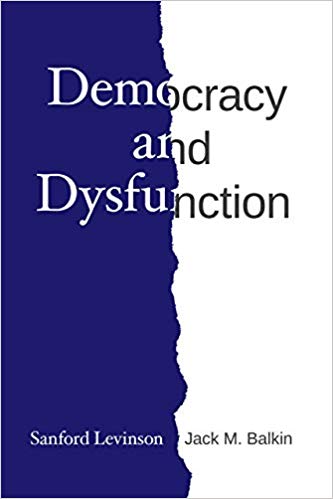
Sanford Levinson and Jack M. Balkin, Democracy and Dysfunction (University of Chicago Press, 2019)

Sanford Levinson, Written in Stone: Public Monuments in Changing Societies (Duke University Press 2018)

Mark A. Graber, Sanford Levinson, and Mark Tushnet, eds., Constitutional Democracy in Crisis? (Oxford University Press 2018)

Gerard Magliocca, The Heart of the Constitution: How the Bill of Rights became the Bill of Rights (Oxford University Press, 2018)

Cynthia Levinson and Sanford Levinson, Fault Lines in the Constitution: The Framers, Their Fights, and the Flaws that Affect Us Today (Peachtree Publishers, 2017)

Brian Z. Tamanaha, A Realistic Theory of Law (Cambridge University Press 2017)

Sanford Levinson, Nullification and Secession in Modern Constitutional Thought (University Press of Kansas 2016)

Sanford Levinson, An Argument Open to All: Reading The Federalist in the 21st Century (Yale University Press 2015)

Stephen M. Griffin, Broken Trust: Dysfunctional Government and Constitutional Reform (University Press of Kansas, 2015)

Frank Pasquale, The Black Box Society: The Secret Algorithms That Control Money and Information (Harvard University Press, 2015)

Bruce Ackerman, We the People, Volume 3: The Civil Rights Revolution (Harvard University Press, 2014)
Balkinization Symposium on We the People, Volume 3: The Civil Rights Revolution

Joseph Fishkin, Bottlenecks: A New Theory of Equal Opportunity (Oxford University Press, 2014)

Mark A. Graber, A New Introduction to American Constitutionalism (Oxford University Press, 2013)

John Mikhail, Elements of Moral Cognition: Rawls' Linguistic Analogy and the Cognitive Science of Moral and Legal Judgment (Cambridge University Press, 2013)

Gerard N. Magliocca, American Founding Son: John Bingham and the Invention of the Fourteenth Amendment (New York University Press, 2013)

Stephen M. Griffin, Long Wars and the Constitution (Harvard University Press, 2013)

Andrew Koppelman, The Tough Luck Constitution and the Assault on Health Care Reform (Oxford University Press, 2013)

James E. Fleming and Linda C. McClain, Ordered Liberty: Rights, Responsibilities, and Virtues (Harvard University Press, 2013)
Balkinization Symposium on Ordered Liberty: Rights, Responsibilities, and Virtues

Andrew Koppelman, Defending American Religious Neutrality (Harvard University Press, 2013)

Brian Z. Tamanaha, Failing Law Schools (University of Chicago Press, 2012)

Sanford Levinson, Framed: America's 51 Constitutions and the Crisis of Governance (Oxford University Press, 2012)

Linda C. McClain and Joanna L. Grossman, Gender Equality: Dimensions of Women's Equal Citizenship (Cambridge University Press, 2012)

Mary Dudziak, War Time: An Idea, Its History, Its Consequences (Oxford University Press, 2012)

Jack M. Balkin, Living Originalism (Harvard University Press, 2011)

Jason Mazzone, Copyfraud and Other Abuses of Intellectual Property Law (Stanford University Press, 2011)

Richard W. Garnett and Andrew Koppelman, First Amendment Stories, (Foundation Press 2011)

Jack M. Balkin, Constitutional Redemption: Political Faith in an Unjust World (Harvard University Press, 2011)

Gerard Magliocca, The Tragedy of William Jennings Bryan: Constitutional Law and the Politics of Backlash (Yale University Press, 2011)

Bernard Harcourt, The Illusion of Free Markets: Punishment and the Myth of Natural Order (Harvard University Press, 2010)

Bruce Ackerman, The Decline and Fall of the American Republic (Harvard University Press, 2010)
Balkinization Symposium on The Decline and Fall of the American Republic

Ian Ayres. Carrots and Sticks: Unlock the Power of Incentives to Get Things Done (Bantam Books, 2010)

Mark Tushnet, Why the Constitution Matters (Yale University Press 2010)

Ian Ayres and Barry Nalebuff: Lifecycle Investing: A New, Safe, and Audacious Way to Improve the Performance of Your Retirement Portfolio (Basic Books, 2010)
.jpg)
Jack M. Balkin, The Laws of Change: I Ching and the Philosophy of Life (2d Edition, Sybil Creek Press 2009)

Brian Z. Tamanaha, Beyond the Formalist-Realist Divide: The Role of Politics in Judging (Princeton University Press 2009)
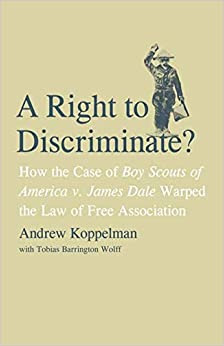
Andrew Koppelman and Tobias Barrington Wolff, A Right to Discriminate?: How the Case of Boy Scouts of America v. James Dale Warped the Law of Free Association (Yale University Press 2009)

Jack M. Balkin and Reva B. Siegel, The Constitution in 2020 (Oxford University Press 2009)

Heather K. Gerken, The Democracy Index: Why Our Election System Is Failing and How to Fix It (Princeton University Press 2009)

Mary Dudziak, Exporting American Dreams: Thurgood Marshall's African Journey (Oxford University Press 2008)

David Luban, Legal Ethics and Human Dignity (Cambridge Univ. Press 2007)

Ian Ayres, Super Crunchers: Why Thinking-By-Numbers is the New Way to be Smart (Bantam 2007)

Jack M. Balkin, James Grimmelmann, Eddan Katz, Nimrod Kozlovski, Shlomit Wagman and Tal Zarsky, eds., Cybercrime: Digital Cops in a Networked Environment (N.Y.U. Press 2007)

Jack M. Balkin and Beth Simone Noveck, The State of Play: Law, Games, and Virtual Worlds (N.Y.U. Press 2006)

Andrew Koppelman, Same Sex, Different States: When Same-Sex Marriages Cross State Lines (Yale University Press 2006)

Brian Tamanaha, Law as a Means to an End (Cambridge University Press 2006)

Sanford Levinson, Our Undemocratic Constitution (Oxford University Press 2006)

Mark Graber, Dred Scott and the Problem of Constitutional Evil (Cambridge University Press 2006)

Jack M. Balkin, ed., What Roe v. Wade Should Have Said (N.Y.U. Press 2005)

Sanford Levinson, ed., Torture: A Collection (Oxford University Press 2004)
Balkin.com homepage
Bibliography
Conlaw.net
Cultural Software
Writings
Opeds
The Information Society Project
BrownvBoard.com
Useful Links
Syllabi and Exams
