Balkinization
an unanticipated consequence of
Jack M. Balkin
Balkinization Symposiums: A Continuing List
E-mail:
Jack Balkin:
jackbalkin at yahoo.com
Bruce Ackerman
bruce.ackerman at yale.edu
Ian Ayres
ian.ayres at yale.edu
Corey Brettschneider
corey_brettschneider at brown.edu
Mary Dudziak
mary.l.dudziak at emory.edu
Joey Fishkin
joey.fishkin at gmail.com
Heather Gerken heather.gerken at yale.edu
Abbe Gluck abbe.gluck at yale.edu
Mark Graber
mgraber at law.umaryland.edu
Stephen Griffin
sgriffin at tulane.edu
Jonathan Hafetz
jonathan.hafetz at shu.edu
Jeremy Kessler
jkessler at law.columbia.edu
Andrew Koppelman
akoppelman at law.northwestern.edu
Marty Lederman
msl46 at law.georgetown.edu
Sanford Levinson
slevinson at law.utexas.edu
David Luban
david.luban at gmail.com
Gerard Magliocca
gmaglioc at iupui.edu
Jason Mazzone
mazzonej at illinois.edu
Linda McClain
lmcclain at bu.edu
John Mikhail
mikhail at law.georgetown.edu
Frank Pasquale
pasquale.frank at gmail.com
Nate Persily
npersily at gmail.com
Michael Stokes Paulsen
michaelstokespaulsen at gmail.com
Deborah Pearlstein
dpearlst at yu.edu
Rick Pildes
rick.pildes at nyu.edu
David Pozen
dpozen at law.columbia.edu
Richard Primus
raprimus at umich.edu
K. Sabeel Rahmansabeel.rahman at brooklaw.edu
Alice Ristroph
alice.ristroph at shu.edu
Neil Siegel
siegel at law.duke.edu
David Super
david.super at law.georgetown.edu
Brian Tamanaha
btamanaha at wulaw.wustl.edu
Nelson Tebbe
nelson.tebbe at brooklaw.edu
Mark Tushnet
mtushnet at law.harvard.edu
Adam Winkler
winkler at ucla.edu
Compendium of posts on Hobby Lobby and related cases
The Anti-Torture Memos: Balkinization Posts on Torture, Interrogation, Detention, War Powers, and OLC
The Anti-Torture Memos (arranged by topic)
Recent Posts
That elusive timeless essence of marriage
Barbour's Bargain
The Illusion of Free Pharmaceutical Markets
Move the cars to remove the snow
We Hold These Truths to Be Universal
The Legal Academy’s Phantom Svengalis (Net Neutrality Edition)
Short Circuited Surge Capacity: Lessons from the Blizzard for Public Health
The Last Business Section
Reva Siegel and Linda Greenhouse discuss "Before Roe v. Wade."
Ideals of Marriage, Ideals of Argumentation
Sanford Levinson Talks about Constitutional Faith and Renewing Democracy
The New START Treaty: A Constitutional Blunder and Its Political Consequences
The Constitution Can Do No Wrong
Parliamentary Parties and the Lame Duck Session
Google Ngram on "Legal Formalism" and "Legal Realism"
Today’s Wall Street Journal: James Grant on The Illusion of Free Markets. [Ground Control to Major Tom]
Network Neutrality Symposium in Yale Law and Policy Review's Inter Alia
Lindsay Graham is not a serious man (and the Constitution makes his frivolity of perhaps life-and-death significance)
Rakove on Maier on the Ratification
"You've got to stop this war in Afghanistan."
Why one is hard pressed to take the Democratic Party seriously
What if there were no 20th Amendment?
What Marriage Isn’t
Department of the Obvious, or Why The Senate Must Be Reformed
Wikileaks and the Mayflower Hotel
Finance Sector as Ultimate Risk Manager?
Almost 40?
Puzzling About Federalism, Take 3
The Law of the Census
Puzzling About Federalism, Take 2
Can’t think of another one
Earl Warren: Homophobe
The "Activity-Inactivity" Distinction
Virginia v. Sebelius: Judge Hudson & Justice Scalia
More Scorn for Judge Hudson's Health Care Ruling
The Virginia Court’s bizarre health law decision
Puzzling About Federalism
DREAMing of Nurses
Bush v. Gore in the American Mind
Patient Autonomy and Personal Health Records
Why the 2010 election was good for the federal judiciary
![[Powered by Blogger]](https://lh3.googleusercontent.com/blogger_img_proxy/AEn0k_t7__VV9m78Ahk2g5k4_XoIMQbd7sg2urZPKcSCTkPzHVPVfLMoQk8RbSBSoaGocHZcSWkQhjVHuKpKNpdcmZRYKy79SN0rFjdpkbn9Wug_=s0-d)
Just A Few Blogs
ACS Blog
Alas, a Blog
Althouse
Arts and Letters Daily
Atrios (Eschaton)
Bill of Health
Buzzflash.com
Buzz Machine
Cato at Liberty
Juan Cole (Informed Comment)
Concurring Opinions
The Constitution in 2020
Corrente
Crooked Timber
Daily Howler
Daily Kos
Dana Boyd
Brad DeLong
Digby (Hullabaloo)
Discriminations
Daniel Drezner
Kevin Drum (Mother Jones)
Electrolite
En Banc
Eunomia (Daniel Larison)
Fafblog
Michael Froomkin (Discourse.net)
GovLab (Beth Noveck)
Rick Hasen (Election Law)
History News Network
How Appealing
Ignatz (Sam Heldman)
The Importance of (Ernie Miller)
Infolaw
Instapundit
International Economic Law and Policy Blog
IntLawGrrls
Jacob Levy
Jesus' General
Jurisdynamics
The Kitchen Cabinet
Mark Kleiman
Law Blog Central
Larry Lessig
Lawyers, Guns and Money
Liberal Oasis
Brian Leiter's Law School Reports
The Leiter Reports
Marginal Revolution
Megan McArdle
Memeorandum
Metafilter
Mirror of Justice
The New Republic
Newseum
No More Mister Nice Blog
Brendan Nyhan
Opinio Juris
Orcinus
The Originalism Blog
Pandagon
Passport (Foreign Policy)
Overcoming Bias
Political Animal (Washington Monthly)
Political Theory Daily Review
Political Wire (Taegan Goddard)
The Poor Man
Virginia Postrel
Prawfsblawg
Public Reason
Jonathan Rauch
Raw Story
Redstate
ReligiousLeftLaw.com
Reporters Committee For Freedom of the Press
Reproductive Rights Blog
Rothman's Roadmap to the Right of Publicity
SCOTUS Blog
Seeing the Forest
Clay Shirky
The Shifted Librarian
The Situationist
Larry Solum (Legal Theory)
Andrew Sullivan
Talking Points Memo
Talk Left
Tapped
Tbogg
TechPresident
The Paper Chase (Jurist)
Tom Paine
Tom Tomorrow (This Modern World)
Eve Tushnet
Uggabugga
University of Chicago Law School Faculty Blog
Unqualified Offerings
The Volokh Conspiracy
War and Piece (Laura Rozen)
Wampum
Oliver Willis
Wonkette
Written Description
Matthew Yglesias
Yin
Your Choice of Feeds
1. XML
powered by

2. Atom Feed
3. RSS 2.0
That elusive timeless essence of marriage
Andrew Koppelman
Kenji Yoshino is right that I misunderstood his rejoinder to the case against same-sex marriage made by Robert George and his coauthors (hereinafter “George” for short), and he ably explains why that rejoinder is more substantial than I took it to be. His (accurate) claim is that George’s definition of marriage is underinclusive. But I still think he and George are talking past each other. To see why, we have to get into some fairly technical philosophy.
I have good news and bad news for Yoshino. The bad news is that he needs to get into these technical philosophical issues in order to show why his objections are effective, and because he does not do so, his argument is incomplete. The good news, much more important, is that if one digs into these philosophical recesses, it becomes clear that Yoshino has exposed to view a central reason why George’s argument is nearly impossible to believe.
Read more »
Posted
1:34 PM
by Andrew Koppelman [link]
Barbour's Bargain
Jason Mazzone
The Supreme Court has never heard a case in which the government has required a person to give a kidney to somebody else. The reason the Court has not heard such a case is that forcing somebody to hand over a kidney is so obviously unconstitutional (at a minimum it violates the due process right of a competent person to refuse unwanted medical treatment) that government has not been foolish enough to try it.
But if the government cannot simply compel us to give up a kidney, can it get our kidneys by making us an offer too good to refuse? Mississippi Governor Haley Barbour believes so. CNN reports that Governor Barbour has struck a deal with two sisters serving life sentences for armed robbery. He has offered the pair suspended sentences (and therefore release from prison) on the condition that one sister donate a kidney to the other sister, who is currently on dialysis at the state's expense. The sisters have accepted the deal.
If this sort of constitutional bargain--in which a kidney earns a get-out-of-jail-free card--seems troubling, consider it in context.
Read more »
Posted
6:00 PM
by Jason Mazzone [link]
The Illusion of Free Pharmaceutical Markets
Frank Pasquale
Over the break, I have been reading the extraordinarily illuminating The Illusion of Free Markets (by fellow Balkinization blogger Bernard Harcourt). I believe Harcourt's "archeology of regulation" convincingly shows that when "layers of legal entitlements, technical rules, and criminal prohibitions are exposed, it is clear that the notion of natural order or market efficiency is pure fiction" (196). What John Quiggin accomplishes in an economic idiom, Harcourt achieves via legal, historical, and philosophical analysis. You'll never view commodity trading (or much of the rest of our economic landscape) the same way after you've read his brilliant book.
Read more »
Posted
4:01 PM
by Frank Pasquale [link]
Move the cars to remove the snow
Jason Mazzone
One of the strangest things about New York City is the free parking on public streets. That's right: New York City permits individuals to leave their 4,000-pound personal possessions on some of the most expensive real estate in the world without paying a dime. In my neighborhood, on the Upper West Side of Manhattan, there are metered spaces on portions of the major avenues but anybody can park without paying on any of the cross streets.
(You might think that New Yorkers already pay for parking through city taxes. But there are far fewer parking spaces (and cars) than there are taxpayers in New York City. And New York law does not limit free parking to city residents.)
Every time there is a snow storm, the foolishness of New York's parking system becomes evident. Plowing a street takes longer and is less effective when the street is lined with cars. On side streets, plowing creates a narrow, snow-walled ally through which traffic must then pass; if a car stops, every vehicle coming behind it (taxis, ambulances, sanitation trucks, police cruisers) must wait. Then there are the car owners who undo the work of the sanitation department by dumping the snow back into the plowed street as they dig their vehicles out. For pedestrians, a plowed, car-lined street is a unique hazard. With the snow pushed up against the side of parked cars rather than distributed evenly across the street, crossing the street requires scaling an icy wall. Parking in New York City might be free to the car owner but for the rest of us, there is, literally, a steep price.
There are two good solutions to these problems.
Read more »
Posted
9:11 PM
by Jason Mazzone [link]
We Hold These Truths to Be Universal
Ian Ayres
Crosspost from Freakonomics: (A few weeks ago, I had the pleasure of attending a conference honoring the accomplishments of Tom Ulen. One of the highlights of the conference was an unusual presentation by Richard McAdams, who not only presented his own work but also told the audience about a cool review article by Joseph Henrich, Steven J. Heine and Ara Norenzayan. Richard deserves a special thanks for highlighting a number of the piece’s neatest results.) The behavioral revolution in economics and psychology has successfully identified and named close to three dozen biases (my favorite behavioral folk song defines them in verse). I had thought that these biases transcended issues of culture. Indeed, both neoclassical and behavioral economists were united in a belief that cultural variables were of secondary importance when it came to the deep drivers of behavior. But a series of experiments now has me thinking that the underlying heuristics are less universal. The article, “The Weirdest People in the World” (ungated working paper), has the startling thesis that social scientists in trying to investigate basic psychology may have erred by oversampling outlier populations. The “Weirdest People” of the title are Western, Educated, Industrialized, Rich, and Democratic. (The cuteness of the title is not one of the article’s strengths.) But the idea that “we” are the exotics usefully jars one from complacency. The heart of the review is a catalog of experiments where the results differ markedly across different societies. Take, for example, the Müller-Lyer illusion, which I would have bet dollars to doughnuts would be a universal trick of the eye: Turns out not only that different societies display different degrees of illusion bias, but the U.S. subjects (represented here by subjects in Evanston, Illinois) are outliers when researchers tested for the prevalence of the illusion across more than a dozen societies throughout the world. The WEIRD subjects, as expected, require “segment a” to be on average 20 percent longer than “segment b” before they subjectively assess the two to be the same length. But other cultures exhibit markedly less bias. Indeed, the “San foragers of the Kalahari seem to be virtually unaffected by the illusion”: The non-representiveness of the United States can also be seen in experiments testing the propensity of subjects to be opportunistic. For example, look at the results from the Dictator Game, which allows one player (the Dictactor) to decide unilaterally how a pot of money will be split with another player: Dictators in the United States and in Canada (Sanquianga) offer nearly half of the prize to the other player. But the “U.S. offers are nearly double that of the Hadza, foragers from Tanzania, and the Tsimane, forager-horticulturalists from the Bolivian Amazon.” The most bizarre results came from a two-stage game of cooperation and punishment. In the first stage, players could contribute to a public good by contributing money to a group project. “All contributions to the group project were multiplied by 1.6 and distributed equally among all partners. “ In stage 2, players could pay some of their private money to “to punish other players by taking money away from them.” What’s bizarre is who subjects from different societies choose to punish: The green, left-hand side of the graph shows the propensity of subjects to punish players who failed to contribute to the group project. The propensity of U.S. subjects to punish free-riders doesn’t seem weird at all. But the U.S, Australia and the U.K. subjects were much less likely to punish players who HAD cooperated by contributing to the group project. In other societies, “[m]any subjects engaged in anti-social punishment; that is, they paid to reduce the earnings of “overly” cooperative individuals (those who contributed more than the punisher did).” It might be that subjects in Oman reason: Who do you think you are, giving so much of your private money to promote a social cause? Even the fundamental attribution error seems less fundamental when tested on non-Western cultures. The fundamental attribution error posits inter alia that individuals tend to “ignore situational information in favor of dispositional information” when evaluating others (but overplay situational information when evaluating themselves). So, for example, if I miss a free throw in an old gym, I’ll tend to blame it on a bent rim. If you miss a free throw in the same gym, I’ll tend to blame it on your poor shooting prowess. Turns out this bias is not as prevalent in other parts of the world: East Asians are more likely than Americans to infer that behaviors are strongly controlled by the situation (Miyamoto & Kitayama 2002; Morris & Peng 1994; Norenzayan et al. 2002a; Van Boven et al. 1999), particularly when situational information is made salient (Choi & Nisbett 1998). Grossmann and Varnum (2010) provides parallel findings with Russians. . . . Hence, although dispositional inferences can be found outside the West, the fundamental attribution error seems less fundamental elsewhere (Choi et al. 1999).
Posted
12:17 PM
by Ian Ayres [link]


The Legal Academy’s Phantom Svengalis (Net Neutrality Edition)
Frank Pasquale
I've been disappointed by the FCC's recent moves on net neutrality. They are not only weak substantively, but also appear vulnerable to jurisdictional challenges.* Like many others, I've been wondering what the FCC chairman was thinking as he delayed action and then ultimately proposed rules that, as Craig Aaron states, are "riddled with loopholes." A recently published reflection on Tim Wu's book The Master Switch by Bruce Gottlieb (who "worked, until this summer, as a senior advisor to [FCC] Chairman Genachowski and was involved in some of the earlier actions that led up to last week's decision") offers some insight.
Read more »
Posted
10:13 AM
by Frank Pasquale [link]
Short Circuited Surge Capacity: Lessons from the Blizzard for Public Health
Frank Pasquale
Bad weather recently caused massive failures at Heathrow Airport, and brought chaos to air travel in the New York area. Both scenarios suggest an intriguing set of dilemmas in health law and policy. We should be doing much more to prepare for sudden, disruptive events in both the transportation and health sectors. But economic short-termism rules the roost, undercutting the infrastructural investments that a more enlightened America would make.
Stuart Altman wisely compared hospitals and airlines in 2006, and worried that many of the former would suffer the fate of legacy carriers:
Read more »
Posted
5:53 PM
by Frank Pasquale [link]
The Last Business Section
Frank Pasquale
The New Museum of Contemporary Art has hosted an exhibit called "The Last Newspaper" the past few months. Part of the exhibit centers around newspaper-based art. Another focus has been a "hybrid of journalism and performance art," as groups of editors and writers developed "last newspaper sections" in areas ranging from real estate to sports to leisure. I co-edited the business section, which is available here in a low-res copy. I'm posting our editorial statement below.
I like how the various articles (contributed by entrepreneurs, theorists, designers, and others) hang together. The terrific design work is a refreshing change from the barren pages of business blogs, law reviews, and academic books (though it looks like some legal scholars are renewing interest in visual aspects of justice). I think programs like "The Last Newspaper" help respond to the all-too-valid critiques of contemporary art offered by Hito Steyerl and others in a recent issue of e-flux.
Read more »
Posted
10:20 PM
by Frank Pasquale [link]
Reva Siegel and Linda Greenhouse discuss "Before Roe v. Wade."
JB
In this video, I interview my colleagues Reva Siegel and Linda Greenhouse about their recent book, Before Roe v. Wade: Voices that Shaped the Abortion Debate Before The Supreme Court's Ruling, a sourcebook that explains the political and legal arguments people made for and against abortion rights leading up to the Supreme Court's 1973 decision. Before Roe vs. Wade: Voices that Shaped The Abortion Debate" from Yale Law Librarians on Vimeo.
Posted
6:05 AM
by JB [link]
Ideals of Marriage, Ideals of Argumentation
Guest Blogger
Kenji Yoshino
Robert George, a conservative professor at Princeton, recently wrote a paper titled "What Is Marriage?" with two co-authors. Last week in Slate, I critiqued the common procreation argument made in that paper—the argument that marriage should be defined as a union of one man and one woman because that was the only combination that could lead to "common procreation." George and his co-authors ("George" for short) have written a response, to which I have written a rejoinder.
Andrew Koppelman, writing on this blog, has now joined the conversation. I write here to respond briefly to Koppelman, because I think he has misunderstood the kinds of arguments—-and the value of the arguments—-I am making against George.
Koppelman states that "Yoshino, unfortunately, never takes on any of the details of [George's] arguments, but instead just summarily notes how weird and counterintuitive it is." Instead, Koppelman contends, I "merely stigmatize[] some analogies they make."
I never described, summarily or otherwise, George's arguments to be "weird and counterintuitive." My argument, rather, was that George's position was "self-destructively over-inclusive." I contended that the principle on which George would seek to fence out gay couples would also, if taken seriously, fence out opposite-sex couples who do not engage in common procreation—couples who cannot or choose not to procreate, as well as couples who create families through adoption or reproductive technologies like sperm and egg donation. George seeks to rescue such couples by observing that infertile opposite-sex couples, for example, are like baseball teams who fulfill the purposes of their organizations even if they do not win. I observed in my critique that this rescue was a false one, as it still demeaned those couples by comparing them to winless baseball teams. So I am not "stigmatiz[ing]" George's analogies, but making arguments about the stigmatic effects of these analogies on couples who cannot or do not have children, which is a different matter entirely.
More broadly, I am doing much more than "just summarily not[ing] how weird and counterintuitive [George's argument] is." I am using a very familiar form of constitutional reasoning: looking to over- and under-inclusiveness. Constitutional arguments often take the form of asking whether state action is properly tailored to a proper state end. If the primary justification underlying the definition of marriage is that it serves the state end of encouraging common procreation, then the ensuing question is whether the exclusion of same-sex marriage is appropriately tailored to that end. If the state end of encouraging common procreation operates not only to exclude same-sex couples, but also to exclude cross-sex couples who do not engage in common procreation, then the tailoring requirement will generally not be met. To be clear, this is not just a matter of constitutional doctrine, but also of simple logic—you cannot argue that a principle justifies the exclusion of same-sex couples from marriage if that principle also excludes individuals you are committed to keeping inside the institution.
At the end of the day, Koppelman and I do not disagree that George is wrong. In his post, Koppelman makes additional arguments against George's analysis, which I find unexceptionable. If he had framed his post as a set of supplementary objections to George's analysis, I would have not felt moved to say more. But I think it is important to take these arguments about over- and under-inclusiveness far more seriously than Koppelman seems to do. They are important parts of how we reason about constitutional law.
Kenji Yoshino is Chief Justice Earl Warren Professor of Constitutional Law at NYU Law School. You can reach him by e-mail at kenji.yoshino at nyu.edu
Posted
8:15 AM
by Guest Blogger [link]
Sanford Levinson Talks about Constitutional Faith and Renewing Democracy
JB
CSPAN recently interviewed Sandy Levinson about his 1988 book, Constitutional Faith.
And here is a lecture Sandy gave in Cambridge, Massachusetts entitled: Renewing Democracy: How Much Do Elections Matter?
Posted
10:14 AM
by JB [link]

The New START Treaty: A Constitutional Blunder and Its Political Consequences
Bruce Ackerman
The Obama Administration had a choice in framing its agreement with the Russians. It could have submitted it for majority consent by both Houses under Article one, generating a binding Congressional-Executive Agreeement -- this is the path taken by Richard Nixon in the first arms control agreement with the Soviets. Or it could have submitted the agreement as a classical treaty under Article two, requiring the approval of two-thirds of the Senate.
In an LA Times op-ed, Oona Hathaway and I argued for the first option, but the Administration chose the second. The result of this blunder is now apparent. If the Administration had taken the Article one route, Nancy Pelosi would have passed the pact expeditiously through the House, giving Harry Reid the momentum needed to obtain the two or three Republican votes required to break a Senate filibuster in short order. Once this threshold was passed, it would have been a simple matter to gain the simple majority vote required for passage. This rapid and decisive victory would have given Obama the green light to negotiate further anti-nuclear proliferation agreements.
But the Administration took the Article two path, and spent many months in a vain effort to convince Republican Senator John Kyl to provide the necessary votes to win a two-thirds majority. While the Administration has finally broken the log-jam, its tactics have led to such partisan bitterness that it has gravely endangered further progress on the anti-prolifereation front -- or so the New York Times reports today.
Perhaps the failure of Obama's most innovative foreign policy initiative was inevitable, given the strengthening of the Republican Right in the next session of Congress. But perhaps not -- maybe the choice of the Article one option, leading to a quick victory for the new agreement, would have greatly strengthened the hand of the Richard Lugars of the Republican party in the years ahead.
But thanks to the Administration's constitutional blunder, we will never know.
Posted
6:32 PM
by Bruce Ackerman [link]
The Constitution Can Do No Wrong
Gerard N. Magliocca
Sovereign immunity started with the fiction that "the King can do no wrong." Constitutional law now rests on a fiction that "the Constitution can do no wrong."
In the nineteenth century, Walter Bagehot explained that all constitutions have two components: the "efficient" part that actually governs and the "dignified" part that sustains the government's legitimacy. In England, the main dignified organ was (and to some extent still is) the Crown. In the United States, it is the written constitution that you see in the National Archives.
In practice, this means that constitutional law is not like science. If a scientific theory is debunked, nobody thinks that this undermines the scientific method. People accept that the progress of knowledge is inevitable and that the truth is subject to revision. Constitutional interpretation is different. When a doctrine or a result that is perceived as wrong, lawyers almost always use the fiction that those cases were "always wrong." (Or, put another way, that the Constitution is always right.) Even with respect to slavery, many abolitionists worked hard to argue that the Constitution was not a pro-slavery document, even though it pretty clearly was.
As I will explain in some posts after the holidays, infallibility is the most powerful constraint on modern constitutional theory. With that teaser, I will wish all of you a Happy New Year!
Posted
11:19 AM
by Gerard N. Magliocca [link]
Parliamentary Parties and the Lame Duck Session
JB
My previous posts on the Republicans as a parliamentary party were based on the assumption that Mitch McConnell would be able to hold the Senate Republicans together on procedural votes in order to block Democratic legislative initiatives. And yet President Obama has been successful in passing several different laws during the lame duck session. (Note this remarkable statement by Lindsay Graham complaining of Republican "capitulation.")
So what gives?
The answer is complicated. In the case of the tax/stimulus legislation, McConnell himself wanted to make a deal because it benefited perhaps the most powerful Republican constituency-- wealthy contributors who want to avoid paying more taxes and didn't want to risk that the Bush tax cuts for the wealthy would actually end for some period of time. Therefore McConnell was willing to let this particular legislation go forward. In other cases, like the vote repealing Don't Ask Don't Tell, different sorts of Republican Senators jumped ship. Some were retiring at the end of this Congress. Some, like Scott Brown, faced considerable pressure given the states they represent. And some like Lisa Murkowski, had very little reason to be a team player because the Republicans had just tried to oust her.
One should not assume, however, that Obama and the Democrats have suddenly found a magic formula that will make the Republicans' tactics obsolete. Indeed, it's difficult to draw many lessons from the lame duck session about what President Obama and the Democrats will or should do during the next Congress. As before, they have to find ways to break Republican unanimity in the Senate, but this will be harder to do now that there are more Republicans, so a few defections won't matter as much. (Indeed, if McConnell plays his cards right, he will probably let a few Republicans off the hook on occasion as long as he always has 40 votes in hand.)
This suggests, ever more strongly, that the best move for Obama and the Democrats would be to change the Senate rules when Congress reconvenes in January and reform the system of filibusters and holds. One hopes that Obama and Reid have learned something from the past two years. They should understand that the Republicans will eventually be moved to change the Senate rules themselves when they next gain control of the Senate. The Republicans will not feel guilty about reducing minority rights in the Senate when they regain power simply because the Democrats were feckless when Republicans were in the minority. Because change is going to come at some point, it would be better for the Democrats to make the change now when they can still gain some advantage from it.
Posted
6:50 AM
by JB [link]
Google Ngram on "Legal Formalism" and "Legal Realism"
Brian Tamanaha
When conducting research on legal formalism several years ago, one of my more surprising findings was that the story about the "formalist age" was actually invented in the mid-1970s by leftist critics of legal liberalism. Before discovering this, I had assumed that the story about the formalist age existed since the beginning of the twentieth century, when Roscoe Pound famously complained about “Mechanical Jurisprudence.” This assumption was incorrect.
Although the notion of "legal formalism" has been around for at least two centuries, for most of this history it has been invoked to criticize a judge or judicial opinion as blind or excessively rigid. (There were no self-proclaimed "legal formalists" until the 1990s and 2000s.) As I elaborate in Beyond the Formalist-Realist Divide, legal historians and legal theorists did not widely think of the turn of the century period as the "formalist age" until this image of the time was cemented in the 1970s and 1980s by Grant Gilmore, Morty Horwitz, Duncan Kennedy, and others (building upon and embellishing earlier accounts of "mechanical jurisprudence").
Once this image took hold, "legal formalism" and "legal realism" became paired as antipodal extremes, each defining the other by way of opposition. Although this opposition has come to dominate contemporary views of judging in political science and legal theory, my argument in the book is that both poles are false historically and unsound theoretically.
The above Google Ngram, measuring textual references to "Legal Formalism" and "Legal Realism," lends quantitative support to my account of the relatively recent rise of the formalist-realist antithesis (see uptick from mid-1970s). And their strong correlation since the mid-1970s suggests that they are indeed a conceptual pair.
Posted
5:24 PM
by Brian Tamanaha [link]
(9) comments

Today’s Wall Street Journal: James Grant on The Illusion of Free Markets. [Ground Control to Major Tom]
Bernard E. Harcourt
James Grant’s book review of The Illusion of Free Markets: Punishment and the Myth of Natural Order in today’s Wall Street Journal is certainly entertaining, but it side-steps the central argument of the book—namely, that the paradoxical belief in, on the one hand, the efficiency of free markets and, on the other hand, government’s unquestioned competence in the field of policing and punishing, has facilitated the massive expansion of our criminal justice system by reducing resistance to the social and political forces that tend toward more criminalization, longer punishments, and harsher policing. It is precisely this paradoxical logic that provokes deep suspicion and recurring resistance whenever legislators contemplate “regulating” the economy, and yet triggers wide enthusiasm and electoral victory whenever politicians pile on sentencing enhancements, stricter drug laws, and three-strikes statutes.
For sure, James Grant, the author of Mr. Market Miscalculates—has a sense of humor. His idea of "college professors who inhabit Planet Tenure” struck me as hilarious. (I can already hear all my junior colleagues: “Beam me up, Scotty!”). Also, the idea of college professors having a “tribal patois” is another good one. But the most humorous lines in the review, I suspect, are unintentional. And there were some good ones—about our punishment iniquities, about the free market. I’ll start with punishment. It’s actually the last line in the review: “As for the iniquity of the American prison system, the writer to read is Conrad Black.”
Conrad Black?
“Ground control to Major Tom… Your circuit's dead, there's something wrong…”
Conrad Black? Excuse me, but he’s not really the poster child of punishment excess, is he? Let’s look elsewhere for a minute. African-Americans in America are incarcerated today at astronomical rates. For Whites (men and women), the incarceration rate in 2005 stood at 412 per 100,000 residents; for African-Americans (men and women), the comparable rate was 2,290 per 100,000. This translates into an incarceration rate of 2.3% of all African Americans in this country (as compared to 0.4% for whites). The racial inequity here—that is, the national black-to-white ratio of incarceration—stands at 5.6. For young African-American men between the ages of 25 and 29, the rate jumps up to one in nine. Yes, that’s 11.7% of young black men in prison or jail. Eleven point seven percent. There’s an iniquity. Marc Mauer and Ryan King at the Sentencing Project have revealing state break-downs in their 2007 study on Uneven Justice. I’d recommend that reading to Mr. Grant—as well as the writings of others, such as Loïc Wacquant’s book Punishing the Poor and Michelle Alexander’s book The New Jim Crow.
A second startling line—again, probably unintentional—has to do with the free market. “In America, on Planet Earth, price discovery is that coordinating power” that achieves efficiency, “that wonderful contrivance—not invented but somehow evolved.”
Can you hear me, Major Tom? Can you hear me, Major Tom? Can you hear?
You’d think Mr. Grant missed the chapters on the myth of “natural order.” From the review essay, it almost feels as if the book sets out to refute the first theorem of welfare economics. Not at all. And explicitly so. The book doesn’t argue that the first theorem is wrong. Nor does it argue that the foundational assumptions of the theorem are in any sense incorrect. (Obviously, assumptions can never be wrong, whether on Planet Tenure or on Planet Earth, they are merely assumptions.) What the book does argue, instead, has to do with the interpretation of what the theorem tells us—of what the price mechanism tells us.
Most people (including Mr. Grant, I take it) interpret the theorem to mean that free markets are efficient: that the situation of the competitive market equilibrium is best from an efficiency perspective. The interpretation in The Illusion of Free Markets, however, is very different. It’s that, first, massive government intervention (the kind, for instance, necessary to keep in place the legal structure and institutional mechanisms that make possible a wheat pit at the Chicago Board of Trade) can lead to situations that are considered efficient (or Pareto optimal, on Planet Tenure, or is that Planet Earth?). Second, that there are lots of different ways for the government to structure law and institutions so as to give rise to forms of exchange that we consider efficient or optimal. (For instance, a universe in which we do and another in which we do not allow options or futures trading at the CBOT can both produce outcomes that will not allow for a Pareto improvement). Third, that those forms of massive government intervention often include, as parts of them, what we typically call “command and control” provisions. (So for instance, at an MCC at the CBOT, the price is fixed by the committee before trading; that involves setting a price in order to make possible a market). And therefore, fourth, that the issue is not “free markets” versus “command-and-control” mechanisms of economic organization—nor, less provocatively, “markets versus regulation”—but rather, and very simply, what are the distributional consequences of the different ways of organizing economic exchange.
On this last question, the only important question, the first theorem tells us essentially nothing. Price mechanisms, it turns out, don’t just appear out of nowhere. In the end, it’s a question of framing, really. Mr. Grant is looking at the same Planet—but he just sees a naturally evolved mechanism based on free, voluntary, compensated exchange, when in fact, there is nothing but complex, institutional, man-made mechanisms and structures that make such “free” exchange remotely possible.
When all is said and done, there’s really just one planet. (Though I wish all my younger colleagues swift transport to the Starship). Mr. Grant, I fear, is, well, ...
… floating in his tin can, far above the Moon. Planet Earth is blue, and there’s nothing more to do….
Posted
12:37 AM
by Bernard E. Harcourt [link]
Network Neutrality Symposium in Yale Law and Policy Review's Inter Alia
Guest Blogger
Christopher Suarez
As the FCC prepares to vote on newly proposed net neutrality rules next Tuesday, the Yale Law and Policy Review has released a symposium on net neutrality in its new online companion, Inter Alia.
Featuring an all-star lineup of net neutrality scholars, the symposium considered various ways to frame the ongoing debate. Dawn Nunziato begins the conversation in The First Amendment Issue of Our Time by outlining the basic contours of the debate from a traditional economic frame. She argues that broadband providers should be regulated much like common carriers. Thus, both wireline and wireless providers should both be subject to nondiscrimination mandates with respect to all content. To the extent that such providers adopt specialized services--for example, a service focused on medical information--regulators should consider applying principles of public forum doctrine, which would allow providers to limit traffic to particular subjects or purposes for which the services are designed. Beyond those special circumstances, however, the internet should remain open and free.
Jonathan Zittrain then asks us to reorient our perspectives on net neutrality is his piece, Net Neutrality as Diplomacy. Instead of framing net neutrality debates in terms of economic efficiency and market choices, Zittrain argues that we should refocus the debate in a diplomatic frame. As individuals secure more and more outposts on the internet--through Twitter, Facebook, Picasa, and Quicken, for example--the internet increasingly becomes an extension of our identities. These outposts are analogous to diplomatic outposts, which serve as extenions of a particular country's homeland. Thus, like diplomats who are free to travel between international outposts with the protection of la valise diplomatique--or the diplomatic pouch--packets of information that travel on the internet should, in this frame, receive similar protection.
In Search, Speech, and Secrecy: Corporate Strategies for Inverting Net Neutrality Debates, Frank Pasquale cautions against broad deference to corporate entities that may disguise their efforts to control data flows online. He fears that ISPs will use trade secret law and other legal tools to shield the underlying architectures of the internet from scrutiny. These underlying architectures--including those that govern search results--have a significant bearing on how all of us perceive information flows on the internet. He urges us to consider broader oversight of Internet companies that control these information flows--such as through offices that record, analyze, and scrutinize their practices.
Susan Crawford, finally, reminds us that net neutrality may be the least of our worries in The Looming Cable Monopoly. Given the limited deployment of fiber in the United States and our heavy reliance on cable broadband, a vast majority of internet users in this country will depend entirely on cable companies for their broadband. In such a world, net neutrality almost seems irrelevant. Instead of focusing primarily on net neutrality regulation, she appears to suggest that regulatory energies should be focused on busting the looming monopoly.
For links to all of these net neutrality symposium pieces and more information on Inter Alia, please visit http://www.yalelawandpolicy.org/interalia.
Christopher Suarez is a student fellow at the Yale Information Society Project. You can reach him by e-mail at christopher.suarez at yale.edu
Posted
6:15 PM
by Guest Blogger [link]
Lindsay Graham is not a serious man (and the Constitution makes his frivolity of perhaps life-and-death significance)
Sandy Levinson
The New York Times reports that South Carolina Republican Sen. Lindsay Graham may well vote against the New Start Treaty because he is upset that the Senate voted to repeal Don't Ask, Don't Tell. That is not a serious argument, especially given the consequences, attested to by the US military, many former Republican Secretaries of State and, indeed, President George H. W. Bush. Dare I award Graham, who aspires to "seriousness," the appellation of "thug" if he takes the treaty down in a partisan effort to put President Barack "in his place" at the back of the political bus? If he honestly opposed the treaty, then that would be another matter. But there is no evidence that he does. Such is the modern Senate, which, thanks to our dysfunctional Constitution, allows a petulant minority of "willful men" to torpedo important international treaties.
Posted
10:11 PM
by Sandy Levinson [link]
(55) comments
Rakove on Maier on the Ratification
Mary L. Dudziak
Balkinization readers will want to take a look at Jack Rakove's review of Pauline Maier, Ratification: The People Debate the Constitution, 1787-1788, which appeared in the Harvard Magazine. (Hat tip to Dan Ernst.) Rakove writes:
Along the way, " Maier is not merely a careful student of these remarkable debates. She brings alive the participants as well." And "Maier’s account of what was actually said" during ratification debates "explains why latter-day originalists like Justices Antonin Scalia and Clarence Thomas, who treat the final text of the ratified document as sacrosanct, reveal so little serious or sustained interest in the actual debates that adopted the Constitution." Ultimately, in illustrating a remarkable moment in American politics, Maier "makes clear why this episode merits the brilliant treatment it has finally received." Histories of the framing of the Constitution in 1787 continue to be written (three in the last eight years). Yet our accounts of this process have always tilted in one direction, toward the debates of the 55 framers at Philadelphia, and away from the 11 months of popular deliberation required to get the Constitution ratified. That story of what the people did with the Constitution has never received the full attention it deserved....
All that has now changed with Pauline Maier’s much-awaited study of ratification, a book that finally enlarges and completes our understanding of how Americans adopted the Constitution.
Read the rest here.
Cross-posted from the Legal History Blog.
Posted
4:00 PM
by Mary L. Dudziak [link]
"You've got to stop this war in Afghanistan."
Brian Tamanaha
The last words of Richard Holbrooke.
Posted
12:43 PM
by Brian Tamanaha [link]
Why one is hard pressed to take the Democratic Party seriously
Sandy Levinson
The egregious Senate (which does deserve credit for repealing Don't Ask Don't Tell, with the support of eight Republican senators), of course also refused to move forward with the "Dream Bill" because there were "only" 55 senators (out of 100, which in some countries that call themselves democracies would be a relevant data point) to support ending debate on the measure. Although, needless to say, most members of the Republican Party voted against cloture, three did not: Senators Richard Lugar, Lisa Murkowsi, and the retiring senators Robert Bennett from Utah, and they deserve genuine kudoi for doing so. But forget the other Republicans. The real disgrace is that the decisive votes to maintain the filibuster were supplied by five ostensible memers of the Democratic Party, Senators Max Baucus and John Tester of Montana, Ben Nelson of Nebraska, Kay Hagan of North Carolina, and Mark Pryor of Arkansas. A serious political party would not allow this. They can, of course, vote however they wish on the final vote. But for ostensible members of the Democratic party to prevent legislation strongly backed by a Democratic President and the Democratic caucus from even coming to the floor should lead to consequences.
I note for the record that Sen. Joseph Lieberman of Conn., whom I have often criticized, voted to end the filibuster. Hurrah for Sen. Lieberman, who also deserves immense credit for exercising real leadership, and breaking with his best friend John McCain (who is having one of the most truly disgraceful end-of-careers imaginable) on Don't Ask Don't Tell.
Posted
6:38 PM
by Sandy Levinson [link]
(19) comments
What if there were no 20th Amendment?
Sandy Levinson
Eugene Garver, who teaches philosophy at St. John's College in Minnesota, has made the extremely shrewd observation that were it not for the 20th Amendment, which in 1933 changed Inauguration Day from March 4 to January 20, then George W. Bush would have had to take responsiblity for the Great Bailout that occurred in January-February 2009. (There's little doubt that the Bush Administration would have done that, given that Henry Paulsen and Ben Bernanke led the initial bailout in November-December 2008.) No doubt Bush would have tried to enlist Obama's support, just as Hoover tried to enlist FDR's support for his policies during the long hiatus in 1933, but Obama could have remained above it all, more than happy, to put it mildly, to let W. take the hit for the "giveaway to Wall Street." Instead, of course, Obama has taken the enormous hit for doing what was quite clearly, all things considered, necessary, and the Republicans could therefore run against the bailout and forget that George W. Bush actually started the whole thing (not only the financial meltdown but also the extraordinary measures to prevent the world from going into full-scale Depression).
I'm certainly not sorry that the 20th Amendment speeded up Inauguration Day. Indeed, of course, I believe that it is highly dysfunctional that we don't inaugurate new presidents as soon as possible after election day. But this is just another example of how the rigid structures imposed on us by the Constitution have very real political consequences.
Posted
6:32 PM
by Sandy Levinson [link]
(9) comments
What Marriage Isn’t
Andrew Koppelman
The same-sex marriage debate is a particularly intractable one, because, more than many other public policy issue, the two sides are unintelligible to one another. Opponents don’t see how same-sex couples can possibly be relevantly similar to opposite-sex couples; proponents don’t see how anyone could fail to perceive the similarity. So academic philosophers, who are particularly concerned with laying out all the moving parts of an argument clearly, have an important contribution to make to public discourse.
Robert George and his colleagues therefore have done us a service with their succinct and clear exposition of the case against same-sex marriage in their new paper, “What is Marriage?” The argument is not persuasive. But it is the clearest short statement of the case that they have offered. They now complain, with justice, that the most prominent response to their paper, by NYU Law Professor Kenji Yoshino, doesn’t really engage with any of their arguments. Here I will try to do better.
Read more »
Posted
3:55 PM
by Andrew Koppelman [link]
Department of the Obvious, or Why The Senate Must Be Reformed
JB
Jon Chait points out the obvious: that Mitch McConnell secured an agreement from all Republican Senators to vote together on all procedural votes. The effect was that the Republicans agreed to act like a parliamentary party, with the baleful effects for American democracy I have described here. Since the tactic has proved so successful in the past two years, there's little reason to doubt that Senate Republicans will attempt to continue it for the foreseeable future, fundamentally changing how Congress works, at least until President Obama finds a way to fracture their coalition, or the Senate Democrats figure out that they need to change the Senate's filibuster and hold rules when the Senate reconvenes in early January.
The Senate must be reformed.
Posted
7:35 AM
by JB [link]
Wikileaks and the Mayflower Hotel
JB
Charlie Savage reports that the U.S. government is trying to distinguish Wikileaks from traditional investigative journalists by arguing that Julian Assange conspired with Pfc. Bradley Manning to obtain secret government information from a government computer system.
The difficulty is that the conspiracy theory also threatens traditional journalists as well.
Journalists are not merely passive recipients of information they receive from their sources. It make take weeks of negotiations (and rounds of drinks at the Mayflower Hotel) to get a source to agree to provide sensitive information, and work out the details of the disclosure. Agreements not to reveal a source who provides sensitive information are just that, agreements. If prosecutors wanted to, they would argue that such agreements were part of a conspiracy to leak classified information under the Espionage Act or related statutes.
The Justice Department might try to distinguish the two cases by seeking to prove that Assange had offered to provide technical assistance to Manning to gain access to the computer system, or provided Manning with software or programming skills. The problem is that this distinction isn't much of a difference. Traditional investigative journalists may assist their sources in other ways besides giving them hacking software. They may, for example, make it easier for them to transmit sensitive information or help them store or transmit the information. They may smooth things over for their sources or encourage them to disclose in countless ways.
As I explained to Savage in a previous interview, Assange is no fool. He understands that the best way to escape prosecution is present himself as a journalist and to point out in every way possible that what he does is like what other investigative journalists do. Indeed, Wikileaks is only disclosing a very small percentage of the files it possesses, and it is working with mainstream journalistic organizations in deciding which files to release.
Journalists should be very worried about the conspiracy theory that the Justice Department is considering. It puts them (and their jobs) in serious danger.
Posted
9:05 AM
by JB [link]
Finance Sector as Ultimate Risk Manager?
Frank Pasquale
David A. Moss's When All Else Fails: Government as the Ultimate Risk Manager should be a vital guide to our future. Moss describes programs ranging from social security to bankruptcy as backstops of support for all classes. As volatility in prices, employment levels, and wages climbs, we should be exploring new "automatic stabilizers" to guarantee every family a "social minimum." Instead, we appear to be privatizing and financializing risk via opaque institutions whose only mandate is to increase their own profits.
Consider, for instance, this vignette from Louise Story's excellent reporting on derivatives trading:
Read more »
Posted
9:57 PM
by Frank Pasquale [link]
Almost 40?
Andrew Koppelman
Pamela Karlan points out that, by some calculations, I may have undercounted the number of Americans who live in jurisdictions that recognize same-sex couples.
Read more »
Posted
5:59 PM
by Andrew Koppelman [link]
Puzzling About Federalism, Take 3
Heather K. Gerken
For the last two days, I have been blogging about some puzzles in the federalism literature. The first is that federalism's two main camps endorse a markedly similar account of federalism, an account that is poorly suited for the institutional arrangements we call "cooperative federalism," where the states and federal government regulate together. The second is that the few scholars who do write about "cooperative federalism" dwell, as the moniker suggests, entirely on the sunnier aspects of federal-state relations and thus neglect many of the theories that have been traditionally associated with constitutional federalism. Scholars, for instance, haven’t thought enough about the uncooperative dimensions of cooperative federalism or the democratic dimensions of these bureaucratic arrangements.
Here’s the third puzzle: federalism is a theory about what a majoritarian system ought to do with its minorities, yet it's had remarkably little to say about the two types of minorities that are most salient in our constitutional system: racial minorities and dissenters.
As I've argued in a recent paper in the Harvard Law Review, Foreword: Federalism All the Way Down, scholars claim that federalism protects minorities by giving them an exit option. Nationalists, of course, worry about federalism for precisely this reason. They worry that the exit option allows local majorities to oppress local minorities. They are reluctant to license local majorities to depart from a national consensus. These fears are deeply rooted in the dark history of slavery and Jim Crow. They are also rooted in an exit account of federalism.
If we orient federalism theory around the institutional arrangements where national minorities exercise what I've called a muscular form of voice, not just exit, we can draw connections between the two grand traditions of constitutional law, rights and structure, by showing how decentralization can serve rather than undermines the core tenets of the First and Fourteenth Amendment.
This argument is easiest to understand if we back into it and start by thinking in institutional terms about what a conventional nationalist thinks is the best way to protect minorities. Proponents of federalism and nationalism both favor a basic baseline of rights. But when it comes to structure, nationalists, disgusted with federalism's past, gravitate to an institutional design strategy familiar to all of us: the diversity paradigm. The idea is simple and intuitive -- that decisionmaking bodies ought to mirror the population from which they are drawn -- they ought to look like America, to use Bill Clinton's favorite phrase. This idea is so pervasive in our thinking that it is inscribed in our vocabulary. In the context of race, our terminology is bimodal. An institution is either "diverse" or "segregated." There is no celebratory term like federalism in the context of race -- a term to celebrate heterogeneous institutions where racial minorities dominate instead of whites. Our discourse on dissent exhibits the same shortcomings. Political dissenters are, by definition, political minorities. Consistent with the diversity paradigm, we typically assume that they should be represented in rough proportion to their population -- one lone skeptic among Twelve Angry Men. Here again, we term institutions where dissenters dominate as "lawless" or "parochial" rather than using a celebratory term like federalism.
Viewed through the lens of federalism, you'll note that the diversity paradigm has an odd quality to it -- it is a theory about empowering racial minorities and dissenters that relentlessly reproduces the same inequalities on governance bodies that they experience everywhere else.
You can see the attraction of federalism, which depends on -- even glories in -- the idea that national minorities constitute local majorities. Why don't we imagine federalism as a strategy for managing and leveraging diversity for racial minorities and dissenters, the two groups where diversity concerns are most salient to the nationalists?
Here I think the exit paradigm gets in the way. Most obviously, the longtime connection between federalism and exit lead nationalists to miss the possibility that we could maintain the local sites that empower minorities without giving up on the idea of enforcing a national consensus.
Less obviously, the exit paradigm directs our focus to states, thus leading us to neglect the smaller units where racial minorities and dissenters are far more likely to dominate. If we abandon the notion that federalism only involves minorities ruling themselves, separate and apart from the center, we can push federalism all the way down to smaller governing institutions. We could thus focus on the ways in which local empowerment serves a role in the political and economic integration of racial minorities. We could imagine local institutions serving as a complementary and competing channel for dissent. We could imagine, in short, decentralized units serving the same type of role in our democracy as do the First and Fourteenth Amendment.
Posted
1:05 PM
by Heather K. Gerken [link]
The Law of the Census
Nate Persily
Next week the Census plans to release its demographic profile of America and soon afterward the apportionment totals for the states. If the 2010 Census is like its predecessors, the state next in line for a congressional seat will sue and argue that some counting method employed by the Census was unconstitutional or otherwise illegal. Because recent Supreme Court decisions surrounding the Voting Rights Act (VRA) have placed greater importance on the size of a minority community that is entitled to its own majority-minority district, we should expect dickering over the census numbers to continue for the next three years or so. For the first time, moreover, the Census will also be releasing data relating to the size of the prisoner and non-citizen population in time for redistricting. I discuss all of these issues and more in an article about to appear in a Cardozo Law Review symposium issue to be published next month. The article -- "The Law of the Census: How to Count, What to Count, Whom to Count, and Where to Count Them" -- is now available here.
Posted
8:22 PM
by Nate Persily [link]
Puzzling About Federalism, Take 2
Heather K. Gerken
Yesterday I wrote about one of the puzzles in the federalism literature -- the fact that the two, main opposing camps in federalism debates have a markedly similar view of state power. Most scholars imagine federalism as providing electoral minorities with an exit option, a chance to rule themselves, separate and apart from the center. As I argue in a paper I just published in the Harvard Law Review, Foreword: Federalism All the Way Down, while "exit" is an excellent way to conceptualize chunks of "Our Federalism," it doesn’t describe all of it. And because constitutional theory remains rooted all but entirely in an exit account, it is disconnected from the many parts of "Our Federalism" where an exit model doesn't capture the form of power states wield. In these areas, the states and federal government regulate together, often with states administering national policy. The power that minorities wield is that of the servant, not the sovereign. In these areas, minorities exercise a muscular form of voice, one that allows them to make federal policy and not just complain about it.
This leads me to a second puzzle about federalism. I'm not the first to argue that the conventional tools of constitutional theory are ill suited for understanding the massive portions of the federal administrative state that we term "cooperative federalism." But cooperative federalists and their intellectual heirs dwell, as the moniker suggests, on the cheerier elements of federal-state interactions -- the ways in which joint regulation promotes mutual learning, healthy competition, and useful redundancy. The work is the rough cognate to the accounts of constitutional federalism that emphasize its technocratic benefits -- those that depict states as laboratories of democracy, sources of innovation, and regulatory rivals.
The puzzle is that scholars who write about "cooperative federalism" haven't limned the theories that make up the other half of constitutional theory -- those that emphasize the role that federalism plays in shaping identity, promoting democracy, and diffusing power. We've missed how much work there is to be done on the uncooperative dimensions of cooperative federalism and the democratic elements of those bureaucratic arrangements. We've neglected the fact that Tocqueville’s democracy fails to produce Weber’s bureaucracy.
Take, for instance, the commonplace that that national power is diffused in two ways, one horizontal and one vertical. There is a curious difference between the ways we understand these institutional arrangements. At the horizontal level, we have long had two competing theories about how to check a government. The first, separation of powers, depends on autonomy and independence. Power is diffused by having institutional actors swim in their own lanes, carrying out policy in their own independent spheres. The second, checks and balances, depends on integration and interdependence. Power is diffused by creating a messy structure of overlapping institutions that depend on one another to get anything done.
Just one model dominates the debate on the vertical diffusion of power: sovereignty, which is the natural cognate to the separation of powers. Both models turn on the notion that power diffusion requires autonomy rather than integration, independence rather than interdependence. Both depend on formal accounts of separate policymaking spheres.
As I argue in The Foreword, what is missing in federalism is the cognate to the checks and balances model -- an account of the ways in which integration and interdependence can help diffuse power. We don't depict voice -- not even the muscular form of voice that allows for rebellious state policymaking -- as a strategy for checking the national government. Instead, we continue to emphasize federalism's hierarchical dimensions rather than imagining federal-state relations as we do the relations between the three branches -- as a system that mixes conflict and cooperation to produce governance.
Let me close with a concrete example of why I think it's worth filling this gap in the literature --why it's important to develop a rough cognate of the checks and balances approach when thinking about the vertical diffusion of power. Think about the efforts of the dissenters in Printz v. United States and New York v. United States to resist the majority's anticommandeering arguments. The majority was able to invoke deeply intuitive, historically rooted arguments about the value of sovereignty. While the dissenters were feeling their way around the arguments I offer in The Foreword, they had to make those arguments piecemeal. Their arguments would have been stronger had they been able to draw upon a well-established doctrinal analogue like “checks and balances” in making their case.
Tomorrow I'll close with one, last puzzle about federalism: why is it that federalism scholars have had so little to say about equal protection and dissent?
Posted
2:34 PM
by Heather K. Gerken [link]
Can’t think of another one
Andrew Koppelman
My Northwestern Law colleague Steven Lubet has offered in an email an elegant summary of the constitutional claim against the federal health insurance mandate: “The scholarly argument against the mandate pretty much runs this way: (1) There must be some limit on federal power; (2) I can’t think of another one; and therefore, (3) the limit must preclude the individual mandate.” This seems to be the source of the novel idea that Congress can regulate activity, but not inactivity, under the necessary and proper clause. (See, for example, Jonathan Adler’s defense of the ruling on the Volokh Conspiracy blog.)
The fundamental problem with Judge Hudson’s claim that Congress is barred from regulating inactivity, even when this is a means to a permissible Congressional end, is that it proposes to limit federal powers with no regard for the purposes for which those powers are being used. The proper response to “I can’t think of another one” is to think of another one.
It’s actually very easy to think of other ones. There’s the one rejected in McCulloch: Congress can only choose means that are ABSOLUTELY necessary to the permitted end. Or here are a few others: Congress cannot enact any legislation that requires the use of instrumentalities that begin with the letter J. Congress cannot enact any legislation that calls for enforcement on Tuesdays. Congress cannot choose any means that weighs more than 346 pounds. All of these would drive back the specter of unlimited Congressional power. The only problem with them is that they are silly and have nothing to do with the underlying reasons for wanting to have limited but effective federal power in the first place. The activity/inactivity distinction has the same problem.
As it happens, the framers thought of one that is more sensible than any of these.
Read more »
Posted
11:17 AM
by Andrew Koppelman [link]
Earl Warren: Homophobe
Sandy Levinson
I attended an excellent conference at the Yale Law School this past weekend, justifiably celebrating the publication of A Republic of Statutes: The New American Constitution, by William Eskridge and John Ferejohn. It argues, among many other things, that one simply cannot understand the American constitutional order if one ignores the "constitutive character" of what they call various "superstatutes" thoughout our history that have shaped that order and, for all intents and purposes, are as "hard-wired" as many of the specific clauses that we ordinary identify as "the Constitution." They are making an extremely important argument that deserves to be debated at length, as it certainly will. (For obvious starters, even if it is spectacularly unlikely that the Social Security Act will in fact be repealed, it would presumably be far easier to do that than to repeal, say, the "Inauguration Day Clause" of the 20th Amendment and replace it with something far more sensible than January 20.) But this obviously doesn't explain the title of my posting.
One of the chapters is about "The Anti-Homosexual Constitution and Its Dis-Entrenchment," which is extremely illuminating. One of the things I learned is the extent to which Earl Warren as the "liberal" governor of California, not only advocated the roundup legitimized in Korematsu, which is well-known and discussed by all of Warren's biographers (as something that must be "explained" even if not justified), but also participated in the efforts to engage in what might well be called the legal terrorization of gays and lesbians in California in the '40s. I was totally unaware of this. I suggested that the lack of attention previously paid to this aspect of Warren's career is evidence of the extent to which "we" simply accept as "normal" the repression directed at gays and lesbians until all too recently in our history.
I suspect that many would regard it as "unfair" to single out Warren for criticism, in the same way that one might regard it as equally unfair to note that some given denizen of Victorian England was anti-Semitic or the like. One expects more of Warren with regard to race and ethnicity in the '40s because, after all, there were groups actively fighting for their liberties. But there were no such "gay and lesbian rights" groups in that era, because to have expressed even public sympathy, let alone to come out oneself, would have exposed oneself to far greater risk than was the case with regard to, say, expressing sympathy for the ACLU or, in the North, the NAACP. Still, it was disconcerting, to put it mildly, to read some of Warren's comments (and the information about several distinctly regressive opinions involving gays and lesbians that are part of the "Warren Court legacy").
One of the striking arguments made by Eskridge and Ferejohn, incidentally, is that the country wasn't really ready for an opinion going the other way in Bowers v. Hardwick, any more than a 1956 decision in Naim v. Naim striking down bans on interracial marriage would have been generally accepted. (They therefore endorse what many see as the Supreme Court's cowardice in that decision, when it basically lied through its teeth about lacking jurisdiction in the case to avoid deciding it the only way that it could have been decided, after Brown, and, of course, the way it was decided 11 years later in Loving v. Virginia, in a decision written by Warren himself.) And they remain decidedly ambivalent about the current litigation in California, hoping that the Ninth Circuit will accept an argument hade in an amicus brief authored by Eskridge to uphold the District Court decision in Peary by focusing on specifics of California's legal regime (so that it is truly arbitrary to deny the right to marry given that specific regime) rather than attempt to decide the issue nationally at this time. One way of describing this position is that this is a time for carefully prudential decisionmaking rather than engaging in foolhardy "courage" that could well provoke a truly unfortunate backlash.
It's an exceptionally interesting book in all sorts of ways, including, of course, putting in a fascinating context the attempts by conservative Republicans on the bench to kill the new medical care bill before it, too, becomes "entrenched" within our constitutional order.
Posted
10:37 PM
by Sandy Levinson [link]
(17) comments
The "Activity-Inactivity" Distinction
Mark Tushnet
I don't think anyone was surprised that conservative Judge Henry Hudson held the individual mandate unconstitutional. What's surprising is the traction that the distinction he relied on has gotten. Congress, according to Judge Hudson, has the power to regulate economic activity but not economic inactivity, that is, a failure to participate in some market such as the insurance market. This distinction seems to me unsound in principle but, more important, inconsistent with the governing precedents. The primary one is Wickard v. Filburn, which is usually described as holding that Congress has the power to regulate economic activities that, taken in themselves, have no substantial effect on interstate commerce but when aggregated do have such an impact. The economic activity in Wickard was the consumption on a person's own farm of wheat grown on that farm.
What the farmer did, though, could just as easily -- indeed, probably more easily -- be described as a failure to purchase wheat in the general market. (Justice Jackson's opinion made the point in this way: "The effect of the statute before us is to restrict the amount which may be produced for market and the extent, as well, to which one may forestall resort to the market by producing to meet his own needs" (emphasis added). Those who do not purchase health-care insurance "forestall resort to the market" by paying the full out-of-pocket costs of their medical care when they incur those costs (or at least assert that they are willing to do so) or by relying on charity to cover the costs (although I would think that in principle the person should forgo that portion of the charity care attributable to the public decision to grant tax-exempt status to charitable health care -- or at least that Congress could require that the person do so).
The government's argument is that the "activity/inactivity" distinction requires too narrow a time-focus -- on the moment at which the decision to purchase or not purchase insurance is made, rather than on the lifetime consumption of health care -- or, alternatively and equivalently, that the relevant market is the healthcare market, not the insurance market. That seems to me right: Filburn, after all, did not participate in the market for wheat, but that didn't prevent Congress from regulating his failure to do so.
Posted
10:10 PM
by Mark Tushnet [link]
Virginia v. Sebelius: Judge Hudson & Justice Scalia
Jason Mazzone
Criticism of Judge Hudson’s opinion today in Virginia v. Sebelius has centered on his rejection of the government’s argument that the insurance mandate is a necessary and proper means to effectuate federal regulation of the interstate health care and insurance markets. Andrew Koppelman, writing on this blog, and Orin Kerr, at Volokh Conspiracy, complain that Judge Hudson’s analysis ignores the command of McCulloch v. Maryland that in exercising its enumerated powers, Congress can choose means beyond those the powers themselves provide for—and that Judge Hudson has thereby read the necessary and proper clause out of the Constitution. It would indeed be odd for a federal district court to ignore McCulloch or any other Supreme Court decision. I don’t think this is what Judge Hudson has done. Judge Hudson might well be wrong in his holding. But today's criticisms seem to me to miss the thrust of Judge Hudson's analysis.
Read more »
Posted
8:40 PM
by Jason Mazzone [link]
More Scorn for Judge Hudson's Health Care Ruling
Frank Pasquale
Well, I guess we all now know that Federal Judge Henry E. Hudson has a "stake worth between $15,000 and $50,000 in a GOP political consulting firm that worked against health care reform -- the very law against which he ruled today." Andrew Koppelman's post below examines some of the major flaws in the opinion. Over at Health Reform Watch, we have previously hosted two pieces by Mark A. Hall (one of the nation’s leading scholars in health care law and policy) making the case for the constitutionality of the ACA. His latest installment finds little in Judge Hudson's ruling to change his mind: Although the court nodded to the challengers’ burden of persuasion and the presumption in favor of constitutionality, it emphasized the lack of any “specifically articulated constitutional authority . . . to mandate the purchase of health insurance” (p. 20). And although the case was about government powers rather than constitutionally-protected individual rights, the judge said (p. 37) that, “At its core this dispute is . . . about an individual’s right to choose” to be uninsured. [Hudson appears to be] someone determined to strike the mandate regardless of the force of argument in the way.
Hall is puzzled by much of the ruling:
Read more »
Posted
6:47 PM
by Frank Pasquale [link]
The Virginia Court’s bizarre health law decision
Andrew Koppelman
Today’s federal ruling striking down the Obama health care law is powerful proof that the law is, in fact, constitutional.
This apparent paradox emerges from the bizarre new legal theories that Judge Henry Hudson had to invent in order to invalidate the law – theories that, if taken seriously, would randomly destroy large parts of federal law.
Read more »
Posted
5:01 PM
by Andrew Koppelman [link]
Puzzling About Federalism
Heather K. Gerken
Lately I've been thinking and writing about federalism for a paper I just published last month in the Harvard Law Review: Foreword: Federalism All the Way Down. There I talk about several puzzles one finds in the federalism literature. One of those puzzles goes to the main intellectual divide in federalism. There is a fair bit of agreement as to what purposes federalism serves: choice, competition, participation, experimentation, and the diffusion of power. The core divide in federalism turns on the best means to pursue those ends. The Supreme Court and a handful of scholars regularly assert that states require sovereignty -- a formal guarantee, enforceable in court -- to protect state power. Another set of scholars just as regularly insists that federalism should move beyond sovereignty. Many endorse process federalism, which looks to politics, inertia, and interdependence as the guarantors of state power. So that's the divide as we conventionally understand it: champions of sovereignty on one side; process federalists on the other. Here’s the puzzle: even though we typically imagine these traditional sparring partners as being on opposite sides of the debate, in fact the two camps have a good deal more in common than we typically imagine. Even as process federalists announce the death of sovereignty, they remain haunted by its ghost. The process federalists' image of state power, for instance, looks remarkably like the one found in a sovereignty account. The de facto autonomy lauded by process federalists looks much like the de jure autonomy lauded by sovereignty’s supporters -- both involve presiding over one's own empire rather than administering someone else's. Process federalists rebuke sovereignty types for endorsing a separate spheres approach, but lurking in their own work is the sense that states should have their own regulatory turf. So why do these putative opponents have so much in common? We can begin to make sense of this fact if we imagine federalism as a strategy for solving one of the great puzzles of democratic design -- what should a majoritarian democracy should do with its minorities? Most accounts of federalism stand in loosely for the notion that the best way to protect minorities in a majoritarian system is to give them what Albert Hirschman might call an "exit option" -- making space for them to enact their own policies, separate and apart from the center. That is why process federalists, who urge the Court to move beyond sovereignty, still stick with sovereignty's intellectual traveling companions. They may differ from sovereignty's champions when thinking about how to protect state power, but both camps are still thinking about power itself in basically the same way. The argument I offer in the Foreword is that while "exit" is an excellent way to conceptualize chunks of "Our Federalism," it doesn't describe all of it. And because constitutional theory remains rooted all but entirely in an exit account, it is disconnected from the many parts of "Our Federalism" where an exit model doesn’t capture the form of power states wield. In these areas, the states and federal government regulate together, often with states administering national policy. The power that minorities wield is that of the servant, not the sovereign. What kind of account do we need to describe state power in the many areas where states are servants, not sovereigns? What's the alternative? Voice, obviously, but here I don’t mean "voice" in the same sense that Hirschman uses it. I am not referring to the idea that minorities can speak out against a national policy. I mean to refer to a more robust, more muscular form of voice: the ability of states to make national policy, not just to complain about it. It's the chance to serve as policymaking insiders rather than autonomous outsider . . . to dissent from within rather than complain from without . . . to administer the federal empire rather than preside over an empire of one’s own. Tomorrow I'll talk about a different puzzle in the literature: why do scholars have such a sunny view of "cooperative" federalism?
Posted
3:35 PM
by Heather K. Gerken [link]
DREAMing of Nurses
Jason Mazzone
Immigration law in the United States has never done a very good job of promoting the nation's economic interests. The proposed "Development, Relief and Education for Alien Minors Act" (DREAM Act) is a case in point. The DREAM Act would provide aliens of "good moral character" who arrived in the United States illegally as minors a path to permanent residency and citizenship if they graduate high school and complete two years in the military or two years of college.
Supporters of the Act say that conditioning legalization on fulfillment of one of these two requirements will benefit the nation militarily and economically. The economic argument is that the individuals who make it through the process will be the best and the brightest, with the skills to find employment. This is a dubious claim. Two years of undefined college education do not make somebody very marketable, particularly in the current economy.
Congress should align the DREAM Act more plainly with the country's economic needs.
The country faces a shortage of nurses. Various studies predict a shortfall of around 500,000 nurses within the next fifteen years as the baby boomer generation ages. In place of the DREAM Act's nebulous requirement of two years of college, Congress should condition legalization upon completion of nursing training and five years of employment as a registered nurse. The DREAM Act can in this way be a win-win, conferring a benefit on the alien whose status is regularized and on the nation.
The proposal need not be limited to nursing. The country also faces a shortage of other health care professionals (including primary care physicians) and the DREAM Act should likewise provide a means of legalization to individuals who commit to working in those professions.
The point is that if Congress is inclined to deal with the problem of individuals who entered the United States unlawfully as children, it can--and should--do so in a way most likely to serve the nation's economic interests.
Posted
1:50 PM
by Jason Mazzone [link]
Bush v. Gore in the American Mind
Nate Persily
[Cross-posted at electionlawblog.com]
On this tenth anniversary of the Supreme Court's decision in Bush v. Gore it is worth examining how views of the decision may have changed since the decision and how attitudes toward the decision relate to contemporary attitudes toward the Court. This post describes results from a survey conducted by Stephen Ansolabehere and myself last summer, which included a question about Bush v. Gore. The full survey is available here. Amy Semet, Stephen Ansolabehere, and I have a work-in-progress that discusses these results in greater detail and that we hope to post in about a month.
The short story is that we are still divided as a country when it comes to perceived fairness of the Court's decision in Bush v Gore. We are divided by race, party, and ideology. The decision, however, is fading in the public memory, as younger respondents and less educated respondents are more willing to say they do not remember the decision.
Our survey asked:
"You may remember that ten years ago the U.S. Supreme Court issued a decision in the case concerning the counting of ballots cast in Florida in the 2000 presidential election contest between George Bush and Al Gore. Do you think the Supreme Court decided the case fairly or unfairly or don't you remember?"
Yes, it decided the case fairly – 33.7%
No, it did not decide the case fairly – 35.2%
I don’t remember – 28.4%
Refused to Answer – 2.6%
The breakdown of responses according to age, education, race, party, ideology, and Bush approval is available here. Ten percent of African Americans, as compared to 40 percent of whites, think the decision was fair. 79 percent of Strong Republicans but only seven percent of Strong Democrats considered the decision fair, which is about the same breakdown one sees on the question as between those who strongly approve or strongly disapprove of the Bush presidency. All of these variables are statistically significant in regressions in which perceived fairness of Bush v. Gore is the dependent variable.
For most observers, the public opinion question surrounding Bush v. Gore is whether the Supreme Court suffered at all in the public mind as a result of its decision. Most studies have found partisan and racial polarization in opinion toward the Court in the immediate aftermath of Bush v. Gore but a return to “normal” by September 11th 2001 if not before. (See Caldeira, Gibson and Spence, “The Supreme Court and the U. S. Presidential Election of 2000", British Journal of Political Science 33:535-556 (2003); Mate and Wright, “The 2000 Presidential Election Controversy”, in Public Opinion and Constitutional Controversy (Persily, Citrin & Egan eds, 2008).
All such studies merely look at attitudes toward the Court (particularly “confidence in the Court”) and notice that the structure of support is similar to that existing pre-Bush v. Gore. No study, so far as we are aware, has looked at contemporary attitudes toward Bush v. Gore and related them to attitudes toward the Court. When we do so, we find the picture to be more complicated than conventional wisdom suggests. Our survey included questions on both confidence in the Court and job approval. (“Below is a list of institutions in this country. As far as the people running these institutions are concerned, would you say you have a great deal of confidence, only some confidence, or hardly any confidence?” The list of institutions included: the Military, the U.S. Supreme Court, Congress, Churches, Corporations, and the President. To measure approval, we simply asked “Do you approve of the job the U.S. Supreme Court is doing?”) Consistent with the conventional wisdom, the simple cross tabs display no significant difference in answers to these questions among those who think Bush v. Gore was fair or unfair.
In regressions predicting both confidence and approval in the Court, however, opinion on Bush v. Gore is statistically significant. For confidence, its effect is small, and overhwhelmed by general confidence in other institutions. For approval, the effect is much greater – and more substantial, for example, than opinion on Roe v. Wade. When holding all other political, ideological, and demographic variables at their mean, the probability of approving of the Court differs by about twenty percentage points between those who thought the decision was fair and those who thought it was unfair.
This finding surprises me, even to the point that I don’t yet believe it. It is also not obvious how one should interpret it. Does the fact that opinion on Bush v. Gore has some predictive power on approval of the Roberts Court in 2010 mean that the decision has had long-lasting effects? Or does opinion on Bush v. Gore serve as a proxy for something else, such as comfort or discomfort with the Court as a political institution? Moreover, are the cross tabs, which show no appreciable difference in attitudes toward the Court based on perceived fairness of Bush v. Gore, really more relevant in addressing the million dollar question whether the Court has paid a price in public opinion for its decision?
For those who could not care less about public opinion toward Court decisions, either because they view survey research as akin to astrology or as irrelevant in the context of interpreting the Constitution, the Indiana Law Review has just published a symposium on election law. My contribution -- “‘Celebrating’ the Tenth Anniversary of the 2000 Election Controversy: What the World Can Learn from the Recent History of Election Dysfunction in the United States” – is available here.
Posted
1:11 PM
by Nate Persily [link]
Patient Autonomy and Personal Health Records
Frank Pasquale
I recently gave remarks as part of a panel at the roundtable "Personal Health Records: Understanding the Evolving Landscape," sponsored by the Office of the National Coordinator for Health Information Technology (ONC). There were many interesting speakers, including some of the leading businesses in the PHR space and regulators from FTC, HHS, and the California state Office of Privacy Protection. The roundtable exposed the promise--and limits--of a personalized health record model. Databases may help both public health and patient care, but the many stakeholders in PHR's may have very different views about how much control patients should have over the presentation of their medical selves in everyday life.
Discussions about health records can get forbiddingly abstract and technical, but a real-world dilemma can help concretize the problem. As Lisa Wangsness's Boston Globe article shows, at least one individual feels "burned" by his effort to quickly port past data into a PHR:
Read more »
Posted
10:48 AM
by Frank Pasquale [link]
Why the 2010 election was good for the federal judiciary
Jason Mazzone
The 112th Congress will convene next January with Republicans holding 47 seats in the Senate, having gained six seats in the November election. This is good news for the federal judiciary.
With Democrats and Independents holding just 53 seats, there will be no strategic retirements at the Supreme Court. There is thus little likelihood of the White House and the Senate being preoccupied, as they have been the past two summers, with a Supreme Court nomination hearing. Few circuit court nominees are likely to be brought to a confirmation hearing in the next two years (and fewer still to a final vote).
The focus of the White House and of the Senate Judiciary Committee can therefore shift to district court nominees, who traditionally have generated less controversy. This will be a healthy development.
Currently, there are 111 vacant seats in the federal courts. Of these, 88 are district court seats. To the extent the federal judiciary is understaffed, it is understaffed at the district court level.
Filling the vacant district court seats is more important than filling the open circuit court seats. Most cases are resolved in district court. District courts also have less capacity to take on additional cases than do circuit courts, which have fewer fixed obligations and greater control over scheduling and disposition of cases.
In the past, the Obama White House has shown a preference for filling circuit court seats. There are currently nominations pending for all but eight of the 23 vacant circuit court seats. By contrast, of the 88 district court openings, there are 40 seats for which the President has not named anybody.
During the next two years, the White House and the Senate Judiciary Committee should focus on filling district court seats. That is a manageable task at a time when the Senate is nearly evenly split.
The White House may have already received this message. Since the November election, President Obama has made fourteen judicial nominations. Thirteen of those nominations are to fill vacant district court seats. This approach is wise and should be continued.
Posted
2:42 PM
by Jason Mazzone [link]
Books by Balkinization Bloggers

Gerard N. Magliocca, The Actual Art of Governing: Justice Robert H. Jackson's Concurring Opinion in the Steel Seizure Case (Oxford University Press, 2025)

Linda C. McClain and Aziza Ahmed, The Routledge Companion to Gender and COVID-19 (Routledge, 2024)

David Pozen, The Constitution of the War on Drugs (Oxford University Press, 2024)

Jack M. Balkin, Memory and Authority: The Uses of History in Constitutional Interpretation (Yale University Press, 2024)
Mark A. Graber, Punish Treason, Reward Loyalty: The Forgotten Goals of Constitutional Reform after the Civil War (University of Kansas Press, 2023)
Jack M. Balkin, What Roe v. Wade Should Have Said: The Nation's Top Legal Experts Rewrite America's Most Controversial Decision - Revised Edition (NYU Press, 2023)

Andrew Koppelman, Burning Down the House: How Libertarian Philosophy Was Corrupted by Delusion and Greed (St. Martin’s Press, 2022)

Gerard N. Magliocca, Washington's Heir: The Life of Justice Bushrod Washington (Oxford University Press, 2022)
Joseph Fishkin and William E. Forbath, The Anti-Oligarchy Constitution: Reconstructing the Economic Foundations of American Democracy (Harvard University Press, 2022)
Mark Tushnet and Bojan Bugaric, Power to the People: Constitutionalism in the Age of Populism (Oxford University Press 2021).

Mark Philip Bradley and Mary L. Dudziak, eds., Making the Forever War: Marilyn B. Young on the Culture and Politics of American Militarism Culture and Politics in the Cold War and Beyond (University of Massachusetts Press, 2021).

Jack M. Balkin, What Obergefell v. Hodges Should Have Said: The Nation's Top Legal Experts Rewrite America's Same-Sex Marriage Decision (Yale University Press, 2020)

Frank Pasquale, New Laws of Robotics: Defending Human Expertise in the Age of AI (Belknap Press, 2020)

Jack M. Balkin, The Cycles of Constitutional Time (Oxford University Press, 2020)

Mark Tushnet, Taking Back the Constitution: Activist Judges and the Next Age of American Law (Yale University Press 2020).

Andrew Koppelman, Gay Rights vs. Religious Liberty?: The Unnecessary Conflict (Oxford University Press, 2020)

Ezekiel J Emanuel and Abbe R. Gluck, The Trillion Dollar Revolution: How the Affordable Care Act Transformed Politics, Law, and Health Care in America (PublicAffairs, 2020)

Linda C. McClain, Who's the Bigot?: Learning from Conflicts over Marriage and Civil Rights Law (Oxford University Press, 2020)
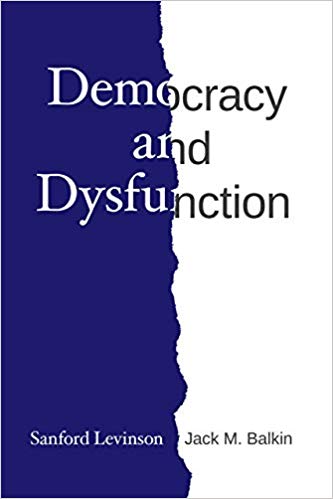
Sanford Levinson and Jack M. Balkin, Democracy and Dysfunction (University of Chicago Press, 2019)

Sanford Levinson, Written in Stone: Public Monuments in Changing Societies (Duke University Press 2018)

Mark A. Graber, Sanford Levinson, and Mark Tushnet, eds., Constitutional Democracy in Crisis? (Oxford University Press 2018)

Gerard Magliocca, The Heart of the Constitution: How the Bill of Rights became the Bill of Rights (Oxford University Press, 2018)

Cynthia Levinson and Sanford Levinson, Fault Lines in the Constitution: The Framers, Their Fights, and the Flaws that Affect Us Today (Peachtree Publishers, 2017)

Brian Z. Tamanaha, A Realistic Theory of Law (Cambridge University Press 2017)

Sanford Levinson, Nullification and Secession in Modern Constitutional Thought (University Press of Kansas 2016)

Sanford Levinson, An Argument Open to All: Reading The Federalist in the 21st Century (Yale University Press 2015)

Stephen M. Griffin, Broken Trust: Dysfunctional Government and Constitutional Reform (University Press of Kansas, 2015)

Frank Pasquale, The Black Box Society: The Secret Algorithms That Control Money and Information (Harvard University Press, 2015)

Bruce Ackerman, We the People, Volume 3: The Civil Rights Revolution (Harvard University Press, 2014)
Balkinization Symposium on We the People, Volume 3: The Civil Rights Revolution

Joseph Fishkin, Bottlenecks: A New Theory of Equal Opportunity (Oxford University Press, 2014)

Mark A. Graber, A New Introduction to American Constitutionalism (Oxford University Press, 2013)

John Mikhail, Elements of Moral Cognition: Rawls' Linguistic Analogy and the Cognitive Science of Moral and Legal Judgment (Cambridge University Press, 2013)

Gerard N. Magliocca, American Founding Son: John Bingham and the Invention of the Fourteenth Amendment (New York University Press, 2013)

Stephen M. Griffin, Long Wars and the Constitution (Harvard University Press, 2013)

Andrew Koppelman, The Tough Luck Constitution and the Assault on Health Care Reform (Oxford University Press, 2013)

James E. Fleming and Linda C. McClain, Ordered Liberty: Rights, Responsibilities, and Virtues (Harvard University Press, 2013)
Balkinization Symposium on Ordered Liberty: Rights, Responsibilities, and Virtues

Andrew Koppelman, Defending American Religious Neutrality (Harvard University Press, 2013)

Brian Z. Tamanaha, Failing Law Schools (University of Chicago Press, 2012)

Sanford Levinson, Framed: America's 51 Constitutions and the Crisis of Governance (Oxford University Press, 2012)

Linda C. McClain and Joanna L. Grossman, Gender Equality: Dimensions of Women's Equal Citizenship (Cambridge University Press, 2012)

Mary Dudziak, War Time: An Idea, Its History, Its Consequences (Oxford University Press, 2012)

Jack M. Balkin, Living Originalism (Harvard University Press, 2011)

Jason Mazzone, Copyfraud and Other Abuses of Intellectual Property Law (Stanford University Press, 2011)

Richard W. Garnett and Andrew Koppelman, First Amendment Stories, (Foundation Press 2011)

Jack M. Balkin, Constitutional Redemption: Political Faith in an Unjust World (Harvard University Press, 2011)

Gerard Magliocca, The Tragedy of William Jennings Bryan: Constitutional Law and the Politics of Backlash (Yale University Press, 2011)

Bernard Harcourt, The Illusion of Free Markets: Punishment and the Myth of Natural Order (Harvard University Press, 2010)

Bruce Ackerman, The Decline and Fall of the American Republic (Harvard University Press, 2010)
Balkinization Symposium on The Decline and Fall of the American Republic

Ian Ayres. Carrots and Sticks: Unlock the Power of Incentives to Get Things Done (Bantam Books, 2010)

Mark Tushnet, Why the Constitution Matters (Yale University Press 2010)

Ian Ayres and Barry Nalebuff: Lifecycle Investing: A New, Safe, and Audacious Way to Improve the Performance of Your Retirement Portfolio (Basic Books, 2010)
.jpg)
Jack M. Balkin, The Laws of Change: I Ching and the Philosophy of Life (2d Edition, Sybil Creek Press 2009)

Brian Z. Tamanaha, Beyond the Formalist-Realist Divide: The Role of Politics in Judging (Princeton University Press 2009)
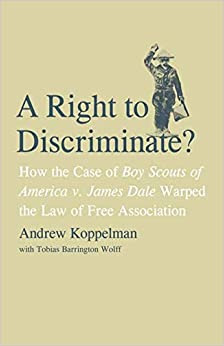
Andrew Koppelman and Tobias Barrington Wolff, A Right to Discriminate?: How the Case of Boy Scouts of America v. James Dale Warped the Law of Free Association (Yale University Press 2009)

Jack M. Balkin and Reva B. Siegel, The Constitution in 2020 (Oxford University Press 2009)

Heather K. Gerken, The Democracy Index: Why Our Election System Is Failing and How to Fix It (Princeton University Press 2009)

Mary Dudziak, Exporting American Dreams: Thurgood Marshall's African Journey (Oxford University Press 2008)

David Luban, Legal Ethics and Human Dignity (Cambridge Univ. Press 2007)

Ian Ayres, Super Crunchers: Why Thinking-By-Numbers is the New Way to be Smart (Bantam 2007)

Jack M. Balkin, James Grimmelmann, Eddan Katz, Nimrod Kozlovski, Shlomit Wagman and Tal Zarsky, eds., Cybercrime: Digital Cops in a Networked Environment (N.Y.U. Press 2007)

Jack M. Balkin and Beth Simone Noveck, The State of Play: Law, Games, and Virtual Worlds (N.Y.U. Press 2006)

Andrew Koppelman, Same Sex, Different States: When Same-Sex Marriages Cross State Lines (Yale University Press 2006)

Brian Tamanaha, Law as a Means to an End (Cambridge University Press 2006)

Sanford Levinson, Our Undemocratic Constitution (Oxford University Press 2006)

Mark Graber, Dred Scott and the Problem of Constitutional Evil (Cambridge University Press 2006)

Jack M. Balkin, ed., What Roe v. Wade Should Have Said (N.Y.U. Press 2005)

Sanford Levinson, ed., Torture: A Collection (Oxford University Press 2004)
Balkin.com homepage
Bibliography
Conlaw.net
Cultural Software
Writings
Opeds
The Information Society Project
BrownvBoard.com
Useful Links
Syllabi and Exams
