Balkinization
an unanticipated consequence of
Jack M. Balkin
Balkinization Symposiums: A Continuing List
E-mail:
Jack Balkin:
jackbalkin at yahoo.com
Bruce Ackerman
bruce.ackerman at yale.edu
Ian Ayres
ian.ayres at yale.edu
Corey Brettschneider
corey_brettschneider at brown.edu
Mary Dudziak
mary.l.dudziak at emory.edu
Joey Fishkin
joey.fishkin at gmail.com
Heather Gerken heather.gerken at yale.edu
Abbe Gluck abbe.gluck at yale.edu
Mark Graber
mgraber at law.umaryland.edu
Stephen Griffin
sgriffin at tulane.edu
Jonathan Hafetz
jonathan.hafetz at shu.edu
Jeremy Kessler
jkessler at law.columbia.edu
Andrew Koppelman
akoppelman at law.northwestern.edu
Marty Lederman
msl46 at law.georgetown.edu
Sanford Levinson
slevinson at law.utexas.edu
David Luban
david.luban at gmail.com
Gerard Magliocca
gmaglioc at iupui.edu
Jason Mazzone
mazzonej at illinois.edu
Linda McClain
lmcclain at bu.edu
John Mikhail
mikhail at law.georgetown.edu
Frank Pasquale
pasquale.frank at gmail.com
Nate Persily
npersily at gmail.com
Michael Stokes Paulsen
michaelstokespaulsen at gmail.com
Deborah Pearlstein
dpearlst at yu.edu
Rick Pildes
rick.pildes at nyu.edu
David Pozen
dpozen at law.columbia.edu
Richard Primus
raprimus at umich.edu
K. Sabeel Rahmansabeel.rahman at brooklaw.edu
Alice Ristroph
alice.ristroph at shu.edu
Neil Siegel
siegel at law.duke.edu
David Super
david.super at law.georgetown.edu
Brian Tamanaha
btamanaha at wulaw.wustl.edu
Nelson Tebbe
nelson.tebbe at brooklaw.edu
Mark Tushnet
mtushnet at law.harvard.edu
Adam Winkler
winkler at ucla.edu
Compendium of posts on Hobby Lobby and related cases
The Anti-Torture Memos: Balkinization Posts on Torture, Interrogation, Detention, War Powers, and OLC
The Anti-Torture Memos (arranged by topic)
Recent Posts
War Powers (Part 3)
Paul Krugman still can't connect all the dots
War Powers (Part 2)
The ACLU and the Future of News
War Powers (Part 1)
Romanticism about the Senate and "great senators"
New OLC Memoranda Released
On Teddy's successor
Score One for the Semi-Autonomy of Law
Torture developments, briefly
Toward a new constitutional convention...
Further notes on our dysfunctional government
But can any serious person believe there are five votes?
The Inevitable Conservative Argument that Health Care Reform is Unconstitutional
Twitter, Conservatives, and How to Think About the Internet and Democracy
Force and Resistance
Dean Edley on Professor Yoo
Trying to Remember Why We’re Closing Gitmo?
The Constitutional Moment of Health Care Reform
Continuing notes on our constitutional dictatorship
![[Powered by Blogger]](https://lh3.googleusercontent.com/blogger_img_proxy/AEn0k_t7__VV9m78Ahk2g5k4_XoIMQbd7sg2urZPKcSCTkPzHVPVfLMoQk8RbSBSoaGocHZcSWkQhjVHuKpKNpdcmZRYKy79SN0rFjdpkbn9Wug_=s0-d)
Just A Few Blogs
ACS Blog
Alas, a Blog
Althouse
Arts and Letters Daily
Atrios (Eschaton)
Bill of Health
Buzzflash.com
Buzz Machine
Cato at Liberty
Juan Cole (Informed Comment)
Concurring Opinions
The Constitution in 2020
Corrente
Crooked Timber
Daily Howler
Daily Kos
Dana Boyd
Brad DeLong
Digby (Hullabaloo)
Discriminations
Daniel Drezner
Kevin Drum (Mother Jones)
Electrolite
En Banc
Eunomia (Daniel Larison)
Fafblog
Michael Froomkin (Discourse.net)
GovLab (Beth Noveck)
Rick Hasen (Election Law)
History News Network
How Appealing
Ignatz (Sam Heldman)
The Importance of (Ernie Miller)
Infolaw
Instapundit
International Economic Law and Policy Blog
IntLawGrrls
Jacob Levy
Jesus' General
Jurisdynamics
The Kitchen Cabinet
Mark Kleiman
Law Blog Central
Larry Lessig
Lawyers, Guns and Money
Liberal Oasis
Brian Leiter's Law School Reports
The Leiter Reports
Marginal Revolution
Megan McArdle
Memeorandum
Metafilter
Mirror of Justice
The New Republic
Newseum
No More Mister Nice Blog
Brendan Nyhan
Opinio Juris
Orcinus
The Originalism Blog
Pandagon
Passport (Foreign Policy)
Overcoming Bias
Political Animal (Washington Monthly)
Political Theory Daily Review
Political Wire (Taegan Goddard)
The Poor Man
Virginia Postrel
Prawfsblawg
Public Reason
Jonathan Rauch
Raw Story
Redstate
ReligiousLeftLaw.com
Reporters Committee For Freedom of the Press
Reproductive Rights Blog
Rothman's Roadmap to the Right of Publicity
SCOTUS Blog
Seeing the Forest
Clay Shirky
The Shifted Librarian
The Situationist
Larry Solum (Legal Theory)
Andrew Sullivan
Talking Points Memo
Talk Left
Tapped
Tbogg
TechPresident
The Paper Chase (Jurist)
Tom Paine
Tom Tomorrow (This Modern World)
Eve Tushnet
Uggabugga
University of Chicago Law School Faculty Blog
Unqualified Offerings
The Volokh Conspiracy
War and Piece (Laura Rozen)
Wampum
Oliver Willis
Wonkette
Written Description
Matthew Yglesias
Yin
Your Choice of Feeds
1. XML
powered by

2. Atom Feed
3. RSS 2.0
War Powers (Part 3)
Stephen Griffin
This post will summarize what I say in the paper about the presidentialist argument from practice. After President Truman made the decision to intervene in Korea, Secretary of State Dean Acheson had his department release a memorandum defending its constitutionality. In what became an especially long-running argument with presidentialists, the memo contended that there were 85 prior instances of presidents ordering military action without the consent of Congress.
Although I suspect the argument from practice is still popular with some, I have to say that this is one of the weakest arguments in the entire war powers debate. It should tell us something that proponents of this argument rarely stop to assess whether there are any congressional actions or practices that are relevant. Practice appears to be a field of argument where only actions by the executive count.
But let me also say that there is a sense in which presidentialists are on to something in relying so often on practice arguments, as opposed to text and history. Invoking practice does have the salutary effect of reminding us that there was something different about U.S. foreign policy post-Pearl Harbor. Something fundamental had changed, whether it is identified with America’s new global position, its overwhelming military and economic power, or its promotion of the United Nations. Of course this took the country away from its prewar isolationism, but talking about isolationism underestimates the change that occurred. After all, diplomatic historians have for some time been trying to get the point across that the isolationism of the 1920s and 30s was not characteristic of U.S. foreign policy as a whole. It has been marked by engagement with the world around us, including the great powers, since 1789. What was different were the consequences of global leadership.
As I indicated in prior posts, I agree with presidentialists that the war powers debate should be understood against the background of U.S. foreign policy. By and large, presidents have not started wars or engaged in military conflicts simply to flex their muscles or win martial glory and electoral victory at the expense of American lives. Rather, they have been trying to advance U.S. foreign policy objectives. The trouble with the post-1950 presidentialist case for war powers is that U.S. diplomatic history does not yield evidence of a well-understood set of “precedents” or practices in favor of unilateral executive power to involve the nation in war. The instances that look like “war” in the twentieth century, such as the Boxer Rebellion and interventions in Latin America, are not only episodes of which no one is proud but also represent actions in pursuit of obsolete foreign policies that were repudiated by presidents such as FDR prior to 1950. And most of the nineteenth century instances are rescues or reprisals against pirates that, on closer inspection, involved the indiscriminate killing of indigenous (and non-piratical) populations.
The bigger problem with the argument from practice in the twentieth century is the existence of what I call “practice cut-offs.” These are events which show that prior instances of presidents ordering military action without asking Congress were not thought by anyone at the time to constitute a precedent or be part of a practice. It is likely that the very idea of an argument from practice based on past incidents is itself an artifact of America’s post-Pearl Harbor and Cold War foreign policy reality.
One such practice cut-off was the debate over the ratification of the Versailles Treaty. During his personal participation in the Paris Peace Conference, President Wilson drafted Article X of the proposed treaty as part of his effort to establish the League of Nations. The Article guaranteed the political independence and territorial integrity of League members against external aggression, and it required members to take action, even to the extent of using military force, against violators of this guarantee. During the Paris conference, the French delegation proposed that the League have an independent enforcement agency, an international military force with the ability to intervene anywhere in the world. Wilson objected that assigning U.S. troops to such a force was incompatible with the Constitution, specifically, the control Congress had over whether the U.S. engaged in war.
Once he returned home, Wilson had to defend the Treaty and Article X became a chief focus in the fight to get the Treaty ratified by the Senate. One argument used by treaty opponents was that Article X undermined Congress’s authority to decide when the U.S. went to war. Wilson responded that “the president would have to seek legislative authority in order to furnish ‘the necessary means of action,’ and he scoffed at the notion that Congress’s constitutional power to declare war might be impaired in this process.” However, the Treaty was defeated in the Senate partly because of the controversy over Article X and the worry that the role of Congress in authorizing war would be usurped.
In offering the debate over the Versailles Treaty as a practice cut-off, I do not mean to suggest that no one believed that the president had some unilateral authority either to defend the territory of the U.S. or to protect American lives or property abroad. But there were many dogs that did not bark in the Treaty debate. If there was a preexisting precedent, analogous to the status of well-settled judicial precedents, for the president to commit significant U.S. forces to military interventions abroad without authorization by Congress, no one noticed. Article X could have been defended by Wilson on the ground that it contemplated purely defensive actions against international aggression and the president already had such authority founded on precedent or practice. Both Wilson and Senator Henry Cabot Lodge, his chief congressional opponent, made no sign that they were even aware of such precedent or practice.
What the Treaty debate showed was that the Boxer Rebellion and the Latin American interventions were simply episodes in foreign policy and did not have the status of legal precedents. We must distinguish carefully between the later significance attributed to such episodes by postwar presidents and what presidents and congressional leaders thought at the time. Presidents such as McKinley did not in fact claim such episodes as the Boxer Rebellion as precedent for the kind of unilateral authority asserted by presidents after 1950. As a somewhat more conservative alternative, such interventions could have been regarded as part of a pattern or practice of unilateral presidential actions commanding troops to solve problems in foreign affairs. If so, however, the pattern or practice did not add up to what the State Department claimed in 1950 – the authority to send large forces to other countries to meet the challenge of foreign aggression. If such had been the case, after all, Wilson would have had a far more secure basis for arguing that the Treaty was not a departure from the language of the Constitution or its unwritten traditions.
Finally, there are two absolutely crucial episodes in U.S. diplomatic history against which the argument from practice makes little sense. The record of sometimes agonizing political and diplomatic maneuvering engaged in by President Wilson prior to U.S. involvement in the Great War and President Roosevelt prior to the Second World War is inexplicable if it is assumed that they already had, as a consequence of past precedent or practice, the power to commit U.S. forces to aid our eventual European allies. The political terrain would have been entirely different, one in which members of Congress would have been deferential to presidential leadership. In other words, it would have been similar to the terrain that prevailed after the beginning of the Cold War and Korea, not before.
In the next post, I will clear away the dishes of both congressionalist and presidentialist arguments and set the table afresh with my own approach to the problem of post-1950 presidential war powers.
Posted
10:16 PM
by Stephen Griffin [link]
Paul Krugman still can't connect all the dots
Sandy Levinson
Paul Krugman's column in today's Times includes two sentences that, needless to say, I find highly compatible with my own analysis of our political situation. The first should be understood in the context of his point that Richard Nixon's health-care proposal, which Ted Kennedy and other Democrats unwisely rejected, was in fact better than any proposal currently on the table: "America is a better country in many ways than it was 35 years ago, but our political system’s ability to deal with real problems has been degraded to such an extent that I sometimes wonder whether the country is still governable." The second is the final sentence of his column: "Actually turning this country around is going to take years of siege warfare against deeply entrenched interests, defending a deeply dysfunctional political system." Krugman is right, of course, but, to my immense regret and frustration, still seems unable to connect the dots. (It is as if, in the 1920s, he analyzed the international economic system without paying attention to the idiocy of the gold standard, because, after all, it was the most basic assumption of international banking and to question it would represent the end of civilization as we knew it. (See, e.g., the excellent book Lords of Finance and particularly its portrait of Montague Norman, the head of the Bank of England.) The analogy, of course, is to our Constitution and its own contribution to our "dysfunctionality" and potential "ungovernability" with regard to issues almost literally involving life and death, including, of course, climate change.
The one and only reason anyone takes such denizens as Max Baucus, Kent Conrad, Olympia Snowe, Charles Grassley, Jeff Bingaman, and Michael Enzi at all seriously is because, representing a grand total of 2.77 of the American population (including o% of our most urban populations or what used to be called the "industrial heartland" of America), they comprise 6% of the votes in the Senate. Like the small parties in Israel, they can extort unconscionable terms from prime ministers desperately seeking to build a majority in the Knesset, especially if we add to the other distortions in the Senate the truly pernicious consequences of the filibuster as a normal way of doing business. Were there no filibuster in the Senate, then who would really care what these senators are "demanding" in return for their votes?
But Krugman prefers to analyze our present discontents in terms exclusively of the role of big money-lobbying and campaign contributions, which are clearly important and to ignore completely the negative contribution that our Constitution makes. Those who wish the United States ill should be the biggest celebrants on Constitution Day, Sept. 17, because unless and until it is reformed, the United States will ever more be unable to confront the really serious problems before it. Of course, to the extent the United States is unable to do this, there will be terrible externalities for the rest of the world as well, so maybe the "celebration" of our dysfunctional Constitution should be muted in Beijing, Tehran, and Caracas.
Posted
9:44 AM
by Sandy Levinson [link]
War Powers (Part 2)
Stephen Griffin
As I said in my first post, my aim in reviewing the war powers debate is not to adjudicate between the congressionalist and presidentialist viewpoints and award a trophy to the point of view that is most correct. Rather, I am slicing through the debate at a specific point – 1950, when President Truman arguably deviated from law and practice by refusing to ask Congress to authorize the military intervention in Korea.
This does make my presentation different than some of the contributions to the traditional debate. For example, I am not interested in the constitutionality or effectiveness of the War Powers Resolution and I do not consider the argument, used by some presidentialists, that the Korea intervention plus other subsequent practice constitute “precedents” for constitutional law today. I am primarily interested in studying Korea as an episode of informal constitutional change, although my analysis does support the idea that it was where the prior constitutional order ran off the rails, thus making any subsequent “precedents” of dubious value. Further, I am interested only in testing official claims of war powers, not what scholars have argued per se. What matters for constitutional change is the power presidents have claimed and acted upon, not whether scholars have produced defensible theories of how to allocate the war powers contained in the Constitution.
Nonetheless, my project does intersect with the traditional war powers debate in several substantial ways. Because I am interested in informal constitutional change, I am trying to show that the Korea decision did represent such a change and so I argue that presidentialist claims that the decision had a strong basis in prior law are incorrect. This of course includes a large swath of standard presidentialist arguments.
I divide the arguments into two sorts: those based on text and history and those based on subsequent practice. With respect to text and history, I distinguish two questions that should be addressed: (1) whether Congress must authorize war before it can be constitutional and (2) whether the president has authority independent of Congress to involve the nation in a war. The evidence is relatively clear that presidents post-1950 have denied (1) and affirmed (2), especially on the basis of the Korea intervention, which has often been claimed as a “precedent.” Once we appreciate that (2) is a live issue, this means a wider range of eighteenth century evidence is relevant than is ordinarily thought to be the case. For example, many scholars believe the only relevant evidence on war powers at the Federal Convention comes from the brief debate on August 17 in which the word “make” was struck and “declare” was inserted into the “declare war” clause of the draft Constitution. However, if our concern is with (2), there is additional evidence available, especially from the initial June 1 debate on the nature of executive power.
When we evaluate a dispute over what history tells us, we should ask which perspective accounts for the evidence in the most coherent and fruitful way. What is impressive about the evidence in favor of the congressionalist position on both (1) and (2) is its consistency. From the adoption of the Articles of Confederation onward through the administrations of the first presidents, the founding generation not only agreed on the location of the war power in an assembly or legislature, they agreed on why they were agreeing – that republican principles allowed for no other option. Congressionalists thus have a much easier time constructing a consistent narrative of the war power in the eighteenth century than do presidentialists. I conclude that (1) should probably be answered affirmatively and (2) almost certainly negatively on the basis of text and history.
In addressing these issues, I devote considerable attention to the work of John Yoo. In his book The Powers of War and Peace, Yoo presents the most recent comprehensive presidentialist case founded mainly on text and eighteenth century history. Yoo does note arguments from practice, but does not devote a great deal of attention to them. Very briefly, I argue that Yoo’s case is built on inferential rather than direct evidence about the meaning of the Constitution and a legal, rather than a historical argument. To put it another way, Yoo cannot cite any individual from the framing and ratification period who supported (or even articulated) the presidentialist position he defends. His argument is built by inference. Further, Yoo’s entire argument is based on taking it as a legal given that in the British tradition, the executive had the power to make war. While this may be true, Yoo uses this legal proposition as an excuse to ignore historical evidence that the framers deliberately chose to deviate from this tradition. Yoo reads all the historical evidence through the lens of this legal proposition, discounting any inconsistencies. He refuses to consider the possibility that the framers thought of themselves as founding a new legal and constitutional order, an analytical mistake of the first order.
I then move to considering arguments from practice. In today’s post, I will just make some preliminary points. This complex issue has often been discussed in terms of compiling lists of those instances where presidents have purportedly exercised war-initiating authority. It is often overlooked that arguments from “practice” then proceed in two distinct ways. An appeal to practice might be made along common law lines in order to establish the existence of a “precedent” or new legal rule. Presumably a single instance would not establish a “rule,” although this is often left unclear. It is usually asserted that there are a string of instances which are sufficiently similar or analogous so that they support the new rule. A second kind of argument demonstrates that practice has established a policy that future officials must respect on pragmatic, consequentialist grounds. This sort of argument does not necessarily involve reasoning by analogy. The events that form the basis of the claim may be dissimilar, yet it is asserted that they belong to a common area of policy that follows a defensible rationale.
These distinct arguments create the possibility that the parties to the debate over practice have been talking past each other. Congressionalists often criticize the “lists of wars” offered by presidentialists on the ground that no one thinks the U.S. has gone to war 85, 125 or 153 times in its history. If the point of such lists is to provide pre-1950 analogues to Korea, most would concede the instances of true presidentially-initiated wars are few in number. On the other hand, presidentialists may be making a different argument. Their favored arena is the making of U.S. foreign policy, with military action being one instrument among others. They contend that each presidentially authorized military action has been taken in the course of pursuing the nation’s foreign policy objectives, in which presidents have exercised leadership while also sharing authority with Congress from the early republic onwards.
These different arguments do have the common characteristic that in both, congressionalists have been on the defensive. Practice is often understood as an arena where presidentialists have had the upper hand. Although it is not my purpose to adjudicate between the two sides, it is hard to see why. If our focus is “war,” there is little doubt that, pre-1950, all of America’s most consequential, successful, terrible, and bloody military conflicts were authorized by Congress. More on arguments from practice in Part 3.
Posted
10:03 PM
by Stephen Griffin [link]
The ACLU and the Future of News
JB
It seems that investigative journalism these days is too difficult and expensive to be left to investigative journalists.
The New York Times reports on the ACLU's successful campaign to use the Freedom of Information Act to get the government to disclose documents about the government's detention and interrogation policies. The ACLU has received hundreds of pages of documents, which it has then released to the public on the Internet, becoming the basis of dozens of stories by journalists.
The torture story is one of the most important examples of American journalism in the last decade. But it was not revealed through traditional investigative reporting alone. Instead, a non-profit organization-- the ACLU--worked in coordination with journalistic efforts to mount a long-term litigation campaign to gain access to important government information. The ACLU then provided the information to the general public on the Internet, and journalists wrote stories based on the revelations, which led to further ACLU requests and more litigation, producing further revelations, and so on.
It is unlikely that many newspapers today--strapped as they are for cash--would have been able to mount a litigation campaign of many years as expensive or as effective as the ACLU did in order to obtain information for a story.
This story exemplifies the ways that journalism is changing in an age of Internet. Without civil society organizations devoted to uncovering the truth, valuable information would not have been revealed. And by placing the information on the Internet, not only journalists, but the general public had access to the raw materials for these stories.
The ACLU, which is not a journalistic organization, played such a central role in journalism for an important reason: Journalists at major newspapers do less and less investigative journalism these days because major newspapers cannot afford it. Equally important, newspapers cannot afford the litigation costs necessary to produce stories like the ones featured in this New York Times article.
At the same time, the use of the Internet as a publishing device routed around traditional journalistic venues for publication and also assisted journalists everywhere by giving them the raw materials to write stories.
It is crucial not to draw a simple but wrong conclusion from this. None of this makes traditional journalism, or newspapers, obsolete in their function of promoting information necessary for democracy. Journalists played an important role at all stages of news production in these stories: "[t]he A.C.L.U. lawyers note that their effort has repeatedly fed off the work of investigative reporters who have identified cases of abuse, legal opinions and other documents that the organization then pursued in court." At the same time, it is clear that without a sustained litigation campaign, which traditional news organizations could not afford, these stories would not have come to light. It also seems clear that journalists are less important to the production of these stories than they were in the past, although they are still very important for analyzing the information received, providing contacts, and suggesting leads for further FOIA inquiries.
Investigative journalism is necessary to the health of democracy; without information about government's activities, citizens cannot know what their government is doing in their name and cannot hold government officials accountable. Because information about government corruption, abuse, and misbehavior is a classic public good, markets alone will not produce enough of it; and government, the traditional generator of many public goods, has little incentives to produce this information without pressure from outside the government.
When newspapers enjoyed monopoly profits due to advertising revenues, they had professional interests and sufficient resources to produce this public good. As newspapers lost their advertising monopoly, and as newspapers were purchased by corporations who valued profits above all, investigative journalism has suffered.
The key point is not that investigative journalism is going away, but that it is changing, and this ACLU story shows us why. In the future investigative journalism will have to rely on organizations outside the traditional mass media in order to produce the valuable public good of access to government information. Public interest law firms, of which the ACLU is one, will increasingly be important players by providing raw materials for professional investigative journalism, while the Internet will provide a publishing platform for their work outside of newspapers and traditional media.
News media, in turn can link to, write about, and analyze these materials for the general public. But even here, traditional media organizations will often be assisted by other non-journalists-- for example, experts who blog and whose stories are read both by journalists and by the public, and non-expert bloggers who promote these stories in the blogosphere to gain the attention of both the public and the mainstream media.
We should not assume that these changes make traditional journalism obsolete: The ACLU plus bloggers would not necessarily be sufficient to place these stories before the public. The combination of the ACLU, plus the blogosphere plus traditional journalists is necessary. What we are seeing, in other words, is not the end of journalism but a new media ecology in which different actors collectively produce the news, analyze it, and deliver it (repeatedly through different venues) to the public.
In sum, investigative journalism by traditional news media organizations is not going away; rather it will become only one part of a larger ecology of news production in which other non-profit organizations play an increasingly important role in producing, analyzing, and publishing information for the public.
Posted
10:11 AM
by JB [link]
War Powers (Part 1)
Stephen Griffin
I hope to be blogging for a few posts on the paper I will present at APSA in Toronto next week (Thursday, Sept. 3 at 8:00 a.m). It’s on war powers and constitutional change, part of a larger project called (for now) The Crisis of the Presidency: War and the Future of the Constitution.
It has arguably been awhile since we had a major debate over the power of the president to take the nation into war without congressional approval. The last one occurred as President George H.W. Bush shifted U.S. troops from a defensive to offensive posture in preparation to kick Saddam Hussein out of Kuwait in 1991. In another sense, however, we have been in continuous debate since 9/11 about the appropriate reach of the commander in chief power and hence, presidential war powers in general. This makes it all the more pressing to understand the history of the controversy and why there is so often such sharp disagreement over the scope of the president’s constitutional powers, as well as the appropriate role of Congress and the judiciary.
Of course, I don’t take on the task of telling the entire history of the war powers controversy in the paper. But it is worth starting with a plea to those historians who might be interested that a study of the war powers debate as history is long overdue. By my estimation, the “modern” or “contemporary” controversy over war powers started in July 1950 when Dean Acheson had the State Department put out an official constitutional justification for President Truman’s decision to intervene in Korea. Many of the subsequent defenders of a broad scope for presidential war powers, especially during the Vietnam era, had some ties to this initial decision and to Acheson. Eugene Rostow was a prominent example. It remains the case that most presidential defenders have had some executive experience, whether in a Republican administration (John Yoo) or Democratic (Jeff Powell and Walter Dellinger). I think you could tell an interesting historical story about how their practical experience figured in their constitutional views, as well as mixing in the story of the Senator Fulbright’s hearings on “national commitments,” Vietnam, and the War Powers Resolution.
In the opinion of quite a few scholars, Truman’s decision was a sharp break from past practice (I call this the “1950 thesis” in the paper) and I spend part of the paper arguing that they are correct. In saying this, I should caution that I didn’t write the paper to adjudicate between the two sides in the war powers controversy. For convenience, we can call them “congressionalist” and “presidentialist.” I find the congressionalist position easier to describe. It holds that all standard methods of constitutional interpretation support a reading of the Constitution in which Congress must authorize a war for it to be constitutional. By contrast, there is more than one version of the presidentialist position. Some contest text and history directly and find a broad scope for presidential war power on the basis of eighteenth century evidence (Yoo). Others start from presidential power in foreign affairs generally, disclaim reliance on evidence of intent as opposed to subsequent practice and make much of the effect of the new international legal order, founded in the UN Charter, on the war powers of the president (Rostow).
My aim is to show what a theory of informal constitutional change can contribute to the war powers debate and our understanding of how the Constitution operates with respect to foreign affairs, especially after World War II. So I’m not trying to settle the war powers debate as such. But I will use the remainder of this post and the next to briefly sketch where I come out on the most salient issues. To be extremely brief, I agree with the legal case put forward by congressionalists, while being in substantial sympathy with the policy case put forward by presidentialists. As so many scholars have concluded, the presidentialist case is weak when judged by the standard methods and tools of legal and constitutional interpretation. But the congressionalist case is also not without difficulties. Because they usually bypass the foreign policy context in which post-1950 presidents have exercised war powers, the congressionalist case risks being both correct and irrelevant. And one of my aims is to show how this could be true.
I’ll note parenthetically that one reason the presidentialist case is harder to get into focus is because presidentialists usually don’t believe the debate is about “war” powers as such. You might regard presidentialists as those who think war, in the sense of total war like World War II, is obsolete, along with the declarations that started them. The issue to them is the use of military force in support of the nation’s foreign policy. As affirmed by many executive officials over the last few decades, “war” or armed conflict is simply another instrument in the pursuit of the nation’s foreign policy objectives (we’ll ignore for now the possibility that this policy approach may conflict with the UN Charter). Hence they see the concentration on “war” by congressionalists as anachronistic. There is a good explanatory point lurking here. Along with various reputable international legal scholars, presidentialists believe that war was outlawed or made irrelevant by the UN Charter. Declarations of war were thus outmoded. This does appear to be a very good explanation of why there have been no declarations of war, not only by the U.S., but worldwide since World War II. However, the normative relationship of this change in the international legal order to the Constitution’s “declare war” clause is far more unclear. While this clause could be read as referring in a literal way to documents called “declarations of war,” it could also be read plausibly as creating an enumerated power in Congress to authorize wars. And “war” could be understood in a common sense way as a major military conflict, rather than a term of art.
Because of the foregoing considerations, it is widely believed that the historical practice of U.S. foreign policy tends to support the presidentialist case. Historically, presidentialists beginning with Truman and Acheson have relied heavily on subsequent practice to make their case. One of the arguments I develop when I discuss the traditional war powers debate is that the opposite is more nearly true, at least prior to 1950. As long as we get to count examples fairly, examination of subsequent practice from 1789 to 1950 favors the congressionalists on-balance. I’ll provide some detail, along with my evaluation of the arguments in the traditional war powers debate, in the next post.
Posted
5:48 PM
by Stephen Griffin [link]
Romanticism about the Senate and "great senators"
Sandy Levinson
Iwas interseted in a story in the NYTimes on how the Senate changed over Ted Kennedy's magnificent career. It begins as follows: In the spring of 2003, the United States Senate was heading for a meltdown. Democrats were blocking confirmation of federal judges. Republicans were set to retaliate with a “nuclear option”: a new rule stripping senators of their right to filibuster judicial nominations. Senator Edward M. Kennedy, fearing for the future of the institution, turned to a historian for help. He invited Robert A. Caro, author of the epic Lyndon B. Johnson biography, “Master of the Senate,” to speak to lawmakers about Senate traditions, and the founding fathers’ vision of it as a place for extended debate.
To Mr. Caro, Mr. Kennedy’s own knowledge of Senate history and reverence for its ideals was yet another reminder of why his host deserved a place in the pantheon of Senate greats, alongside men like Webster and Calhoun and Clay. But it was also a reminder of how much the Senate had changed during Mr. Kennedy’s 46 years there.
“Ted Kennedy was a senator out of another, very different, Senate era: an era in which senators who believed in great causes stood at their desks, year after year and decade after decade, fighting for those causes, and educating the country about them,” Mr. Caro said.
So what's wrong with this picture?
I begin with the fact--and I argued at the time--that it was a sign of the almost criminal stupidity of the Democrats that they fell victim to the "nuclear option" threat. The filibuster is a thoroughly pernicious institution. It would have been far better for the country--and for the Democratic Party--had the "nuclear option" been invoked as a key step to getting rid of the filibuster entirely. Ironically, the filibuster is most defensible with judicial appointments, given that they are lifetime. They are least defensible for limited-term appointments and somewhere in between with regard to legislation. But, overall, the institution has outlived its usefulness, unless, as I've argued earlier, one is a fan of John C. Calhoun and concurrent majoritarianism.
So that brings us to Calhoun, a thoroughly brilliant man who devoted his considerable talents, for most of his career, to nurturing and defending chattel slavery. It's really as simple as that. The United States would have been better off had Calhoun been thrown from a horse and killed in, say, 1827. Caro, whose books on Johnson and both great and flawed by a tendency to demonize at times a remarkably complex man, has an untenably romantic view of "great senators." Kenned is great because of the causes for which he fought, as was true of, say, George Norris, Robert LaFollette, and Robert Wagner. One might say of Robert Taft that he was a great senator not simply because he was a formidable reactionary, but because we can recognize, 60 years later, his prescience in some of the warning he delivered about our own turn to presidential unilateralism around the world. Perhaps Clay, the "Great Compromiser," is great because he saved the Union in 1850 (though this requires an argument that saving the Union was worth further compromises with the Slavocracy. If one likes Clay, then why not go ahead and praise Taney, who was also trying to save the Union in 1857 in Dred Scott?
I find that Ted Kennedy's death moves me, among what might be called "natural deaths" (as distinguished from assassinations), more than that of any other public figure since Pope John XXIII. Both did what they could to reform perhaps terminally sclerotic institutions in distinctly progressive directions. For that they deserve the admiration and esteem of all of us. But it desecrates what was so admirable about Kennedy to mention John C. Calhoun in the same breath. It is, indeed, like those say that both Churchill and Hitler were "great leaders" because, along some totally amoral metric, they were able to move their audiences to do remarkable things. Well, yes, but anyone who stops there is a moral idiot.
Posted
2:04 PM
by Sandy Levinson [link]
(43) comments
New OLC Memoranda Released
JB
The Office of Legal Counsel, responding to a Freedom of Information Act request, has now released a treasure trove of new memoranda discussing the Bush Administration's war on terror policies. Although the basic details of much of this were already known, the actual memos themselves are quite interesting. The highlights include memos by Jack Goldsmith telling the CIA not to do anymore waterboarding in May of 2004, and a memo by his successor at the OLC, Daniel Levin, telling the CIA they can go ahead and do it on August 6, 2004. There are also two memoranda from John Yoo arguing for the President's right to use military force at any time without congressional approval and offering CIA interrogators a good faith defense to torture.
On October 21st, 2002, five days after Congress authorization of the use of military force against Iraq, John Yoo explains why it was legally irrelevant that Congress authorized the Iraq War, noting that the President could have attacked Iraq without anyone's permission. Delightfully, Yoo cites President Clinton's use of force in Bosnia, which Yoo himself had questioned when the Republicans were out of power. But perhaps being in power gave him a different perspective.
Yoo sums up his argument this way: "There is no expression in the Constitution of any requirement that the President seek authorization from Congress prior to using military force. There is certainly nothing in the text of the Constitution that explicitly requires Congress to consent before the President may exercise his authority as Chief Executive and Commander in Chief to command U.S. military forces." I'm glad we straightened that out.
Next, we have John Yoo, on July 13, 2002, giving us the shorter version of the August 1, 2002 Torture Memo in a brief note to John Rizzo, the CIA's acting general counsel. The item of note here is Yoo's conclusion that there is a good faith defense to the specific intent requirement of the federal anti-torture statute. Yoo argues that if CIA interrogators had a good faith belief that what they were doing would not cause the prisoner prolonged mental harm, then they cannot be convicted of torture. Yoo notes that if interrogators were told that the techniques would not cause prolonged mental harm by professionals or if they learned of this through a survey of the professional literature, that would be enough. This if course, makes the participation of psychologists in the torture program all the more important. They were the get out of jail free card.
Next, we have Jack Goldsmith carefully dancing around the Yoo/Bybee torture memos in a pair of letters to the CIA dated May 27th 2004 and July 7, 2004. In the May 27th letter, Goldsmith advises the CIA to continue suspending the use of waterboarding:[T]he opinion that the Office of Legal Counsel provided to John Rizzo in August 2002 addressing ten enhanced interrogation techniques depended upon a number of factual assumptions as well as limitations concerning how those techniques would be applied, and it is my understanding that this Office subsequently agreed that the same legal principles, subject to the same factual assumptions and limitations, could be applied for interrogations of persons other than the specific individual addressed in that August 2002 opinion. Our initial review of the Inspector General's Report raises the possibility that, at least in some instances and particularly early in the program, the actual practice may not have been congruent with all of these assumptions and limitations.
The July 7th, 2004 letter reminds the CIA to adhere to "General Safeguards" attached to one of the torture memos and to certain elements of the Army Field Manual:
In particular, it appears that the application of the waterboard technique may have deviated in some respects from the descriptions in our opinion. We have not yet reviewed all the pertinent facts to determine whether such deviations are material for purposes of the advice we provided. Some facts discussed by the Report had clearly been discussed with Department of Justice personnel in 2003. Some other information, however, appears to have been generated in the course of the Inspector General's inquiry. It raises a concern, for example, that the Inspector General has suggested, among other things, that the "SERE waterboard experience is so different from the subsequent Agency usage as to make it almost irrelevant." IG Report at 22 n.26. As you know, the use of the waterboard in SERE training was a significant factor in this Office's legal analysis. I understand that the waterboard technique has not been used since March 2003. In light of the assertions in the Inspector General's Report, and the factual assumptions underlying our advice, we strongly recommend that any use of this technique remain suspended until we have had a more thorough opportunity to review the Report and the factual assertions in it.
We recommend that with respect to the use of the other nine techniques, you review the steps you have already taken to ensure that in actual practice any use of those techniques adheres closely to the assumptions and limitations stated in our opinion of August 2002.The Deputy Attorney General asked me to emphasize to you that approval of the nine techniques described in the Memorandum for John Rizzo, Acting General Counsel, Central Intelligence Agency, from Jay S. Bybee, Assistant Attorney General, Office of Legal Counsel, Re: Interrogation of al Qaeda Operative (Aug. 1, 2002), presupposes that the techniques will adhere closely to the assumptions and limitations stated in that memorandum.
On July 22d, 2004, Attorney General John Ashcroft writes John McLaughlin, Acting Director of the CIA to tell him that the CIA can use nine of the techniques described in the August 1, 2002 torture memo from Jay Bybee, other than waterboarding.
The Deputy Attorney General also asked me to emphasize that approval of the twenty-four interrogation techniques in the Secretary of Defense's April 15, 2003, memorandum was conditioned on the set of "General Safeguards" set out as an attachment to that memorandum, and on the cross-referenced descriptions of seventeen of the twenty-four techniques set forth in Army Field Manual 34-54: Intelligence Interrogation (1992). Please ensure that your use of these techniques follows the "General Safeguards" and the descriptions and conditions set forth in the Field Manual.
Finally, we have a series of four letters from Daniel Levin at the OLC approving the CIA's use of various interrogation techniques, including "attention grasp, walling, facial hold, racial slap (insult slap), cramped confinement, wall standing, stress positions, sleep deprivation, dietary manipulation, nudity, water dousing, and abdominal slap."
In the August 6th, 2004 memorandum, Levin approves waterboarding, which Goldsmith had temporarily suspended:This letter will confirm our advice that, although it is a close and difficult question, the use of the waterboard technique in the contemplated interrogation of [REDACTED] outside territory subject to United States jurisdiction would not violate any United States statute, including 18 U.S.C. § 2340A [the federal anti-torture statute], nor would it violate the United States Constitution or any treaty obligation of the United States.
Levin notes the following restrictions on waterboarding, which, in fact, had not been followed:The technique will be used in no more than two sessions, of two hours each, per day. On each day, the total time of the applications of the technique will not exceed 20 minutes. The period over which the technique is used will not extend longer than 30 days, and the technique will not be used on more than 15 days in this period. These limits are consistent with the Memorandum for John A. Rizzo, Acting General Counsel, Central Intelligence Agency, from Jay S. Bybee, Assistant Attorney General, Re: Interrogation of al Qaeda Operative (Aug. 1, 2002), and with the previous uses of the technique, as they have been described to us.
Posted
8:57 AM
by JB [link]
On Teddy's successor
Sandy Levinson
There are so many things that could be said about Edward M. Kennedy, beginning with the fact that he was not only the best senator in my lifetime, but also, quite arguably, the best senator in American history (or, at worse, tied for first with such people as George Norris and a very few others). He also provided an inspiring example of personal redemption in becoming, quite clearly, the greatest of the Kennedy brothers (granting, of course, that we'll never know what would have become of the remarkable Bobby Kennedy had he lived). So rest in well deserved peace.
Now there is the question of the succession. Teddy was altogether correct in suggesting that it is close to zany (not his words, or course) to wait the statutorily required 145 days (under Mass. law) for a special election, thus depriving Mass. of any representation during the most important debates in many, many years (perhaps decades). Those who are saying that it would be "unfair" to change the rule adopted in 2004 are missing the point that there are real problems when governors change the part of the state's senator simply because of the fortuity of death, as Mitt Romney presumably would have done had Kerry been elected President. Some states, like Wyoming, have very sensible laws (which I, pace Vik Amar, with whom I debated the issue in the Hastings Constitutional Law Journal, believe is perfectly constitional) requiring that the governor pick someone from the deceased senator's own party (indeed, from a list compiled by the state party itself). There is also the spurious argument, adopted by Russ Feingold and the editorial page of the New York Times, that it is somehow "anti-democratic" to have any appointed senators at all. Why it is "democratic" to deprive states of any representation at all for the months required to have a special election is beyond me. And, more to the point, the real idiocy of the Feingold-Times position is revealed, as I've argued several times before, should there be a mass disaster generating a significant number of vacancies in the Senate.
In any event, I hope that the Massachusetts legislature will have the wit to reject the "special electionists" and allow Gov. Patrick to name a worthy successor as soon as possible. Massachusetts needs that; so does the country.
Posted
6:54 PM
by Sandy Levinson [link]
(39) comments
Score One for the Semi-Autonomy of Law
Deborah Pearlstein
Cross-posted at Opinio Juris
UPDATE: The long-awaited report by the CIA Inspector General completed in 2004 and kept secret since has now been released by the Administration. The memos former Vice President Cheney says demonstrate the efficacy of torture in eliciting information are also now available. Note the Cheney memos are heavily, heavily redacted and it is impossible to tell how the information they described was obtained from detainees.
Today’s news that the Attorney General has decided to appoint a prosecutor to investigate some of the most egregious acts of torture committed by the U.S. government after September 11 will I hope be greeted with some praise by the human rights community, and by the many Americans who have sought some accountability for the most notorious acts of abuse. To be sure, the prosecutorial hurdles in these cases remain substantial, so it is unclear what if anything will ultimately result. (Among many other things, years have passed since some of the most troubling detainee deaths in custody. A report I worked on a few years back reviewed thousands of pages of FOIA’d government documents and concluded that nearly 100 detainees had died in U.S. custody as of 2006, at least 8 of whom had been, by any definition, tortured to death.) It also remains unclear just what the scope of the investigation will be, what it might become, and what else might be done (outside the criminal justice system) to gain and assimilate lessons learned from U.S. detention and interrogation operations in recent years.
For these among other reasons, I think today’s announcement is better understood as a modest victory for the more general (call me quaint) notion that there remains a meaningful distinction between power politics and law. It may well be that the Administration will take at least some kind of political hit for the decision of its Attorney General. Could be the hit will be in lost votes on the Hill. (Ubiquitous health-care-negotiator Senator Grassley (R-IA) is among those who have been vocal in opposing further investigation.) Could be any impact will be tempered (for better or worse) by other, more pressing items on the Administration’s political agenda. Either way, given the President’s repeated statements following the election that he wished to look forward, not back, on questions of accountability for torture, it seems likely the President wouldn’t have picked just now, in the midst of the health care fight of the century, to go down this road if he could avoid it. As it turns out, though, today’s news suggests that it is possible to have a President who actually believes in the prosecutorial independence of the Attorney General. And an Attorney General who actually believes in the law. If reports are true, it’s one good step. We'll have to see what follows.
Posted
4:08 PM
by Deborah Pearlstein [link]
Torture developments, briefly
Alice Ristroph
The Washington Post reports that Attorney General Holder will appoint a special prosecutor to investigate specific incidents of alleged torture by CIA employees and contractors. Details are emerging about the contents of two previously classified reports on interrogation practices, one from the CIA Inspector General and the other from the Justice Department's Office of Professional Responsibility. (The former report is scheduled to be released today.) And in the meantime, the Obama administration will continue the practice of rendition--sending persons suspected of terrorism to other countries to be interrogated.
UPDATE: The CIA Inspector General's report is now available here.
Posted
3:13 PM
by Alice Ristroph [link]
Toward a new constitutional convention...
Sandy Levinson
in New York. Today's Times has a story aptly titled "As Voter Disgust with Albany Rises, So Do Calls for a New Constitution." It notes that quite a few altogether respectable New Yorkers, both Democrats and Republicans, are suggesting that the cure for New York's almost terminal dysfunctionality will include a new constitution. Opponents focus, among other things, on the problems of selecting a convention. How does one prevent it from falling into the control either of existing party hacks or single-issue zealots? There is, actually, a remarkably easy answer: Return to Athens and select the convention by lottery, as we do juries. Jim Fishkin has a forthcoming book, When the People Speak, detailing his experiences around the world running "deliberative polls," which rely on the lottery principle of selection. Interestingly enough, the same discussion is going on in another roaringly dysfunctional state, where the state constitution is even more directly implicated in its breakdown--I am referring, of course, to California. There are calls not only for a convention--the most recent endorsement was by the LA Times,, but also advocates of lottery selection. Indeed, Rick Herzberg has an interesting discussion in the current New Yorker about the California debates. [I learned about the LA Times endorsement from an interesting blog by Joe Matthews, a long-time reporter on California politics. It looks like an essential site for anyone who wants to follow the politics, including the constitutional politics, of the Golden State.]
Now, if only someone would begin to connect the dots with regard to our national Constitution....
Though, as the debates in both California and New York reveal, the ultimate problem may not really be generating disgust with the constitution (though that is much, much harder with the US Constitution, given our ridiculous sacralization of a human, all-too-human document), but, rather, generating any remaining faith in the capacity of "we the people" actually to become active agents of our own destiny. We're trying to bring "democracy" to Afghanistan, but how many people really believe that the United States is ready for a 21st century democracy itself? Unfortunately, I suspect that the main proponents of radical democracy these days are right-wing crypto-fascists. These are not happy times (however much we should all rejoice that Barack Obama stomped John McCain and Sarah Palin in the election).
Posted
10:55 AM
by Sandy Levinson [link]
(30) comments
Further notes on our dysfunctional government
Sandy Levinson
The NYTimes has just posted a story on the appalling number of executive branch positions that remain unfilled because of the Senate's failure to confirm nominations that have been made or, in some cases, because the Administration has failed to nominate anyone at all. I don't know if this can properly be counted as more evidence of our dysfunctional constitution or not, but does it really matter? Here we are, with multiple challenges and even crises, and vital positions are unfilled. Take the job that most readers of Balkinziation are probably most familiar with, the head of the Office Legal Counsel. Obama is to be commended for nominating Dawn Johnson. He is, if not to be condemned, than at least to be severely criticized, for, so far as I can discern, exhibiting not a scintilla of backbone in trying to break the absolutely outrageous Republican hold on her nomination. (I am curious if any deals were made to get Harold Koh's confirmation by further allowing Dawn Johnson to be put on the back burner.) I find myself asking "what would George W. Bush have done," and the answer is that he would have made a recess appointment as Congress traipses off for a six-week vacation (and, of course, the Obamas are off to Martha's Vineyard). Now there are all sorts of problems with recess appointments, and I think they are generally unwise. So it's probably for the best that Obama hasn't done it. But Bush's allies would have been raising the roof, as they did with, say, John Bolton and other egregious nominees (from my point of view). Where are the liberal equivalents of the editorial page of the Wall Street Journal? Is Dawn Johnson another casualty either of the misguided search for bipartisanship in a Senate constituted, in significant measure of mad-dog Republicans, or is she simply being sacrified because of the belief that Charles Grassley (or God know whom) has to be appeased in order to pick up a Republican vote for medical reform? Eric Holder has apparently said that her confirmation is one of his "top priorities." One can only wonder what effort the Administration is putting into things that aren't at the top of its list. But the problems run far wider than simply the OLC, which is being run, I presume, by the absolutely first-rate, I-rejoice-for-the-country-that-they're-there Marty Lederman and David Barron. But consider some other examples mentioned by the author of the Times piece, Peter Baker: The sluggish pace has kept Mr. Obama from having his own people enacting programs central to his mission. He is trying to fix the financial markets but does not have an assistant treasury secretary for financial markets. He is spending more money on transportation than anyone since Dwight D. Eisenhower but does not have his own inspector general watching how the dollars are used. He is fighting two wars but does not have an Army secretary. He sent Secretary of State Hillary Rodham Clinton to Africa to talk about international development but does not have anyone running the Agency for International Development. He has invited major powers to a summit on nuclear nonproliferation but does not have an assistant secretary of state for nonproliferation. He has vowed to improve government efficiency but does not “If you’re running G.M. without half your senior executives in place, are you worried? I’d say your stockholders would be going nuts,” said Terry Sullivan, a professor at the University of North Carolina and executive director of the White House Transition Project, which tracks appointments. “The notion of the American will — it’s not being thwarted, but it’s slow to come to fruition.”
In any case, can any reasonable person believe that we have a truly functional government, "democratic," "republican," or otherwise?
have the chief performance officer he promised.
Posted
5:38 PM
by Sandy Levinson [link]
(25) comments
But can any serious person believe there are five votes?
Sandy Levinson
Jack notes below the "inevitable" move of those opposed to reform of our medical care (or, for many, medical non-care) system to the plane of constitutional law. He notes the reliance on a 1919 case, which in turn relied substantially on the infamous case of Hammer v. Dagenhart (1918) that held child labor laws to be beyond Congress's power. And, of course, the Old Court that battled the New Deal relied on these cases and such classic distinctions as "commerce" v. "manufacture" and, even more to the point, "direct" and "indirect" effects on commerce. (The current majority returned, in effect, to the latter in the infamous Morrison case invalidating parts of the Violence Against Women Act because domestic violence isn't actually a "commercial activity"; it "merely" affects commerce, but if you allowed that to count, then nothing would be protected against congressional control unless it's explicitly protected by the Bill of Rights.
So what the opposition will do is proclaim that it's time to take the "real" Constitution out of exile and return to the pre-1937 understanding. Jack says he'd love to debate that, as would many of us, but what would be the point? Is it "crazy" to argue that the New Deal was unconstitutional? Not really, depending on your theory of the Constitution. After all, Jack's great colleague Bruce Ackerman basically agrees that the New Deal required a constitutional transformation, a "non-Article V constitutional amendment," and I basically agree. And, like Ackerman, I see no problem with that since otherwise our constitutional order would be even more dreadful than I think it is (since Ackerman, for all of his brilliance, simply ignores the fact that our "hard-wired" structural constitution isn't really amendable to clever "workarounds" or, at least so far, similar kinds of "constitutional moments" as we saw during the New Deal.
There are certainly "respectable people" in the legal academy--begin with Richard Epstein and go on to Randy Barnett or Ilya Somin, in the next generation, not to mention the Cato Institute contributors to the very interesting The Dirty Dozen--who argue that the New Deal was unconstitutional, and I assume that Jack wouldn't flunk them in a Con Law I course, at least so long as they admitted that they've long since lost that battle in the Supreme Court. But, after all, I know that Jack, like myself, believes in "constitutional interpretation outside the courts," so it really isn't dispostive as to "possible constitutional arguments" that there is no judicial support for a given proposition. But, for better and, I believe, worse, most Americans have been trained to believe that "the Constitution is what the Supreme Court says it is." So what must proponents of "the unconstitutional medical plan" really be thinking if they are making an argument that they expect to be taken seriously by the general public and not merely by constitutional theorists?
The answer is simple: They have to posit that there are five votes on the current US Supreme Court to adopt Bailey and other pre-1937 relics in circumstances like the following: Obama and his allies have successfully surmounted both the institutional obstacles created by our hard-wired Constitution (e.g., the ridiculous power given in the Senate to provincials like Max Baucus and Olympia Snowe and the other members of the "gang of six," who represent, in toto, 2.77% of the entire American population) and the additional veto points created by the absurd filibuster rules. This will happen, as was the case with the Civil Rights Act of 1964, if and only if there is real support among the general public that insists on some kind of significant change. That, after all, is why hundreds of millions of dollars are being spent even as we speak on television ads (and twitters) to capture the public.
So imagine that such a bill passes and then diehards ask the courts to invalidate it. Is that really imaginable. For starters, could they count on Scalia, given his vote in the medical marijana case? Kennedy believes in the "dignity of states." But is he really willing to become George Sutherland at this stage in his career. Will John Roberts really want to make Bush v. Gore look like a tea party (given what we knew and didn't know in 2000 about George W. Bush's utter unfitness to be President of the United States) by dooming a widely-accepted reform? Ask yoursekf if there would have been five votes against the Civil Rights Act in 1965 had Congress predicated it on Section 5 of the Fourteenth Amendment, the preferable route, instead of the doctrinally easier Commerce Clause, which easily got nine votes? Maybe Harlan would have chosen to be a doctrinal purist and dissented, but how much would one want to bet on that proposition?
My own view is that I'd love to debate the mossbacks while wearing my political scientist hat, while Jack can, very ably, wear his law professor-doctrinalist hat. And that's because I view as almost truly frivolous the belief that the courts will--or ought--to take on both Congress and the President with regard to something so basic as medical reform.
Posted
5:23 PM
by Sandy Levinson [link]
(40) comments
The Inevitable Conservative Argument that Health Care Reform is Unconstitutional
JB
It was only a matter of time. After Michelle Bachmann and Virgina Foxx, now come David Rivkin and Lee Casey to tell us that if health care reform passes, it will be unconstitutional. And they even drag out a case from the Lochner Era, Bailey v. Drexel Furniture, to make their case.
You see, Rivkin and Casey think that a federal requirement that uninsured individuals must purchase health insurance can't be within Congress's commerce power because when ordinary individuals don't purchase health insurance, their mere failure to do so has no effects (economic or otherwise) on interstate commerce.The otherwise uninsured would be required to buy coverage, not because they were even tangentially engaged in the "production, distribution or consumption of commodities," but for no other reason than that people without health insurance exist. The federal government does not have the power to regulate Americans simply because they are there.
Got it? When people don't buy things, by definition it doesn't affect commerce! (For example, during recessions people stop buying things and everyone knows that has no economic effects.) On the other hand, Rivkin and Lee begin their op-ed by arguing that "[w]ithout the young to subsidize the old, a comprehensive national health system will not work." This sounds to me like a claim that the number of people who buy health insurance affects the ability of private insurance companies to sell health insurance at a profit. So again, why is it that failure to purchase health insurance does not affect interstate commerce?
Hey, David, Lee, let's debate this one. In public. It would be fun. Really, it would. I'd love to defend the proposition that the New Deal is constitutional with you.
I haven't had this much fun since Con Law I.
Posted
1:24 PM
by JB [link]
Twitter, Conservatives, and How to Think About the Internet and Democracy
JB
CNN reports that conservatives have learned how to use Twitter for organizing better than liberals have. Ron Chusid argues that this makes sense because "[t]he conservative movement is essentially a bumper sticker ideology" whereas "[i]n the blogosphere it is common to have posts with links to supporting evidence and the information is often open to debate in the comments and from other blogs. The blogosphere is the on line medium for those who have coherent arguments and the facts to back them up."
This is, I think, entirely the wrong conclusion to draw from this story. My thanks to Ron for giving me an opportunity to use his comment to explain what I've been thinking recently about Internet tools and politics and the relationship between the Internet and democracy.
First, the fact that (some) conservatives have found out how to use Twitter effectively tells us almost nothing about how conservatives reason or deliberate. The conservative blogosphere is fully of detailed arguments about every kind of subject with plenty of links to evidence. If you are a liberal, you may not like these arguments, or how evidence is marshaled to support them, but that is another matter entirely.
Despite this CNN story, it is not clear to me that liberals and conservatives actually have differential rates for using Twitter for political purposes. Even it this is the case, I doubt it tells us anything about liberals and conservatives other that a contingent fact about a particular moment in the adoption of new technologies for certain political purposes.
That is, the story tells us only that some members of the conservative movement have found Twitter useful in certain ways, mostly for organizing and for promoting solidarity, and liberals haven't yet used it as much for those purposes.
The key point is to understand that Twitter, like other communications media, has particular affordances-- that is, things it lets you do. As a medium of communication, Twitter does some things better than others, and as people experiment with it, they find how to use it in multiple ways in politics. Different people find out how to use and innovate with new media at different times, and then other people, learning from their example, imitate those uses and innovate new ones.
It is not surprising that members of one political movement will gravitate to a new medium to see if it can give them some sort of advantage. Eventually, people with a different politics see how it can be done and they adopt the most successful techniques, perhaps doing further innovation along the way.
Thus, a better way of understanding this story about Twitter and conservatives is as a story about the contingent history of innovation and imitation. Groups leapfrog each other by adopting new media and new media techniques in order to gain an advantage. Conservatives used the end of the Fairness Doctrine in the 1980s to experiment with talk radio as a political medium and they were also early adopters of blogs; then liberals leapfrogged by discovering how to use blogs and social software for organization, community formation, and fundraising. Now (some) conservatives are leapfrogging (some) liberals by experimenting with Twitter.
Twitter can be used for many purposes, but one thing it is good for is quick communication that can include links to longer discussions. For this reason, it is better for organizing and for quick reports than for argument and deliberation.
Twitter is excellent for giving short comments or orders or short reports to inform a mass of people. Twitter was used during the recent Iranian uprising because that is what people needed. (And it was not because they were either liberal or conservative-- it was because they needed tools to organize and broadcast). Twitter gives short bits of information to those who need such short bits. One does not deliberate or debate on Twitter; rather one summarizes, announces a conclusion, and then links to a longer discussion (or not at all.)
Some conservatives, especially those in politics, may have gravitated to Twitter because this is the sort of communicative tool they found useful for their organizing needs, not because they don't know how to think or reason or because they don't like serious debate.
I suspect one might try to argue that it is noteworthy that conservatives have pioneered talk radio and the use of Twitter, while liberals have pioneered different social networking and organization tools like the various tools used by (for example) Daily Kos, Moveon.org and Act Blue.
From this one might draw some important conclusions about how contemporary liberals and conservatives organize politically. But one could not draw any important conclusions about how they reason or deliberate.
This brings me to a larger issue. There is a very familiar fallacy I have found repeatedly in studies of the Internet and democracy. People assume that the primary way to measure how the Internet affects democracy is to ask how Internet media affect deliberation or can be used for the purposes of deliberation. They assume that Internet media must be judged in terms of their contribution to or effects on deliberation because they incorrectly conflate democracy with democratic deliberation. When they discover that certain Internet tools and certain Internet media are not particularly well suited for deliberation, they conclude that the Internet (as a whole!) harms democracy.
This form of reasoning is a fallacy in several ways. First, democracy is far more than deliberation. It is a series of interlocking and mutually supportive activities including expression, debate, dissent, protest, organizing, solidarity formation, fundraising, voting, and governing. Existing Internet media are quite good at some of these tasks, less good at others.
Second, the Internet is not one medium but many, and new media are being created using digital networks all the time, and those already existing are plastic and can often be adapted to new uses. Therefore it is a mistake to conclude that "the Internet" is bad for democracy because certain existing media are currently well adapted for certain purposes but not others.
In this case, some conservatives have found that Twitter is quite good for reaching supporters, organizing them, and building solidarity. For all I know it may turn out to be useful for fundraising purposes too. One should not conclude from this either (1) that conservatives don't know how to reason or deliberate because they like to use Twitter, or (2) that because Twitter is not a tool for deliberation it is therefore dumbing down politics or that it is bad for democracy, or (3) that because a particular Internet medium-- namely Twitter-- has these effects "the Internet" as a whole is good or bad for democracy.
Posted
1:02 PM
by JB [link]
Force and Resistance
Alice Ristroph
Last week I wrote about the term “violence specialists” as a description of police officers and military personnel. It’s nearly impossible to discuss violence without encountering disputes about the definition of the word. Not surprisingly, violence is defined differently depending on the context, and on the political consequences of using that label. So should we just avoid the word violence? Some argue that violence is inevitably associated with illegitimacy and wrongfulness, and so prefer to use the word “force” when describing physical restraint, compulsion, or injury imposed by state officials. But I’ve recently come across an official definition of police force that suggests that this word may be equally contested. Does force require the target’s resistance? Must a subject “resist to the utmost” before we say the police have used force against him? More after the jump.
“When Is Police Violence Justified?” asks Rachel Harmon of UVA in a fascinating recent article. Though “violence” appears in the title, most of the article refers to “use of force” instead. What counts as force? Harmon quotes a federal consent order to define “police force”:any physical strike or instrumental contact with a person; any attempted physical strike or instrumental contact that does not take effect; or any significant physical contact that restricts the movement of a person. … The term does not include escorting or handcuffing a person, with no or minimal resistance. [emphasis mine]
Under this definition, an “ordinary” custodial arrest involves no use of force, even if the suspect is handcuffed and placed in the back of a police cruiser. He’s been subject to physical contact that restricts his movement, but unless he resists, no force has been used. Even minimal resistance is not enough; the arrestee must really fight back before the arrest is forceful.
This is not the only context in which force has been linked to resistance. Under the common law, the crime of rape was defined as “the carnal knowledge of a woman forcibly and against her will.” Force and non-consent were two separate requirements, and to convict of rape, the state had to establish that the defendant used force. Many courts interpreted the force element as a resistance requirement: if the woman didn’t resist, the sex wasn’t forced and it wasn’t rape. One (in)famous opinion called resistance the “sine qua non [of] the crime of rape,” and went on to explain that minimal resistance wouldn’t suffice for a conviction. Instead, the woman must give “her utmost” resistance; “there must be the most vehement exercise of every physical means or faculty within the woman’s power to resist the penetration of her person….”
In the past few decades, many jurisdictions have abandoned formal force or resistance requirements as elements of rape. And rape reform advocates have urged that we view all nonconsensual sex as not just forced but violent, whether or not the victim fights back or winds up bloodied and bruised. It’s unclear whether these reform efforts have had substantial effects on actual rape convictions. But the old force-resistance link of rape law seems strikingly parallel to the force-resistance requirement in the above definition of police force. My own view is that the resistance requirement defines force too narrowly. In the context of policing and punishment, it leads us to forget what, in "Violence and the Word," Robert Cover urged readers to remember—“that most prisoners walk into prison because they know they will be dragged or beaten into prison if they do not walk.” Like Cover, I “do not wish us to pretend that we talk our prisoners into jail.”
[Cross-posted at Concurring Opinions.]
Posted
12:09 PM
by Alice Ristroph [link]
Dean Edley on Professor Yoo
Deborah Pearlstein
Controversy continues to surround John Yoo and the memos he wrote while a Justice Department lawyer that were used as the legal basis for torture in U.S. interrogation operations. Under the circumstances, I thought it appropriate to reprint here an email recently circulated to UC Berkeley faculty, administration and students by Dean Christopher Edley of Berkeley Law School. (Happy to hat tip the sources who passed the email along, but I'll defer for now in case they'd prefer to remain anonymous.) Dean Edley is responding to substantial public protests surrounding Professor Yoo's return to his tenured professorship in law at Berkeley. In the interest of full disclosure, I should say I am grateful to have had Chris Edley as a professor when I was a law student. Far more to the point, however, I thought the email was thoughtful, important, and worth consideration. It's reprinted in its entirety below. The Torture Memos, Professor Yoo, and Academic Lawyers, on the other hand, should not have blanket immunity for all their advice and actions, no matter what. But it does matter to me that Yoo was an adviser, while President Bush and his national security appointees were the deciders. What of the argument made by so many critics that Professor Yoo was so wrong on these sensitive issues that it amounted to an ethical breach or even a war crime? It Assuming one believes as I do that Professor Yoo offered bad ideas and even worse advice during his government service, that judgment alone would not warrant dismissal or even a potentially chilling inquiry. As a legal matter, the test here at the University of California is the relevant excerpt from the "General University Policy Regarding Academic Appointees," adopted for the 10-campus University of California by both the system-wide Academic Senate and the Board of Regents: Types of unacceptable conduct: … Commission of a criminal act which has led to conviction in a court of law and which clearly demonstrates unfitness to continue as a member of the faculty. [Academic Personnel Manual sec. 015]
Freedom
Statement of Dean Edley
August 20, 2009
While on leave of absence from Berkeley, serving as a Deputy Assistant Attorney General in the Bush Administration, Professor Yoo wrote and contributed to memoranda that officials used as the legal basis for policies concerning detention and interrogation techniques in our nation's efforts to combat terrorism. The controversial reasoning and conclusions in these documents have been widely criticized in the academic literature, the media and in protests stretching over the past two years or more. Locally, I have received thousands of communications criticizing Professor's Yoo's continuing presence at Berkeley Law. In recent weeks protestors have frequently gone to Professor Yoo's home and posted signs in his neighborhood. Now, protestors have intentionally disrupted our classes and threatened to continue—not just assembling to voice their views, but attempting to prevent Professor Yoo from teaching, to the detriment of students who have chosen to enroll in his course. Other classrooms are also affected.
As dean I feel obliged to comment. Nonetheless, I speak only for myself in the following remarks, with no expectation that I will completely satisfy anyone.
Professor Yoo began teaching at Berkeley Law in 1993, received tenure in 1999, and then took a leave of absence to work in the Bush Administration. He returned in 2004, and remains a very successful teacher and prolific (though often controversial) scholar. Because this is a public university, he enjoys not only security of employment and academic freedom, but also First Amendment and Due Process rights.
It seems we do need regular reminders: These protections, while not absolute, are nearly so because they are essential to the excellence of American universities and the progress of ideas. Indeed, in Berkeley's classrooms and courtyards our community argues about the legal and moral issues with the intensity and discipline these crucial issues deserve. Those who prefer to avoid these arguments—be they left or right or lazy—will not find Berkeley or any other truly great law school a wholly congenial place to study. For that we make no apology.
Does what Professor Yoo wrote while away from the University somehow place him beyond the pale of academic freedom today, when he is back on campus? If this were some professor vigorously expounding controversial and even extreme views, we would be in a familiar drama with the usual stakes. Had that professor been on leave marching with Nazis in Skokie or advising communists during the McCarthy era, reasonable people would probably find that a still easier case.
Or consider the more contemporary possibility of a pro-choice professor, who wielded power while on leave serving in government, or gained notoriety leading weekend rallies. The professor is attacked at his college, a socially conservative place where the prevailing view is that abortion is murder and active defenders of a woman's right to choose are complicit in infanticide. In Professor Yoo's case, additional things are obviously in play. Gravely so, because some of the views he authored while a professor were merely controversial back then; while in government those same views became consequential.
My sense is that the vast majority of legal academics with a view of the matter disagree with substantial portions of Professor Yoo's analyses; this includes most though perhaps not all of his Berkeley Law colleagues. If, however, this strong consensus were enough to fire or sanction someone, then academic freedom would be meaningless.
There are important questions about the content of the Yoo memoranda—about
tortured definitions of "torture," about how he and his colleagues conceived their role as lawyers, and about whether and when the Commander in Chief is subject to domestic statutes and international law that he finds bothersome or interfering. We press our students to grapple with these matters, and in the legal literature Professor Yoo and his critics do battle. One can oppose and even condemn a challenging or even abhorrent idea, but I do not believe that in a university we can fearfully refuse to look at it.
That would not be the best way to educate, or a promising way to seek deeper understanding in a world of continual, strange revolutions.
There is more, however. Having worked in the White House under two presidents, I am exceptionally sensitive to the complex, ineffable boundary between policymaking and law-declaring. I know that Professor Yoo continues to believe his legal reasoning was sound, but I do not know whether he believes that the Department of Defense and CIA made political or moral mistakes in the way they exercised the discretion his memoranda declared available to them within the law. As critical as I am of his analyses, no argument about what he did or didn't facilitate, or about his special obligations as an attorney, makes his conduct morally equivalent to that of his nominal clients, Secretary Rumsfeld, et al., or comparable to the conduct of interrogators distant in time, rank and place. The law does not criminalize very immoral act, however, and there is a strong argument that these more direct actors get a "pass" because they relied on the DOJ memoranda. (Even if Rumsfeld thought his actions were legal, that didn't make his choices moral.)
What troubles me substantively with the analyses in the memoranda is that they reduce the Rule of Law to the Reign of Politics. I believe there is much more to the separation of powers than the promise of ultimate remedies like the ballot box and impeachment, even in the case of a Commander in Chief during war. And I believe that the revolution in sensibilities after 9/11 demanded greater, not reduced, vigilance for constitutional rights and safeguards.
is true, I believe, that government lawyers have a larger, higher client than their political supervisors; there are circumstances when a fair reading of the law must—perhaps as an ethical matter—provide a bulwark to political and bureaucratic discretion. And it shouldn't require a private plaintiff and a Supreme Court ruling to make it so. Few professions require an oath at entry, but law does. Oaths must mean something.
This very restrictive standard is binding on me as dean, and in any case disciplinary authority over faculty is lodged not with deans but with the Provost, Chancellor and Academic Senate. But I will put aside that shield and state my independent and personal view of the matter:
I believe the crucial questions in view of our university mission are these: Was there clear professional misconduct—that is, some breach of the professional ethics applicable to a government attorney—material to Professor Yoo's academic performance now? Did writing the memoranda, and any related acts, violate a criminal or comparable statute? Absent very substantial evidence on these questions, no university worthy of distinction should even contemplate dismissing a faculty member. That standard has not been met.
When the Attorney General releases the results of DOJ's internal ethics investigation, I and many others will review it carefully and consider whether there are implications for this campus. In all candor, I doubt that there will be. Non-clinical faculty need not be a member of a bar, and Professor Yoo does not teach our courses on Professional Responsibility.
On the other hand, prosecution, followed by conviction and unsuccessful appeal, would be a very different matter. As a board member of the Obama Presidential Transition, I argued that fidelity to the Rule of Law requires investigation of possible criminality by officials in the previous administration, despite the political cost of being attacked for conducting a "witch hunt". My belief then, and now, is that only in a court of law can we have definitive findings of fact and conclusions of law. We need both. My friend Eric Holder, Attorney General of the United States, should either pursue the matter, or tell us that he believes there was no criminality. We need to know what happened, and not just from journalists. We need to know where the
boundaries of lawful conduct are in combating national security threats. We need
to know when legal advice and advocacy become criminal.
University faculty and administrators are not competent to answer these questions. If we try to do so in the circumstances at hand, we imperil values at our very core.
Posted 5:50 PM by Deborah Pearlstein [link] (34) comments
Trying to Remember Why We’re Closing Gitmo?
Deborah Pearlstein
Cross-posted at Opinio Juris
Following my testimony last month to the Senate Judiciary Committee’s Subcommittee on Terrorism and Homeland Security on military commissions and the like, Senator Kyl (R-AZ) was kind enough to send along some follow-up questions to answer. His first follow-up question was one of the same as one he’d posed in the hearing itself: What if any empirical evidence is there to support President Obama’s statement that “the existence of Guantanamo likely created more terrorists around the world than it ever detained.”
It’s a fair and important question – one it's likely the President is in a better position to answer than I. Nonetheless, it gave me occasion recently to start compiling some of the reports I’ve found most persuasive over the years that led me to conclude the President’s view had merit. For your summer reading entertainment (and before Congress comes back and starts back-pedaling the otherwise sweeping bipartisan consensus in favor of closure again), I thought I’d start a list here. If folks have other sources they’d like to recommend, feel free.
Matthew Alexander’s statements are pretty powerful. A veteran Air Force counterintelligence agent who served as a senior interrogator for the United States in Iraq, Alexander wrote: “I learned in Iraq that the No. 1 reason foreign fighters flocked there to fight were the abuses carried out at Abu Ghraib and Guantanamo. Our policy of torture was directly and swiftly recruiting fighters for al-Qaeda in Iraq. The large majority of suicide bombings in Iraq are still carried out by these foreigners. They are also involved in most of the attacks on U.S. and coalition forces in Iraq. It's no exaggeration to say that at least half of our losses and casualties in that country have come at the hands of foreigners who joined the fray because of our program of detainee abuse.”
Alexander wasn’t the first to say as much. On June 17, 2008, former Navy General Counsel Alberto Mora testified to the U.S. Senate Committee on Armed Services as follows: “[T]here are serving U.S. flag-rank officers who maintain that the first and second identifiable causes of U.S. combat deaths in Iraq – as judged by their effectiveness in recruiting insurgent fighters into combat – are, respectively the symbols of Abu Ghraib and Guantanamo.”
In 2008, McClatchy news service published a detailed series of reports on the Guantanamo Bay detention program that it based on interviews with U.S. officials, foreign intelligence services, and former detainees. The reports concluded, among other things, that “instead of confining terrorists, Guantánamo often produced more of them by rounding up common criminals, conscripts, low-level foot soldiers and men with no allegiance to radical Islam — thus inspiring a deep hatred of the United States in them — and then housing them in cells next to radical Islamists.”
Posted
11:43 AM
by Deborah Pearlstein [link]
(22) comments
The Constitutional Moment of Health Care Reform
JB
The "constitutional" impediment to passing health care reform is the 60 vote requirement for passing bills in the Senate. I use the term in quotes because it is merely a matter of internal Senate rules and could be changed at any time. But it is "constitutional" in another sense because it has come to be understood as a basic rule of politics. In fact the regular use of the threat of the filibuster routinely to require 60 votes for any kind of legislation is relatively recent, perhaps less than two decades old.
The frustration that Democrats have experienced with getting health care reform through Congress has led them to consider getting around the 60 vote requirement through the reconciliation process.
Going around the filibuster in this way will anger Republicans because it prevents their veto. It will especially anger moderate Republicans like Olympia Snowe because it makes them far less powerful because far less necessary. And it will even discomfit moderate Democrats because their power is also reduced, and because the 60 vote requirement gives them political cover to oppose legislation (when supporting it might create political problems in their states) when they know moderate Republicans will also oppose it.
Finally, routing around the filibuster will weaken the power of small state Senators. Small state senators are advantaged in the Senate anyway, so a supermajority requirement simply gives them an incremental advantage over what they already enjoy.
It is likely that the reason why the filibuster has metastasized from a rarely invoked possibility into a routine and serious constitutional impediment is that it benefits so many important groups: minority party senators (of whichever party happens to be in the minority), moderates of both parties, and small state senators. Increased political polarization between the parties in Congress probably also has contributed to the current predicament. (Note that although political polarization has reduced the number of Republican moderates, it has also made the remaining moderates of both parties even more powerful in producing or blocking 60 vote majorities when the parties are closely competitive.)
During the first George W. Bush the Republicans, then in control, contemplated getting rid of the filibuster in order to stock the lower federal courts with particular conservative candidates. Senate Majority leader Bill Frist argued for abolishing it only with respect to judicial appointments. Democrats opposed the idea then, but probably now wish they had provoked the Republicans not only to support Frist's proposal, but to abolish filibusters generally.
The fight over health care reform may give Democrats sufficient incentives to set a precedent that weakens the filibuster (without getting rid of it) through a more regular use of the reconciliation process. This will meet with considerable resistance for the reasons stated above, but if it is successful, it may create a more regularly used method of going around the filibuster as it currently exists. This would be a constitutional change of some significance.
Routing around the filibuster might not be a "constitutional moment" in Bruce Ackerman's sense, because one might argue that the Democrats have not yet won a succession of strong majorities in Congress as they did during the New Deal, representing overwhelming popular support for change. Whether or not it is a constitutional moment in Ackeman's sense, it would still be an important constitutional reform. In this sense, we face a constitutional moment of potential constitutional change that would have long-lasting consequences.
Such reforms rarely happen simply out of an interest in good government. Rather, they occur because mobilized majorities want to get a particular substantive issue resolved in a particular way, and they take a position on structural features of the Constitution in order to achieve their reforms. The kinds of reforms they propose are often calibrated to achieve a short term effect but often have long term-consequences, both substantively and procedurally.
In hindsight, I believe that the Democrats should have agreed to get rid of the filibuster in 2003 and 2004. It was very hard for them to do so because they did not believe they would be in the majority for many years. Perhaps Miguel Estrada would have gotten on the D.C. Circuit and perhaps he might even have become the first Latino Supreme Court Justice. But so what? Democrats got Sam Alito instead. It's not clear why standing up for the filibuster got them very much.
There are far better reasons for the Republicans to resist weakening the 60 vote requirement now than the Democrats had in 2003. If the Democrats pass health care reform, this may disadvantage the Republicans for a decade. This is true even though the Republicans will eventually get behind health care reform just as they eventually learned to live with the New Deal, the welfare state and Medicare, indeed, even turning this expansion of government powers and programs to their own political purposes in later years. Even so, in the long run, the Republicans will come back to power, and they may realize once again that the filibuster, as it has developed in recent years is a Frankenstein monster that undermines democratic self-government. If we are to have a constitutional moment that ends (or at least weakens) the filibuster, it should come as soon as possible.
Posted
10:59 AM
by JB [link]
Continuing notes on our constitutional dictatorship
Sandy Levinson
By happy coincidence, I spent this morning finishing David Wessel's excellent In Fed We Trust: Ben Bernanke's War on the Great Panic and a superb 2000 article, 21 Cardozo L. Rev. 1869, by Indiana political theorist William Scheurman, The Economic State of Emergency, originally prepared for a conference at Cardozo on Carl Schmitt, the subject of frequent earlier posts of mine. Scheurman, to put it mildly, is no fan of Schmitt, but he concedes that Schmitt was on to something in his analyeses of the interplay between the changing economic situation in Germany and elsewhere during the '20s (including the rise of the welfare state) and the proclivities toward invocations of "emergency powers" and challenges to traditional liberal notions of "the rule of law." Very importantly, as Scheuerman writes, "Whatever its precise sources, by the 1920s and 1930s the notion of the emergency situation was increasingly separated from any evidence of military conflict of armed rebellion whatsoever." That is, it is a major error to assume that only traditionally defined "national security" concerns evoke declarations of "emergencies" and concomitant stretching, if not outright breaking, of legal restraints. So now this brings me to Wessel's book:
Wessel, one of the Wall Street Journal's chief reporters on the economy, details the response of Ben Bernanke and, to only a somewhat lesser extent, Henry Paulsen (together with Tim Geithner) to what Wessel terms the "Great Panic" provoked by the collapse of the housing market and the associated debacle with sub-prime mortgages and then, of course, given a big boost by the threatened bankruptcy of Bear Stearns and the actual collapse of Lehman Brothers. There are many things that make the book worth reading, but let me focus only on a couple of them:
First, consider the "second subtitle," as it were, on the book's jacket: "How the Federal Reserve Became the Fourth Branch of Government." A major thesis of the book is that Bernanke, in behalf of the Fed, was taking many important decisions basically independently. Even if Paulsen was playing a role (often quite an unhelpful one), the ostensible President of the United States, one George W. Bush, was entirely irrelevant to most of the events Wessel describes, as was, by and large, Congress, at least until the sums of money became so completely gigantic that Congress had to authorize them (and did so basically at the pointn of an economic gun on the assurance by Bernanke and Paulsen that a failure to act would be equivalent of accepting a Pearl Harbor-like decimination of the American and world economy). Congress, not for the first time, had indicated a complete inability to act genuinely to prevent the crisis; the economy had to be going over the cliff before it would act. (Does this strike a chord with regard to current events?)
The second point is perhaps of even more immediate concern to lawyers, for Wessel's recurrent mantra, always in italics is whatever it takes. This describe Bernanke's determination that the slide toward another Great Depression, if not worse, not take place on his watch and his concomitant willingness to do "whatever it takes" to avoid that. Thus the invocation of a hitherto obscure 1932 law--and the fact that it was passed in 1932 is of independent interest, since that obviously precedes FDR's coming to power--that authorized the Fed to do a variety of amazing things in "unusual and exigent" circumstances. One might well regard this as an example of "delegation run riot," at least in traditional terms. But Wessel notes that even that law wasn't an out-and-out blank check, and that it required some creative lawyering and jerry-rigging of institutional structures to justify what was done. "Seeing imminent danger to the financial system, Bernanke and the New York Fed's Tim Geithner had no choice but to improvise...." (p. 148, emphasis added). Indeed, to quote from the concluding chapter, "they stretched law to do whatever it takes to protect the system from clear and present danger" (p. 274, first italics added) .
In an article that Jack and I have recently written, on "Designing a Constitutional Dictatorship," we put forth the notion of "distributed dictatorial authority," by which we mean, simply, that it is a profound error to assume that there is one and only one "Great Decider" for all issues. It depends very much on the kind of "clear and present danger" that is thought to be facing the nation as to who will claim such authority. With regard to military and foreign policy, it will almost always be the President, though, of course, it is increasingly difficult to distinguish national and foreign policy with regard to economic issues. But if it is the economy, then, if Wessel is correct, it was, and presumably in the future will be, the head of the Fed who will be inclined to repeat Al Haig's memorable statement that "I'm in charge," and, if Wessel is correct, we'll be very happy that somebody so competent as Bernanke was in charge. But it might also be a good idea to ask some serious institutional design questions about what has happened the past couple of years, and whether we are entirely happy with the emergence of the Fed not only as a "fourth branch of government," but also with the fact that the head of the Fed, whether it's Greenspan or Bernanke, has the power he does. But, of course, what's the alternative, given, as Wessel also demonstrates, the necessity on occasion to make truly immediate decisions? As it happens, Hillary Clinton's infamous "3 AM" ad probably has far more relevance with regard to financial crises than to foreign policy ones, where there will be (with the exception of Pearl Harbor, perhaps) time to convene an EX COM, as with the Cuban Missile Crisis. In any event, Wessel's book deserves both a large audience and, more to the point, a wide discussion. (Dare I note, for example, that his conclusions also notes that "[a]t the Fed, there was more than one conversation about the advantages of parliamentary systems, where the prime minister can count on his party to do whatever he deems necessary at the darkest hour," conversations provoked, of course, by the inability of the President to rally his party behind the bailout in October and the added momentum toward collapse that was generated by the initial defeat of the bill.)
Posted
3:53 PM
by Sandy Levinson [link]
(15) comments
Books by Balkinization Bloggers

Gerard N. Magliocca, The Actual Art of Governing: Justice Robert H. Jackson's Concurring Opinion in the Steel Seizure Case (Oxford University Press, 2025)

Linda C. McClain and Aziza Ahmed, The Routledge Companion to Gender and COVID-19 (Routledge, 2024)

David Pozen, The Constitution of the War on Drugs (Oxford University Press, 2024)

Jack M. Balkin, Memory and Authority: The Uses of History in Constitutional Interpretation (Yale University Press, 2024)
Mark A. Graber, Punish Treason, Reward Loyalty: The Forgotten Goals of Constitutional Reform after the Civil War (University of Kansas Press, 2023)
Jack M. Balkin, What Roe v. Wade Should Have Said: The Nation's Top Legal Experts Rewrite America's Most Controversial Decision - Revised Edition (NYU Press, 2023)

Andrew Koppelman, Burning Down the House: How Libertarian Philosophy Was Corrupted by Delusion and Greed (St. Martin’s Press, 2022)

Gerard N. Magliocca, Washington's Heir: The Life of Justice Bushrod Washington (Oxford University Press, 2022)
Joseph Fishkin and William E. Forbath, The Anti-Oligarchy Constitution: Reconstructing the Economic Foundations of American Democracy (Harvard University Press, 2022)
Mark Tushnet and Bojan Bugaric, Power to the People: Constitutionalism in the Age of Populism (Oxford University Press 2021).

Mark Philip Bradley and Mary L. Dudziak, eds., Making the Forever War: Marilyn B. Young on the Culture and Politics of American Militarism Culture and Politics in the Cold War and Beyond (University of Massachusetts Press, 2021).

Jack M. Balkin, What Obergefell v. Hodges Should Have Said: The Nation's Top Legal Experts Rewrite America's Same-Sex Marriage Decision (Yale University Press, 2020)

Frank Pasquale, New Laws of Robotics: Defending Human Expertise in the Age of AI (Belknap Press, 2020)

Jack M. Balkin, The Cycles of Constitutional Time (Oxford University Press, 2020)

Mark Tushnet, Taking Back the Constitution: Activist Judges and the Next Age of American Law (Yale University Press 2020).

Andrew Koppelman, Gay Rights vs. Religious Liberty?: The Unnecessary Conflict (Oxford University Press, 2020)

Ezekiel J Emanuel and Abbe R. Gluck, The Trillion Dollar Revolution: How the Affordable Care Act Transformed Politics, Law, and Health Care in America (PublicAffairs, 2020)

Linda C. McClain, Who's the Bigot?: Learning from Conflicts over Marriage and Civil Rights Law (Oxford University Press, 2020)
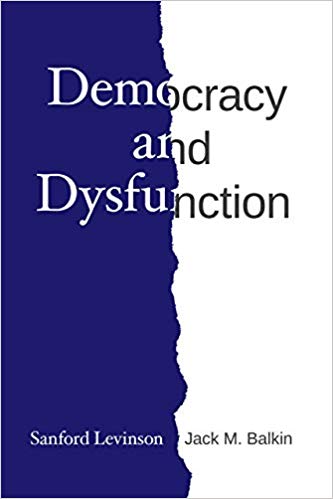
Sanford Levinson and Jack M. Balkin, Democracy and Dysfunction (University of Chicago Press, 2019)

Sanford Levinson, Written in Stone: Public Monuments in Changing Societies (Duke University Press 2018)

Mark A. Graber, Sanford Levinson, and Mark Tushnet, eds., Constitutional Democracy in Crisis? (Oxford University Press 2018)

Gerard Magliocca, The Heart of the Constitution: How the Bill of Rights became the Bill of Rights (Oxford University Press, 2018)

Cynthia Levinson and Sanford Levinson, Fault Lines in the Constitution: The Framers, Their Fights, and the Flaws that Affect Us Today (Peachtree Publishers, 2017)

Brian Z. Tamanaha, A Realistic Theory of Law (Cambridge University Press 2017)

Sanford Levinson, Nullification and Secession in Modern Constitutional Thought (University Press of Kansas 2016)

Sanford Levinson, An Argument Open to All: Reading The Federalist in the 21st Century (Yale University Press 2015)

Stephen M. Griffin, Broken Trust: Dysfunctional Government and Constitutional Reform (University Press of Kansas, 2015)

Frank Pasquale, The Black Box Society: The Secret Algorithms That Control Money and Information (Harvard University Press, 2015)

Bruce Ackerman, We the People, Volume 3: The Civil Rights Revolution (Harvard University Press, 2014)
Balkinization Symposium on We the People, Volume 3: The Civil Rights Revolution

Joseph Fishkin, Bottlenecks: A New Theory of Equal Opportunity (Oxford University Press, 2014)

Mark A. Graber, A New Introduction to American Constitutionalism (Oxford University Press, 2013)

John Mikhail, Elements of Moral Cognition: Rawls' Linguistic Analogy and the Cognitive Science of Moral and Legal Judgment (Cambridge University Press, 2013)

Gerard N. Magliocca, American Founding Son: John Bingham and the Invention of the Fourteenth Amendment (New York University Press, 2013)

Stephen M. Griffin, Long Wars and the Constitution (Harvard University Press, 2013)

Andrew Koppelman, The Tough Luck Constitution and the Assault on Health Care Reform (Oxford University Press, 2013)

James E. Fleming and Linda C. McClain, Ordered Liberty: Rights, Responsibilities, and Virtues (Harvard University Press, 2013)
Balkinization Symposium on Ordered Liberty: Rights, Responsibilities, and Virtues

Andrew Koppelman, Defending American Religious Neutrality (Harvard University Press, 2013)

Brian Z. Tamanaha, Failing Law Schools (University of Chicago Press, 2012)

Sanford Levinson, Framed: America's 51 Constitutions and the Crisis of Governance (Oxford University Press, 2012)

Linda C. McClain and Joanna L. Grossman, Gender Equality: Dimensions of Women's Equal Citizenship (Cambridge University Press, 2012)

Mary Dudziak, War Time: An Idea, Its History, Its Consequences (Oxford University Press, 2012)

Jack M. Balkin, Living Originalism (Harvard University Press, 2011)

Jason Mazzone, Copyfraud and Other Abuses of Intellectual Property Law (Stanford University Press, 2011)

Richard W. Garnett and Andrew Koppelman, First Amendment Stories, (Foundation Press 2011)

Jack M. Balkin, Constitutional Redemption: Political Faith in an Unjust World (Harvard University Press, 2011)

Gerard Magliocca, The Tragedy of William Jennings Bryan: Constitutional Law and the Politics of Backlash (Yale University Press, 2011)

Bernard Harcourt, The Illusion of Free Markets: Punishment and the Myth of Natural Order (Harvard University Press, 2010)

Bruce Ackerman, The Decline and Fall of the American Republic (Harvard University Press, 2010)
Balkinization Symposium on The Decline and Fall of the American Republic

Ian Ayres. Carrots and Sticks: Unlock the Power of Incentives to Get Things Done (Bantam Books, 2010)

Mark Tushnet, Why the Constitution Matters (Yale University Press 2010)

Ian Ayres and Barry Nalebuff: Lifecycle Investing: A New, Safe, and Audacious Way to Improve the Performance of Your Retirement Portfolio (Basic Books, 2010)
.jpg)
Jack M. Balkin, The Laws of Change: I Ching and the Philosophy of Life (2d Edition, Sybil Creek Press 2009)

Brian Z. Tamanaha, Beyond the Formalist-Realist Divide: The Role of Politics in Judging (Princeton University Press 2009)
Andrew Koppelman and Tobias Barrington Wolff, A Right to Discriminate?: How the Case of Boy Scouts of America v. James Dale Warped the Law of Free Association (Yale University Press 2009)

Jack M. Balkin and Reva B. Siegel, The Constitution in 2020 (Oxford University Press 2009)

Heather K. Gerken, The Democracy Index: Why Our Election System Is Failing and How to Fix It (Princeton University Press 2009)

Mary Dudziak, Exporting American Dreams: Thurgood Marshall's African Journey (Oxford University Press 2008)

David Luban, Legal Ethics and Human Dignity (Cambridge Univ. Press 2007)

Ian Ayres, Super Crunchers: Why Thinking-By-Numbers is the New Way to be Smart (Bantam 2007)

Jack M. Balkin, James Grimmelmann, Eddan Katz, Nimrod Kozlovski, Shlomit Wagman and Tal Zarsky, eds., Cybercrime: Digital Cops in a Networked Environment (N.Y.U. Press 2007)

Jack M. Balkin and Beth Simone Noveck, The State of Play: Law, Games, and Virtual Worlds (N.Y.U. Press 2006)

Andrew Koppelman, Same Sex, Different States: When Same-Sex Marriages Cross State Lines (Yale University Press 2006)

Brian Tamanaha, Law as a Means to an End (Cambridge University Press 2006)

Sanford Levinson, Our Undemocratic Constitution (Oxford University Press 2006)

Mark Graber, Dred Scott and the Problem of Constitutional Evil (Cambridge University Press 2006)

Jack M. Balkin, ed., What Roe v. Wade Should Have Said (N.Y.U. Press 2005)

Sanford Levinson, ed., Torture: A Collection (Oxford University Press 2004)
Balkin.com homepage
Bibliography
Conlaw.net
Cultural Software
Writings
Opeds
The Information Society Project
BrownvBoard.com
Useful Links
Syllabi and Exams
