Balkinization
an unanticipated consequence of
Jack M. Balkin
Balkinization Symposiums: A Continuing List
E-mail:
Jack Balkin:
jackbalkin at yahoo.com
Bruce Ackerman
bruce.ackerman at yale.edu
Ian Ayres
ian.ayres at yale.edu
Corey Brettschneider
corey_brettschneider at brown.edu
Mary Dudziak
mary.l.dudziak at emory.edu
Joey Fishkin
joey.fishkin at gmail.com
Heather Gerken heather.gerken at yale.edu
Abbe Gluck abbe.gluck at yale.edu
Mark Graber
mgraber at law.umaryland.edu
Stephen Griffin
sgriffin at tulane.edu
Jonathan Hafetz
jonathan.hafetz at shu.edu
Jeremy Kessler
jkessler at law.columbia.edu
Andrew Koppelman
akoppelman at law.northwestern.edu
Marty Lederman
msl46 at law.georgetown.edu
Sanford Levinson
slevinson at law.utexas.edu
David Luban
david.luban at gmail.com
Gerard Magliocca
gmaglioc at iupui.edu
Jason Mazzone
mazzonej at illinois.edu
Linda McClain
lmcclain at bu.edu
John Mikhail
mikhail at law.georgetown.edu
Frank Pasquale
pasquale.frank at gmail.com
Nate Persily
npersily at gmail.com
Michael Stokes Paulsen
michaelstokespaulsen at gmail.com
Deborah Pearlstein
dpearlst at yu.edu
Rick Pildes
rick.pildes at nyu.edu
David Pozen
dpozen at law.columbia.edu
Richard Primus
raprimus at umich.edu
K. Sabeel Rahmansabeel.rahman at brooklaw.edu
Alice Ristroph
alice.ristroph at shu.edu
Neil Siegel
siegel at law.duke.edu
David Super
david.super at law.georgetown.edu
Brian Tamanaha
btamanaha at wulaw.wustl.edu
Nelson Tebbe
nelson.tebbe at brooklaw.edu
Mark Tushnet
mtushnet at law.harvard.edu
Adam Winkler
winkler at ucla.edu
Compendium of posts on Hobby Lobby and related cases
The Anti-Torture Memos: Balkinization Posts on Torture, Interrogation, Detention, War Powers, and OLC
The Anti-Torture Memos (arranged by topic)
Recent Posts
George W. Obama and Barack Hussein Bush: Some Notes on the Presidential Politics of Emergency
“This Is No Picnic for Me Either, Buster”: Obama and Outliers
Put Your Money Where Your B-Tush Is
Cyber Civil Rights
Collateral Damage: Reforming the National Fugitive Operations Program
Why it's fallacious to compare the stimulus bill to, say, reforming the medical care system
A Voucher System for Investigative Reporting
Silverstein, LAW'S ALLURE
It may be morning in America, but we still have the same defective Constitution
Redux: Does Broadband Belong in the Economic Stimulus Package?
Watching the Watchmen
Watching for Stimulus Abuses
The fall of Qi Yuling
Money in Crisis: Revisiting the Legal Tender Cases
An Offer Republican Governors Can Refuse
The Bush Presidency and Theories of Constitutional Change (Part II)
![[Powered by Blogger]](https://lh3.googleusercontent.com/blogger_img_proxy/AEn0k_t7__VV9m78Ahk2g5k4_XoIMQbd7sg2urZPKcSCTkPzHVPVfLMoQk8RbSBSoaGocHZcSWkQhjVHuKpKNpdcmZRYKy79SN0rFjdpkbn9Wug_=s0-d)
Just A Few Blogs
ACS Blog
Alas, a Blog
Althouse
Arts and Letters Daily
Atrios (Eschaton)
Bill of Health
Buzzflash.com
Buzz Machine
Cato at Liberty
Juan Cole (Informed Comment)
Concurring Opinions
The Constitution in 2020
Corrente
Crooked Timber
Daily Howler
Daily Kos
Dana Boyd
Brad DeLong
Digby (Hullabaloo)
Discriminations
Daniel Drezner
Kevin Drum (Mother Jones)
Electrolite
En Banc
Eunomia (Daniel Larison)
Fafblog
Michael Froomkin (Discourse.net)
GovLab (Beth Noveck)
Rick Hasen (Election Law)
History News Network
How Appealing
Ignatz (Sam Heldman)
The Importance of (Ernie Miller)
Infolaw
Instapundit
International Economic Law and Policy Blog
IntLawGrrls
Jacob Levy
Jesus' General
Jurisdynamics
The Kitchen Cabinet
Mark Kleiman
Law Blog Central
Larry Lessig
Lawyers, Guns and Money
Liberal Oasis
Brian Leiter's Law School Reports
The Leiter Reports
Marginal Revolution
Megan McArdle
Memeorandum
Metafilter
Mirror of Justice
The New Republic
Newseum
No More Mister Nice Blog
Brendan Nyhan
Opinio Juris
Orcinus
The Originalism Blog
Pandagon
Passport (Foreign Policy)
Overcoming Bias
Political Animal (Washington Monthly)
Political Theory Daily Review
Political Wire (Taegan Goddard)
The Poor Man
Virginia Postrel
Prawfsblawg
Public Reason
Jonathan Rauch
Raw Story
Redstate
ReligiousLeftLaw.com
Reporters Committee For Freedom of the Press
Reproductive Rights Blog
Rothman's Roadmap to the Right of Publicity
SCOTUS Blog
Seeing the Forest
Clay Shirky
The Shifted Librarian
The Situationist
Larry Solum (Legal Theory)
Andrew Sullivan
Talking Points Memo
Talk Left
Tapped
Tbogg
TechPresident
The Paper Chase (Jurist)
Tom Paine
Tom Tomorrow (This Modern World)
Eve Tushnet
Uggabugga
University of Chicago Law School Faculty Blog
Unqualified Offerings
The Volokh Conspiracy
War and Piece (Laura Rozen)
Wampum
Oliver Willis
Wonkette
Written Description
Matthew Yglesias
Yin
Your Choice of Feeds
1. XML
powered by

2. Atom Feed
3. RSS 2.0
George W. Obama and Barack Hussein Bush: Some Notes on the Presidential Politics of Emergency
JB
You may have noticed that Barack Obama, like George W. Bush before him, is taking advantage of the opportunities presented by emergency. Or, more correctly, he is taking advantage of the President's first mover advantage to define the situation before him as an emergency and to assert that bold, decisive action is necessary to avert the particular sort of crisis that he claims the nation now faces.
In Bush's case, the 9/11 attacks allowed Bush to define the situation as a question of war and himself as a war president, thus purporting activate all of the powers that a president enjoys in time of war. Hence the War on Terror, a war with no defined battlefield and no defined enemy. Since these were lacking the President could define the war as taking place literally everywhere, including within the United States. And since the enemy was a shadowy network of loosely connected terrorist organizations, the President could assert that almost any country and any (foreign) organization was connected to Al Qaeda. Thus armed, the President's choice of tactics (conducted largely in secret, including secret domestic surveillance, detention without habeas corpus, torture) and his choice of targets (Iraq) reflected his structuring of the situation, and thus of his own powers: It was a war against the United States that our country would fight led by a Commander-in-Chief over affairs both foreign and domestic.
Steve Griffin has made an excellent analysis of President Bush's creation of reality in these two posts and this recent article. It is worth noting is that Bush's successor, Barack Obama has pursued a remarkably similar framing strategy, albeit with a few salient differences.
Obama portrays the situation before us as the greatest economic crisis since the Great Depression. He does not hesitate to explain that the situation is frightening and should be so. The more severe the crisis, the greater the need for bold, decisive action, and the greater the need for the country to rally around its leader, to whom the public looks to resolve the crisis. To do this, the leader needs the support of all to surmount the very serious problems that the country faces. This not a time for selfishness, narrowmindedness, or obstruction. Everyone must work together. The President, in turn, must set the agenda. He must lead. He must present a plan; Congress must work out the details and ratify it without delay or obstruction.
The first stage of the plan, however, is only the beginning; the country must do far more to stem the crisis. The greater the crisis, the more severe the emergency, the more the president must do, the more plans he must make, and the more times he must return to Congress, which must in turn continue to ratify his plans. If the Congress does not cooperate, the President will go over their heads to the American people, explaining that Congress does not understand the seriousness of the dangers we face and the crisis in which we are enmeshed. Quick, bold, decisive action is necessary. Leaders must lead, others must follow.
Does this sound familiar? It should. It is Bush's strategy of September 2001.
Both Bush and Obama have made use of the President's power to define emergency and crisis in ways that shape others imaginations, and in ways that legitimate the steps they assert must be taken. Bush insisted that he needed vast powers to detain, interrogate and make war; he pointed to Iraq and insisted that it was a continuation of the war against Al Qaeda. Obama insists that he must have an enormous stimulus to jump start the economy, he must take control of major banking institutions to stave off financial meltdown, and he must propose a remarkably ambitious new budget with new programs for infrastructure development, health care, education, energy conservation and environmental protection to sustain economic capacity and global competitiveness in the future. Given the crisis we face, the only way forward, Obama is saying, is to reject Reaganism and embark on a Second New Deal focused on guarantees of health care for all Americans, financial regulation and/or government control of financial institutions, environmental protection, energy independence, and infrastructure investment. That is to say, just as Bush identified his crisis to justify the policies he pursued, so Obama has defined his crisis to justify his proposed solutions.
Are there truly no differences, then, between what the two men are doing? Of course there are, and I will return to them shortly. Moreover, I should point out that your view about the legitimacy of a particular use of the Presidential politics of emergency depends on which of the two men you support and your view about whether they have accurately described the nature and the scope of the situation before the country. For if they have, of course, their solution, tailored to that description, makes correspondingly more sense, and so does following their leadership. If there really is an emergency along the lines described by the President, then of course, it is very different than if there is no emergency, or it is not as severe as the President says it is, or if the nature of the problem is different than the President describes, for then the solutions are the wrong solutions, and will lead the country in the wrong direction. So if Bush gauged the situation more or less correctly and Obama incorrectly, or the other way around, then that is a very big difference indeed. But addressing that question is not the point of this particular post.
Here, I do not focus on who is right or who is wrong in their assessments of the situation the country faces. Instead, I want to focus on what the two men share-- the similar way in which the modern President-- whether Bush or Obama-- uses the formulation and articulation of crisis and emergency in order to take control of the political agenda, shape the nation's political imagination, and make resistance seem, at least in the short run, parochial, narrow minded and even futile.
If conservative Republicans today feel as if nobody is listening to them, if they feel that others think them petty, out of touch, and just a little bit loony, they should consider how liberal Democrats felt in the strange days following the 9/11 attacks, when George W. Bush, aided and abetted by a Republican Congress and a supine (and sometimes actively cheerleading) media, seemed to sweep away all opposition and conquer everything in his sights, (except, apparently, Osama Bin Laden). From September 2001 to about May 2003, criticism of the President, when it was not drowned out by a chorus of avid supporters, was largely ineffective and perhaps even a little unpatriotic. 9/11, it was repeatedly said, changed everything. It was time to rethink old verities and understand the new political realities and the new needs of a nation facing an existential crisis and an almost unfathomable emergency.
People may have forgotten how powerful social norms against dissent were in those days immediately following 9/11 because the spell was broken shortly after the initial successes of the Iraq invasion. In hindsight, the turning point was Bush's famous moment of hubris, dressing up like a pilot and appearing at a carefully staged event before a sign proudly proclaiming "Mission Accomplished." Before this, everything seemed to go right for the President. Afterwards, less and less did.
The secret and the danger of Presidential government by emergency is the need to convert the sense of felt crisis into a lasting advantage for the President and his party. Franklin Roosevelt succeeded at this, in part because he was famously adaptable and protean and in part because he was handed not one but two crises following on top of each other-- the Great Depression and World War II. Out of these two came the great success of American liberalism in defining political realities and opportunities-- until the advent of Ronald Reagan, who successfully converted dissatisfaction with the economy into a sustainable political movement.
Bush, like Roosevelt, was handed an amazing political opportunity, an opportunity that even Reagan did not have-- an event that could easily be interpreted-- and was interpreted-- as creating an existential crisis. The problem for Bush was that he was not able to sustain the sense of crisis very long or to convert it into a lasting political advantage for himself and his party. This was, in part, due to bad luck, but also in part due to his incompetence (and those of his lieutenants), his lack of flexibility, and, ironically-- given his repeated assertions that times had changed-- his inability to understand the times and adjust to them.
This last point is worth emphasizing: Even if the President has a first mover advantage to redefine the political situation to his advantage, he cannot do so indefinitely. At some point he has to adjust to the responses to his actions, and to realities that he has not anticipated. Bush and his advisors did not do so successfully. If they had, they might well have achieved a new political majority that would last for decades. Because they did not, they created an opportunity for Barack Obama to create such a majority.
Obama has now been handed an opportunity like Reagan's, but actually greater than Reagan's due to Bush's incompetence, and Bush's failure and the failure of his party to understand and properly react to events.
President Obama will, for the time being, invoke crisis and emergency as the justification for what he does. He will attempt to define the situation to make dissent appear feckless, selfish, out of touch with reality or irrelevant. Like Bush, and like other leaders before him, he might be tempted to buy himself a little more time to solve his stated problems by exaggerating the scope of the crisis and replacing one crisis with another, but he cannot do this indefinitely. That would require consistently making the situation appear worse than it already is, continually raising the stakes of his politics-- and that is a very dangerous game. Instead, his task is the solve the problem he poses in a way that makes the nation grateful to him and his party and durably changes the structure and assumptions of politics. This is what Lincoln did and Roosevelt did, and to lesser extent, what Reagan did. It is what Bush tried to do but ultimately failed to do. He changed some assumptions of politics, to be sure, but not always in the ways he had hoped. Bush used the politics of emergency badly, Obama must learn from his example.
What is the difference, at least so far, between Obama's use of the presidential politics of emergency and Bush's? If we put aside the enormous question of who is really understanding the situation clearly and who is misguided, there are two salient differences. One has to do with tactics, the other with the resources of political support.
First, Bush relied on secrecy, lack of oversight and accountability, and on doing end runs around existing government institutions to get what he wanted. He had a propaganda arm in the mass media, but he and his advisors were carefully to avoid very much transparency in what they were doing; instead, they repeatedly insisted that we should trust the Executive in time of crisis. In part as a reaction to Bush, and in part because the crisis is domestic and not one of foreign policy, Obama is making a fetish of transparency in his budget, and he is establishing various accountability mechanisms. It is difficulty to know how much transparency and accountability there will actually turn out to be, because the budget is vast and the amount of money (and the power to spend it) is mind boggling. So it may be a show, especially if important details, although formally made transparent, are difficult to examine and analyze in the sheer weight of things made public. Put another way, transparency can sometimes be as good as secrecy.
Second, Obama begins with much greater support in Congress. Bush never had Republican majorities as great as the Democratic majorities Obama now enjoys. In addition, Obama seems to have a more well developed machine of support in civil society. Bush had the right wing media (including the right wing blogosphere) and right wing think tanks, as well as the support of conservative churches and significant parts of the business community-- support which, it is worth noting, he gradually lost due to his incompetence. Obama begins with support among traditionally Democratic constituencies, liberal media, unions, and the academy, but far more important, he has created a powerful campaign machine using new media that is still in place, and will likely be harnessed to rally supporters to pressure government officials to follow the President. Like other presidents before him, Obama has the opportunity to employ a revolution in media to create a new base of support in civil society. How well he manages and sustains that base of support is yet to be determined.
Both Bush and Obama have relied on the politics of emergency at the beginning of their respective presidencies. It is an interesting and troubling question whether this politics will increasingly be part of the modus operandi of American presidents in the future.
Posted
2:35 PM
by JB [link]
“This Is No Picnic for Me Either, Buster”: Obama and Outliers
Ian Ayres
Crosspost from Freakonomics: My favorite Obama quotation is not one of his most poetic: He had me at “buster.” I love these words because they seem so clearly not to be his voice. He is letting his mom’s voice be heard. Even now, I find myself crying when I watch this clip: Maybe part of my emotional reaction is that, like Obama’s mother, I have forced my kids to get up at ungodly hours to study in the morning. We have been doing “daddy school” in the morning and during the summer for years. When my 7-year-old daughter said she desperately wanted a dog, I told her (in a twist on another Obama story) she could have one if she published an article in a peer-reviewed journal. And then we worked together on a family statistical project for more than two years to make it happen. Our dog is named Cheby (Shev) in honor of a statistician. Obama’s “buster” story came back to me as I was reading Malcolm Gladwell’s excellent new book, Outliers: The Story of Success. Gladwell writes beautifully, and I like this book even more than Blink or The Tipping Point. In story after story, he destroys the simplicity of the raw-genius explanations for personal success that we love to tell. Gladwell insists that there are always background conditions of opportunity and good luck that are equally, if not more, important. Many of these opportunities come from parents, but some come from cultural advantages. For example, he tells about the linguistic advantage that Chinese speakers have in math. Fourteen and 23 are hard to add in English (because linguistically, 4 comes before 10 in 14, but 3 comes after 20 in 23). But in contrast, Chinese has a much less idiosyncratic linguistic system, as Gladwell explains in the book: Gladwell also argues that the crushing difficulty of maintaining successful rice paddies has tended to make hard work a more central part of Chinese culture than many Western cultures. He points to this Chinese proverb: No one who can rise before dawn 360 days a year fails to make his family rich. (p. 238) What scares me a bit about the book (and myself) is the normative gloss that Gladwell puts on the hard-work ethic. He doesn’t renounce the 360-day proverb; he seems to embrace it. He openly extols the Bronx KIPP Academy, where school starts early and goes half the day on Saturdays, and for several weeks in the summer. (KIPP’s plan actually sounds a lot like my “daddy school,” which I wrap around my kids’ traditional school day.) Gladwell wants society to open up opportunities to work hard — with programs like KIPP — so that many more people have the chance to succeed. To be clear, the book is about the many different contextual elements that are prerequisites to success — and practicing some skill for 10,000 hours is only one of them. In the very last sentence of the book, harkening back to the factors that led to his mom’s rise from poverty in Jamaica, Gladwell poetically asks: [I]f the resources of that grocer, the fruits of those riots, the possibilities of that culture, and the privileges of that skin tone had been extended to others, how many more would live a life of fulfillment, in a beautiful house high on a hill? (p. 285) For Gladwell, the answer is pretty clearly “A lot more.” But the book, in hinting at this normative thesis, fails to consider the wisdom of Robert Frank. In The Winner-Take-All Society, Frank and coauthor Philip Cook argue that changes in the productive technology in many fields have concentrated the benefits from success in a smaller and smaller set of winners. When you can listen to a Kathleen Battle CD, why would you buy any other soprano’s recording? Frank would argue that if we subsidize the opportunities for a million more people to study voice, we would probabilistically produce a better winner. But most of the gains would still go to the winner. We would still just have one beautiful house on the hill. I’m taking such an active part in my kids’ education mostly because I want to imprint on them my idea of the good life, but partly because (even before reading Outliers) I have bought into Gladwell’s thesis that opportunities are crucially important. What gives me pause, though, is that I also accept Frank’s thesis that there are a limited number of houses on the hill. I selfishly want to increase my kids’ chances of success. But a less selfish part of me is attracted to Frank’s idea that society should do just the opposite of what Gladwell wants and dampen the rat-race incentives to get up before dawn 360 days a year.
My mother [would] … wake me up at 4:30 in the morning, and we’d sit there and go through my lessons. And I used to complain and grumble. And she’d say, “Well this is no picnic for me either, buster.”
Ask an Asian child to add three-tens-seven and two-tens-two, and then the necessary equation is right there, embedded in the sentence. (p. 229)
Posted
10:15 AM
by Ian Ayres [link]
(14) comments
Put Your Money Where Your B-Tush Is
Ian Ayres
Crosspost from Freakonomics: Thanks to The Times’s nice writeup (“Dieting? Put Your Money Where Your Fat Is”), an Internet company that I helped found, www.stickK.com, has been getting a spike in commitment contracts. As readers of this blog know, stickK (shameless plug) is a commitment store that helps you stick to your goals. We’ll elicit support from your friends. We’ll nag you if you want. And most uniquely, we’ll let you put your own money at stake. It’s still hard for me to believe that in just over a year, people have been willing to put at risk more than $1 million in their contractual commitments. Readers of this blog shouldn’t be surprised at the power of incentives. But The Times recently ran a piece that is also near and dear to my heart — emphasizing the power of peer pressure to change behavior. Positive Energy has been working with the Sacramento Municipal Utility District to test the impact of giving customers a different kind of information on their energy bill: Last April, it began sending out statements to 35,000 randomly selected customers, rating them on their energy use compared with that of neighbors in 100 homes of similar size that used the same heating fuel. The customers were also compared with the 20 neighbors who were especially efficient in saving energy. Customers who scored high earned two smiley faces on their statements. “Good” conservation got a single smiley face. Customers … in the “below average” category got frowns, but the utility stopped using them after a few customers got upset. The exciting news is that “customers who received the personalized report reduced energy use by 2 percent more than those who got standard statements.” This isn’t a surprise to Robert Cialdini (the author of the classic book Influence), who back in 2004 published a small, randomized study of 290 households in San Marcos, California — again looking at the impact of emoticons (those smiley and frowny faces) on energy consumption. The following figure summarizes the core results: Peer information alone led to a reversion to the mean. The households that consumed above the average reduced their consumption, while the below-average households responded to the good news that they were consuming less by increasing their energy consumption. But look what happens in the right-hand columns where peer information is paired with the emoticons. The above-average energy consumers again conserved, without the perverse energy increases from the households that started below average. It looks as if these conserving households act to keep their gold star of approval. There is also a great writeup of this study as a prime example of choice architecture in the book Nudge. The independent power of the emoticons shows that what’s going on is not just the dissemination of information; it’s about how the information is framed. In Sacramento, Positive Energy ultimately discontinued sending out the emoticons after a few complaints. But an intermediate strategy would be to discontinue the frowny faces to the energy hogs but continue sending out smiley faces to the “good” conservationist households. I should add that Cialdini has a financial interest in these outcomes, as he owns a stake in Positive Energy. I also have more than a passing interest. I’m working with Positive Energy to analyze future data on the power of both peer information and commitment contracts. I’ve also been promoting the value of peer information for the last few years. Back in 2005, Barry Nalebuff and I published an article in Forbes, arguing for something right in line with Positive Energy’s core mission: Why not have the heating bill tell you if you’re using too much energy? Most heating bills report how much gas or electricity you used last month compared with a year ago. A lot of them also report heating degree days (how far and how long the temperature veered below 65 degrees over the course of the month). But this pair of numbers isn’t very helpful. Together they don’t tell you whether you need to upgrade your insulation. There’s a better way to answer this question. Just tell people how much energy they used that month compared with other people in similar-size homes. In many cities (including our own New Haven), the square footage of each house is publicly available — so the gas company could calculate the energy per square foot for each house and display the information on each month’s bill. Further helping you out by doing the math, it could report energy consumed (in BTU) per square foot per degree day. We’ll call this measure B-Tush (BTU per square foot per heating degree day). The key here is to report how folks did relative to their neighbors. According to a 1997 Department of Energy survey, the U.S. average B-Tush is 10. If you are up to 25, then you are among the worst 10 percent. You should invest in better insulation — or else turn down the thermostat and buy some sweaters. Economists tend to think of information and incentives as the core drivers of human behavior. But Cialdini and Positive Energy have me thinking that smiley faces may also play a useful role. P.S. stickK.com hasn’t quite gone so far as to include emoticons in its messaging to help people stick to their commitments, but we are enhancing the behavioral support features. We’ve just launched several new communities (concerning things like “health and lifestyle,” “green initiatives,” and “money and finance”) to help people better connect with others who have similar goals.
Posted
1:21 PM
by Ian Ayres [link]
(1) comments

Cyber Civil Rights
Frank Pasquale
I just wanted to put up a note of congratulations to Danielle Citron, whose work Cyber Civil Rights was just published by the B.U. Law Review. I've seen Citron present the piece at a conference, and I think it really breaks new ground in applying venerable laws to the online environment. As recent controversies have shown, it's easy for online mobs to inflict real injuries on their victims--and women bear a disproportionate share of the abuse. Citron argues that "acting against these attacks . . . helps preserve vibrant online dialogue and promote a culture of political, social, and economic equality."
David Hoffman and I tried to organize an online symposium last fall to discuss Citron's work, but we couldn't get the schedules of participants worked out. This year we're going to try again, hopefully for early April.
If you'd like to suggest possible commentators, please email me.
One good side effect of the delay is that we'll also be able to discuss some of Citron's more recent work. Online attacks are getting more attention in the media. Evoking Catharine MacKinnon's work to end sexual harassment, Citron argues that naming and recognizing the gendered nature of many online threats is crucial to developing common cultural understandings that enable real democratic culture and participation online.
I really value that kind of historical perspective, especially after listening to Fred Strebeigh discuss his work Equal: Women Reshape American Law. Strebeigh "tells the story of the female lawyers who took on sexual harassment, sexual discrimination and violence against women," and the most remarkable part of the podcast was how many women resigned themselves to sexism in the legal profession even as they were beginning their careers in the extraordinarily discriminatory environment of the 1950s and 60s. I see Citron's work as another step in the consciousness-raising that brave feminists began decades ago.
X-posted to Concurring Opinions.
Posted
9:37 AM
by Frank Pasquale [link]
Collateral Damage: Reforming the National Fugitive Operations Program
Guest Blogger
Margot Mendelson
Shayna Strom
Mike Wishnie
In the past few years, a growing number of blogs, newspapers, and magazines have highlighted stories of immigration raids in communities throughout the country, from New Haven, Connecticut to Long Island, New York to Willmar, Minnesota. In each instance, SWAT-like teams entered homes in residential neighborhoods, often in the early hours of the morning, and arrested large numbers of people on charges of being in the U.S. illegally.
These raids were the undertaking of a well-funded governmental program, the National Fugitive Operations Program (NFOP), an initiative designed and funded for the purpose of arresting and removing “dangerous fugitive aliens.” The NFOP has expanded rapidly in recent years, and has been called the “Cadillac program” of the U.S.’s immigration enforcement efforts.
Yet in spite of the program’s dramatic growth and broad national security claims, NFOP may be the very antithesis of the Obama Administration’s professed commitment to “smart power”— the strategic deployment of resources to achieve important foreign policy goals. As we demonstrated in a recent report released by the Migration Policy Institute, the NFOP is an expensive program that diverts resources away from crucial national security efforts in an effort to catch easy targets. Over the program’s five-year lifespan, Fugitive Operations Teams (FOTs) across the country have primarily arrested unauthorized immigrants with no criminal background.
From its conception in 2003, NFOP was intended – and funded – as a national security program. Created in the wake of September 11, 2001, DHS Secretary Michael Chertoff and ICE Chief Julie Myers sold the NFOP to Congress and the public as an important component in the homeland security agenda. According to DHS, NFOP pursues and apprehends “dangerous fugitive aliens”: individuals with outstanding removal orders who have been convicted of violent crimes or whom Immigration & Customs Enforcement (ICE) deems to pose a threat to the community or national security. Since NFOP became operational more than five years ago, it has ballooned – expanding 2,300 percent in funding and 1,300 percent in personnel. Today, there are approximately 100 teams operating across the country, and FOTs have arrested more than 96,000 individuals.
As the NFOP’s size and price tag grow, so too does the chasm between its mandate and its practices. According to data collected from ICE, 73 percent of the individuals arrested by FOTs between mid-2003 and February 2008 had no criminal convictions at all. In fact, dangerous fugitive aliens accounted for only 9 percent of overall arrests in FY2007. According ICE records obtained by the Immigration Justice Clinic at Benjamin N. Cardozo School of Law through a Freedom of Information Act lawsuit, $625 million in funds and five years of nationwide operation have resulted in the arrest of precisely one fugitive alien deemed to be a national security threat.
Over time, the NFOP has strayed further from its national security mission, a result of the counterproductive impact of quota-driven law enforcement. In FY2003, 18 percent of FOT arrests in FY2007 were “ordinary status violators”—people who have never had their cases adjudicated by an Immigration Judge, and who fall outside of the NFOP’s priority structure entirely. By FY2007, that figure had risen to fully 40 percent. The report traces the rise in such “collateral arrests” to a specific shift in policy whereby ICE dropped its expectation that each FOT arrest 125 fugitive aliens per year, 75 percent of which were to be criminal aliens. Instead, in a series of official memos, ICE called upon teams to arrest 1,000 individuals and explicitly permitted collateral arrests to count towards the objective. The new quota does not reflect ICE’s stated priorities and merely incentivizes FOTs to arrest widely and indiscriminately.
We are gratified to see that our report has garnered significant interest in the media and by policymakers. The New York Times reported the study’s findings on February 3, 2009 and was followed by a story in the Washington Post the next day. According to the Washington Post, Rep. David E. Price (D-N.C.), chairman of the House Appropriations Subcommittee for Homeland Security, said he was “discouraged that ICE’s previous leadership misrepresented the goals of the expanded Fugitive Operations Program and chose not to use its additional resources as Congress instructed.” DHS Secretary Napolitano has not issued a formal statement, but rejected some criticisms that the report called for "amnesty for lawbreakers." Speaking to the Post, she noted that that such statements set up a "false dichotomy," arguing, “[I]t’s a matter of where you put your emphasis.”
The NFOP needs to be reformed so that its operations match its mission. Protecting national security through the current NFOP is like trying to carve a delicate sculpture with a chain saw—you may get an outcome, but it won’t look at all like the one you intended.
Posted
6:31 AM
by Guest Blogger [link]
Why it's fallacious to compare the stimulus bill to, say, reforming the medical care system
Sandy Levinson
It is obviously tempting to assert that the quick passage of the stimulus bill (after paying tribute to the unholy threesome of Collins, Snowe, and Specter) adequately disproves my reiterated argument that we have a system that makes it difficult, if not impossible, to confront adequately the challenges that face us, such as getting a handle on our inefficient and unjust system of delivering medical care to those who need it. My view is that it is a big mistake to take much comfort in the quick passage of the stimulus bill (putting to one side whether one approves of everything that was in it, a discussion I have no desire to get into). In many ways, it was an "easy" bill to pass, for at least a number of reasons: a) (almost) everyone recognizes that there is a crisis and that something needs to be done, and fast; b) although the bill no doubt has a lot of consequences, both for good and for ill, in creating incentives for a variety of behaviors, it does not in itself constitute a serious attempt to significantly reform of any important aspect of the American political or economic system; and c) as critics of the bill point out endlessly, it's quite easy to get legislators to vote for programs that shovel money to their constituents and place the burden of paying for the programs on future generations.
So contrast this with reform of the medical system (let alone energy and education, the other two big-ticket items on Obama's agenda). I happen to think our present medical system is part of our "crisis," but I doubt that that is a sufficiently widely-shared reaction. Far more to the point is that any significant change of our present system will require taking on a lot of entrenched interests, beginning with insurance companies, who will do everything they can to retain their share of a lucrative pie. (Just as Obama is unable to accept the increasingly across-the-political- spectrum advice from professional economists to nationalize failing banks, he will, I suspect, be equally unable to support the most rational reform, which is some form of a "single payer" system that gets rid of insurance companies entirely.) And, of course, it may be necessary to raise taxes in order to save Medicare. All of these features make it ever harder to achieve the kind of "complete consensus" between the House and Senate that is a predicate condition for the passage of legislation, especially when one of these two houses ridiculously overrepresents small states and, perhaps more seriously at least in this case--it may be that the issue of medical care is sufficiently universal not to be all that relevant to the large state-small state divided--the ability of a tyrannical minority to prevent bills even from coming to the floor if they can hold their 41-senator coalition together.
I don't disagree with those who say that the Congress should engage in extended deliberation and vigorous debate about the proposed programs. I'm not an advocate of the behavior during FDR's 100 days where the Congress simply passed, without any deliberation, bills they received from the White House. The question is whether a minority in an already undemocraticly constituted Senate should be able to prevent electoral majorities from passing what most Americans believe is desirable, even necessary, legislation.
In more ways than imagined, the next several years will present the most profound test since 1860 of the capacity of our political system to respond to the deep exigencies of the day. I skip the New Deal because, obviously, FDR really didn't have to worry about Republican recalcitrance. He did have to worry about the Supreme Court, whose edict he was prepared to defy had they struck down repudiation of the Gold Clause, but he never had to face that.
Posted
5:47 PM
by Sandy Levinson [link]
(30) comments
A Voucher System for Investigative Reporting
Ian Ayres
Crosspost from Freakonomics: Dozens of proposals are floating around suggesting different ways to fix what seems to be the broken business model for newspapers. Michael Kinsley’s Op-Ed, working backwards from the gross numbers, provides a devastating critique of the claim that micropayments on the Internet could save the industry: Micropayment advocates imagine extracting as much as $2 a month from readers. The Times sells just over a million daily papers. If every one of those million buyers went online and paid $2 a month, that would be $24 million a year. Even with the economic crisis, paper and digital advertising in The Times brought in about $1 billion last year. Circulation brought in $668 million. Two bucks per reader per month is not going to save newspapers. But the same result is strongly suggested by theory. There’s no guarantee that private demand will produce the socially optimal quantity of investigative political reporting. Muckraking is a public good, and rational consumers would rather benefit from having the other guy pay for it. The same impulse that underlies the “rational ignorance” of voters may undercut the private market’s provision of political information. Investigative reporting in the old days seemed like it was a loss-leader in the information bundle to which we subscribed. As a kid, I read the newspaper for the funnies, movie times, the sports scores, and for the classified ads. I still value this info, but I never get it from the printed page. Even a few years ago, I can remember feeding money into New Haven Register newspaper dispensers to learn the local movie times. But with an Internet-enabled cell phone, I almost never buy the Register anymore. The bottom line is that we may need to publicly subsidize investigative reporting if we’re going to get enough of it. But the problem with subsidies lies in this question: who is going to decide what kinds of issues get investigated? It’s scary to think of having politicians decide the targets of journalism. Bruce Ackerman and I have a solution (just published in the Guardian): We urge democracies throughout the world to consider the creation of national endowments for journalism that are carefully designed to confront the impending collapse of investigative reporting. The real concern is not the newspaper, but news coverage. It’s not clear that print news is a viable technology. Classified ads are more efficiently delivered by websites. Nobody under 50 waits to read all about stock prices or scores in the morning edition. The government should sit back and let the market decide the right way to distribute the news. But there are huge costs to losing a vibrant core of investigative reporters covering local, national, and international stories. The Internet is well suited to detect scandals that require lots of bloggers to spend a little bit of time searching for bits of incriminating evidence. But it’s no substitute for serious investigative reporting that requires weeks of intelligent inquiry to get to the heart of the problem. Without Woodwards and Bernsteins, there will be even more Nixons and Madoffs raining mayhem and destruction. It will take decades to revitalise investigative journalism if we allow the present corps of reporters to disintegrate. This is happening at an alarming rate. … The problem with a BBC-style solution is clear enough. It is one thing for government to serve as one source of investigation, but quite another for it to dominate the field. A near-monopoly would mean the death of critical inquiry. There are serious problems with private endowments as well. For starters, there is the matter of scale. Pro Publica, an innovative private foundation for investigative reporting, is currently funding 28 journalists. It is hard to make the case for a massive increase in private funding when university endowments are crashing throughout the world, imperiling basic research. More fundamentally, a system of private endowments creates perverse incentives. Insulated from the profit motive, the endowments will pursue their own agendas without paying much attention to the issues that the public really cares about. Here is where our system of national endowments enters the argument. In contrast to current proposals, we do not rely on public or private do-gooders to dole out money to their favorite journalists. Each national endowment would subsidize investigations on a strict mathematical formula based on the number of citizens who actually read their reports on news sites. Some might find this prospect daunting. Readers may flock to sensationalist tabloids that will also qualify for grants for their “investigations”. But common sense, as well as fundamental liberal values, counsels against any governmental effort to regulate the quality of news. So long as the endowment only subsidizes investigative expenditures, in-depth reporting will get a large share of the fund — provided that it generates important stories that generate broad interest. The government provides the subsidy, but “the people” decide how it will be distributed. You vote with your eyes and ears. Bruce and I, in Voting With Dollars, suggest an analogous system called “Patriot Dollars” that would allow individual voters to decide how campaign-finance subsidies would be distributed. But here the voucher scheme is implemented by a less obtrusive choice architecture. The ordinary act of reading or listening to a piece of journalism tells government that this is the organization that should be subsidized. Instead of influencing the content of what will be reported on, government can empower readers by subsidizing the news organizations that have succeeded in the past.
The endowment must monitor media hits and circulation counts. This is doable. Advertisers already rely on independent audits. So can the government. Some governmental monitoring of financial matters is also necessary. News organizations would otherwise be tempted to obtain subsidies for marketing and business operations. Without minimizing the problems involved in institutional design, the creation of an effective and disciplined national endowment seems entirely realistic.
Posted
3:52 PM
by Ian Ayres [link]
(7) comments
Silverstein, LAW'S ALLURE
Mark Graber
Law’s Allure: How Law Shapes, Contrains, Saves and Kills Politics provides an original and compelling analysis of the complex relationships between law and politics. Professor Silverstein’s insights that juridification in the United States is on the rise, that juridification is more than government by judiciary, and that this escape from politics has numerous hidden costs are interesting and important. The case studies are well written and informative, the research is solid, and the conclusions likely to provoke a good deal of conversation both within and without political science. Readers of such classics as Rosenberg, The Hollow Hope and McCann, Rights at Work, will want to add Law’s Allure to their bookshelves and syllabi. Lawyers in both government and public interest litigation should take the work’s proscriptions seriously.
Professor Silverstein provides a far more nuanced account of the relationship between law and politics than found in the existing political science literature. Most of the scholarship focuses on comparative institutional competence. Conventional legal wisdom proclaims law is a good tool for progressive policies. Gerry Rosenberg insists politics is the only fora for social change, while Michael McCann insists that legal solos have merits even when they do not directly produce desired reforms. There is also a long, relatively atheoretical, literature on constitutional dialogues, which simply highlights that both courts and elected officials participate in constitutional decision making. Law’s Allure makes important contributions to both literatures. One central theme of the manuscript is that courts never perform solos. Even when courts are silent, elected officials always act under what Mark Tushnet describes as a "judicial overhang." The crucial question is not which institution is more likely to produce desirable policy, but what sort of interactions between courts and elected officials are likely to produce desirable policy. One would think this an obvious insight, but one does not find this in the literature, and certainly not with the richness in this manuscript. Both justices and elected officials, Silverstein points out are always involved in a complicated iterated game with each other. Some games are more cooperative than others, but what needs analysis are the games, not what the impact of one institution isolated from the other. Professor Silverstein briefly observes that courts almost never produce social change on their own, but that courts matter when they interact with other governing officials. Courts made a major contribution to the environment, for example, not by performing a solo, but by building on a legislative framework. The problem with judicial rulings in campaign finance, was not that courts were making policy, but that the combination of legislation and judicial rulings was incoherent.
The manuscript does a nice job reminding political scientists that opinions structure the law/politics relationship as much as particular holdings. Most of the literature focuses on whether and how elected officials comply with court decisions. Professor Silverstein demonstrates that a good deal of the relationship between courts and elected officials occurs as each tries to work within the other’s precedents. For example, the Civil Rights Act of 1964 took a particular form because elected officials knew that the Supreme Court would sustain anything passed under the Commerce Clause, but might have doubts about the bill if passed under the Fourteenth Amendment. This precedential spiral had important consequences as judicial understandings of the commerce clause narrowed and the possible precedent paths based on Section 5 had never developed. The important point is that constitutional and legal dialogues are as much about legal frameworks as legal decisions. Judicial decisions often matter, not as requiring elected officials to do a specific thing, but as leading elected officials to discuss matters in a particular way. Witness how Buckley structured the debate over campaign finance law. I would add the way Bakke forces everyone to talk about diversity.
Law may matter, Law’ s Allure points out, even when courts are absent. Law’s Allure develops the original and important insight that the contemporary fascination with law extends beyond the lawsuit. Congress, when faced with problems as diverse as corruption in government, budgetary deficits, and presidential military adventures, has consistently attempted to resolve these problems by passing laws mandating automatic procedures rather than by resolving the particular policy. Rather than voting for specific budget cuts, Congress attempted to empower the Comptroller General to make the decision. The War Powers Act similarly relies on automatic procedures rather than a congressional vote on the particular military excursion.
The central lesson this all this analysis teaches is that law improves politics when law is not a substitute for politics. Litigation works fairly well, Professor Silverstein demonstrates, when politics has become stalemated or when justices are largely acting consistently with at least one branch of the national government. Brown helped break the logjam that prevented any policy from being made on racial segregation. The Supreme Court in the reapportionment cases broke the power of rural minorities who were preventing fair districting. Significantly, these opinions create powerful constituencies who were prepared to support the judicial decision. Litigation, in this sense, created a better politics and a politics that was likely to support the principles being articulated by courts. Judicial decisions also work well, the case study of the environment demonstrates, when courts and Congress are animated by similar principles. While Professor Silverstein does not quote Professor Scot Powe’s observation that there was a division of labor between courts and the executive branch during the 1960s, his analysis makes a similar point and does so more comprehensively. When courts are following legislative mandates, even vague legislative mandates, the resulting dialogues are likely to be more constructive than de-constructive. Courts do not perform the solos, but they matter a good deal when, for lots of reasons, elected officials cannot perform solos either.
Law, Law’s Allure also demonstrates in numerous ways, cannot substitute for a reasonably functioning politics. Political losers, while tempted to turn to law, are likely to be frustrated. First, they are not likely to win. When they do win victories in court, they may soon find themselves confronted by invigorated counter movements aimed at appointing more favorable justices, which requires them to go back and fight in the politics they thought they could avoid. When justices substitute their principles for those of Congress they may make a bigger mess. As the case study on campaign finance demonstrates, when courts declare parts of complex laws unconstitutional, the surviving mass may be worse from everyone’s perspective than the law or the world without the law. Finally, and most subtly, Professor Silverstein raises important questions about the turn to automatic law as a substitute for actually debating the specifics of budgets, corruption or war. The main virtue of automatic procedures, it seems, is that elected officials get to claim credit for doing things they are not actually doing. In practice, matters almost always get worse or, I think, not better. I am more fond of independent prosecutors than Professor Silverstein or Justice Scalia, but do not think the law actually did much of anything.
Posted
7:50 AM
by Mark Graber [link]
It may be morning in America, but we still have the same defective Constitution
Sandy Levinson
I'm still elated by the results of the election and the fact that, at long last (and several weeks late) Barack Obama was finally inaugurated. But no one should doubt that among the problems we face in this country is a political system that is structured to create, if not out-and-out gridlock--some legislation does in fact get passed, after all--then a structured incapacity to confront serious problems head-on, especially if any proposed solutions involve serious sacrifice by one's own constituents. When Tip O'Neil so memorably said that "all politics is local," he was offering a profound statement about the polity generated by the Constitution, in which ever single member of Congress is indeed a parochial local representative when push comes to shove. "People want the basic stuff fixed," said state Rep. Vernon Sykes, a Democrat who chairs the Finance and Appropriations Committee in the Ohio House. "They don't have a romantic notion of bipartisanship. They just want people to come together to solve problems."
Writing in the Washington Post, E.J. Dionne notes the abject fear that is sweeping the country. "[T]he point is not the numerical count of Republicans who vote for this or that. It's whether frightened citizens sense that government is working.
But do we have a system that encourages this? Just look at the some of the absurd politics surrounding the stimulus bill, where three Republican senators, two of them from the great small state of Maine, were able to extort their own policy preferences because of the indefensible voting rule in the Senate that requires 60 votes even to bring a bill to the floor for a vote. Part of the problem, to be sure, is that Obama was insistent on demonstrating at least a modicum of "bipartisan" support, so he wasn't willing to dare Sen. Collins, Snowe, and Specter actually to join in a filibuster of the bill and demonstrate to the country the abject irresponsibility of the contemporary Republican (congressional) party. But look at the House, where Obama, who got not a single Republican vote, didn't have to worry that that affected the possibility of getting his bill through at all.
There are many bicameral systems around the world, but extremely few have adopted the American practice of giving an absolute veto to each house over legislation passed by the other. Most systems have a way of breaking deadlocks. We do not, which means that what Woodrow Wilson called "a small band of willful men [and now, glory be, women]" can hold the rest of the country hostage to their own parochial political desires. In this respect, we are no better than Israel, which is widely taken to be one of the worst political systems in the world because of the totally disproportionate power given to relatively small parties who can take advantage of their crucial importance in providing the marginally necessary votes to construct a government.
One could, of course, offer the recent unpleasantness in California as another perfect exhibit of a truly awfully designed constitution, inasmuch as it gives 1/3+1 in each house an absolute veto power over the budget. I note a fascinating article that appeared in Sunday's New York Times about the diminished enthusiasm by the U.S. for what might be termed the "international democracy project." One may or may not believe that the U.S. should strive to bring "democracy" to other countries, but it would certainly be wonderful if we adopted a more self-critical spirit and asked whether we have a truly defensible system of "democracy" here at home.
Lest any of you think that my concern is exclusively about Republican mossbacks, let me also say that I am most disturbed by the fact that "we" seem to accept, without any significant public discussion, that the decision on whether we engage in a de facto escalation of the war in Afghanistan will be made by our newly elected and inaugurated constitutional dictator. My own view is that any authorization for the initial entry into Afghanistan is now irrelevant, for there is no serious argument that Al Qaeda is threatening to take over Afghanistan and use it as a staging area. It's time for Congress to state, loudly and clearly, whether they wish to declare war on a terrible group of Islamic extremists who present little or no threat to American security interests or, with whatever degree of appropriate lament, order a withdrawal.
It's obviously not the Constitution that prevents Congress from taking real responsibility for the potential quagmire in Afghanistan, but, rather, a long train of presidential actions that have led "us" to believe that the Commander-in-Chief really has carte blanche in deciding whether or not to take the country further into war.
Posted
7:09 PM
by Sandy Levinson [link]
(19) comments
Redux: Does Broadband Belong in the Economic Stimulus Package?
Neil Netanel
The economic stimulus bill provides for $7.2 billion in grants, loans, and loan guarantees for construction of rural broadband internet. In a February 11th post, I questioned whether that sizable government expenditure truly serves the job-creation goals of the stimulus package, as opposed to those of telecommunications law and policy generally. Articles in the Washington Post (Skepticism Arises Over Rural Broadband Stimulus) and New York Times (Rural Broadband: No Job Creation Machine) over the last couple days have posed the same question. Both articles refer to a study co-authored by Raul Katz, Director of Business Strategy Research at Columbia Business School's Institute for Tele-Information.
Katz's study estimates that the capital investment in broadband construction funded under the stimulus legislation would yield approximately 128,000 jobs over a four year period, as compared to 152,000 jobs that a similar investment in "roads and bridges" would generate. The study also finds as unsubstantiated the claims that, once constructed, rural broadband's network effects would produce significant numbers of new jobs. Katz and his co-author estimate that jobs from network effects could range from 0 to 270,000 jobs over four years, with anectodal evidence pointing to the lower end of that range. In particular, Katz and his co-author note that (1) a saturation effect as broadband penetration reaches high levels nationally might limit broadband's economic impact, (2) broadband can generate increases in productivity that can actually reduce jobs (something which in normal times would be an efficiency gain, but which would run counter to the job-creation goals of the stimulus package), (3) broadband enables the outsourcing of jobs, which can also reduce jobs in the area targeted for broadband deployment (and perhaps in the US generally), and (4) job creation in the targeted areas might simply come from relocated jobs from others areas of the US and thus should not be considered as creating incremental employment.
It does appear that telecommunications policy warrants far greater government investment in broadband. US government investment is far below that of other countries with greater broadband deployment. But those telecommunications policies should arguably take a back seat to job creation at this point, and doubts about whether the broadband investment provided for under the stimulus package will actually yield as much job creation as other investments calls into question whether broadband belongs in the package.
Posted
7:39 PM
by Neil Netanel [link]
Watching the Watchmen
Stephen Griffin
Quis custodiet ipsos custodes? This question posed by the Latin satirist Juvenal is familiar to anyone who has read a basket of books on judicial review. I’ve seen it translated as “Who will guard those selfsame guardians” in the context of asking: if the Supreme Court is the guardian of the Constitution, who will ensure the Court follows that supreme law? In the next few weeks, you are more likely to see it translated as “Who will watch the Watchmen?” as we move toward the opening of the film based on Watchmen, a famous graphical novel. Fragments of this question appear throughout the story as the “superhero” vigilante characters (all but one lack superhuman abilities) grapple with various moral dilemmas.
Last week I tested my students’ awareness of the movie, which was quite high. I used it to discuss the meaning of the Latin phrase, but the novel’s story is not without constitutional interest. In the alternate reality 1980s of Watchmen, Richard Nixon is in his fourth term as president. The 22nd Amendment, barring more than two presidential terms was repealed when he won the Vietnam War and led the U.S. to a position of dominance over the Soviet Union with the help of “Dr. Manhattan,” the one person with superhuman abilities, the victim of a science experiment gone wrong. The other Watchmen are ordinary humans (albeit with some extraordinary talents) who have fought crime according to their varying codes of morality. One of the reasons the novel has enjoyed such success is that the moral choices the characters face seem real, despite an ultimately implausible (at least to me) plot. Here’s something else worth thinking about for those who remember the Cold War. In the novel, the dominant position of the U.S. has not promoted national security. Instead, by backing the Soviet Union into a corner, it has virtually guaranteed a nuclear war. Dr. Manhattan is a literal deus ex machina, but even with god-like abilities, he cannot stop every nuclear warhead. How this gets resolved I’ll let you discover. Or your students can tell you.
Posted
5:51 PM
by Stephen Griffin [link]
(12) comments
Watching for Stimulus Abuses
Guest Blogger
Martha Minow
The economic stimulus package will provide billions of dollars through contracts with government contractors over the next several years—and it’s about time to anticipate and control for the predictable problems with accountability. Rebuilding bridges and tunnels, green initiatives improving energy efficiency in government buildings and in private settings, information technology projects for schools and health care, even funding of arts initiatives, to meet the stimulus goal, will have to proceed quickly and will necessarily rely on private providers. We know from the escalating reliance on private contractors during the Afghanistan and Iraq wars, the response to the Katrina disaster, and the first phase of the bail-out for financial institutions that emergencies invite carelessness and abuse when it comes to ensuring that government dollars reach their intended use and produce effective results. Massive graft by contractors and government officials in Iraq reconstruction projects is well-documented. Chains of subcontractors involved in clean-up and reconstruction in New Orleans often ran many companies deep, with each additional tier making it hard to discover and go after fraud and making lost pay. The Congress is still trying to get answers about how moneys were spent on the Troubled Assets Relief Program. We know the risks; we should demand tough oversight accountability measures to accompany the stimulus package and its pay-out at the state and local levels.
Some, and perhaps even much, of private government contracting works well. Contracts for run-of-the mill supplies and routine commercial services may pose few problems while generating significant savings or quality improvements for taxpayers. From this perspective, examples of egregious contractor conduct seem few and far between, and should not be the basis for unnecessary system-wide reform. Ye especially when viewed as emergency actions, contracts are literally off-the-books; others are awarded under suspicious circumstances, hurriedly and without competition. Many contracts are so underspecified as to afford contractors almost unlimited discretion. And even when contractual terms are clear, there can be a stunning failure of government oversight. At times, it seems as if no one in any branch of government—executive, legislative, judicial—has the knowledge and capacity, not to mention the political will, to enforce contractual terms.
In fact, the three accountability regimes of law, markets, and politics can all break down in the face of the extensive government contracting. Government agencies so often lack the capacity to enforce contractual terms or keep up with contractors who know how to exploit gaps in the framework of legal obligations and contract duties. Private economic markets can fail to exert meaningful control over contractors; often the government itself creates the market by generating demand, and then, through devices like no-bid and cost-plus contracts, fails to use market discipline. Political checks, which are inconsistent at best, can collapse entirely. This happens especially when one political party controls both Congress and the executive branch: oversight investigations dropped off significantly. Even when Congress does actively investigate wrongdoing, the hearings and follow-up measures tend to be reactive and superficial, offering relatively little by way of meaningful reform. Of course, none of three main accountability mechanisms can function effectively if basic information about performance, costs, and effects are hard to obtain. The relative inaccessibility of the contracting process (to all but the competing contractors themselves, and the most intrepid academics) only heightens the risk that serious problems will be identified too late, or never. If contractual governance bypasses the checks on efficiency, performance, and compliance with public norms, then it can fail by these very criteria.
The Department of Defense has even contracted out the oversight process to private parties, who often have conflicts of interest because they seek and at times hold direct service contracts as well. Neither the agencies supervising the contracts, nor Congress, which supervises the agencies, are able to ensure that contracting is done in a fair or effective manner, resulting in millions of wasted taxpayer money. The scandals involving Blackwater employees, who provide security services to U.S. diplomats and are answerable to no legal system, went further, culminating in the company’s ouster by Iraq after its employees allegedly opened fire on civilians, killing several. Especially when the private contractors perform outside the jurisdiction of an operating legal system—as in war-time Iraq or New Orleans immediately after the Hurricane Katrina disaster—risks of illegal and abusive conduct, however exceptional, increase dramatically.
Much outsourced work evades basic public efforts at openness. For example, despite repeated public questions since 9/11, neither the Army nor the Pentagon directly answered how many private contract employees worked for the military; public officials report that they simply do not know the answer. It is thus not surprising that Congress and the wider public have limited understanding of the actual extent of outsourced activity. Large-scale government contracts are likely to lack effective accountability mechanisms, such as a system enabling real-time auditing and guarding against excessive sub-contracting that raises overhead and reduces efficiency and transparency. Large-scale contracts executed under exigent circumstances may also well exceed the government’s capacity to manage and monitor private company performance.
It is not enough to call for more government oversight when our current oversight system has not been effective at addressing the problems detailed above. Nor is it adequate to demand more of the familiar legal and procedural checks if those checks will ossify the contracting system to the point of paralysis. Minimal accountability for government contracting requires sufficient investment in human capital and deliberate selection of the mechanisms for gathering information, setting the requirements for effective performance, and managing and enforcing the contracting and oversight process. Planning before entering into any contract, determining procedures for large-scale contracting, and anticipating the impact of the use of contractors on the government’s capacity to comply with law and public policies are crucial elements both for decisions about whether to contract and for the redesign and administration of the framework for government contracting.
As a first step in any serious discussion of reform, the accounting system for contractual governance must be honest: the costs of adequate supervision must be calculated as part of the outsourcing program, and built in, even if this means that outsourcing will not reduce costs as much as projections suggest. The government must invest in oversight—in the sense of ensuring that mechanisms of accountability are in place, whether they take the form of legal regulation, measurable contract performance terms and government contract management capacity, or political review, with sufficient disclosure of relevant indicators of performance and effectiveness. Clarity about actual requirements, roles, and responsibilities is the central precondition so that each contracting arrangement specifies who is accountable to whom, for what, through what processes, by clear standards, and with specific consequences. Meantime, providing for real monitoring and oversight, if calculated and paid for, could also add to the basic purpose of the stimulus package by restoring confidence in the system—and by providing jobs for the watch-dogs.
Martha Minow, Jeremiah Smith Jr. Professor at Harvard Law School, is co-editor (with Jody Freeman) of Government by Contract (Harvard University Press 2009).
Posted
7:05 AM
by Guest Blogger [link]
The fall of Qi Yuling
Lauren Hilgers
Quietly, in a batch of other laws and rulings being thrown out at the end of 2008, China recently abolished the Qi Yuling ruling, nullifying what has long been considered by many the seminal constitutional law ruling in PRC history. The case was the first to indicate that China’s constitution could be applied in civil litigation. Many hoped it would set the scene for the integration of constitutional law into China’s existing judicial system.
For those who have been watching the Supreme People’s Court over the past year, the loss of the Qi Yuling ruling is not shocking, and some argue not particularly important. Since the appointment of the Wang Shengjun, a former police chief in Anhui Province, as the head of the court last year, the SPC has steered the judicial system closer into the Party fold, espousing a doctrine that keeps the interests of the Party and the people on equal footing with China’s constitution and laws. There is little space in Wang Shengjun's world for a case like Qi Yuling.
The case involved a woman, Qi Yuling, who had recently taken an examination to enter a local business school. Her exam results, however, were intercepted by Chen Xiaoqi, the daughter of a powerful local man, who used them as her own. She continued using Qi’s identity through her course of study and later, to get a job at a bank. Apparently, a number of government institutions were aware of the fraud, but looked the other way.
When Qi discovered what had happened, she sued on the grounds that it violated both the right to her name and her right to education. The court ruled in her favor, based on a clause included in the PRC’s constitution. The decision was celebrated at the time, with some going so far as to proclaim it China’s Marbury vs. Madison.
After the initial furor over the Qi case died down, however, the constitution disappeared from the halls of the SPC. No other case further solidified the court’s interpretive powers. The withdrawal of the decision, some argue, is really only a confirmation of its impotence. There are reasons for this—for one, Qi Yuling was a civil case. In a recent article that appeared in Caijing, a Chinese business and finance magazine Xiao Han, the Dean of the Fada Commercial Law Institute, argues that “(The constitution) should be the mediator between the people and the country, rather than the mediator between people.”
It’s application in the Qi Yuling case fails to do this.
One thing that the case did was the change the argument over constitutional reform. After the Qi ruling came out, calls for a separate constitutional court slackened. The Qi Yuling case had people thinking that constitutional interpretation could be assimilated into China’s current system. This argument has provided fuel to many “wenquan” or rights lawyers have worked toward increased awareness of constitutional rights occasionally trying to use the constitution in their arguments. While these advocates had their successes, in seven years there has been no real follow-up to Qi Yuling.
Even if Qi Yuling had signaled real change, Han argues that China’s current legal structure could not support constitutional interpretation. China’s courts are not mature or independent enough to tackle constitutional interpretation responsibly. “The constitution would cease to exist,” he says. Han suggests, instead, the creation of an independent constitutional court.
Of course, the withdrawal of the Qi Yuling ruling does not suggest the SPC is on its way to any kind of constitutional reform. While may it may not have been the trendsetter that many hoped, Qi Yuling was at least a symbol of the possibility for change. It’s loss, combined with Wang Shengjun’s continuing emphasis on creating a legal system that measures the political and social climate before coming to any decisions, suggests a distancing from constitutional reform as a whole.
Posted
6:37 AM
by Lauren Hilgers [link]
Money in Crisis: Revisiting the Legal Tender Cases
Frank Pasquale
Despairing at the stimulus package, some voices on the right have launched a first principles attack on the borrowing it entails. In the Wall Street Journal, Judy Shelton says "let's go back to the gold standard," claiming that "Fiat money -- i.e., currency with no intrinsic worth that government has decreed legal tender -- loses its value when government creates more than can be absorbed by the productive real economy." Thomas E. Woods at the contrarian The American Conservative notes the intellectual roots of today's gold bugs:The libertarian and conservative think tanks that liberally invoke the names of Austrian School economists like F.A. Hayek have tended to ignore these men’s opposition to central banking, a position too politically incorrect even for those who pride themselves on their willingness to defend unpopular positions.
Many of these thinkers worry about an apocalyptic hyperinflation sparked by a Fed gone wild. Like predictions of depression, such predictions of monetary instability may be a self-fulfilling prophecy, as worries about the funding of the stimulus mount.
The standard progressive response to these worries is to dismiss them as fringe thought--as Paul Krugman might say, the worry now is deflation, not inflation. But John Chung's fascinating article Money as Simulacrum: The Legal Nature and Reality of Money puts the new concerns about the dollar in a historical light. By examining the reasoning of the Supreme Court's "legal tender cases," which examined "whether Congress has the power to make paper a good tender in payment of debts,” Chung draws some disturbing conclusions about present monetary controversies.
American history buffs are probably aware of the great conflicts over the gold standard in the US, especially William Jennings Bryan's classic Cross of Gold speech of 1896. Even as the concept of fiat money percolated into US monetary policy, conservatives denounced it. Chung highlights Justice Field's dissent in Juilliard v. Greenman, where Field asked "why should there be any restraint upon unlimited appropriations by the government for all imaginary schemes of public improvement, if the printing-press can furnish the money that is needed for them?" But the panic of 1907 and subsequent creation of the Federal Reserve put the US on the long road toward a repudiation of the gold standard. Since 1933, U.S. money has been backed by nothing but itself, as this language from the Treasury Department acknowledges: Federal Reserve notes are not redeemable in gold, silver or any other commodity, and receive no backing by anything. This has been the case since 1933. The notes have no value for themselves, but for what they will buy. In another sense, because they are legal tender, Federal Reserve notes are ‘backed’ by all the goods and services in the economy.
It's hard to imagine a different course of events from our vantage point; why should the supply of money in an economy be tied to anything as arbitrary as the supply of gold? Given advances in chemistry and nanotechnology, precious metals themselves may someday be as easy to generate as dollars.
But the new gold bugs think the monetary system should be a matter of choice, and complain that law disadvantages their preferred means of doing business. Here's Shelton: Legal tender laws currently favor government-issued money, putting private contracts in gold or silver at a distinct disadvantage. Contracts denominated in Federal Reserve notes are enforced by the courts, whereas contracts denominated in gold are not. Gold purchases are subject to taxes, both sales and capital gains. And while the Constitution specifies that only commodity standards are lawful -- "No state shall coin money, emit bills of credit, or make anything but gold and silver coin a tender in payment of debts" (Art. I, Sec. 10) -- it is fiat money that enjoys legal tender status and its protections.
Now is the time to challenge the exclusive monopoly of Federal Reserve notes as currency. Buyers and sellers, by mutual consent, should have access to an alternate means for settling accounts; they should be able to do business using a monetary unit of account defined in terms of gold. The existence of parallel currencies operating side-by-side on an equal legal footing would make it clear whether people had more confidence in fiat money or money redeemable in gold. If the gold-based system is preferred, it means that people fully understand that the purpose of money is to facilitate commerce, not to camouflage fiscal mismanagement.
Commenting on the proposed "Indiana Honest Money Act," which would, "if enacted, allow citizens the option of paying in or receiving back gold, silver or the equivalent electronic receipt as an alternative to Federal Reserve notes," Shelton claims that there is "a growing feeling in the heartland that we need to go back to sound money." Like Thomas Frank's Kansans, Indiana populists of today have apparently reversed course from their Bryanite forbears.
Of course, such a parallel banking system may turn out to be little more in practice than a creative way of avoiding taxes. Other authors have predicted that "The computer revolution . . . will subvert and destroy the nation-state as globalized cybercommerce, lubricated by cybercurrency, drastically limits governments' powers to tax." Such yearning for a new gold standard may look like a hedge against reckless state spending, but sets in motion the very processes it claims to fear by setting up exchanges that can avoid the tax burden of the real economy.
Furthermore, the problem of monetary stability can't be solved by gold. Shelton may be upset that, as Chung puts it, "Paper money, formerly the sign of the real (gold), has become the real." Yet even if a gold standard were restored to its "rightful place," gold's value again would be a product of belief, not any fixed intrinsic worth its atoms have. People now tend to treat gold as a "safe" alternative to money or stocks, but that perception is only based on predictions about what will function as a medium of exchange or store of value in the future. Chung observes that "Money is now a pure abstraction with its own self-referential value and reality, whose creation is no longer constrained by a reference to anything else," but the same would likely apply to gold once it was accepted as payment for debts. It's turtles all the way down.
Ultimately, just as the market is preceded by law, money's value hinges on its ability to value past actions and to exert force over the future. Money is legitimate to the extent it is distributed wisely and fairly; money is valuable to the extent it gives power. Given the near-record levels of US inequality reached in recent years, money's legitimacy may be declining. But anyone who observes the Paulson-Geithner reaction to the financial crisis can't help but appreciate its power: particularly as expressed in campaign contributions, and the range of the "thinkable" in the press.
Yet at some point even this power might fade. Chung wisely focuses on today's bizarre concentrations of wealth as an indication of the "death of reference" in our monetary system and its replacement with "a total relativity." He notes that "In 2007, the average amount of annual compensation for the top 25 highest paid hedge fund managers was $892-million." Even before the financial crisis, could anyone believe that any of these individuals made over 17,800 times the economic contribution of, say, a plumber making $50,000 per year? As Brad Delong has calculated, "not even the richest of the pre-Civil War southern slaveholders disposed of" the property in the hands of today's billionaires.
While the new gold standard advocates panic over government spending and efforts to shore up the banking system, perhaps they should consider exactly what present distributions of money entail. If the $892,000,000 per-year hedge fund manager and the $50,000-a-year plumber were to come up to a store at the end of a year of work, and bid for its contents, does it really make sense to give the former 17,839/17,840 of its goods, and the latter 1/17,840 of them? If money is starting to seem unreal, maybe America's fractal inequality has more to do with it than government's efforts to remedy its effects.
Posted
8:32 AM
by Frank Pasquale [link]
An Offer Republican Governors Can Refuse
JB
News reports suggest that Governors Bobby Jindal of Louisiana and Rick Perry of Texas are contemplating turning down billions of dollars to their states in the new stimulus package because they don't like the conditions attached. A few other Republican governors have raised similar objections to accepting money from the stimulus.
All of this is probably just political grandstanding, and eventually the governors will probably accept almost all of the money offered to them. Nevertheless, what is interesting about this story from the standpoint of constitutional law is that, ironically, the governors' threats to refuse federal money actually help establish the constitutionality of the stimulus bill, and its proposed bargain of federal funding in return for state regulatory obligations.
During the 1990s the Rehnquist Court flirted with the idea of rolling back certain aspects of the New Deal and increasing state immunity from federal control. But it never seriously considered rolling back the most powerful tool for regulating state governments in the federal arsenal-- the use of conditional federal spending. To do that it would have to rethink spending clause doctrines which date back to the New Deal and which were used, among other things, to uphold the Social Security system.
This is one reason why the Rehnquist Court's federalism revolution was largely symbolic: Pretty much all of the protections the Rehnquist Court offered state governments become irrelevant if the federal government uses conditional spending rather than direct regulation to get its way. For example, in exchange for federal funding the federal government can require state officials to enforce federal mandates and it can even require state legislatures to pass laws that the feds write. (To give only one example, in 2000, in U.S. v. Morrison, the Rehnquist Court struck down the civil rights remedy in the federal Violence Against Women Act. But Congress could have required each state to pass its own violence against women act in return for the considerable federal funding that accompanied the original act.)
The Supreme Court's jurisprudence on conditional funding to the states under the spending or General Welfare clause is premised on the idea that conditions on federal grants to the states do not violate the reserved powers of the states under the Tenth Amendment because states always have the right to turn down the funding. For some, this doctrine is little more than a legal fiction: because states in the modern era are so dependent on federal largess, the offer of funding with strings attached is one that the states cannot refuse. Hence no matter what the courts say, the states are really being coerced into accepting federal regulation, which, critics of modern spending clause doctrine would contend, violates the Tenth Amendment.
Upholding the Social Security Act in Steward Machine Co. v Davis in 1937, Justice Cardozo agreed that there might be some point at which "pressure turns into compulsion," but lacking definitive proof of such coercion, conditional federal spending under the General Welfare Clause is constitutional: "[T]o hold that [a state's] motive or temptation [to accept federal money] is equivalent to coercion is to plunge the law in endless difficulties. The outcome of such a doctrine is the acceptance of a philosophical determinism by which choice becomes impossible. Till now the law has been guided by a robust common sense which assumes the freedom of the will as a working hypothesis in the solution of its problems." The Court reaffirmed this idea in South Dakota v. Dole, its most important recent spending clause decision (written, it is worth noting, by that great defender of state's rights, Chief Justice William Rehnquist). The majority pointed out that the mere fact that states agree to regulate their behavior in return for federal grants does not prove that states were unconstitutionally coerced: "We cannot conclude . . . that a conditional grant of federal money of this sort is unconstitutional simply by reason of its success in achieving the congressional objective."
Ironically, then, if one or more states seriously suggests that they may refuse some or all of the stimulus money because of the federal strings attached, this tends to demonstrate that the stimulus bill is a constitutional exercise of the spending power: it is evidence that pressure to accept federal monies has not turned into compulsion, that a genuine offer is being made and that each state can still freely decide whether or not to accept the money.
Whether or not these Republican governors are helping their constituents or hurting them by refusing financial support in the greatest economic crisis since the Great Depression, they are, whether they recognize it or not, helping to legitimate federal power to regulate state governments through the stimulus bill.
UPDATE: Jonathan Adler of Volokh Conspiracy asked me about the following feature of the stimulus bill which allows the state legislature to certify acceptance of funds even without the governor's approval:ADDITIONAL FUNDING DISTRIBUTION AND ASSURANCE OF APPROPRIATE USE OF FUNDS
SEC. 1607. (a) Certification by Governor- Not later than 45 days after the date of enactment of this Act, for funds provided to any State or agency thereof, the Governor of the State shall certify that: (1) the State will request and use funds provided by this Act; and (2) the funds will be used to create jobs and promote economic growth.
(b) Acceptance by State Legislature- If funds provided to any State in any division of this Act are not accepted for use by the Governor, then acceptance by the State legislature, by means of the adoption of a concurrent resolution, shall be sufficient to provide funding to such State.
(c) Distribution- After the adoption of a State legislature's concurrent resolution, funding to the State will be for distribution to local governments, councils of government, public entities, and public-private entities within the State either by formula or at the State's discretion.
This poses a different constitutional issue. Spending clause jurisprudence is premised on the state government's consent. But what is the state government? It all depends on how the state organizes its decisional processes, so that the federal government may appropriately say that the state is estopped from claiming that it has voluntarily taken the funds (and therefore consented to the regulatory strings attached to the funds).
If authorized state consent for funds requires the governor's consent, then there is no state consent. (To use an extreme example, the federal government couldn't say, if the janitor in the capitol building consents, there is state consent.) In order to claim state consent to federal funds, the federal government must respect the way the state has organized its decisional functions.
However, not all states are organized the same; some do not have a unitary executive, for example. So it's possible that the provision is constitutional as to some states, but not to others.
Posted
5:31 AM
by JB [link]
The Bush Presidency and Theories of Constitutional Change (Part II)
Stephen Griffin
In my earlier post on this subject, I posited that the Bush presidency poses a challenge for theories of constitutional change. How should that change be met? After the jump, I provide a sample of the analysis in my article of the title above, just posted on SSRN. The analysis does differ from the kind scholars have absorbed from the theories put forward by Bruce Ackerman and Keith Whittington. It does not focus on constitutional moments or constructions.
Here let me address informally what sort of conceptual moves are necessary before scholars can come to grips with change in the Bush presidency. First, we need to drop the assumption, often more implicit than explicit, that informal constitutional change outside Article V and judicial doctrine is a matter of “adapting” the “unwritten” Constitution to new circumstances. Instead, we need to see the terrain of informal change as involving a tension between the use of the text by officials to leverage the creation of new powers and the constraints, however abstract, that the text places on official action. This tension is mediated by institutions who are chiefly interested in pursuing policy objectives seen as important rather than paying close attention to the rules in the text.
Next, we should not understand informal change in quasi-legalistic terms. By this I mean we should not search for a test that will separate informal changes that are the equivalent of the rules in the text of the Constitution from those that are not. Consider that if such a test were already accepted, we would have an accepted set of constitutional “conventions” in the manner of legal systems that do not have a supreme fundamental law. Or we might have a well-defined doctrine of “extra-constitutional” institutions and practices. But we do not. This shows we take Article V and VI seriously.
Informal change can be approached by studying the development of state institutions over time. This provides a more secure understanding of when change occurs than quasi-legal tests. It also points up that informal change can occur internally, as a result of the logic of the constitutional system itself, rather than be imposed externally by, say, a social movement. This sort of view also allows for the possibility that informal change may be deeply problematic. Another implicit assumption concerning informal or “unwritten” change is that adapting the Constitution to new circumstances does not jeopardize the system as a whole or raise fundamental questions as to its adequacy. But paying close attention to how institutions operate, especially in times of crisis, allows us to pose such questions within the framework of the theory I offer.
Notice how abuses of presidential power keep happening? Scholars differ on where to start the chain, but here are a few examples: the Bay of Pigs, the expansion of U.S. involvement in Vietnam, Watergate, intelligence agency abuses, Iran-contra, and the post-9/11 presidency. Are there not similarities here, both circumstantial and institutional? All involve foreign affairs, war, and the presidency. The uncertain constitutional status of the intelligence agencies, especially the CIA, are a dark thread throughout. But what are the connections and what do they show about the ability of the constitutional system to adapt to new circumstances? These are questions I will be exploring in future articles.
With this theoretical background in mind, I will argue that the Bush administration’s changes to the constitutional order can be explained in the following way. After the 9/11 attacks, President Bush cleared the ground for significant informal constitutional change by using his Commander in Chief power to aggressively define the reality in which all branches of government would henceforth operate. That reality was a state of war equivalent to World War II, the last total war fought by the U.S. The informal changes were often secret in that the public (and other administration officials) did not know they were taking place. They were further enabled by the OVP going operational in the manner of a cabinet department. Lawyers in the White House, OVP, and the Department of Justice used their positional advantages to immunize executive officials from legal liability by adopting the theory of “preclusive” Commander in Chief powers. Finally, as a related point, I suggest executive officials were driven primarily by a fear of accountability generated by the internal logic of the constitutional system rather than from the more commonly posited desire to aggrandize their own power. The discussion that follows traces each of these points.
A useful quality of an institutional approach to constitutional change is that it highlights the latent power contained within roles created by the text. History suggested that after a Pearl Harbor-like attack, vast power to shape the nation’s response would flow to President Bush as Commander in Chief. Arguably the single most important constitutional action in the aftermath of the shocking and disorienting events of 9/11 was Bush’s assertion that the United States was at war.
A famous remark can help orient us with regard to President Bush’s ability to define this new constitutional reality. In an article on the anti-analytical qualities of the Bush presidency, reporter Ron Suskind quoted a “senior adviser to Bush.” The adviser characterized Suskind as being “’in what we call the reality-based community,’ which he defined as people who ‘believe that solutions emerge from your judicious study of discernible reality.’” He continued, “’That’s not the way the world really works anymore . . . We’re an empire now, and when we act, we create our own reality. And while you’re studying that reality – judiciously as you will – we’ll act again, creating other new realities, which you can study too, and that’s how things will sort out. We’re history’s actors . . . and you, all of you, will be left to just study what we do.’”
No doubt some analyses of the “reality-based community” remark focus on the implicit assumption of the Bush adviser that the administration was immune from the real-world consequences of its actions. However, consider this remark in the light of 9/11. First, it suggests that the exercise of power is transformative. Power creates its own reality to which others must respond. It also points to the first-mover status accorded to the president as Commander in Chief after a surprise attack on the United States. Because the war on terror justified preemptive actions, the administration will always stay one step ahead of “judicious study” through the use of surprise to throw our enemies (and, as it happens, the reality-based community at home) off balance.
Any surprise attack on the United States would likely give the sitting president this sort of unique power. The 9/11 attacks gave President Bush an enormous opportunity to shape public deliberation for the conflict to come. The president had the option of encouraging public debate on the nature of the response. Instead, President Bush immediately categorized the attacks as a military operation, akin to an invasion by a foreign state. The President told his advisers “’we’re at war’” just hours after the attacks occurred and made a global war on terror the official policy of the executive branch. Two days after 9/11 the President told the press, “’[N]ow that war has been declared on us, we will lead the world to victory.’”
The potent framing effects of Bush’s statements pose a serious difficulty for theories of constitutional change based on public deliberation or constructions. Bush’s definition of reality so thoroughly disabled the public sphere that the press and the public were still having trouble escaping the 9/11 frame as the Iraq War began in early 2003. This suggests that a theory of change that is not dependent on a particular normative path and is more attuned to the disruptive potential of the exercise of textual power is more useful in understanding the presidency after 9/11.
Posted
8:37 PM
by Stephen Griffin [link]
Books by Balkinization Bloggers

Gerard N. Magliocca, The Actual Art of Governing: Justice Robert H. Jackson's Concurring Opinion in the Steel Seizure Case (Oxford University Press, 2025)

Linda C. McClain and Aziza Ahmed, The Routledge Companion to Gender and COVID-19 (Routledge, 2024)

David Pozen, The Constitution of the War on Drugs (Oxford University Press, 2024)

Jack M. Balkin, Memory and Authority: The Uses of History in Constitutional Interpretation (Yale University Press, 2024)
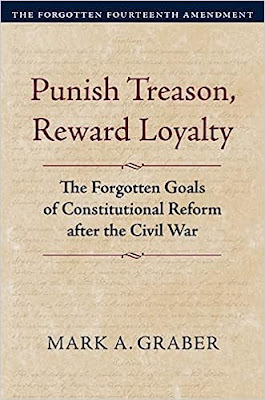
Mark A. Graber, Punish Treason, Reward Loyalty: The Forgotten Goals of Constitutional Reform after the Civil War (University of Kansas Press, 2023)
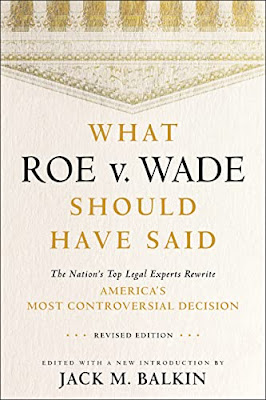
Jack M. Balkin, What Roe v. Wade Should Have Said: The Nation's Top Legal Experts Rewrite America's Most Controversial Decision - Revised Edition (NYU Press, 2023)

Andrew Koppelman, Burning Down the House: How Libertarian Philosophy Was Corrupted by Delusion and Greed (St. Martin’s Press, 2022)

Gerard N. Magliocca, Washington's Heir: The Life of Justice Bushrod Washington (Oxford University Press, 2022)
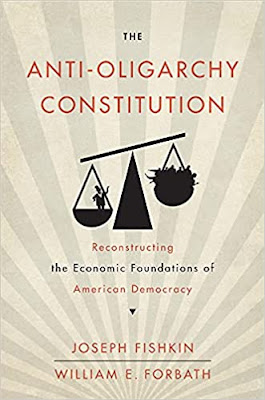
Joseph Fishkin and William E. Forbath, The Anti-Oligarchy Constitution: Reconstructing the Economic Foundations of American Democracy (Harvard University Press, 2022)
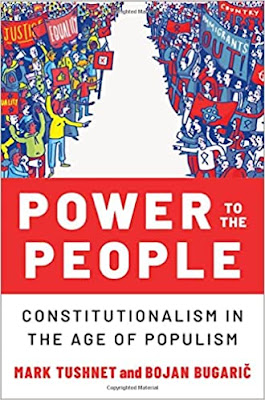
Mark Tushnet and Bojan Bugaric, Power to the People: Constitutionalism in the Age of Populism (Oxford University Press 2021).

Mark Philip Bradley and Mary L. Dudziak, eds., Making the Forever War: Marilyn B. Young on the Culture and Politics of American Militarism Culture and Politics in the Cold War and Beyond (University of Massachusetts Press, 2021).

Jack M. Balkin, What Obergefell v. Hodges Should Have Said: The Nation's Top Legal Experts Rewrite America's Same-Sex Marriage Decision (Yale University Press, 2020)

Frank Pasquale, New Laws of Robotics: Defending Human Expertise in the Age of AI (Belknap Press, 2020)

Jack M. Balkin, The Cycles of Constitutional Time (Oxford University Press, 2020)

Mark Tushnet, Taking Back the Constitution: Activist Judges and the Next Age of American Law (Yale University Press 2020).

Andrew Koppelman, Gay Rights vs. Religious Liberty?: The Unnecessary Conflict (Oxford University Press, 2020)

Ezekiel J Emanuel and Abbe R. Gluck, The Trillion Dollar Revolution: How the Affordable Care Act Transformed Politics, Law, and Health Care in America (PublicAffairs, 2020)

Linda C. McClain, Who's the Bigot?: Learning from Conflicts over Marriage and Civil Rights Law (Oxford University Press, 2020)
Sanford Levinson and Jack M. Balkin, Democracy and Dysfunction (University of Chicago Press, 2019)

Sanford Levinson, Written in Stone: Public Monuments in Changing Societies (Duke University Press 2018)

Mark A. Graber, Sanford Levinson, and Mark Tushnet, eds., Constitutional Democracy in Crisis? (Oxford University Press 2018)

Gerard Magliocca, The Heart of the Constitution: How the Bill of Rights became the Bill of Rights (Oxford University Press, 2018)

Cynthia Levinson and Sanford Levinson, Fault Lines in the Constitution: The Framers, Their Fights, and the Flaws that Affect Us Today (Peachtree Publishers, 2017)

Brian Z. Tamanaha, A Realistic Theory of Law (Cambridge University Press 2017)

Sanford Levinson, Nullification and Secession in Modern Constitutional Thought (University Press of Kansas 2016)

Sanford Levinson, An Argument Open to All: Reading The Federalist in the 21st Century (Yale University Press 2015)

Stephen M. Griffin, Broken Trust: Dysfunctional Government and Constitutional Reform (University Press of Kansas, 2015)

Frank Pasquale, The Black Box Society: The Secret Algorithms That Control Money and Information (Harvard University Press, 2015)

Bruce Ackerman, We the People, Volume 3: The Civil Rights Revolution (Harvard University Press, 2014)
Balkinization Symposium on We the People, Volume 3: The Civil Rights Revolution

Joseph Fishkin, Bottlenecks: A New Theory of Equal Opportunity (Oxford University Press, 2014)

Mark A. Graber, A New Introduction to American Constitutionalism (Oxford University Press, 2013)

John Mikhail, Elements of Moral Cognition: Rawls' Linguistic Analogy and the Cognitive Science of Moral and Legal Judgment (Cambridge University Press, 2013)

Gerard N. Magliocca, American Founding Son: John Bingham and the Invention of the Fourteenth Amendment (New York University Press, 2013)

Stephen M. Griffin, Long Wars and the Constitution (Harvard University Press, 2013)

Andrew Koppelman, The Tough Luck Constitution and the Assault on Health Care Reform (Oxford University Press, 2013)

James E. Fleming and Linda C. McClain, Ordered Liberty: Rights, Responsibilities, and Virtues (Harvard University Press, 2013)
Balkinization Symposium on Ordered Liberty: Rights, Responsibilities, and Virtues

Andrew Koppelman, Defending American Religious Neutrality (Harvard University Press, 2013)

Brian Z. Tamanaha, Failing Law Schools (University of Chicago Press, 2012)

Sanford Levinson, Framed: America's 51 Constitutions and the Crisis of Governance (Oxford University Press, 2012)

Linda C. McClain and Joanna L. Grossman, Gender Equality: Dimensions of Women's Equal Citizenship (Cambridge University Press, 2012)

Mary Dudziak, War Time: An Idea, Its History, Its Consequences (Oxford University Press, 2012)

Jack M. Balkin, Living Originalism (Harvard University Press, 2011)

Jason Mazzone, Copyfraud and Other Abuses of Intellectual Property Law (Stanford University Press, 2011)

Richard W. Garnett and Andrew Koppelman, First Amendment Stories, (Foundation Press 2011)

Jack M. Balkin, Constitutional Redemption: Political Faith in an Unjust World (Harvard University Press, 2011)

Gerard Magliocca, The Tragedy of William Jennings Bryan: Constitutional Law and the Politics of Backlash (Yale University Press, 2011)

Bernard Harcourt, The Illusion of Free Markets: Punishment and the Myth of Natural Order (Harvard University Press, 2010)

Bruce Ackerman, The Decline and Fall of the American Republic (Harvard University Press, 2010)
Balkinization Symposium on The Decline and Fall of the American Republic

Ian Ayres. Carrots and Sticks: Unlock the Power of Incentives to Get Things Done (Bantam Books, 2010)

Mark Tushnet, Why the Constitution Matters (Yale University Press 2010)

Ian Ayres and Barry Nalebuff: Lifecycle Investing: A New, Safe, and Audacious Way to Improve the Performance of Your Retirement Portfolio (Basic Books, 2010)
.jpg)
Jack M. Balkin, The Laws of Change: I Ching and the Philosophy of Life (2d Edition, Sybil Creek Press 2009)

Brian Z. Tamanaha, Beyond the Formalist-Realist Divide: The Role of Politics in Judging (Princeton University Press 2009)
Andrew Koppelman and Tobias Barrington Wolff, A Right to Discriminate?: How the Case of Boy Scouts of America v. James Dale Warped the Law of Free Association (Yale University Press 2009)

Jack M. Balkin and Reva B. Siegel, The Constitution in 2020 (Oxford University Press 2009)

Heather K. Gerken, The Democracy Index: Why Our Election System Is Failing and How to Fix It (Princeton University Press 2009)

Mary Dudziak, Exporting American Dreams: Thurgood Marshall's African Journey (Oxford University Press 2008)

David Luban, Legal Ethics and Human Dignity (Cambridge Univ. Press 2007)

Ian Ayres, Super Crunchers: Why Thinking-By-Numbers is the New Way to be Smart (Bantam 2007)

Jack M. Balkin, James Grimmelmann, Eddan Katz, Nimrod Kozlovski, Shlomit Wagman and Tal Zarsky, eds., Cybercrime: Digital Cops in a Networked Environment (N.Y.U. Press 2007)

Jack M. Balkin and Beth Simone Noveck, The State of Play: Law, Games, and Virtual Worlds (N.Y.U. Press 2006)

Andrew Koppelman, Same Sex, Different States: When Same-Sex Marriages Cross State Lines (Yale University Press 2006)

Brian Tamanaha, Law as a Means to an End (Cambridge University Press 2006)

Sanford Levinson, Our Undemocratic Constitution (Oxford University Press 2006)

Mark Graber, Dred Scott and the Problem of Constitutional Evil (Cambridge University Press 2006)

Jack M. Balkin, ed., What Roe v. Wade Should Have Said (N.Y.U. Press 2005)

Sanford Levinson, ed., Torture: A Collection (Oxford University Press 2004)
Balkin.com homepage
Bibliography
Conlaw.net
Cultural Software
Writings
Opeds
The Information Society Project
BrownvBoard.com
Useful Links
Syllabi and Exams
