Balkinization
an unanticipated consequence of
Jack M. Balkin
Balkinization Symposiums: A Continuing List
E-mail:
Jack Balkin:
jackbalkin at yahoo.com
Bruce Ackerman
bruce.ackerman at yale.edu
Ian Ayres
ian.ayres at yale.edu
Corey Brettschneider
corey_brettschneider at brown.edu
Mary Dudziak
mary.l.dudziak at emory.edu
Joey Fishkin
joey.fishkin at gmail.com
Heather Gerken heather.gerken at yale.edu
Abbe Gluck abbe.gluck at yale.edu
Mark Graber
mgraber at law.umaryland.edu
Stephen Griffin
sgriffin at tulane.edu
Jonathan Hafetz
jonathan.hafetz at shu.edu
Jeremy Kessler
jkessler at law.columbia.edu
Andrew Koppelman
akoppelman at law.northwestern.edu
Marty Lederman
msl46 at law.georgetown.edu
Sanford Levinson
slevinson at law.utexas.edu
David Luban
david.luban at gmail.com
Gerard Magliocca
gmaglioc at iupui.edu
Jason Mazzone
mazzonej at illinois.edu
Linda McClain
lmcclain at bu.edu
John Mikhail
mikhail at law.georgetown.edu
Frank Pasquale
pasquale.frank at gmail.com
Nate Persily
npersily at gmail.com
Michael Stokes Paulsen
michaelstokespaulsen at gmail.com
Deborah Pearlstein
dpearlst at yu.edu
Rick Pildes
rick.pildes at nyu.edu
David Pozen
dpozen at law.columbia.edu
Richard Primus
raprimus at umich.edu
K. Sabeel Rahmansabeel.rahman at brooklaw.edu
Alice Ristroph
alice.ristroph at shu.edu
Neil Siegel
siegel at law.duke.edu
David Super
david.super at law.georgetown.edu
Brian Tamanaha
btamanaha at wulaw.wustl.edu
Nelson Tebbe
nelson.tebbe at brooklaw.edu
Mark Tushnet
mtushnet at law.harvard.edu
Adam Winkler
winkler at ucla.edu
Compendium of posts on Hobby Lobby and related cases
The Anti-Torture Memos: Balkinization Posts on Torture, Interrogation, Detention, War Powers, and OLC
The Anti-Torture Memos (arranged by topic)
Recent Posts
Better a criminal than an overreaching incompetent?
![[Powered by Blogger]](https://lh3.googleusercontent.com/blogger_img_proxy/AEn0k_sRQPENXIUHKdOMmygMlf8IVd8fyvMCv_hfPb3NqqMBy81hhn78Ljx7FlqHJsQ7iEecUOfvFOO0bxM9Yd-AZtQ3gi4DGfnZZFNFb0yS9Ma9=s0-d)
Just A Few Blogs
ACS Blog
Alas, a Blog
Althouse
Arts and Letters Daily
Atrios (Eschaton)
Bill of Health
Buzzflash.com
Buzz Machine
Cato at Liberty
Juan Cole (Informed Comment)
Concurring Opinions
The Constitution in 2020
Corrente
Crooked Timber
Daily Howler
Daily Kos
Dana Boyd
Brad DeLong
Digby (Hullabaloo)
Discriminations
Daniel Drezner
Kevin Drum (Mother Jones)
Electrolite
En Banc
Eunomia (Daniel Larison)
Fafblog
Michael Froomkin (Discourse.net)
GovLab (Beth Noveck)
Rick Hasen (Election Law)
History News Network
How Appealing
Ignatz (Sam Heldman)
The Importance of (Ernie Miller)
Infolaw
Instapundit
International Economic Law and Policy Blog
IntLawGrrls
Jacob Levy
Jesus' General
Jurisdynamics
The Kitchen Cabinet
Mark Kleiman
Law Blog Central
Larry Lessig
Lawyers, Guns and Money
Liberal Oasis
Brian Leiter's Law School Reports
The Leiter Reports
Marginal Revolution
Megan McArdle
Memeorandum
Metafilter
Mirror of Justice
The New Republic
Newseum
No More Mister Nice Blog
Brendan Nyhan
Opinio Juris
Orcinus
The Originalism Blog
Pandagon
Passport (Foreign Policy)
Overcoming Bias
Political Animal (Washington Monthly)
Political Theory Daily Review
Political Wire (Taegan Goddard)
The Poor Man
Virginia Postrel
Prawfsblawg
Public Reason
Jonathan Rauch
Raw Story
Redstate
ReligiousLeftLaw.com
Reporters Committee For Freedom of the Press
Reproductive Rights Blog
Rothman's Roadmap to the Right of Publicity
SCOTUS Blog
Seeing the Forest
Clay Shirky
The Shifted Librarian
The Situationist
Larry Solum (Legal Theory)
Andrew Sullivan
Talking Points Memo
Talk Left
Tapped
Tbogg
TechPresident
The Paper Chase (Jurist)
Tom Paine
Tom Tomorrow (This Modern World)
Eve Tushnet
Uggabugga
University of Chicago Law School Faculty Blog
Unqualified Offerings
The Volokh Conspiracy
War and Piece (Laura Rozen)
Wampum
Oliver Willis
Wonkette
Written Description
Matthew Yglesias
Yin
Your Choice of Feeds
1. XML
powered by

2. Atom Feed
3. RSS 2.0
Better a criminal than an overreaching incompetent?
Sandy Levinson
I begin by commending Laurence Tribe's typically incisive and bravura statement regarding the issues surrounding signing statements. I think he is exactly right in almost all respects. What strikes me about the debate, though, is precisely its "legalistic" nature. That is, opponents of President Bush seem to believe that they must, in effect, proclaim that he is acting unconstitutionally rather than, say, "merely" unwisely or even frighteningly, in his articulation of his powers under Article II. Concomitantly, supporters seem to believe they win the debate if they can demonstrate that Bush is in fact following a fairly well-established legal practice, going back at least to President Woodrow Wilson, of issuing such "signing statements." In some ways, I think this manifests part of the pathology that came to the fore at the time of Watergate and has been with us thereafter. To wit, we seem to believe that a president remains entitled to his office (and the public trust) so long as he/she isn't a "criminal," which for these purposes can be defined as someone who violates reasonbly clear constitutional duties. Unfortunately, this pathology derives from the Constitution itself.
I have in earlier posts noted some of the peculiar (and distorting) features of the debate over President Clinton's impeachment in this regard. We would, I believe, far better off if our Constitution allowed votes of "no confidence" in presidents whom we regard as overreaching incompetents, without having to demonstrate criminality. Unfortunately, to suggest such a possibility in the minds of most is to be just as defiant of constitutional norms as Bush's "signing statements" are thought to be. Almost everyone seems to agree that George Bush is precisely like a feudal lord (or pre-revolutionary official in France), who "owns" his office until Jan. 20, 2009, unless he commits an act of obvious "high" criminality or becomes sufficiently ill as to warrant replacement via the 25th Amendment (though the Amendment proved unavailing with regard to what was quite likely Ronald Reagan's known (to insiders) Alzheimer's disease in his second term). This is one of the realities behind Joseph Lieberman's ineptly-phrased statement that we had to be concerned about undercutting the president we were stuck with for three more years. Even Lieberman's bitterest enemies do not suggest that there is a way, under our current system, of bouncing Bush prior to 2009,other than the formalities of impeachment and proof of "high crimes and misdeameanors."
Thanks to our thoroughly defective Constitution, we are unable to have the kind of cogent discussion of George Bush's retention in office that would be best for the nation. If we had a procedure of "no confidence," the 2006 congressional elections could easily be run precisely on whether or not the public wanted to maintain him in office. Obviously, if the alternative were Dick Cheney, many people might answer "yes." This illustrates another constitutional pathology, the presence of a vice-president as heir-apprent who may in fact be every bit as bad as the incumbent. This was, incidentally, not the case with Clinton and Gore. Those who (defensibly) viewed Clinton as disgracing his office could have no legitimate objection to Gore's becoming President in his stead. Any process of no-confidence displacement would have to address this problem. My own solution, for what it is worth, is to allow the Congress either to call new elections or to allow the congressional caucus of the president's own party to pick his/her successor, in order to guard against an opposition-party motivated "coup" to seize the White House without having won an election.
It should be clear that the "signing statement" controversy raises fundamental questions about the nature of our political system. Some of these questions can be addressed through the skills of first-rate lawyers like Professor Tribe. But others, I fear, tend to fall through the cracks precisely because our Constitution seems to confine us to "legalistic" thrusts and counterthrusts and to delegitimize in advance a dialogue based on more "political" considerations. However important the former are, ultimately the latter are, I believe, even more important. In reviewing the late Abram Chayes's book on the Cuban Missile Crisis many years ago, I suggested that he was displaying a kind of "crackpot legalism" in his emphasis on the legality of Kennedy's blockade of Cuba while totally and completely ignoring the fact that Kennedy, according to Ted Sorenson, believed that he was running a 1/3 chance of nuclear war by challenging the Soviet Union. I imagined someone in a cave, following a nuclear exchange, proclaiming, "I'm so glad that JFK had a legal basis for doing his part to initiate World War III." (Thank God Kennedy was ultimately willing to compromise with Khrushchev by in effect offering to withdraw Jupiter missiles from Turkey, though, because of the upcoming elections, he lied to the American public with regard to whether any deal had been struck.) We have to develop a way of talking truly seriously about the central issues of our time, including the nature of our political system, without believing that it all reduces to standard-form "legal arguments."
Posted
11:14 PM
by Sandy Levinson [link]
It's perfectly clear that the President's authority to check unconstitutional legislation is contained in the Presentment Clause of the Constitution, which allows him to veto legislation. (He can also appoint private counsel for the government and have the executive branch argue that a statute is unconstitutional in court. And with criminal statutes, he may use discretion not to prosecute. The President can also resign his office if he truly feels he cannot enforce the law.)
It's also perfectly clear that line-item vetoes are unconstitutional under controlling authority-- controlling authority that I might add emphatically and persuasively rejected the position of the former Clinton OLC folks now arguing for signing statements, and exposed that reasoning as completely and utterly without merit.
The presence of the all-or-nothing Presentment Clause, and the unconstitutionality of line-item vetoes, makes it clear that the President is supposed to veto unconstitutional (including unconstitutional-as-applied) legislation. It's purely because Presidents don't want to take the political hit of vetoing legislation that they instruct OLC lawyers to draft convoluted defenses of signing statement line-item vetoes.
It's just a make-weight argument, concocted by lawyers who don't like the fact that the Constitution sometimes forces Presidents to do things they would rather not do. It's designed to provide a talking point for those who trumpet executive power, nothing more.

I tend to think that the debate is not "distorted" by the fact that we're not a parlementary system. Unless you take that system as the default, somehow. We're having the appropriate debate for OUR system.
The question for those who take Dilan's position is as follows: Would you support amending the Oath of Office Clause to (something like) the following: "I will support, protect, and defend the Constitution of the United States, but only as it is defined by the Supreme Court of the United States"?
As for Brett's response, I should make it clear that I do not support "pure parliamentarianism." Indeed, I tried to make it clear that my preferred "no-confidence" system would make it impossible for an opposition party to take power through the no-confidence vote. Moreover, I should have specified as well that any vote of "no confidence" would have to be supermajoritarian, which would, as a practical matter, requires that there be some degree of support from the President's own party for the no-confidence measure.
I agree with Brett that the debate we're having is, alas, structured by aspects of our Constitution (i.e., the impeachment clause's emphasis on "high crimes and misdemeanors"), but that is independent of the fact that we are a presidentialist system per se.
Wouldn't the same result be achieved by expanding the scope of impeachable offenses?
Ultimately, though, I'm afraid that your proposal is itself too legalistic. Whatever the Constitutional provision, whatever the established practice, I can't imagine the Congress we've had for the last 4 years taking any action against Bush -- the real scandal has been the abdication of Congressional responsibility, not the lack of Congressional power.
I'm less inclined to see the current problem as a structural failure and more inclined to see it as a political one.
Well I have to agree with Prof. Tribe's basic observation that the signing statements per se are not the real problem, and I don't think there's anything 'legalistic' about the current situation except the outrageously dishonest sophistry of the administration's supporters.
What is political about establishing the elements of a crime under a statute?
All of their policies derive from a single consitututional claim:
""In light of the text, plan, and history of the Constitution, its interpretation by both past Administrations and the courts, the longstanding practice of the executive branch, and the express affirmation of the President's constitutional authorities by Congress, we think it beyond question that the President has the plenary constitutional power to take such military actions as he deems necessary and appropriate to respond to the terrorist attacks upon the United States on September 11, 2001. Force can be used both to retaliate for those attacks, and to prevent and deter future assaults on the Nation. Military actions need not be limited to those individuals, groups, or states that participated in the attacks on the World Trade Center and the Pentagon: the Constitution vests the President with the power to strike terrorist groups or organizations that cannot be demonstrably linked to the September 11 incidents, but that, nonetheless, pose a similar threat to the security of the United States and the lives of its people, whether at home or overseas. FN32 In both the War Powers Resolution and the Joint Resolution, Congress has recognized the President's authority to use force in circumstances such as those created by the September 11 incidents. Neither statute, however, can place any limits on the President's determinations as to any terrorist threat, the amount of military force to be used in response, or the method, timing, and nature of the response. These decisions, under our Constitution, are for the President alone to make."
{ FN32 - We of course understand that terrorist organizations and their state sponsors operate by secrecy and concealment, and that it is correspondingly difficult to establish, by the standards of criminal law or even lower legal standards, that particular individuals or groups have been or may be implicated in attacks on the United States. Moreover, even when evidence sufficient to establish involvement is available to the President, it may be impossible for him to disclose that evidence without compromising classified methods and sources, and so damaging the security of the United States. See, e.g., Chicago & Southern Air Lines, Inc, 333 U.S. at 111 ("The President... has available intelligence services whose reports are not and ought not to be published to the world."); see also Ruth Wedgwood, Responding to Terrorism: The Strikes Against Bin Laden, 24 Yale J. Int'l L. 559, 568-74 (1999) (analyzing difficulties of establishing and publicizing evidence of causation of terrorist incidents). But we do not think that the difficulty or impossibility of establishing proof to a criminal law standard (or of making evidence public) bars the President from taking such military measures as, in his best judgment, he thinks necessary or appropriate to defend the United States from terrorist attacks. In the exercise of his plenary power to use military force, the President's decisions are for him alone and are unreviewable. }
John Yoo, The President's Constitutional Authority to Conduct Military Operations Against Terrorists and Nations Supporting Them, OLC (2001.09.25), Conclusion.
Think about it folks -- the claim there is that the President may kill or imprison anyone at any time for any reason. In short, that the Constitution gives the President of the United States the powers of a Roman Emperor.
Anyone who says that notion is Consitutional is either a liar or an idiot, and the people who are running this administration are plainly BOTH. Such a proposition is diametrically opposite to the plain meaning of the Constitution and utterly contrary to the principles of the American Revolution.
And I don't care how many fools think otherwise.
The real problem here isn't the Constitution, it's the people of this country. The Constitution does have it's faults, but the changes I think we need are proportional representation in the House, the elimination of the Electoral College, and some form of population based apportionment in the Senate, say 1-6 seats based on size.
But no Constitution is worth anything if it's only used as a smokescreen for criminals and tyrants, and regardless of anything else, the number one priority for this nation going forward is to make very certain that George Bush and Dick Cheney are punished to the fullest extent of the law for their crimes -- even if it takes 20 years or more. Until we do, we won't amount to anything but but what we are right now: a disgraceful failed state wallowing in hypocrisy and foolishness.
The problem is, on this one the Constitution IS clear. There's a procedure for Presidents to deal with objectionable legislation. And the text of the Constitution rejects line-item vetoes and forces the President to deal with legislation wholesale. Instead of using that procedure, the President tries to have it both ways by signing the legislation but refusing to enforce it. I might add, though this doesn't effect the analysis, that the reason the President is doing this is not some high minded concern over the Constitution, but because of the poltical costs of a veto.
And you have a controlling recent Supreme Court case saying line-item vetos are unconstititutional.
So what we have left are lawyers making creative arguments. There's nothing wrong with that-- I do it all the time-- but just because lawyers can muddy the waters doesn't mean that the text of the Constitution isn't clear.
"The question for those who take Dilan's position is as follows: Would you support amending the Oath of Office Clause to (something like) the following: 'I will support, protect, and defend the Constitution of the United States, but only as it is defined by the Supreme Court of the United States'?"
No. First of all, Presidents have to obey lower court opinions too. Second, Presidents DO have an obligation to follow the Constitution even when not ordered to by the Supreme Court, by VETOING UNCONSTITUTIONAL LEGISLATION. What Presidents have no Constitutional power to do is sign legislation with their fingers crossed behind their backs, then refuse to enforce laws that they signed. No amendment to the Oath is necessary, because the Presentment Clause prohibits Presidents from doing that.
http://obatkutil.over-blog.com/
http://obatkutilkelamin-tradisional.jimdo.com/
http://www.lautanindonesia.com/blog/obatkutilkelamindanjenggerayam/
http://obatkutilmanjur.weebly.com/
http://obatkutilampuh.livejournal.com/
http://obatkutilkelamintradisional123.blogdetik.com/
http://obatkutil12345.edublogs.org/
http://pengobatankutil.blog.planetbiru.com/
http://obatkutil.freeblog.biz/
http://batkutil.blog.com/
Pengobatan kencing nanah atau gonore manjur
Obat kencing nanah pada pria
Obat kencing nanah pada pria di apotik
Obat kencing nanah di apotik
Obat kencing nanah di apotek
Obat kencing nanah herbal
Obat kencing nanah yang ada di apotik
Obat kencing nanah di apotik kimia farma
Obat kencing nanah yang di jual di apotik
Obat kencing nanah dari dokter
Obat kencing nanah ampuh
Obat kencing nanah kaskus
Obat kencing nanah surabaya
Obat kencing nanah jogja
Obat kencing nanah yang tersedia di apotik
Obat kencing nanah apotek
Obat kencing nanah yang ada di apotek
Cara mengobati sipilis atau gonore (GO)
Cara pengobatan kencing nanah dan sipilis
obat kutil kelamin untuk ibu hamil
obat kutil kelamin tanpa operasi
obat kutil kelamin kaskus
obat kutil kelamin dokter
obat kutil kelamin mujarab
obat kutil kelamin di jakarta
obat kutil kelamin untuk wanita
obat kutil kelamin/jengger ayam
obat kutil kelamin surabaya
obat kutil kelamin yang ada di apotik
obat kutil kelamin bandung
Kapur sirih untuk obat kutil kelamin
Obat kutil kelamin medis
Obat menghilangkan kutil kelamin
Obat menyembuhkan kutil kelamin
Obat tradisional menyembuhkan kutil kelamin
Obat minum untuk kutil kelamin
Obat medis untuk kutil kelamin
Merek obat kutil kelamin
Obat kutil kelamin de nature
Nama obat kutil kelamin
Obat tradisional buat sipilis
Obat herbal buat sipilis
Obat dokter buat sipilis
Obat generik buat sipilis
Obat sipilis dengan bayam duri
Obat sipilis yang bagus
Obat china sipilis
Cara obat sipilis di apotik
obat kutil kelamin untuk ibu hamil
obat kutil kelamin tanpa operasi
obat kutil kelamin kaskus
obat kutil kelamin dokter
obat kutil kelamin mujarab
obat kutil kelamin di jakarta
obat kutil kelamin untuk wanita
obat kutil kelamin/jengger ayam
obat kutil kelamin surabaya
obat kutil kelamin yang ada di apotik
obat kutil kelamin bandung
Kapur sirih untuk obat kutil kelamin
Obat kutil kelamin medis
Obat menghilangkan kutil kelamin
Obat menyembuhkan kutil kelamin
Obat tradisional menyembuhkan kutil kelamin
Obat minum untuk kutil kelamin
Obat medis untuk kutil kelamin
Merek obat kutil kelamin
Obat kutil kelamin de nature
Nama obat kutil kelamin
Obat tradisional buat sipilis
Obat herbal buat sipilis
Obat dokter buat sipilis
Obat generik buat sipilis
Obat sipilis dengan bayam duri
Obat sipilis yang bagus
Obat china sipilis
Cara obat sipilis di apotik
Agen Judi Online Terpercaya
Books by Balkinization Bloggers

Gerard N. Magliocca, The Actual Art of Governing: Justice Robert H. Jackson's Concurring Opinion in the Steel Seizure Case (Oxford University Press, 2025)

Linda C. McClain and Aziza Ahmed, The Routledge Companion to Gender and COVID-19 (Routledge, 2024)

David Pozen, The Constitution of the War on Drugs (Oxford University Press, 2024)

Jack M. Balkin, Memory and Authority: The Uses of History in Constitutional Interpretation (Yale University Press, 2024)
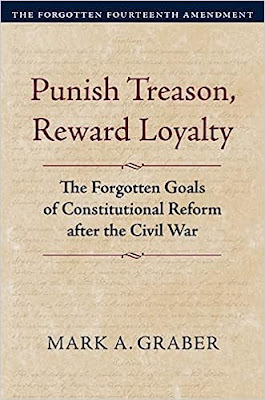
Mark A. Graber, Punish Treason, Reward Loyalty: The Forgotten Goals of Constitutional Reform after the Civil War (University of Kansas Press, 2023)
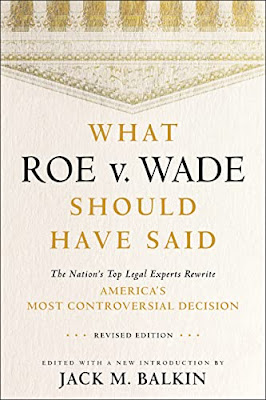
Jack M. Balkin, What Roe v. Wade Should Have Said: The Nation's Top Legal Experts Rewrite America's Most Controversial Decision - Revised Edition (NYU Press, 2023)

Andrew Koppelman, Burning Down the House: How Libertarian Philosophy Was Corrupted by Delusion and Greed (St. Martin’s Press, 2022)

Gerard N. Magliocca, Washington's Heir: The Life of Justice Bushrod Washington (Oxford University Press, 2022)
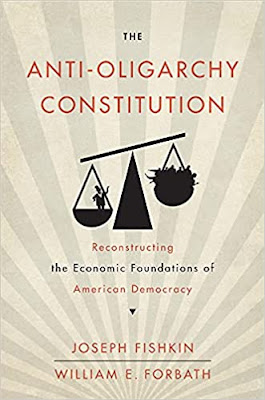
Joseph Fishkin and William E. Forbath, The Anti-Oligarchy Constitution: Reconstructing the Economic Foundations of American Democracy (Harvard University Press, 2022)
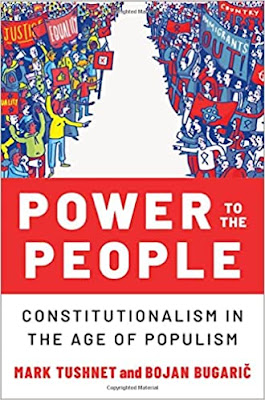
Mark Tushnet and Bojan Bugaric, Power to the People: Constitutionalism in the Age of Populism (Oxford University Press 2021).

Mark Philip Bradley and Mary L. Dudziak, eds., Making the Forever War: Marilyn B. Young on the Culture and Politics of American Militarism Culture and Politics in the Cold War and Beyond (University of Massachusetts Press, 2021).

Jack M. Balkin, What Obergefell v. Hodges Should Have Said: The Nation's Top Legal Experts Rewrite America's Same-Sex Marriage Decision (Yale University Press, 2020)

Frank Pasquale, New Laws of Robotics: Defending Human Expertise in the Age of AI (Belknap Press, 2020)

Jack M. Balkin, The Cycles of Constitutional Time (Oxford University Press, 2020)

Mark Tushnet, Taking Back the Constitution: Activist Judges and the Next Age of American Law (Yale University Press 2020).

Andrew Koppelman, Gay Rights vs. Religious Liberty?: The Unnecessary Conflict (Oxford University Press, 2020)

Ezekiel J Emanuel and Abbe R. Gluck, The Trillion Dollar Revolution: How the Affordable Care Act Transformed Politics, Law, and Health Care in America (PublicAffairs, 2020)

Linda C. McClain, Who's the Bigot?: Learning from Conflicts over Marriage and Civil Rights Law (Oxford University Press, 2020)
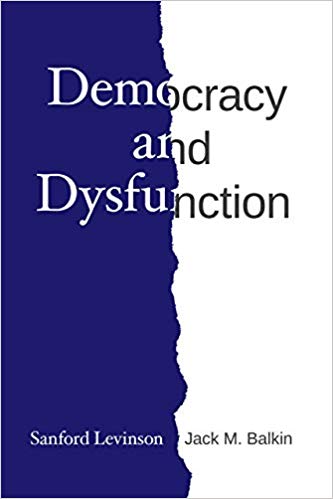
Sanford Levinson and Jack M. Balkin, Democracy and Dysfunction (University of Chicago Press, 2019)

Sanford Levinson, Written in Stone: Public Monuments in Changing Societies (Duke University Press 2018)

Mark A. Graber, Sanford Levinson, and Mark Tushnet, eds., Constitutional Democracy in Crisis? (Oxford University Press 2018)

Gerard Magliocca, The Heart of the Constitution: How the Bill of Rights became the Bill of Rights (Oxford University Press, 2018)

Cynthia Levinson and Sanford Levinson, Fault Lines in the Constitution: The Framers, Their Fights, and the Flaws that Affect Us Today (Peachtree Publishers, 2017)

Brian Z. Tamanaha, A Realistic Theory of Law (Cambridge University Press 2017)

Sanford Levinson, Nullification and Secession in Modern Constitutional Thought (University Press of Kansas 2016)

Sanford Levinson, An Argument Open to All: Reading The Federalist in the 21st Century (Yale University Press 2015)

Stephen M. Griffin, Broken Trust: Dysfunctional Government and Constitutional Reform (University Press of Kansas, 2015)

Frank Pasquale, The Black Box Society: The Secret Algorithms That Control Money and Information (Harvard University Press, 2015)

Bruce Ackerman, We the People, Volume 3: The Civil Rights Revolution (Harvard University Press, 2014)
Balkinization Symposium on We the People, Volume 3: The Civil Rights Revolution

Joseph Fishkin, Bottlenecks: A New Theory of Equal Opportunity (Oxford University Press, 2014)

Mark A. Graber, A New Introduction to American Constitutionalism (Oxford University Press, 2013)

John Mikhail, Elements of Moral Cognition: Rawls' Linguistic Analogy and the Cognitive Science of Moral and Legal Judgment (Cambridge University Press, 2013)

Gerard N. Magliocca, American Founding Son: John Bingham and the Invention of the Fourteenth Amendment (New York University Press, 2013)

Stephen M. Griffin, Long Wars and the Constitution (Harvard University Press, 2013)

Andrew Koppelman, The Tough Luck Constitution and the Assault on Health Care Reform (Oxford University Press, 2013)

James E. Fleming and Linda C. McClain, Ordered Liberty: Rights, Responsibilities, and Virtues (Harvard University Press, 2013)
Balkinization Symposium on Ordered Liberty: Rights, Responsibilities, and Virtues

Andrew Koppelman, Defending American Religious Neutrality (Harvard University Press, 2013)

Brian Z. Tamanaha, Failing Law Schools (University of Chicago Press, 2012)

Sanford Levinson, Framed: America's 51 Constitutions and the Crisis of Governance (Oxford University Press, 2012)

Linda C. McClain and Joanna L. Grossman, Gender Equality: Dimensions of Women's Equal Citizenship (Cambridge University Press, 2012)

Mary Dudziak, War Time: An Idea, Its History, Its Consequences (Oxford University Press, 2012)

Jack M. Balkin, Living Originalism (Harvard University Press, 2011)

Jason Mazzone, Copyfraud and Other Abuses of Intellectual Property Law (Stanford University Press, 2011)

Richard W. Garnett and Andrew Koppelman, First Amendment Stories, (Foundation Press 2011)

Jack M. Balkin, Constitutional Redemption: Political Faith in an Unjust World (Harvard University Press, 2011)

Gerard Magliocca, The Tragedy of William Jennings Bryan: Constitutional Law and the Politics of Backlash (Yale University Press, 2011)

Bernard Harcourt, The Illusion of Free Markets: Punishment and the Myth of Natural Order (Harvard University Press, 2010)

Bruce Ackerman, The Decline and Fall of the American Republic (Harvard University Press, 2010)
Balkinization Symposium on The Decline and Fall of the American Republic

Ian Ayres. Carrots and Sticks: Unlock the Power of Incentives to Get Things Done (Bantam Books, 2010)

Mark Tushnet, Why the Constitution Matters (Yale University Press 2010)

Ian Ayres and Barry Nalebuff: Lifecycle Investing: A New, Safe, and Audacious Way to Improve the Performance of Your Retirement Portfolio (Basic Books, 2010)
.jpg)
Jack M. Balkin, The Laws of Change: I Ching and the Philosophy of Life (2d Edition, Sybil Creek Press 2009)

Brian Z. Tamanaha, Beyond the Formalist-Realist Divide: The Role of Politics in Judging (Princeton University Press 2009)
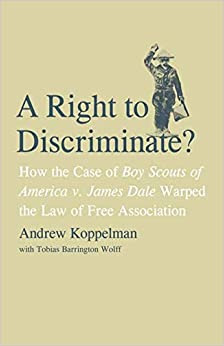
Andrew Koppelman and Tobias Barrington Wolff, A Right to Discriminate?: How the Case of Boy Scouts of America v. James Dale Warped the Law of Free Association (Yale University Press 2009)

Jack M. Balkin and Reva B. Siegel, The Constitution in 2020 (Oxford University Press 2009)

Heather K. Gerken, The Democracy Index: Why Our Election System Is Failing and How to Fix It (Princeton University Press 2009)

Mary Dudziak, Exporting American Dreams: Thurgood Marshall's African Journey (Oxford University Press 2008)

David Luban, Legal Ethics and Human Dignity (Cambridge Univ. Press 2007)

Ian Ayres, Super Crunchers: Why Thinking-By-Numbers is the New Way to be Smart (Bantam 2007)

Jack M. Balkin, James Grimmelmann, Eddan Katz, Nimrod Kozlovski, Shlomit Wagman and Tal Zarsky, eds., Cybercrime: Digital Cops in a Networked Environment (N.Y.U. Press 2007)
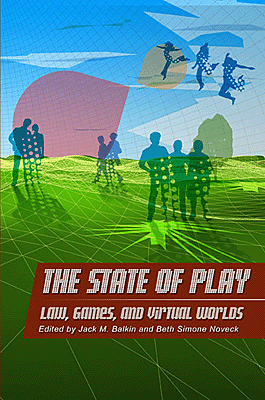
Jack M. Balkin and Beth Simone Noveck, The State of Play: Law, Games, and Virtual Worlds (N.Y.U. Press 2006)

Andrew Koppelman, Same Sex, Different States: When Same-Sex Marriages Cross State Lines (Yale University Press 2006)

Brian Tamanaha, Law as a Means to an End (Cambridge University Press 2006)

Sanford Levinson, Our Undemocratic Constitution (Oxford University Press 2006)

Mark Graber, Dred Scott and the Problem of Constitutional Evil (Cambridge University Press 2006)

Jack M. Balkin, ed., What Roe v. Wade Should Have Said (N.Y.U. Press 2005)

Sanford Levinson, ed., Torture: A Collection (Oxford University Press 2004)
Balkin.com homepage
Bibliography
Conlaw.net
Cultural Software
Writings
Opeds
The Information Society Project
BrownvBoard.com
Useful Links
Syllabi and Exams
