Balkinization
an unanticipated consequence of
Jack M. Balkin
Balkinization Symposiums: A Continuing List
E-mail:
Jack Balkin:
jackbalkin at yahoo.com
Bruce Ackerman
bruce.ackerman at yale.edu
Ian Ayres
ian.ayres at yale.edu
Corey Brettschneider
corey_brettschneider at brown.edu
Mary Dudziak
mary.l.dudziak at emory.edu
Joey Fishkin
joey.fishkin at gmail.com
Heather Gerken heather.gerken at yale.edu
Abbe Gluck abbe.gluck at yale.edu
Mark Graber
mgraber at law.umaryland.edu
Stephen Griffin
sgriffin at tulane.edu
Jonathan Hafetz
jonathan.hafetz at shu.edu
Jeremy Kessler
jkessler at law.columbia.edu
Andrew Koppelman
akoppelman at law.northwestern.edu
Marty Lederman
msl46 at law.georgetown.edu
Sanford Levinson
slevinson at law.utexas.edu
David Luban
david.luban at gmail.com
Gerard Magliocca
gmaglioc at iupui.edu
Jason Mazzone
mazzonej at illinois.edu
Linda McClain
lmcclain at bu.edu
John Mikhail
mikhail at law.georgetown.edu
Frank Pasquale
pasquale.frank at gmail.com
Nate Persily
npersily at gmail.com
Michael Stokes Paulsen
michaelstokespaulsen at gmail.com
Deborah Pearlstein
dpearlst at yu.edu
Rick Pildes
rick.pildes at nyu.edu
David Pozen
dpozen at law.columbia.edu
Richard Primus
raprimus at umich.edu
K. Sabeel Rahmansabeel.rahman at brooklaw.edu
Alice Ristroph
alice.ristroph at shu.edu
Neil Siegel
siegel at law.duke.edu
David Super
david.super at law.georgetown.edu
Brian Tamanaha
btamanaha at wulaw.wustl.edu
Nelson Tebbe
nelson.tebbe at brooklaw.edu
Mark Tushnet
mtushnet at law.harvard.edu
Adam Winkler
winkler at ucla.edu
Compendium of posts on Hobby Lobby and related cases
The Anti-Torture Memos: Balkinization Posts on Torture, Interrogation, Detention, War Powers, and OLC
The Anti-Torture Memos (arranged by topic)
Recent Posts
![[Powered by Blogger]](https://lh3.googleusercontent.com/blogger_img_proxy/AEn0k_uTLd7QtfMoNFoIVx4Igw52ipb7ZVx5fmf1isI-tEoyXC91OaK_Oa9-Q0cz5yd5dg-u4k8vwMZqCsqNDkwf3DaIFIzmqcV3h4soHgK-6PQ3=s0-d)
Just A Few Blogs
ACS Blog
Alas, a Blog
Althouse
Arts and Letters Daily
Atrios (Eschaton)
Bill of Health
Buzzflash.com
Buzz Machine
Cato at Liberty
Juan Cole (Informed Comment)
Concurring Opinions
The Constitution in 2020
Corrente
Crooked Timber
Daily Howler
Daily Kos
Dana Boyd
Brad DeLong
Digby (Hullabaloo)
Discriminations
Daniel Drezner
Kevin Drum (Mother Jones)
Electrolite
En Banc
Eunomia (Daniel Larison)
Fafblog
Michael Froomkin (Discourse.net)
GovLab (Beth Noveck)
Rick Hasen (Election Law)
History News Network
How Appealing
Ignatz (Sam Heldman)
The Importance of (Ernie Miller)
Infolaw
Instapundit
International Economic Law and Policy Blog
IntLawGrrls
Jacob Levy
Jesus' General
Jurisdynamics
The Kitchen Cabinet
Mark Kleiman
Law Blog Central
Larry Lessig
Lawyers, Guns and Money
Liberal Oasis
Brian Leiter's Law School Reports
The Leiter Reports
Marginal Revolution
Megan McArdle
Memeorandum
Metafilter
Mirror of Justice
The New Republic
Newseum
No More Mister Nice Blog
Brendan Nyhan
Opinio Juris
Orcinus
The Originalism Blog
Pandagon
Passport (Foreign Policy)
Overcoming Bias
Political Animal (Washington Monthly)
Political Theory Daily Review
Political Wire (Taegan Goddard)
The Poor Man
Virginia Postrel
Prawfsblawg
Public Reason
Jonathan Rauch
Raw Story
Redstate
ReligiousLeftLaw.com
Reporters Committee For Freedom of the Press
Reproductive Rights Blog
Rothman's Roadmap to the Right of Publicity
SCOTUS Blog
Seeing the Forest
Clay Shirky
The Shifted Librarian
The Situationist
Larry Solum (Legal Theory)
Andrew Sullivan
Talking Points Memo
Talk Left
Tapped
Tbogg
TechPresident
The Paper Chase (Jurist)
Tom Paine
Tom Tomorrow (This Modern World)
Eve Tushnet
Uggabugga
University of Chicago Law School Faculty Blog
Unqualified Offerings
The Volokh Conspiracy
War and Piece (Laura Rozen)
Wampum
Oliver Willis
Wonkette
Written Description
Matthew Yglesias
Yin
Your Choice of Feeds
1. XML
powered by

2. Atom Feed
3. RSS 2.0
JB
Why the Confirmation Process is Broken
I've said very little about the fights over Miguel Estrada and other Bush judicial nominees. Howard Bashman has had exemplary coverage of the issues for those who are interested. The decision by Democrats to fillibuster some nominations and hold up others is explicable in part by the fact that the Republicans did not behave themselves very well during the Clinton years. But I think something else is going on.
Generally speaking, much constitutional change occurs not through amendments under Article V but through interpretation by Article III judges. The best way to change the Constitution is through stocking the courts with your ideological allies, a process that Sandy Levinson and I call "partisan entrenchment." Some presidents make judicial appointments as political favors, or to reward friends. But some presidents consciously set out to restock the courts according to an ideological vision. Roosevelt's Supreme Court appointments, for example, were designed to give constitutional legitimacy to the New Deal. The sea change in constitutional understandings that occurred after 1937 is due less to the Court's famous "switch in time" in West Coast Hotel and NLRB v. Jones and Laughlin than to the fact that by 1940 Roosevelt had been able to replace several conservative jurists with New Deal acolytes. For better or for worse, this is how our Constitution changes.
Of the two major political parties, the Republican Party has been considerably more devoted to the goal of partisan entrenchment in recent years. That is because the conservative social movements of the past thirty years, which helped the Republicans gain repeated electoral victories, saw the federal courts, and particularly the Supreme Court, as liberal elite institutions out of touch with popular morality and American values. For this reason, Reagan and the two Bushes have tended to value ideological purity in judicial appointments somewhat more than Clinton did. Republicans, or at least the hard right of the party, really cared a lot about judicial appointments, and wanted to change the Constitution to their way of thinking. To a considerable extent they have succeeded, but not in all respects. There is still a great deal more work to be done.
The Republican strategy of delaying Clinton's appointments was part of this crusade to remake the courts. Many Republicans didn't think Clinton deserved to be president in the first place, and they quickly recognized that he could be pushed around. So they fought hard to keep many of his nominees from getting a hearing. And they succeeded in a number of cases. Elena Kagan, who is going to be the next Dean of the Harvard Law School, was nominated to the D.C. Circuit, but never got a vote. (Incidentally, had she gotten a chance, President Bush would not have been able to nominate Miguel Estrada to fill the same vacant slot on the D.C.Circuit.)
Until the Bush Presidency, the Democrats tended to roll over and play dead when the Republicans played hardball on judicial appointments. Why did things change? The reason is simple: The election of 2000 infuriated their base and convinced many Democrats (yours truly included) that a serious miscarriage of justice had occured (more about that here). Five conservative justices on the Supreme Court had handed the Presidency to the man who would appoint more conservative Republicans to be their colleagues and successors. Once Bush took office, he made clear that he would not govern from the center; rather he would govern from the right, and his judicial appointments contained many strongly ideological conservatives. It became clear to the Democrats that the Republican agenda of stocking the courts with strongly conservative ideologues would continue apace, and even be accelerated during the Bush administration.
The view among many Democrats was that the election had been stolen, and thus the power to appoint judges and Justices had been improperly given to the Republican Party by five conservative Republican Justices. Most Democrats in the Senate did not openly talk this way, since they well understood that the public did not want a continual rehash of the election, particularly after 9/11, but they thought it nevertheless. And many were particularly incensed that Bush would use the legitimacy he gained as Commander-in-Chief arising out of 9/11 to push for strongly ideological appointments to the judiciary. For this reason they thought it important to indicate to the Republicans that they would resist what they regarded as the most egregious appointments at the circuit court level. In other words, I think that the broken down judicial appointments process is not just payback for Orrin Hatch's stonewalling during the Clinton years. I think it is also due in part to outrage at the election, and outrage at the Supreme Court's apparent conflict of interest in handing the Presidency to the party that the members of the Court's five-person conservative majority preferred.
If, as I suspect, the 2000 election is an important, although unspoken part of the story of judicial appointments, then we can expect that there will be a particularly vigorous fight over the next Supreme Court nomination, particularly if the person who retires is a swing Justice like O'Connor or a moderate-to-liberal like Stevens. Many Democrats do not want the five conservatives on the Supreme Court to get away with what they regard as a particularly atrocious deed. Republicans can pretend that Democrats have put this aspect of the past behind them, as Republicans themselves have. But this sort of trauma inflicted on one of the two major political parties does not go away so easily.
I have said before that election of 2000 is like Poe's tell-tale heart. Many people think that the election is ancient history. But in my view the election, and the felt sense of grievance by many Democrats, frames a great deal that is occuring between the two parties today, particularly on judicial appointments.
The Democratic Party was originally assigned the donkey because the donkey was thought to be rebellious and the Democrats were the party of the secessionist South. The Republican party was assigned the elephant because they had long memories about the Civil War, and the joke was that they never wanted people to forget about what the Democrats did. I think that the mascots probably should be reversed now. The Republicans have become the stubborn rebellious mules, and the Democrats are going to be the ones with the long memories.
Posted
7:15 PM
by JB [link]
(2) comments
JB
Is a "Strong and Decisive" Leader a Good Leader?
David Broder argues in an essay in the Washington Post that Democrats can't attack Bush on leadership, which is his "strong suit." Opinion polls repeatedly suggest that the public believes that Bush is a "strong and decisive leader" and support him for that reason.
It appears that 9/11 did for Bush what the assassination attempt that Ronald Reagan survived and almost laughed off did for his reputation, barely two months into his presidency in 1981. That event formed an indelible impression of Reagan in the minds of millions of voters and gave him an almost mythic dimension that withstood recession, scandal and controversy.
Almost everything Bush has done since becoming president has been designed to create a similar sense of steadfastness. His pursuit of adversaries in Afghanistan and Iraq is of a piece with his persistence in pressing for passage of big tax cuts and confirmation of conservative judges here at home. It is not surprising that many people respond positively to Bush's decisiveness. When times are tough, it is nice to know that the people in charge have a plan and will stick to it come thick or thin. But strong and decisive leadership is not necessarily the same thing as good leadership. If the President is headed in the wrong direction and won't listen to reason, then the same characteristics of perseverance that seem admirable may actually be quite harmful for the country. It is true enough that George W. Bush is no Jimmy Carter. He doesn't obsess about details (indeed he doesn't even bother to master them) and he has absolutely no problem with making firm decisions, sticking to his guns, and refusing to compromise. However, as I mentioned in a previous post, a person can fail to be up to the job of President not because he is too reticent and weak-willed, or because he freezes in a crisis, but because he overreacts and pushes too hard and too fast at the wrong times. George W. Bush’s failings are not neurosis and indecision. They are stubbornness, tunnel vision, narrowmindedness, over-aggressiveness, belligerence, and hubris.
Moreover, the appearance of steadfastness may be illusory. Although Bush routed the Taliban in Afghanistan, a year later the country is in shambles and has fallen off the radar screen of public attention. The Administration has simply not carried through on its promises here; instead, it has diverted public attention to a war with Iraq. Moreover, refusing to compromise is not necessarily a virtue if a leader won't have to suffer the consequences of the course he chooses or pay for his mistakes. Bush's determination to cut more and more taxes for the wealthiest Americans is going to create long term problems for the nation's fiscal health that may emerge many years after he leaves office.
The problem with a decisive president like George W. Bush is that he may decisively get the country into a whole series of messes that his successors will have to clean up. In a sense, this is a familar pattern in Bush's personal history: He takes risks, acts foolishly and aggressively, gets into trouble, and then somebody else cleans up his mess. But this time he is not simply the owner of an oil company or a baseball team. He is directing the domestic and foreign policy of the most powerful nation on earth. If he makes a mess this time, it may be a very big mess indeed.
But at least we will have the comfort of knowing that he never lost a night's sleep about it.
It is evident that the event that defined Bush as a strong and decisive leader was the terrorist attacks of Sept. 11, 2001. A month earlier, only 55 percent of Gallup respondents attributed those traits to him. A month after the assault on the World Trade Center and the Pentagon, it had jumped to 75 percent -- and it has basically stayed at that stratospheric level.
Posted
12:32 AM
by JB [link]
(4) comments
JB
Undermining the "Traditional Family"
Stanley Kurtz comes to Santorum's (partial) defense in this NRO online column:
So when Santorum says that "all these things" (homosexuality, polygamy, etc.) tend to undermine the traditional family, he is absolutely right. And I can agree with Santorum about this, even if I personally happen to believe that the tradeoff in family instability happens to be worth it in the case of sodomy laws, which I think should be abolished. We all need to decide — individually, and as a society — how to balance the complex tradeoff between family stability and personal freedom. But the tradeoff is real, and there is nothing wrong with any individual consulting his religious beliefs to help him decide how to balance these competing goods. In this case, moreover, I believe that Santorum's religiously derived wisdom contributes to the public debate by reminding naive secularists that there is in fact a tradeoff between sexual freedom and family stability. The flaw in this logic is Kurtz's equation of the stability of the "traditional family" with "family stability" per se. Pre-marital sex and acceptance of homosexuality may have destabilized or undermined traditional notions of how families should be formed, including, for example, the subordinate role of women and the sexual division of labor. But it does not follow that other understandings of how families should be organized might not replace those traditional understandings. To a very significant degree, this has been the case. Men and women have somewhat different views about their responsibilities to each other in and out of marriage than they had in say, the mid 1950's, although it would be foolish to think there are not also strong continuities in expectations about gender roles. And homosexual families have formed, which can be, and are, just as stable and loving as heterosexual families.
We should not think that the choice is one between "traditional families" with all of their hierarchical elements and gendered expectations, or personal freedom. This is a false dichotomy. American society is in the process of producing new ways for families to be families. (Indeed, the nature of the family has been in continuous change throughout the country's history, and the notion that there was once a golden age when American families were simply "stable" is a myth that involves forgetting much of the coutnry's history, including the effects of, among other things, chattel slavery, immigration, industrialization, war, and so on.). Kurtz and I share, I think, a desire that family relations be relatively stable because both of us think that families are important units of social cohesion that help inculcate moral values and promote many of the goods of social life. What we appear to disagree about is whether there is more than one way to constitute a family.
when the pope says that sexual relations not directed toward reproduction within the context of marriage tend to threaten the structure of the traditional family, he is absolutely right. It is not necessary to be Catholic — or religious — to grant the acuity of the pope's sociological insight. In fact, it is not even necessary to agree with the pope about the need to limit non-marital sexual relations to see the validity of the connection he is making. The truth is, a whole series of non-marital or non-reproductive practices that have gained social approval over the last 30 years — from birth control, to abortion, to premarital sex, to homosexuality — have in fact helped to undermine the structure of the traditional family. That is true, whether or not you are religious, and whether or not you think that these developments have been positive or not.
Posted
12:31 PM
by JB [link]
(2) comments
JB
Why the Jury is Still Out on the War in Iraq, Part II
According to a report by the Washington Post
After testing some -- though by no means all -- of their best leads, analysts here and in Washington are increasingly doubtful that they will find what they are looking for in the places described on a five-tiered target list drawn up before fighting began. ...
If such weapons or the means of making them have been removed from the centralized control of former Iraqi officials, high-ranking U.S. officials acknowledged, then the war may prove to aggravate the proliferation threat that President Bush said he fought to forestall.
I must say that this does not inspire confidence in President Bush's judgment. We can still hope that these weapons will be found soon, or at least conclusive evidence uncovered that virtually all of them were destroyed shortly before the war began. For if they were not *all* destroyed, and we can't find them, there is a strong possibility that they were distributed to or stolen by terrorist organizations during the chaos that surrounded the fall of Baghdad.
One could say that this is ironic-- that going to war to disarm Saddam might bring about the arming of terrorists with weapons of mass destruction, the very thing we wanted to prevent-- but in fact it's not ironic at all. The Bush Administration was repeatedly warned that attacking Iraq might have this undesireable side effect. It simply didn't listen to these warnings. Indeed, it didn't listen to a very large number of warnings about the unintended consequences of starting this war.
Now we must pray that we will not be punished for our President's overconfidence.
With little to show after 30 days, the Bush administration is losing confidence in its prewar belief that it had strong clues pointing to the whereabouts of weapons of mass destruction concealed in Iraq, according to planners and participants in the hunt.
Posted
11:46 PM
by JB [link]
(3) comments
JB
Why the Jury is Still Out on the War in Iraq
I was and continue to be a war skeptic, although, like my pro-war friends, I am delighted that Saddam and his Stalinist-style regime have been overthrown. My concern has not been that the U.S. might not win, or that the war would take too long, but rather that the occupation would be very long and difficult, and that the war would unleash a set of unintended consequences that would get the United States into deeper and deeper trouble, destroy our security, fracture our alliances, undermine our moral authority, and ensnare us in many more destructive wars in the future.
The jury is still out on those questions, and indeed, we will not know for some time whether the Bush Administration's strategy was far wiser than I now believe it to be.
In the meantime, when I read stories like the following from today's Washington Post, I am not comforted that our leaders know what they are doing:
The burst of Shiite power -- as demonstrated by the hundreds of thousands who made a long-banned pilgrimage to the holy city of Karbala yesterday -- has U.S. officials looking for allies in the struggle to fill the power vacuum left by the downfall of Saddam Hussein.
As the administration plotted to overthrow Hussein's government, U.S. officials said this week, it failed to fully appreciate the force of Shiite aspirations and is now concerned that those sentiments could coalesce into a fundamentalist government. Some administration officials were dazzled by Ahmed Chalabi, the prominent Iraqi exile who is a Shiite and an advocate of a secular democracy. Others were more focused on the overriding goal of defeating Hussein and paid little attention to the dynamics of religion and politics in the region. Chou-en-Lai famously responded to the question "Do you think the French Revolution was a success?" with the answer "It's too soon to tell." I think that the same is true of Bush's adventure in remaking the Middle East in America's image. Perhaps we will look back on this moment in history with satisfaction, and view Bush and Rumsfeld and their neoconservative allies as visionaries who saw that America could remake the world into a vibrant garden of democracy with enough military force and enough political will. But I doubt it very much.
And so, I continue to be a war skeptic, and, indeed, I think it important more than ever to call the President and his followers to task for their shortcomings and misjudgments about this war and its aftermath. That sort of criticism, whether made in time of war or in time of peace, is the most crucial to the health of a democracy like ours. If we allow the President simply to do what he thinks best, his thinking may not be the best thinking, and we shall all have to pay for his hubris, for many years to come.
As Iraqi Shiite demands for a dominant role in Iraq's future mount, Bush administration officials say they underestimated the Shiites' organizational strength and are unprepared to prevent the rise of an anti-American, Islamic fundamentalist government in the country.
Posted
11:01 AM
by JB [link]
(3) comments
JB
Rick Santorum and Homosexuality
Pennsylvania Senator Rick Santorum angered gay rights groups with this recent interview with the Associated Press:
I well understand that Santorum was trying to compare homosexuality to incest and polygamy in order to criticize homosexuality. I completely disagree with his criticism of homosexuality and think that the Supreme Court should overturn Bowers v. Hardwick, the 1986 case that upheld criminalization of same-sex relations. Nevertheless, Santorum's remarks raise an important issue about constitutional interpretation and how the meaning of constitutional rights changes over time that is well worth discussing.
First some background on what Santorum said: The Supreme Court has protected procreative liberty under a mis-named "right to privacy," which is really a combination of several different rights, including the right of intimate association, the right to decide the conditions under which one will bear or beget a child, and the right to sexual autonomy. Judicial recognition of this set of rights stems from two cases decided in the 1920's that concerned the right of parents to direct how their children were raised, a case in the 1940's which struck down a compulsory sterilization law directed at lower class criminals (as opposed to white collar criminals), and was finally recognized in a 1965 case which upheld the right of married couples to purchase contraceptives, and a 1972 case which extended the right to unmarried persons. The 1973 decision in Roe v. Wade is based on this right as well.
The basic problem with the right of privacy is not that it is not mentioned in the Constitution (the word "liberty" does appear in both the 5th and 14th Amendments) nor is it that it was unknown under the original understanding (a lot of rights that we would not be willing to give up today were unprotected according to the original understanding). It is rather that it is difficult to put a precise boundary on how far the right to privacy extends. A convervative traditionalist might argue that the right of procreative liberty only should extend to traditionally recognized rights of intimate association and procreative liberty like those of married couples to have sex and beget children, but not to anything that is nontraditional. The argument is that courts are not very good at defining the boundaries of the right of privacy, so they should just stick to rights that have a long and hallowed tradition.
If courts move past the most traditional versions of the right to intimate association and procreative autonomy that almost everybody agrees are ok, the argument goes, they will not be able to find a clear stopping point. That's because all of the practices that courts might wish to protect will be controversial and immoral to someone or somebody. This is Santorum's point: You may think that incest (even between consenting adults), polygamy and adultery are morally wrong, but not homosexualty. Santorum thinks they are all morally wrong and undermine the stability of society. Other people might think that all of them (or some of them) are morally permissible (Think about the official position of the Mormon Church in the 19th century, for example). Whose views about morality should win out? Since there is strong disagreement about these practices, courts should leave it up to local communities to determine their legality. This is, I think, the best version of the argument that Santorum was trying to make.
But this argument overlooks an important point about how constitutional rights get their content. In fact, the scope of the constitutional right of privacy is determined by evolving social norms, not by legal logic. It is determined by politics and social movement contestation, even if judges don't recognize this fact or admit it to themselves. We often think that fundamental rights should reflect basic values that do not change over time. In fact it is quite the opposite. Through social movement contestation, people demand that the articulation of fundamental rights keep pace with their changing ideas of what values are most important and fundamental. Rights become timeless, in other words, when the time is right for them.
The right of privacy is a perfect example of this phenomenon. The right of privacy is always responding to changing notions of what is sexually appropriate and inappropiate. Today most people in the United States (and certainly most young people) think that heterosexual sex between unmarried individuals is permissible. It was not always thus. The sexual revolution changed people's views about the morality of pre-marital sex. That, in turn, changed what people thought the state had a right to regulate. Most people now probably think that it is none of the state's business whether heterosexual couples have sex and whether they wish to live together outside of marriage.
The same thing, I would submit, is happening with same-sex relations. When the Supreme Court first considered the issue in 1986 in Bowers v. Hardwick, homosexuality was only beginning to win widespread social acceptance. Not surprisingly, the Supreme Court, filled with people of a much older generation, could not muster five votes to protect the rights of gays and lesbians. What was surprising was that there were already four votes to do so. Now, with Will and Grace one of the top-rated comedies on television, it is quite clear that a very large number of people have changed their views. It is only a matter of time before the Supreme Court begins to protect same-sex relations. Whether they will do so through extending the right of privacy or through the use of the equal protection clause is yet to be determined. But they will change constitutional law to accomodate changing social mores. However, since there have been no similar changes in social attitudes about incest or polgyamy, there is no reason to think that courts will protect those practices. As I have said, the reason is not based on logic, but experience, which, as Oliver Wendell Holmes, Jr. once said, is the real source of the life of the law..
Conservative religious groups used to have the upper hand in the debate over gay rights. But now they have seen the writing on the wall. They are, for the most part, resigned to the Supreme Court's overruling or severely limiting Bowers v. Hardwick. Santorum's comments should be understood in this light. He is giving this feature of right wing politics its last hurrah. Right wing politicians will quickly see that the most overt forms of gay baiting do not work except to an increasingly small number of their constituents, and so they will gradually give up trying to do it. Instead, they will shift to more subtle forms of homophobic appeals, just as they did in the case of race. Within twenty years or so, it will be impossible for Santorum or someone like him to make comments like this and still expect to be elected to national office. At that point, it will be seen as akin to Trent Lott's comments about race. In fact, as the outcry over Santorum suggests, we are witnessing this transformation of what is politically acceptable to say before our very eyes. Santorum is on the losing side of a long battle. In the future, social conservatives will change their rhetoric, for example, by insisting that gays have a perfect right to do what they want behind closed doors, as long as they do not try to flaunt their practices in front of heterosexuals. The struggle for gay rights will then focus on the question of full acceptance rather than mere tolerance.
Referring to an upcoming decision from the U.S. Supreme Court on the constitutionality of antigay sodomy laws, Santorum told the Associated Press, "If the Supreme Court says that you have the right to consensual [gay] sex within your home, then you have the right to bigamy, you have the right to polygamy, you have the right to incest, you have the right to adultery. You have the right to anything." He then added, "All of those things are antithetical to a healthy, stable, traditional family. And that's sort of where we are in today's world, unfortunately. It all comes from, I would argue, this right to privacy that doesn't exist, in my opinion, in the United States Constitution."
Posted
10:47 PM
by JB [link]
(2) comments
JB
Where are the Weapons of Mass Destruction?
A small case of being hoisted by one's own petard: (as Reuters reports.)
Baghdad denied having any banned weapons, and so far there have been no confirmed findings of any on Iraqi territory.
President Bush urged the United Nations on Wednesday to lift 13-year-old sanctions on Iraq, which would allow it to sell oil to help pay for postwar construction following the overthrow of Saddam Hussein.
But the sanctions cannot be ended until the U.N. inspection agency UNMOVIC certifies Iraq is free of weapons of mass destruction and the 15-nation Security Council adopts a resolution lifting them.
Here are some possibilities:
(1) They are there and we will find them if we keep looking.
(2) The weapons were distributed to or sold to terrorists during the overthrow of Saddam's regime and the chaos that resulted, which is precisely what the Bush Administration was repeatedly warned about as a reason not to attack Iraq.
(3) The weapons are in Syria, and we should go to war with them to see if they are there. Unless they are in Iran, so we should go to war to find them there, unless... well, you get the general idea.
(4) The Bush Administration lied to us, and the accusation about weapons of mass destruction was essentially a pretext for overthrowing Saddam.
Well, that makes me feel much better.
I'm hoping we find them in Iraq, and find lots of them, soon.
I don't trust the Bush Administration's motives for going to war, especially since the Administration constantly changed its stated objectives, from regime change (in 2002) to disarmament (during the debates at the U.N.) to liberation of the Iraqi people (after it was clear that the U.N. would not approve the adventure). I do think we were lied to, and lied to repeatedly. And I continue to think that the Bush Administration doesn't have a clue about how long the reconstruction of Iraq will take and how great a danger it has unleased by destabilizing the region. Nevertheless, if if large caches of weapons of mass destruction are found, that will help justify the war in hindsight.
I repeat: Let's hope that we find Iraq's weapons of mass destruction, and find them soon.
LONDON (Reuters) - The United States launched the war to disarm Iraq after accusing Baghdad of concealing weapons of mass destruction.
Why haven't we found any weapons of mass destruction?
Posted
5:56 PM
by JB [link]
(0) comments
JB
Cyberdemocracy conference
The Information Society Project at Yale Law School, which I direct, held its spring conference on Democracy in the Digital Age. The conference was a rousing success, if I do say so myself (and I do). James Grimmelmann, the well-known enfant terrible of Lawmeme, offers the play by play.
Posted
8:42 AM
by JB [link]
(8) comments
JB
Eagleburger to George W. Bush: Don't Go For More Or You'll Be Impeached, You Knucklehead
From the BBC News (via Atrios, via Tom Runnacles):
In an impassioned interview, Mr Eagleburger also tells us that if George W. Bush were to take military action against Iran and Syria, he should be impeached.
I was curious whether Eagleburger was impeachment happy, so I found the following story, also from the BBC on November 19, 1998:
He told BBC Radio 4: "I don't much like him as president but I don't want to see him impeached." Well, at least the man has his priorities straight. Lying about sex under oath is one thing, bringing untold chaos and destruction on the world is another.
BTW, in case you're wondering, no, we haven't attacked Syria or Iran. Yet.
So this is all academic, but then I am an academic and these sorts of things interest me.
You might well be wondering at this point, does Eagleburger have his constitutional law right? Can a president be impeached for taking the country to war repeatedly? Well, I'll discuss that one in a future post. Stay tuned.
The British will take heart from the more cautious voices coming out of Washington. Lawrence Eagleburger was Secretary of State for Bush's father, the first President Bush, and he and other leading veterans of the first Bush administration warned last summer about the dangers of attacking Iraq. In fact they were thought to be acting as proxies for their old boss, who was said to be privately unconvinced of his son's policies. Now that the military campaign seems to be drawing to a close, we ask Mr Eagleburger if it is true that winning the peace will be much harder.
Here's another report, courtesy of the Belfast Telegraph:
Lawrence Eagleburger, who was US Secretary of State under George Bush Snr, told the BBC: "If George Bush [Jnr] decided he was going to turn the troops loose on Syria and Iran after that he would last in office for about 15 minutes. ... In fact if President Bush were to try that now even I would think that he ought to be impeached. You can't get away with that sort of thing in this democracy."
You can get the full interview here and here.
Lawrence Eagleburger, a former Secretary of State in the George Bush administration, said he believed [President Clinton] would survive - but in a much weakened state.
Posted
9:08 PM
by JB [link]
(4) comments
JB
Nino and me, in full agreement (well, almost)
At an address at the University of Mississippi, Justice Antonin Scalia spoke out against the dangers of treating the Constitution as a "living document." (courtesy of Howard Bashman as well as Patrick Carver, the Ole Miss Conservative)
"What makes you think that a living Constitution is going to evolve in the direction of greater freedoms?" Scalia asked. "It could evolve in the direction of less freedom, and it has." When the man is right, he's right. When judges make up constitutional doctrines that keep democratically elected legislatures from reforming society and securing liberty and equality, they are failing to do their job properly.
A few examples might include Scalia's own votes to strike down affirmative action programs in Croson and Adarand, and his votes to strike down damage remedies when state governments violate federal civil rights laws in cases like Kimel and Garrett.
On the other hand, Scalia pointed out, when judges refuse to enforce constitutional guarantees against unconstitutional legislation, they also fail to do their job, and this is so even if the meaning of the constitutional guarantee is more expansive than the original understanding:
"I would have been delighted to throw Mr. (Gregory Lee) Johnson in jail," Scalia said of the man tied to the flag case. "Unfortunately, as I understand the First Amendment, I couldn't do it." Now there's no evidence of which I am currently aware that flag burning was protected under the original understanding of the Free Speech clause in 1791, so Scalia is not making an argument from the original understanding. Rather, he is making an argument, as he forthrightly says, from what he understands the First Amendment to mean.
Good for him.
Now if, according to Scalia, the best interpretation of the meaning of the First Amendment has changed significantly from the original understanding-- a position which Scalia must apparently hold given his views not only on flag burning but on many other subjects like commercial speech-- then it is up to judges to do the best job they can in interpreting the document so as to protect fundamental rights from legislative depredations.
But please, whatever you do, don't call this a living Constitution.
Scalia, 67, a conservative justice known for legal decisions based on strict interpretations of the U.S. Constitution, said people who want change in society should use the democratic process, not the courts, to bring it about.
In 1989, he cast the deciding fifth vote in Texas v. Johnson, the decision that struck down laws against burning the American flag. At the time, conservatives were incensed. Thursday afternoon, Scalia told the UM crowd in that case and others, he was handcuffed by the Constitution.
Posted
6:44 PM
by JB [link]
(1) comments
JB
What the Fall of Baghdad Means
The stunning victory of American and British forces in overthrowing Saddam Hussein’s regime in a little more than three week’s time has changed the world forever. This is as momentous an occasion in its own way as 9-11.
Why is this so? Because it demonstrated that the United States could, at comparatively little cost, and with comparatively little loss of American lives, overthrow the government of a middle sized regime.
Once the United States became the sole remaining dominant power in the world, the natural fear was that it would throw its weight around. Although the United States is convinced of the righteousness of its own causes, not all other countries agree. Therefore they have reason to be afraid.
There are lots of ways to throw your weight around. The actual use of military force is only the most overt. Most countries assumed that the United States might indeed begin to bully them, but they assumed that military force would be used as a last resort. There were two reasons for this. First, the use of military force is costly and expensive. It takes a long time to gather the necessary forces, and prepare them for battle. It is also very expensive to do so. Second, military campaigns are unpredictable and may lead to serious casualties by the attacking side, even if the attacker is much more powerful.
These time constrains and expense of military action, many people thought, were a natural deterrent against military adventurism by the world’s remaining superpower. Although the United States might huff and puff, it would not blow other countries’ houses down. The U.S. lost in Vietnam, and it won in the first Gulf War only by assembling overwhelming force. It could not afford to do that more than once in a decade. Moreover, as Vietnam demonstrated, a limited war can easily spiral into a larger war with significant American casualties.
If the U.S. could use its military force to launch a full scale war only infrequently, the argument went, certain types of foreign policy strategies would be off the table. In particular, the U.S. could not get into a series of wars designed preemptively to eliminate threats or displace troublesome regimes.
The victory in Iraq upset those calculations. Rumsfeld’s idea was to retool the U.S. military so that it could attack early and often, with comparatively minimal cost and with comparatively little loss of American life. Those two features– low cost and low American casualties-- were essential in order to ensure support at home for a series of military adventures. (Note that low American casualties does not mean low casualties in general– lots of enemy forces can be annihilated without losing domestic support).
Rumsfeld has been proved right, at least so far. The American public, doubtful about the war, has changed its views in the last three weeks and now largely supports the war. As the saying goes, victory has many fathers, defeat is an orphan.
Proving that the U.S. can overthrow regimes it does not like with relatively low cost and low American casualties changes the world because it now means that the United States can make a credible threat to engage in a series of wars against small to midsized regimes that it dislikes or regards as potential threats. That of, course, is a necessary precondition to the strategy of preemptive attack against the nation’s enemies favored by Assistant Defense Secretary Wolfowitz, which is now part of the country’s larger foreign policy strategy, as outlined in by President Bush in June of 2002.
The strategy of military preemption against countries that pose a present or future threat was only feasible if the nature of war were modified sufficiently so that the U.S. could credibly threaten to engage in limited cost/limited casualty wars early and often. The fall of Baghdad strengthens the hands of those who claim that this is now possible.
Let me say that as much as I admire the planning that went into the fall of Baghdad, these events cause me to shudder with apprehension. The demonstration that America can go to war early and often if it wants to greatly increases the chances that it will do so, and that we will be fighting a series of wars in the near future. To be sure, the Bush Administration, if it is canny, will not do this. It will simply use the fall of Baghdad to demonstrate what it *can* do, so that its ability to threaten and cajole without actually using force will be thereby enhanced. Nevertheless, recent events will encourage an even more swaggering attitude by the Bush Administration toward the rest of the world. That is likely to increase the chances that military force will be planned and employed.
A great danger is that even if the war in Iraq turns out to be low cost/low casualty, the next war and the war after that will not be. In other words, we may be falling into a trap of our own making.
Perhaps equally important are two other factors. First, the greatest enemy of a power like ours is our own hubris, the belief that we can do pretty much whatever we want, by brute force if necessary. That hubris is dangerous because it leads to overreaching, and overreaching can lead to catastrophe and decline.
Second, a continuous series of wars is not only bad for other countries. (Remember low casualties for our forces doesn’t necessarily mean low casualties for other countries). A series of wars is also bad for the health of our democracy. More war means that more and more expenditures must be diverted to military and national security concerns. More war means more and more justifications offered to limit civil liberties. More war means more and more efforts to dissuade criticism on the grounds that we must support our troops while they are in the field. And more war means more opportunities for Americans to be attacked on their own soil by terrorists eager for revenge.
Secretary Rumsfeld and Vice President Cheney are now justifiably happy that their wish for a powerful, mobile army has been granted.
But precisely because their wish has been granted, the most dangerous times for our country now lie ahead.
Posted
11:30 AM
by JB [link]
(3) comments
JB
The Use and Abuse of the Federal Material Witness Statute
The New York Times reports today that Maher Hawash, an American citizen who is a 38 year old software engineer who works for Intel Corp. and who lives in the Portland, Oregon area, has been held in prison for the past two weeks without being charged with a crime or brought before a judge. Instead, the Justice Department has chosen to detain him indefintely as a material witness. TalkLeft also has coverage here.
Following 9/11 the Justice Department has used the statute to round up an unspecified number of people and hold them indefinitely without trial. (You can find previous stories on the Justice Department's policy here, here, here, and here.) The statute is designed to ensure that people are available to testify in criminal proceedings, and states by its terms that detention is *not* permitted if the testimony can be obtained by deposition. As the statute, codified at 18 U.S.C 3144, states:
Does the "failure of justice" language justify indefinite detention? No, for two reasons. First, the point of this language is to permit flexibility in situations where the government would like to hold someone *temporarily* until the government can determine whether their testimony at a grand jury hearing or criminal is necessary in addition to deposition testimony. It should not apply to permit *indefinite* detention if the government isn't really serious about obtaining such testimony. Second, and perhaps more importantly, the "failure of justice" language cannot be used to permit indefinite detention of persons the government thinks might be involved in wrongdoing. That is because the government always retains the authority to charge the detainee as a criminal suspect, and hold him or her for trial. If the government doesn't even have probable cause to arrest a citizen, it is not clear why the government may subject that citizen to indefinite incarceration. This is competely backwards: if the government *did* have probable cause to arrest, then the citizen would have various procedural rights to appear before a judge to determine whether the test of probable cause was met, and the case against him or her would have to be set for prosecution and trial. Thus, if the government is permitted to use the material witness statute in the way that the Justice Department is currently using it, a citizen is *worse off* if the government lacks evidence to prosecute him or her. The statute should not be read to permit an end-run around the criminal procedure protections of the Bill of Rights.
Using the material witness statute to detain people when there is no serious interest in obtaining their testimony for a grand jury or a criminal trial is an abuse of the federal material witness statute. It is important to recognize that this statute may be constitutional on its face and yet it may be unconstitutionally applied if its undelying purposes are abused by overzealous government officials. That is what has been going on in the months following 9/11. The Justice Department needs to stop misusing the statute, and if they will not, Congress needs to amend this statute to prevent these violations of civil liberties. Unfortunately, I fear that this particular abuse of civil liberties is not very high on Congress's agenda, and that the Ashcroft led Justice Department would, if anything, like even more power to detain people indefinitely.
The federal material witness statute allows federal officials to detain people whose testimony is thought to be material to an ongoing criminal investigation for the purpose of testifying before a grand jury or in a criminal trial. The material witness statute, passed in 1984, was used rather infrequently before 9/11, mostly in drug smuggling and organized crime cases.
No material witness may be detained because of inability to comply with any condition of release if the testimony of such witness can adequately be secured by deposition, and if further detention is not necessary to prevent a failure of justice. Release of a material witness may be delayed for a reasonable period of time until the deposition of the witness can be taken pursuant to the Federal Rules of Criminal Procedure.
Nevertheless, the Justice Department does not appear to be interested in actually having many of the detainees testify. Rather, they simply want to hold them so that they can incapacitate them or interrogate them at their convenience. This is a clear abuse of the purposes of the statute.
Posted
10:57 AM
by JB [link]
(5) comments
Books by Balkinization Bloggers

Mark Tushnet and Bojan Bugaric, Constitutionalism and Its Discontents (University of Chicago Press, 2026)

Gerard N. Magliocca, The Actual Art of Governing: Justice Robert H. Jackson's Concurring Opinion in the Steel Seizure Case (Oxford University Press, 2025)

Linda C. McClain and Aziza Ahmed, The Routledge Companion to Gender and COVID-19 (Routledge, 2024)

David Pozen, The Constitution of the War on Drugs (Oxford University Press, 2024)

Jack M. Balkin, Memory and Authority: The Uses of History in Constitutional Interpretation (Yale University Press, 2024)
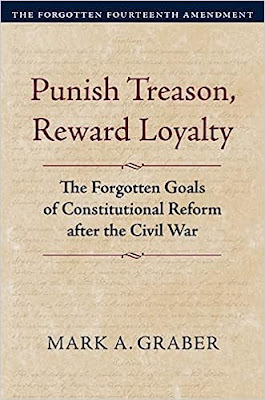
Mark A. Graber, Punish Treason, Reward Loyalty: The Forgotten Goals of Constitutional Reform after the Civil War (University of Kansas Press, 2023)
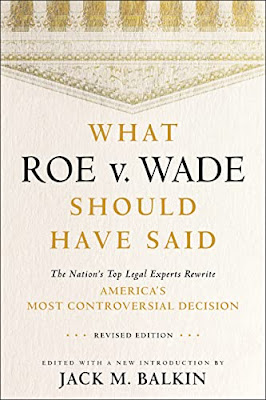
Jack M. Balkin, What Roe v. Wade Should Have Said: The Nation's Top Legal Experts Rewrite America's Most Controversial Decision - Revised Edition (NYU Press, 2023)

Andrew Koppelman, Burning Down the House: How Libertarian Philosophy Was Corrupted by Delusion and Greed (St. Martin’s Press, 2022)

Gerard N. Magliocca, Washington's Heir: The Life of Justice Bushrod Washington (Oxford University Press, 2022)
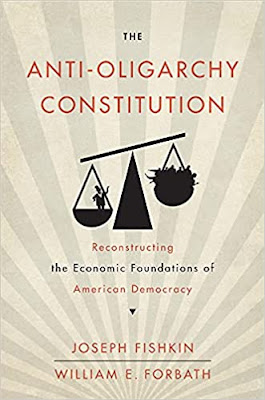
Joseph Fishkin and William E. Forbath, The Anti-Oligarchy Constitution: Reconstructing the Economic Foundations of American Democracy (Harvard University Press, 2022)
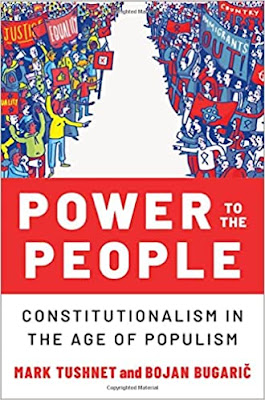
Mark Tushnet and Bojan Bugaric, Power to the People: Constitutionalism in the Age of Populism (Oxford University Press 2021).

Mark Philip Bradley and Mary L. Dudziak, eds., Making the Forever War: Marilyn B. Young on the Culture and Politics of American Militarism Culture and Politics in the Cold War and Beyond (University of Massachusetts Press, 2021).

Jack M. Balkin, What Obergefell v. Hodges Should Have Said: The Nation's Top Legal Experts Rewrite America's Same-Sex Marriage Decision (Yale University Press, 2020)

Frank Pasquale, New Laws of Robotics: Defending Human Expertise in the Age of AI (Belknap Press, 2020)

Jack M. Balkin, The Cycles of Constitutional Time (Oxford University Press, 2020)

Mark Tushnet, Taking Back the Constitution: Activist Judges and the Next Age of American Law (Yale University Press 2020).

Andrew Koppelman, Gay Rights vs. Religious Liberty?: The Unnecessary Conflict (Oxford University Press, 2020)

Ezekiel J Emanuel and Abbe R. Gluck, The Trillion Dollar Revolution: How the Affordable Care Act Transformed Politics, Law, and Health Care in America (PublicAffairs, 2020)

Linda C. McClain, Who's the Bigot?: Learning from Conflicts over Marriage and Civil Rights Law (Oxford University Press, 2020)
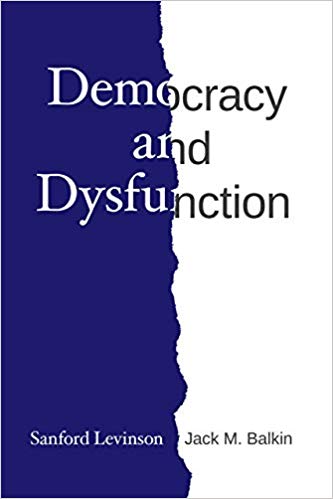
Sanford Levinson and Jack M. Balkin, Democracy and Dysfunction (University of Chicago Press, 2019)

Sanford Levinson, Written in Stone: Public Monuments in Changing Societies (Duke University Press 2018)

Mark A. Graber, Sanford Levinson, and Mark Tushnet, eds., Constitutional Democracy in Crisis? (Oxford University Press 2018)

Gerard Magliocca, The Heart of the Constitution: How the Bill of Rights became the Bill of Rights (Oxford University Press, 2018)

Cynthia Levinson and Sanford Levinson, Fault Lines in the Constitution: The Framers, Their Fights, and the Flaws that Affect Us Today (Peachtree Publishers, 2017)

Brian Z. Tamanaha, A Realistic Theory of Law (Cambridge University Press 2017)

Sanford Levinson, Nullification and Secession in Modern Constitutional Thought (University Press of Kansas 2016)

Sanford Levinson, An Argument Open to All: Reading The Federalist in the 21st Century (Yale University Press 2015)

Stephen M. Griffin, Broken Trust: Dysfunctional Government and Constitutional Reform (University Press of Kansas, 2015)

Frank Pasquale, The Black Box Society: The Secret Algorithms That Control Money and Information (Harvard University Press, 2015)

Bruce Ackerman, We the People, Volume 3: The Civil Rights Revolution (Harvard University Press, 2014)
Balkinization Symposium on We the People, Volume 3: The Civil Rights Revolution

Joseph Fishkin, Bottlenecks: A New Theory of Equal Opportunity (Oxford University Press, 2014)

Mark A. Graber, A New Introduction to American Constitutionalism (Oxford University Press, 2013)

John Mikhail, Elements of Moral Cognition: Rawls' Linguistic Analogy and the Cognitive Science of Moral and Legal Judgment (Cambridge University Press, 2013)

Gerard N. Magliocca, American Founding Son: John Bingham and the Invention of the Fourteenth Amendment (New York University Press, 2013)

Stephen M. Griffin, Long Wars and the Constitution (Harvard University Press, 2013)

Andrew Koppelman, The Tough Luck Constitution and the Assault on Health Care Reform (Oxford University Press, 2013)

James E. Fleming and Linda C. McClain, Ordered Liberty: Rights, Responsibilities, and Virtues (Harvard University Press, 2013)
Balkinization Symposium on Ordered Liberty: Rights, Responsibilities, and Virtues

Andrew Koppelman, Defending American Religious Neutrality (Harvard University Press, 2013)

Brian Z. Tamanaha, Failing Law Schools (University of Chicago Press, 2012)

Sanford Levinson, Framed: America's 51 Constitutions and the Crisis of Governance (Oxford University Press, 2012)

Linda C. McClain and Joanna L. Grossman, Gender Equality: Dimensions of Women's Equal Citizenship (Cambridge University Press, 2012)

Mary Dudziak, War Time: An Idea, Its History, Its Consequences (Oxford University Press, 2012)

Jack M. Balkin, Living Originalism (Harvard University Press, 2011)

Jason Mazzone, Copyfraud and Other Abuses of Intellectual Property Law (Stanford University Press, 2011)

Richard W. Garnett and Andrew Koppelman, First Amendment Stories, (Foundation Press 2011)

Jack M. Balkin, Constitutional Redemption: Political Faith in an Unjust World (Harvard University Press, 2011)

Gerard Magliocca, The Tragedy of William Jennings Bryan: Constitutional Law and the Politics of Backlash (Yale University Press, 2011)

Bernard Harcourt, The Illusion of Free Markets: Punishment and the Myth of Natural Order (Harvard University Press, 2010)

Bruce Ackerman, The Decline and Fall of the American Republic (Harvard University Press, 2010)
Balkinization Symposium on The Decline and Fall of the American Republic

Ian Ayres. Carrots and Sticks: Unlock the Power of Incentives to Get Things Done (Bantam Books, 2010)

Mark Tushnet, Why the Constitution Matters (Yale University Press 2010)

Ian Ayres and Barry Nalebuff: Lifecycle Investing: A New, Safe, and Audacious Way to Improve the Performance of Your Retirement Portfolio (Basic Books, 2010)
.jpg)
Jack M. Balkin, The Laws of Change: I Ching and the Philosophy of Life (2d Edition, Sybil Creek Press 2009)

Brian Z. Tamanaha, Beyond the Formalist-Realist Divide: The Role of Politics in Judging (Princeton University Press 2009)
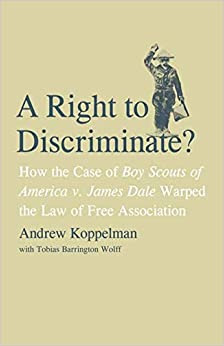
Andrew Koppelman and Tobias Barrington Wolff, A Right to Discriminate?: How the Case of Boy Scouts of America v. James Dale Warped the Law of Free Association (Yale University Press 2009)

Jack M. Balkin and Reva B. Siegel, The Constitution in 2020 (Oxford University Press 2009)

Heather K. Gerken, The Democracy Index: Why Our Election System Is Failing and How to Fix It (Princeton University Press 2009)

Mary Dudziak, Exporting American Dreams: Thurgood Marshall's African Journey (Oxford University Press 2008)

David Luban, Legal Ethics and Human Dignity (Cambridge Univ. Press 2007)

Ian Ayres, Super Crunchers: Why Thinking-By-Numbers is the New Way to be Smart (Bantam 2007)

Jack M. Balkin, James Grimmelmann, Eddan Katz, Nimrod Kozlovski, Shlomit Wagman and Tal Zarsky, eds., Cybercrime: Digital Cops in a Networked Environment (N.Y.U. Press 2007)

Jack M. Balkin and Beth Simone Noveck, The State of Play: Law, Games, and Virtual Worlds (N.Y.U. Press 2006)

Andrew Koppelman, Same Sex, Different States: When Same-Sex Marriages Cross State Lines (Yale University Press 2006)

Brian Tamanaha, Law as a Means to an End (Cambridge University Press 2006)

Sanford Levinson, Our Undemocratic Constitution (Oxford University Press 2006)

Mark Graber, Dred Scott and the Problem of Constitutional Evil (Cambridge University Press 2006)

Jack M. Balkin, ed., What Roe v. Wade Should Have Said (N.Y.U. Press 2005)

Sanford Levinson, ed., Torture: A Collection (Oxford University Press 2004)
Balkin.com homepage
Bibliography
Conlaw.net
Cultural Software
Writings
Opeds
The Information Society Project
BrownvBoard.com
Useful Links
Syllabi and Exams
