Balkinization
an unanticipated consequence of
Jack M. Balkin
Balkinization Symposiums: A Continuing List
E-mail:
Jack Balkin:
jackbalkin at yahoo.com
Bruce Ackerman
bruce.ackerman at yale.edu
Ian Ayres
ian.ayres at yale.edu
Corey Brettschneider
corey_brettschneider at brown.edu
Mary Dudziak
mary.l.dudziak at emory.edu
Joey Fishkin
joey.fishkin at gmail.com
Heather Gerken heather.gerken at yale.edu
Abbe Gluck abbe.gluck at yale.edu
Mark Graber
mgraber at law.umaryland.edu
Stephen Griffin
sgriffin at tulane.edu
Jonathan Hafetz
jonathan.hafetz at shu.edu
Jeremy Kessler
jkessler at law.columbia.edu
Andrew Koppelman
akoppelman at law.northwestern.edu
Marty Lederman
msl46 at law.georgetown.edu
Sanford Levinson
slevinson at law.utexas.edu
David Luban
david.luban at gmail.com
Gerard Magliocca
gmaglioc at iupui.edu
Jason Mazzone
mazzonej at illinois.edu
Linda McClain
lmcclain at bu.edu
John Mikhail
mikhail at law.georgetown.edu
Frank Pasquale
pasquale.frank at gmail.com
Nate Persily
npersily at gmail.com
Michael Stokes Paulsen
michaelstokespaulsen at gmail.com
Deborah Pearlstein
dpearlst at yu.edu
Rick Pildes
rick.pildes at nyu.edu
David Pozen
dpozen at law.columbia.edu
Richard Primus
raprimus at umich.edu
K. Sabeel Rahmansabeel.rahman at brooklaw.edu
Alice Ristroph
alice.ristroph at shu.edu
Neil Siegel
siegel at law.duke.edu
David Super
david.super at law.georgetown.edu
Brian Tamanaha
btamanaha at wulaw.wustl.edu
Nelson Tebbe
nelson.tebbe at brooklaw.edu
Mark Tushnet
mtushnet at law.harvard.edu
Adam Winkler
winkler at ucla.edu
Compendium of posts on Hobby Lobby and related cases
The Anti-Torture Memos: Balkinization Posts on Torture, Interrogation, Detention, War Powers, and OLC
The Anti-Torture Memos (arranged by topic)
Recent Posts
Shameless: The President's Constitutional Authority to Appoint Political Hacks to Run FEMA
![[Powered by Blogger]](https://lh3.googleusercontent.com/blogger_img_proxy/AEn0k_u4HJOg9hN305sLNpbM4jX9ecNziCR5gZz2j77PXYMJo4PcGIYYgtvuoHQVJZAoMIrU0Q1ICEjrDHqAnKs3-X00_M8TT9cOIlq8go-zR8_g=s0-d)
Just A Few Blogs
ACS Blog
Alas, a Blog
Althouse
Arts and Letters Daily
Atrios (Eschaton)
Bill of Health
Buzzflash.com
Buzz Machine
Cato at Liberty
Juan Cole (Informed Comment)
Concurring Opinions
The Constitution in 2020
Corrente
Crooked Timber
Daily Howler
Daily Kos
Dana Boyd
Brad DeLong
Digby (Hullabaloo)
Discriminations
Daniel Drezner
Kevin Drum (Mother Jones)
Electrolite
En Banc
Eunomia (Daniel Larison)
Fafblog
Michael Froomkin (Discourse.net)
GovLab (Beth Noveck)
Rick Hasen (Election Law)
History News Network
How Appealing
Ignatz (Sam Heldman)
The Importance of (Ernie Miller)
Infolaw
Instapundit
International Economic Law and Policy Blog
IntLawGrrls
Jacob Levy
Jesus' General
Jurisdynamics
The Kitchen Cabinet
Mark Kleiman
Law Blog Central
Larry Lessig
Lawyers, Guns and Money
Liberal Oasis
Brian Leiter's Law School Reports
The Leiter Reports
Marginal Revolution
Megan McArdle
Memeorandum
Metafilter
Mirror of Justice
The New Republic
Newseum
No More Mister Nice Blog
Brendan Nyhan
Opinio Juris
Orcinus
The Originalism Blog
Pandagon
Passport (Foreign Policy)
Overcoming Bias
Political Animal (Washington Monthly)
Political Theory Daily Review
Political Wire (Taegan Goddard)
The Poor Man
Virginia Postrel
Prawfsblawg
Public Reason
Jonathan Rauch
Raw Story
Redstate
ReligiousLeftLaw.com
Reporters Committee For Freedom of the Press
Reproductive Rights Blog
Rothman's Roadmap to the Right of Publicity
SCOTUS Blog
Seeing the Forest
Clay Shirky
The Shifted Librarian
The Situationist
Larry Solum (Legal Theory)
Andrew Sullivan
Talking Points Memo
Talk Left
Tapped
Tbogg
TechPresident
The Paper Chase (Jurist)
Tom Paine
Tom Tomorrow (This Modern World)
Eve Tushnet
Uggabugga
University of Chicago Law School Faculty Blog
Unqualified Offerings
The Volokh Conspiracy
War and Piece (Laura Rozen)
Wampum
Oliver Willis
Wonkette
Written Description
Matthew Yglesias
Yin
Your Choice of Feeds
1. XML
powered by

2. Atom Feed
3. RSS 2.0
Shameless: The President's Constitutional Authority to Appoint Political Hacks to Run FEMA
Marty Lederman
Yesterday, the President signed H.R. 5441, the annual Department of Homeland Security Appropriations Act. In his signing statement, the President noted constitutional objections to more than 37 different provisions of the bill. (Thirty-seven provisions are specified -- but several of those are listed merely as examples ("such as") of still other unenumerated "provisions" of the Act. There's no way of knowing how many provisions the President intends to implement (or not implement) contrary to congressional will.)
Many of those objections are perfectly proper, such as with respect to those provisions that would require congressional committee approval before the Executive could execute them, thereby violating the principles of INS v. Chadha. Others are subject to reasonable dispute.
Some of the objections, however, are just ridiculous. Section 513 of the bill, for instance, transfers the authority to conduct security background investigations of potential employees in certain agencies from the Office of Personnel Management to the Department of Homeland Security, until such time as the President has selected a single agency to conduct security clearance investigations. In the President's view, this temporary transfer of security investigation authority from one agency to another implicates the President's "exclusive constitutional authority, as head of the unitary executive branch and as Commander in Chief"! (Recall that Article I designates the President the Commander in Chief Clause of the Army and the Navy.)
But that's not the most alarming objection.
Remember Katrina?
Remember Michael Brown, the FEMA Administrator who did such a bang-up job dealing with the crisis?
Well, in this bill Congress took a very modest step to try to prevent that sort of incompetence in cases of future disasters: Section 611 of the Act imposes the following qualifications for the Administrator of FEMA:The Administrator shall be appointed from among individuals who have—
(A) a demonstrated ability in and knowledge of emergency management and homeland security; and
(B) not less than 5 years of executive leadership and management experience in the public or private sector.
According to the President, this provision apparently transgresses the Appointments Clause because it "purports to limit" -- purports to limit! -- "the qualifications of the pool of persons from whom the President may select the appointee in a manner that rules out a large portion of those persons best qualified by experience and knowledge to fill the office." Accordingly, "[t]he executive branch shall construe [the qualification] in a manner consistent with the Appointments Clause of the Constitution."
This is simply mind-boggling. Qualifications for presidential appointees are ubiquitous in federal law, and have been since the dawn of the Republic. In the Judiciary Act of 1789, in fact, the very first Congress required that the Attorney General be a "meet person, learned in the law," 1 Stat. 93 -- a qualification not unlike that for the FEMA Administrator in the new law. In Myers v. U.S., Justice Brandeis spent almost ten pages of the U.S. Reports enumerating scores of such qualifications from 1789 to 1926 alone -- including many cases in which Congress "has limited the power of nomination . . . by prescribing specific professional attainments, or occupational experience." 272 U.S. at 265-274. Even the majority in Myers -- a very strongly pro-President opinion -- conceded that Congress may impose "reasonable and relevant qualifications and rules of eligibility of appointees." 272 U.S. at 129. Such qualifications are constitutional as long as they "do not so limit selection and so trench upon executive choice as to be in effect legislative designation" of a particular appointee." 272 U.S. at 128.
The test was probably best articulated by Attorney General Akerman in an 1871 opinion: Statutory qualifications for federal officers appointed by the President are ok as long as they "leav[e] scope for the judgment and will of the [President]. . . . . Congress may not dictate qualifications "unattainable by a sufficient number to afford ample room for choice." Civil Service Commission, 13 Op. Att'y Gen. 516, 520-21, 525 (1871).
Obviously, section 613 easily satisfies this test. It merely requires that the Administrator of FEMA have "a demonstrated ability in and knowledge of emergency management and homeland security" and "not less than 5 years of executive leadership and management experience in the public or private sector." To be sure, this qualification would prevent the appointment of someone whose only "relevant" experience was being friends with Joseph Allbaugh and overseeing horse trial judges and stewards for the Arabian Horse Association until being ""forced out . . . after withstanding numerous lawsuits against his enforcement of rules for judges and stewards."
But it certainly could be construed to leave the President with the authority to appoint just about anyone who has the actual capacity to run FEMA.
I suppose it's possible the President could have taken the view that all statutory qualifications for presidential appointees are unconstitutional. That would have been wrong, and belied by unbroken history. But it would at least have made logical sense.
Instead, the signing statement has the temerity to state that the qualifications in the bill "rule[] out a large portion of those persons best qualified by experience and knowledge to fill the office"!
That's right -- in the views of this President, requiring a demonstrated ability in and knowledge of emergency management and homeland security and at least five years of executive leadership and management experience "rules out a large portion of those persons best qualified by experience and knowledge to fill the office" of FEMA Administrator -- and thus the President apparently will not feel bound to satisfy those qualifications.
Of course, this makes no sense at all . . . unless, in the Administration's view, what a FEMA Administrator really needs to "fill the office" is not experience and knowledge of disaster relief and management skills, but instead "experience [in] and knowledge" of how to be blindly loyal to the Republican Party.
Remarkable.
[NOTE: The language in the signing statement -- "rules out a large portion of those persons best qualified by experience and knowledge to fill the office" -- is taken verbatim from an OLC Opinion in the Clinton Administration which concluded that a statute preventing the President from appointing as United States Trade Representative anyone "who has directly represented, aided, or advised a foreign entity in any trade negotiation, or trade dispute, with the United States," is unconstitutional. The conclusion of that opinion was, in my view, wrong -- the Trade Rep qualification still left the President "ample room for choice" of an appointee -- but obviously, that statute would have ruled out many of the best-qualified persons for Trade Representative (including Charlene Barshevsky), and so its empirical claim was reasonable, even if its constitutional conclusion was mistaken. In the FEMA case, by contrast, the statutory qualification likely does not rule out any of the persons best qualified to fill the office -- it rules out only those people, such as Michael Brown, who are patently unqualified to perform the important functions of that office.]
Posted
4:52 PM
by Marty Lederman [link]

Under your theory, if the President doesn't appoint people of sufficient competence (under a rubric you don't provide), he's violating the Constitution?
Marty never said either of those things (and there's two assertions there: that Marty's criterion is "sufficient competence", and that not appointing such people would be "violating the Constitution").
The criteria are plainly spelled out (Marty clearly "provide[d]" the "rubric"), and "sufficient competence" is not one (although one might argue that the actual qualifications are in effect a requirement of "minimal competence or at least experience"). And if the preznit ignores this requirement, he would be ignoring statutory law, not violating the Constitution (sadly, the Constitution doesn't have "sufficient competence" written into it, thus our misfortunes with the preznitcy of Dubya).
I will note, just for the record, that the RW was putting out papers in favour of Clinton's impeachment that argued that the impeachment clause was intended in part to take care of gross malfeasance or mismanagement and that "high crimes and misdemeanors" was just a term of art encompassing such.
Cheers,

Although FEMA's story was a disaster, the levee failure was the responsibility of several entities, some public agencies and the local civil engineering works district, some private contractors.
I was reminded of another agency's moment of embarrassment earlier in 2006, which achieved a resolution much like FEMA's, with replacement of an individual who was executing administration policy but had created a counterproductive result by its implementation at NASA in the matter of suppressed science about global climate change.
Scientist complains about chaperone and censorship, January 2006.
Censor resigns from NASA February 2006.
Scientist's website in the university.
On the Katrina fiasco, consider the Times Picayune notice this week of a statewide vote to merge levee district boards and upgrade boardmember qualifications. I am sure our host JB will pardon the article's opening journalistic prose:
"A citizens campaign to abandon politics-as-usual culminated Saturday in an overwhelming statewide vote to consolidate southeast Louisiana's balkanized system of levee boards and replace them with flood protection authorities that will be governed for the first time by appointees with expertise in fields such as engineering and hydrology.
I'm assuming the "4" years reflects his Arkansas Office of Emergency Services experience since he was appointed in 1988. But, he also had various years in private sector service that would meet the test. Surely at least one year.
As to "God," I think he would meet the "private" and "public" (he does control everything, right?) requirements.
Anyway, if the terms are too strict, they are not patently unreasonable in any degree esp. as compared to any number of other offices that have requirements.
By requiring experience ("demonstrated ability in") both in emergency management and in homeland security, the statute may in fact be very limiting in who can be chosen. How many people have had jobs in both areas or otherwise have had responsibilities that have allowed them to "demonstrate[] ability in" handling issues in both areas?
If the statute had required knowledge of both areas and demonstrated ability in dealing with one or the other, then I'd have no problem joining your criticism of the signing statement.
If you would not interpret the requirement so as to mandate that the person have had responsibilities to deal with issues in both areas, then that's fine, but it's probably the same kind of interpretation that the signing statement indicates that the administration will adopt.
Mark S. Scarberry
Pepperdine Univ. School of Law
obat herpes tradisional yang ampuh
obat herpes terbaik
obat herpes tangan
obat herpes tercepat
obat herpes tipe 2
obat herpes tradisional untuk bayi
obat herpes tenggorokan
obat herpes terbaru
obat herpes tablet
obat herpes tomcat
obat herpes tumbuhan
Kapur sirih untuk obat kutil kelamin
Obat kutil kelamin medis
Obat menghilangkan kutil kelamin
Obat menyembuhkan kutil kelamin
Obat tradisional menyembuhkan kutil kelamin
Obat minum untuk kutil kelamin
Obat medis untuk kutil kelamin
Merek obat kutil kelamin
Obat kutil kelamin de nature
Nama obat kutil kelamin
Obat tradisional buat sipilis
Obat herbal buat sipilis
Obat dokter buat sipilis
Obat kutil di sekitar kelamin
Obat farmasi untuk kutil kelamin
Obat generik untuk kutil kelamin
Obat kutil kelamin imiquimod
Jual obat kutil kelamin
Jual obat kutil kelamin murah
Obat kutil kelamin yg di jual di apotik
Jual obat penghilang kutil kelamin
Obat kimia kutil kelamin
Kapur sirih untuk obat kutil kelamin
Obat kutil kelamin medis
Obat menghilangkan kutil kelamin
Obat kutil kelamin tradisional
Obat kutil kelamin
Obat kutil kelamin wanita
Obat kutil kelamin di apotik
Obat kutil kelamin untuk ibu hamil
Obat kutil kelamin untuk wanita
Obat kutil kelamin mujarab
Obat kutil kelamin di anus
Obat kutil kelamin/jengger ayam
Obat kutil kelamin paling murah
obat gonore pada ibu hamil
obat gonore tradisional
obat gonore tenggorokan
obat gonore paling efektif
obat gonore pada wanita
obat gonore atau kencing nanah
Obat herpes untuk bayi
Obat herpes untuk ibu hamil
Obat herpes ampuh
Obat herpes untuk anak
Obat herpes mulut
Pengobatan herbal kutil kelamin wanita
pengobatan ampuh kutil kelamin pada wanita
obat kutil kelamin yang ada di apotik
obat kutil kelamin yg dijual di apotik
obat kutil di kemaluan wanita
pengobatan kutil kelamin pada pria
pengobatan penyakit kutil kelamin pada pria
obat penyakit kutil pada kelamin pria
Pengobatan kutil kelamin aman dan tanpa operasi
obat kutil pada alat kelamin pria
pengobatan kutil kelamin
pengobatan kutil kelamin pada pria dan wanita
pengobatan kutil kelamin pria
pengobatan kutil kelamin wanita
pengobatan kutil kelamin dengan cuka apel
pengobatan kutil kelamin di anus
Cara mengobati kutil di kelamin wanita hamil
pengobatan kutil kelamin di bandung
Cara mengobati jengger ayam dan kutil kelamin
obat kutil kelamin
Obat wasir herbal tanpa operasi
Obat wasir herbal stadium 4 tanpa operasi
Cara mengobati wasir dan ambeien
obat gonore tenggorokan
obat gonore paling efektif
obat gonore pada wanita
obat gonore atau kencing nanah
obat gonore apa
obat alternatif gonore
obat gonore yang ampuh
obat gonore yg ampuh
obat gonore yang paling ampuh
obat gonore yang dijual di apotik
obat buat gonore
obat bakteri gonore
obat gonore dijual bebas
obat pembunuh bakteri gonore
buah obat gonore
obat gonore dan klamidia
obat gonore dokter
nama obat gonore di apotek
jenis obat gonore di apotik
harga obat gonore di apotik
merk obat gonore di apotik
obat sifilis dan gonore
fungsi obat gonore
obat gejala gonore
obat gonore untuk ibu hamil
obat gonore untuk wanita hamil
harga obat gonore
obat injeksi gonore
obat kutil kelamin yang ada di apotik
obat kutil kelamin yg dijual di apotik
obat kutil di kemaluan wanita
pengobatan kutil kelamin pada pria
pengobatan penyakit kutil kelamin pada pria
obat penyakit kutil pada kelamin pria
Pengobatan kutil kelamin aman dan tanpa operasi
obat kutil pada alat kelamin pria
pengobatan kutil kelamin
pengobatan kutil kelamin pada pria dan wanita
pengobatan kutil kelamin pria
pengobatan kutil kelamin wanita
pengobatan kutil kelamin dengan cuka apel
pengobatan kutil kelamin di anus
Cara mengobati kutil di kelamin wanita hamil
pengobatan kutil kelamin di bandung
obat kutil kelamin
obat kutil kelamin di apotik
obat kutil kelamin tradisional
obat kutil kelamin wanita
Beli obat kutil kelamin
Obat salep buat kutil kelamin
Obat cina kutil kelamin
Cuka obat kutil kelamin
Obat cina untuk kutil kelamin
Obat cina penghilang kutil kelamin
Obat china untuk kutil kelamin
Obat herpes cepat kering
Obat herpes cepat
Obat herpes cacar ular
Obat herpes cream
Obat herpes.com
Obat herpes china
Obat cacar herpes
Obat herpes paling cepat
Obat herpes yang cepat
Obat luka herpes cepat kering
Pengobatan cepat herpes
Obat wasir ambeien herbal
Pengobatan wasir ambeien tanpa operasi
Obat untuk ambeien dan wasir
Obat wasir dan ambeien manjur di obatwasir.biz hafizah
Obat herbal wasir dan ambeyen
Obat alami wasir dan ambeien
Obat tradisional menyembuhkan kutil kelamin
Obat minum untuk kutil kelamin
Obat medis untuk kutil kelamin
Obat kutil kelamin DE NATURE
Merek obat kutil kelamin
Obat kutil kelamin de nature
Nama obat kutil kelamin
Nama salep obat kutil kelamin
Obat kutil kelamin tanpa operasi
Obat oles untuk kutil kelamin
Obat kutil di alat kelamin pria
Obat untuk kutil pada kelamin
Obat tradisional kutil pada kelamin
Obat penyakit kutil kelamin
Obat penghilang kutil kelamin
Obat perontok kutil kelamin
Obat tradisional kutil kelamin pada pria
Obat untuk penyakit kutil kelamin
Propolis untuk obat kutil kelamin
Obat alami untuk penyakit kutil kelamin
Obat kutil pd kelamin
Resep obat kutil kelamin
Obat anti sifilis
Obat sipilis dijual di apotik
Obat sipilis murah di apotik
Obat alami sipilis pada pria
Obat sifilis ampuh
Obat sipilis beli di apotik
Obat sipilis buat wanita
Obat sipilis buatan sendiri
Obat sipilis bagi wanita
Obat buat sipilis
Obat biotik sifilis
Obat antibiotik buat sipilis
Obat tradisional buat sipilis
Obat herbal buat sipilis
Obat dokter buat sipilis
Obat generik buat sipilis
Obat sipilis dengan bayam duri
Obat sipilis yang bagus
Obat buat sifilis
Obat sipilis.com
Obat sipilis ciprofloxacin
Obat china sipilis
obat kutil kelamin dan leher
obat alami menghilangkan kutil kelamin
obat tradisional untuk menghilangkan kutil kelamin
kumpulan obat kutil kelamin
obat tradisional kutil kelamin
obat penyakit kutil kelamin
obat tradisional untuk kutil kelamin
obat alami untuk menghilangkan kutil kelamin
obat alami kutil kelamin
Obat kencing nanah pria
Obat kencing nanah dan darah
Obat kencing nanah apotik
Obat kencing nanah antibiotik
Obat kencing nanah amoxicillin
Obat kencing nanah apa
Obat kencing nanah apa ya
Obat kencing nanah atau gonore
Obat kencing nanah akut
Obat kencing nanah ada di apotik
Obat kencing nanah di apotik umum
Obat kencing nanah paling ampuh
Obat kencing nanah yang ampuh
Obat kencing nanah secara alami
Obat kencing nanah bandung
Obat kencing nanah buatan sendiri
Obat kencing nanah yang bisa dibeli di apotik
Obat herbal untuk mengobati kencing nanah
Obat kencing nanah paling bagus
Obat kencing nanah yang bisa dibeli di apotek
Obat kencing nanah di apotik bebas
Obat kencing nanah yang dijual bebas
Agen Judi Online Terpercaya
Books by Balkinization Bloggers

Gerard N. Magliocca, The Actual Art of Governing: Justice Robert H. Jackson's Concurring Opinion in the Steel Seizure Case (Oxford University Press, 2025)

Linda C. McClain and Aziza Ahmed, The Routledge Companion to Gender and COVID-19 (Routledge, 2024)

David Pozen, The Constitution of the War on Drugs (Oxford University Press, 2024)

Jack M. Balkin, Memory and Authority: The Uses of History in Constitutional Interpretation (Yale University Press, 2024)
Mark A. Graber, Punish Treason, Reward Loyalty: The Forgotten Goals of Constitutional Reform after the Civil War (University of Kansas Press, 2023)
Jack M. Balkin, What Roe v. Wade Should Have Said: The Nation's Top Legal Experts Rewrite America's Most Controversial Decision - Revised Edition (NYU Press, 2023)

Andrew Koppelman, Burning Down the House: How Libertarian Philosophy Was Corrupted by Delusion and Greed (St. Martin’s Press, 2022)

Gerard N. Magliocca, Washington's Heir: The Life of Justice Bushrod Washington (Oxford University Press, 2022)
Joseph Fishkin and William E. Forbath, The Anti-Oligarchy Constitution: Reconstructing the Economic Foundations of American Democracy (Harvard University Press, 2022)
Mark Tushnet and Bojan Bugaric, Power to the People: Constitutionalism in the Age of Populism (Oxford University Press 2021).

Mark Philip Bradley and Mary L. Dudziak, eds., Making the Forever War: Marilyn B. Young on the Culture and Politics of American Militarism Culture and Politics in the Cold War and Beyond (University of Massachusetts Press, 2021).

Jack M. Balkin, What Obergefell v. Hodges Should Have Said: The Nation's Top Legal Experts Rewrite America's Same-Sex Marriage Decision (Yale University Press, 2020)

Frank Pasquale, New Laws of Robotics: Defending Human Expertise in the Age of AI (Belknap Press, 2020)

Jack M. Balkin, The Cycles of Constitutional Time (Oxford University Press, 2020)

Mark Tushnet, Taking Back the Constitution: Activist Judges and the Next Age of American Law (Yale University Press 2020).

Andrew Koppelman, Gay Rights vs. Religious Liberty?: The Unnecessary Conflict (Oxford University Press, 2020)

Ezekiel J Emanuel and Abbe R. Gluck, The Trillion Dollar Revolution: How the Affordable Care Act Transformed Politics, Law, and Health Care in America (PublicAffairs, 2020)

Linda C. McClain, Who's the Bigot?: Learning from Conflicts over Marriage and Civil Rights Law (Oxford University Press, 2020)
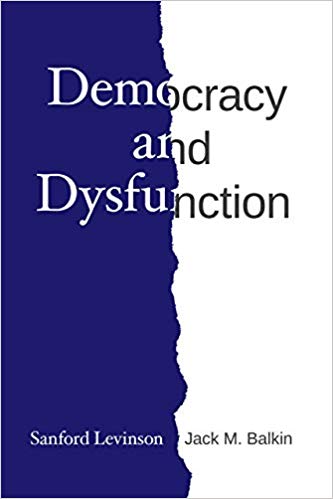
Sanford Levinson and Jack M. Balkin, Democracy and Dysfunction (University of Chicago Press, 2019)

Sanford Levinson, Written in Stone: Public Monuments in Changing Societies (Duke University Press 2018)

Mark A. Graber, Sanford Levinson, and Mark Tushnet, eds., Constitutional Democracy in Crisis? (Oxford University Press 2018)

Gerard Magliocca, The Heart of the Constitution: How the Bill of Rights became the Bill of Rights (Oxford University Press, 2018)

Cynthia Levinson and Sanford Levinson, Fault Lines in the Constitution: The Framers, Their Fights, and the Flaws that Affect Us Today (Peachtree Publishers, 2017)

Brian Z. Tamanaha, A Realistic Theory of Law (Cambridge University Press 2017)

Sanford Levinson, Nullification and Secession in Modern Constitutional Thought (University Press of Kansas 2016)

Sanford Levinson, An Argument Open to All: Reading The Federalist in the 21st Century (Yale University Press 2015)

Stephen M. Griffin, Broken Trust: Dysfunctional Government and Constitutional Reform (University Press of Kansas, 2015)

Frank Pasquale, The Black Box Society: The Secret Algorithms That Control Money and Information (Harvard University Press, 2015)

Bruce Ackerman, We the People, Volume 3: The Civil Rights Revolution (Harvard University Press, 2014)
Balkinization Symposium on We the People, Volume 3: The Civil Rights Revolution

Joseph Fishkin, Bottlenecks: A New Theory of Equal Opportunity (Oxford University Press, 2014)

Mark A. Graber, A New Introduction to American Constitutionalism (Oxford University Press, 2013)

John Mikhail, Elements of Moral Cognition: Rawls' Linguistic Analogy and the Cognitive Science of Moral and Legal Judgment (Cambridge University Press, 2013)

Gerard N. Magliocca, American Founding Son: John Bingham and the Invention of the Fourteenth Amendment (New York University Press, 2013)

Stephen M. Griffin, Long Wars and the Constitution (Harvard University Press, 2013)

Andrew Koppelman, The Tough Luck Constitution and the Assault on Health Care Reform (Oxford University Press, 2013)

James E. Fleming and Linda C. McClain, Ordered Liberty: Rights, Responsibilities, and Virtues (Harvard University Press, 2013)
Balkinization Symposium on Ordered Liberty: Rights, Responsibilities, and Virtues

Andrew Koppelman, Defending American Religious Neutrality (Harvard University Press, 2013)

Brian Z. Tamanaha, Failing Law Schools (University of Chicago Press, 2012)

Sanford Levinson, Framed: America's 51 Constitutions and the Crisis of Governance (Oxford University Press, 2012)

Linda C. McClain and Joanna L. Grossman, Gender Equality: Dimensions of Women's Equal Citizenship (Cambridge University Press, 2012)

Mary Dudziak, War Time: An Idea, Its History, Its Consequences (Oxford University Press, 2012)

Jack M. Balkin, Living Originalism (Harvard University Press, 2011)

Jason Mazzone, Copyfraud and Other Abuses of Intellectual Property Law (Stanford University Press, 2011)

Richard W. Garnett and Andrew Koppelman, First Amendment Stories, (Foundation Press 2011)

Jack M. Balkin, Constitutional Redemption: Political Faith in an Unjust World (Harvard University Press, 2011)

Gerard Magliocca, The Tragedy of William Jennings Bryan: Constitutional Law and the Politics of Backlash (Yale University Press, 2011)

Bernard Harcourt, The Illusion of Free Markets: Punishment and the Myth of Natural Order (Harvard University Press, 2010)

Bruce Ackerman, The Decline and Fall of the American Republic (Harvard University Press, 2010)
Balkinization Symposium on The Decline and Fall of the American Republic

Ian Ayres. Carrots and Sticks: Unlock the Power of Incentives to Get Things Done (Bantam Books, 2010)

Mark Tushnet, Why the Constitution Matters (Yale University Press 2010)

Ian Ayres and Barry Nalebuff: Lifecycle Investing: A New, Safe, and Audacious Way to Improve the Performance of Your Retirement Portfolio (Basic Books, 2010)
.jpg)
Jack M. Balkin, The Laws of Change: I Ching and the Philosophy of Life (2d Edition, Sybil Creek Press 2009)

Brian Z. Tamanaha, Beyond the Formalist-Realist Divide: The Role of Politics in Judging (Princeton University Press 2009)
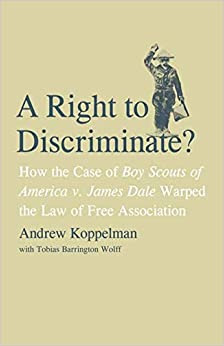
Andrew Koppelman and Tobias Barrington Wolff, A Right to Discriminate?: How the Case of Boy Scouts of America v. James Dale Warped the Law of Free Association (Yale University Press 2009)

Jack M. Balkin and Reva B. Siegel, The Constitution in 2020 (Oxford University Press 2009)

Heather K. Gerken, The Democracy Index: Why Our Election System Is Failing and How to Fix It (Princeton University Press 2009)

Mary Dudziak, Exporting American Dreams: Thurgood Marshall's African Journey (Oxford University Press 2008)

David Luban, Legal Ethics and Human Dignity (Cambridge Univ. Press 2007)

Ian Ayres, Super Crunchers: Why Thinking-By-Numbers is the New Way to be Smart (Bantam 2007)

Jack M. Balkin, James Grimmelmann, Eddan Katz, Nimrod Kozlovski, Shlomit Wagman and Tal Zarsky, eds., Cybercrime: Digital Cops in a Networked Environment (N.Y.U. Press 2007)
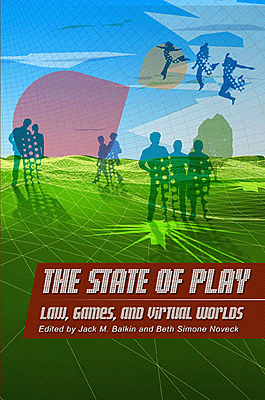
Jack M. Balkin and Beth Simone Noveck, The State of Play: Law, Games, and Virtual Worlds (N.Y.U. Press 2006)

Andrew Koppelman, Same Sex, Different States: When Same-Sex Marriages Cross State Lines (Yale University Press 2006)

Brian Tamanaha, Law as a Means to an End (Cambridge University Press 2006)

Sanford Levinson, Our Undemocratic Constitution (Oxford University Press 2006)

Mark Graber, Dred Scott and the Problem of Constitutional Evil (Cambridge University Press 2006)

Jack M. Balkin, ed., What Roe v. Wade Should Have Said (N.Y.U. Press 2005)

Sanford Levinson, ed., Torture: A Collection (Oxford University Press 2004)
Balkin.com homepage
Bibliography
Conlaw.net
Cultural Software
Writings
Opeds
The Information Society Project
BrownvBoard.com
Useful Links
Syllabi and Exams
